




Abstract
Chrysanthemum flowers are usually used for cultural and religious ceremonies however, the chrysanthemum stems are left for open burning or landfilling on many farmlands. These stems are one of the sources of agricultural waste in Malaysia that cause environmental impacts. In order to reduce the impact of chrysanthemum stems, this research study has utilised these valuable chrysanthemum stems in producing a new polymer composite. Hence, the present research study focuses on the preparation of non-woven and woven chrysanthemum stem fibre (CSF) reinforced unsaturated polyester (UPs) composites via simple hand lay-up method. The results showed the tensile properties (tensile strength and modulus of elasticity) of woven fibre filled UPs was higher than non-woven fibre filled UPs composites. However, non-woven fibre filled UPs presented higher water absorption and elongation at break as compared to woven fibre filled UPs composites. Furthermore, bleaching treatment with hydrogen peroxide is carried out in order to improve the tensile properties and water resistance of UPs/CSF composites. The functional groups of unbleached and bleached fibres were analysed using Fourier Transform Infrared (FTIR) analysis. Some lignin, hemicellulose and impurities of CSF have been removed after the bleaching treatment on CSF, as proven by FTIR results.
Introduction
Chrysanthemum is also known as mums or chrysanths, which is mostly used in Japan, China, India and Malaysia during festivals or wedding ceremonies, for example, Kiku Matsuri festival in Japan, 1 Holi and Diwali festival in Hindu, India 2 and chrysanthemum cultural festival held in Kaifeng, China. 3 During the festivals, people only use chrysanthemum flowers for praying or celebrations. In addition, the chrysanthemums are also cultivated in China and Japan as a flowering herb. 4 However, the unwanted parts such as leaves and stems are left to rot in landfills. Furthermore, these unwanted parts become agricultural wastes after festivals. Moreover, during dumping of the flowers in landfills would automatically cause them rot and then turn them into a virus (mosaic virus), which is dangerous to humans, animals and the environment. 5 The chrysanthemum plant waste has increased annually during and after festivals or celebrations. If farmers opt to throw them away or burn them up, they cause harmful environmental impacts like air, water and river pollutions.
In general, the chrysanthemum consists plant parts such as the flowers, leaves, stems and roots. Each part has the potential to give different applications, for example, post chrysanthemum waste fibre application in reinforcing plastic composite materials. Chitra reported a study about the chrysanthemum flower fibre reinforcing polypropylene (PP) composite. 6 The author stated that chrysanthemum flowers are a bast fibre which consists of helically wound cellulose micro-fibrils in an amorphous matrix of lignin and hemicellulose. Hence, the author utilised these valuable fibres to enhance the properties of PP composite. 6 Furthermore, Chun et al. claimed that the incorporation of chrysanthemum waste fibre (CWF) enhanced the tensile modulus of the polylactic acid (PLA) composites. 4 The tensile modulus of PLA composites increases with higher loading of CWF.
Polyester (UPs) is a long-chain thermoset polymer. There are two types of polyesters which are saturated and unsaturated polyesters. The unsaturated polyester consists of double bonds and alkyl groups. Meanwhile, the saturated polyester consists of a single bond in the polymer backbone. Besides, the saturated polyester shows higher molecular weight than unsaturated polyester. The unsaturated polyesters are usually used as polymer matrices in composites.7,8 In the preparation of the composites, there are some drawbacks of the composite specimens such as high water or moisture absorption, poor mechanical properties and delamination defect. In order to improve the properties of composites, the chemical treatment on fibre has to be carried out.
Chemical treatment is a surface modification on the natural fibre process. There are various types of chemical treatments such as alkali treatment, dewaxing, cyanoethylation and bleaching treatment. 9 The bleaching treatment with hydrogen peroxide (H2O2) was carried out in this research study, in order to remove impurities on the fibre surface and also to improve the properties of the composites. In general, the bleaching treatment is capable of decolourising fibre by removing lignin, hemicellulose contents and impurities from the natural fibre. Similar observation was claimed by Rayung et al. 10 The authors stated that the perhydroxyl ions (HOO−) will be generated by the dissociation of H2O2 in NaOH solution (alkaline media) and hence capable of decolourisation of the natural fibre. This is due to the HOO− ions attacking the light absorbing chromophoric groups of lignin and cellulose (carbonyl and conjugated carbonyl groups and quinones). 10
In this research study, the long chrysanthemum stem fibre (CSF) was come in two types such as woven and non-woven CSF. The woven CSF is produced by interlacing two sets of threads such as warp and weft, at right angles to each other. The warp is a set of threads in a vertical direction wound onto a frame, however, the weft is the thread interlaced in a horizontal direction to create the plain weave woven CSF. 11 In contrast, the non-woven CSF is characterised by random orientation. Hence, the research study focused on the preparation of woven and non-woven CSF filled UPs via simple hand lay-up method and the bleaching treatment with H2O2 which was carried out to improve the mechanical and water resistance properties of the UP composite.
Moreover, the UPs/CSF composite can be applied in furniture applications like chairs, tables, and some decorative products. Figure 1 shows a small table made by using UPs/CSF composites, which is a lab-based product made in HELP College of Arts and Technology laboratory (Materials Lab).

UPs/CSF composite table top.
Methodology
Materials
Unsaturated polyester (UPs) was used as matrix while chrysanthemum stem fibre (CSF) was used as reinforcement in the composite. The UPs and butanox (used as hardener) were supplied by Kaliba Sdn. Bhd., Malaysia. Moreover, hydrogen peroxide (H2O2) used as a bleaching agent, was purchased from Ever Green Engineering Resources, Malaysia. Sodium hydroxide (NaOH) was also supplied by Ever Green Engineering Resources, Malaysia, which was used to control the pH during the bleaching treatment. The chrysanthemum stems were collected from local markets and Indian temples in Malaysia. After collecting the stems, the fibre from the stems were extracted by a simple water retting method.
Extraction of fibre from chrysanthemum stem
After collecting the chrysanthemum stems, the stems were washed and immersed into a water retting tank for 15 days. Within the 15 days, the stems were washed and submerged in another water tank for 3 or more days. The water irrigation process took 10–15 days to fully extract the fibres from the stems. Then, the extracted fibres were dried in an oven at 60°C for 24 h.
Bleaching treatment of chrysanthemum stem fibre (CSF) with hydrogen peroxide (H2O2)
The bleaching treatment was performed according to the method used by Wong and Chan 12 and Nanthakumar et al. 13 The unbleached and bleached woven and non-woven CSF were made before preparing the composite samples. Then, the woven and non-woven CSF were immersed into binder solution (binder: distilled water) with ratio of 1:9 before impregnation with UPs to produce UPs composites. Figure 2(a) shows plain weave woven CSF. The colour of the CSF changed after the bleaching treatment, as presented in Figure 2(b).

(a) Plain weave woven of CSF and (b) the colour of CSF: (left) before and (right) after bleaching treatment with H2O2.
Preparation of non-woven and woven CSF reinforced UPs composites
The UPs/CSF composites were prepared by hand lay-up method. The weight ratio of the mixing (UPs: butanox) is 8:2. The woven CSF was impregnated with UPs matrices and placed over the mould (150 × 150 × 10) mm. The composite was allowed to cure for 24 hours, followed by a post-cure process in an oven at 50°C for an hour. Similar procedures were carried out by non-woven CSF filled UPs composites. The formulations of the UPs/CSF composites are listed in Table 1.
Formulations of UPs/CSF composites.

Testing and analysis
Fourier transform infrared (FTIR) analysis
The functional groups of unbleached and bleached CSF were measured by FTIR (model spectrum 100, Perkin Elmer, Waltham, MA, USA). An attenuated total reflectance (ATR) technique was used to conduct the FTIR analysis. 16 scans in the wave number (cm−1) range of 4000–600 cm−1 were carried out and a resolution of 4 cm−1 was recorded for each specimen. The peak intensity ratio (R) was calculated by dividing intensity of peak within 1750–1700 cm−1 over peak 1100–1000 cm−1. The R ratio was used to indicate the lignin to cellulose ratio in the CSF.
Tensile test
Tensile properties of UPs/CSF composites were tested according to ASTM D 638. The tensile strength, modulus of elasticity and elongation at break of the composites were determined by using VICTOR Material Testing Equipment. At least 10 specimens of each formulation as stated in Table 1 were tested to get an accurate average result. A cross-head speed of 30 mm/min and a load of 10 kN were used in this testing.
Flexural test
The flexural strength and flexural modulus of the composites were measured according to ASTM D 790, using VICTOR Material Testing Equipment. The flexural properties were determined with a cross-head speed of 30 mm/min and a load of 10 kN at room temperature. 10 specimens from each formulation were tested and the average results were recorded.
Water absorption test
The water absorption test was carried out by following the ASTM D 570. The specimen with a dimensions of 30 × 25 mm was immersed in distilled water at room temperature for 40 days. Water absorption properties of the composites were controlled by the weight of the composite. After that, the weight of the specimen was measured at every 2-day intervals. The specimen was wiped by using tissue paper before weighing to remove the water on the surface of the specimen. At least five specimens for each formulation were tested to get an average value. Percentage water absorption of each specimen was calculated by using Equation (1).

where, W = weight after exposure. Wdry = original dried weight.
Morphological analysis
The fracture specimens of unbleached and bleached UPs/CSF composites were examined with Field Emission Scanning Electron Microscope (FESEM, model FEI Quanta 400F). The specimens were coated with an ultra-thin layer of gold for avoiding charging. The acceleration of the electrons was fixed at 10 keV.
Results and discussion
FTIR analysis
The FTIR spectrums of unbleached and bleached CSF are shown in Figure 3. Table 2 compares the peak intensity of the functional groups in unbleached and bleached CSF. A broad peak at 3368 cm−1 was related to the –OH groups. The peak at 2927 cm−1 corresponded to –CH stretching. Besides, the FTIR analysis detected the wavenumbers 1739 cm−1 that corresponds to the ester carbonyl vibrations of acetyl, feruloyl and p-coumaryl groups in lignin. There is also a stretching peak at 1650 cm−1 of unbleached fibre which is attributed to the carbonyl group of the ester in hemicellulose and that is also a functional group of carbonyl aldehyde in lignin.
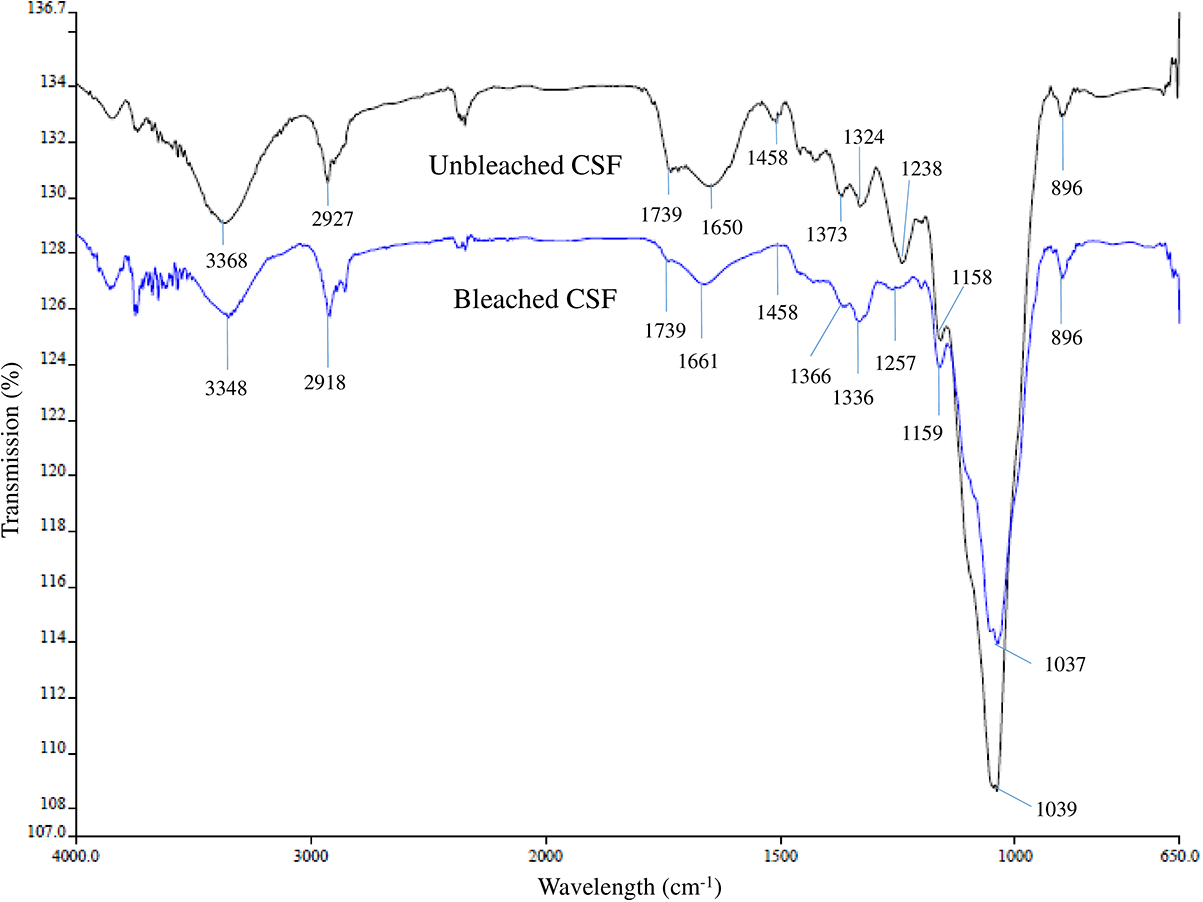
FTIR spectrum analysis of unbleached and bleached CSF.
Functional groups of unbleached and bleached CSF.
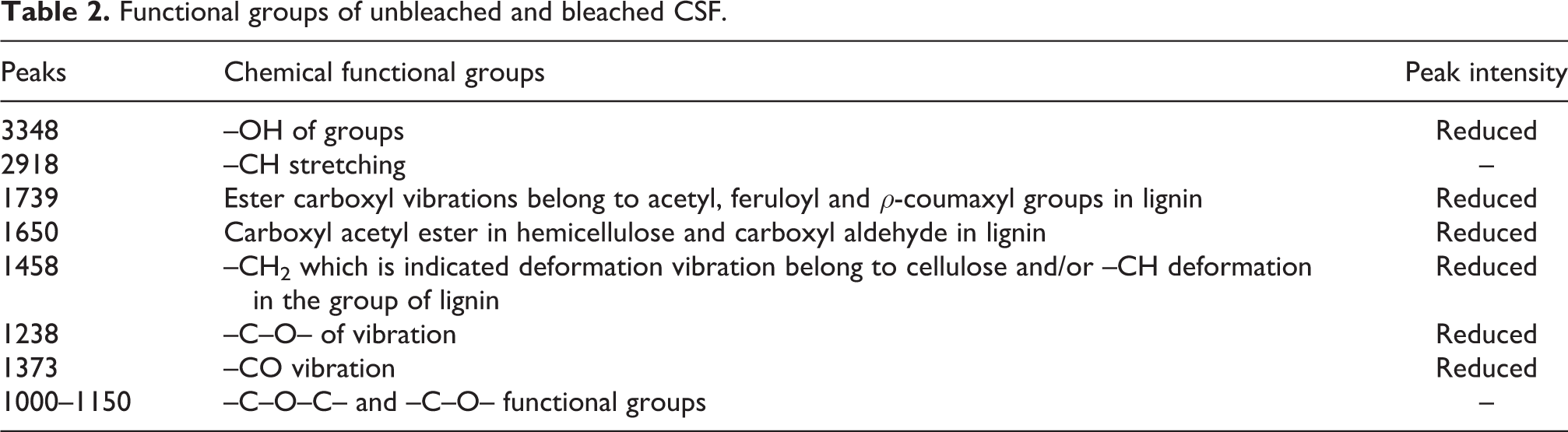
However, it has been shown that some lignin content was removed after the bleaching treatment with H2O2 due to the decreasing of peak intensity at 1739 cm−1 of the bleached CSF. Moreover, the wavenumbers of the peak intensity at 1650 cm−1 also decreased due to the removal of lignin and hemicellulose after bleaching treatment. The peak at 1238 cm−1 that is related to C–O vibration showed decreased peak intensity after treatment, associated with the removal of lignin. According Table 3, the lignin to cellulose content of CSF was significantly reduced after bleached with H2O2. Similar findings were also observed by Wong and Chan, 12 Nanthakumar et al., 13 Jonoobi et al., 14 Wang et al. 15 and Razak et al. 16
Peak intensity ration of unbleached and bleached CSF.

Tensile properties
Figure 4 depicts the tensile strength of neat UPs, unbleached and bleached CSF fibres reinforced with UPs composites. Based on Figure 4(a), the tensile strength of UPs/CSF composite was higher than the neat UPs since the CSF act as reinforcement to enhance the properties of the composite. The woven CSF filled UPs composite exhibited higher tensile strength as compared to non-woven composite. This might be due to the plain weave woven fibre that improved mechanical bonding in between the CSF as well as enhanced the tensile strength of the composite. Similar finding was recorded by Rachchh. 17 According to Rachchh, woven fibre made from interlacing of warp and weft in a weave style had improved the mechanical bonding in between the fibre. 17 In addition, non-woven fibres are irregular in shape, with random overlapping of the wrapping, which might cause lower tensile strength of non-woven CSF reinforced UPs composite compared to woven composite. Furthermore, the concentration, orientation, size, shape and distribution of the fibre or reinforcement would have affected the mechanical properties of the composites. 18 Ratim et al. claimed that the random oriented fibre would cause slippage when the force was applied to the composite. 19

(a) Tensile strength of neat UPs and UPs/CSF composites and (b) Structure of composite before bleaching treatment on fibre and (c) Proposed mechanical interlocking mechanism in composite after bleaching treatment on fibre.
Nevertheless, the bleached CSF filled UPs composites showed a higher tensile strength than unbleached composite. This is due to the bleaching treatment with H2O2 which improved the surface roughness of CSF, as well as enhanced the adhesion interaction between UPs and CSF. Besides, the bleaching treatment with H2O2 removed the impurities on the fibre surface and some lignin contents, which was shown in the FTIR analysis. The removal of impurities and lignin content would cause the fibre surface to become rougher, and form a good mechanical interlocking in between UPs and CSF. The presence of a good matrix-fibre mechanical interlocking interaction (physical bonding) would improve the mechanical properties of the composite. 20 Chun et al. studied the effect of coupling agent on the tensile properties of polylactic acid/chrysanthemum waste fibre composite. 4 They also recorded the same finding that the chemical modification of natural fibre enhanced the interfacial bonding between matrix and fibre.4,21 The proposed matrix-fibre mechanical interlocking mechanism is presented in Figure 4. Before bleaching treatment on CSF, there is weak interfacial interaction between matrix and fibre, as shown in Figure 4(b). However, after bleaching treatment, some impurities and lignin contents were removed and hence improved the surface roughness of the CSF (Figure 4(c)).
Elongation at break of the neat UPs and UPs/CSF composite are shown in Figure 5(a). From Figure 5(b), the neat UPs shows higher elongation at break than all the UPs/CSF composites. This is due to the addition of CSF that reduced the chain mobility of UPs as well as increased the rigidity of UPs/CSF composites. As a comparison, the woven CSF filled UPs composite exhibited lower elongation at break than non-woven CSF composites due to the presence of a better mechanical interlocking (interfacial interaction) between fibre and fibre or fibre and matrix in woven CSF composites. The same trend can be seen in the bleached and unbleached composites, as shown in Figure 5(a). The bleaching treatment of CSF with H2O2 improved mechanical interaction between UPs-CSF and reduced the flexibility of the composites. Bleached composite can withstand more force than unbleached composite due to a better matrix-fibre interfacial interaction. Similar finding was reported by Razak et al. 16
Figure 5(b) illustrates Young’s Modulus of neat UPs and UPS/CSF composites. The Young’s modulus of composites higher than the neat UPs due to the addition of high stiffness fibre enhanced the Young’s modulus of composites. Similar result was reported by Salmah et al. 22 The authors claimed that the Young’s modulus is an indication of the stiffness of the composite. Thus, the incorporation of natural fibre increased the stiffness as well as Young’s modulus of polymer composite. 22 It has been proven that the bleaching treatment with H2O2, where treatment created a rougher surface on the fibre, removed the impurities from the fibre as well as created a good mechanical bonding between fibres with the matrix. According to Wong and Chan, the authors stated that the stiffness of composites improved after the bleaching treatment due to the enhancement of matrix-fibre mechanical interlocking. 12
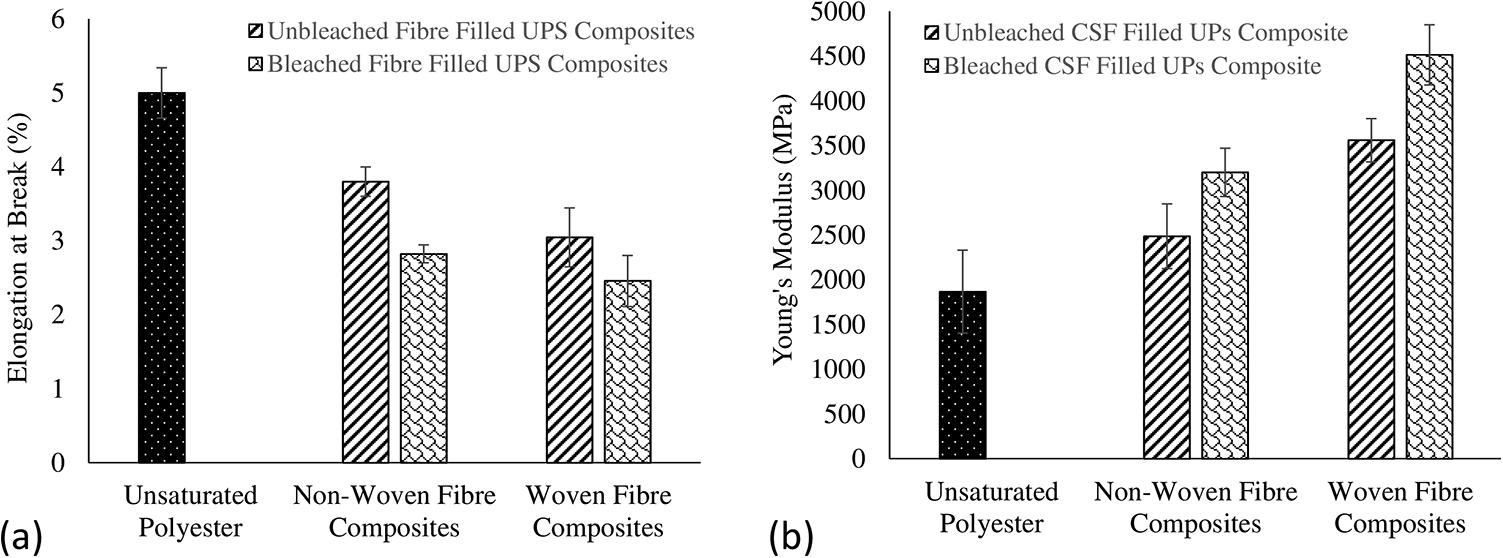
(a) Elongation at break and (b) Young’s modulus of neat UPs and UPs/CSF composites.
Flexural properties
The flexural strength and modulus of neat UPs and UPs/CSF composites are presented in Figure 6(a) and (b), respectively. The neat UPs exhibited the lowest flexural strength and flexural modulus as compared to all composites. Incorporation of high stiffness of CSF increased the flexural strength and modulus of composites due to the CSF that reinforced the flexural properties of composite. The woven CSF filled UPs showed higher flexural strength and modulus than non-woven CSF composites. In addition, bleached CSF composites presented higher flexural properties in a comparison with unbleached CSF composites. Thus, it can be concluded that the plain weave woven and bleached CSF with H2O2 would improve the matrix-fibre interfacial interaction via mechanical interlocking mechanism as well as enhanced the flexural properties of composites. Similar results were claimed by Pao and Yeng. 23 Salmah et al. studied the effect of the treated natural fibre on flexural properties of UPs composite. They claimed that the treated natural fibre presented higher flexural strength and flexural modulus in a comparison with untreated natural fibre filled UPs composite due to the improvement of interfacial adhesion induced through surface modification of natural fibre. 22

(a) Flexural strength and (b) flexural modulus of neat UPs and UPs/CSF composites.
Water absorption
The water absorption properties of UPs/CSF composites are displayed in Figure 7. Based on Figure 7, the water absorption properties of composites increases with immersion time. The neat UPs exhibited the lowest water absorption properties as compared to all UPs/CSF composites. This is due to the fact that the UPs is a hydrophobic material. However, unbleached non-woven CSF composite absorbed more water than woven CSF composite due to the non-woven CSF which is randomly overlapped and orientated, resulting in water being able to penetrate into the composite. Moreover, the CSF is a hydrophilic natural fibre, which can absorb water easily. Nevertheless, the plain weave woven CSF is oriented with weaving style and it can reduce the water penetration paths into the composite. Furthermore, the plain weave woven CSF is blocking the diffusion path after a long exposure, and hence slowing down the water absorption process of the UP composites. Thus, the woven CSF composite has lower water absorption properties as compared to non-woven composite.

Percentage water absorption of neat UPs and UPs/CSF composites.
On the other hand, the bleached woven and non-woven composite showed lower water absorption value because the fibre was treated via H2O2 and resulted in the surface becoming rougher which can form a good mechanical bonding between UPs and CSF as well as decrease the water diffusion into the composite. Similar finding was recorded by Chun et al., 24 Kim and Seo 25 and Chun and Husseinsyah. 26 According to Chun et al., the water molecules were able to penetrate into the composite material through the capillary action and thereby, getting trapped in the interface region. 24
In general, Fick’s law is a study related to the diffusion mechanism and kinetics of the materials. Hence, the water absorption properties of UPs/CSF composites can be measured by using Fick’s law based on Equation (2).27,28

where, Mt: moisture content at time t; Ms: moisture content at saturated time; k and n: constant.
Furthermore, the moisture diffusion behaviour of UPs/CSF composites are divided in three cases, such as (i) case I (n = 0.5), Fickian diffusion; (ii) case II (0.5 < n < 1), non-Fickian diffusion; and (iii) case III, (n > 1).27-30 However, the curve log Mt/Ms versus log t can be used to determine the values of k and n, as illustrated in Figure 8. Moreover, the diffusion coefficient (D) can be used as a parameter in Fick’s module and can be estimated from the slope of the Mt/Ms versus time (t0.5) curve (refer to Equation 3), as displayed in Figure 9. The D values can be used to determine the ability of the water molecules to diffuse and penetrate into the UPs/CSF composite structure.

where, h = thickness of specimen.
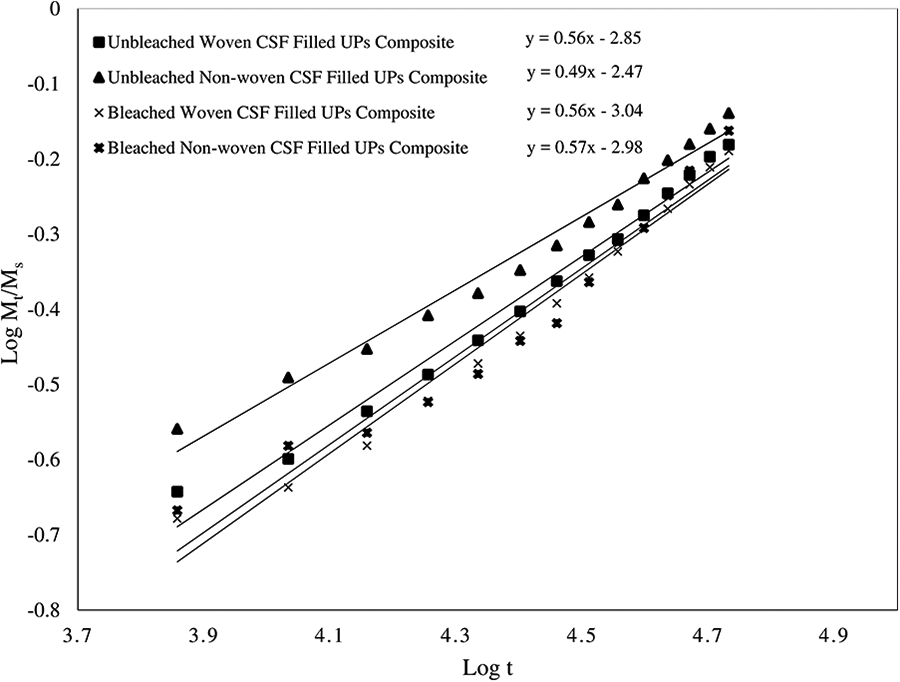
Plot of log Mt/Ms versus log time of unbleached and bleached UPs/CSF composites.
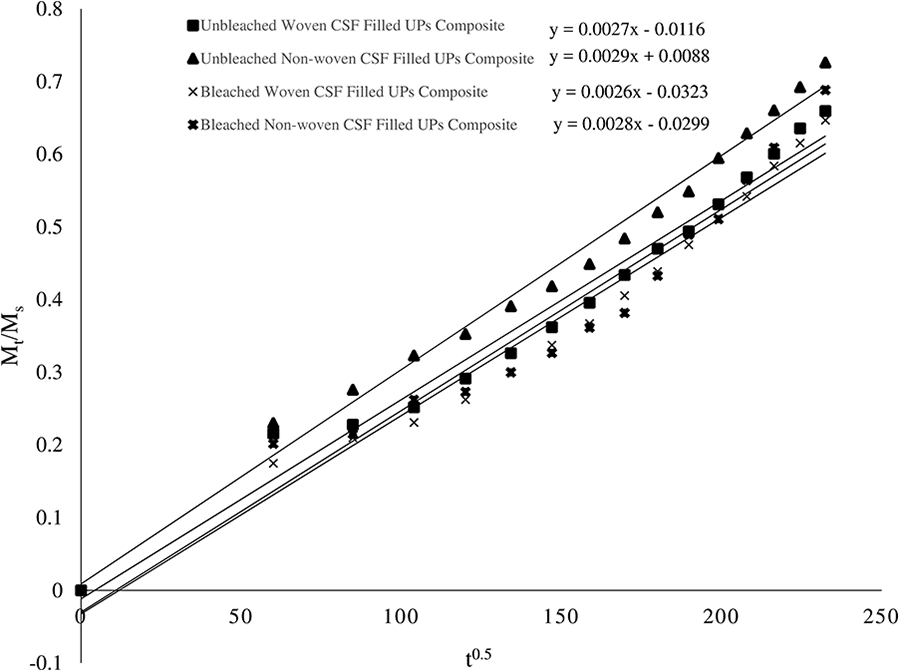
Plot of Mt/Ms versus t0.5 of unbleached and bleached UPs/CSF composites.
Table 4 lists the values of k, n and D, which are obtained from the Figures 8 and 9. The values of n shown in Table 4 are close to 0.5, indicating both woven and non-woven composites followed the Fickian diffusion property. Moreover, the k values decreased in both bleached woven and non-woven composites. This is due to the bleaching treatment which enhanced the water resistance of the composites. These findings were aligned with the results of water absorption, as shown in Figure 7. Similar findings were reported by Zhao et al. 29 and Kushwaha and Kumar. 30 Eventually, this can be used as evidence to prove that the bleaching treatment with H2O2 can enhance the water resistivity of UPs/CSF composite due to the improved interfacial adhesion between UPs and CSF composites.
Water absorption diffusion coefficient and constant values of unbleached and bleached UPs composites.

Morphological properties
Figure 10 shows the fracture surface of unbleached and bleached UPs/CSF composites. Refer to Figure 10(a), there was a gap between fibre and this indicated that the UPs matrix has poor interfacial adhesion with unbleached CSF. Besides, the holes due to fibre pull out can be observed in Figure 10(a) as well. This is because of the weak adhesion between fibre and matrix caused the fibre pull out. In opposite, there was no gap between bleached CSF and UPs matrix as displayed in Figure 10(b). This indicated that the UPs matrix has a good adhesion with bleached CSF. Then, the fibre pull out also absence in bleached UPs/CSF composite. Thus, the observation proven that the mechanical strength of composite with bleached fibre was better due to better interfacial adhesion.

SEM micrograph of fracture surface: (a) unbleached and (b) bleached UPs/CSF composite.
Conclusion
In a nutshell, the woven CSF filled UPs composite showed better properties (mechanical properties and water resistance) than non-woven CSF composites since the plain weave of woven CSF exhibited better mechanical bonding. Besides, bleaching treatment with H2O2 on the fibre improved the mechanical and water resistivity properties of the composites. The bleaching treatment with H2O2 was reduced the impurities and lignin contents from the CSF, as proven in FTIR analysis. The removal of these impurities and lignin contents were enhanced the surface roughness of CSF and thus improved the properties of the composite.
Footnotes
Acknowledgement
The authors would like to thank Centre for Engineering Programmes at Imperium International College (IIC), Malaysia, for providing the materials and equipment to complete this research project.
Declaration of conflicting interests
The author(s) declared no potential conflicts of interest with respect to the research, authorship, and/or publication of this article.
Funding
The author(s) received no financial support for the research, authorship, and/or publication of this article.
