




Abstract
This article focuses on the establishment of theoretical model for the formation of balanced curved rubber hose under pressure. According to the rotation angle of the cord along the axial direction in the curved rubber hose is the same as that in the straight hose before forming, the theoretical model of the straight hose length was established. Then based on the thin shell theory without considering bending moments and shear force, and considering the deformation characteristics of the rope structure and the mechanical equilibrium angle of the hose, the theoretical model of the balance performance was established. According to the theoretical model, the influence of structural parameters of curved hose on the length of the straight hose and the balance performance of hose was studied. Eventually, the finite element model was established to simulate the deformation process of the curved hose. Based on the calculation results of the theoretical and simulation model, the experiment of forming and balance performance of the curved hose was carried out. The experimental results are in good agreement with the theoretical and simulation model.
Introduction
With the application of air spring vibration isolation technology and floating raft vibration isolation technology on ships, 1 -3 the pipeline system connecting equipment and the ship becomes one of the important source of noise and vibration. As a rubber composite hose made of filament winding, 4 the rubber hose can effectively control the vibration and noise transmission in the pipeline system. Due to the special geometric structure, the curved rubber hose has strong displacement compensation ability, the small axial stiffness, and a good damping effect for vibration. The application of curved rubber hoses on ship pipelines gets more and more attention.
At present, the filament winding tubes are mostly rigid composite materials, 5 -7 and in the forming process, 8 -10 the research mainly focus on fiber-wound circular tubes. In the research of mechanical properties of rigid composites, based on the three-dimensional anisotropic elastic theory, Bakaiyan et al. 11 analyzed the stress distribution and deformation characteristics of the composite circular tube under the temperature field and internal pressure. According to the Tasi-Hill strength criterion, the influence of structural parameters on the failure strength of the pipe body was studied. In the fiber winding process, Su and Zhang 12 analyzed the influence of different forming process parameters on the performance of the wound pipe body, established a tension closed-loop control system for the multidirectional winding machine, and proved that the control system design of multidirectional winding machine is reasonable and effective through mechanical experiments. According to the wrinkling phenomenon of the product winding layer, Lee et al. 13 proposed a layer tension distribution curve to eliminate the defects of the wound product caused by the tension fluctuation.
In industry, because it is very difficult to wind the cord on the curved body deviated from geodesic without slipping, nowadays, the forming of curved rubber hoses is mainly achieved by pressurizing inside of the straight hose. As the formed curved rubber hose will generate a certain displacement in the axial direction under the internal pressure, it will lead to additional force and displacement to the connected pipeline or equipment. When there are too much additional force and displacement, the normal operation of the system will be affected. The balance performance of the hose refers to the axial deformation of the pipe body under the rated pressure; therefore, the forming design of the balanced curved rubber hose requires the curved hose to be formed well and have a good balance performance under the rated pressure. The forming of the curved rubber hose was required to determine the length of the straight hose and the structural parameters for achieving the balance of the curved hose. At present, since there is no parametric theoretical model of the forming design, and the design is mainly debugged through a large number of experiments, the establishment of parametric theoretical model for the design of balanced curved rubber hoses is of great significance for the production and application of curved hose.
The curved rubber hose, composed of the cord–rubber composite material, is different from the current rigid composite material, and it is a typical flexible composite. 14 -17 Due to the special geometry and fiber composite material, the curved rubber hose has complex mechanical anisotropy and nonlinear characteristics. 18,19 And as the actual winding angle and mechanical equilibrium angle of the cord changes with different parts of the hose, it becomes more difficult to establish the parametric mechanical model of the rubber hose. On the basis of previous studies on elbow-shaped rubber hoses 20 and the theory of grid analysis, the actual cord winding angle of the formed bellows-type rubber hose was derived by Xiaoping, 21 and the balance performance of the hose under different initial winding angles was calculated by the finite element method. However, the related work did not establish a parametric theoretical model for the forming design of the balanced curved rubber hose.
The article mainly focuses on the establishment of the theoretical model of the straight hose length determination and the balanced structure parameter design in the balanced curved rubber hose forming design. According to the rotation angle of the cord along the axial direction in the curved rubber hose is the same as that in the straight hose before forming, the differential equation of the trajectory of the cord in the hose was deduced, and the theoretical model of the straight hose length was established. Then based on the deformation characteristics of the rope structure and thin shell theory without considering bending moments and shear force, the deformation of the curved rubber hose was divided into two stages, including winding angle deflection and tensile deformation of fiber, and the parametric theoretical model for the balance performance of curved rubber hoses was established. Eventually, the finite element model was established to simulate the deformation process of the hose structure determined by the parametric theoretical model under internal pressure. The forming design theory and simulation model was verified by experiments.
Experimental method on the forming of balanced curved rubber hose
Forming process of curved rubber hose
In industry, it is very difficult to wind the cord on the curved body deviated from geodesic without slipping. In this article, the forming process of the curved rubber hose was divided into two steps. Firstly, the rubber hose with the length of L
S is wound at an angle of

Curved hose wall structure.
Analysis of the forming and balance performance of curved rubber hose
For a curved rubber hose of known structure, two process parameters of the straight hose length L
S and the initial fiber winding angle
At present, the length of the straight hose and the initial winding angle of the fiber are determined by a large number of experiments. The curved rubber hose with the radius at both ends of the hose of 62.5 mm, curvature radius of 70 mm, and hose length of 133 mm was researched. The length of straight hose and the initial winding angle of the fiber were adjusted to make different curved hoses. The pressure of 3 MPa was applied inside of the hose to measure the balance performance of the curved rubber hose. The forming process parameters of hose and experiment results are presented in Table 1. The balance performance is positive when the hose is elongated, and the balance performance is negative when the hose is shortened. According to the distribution of the cords in the curved hose and the balance results, the forming process parameters were adjusted, and four experiments were carried out to obtain the curved hose with uniform distribution of cord and good balance performance.
Forming process parameters and experiment results of curved hose.

The longitudinal section is shown in Online Supplemental Appendix A2. It can be seen from the experiment results of Schemes 1 and 2 (Online Supplemental Appendix A2) that when the initial winding angle is too large, the deformation of hose has a tendency of elongation under internal pressure. It can be seen from the experiment results of Schemes 2 and 3 (Online Supplemental Appendix A2) that when the length of the straight hose is too long, the deformation of hose has a tendency of elongation under internal pressure. The length of the straight hose in Schemes 1 to 3 (Online Supplemental Appendix A2) is too long; therefore, during the forming process, the cords were wrinkled and did not meet the requirements for the forming of curved hose.
It can be seen from the experimental results that reasonable length of straight hose and initial winding angle can make the cords evenly distributed and the curved hose has a good balance performance; however, it is still impossible to determine the forming process parameters of the curved rubber hose by theoretical methods. The experiment method requires higher cost and longer time period; therefore, it is important to establish the theoretical and simulation model to determine the forming process parameters.
Theoretical method of straight hose length
Trajectory model of cords in straight hose
During the forming process, the flanges at both ends are constrained and there is no relative rotation. Therefore, the total rotation angle of the cord in the straight hose is the same as that in the formed curved hose. The total rotation angle of the cord is recorded as

Cord trajectory model in straight hose.
The cord is wound into a space spiral on the straight hose, and the angle between the cord and the axial direction is a constant value

Then the axial projection of the curved microsegment MN can be expressed as follows:

It can be seen from equation (2) that, for the straight hose with a constant cord winding angle

For a straight hose with a constant total rotation angle

Trajectory model of cords in curved hose
With the center of the curved rubber hose as the origin, the cylindrical coordinate system was established, as shown in Figure 3. R N is the radius at both ends of the hose, r is the curvature radius, and l is the length of the curved hose. According to the geometric relationship, the rotation radius R corresponding to any point can be calculated, as shown in equation (5).


Cord model in curved rubber hose.
The straight hose is deformed into curved hose under internal pressure, and the cord forms a complex space spiral on the curved hose. NN′ is the projection of the cord microsegment MN on the bus bar. According to the geometric relationship, the arc length of the NN′ is recorded as dl:

At point N, the cord winding angle is

Substituting equation (6) into equation (7), the differential equation for the cord trajectory of the curved rubber hose in the cylindrical coordinate system can be obtained:

Length of straight hose required for the forming of curved hose
The cord winding angle

Substituting equation (9) into equation (8), the differential equation for the cord trajectory of the curved rubber hose in the cylindrical coordinate system can be obtained:

By integrating the equation (10), the rotation angle

According to the total rotation angle

Theoretical method for the balance performance of curved rubber hoses
Relationship between basic geometric parameters of curved rubber hoses
From Online Supplemental Appendix A3, the geometric relationship of the curved rubber hose can be shown in equation (13).

It can be seen from the geometrical parameters of the curved hose that the curvature radius of point Q in the direction α is IQ, that is,


Mechanical balance angle of curved rubber hose under internal pressure
For curved rubber hoses, the elastic modulus of the cord is much larger than the elastic modulus of the rubber. (The axial elastic modulus of the cord is 33.882 GPa, while the elastic modulus of the rubber is 6 MPa.) The internal pressure is mainly carried by the cord layer. Therefore, the influence of rubber is not considered in the mechanical model. The fibers in the cord reinforcement layer only provide tensile force and do not provide torque and bending moment. The thickness of the cord layer is much smaller than the curvature radius of the curved hose; therefore, it is consistent with the assumption of thin shell theory without considering bending moments and shear force. 22
At any point Q, the differential shell QQ
1
Q
2
Q
3 is cut on the curved shell with


Mechanical equilibrium analysis of differential shell.
The both ends of curved rubber hose are closed and only the internal pressure p was applied inside of the hose. The boundary conditions are as follows:


Substituting equation (17) and equation (18) into equation (16), the tensile force on unit width of the midplane in the hose can be solved, as shown in equations (19) and (20).


According to the geometric relationship of the differential unit, the fiber winding angle

Without considering the tensile deformation of the cord, when the combined force of the force in the α direction and the force in the

Substituting equation (22) into equation (21), the mechanical equilibrium angle

Analysis of deformation of the curved rubber hose
According to the deformation characteristics of the rope structure under stress conditions,
15
the deformation of the curved rubber hose along the α direction was analyzed in two steps, as shown in Figures 5 and 6. (1) The microsegment

Diagram of first step deformation.
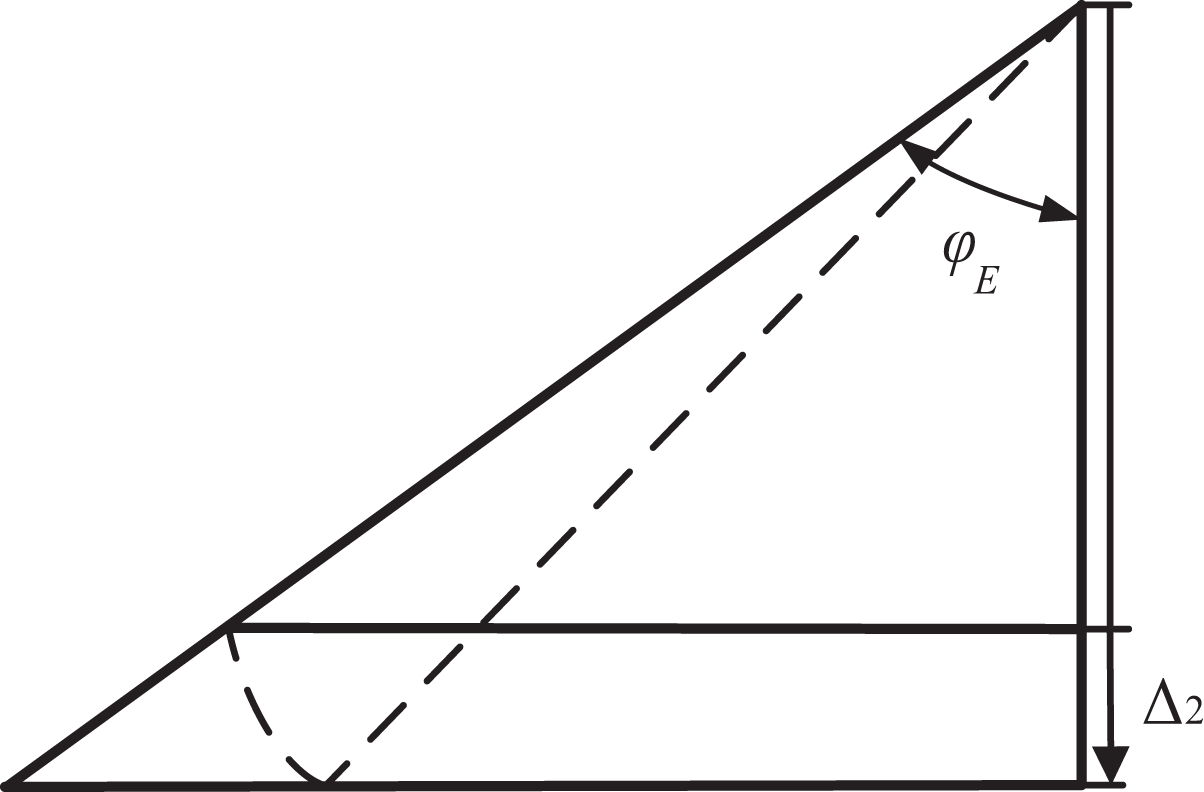
Diagram of second step deformation.
It can be seen from Figure 5, in the first step deformation analysis,


When the cord winding angle
It can be seen from Figure 6, in the second step deformation analysis,


In summary, the total deformation of the hose can be obtained from
Anisotropy-based physics equation of thin shell
Based on the thin shell theory without considering bending moments and shear force, the physical equation of the thin shell under internal pressure can be obtained from equations (28) and (29).


For the curved rubber hose with the cord winding angle

Under the internal pressure p, the strain in α and
The element
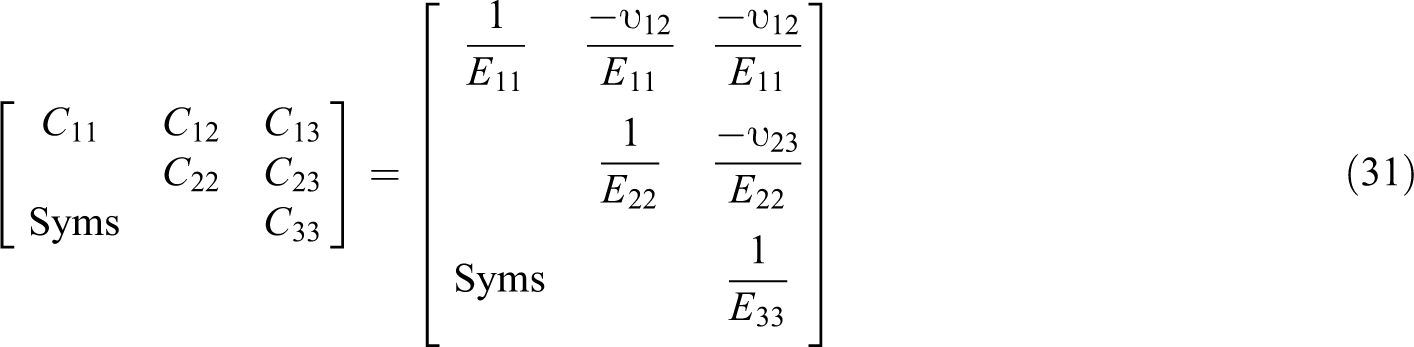
The elastic modulus of the cord is represented by
Material parameters of the cord.

The element




where
Substituting equations (30), (31), (32), (33), (34), and (35) into equations (28) and (29), under the internal pressure p, the strain

Substituting equation (36) into equation (26), under the internal pressure p, the axial deformation of the hose can be obtained, as shown in equation (37).

Discussion
The forming effect of the balanced curved rubber hose is mainly evaluated from the distribution of the cord and the balance performance of the curved hose, and the distribution of the cord is affected by the length of the straight tube. Therefore, the parameterized theoretical model is used to analyze the influence of structure parameters on the length of straight hose and the balance performance of curved hose, which is of great significance for production design. The curved rubber hose with initial fiber winding angle of 14°, fiber layer thickness of 3 mm, the radius at both ends of the hose of 62.5 mm, curvature radius of 70 mm, and hose length of 133 mm was used as the research object. The influence of parameters such as initial winding angle, radius at both ends of the hose, length of the hose, and curvature radius on the forming and balance performance of the hose was analyzed by the theoretical model of the curved rubber hose. The following discussion has only one parameter as a variable and other parameters as constants. The balance of the curved hose is the axial deformation of the hose under the internal pressure of 3 MPa.
The effect of the initial winding angle of the fiber on the forming design of the balanced curved rubber hose
The initial winding angle of the fiber was changed, and the effect of the initial winding angle on the forming design of the balanced curved hose was analyzed. Figure 7 shows the effect of the initial winding angle on the length of the straight hose. It can be seen from the figure that the length of the straight hose is not changed as the initial winding angle changes. Figure 7 shows the effect of the initial winding angle on the balance performance of the curved hose. It can be seen from the figure that when the initial winding angle of the fiber is 10°, the axial deformation of curved hose is shortened by 0.3 mm under the internal pressure of 3 MPa. When the initial winding angle of the fiber is 13°, the axial deformation of the curved hose is close to 0 mm, and the hose has the best balance performance. Continue to increase the initial winding angle of the fiber, the axial elongation of the hose occurs under the internal pressure, and the elongation of the hose increases exponentially with the increase of winding angle. According to the influence of the initial winding angle on the balance performance of the curved hose, the initial winding angle of the fiber has a critical value. When the initial winding angle is less than the critical value, the balance performance of the hose is shortened. When the initial winding angle is greater than the critical value, the balance performance of the hose is elongated.
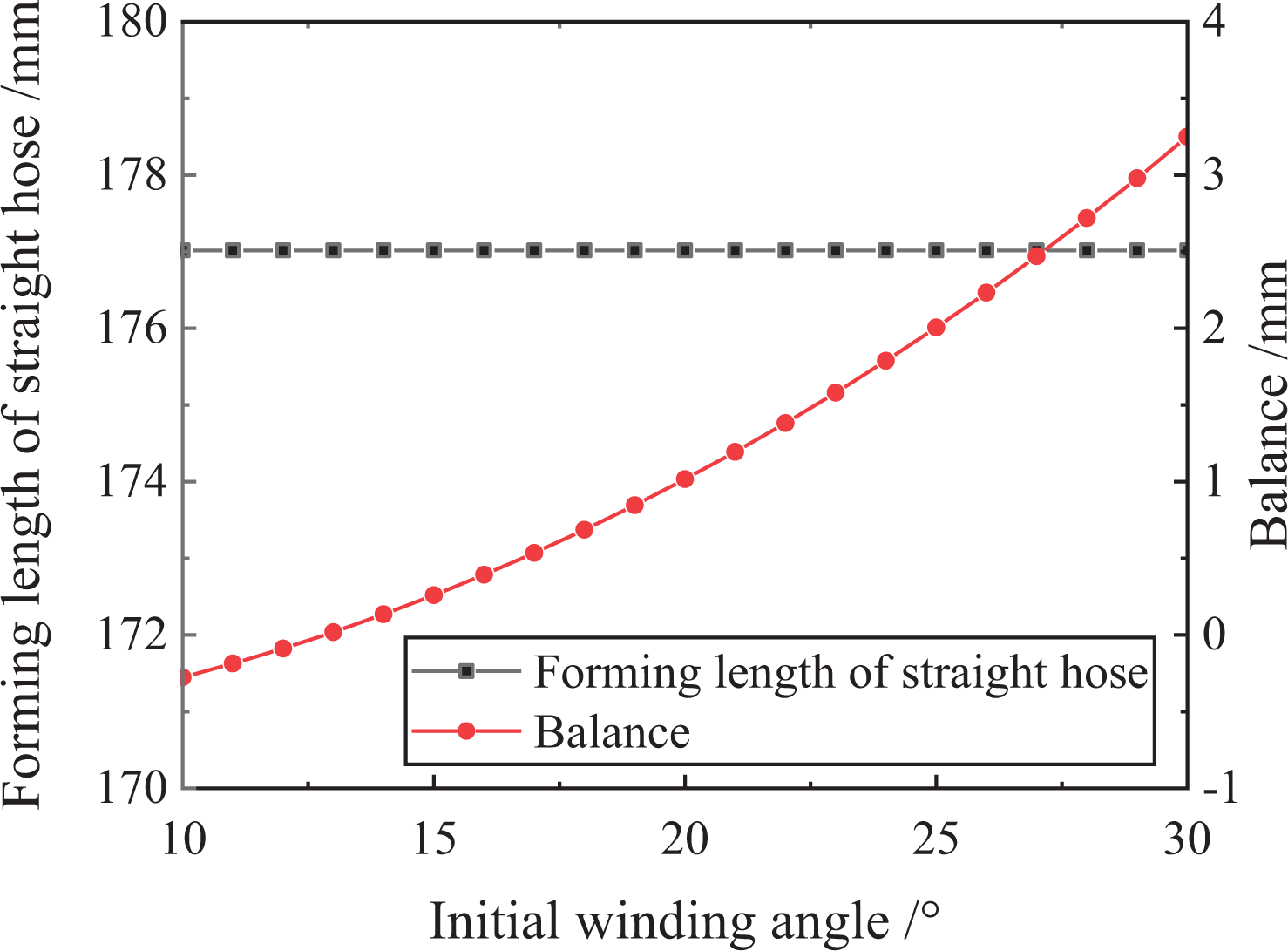
Effect of fiber initial winding angle on the forming design of the balanced curved hose.
The effect of radius at both ends of the hose on the forming design of the balanced curved rubber hose
The radius at both ends of the hose was changed, and the effect of the radius at both ends of the hose on the forming design of the balanced curved hose was analyzed. Figure 8 shows the effect of the radius at both ends of the hose on the length of the straight hose. It can be seen from the figure that the length of the straight hose is not changed as the radius at both ends of the hose changes. Figure 8 shows the effect of the radius at both ends of the hose on the balance performance of the curved hose. It can be seen from the figure that when the radius at both ends of the hose is 32.5 mm, the axial deformation of curved hose is shortened by 1.9 mm under the internal pressure of 3 MPa. When the radius at both ends of the hose is 61 mm, the axial deformation of the curved hose is close to 0 mm, and the hose has the best balance performance. Continue to increase the radius at both ends of the hose, the axial elongation of the hose occurs under the internal pressure, and the elongation of the hose increases exponentially with the increase of radius at both ends of the hose. Combined with the influence of the initial winding angle of the fiber on the balance performance of the curved hose, it can be seen that as the radius at both ends of the hose increases, the critical initial winding angle of the hose with good balance performance is decreased.

Effect of radius at both ends of the hose on the forming design of the balanced curved hose.
The effect of radius of curvature on the forming design of the balanced curved rubber hose
The radius of curvature was changed, and the effect of the radius of curvature on the forming design of the balanced curved hose was analyzed. Figure 9 shows the effect of the radius of curvature on the length of the straight hose. It can be seen from the figure that the length of the straight hose decreases as the radius of curvature increases, and the rate of decrease of the straight hose length decreases as the radius of curvature increases. Figure 9 shows the effect of the radius of curvature on the balance performance of the curved hose. It can be seen from the figure that when the radius of curvature is 70 mm, the axial deformation of curved hose is elongated by 0.13 mm under the internal pressure of 3 MPa. The axial deformation of the curved hose is close to 0 mm, and the hose has a good balance performance. Increasing the radius of curvature, the axial deformation of the hose is shortened under the action of internal pressure. The larger the radius of curvature of the hose, the larger the axial shortening deformation and the smaller the axial shortening deformation rate. Combined with the influence of the initial winding angle of the fiber on the balance performance of the curved hose, it can be seen that as the radius of curvature increases, the critical initial winding angle of the hose with good balance performance increases.

Effect of radius of curvature on the forming design of the balanced curved hose.
The effect of length of curved hose on the forming design of the balanced curved rubber hose
The length of curved hose was changed, and the influence of the length of curved hose on the forming design of the balanced curved hose was analyzed. Figure 10 shows the effect of the length of curved hose on the length of the straight hose. It can be seen from the figure that the length of the straight hose increases exponentially with the increase of the curved hose length. Figure 10 shows the effect of the length of the straight hose on the balance performance of the curved hose. It can be seen from the figure that when the length of the curved hose is 113 mm, the axial deformation of curved hose is shortened by 1.63 mm under the internal pressure of 3 MPa. When the length of curved hose is 132 mm, the axial deformation of the curved hose is close to 0 mm, and the hose has the best balance performance. Continue to increase the length of curved hose, the axial elongation of the hose occurs under the internal pressure, and the elongation of the hose increases exponentially with the increase of length of curved hose. Combined with the influence of the initial winding angle of the fiber on the balance performance of the curved hose, it can be seen that as the length of curved hose increases, the critical initial winding angle of the hose with good balance performance decreases.
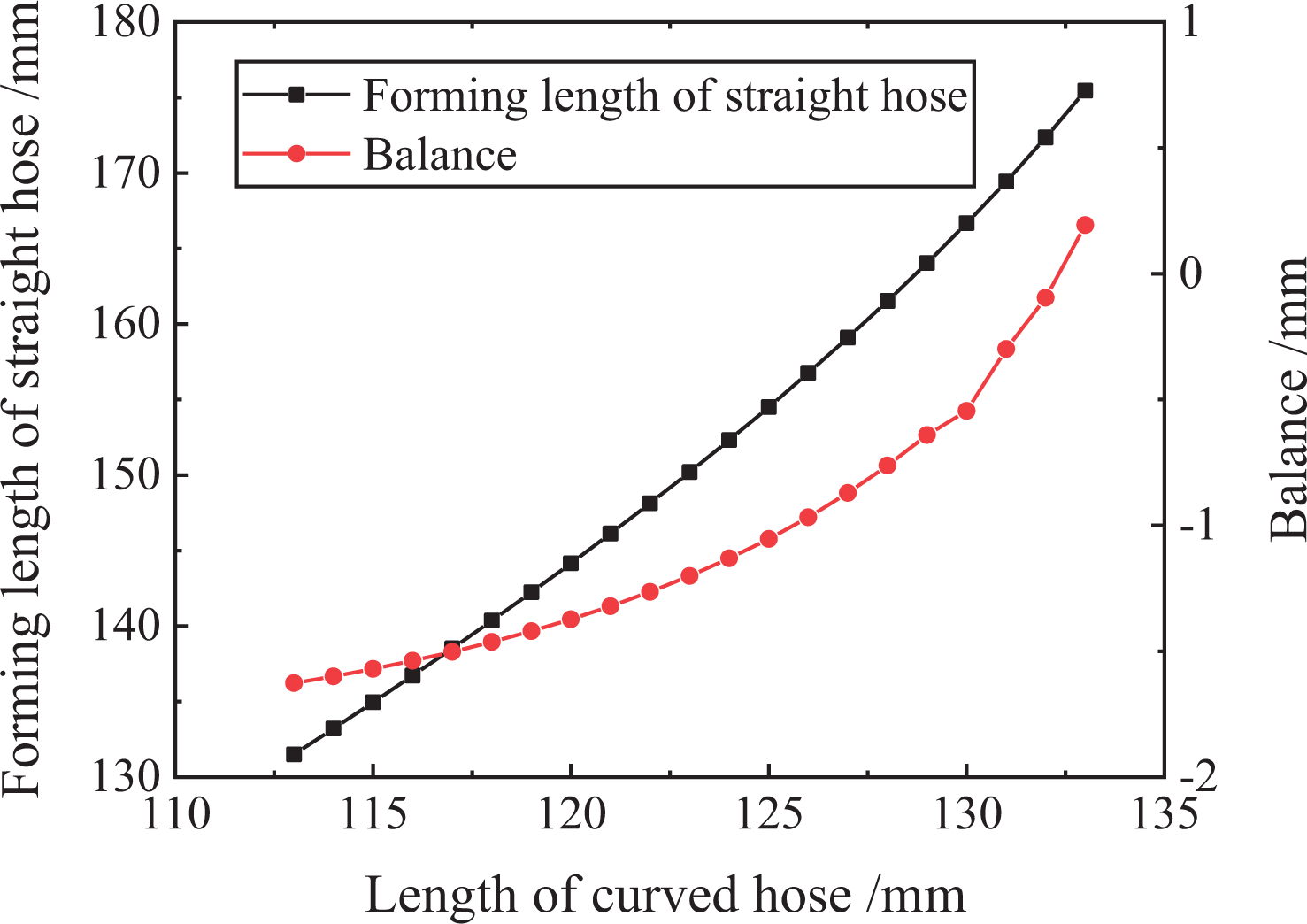
Effect of length of curved hose on the forming design of the balanced curved hose.
In summary, (1) the length of the straight hose decreases with the increase of the radius of curvature, increases with the increase of the length of the curved hose, and does not change with the initial winding angle and the radius at both ends of hose; (2) under the internal pressure of 3 MPa, with the initial winding angle, the radius at both ends of the hose and the length of the curved hose increase, the balance of the curved hose gradually changes from axial shortening to axial elongation. With the radius of curvature increases, the balance of the curved hose gradually changes from axial elongation to axial shortening; and (3) combined with the influence of the initial winding angle of the fiber on the balance performance of the curved hose, as the radius at both ends of the hose and the length of the curved hose increase, the critical winding angle of the hose with good balance performance decreases. As the radius of curvature increases, the critical initial winding angle of the hose with good balance performance increases.
Simulation method of forming process and balance performance of curved rubber hose
Influenced by factors such as the distribution of the cord and the internal force, the deformation process of the curved hose is very complicated. The forming process and the balance performance of the curved hose can be accurately simulated by the finite element analysis method; therefore, the correctness of the theoretical model is verified by the finite element method, which provides a reliable basis for determining the forming design parameters of the curved hose.
Simulation model of curved rubber hose
The forming process and balance performance of the curved rubber hose were simulated by ANSYS. To simulate the alternately wound fiber and the rubber between the fiber, the curved rubber hose can be regarded as the structure composed of a volume microelement periodic arrangement. Due to the material properties of cord and rubber, the cord is simulated by the line element (LINK10), and the rubber is simulated by the solid element (SOLID185) (as shown in Online Supplemental Appendices A4 and A5). And according to the deformation characteristics of the rope structure that only provides the tensile force, the stiffness characteristic of the LINK10 is set to be only tension; therefore, the element stiffness matrix does not function when the element is compressed. In the simulation, the LINK10 and the SOLID185 are all isotropic materials, and the parameters of the material properties 21 are presented in Table 3.
Material parameters of LINK10 and SOLID185.

LINK10: line element; SOLID185: solid element.
Since the hose is an axisymmetric body and only the internal pressure of the hose is considered, the solution for the deformation of the rubber hose is an axisymmetric problem. Therefore, only one-eighth of the hose model was established. Since only one-eighth model of the hose is considered, symmetric constraints were imposed on the symmetry plane. The hose is only subjected to internal pressure during the forming process and experiment of balance performance, so only the internal pressure is applied inside the hose wall. The uniform pressure P pre is applied to the joint surface of the hose and the flange, to simulate the axial tension generated by the flange on the hose during the pressurization process. The uniform pressure P pre can be calculated by equation (38). S is the area of the joint surface between the hose and the flange.

Simulation analysis for the forming process of curved rubber hose
The forming parameters of the curved hose were designed by theoretical model of straight hose length and balance performance of curved hose under internal pressure. For the curved hose with radius at both ends of the hose of 62.5 mm, radius of curvature of 70 mm, and hose length of 133 mm, when the length of the straight hose is 177 mm and the initial winding angle of the fiber is 13°, the curved hose is well formed and the deformation is 0 mm under internal pressure of 3 MPa. According to the forming parameters calculated by the theoretical model, the forming process and the balance performance of the curved hose were simulated.
Firstly, the forming process of the curved rubber hose was simulated and analyzed. One-eighth model of a cylinder was established with radius of 62.5 mm and length of 177 mm. The distance between adjacent cords is 0.78 mm, and the thickness of the middle rubber layer is 1 mm. According to equation (38), it can be calculated that for a single solid element, the grid size along bus bar direction is 3.47 mm, along circumferential direction is 0.80 mm, and along thickness direction is 1 mm. When the grid size of the bus bar direction differs greatly from the circumferential direction, grid distortion is easy to occur. Therefore, the rubber solid element is equally divided into three parts in the direction of the bus bar.
The simulation parameters were set according to the modeling method in “The effect of the initial winding angle of the fiber on the forming design of the balanced curved rubber hose” section, and the model was solved. The straight hose model based on the theoretical calculation results fits well with the constrained displacement mold after the pressure is applied. The correctness of the theoretical model for straight hose length is verified.
Simulation analysis for the balance performance of curved rubber hose
The balance performance of the curved rubber hose under internal pressure of 3 MPa was simulated. Based on the simulation results of the curved hose forming, the internal pressure of 3 MPa is applied inside the hose body, and the axial elongation of the one-eighth hose model is −0.05 mm. Therefore, the entire curved hose is axially elongated by −0.1 mm under internal pressure of 3 MPa. The simulation result is in good agreement with the theoretical calculation of 0 mm. The initial winding angle of the fiber was changed, and the theoretical calculation results and simulation calculation results were presented in Table 4. The difference between the theoretical calculation results and the simulation results is within 0.5 mm, and the theoretical model for the balance performance of the curved rubber hose is verified.
Theory and simulation results of the hose balance under different initial winding angle.

Forming design and experimental verification of curved hose
Combined with the actual working conditions, the forming process parameters of three curved rubber hoses are designed by the theoretical calculation model, and the curved rubber hose is made(as shown in Online Supplemental Appendix A6). Simulation and experiment for the balance performance of the hose was performed. Forming process parameters, simulation and experimental results of balance performance are presented in Table 5. In practical applications, the balance performance of the hose is required to be within ±1 mm. From Table 4, the theoretical calculation results and the simulation calculation results are in good agreement with the experiment results, and the balance performance of experiment results is all within ±1 mm.
Forming process parameters of hose and balance results.

The longitudinal section of the curved hose was cut (as shown in Online Supplemental Appendix A7). The cords are evenly distributed in the rubber matrix without wrinkles. The results showed that it is significance for the forming design of curved hose to obtain the straight hose length of the curved rubber hose and the initial winding angle of the fiber through theoretical calculation and then verify the forming process parameters by simulation.
Results
Based on the rotation angle of the cord along the axial direction in the curved rubber hose is the same as that in the straight hose before forming, and the deformation characteristics of the rope structure and thin shell theory without considering bending moments and shear force, the parametric theoretical model for the forming design of balanced curved rubber hoses was established. The parametric theoretical model under internal pressure was analyzed by finite element model. The forming design theory and simulation model was verified by experiments. The conclusions can be summarized as follows: The length of the straight hose decreases with the increase of the radius of curvature, increases with the increase of the length of the curved hose, and does not change with the initial winding angle and the radius at both ends of hose. Combined with the influence of the initial winding angle of the fiber on the balance performance of the curved hose, as the radius at both ends of the hose and the length of the curved hose increase, the critical winding angle of the hose with good balance performance decreases. As the radius of curvature increases, the critical initial winding angle of the hose with good balance performance increases. The theory, simulation, and experiment results of the forming design of structures I, II, and III were compared. The results showed that it is significance for the forming design of curved hose to obtain the straight hose length of the curved rubber hose and the initial winding angle of the fiber through theoretical calculation and then verify the forming process parameters by simulation.
Supplemental material
Supplementary_file - Establishment and verification of theoretical model for forming design of balanced curved rubber hose
Supplementary_file for Establishment and verification of theoretical model for forming design of balanced curved rubber hose by Gao Hua, Shuai Changgeng and Xu Guomin in Polymers and Polymer Composites
Footnotes
Acknowledgements
The authors wish to acknowledge, with thanks, the financial support from the Army Key Research Projects.
Declaration of conflicting interests
The author(s) declared no potential conflicts of interest with respect to the research, authorship, and/or publication of this article.
Funding
The author(s) received no financial support for the research, authorship, and/or publication of this article.

Supplemental material
Supplemental material for this article is available online.
References
Supplementary Material
Please find the following supplemental material available below.
For Open Access articles published under a Creative Commons License, all supplemental material carries the same license as the article it is associated with.
For non-Open Access articles published, all supplemental material carries a non-exclusive license, and permission requests for re-use of supplemental material or any part of supplemental material shall be sent directly to the copyright owner as specified in the copyright notice associated with the article.
