




Abstract
The vulcanization properties, physicochemical, dielectric, and electrical properties of natural rubber-based composites were investigated and compared. The composites contain 30–70 phr functional fillers having low (silicon dioxide (SiO2)) and high (titanium dioxide (TiO2)) dielectric constant values. The possibilities of using the composites as substrates in compact flexible antennas have been evaluated. Fillers are also characterized. It has been shown that they have a noticeable but different influence on all the properties of the composites studied. That is primarily due to the different structure and specific properties of SiO2 and TiO2, thereby determining the different “filler–filler” and “rubber–filler” interactions. The composite filled with TiO2 at 70 phr has a better capacity to act as a substrate in body area network antennas than the SiO2-filled composites. An antenna with such a substrate has features that meet all the requirements of the industrial, science, and medical spectrum. TiO2 composites do not change their resistance to pressure or deflection within certain limits, having a self-cleaning and antibacterial effect, which is also beneficial for their usage in antennas that are left on or near the human body.
Keywords
Introduction
Although the most commonly used hard antennas provide capabilities for a number of applications, the development of flexible antennas and the interest in them in recent years has grown significantly, mainly due to their attractive features. 1 Those antennas are light and can occupy the desired shape of the object, being able to follow the movements and the changes in its shape. 2 In all cases, the pad and the insulating layers between the elements of those flexible antennas are filled with elastomeric composites. 3 -6 However, the requirements for these composites are too serious: They should not change their flexural or pressure properties, they should have a low relative permittivity to reduce signal propagation delay, low loss tangent to reduce signal attenuation along with better signal performance, mechanical flexibility, high dimensional stability, moisture absorption resistance, and high thermal conductivity to dissipate the heat generated. 7 -10 Natural rubber (NR) has the potential to be used in such applications as it has a relatively low cost, is easy to process, has high elasticity and water resistance, has stable electrical properties, and what is particularly important—it is a product that comes from renewable sources and is environment-friendly. It is also well known that the properties of elastomer-based composites can be substantially altered by introducing functional fillers into the rubber matrix. 11 According to some authors, 12,13 silicon dioxide (SiO2, a low dielectric constant filler) and titanium dioxide (TiO2, a filler with a high dielectric constant) may be used in antenna applications of composite materials. Sarmah et al. 12 developed a support material and the antenna in the X-band, as used for the polymer matrix low-density polyethylene, and as a filler of TiO2. This material clearly cannot ensure the necessary flexibility and elasticity of the substrate, as the residual deformation of this polymer is very high. Chameswary and Sebastian 13 have developed a composite based on TiO2-filled butyl rubber, which is a synthetic elastomer and is not derived from renewable sources and is more difficult to vulcanize. Awang et al. 14 and Razali et al. 15 developed composites for flexible antennas based on NR filled with carbon black. But, as shown in International Agency for Research on Cancer, 16 carbon black is possibly carcinogenic to humans (group 2B).
Nayak et al. 17,18 developed flexible titania–polyurethane nanocomposites of different compositions that exhibit composition-dependent dielectric properties. These dielectric properties at low frequency have been found to depend on morphology. From mechanical test, Nayak et al. 18 have shown that the properties depend on both composition and mixing methods. Nayak et al. 19 have investigated the dielectric and mechanical properties of the poly(dimethylsiloxane)–titania nanocomposites, and Nayak et al. 20 show the same properties of ethylene–propylene–diene monomer–titania nanocomposites. The measurements and analyses listed above do not imply any possible application of the composites obtained in flexible antennas.
Datta et al. 21 examined the filling of NR with TiO2, mainly in terms of their use in technical rubber products and not in the manufacture of antennas: It is well known that TiO2 is a cheap inorganic filler, which can be applied as a reinforcing agent and a cost-reductive additive. Its mechanical properties have been analyzed in the context of tensile properties, hardness, abrasion resistance, tear strength, cyclic compression behavior, and rebound resilience. The dynamic mechanical properties (i.e. storage and loss modulus and damping factor vs. temperature) and thermal stability have also been determined and analyzed by Datta et al. 21 However, they do not explore and comment on the possibilities of antenna applications of the composites. It should also be borne in mind that TiO2 is widely used in environmental applications such as self-cleaning and antibacterial agents. 22
On the other hand, SiO2 has become more and more necessary in the modern rubber industry as a substitute for carbon black. 11 The practice started in 1992 when the company Michelin launched regular production of the so-called “green” tires in which carbon black is replaced by silica as a filler. 23
The purpose of this article is to investigate the properties and possibilities for antenna applications of NR-based composites obtained from renewable sources. The former are filled with oxides having low and high values of the dielectric constant, especially SiO2 and TiO2.
Experimental
Materials and methods
Table 1 summarizes some of the most important features of the used fillers. The formulations of the rubber compounds used are summarized in Table 2.
Most important features of used fillers.

SiO2: silicon dioxide; TiO2: titanium dioxide.
Formulations of the rubber compounds used.

SiO2: silicon dioxide; TiO2: titanium dioxide; NR: natural rubber; IPPD: N-isopropyl-N′-phenyl-1,4-phenylenediamine; TBBS: N-tert-butyl-benzothiasole-sulphenamide.
Preparation and vulcanization of the test specimens
The compounds were made on an open laboratory two-roll rubber mill (L/D 320 × 160 mm2, friction 1.27, and speed of the slower roll 25 min−1). The vulcanization of the rubber compounds was carried out on an electrically heated hydraulic vulcanization press with 400 × 400 mm2 plates at 150°C, pressure of 10 MPa, and time determined by the vulcanization isotherms of the compounds taken on an MDR 2000 Vulcanometer (AlphaTechnology, Hudson, OH, USA). The resulting vulcanizates were plates 150 × 150 × 2 mm3 in size.
Characterization methods
The compounds and the composites were characterized as follows:
− Vulcanization properties—according to BDS ISO 3417:2002: The following vulcanization properties were measured: minimum torque (ML), maximum torque (MH), ΔM = MH − ML (characterizes the density of the vulcanization network), T 50 (optimal time for completion of 50% vulcanization), T 90 (optimal time to complete 90% curing), t s1 (scorch time estimated as an increase in the torque by one unit), t s2 (scorch time, estimated as an increase in the torque by two units), tand@ML (tangent of mechanical loss angle at minimum torque), and tand@MH (tangent of mechanical loss angle at maximum torque). The sample quantity was 4.5 g.
− Physicomechanical properties (modulus at 100% and 300% elongation, tensile stress, relative elongation, and residual elongation)—according to BDS ISO 37:2002 and BDS EN 12 803: The mechanical properties were determined using 78-mm double-sided test specimens having a working area of 20 mm in length and 4 mm in width. The specimens were cut from a rubber sheet of 150 × 150 × 2 mm3. The test was performed at a tensile speed of 500 mm min−1.
− Shore A hardness—according to BDS ISO 7619:2001
− Electrical properties (volume resistivity)—according to laboratory methods as follows:
1. Volume resistivity: The volume resistivity (ρ v, Ωċm) of flat rubber-based specimens in a uniform electric field produced by the direct current was calculated by the equation:
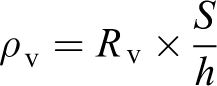
where R v is ohmic resistance between the electrodes (Ω), S is cross-sectional area of the measuring electrode (m2), and h is the thickness of the sample (m).
The ohmic electric resistivity of the composites investigated was measured on a teraohmmeter Teralin III (produced in Germany).
The vulcanizate was placed between two brass electrodes—voltage and measuring with a cross section of 0.0022 m2. Having switched on the voltage, the current running through the sample was allowed to stabilize for 1 min.
2. Volume resistivity at different applied pressure: The measurements were performed as in item 1 above, using measuring electrodes, which produced pressure on the composite tested varying as follows: 4, 10, 14.7, 20.6, 25.2, 32.1, and 42.6 kPa.
3. Volume resistivity at different composite bending: The testing set connected to terraohmmeter is shown in Figure 1. The deformation of the samples subjected to bending was 1–6%.

Laboratory set for measuring the specific volume as a function of bending (1. Textolite plate; 2. Electrodes; 3. fixing bolt; 4. Teflon pad for fixing the distance; 5. Steel axis setting the bending degree; 6. Screw for fixing the bending degree; 7. Contact sockets; 8. Test sample).
− Scanning electron microscopy: Scanning electron microscopy (SEM) images of the samples tested (fillers and NR-based composites) were taken on a SEM/FIB LYRA I XMU microscope (TESCAN, Brno, Czechia; Brucker, Billerica, MA, USA) having the following properties: electron source, Wolfram heated fiber; resolution, 3.5 nm at 30 kV; and acceleration voltage, 200 V/30 kV. An EDX Quantax 200 (Brucker) detector was used to record Energy-dispersive X-ray spectroscopy (EDX) spectra.
The powder fillers (SiO2 and TiO2) were put onto aluminum holders covered by a double-sided carbon tape, which was conductive. Cross sections of the composite samples were broken off following the freezing of the former in liquid nitrogen. The samples thus prepared were covered with carbon.
− Dielectric properties (real
Results and discussion
Characterization of the fillers used
The particles of the fillers used were characterized by SEM (Figure 2).

SEM images of fillers used: (a and b) silica and (c and d) titanium dioxide.
As shown in Figure 2, there is a fundamental difference between the two particle types: SiO2 is in large size units of irregular shape formed by a large number of elementary particles (Figure 2(a, b)). The size of the aggregates is different. TiO2 particles do not show the formation of aggregates (Figure 2(c)) even at higher magnification (Figure 2(d)). The particles look the same in size, close to the spherical shape. This peculiarity of TiO2 particles, as we shall see later, is extremely important for all the properties of the composites that contain it.
Fourier transform infrared spectroscopy has been used to prove or reject the presence of hydroxyl groups on the surface of the particles of the fillers used. This is important in terms of “filler–filler” interactions, respectively, for the tendency of particles to aggregate and agglomerate. The spectra (Figure 3) show that there are no hydroxyl groups on the surface of the TiO2 particles, so no such tendency is observed. The presence of a significant amount of hydroxyl groups on the surface of the silica particles is demonstrated by the broader peak at 3427 cm−1.

Infrared spectra of (a) silicon dioxide and (b) titanium dioxide.
This greatly reduces the propensity of TiO2 particles to aggregation and agglomeration as opposed to the behavior of silica particles, which in turn leads to better dispersion of TiO2 particles in the elastomer matrix, while the dispersion of silica particles, particularly in cases where no compatibilizer is used, is much more difficult. Better dispersion ensures good homogeneity of the rubber compound, and the preservation of small particle size is a guarantee of a stronger interaction of the elastomeric filler at the interfacial boundary, respectively, for better physicomechanical performance. On the contrary, a more difficult dispersion of aggregates of different shape and size leads to inhomogeneity of the composite and, ultimately, to lower physical and mechanical indicator. Moreover, the presence of inhomogeneities of different kinds leads to the creation of voltages and voltages of the interfacial boundaries, where, eventually, the destruction of the composite begins with deforming efforts (e.g. pressure, bending) on it. The above is confirmed by the SEM images of the composites containing both types of fillers (Figure 4). An SEM image of an unfilled NR-based composite is also given for comparison.

SEM images of unfilled composite based on (a) natural rubber and composites comprising (b) silica and (c) titanium dioxide.
Meera et al. 25 also draw attention to the fact that the lack of active hydroxyl groups is the cause of some specific properties of TiO2 particles.
Vulcanization properties of the compounds containing the fillers investigated
The vulcanization properties of the tested composites are presented in Table 3.
Vulcanization properties at 150°C.

ML: minimum torque; MH: maximum torque; ΔM = MH − ML (characterizes the density of the vulcanization network); T 50: optimal time for completion of 50% vulcanization; T 90: optimal time to complete 90% curing; t s1: scorch time estimated as an increase in the torque by one unit; t s2: scorch time, estimated as an increase in the torque by two units; tand@ML: tangent of mechanical loss angle at minimum torque; tand@MH: tangent of mechanical loss angle at maximum torque; SiO2: silicon dioxide; TiO2: titanium dioxide; NR: natural rubber.
The analysis of the vulcanization properties immediately reveals the influence that the chemical nature and the specifics of the fillers used have on them. The minimum torque, which is most often associated with the effective viscosity of the rubber compound, gradually increases with the increase in the amount of fillers, but in any case remains higher for the silica-containing compounds. The maximum torque usually associated with the hardness of the compound containing a lower amount of filler has close values for the two fillers but when the loading with SiO2 is at 70 phr, the hardness rises sharply. The same trend is observed with the difference ΔM = MH − ML. These features are undoubtedly due to the more difficult introduction and dispersion of silica in the rubber matrix compared to TiO2. That is due to the fact that, in the former, the interaction between the filler particles (i.e. the filler–filler interaction) is significantly higher than that between them and the elastomer (the rubber–filler interaction) due to the presence of hydroxyl groups on their surface, which are absent on the surface of the TiO2 particles. In silica composites, there has been a significant increase in the time of premature curing as well as the 50% and 90% time of the vulcanization process compared to those containing TiO2 and the unfilled composites. The pH values of the two fillers are presented in Table 1. The pH of silica is 6.5 and that of TiO2 is 7–8. Undoubtedly, these pH values influence the vulcanization process and retard it. For silica, the value is lower, that is, it is more acidic than TiO2, so it has a lower vulcanization rate. It is also known that in the case of silica composites, the filler (due to the available hydroxyl groups) absorbs the accelerators on its surface, immobilizes them there, and deactivates them, which leads to a slower vulcanization process. Chemicals like organosilanes, diethylene glycol (DEG), and so on are used in silica formulations to avoid curative adsorption by the filler. In the compounds investigated (Table 2), this effect is increased by the fact that no compatibilizer (e.g. organosilane) is included in the rubber mixture. That is almost not observed in the case of TiO2 containing compounds. The tangent of mechanical loss angle to the minimum torque (tand@ML) decreases with increasing the filler amount but remains higher for the compounds with TiO2, and tangent of mechanical loss angle at maximum torque (tand@MH) rises slightly with increasing the filling but remains high in composites with silica. The tangent of mechanical loss angle is a ratio between the dynamic loss module and the dynamic storage module. 26 Its value is associated with the mobility of the macromolecules and phase transitions in polymers. 26 It is impacted by filler dispersion, dynamic deformation, “filler–filler,” and “rubber–filler” interactions. The differences explained above and the specificities of the two fillers are the reason for the observed differences in the values of the tangent of mechanical loss angle at a minimum and maximum torque. In conclusion, both fillers have a noticeable influence on the vulcanization properties of the rubber compounds containing them, but the influence of silica is more pronounced due to the presence of hydroxyl groups on its surface, hindering the accelerators dispersing and adsorbing on the surface of its particles.
Physicomechanical properties
The physicomechanical properties of the studied composites are summarized in Table 4. The table shows that the composites of TiO2 have a higher modulus at 300% elongation, tensile strength, elongation, and elasticity (residual elongation remains low) but a low modulus at 100% elongation in comparison to composites containing SiO2. Their hardness is closer to that of the unfilled composite and grows slightly with the filling, whereas in the composite with silica, it increases considerably as well as the residual elongation, especially with an increase in the degree of filling. That is due to the fact that TiO2 is better dispersed and the composites with it are more homogeneous. The lack of agglomeration and the preservation of small particle size is a guarantee of a stronger elastomer–filler interaction at the interfacial boundary, respectively, for better physicomechanical performance. SiO2 agglomeration significantly reduces the particle surface to volume ratio. The SEM images also confirm uniform dispersion of the TiO2 particles in the matrix. A good dispersion is achieved when the repulsive forces between the particles are greater than the van der Waals forces of attraction or the mechanical couplings between particles. 27 Obviously, the SiO2 particles show exactly the opposite—stronger “filler–filler” interaction and a weaker “rubber–filler” one, which leads to lower mechanical performance. The tensile strength of the composites with TiO2 exceeds significantly that of the unfilled composite for the above reasons.
Physicomechanical properties of the studied composites.
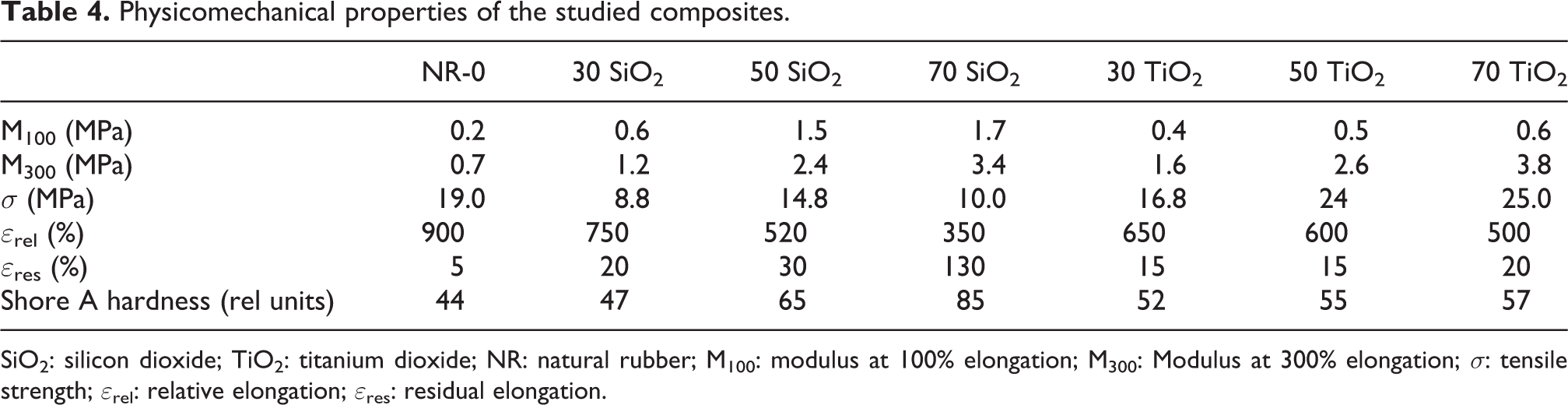
SiO2: silicon dioxide; TiO2: titanium dioxide; NR: natural rubber; M100: modulus at 100% elongation; M300: Modulus at 300% elongation; σ: tensile strength; εrel: relative elongation; εres: residual elongation.
Influence of the chemical nature of the fillers used in dielectric properties of composites
Table 5 presents the real (
The results in the table show the strong influence of the chemical nature and structure of the fillers used on the studied properties. As seen from the table, the composites containing TiO2 have a higher value of the real part of the dielectric constant than the composites containing SiO2. It should be borne in mind, however, that the real part of the dielectric permeability of TiO2 (also called the dielectric constant) is much higher (86–173) than that of SiO2 (3.8–3.9), which explains the difference in these properties for composite materials as a whole. It is also noticeable that with increasing the amount of TiO2, the values of the real part of the dielectric permeability of the composite increase and exceed those of the unfilled composite (NR 0). The value for the SiO2 filled composites decreases slightly and remains lower than that of the unfilled composite. In terms of the imaginary part of permittivity, behavior of composites is also different: In the case of TiO2, with increasing the filling, the values decrease, quite sharply, while for silica, though slightly, they increase, but in most cases, remain lower than those for the composites containing TiO2. The observed changes in the variation of the real and imaginary parts of the permittivity with the filling also explain the changes in the dielectric loss angle tangent values (tan δ∊ = ∊″/∊′). With the increase of filling in the TiO2 composites, the values decrease significantly and in the case of the silica composites increase slightly. What makes an impression is the value of tan δ∊ for the composite filled with TiO2 at 70 phr (0.0048), which is too low and opens up opportunities for some of its antenna applications, in particular, as a substrate and/or insulating layers. Similar applications could have composites filled with 50 phr TiO2 (tan δ∊ = 0.0169) and 30 phr silica (tan δ∊ = 0.0155). The value of the imaginary part of the dielectric constant (also called dielectric losses) in a multicomponent composite depends on a large number of complex phenomena such as natural resonance, dipole relaxation, and interfacial polarization. Interfacial polarization is observed in the heterogeneous interfacial layer and is due to the accumulation of charges in it, associated with the formation of large dipoles. 28 It is also notable that the particles of TiO2 have a high ionic polarization due to the presence of Ti4+ and O2 − ions, which increase the static permeability. 28 Important factors for forming the real and imaginary parts of dielectric permeability are the filling degree, morphology, and structure of the fillers used, the differences in particle size and shape, and the differences in the morphology, structure, and element composition of the composite.
Figure 5 shows the results of the SEM-EDX analyses of the unfilled composite and of the composites containing both types of fillers. Serious differences in elemental composition are seen, which in itself also causes the observed differences in dielectric permeability.

SEM-EDX spectra of (a) nonfilled, (b) filled with TiO2 with (c) SiO2 composite (amount of loading 50 phr) and obtained as a result their elemental composition. (Markings to the tables in Figure 5: El: element; AN: atomic number; K-series: data processing is based on peak readings due to transitions of electrons from the outer shells to the K-shell that is most internal; unn.C: unnormalized concentrations—concentrations that do not account for all elements, errors, noises, etc., therefore, their total amount is usually different from 100%; Norm.C: normalized concentrations—concentrations are recalculated to a total 100%, taking into account any errors; atom C: concentration of the element in weight or atomic percentages calculated item and the software).
Carbon (84.32 at.%) and oxygen (14.34 at.%) dominate in the unfilled composite. The composite with TiO2 comprises quite different quantities of carbon—52.35 at.% and oxygen—33.46 at.%, there is also 10.93 at.% titanium. The results have shown that silica-filled composite contains 52. 58 at.% carbon, 39.29 at.% oxygen, as well as 6.73 at.% silicon. SEM images (Figure 3) show the differences in the morphology of composites. All of the above explain the dissimilarities in the dielectric properties of the composites. Concerning the conductivity at 2.45 GHz (Table 5), one sees that the conductivity increases with the degree of filling with both tested fillers (i.e. their resistance decreases). The effects of TiO2 are much more pronounced than those of silica. That is probably due to the fact that TiO2 itself has a lower resistance than SiO2, and the differences with the corresponding values for the elastomeric matrix are greater. Since both fillers are more conductive than pure NR, their introduction into the composite leads to an increase in conductivity.
Dielectric properties of composites filled with different amounts of titanium dioxide and silicon dioxide at a frequency f = 2.56 GHz.

SiO2: silicon dioxide; TiO2: titanium dioxide; NR: natural rubber;
Impact of the chemical nature of the used fillers on volume resistivity
Table 6 summarizes the results of the measurement of the volume resistivity of the composites studied and how it varies depending on the chemical nature of the filler and the degree of filling.
As seen from the table, for both fillers, with increasing the degree of filling, the resistivity gradually decreases. In each case, the resistivity of the composites with TiO2 remains lower than that of the composites with silica. The filled rubber composites have a lower resistivity than the unfilled. However, since the fillers and the polymer matrix have close volume resistivity values (within the range of 1.1010–1.1013 Ω·m), there is no well-expressed percolation threshold despite the high degree of filling of the composites.
The electrical conductivity of composites may be explained by the formation of a three-dimensional network of the particles within the rubber matrix. It is known that two main mechanisms are responsible for the electrical performance of filled rubber composites. 29 The first one occurs when there is a direct contact between the particles and current carriers can be transferred from one particle to another. The second mechanism is the so-called tunnel effect 30 that occurs when there is a thin rubber insulating layer separating two particles. Even if there is no contact between the particles, electron transfer is possible despite the insulating rubber layer between the particles. When the potential difference reaches a certain value, the electrons are able to jump from one particle to another. But these mechanisms are launched only if there is a network within the rubber matrix. Various factors influence the presence or absence of this network. Filler particles concentration and particles size as well as particles-specific features determine the formation of the network through the entire matrix if its concentration is high enough. In addition to the above, the important fact that the volume resistivity of pure TiO2 is lower than that of pure SiO2 (Table 6) explains the observed effects in the studied composites.
Dependence of specific volumetric electrical resistance on the chemical nature of the filler and degree of filling.
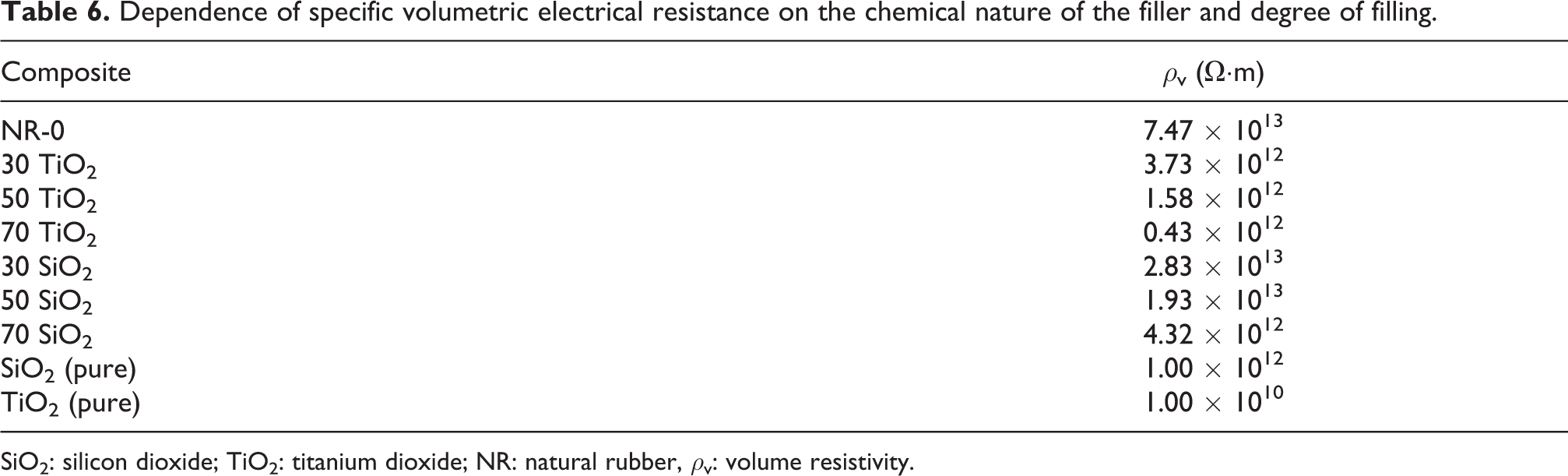
SiO2: silicon dioxide; TiO2: titanium dioxide; NR: natural rubber, ρ v: volume resistivity.
Influence of applied external pressure on volume resistivity of the studied composites
The dependence of volume resistivity on the pressure in the range of 5–45 kPa for the composites tested is shown in Figure 6.

Dependence of volume resistivity on the applied pressure for the composites studied: (a) filled with silicon dioxide and (b) filled with titanium dioxide.
The graphs reveal that even when external pressure is applied to the composite material, the results of Table 6 are confirmed, according to which, by increasing the filling of the composites with both fillers, the specific volume resistivity decreases under the same other conditions. TiO2 composites have a lower resistivity than silicon composites, which is expected in view of the fact that the former has a slightly lower resistivity than the latter. On the other hand, it is noticeable that in the investigated areas of pressure variation, it does not cause significant changes in the resistance of the composites. For all filled composites, there is a slight increase in the resistance with a pressure increase in the range of 5–15 kPa, but it is practically unchanged at further increase. In the case of nonfilled composites, however, there is a constant slight decrease of the resistance by increasing the pressure. Undoubtedly, this difference between the filled and the nonfilled composites is due to the influence of the fillers on the conductivity forming factors: In the absence of a filler, the application of external pressure facilitates the formation of the conductive paths and the passage of the current carriers and the resistance decreases. In the presence of a filler, however, with close resistances to that of the elastomeric matrix, this process is hampered, resulting in an initial increase of the resistance, after which it stabilizes around a certain value. In any case, however, to use the studied composites as substrates and/or insulating layers in wireless communications antennas portable on the human body, the lack of changes in the resistance to external pressure application is highly desirable. In this sense, composites filled with TiO2 at 50 and 70 phr, with the smallest changes in the pressure resistance after applying 15 kPa of external pressure, are the most suitable for such potential applications based on the results obtained.
Influence of the degree of bending on the volume resistivity of the studied composites
The effect of the degree of bending in the range of 1–6% on the specific volumetric electrical resistance of the composites filled with TiO2 at 50 and 70 phr has been studied. These composites have yielded the most relevant results in the studies described above with respect to prospective antenna applications (Figure 7). As seen from the figure, in the observed range, the bending practically does not affect the volumetric resistance, which is the desired quality in view of using these composites as antenna substrates.

Influence of the degree of bending on the specific volumetric resistivity of composites filled with titanium dioxide.
Antenna application of the composites investigated
Generally, the most important performance characteristics of interest when designing a flexible antenna for body area networks (BANs) in the industry, science, and medical (ISM) 2.45-GHz band are its radiation efficiency (more than 50%), impedance matching (|S11| ≤ −15 dB at resonant frequency, |S11| ≤ −10 dB within the frequency band of interest), and bandwidth (more than 80 MHz). Mechanical flexibility, low specific absorption rate (SAR ≤ 0.5 W kg−1), ease of system integration, and immunity to performance degradation are also the factors to consider while designing these antennas.
The purpose of the substrate material of a flexible antenna for BANs is primarily to provide mechanical support for the radiating antenna elements and to maintain the required precision spacing between the antenna elements and its reflector. With higher dielectric constant of the substrate material, the antenna size can be reduced due to a loading effect. Moreover, materials with a higher dielectric constant should be used with care. They can significantly reduce the radiation efficiency by having overly small antenna volumes. The selection of the appropriate material for a flexible antenna should be based on the desired antenna size, radiation efficiency, reflection coefficient, mechanical flexibility, cost, and so on. Radiation efficiency is one of the most important criteria for BANs application in determining the substrate type. Consequently, lower loss materials as composites filled with TiO2 at 50 (tan δ = 0.0169) and 70 phr (tan δ = 0.0048) or composites filled with silica at 30 (tan δ = 0.0155) phr may be used as substrate to maximize antenna radiation efficiency.
To study the feasibility of using composites filled with TiO2 as antenna substrates, a flexible antenna for communication in BANs has been developed. BANs are chosen because these systems are applied in different areas from consumer electronics, health monitoring, medical care, and sports to military purposes. 31,32 The antenna intended for practical applications in a BAN is subject to specific requirements as the human body is a part of the communication channel. For this reason, one of the basic requirements for the antenna is to operate robustly in close proximity to the human body. 33,34 Some authors recommend the use of antenna structures that have unidirectional patterns or elements that have isolators to reduce the impact of the human body on antenna performance. Another important requirement for antennas for BANs is that they maintain good radiation characteristics and high radiation efficiency with low levels of SAR. Complying with the requirements also include compactability (small size), lightweight, and flexibility, because the antenna and all communication systems have to be integrated into the garment with maximum physical comfort to the surface of the human body. The optimal antenna design has been constructed with a substrate from a composite containing TiO2 at 70 phr (tan δ = 0.0048) and antenna performance has been studied under different conditions. The antenna gave robust on-body performances. Simulated and measured results demonstrate that a bandwidth of 100 MHz in both the free space and on a human body has been achieved. Moreover, simulated radiation efficiency of more than 60% has been realized in the entire ISM 2.5 GHz band. The proposed antenna also generates a maximum SAR of 0.056 W kg−1 at 2.44 GHz, this value is far below the European standard threshold.
The configuration, picture, and measurement results of the S-parameters of the developed antenna are shown in Figure 8.

(a) Configuration of the proposed antenna, (b) a photo showing the possibilities of the bending antenna, and (c) characteristics of the antenna in the free space and when placed on the human body.
As seen in Figure 8(b), the developed antenna is flexible, lightweight, low profile, with small dimensions of 51.2 × 1.3 × 51.2 mm3, which enables practical application in BANs. The parameters and characteristics of the antenna are examined in two cases—in free space and when placed on the body of a person (Figure 8(c)). The results show that the realized antenna covers the ISM band and has a robust input impedance even when it is placed onto a human body. In addition, the proposed antenna exhibits high radiation efficiency (over 60% over the entire ISM band) and small SAR values. The specific bulk resistivity of the substrate is not affected by changes in pressure and bending.
Conclusions
The influence of oxide fillers with low and high values of the dielectric constant on the vulcanization, physicomechanical, electrical, and dielectric properties of composites based on NR when filling in the range of 30–70 phr has been compared, and the possibilities for their antenna applications are evaluated.
All tested properties of the fillers have been found to be strongly dependent on their chemical nature and structural characteristics. Therefore, the composites containing them differ greatly. It can be categorically stated that the observed differences are due to the fact that the interaction between the particles of the filler (i.e. the filler–filler interaction) is significantly higher than that between them and the elastomer (i.e. the rubber–filler interaction) due to the presence of hydroxyl groups on the surface, such as the surface of the TiO2 particles. This particular feature influences the vulcanization and physicomechanical properties. The difference in the elemental composition of the composites influences their dielectric properties. In terms of antenna applications, composites containing 50–70 phr of TiO2 are the most suitable since they have a low tangent of the dielectric loss angle and provide the best antenna characteristics of high radiation efficiency, high coefficient of amplification, and good balance of electromagnetic properties over a wide frequency range. In addition, they undergo the smallest changes in the values of their specific volumetric electrical resistance under compression or bending, which is beneficial in their actual application associated with the antenna placing onto the human body as they can follow its movements. It has been shown that composites containing a filler with a high dielectric constant can be successfully used as substrates in compact flexible antennas in BANs and are more suitable than composites containing a filler with a low dielectric constant. Moreover, the proposed antenna exhibits high radiation efficiency (more than 60% over the entire ISM band) and small SAR values.
Footnotes
Acknowledgements
The authors would like to acknowledge the support of King Khalid University for this research through grant no. RCAMS/KKU/006-18 under the Research Center for Advanced Materials Science at King Khalid University, Saudi Arabia and that of the University of Chemical Technology and Metallurgy, Sofia, Bulgaria.
Declaration of conflicting interests
The author(s) declared no potential conflicts of interest with respect to the research, authorship, and/or publication of this article.
Funding
The author(s) received no financial support for the research, authorship, and/or publication of this article.
