




Abstract
A novel amphoteric polymer TH-1 was synthesized using the monomers of 2-acrylamido-2-methylpropane sulfonic acid, acrylic acid, acrylamide, and cationic monomer through radical copolymerization as filtrate loss reducer in oil well cementing. Optimal synthesis conditions of TH-1 were obtained by an orthogonal experiment. The composition of copolymer (TH-1) was characterized by Fourier-transform infrared spectrum and proton nuclear magnetic resonance spectroscopy. The thermal stability of the synthesized copolymer was tested by thermogravimetric analysis. The fluid loss (FL) control and thickening performance of cement slurry incorporating TH-1 were evaluated at different temperatures. The filtration reduction mechanism of TH-1 was finally discussed. Results suggest that the amphoteric polymer is the target product polymerized by all the monomers, which presents excellent filtrate reduction property, high thermal stability, and strong saline tolerance under 200°C. The amphoteric polymer TH-1 includes cationic and anionic group in a molecule structure, which can adsorb firmly onto the surface of cement particles through electrostatic attraction and form adsorption membrane of viscoelastic polymer. In this way, compact cement filter cakes are formed, thereby efficiently reducing the FL.
Introduction
The main objective of oil well cement is to provide zonal isolation and well integrity and to protect the casing. 1 The most basic work encountered in cementing the casing in oil and gas wells is the use of suitable cement slurry to ensure secure and effective operation. It is well-known that the filtration characteristics of cement slurry play a key role in ensuring the safety of oil well cementing operation and improving the cementing quality. 2 -4 Excessive fluid loss (FL) of cement slurry endangers a cementing operation no matter during placement or during waiting-on-cement. The filtrate loss control additives are often used to reduce FL of cement slurry, which is different from those used in drilling fluid. This situation combined with the variety of well cementing conditions, such as temperature, pressure, and formation characteristics, requires the development of specific additives for filtrate loss control to meet the needs of well cementing. The selection of a filtration control agent is key to the cement slurry preparation. Traditionally, FL was controlled by the use of bentonite, sodium montmorillonite, whose plate-like particles were used to block the pore in the cement filter cake. 5 Since the polymeric additives have been introduced to control filtrate loss in 1930, their utility increased widely and product variety was developed abundantly owing to its specificity. Nowadays, most of FL control additives (filtrate reducer) are water-soluble synthetic polymer products. 6 Tiemeyer and Planck reported that a synthetic polymer based on allyloxy-2-hydroxy propane sulfonic acid exhibited excellent FL performance. 7 Nunes et al. synthesized new spherical microparticles. 8 The property of the material is related to the rubbery characteristic, which forms the desirable filter cake to block the entrance of fluid into the formation. Salami and Planck described a graft copolymer, which comprised side chains connected to the backbone by aqueous free radical copolymerization. 9 Generally, polymers containing specific functional groups will adsorb easily onto cement particles. Many studies have been undertaken to find appropriate polymers for this purpose. 10,11 Sheen et al. have prepared a new amphoteric copolymer and reported that this polymer significantly increased the required performance. 12 Weng et al. 13 have reported an amphoteric copolymer PAC with a proper monomer ratio and molecular weight was found to be effective in dispersing cement particles and enhancing the fluidity of either cement pastes or mortars.
The mechanism of these polymers has been studied recently. According to the research result from Plank and Cadix 14 –16 , adsorption onto the surface of hydrating cement is an important key to achieve the FL control performance, which derived from the theories of colloidal sciences. 17,18 Although good results using water-soluble synthetic polymers have been reported, some aspects can still be improved. However, the commercial FL control additions have many weaknesses, such as a lack of FL control, no salt resistance, and poor thermal stability under high-temperature and high-pressure conditions, which leads to failure of cementing. With the increase of the energy demand and the development of drilling technology in the world, the drilling of deep well and ultradeep well will become an important aspect of the petroleum industry. Hence, there is a demand for a filtrate reducer, which performs well under high-temperature condition. 19,20 Therefore, new and more effective filtration control agents should be developed.
Almost polymer belonged to anionic polymers in the current application of chemical admixtures. Amphoteric admixtures have seldom been reported before. Miao et al. have prepared a new generation amphoteric comb-like copolymer and reported that this polymer significantly increased the required performance. 21 Cement slurries can be characterized as colloidal suspensions. Cement particle surface is made up of positive and negative patches. 5,22 In fact, FL control performance is demonstrated to be directly linked to the adsorption level on the cement surface, so the electrostatic effects play a dominant role in polymer adsorption. 16 If the target product includes with positive and negative groups at the same time, which can be adsorbed easier on the surface of cement particles, forming a layer of adsorption membrane, it would strengthen the ability to reduce FL. Therefore, it would be interesting to synthesize and evaluate the performance of polymer containing both cationic and anionic groups in its molecular structure. However, little work has been devoted to this topic.
Here, in view of electrostatic adsorption mechanism of filtrate reducer and colloidal suspension theory, our main motivation was to develop a high-performance filtration control agent for oil well cementing. For this purpose, a novel amphoteric polymer (TH-1) was synthesized using 2-acrylamide-2-methylpropane sulfonic acid (AMPS), acrylic acid (AA), acrylamide (AM), and a new cationic monomer (W) as monomers via aqueous free radical copolymerization. Our aim is to improve the adsorption ability of filtrate reducer onto the cement particle’s surface by introducing the W. Therefore, we firstly discuss the effect of copolymerization reaction parameters, such as the reaction time, temperature, the mole ratio of AMPS/AM/AA/W, and the initiator concentration on the performance of filtrate reducer. And then, the filtration reduction mechanism was discussed.
Experimental
Raw materials and instruments
The raw materials include AA (chemical), AM (chemical), AMPS (chemical), W, ammonium peroxydisulfate ((NH4)2S2O8, Analytical Reagent (AR) grade), sodium hydrogen sulfite (NaHSO3, AR grade), sodium hydroxide (NaOH, AR grade), ethyl alcohol absolute (AR grade), and other chemical reagents were purchased from Chengdu Kelong, Inc. (Chengdu, China) and were used without further purification. Water used in this study was deionized water. Jiahua class G cement, a retarder (BCR-200L\BCR-300 R), dispersant (SXY-2), and so on are also used.
The instruments used in the experiment include KOY79 -1 magnetic heating stirrer, OWC-9380 (B) type thickener, LM-02 digital dynamometer, DFC-0805 type high temperature, and high pressure FL meter (Tongchun Analytical Instrument Factory of Qingdao, China).
Synthesis of filtrate reducer
Copolymers of AMPS, AA, AM, and W were prepared via free radical aqueous solution polymerization technique in the laboratory. The orthogonal test was used to optimize the synthesis conditions. The optimized parameters can be obtained according to the minimum value of FL(API) of cement slurry with the same copolymer amount (4% by weight of cement (BWOC)). The four main factors, including the mole ratio of AMPS:AM:W:AA, reaction temperature, initiator concentration, and the pH value, are selected to research the synthesis conditions.
The filtrate reducer was prepared according to the following steps: First, the initiator ((NH4)2S2O8 and NaHSO3 with the mole ratio 1:1 in aqueous solution) was first dissolved in some volume of water, which was labeled as solution A, and then, a certain amount of deionized water was fed into a 1-L three-necked round-bottomed flask with a stirrer, a thermometer, and an intelligent control temperature device. Second, the monomers AMPS and AM were added into the flask, then liquid AA and W were added, and stir until it is uniform in nitrogen atmosphere. NaOH or diluted hydrochloric acid was added to regulate pH value of the reaction mixture with constant stirring thoroughly. To avoid the premature polymerization induced by excessive heat released by the reaction of solution system, this monomer solution has to be kept at a temperature below 40°C. Third, after bubbling with nitrogen for 20 min, solution A was slowly added to the reaction mixture over 30 min. During the synthesis, the mixtures were constantly stirred at about 200–300 r min−1 and the temperature was kept by a water bath. The viscous yellowish liquid could be synthesized after several hours, namely for the synthesis of filtrate reducer TH-1, which was used to evaluate the property of FL control ability. The schematic representation of the polymer TH-1 synthesis is shown in Figure 1. The specimens used for the characterization and measurements were subjected to precipitation with a large amount of anhydrous ethanol and acetone subsequently. The precipitation production was converted into the powder through drying in vacuum and crushing break in an agate mortar.
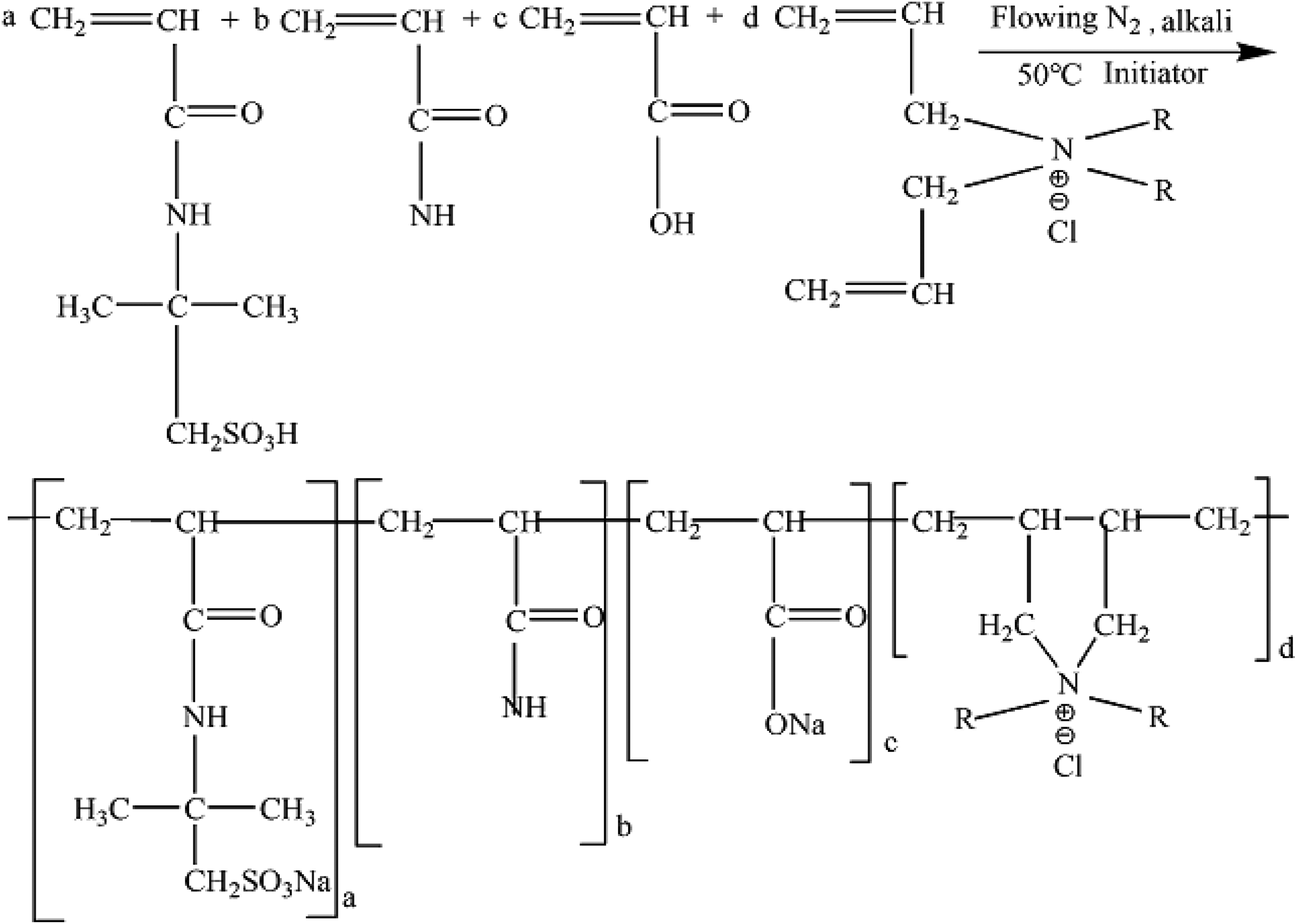
Monomers of AMPS, AM, AA, W, and the synthesis of their copolymer.
Chemical characterization of FL reducing agent
In identifying the chemical structure, the dried specimens with a certain mass were mixed with potassium bromide and pressed into a transparent disk using a PerkinElmer table press die set. The Fourier-transform infrared (FTIR) spectra of the specimen were recorded on FTIR (Equinox 55, Bruker Analytische Messtechnik GmbH, Germany). The spectra were collected from 4000 cm−1 to 500 cm−1, with a 1 cm−1 resolution over 32 scans, and measurements were performed in the transmission model.
Nuclear magnetic resonance (NMR) was used to analyze the chemical structure. The hydrogen-1 NMR (1H-NMR) spectra were obtained at room temperature with an ARX-400 Spectrometer (Bruker Co., Germany) operating at frequencies of 400 MHz, and the chemical shift values were expressed in d values (ppm) relative to tetramethylsilane as an internal standard. Measurements were carried out in D2O at a constant concentration of 1 mg/0.60 mL. All spectra were recorded in 5-mm NMR tubes using an airflow rate of 535 L h−1. For each experiment, 32 spectra with 16 K data points were collected using 64 scans. The duration of the magnetic field pulse gradients (δ) was 4.0 ms. The diffusion time (Δ) was 150 ms, and the eddy current delay was set to 4.8 ms. The pulse gradient (g) was incrementally increased from 1% to 98% of the maximum gradient strength via a linear ramp.
The Shimadzu TGA-50 thermogravimetric analyzer was used to check the thermal stability performance under high temperature. The temperature range was from 40°C to 650°C at a heating rate of 10°C min−1 under the flowing nitrogen gas.
Performance measurement of cement slurry system for filtrate reducer
The laboratory methods for each test followed the API RP 10B standard. 23 The results were expressed as the mean for each formulation, assessed in triplicate. The reproducibility of the tests was quantified by the standard deviation of the experiment data.
Cement slurry API static FL
The main parameter of interest in this respect is the volume of filtrate collected in static filtration test. The test parameter can be used to estimate the probable behavior of the cement slurry during cementing process (the placement process and no circulation in the well). The test was conducted in an OFI testing equipment filter press at 90°C under a pressure differential of 6.9 MPa during 30 min. The system constituted by a filter cell was involved by a heating jacket. The filtrate was collected in a measuring test tube. Before starting the test, the jacket was preheated over the test temperature and the cement slurry was homogenized in an atmospheric consistometer (model 1250 from Ametek Chandler Engineering, Broken Arrow, Oklahoma) about 20 min. And then, the cement slurry was poured into the filter cell, which was inserted in the jacket. The system was sealed and pressurized with nitrogen. Filtration proceeded through a 22.6 cm2 mesh metal sieve placed at the bottom of the cell. The filtrate is collected over a period of 30 min. As described by API RP 10B, the collected filtrate volume was doubled and regarded as API FL (FL(API)) of the corresponding cement slurry.
Cement slurry thickening time
The thickening property of cement slurry is a key property in oil well cementing. It needs not only proper thickening time (between 4 h and 6 h) and short transition time (right angle thickening property) but also proper initial consistency (less than 30 Bearden units of consistency (Bc)) and good shape of thickening curve (steady without bulge). The time span during which the cement slurry remained in a pumpable, fluid state was determined in the high pressure–high temperature (HPHT) consistometer (API RP 10B, 2002). The consistency of the slurry expressed in Bc was measured. After the slurry container was installed in the HPHT consistometer, the temperature and pressure should be increased in accordance with the appropriate well-simulation test schedule. The thickening time is the passed (elapsed) time between the first application of temperature and pressure to the pressurized consistometer and the time at which the consistency of 100 Bc was reached.
Results and discussion
Analysis of orthogonal experiment results
The orthogonal L16 (44) experiments are designed to optimize the synthesis conditions. As presented in Table 1, four key factors, including monomer ratio (A), reaction temperature (B), initiator concentration, (C) and solution pH value (D), were selected. The optimized conditions can be obtained according to the minimum value of the filtration loss of cement slurry with the prepared filtrate reducer at 90°C and 6.9 MPa. The FL(API) under different conditions was compared, and the main factors affecting the copolymer and the optimum synthetic conditions were determined. In the monomer ratio, the content of AA is fixed, because it can reduce the retarding effect of the product and cannot affect the strength development of the cement stone. To make the synthetic filtrate reducer have a suitable viscosity, the solid content of monomer is 25%. Table 2 presents the results of the orthogonal tests. The results show that the solution pH value and mass fraction of the initiator play an important role in the reduction of the filtration loss than other factors. The reaction media and the dosage of the initiator have the greatest influence on free radical polymerization because of the induced decomposition and the cage effect. 24 According to Pan, 25 less initiator leads to low efficiency and slow polymerization rate. The optimum synthetic conditions are as follows: D4C3B1A3. That is to say, the ratio of the monomer is 6:2:2:1, the solution pH value is 7, the reaction temperature is 50°C, and initiator concentration is 0.8%.
Factors and levels of orthogonal experiment.a
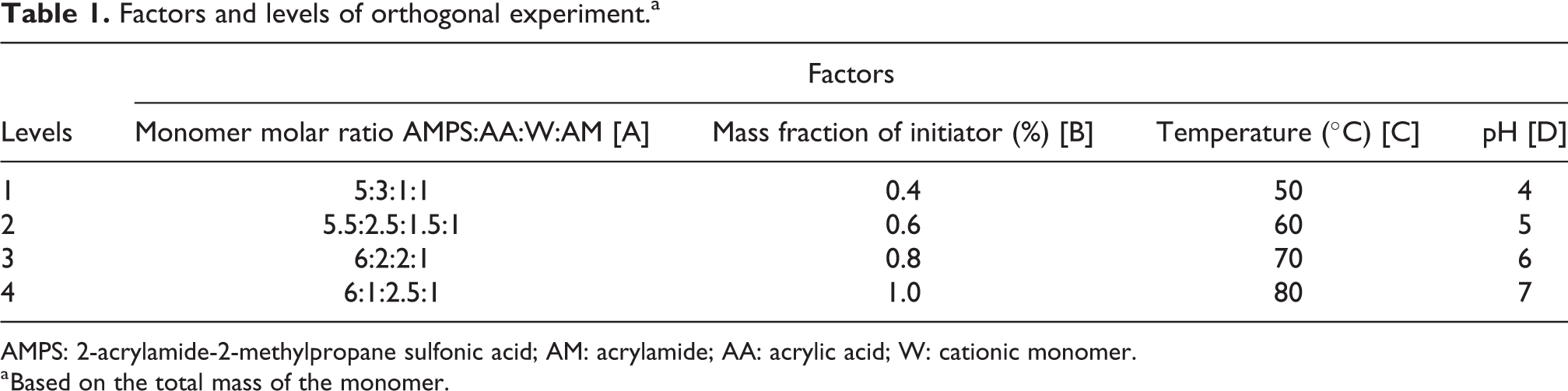
AMPS: 2-acrylamide-2-methylpropane sulfonic acid; AM: acrylamide; AA: acrylic acid; W: cationic monomer.
a Based on the total mass of the monomer.
Orthogonal experiment table.

Chemical characterization of filtrate reducer TH-1
FITR spectrum analysis of filtrate reducer TH-1
The synthetic filtrate reducer TH-1 is purified, washed, dried, and ground into white powder by ethanol. Its structure was characterized by FITR spectrum analysis, which was shown in Figure 2; 3400–3600 cm−1 is the hydrogen bond of the amide group in the AM link and the stretching vibration absorption peak of N–H7; 2948 cm−1 is the stretching vibration absorption peak of CH2.
9
Stretching vibration absorption peak of C=O bond is in 1649 cm−1 (–CONH2); 1423 cm−1 is assigned to –OH in-plane flexural vibration absorption peak in –COOH; 1223 and 1079 cm−1 is the

FTIR spectrum of the synthesized copolymer.
1H-NMR analysis of filtrate reducer TH-1
The 1H-NMR spectrum of the synthesized copolymer is shown in Figure 3. δ H-3 = 2.5 and δ H-4 = 2.1 are characteristic proton resonance peaks of the methylene group and the methylene group of the amide group, respectively. δ H-5 = 1.4 corresponds to the relative displacement of proton in –COOH of AA. δ H-1 = 3.40 corresponds to the proton resonance peak characteristics of side-chain Poly (2-acrylamido-2-methylpropanesulfonic acid sodium) methylene. The characteristic proton resonance peak at the junction of δ H-2 = 2.95 is the methylene group that connects the carboxylic group to the molecular backbone. 26 1H-NMR analysis showed that the four monomers were involved in the polymerization.

1H-NMR spectrum of the synthesized copolymer, measured in D2O.
TGA of filtrate reducer TH-1
After the sample was purified and dried, thermogravimetric analysis (TGA) was performed to detect the thermal stability of TH-1, and the experimental results were shown in Figure 4. Firstly, the thermogravimetric curve showed that the FL control agent appeared a certain degree of weight loss before 120°C and 2.4% mass losses. It was caused by evaporation of water molecules, and then, the FL agent did not show obvious mass loss before 260°C. Secondly, the drastic weight loss occurs near 350°C in the thermogravimetric (TG) curve, which ends at about 380°C, and the mass loss of the synthesized copolymer quickly reaches 47.3% between 260°C and 380°C. The last stage is around 450°C. The mass loss declines constantly in the TG curve, and 30% mass is left when the temperature reaches 600°C. A large number of mass losses are caused by the thermal degradation of C–C in the main chain at higher temperature. 27 Combined with the above analysis, the synthesized copolymer (TH-1) shows no significant mass loss below 350°C.
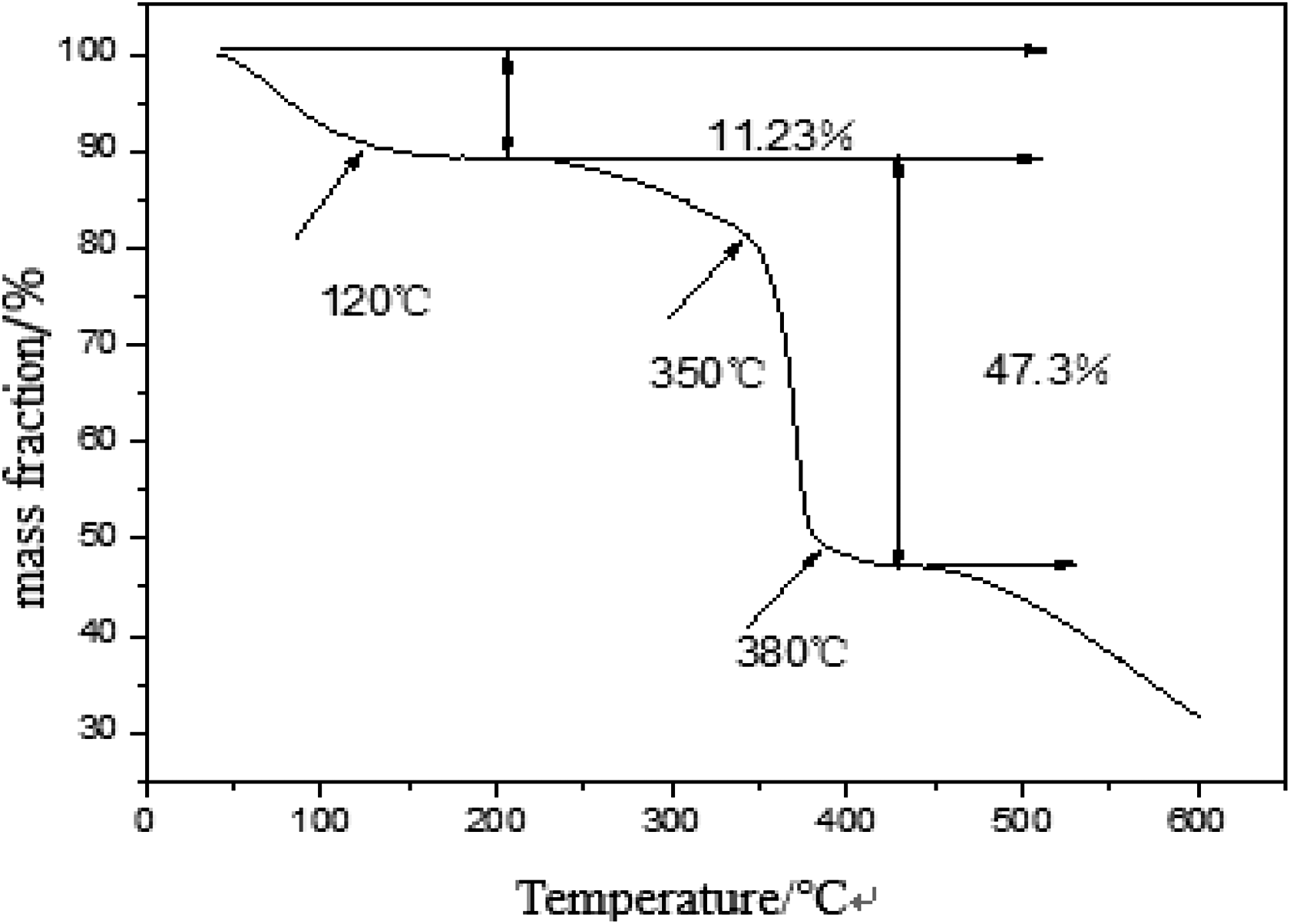
Thermogravimetric diagram of TH-1.
Performance evaluation of filtrate reducer TH-1
FL control performance of filtrate reducer TH-1
The FLAPI of the freshwater and 18% and 36% by weight of water (BWOW) saltwater cement slurries (ρ = 1.89 g cm− 3) with different TH-1 FL additive concentration (%BWOC) at 90°C/6.9 MPa are evaluated. The influence of the TH-1 FL additive concentration on the API FL values of cement slurries is shown in Figure 5. As is shown in Figure 5, the FL values (FL(API)) of cement slurry rapidly decrease with the increasing of the TH-1 concentration, but the FL value (FL(API)) in salt cement slurry is larger than that in freshwater cement slurry at the same concentrations of the TH-1. No matter the dosage of 4% TH-1 in freshwater or 6% in saturated salt cement slurry system, the amount of FL values (FL(API)) can be controlled within 50 mL, which can meet the construction requirements. The reason is that cement slurries are strong alkaline suspensions, including different kinds of salt ions. The salt ions have the screening effect in the cement slurry suspension, which makes the molecular chain of the TH-1 twisting, 24 especially in 36% BWOW saltwater cement slurry. The salt solution is a kind of strong electrolyte solution and the FL of brine cement slurry is difficult to control. The abilities of FL control of many kinds of filtrate reducer will be weakened and even disappear in brine cement slurry. 28,29

Influence of the TH-1 additive concentration on the American Petroleum Institute (API) fluid loss values of the three investigated cement slurries.
Temperature resistance of filtrate reducer TH-1
Temperature resistance is an important prerequisite for application of FL reducing agent in deep well and ultradeep well. Different temperature experiments are designed to test the temperature resistance of FL reducing agent; 4% and 5% fluid loss reducers were added into the cement slurries. Figure 6 is a test result diagram. As can be seen from Figure 6, with the increase in temperature, the FL value of cement slurry is increasing. But when the temperature is 200°C and the amount of TH-1 is 5%, the FL values can still be controlled within 50 mL. It shows that the filtrate reducer TH-1 has good high-temperature resistance. The filtrate reducer TH-1 can be associated to form “physical cross-linking network” structure, the advantage of this structure is in a state of molecular cross-linking, and molecular functional group is “embedded” in the association structure at low temperature. When the temperature increases, the association structure is gradually released, and the surface of cement particles is changed from partial adsorption to multipoint total adsorption, and the process is reversible. Compared with other anionic polymer reducers, the results show the TH-1 itself has good characteristics of temperature resistance. 19 In this way, the filtrate reducer TH-1 can also have good FL reducing ability at high temperature and does not affect the strength development of cement stone at low temperature.
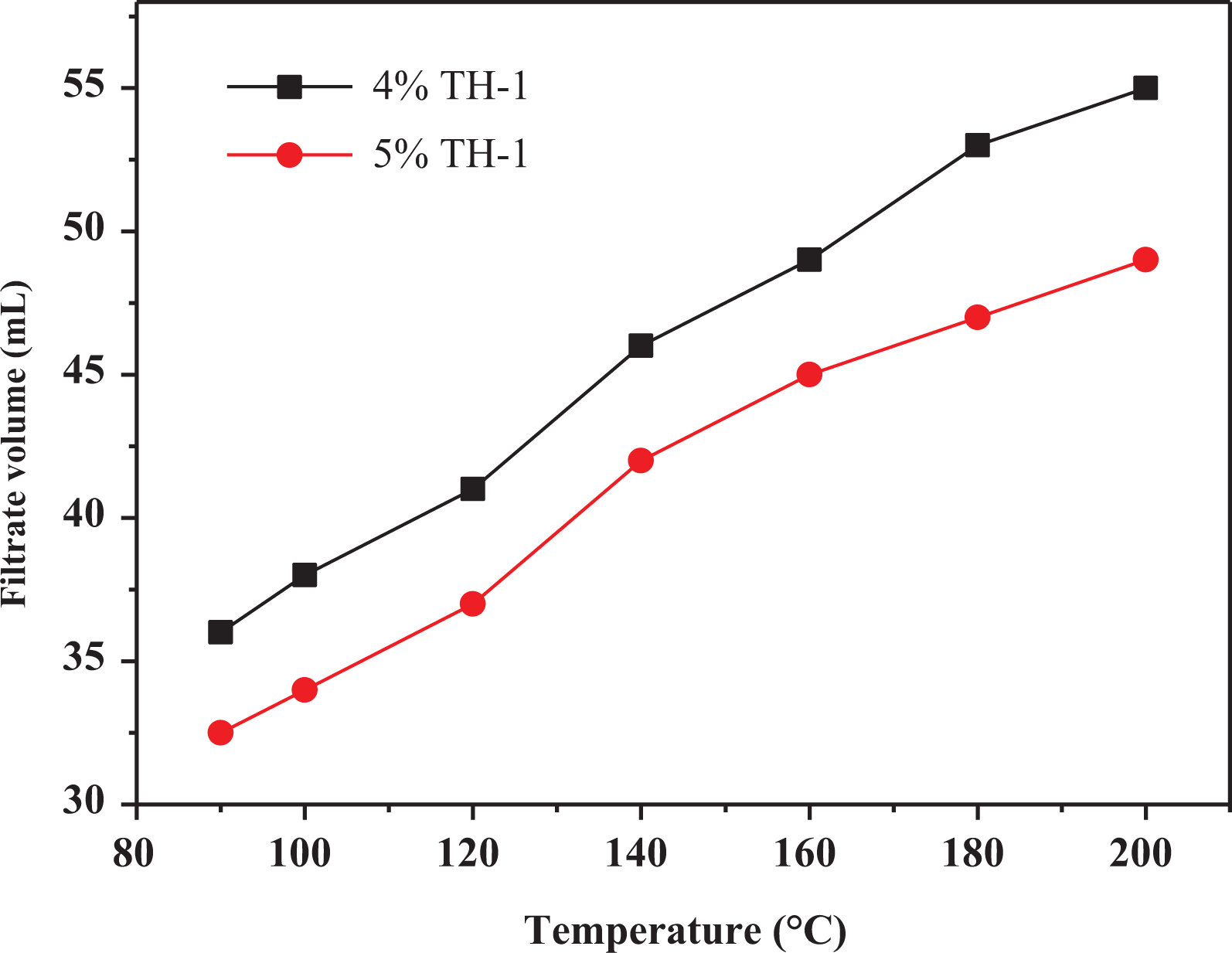
Influence of temperature on the API fluid loss values of the two investigated cement slurries.
Influence of filtrate reducer TH-1 on thickening properties of saturated brine cement slurry
The thickening performance of cement slurry is crucial. Not only the initial consistency is moderate, and the thickening curve is smooth without exception, but also the thickening transition time is short, and curve is “square” to meet the construction requirements. Base cement slurry formula and experimental conditions are presented in Table 3, and the designed density of all cement slurries is 1.89 g cm−3. Figure 7 is the thickening curve of cement slurries with filtrate reducer TH-1 at different conditions.
Base cement slurry formula and experimental conditions.

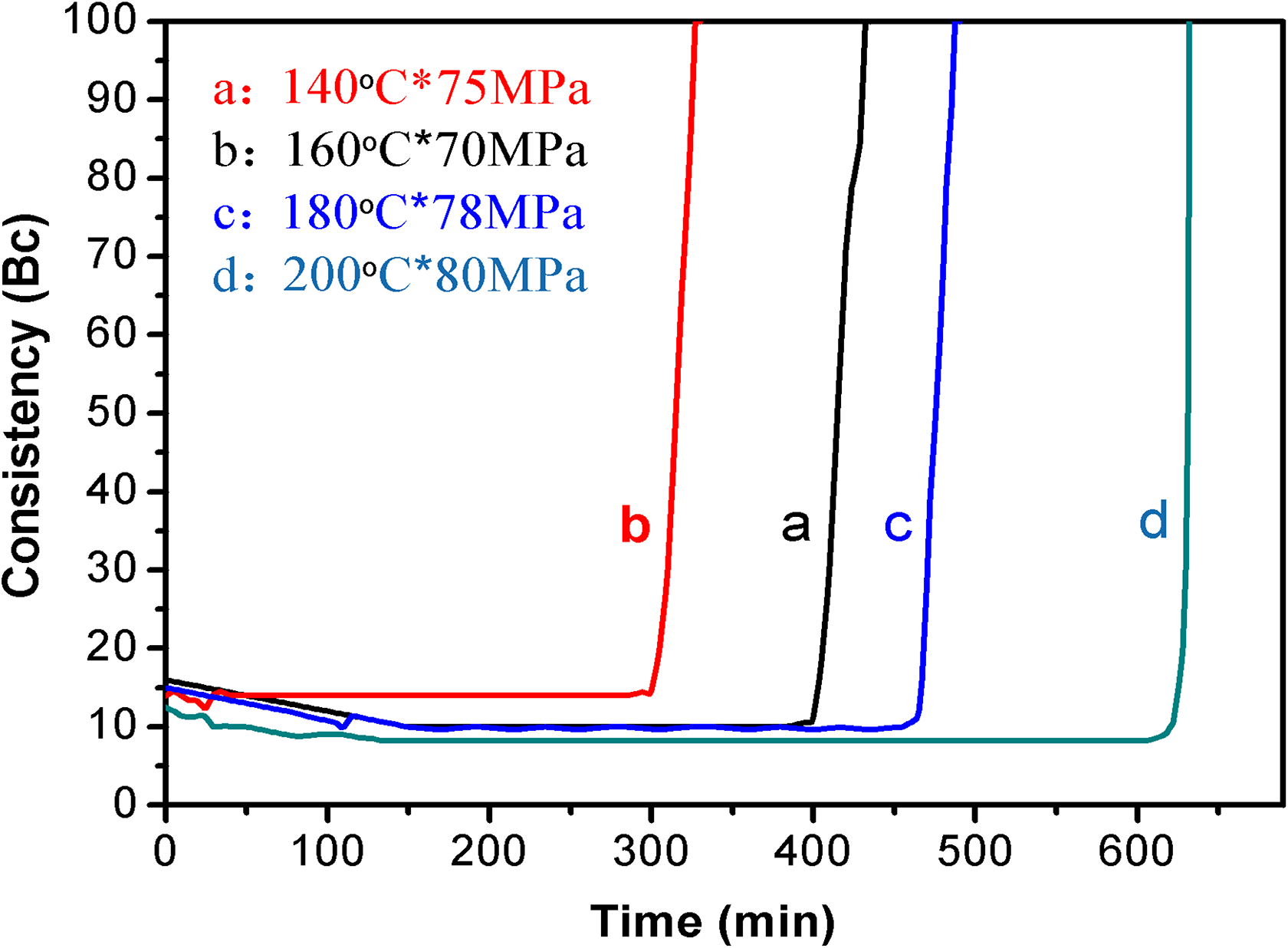
Thickening curves of cement slurries with fluid loss addition TH-1 at different temperature and pressure.
According to the thickening diagram, the initial consistency of the cement slurry is about 12 Bc. In the process of full thickening test, the consistency of cement slurry did not show an obvious decrease with the increase of temperature, so cement slurry has excellent stability at high temperature. Under the given temperature and pressure conditions, the thickening curve is smooth, no fluctuation or “core” phenomenon exists, which shows that the filtrate reducer TH-1 will not cause hidden safety problems in cementing operation. Finally, the thickening curve is right angle thickening, which has short transition time. It shows that cement slurry with filtrate reducer has good antigas channeling performance.
Comparative test between TH-1 and other filtrate reducers for oil well cementing
At present, nature and synthetic polymer are widely used in oil well cementing. The filtrate reducer additives are added into the freshwater cement slurry with the different amount at different temperatures. The density of all cement slurries is 1.89 g cm−3. The FL values of cement slurries are measured at 6.9 MPa. The results are listed in Table 4. As can be seen in Table 4, the FL value of TH-1 addition is 37, 40, and 36 mL at 90°C, 120°C, and 150°C, respectively, which is smaller than the other two products. Compared with nature and anionic polymer filtrate reducer, the amphoteric polymer TH-1 has better filtrate loss control performance.
The fluid loss values of nature polymer, anionic polymer, and TH-1.

Mechanism analysis of filtrate reducer TH-1
Oil well cements, usually based on Portland cement compositions, are particularly rich in silicate phase. Four principal mineral phase compounds of oil well cements used in this work are tricalcium silicate, dicalcium silicate, tricalcium aluminate, and tetracalcium alumino ferrite, which are presented in Table 5. In the cement slurry system, some cement particles have a positive charge on the surface, and some cement particles have a negative charge on the surface, as shown in Figure 8(a). So, the charged surfaces of a cement particle attract oppositely charge in the cement suspensions. 18,30 -34 The amphoteric polymer filtrate reducer TH-1 includes cationic and anionic group in a molecule structure shown in Figure 8(b), which can be adsorbed firmly on the surface of cement particles through electrostatic attraction, and forms a layer of adsorption membrane of viscoelasticity macromolecular, as shown in Figure 8(c). At the same time, the filtrate reducer TH-1 can also be adsorbed on the surface of cement particles through the hydrogen band, which could produce a hydrated layer, which makes the cement particles easily squeeze into the pores among the cement particles. Under differential pressure (ΔP), the channels of FL were blocked. And then, the cement filter cake becomes dense, and the permeability reduces, which can contribute to reduce the filtration loss.
Mineral compositions and physical properties of class G oil well cement.

C3S: tricalcium silicate; C2S: dicalcium silicate; C3A: tricalcium aluminate; C4AF: tetracalcium alumino ferrite.

The adsorption schematic diagram of amphoteric filtrate reducer on cement particle surfaces: (a) the surface of cement particles, (b) the TH-1 molecule structure, and (c) TH-1 adsorption on the surface of cement particles.
To probe the working mechanism of amphoteric copolymer TH-1 as filtrate reducer for cement slurry, we employed a scanning electron microscope (SEM) to observe the morphology of the cement filter cake after drying. The SEM of cement filter cake was shown in Figure 9. It can be seen from Figure 9 that the cement filter cake formed in the presence of filtrate reducer TH-1 (Figure 9(b)) shows a different image from that without TH-1 (Figure 9(a)). The surface of cement filter cake with TH-1 becomes smooth and compacted, because of coverage with copolymer film and seal of microholes to reduce permeability. The amphoteric copolymer TH-1 is multipoint adsorption to form a layer of adsorption film (Figure 9(c)), which could cover and seal the microholes in the cement cake to make it more compacted and reduce permeability.

SEM of cement filter cake: (a) the cement filter cake without TH-1, (b) the cement filter cake with TH-1, and (c) the multipoint adsorption of TH-1 on the surface of cement particles.
Conclusion
An amphoteric copolymer filtrate reducer TH-1 was synthesized by introducing a new W into the traditional class AMPS filtrate reducer. NMR spectroscopy and infrared spectra showed that the four monomers were copolymerized effectively. The TGA showed that the thermal stability of TH-1 was up to 350°C. The filtrate reducer TH-1 has excellent filtrate reduction property, strong saline tolerance, and good high-temperature resistance. The filtrate reducer TH-1 forms a layer of adsorption membrane on the surface of cement particles. The cement filter cake is more compact, and the gap filling is full, which efficiently controls the FL of cement slurry.
Footnotes
Declaration of conflicting interests
The author(s) declared no potential conflicts of interest with respect to the research, authorship, and/or publication of this article.
Funding
The author(s) disclosed receipt of the financial support for the research, authorship, and/or publication of this article: The financial support of Open Fund Project (PLN 1120) of State Key Laboratory of Oil and Gas Reservoir Geology and Exploitation (Southwest Petroleum University) are greatly acknowledged.
