




Abstract
The current study examines the tribological performance of poly(methyl methacrylate) (PMMA) reinforced with Salvadora persica (S. persica) powder and hydroxyapatite (HAP). This composite was selected to be used in dental application. Different percentages of S. persica were employed to enhance bioactivity and antibacterial properties. However, HAP was used to improve the wear performance of the composite. Friction response was investigated through scanning electron microscopy (SEM) with energy-dispersive spectroscopy, Vickers hardness, pin-on-disc tribometer, and 2-D profilometer. Both wear volume and friction coefficient were investigated, especially when changing the percentage of S. persica and HAP fillers. Moreover, the morphologies of the wear track were examined by the SEM, the wear mechanisms are discussed, and the phenomenon of stick-slip is shown. The main results revealed that the composition (70% PMMA + 20% S. persica + 10% HAP) has the best wear resistance.
Introduction
Tooth wear is a complex process that can be affected by many factors, such as the presence of opposing restorative materials with different wear behavior compared to tooth structure. 1 However, in the oral environment, oral bacteria, caries, and the biofilm acids represent the main reason behind the failure of dental restoration. To avoid demineralization, promote tooth remineralization, and improve the resistance of the oral bacteria, several studies incorporated antibacterial monomers or calcium phosphate particles into dental resin composite. 2,3 In fact, novel polymers containing quaternary ammonium monomer dimethylaminododecyl methacrylate (DMADDM) have been synthesized with antibacterial activities. 4,5 Another approach is to incorporate bioactive plant macromolecules and metabolites in enhancing bioactive performance of dental biomaterials by promoting material-tissue/cell interface. 6
In this work, a novel biocomposite with poly(methyl methacrylate) (PMMA), as resin containing both Salvadora persica powder and hydroxyapatite (HAP) as fillers, was elaborated. On the one hand, the medical plant S. persica was interesting due to its chemical, physical, and biological properties. In this case, we used the natural S. persica for its clinical interest arising from a number of mechanisms, including its antiplaque, anticaries, anti-inflammatory, antioxidant, antiviral, and antimicrobial properties. 7 The antioxidant activity can prevent or delay some types of cell damage by counteracting the damaging effects of oxidation. Besides, the antimicrobial and antiviral activity refer to the process of killing or inhibiting the disease-causing microbes and viruses, respectively. On the other hand, we used HAP as fillers in dental composite to improve the wear performance. 8,9 Moreover, HAP has a chemical composition similar to tooth enamel 10 and is highly biocompatible and bioactive as a result of thermodynamic stability in pH, temperature, and composition of physiological fluid level. 11 In addition, HAP promotes the remineralization of tooth enamel with Ca and P ion release. 12
In the present research work, it would highly be desirable to develop a dental restorative material with biological activities, such as the antibacterial activity, and interesting tribological properties. Knowing that human teeth and dental restorative materials are susceptible to inevitable lifetime process wear and friction, we focused on the evaluation of the effects of the addition of S. persica and HAP content on the tribological properties of the acrylic resin-based composite.
Materials and methods
Materials
A new composite was manufactured based on PMMA used as organic matric and different percentages of S. persica and HAP used as fillers. The acrylic resin (Nic Tone, MDC Dental, CA, USA) was supplied by manufacturer dental continental in the form of powder and liquid. The resin was used as the polymer/monomer ratio of 2:1.
Firstly, S. persica sticks (Miswak, Sewak Al-Baraka, Pakistan) were initially dried at room temperature. Then, the dried sticks were blended in a food-processing blender (coffee grinder, Moulinex, China). The mean size of the obtained particles powder was inferior to 40 μm. The characteristics of the S. persica powder are reported in Table 1.
Physical and chemical characteristics of Salvadora persica powder.

As mentioned above, the pure commercial HAP powder (Sigma-Aldrich, CA, USA, ≥90%) was used as a reinforcing material. The particle size of HAP is approximately 40 μm. The surface treatment of HAP particles was achieved by shaking samples during 48 h with a diluted solution of citric acid (0.05 M, pH = 6.0). After filtration, the HAP particles were dried at 60°C for 12 h. The presence of each coupling agent on the HAP surface was verified by infrared spectroscopy.
The composition of the evaluated experimental composite materials is presented in Table 2.
Composition of the evaluated experimental composite materials.

PMMA: poly(methyl methacrylate); HAP: hydroxyapatite.
Elaboration of samples
The powder and liquid of the denture base resin were mixed according to the conditions specified in the instruction manual and polymerization procedure. The composites were performed in a pressure device (Mini Major 2000, Major, Italy) at 60°C for 10 min under a pressure of 0.5 MPa. The dimensions of cylindrical samples were Ø25 × 4 mm2.
Vickers hardness
The Vickers hardness of composites was measured using a universal hardness tester (Zwick/Roell, ZHU 2.5, Japan). The indentation load HV10 was used. The full load was normally applied for 10 s.
Wear test
For tribological tests, the experiments were conducted using a pin-on-disk tribometer MZ-03 (ENIS-URCIM, Sfax, Tunisia). 13 The applied counter-body was an alumina ball with a diameter of 6 mm and a surface finish of 0.06 mm (Ra). The surface roughness of samples was Ra ≤0.4 µm. Three loads 2, 10, and 15 N were applied during wear tests. The sliding velocity was 300 r min−1 for 2 h and the diameter of wear track was 6 mm. The loads and sliding velocity were chosen to ensure severe wear conditions in these investigations (2 months of clinical service). All tests were conducted under dry conditions at room temperature. After testing, the wear track was scanned using a profilometer, in 10 locations, to obtain the wear volume. These volumes were employed to show the effect of S. persica and HAP addition on the wear resistance of the composite. Furthermore, the wear tracks were sputter coated with gold and examined using scanning electron microscope (SEM) (ZEISS 1450VPSE) to determine the wear mechanisms. In addition, the SEM equipped with X-ray energy-dispersive spectroscopy (EDS) to examine the wear debris.
Data are expressed as mean ± standard deviation (n = 5). One-way analysis of variance (ANOVA) was used to determine the differences among various groups. Values were considered statistically significant when p ≤0.05.
Results and discussion
HAP-coupling agent
To induce the reinforcement of the matrix/filler interface, citric acid was used because it is more biocompatible than silane and interacts easily with calcium ions.
11
Figure 1 shows Fourier-transform infrared spectra of HAP, indicating the presence of each coupling agent on particle’s surface. The band at 1090–1030 cm−1 and 600–560 cm−1 was due to the absorption of

FTIR spectra of (a) HAP without coupling agent and (b) HAP with coupling agent. HAP: hydroxyapatite; FTIR: Fourier-transform infrared.
Hardness
The mean values of the surface hardness of different compositions of the composite are shown in Figure 2. The hardness of the specimens decreased with the addition of S. persica (30 wt%) (p ≤ 0.05). However, the hardness significantly increased with the addition of 5% HAP in the first stage. Then, by increasing the percentage of HAP, the increase in hardness became not determinative. These findings are in agreement with those obtained by Raul et al., 11 who found that the addition of HAP particles to the unfilled monomer mixtures led to the increase of the surface hardness of the material.
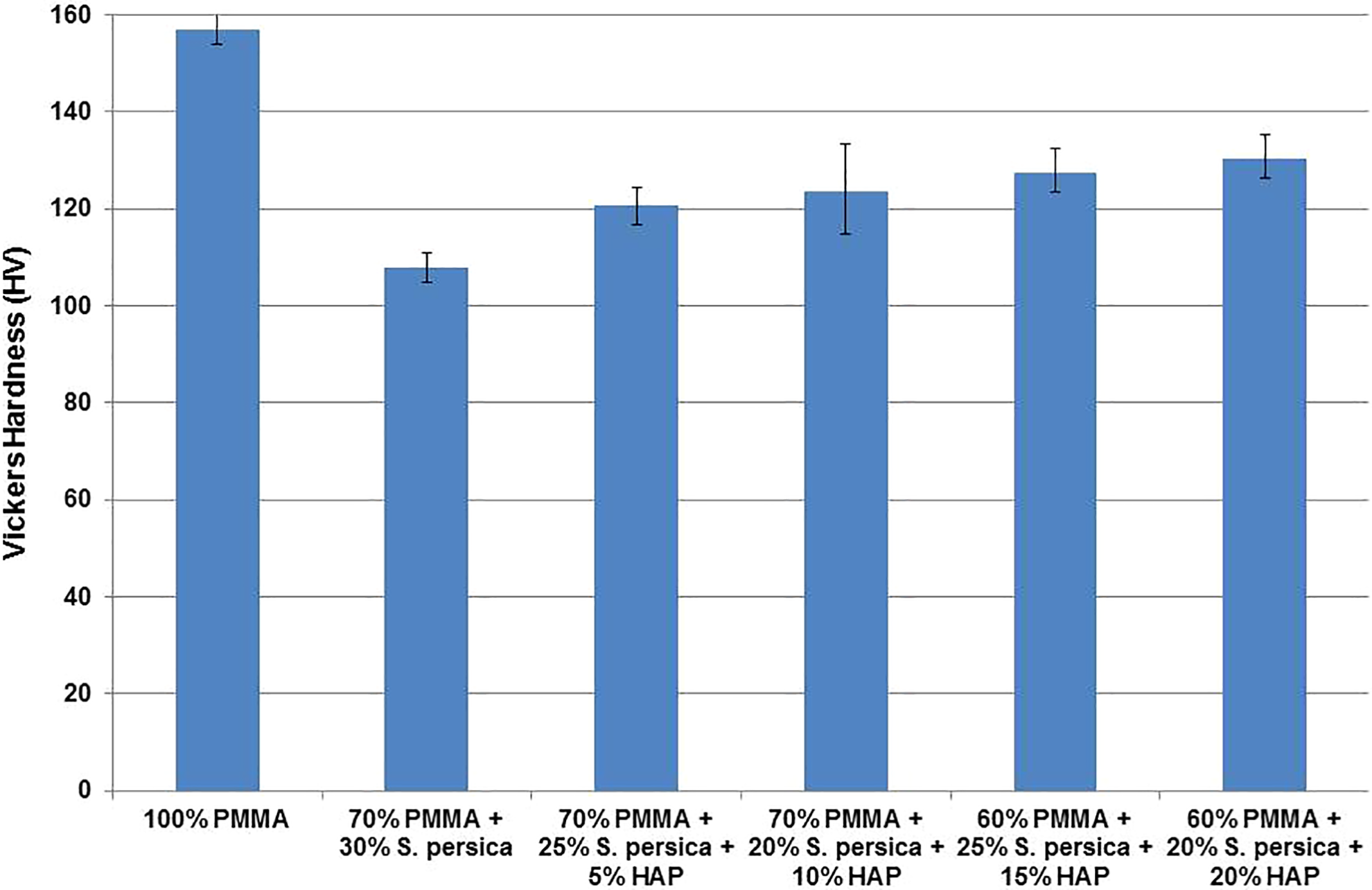
Hardness of different composition of the composite.
Wear behavior
The evolution of friction coefficient for the composites, during 2 h of sliding, is displayed in Figure 3. As can be seen in Figure 3(a), all friction curves show similar regimes for the different composites: the friction coefficient appears to increase rapidly at the beginning of the tribological test, after that, it remains at a constant value. This result may be related to that initial sample having a fresh surface, where its topography is the pertinent parameter determining the amplitude of contact face to wear. It also reveals that the evolution of the friction coefficient of PMMA/alumina was not significantly affected by the filler’s addition (Figure 3(a)).

(a) Friction coefficient versus time in dry ambient condition with 10 N and (b) the average steady coefficient of friction as a function of normal loads describing all studied composites.
Figure 3(b) reveals the evolution of friction coefficient against the applied normal load. It is clearly seen that the friction coefficient decreases with the applied load. This result can be explained by the effect of the third body and is highlighted in the composite. 14 In addition, this result may be due to improved contact area. 15
The wear resistance for different samples was estimated. Figure 4 shows the evolution of wear volume for different composites after 2 h sliding. To better illustrate wear variation, Figure 4(a) focuses on 2 N normal load case, whereas Figure 4(b) shows 10 and 15 N normal load cases. It can be noted that the wear volume of the composite significantly increased with the increase in the normal load for all tested materials. The ANOVA confirmed that the differences in the wear factors for the experiments with the three loads were statistically significant (p < 0.05).

Wear volume of different composites for (a) the load of 2 N and (b) the three loads (2, 10, and 15 N) used in the experiments.
The wear volume also increased with the addition of S. persica to PMMA for the three applied loads of 2, 10, and 15 N (p < 0.05).
Moreover, keeping the same percentage of PMMA, the addition of HAP to the composite caused the decrease of the wear volume in all cases (p < 0.05). Compared to the composite (70% PMMA + 30% S. persica), the addition of HAP enhanced the wear resistance of composites. However, keeping the same percentage of S. persica, increasing the amount of HAP increased the wear volume of the composite (p < 0.05), which is in contradiction with the expectations. Regarding this, it can be said that the increase in the total percentage of fillers further disturbed the uniformity of PMMA matrix; therefore, more surface pores and gaps will be prone to surface damage and reduces the wear resistance of the composite. 16
In addition, this result can be explained by an optimum fraction of HAP found in which the best wear resistance is achieved. In fact, the addition of 15% and 20% of HAP did not improve the wear resistance of the composite. Thus, this optimum fraction may be less than 10%. Seyed et al. 9 indicated that the addition of up to 10 wt% HAP to PMMA can improve the wear resistance. Moreover, Zafarani et al. 16 founded an optimum fraction of HAP (20 wt%) with the polytetrafluoroethylene (PTFE) in which the best wear resistance is achieved.
Thus, the composite with “70% PMMA + 20% S. persica + 10% HAP” formulation had the best wear resistance compared to the other composites and had a similar wear resistance as well as the pure PMMA (p > 0.05).
We can conclude that a new dental material was elaborated by adding S. persica. Thus, the biological activities, specifically antibacterial activity, can be added to the composite. As can be expected, S. persica decreased the wear resistance. Thus, to improve this mechanical property, another filler (HAP) was incorporated. As a result, the composite (70% PMMA + 20% S. persica + 10% HAP), in which an important percentage of S. persica was incorporated, has the best wear resistance.
To confirm such explanation of wear response and identify wear mechanism, further characterizations were required, especially on wear tracks.
SEM/EDS analysis
The SEM micrographs show typical worn surfaces of different composites, tested under 2, 10, and 15 N normal loads.
Firstly, it is worth to note that no significant wear was observed on the alumina ball. The wear debris mainly issued from composite were examined with the SEM/EDS. The EDS analysis showed Ca and P peaks with all composites. However, no peak of Al was detected, confirming that the wear debris generated from composite surface (Figure 5). Furthermore, the presence of Ca and P in debris can have a good effect on the remineralization of tooth enamel. 12
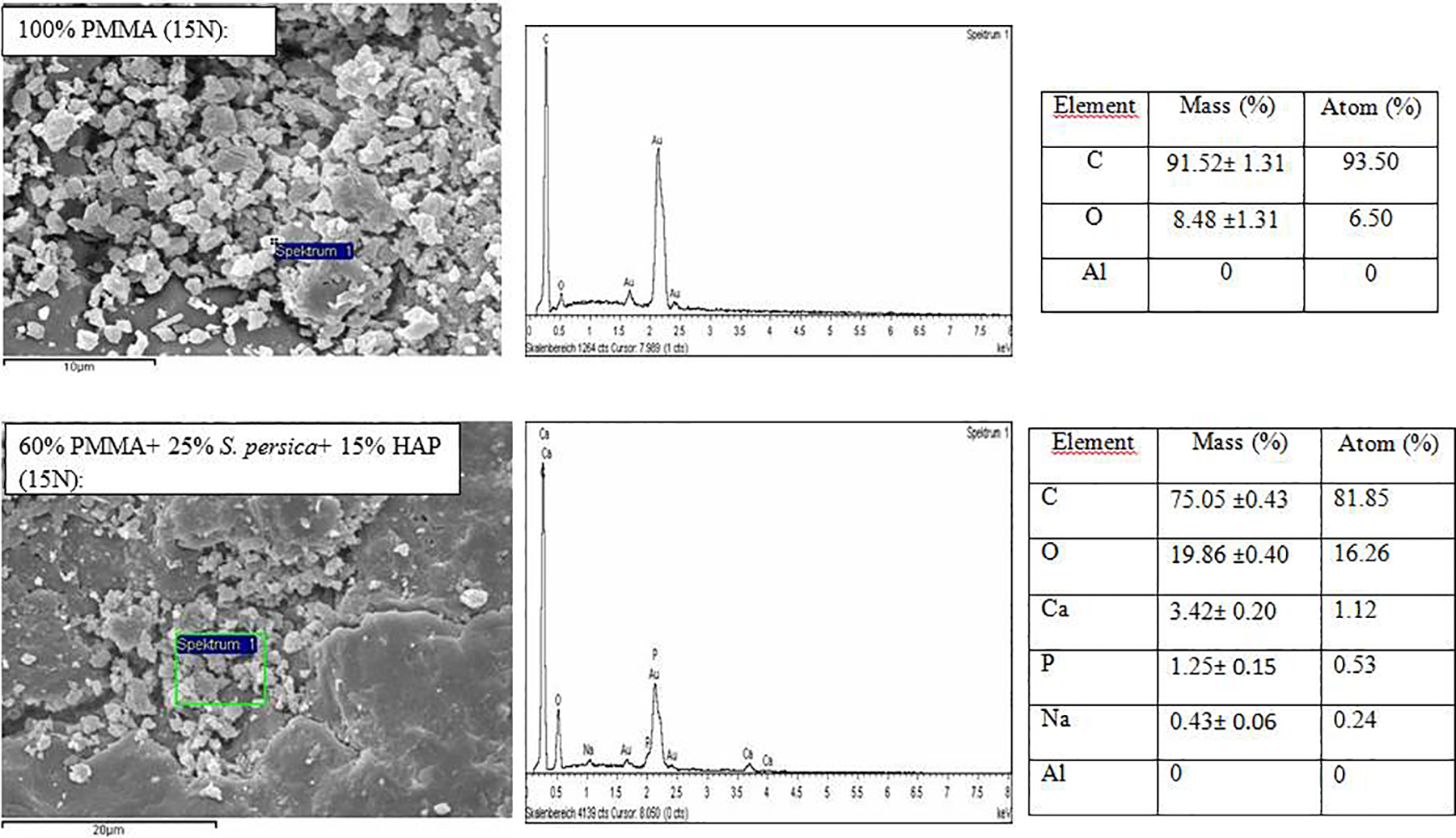
SEM-EDS observation of wear debris of different composites. SEM: scanning electron microscopy; EDS: energy-dispersive spectroscopy.
Regarding the wear mechanism, a stick-slip phenomenon can be identified on the wear track of all composites. Indeed, for the lowest normal load used, 2 N, initially, abrasive wear was revealed (the existence of some grooves (Figure 6)). However, by increasing the magnification of the images groove, a peeling surface was observed (Figure 6). Consequently, the grooves were, in reality, a stick-slip phenomenon, and an alternation between adhesion and friction was distinguished. Furthermore, a crack network was revealed on the wear track (Figure 7). Actually, small cracks appear due to the microfatigue phenomenon and the stress concentration on the surface of the composite. Indeed, Figure 6(b) exhibits continuous and deep cracks. Here, the microcracks assist material removal during alumina ball sliding. In fact, the intersection of radial microcrack with longitudinal microcrack leads first to the fracture of small particles and then to its detachment from the matrix in the form of debris (Figure 8). This debris acts as the third body and is the origin of grooves.

SEM observation of wear surface of the composite (60% PMMA + 25% Salvadora persica + 15% HAP) (2 N): (a) general view and (b) part of the observation with higher magnification. SEM: scanning electron microscopy; PMMA: poly(methyl methacrylate); HAP: hydroxyapatite.

SEM observation of wear surface of different composites appearance the crack network: (a) 60% PMMA + 20% S. persica + 20% HAP (2N) and (b) 70% PMMA + 20% S. persica + 10% HAP (2N). SEM: scanning electron microscopy.

SEM observation of entrapment sites for the compacted debris of the composite (60% PMMA + 25% S. persica + 15% HAP (15 N). SEM: scanning electron microscopy; PMMA: poly(methyl methacrylate); HAP: hydroxyapatite.
For the highest normal load used 10 and 15 N, there is a transition in wear mechanism, which becomes more severe, and the generation of debris becomes more important. Indeed, after 36,000 reciprocating sliding cycles, a localized microfatigue phenomenon was detected on the composite surface and it is followed by the formation of debris. These particles are kept inside the contact zone. Thus, the contact pressure is the preponderant factor to explain that debris are not expelled easily out of the contact zone. 17 Furthermore, the composite fragments produced from the highly loaded surface contacts by fracture are trapped between the two sliding surfaces and crushed into finer particles and will be compacted into the wear track to form a stuck zone and smooth area at the contact surface (Figure 9). The entrapment sites for compacted debris are generally identified into the valley regions of the rough composite surfaces (Figure 8). Hence, the wear tracks on the composite were nonuniform (Figure 9). Due to the stick-slip phenomenon, an alternation between adhesion and friction was illustrated. Although the stick-slip evolution depends on composite debris, third body, it also produces debris. 17

SEM observation of compacted debris of wear surface of different composites: (a) 70% PMMA + 25% S. persica + 5% HAP (15N) and (b) 70% PMMA + 20% S. persica + 10% HAP (10N). SEM: scanning electron microscopy.
Accordingly, the general wear mechanism is likely stick-slip. Thus, the stick-slip phenomenon depends on the normal load. According to Geringer et al., 17 the stick-slip is more important with the increase in the normal load.
Conclusions
Based on the experimental results of the wear tests under dry conditions, the following conclusions could be drawn: For the same explored conditions, the friction coefficients of all composites were similar, especially with the load of 10 and 15 N. However, this coefficient decreased with the applied loads. The composite (70% PMMA + 20% S. persica + 10% HAP) has the best wear resistance. The amount of fillers must be minimized to further improve the wear resistance of the composite. In terms of wear mechanisms, the phenomenon of stick-slip was shown.
Footnotes
Acknowledgements
The authors specially thank the technical and supporting staff at FH Bielefeld University of Applied Sciences (Bielefeld, Germany) for their assistance in laboratory analyses and Leila MAHFOUDHI (Faculty of Sciences, Sfax) for proof reading our manuscript.
Declaration of conflicting interests
The author(s) declared no potential conflicts of interest with respect to the research, authorship, and/or publication of this article.
Funding
The author(s) received no financial support for the research, authorship, and/or publication of this article.
