




Abstract
Carbon fibre-reinforced polymer (CFRP) tubes have been increasingly used in various structural applications due to its lightweight and attractive crashworthiness performance. The key parameter of the winding angle plays an important role in the energy-absorbing performance of CFRP tubes. In order to understand the relationship between the compressive performance and winding angle, this article is aimed to study the effect of winding angle with ±45°, ±60° and ±75° of CFRP tubes. The thin-walled CFRP tubes were performed by the quasi-static compression test, which were fabricated using the wet winding technique. The result was concluded that as the winding angle increased, the compressive modulus showed the decreasing trend. In the view of energy absorption (EA) and specific energy absorption (SEA), it was exhibited the decreasing trend as the winding angle increased. It was noted that CFRP tubes with ±45° winding angle recorded the average maximum SEA of 24.67 kJ kg−1. Moreover, the crushing behaviour of thin-walled CFRP tubes were involved and studied.
Keywords
Introduction
In recent years, automotive and aerospace industries mainly used advanced materials to replace conventional materials. Carbon fibre-reinforced polymer (CFRP) tubes have been increasingly used for various applications, including high-pressure vessels, 1 rocket motor cases, 2 missile cases and railway vehicles. 3,4 In order to fabricate a filament-wound composite tube, filament winding process is commonly used to manufacture the mass production of high-performance CFRP and glass fibre-reinforced polymer (GFRP) tubes. The filament winding technique has several advantages such as high automation, high productivity, high fibre volume and low cost on fibre and resin used, which compares to other composite fabrication methods. 5,6 For the properties and relevant performance of CFRP tubes, there are mainly affected by several factors, such as the geometric factor, 7 winding angle, 8 -10 material type, 11,12 loading condition 13 and trigger mechanism. 14 Noticeably, CFRP material is unlike the conventional materials like metal or aluminium, the failure behaviour of CFRP tubes are much complicated, including transverse cracks, fibre fracture, matrix cracks, inwards and outwards fronds and delamination. 4,15
Several researchers have reported that the crushing failure behaviour of CFRP tubes is observed from the existing cracks, which is mainly affected by its form, size, location and type. 16,17 . Some of the related literature has been carried out to explore several influence factors, such as winding angle, material type and geometric parameter. For example, Jia et al. investigated the effect of the geometric factor, winding angle and pre-crack angle of the filament-wound CFRP tubes under quasi-static crushing behaviour. 7 It was reported that with then winding angle increased, the compressive strength, modulus and crack length generally exhibited the decreasing trend. Moreover, Wang et al. have studied the effects of fibre orientation and wall thickness on energy-absorbing characteristics of CFRP tubes under different loading conditions. 18 It was found that the fibre orientation and wall thickness had significant influences in energy absorption (EA) performance. Mahdi et al. studied the effect of fibre orientation on the EA capability of composite tubes. It was shown composite tubes with 15°/−75° fibre orientation recorded the highest EA. 19
For CFRP and GFRP material types, CFRP material offers a higher capability against the crushing behaviour compared to GFRP with the same structural perspective. 4 Although some works have been studied to understand the effect of winding angle on CFRP tubes, there is still limited work reported on crushing failure behaviour and 15° differential value winding angle of thin-walled CFRP tubes on compressive properties. Therefore, this article aims to study the effect of the winding angle of thin-walled CFRP tubes with ±45°, ±60° and ±75°. The thin-walled CFRP tubes were fabricated using the portable three-axis filament winding machine, which used a wet winding process. In order to examine the compressive properties of CFRP tubes, the quasi-static axial compressive test was performed. Furthermore, several parameters of compressive properties were studied such as peak crushing force (F peak), mean crushing force (F mean), crushing force efficiency (CFE), EA, and specific energy absorption (SEA). The crushing failure behaviour of CFRP tube with ±45°, ±60° and ±75° winding angles was also studied.
Experimental methods
Materials preparation
The epoxy resin, D.E.R.331TM liquid epoxy resin was supplied by Salju Bistari Sdn. Bhd (Selangor, Malaysia). The hardener, a modified cycloaliphatic amine JOINTMINE 905-3S, was provided by Epochemie International Pte Ltd (Woodlands Bizhub, Singapore) The PYROFILTM TR30S 3 K carbon fibres were obtained from Mitsubishi Rayon Co., Ltd (Tokyo, Japan), which had a diameter of 7 µm, a density of 1.79 g cm−3, a tensile strength of 4.12 GPa and an elongation of 1.8%.
Specimen fabrication
The epoxy resin system was provided epoxy resin and hardener with a recommended weight ratio of 2:1, which was uniformly mixed using WiseStir HS-30D (Selangor, Malaysia) at 200 r min−1. Filament-wound CFRP tubes of ±45°, ±60° and ±75° winding angles were fabricated by the portable lab-scale three-axis filament winding machine. 20,21 Figure 1 presents a flow process of thin-walled CFRP tube preparation procedure in this study, which refers to the mandrel surface layer preparation stage, fabrication stage, curing stage, demoulding stage and cutting stage. The mandrel surface was covered with three layers to avoid the direct contact between the mandrel surface and inner surface of CFRP tube, which involved normal tissue layer, packing tape layer and Teflon layer.
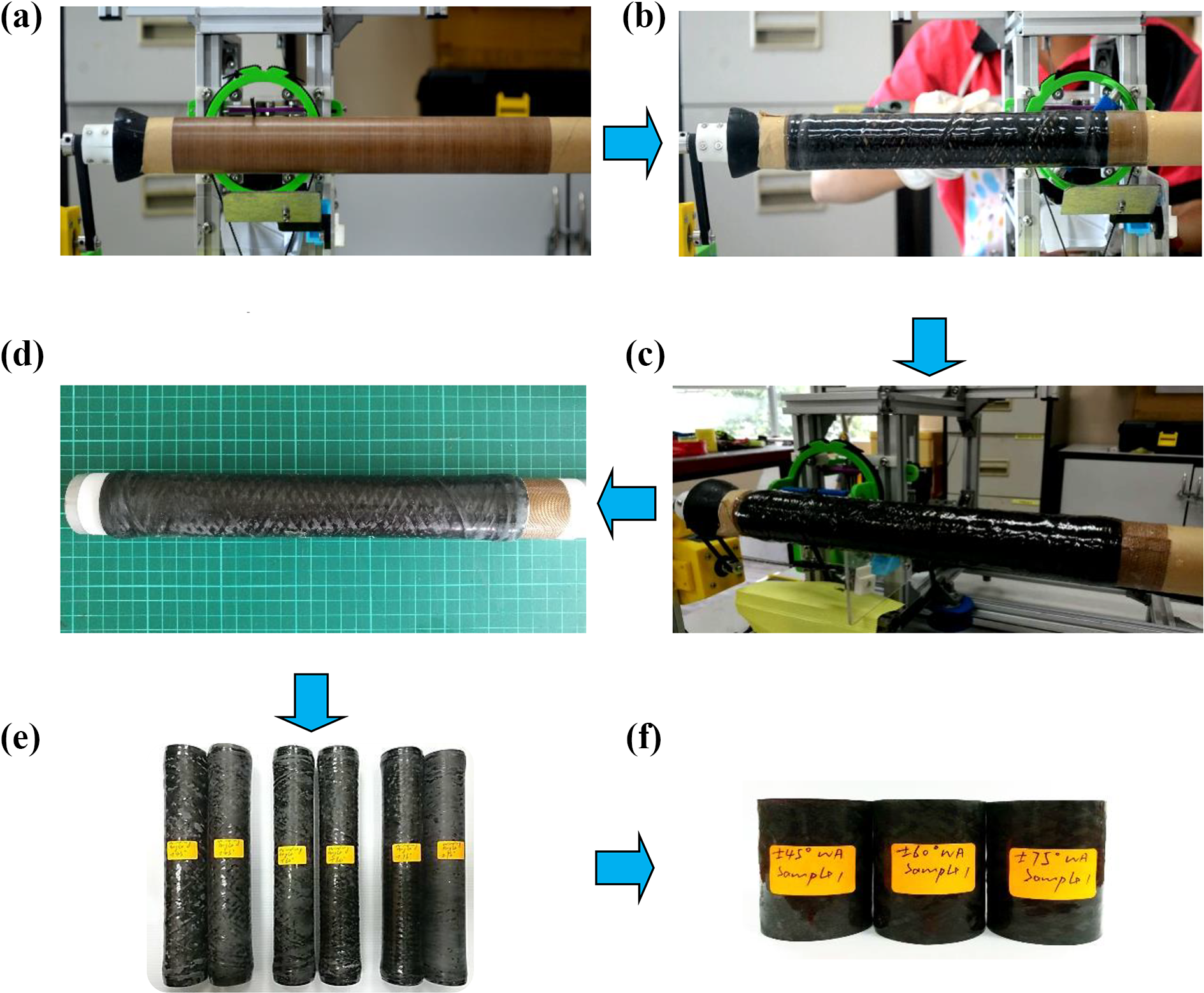
Flow process of thin-walled CFRP tube preparation procedure in this study. (a) mandrel surface layer preparation, (b) wet winding process, (c) curing process, (d) demoulding process, (e) CFRP tubes, and (f) cutting process.
Initial specimens were fabricated using wet winding process and fully cured for 24 h at room temperature of 25°C. The initial CFRP tube was easily demoulded from the mandrel. The CFRP tubes were cut into 55 mm height by vertical saw machine, and two end cross-section surfaces were polished using the Forcipol (Selangor Darul Ehsan, Malaysia) grinder–polisher equipment. The structural dimension of CFRP tube had an inner diameter of 39.2 mm and an outer diameter of 41.6 mm, which followed the ASTM D5449 standard, as shown in Figure 2. The geometric dimension, mass and stacking sequence of specimens were summarized in Table 1. The specimen was labelled according to the type of material and winding angle. For example, the specimen CFRP451 represents the first trial single CFRP tube with a ±45° winding angle of two ply layers. Furthermore, the fibre mass fraction of CFRP tubes was determined as 39.93%, 40.63% and 42.77% for ±45°, ±60° and ±75° winding angles, which were obtained according to burnout test.

The structural dimension of CFRP tubular sample used in this study.
Summary of all thin-walled CFRP tubes.

CFRP: carbon fibre-reinforced polymer.
Quasi-static axial compression test
The quasi-static axial compressive test was performed using a standard universal testing machine Instron-3369 (Petaling Jaya, Selangor Darul Ehsan, Malaysia) model with a maximum of 50 kN load capability. The machine crosshead loading rate was set to 2 mm min−1. The thin-walled CFRP tubes were crushed 40 mm, which was 72% crushing displacement of the initial height of the specimen. The load versus displacement curves were recorded and plotted by the Bluehill version 3 software, and the crushing failure behaviour of CFRP tubes was photographed by the crushing history. Four trials of each winding angle were tested to ensure the reliability of this study. Figure 3 shows the schematic overview of quasi-static compression test setup in detail.

Schematic diagram of quasi-static compression test setup.
Crashworthiness criteria
Based on previous studies on the crushing behaviour of CFRP tubes, several typical compressive properties were defined and calculated to evaluate the compressive performance, such as F peak, F mean, CFE, EA and SEA. 7,22 -26
The F peak is obtained from the load versus displacement curve, and the F mean is calculated as follows:

where d is the crushing displacement and EA represents the energy absorption between the crushing displacement, which is mathematically calculated according to the following equation:

where d is the crushing displacement, x is the function of deformation and F(x) is the crushing force.
The CFE is defined to quantify the crushing force uniformity, which is used to evaluate the stability of the compressive performance as the absorber. It is defined as the following equation:

The SEA is an essential parameter to evaluate the crushing characteristics of the used material. It is defined as the absorbed energy by per unit mass of crushing specimens, as calculated:

where m is the mass of the crushing sample. It is noted that the higher SEA value represents a better EA efficiency in crushing condition.
Results and discussion
Result of crushing behaviour of CFRP tube
The typical crushing history and load versus displacement of the CFRP tube under quasi-static compression test are shown in Figure 4. There are elastic and plastic deformation stages during in crushing deformation history. In the elastic deformation stage, the crushing load sharply increased to the peak force of 8.49 kN at crushing displacement of 2.12 mm, where the crushing failure deformation of the CFRP tube occurred. In the plastic deformation stage, the crushing load dropped abruptly and floated within a small range, where the plastic failure deformation of the CFRP tube observed.

The typical crushing behaviour of CFRP tube under quasi-static loading.
The typical crushing behaviour of CFRP tubes with ±45°, ±60° and ±75° winding angles is shown in Figure 5. For instance, CFRP45X represents the four trials of CFRP tubes with a ±45° winding angle. It can be seen that the crushing failure of CFRP45X, CFRP60X and CFRP75X showed unstable local buckling deformation in the thin-walled tube wall. It was used to hinder the further deformation expansion of the longitudinal cracks and terminate the delamination. 25 Failure cracks of CFRP45X occurred at the top position of the CFRP tube, and failure cracks of CFRP60X and CFRP75X were initiated at around the middle height. It was observed that some transverse cracks, fibre fracture, outwards, local buckling and fragments were initiated and propagated in the plastic deformation stage as the crosshead moved further in the test. Moreover, it was observed that initial cracks were occurred and paralleled the winding angle following the axial direction, which agreed with the similar observation on CFRP tubes by other researchers. 7,10,26

The typical crushing behaviour of CFRP tubes with three types of winding angles: (a) ±45° winding angle, (b) ±60° winding angle and (c) ±75° winding angle.
Figure 6 shows the crushing failure photographs of the damaged CFRP tubes with ±45°, ±60° and ±75° winding angles. For specimen CFRP451 and CFRP454, several buckling paths were occurred between the undamaged zones and transverse cracks around the tubular wall, as shown in Figure 6(a). The EA was mainly due to fibre fracture, transverse shearing, inward and outward fronds. For specimen CFRP601, CFRP602 and CFRP604, as shown in Figure 6(b), transverse cracks and fibre fracture were mainly observed. The EA was based on the initiation and propagation of transverse cracks, fibre fracture, lamina bending and the frictional interaction between the tube wall and crosshead.

Thin-walled CFRP tubes after quasi-static compressive test: (a) ±45° winding angle, (b) ±60° winding angle and (c) ±75° winding angle.
The CFRP tubes with ±75° winding angle had a similar crushing failure behaviour, which observed the circumferential cracks, few transverse cracks, brittle fracturing and fibre fracture. The corresponding EA was mainly due to the initiation and propagation of transverse and circumferential cracks, brittle fracturing of the lamina and the frictional contact between the specimen and two crossheads. Moreover, specimen CFRP752 showed several undamaged zones, and it was the fact that the unstable crushing deformation happened in the middle position of the tube, which caused the catastrophic collapse.
Result of load versus displacement curves
Graph of load versus displacement curves of CFRP tubes with ±45°, ±60° and ±75° winding angles was plotted in Figure 7, which showed the similar load versus displacement curves. 25 -27 For specimen CFRP453, the load sharply reached 11.09 kN as the peak load. It started to shear off as the compressive crosshead moved further in the plastic deformation stage. It was noted that the crushing fracture occurred obviously after the compressive load reached the peak load point, and the CFRP tubes started undergoing the compact failure mode. It can be seen that as the winding angle increased, the peak load of CFRP tube showed the decreasing trend. Meanwhile, CFRP tubes with ±45° winding angle offered the better energy-absorption performance according to its load versus displacement curves, as shown in Figure 7(a). Like specimen CFRP751, it obtained the lower load versus displacement graph compared to other specimens with ±75° winding angle, which probably caused by the unstable loading condition and specimen’s imperfections. 27

Graph of load versus displacement curves of CFRP tubes: (a) ±45° winding angle, (b) ±60° winding angle and (c) ±75° winding angle.
Figure 8 presents the typical stress versus strain curve of CFRP tubes with ±45°, ±60° and ±75° winding angles. Specimen CFRP45X offered the maximum nominal stress value of 64.30 MPa, which is 1.15 and 1.21 times on nominal stress value for CFRP60X of 55.69 MPa and CFRP75X of 52.95 MPa, respectively. It was revealed that as the winding angle increased from ±45° to ±75°, the maximum nominal stress value of CFRP tubes showed the decreasing trend. The thin-walled CFRP tubes with ±45° winding angle had the better progressive crushing performance under quasi-static axial compressive test, which was attributable to the fact that the fibre alignment along the longitudinal axis decreased as the winding angle increased.

Graph of the typical stress versus strain curve of CFRP tube with ±45°, ±60° and ±75° winding angles.
Effect of winding angle on compressive properties
Figure 9 presents the effect of winding angle on the compressive modulus and compressive strength of CFRP tubes. It can be seen that as the winding angle increased, the compressive modulus exhibited the decreasing trend, as shown in Figure 9. The maximum compressive modulus occurred at ±45° winding angle, which agreed with similar studies of CFRP tubes by previous researchers. 7,28 -30 Furthermore, it was noted that as the winding angle increased, the compressive strength value exhibited an increasing trend from the ±45° to ±60° winding angle. However, it was observed the decreasing trend from the ±60° to ±75° winding angle. The maximum compressive strength value occurred at ±60° winding angle, and it showed the average compressive strength of 58.60 MPa with 4.14 MPa standard deviation.

Effect of winding angle on compressive modulus and strength of CFRP tubes with ±45°, ±60° and ±75° winding angles.
The compressive modulus was obviously shown the decreasing trend, as shown in Figure 9, which was attributed to the fibre alignment with the winding angle increasing. However, the minimum compressive strength value was shown at ±45° winding angle, which involved the local buckling crushing behaviour of CFRP tube. For the lower winding angle below ±45°, such as ±20° or ±40°, Jia et al. have investigated that with the winding angle decreased, the compressive modulus and strength observed the maximum value at the winding angle of ±20°. 7 Moreover, several compressive properties of the CFRP tubes such as F peak, F mean, EA and SEA were obtained and calculated according to the load versus displacement curves, which were summarized in Table 2.
Summary of compressive properties of all CFRP tubes.
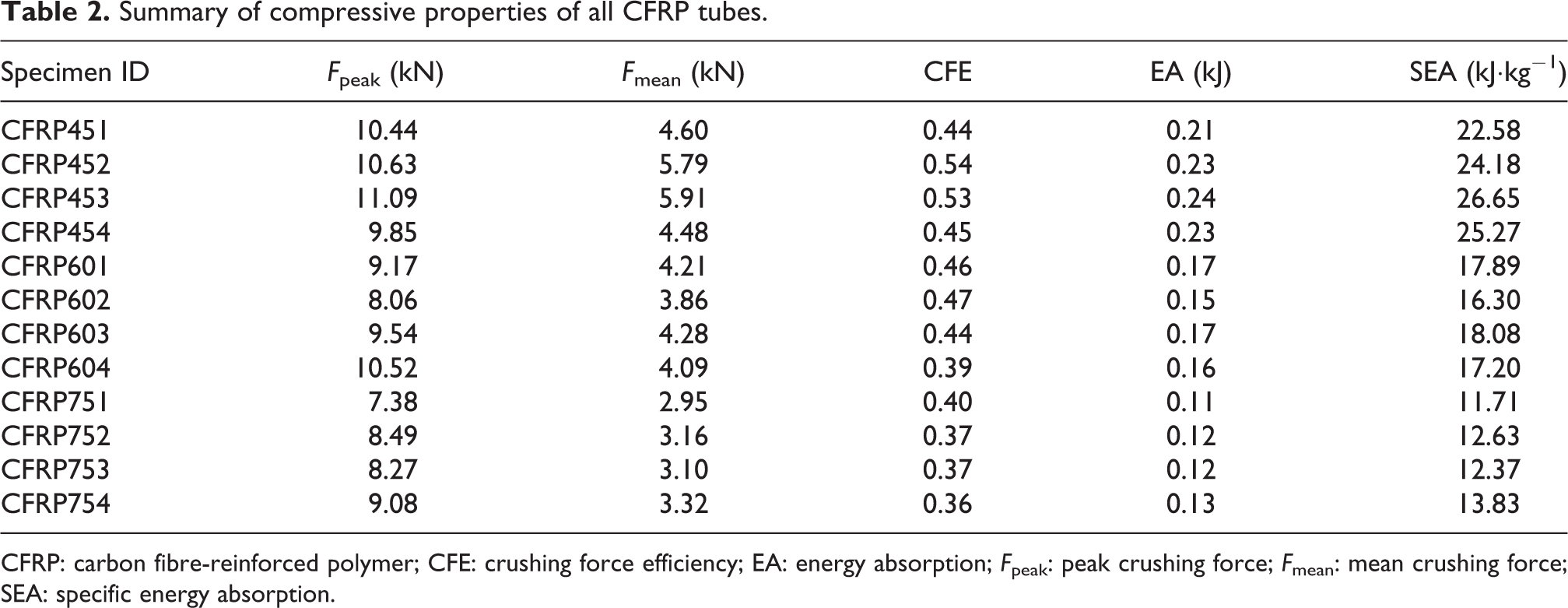
CFRP: carbon fibre-reinforced polymer; CFE: crushing force efficiency; EA: energy absorption; F peak: peak crushing force; F mean: mean crushing force; SEA: specific energy absorption.
Energy-absorbing characteristics of CFRP tubes are essential parameters used in automotive and aerospace applications. Therefore, it is significant to study the effect of winding angle on EA and SEA of thin-walled CFRP tubes, which were calculated according to equations (2) and (4). Figure 10 shows the effect of the winding angle on the EA and SEA of CFRP tubes. The average maximum EA was 231.36 J at ±45° winding angle of CFRP tubes. It was observed that the CFRP tube with ±60° winding angle showed the 1.31 times improvement on EA compared to ±75° winding angle, as shown in Figure 10(a).
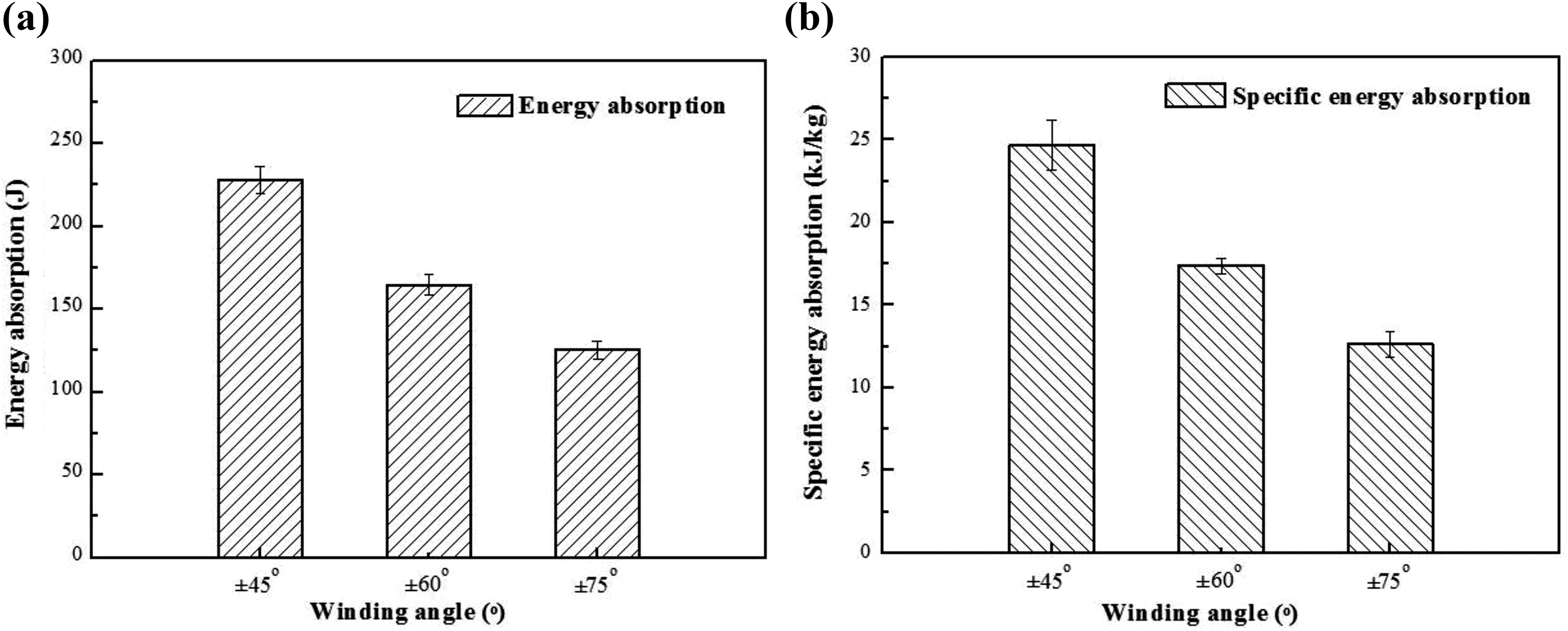
Effect of winding angle on energy-absorbing properties of CFRP tubes with ±45°, ±60° and ±75° winding angles: (a) EA and (b) SEA.
For SEA, it was found the maximum SEA was 24.67 kJ kg− 1 at ±45° winding angle, as shown in Figure 10(b). It can be seen that as the winding angle increased, the EA and SEA gradually showed the decreasing trend, which was consistent with the related studies by other researchers. 18,19,31,32 . It was attributable to the fact that as the winding angle approached to the loading direction, it offered the better energy-absorbing characteristics of thin-walled CFRP tubes. 7
Conclusion
The effect of winding angle on the crashworthiness characteristic of CFRP tubes was experimentally investigated in this study. The main conclusions from this study are summarized as follows.
The crushing behaviour of thin-walled CFRP tubes was mainly observed several failure types, which involved transverse cracks, brittle fracture, fibre fracture, local buckling, lamina bending, inward and outward fronts and fragments.
For load versus displacement curves of thin-walled CFRP tubes, it was concluded that specimen CFRP45X obtained the average maximum F peak of 10.50 kN and the average maximum F mean of 5.19 kN. It was summarized that as the winding angle increased, the peak load of CFRP tube showed the decreasing trend.
For compressive modulus and compressive strength of thin-walled CFRP tubes, it was found that as the winding angle increased, the compressive modulus generally exhibited the decreasing trend. Moreover, the compressive strength plotted the increasing trend from ±45° to ±60° winding angle, and it showed the decreasing trend from the ±60° to ±75° winding angle.
For the effect of winding angle on EA and SEA, it was obtained that as the winding angle increased, EA and SEA showed the decreasing trend. The average maximum EA was 231.36 J at ±45° winding angle, which offered 1.63 and 1.84 times higher value compared to ±60° and ±75° winding angles.
Footnotes
Acknowledgements
The authors are grateful to the Ministry of Education Malaysia (Fundamental Research Grant Scheme: FRGS/1/2019/TK03/UMP/02/10) and Faculty of Mechanical and Automotive Engineering Technology, Universiti Malaysia Pahang for funding this research with PGRS180319. This research work is strongly supported by Structural Material & Degradation (SMD) Focus Group, which provided the research materials and equipment.
Declaration of conflicting interests
The author(s) declare no potential conflict of interest concerning the research, authorship, and/or publication of this article.
Funding
The author(s) disclosed receipt of the following financial support for the research, authorship, and/or publication of this article: Master Research Scholarship (MRS), Institute of Postgraduate Studies, Universiti Malaysia Pahang.
