



Abstract
The hexamethylenediamine-modified graphite oxide/Co-polyamide (GO-HMD/CO-PA) nanocomposites were successfully produced by solution blending method. X-ray diffraction, Fourier-transform infrared spectroscopy, scanning electron microscopy, and atomic force microscopy analyses revealed that GO with a large number of oxygen-containing functional groups was successfully obtained by a modified Hummer’s method. For GO-HMD, the amino and amide bonds were introduced into the GO sheets, making the sheets more incompact, fluffy, and irregular. GO-HMD with a content of less than 1 wt% could be uniformly dispersed in the CO-PA matrix. A series of analysis indicated that the tensile strength, yield strength, and elongation at break of 0.4 wt% GO-HMD/CO-PA increased by 73.4%, 185.9%, and 42.3%, respectively. Thermogravimetric analysis showed that GO-HMD played the role of the heterogeneous nucleation in the matrix and could change the crystal type of the polyamide. The T 50% and Td , max of nanocomposites were 14.3°C and 11.8°C higher than pure polyamide, respectively. The nanofiller GO-HMD contributes to the increase of the thermal diffusivity at low temperature.
Introduction
Polyamide (or nylon), as one of the most important engineering plastics, has many outstanding properties, such as good durability, strength, excellent chemical resistance, flexibility, and so on, so it has been widely used in many fields. 1 -4 Following nylon 6 and nylon 66, graphite oxide (GO)/Co-polyamide (CO-PA) was successfully synthesized by Gehard Poessnecker et al. 5 At present, CO-PA has been widely used because of its good processability. However, the pure CO-PA also has disadvantages, such as strong absorption of water, weak light resistance, and acid resistance, so it needs to be modified by nanofiller to enhance performances. The addition of carbon nanofiller to the polymer matrix has attracted a lot of attention from researchers. Carbon nanofiber, 6 C60, 7 carbon nanotube, 8 graphene(GE), 9 and other fillers have been extensively studied and applied to matrix materials. Among them, as a new type of carbon material, GE has attracted wide interest since it was discovered in 2004 by Novoselov et al. 10 at Manchester University. GE has many excellent properties including abrasion resistance, a specific surface area (2630 m2 g−1), 11 high Young modulus (1.01 TPa), and tensile strength (125 GPa) 12 because of its unique two-dimensional structure. Due to its excellent properties, GE has been widely used in the production of composite materials to improve the mechanical properties, thermal properties, and electrical properties of composite materials. 13 -18 However, it has a strong conjugation effect because of the unique structure, 19 so it is easy to agglomerate in the matrix, which affects the improvement of the properties of composites.
Functionalization of GE is an important method to solve the problem of poor dispersion of GE. Due to the strong reactivity of amino groups, amino modification is often used to prepare aminated GE and its composite materials. 20 Kuila et al. 21 successfully prepared dodecyl amine/GO using the amino groups of dodecyl amine and the oxygen-containing functional groups linked on the GO layers. Niyogi et al. 22 modified prechlorinated GO with octadecylamine, and the products could be dissolved in various organic solvents. Su et al. 23 explored resistive humidity sensors prepared by adding diamine-functionalized GO, and the results showed that the humidity sensors have wide measurement range, high sensitivity, good flexibility, fast response time, and short recovery time. In summary, the modified GO has introduced some new functional groups, which improved its dispersibility in the matrix and further extended the application ranges.
With the development of society, polymer materials have been widely used in a variety of industries, but in some fields polymer materials can’t meet people’s requirements because of their inherent properties. The combination of nano fillers and polymers can improve the properties of polymers to a certain extent, 24 -26 which is an important topic for scientists. 27 -32 Hieu et al. 33 prepared GE/polyvinyl alcohol (PVA) and GO/PVA nanocomposite films by solution blending method to study the compatibility of GE, GO with PVA, and the effect on PVA performances. The results showed that when the fillers content was 0.5 wt%, the dispersion of GO in PVA matrix was better than that of GE, and the thermal stability of GE/PVA nanocomposites was better than that of pure PVA. Tewatia et al. 34 prepared a GE/polyether ether ketone nanocomposite by melt blending. Compared with pure polymer, the amount of GE was between 2 wt% and 5 wt%, and the mechanical properties, thermal stability, and crystallization properties of the composites were improved.
At present, most of the researches on GE-enhanced polyamides are based on PA-6, and few of them are based on Co-polyamide PA-6/PA-66/PA-1010. In fact, due to the irregularity of the CO-PA molecular chain, it has good toughness, but the strength is not as good as PA-6, PA-66, and PA-1010. Therefore, the aim of the work was to greatly improve the mechanical properties of CO-PA by adding an appropriate amount of hexamethylenediamine-modified graphite oxide (GO-HMD).
Experimental section
Materials
Natural graphite (NG, SP-2(C > 99%, D = 5 μm)) was purchased from Tianjin Dengke Reagent Company (China); potassium permanganate (KMnO4) (C.P.) was purchased from Tianjin Kemiou Reagent Company (China); CO-PA (PSGN150, containing PA-6, PA-66, and PA-1010; with a mass ratio of 7:2:1) was supplied by Shanghai Xinhao Chemical Company (China); sodium nitrate (NaNO3) (C.P.) was purchased from Tianjin Damao Reagent Factory (China); sulphuric acid (H2SO4) (>98%) and hydrogen peroxide (30 wt%) were purchased from Chengdu Kelong Reagent Factory (China); N, N-dimethylformamide (DMF) was purchased from Tianjin Fuyu Fine Chemical Company (China); HMD was purchased from Tianjin Dingsheng Chemical Company (China); and O-(7-azabenzotriazol-1-yl)-N, N, N′, N′-tetramethyluronium hexafluorophosphate (HATU) was purchased from Yonghua Chemical Technology Company (China).
Synthesis of GO
In this article, GO was prepared by a modified Hummer’s method, which was described in detail in our previous report. 35
Synthesis of GO-HMD
GO (0.5 g) was first dispersed in 250 mL of the DMF using ultrasonication (power, 99 W; Shanghai Zhi Sun Instrument Corporation, China) to obtain GO-DMF suspension (2 mg mL−1). HATU (0.5 g) was carried out in GO-DMF suspension and heated to 60°C in an oil bath. Then under this temperature, HMD (5 g) was dissolved into the mixture and stirred constantly for 6 h. Finally, the GO suspension was filtered, washed with distilled water, and dried in vacuum at 60°C for 24 h. The modified GE powder sample was labeled as GO-NH2/HMD. The preparation process of GO-NH2/HMD nanoplatelets is shown in Figure 1.

Schematic diagram of the preparation process of GO-NH2/HMD.
Fabrication of GO-HMD/CO-PA nanocomposites
Respectively, appropriate amount of GO-HMD (0.02 g, 0.04 g, 0.06 g, 0.08 g, 0.10 g, and 0.15 g) was dispersed in the DMF and ultrasonic vibration for 2 h to obtain uniform GO-HMD/DMF dispersions (1 mg mL−1). At the same time, CO-PA (10 g) was added into DMF (50 mL) and then continuously stirred at 130°C in an oil bath until CO-PA was completely dissolved. Then the GO-HMD dispersion was added into the CO-PA solution drop by drop, after completely mixed, the mixture was continuously stirred at 130°C for 1 h. Then, the composites were poured into culture dish and dried in vacuum environment at 60°C to constant weight. Finally, the GO-HMD/CO-PA blends were pressed into sheets by preheating for 20-min hot pressing (10 MPa) for 8 min at 180°C and then cooling for 10 min at room temperature (10 MPa).
Characterization
Atomic force microscopy
The surface topography of the GO and GO-HMD was characterized by atomic force microscopy (AFM) technique which was carried out in tapping mode on a Mulitimode 8 (Bruker Company, Billerica, Massachusetts, USA). The GO and GO-HMD powder were dispersed in ethyl alcohol with a concentration of 0.01 mg mL−1. The sample was prepared by spin-coating on a mica surface at room temperature.
Fourier-transform infrared spectroscopy
The structure and functional groups of NG, GO, and GO-HMD were characterized on a Nicolet 380 spectrometer (Shanghai Thermo Fisher Scientific, China) from 400 cm−1 to 4000 cm−1. The powder specimens (1–2 mg) were ground together with potassium bromide (KBr) pellets (dried at 100°C for 30 min, 200 mg) and compacted to form disks (10 MPa).
X-ray diffraction
X-ray diffraction (XRD) measurements were performed on a D/Max2500PC diffractometer (Rigaku Co. Ltd, Japan) at room temperature. Cu Kα radiation (λ = 0.154 nm) was generated at 40 kV and 30 mA. The samples were scanned in the range of 2θ from 4° to 40° at the scan rate of 8° min−1. The NG, GO, and GO-HMD samples were in a powdered form, while CO-PA and GO-HMD/CO-PA composites samples were hot pressed sheets.
Scanning electron microscopy
Powder of NG, GO, and GO-HMD and fracture section of GO-HMD/CO-PA composite films in liquid nitrogen were stuck to conducting resin and then sprayed with gold. The microscope images and structure of all samples were collected using scanning electron microscopy (NOVA NOVASEM 450; Japan Electron Co. Ltd) at the acceleration voltage of 5 kV.
Differential scanning calorimetry
The thermal properties of the GO-HMD/CO-PA nanocomposites were analyzed by a differential scanning calorimetry (DSC) analyzer (1600 LF; Shanghai Meter Toledo Co. Ltd, China) under an N2 atmosphere. The samples (10–20 mg) were heated from room temperature to 200°C with 20°C min−1 heating rate and kept at 200°C for 5 min, then cooled to −20°C with 10°C min−1 cooling rate, and kept at −20°C for 5 min. Finally, the samples were heated to 200°C at a heating rate of 10°C min−1.
Thermogravimetric analysis
Thermogravimetric analysis (TGA) (1600 LF; Shanghai Mettler Toledo Co. Ltd, China) was used to analyze the thermal stability of GO-HMD/CO-PA nanocomposites. GO-HMD/CO-PA specimens were heated from 50°C to 750°C under an N2 atmosphere (50 mL min−1) with a heating rate of 20°C min−1.
Mechanical properties
According to China Standard GB/T1040-92, the tested specimens were cut into dumbbell-shaped. The test of mechanical properties was conducted at room temperature with a cross-head rate of 50 mm min−1 on a universal testing machine (AI-7000M; Dongguan Gaotie Testing Instrument Co. Ltd, China).
Thermal diffusivity
Thermal diffusivity, which represents the ability of temperature to become uniformity in all parts of a thermal medium during heating or cooling, was measured by a laser thermal conductivity instrument (LFA457; Shanghai Zhao Ming Electronic Technology Co., Ltd, China). The greater the thermal diffusivity is, the faster the heat is transferred inside the material. In this experiment, the samples were prepared by tableting with a diameter of 1 cm and a thickness of 2 mm and then subjected to carbon spraying treatment. The thermal diffusivity was, respectively, measured at 25°C, 50°C, 75°C, 100°C, and 125°C temperatures with Ar as a protective gas at a flow rate of 50 mL min−1. The thermal diffusivity value at each temperature was the average value of the three laser dots.
Results and discussion
XRD analysis
Diffractograms of NG, GO, and GO-HMD are given in Figure 2. It can be seen that the original NG showed a sharp diffraction peak at 2θ = 26.4°. From the Bragg equation, the interlayer spacing of NG is 0.336 nm. However, the peak at 2θ = 10.8° for GO indicates that NG is separated into some thinner flakes with a lamellar spacing of about 0.828 nm. This result means that a large number of oxygen-containing groups are successfully introduced into the graphite layers. GO-HMD has diffraction peak at 2θ = 7.9°, whose interlayer spacing is expanded to 1.116 nm by introducing amino groups on the GO. In general, the existence of functional groups could increase the interlayer spacing.

XRD images of NG, GO, and GO-HMD.
The XRD patterns of GO-HMD/CO-PA nanocomposites are shown in Figure 3. Pure CO-PA has a broad diffraction peak at 2θ = 21°, which is a typical feature of the γ crystalline pattern. However, the positions of diffraction peaks of GO-HMD/CO-PA nanocomposites are obviously different from that of pure CO-PA. The GO-HMD/CO-PA nanocomposites have two diffraction peaks at 2θ = 20° and 2θ = 23.1°, which are caused by α crystalline pattern. Studies have confirmed the presence of α- and γ-phase crystallites in polyamides. 36 It is worth noting that α-phase is the thermodynamically stable phase, whereas the γ-phase is the least stable phase. 37 When adding nanoparticle GO, GO can act like a nucleating agent, heterogeneous nucleation, thereby promoting the formation of α crystalline pattern. Therefore, GO-HMD can change the crystalline properties of CO-PA and make α crystal form of CO-PA nanocomposites more stable. In addition, because the GO content is very small, there is no obvious diffraction peak near 2θ = 7.9°.

XRD images of GO-HMD/CO-PA (
Fourier-transform infrared spectroscopy analysis
Figure 4 presents the Fourier-transform infrared spectroscopy (FTIR) of NG, GO, and GO-HMD nanofillers. As shown from the spectrogram, the FTIR of NG shows a smooth state with no obvious characteristic absorption peaks. For GO, the broad and strong absorption band between 3200 cm−1 and 3600 cm−1 is attributed to the hydroxyl (–OH). The peak at 1640 cm−1 corresponds to the C = C stretching vibration. Some characteristic bands are found at 1750 cm−1, 1396 cm−1, and 1107 cm−1, assigned to the stretching vibrations of C=O in the carboxylic acid groups, –COOH groups, and C–O–C groups, respectively. The results showed that the lamellae and edges of GO contain rich oxygen-containing functional groups, which indicated that NG has been oxidized to GO. Compared with GO, the absorption band between 3200 cm−1 and 3600 cm−1 in the spectrum of GO-HMD basically disappears. The peaks at 1590 cm−1, 1027 cm−1, and 672 cm−1 represent the stretching vibrations of –NH groups, C–N groups, and N–H groups, respectively. The results showed that most of the oxygen functional groups on the GO decrease or disappear when GO is aminated, and nucleophilic substitution takes place to form new amide bonds.

FTIR spectra of NG, GO, and GO-HMD.
Morphological properties analysis
The morphology of NG, GO, and GO-HMD nanoplatelets is shown in Figure 5. According to the morphological analysis of NG, the slice structure is arranged closely and orderly without wrinkling. But in Figure 5(b), the slice edges of GO are relatively transparent, and there are linen-like fold at the edge of the lamellae, which is attributed to the introduction of a large number of oxygen functional groups to the lamellae and edges of GO. Compared with the NG, the interlamellar spacing of GO is obviously increased. From Figure 5(c), compared with the GO lamellar structure, the film thickness of amino-modified GE is markedly increased, the slice size is reduced, and the distribution is scattered and irregular. In addition, the GO-HMD sheet becomes more incompact and fluffy, and the wrinkles like the linen shape become inconspicuous. This phenomenon means that there is a strong reaction between the amino groups and the oxygen-containing functional groups of GO, thus reducing the strong Van der Waals force between GE sheets, which will help to eliminate the agglomeration of grapheme sheets.
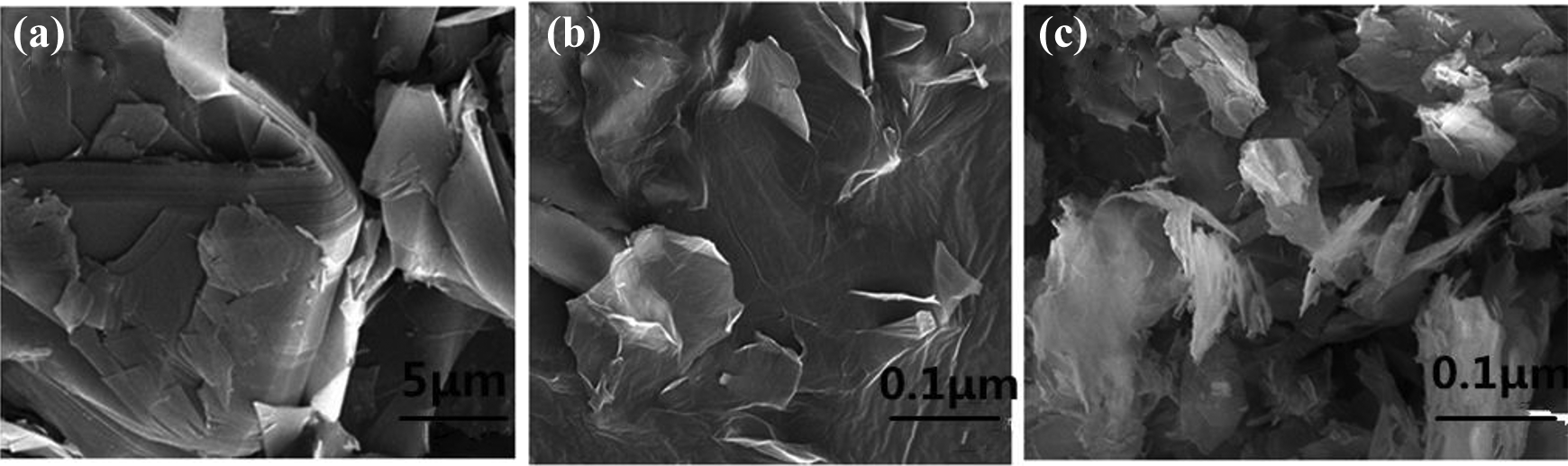
SEM images of (a) NG, (b) GO, and (c) GO-HMD.
Figure 6(a) is the AFM image of GO and the height profile of GO layers. AFM analysis shows that the slice size of the GO is about 100 nm and the thickness is about 0.670 nm. This further confirms that a certain amount of oxygen-containing functional groups are attached to the oxidized GE layer, thereby increasing the thickness of the GE sheets.

AFM images and height profile of (a) GO and (b) GO-HMD.
Figure 6(b) shows the AFM image of GO-HMD and the height profile of GO-HMD sheets. Based on the AFM characterization, the slice size of the GO-HMD is about 125 nm and the thickness is about 1.150 nm. Compared with GO, the thickness of GE modified by amination increases, which is related to the reaction between the amino groups and the functional groups on the GO layers. This is concordance with the XRD analysis of GO-HMD.
Figure 7 is the cross-sectional morphology of GO-HMD/CO-PA nanocomposites, from which the dispersion of GO-HMD in the matrix can be observed. It can be observed when the GO-HMD content is 0.4 wt%, the cross-sectional morphology of nanocomposites is smooth and uniform, and the transparent flake of modified GE is observed obviously. With the increase of GO-HMD content, the cross section of nanocomposites become rougher, and the stress marks become more obvious, which illustrates that GO-HMD can be dispersed uniformly in the polyamide matrix without agglomeration. An obvious aggregation phenomenon can be observed when the GO-HMD content is 1 wt%. This observation shows that when the addition amount of GO-HMD is appropriate, the good interfacial interaction between CO-PA and GO-HMD increases the mechanical properties of the polymer composites, thus making the fracture surface rougher. However, when the content of GO-HMD is more than 1 wt%, the aggregation phenomenon leads to the obvious change of the micromorphology of nanocomposites, which further affects the mechanical properties of nanocomposites.

SEM images of (a) 0.4 wt% GO-HMD, (b) 0.6 wt% GO-HMD, (c) 0.8 wt%-GO-HMD, and (d) 1.0 wt% GO-HMD.
Mechanical properties
Figure 8 and Table 1 reveal the mechanical properties of pure CO-PA and GO-HMD/CO-PA nanocomposites. As shown in Figure 8, all samples showed typical yield behavior, and the tensile strength, yield strength, and elongation at break of CO-PA nanocomposites increased first and then decreased with the increase of GO-HMD content. Specific data are shown in Table 1, the tensile strength and yield strength of neat CO-PA are 38 MPa and 19.8 MPa, respectively. When GO-HMD content is 0.4 wt%, the tensile strength and yield strength of the composites are 65.9 MPa and 56.6 MPa, respectively, which are 73.4% and 185.9% higher than that of neat CO-PA, respectively. At the same time, the elongation at break increased from 337.6% to 480.4%, compared with pure CO-PA, increased by 42.3%. Wang et al. 38 also prepared GO-PA6 composites. The results showed that when the loading of GO was 0.25 wt%, the tensile strength was increased by 50.9% compared with pure PA6. While Scaffaro et al. 39 enhanced PA6 with unmodified GO, the tensile strength of the composite increased by only 37.5%. From the experimental results, it can be seen that the proper amount of nanofiller GO-NH2/HMD can greatly improve the mechanical properties of CO-PA. Reasons can be the following three aspects: (1) the GE itself has excellent mechanical properties and can be used as an enhancer to improve the mechanical strength of CO-PA; (2) the covalent interaction between GO-HMD and CO-PA can result in strong interfacial interaction; (3) the modified GE has a large specific surface area and can produce good affinity between the two materials. However, when the content of the modified GE is too high, the agglomeration occurs due to the van der Waals force between the GE sheets resulting in restacking of GE. Therefore, the modified GE content must be within a certain range to effectively improve the mechanical properties of CO-PA.

Mechanical properties of CO-PA and GO-HMD/CO-PA. (a) Stress–strain curves (
Mechanical properties of GO-HMD/CO-PA nanocomposites.

GO-HMD: hexamethylenediamine-modified graphite oxide; CO-PA: Co-polyamide.
Differential scanning calorimetry
Figure 9 exhibits the DSC thermograms of CO-PA and the composites with various GO-HMD contents. As can be seen from the cooling curve (Figure 9(a)), pure polyamide does not exhibit crystallization exothermic peaks, indicating that pure polyamide hardly has crystalline ability, its crystallization speed can’t keep up with the change of cooling rate, so that pure polyamide has formed solid before it can be crystallized. With the increasing amount of GO-HMD, the broad crystalline exothermic peaks of nanocomposites become sharper. When the contents of GO-HMD are 0.2 wt%, 0.6 wt%, 1.0 wt%, and 1.5 wt%, the crystallization exothermic peak appeared at 105°C, 109.0°C, 110.7°C, and 112.7°C, respectively. This showed that the proper addition of modified GE can improve the crystallization behavior of polyamide, promote the heterogeneous nucleation of nanocomposite, and improve its crystallization speed and crystallization degree.

DSC images of CO-PA and GO-HMD/CO-PA from (a) cooling stage and (b) heating stage (
The heating curves are given in Figure 9(b), in which it can be seen that the Tg of nanocomposites is higher than that of pure polyamide. As the content of GO-HMD increases, Tg gradually moves toward high temperature, which indicated that the addition of GO-HMD increases the rigidity of the polyamide molecular chain, hinders the movement of the molecular chain, and needs to absorb more heat to remove the polyamide molecular chain, thereby increasing the Tg of the nanocomposite. In Figure 9(b), it can be seen that pure polyamide has a melting peak at about 153.3°C and a cold crystallization peak at 79.8°C, which is due to the crystallization of polyamide in the cooling phase did not occur, and when the temperature is higher than Tg below Tm , the polyamide chain began to move again and arranged in orderly direction, resulting in a new crystallization peak. For the nanocomposites, the presence of GO-HMD hinders the movement of the polyamide molecular chains, thus hindering the movement of the molecular chains toward the ordered direction. The weak melting peak near 144.5° indicated that the GO-HMD acts as heterogeneous nucleation in the polyamide matrix, which leads to a change of the crystal shape and appear a new melting peak, this is consistent with the results of XRD analysis.
Thermogravimetric analysis
TGA was used to research the thermal degradation of the CO-PA nanocomposites. The detailed experimental results are shown in Figure 10(a) and summarized in Table 2. When the contents of GO-HMD is 0.2 wt%, 0.6 wt%, 0.8 wt%, and 1.0 wt%, the T 50% of the nanocomposites is 457.0°C, 463.0°C, 466.0°C, and 468.0°C, respectively. The thermal degradation temperature of GO-HMD/CO-PA nanocomposites is about 14.3°C higher than that of pure polyamide, which indicates that the addition of GO-HMD nanofiller can improve the thermal degradation temperature of CO-PA. Figure 10(b) shows the derivative thermogravimetry (DTG) analysis of CO-PA and GO-HMD/CO-PA nanocomposites. We can see that when the contents of GO/HMD are 0.2 wt%, 0.6 wt%, 0.8 wt%, and 1.0 wt%, the Td , max of the nanocomposites was found to be around 458.3°C, 460.0°C, 465.1°C, and 466.8°C, respectively. It can be seen that the highest Td , max of nanocomposites is about 11.8°C higher than that of pure polyamide.

(a) TGA and (b) DTG thermograms of CO-PA and GO-HMD/CO-PA (
TGA and DTG analysis of GO-HMD/CO-PA nanocomposites.

TGA: thermogravimetric analysis; GO-HMD: hexamethylenediamine-modified graphite oxide; CO-PA: Co-polyamide.
In conclusion, GO-HMD can improve the thermal stability of CO-PA nanocomposites. This result can be explained by the following reasons: (1) the proper amount of GO-NH2/HMD can be uniformly dispersed in the polyamide matrix as a heat transfer medium to conduct heat in time, thus delaying the degradation process of nanocomposites to a certain extent; (2) the covalent bonds between GO-HMD and CO-PA produce strong interfacial interactions, which reduces the flexibility of the polyamide chain and hinders its normal movement, thus increasing the thermal degradation temperature of the nanocomposites and delaying its degradation.
Thermal diffusivity
Figure 11 shows the thermal diffusivity curves of CO-PA and GO-HMD/CO-PA nanocomposites. It can be seen that the thermal diffusivity of pure CO-PA and nanocomposites decreases with increasing temperature. The thermal diffusivity of GO-HMD/CO-PA nanocomposites is obviously higher than that of pure polyamide at low temperature. However, as the temperature increases, the addition of modified GE has no significant influence on the thermal diffusivity of polyamide, even lower than that of pure polyamide. This phenomenon can be explained in the following aspects: First, at low temperatures, the material is a solid state with a large temperature difference and a small lattice vibration, which does not hinder the conduction of phonons. In addition, the good thermodynamic properties of GE itself are favorable for the conduction of phonons. Therefore, the low-temperature heat conduction speed of the composite materials is fast; second, with the increase of temperature, polyamide and its composites change from solid to viscous state, the internal temperature difference becomes smaller, and the lattice vibration amplitude increases, which make the blocking effect greater than the promoting effect of GE during phonon conduction.

Thermal diffusivity of CO-PA and GO-HMD/CO-PA.
Conclusions
GO-HMD/CO-PA nanocomposites were successfully prepared by solution blending and analyzed by a series of tests. When the content of nano filler is not higher than 1 wt%, it can be dispersed uniformly in the polyamide matrix. When the content reaches 1 wt%, the modified GE sheets begin to agglomerate in the polyamide matrix. The results of mechanical properties showed that nanofilling can significantly improve the yield strength, tensile strength, and elongation at break of CO-PA. The tensile strength, yield strength, and elongation at break of the composite containing 0.4 wt% GO-HMD increase by 73.4%, 185.9% and 42.3%, respectively. DSC results demonstrated that the nanofiller could change the crystal form of polyamide and improve the crystallization temperature and glass transition temperature of nanocomposites. TGA showed that nanofiller could improve the thermal stability of polyamide. The nanofiller GO-HMD contributes to the increase of the thermal diffusivity of the polyamide matrix at low temperature.
In summary, amino-modified GE oxide can significantly enhance the properties of polyamide matrix and provide a wider range of applications for CO-PA. In the future, GO-HMD can improve the mechanical and thermodynamic properties of other new materials.
Footnotes
Acknowledgements
The authors appreciate the School of Materials Science and Engineering, Shandong University of Science and Technology, for providing equipment support for this research, thank the Polymer Processing and Modification Group, and also thank Professor Ruiqin Bai for providing guidance on this article.
Declaration of conflicting interests
The author(s) declared no potential conflicts of interest with respect to the research, authorship, and/or publication of this article.
Funding
The author(s) disclosed receipt of the following financial support for the research, authorship, and/or publication of this article: This research was financially supported by the Scientific Research Foundation of Shandong University of Science and Technology for Recruited Talents (No. 2014RCJJ002).
