




Abstract
The article reports some experimental data on the effects of three types of clay: organo-modified montmorillonite (cloisite 30B (C30B)), sepiolite (SP9), and halloysite nanotubes (HNT) on the morphology and physicomechanical properties of polycaprolactone (PCL)/clays bionanocomposites prepared by melt compounding. The clays were incorporated separately into the PCL matrix at a loading rate of 5.00 wt%, which corresponds to 2.91 ± 0.53, 2.42 ± 0.02, and 2.68 ± 0.13 vol% for C30B, SP9, and HNT, respectively. Scanning electron microscopy analysis showed good dispersion of both C30B and SP9 in the polymer matrix, while the presence of a few HNT aggregates was observed on the fracture surface of the PCL bionanocomposite. Furthermore, the HNT aggregates were randomly dispersed. The results indicated an enhancement of the rheological and tensile properties of the PCL bionanocomposite samples filled with C30B and SP9 compared to those containing HNT. Indeed, it was shown an increase in Young’s modulus of PCL from 450 ± 16 MPa to 563 ± 42 MPa, 645 ± 68 MPa, and 502 ± 66 MPa for PCL bionanocomposites loaded with C30B, SP9, and HNT, respectively. On the other hand, the thermal stability of the whole PCL bionanocomposite samples was reduced being, however, more pronounced for those containing HNT. The decomposition temperature recorded at 5.00 wt% loss (T 5%) indicated 384.7 ± 0.9 for neat PCL, while the PCL bionanocomposites filled with C30B, SP9, and HNT exhibited the values of 357.3 ± 0.5, 353.2 ± 0.9, and 368.4 ± 0.4, respectively.
Introduction
Polycaprolactone (PCL) is a semicrystalline 1 and hydrophobic polymer. 2,3 PCL is known as an important biocompatible and biodegradable aliphatic polyester with good processability and miscibility with various polymers. 4 -6 Indeed, PCL has been considered as one of the best candidates to replace the conventional polymers mainly in the fields of food packaging, biomedical, pharmaceutical, and agriculture. 4,7 -9 However, the use of PCL to produce other items at large scale is rather limited due to its poor thermal, mechanical, and barrier properties. 9,10
Nevertheless in the last decades, the incorporation of clay nanofillers of different chemical structure and aspect ratios such as lamellar, fibrous, and tubular clays in PCL is considered as one of the best routes to improve the polymer properties, thus extending its applications in many industrial fields. 6,11
Most of the research works carried out on PCL bionanocomposites were devoted to layered silicates-based nanocomposites, using in particular the organically modified montmorillonite with bis-(2-hydroxyethyl) methyl tallow alkylammonium cations due to its high aspect ratio from 600 to 1000 12 and also to the role played by this organo-modified clay to improve the mechanical, thermal, and barrier properties of polymers. 13 -17 Indeed, in the work of Ludueńa et al., 18 a series of PCL bionanocomposites filled with unmodified and organo-modified montmorillonites were prepared by melt blending. It was reported that the organo-modified clays enhanced the stiffness of the PCL matrix due to better dispersion of the clay. Improved properties were obtained with both organo-modified montmorillonites, that is, cloisite 30B (C30B) and cloisite 20A thank to the polarity and the interlayer distance of the latter.
Recently, other types of clay fillers have been the object of a great interest by many researchers for the development of new bionanocomposite materials. 19 -21 Among these, sepiolite (SP9) is a kind of mineral fibrous nanoclay constituted of two tetrahedral silica sheets and a central octahedral sheet with magnesium having the following structural formula, that is, Si12O30Mg8(OH)4.(H2O)4.8H2O. SP9 has typically a surface area around 200 m2 g−1, a length of 0.2–4 μm, a width of 10–30 nm, a thickness of 5–10 nm, and a cation exchange capacity ranging from 20 meq/100 g to 40 meq/100 g. 22 -25 It is characterized by an aspect ratio ranging from 10 to 20. 21,26 Nikolic et al. 27 investigated the effect of unmodified and organo-modified sepiolites on the performances of PCL bionanocomposites prepared by casting method. The results revealed that the organo-modification of sepiolites enhanced the dispersion degree of nanoclay into the matrix, leading to an improvement of the mechanical properties compared to the neat PCL.
On the other hand, tubular fillers were also tested on various polymer matrices. Among these, halloysite nanotubes (HNT) are natural aluminosilicate nanotubes with tubular microstructure. 28 -30 Halloysite is a dioctahedral1:1 mineral clay, chemically similar to kaolinite, 31 with the chemical composition (Al2Si2O5(OH)4.nH2O). 20,32 The length of HNT tubes ranges from 100 nm to 2000 nm, the inner and outer diameters of the tubes are 10–30 nm and 30–50 nm, respectively, and an aspect ratio of 10 to 50. 33 -35 Thermal, mechanical, and rheological properties of PCL-HNT bionanocomposites have been investigated by Lee and Chang. 20 The authors reported that the presence of HNT in PCL improved the tensile and dynamic mechanical properties of the bionanocomposite, while the rheological measurements indicated a stronger shear-thinning behavior.
Although there are many articles dealing with PCL/clays bionanocomposites, 27,36 -38 however to the best of our knowledge, there is no article available in the literature which reports the separate effect of various clays on the morphology and properties of the same PCL matrix. Therefore, the objective of the article was to evaluate the effect of three different clays added separately to the PCL matrix at 5.00 wt%, including C30B, SP9, and HNT on morphology, water absorption (WA), and rheological, mechanical, and thermal properties of PCL bionanocomposites.
Experimental
Materials
Poly(ε-caprolactone) used was supplied by Perstorp Company, Sweden, under the grade CAPA 6800, PCL. The number-average molecular weight (M w) of the polymer is 80,000 g mol−1.
Various clays were used as nanofillers. The commercial organo-modified montmorillonite, that is, C30B was supplied by Southern Clay Products (Gonzales, Texas, USA). C30B is a montmorillonite modified with bis-(2-hydroxyethyl) methyl tallow alkylammonium cations.
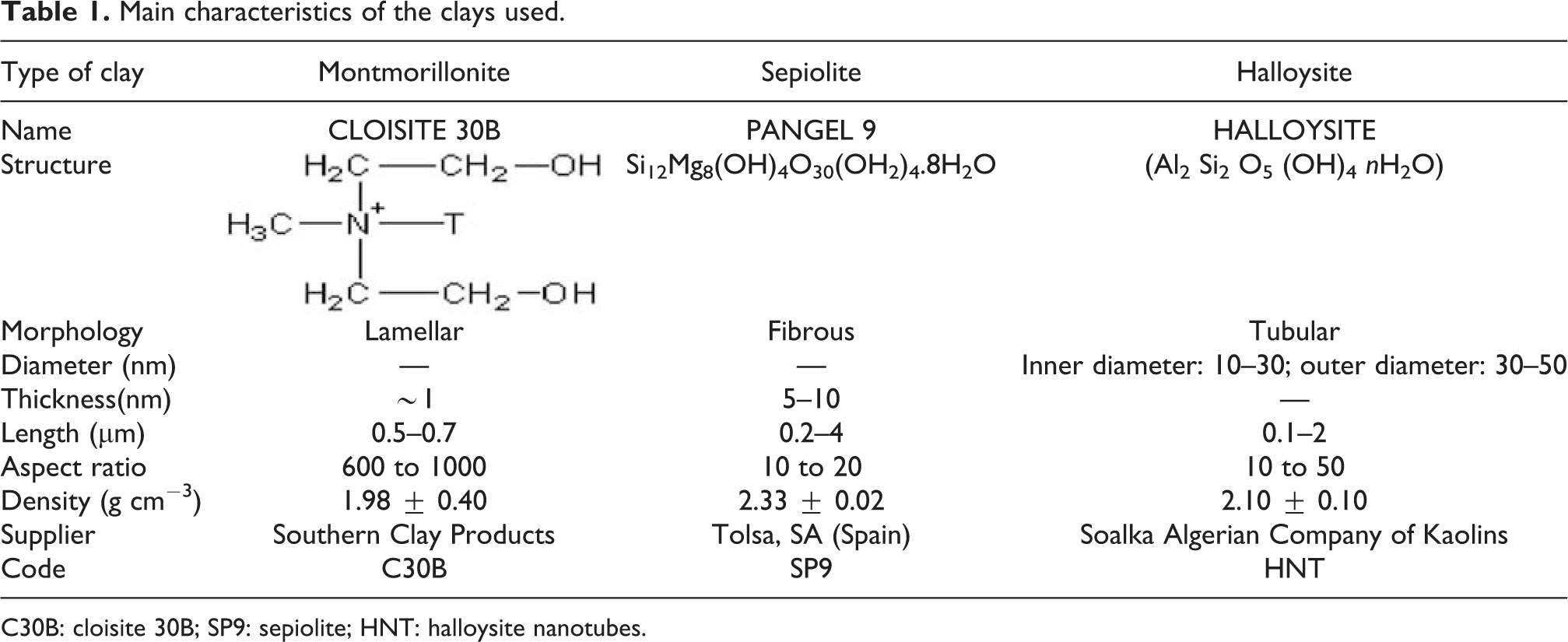
Unmodified sepiolite, that is, Pangel S9 (SP9) was supplied by Tolsa, SA (Spain) and unmodified HNT was supplied by the Algerian Company of Kaolins (Soalka). The main characteristics of the clays used in this work are listed in Table 1.
Main characteristics of the clays used.
C30B: cloisite 30B; SP9: sepiolite; HNT: halloysite nanotubes.
Sample preparation
Various bionanocomposites samples separately filled with 5.00 wt% of C30B, SP9, and HNT, which correspond to 2.91 ± 0.53, 2.42 ± 0.02, and 2.68 ± 0.13 vol%, respectively, were prepared by melt compounding in a double-screw mini-extruder “DSM Xplore 5 &15 Micro Compounder,” (Netherlands) at a residence time of 3 min at 100°C and a screw speed of 150 r min−1. Standard specimens for mechanical testing were obtained by injection molding machine (100°C, 3 min at 7 MPa). The neat PCL was subjected to the same processing conditions for comparison. The samples were named as neat PCL for the matrix and PCL-C30B, PCL-SP9, and PCL-HNT for the bionanocomposites.
Technical characterization
Scanning electron microscopy
The morphology of neat PCL and different bionanocomposites (PCL-C30B, PCL-SP9, and PCL-HNT) was observed using a Jeol JSM-6031 (Japan) scanning electron microscope (SEM). All the samples were cryofractured after immersion in liquid nitrogen. The fractured surface was scanned to observe the dispersion of clays. The surface of the samples was coated with a thin gold layer by means of a Polaron sputtering apparatus (Japan).
Rheological measurements
The dynamic oscillatory shear measurements were performed using an Anton Paar CTD 450 Physica MCR 301 rheometer (France) equipped with parallel plates of 25 mm diameter at 80°C. Samples disks were vacuum-dried before measurements at 40°C for 24 h. The limit of the linear viscoelastic regime was determined by performing a strain sweep at 1 Hz. A strain of 0.2%, corresponding to the linear viscoelastic domain, was chosen to perform dynamic measurements over a frequency range from 0.01 Hz to 100 Hz. An average value of three repeated tests was taken for each formulation.
Thermogravimetric analysis
Thermogravimetric analysis (TGA) measurements were carried out using a Setaram TG-DTA 92-10 (France) to evaluate the thermal stability of both neat PCL and PCL bionanocomposites samples. The samples were heated from 20°C to 1000°C at a scan rate of 10°C min−1 under nitrogen. Derivative thermogravimetric (DTG) analysis defined as the derivative curve of the thermogravimetric thermogram allows the determination of the temperature corresponding to the maximum rate of decomposition (T mrd). The residue left at 700°C was also determined for all the samples. Three replicates were performed for each sample.
Tensile tests
Tensile tests were performed using an MTS Synergy RT1000 testing apparatus (Eden Prairie, MN, USA) at 23°C and a relative humidity of 48% according to the ISO 527 standard method. The tensile specimens prepared by injection molding have the following dimensions: thickness (T) = 3.2 mm, width of the narrow section (W) = 63 mm, and length of the narrow section (L) = 84.16 mm in concordance with ISO 527-2 1BA. The loading speed was 1 mm min−1. An MTS extensometer (Eden Prairie, MN, USA) was used with a nominal gauge length of 25 mm. Four samples of each material were tested. The tests were carried out four times for each material and the results were averaged arithmetically.
WA test
The WA was determined by measuring the difference from the weight at the initial time of the test and the constant final weight of the sample according to the following procedure: the specimen dimensions for WA experiments were 10 × 10 × 3 mm3. A minimum of three samples were tested for each material. Samples were first dried overnight at 60°C. They were subsequently cooled in a desiccator at ambient temperature and weighted using a four-digital balance. Then, the samples were immersed in distilled water, pH = 6 and 25°C. After 24 h, the samples were removed and blotted to eliminate the excess water on the surface. After weighting, the WA of the samples was calculated according to the following equation 39 :

where Wf and Wi are the weights of the material after and before immersion in distilled water, respectively.
Results and discussion
Scanning electron microscopy
The micrographs of the neat PCL and those of the different PCL bionanocomposites were observed by SEM to investigate the dispersion state of the different clays added to the PCL matrix as shown in Figure 1(a) to (d).

SEM micrographs of the fracture surface: (a) neat PCL, (b) PCL-C30B, (c) PCL-SP9, and (d) PCL-HNT.
The SEM images of PCL-C30B and PCL-SP9 bionanocomposites displayed in Figure 1. Figure 1(b) and (c) shows homogeneous clays dispersion into the PCL matrix. Further, there is no aggregates formation appearing on the fracture surface of the samples. Similar morphological data were reported by Lee and Chang and Fukushima et al. 20,40
Whereas for PCL-HNT bionanocomposite, Figure 1(d) shows the presence of a few aggregates randomly dispersed on the fracture surface. Moreover, it is also observed a poor dispersion of HNT in the PCL matrix.
Rheological properties
The rheological behavior was investigated to evaluate the microstructure of PCL bionanocomposites in the molten state. The variation of storage modulus (G′) and loss modulus (G″) of neat PCL, PCL-C30B, PCL-SP9, and PCL-HNT bionanocomposites filled at 5.00 wt% of clays is shown in Figure 2(a) to (b), respectively.

(a) Storage modulus, (b) loss modulus, and (c) complex viscosity versus frequencies at 80°C for PCL and its bionanocomposites.
From Figure 2(a) and (b), the rheological behavior of the PCL filled with SP9 and C30B exhibits significant differences compared to that of neat PCL, while the PCL-HNT bionanocomposite sample has almost the same behavior as the neat PCL. Figure 2 also shows that the values of G′ and G″ of PCL-SP9 and PCL-C30B bionanocomposites are higher than those of neat PCL and PCL-HNT bionanocomposite. This is due probably to good interactions between the polymer and C30B and SP9, resulting in a homogeneous dispersion of SP9 and C30B within the PCL matrix.
Moreover, these results could also be due to the nanofiller aspect ratio. The modulus of the bionanocomposite samples is closely related to the aspect ratio. Indeed, the elastic modulus is higher when the aspect ratio is larger. Comparing the aspect ratio of the investigated clays, the aspect ratio of C30B is much higher than the other nanofillers, resulting in a higher storage modulus of the PCL-C30B system compared to the rest of the bionanocomposites samples.
A monotonical increase of the values of G′ and G″ for the whole samples was observed at low frequencies, but the values became close to each other at a high-frequency range. At this frequency level, the curves of the different samples come together because of the mobility of the macromolecular chains, which is detected. The region is dominated by the polymer. It is corresponding to the segmental motion of the polymer molecules. 20,36
The evolution of the complex viscosity (η*) as a function of the frequency for the neat PCL and the bionanocomposites reinforced with SP9, HNT, and C30B are shown in Figure 2(c).
The different samples show a Newtonian behavior at low frequencies, followed by a reduction of η* at the terminal region with an increase in frequency exhibiting a shear-thinning behavior (also called pseudoplastic behavior). 6 Indeed, the viscosity of the bionanocomposites system increases in the low frequencies region upon adding SP9 and C30B, excepted PCL-HNT sample.
To compare the reinforcing effect of each nanofiller towards the PCL matrix, the reinforcing factor of storage modulus (G′) as a function of frequency is shown in Figure 3 for PCL systems.
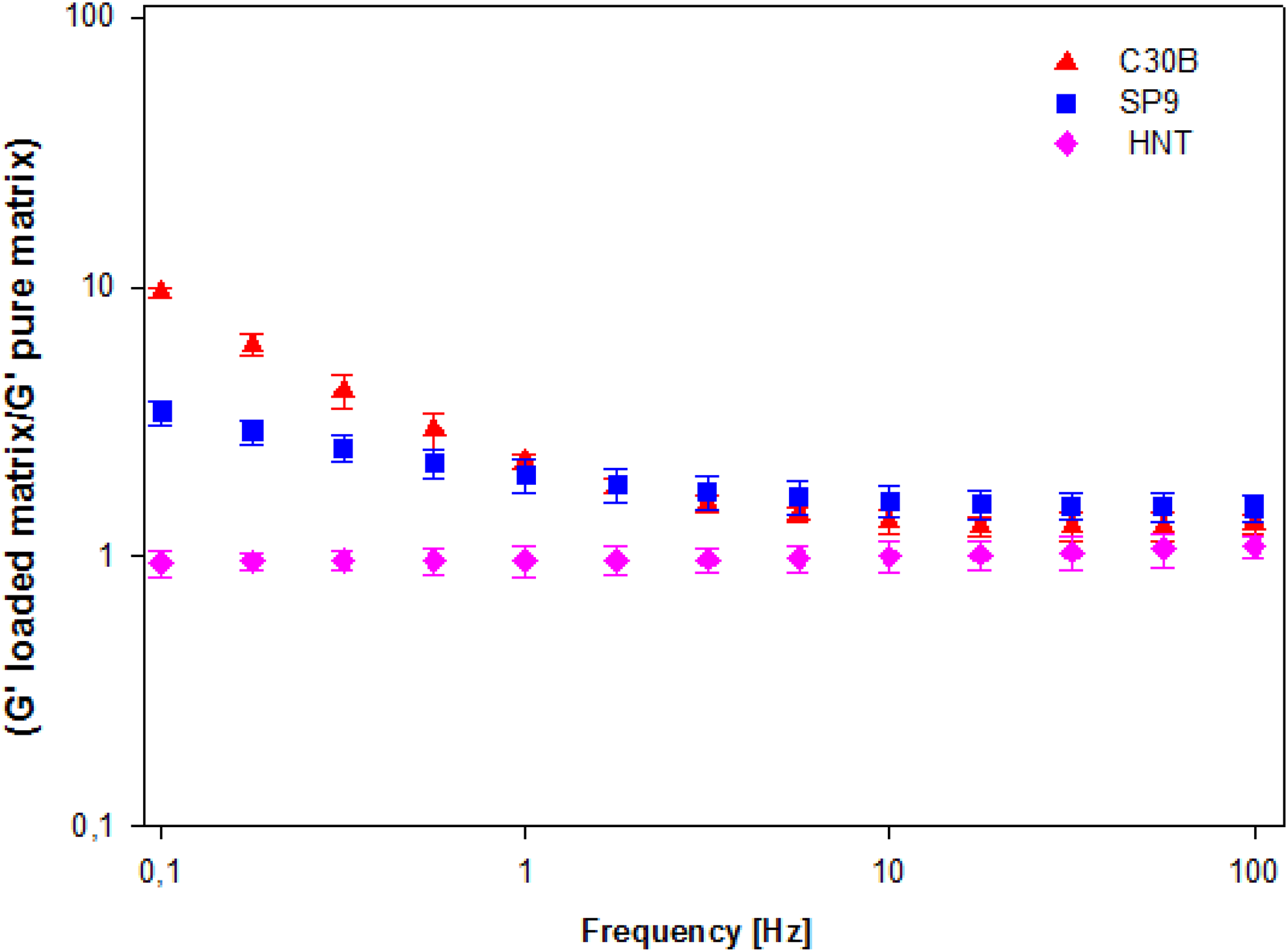
Reinforcing factor of the storage modulus G′ as a function of frequency for PCL systems.
In Figure 3, it is observed that the incorporation of C30B and SP9 into the PCL matrix strongly increased the reinforcing factor of the bionanocomposites compared to that of the PCL-HNT system. However, the reinforcing factor is much higher with the addition of C30B. The increase of the reinforcing factor could be attributed to a better dispersion of C30B and SP9 in the PCL matrix as well as to their high aspect ratio. According to the literature data and Guth theory, 41 expressed by the following equation:

where c, m, and p refer to the composite, the matrix, and the particle, respectively, and Vp is the volume fraction, the value of the elastic modulus of the composite is closely linked to that of the aspect ratio of the filler. 41 We noticed that the greater is the aspect ratio, the higher is the elastic modulus. In our case, the aspect ratio would be greater when the exfoliation of the layers was reached, resulting in a higher storage modulus, and consequently, a higher reinforcing factor (G′bionanocomposite/G′matrix).
Thermogravimetric analysis
The thermal stability of the neat PCL and the different bionanocomposites (PCL-C30B, PCL-SP9, and PCL-HNT) was evaluated by TGA. Figure 4(a) and (b) shows TGA and DTG thermograms of PCL and its corresponding bionanocomposites. The values of temperature corresponding to the mass loss of 5.00 wt% (T 5%) and temperature corresponding to the maximum decomposition rate (T mrd) are given in Table 2.

(a) TGA and (b) DTG curves of neat PCL and different bionanocomposites.
Values of T 5% (temperature at 5.00 wt% loss) and T mrd (temperature at maximum decomposition rate) for neat PCL and PCL-C30B, PCL-SP9, and PCL-HNT bionanocomposites.

C30B: cloisite 30B; SP9: sepiolite; PCL: polycaprolactone; HNT: halloysite nanotubes.
Figure 4 shows that the thermograms display only one degradation step. Furthermore, the incorporation of C30B, SP9, and HNT clays leads to a decrease in the thermal stability of the PCL matrix. Indeed, the T 5% value of neat PCL, which is 384.7 ± 0.9 decreases to 357.3 ± 0.5, 353.2 ± 0.9, and 368.4 ± 0.4 in the PCL-C30B, PCL-SP9, and PCL-HNT bionanocomposites, respectively. The results indicate that PCL bionanocomposites are less stable materials than neat PCL. Similar results were reported by Fukushima et al. 42 According to the literature data, 43 the mineral clays could catalyze PCL pyrolysis due to the presence of Lewis acidic sites, formed during the degradation. 43 For instance, the decomposition of C30B products to hydroxyl groups, which are converted to water molecules, is able to hydrolyze the 3-caprolactoneinto hex-5-enoic acid, thus accelerating the PCL decomposition. 44 The same phenomenon could also occur in the PCL matrix in the presence of HNT and SP9. 19
Mechanical properties
The effect of the different clays on the mechanical properties of PCL and its bionanocomposites, that is, PCL-C30B, PCL-SP9, and PCL-HNT, was evaluated by tensile tests and the results are given in Table 3.
Tensile characteristics of neat PCL and PCL-C30B, PCL-SP9, and PCL-HNT bionanocomposites.

C30B: cloisite 30B; SP9: sepiolite; PCL: polycaprolactone; HNT: halloysite nanotubes.
The incorporation of clays in the PCL matrix leads to a significant increase in Young’s modulus for the whole bionanocomposite samples compared to that of neat PCL, being, however, much higher for PCL-C30B and PCL-SP9. Indeed, the Young’s modulus value of neat PCL increases by about +25% and +43% with the addition of 5.00 wt% of C30B and SP9, respectively. Whereas, only +11% increases in PCL are obtained with 5.00 wt% of HNT. The significant enhancement in Young’s modulus of neat PCL with the incorporation of C30B and SP9 could be attributed on one hand, to the rigid character of the fillers, and on the other hand, to better dispersion of C30B and SP9 into the polymer matrix and subsequently to better compatibility between the components. This is consistent with the data reported by Ludueña et al. and Labidi et al. 37,44,45
Table 3 also indicates that the tensile strength values of the bionanocomposite samples are close to those of neat PCL taking into account the experimental errors, except for the PCL-SP9 sample. The latter exhibits a decrease by almost 20% compared to neat PCL. This behavior could be due to the high stiffness of the sample (approximately 43% increase in Young’s modulus), thus reducing its strength. 18 Similar trend is also observed with the values of elongation at break of the bionanocomposite samples compared to neat PCL.
WA test
The values of WA were determined for both neat PCL and PCL bionanocomposite samples, that is, PCL-C30B, PCL-SP9, and PCL-HNT. The data are summarized in Table 4. It is noticed that the WA value for neat PCL is very low (approximately 0.52%) due to its hydrophobic character. 20 However, the incorporation of C30B, SP9, and HNT into the PCL matrix results in an increase of WA passing from 0.52 ± 0.06 for neat PCL to 0.64 ± 0.11, 0.92 ± 0.12, and 0.63 ± 0.06 for PCL-C30B, PCL-SP9, and PCL-HNT, respectively. This result is expected regarding the strong hydrophilic character of the clays 42 promoting the hydrogen bonding of the hydroxyl groups on the different clays with water molecules. 18,20
Values of WA of neat PCL and PCL-C30B, PCL-SP9, and PCL-HNT bionanocomposites.

WA: water absorption; C30B: cloisite 30B; SP9: sepiolite; PCL: polycaprolactone; HNT: halloysite nanotubes.
Conclusion
PCL bionanocomposites filled with three types of clay (C30B, SP9, and HNT) were prepared by melt compounding at filler content of 5.00 wt%. From this study, the following conclusions can be drawn: HNT does not lead to any improvement of the properties of PCL due probably to the formation of aggregates. This suggests a suitable surface treatment of HNT before any melt blending with the PCL matrix. Unlike in the case of C30B and SP9, the results show an enhancement of the rheological and tensile properties of PCL bionanocomposite samples compared to neat PCL. Indeed, the bionanocomposites exhibit a strong shear-thinning behavior and a nonterminal viscoelastic behavior at low frequencies and an increase of Young’s modulus. Moreover, SEM observations indicate a good dispersion of C30B and SP9 in the PCL matrix. WA measurements show an increased hydrophilic character of the whole bionanocomposite samples compared to that of neat PCL.
Footnotes
Acknowledgements
The authors are grateful to Mickael Castro and Françoise Peresse for their help in the experimental work.
Declaration of conflicting interests
The authors declared no potential conflicts of interest with respect to the research, authorship, and/or publication of this article.
Funding
The authors received no financial support for the research, authorship, and/or publication of this article.
