




Abstract
The poly(ε-caprolactone)/silicon oxide (PCL/SiO x )-coated film was prepared by plasma-enhanced chemical vapor deposition of SiO x . The result showed that the PCL/SiO x film presented increased elongation at break and appropriate gas permeability and CO2/O2 permselectivity. The PCL/SiO x film was further used for window packing container of equilibrium-modified atmosphere packaging of fresh cherry tomato. The gas composition within containers depended on the permeability of PCL/SiO x film and respiration of cherry tomato, which finally reached steady states that 4–6% CO2 and 11–13% O2 at room temperature and 2–3% CO2 and 17–19% O2 at 5°C, respectively. High sensory score, firmness, soluble solid concentration, ascorbic acid content, lower weight loss, and retarded respiration climacteric could be found for the cherry tomato packaged by PCL/SiO x film, indicating that delayed ripening, higher nutrient content, and extended shelf life were achieved.
Introduction
During the past decades, fresh fruits and vegetables have become essential part of healthy diet. 1 Cherry tomato, an easy perishable fruit, 2 –4 is a produce world widely consumed as both fresh fruits and processed products. As a typical kind of respiratory climactic fruit, it ripened and softened quickly when stored at room temperature. 5 Currently, many research have been devoted to prolong the shelf life of cherry tomatoes, including bioactive gibberellins, essential oil treatment, edible composite coatings packaging, modified atmosphere packaging (MAP), ozone treatment, and so on. 4,6,7
Traditional MAP packaging combined with low-temperature storage has been considered one of the most effective methods to extend the shelf life of fresh produces. Dennis et al. found that the shelf life of mature green tomatoes, being stored in a modified atmosphere (5%CO2, 5% O2, and 90% N2, 12.5°C), can be extended to 10 weeks. 8 Fagundes et al. studied the effects of active MAP on the postharvest quality of cherry tomatoes stored at 5°C and in bioriented polypropylene (PP)/low-density polyethylene (PE) bags. 9 The result showed that atmosphere composition (5% O2 + 5% CO2) used in the packaging could extend the shelf life of cherry tomatoes to 25 days.
However, the preservation effect of traditional MAP packaging usually depended on the gas filled artificially. This kind “air package” is expensive and not suitable for industrialization. Equilibrium-modified atmosphere (EMA) packaging is a kind of MAP. 10 Either the pack is flushed with the required gas mix or the produce is sealed within the pack with no modification to the atmosphere. The gas composition in EMA package depends on both respiration of the produce and the gas permeability of the packaging. Kim et al. used the PP/octadecane composite films to control the gas concentration in cherry tomatoes package and found that this reduced the enzymatic activity and led to higher quality cherry tomatoes compared to the case when the pure PP films were used. 11 Ali et al. dipped mature green cherry tomato fruit in hot water and subsequently stored in plastic films with various O2 but similar CO2 permeabilities at 15°C. Results showed that individually both the hot water dip treatment and low O2 modified atmosphere in films delay color development. 12 Mohanty et al. investigated the effectiveness of a polyvinyl alcohol film containing the natural antimicrobial oregano essential oil as an active packaging application for cherry tomato. The film exerted an antimicrobial effect via the atmosphere surrounding the food and preserved the quality of tomatoes. 13 The above research showed that EMA packaging can be one of the effective and convenient methods to extend the shelf life of fresh cherry tomato.
Recently, much attention has been paid to the potential of biodegradable polymers in food packing. 13 –15 As a biodegradable aliphatic polyester, poly(ε-caprolactone) (PCL) is one of the most popular materials for tissue engineering due to its optimal biocompatibility, reasonable biodegradability, as well as exceptional mechanical and thermoplastic characteristics. 15 –17 Besides, it is a high flexible semicrystalline thermoplastic polyester. 18,19 However, its application in the packaging material is limited due to its low barrier property. 20 Therefore, increasing barrier properties of PCL film for packaging is desirable.
Silicon oxide (SiO x ) thin layer deposited on polymeric membrane was widely used in a variety of industrial fields because of its excellent properties, such as antiscratch, chemical resistance, ecological benefits, and barrier properties. SiO x as an alternative to coatings on polymer substrates has also been exploited in recent years for packaging applications. 21 –23 In recent studies, poly(ethylene terephthalate) (PET), oriented PP, PE, and oriented nylon have been used as base materials for packaging. However, these polymers are nonbiodegradable. In this regard, there is a strong demand for silica coating on biodegradable polymeric material (such as PCL). 23 –26 It is reported that some better films with relatively low stress and high quality without pinhole films will be made by plasma-enhanced chemical vapor deposition (PECVD). 27
In this work, PCL/SiO x -coated film was prepared by PECVD to improve the barrier properties of PCL film. The effects of SiO x layer on the mechanical properties, gas permeability, and selectivity were investigated. Lastly, the film was used as the window packaging material for cherry tomatoes preservation. The effect of the coated membrane on the gas concentration and the fruit’s quality was also investigated, which will provide a theoretical basis for its applications in the fresh food packaging field.
Materials and methods
Materials
Cherry tomato (Solanum lycopersicum var. cerasiforme) fruits, without physical injury or infection, were harvested at the pale yellow stage in Hohhot, China, and transported to the laboratory immediately. The size was 3.4 ± 1.1 cm in diameter and 11.8 ± 0.9 g in weight (n = 10).
PCL (M n = 8.1 × 10⁴ g·mol−1) was purchased from GuangHua WeiYE Co., Ltd (Shenzhen, China). PCL film (thickness ≈ 20 μm; width ≈ 20 mm) was prepared by uniaxial stretching with a twin-screw extruder system (PPT-3/SJ2-20-250, Guangzhou POTOP Experimental Analysis Instrument Co., Ltd, China). The mixed materials were injected into the twin-screw extruder and the temperature of the screw group was adjusted successively at 100–190°C and the melting extrusion temperature was 190°C. The extrusion rate was 230 r min−1 and the feed rate was 5 r min−1. The draw ratio of fixed roll and mobile tensile roll was 5.
Glass container was purchased from HOKOO Glassware Co., Ltd (Anhui, China). The glass container (11 × 8 × 4 cm3) has a well-sealed PP lid (11 × 8 ×0.2 cm3) with a breathable window (5 × 1.36 cm2) in the lid. No. 2118 clear adhesive for plastic was purchased from Suzhou tuna new materials Limited by Share Ltd (Jiangsu, China). There was a gasket between the lid and glass container to reach good sealing effect. Hexamethyldisiloxane (HMDSO) with a purity of 99%, used for sputtering, was supplied by J&K Scientific Ltd (Beijing, China).
Methods
Preparation of PCL/SiO x -coated films
SiO
x
was deposited on the surface of PCL film (diameter = 10 cm) using a capacitive coupled radio frequency (RF) PECVD system (ICP-PECVD-500, Hefei Feifan Scientific and Technology Ltd, China). To ensure that the deposited films could adhere strongly to PCL film, PCL film was treated by Ar (99.99%) gas with 100
Material characteristic analysis
ATR-Fourier transform infrared spectra measurement
The Attenuated Total Reflection-Fourier transform infrared (ATR-FTIR) spectra were recorded on the IR Affinity-1 spectrometer (Shimazu, Japan) with two 45 × 8 mm2 films to analyze the chemical composition of the film surfaces. The spectra were recorded from 750 cm−1 to 2250 cm−1 with the sum of 128 scans at a resolution of 4 cm−1.
Scanning electron microscopy
The phase morphologies of solid samples were observed using Shimadzu Co S-530 (Shimadzu Co, Kyoto, Japan) scanning electron microscopy (SEM) with an accelerating voltage of 25 kV.
Tensile test
The tensile properties of thin films were carried out using a test machine (XH-8750, Dongguan Xinghui Electronic Co., Ltd, China) according to ASTM-D882-09 at a crosshead speed of 50 mm min−1. All samples were cut and shaped into dumbbell-type bars (thickness of 25 μm, width of 0.5 cm, and length of 2 cm). The average value of three specimens was used to describe the mechanical properties.
Oxygen transmission rate (OTR) and carbon dioxide transmission rate (CTR) were measured with a manometric gas permeability tester (LyssyL100-5000; Systech Illinois Instruments, Inc., Oxford, UK) followed by ASTM1434-82 at 5°C and 25°C, room humidity, respectively. Each test had three repetitions.
Water vapor transmission rate
Water vapor transmission rate (WVTR) was measured using a Permatran-W Model 3/61 water vapor permeability meter (Mocon, Inc., Minneapolis, USA) according to ASTM E96 (Default Method) with a mask with the area of 1 cm2. Measurement was carried out at 25°C under the relative humidity (RH) of 65%. Each value was obtained by averaging the results of three repetition samples.
Packaging and storage of cherry tomato
Fresh cherry tomato of 110 ± 5 g was put into a cuboid glass container and then put the lid on the glass container. The lid was sealed by sticking PCL or PCL/SiO x film and lid with adhesive. Glass is regarded as an impermeable material. As shown in Figure 1, all gas exchange mainly depended on the lid with PCL or PCL/SiO x film as window. There are three different treatments in this study: cherry tomatoes that were put into the glass container and then exposed to open air was control group (CK). For the second and third groups, the PCL film and PCL/SiO x film were used as lid of the glass container, respectively. Cherry tomatoes were stored under two different conditions: at the 30% RH/room temperature, 5 ± 1°C/60–80% RH in the refrigerator, respectively. Three repetition samples of each group will be tested in an acceptance test session.

The schematic diagram of film preparation.
Storage quality analysis of cherry tomato
Atmosphere composition within packages
The O2 and CO2 levels within packages were monitored during storage by using a Headspace Gas Analyzer (Model 6600; Systech Instruments, UK). For analysis, a needle attached to the analyzer was inserted through a silicone septum into the package. The O2 and CO2 levels were directly given by the analyzer. Three independent measurements were performed and their average value was obtained.
Sensory evaluation
The sensory evaluation standard of cherry tomato was given in Table 1. Sensory quality was evaluated by a trained panel with 12 members that had the experience in sensory evaluation practice based on a modified method. 28 For that, the comprehensive sensory evaluation of cherry tomatoes in each container which presented in a randomized order to the panelists was analyzed to obtain an average value (from 0 to 10 points). Generally, it was considered unacceptable when the score was below four points.
The criteria for sensory evaluation of cherry tomato.

Measurement of firmness and soluble solids concentration
Firmness and soluble solids concentration (SSC) were measured according to the methods reported by Mitcham 29 and the mean value of six individual tomatoes was used to describe the quality of the sample. Firmness was measured on two opposite sides at a maximum distance for each of six tomatoes by GY-1 durometer (SHT Tools Co., Ltd, China). SSC of the cherry tomato was determined by the digital MQK-50 refractometer (Shanghai Mi Qingke Industrial Co., Ltd, China) at ambient temperature.
Determination of weight loss
The weight of the cherry tomato which before packaging in each container was considered as the initial weight (Wi). During storage, the weight of the corresponding cherry tomato was recorded and denoted as Wt. Therefore, the weight loss of the cherry tomato during storage is expressed as: (Wi−Wt)/Wi × 100%. 30
Measurement of ascorbic acid
Ascorbic acid (AsA) content of the cherry tomato was measured by an ultraviolet spectrophotometer (UV-2450, Shimadzu, Japan). Ten grams of cherry tomato was added into 10 mL 1% hydrochloric acid (HCl, v/v) solution and grinded, followed by the addition of 50 mL distilled water and homogenized. Then, the homogenate was centrifuged for 10 min at 5000 r min−1. After centrifugation, 1 mL supernatant and 2 mL HCl solution (10%, v/v) were transferred into the 50 mL volumetric flask and stirred evenly. Finally, dilute with distilled water to volume. The highest absorption peak value of the UV spectrum 287 nm was used for calculating AsA content.
Statistical analysis
Data are presented as mean ± standard deviation (n = 3). All data were calculated by single-factor analysis of variance using SPSS Statistics 20. Significant differences in mean values were assessed by Duncan’s multiple range tests at the level p < 0.05.
Results and discussion
Material characteristic
ATR-FTIR analysis of films
ATR-FTIR spectra can give information about the chemical composition of the film from the top surface into the depth of a few micrometers. Figure 2 showed the ATR-FTIR spectra of the SiO x , PCL, and PCL/SiO x films. For pure PCL, the bands at 1726 cm−1 were assigned to C=O stretching band. For neat SiO x , the symmetric and asymmetric stretching vibration of Si–O–Si bond appeared at range of 880–780 cm−1 and 1100–1000 cm−1, respectively. 31 After coating with SiO x , it could be clearly seen from the spectra of PCL/SiO x film that the intensity of the band of the C=O group at 1726 cm−1 is decreased and the intensity of the band of Si–O–Si increased, implying that the PCL surface was coated by a layer of SiO x .

ATR-FTIR spectra of SiO x , PCL film, and PCL/SiO x film.
SEM analysis
The morphological structures of samples were characterized using SEM. As can be seen from Figure 3, pure PCL exhibited a smooth and uniform morphology. After coating with SiO x , a few narrow and shallow cracks can be found in the smooth surface of PCL/SiO x film. This result indicated that a thin coat of the brittleness SiO x was formed on the surface of PCL, and the PCL/SiO x film was successfully prepared in this study. Besides, it can also be seen that those cracks were very little area compared with the covered area on the surface of PCL/SiO x film. So, most of the PCL was covered with continuous thin SiO x layer, this result is well according with ATR-FTIR analysis.
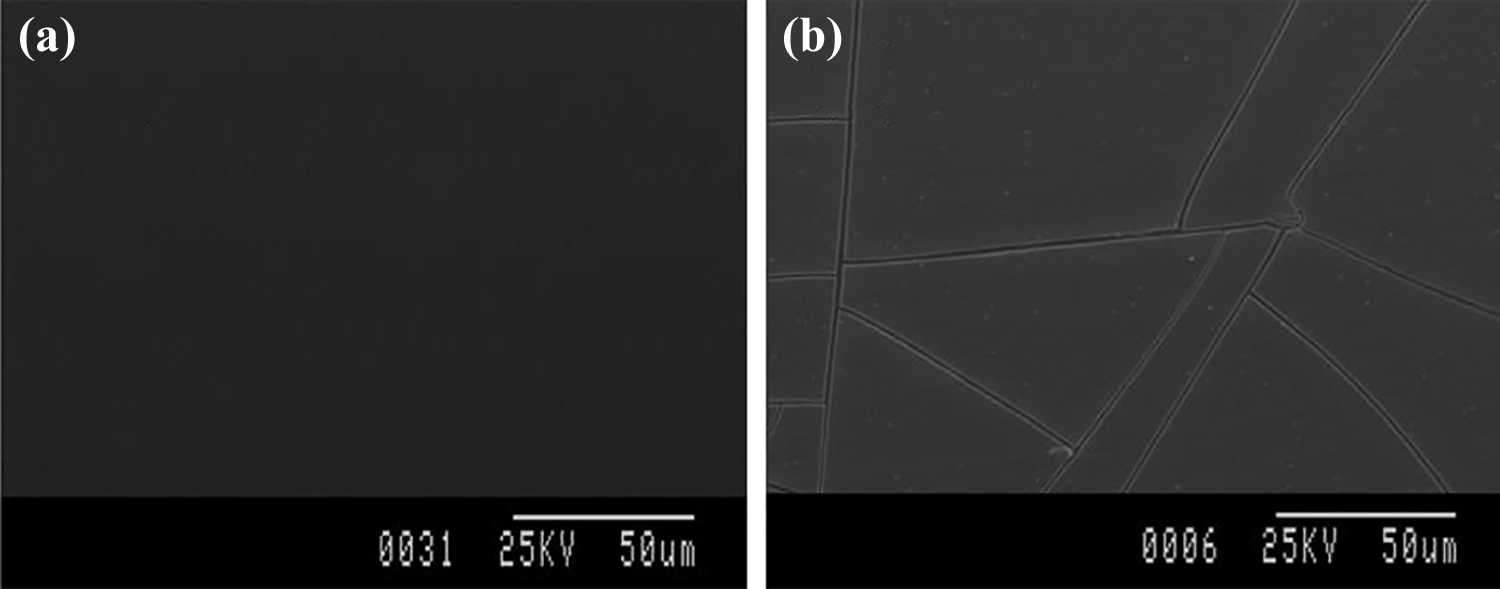
SEM micrographs of polymer surfaces of (a) neat PCL film and (b) PCL/SiO x -coated film.
Tensile property analysis
The tensile properties of PCL and PCL/SiO x film were evaluated. The elongation at break, Young’s modulus, and yield strength of samples were summarized in Figure 4 and Table 2. Since PCL film was oriented stretching, the Young’s modulus and yield strength along the oriented stretching direction showed a higher value than that of the unstretched one, but the elongation at break showed lower value. 29,32 Compared with neat PCL film, both yield strength and Young’s modulus of the PCL/SiO x film decreased slightly. However, the elongation at break of PCL/SiO x increased significantly, indicating that the SiO x coating is highly adherent to the PCL surface and the PCL/SiO x kept relatively good tensile strength and flexibility. 33

Stress–strain curves of PCL and PCL/SiO x film.
Mechanical properties of PCL and PCL/SiO x films.

PCL: poly(ε-caprolactone); SiO x : silicon oxide.
Gas permeability
Selecting films with suitable gas permeability for different fruit is important, since extremely high CO2 concentration and/or low O2 concentration can induce anerobic metabolism and physiological damage, which depreciate fruit quality. 34 –36 Table 3 showed the gas permeability of PCL and PCL/SiO x films at 5°C and 25°C. It can be seen that the OTR value of PCL film was 1010 cm3·m−2·day−1 at 5°C. When deposited the SiO x coating, the OTR value reduced by 22.2%. Meanwhile, the CTR value greatly decreased from 12523 cm3·m−2 day−1 to 5392 cm3·m−2 day−1. It was suggested that the SiO x layer showed efficient barrier to CO2. Thus, upon coating, the CO2/O2 permselectivity of PCL film was obviously decreased from 12.4 to 6.9. However, the SiO x coating has no obvious effect on the WVTR of PCL film due to the hydrophilic nature of SiO x . With the temperature increasing to 25°C, both the OTR and CTR values of PCL and PCL/SiO x films increased. However, it should be noticed that the selective permeability of films slightly decreased with the increasing temperature. This may be because the gas solubility in the films decreased with increasing temperatures. Generally, the increase of the gas permeability occurred faster than the decrease of the solubility. Thus, increased temperatures will finally cause a decrease in both solubility and diffusion selectivity for most polymer films. 37
Gas permeability and permselectivity of PCL and PCL/SiO x films at 5°C and 25°C.

PCL: poly(ε-caprolactone); SiO x : silicon oxide.
a The testing condition is beyond the capabilities of measurement of the instrument.
Storage quality of cherry tomato
Variation of gas concentration in the pack of cherry tomato
Both the PCL and PCL/SiO x films are used as lid of a glass container to pack the cherry tomato. The changes of O2 and CO2 concentration within the container stored at room temperature and 5°C were shown in Figure 5. The O2 concentration appeared to decline firstly and then gradually stabilized. However, the CO2 concentration appeared to increase firstly and then gradually stabilized in both two different storage conditions. The gas concentration in containers with PCL/SiO x and PCL as lids reached steady state with 4–6% CO2, 11–13% O2 and 2–4% CO2, 15–16% O2 at room temperature, respectively. The gas concentration in PCL/SiO x and the PCL packs stored at 5°C reached steady state with 2–3% CO2, 17–19% O2 and about 1% CO2, 19–20% O2, respectively. The CO2 concentration in the container with PCL and PCL/SiO x films as lids increased to about 5.5% on the sixth day at room temperature and then leveled off at the subsequent storage time. But that in the control group was unaltered because the cherry tomato was exposed in open air. Within the first 3 days, vigorous postharvest respiration of the cherry tomato resulted in the increase of CO2 concentration in all containers. At the later storage stage, CO2 concentration kept at a stable level due to different permselectivity of the covered film lid. With the storage time extending, a dynamic equilibrium would be achieved. CO2 concentration in the container with PCL/SiO x film as lid was slightly higher than that in the PCL-lid container. This attributed to the better gas barrier property of PCL/SiO x film, which leads to the accumulation of more amount of CO2 in the container.

Concentration of O2 and CO2 within EMA packaging stored at (a) room temperature and (b) 5°C. Vertical bars represent the average values with SD (n = 3).
The O2 concentration in the container at room temperature decreased in all containers. The decrease in O2 concentration was associated with the postharvest respiration. Moreover, O2 concentration in PCL/SiO x -lid container was lower than that in the case of PCL. This may be also attributed to better barrier property of PCL/SiO x film inhibited the gas exchange in the container. Meanwhile, the oxygen was consumed by fruit respiration, thus resulting in a relative lower O2 concentration.
Similar gas concentrations change in the containers stored at 5°C could be found in Figure 5(b). It should be noticed that the respiration was inhibited at 5°C, which leaded to lower CO2 and higher O2 concentration in the pack. In a word, the container with PCL/SiO x film as lid can control the gas exchange of pack. The postharvest respiration in such container could be inhibited. In addition, storage temperature had a significant effect on the gas concentration in the pack (p < 0.05).
PCL/SiO x film with better barrier ability will lead relative higher CO2 and lower O2 concentration in container and prolong the shelf life of cherry tomato. This result was similar to the results reported in PP/SiO x and PET/SiO x films. 38,39
Sensory evaluation
As shown in Figure 6, the sensory score of cherry tomato of all groups decreased with the storage time. The cherry tomato stored at room temperature in the control group showed the shortest shelf life of 12 days and lowest sensory score (Figure 6(a)), which may be ascribed to exposed in open air lead the faster water loss rate and poor appearance. At the same storage time, the sensory score of the cherry tomato suffered different change trends in different packaging treatments (control group < PCL film package < PCL/SiO x film package). The cherry tomato in the case of PCL/SiO x film package showed a higher sensory score compared with PCL film package, which attributed to the more suitable gas perm-selectivity of PCL/SiO x film was helpful to the gas exchange of package. As shown in Figure 4, there were more CO2 and less O2 in the container with PCL/SiO x film as lid. Compared with other samples, the respiration and decay could be inhibited more effective in the PCL/SiO x film package.

Sensory score of cherry tomato stored at (a) room temperature and (b) 5°C. Vertical bars represented the average values with SD (n = 3).
As shown in Figure 6(b), the sensory score of sample at 5°C was higher than that at room temperature at the same storage time, which related to the slower respiration. Also, similar change trends of the sensory score could be found for the cherry tomato stored at 5°C. After the sixth day, the sensory score was greatly influenced by the gas concentration and storage temperature (p < 0.05). From the viewpoint of the sensory score, the shelf life of the cherry tomato stored at 5°C in container with PCL/SiO x film as lid can reach at least 30 days far longer than the control (at least 18 days).
SSC analysis
SSC of the cherry tomato decreased with storage time, which was associated with the physiological consumption. For the cherry tomato in the control group, SSC reduced rapidly due to vigorous respiration with fast metabolism in open air (Figure 7). The low temperature can inhibit the respiration rate. At the same storage time, SSC at 5°C was higher than that at room temperature, associated with the slow metabolism and nutrients consumption in lower temperature. The gas concentration and storage time start to have a significant effect (p < 0.05) on SSC from the 9th day at room temperature and a significant effect on SSC content from the 12th day under 5°C. SSC of the cherry tomato in container with PCL/SiO x film as lid was higher than the other groups.

SSC of cherry tomato stored at (a) room temperature and (b) 5°C. Vertical bars represented the average values with SD (n = 3).
Firmness analysis
Firmness is an important indicator to assess the ripening and consumer acceptance of fruit. As shown in Figure 8, the firmness of cherry tomato in all groups decreased with the storage time. Fruit softening occurs due to deterioration in the cell structure, cell wall composition, and intracellular materials. 40 At the same storage time, firmness decreased slower at 5°C than that at room temperature. The decrease of fruit firmness during storage time was mainly attributed to the water-insoluble protopectins change into water-soluble pectins caused by the pectinase. 41 Low temperatures inhibited the enzyme activity and the respiration of cherry tomato. This can help keep the fruits’ firmness.
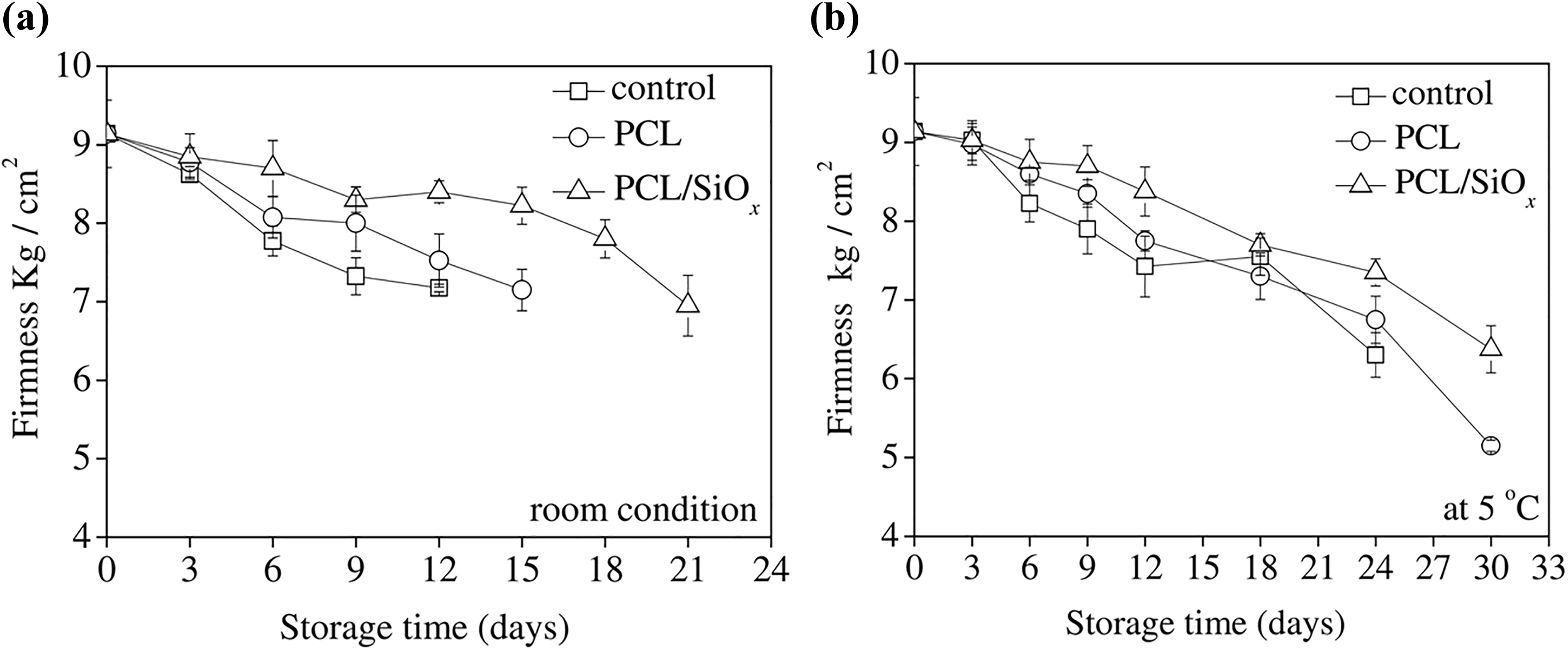
Firmness of cherry tomato stored at (a) room temperature and (b) 5°C. Vertical bars represented the average values with SD (n = 3).
Weight loss analysis
Water is a major component of tomato fruit, which maintains the cell turgor, texture, and appearance of fruit during growth and storage. Water and nutrients loss cause the weight loss of the fruit during storage. The weight loss of cherry tomato in control, PCL, and PCL/SiO x groups increased during the whole storage period (Figure 9). Furthermore, the weight loss rate in the case of PCL and PCL/SiO x films packages was lower than the control group. This is because good water vapor barrier of the packing film can maintain the container with higher RH, resulting in decreased transpiration. No significant change in the weight loss rate could be found in these two cases of the packing film because the difference in WVTR between these two packing films was not significant. From the 12th day, gas concentration and storage time showed a significant effect on weight loss (p < 0.05).

Weight loss rate of cherry tomato stored at (a) room temperature and (b) 5°C. Vertical bars represented the average values with SD (n = 3).
Change in AsA content
AsA is one of the most important vitamins in human nutrition, and the AsA content of cherry tomato is higher than that of other fruits and vegetables. As shown in Figure 10, it can be concluded that the AsA content firstly increased (with a minor fluctuation) and then decreased with the storage time. During the storage, the AsA content increased to a maximum at respiration climacteric, followed by a slow reduction, resulting in the quick decay of cherry tomato. The AsA content of cherry tomato in the control group increased to peak value on the ninth day at room temperature due to the respiration climacteric. For PCL and PCL/SiO x film package groups, the respiration climacteric occurred on the 12th day. This is because the respiration climacteric (ripening) was retarded due to the barrier property of PCL and PCL/SiO x film. As can be seen from Figure 10(b), the AsA content in the case of PCL film package was slightly higher than that in the case of PCL/SiO x film package within 6 days of storage at 5°C. During 6–18 days of storage, PCL/SiO x group showed slightly higher AsA content than that of PCL film package. The respiration was significantly inhibited and the peak value of AsA appeared on ninth day and kept a relative high content due to the higher concentrations of CO2 and lower concentrations of O2 in the package at 5°C. That is to say, the gas composition in the container is favorable to extend the shelf life of the tomato in PCL/SiO x film package. Moreover, significant difference of the AsA content was found between the control group and other two groups (p < 0.05).

AsA content of cherry tomato stored at (a) room temperature and (b) 5°C. Vertical bars represented the average values with SD (n = 3).
Conclusions
PCL/SiO x -coated film was prepared by PECVD. Upon coating of SiO x , the oxygen and carbon dioxide barrier properties, as well as the gas permeability and CO2/O2 permselectivity of PCL/SiO x film, were adjusted. Depending on permeability of PCL/SiO x film and respiration of cherry tomato, the atmosphere composition of the sealed container reached a relative suitable level for preservation of cherry tomato. The shelf life of the cherry tomato was greatly extended due to spontaneously gas exchange during storage.
Footnotes
Declaration of conflicting interests
The authors declared no potential conflicts of interest with respect to the research, authorship, and/or publication of this article.
Funding
The authors disclosed receipt of the following financial support for the research, authorship, and/or publication of this article: This research was supported by Scientific and Technological Innovation Guide Award Project of Inner Mongolia Autonomous Region (2016).