




Abstract
In this work, we report a novel strategy for improving the interfacial nature in corn fiber/polylactide (CRF/PLA) composites by directly applying a sizing containing silica nanoparticles on the surface of CRFs. This results in enhanced mechanical properties of the CRF/PLA composites. These improvements can be mainly attributed to the presence of silica nanoparticles on CRF-PLA interfaces, which act to resist the crack propagation. The increased surface roughness of CRFs from incorporated silica nanoparticles may also contribute to the enhanced mechanical properties. This simple methodology can be easily scaled up and thus shows great promise in industrial applications.
Introduction
It is well accepted that the fiber/matrix interface in composites controls not only the mechanical properties but also physical properties. 1 –4 Generally, a strong interfacial bonding means high load–transfer efficiency and high strength and stiffness can be achieved, while a relatively weak fiber/matrix interface helps with the energy absorption under impact conditions. 1,2 The manipulation of fiber/matrix interface is mainly achieved through surface treatment of fibers. In fact, all reinforcing fibers, particularly glass and carbon fibers are surface treated. 2 After surface treatment, a polymer coating (typically epoxy), referred to as a “sizing,” is applied to protect the carbon and glass fibers during handling and improve the processability of fiber yarns. 5,6
In recent years, apart from glass and carbon fibers, the development of green composites made from natural fibers has been a hot topic all over the world. Compared with glass fibers, the major motivation of using natural fibers is their lower cost (about one-third or less), significantly reduced weight, and easy recycling. Among the thousands of different natural fibers, only a few have been investigated. Flax, jute, hemp, sisal, ramie, and kenaf fibers are examples of some of the most studied natural fibers with various applications. Besides these natural fibers, corn fibers (CRFs) are also gaining interest due to their lower cost and greater availability (from farm waste). Using CRFs as reinforcements in biodegradable polymers is an inexpensive and environment-friendly way to dispose farm waste while financially profiting farmers. 7 –13
Unlike glass and carbon fibers, natural fibers possess very different properties. For example, their basic element is elementary fibers. They have porous structure and irregular cross section and their surface are hydrophilic. The hydrophilicity of natural fibers translates to the incompatibility with hydrophobic polymer matrices. To solve such incompatibility, surface treatment becomes mandatory. Up to date, many methods have been reported. 2,14 In general, there are two types of surface treatment methods, physical and chemical. 15 –18 Compared to physical methods, chemical methods often result in stronger fiber/matrix interface bonding. 19,20 Alkaline, coupling with silanes, grafting by monomers, and acylation are commonly used chemical treatments. 14 Compared with the most widely used alkaline treatment, surface sizings of natural fibers are still in their infancy. 2 However, the advantages of surface sizing have made it very attractive. 2 Some advantages include improved handling properties of fibers, enhanced fiber wetting by the matrix and in particular, improved fiber/matrix adhesion. 21 –23 Interestingly, it has been shown by recent studies that the addition of nanofillers into sizing formulations improves interfacial bonding and is thus gaining more and more attention. 2,6
The reported nanofillers in sizing formulations include halloysite nanotubes, 24 carbon nanotube (CNT), 25 –27 graphene, 28 graphene oxide (GO), 29 –31 and silica (SiO2) nanoparticles, 6,32 –35 For example, GO sheets were used to improve the carbon fiber/epoxy bonding. Zhang et al. 29 dispersed the GO sheets in the fiber sizing and then coated them onto the surface of carbon fibers. As a result, at a GO concentration of 5 wt%, significant enhancements of interfacial shear strength, interlaminar shear strength, and tensile properties were achieved in the composites. Godara et al. 36 directly dispersed CNTs in a fiber sizing formulation of E-glass fibers. They compared the fiber sizing method to other two ways of incorporating CNTs to the matrix and incorporating CNTs in the fiber sizing and matrix simultaneously. 36 They observed the improvements of interfacial shear strength in all three cases while the sole introduction of CNTs in the fiber sizing resulted in the maximum improvement. Yang et al. 32 coated a sizing with silica nanoparticles on the surface of carbon fibers and significantly improved interfacial shear strength was obtained. Unfortunately, there is no report in the literature regarding the nanofillers-contained sizing for the surface treatment of natural fibers, not to mention CRFs.
In this work, a facile method to adjust the interface properties between CRFs and polylactide (PLA) has been developed by adding nanofillers to the sizing solutions of CRFs. Silica nanoparticles were selected as the model nanofillers since they are much cheaper than CNT, graphene, and GO. We initially dispersed the silica nanoparticles in the fiber sizing and then coated them directly onto the surface of CRFs. The surface-treated CRFs (denoted as SiO2@CRF) were used to reinforce PLA. The purpose of this work was to prepare PLA composites reinforced by SiO2@CRF and to analyze the effect of incorporating silica nanoparticles in sizing solutions on the mechanical properties of the as-prepared SiO2@CRF/PLA composites.
Experimental
Materials
The silica nanoparticles (model W-200, average diameter = 60 nm, purity ≥99.9%) used in this work were provided by Shouguang Baote Chemical Co., Ltd (Weifang, China). The matrix material (purchased from Shenzhen Guanghua Weiye Industrial Co., Ltd, China) was an AI-0001 PLA with the basic parameters of M n = (8–10) × 105 g/mol and melt index = 512 g/10 min. A farm in Hebei Province, China, provided the corn stalks. Sodium hydroxide, analytical grade, was purchased from Tianjin Chemical Reagent Co., Ltd (Tianjin, China). The KH550 silane coupling agent (g-aminopropyl triethoxysilane, molecular formula H2NCH2CH2CH2Si(OC2H5)3, a colorless to light yellow low-viscosity liquid) was provided by Nanjing Chemical Industry Group (China).
Preparation of CRFs
The preparation process of CRFs was similar to that reported in our previous work. 7,8 Briefly, the corn stalks went through thorough cleaning and drying, followed by separation of straw skins using a skin separator (PRFII-0.2, Jilin Fenghe Botanical Development, China). The resultant skins were pulverized by a JWF-250 Cutting Mill (Hongle Machinery Plant, Xingyang, Henan, China). Finally, a 40-mesh sieve was used to remove corn husks and debris and the resultant CRFs have a length of less than 3 mm.
Preparation of sizing solutions containing silica nanoparticles
First, silica dispersion was prepared by adding silica nanoparticles to the solution of sodium dodecyl sulfate (SDS, dispersant) under ultrasonication for 2 h. The ratio of silica nanoparticles to SDS was 1:2. Meanwhile, a sizing solution was prepared by hydrolyzing silane coupling agent KH550 in an ethanol aqueous solution with a deionized water to ethanol ratio of 3:1 (by weight) for 20 min at room temperature. After adding the sizing material (epoxy film former) into the KH550 solution, the mixture was stirred at a rate of 250 r min−1 until homogeneous. The concentration of sizing agent was 12 wt% in the final sizing solution. The abovementioned silica dispersion was mixed with the sizing solution, leading to four silica modified sizing solutions containing 0.5, 1.0, 1.5, and 2.0 wt% silica nanoparticles, respectively. As a control, the unmodified blank sizing solution without silica nanoparticles was also prepared.
Surface treatment of CRFs with silica nanoparticles
Prior to sizing treatment, CRFs were treated with alkali, which was described in our previous work. 7 After alkali treatment, the CRFs were dried at 95°C in an oven. Afterward, the dried CRFs were immersed in sizing solutions with varying silica nanoparticles under vigorous stirring for 30 min. Finally, we removed the sizing-treated CRFs from the solutions and dried them at 80°C for 12 h.
Preparation of SiO2@CRF/PLA composites
To prepare SiO2@CRF/PLA composites with uniformly distributed CRFs, CRFs with varying sizings and PLA pellets were thoroughly blended at ambient temperature for 8 min at 60 r min−1 using an SLH-0.01 internal mixer (Shanghai Dongqiu Mixing Machine Co., Ltd, Shanghai, China). The mixtures were dried at 100°C for 4 h and used for injection molding with an MA600 injection molding machine (Haitian Plastics Machinery, Ningbo, China) at a temperature of 180°C and an injection pressure of 70 MPa to obtain test specimens. The fiber mass content in composite samples varied from 5% to 20%, unless otherwise indicated. The designation of the composite specimens prepared in this work is listed in Table 1.
The designation of the composites prepared in this work.

SiO2: silica; CRF: corn fiber; PLA: polylactide.
Mechanical testing
A CMT-4304 universal testing machine (Shenzhen Suns Co., Ltd, China) was used to test the tensile and flexural properties of SiO2@CRF/PLA composites and bare PLA according to ISO 527-1 and ISO 178, respectively. Tensile and flexural tests were conducted with the crosshead speed of 5 and 1.4 mm min−1, respectively. A XCJD-50 impact tester (Chengde Puhui Testing Instrument Co., Ltd, Hebei, China) was used to test the notched Izod impact. The tests were performed in accordance with ISO 179-1:2010. A heat deflection temperature (HDT) analyzer (Chengde Jinjian Testing Instrument, Hebei, China) was used to measure HDT. The HDT tests were carried out at a bending force of 1.82 MPa following ISO 75-2:2004. The heating rate was 2°C min−1 and data were collected from 25°C to 120°C. All mechanical tests were performed in triplicate.
Results and discussion
Preparation and morphology of CRFs and composites
The preparation process of SiO2@CRF/PLA composites is illustrated in Figure 1. The procedure starts with skin separation followed by smashing, sieving, alkali treatment, sizing treatment, and injection molding. Obviously, the preparation process of the SiO2@CRF/PLA composites is versatile and can be easily scaled up for industrial production, which makes the SiO2@CRF/PLA composites very competitive in the market.

Preparation process of the SiO2@CRF/PLA composites.
The dispersion of silica nanoparticles in the sizing solutions was examined using TEM. Figure 2(a) demonstrates highly dispersed silica nanoparticles in the sizing solution, and Figure 2(b) shows that the size of silica nanoparticles is around 60 nm, in line with the data specified by the provider, further confirming the separation of each single silica nanoparticle.

TEM images of silica nanoparticles in sizing agent at (a) low and (b) high magnifications.
As illustrated in Figure 3, the excellent dispersion of silica nanoparticles in sizing solutions is closely related to the following aspects. (a) The surface energy decreases due to the presence of surfactant molecules on the surface of each silica nanoparticles, which introduces the electrostatic repulsion between similarly charged particles. 37 The improved dispersion of silica nanoparticle was also reported and interpreted by many groups. 37,38 (b) When coupling agent is introduced, one end of the molecules of coupling agent connects with silica nanoparticles and the other end reacts with the reactive additives (epoxide groups) in the sizing solutions. 8

A schematic representation showing the dispersion of silica nanoparticles in sizing solutions.
The morphology of CRFs treated under different conditions was characterized using scanning electron microscopy. As seen in Figure 4(a), rugged surfaces are noted when CRFs are not sized, which is consistent with our previous report. 7 Figure 4(b) and (c) demonstrates that the CRFs are covered by a sizing layer regardless of the existence of silica nanoparticles in sizing solutions. Moreover, a comparison between Figure 4(b) and (c) reveals obvious difference in surface roughness, indicating the influence of silica nanoparticles on surface morphology of CRFs. Similar results were reported in previous work. 32,33
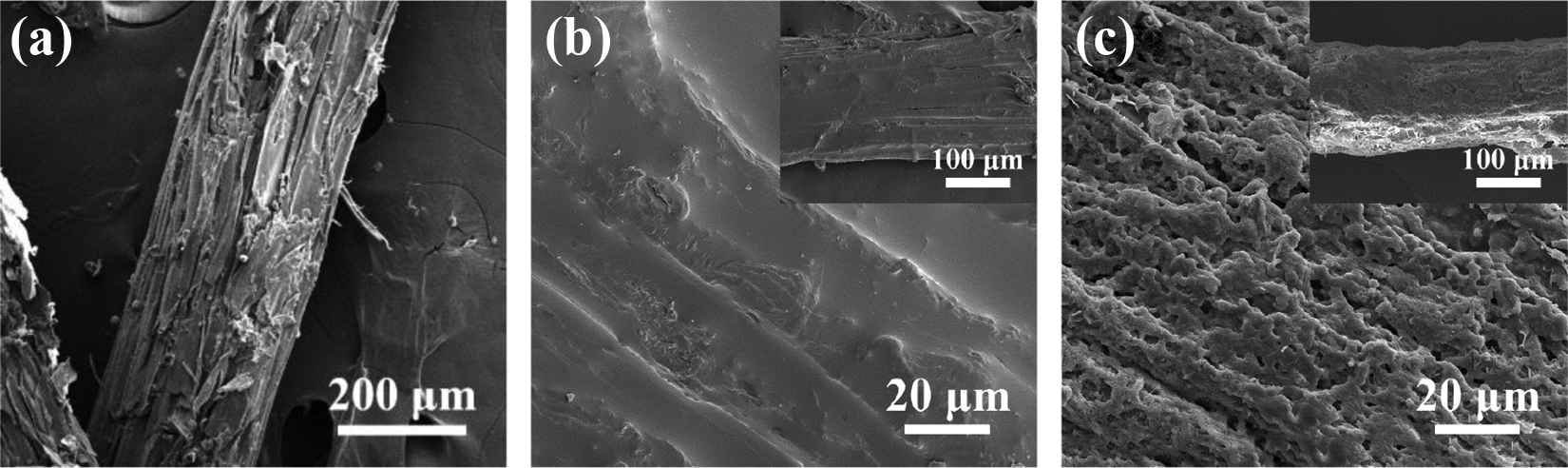
SEM images of corn fibers treated by (a) alkali, (b) sizing solution without silica nanoparticles, and (c) sizing solution with 1 wt% silica nanoparticles.
Mechanical properties of SiO2@CRF/PLA composites
We first tested the mechanical properties of SiO2@CRF/PLA composites containing 10 wt% CRFs treated with sizing solutions containing silica nanoparticles with different concentrations. As can be seen from Figure 5, the five composites show similar stress–strain curves, which are comprised of an initial linear part and a subsequent non-linear plastic portion. However, the peak stresses are different among these composites, among which SiO2@CRF10/PLA-10 shows the highest stress. To determine the effect of fiber content, tensile strength and modulus of SiO2@CRF5/PLA-10, SiO2@CRF10/PLA-10, and SiO2@CRF20/PLA-10 were tested (Figure 6(a)). It is seen that both tensile strength and modulus increase as fiber content increases. However, the increase slows down above 10 wt%. Therefore, the SiO2@CRF10/PLA composites were selected in the subsequent investigation. Figure 6(b) displays the values of tensile strength and modulus of five SiO2@CRF10/PLA composites. Note that, although there are no significant differences in their fracture surfaces (Figure 7, all showing smooth fiber surfaces and grooves left in the matrix, without PLA matrix stuck on fibers) and strain at break (data not shown), both tensile strength and modulus show an initial increase and then a decline with increasing content of silica nanoparticles in sizing solutions. SiO2@CRF10/PLA-20 shows the lowest tensile strength (41.18 ± 2.34 MPa) among all composites, which is comparable to that of bare PLA (40.9 ± 0.6 MPa). The peak strength and modulus values, which are 50.1 MPa and 5.4 GPa, respectively, are observed in SiO2@CRF10/PLA-10. The improvements in tensile strength and modulus are 8.4% and 9.1%, respectively, as compared to SiO2@CRF10/PLA-0.
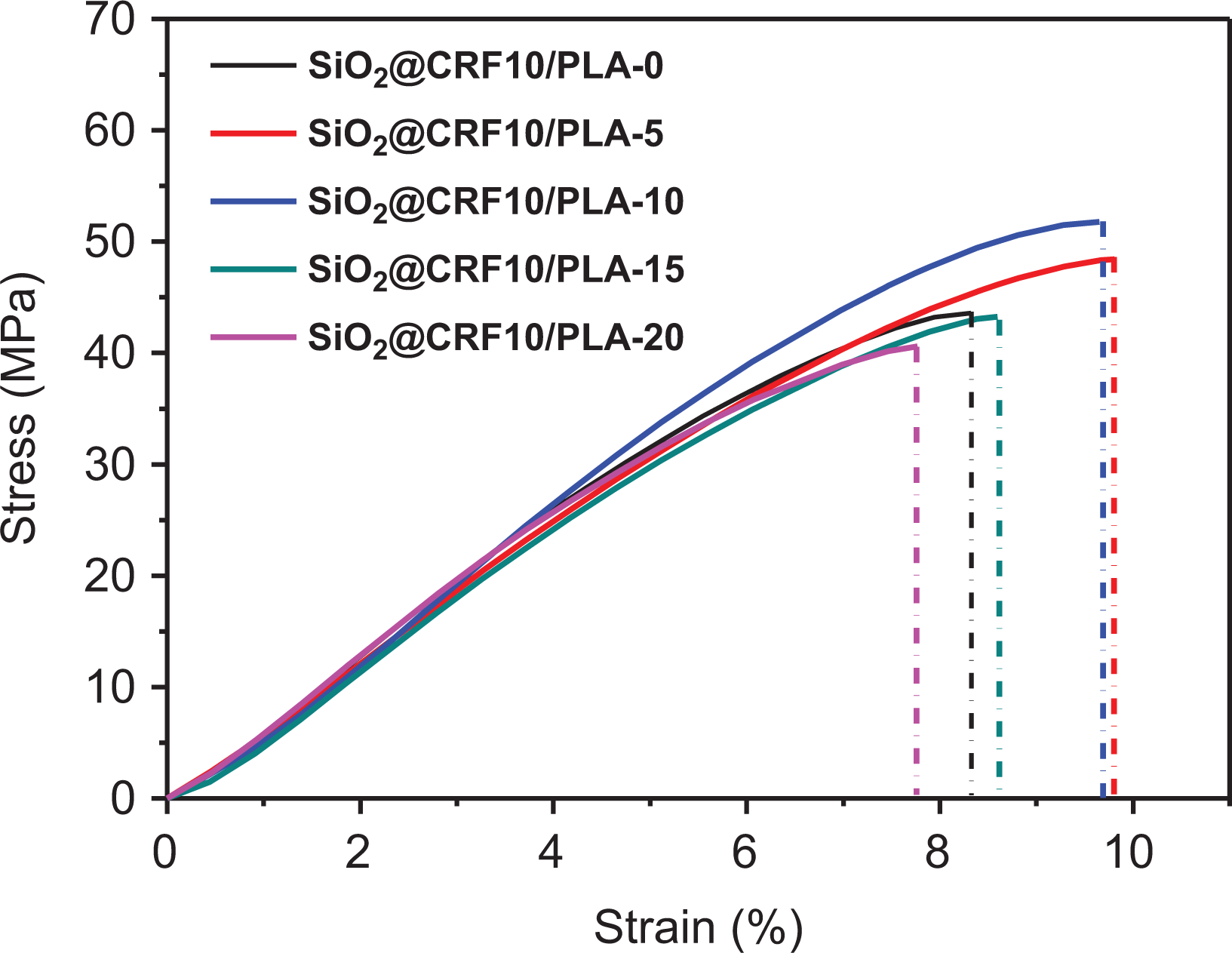
The stress–strain curves of SiO2@CRF/PLA composites reinforced with corn fibers treated with sizing solutions containing different contents of silica nanoparticles.

(a) Effect of fiber content on tensile strength and tensile modulus of the SiO2@CRF/PLA-10 composites. (b) Effect of content of silica nanoparticles in sizing solutions on tensile strength and tensile modulus of the SiO2@CRF10/PLA composites.

Tensile fracture surfaces of (a) SiO2@CRF10/PLA-0, (b) SiO2@CRF10/PLA-10, and (c) SiO2@CRF10/PLA-20.
The flexural strength and modulus of the SiO2@CRF/PLA composites as a function of silica content in sizing solutions are presented in Figure 8. Obviously, the changing pattern of flexural strength and modulus is similar to that of tensile properties. Likewise, SiO2@CRF10/PLA-10 exhibits the largest flexural strength (96.3 MPa) and modulus (5.0 GPa) among five composites. The improvements are 17.2% and 8.2% for flexural strength and modulus, respectively, as compared to SiO2@CRF10/PLA-0.

Effect of content of silica nanoparticles in sizing solutions on flexural strength and flexural modulus of the SiO2@CRF10/PLA composites.
Interestingly, the same changing pattern is also observed for impact strength, as shown in Figure 9. The highest impact strength of SiO2@CRF10/PLA-10 shows an improvement of 31.2% over SiO2@CRF10/PLA-0.

Effect of content of silica nanoparticles in sizing solutions on impact strength of the SiO2@CRF10/PLA composites.
The HDT was measured since it is an important parameter of polymer composites. HDT is mainly related to fiber content and fiber/matrix interface. Figure 10 reveals that the effect of silica content in sizing solutions on HDT is not substantial. Although SiO2@CRF10/PLA-10 shows the highest HDT among all composites, the difference is not statistically significant (p > 0.05).

Effect of content of silica nanoparticles in sizing solutions on HDT of the SiO2@CRF10/PLA composites.
Reinforcing mechanisms
These results suggest that the incorporation of silica nanoparticles in the sizing solutions can effectively improve tensile, flexural, and impact properties of the SiO2@CRF10/PLA composites and the improvements are dependent on the content of silica nanoparticles in the sizing solutions. As mentioned before, the mechanical properties of composites are primarily controlled by their interfacial adhesion. Therefore, we believe that the improvements in mechanical properties as a result of incorporation of silica nanoparticles in the sizing solutions are likely due to improved interfacial nature. We propose that the following aspects are responsible for the improved mechanical properties of the SiO2@CRF10/PLA composites. Firstly, the presence of silica nanoparticles on CRFs leads to increased fiber surface roughness and enlarged surface area of CRFs, which increases the mechanical interlocking between the fiber and the matrix. 27,32,39 Secondly, the enlarged surface area of silica nanoparticles facilitates the absorption of applied energy. Thirdly, there are chemical interactions between sizing-treated silica nanoparticles and CRFs, which improve the interfacial adhesion. Lastly and most importantly, the silica nanoparticles in the interface layer serve to resist the propagation of cracks. The proposed mechanisms are schematically illustrated in Figure 11. As shown in Figure 11, at a critical level of external stress, cracks may initiate at interface regions which are usually the weakest location compared with the CRFs and the PLA matrix. Further propagation and coalescence of these cracks depends on the interfacial nature. The homogeneous distribution of the silica nanoparticles on CRFs may play a significant role in suppressing crack propagation in the polymer matrix. However, at a content above 1 wt%, the silica nanoparticles will agglomerate in the interfacial regions, thus causing cracks and local stress concentration. This results in decreased energy dissipation capability and, finally, the loss of improvement on the interfacial properties of the composites. 29,40 This mechanism can elucidate the reduction of mechanical properties after exceeding the optimum content of silica nanoparticles.

Schematic illustration showing the reinforcing mechanisms of SiO2@CRF10/PLA composites.
Conclusions
We have demonstrated the preparation of PLA composites reinforced with CRFs that are surface coated with sizing solutions containing silica nanoparticles. The preparation process includes conventional treatment of CRFs and injection molding, which can be easily scaled up. Measurements of mechanical properties of the SiO2@CRF10/PLA composites demonstrate a silica content dependent change of tensile, flexural, and impact properties. The SiO2@CRF10/PLA-10 composite possess the highest tensile, flexural, and impact strength. These results indicate that the optimum silica content in sizing solutions is 1 wt%. The improvements of mechanical properties as a result of silica incorporation in sizing solutions can be mainly ascribed to the resistance of crack propagation during loading as a result of the existence of silica nanoparticles in the interface regions. The enhanced interfacial adhesion between CRFs and PLA matrix as a result of the increased surface roughness and chemical interactions between silica nanoparticles and PLA matrix may also contribute.
Footnotes
Declaration of conflicting interests
The author(s) declared no potential conflicts of interest with respect to the research, authorship, and/or publication of this article.
Funding
The author(s) disclosed receipt of the following financial support for the research, authorship, and/or publication of this article: This work was supported by the National Natural Science Foundation of China [grant no. 31870963] and the Youth Science Foundation of Jiangxi Province [grant no. 20181BAB216010].
