




Abstract
In this study, the durability of movable weirs was improved by replacing steel clamping plates with glass fiber-reinforced polymer (GFRP) material. Because the clamping plates of movable weirs are always in contact with water, the service life of weirs is reduced due to corrosion. Other environmental conditions also degrade movable weirs, such as exposure to continuous inundation, dry environments, repeated dry and wet conditions, and chemical environments. This study evaluated the absorption, fracture, and long-term aging properties of GFRP clamping plates for improved movable weirs. Absorption increased with immersion time in 60°C tap water, sodium sulfate (Na2SO4) solution, or calcium chloride (CaCl2) solution. However, the total absorption for 50 days and 100 days exposure was low, less than 0.50% and 0.62%, respectively. In fracture load tests, the GFRP clamping plates showed the largest reduction in strength after exposure to the CaCl2 solution; 70% and 67% of the control load were retained for exposures of 50 days and 100 days, respectively. After exposure to both tap water and the Na2SO4 solution, the GFRP clamping plates showed residual strengths of 77% and 69% after 50 days and 100 days exposure, respectively. The GFRP clamping plates showed 74% and 71% residual strength after exposure to repeated freeze–thaw environments for 50 days and 100 days, respectively, and 80% residual strength after exposure to all other environments for 50 days or 100 days. Both vertical and horizontal cracks were generated before fracture after exposure to an environment involving direct contact with moisture. Without moisture, only horizontal cracks were generated before fracture.
Introduction
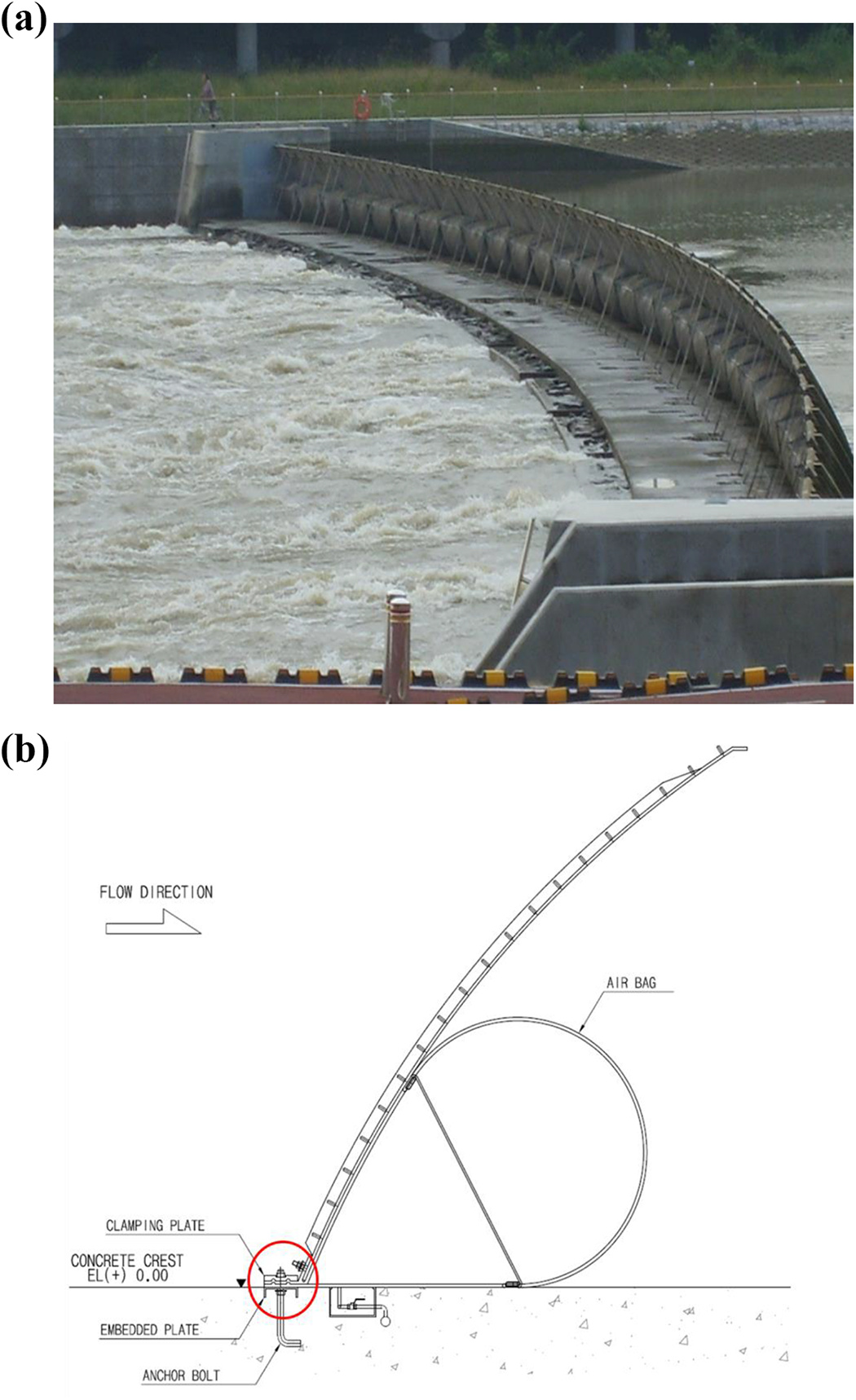
Movable weirs, developed in the 1980s, are used to control the flow characteristics of rivers or obstruct flow to retain the required water levels via variation in their height and/or position. 1 –3 When rivers are controlled by fixed concrete weirs, silt tends to deposit upstream due to the reduced flow velocity; this generates problems such as flooding, water flow capacity degradation, and water pollution. 4 Also fixed concrete weirs lose most of their functionality over time. Therefore, fixed weirs are increasingly being demolished and replaced by movable weirs. 5 There are different types of movable weirs, such as rubber weirs, tipping gates, and hinge-type gates. In recent years, there has been an increasing demand for rubber weirs and improved movable weirs. 6,7 Rubber weirs are eco-friendly structures with no leakage of pollutants into rivers. However, the strength of rubber weirs is insufficient. 2 –5 Improved movable weirs resolve the shortcomings of rubber weirs and tipping gates, 8 –10 using a combination of airbags and a stainless steel gates 2 –6 (Figure 1); however, steel, used in almost all of the components other than the airbags, tend to corrode in river environments (Figure 2). One of the steel components in question is a clamping plate. Steel clamping plates are installed inside and outside of the airbags (formed of rubber sheets); these plates play an important role in solidifying the airbags to the concrete base when the movable weir is built (Figure 1). Corrosion of the steel clamping plates can reduce the service life of movable weirs. To solve the corrosion problems of the clamping plates, various methods are being considered. In this study, we applied glass fiber-reinforced polymer (GFRP) composites, which have no potential to corrode, as clamping plates. 13 –17 The use of GFRP composites for clamping plates also solves the problems caused by the high weight of steel during construction of the movable weirs and improves construction efficiency. GFRP composites have been applied as construction reinforcement materials in the form of bars, sheets, plates, and grids. 18 –21 In particular, because its corrosion resistance is superior, GFRP is used broadly as a replacement material for reinforcing steel bars; numerous studies have examined the application of GFRP to bridge decks and other construction. 11,12,23,24 Additionally, GFRP composites have much better strength-to-weight ratio than steel materials as well as excellent corrosion resistance. 11,12,19 –24 This study attempted to improve the durability of movable weirs by applying GFRP composites as replacement materials for steel clamping plates. In particular, because the clamping plates of movable weirs are always in contact with water, they are exposed to various environments. The GFRP clamping plate has excellent corrosion resistance, but sufficient durability has not been proved when exposed to various environments such as chemical environments, repeated freezing and thawing cycles, etc. In particular, it is in constant contact with water, so expansion and cracking due to moisture absorption may occur in various environments combined with moisture, thereby promoting fracture. Therefore, evaluation and verification in such an exposure environment is necessary. In this study, the absorption, fracture, and long-term aging properties of GFRP clamping plates for movable weirs were evaluated, with respect to exposure to various environmental aging conditions.

Experimental plan
In this study, we evaluated the strength, failure, and deterioration effect of GFRP clamping plate. First, the GFRP clamping plate was applied to the improved movable weir to determine the shape of the maximum fixing effect of the airbag. Second, in this study, the determined shape of GFRP clamping plate was manufactured. Third, the flexural fracture test was performed to measure the fracture strength of the manufactured GFRP clamping plate. In addition, GFRP clamping plate was subjected to moisture absorption and flexural fracture test after exposure to long-term deterioration condition to evaluate resistance to deterioration due to penetration of water. Also fracture formation was analyzed to evaluate the tendency of fracture.
Manufacturing GFRP clamping plates for improved movable weirs
To date, commercially available GFRP materials have not been used for clamping plates for movable weirs. This study used E-glass fibers obtained from Hankuk Fiber Group (Gyeongsangnam-do, Republic of Korea), a low-cost fiber with excellent mechanical characteristics, as reinforcing fibers in a polymer matrix. The polymer matrix consisted of epoxy, vinyl ester, and polyester resin. Polyester resin is not suitable on its own for the clamping plate material, because it is easily destroyed by OH ions. Vinyl ester resin is also affected by OH ions; however, ester-free products significantly reduce this weakness. 15 In this study, vinyl ester resin obtained from Ashland Chemical (Covington, Kentucky, USA) was used because of its low cost and excellent durability. Table 1 lists the characteristics of E-glass fibers and the vinyl ester resin used in this study. The mixture ratio for the GFRP material was 70% E-glass fibers and 30% vinyl ester resin by volume; pultrusion was used to form the shapes.

The GFRP clamping plate was made by Yooil Engineering Co. Ltd (Kyunggi-Do, Republic of Korea). Figure 3 shows design drawings and the shapes of the GFRP clamping plates. This study used a 250 × 600 × 86 mm3 size test sample with the same shape as the actual clamping plate, and Figure 3 shows the design drawing and shape of the GFRP clamping plate. The GFRP clamping plate was shaped to prevent water from penetrating into the airbag connection. Figure 4 shows images taken during production of E-glass fiber supplied to the mixture (Figure 4(a)), vinyl ester resin impregnation (Figure 4(b)), and clamping plate formation via the pultrusion method (Figure 4(c)). The final shapes of the GFRP clamping plates produced are shown in Figure 4(d).

Design of GFRP clapping plate for improved movable weir. GFRP: glass fiber-reinforced polymer.
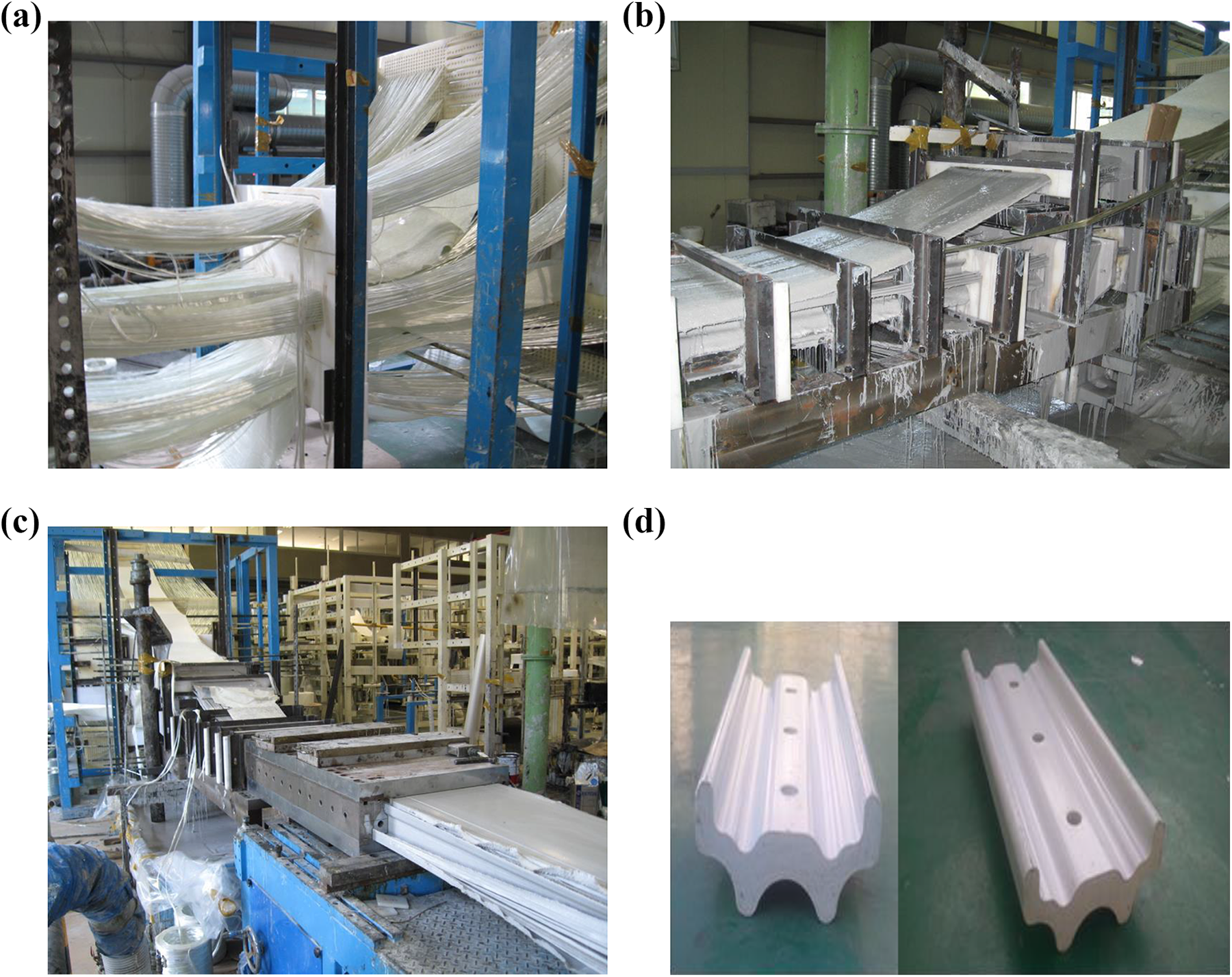
Manufacturing process of GFRP clapping plate for improved movable weir: (a) E-glass fiber supply, (b) impregnation of vinyl ester resin, (c) pultrusion of GFRP clapping plate, and (d) geometry of GFRP clapping plate. GFRP: glass fiber-reinforced polymer.
Test methods
Absorption tests
The purpose of this study was to evaluate the performance of GFRP clamping plates for improved movable weirs. Therefore, this study evaluated the absorption of the GFRP material, applying tap water, a 10% sodium sulfate (Na2SO4) solution, and a 4% calcium chloride (CaCl2) solution. The 10% Na2SO4 solution and 4% CaCl2 solution were applied to determine the effect of a chemical environment and for accelerating moisture absorption. The temperature of the solutions was maintained at 60°C. 15 –18,24 For evaluating weight changes of the GFRP clamping plate, the six specimens were weighed every day for 100 days. Absorption was calculated using equation (1): 11,19,24

where M is absorption (%), W is the wet weight, and W d is the dry weight.
Flexural tests
The GFRP clamping plates must resist bending and shearing loads more often than tensile loads. The tensile strength of the GFRP clamping plate is higher than the steel clamping plate, but the shear strength is lower than the steel clamping plate. This is because of the manufacturing method, which deploys E-glass fibers in only one direction, and the pultrusion method, in which fibers are adhered by vinyl ester resin. In this study, the flexural load was determined by the load when the GFRP clamping plate was fractured. Figure 5 shows a photograph of the flexural test using a universal testing machine (UTM) with a capacity of 1000 kN. 22,23 This test was repeated twice for six specimens.

Fracture load test of GFRP clapping plate for improved movable weir. GFRP: glass fiber-reinforced polymer.
Exposure to aging environments
Immersion in chemical solutions
One of the main reasons for applying GFRP clamping plates is to solve the problems of corrosion, which occurs when using steel products. Therefore, the new material must have excellent corrosion resistance in chemical environments. To evaluate the durability of the GFRP clamping plates, seven different environmental conditions were considered. We immersed the GFRP clamping plates for 50 days and 100 days in 10% Na2SO4 solution and 4% CaCl2 solution, with the temperature of the solution kept at 60°C, similar to the test conditions used in previous studies. 11,12,17 –22,24 For evaluating the performance of the GFRP clamping plates in water environment, tap water was used at 60°C for an exposure period of 100 days. Also this test was repeated twice for six specimens.
Repeated wetting–drying tests
When the surface of the GFRP clamping plate alternates repeatedly between a dry state and a wet state, the possibility of surface fracture is high. For evaluating the sensitivity of GFRP clamping plates to changing moisture conditions, repeated wetting–drying tests were conducted. After drying the GFRP clamping plate for 24 h in an oven at about 60°C, the plate was soaked for 24 h in 20°C water. 11,12,17 –22 The test was conducted 50 times for 100 days. Also this test was repeated twice for six specimens.
Long-term oven drying tests
Because the coefficients of expansion of the materials composing the GFRP clamping plates for movable weirs are different, fracture can be generated due to expansion mismatch between the fibers and the polymer resin, if high-temperature operation is continuous. Therefore, in this study, a GFRP clamping plate was heated in a 60°C oven for 100 days. 11,12,17 –22 This test was repeated twice for six specimens.
Repeated freezing and thawing tests
The possibility of fracture of the GFRP clamping plate by repeated freeze–thaw cycles was also evaluated. In the case of movable weirs, it is possible to have freeze–thaw cycles during the winter. As such, a test was carried out according to the ASTM C 666 standard. In the test, the effect of 100 days of freeze–thaw cycles on the fracture load was measured. This test was repeated twice for six specimens.
Long-term freezing tests
Drastic fracture of the GFRP clamping plate can occur when load is applied when the surrounding water is frozen. Therefore, in this study, the fracture properties of the GFRP clamping plate were evaluated after freezing at −5°C for 100 days. 11,12,17 –22 This test was repeated twice for six specimens.
Results and discussions
Absorption
Figure 6 shows the moisture absorption behavior of the GFRP clamping plate. The test results for tap water exposure show an almost constant behavior after 50 days. When the material was exposed to CaCl2 solution or Na2SO4 solution, the absorption was significantly higher over the first 50 days. However, after 50-day exposure, absorption exhibited only a small increase or a constant value. The quantity of moisture absorbed was the smallest in tap water; in the CaCl2 and Na2SO4 solutions, the moisture absorption was nearly the same. Figure 7 gives the final absorption amounts of the GFRP clamping plates after exposure for 50 days and 100 days. For the case of 50-day exposure to CaCl2 and Na2SO4 solutions, the rates were 0.51% and 0.49%, respectively. However, in the case of tap water, the rate of 0.34% was lower than for CaCl2 and Na2SO4 exposure. For 100-day exposure, in the case of immersion in CaCl2 and Na2SO4 solutions, the rates were 0.62% and 0.61%, respectively. Again the rate for tap water was lower at 0.37%.
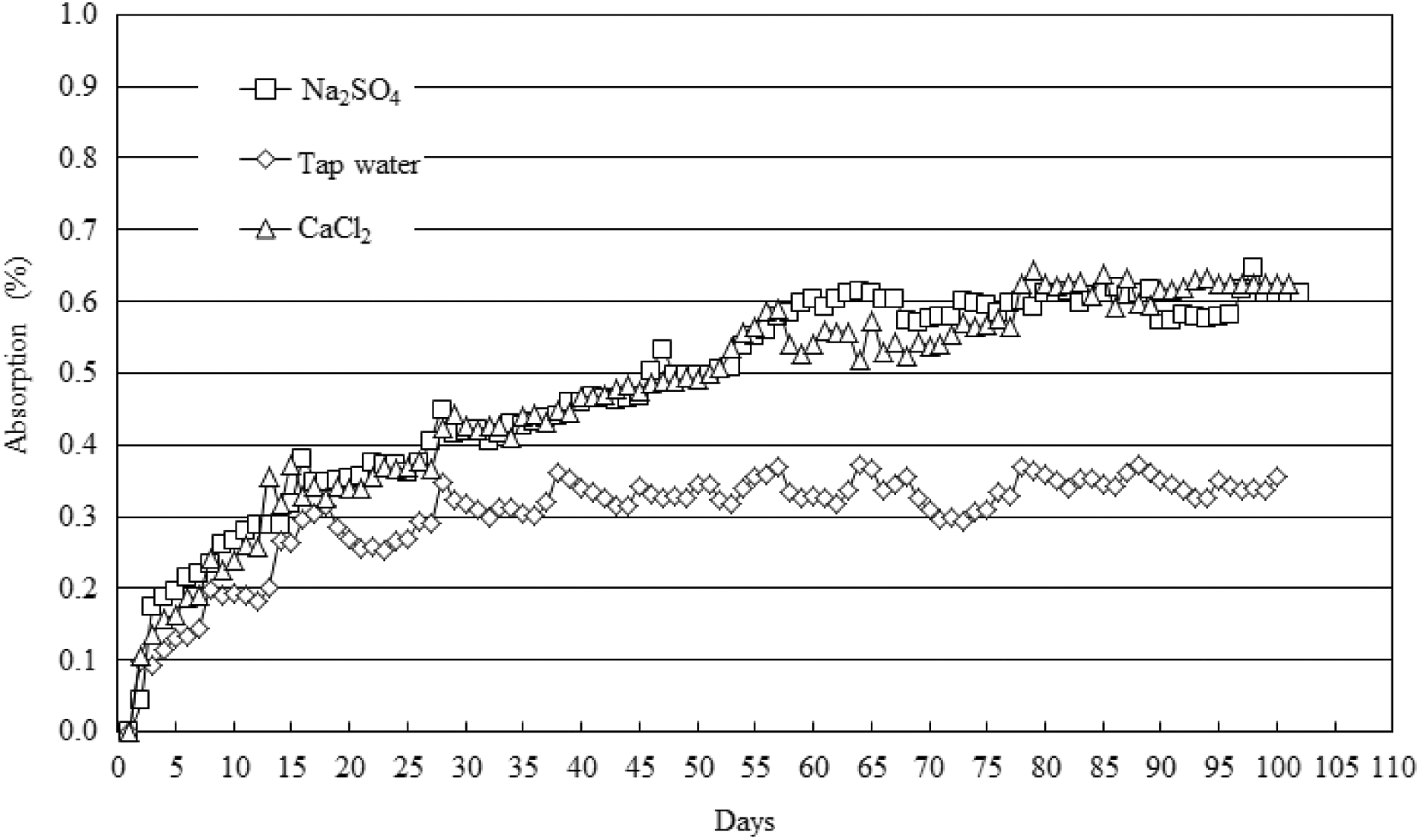
Absorption behavior of GFRP clapping plate for improved movable. GFRP: glass fiber-reinforced polymer; Na2SO4: sodium sulfate; CaCl2: calcium chloride.

Final absorption rate of GFRP clapping plate for improved movable. GFRP: glass fiber-reinforced polymer
Fracture load and residual fracture load
The results of fracture tests of the GFRP clamping plates are given in Figure 8. The fracture load of the GFRP clamping plate that was not exposed to any damaging environment was about 123.00 kN. The fracture loads of the GFRP clamping plates exposed to Na2SO4 solution were 96.04 kN and 85.23 kN after 50 days and 100 days exposure, respectively. The fracture loads of the GFRP clamping plates exposed to CaCl2 solution were 86.62 kN and 84.24 kN after 50 days and 100 days immersion, respectively. The fracture loads of the GFRP clamping plates exposed to tap water were 96.17 kN and 92.48 kN after 50 days and 100 days immersion, respectively.

Fracture load of GFRP clapping plate for improved movable weir: (a) accelerate environmental solution exposure and (b) accelerate climatic conditions exposure. GFRP: glass fiber-reinforced polymer; Na2SO4: sodium sulfate; CaCl2: calcium chloride.
The results of fracture tests after exposing the GFRP clamping plates to different ambient environments are shown in Figure 8(b). After 50 days and 100 days of repeated wetting and drying, the fracture loads were 108.29 kN and 99.21 kN, respectively. After 50 days and 100 days of freeze–thaw repetitions, the fracture loads were 91.96 kN and 88.21 kN, respectively. The results after 50 days and 100 days of long-term high-temperature exposure were 101.85 kN and 99.34 kN, respectively. Finally, the results of the fracture tests of the GFRP clamping plates exposed to 50 days and 100 days of freezing were 105.27 kN and 101.21 kN, respectively.
The residual fracture loads of the GFRP clamping plates are given in Figure 9. For 50 days immersion, the reduction of the fracture load was the largest in the case when the material was exposed to CaCl2 solution; the cases of exposure to tap water and to Na2SO4 solution showed almost equal results. For 100 days immersion, the fracture load reductions for CaCl2 solution and Na2SO4 solution exposure were similar. In the case of tap water immersion, the results were similar to those for 50 days exposure. The results of evaluating the effects of climate environments (repeated freezing–thawing, repeated wetting–drying, long-term freezing, and long-term oven drying) are given in Figure 9(b). In these test results, the largest fracture load reduction was observed when repeated freezing–thawing was applied; in other environments, the material withstood over 80% of the control fracture load after 50 days and 100 days exposure. In the case of repeated freezing–thawing, the residual fracture loads were about 74% and 71% after 50 days and 100 days exposure, respectively.
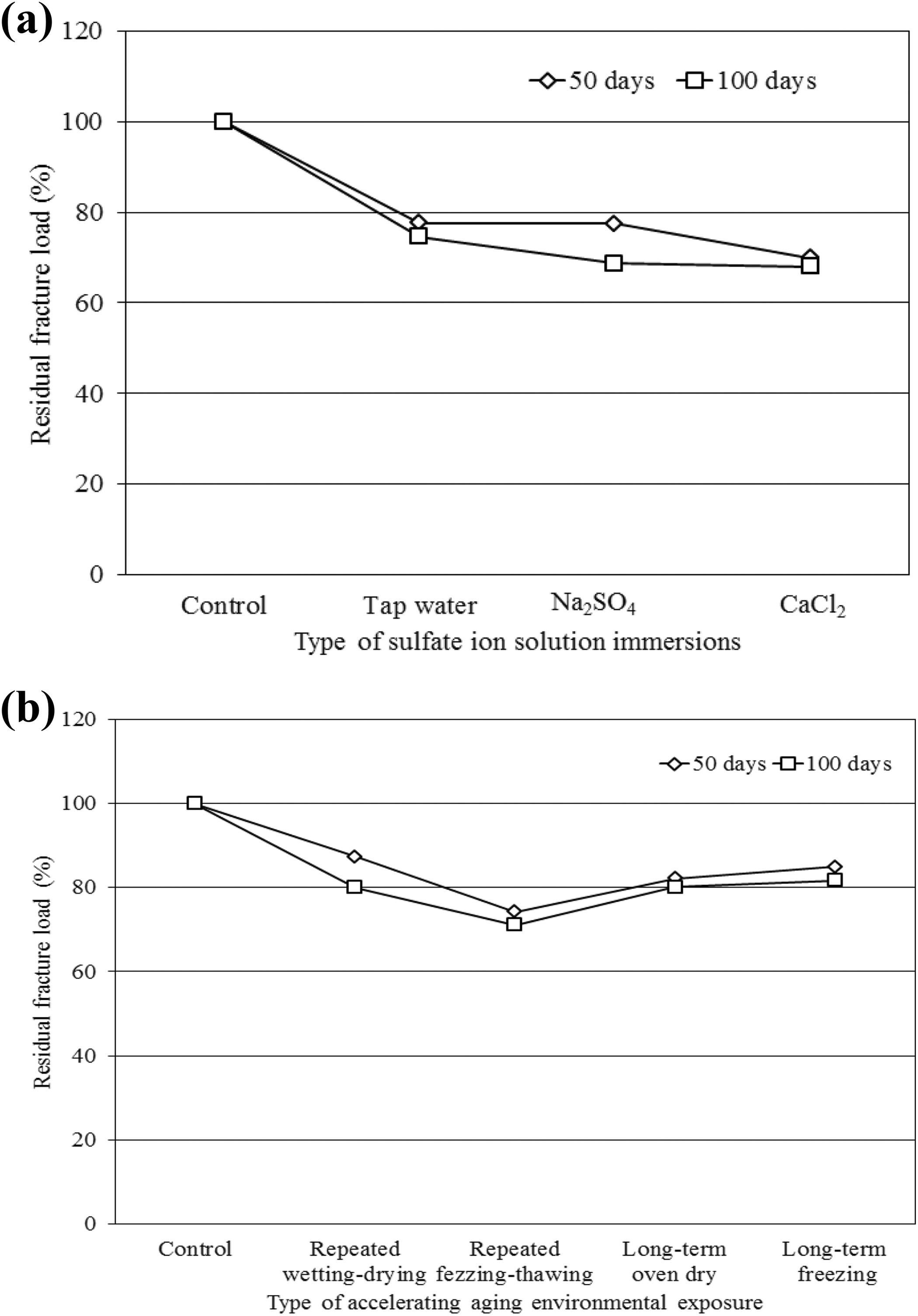
Residual fracture load of GFRP clapping plate for improved movable weir: (a) accelerate environmental solution exposure and (b) accelerate climatic conditions exposure. GFRP: glass fiber-reinforced polymer; Na2SO4: sodium sulfate; CaCl2: calcium chloride.
Fracture shapes
Figure 10 shows the fracture shapes in the GFRP clamping plates after exposure to various environments for 100 days. In general, the fracture of the GFRP clamping plates occurs as fracture of the glass fibers and in the form of fracture generation by the matrix material, in which the adhesion between the glass fibers is destroyed. The fracture shapes seen in the GFRP clamping plates include vertical and horizontal cracks, by separation at the interface between glass fibers, after exposure to all environments. The control GFRP clamping plate showed a fracture shape with a horizontal crack that was generated by separation between the fibers at the layer interface created by the one-directional deployment of fibers. The GFRP clamping plate dried for a long period in an oven shows horizontal cracks just like those in the control GFRP clamping plate. However, in the cases of soaking in 60°C tap water, Na2SO4 solution, and CaCl2 solution, the cracks generated were not only in the horizontal direction but also in the vertical direction. The specimens exposed to repeated wetting and drying, long-term freezing, and repeated freezing–thawing environments show cracks generated in both the horizontal and the vertical directions.
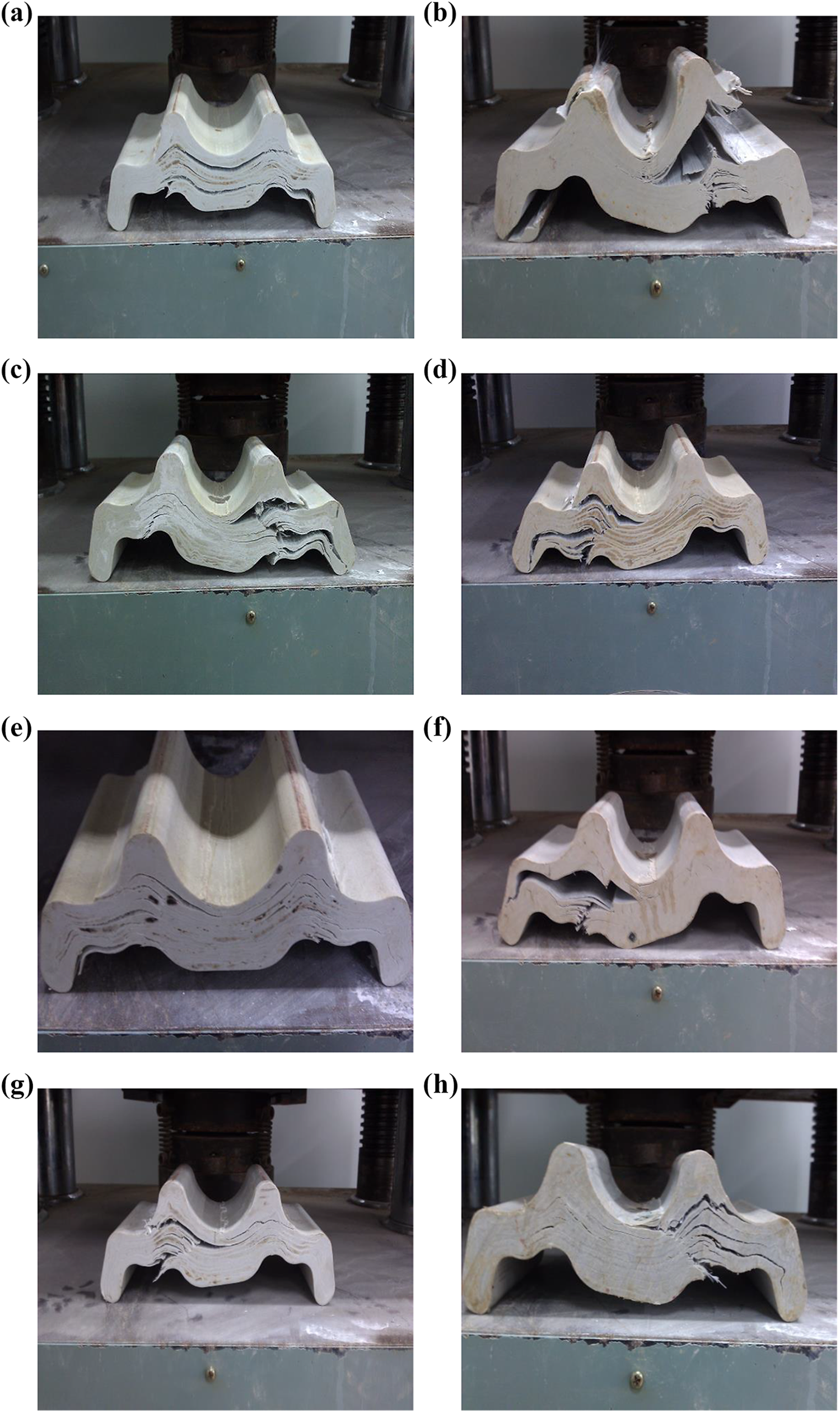
Fracture mode of GFRP clapping plate for improved movable after 100 days exposure: (a) control, (b) tap water at 60°C, (c) Na2SO4 solution at 60°C, (d) CaCl2 solution at 60°C, (e) long-term oven dry, (f) repeated wetting and dying cycles, (g) long-term freezing, and (h) repeated freezing and thawing cycles. GFRP: glass fiber-reinforced polymer; Na2SO4: sodium sulfate; CaCl2: calcium chloride.
In all of the cases in which the GFRP clamping plates were exposed to an environment with water (60°C tap water, Na2SO4 solution, CaCl2 solution, repeated wetting and drying, long-term freezing, repeated freezing–thawing), horizontal cracks and vertical cracks were generated. However, in the cases involving environments without water (control and long-term oven drying), fracture was only by horizontal cracks. This shows that when the matrix material (vinyl ester resin) adhering the glass fibers comes into contact with moisture, it deteriorates to a greater extent than it would with no contact. Thus, GFRP clamping plates exposed to moisture are more likely to experience corrosive effects than GFRP composites that do not come into contact with water directly.
Relationship between absorption and residual fracture load
The relationship between absorption and residual fracture load for GFRP clamping plates is shown in Figure 11. In general, the residual fracture load decreased as absorption increased. After 100 days of exposure, the residual fracture load showed the highest value for the case of tap water; this case showed the lowest absorption. The material exhibited similar absorption values when exposed to solutions of CaCl2 and Na2SO4; the residual strength values were also similar. Therefore, the test results show that absorption affects the residual fracture load.
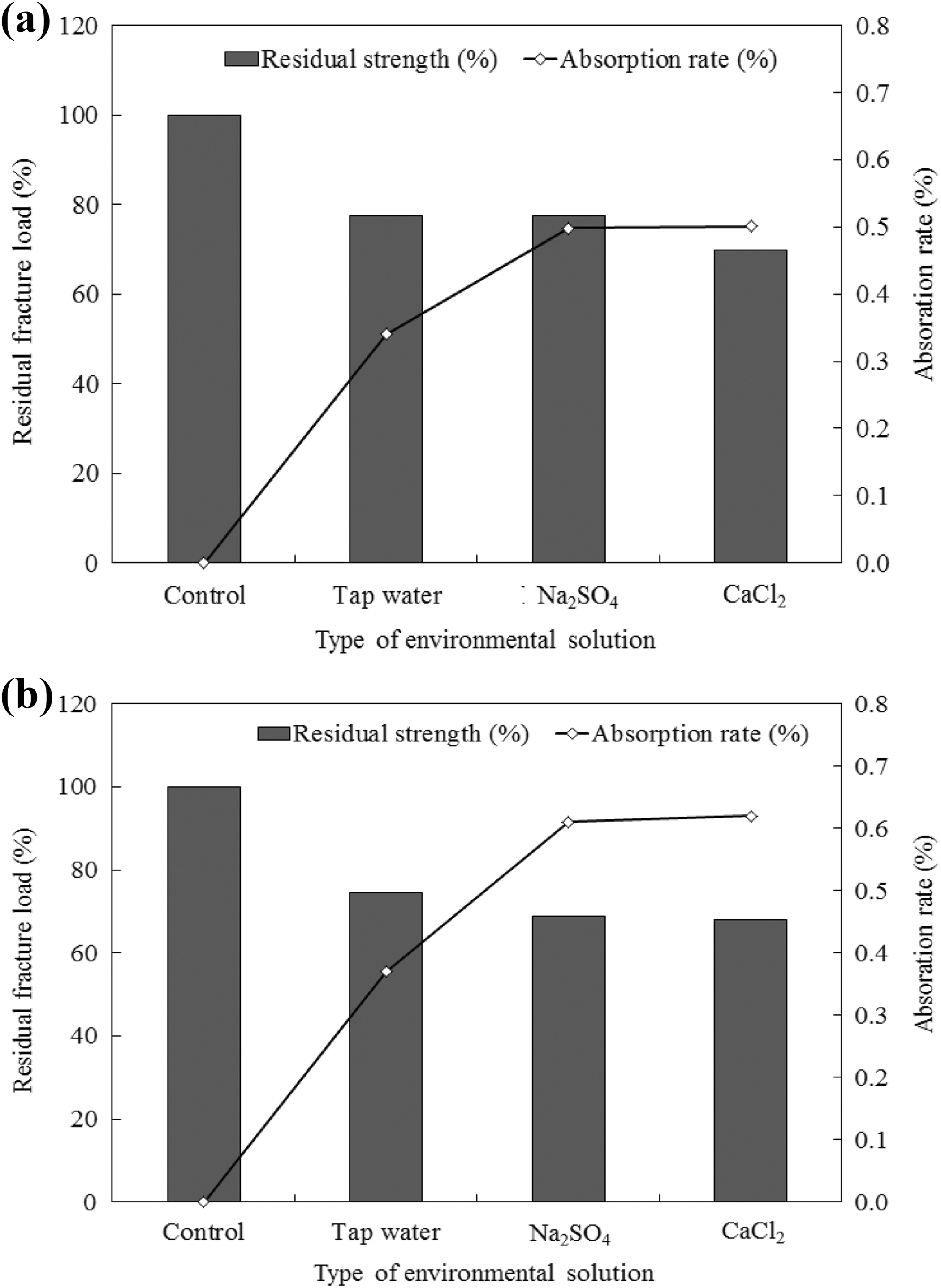
Relationship between absorption rate and residual fracture load of GFRP clapping plate for improved movable weir: (a) 50 days and (b) 100 days. GFRP: glass fiber-reinforced polymer.
Conclusions
This study evaluated the absorption, fracture, and long-term aging properties of GFRP clamping plates for improved movable weirs to solve problems related to the corrosion of steel clamping plates currently used in movable weir installations. GFRP clamping plates have no corrosion problems but, as their performance has yet to be verified sufficiently in various chemical solution/ambient environments, their application has been limited. Therefore, the purpose of this study was to provide data to allow increased use of GFRP clamping plates and thereby increase the service life of movable weirs by examining the fracture characteristics and long-term aging properties of GFRP clamping plates. A summary of the test results is given below. Moisture absorption continuously increased with immersion time in tap water at 60°C, Na2SO4 solution, and CaCl2 solution; however, the final absorption amounts after 50 days and 100 days were low, less than 0.5% and 0.65%, respectively. Fracture load tests for GFRP clamping plates showed that the material withstood about 70% and 67% of the control load after exposure to the CaCl2 solution for 50 days and 100 days, respectively. In other chemical solutions, the residual strength was 77% and 69%, after 50 days and 100 days exposure, respectively. In the set of tests involving exposure to different climate environments, the plates withstood 74% and 71% of the control load after 50 days and 100 days exposure to repeated freeze–thaw cycles, respectively. The residual strength was over 80% in all other environments after both 50 days and 100 days. The results of the fracture shape tests showed that both vertical and horizontal cracks were generated, leading to fracture, after exposure to environments where direct contact with moisture occurred; in environments without contact with moisture, only horizontal cracks were generated.
Footnotes
Declaration of conflicting interests
The author(s) declared no potential conflicts of interest with respect to the research, authorship, and/or publication of this article.
Funding
The author(s) received financial support for the research, authorship, and/or publication of this article: This work was supported by Korea Institute of Planning and Evaluation for Technology in Food, Agriculture, Forestry and Fisheries (IPET) through Advanced Production Technology Development Program, funded by Ministry of Agriculture, Food and Rural Affairs MAFRA) (11068-03-3-WT011) and this work was carried out with the support of “Cooperative Research Program for Agriculture Science & Technology Development (Project No. PJ012569032018)” Rural Development Administration, Republic of Korea.