




Abstract
In this paper, in order to estimate efficacy, creep recovery, and residual strength of Fiber Reinforced Polymers (FRPs) strengthened Reinforced Concrete (RC) beams, long-term flexural experiments and static flexural experiments were carried out. For the long-term experiments, the beams were strengthened with a Carbon Fiber Reinforced Polymer (CFRP) plate and a Glass Fiber Reinforced Polymer (GFRP) plate respectively. The beams were placed under sustained loads for about 550 days. After the 550 days, all of the beams were unloaded for the measurement of deformation recovery. The deflection and strains of rebars and FRPs reinforcements were measures for about 60 days. As the result of long-terms experiment, the beams strengthened with CFRP plate showed a better performance in terms of deflection and strains of rebars. And the strengthened RC beams were very effective in terms of deflection control. Furthermore, the strengthened beams have shown immediate deformation recovery. Through the static flexural experiments, it was shown that the CFRP strengthened beam had high residual strength. It seems that the sustained loads did not affect bond and residual strength of the beams.
Keywords
Introduction
In the recent construction industry, there has been a wide use of Reinforced Concrete (RC) due to its economical and mechanical benefits. Although it has many beneficial characteristics, most of the existing reinforced structures are in need of rehabilitation and strengthening. As steel reinforcements located in the concrete materials undergo corrosion and deterioration, the reinforced concrete structures undergo degradation as well. In order to strengthen the reinforced concrete structures, various strengthening materials and methods have been used. Particularly, external prestressing reinforcement, external bonded reinforcement and near surface mounted reinforcement have widely used. For an application of the external bonded reinforcement and near surface mounted reinforcement, Fiber Reinforced Polymers (FRPs) have been considered to be an innovative material. Thus use of the FRPs has been increased. FRPs have many superior characteristics, such as corrosion resistance, a high tensile strength-to-weight ratio, nonconductivity and design flexibility. Since the FRPs have not only the mechanical superiority but also marketability, worldwide interest in the materials and their application has arisen.
In order to investigate the behavior of the RC beams that had been externally strengthened with FRPs, various researchers have carried out research works. H. Rahimi et al. tested thirty-one RC beams that had been externally strengthened with Carbon Fiber Reinforced Polymers (CFRP), Grass Fiber Reinforced Polymers (GFRP) and steel plates in order to investigate their structural behavior 1 . The test variables that were used were the amount of conventional reinforcement, types of reinforcement and the amount of external reinforcement. The RC beams that were strengthened with composite plates showed a high load-carrying capacity of up to 230% over beams that were not strengthened with plates. It was confirmed that the strength and stiffness of the beams increased as the modulus and the amount of external reinforcement increased. For the beams that had been preloaded before external reinforcement, an equivalent performance was indicated.
H. Pham et al. tested eighteen concrete beams in order to investigate failure mechanism and the influence on the beams that were externally strengthened with FRPs 2 . The beams were divided into two groups, one that was retrofitted with 6 layers and one with 2 layers of CFRP. It was proved that the efficacy of FRPs increased with a concurrent increase in bond length and amount of FRPs that was used. Furthermore, it was proved that the concrete cover of the beams did not influence the efficacy of FRPs.
In order to investigate the effectiveness of longitudinal and shear reinforcement, Z. Wu et al. tested six FRPs/concrete hybrid beams that were externally bonded with CFRP/GFRP sheets 3 . CFRP sheets are axially bonded at the bottom of RC beams and GFRP sheets are directionally wrapped to prevent the debonding of the CFRP sheets. It was proved that the FRPs/concrete hybrid system was effective when used as a flexural member. The debonding of the longitudinal CFRP sheets affected the high load-carrying capacity of the beams.
Unlike the static behavior of the RC beams externally strengthened with FRPs, research works on the beams under sustained loads are extremely rare. In addition, deformation recovery and estimation on the residual strength of the beams should be accompanied with the long-term experiment.
Tan and Saha conducted a study on both analytical and experimental characteristics of the time-dependant deflection of RC beams externally bonded with FRPs 4 . Total nine RC beams were made and experimented under sustained loads for 2 years. Among the nine beams, six beams were externally bonded with glass FRPs. By using the adjusted effective modulus method and the effective modulus method, deflections of the strengthened beams were predicted.
G. Al Chami et al. carried out a series of experiments on the time-dependent behavior of carbon FRPs-strengthened concrete beams 5 . The time-dependant experiments were conducted on twenty-six RC beams which have different reinforcement ratios under various levels of sustained loads. Through the time-dependant experiments, there is no virtually improvement in terms of long-term deflection although FRPs-strengthening is effective to increase the ultimate capacities of the beams.
For the creep recovery of prepacked aggregate concrete, Abu S. M. and Abdul Awal made twelve concrete cylinders and four creep specimens were loaded by sustained loads, which were 40% of the ultimate strength. After 90 days, the specimens were unloaded to measure creep recovery 6 .
In this paper, three RC beams, carbon FRPs-strengthened beam, glass FRPs-strengthened beam and normal RC beam were made. For investigating time-dependant behavior, deformation recovery and residual strength, long-term experiment and static flexural experiment were carried out.
Experiment
Parameters and Dimensions of Specimens
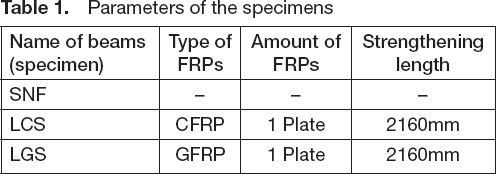
This experiment was carried out on three RC beams, each having a rectangular cross-section of 200 × 300 mm, an entire span of 2700 mm and a loaded span of 2400 mm. A concrete clear cover of 30 mm was kept constant for each beam. Unlike typical beam design, compression rebars were over-reinforced in order to prevent compression failure of the beams. D13 and D10 steel rebars were used for compression and for tension rebars, respectively. D10 steel stirrups were applied at 100 mm spacing along the lengths of the beams. Detail and test setup of the beams were shown in
Parameters of the specimens
Parameters of the specimens

Detail and test setup of the specimens
For the 28-day compressive strength of the concrete, standard cylinder compressive tests were undertaken. The size of the concrete cylinders was 100 × 200 mm. The cylinder compressive strength of the concrete that was used for the beams was taken as the measured average of three compressive strength tests. 10 mm diameter compression rebars and tension rebars, and 10 mm diameter stirrups were used for the beams. Tensile tests were undertaken to obtain the yield strength and Modulus of elasticity. One-way CFRP and GFRP plates were bonded to the beams.
Material properties of the specimens

Material properties of the specimens
In order to investigate the long-term behavior of the beams strengthened with CFRP and GFRP plates, all of the beams were loaded by a sustained load of 25 kN for about 550 days. For the measurement of strains, a series of strain gauges were bonded to rebars and FRPs plates. One dial gauge was installed at the mid-span to measure the deflection of the beams. The strains and deflections of the beams were obtained by using a data logger every day. The location of the gauges was shown in
After about 550 days, all of the beams were unloaded. In order to figure out the characteristics of deformation recovery of the beams, the strains and deflections were measured for about 60 days in the same way.
To estimate the residual strength of the beams, static flexural experiments were carried out. By using a 1,000 kN Universal Testing Machine (UTM), each beam was loaded at the rate of 1mm/min in the four-point bending as the long-term experiment. Two Linear Variable Displacement Transducers (LVDTs) were located at the mid-span of the beams. Through an EDX-1500A data logger, the strains and deflections were recorded.
Generally, RC beams strengthened with FRPs plates are disposed in the natural environment in which temperature changes over time. In this experiment, in order to take into account a temperature change corresponding to the atmospheric environment also, specimens were exposed to the outside environment.
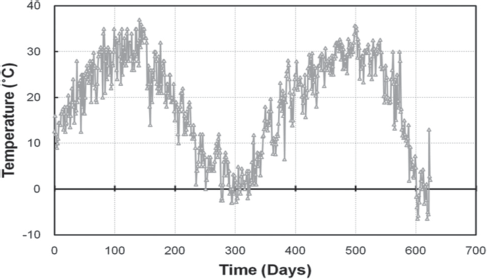
Long-term temperature change
Long-Term Experiments
All of the beams were loaded by 25 kN. In terms of the immediate deflection, the beams that were strengthened with CFRP and GFRP plates showed less deflection than that for the control beam, SNF. In particular, LCS, the beam with CFRP plate, showed the least immediate deflection compared with the other beams. The deflection of LCS was about 35% less than that of SNF. Thus it can be said that the beams externally strengthened with FRPs are superior to non-strengthened beam in terms of serviceability.
For about 550 days, the beams were located under the sustained load of 25 kN. On the whole, it was indicated that LCS showed better time-dependant performance than the other beams did. As shown in

Long-term deflections at mid-span
Comparing the total deflections on the last day of the long-term experiment, LGS and LCS showed 0.4% and 14% less deflections respectively than SNF did. For the time-dependant deflection, which is total deflection minus immediate deflection, no significant increase in the time-dependant performance was indicated between SNF and LGS. It seems that the GFRP plate did not contribute to the deflection control because its modulus of elasticity is lower than that of steel rebar.

Tension strains at mid-span
As shown in

Compression strains at mid-span
There were not so significant differences in compression strains, between LCS and LGS. The reason why the strains of strengthened beams were higher than those of non-strengthened beams seems to be a role of FRPs. Since tension force of the strengthened beams was partially taken by FRPs, relatively small portion of the tension force may cause relatively small amount of compression force. The small amount of compression force may be transferred to the compression rebar to maintain equilibrium condition.
Overall, the LCS showed less strain of FRPs than LGS. For immediate strain of FRPs, LCS showed about 51% less strain than LGS. In comparison of time-dependant strain, which excludes the immediate strain, LCS showed about 10% less strain than LGS. The strains of FRPs tend to decrease after 180 days and increase after 300 days. It is due to the change in temperature. The strains of FRPs with duration of time were shown in

FRPs strains at mid-span
In order to investigate the residual strength of the beams strengthened with FRPs, a static flexural experiment was carried out. Load-deflection curves of the beams are shown in

Load-deflection relationships
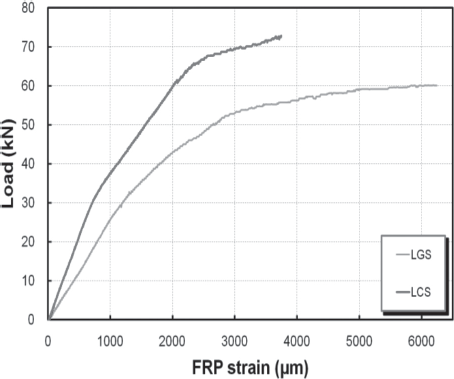
Load-strain relationships of FRPs
Strains of FRPs along the distance from mid-span were shown in

Strain-distance relationships of CFRP plate
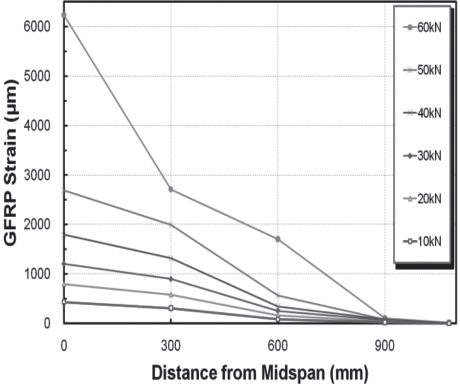
Strain-distance relationships of GFRP plate
In case of GFRP plate, full capacity of GFRP plate was not achieved either since the strain was 6236 μm when delamination of GFRP occurred. The strain of delamination was only 25% of the ultimate strain of CFRP plate. It was estimated that an increase in load-carrying capacity was influenced by not only high modulus of elasticity of FRPs but also bond characteristic. Generally, delamination is caused by shear stress.
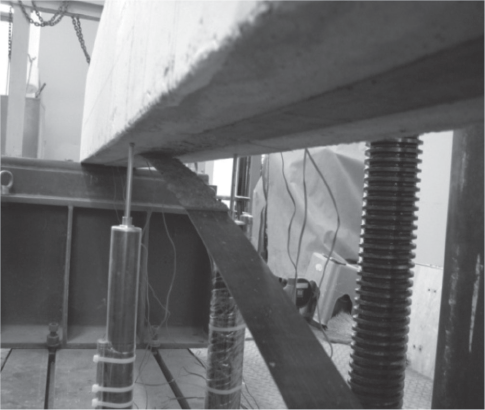
Failure mode of CFRP plate
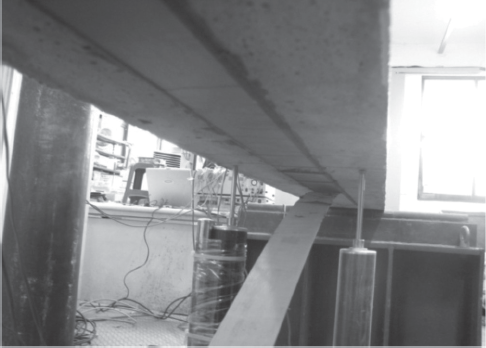
Failure mode of GFRP plate
For the deformation recovery experiment, all the beams were unloaded after about 550 days. The strains and deflections were measured for about 60 days. In general, when a sustained load is removed, a certain amount of deformation is recovered immediately. The deformation is called immediate recovery of deformation.
Comparison of immediate deformation with immediate recovery of deformation

Comparison of immediate deformation with immediate recovery of deformation
When the sustained load of 25 kN was applied, 4 to 5 cracks were indicated from each beam. For SNF, a crack was propagated up to 20 cm. For LCS, a crack of 10cm length was indicated on the first day of the long-term experiment, and the crack was propagated up to 13 cm on the second day.

Cracking patterns
Through the long-term experiment, deformation recovery and residual strength experiment, the following conclusions were reached.
The beam with CFRP plate showed a better performance in terms of long-term behavior. Although the strengthening materials were very effective in resisting immediate load, they did not affect the long-term deformation.
Strengthening materials, CFRP and GFRP plate, have an influence not on the numbers of cracks but on the growth of the cracks.
There was a correlation between long-term deformation and deformation recovery. It can be said that deformation recovery is proportionate to long-term deformation.
Even though all of the beams were loaded by a sustained load of 25 kN, the beam strengthened with CFRP plate showed the most load-carrying capacity.
Footnotes
Acknowledgment
This study was supported by Research Fund of Research Fund of National Research Foundation of Korea (NRF) - 2015R1C1A1A02036540. The authors gratefully acknowledge this support.