




Abstract
The legitimacy of security forces and the broader security sector partly derives from the legitimacy of the state, but they also possess and cultivate a legitimacy of their own. What strategies do they employ to obtain and sustain legitimacy? This article argues that the sector presents itself as dual: extraordinary yet accessible, superior yet close to society, as part of a self-legitimation strategy. Self-legitimation targets actors both outside and within the sector, justifying the sector’s existence, power and activities to external and internal audiences. This argument is based on secondary literature and observations of slogans, images, artefacts and performances at four editions of two security fairs: the Defence and Security Equipment International (DSEI) in London (2015, 2017) and LAAD Defence & Security in Rio de Janeiro (2019, 2023). Security fairs, are methodologically useful to identify self-legitimation strategies and are themselves legitimation instruments. They play a key role in (re)producing contemporary forms of militarism by legitimating, naturalizing and universalizing weapons-based, tech-based and industry-dependent views of security provision.
Introduction
What makes security forces and the broader security sector legitimate? Addressing this question is essential to understanding how they gain and sustain power, and how militarism is (re)produced and normalized within state and society.
Security forces possess coercive power, but their continued ability to exert it depends on obedience from the public, legislative and executive support, and broader societal endorsement. To secure this, they need legitimacy – understood here as the perception of an entity as ‘desirable, proper or appropriate within some socially constructed system of norms, values, beliefs, and definitions’ (Suchman, 1995). Legitimacy transforms factual power into a ‘cosmos of acquired rights’ (Weber, 1946: 262).
In a Weberian approach, the legitimacy of security forces derives from the legitimacy of the ruler and/or the state (Mann, 2012: 11). However, the interests of security forces often diverge from those of the authorities or publics on which they depend. The ideal of the military, for example, as an apolitical, armed servant of society reflects normative theories of civil–military relations more than the dynamics of interactions between the military and other actors (Payne, 2023; Pion-Berlin and Trinkunas, 2010). Consequently, the military and others in the security sector – e.g. law enforcement agencies, the arms industry, arms export promotion agencies – have incentives to cultivate a legitimacy of their own to pursue institutional and sectoral interests.
How do they pursue and manage legitimacy? Rather than doing so in the ‘old-fashioned way’ – by meeting society’s demands and complying with norms (Feaver, 2023: 276) – they may instead seek to create an illusion of alignment with society’s interests and norms, or to shape those interests and norms to match their own. This article theorizes these practices as forms of self-legitimation. Actors justify their right to exist, act and wield authority through self-generated narratives, which are instruments for producing legitimacy rather than reflections of it (Bitektine, 2011; Bourdieu, 2018; Jackson, 2006; Suchman, 1995). They manifest as stories, symbols, propaganda, rituals and performances that actors produce about themselves, for their own benefit. These official narratives are imposed as the only legitimate view, becoming a standard against which other views should be judged (Bourdieu, 2018: 69). From this angle, military parades, for instance, are not reflections of legitimacy but instruments for manufacturing it. Legitimacy is granted from above (e.g. formal mandates, government endorsement) and/or from below (e.g. public opinion), but what is regarded as legitimate may itself be shaped by an actor’s self-legitimation.
Empirically, this article is based on field observations at four editions of two major security fairs: Defence and Security Equipment International (DSEI) in London (2015, 2017) and LAAD Defence & Security in Rio de Janeiro (2019, 2023). Although central to the sector, these fairs remain underexplored in empirical research. Like other trade fairs, security fairs are more than showrooms and sites of economic exchange: they help shape the sector’s social infrastructure (Aspers and Darr, 2011; Stockmarr, 2015). These events enable actors to display, exchange and reproduce social and symbolic capital, gain awareness of and cultivate shared interests, and diffuse discourses, norms and policy agendas. I argue that security fairs are methodologically useful to identify self-legitimation strategies and are themselves legitimation instruments. Fieldwork at security fairs thus offers a window into how the sector practises self-legitimation and how these fairs contribute to legitimating the sector and its actors.
Based on observations in these security fairs, and building on the idea that militaries are both ‘familiar and dramatically unusual’ (Farish, 2016: 22), this article argues that security forces and others in the security sector represent themselves as extraordinary yet accessible, superior yet embedded in society, as part of a self-legitimation strategy. They construct extraordinariness through material and normative means: displays of firepower, advanced technology, moral virtue, and association with national myths and values. These representations aim to elevate their status, justify exceptional prerogatives and signal authority by eliciting awe and fascination (Allen, 2018; Keltner and Haidt, 2003).
Yet extraordinariness can alienate the sector from society and the rest of the state, making it appear impenetrable or excessively violent. To counter this ‘problem’, the sector seeks to create a sense of proximity, making the exceptional seem familiar. It does so by commodifying the extraordinary, observable in at least two ways: banalizing weapons and violence via the diffusion of gun cultures, military values (e.g. strict hierarchy, virility), military symbols and military jargon; and promoting narratives that present the sector and its actors as embedded in society – and vice versa.
To explore this commodification, the article draws on two notions: (i) the notion of spectacle of universality (Bourdieu, 2018), through which actors stage their particular interests, norms and worldviews as universal, presenting themselves as embodiments of the general interest; and (ii) the notion of banal militarism, referring to the routine, often unnoticed ways in which military practices, values and aesthetics are normalized and woven into everyday life (Rossdale, 2019).
Overall, militarism – understood here as a ‘complex package of ideas that, all together, foster military values in both military and civilian affairs’ (Enloe, 2016: 11) – plays a central role in self-legitimation strategies, both in constructing extraordinariness and making it appear accessible. Militarism is both an instrument and a product of self-legitimation. Promoting militarism aims at bringing legitimacy to the military and militarized actors, who can then use legitimacy to exert power in various forms, including – though not limited to – militarized ones.
The article is structured as follows. The first section defines the security sector and explains why a legitimacy-centred approach is necessary to understand its power. The second outlines the method, centred on observations at security fairs. The third and fourth sections present the empirical analysis of how the sector constructs extraordinariness and renders itself accessible by commodifying the extraordinary. These sections are followed by a discussion of the findings and the conclusions.
Legitimacy and self-legitimation in the security sector
Conceptualizing the security sector
I define the security sector as a set of formal actors involved in providing security and who see themselves as part of a group sharing interests, norms and a collective identity. A security sector can be local, national, or transnational, and may include both state and non-state actors. It typically encompasses the military, ministry of defence, law enforcement agencies, intelligence agencies, arms export bodies, the security industry and security-focused think tanks. Providing or supporting the provision of security is their declared central purpose.
This conception is broader than that of the military-industrial complex, though it includes it, and also includes what King (2024) terms the military-tech complex. Including both private and public institutions is justified by their shared interests and the frequent blurred lines between them (Abrahamsen and Williams, 2010; Bigo, 2008; Leander, 2024). The same applies to the often-blurred boundaries between external and internal security, policing and warfare (Abrahamsen and Williams, 2010; Flores-Macías and Zarkin, 2024). Providing security is the main goal of both militaries and police agencies, a common purpose that gives them overlapping identities and incentives to pursue common interests.
The sector’s boundaries are malleable, shifting with (de)securitization, changes in the security use of technologies, consolidation or fragmentation of security forces, and transnationalization – or reshoring – of firms and supply chains. Illicit actors – e.g. rebel groups, death squads – are excluded, though they may support or receive support from sector actors.
While related to Bourdieu’s (2020) concept of field, this article uses the term sector to emphasize shared interests, norms and identities over hierarchical dynamics or competition among security actors. A field is a structured social space, comprising hierarchical relationships and power dynamics, within which actors compete for influence and resources. Previous research has drawn on the notion of field to explain, for example, securitization, militarization, and changes in patterns of relations among security actors (e.g. Abrahamsen and Williams, 2010; Bigo, 2008). The security sector exists though within a broader security field that may include insurgents, civil society groups, and many others that compete, contest and negotiate security-related issues. The sector both shapes and is shaped by this broader field. Policy changes may reshape the field by empowering or constraining human rights groups, for example, while the sector can shape the security field through securitization and militarization.
This use of the term security sector differs from that in the security sector reform (SSR) literature. This literature adopts a normative lens, emphasizing actors that should be involved in – and practices that should be applied to – security provision, control and oversight, such as national human rights institutions, media and investigative journalists, transitional justice mechanisms and community-based security initiatives (Ebo and Hänggi, 2020; Sedra, 2010).
What makes the security sector legitimate? A theoretical discussion
Legitimacy is an abstract political resource (Barker, 2001: 28), an intangible asset that is negotiable and transferrable. A distinct legitimacy is a valuable resource for actors in the security sector, allowing them to justify their existence, power and methods, thus improving their ability to exert influence. They may leverage their legitimacy in bargaining processes, for example, lending it to a ruler in exchange for public money or threatening to withdraw support. Egypt’s military, for instance, helped oust President Mubarak in 2011 to preserve its legitimacy, retain economic benefits from US military aid, and maintain control over segments of the Egyptian economy (Nepstad, 2013).
Actors in the security sector possess legitimacy when their existence, power and activities are accepted by society, the rest of the state, and other actors within the sector. But how do they acquire and sustain legitimacy? There are at least three theoretical answers. Here, I focus on the legitimacy of security forces, before later expanding the discussion to the broader security sector.
In the Weberian tradition, emphasis is on the legitimacy of rulers and the state. In this approach, the military and law enforcement agencies do not possess inherent legitimacy. Rather, their legitimacy derives from that of the ruler or state, and their actions are legitimate insofar as the ruler or state sanctions them. Since the state is the legitimate ‘repository of physical force in society’, there is no need to analytically separate the legitimacy of the state from that of its security forces (Mann, 2012: 11).
In the civil–military relations literature, legitimacy stems from effectiveness and compliance with societal norms. Feaver (1999) describes this as the civil–military problématique: militaries gain legitimacy by delivering security without abusing power. This approach is useful for drawing attention to the distinct legitimacy of the military but is limited for this article’s purposes: (i) it does not emphasize the military’s agency in managing its legitimacy, which it may do through rituals, diffusion of narratives and propaganda, or by shaping the benchmarks against which its effectiveness and compliance are assessed; (ii) it prioritizes the military over other sector actors; and (iii) its binary and normative view of civilians and soldiers can mask their co-constitution and the often-unclear boundaries between them (Mabee and Vucetic, 2018: 100).
In critical security studies, security threats are constructed through securitization, which legitimates exceptional methods to combat them (Wæver, 1993). In critical security studies, the legitimacy at stake is that of methods, but securitization also enhances the legitimacy of actors defending and adopting these exceptional methods. Critical military studies focus on the material, institutional and ideological aspects of military power and their diffusion into society. While the concept of securitization is key in critical security studies, militarization and militarism are key in critical military studies. Previous research within critical military studies indicates that militarism permeates different spheres of life, and that the boundaries between civilian and military actors are more blurred than assumed in the civil–military binary (Enloe, 2016; Sjoberg and Via, 2010; Stavrianakis and Stern, 2018).
This article is situated within critical security studies and critical military studies literature, emphasizing (i) how security representations and discourses legitimate security practices and actors (e.g. Browning and McDonald, 2013: 239), and (ii) the agency of these actors in defining their missions and appropriate security methods (Grondin, 2023: 2). It bridges the critical security studies and critical military studies literatures in two ways. First, it looks at the whole security sector, integrating critical security studies’ attention to threat construction and the legitimacy of security methods with critical military studies’ focus on militarization and the military’s role in both securitization and militarization (Stavrianakis and Stern, 2018: 8). Second, previous research in critical military studies has explored the militarization of civilian spaces, activities and products (e.g. Enloe, 2000), but less attention has been given to whether and how the military and other actors in the security sector shape these processes as parts of self-legitimation narratives.
The article examines norm construction and diffusion but is both one level up and one level down from a standalone discussion on norms. One level up, it examines the role of norm construction and diffusion as part of self-legitimation strategies, thus situating norm dynamics within a broader purpose. One level down, it explores the substance of these norms.
Legitimation and self-legitimation
Legitimacy is constructed and maintained through legitimation, a process through which ‘something that is, is made to appear as something which should be’ (Luckmann, 1987: 110–111). In other words, legitimation is the ‘process of social construction of legitimacy’ (Bitektine, 2011). In policymaking, legitimation defines the boundaries of legitimate policy options by shaping what is considered acceptable and unacceptable (Jackson, 2006: 16). Legitimation is a permanent process, a constant reminder to external actors and oneself that one is legitimate.
Drawing on Bourdieu (2018: 4), I argue that self-legitimation is central to understanding what renders the security sector legitimate – and, by extension, how it survives and thrives. Self-legitimation manifests as practices through which actors justify and rationalize their existence, authority and activities on their own terms. Security forces and other actors within the sector have little incentive to leave the task of legitimation solely to external audiences. Instead, they seek to socialize external and internal audiences into specific ways of thinking and feeling about the sector. When self-legitimation succeeds, the security sector achieves legitimacy on its own terms, rather than on those imposed or expected by others.
To explore how the security sector manages legitimacy through self-legitimation, I use a typology from organizational studies literature, which is well suited to examining the legitimacy of individual sectors and organizations and how they manage it. I follow Suchman (1995), who divides legitimacy into three types: pragmatic, moral and cognitive. Pragmatic legitimacy stems from perceived usefulness. Equivalent to output legitimacy (Schmidt, 2013), it depends on whether actors appear effective. To obtain pragmatic legitimacy, security actors present selected pieces of information about the sector’s performance and define and diffuse understandings of effectiveness. For instance, if effectiveness is associated with processes that the sector privileges – e.g. firepower, hawkishness, tough-on-crime policies – rather than with outcomes, it can enjoy pragmatic legitimacy on its own terms, and regardless of whether it provides security.
Moral legitimacy stems from normative approval: actors and their activities are regarded as compliant with societal norms. To obtain moral legitimacy, actors in the sector seek to convince others that they comply with norms, while also spreading their own visions of appropriate norms. The military and police, for example, enjoy this type of legitimacy if their values are regarded as correct, and if they are perceived as serving society rather than themselves or the elites, thus ‘conforming to altruistic ideals’ (Suchman, 1995). To pursue moral legitimacy, security actors perform the spectacle of universality (Bourdieu, 2018: 28), publicizing instances of compliance with societal norms, concealing non-compliance, and seeking to define those norms in the first place.
Cognitive legitimacy stems from taken-for-grantedness (Suchman, 1995). To obtain this type of legitimacy, actors in the sector seek to convince others that their existence, power and activities are natural and inevitable – just ‘common knowledge’ or ‘common sense’. The goal is to make the constructed appear ‘natural, attractive and unquestioned’ (Baker, 2020: 1). This is likely the most effective form of legitimacy: one that is invisible, conceals contingency and is internalized in the minds of the public.
In summary, to gain or maintain legitimacy, actors in the sector seek to persuade others that their existence, power and activities are effective (pragmatic legitimacy), norm-compliant (moral legitimacy) and natural (cognitive legitimacy). As these three types of legitimacy are interconnected, self-legitimation strategies to build one type often bolster or require the others. For example, portraying the military as effective (pragmatic legitimacy) involves selecting benchmarks that are normatively valued (moral legitimacy) and embedding those values in narratives of tradition and inevitability (cognitive legitimacy).
Self-legitimation is not only an instrument to ‘fool the masses’, though, it is also a way of providing meaning and a sense of purpose to members of the entity (Luckmann, 1987). Self-legitimation narratives offer an ethically coherent story that justifies and rationalizes one’s existence, power and activities to oneself. When endorsed by internal audiences, these narratives contribute to making the sector or individual organizations within it ‘a world endowed with sense and value, in which it is worth investing one’s energy’ (Bourdieu and Wacquant, 1992: 127).
The structure of the security sector’s self-legitimation narratives
Actors in the security sector create an image of extraordinariness using material and normative means, especially displays of firepower and technology, emphasis on high moral standards – e.g. patriotism, duty, sacrifice – and ties to national symbols and myths.
Displays of firepower and advanced technology can elicit awe in observers, ‘an emotion characterized by the feeling of transcendence’ (Allen, 2018; Keltner and Haidt, 2003). The technological sophistication of modern militaries may produce the ‘technological sublime’ – the awe and fascination elicited by modern machinery (Marx, 2000). By transcending the ordinary, military machines and security technologies convey a sense of extraordinary power that other security measures, such as disarmament and social inclusion, cannot replicate. They suggest that people and organizations in the sector are exceptional.
Moreover, modern militaries are intertwined with alleged superior values, traditions and national myths. The military would embody the nation itself. Performances evoking superior values and national myths aim to create an appearance of extreme devotion from soldiers to the nation – and from the public to soldiers. In the United States, for example, the military is part of a civil religion: soldiers killed in action become not only heroes but also ‘saints’ (Ebel, 2015). Associating the military with superior values also legitimates wars. During the War on Terror, for example, US authorities dehumanized adversaries by arguing that they lacked values (Steuter and Wills, 2010).
However, extraordinariness alone can make the sector seem impenetrable or overly violent. Actors in the sector counter this ‘problem’ by commodifying the extraordinary. They do so through both material and normative means, such as diffusing gun cultures, spreading military norms, values and symbols (e.g. virility, military jargon, military aesthetics), and portraying soldiers as caring and approachable. Following Bourdieu (2018), I argue that actors in the sector emphasize that the sector and society are intertwined to normalize and depoliticize their existence, power, methods and worldviews.
A key way actors in the sector commodify the extraordinary is by producing and diffusing banal militarism. The term derives from banal nationalism, which refers to the everyday and often unnoticed ways in which national identity is reinforced, making the nation seem natural and ever-present (Billig, 2005; Rossdale, 2019). Examples of banal militarism are gun cultures, militarized imagery in popular culture, routine use of military equipment in law enforcement, and portrayal of critiques of security forces as unpatriotic, ideological, or naive. I argue that the security sector manufactures the banal to construct perceived accessibility. The banal is a commodified version of the extraordinary.
Military and police self-legitimation practices convey material and moral superiority through multiple channels, including education, public ceremonies, entertainment and social media. The US government promoted the War on Terror, for example, through popular cinema, sports and advertising (Coyne and Hall, 2021), showcasing the extraordinariness of the US security apparatus and, by extension, the exceptionalism of the country itself. This strategy is an instance of what Ellul (1973) calls propaganda of integration, aimed at standardizing norms, values, or ideologies in society to foster cohesion and make society more manageable.
Research at and about security fairs
A major obstacle in empirical research on the security sector is its ‘veil of secrecy’ (Grondin, 2023: 194). Security fairs present an opportunity to peer behind this veil, offering a chance to observe internal features of the sector in an efficient manner. These fairs take place over a short period and attract a wide range of participants, including militaries, defence ministries, law enforcement agencies, the security industry, contractors and specialized media outlets.
Previous research has explored security fairs as sites for fieldwork (e.g. Carver and Lyddon, 2022, chap. 4; Leander, 2021; Rossdale, 2019; Stockmarr, 2015), and there is a larger body of scholarship on trade fairs from other sectors. Trade fairs are ‘hot spots’ for exchanging goods, services and ideas – places where ‘complexity is rendered visible and made tangible’ (Garsten and Nyqvist, 2013: 202). They function as ‘villages of professionals’, where industries and professional identities are formed and reinforced (Nyqvist et al., 2017).
Security fairs share much in common with other trade fairs. Companies, government agencies and specialized media set up stands to display their products and services, organize meetings and engage with visitors. Opportunities for interaction arise in seminars, at stands, in hallways and during lunch breaks. Like other trade fairs, security fairs are not only venues for negotiating goods and services, they are platforms for fostering connections among actors and disseminating discourses, ideas, norms and policy agendas (Aspers and Darr, 2011).
I visited DSEI in London in 2015 and 2017 and LAAD in Rio de Janeiro in 2019 and 2023. These are among the largest security fairs in terms of visitors and exhibitors, alongside others such as the International Defence Industry Fair (IDEF) in Istanbul and Eurosatory in Paris. DSEI and LAAD are held biannually and follow a similar format. Both fairs result from collaborative efforts between governments and private entities. There are two types of stands at these fairs: those from individual companies (e.g. BAE Systems, Lockheed Martin, SAAB), with the largest companies usually having the largest stands; and national pavilions, almost always organized by government departments that promote exports in general or arms exports in particular.
The company Clarion Events organized DSEI 2015, DSEI 2017 and LAAD 2019. In 2017, DSEI attracted around 36,000 visitors and 1600 exhibitors, while LAAD had approximately 37,000 visitors and 600 exhibitors. 1 DSEI’s predecessors were the British Army Equipment Exhibition (BAAE) and Royal Navy Equipment Exhibition (RNEE), first held in 1976 and 1977, respectively. BAAE and RNEE were privatized in 1999 and merged into a single event called DSEI. LAAD, originally launched in 1997 as Latin America Defentech (LAD), changed its name to Latin America Aero & Defence (LAAD) in 2005 and became LAAD Defence & Security in 2011. Although DSEI and LAAD are similar, there are notable differences. Access to DSEI is more restrictive, barring exhibitors from certain countries – e.g. China, Iran, Russia – and limiting access for NGO experts and certain journalists. 2 LAAD has a stronger local focus, with Brazilian military and law enforcement agencies taking a more prominent role than their UK counterparts at DSEI.
Both DSEI and LAAD have evolved beyond traditional defence exhibitions into broader security fairs. In 2015, DSEI hosted for the first time a ‘security zone’ devoted to counterterrorism, border security and policing. This zone added to the pre-existing land, naval, air and joint zones. LAAD similarly broadened its scope, changing from an air and defence fair to one encompassing the entire security sector, adopting its current name – LAAD Defence & Security – in 2011. These changes confirm findings from previous research on the integration of military and law enforcement and the blurring of lines between external and internal security (e.g. Abrahamsen and Williams, 2010; Stavrianakis and Stern, 2018).
Security fairs differ from gun shows, which target the general public, and from air and military shows, which aim to foster admiration for the military, cultivate civic pride and promote defence-mindedness among broader audiences (Rech and Williams, 2016). By contrast, security fairs are intended for professionals within the sector, with the vast majority of visitors being male.
Two questions guided the fieldwork. First, how does the security sector – and its actors – pursue and manage legitimacy? Second, what is the role of security fairs themselves in legitimating the sector, its actors, practices and worldviews? While these questions guided the fieldwork, I remained open to emerging issues and questions from the field (Eggeling, 2021). At the fairs, I observed stands and displays, exploring how companies, government agencies and other actors represented their products, services, activities and themselves, as well as how they represented perceived adversaries or outgroups. I analysed exhibit design, use of imagery and slogans, selection and arrangement of artefacts on display, and live performances such as equipment demonstrations. I paid particular attention to whether and how these representations sought to convey legitimacy. I also held informal conversations with exhibitors and attendees, gathering insights into whether and how these representations were received or accepted as natural.
Constructing extraordinariness
Actors in the security sector portray themselves as powerful, enduring and transcendent, emphasizing exceptional qualities that distinguish them from others. This section explores two manifestations of this self-legitimation strategy: (i) the use of material means, especially displays of equipment and technologies, as an effort to perform material superiority in pursuit of pragmatic legitimacy; and (ii) the use of normative means, especially emphasis on myths and alleged superior values, as an effort to obtain moral and cognitive legitimacy.
Constructing material extraordinariness: Firepower and security technologies
Equipment and technologies are the most prominent visual features of security fairs, through which exhibitors showcase capabilities in developing, producing and/or using them. These are not only products for sale but also instruments of impression management, designed to project power, modernity and rationality.
While most visitors to the fairs are unlikely to influence major equipment acquisitions directly, security fairs are more than markets. They serve as platforms for normalizing and universalizing weapons- and tech-based views of security, reinforcing the notion that the sector deserves legitimacy due to its capacity to develop, produce, or deploy advanced weaponry and technologies. The displays at security fairs are self-legitimation instruments, reflecting and reinforcing a view in which firepower and technological solutions are the central elements of security provision.
At security fairs, private corporations display both big and small equipment, including armoured cars, howitzers, radars, aircraft, small arms and light weapons (SALW) and soldier equipment, as well as various components such as head-up displays, communication systems, sensors, simulators and many others.
National pavilions are a major part of security fairs, projecting an image of firepower and technological excellence, as seen across both democracies and non-democracies, and among countries from the Global North and Global South. As the host of DSEI, the UK government had the largest national pavilion at the fair (Figure 1), featuring military equipment alongside British soldiers and companies. By their very co-presence in the pavilion, they legitimate one another, signalling a cohesive sector in which interests, identities and views of security are aligned. Other pavilions have similar characteristics. National pavilions from Austria, Canada, India, South Africa and Türkiye, for example, were among the largest ones at DSEI and LAAD, projecting a national and sectoral image of strong material capabilities (e.g. Figures A.1 and A.2). 3 Russian and Chinese institutions are not allowed to participate in DSEI, but they are permitted at LAAD. LAAD 2019 had a large pavilion from Rosoboronexport, Russia’s sole government intermediary for exporting weapons. Chinese company Norinco has maintained a presence in LAAD since its first edition in 1997 (Gaudenzi, 1997). In 2023, Norinco was the second largest defence company in China and eighth largest in the world. 4
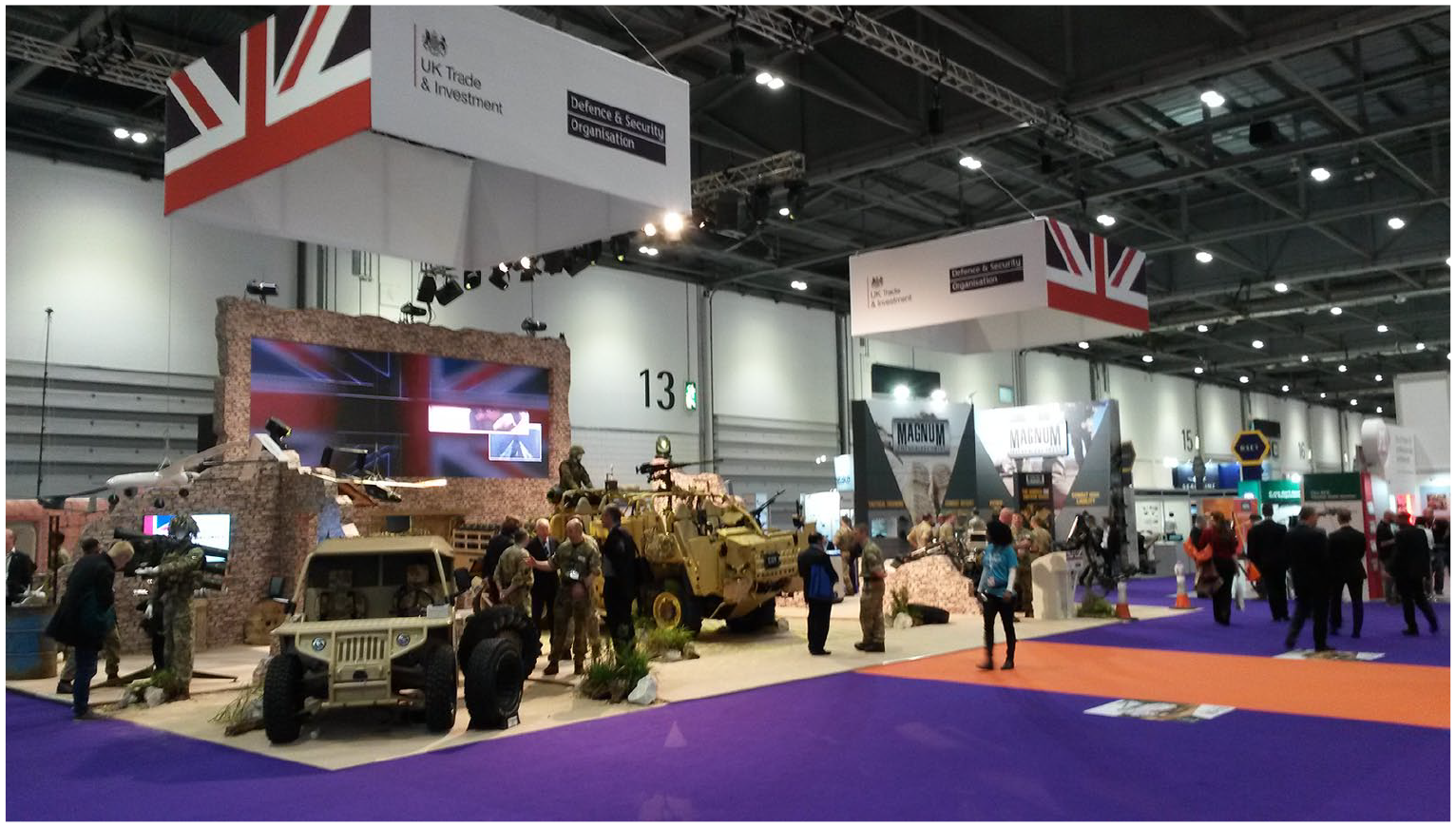
UK national pavilion, DSEI 2015.
National militaries and law enforcement agencies (e.g. police forces, border control agencies) have their own spaces at security fairs, indicating their pursuit of legitimacy through displays of material power. At DSEI 2015, for instance, national militaries exhibited equipment such as the US Army’s CH-47 Chinook helicopter and an Indian Navy Talwar-class warship. The fair also featured live demonstrations of counterterrorism and anti-piracy operations, allowing visitors to observe security forces and their products and technologies in action.
DSEI and LAAD also reveal blurred lines between military and policing, though this feature is more pronounced at LAAD. Hawkish policies elsewhere are equivalent to mano dura, tough-on-crime policies in Latin America. In this way, LAAD contributes to defining the boundaries of legitimate and effective public safety strategies – centred on firepower and technology. At LAAD 2019, the stand of BOPE, the special operations unit of Rio de Janeiro’s Military Police (PMERJ), displayed the unit’s badge sculpted from cartridge cases, alongside one of its armoured vehicles (Figure 2). This symbol of firepower, combined with the display of armoured technology, suggests an exceptional capacity to combat crime. BOPE should deserve admiration – and legitimacy – not despite its militaristic approach, but because of it.
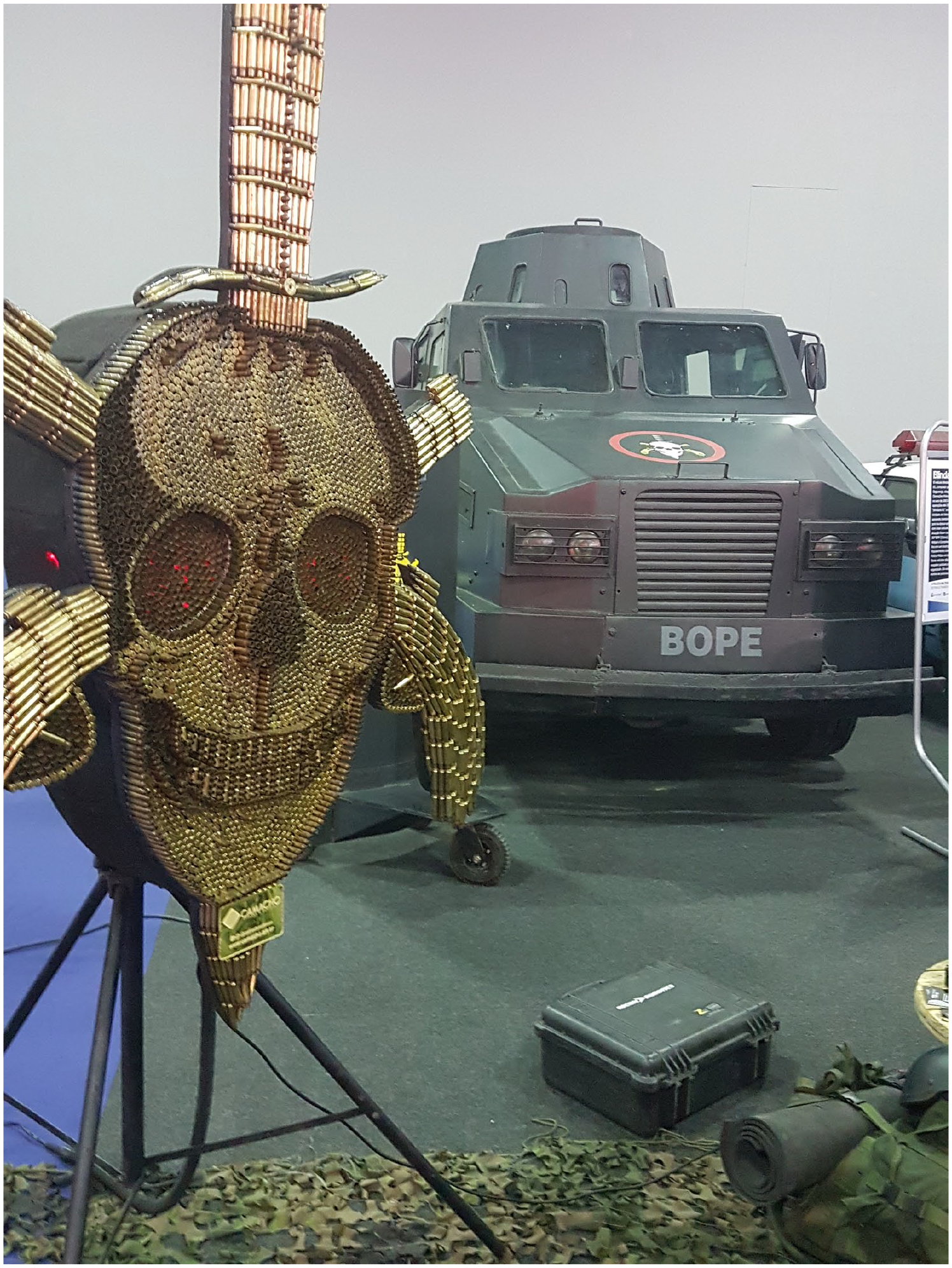
Stand of BOPE, the PMERJ’s special operations unit, LAAD 2019.
At LAAD 2019, the PMERJ’s stand displayed a picture of a comunidade (aka favela) next to rifles (Figure 3). Comunidades are areas of high-risk police operations, usually controlled by drug lords or mafia-like paramilitary groups known as milícias. Rio’s comunidades are portrayed as spaces inhabited by people who deserve compassion or violence, and that should be conquered or pacified through militarized interventions, using heavy equipment if needed. This representation is similar to what Stockmarr (2015) observed in a security fair in Israel in 2012, where the places of intervention were presented as ‘dry and Mediterranean, a refugee camp or an urban slum’. Resembling a colonial imaginary, threats are racialized and circumscribed to these areas, where extraordinary security measures – such as ‘special operations’ and extrajudicial killings – are permitted. In 2022 alone, PMERJ killed 1327 people, more than the 1255 people killed by all police forces in the United States combined. 5
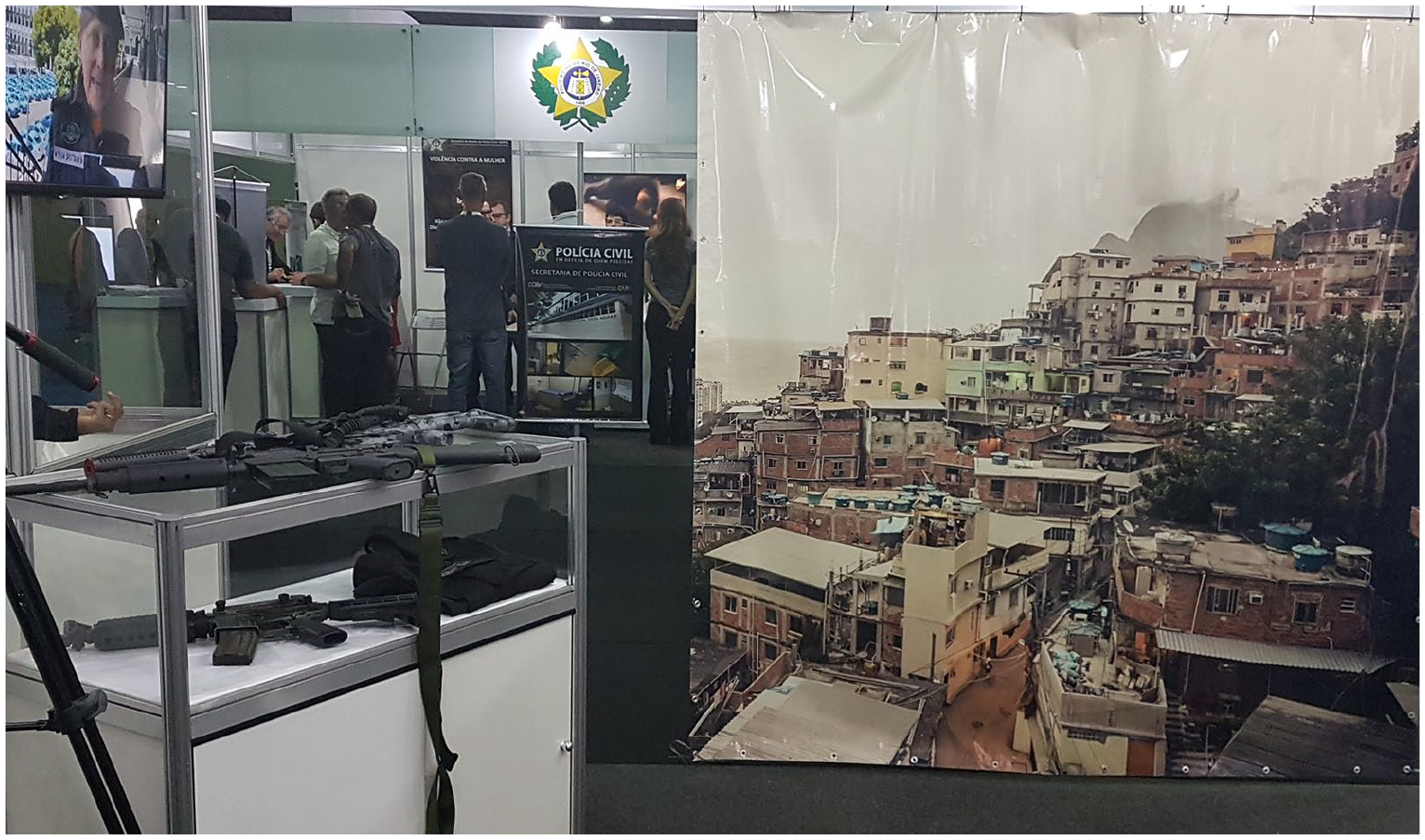
Stand of the Military Police of the Rio de Janeiro State (PMERJ), LAAD 2019.
The specialized press also constructs the extraordinary by highlighting firepower and technology. At LAAD 2023, the fair’s official magazine was Tecnologia & Defesa (Technology & Defence), the largest Brazilian magazine in this area, created in 1983. As other publications from the sector, Tecnologia & Defesa emphasizes the sophistication of military technology and equipment. In its ‘daily show news’ about LAAD 2023, circulated during the fair, the reports promoted Brazilian and non-Brazilian companies and their most sophisticated items. There were reports about products and services from Avibras, Embraer, Leonardo, Rolls-Royce, SAAB, Sikorsky and others.
Constructing moral extraordinariness: Myths, values and norms
Actors in the security sector emphasize their superior values and moral standards, and their alleged embodiment of the nation. This strategy seeks to secure moral and cognitive legitimacy: the sector portrays itself as permanent and essential to keeping countries and communities safe, a mission fulfilled with patriotism, loyalty, discipline, sacrifice and other military values. Security fairs reveal this strategy in at least four ways.
First, through representations of soldiers and police officers as heroes. A banner at LAAD 2023 (Figure A.3) displayed the slogan ‘empowering our heroes’, presented by the fair’s organizer, Creative Events. The distinction between heroes and villains lies not in their force but in the values they uphold. While both may possess power, only the former possesses moral righteousness – and therefore deserves legitimacy. This framing also constructs adversaries as malign, opposing ‘our’ values. The construct of soldiers and police officers as heroes is a persistent feature of military and police propaganda (Boggs, 2017).
Second, through national pavilions. These serve as platforms that link national values, symbols and myths to security actors, products, services and technologies. The sector and its actors present themselves as outstanding representatives of the country, political expressions of the nation to which others within and outside the sector should defer. National pavilions blend private corporations, the military and government agencies, and turn this blend into a national symbol itself. Governments thus define and construct the security industry as both an integral part of the nation and an extension of the state. The UK pavilion at DSEI, for example (Figure 1), displayed military equipment from private companies alongside British soldiers, who acted as company salespeople, legitimating these firms by linking them to military and national values.
National pavilions are also tools of defence diplomacy and public diplomacy. At LAAD 2019 and 2023, the US DoD’s pavilion displayed propaganda of US security cooperation with allies and select non-allies. The pavilion emphasized four main areas of security cooperation: arms transfers, institutional capacity building, education and training, and humanitarian assistance (Figure A.4). A video played footage of US diplomatic and military achievements, such as the Gulf War and Oslo I Accord, reinforcing an image of the US government as both powerful and morally upright, able to wield force in the service of just causes. These self-representations contrast with images of massacres and abuses. While violence is inherent to war, its uncontrolled visual dissemination exposes contradictions between the military’s actions and declared moral standards. For instance, images of the My Lai massacre, revealed in 1969, and Abu Ghraib torture and prisoner abuse, revealed in 2004, contradicted military self-representations, fuelling opposition to the Vietnam and Iraq wars, respectively.
Third, through the selection of ingroups and outgroups. DSEI excludes China, Iran and Russia, for example, helping define the boundaries of a legitimate transnational security sector, composed of Western governments, allied nations and select non-allies such as Brazil and India. This exclusion strengthens the perception that DSEI participants share values and norms.
Fourth, through the notion of ‘protecting those who protect us’, whereby the security industry seeks to associate its brands, products and services with the protection of soldiers and police officers. The industry claims to safeguard not only society but also security personnel by equipping them with armoured vehicles, bulletproof vests and other protective gear. As an illustration, an armoured vehicle from Rio’s police bore the slogans ‘technology that saves lives’ and ‘maximum comfort, maximum protection’, engraved beneath the manufacturer’s name, the US company Combat Armor Defence. The industry presents itself as both a guarantor of physical protection and a moral ally of security forces, sharing their values and norms.
Commodifying the extraordinary
Extraordinariness may undermine legitimacy if it makes the sector and its actors seem alienated from society or too violent. Actors in the sector counter this ‘problem’ by commodifying the extraordinary, using for that purpose material and normative means. This strategy is manifested in efforts to (i) normalize weapons, security technologies and state violence, and (ii) present security forces as tough yet compassionate and approachable, embodying the image of the warrior-protector. The former indicates a search for cognitive legitimacy while the latter indicates a search for pragmatic and moral legitimacy. There are likely other strategies too.
Normalizing weapons, security technologies and state violence
The very format of a trade fair normalizes weapons, security technologies, state violence and the sector itself by situating them within the broader economy. The showroom and market format creates an ‘atmosphere of commercial normality’ (Leander, 2024). The venues holding the fairs, Excel London and Riocentro, hold other trade fairs and conventions, positioning the security sector as one among others, giving it a ‘civilized gaze as were they selling any kind of commodity’ (Stockmarr, 2015). The fact that the organizer of LAAD (until 2019) and DSEI, Clarion Events, operates across multiple sectors – rather than specializing in security – further reinforces this impression.
Rather than one instrument in a toolbox, security fairs present weapons and security technologies as the default response to perceived security threats, trivializing the centrality of weapons and technologies in security provision and everyday life. Security fairs contribute to give a taken-for-grantedness character to the paradigm that security problems are always solved with more weapons and technology. The transnational character of the fairs also contributes to normalize weapons-, tech- and industry-dependent views of security by universalizing them (Stockmarr, 2015).
At LAAD 2019 and 2023, when visitors entered the fair, they first saw the stands of CBC and Taurus, Brazil’s largest manufacturers of ammunition and SALW, respectively. 6 A banner at the Taurus stand in 2019 proclaimed, ‘self-defence is your right’ (Figure 4), framing gun ownership as an intrinsic right and essential for personal safety. Slogans, imagery and the firearms themselves function as political messages, naturalizing gun cultures and normalizing a weapons-based view of security provision. Taurus promotes gun culture in Brazil by sponsoring shooting events and ranges, and using weapons as symbols of patriotism, civic duty and protection of law-abiding citizens (Motoryn, 2023). The company is also a major financial supporter of the US National Rifle Association (NRA), which recognized Taurus as its top ally in 2023. 7 At LAAD, other SALW manufacturers, such as Beretta, Colt and Glock, also offered visitors the opportunity to observe and handle firearms. The underlying message is that weapons are extraordinary but should also be part of daily life.
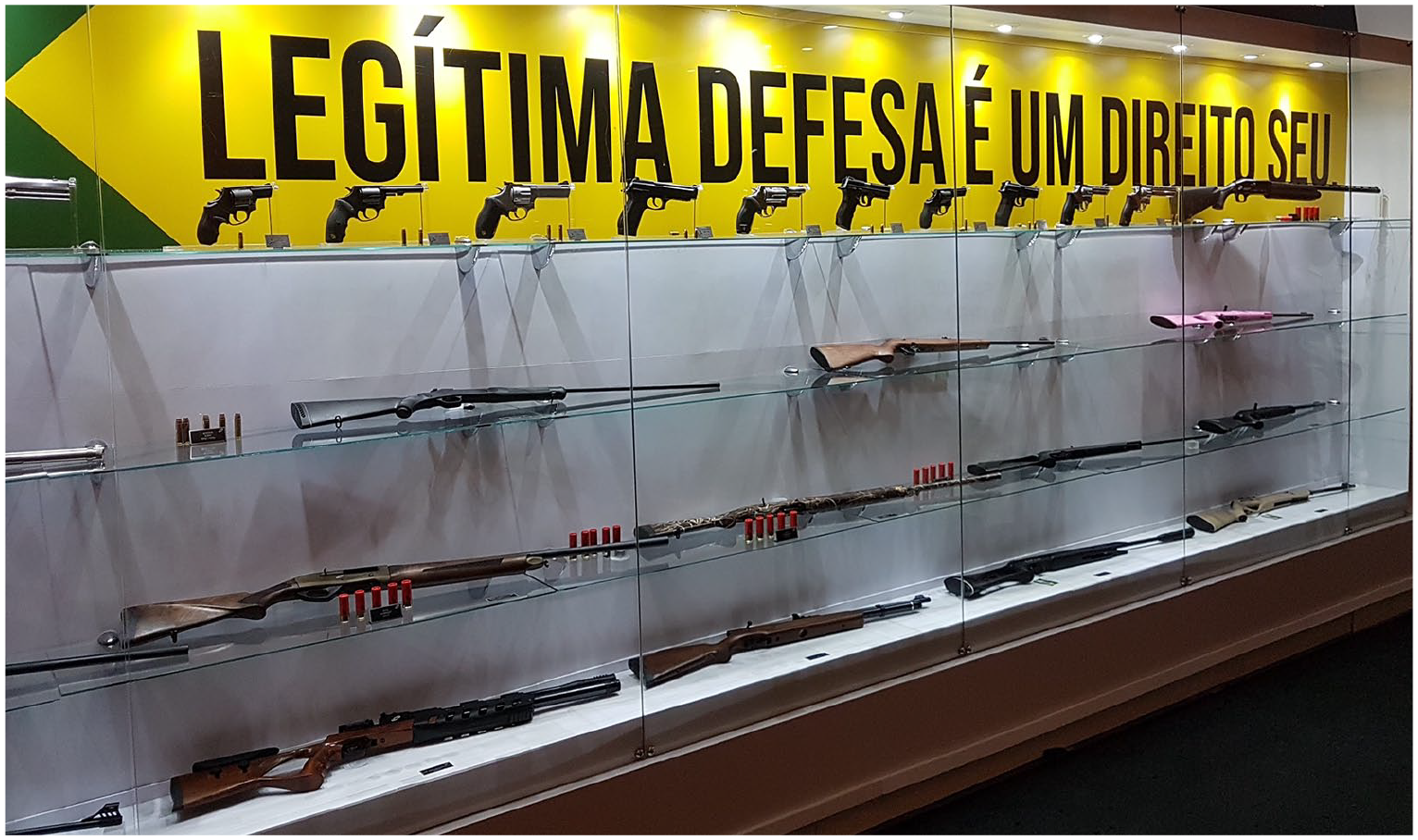
Stand from Taurus, LAAD 2019.
While most uniformed personnel at these fairs are lower- and middle-ranking soldiers and police officers – unlikely to directly influence weapons procurement – companies aim to cultivate their support (see Figure A.5). Why do they do that? Beyond selling to security forces, arms manufacturers seek to normalize a weapons-, tech- and industry-dependent view of security among military personnel and law enforcement agents. Arms manufacturers promote weapons while diffusing gun rights and the idea that authorities should promote such rights. Companies want soldiers and police officers on their side, endorsing their existence, products, services and views of security.
At LAAD, the stands of Brazilian law enforcement agencies revealed a similar pattern. At the stand of Brazil’s Ministry of Justice and Public Safety at LAAD 2019, a display of riot control equipment from Brazilian company Condor – including tear gas grenades, pepper sprayers, and rubber projectiles – stood out (Figure A.6). In the display, the items looked ordinary, banal, naturalizing their centrality as instruments to address perceived safety problems.
Companies and government agencies also promote gun cultures while officially promoting national security, national defence, or security cooperation. At LAAD, Brazilian manufacturers of SALW and less-lethal weapons – e.g. Taurus, CBC, Condor – presented their status of Defence Strategic Companies (Empresas Estratégicas de Defesa – EED). This is a status and badge that Brazil’s Ministry of Defence confers to companies considered essential for national defence. The US government adopts similar practices. For instance, Figure 5 shows company Smith & Wesson in the US pavilion at LAAD 2023, indicating how the US government diffuses gun cultures by associating a manufacturer of SALW with national security and security cooperation.
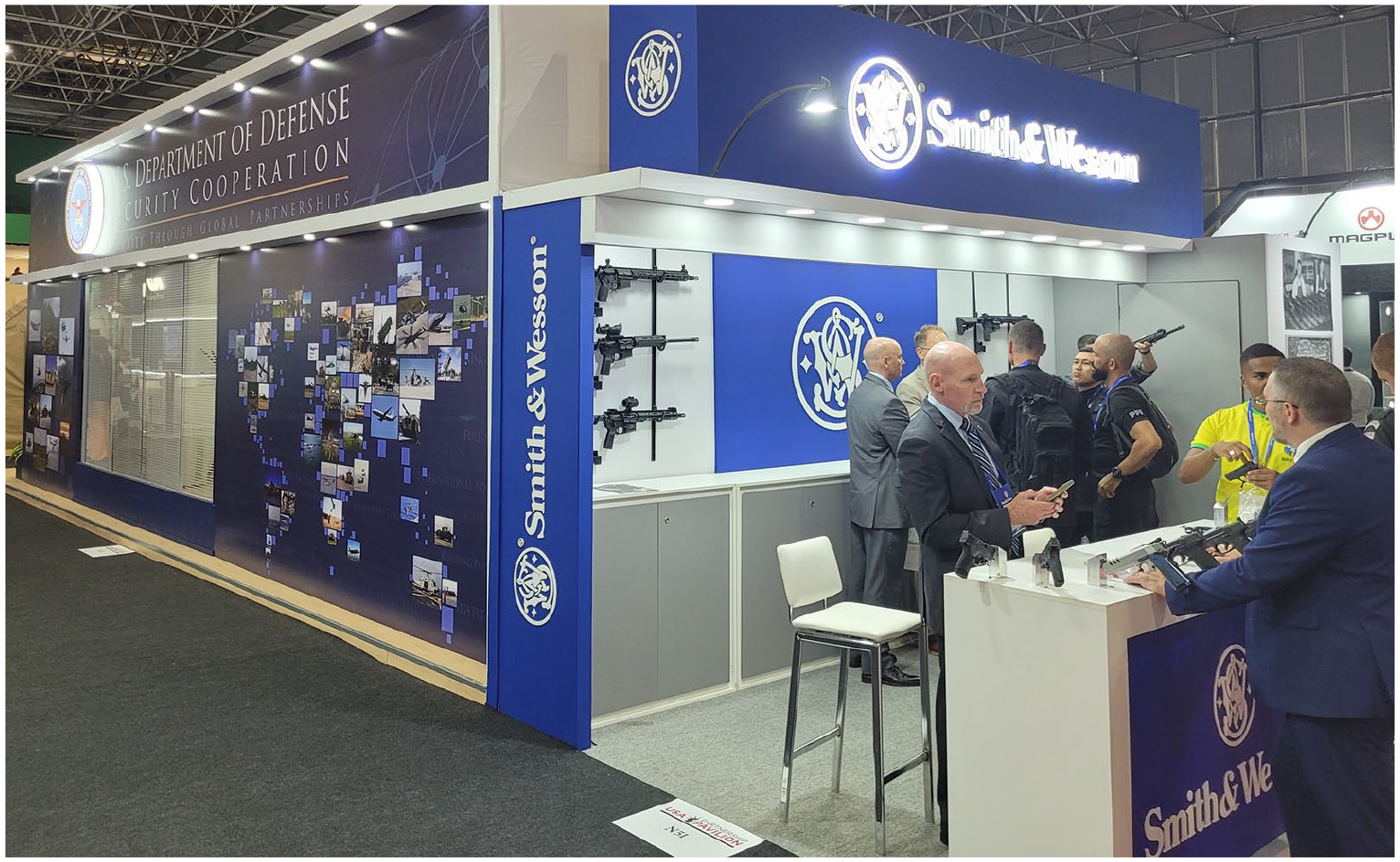
Part of the US national pavilion, LAAD 2023.
If average visitors at DSEI or LAAD cannot influence procurement of SALW, they are even more unlikely to influence procurement of major weapons systems such as aircraft and naval vessels. Yet, security fairs are more than a market for goods and services; they diffuse weapons- and tech-based views of security and define legitimate actors and discourses in the sector. The fact that some items cannot be acquired at all underscores this point. At LAAD 2019, a representative from Itaguaí Construções Navais (ICN), responsible for building Brazil’s first nuclear submarine, gave a lecture about the project. The nuclear submarine project and its components are not for sale, suggesting that the company’s participation at LAAD aims primarily at expanding or maintaining its projects’ legitimacy within and outside the sector.
Companies and the military also emphasize the dual-use nature of military technology, arguing that the sector provides not only security but also civilian technological benefits (Dagnino, 2010). For instance, at LAAD 2023, the Brazilian state-owned company Amazul promoted its naval nuclear programme under the slogan ‘national technology for the benefit of society’, highlighting its civilian benefits and creating a sense of embeddedness of the security sector in society.
The warrior-protector
Security forces also seek legitimacy by portraying themselves as compassionate, caring and approachable. Previous research has explored these practices. The US DoD, for example, showcases protectiveness and care through various visual media. Official images depict ‘happy and positive encounter[s] between service and civilians in need’, such as US soldiers entertaining children or administering medical care (Roderick, 2016: 327). The underlying message is that the US military is both a combat-ready and humanitarian force. The US film industry constructs and reinforces this dual image by portraying soldiers as tough yet gentle with comrades and those requiring assistance (Philpott, 2018). In Europe, Frontex employs a similar strategy, presenting images of masculinized border guards, but also of humanitarian interactions with people in distress (Achilleos-Sarll et al., 2023). Such representations sanitize and depoliticize these actors’ power and methods.
Security fairs reveal a similar pattern. Michael Fallon, then-UK Secretary of State for Defence, opened DSEI 2015 with a speech linking military strength to humanitarian aid: ‘our Typhoons and Tornados are defending us and the Baltics from Russian aggression and striking at ISIL targets. Our ships are rescuing migrants from the Mediterranean and helping to keep trade routes open’ (Fallon, 2015). At LAAD 2019, the US DoD displayed images juxtaposing military firepower and technological excellence with acts of compassion and care, such as soldiers assisting children (Figure 6). The stand conveys in this way the message that the US military is powerful but protective. Similarly, the Brazilian Army’s stand at LAAD 2019 featured its main slogan, Braço Forte, Mão Amiga (Strong Arm, Helping Hand), created in 1992 (Figure 7), reinforcing its dual role as both tough and compassionate, blending military strength with humanitarianism.
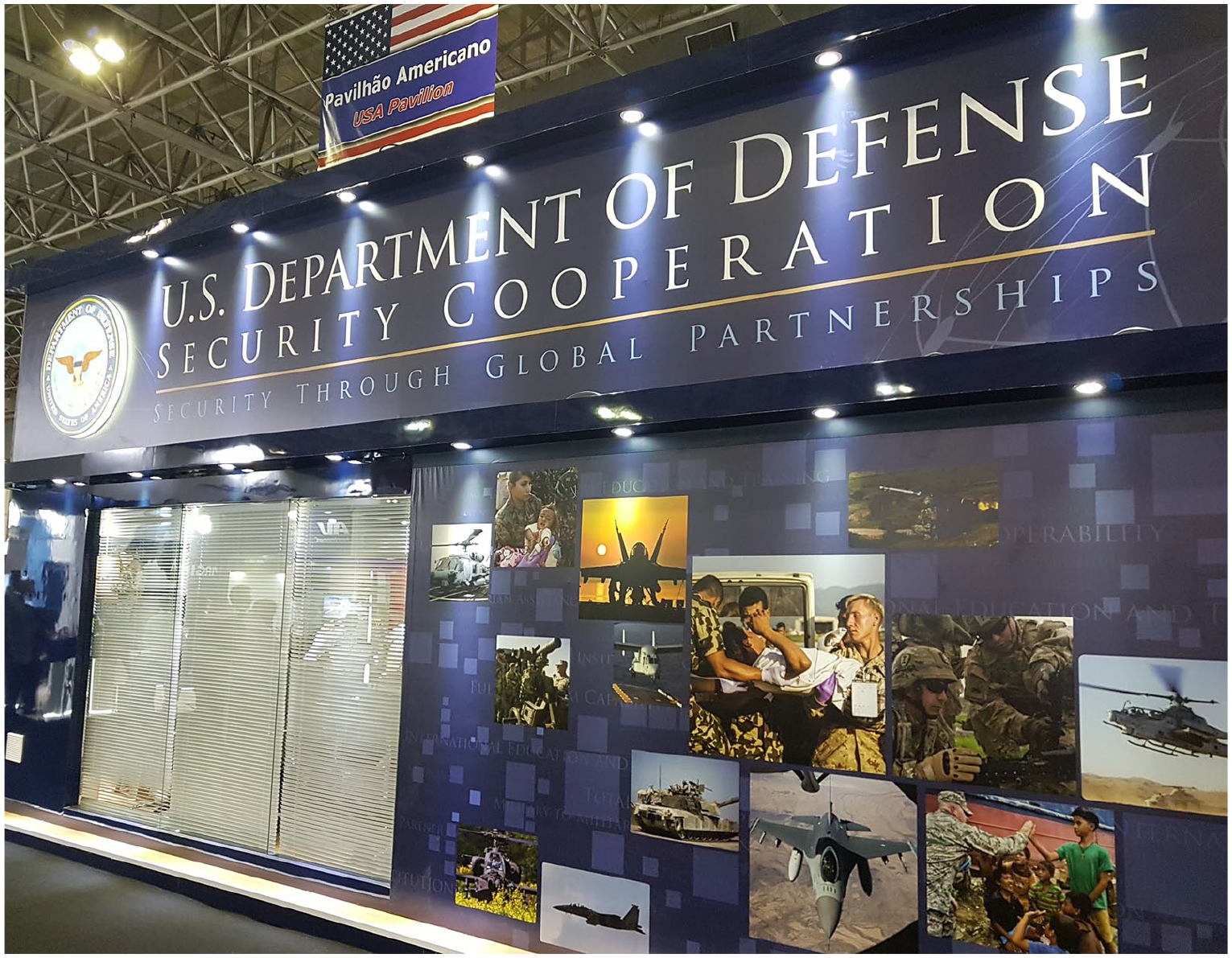
Advertising piece in the US DoD stand, LAAD 2019.
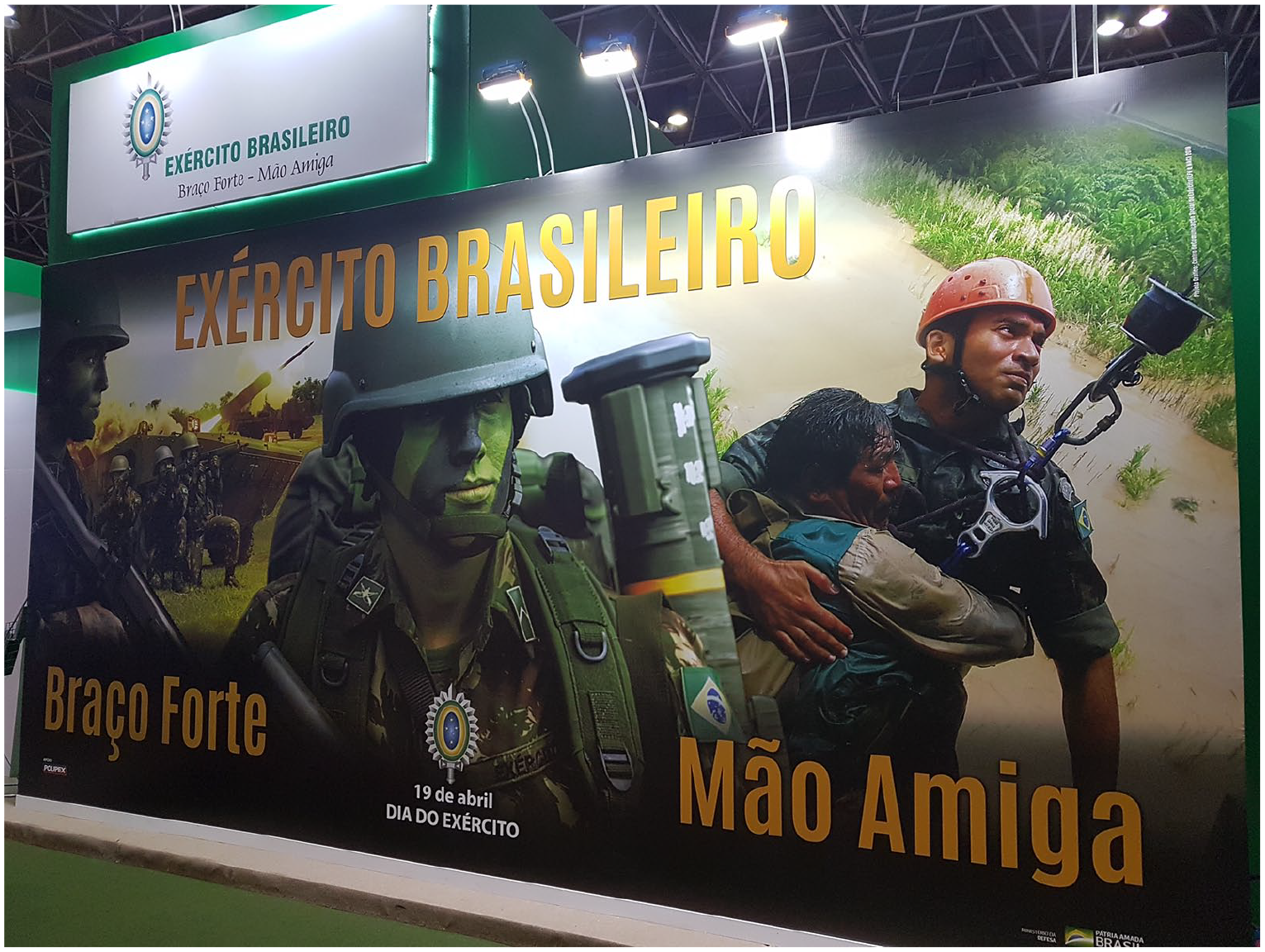
Advertising piece in the Brazilian Army’s stand, LAAD 2019.
Associating soldiers with social work is also useful to present the military as caring and concerned with society’s problems. Regardless of whether such initiatives have positive impacts, they serve as instruments to manage legitimacy. In Brazil, an instrument for that is what the military calls civic-social actions (ações cívico-sociais – ACISO). Through these activities, the military provides social services, such as medical care and entertainment to children, the ultimate goal of which is instilling civic values in the population – and creating photo opportunities. For instance, the Brazilian Army organized an ACISO event in an indigenous community in 2023 as part of Operation Ágata, the largest military exercise in Brazil, held annually along Brazil’s borders. 8
Scholars examining the intersection of gender and militarism also underscore the fusion of militarism and care. In Brazil, the military regards soldiers’ families as part of an extended military (Castro, 2018), enabling it to expand its reach in society and, consequently, its sources of legitimacy. As families symbolize care, the notion of ‘military family’ indicates the military’s aspiration to present itself as caring, akin to familial ideals. Enloe (2014) emphasizes that understanding the military and militarism requires looking at military wives; US military institutions seek to extend themselves into the lives of soldiers’ families as a way of gathering support and normalizing militarism within society.
Discussion
Examining how actors in the security sector represent themselves to society, to other state actors, and within the sector is crucial for understanding how the sector gains and maintains legitimacy – an important asset for sustaining their existence, power and activities. Based on the analysis, I advance two propositions. The first proposition is that the security sector constructs and plays with a duality of being both extraordinary and accessible as a self-legitimation strategy.
Proposition 1
The security sector legitimates itself by constructing and playing with a duality of being extraordinary and accessible, using a combination of material and normative means.
The sector and its actors seek to persuade both external and internal audiences that they are effective, morally correct and natural by projecting themselves as exceptional yet relatable. Their narratives are intended to be adopted and reproduced by society, shaping how the public perceives the sector. By inculcating militarism in external audiences, the sector seeks endorsement of its existence, power, methods and worldview on its own terms. The more militarism is normalized and the greater society’s fascination with weapons and security technologies, the more these self-legitimation strategies resonate. These narratives also provide members of the sector with a sense of mission, coherence and purpose, ensuring that they perceive their roles and activities as legitimate.
The second proposition is that security fairs contribute to naturalize and universalize a security paradigm rooted on weapons, technology and the industry. By doing so, they contribute to depoliticizing instruments of security provision, presenting them as neutral, technical solutions, obscuring the power structures that produce and deploy them. Similarly, the notion of the sector’s moral superiority overshadows discussions about the causes of violence, which is attributed to the value-deficiency of adversaries, in contrast to the superior values of security forces and their supporters. Security fairs thus depoliticize both the causes of and responses to insecurity.
Proposition 2
Security fairs naturalize and universalize a security paradigm centred on weapons, technology, the industry, and alleged superior values, depoliticizing both the causes of insecurity and its solutions.
This article’s findings have at least four theoretical implications for the critical security studies and critical military studies literatures. First, they indicate that actors in the security sector view legitimacy as a distinct and valuable political resource, which they seek to cultivate.
Second, self-legitimation is a continuous and adaptive process, indicating the dynamic and context-specific nature of legitimacy. To maintain their legitimacy, security actors respond to material developments and normative shifts in society. For example, they may use technological innovations – e.g. surveillance systems, drones, cybersecurity tools – not for their practical utility, but as props that convey modernity and effectiveness. They may also instrumentalize progressive agendas – e.g. gender equality, environmental responsibility – as part of their self-legitimation repertoire.
Third, the article shows how actors in the security sector engage in norm construction and diffusion. Through material, discursive and performative strategies, actors in the sector frame their values and practices as necessary, natural and universally valid. They do so by embedding militarism in public discourse, policies and everyday life. The banalization of weapons and violence, alongside narratives of proximity to society, transforms militarism into a form of soft power, making the sector appear both attractive and familiar.
Fourth, the findings align with previous research showing the blurred lines between civilian and military, public and private, war and policing (Abrahamsen and Williams, 2010; Enloe, 2016; Sjoberg and Via, 2010; Stavrianakis and Stern, 2018). Yet they also call for greater attention to the varied manifestations of militarism, and to how marginalized populations – especially in the Global South – experience its most violent consequences. In Latin America, for example, war-like responses to crime persist as legacies of authoritarian rule (González, 2020), disproportionately affecting the urban poor and racialized communities.
Methodologically, this article confirms the value of studying security fairs. These sites reveal sectoral identities, self-legitimation strategies, state–industry interactions and mainstream security practices. Security fairs are not only sites of economic exchange but also of social construction; they define ingroups, outgroups and legitimate security practices. They are also hubs where actors can diffuse, consume and universalize legitimation narratives. These narratives enhance the sector’s cohesiveness by facilitating socialization, reinforcing identity and offering coherent stories that actors can adopt and diffuse. Researchers interested in studying security fairs would benefit from prior knowledge of key sectoral actors, state–industry relations, the fairs themselves, and the symbolic and normative repertoire on which actors in the sector draw.
From a policy perspective, governments should reduce the emphasis on weapons- and tech-based conceptions of security. They should denaturalize such views, countering gun and techno-fetishism among security forces and society at large. At security fairs and other spaces, governments should create more space for non-militarized security approaches, such as problem-oriented policing, violence prevention programmes and firearms regulation. Although these approaches do appear in security fairs, their presence is marginal. For instance, LAAD 2019 had a small stand for a programme called Patrulha Maria da Penha (Figure A.7), organized by the Municipal Guard of Duque de Caxias, near Rio de Janeiro. This programme protects women from domestic violence, drawing its name from a national law introduced in 2006. The stand had two police officers. I asked them whether there was interest in their stand; they said that there was little interest, and it was hard to draw attention when there was so much ‘pyrotechnics’ around. At LAAD 2023, a similar programme from Rio de Janeiro’s Municipal Guard had a larger and more visually appealing stand (Figure 8), but it still struggled for visibility in a fair dominated by firepower and technology.
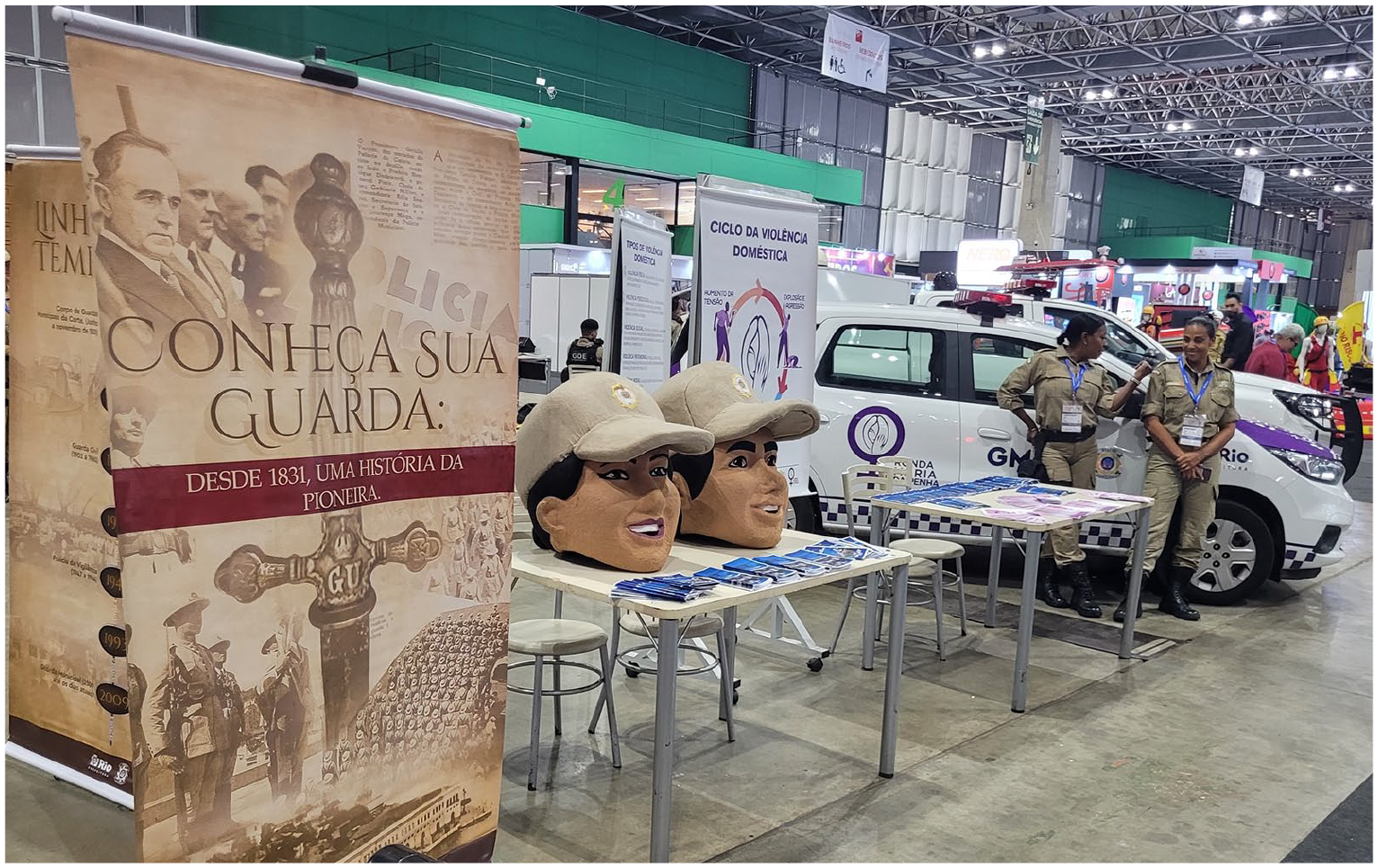
Stand from the Municipal Guard of Rio de Janeiro, LAAD 2023.
Another policy implication concerns civil–military relations, especially in contexts where the boundaries between military and police are or could become blurred. Hybrid roles – such as soldiers engaging in civilian affairs or police adopting war-like tactics – undermine civilian control and democratic governance. While efforts to limit military influence often focus on the military itself, militarized police agencies may persist as pockets of authoritarianism within democratic states (González, 2020). Security fairs reinforce this dynamic by normalizing a security sector that includes both military and law enforcement. Similarly, they promote the idea that public and private actors are aligned, legitimating the security industry by presenting it not only as an industrial-commercial complex but also as an extension of the state.
Yet, while self-legitimation benefits the sector, it also exposes it to counter-legitimation. Anti-militarists, peace activists and others can challenge legitimacy claims by exposing contradictions between professed standards and actual practice, such as corruption, resource misallocation, abuse, or operational failure. Activists can also promote alternative frames that emphasize non-militaristic policies and the need to rehumanize marginalized groups.
Conclusion
Because the security sector depends on society and other state actors to survive and prosper, it has a vested interest in managing these relationships and, as part of this effort, cultivating a distinctive legitimacy. To that end, actors construct and reproduce an image of extraordinariness and accessibility – a duality they play with according to context and convenience.
This duality is central in the sector’s performance of the spectacle of universality, an effort to create an illusion of neutrality and universalism – key to securing pragmatic, moral and cognitive forms of legitimacy. While displays of firepower, advanced technology and superior moral values evoke awe and project authority, banal militarism and narratives of proximity between the sector, its actors and society evoke familiarity. The extraordinary invites admiration through perceived superiority; the accessible does so through perceived proximity. The sector thus appears both above society and embedded within it – superior yet ordinary, distant yet intimate.
Security fairs offer a rich empirical site to observe these practices, but the fairs themselves also legitimate the sector’s existence, power and methods. Blending technical, moral and emotional appeals, they make militarism and the security sector appear natural and desirable. They blur the lines between commercial promotion and political messaging, naturalizing a weapons-, tech- and industry-based view of security. Soldiers and law enforcement agents are socialized into this vision but also diffuse it, helping to keep it as a mainstream security paradigm. The marginal presence of alternative approaches underscores and perpetuates the sector’s narrative monopoly. These fairs are thus not only commercial events but also sites of legitimation.
This article’s findings contribute theoretically to critical security studies and critical military studies literatures. They show that actors in the security sector treat legitimacy as a valuable resource, pursuing it through structured self-generated narratives that present them as effective, morally sound and socially embedded. The article also highlights how actors in the sector embed militarism in everyday life by diffusing their own norms and views of social order; in the process, they turn militarism into a form of soft power. Militarization thus results in part of practices initiated from within the security sector. Rather than responding to pre-existing threats, demands, or norms, the sector seeks to generate the very conditions under which its existence, power and methods are regarded as effective, appropriate and natural.
There are at least four avenues for future research. First, examining how the security sector builds and mobilizes different types of capital – e.g. economic, social, symbolic – to manage legitimacy. Researchers could investigate, for example, how the security sector instrumentalizes both conservative and progressive ideas and agendas – e.g. traditional values, liberalism, gender equality – as part of self-legitimation strategies.
Second, exploring how transnational and local dynamics interact in shaping security practices, and the legitimacy and self-legitimation strategies of the security sector. For instance, a greater influence of hawks in US politics may strengthen the position of mano dura advocates in Latin America. Security fairs and other professional gatherings provide a forum for these actors to interact and/or emulate each other, fostering transnational connections that may shape security practices and self-legitimation strategies.
Third, analysing how the actual use of force and technologies contributes to legitimate the sector and its actors. For instance, how are police operations, including those involving lethal force, presented and justified? Such events may themselves function as acts of self-legitimation.
Fourth, examining whether other sectors, such as Big Tech or the financial sector, adopt similar narratives of self-legitimation. Like the security sector, they may present themselves as indispensable and superior while appearing aligned with public values and embedded in everyday life. Investigating other sectors could enable theorization beyond the security sector, revealing common self-legitimation strategies and how these strategies may reproduce dominant paradigms – whether of security, technological progress, or economic order.
I do not claim that the security sector’s legitimacy is independent of its ability to deliver security and comply with norms. What I claim is that actors in the sector can manipulate perceptions of effectiveness, compliance, and the naturalness and universality of their existence, power, methods and worldviews. They can also construct or reproduce the very benchmarks against which they are assessed.
Supplemental Material
sj-pdf-1-sdi-10.1177_09670106251347873 – Supplemental material for The security sector in pursuit of legitimacy: Self-legitimation practices in security fairs
Supplemental material, sj-pdf-1-sdi-10.1177_09670106251347873 for The security sector in pursuit of legitimacy: Self-legitimation practices in security fairs by Rodrigo Fracalossi de Moraes in Security Dialogue
Footnotes
Acknowledgements
The research for this article has benefitted from discussions with and suggestions from Andrew Hurrell, Ann Feltham, Keith Krause, Pepper Culpepper, Rosanna O’Keeffe, and from a seminar with colleagues at the University of Southampton’s Department of Politics and International Relations (PAIR). I also thank the discussant and participants of the panel ‘New Technologies and Future War’ at the British International Studies Association (BISA) 2024 Conference, Birmingham.
Funding
The author received no financial support for the research, authorship, and/or publication of this article.

Supplemental material
Supplemental material for this article is available online.
Notes
References
Supplementary Material
Please find the following supplemental material available below.
For Open Access articles published under a Creative Commons License, all supplemental material carries the same license as the article it is associated with.
For non-Open Access articles published, all supplemental material carries a non-exclusive license, and permission requests for re-use of supplemental material or any part of supplemental material shall be sent directly to the copyright owner as specified in the copyright notice associated with the article.
