




Abstract
This article introduces the US Aid to Security Sector Actors (USASSA) dataset, the product of a collaboration between academic researchers and the nonprofit Security Assistance Monitor. In addition to providing the most comprehensive source of data on US security assistance, the USASSA dataset transforms detailed information about how security assistance funds are spent into aid and recipient typologies that can be used to conduct more sophisticated analyses of how this foreign policy tool is employed, its utility, and its limitations. Our data clearly show not only the magnitude and geographic reach of US security assistance, but also its diversity. While some security assisance is akin to humanitarian aid, other types of assistance blur the line between foreign aid and proxy warfare. We demonstrate the utility of the dataset with an exploration of whether the effects of US security assistance on human rights violations and domestic terrorism vary across types of aid.
Keywords
Over the past two decades, there have been tremendous advances in the availability and quality of data on development, humanitarian, and governance aid, which has enabled significant progress in empirical research on the myriad impacts of this aid. The same is not true for military aid. Although security assistance is a substantial and growing component of the foreign policy toolkits of powerful states, and security aid could have more severe unintended consequences than other forms of aid, multiple barriers to collecting comprehensive and detailed data on security assistance have stymied research in this area. Does providing security assistance to fragile states like Somalia increase or decrease the risk of civilian harm? Does assistance provided during an armed conflict affect peacebuilding after war termination? What are the effects of military aid provided to a state’s security forces during governance transitions? Are security sector reform and defense institution building programs effective? These questions and many more can only be adequately explored if scholars have access to high quality data.
In this article we introduce a new dataset, the product of a collaboration between academic researchers and the nonprofit Security Assistance Monitor (SAM), that combines all publicly available data on US security aid provided to foreign militaries, police, and other security sector actors into a comprehensive, global dataset. While details on many security assistance activities are available from government reports and NGOs, much of the more granular information is not consolidated and coded in a way that would allow for systematic analysis. Security assistance authorities fund a wide range of activities, including training and equipping militaries for combat, law enforcement training, building special forces units, institutional reform, humanitarian assistance, counterproliferation initiatives, and English language courses. Moreover, US security assistance is provided to a range of security sector actors within countries: police forces, army units, civilians in defense ministries, air force pilots, and border guards, among others. In addition to providing the most comprehensive source of data on US security assistance, this dataset transforms detailed information about how security assistance funds are spent into aid and recipient typologies that can be used to conduct more sophisticated analyses of how this foreign policy tool is employed, its utility, and its limitations. There are two versions of the dataset. In the first version, each of the 32,008 observations is an item (or items) of US security aid provided between 2000 and 2019 and variables identify the country or geographic region that received the assistance, funding amount in US dollars, fiscal year in which the aid was disbursed, security assistance program under which the aid was authorized, aid type and recipient type. In the second version, there is an observation for each United Nations member state in every year from 2000 to 2019. Variables record the total amount of security assistance a country received (if any), the amount of assistance the country received in each of thirteen aid type categories, and the amount of assistance provided to each recipient type.
Interest in security assistance has surged due in part to the United States’ massive and costly efforts to train and equip state security forces in Iraq and Afghanistan, but also in response to the apparent effectiveness of Western security aid to Ukraine, controversy over security assistance to Israel, and growing awareness of security force capacity-building on the African continent. We believe this dataset can advance scholarship and inform important policy debates. In the remainder of this article, we introduce readers to the US security assistance landscape and briefly describe some of the unique challenges to collecting comprehensive data on security aid. We then explain how the dataset was created and provide descriptive statistics. Next, we demonstrate the utility of the data by exploring whether the effects of US security assistance on human rights violations and domestic terrorism vary across types of aid. We conclude with a discussion of the need for this dataset and the ways that it could advance research.
US Security Sector Assistance
The United States is by far the largest provider of security assistance worldwide. Security assistance managed by the State Department, often implemented by the Department of Defense (DoD), is authorized under Title 22 of the US Code. The DoD is given similar authorities under Title 10. Various agencies of the US government and the armed forces use different terms for the vast array of legal authorities (programs) 1 that provide military training, equipment, advising, and education to foreign security forces. We use the broad terms security assistance, security sector assistance, and military aid to encompass all such programs.
The United States has provided some form of security assistance to at least 179 of the 193 United Nations member countries over the past 20 years. Between 2000 and 2019, the US delivered security assistance worth over 340 billion USD, an average of $17 billion a year, to foreign governments and their security sectors. 2 Spending on training and equipping foreign security forces, defense institution building, law enforcement training, and a wide range of other activities funded by security assistance programs increased more than 350 percent in real terms between 2001 and 2007. At the same time, the proportion of funding managed by the Department of Defense versus the Department of State shifted from 8 percent DoD, 92 percent State in 2000, to 62 percent DoD, 38 percent State in 2007.
Unfortunately, there are significant obstacles to collecting comprehensive, detailed data on the incredibly vast and complex assortment of legal authorities and funding authorizations that comprise the US security sector assistance enterprise. Despite the significant sums budgeted for foreign security assistance, reporting, monitoring, and evaluation requirements for security assistance are far less stringent than those placed on economic aid (Marquis et al. 2016; Miller and Mahanty April 14 2020). As a result, even Congress, which has a mandate to provide oversight of the security assistance programs they authorize and fund, does not have easy access to a comprehensive picture of how the funding they allocate is spent (Serafino 2016).
Security assistance funds managed by the Department of Defense are particularly challenging to track due to frequent changes in accounts and programs, poor recordkeeping, and laxer requirements for reporting than State Department programs (Isacson and Kinosian 2017; Serafino 2016; U.S. Government Accountability Office 2018). After 9/11, Congress granted dozens of new security cooperation authorities to the Department of Defense, giving the DoD a greatly expanded role in building the capacity of foreign forces, increasing not just the amount of funding for these activities, but the number of state recipients as well (Epstein and Rosen 2018). The majority of new DoD security assistance authorities were originally designed to be temporary programs to address immediate threats. In practice, many programs have endured. In a series of reports, the Congressional Research Service bemoans the difficulty of obtaining data on security sector assistance programs, noting that inconsistent Congressional notification requirements make it impossible to get a “full and authoritative accounting” of US security assistance funding around the world (Serafino 2014, 26), and that the ambiguity built into DoD programs in particular makes it “difficult to understand what, specifically, the DoD is doing to build partner capacity” (McInnis and Lucas 2015, 1).
This project is an attempt to provide researchers, policymakers, and the public with a thorough accounting of US security sector aid spending across the globe, including the specifics of what goods and services are being provided to which security sector actors with these funds.
The USASSA Dataset
The US Aid to Security Sector Actors (USASSA) dataset aims to consolidate all available unclassified data on US aid provided to foreign militaries, police, and other security sector actors between 2000 and 2019. Recognizing that comprehensive information on security assistance was not easily accessible to policymakers or the public, in 2014 the Center for International Policy (CIP) founded the Security Assistance Monitor (SAM) program to collect and analyze information on US security sector assistance programs worldwide. SAM compiles its data from government documents including, for example, Congressional appropriation bills, budget justifications, and reports from the US State Department, Department of Defense, Congressional Research Service, and Government Accountability Office. Some government reports are obtained through Freedom of Information Act (FOIA) requests.
The Security Assistance Monitor’s data 3 are searchable via interactive dashboards on SAM’s website and extremely useful for getting a macro-level view of aid amounts provided to countries over time, or drilling down into specifics on aid provided to a particular country. In addition to media outlets, it is not uncommon for policymakers and even military officials to turn to the Security Assistance Monitor for information on US security aid programs. However, the data are not widely used for academic analyses because the most detailed information is not comprehensive (i.e., available for all programs, countries, and years), and valuable information is lost at higher levels of aggregation (e.g., the country-year level of analysis). To remedy this, we set out to produce a dataset that would be better suited to academic research and, in particular, quantitative analyses.
This collaboration between academic researchers and staff from the Security Assistance Monitor: (1) Combines all publicly available data into a comprehensive, global dataset at the country-year level of analysis, including observations for all United Nations member states in every year from 2000 to 2019 (2) Expands and verifies SAM’s existing data with additional information collected from a wide range of government documents, media reports, and secondary source material; (3) Codes qualitative information from these sources into categorical variables useful for quantitative analyses; and (4) Provides a complete bibliography of sources
Data Set Construction
To create the dataset, we began with the information the Security Assistance Monitor had collected about US foreign security assistance programs worldwide at two levels of analysis. Each of the almost fifteen thousand observations at the recipient-program-year level identifies the recipient country or region, delivery year, the amount of aid in US dollars, and the security assistance program under which the aid is provided. Each of the 23,878 observations at the line-item level of analysis (observations for a subset of the recipient-program-year level data representing just under 50 percent of total security assistance provided between 2000 and 2019) contains a short description of the security assistance “item” provided and a source material reference, in addition to aid amount, recipient, year, and program information. An item could be a material object or objects (a tank, weapon system, or uniforms); a training activity, military exercise, or educational course; or a direct service provided by American personnel like demining or transportation. We discuss these different types of aid in more detail below.
These two sources of data were reconciled to create one dataset with comprehensive data at the line-item level. Security aid amounts for which we had information about the recipient, program, and year, but no matching line-item details, were retained as observations with missing information in the item description. To provide readers with a better sense of the range of item descriptions in the SAM data, a sample of observations for Niger between 2012 and 2014 is provided in Appendix B.
A research team at UNC-Chapel Hill then created two additional variables for each observation—aid type and recipient type. Aid type is a categorical variable with twelve categories specifying the nature of the assistance item provided. Recipient type classifies the individual, unit, or agency to which the assistance was provided.
Coding Aid Type and Recipient Type
Security Sector Aid Typology.
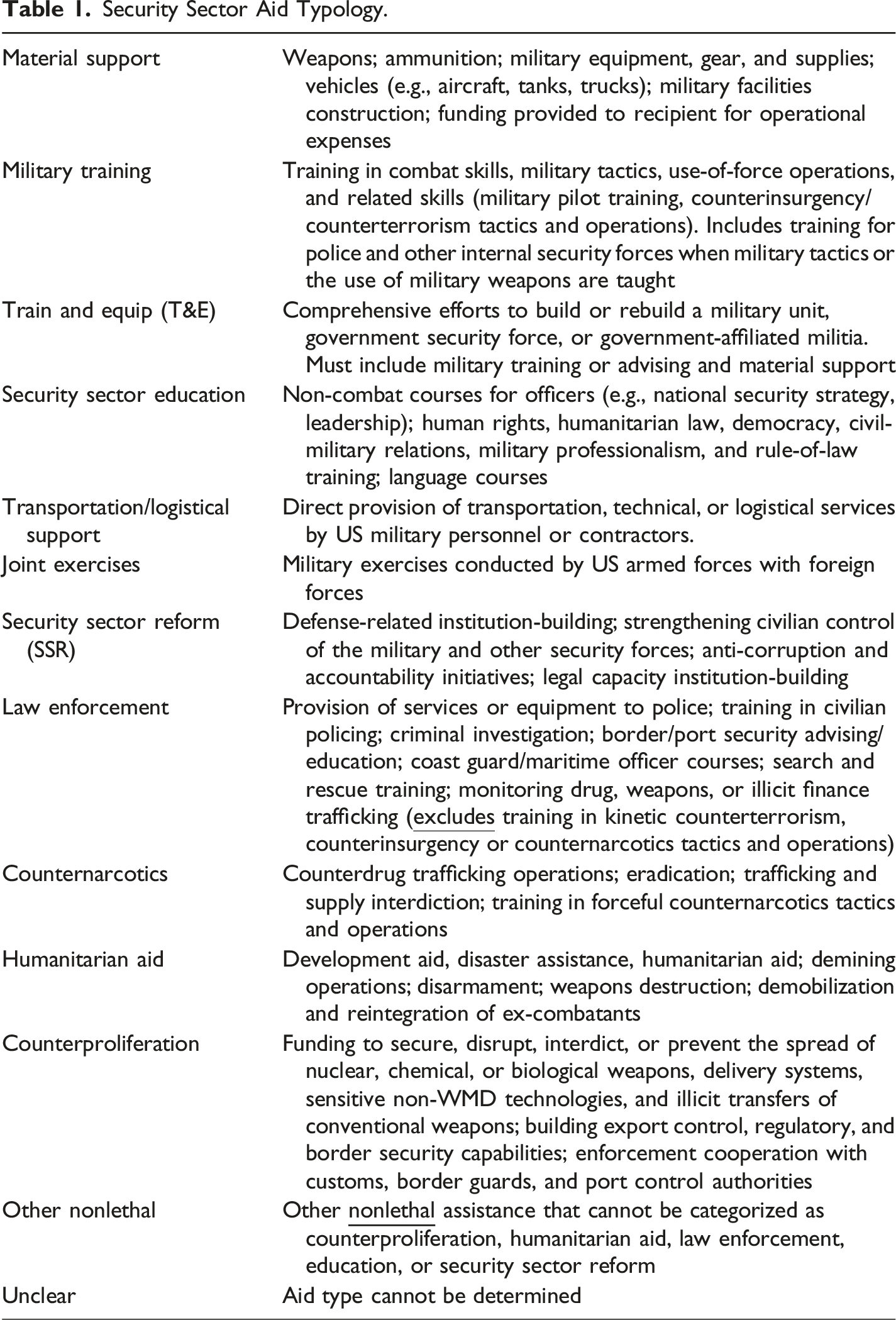
Beginning in 2022, the team began to recode the aid type and recipient type variables according to the new operational definitions. Working program by program, the team used the item descriptions and the original source materials referenced by SAM to determine the aid and recipient type for each “item” provided within a given security assistance program. If the original source documentation did not provide enough information to code the aid and recipient type, the coder would conduct an internet search for additional documentation using the name of the security assistance program or account, recipient country, year, and keywords from the item description (when available). These searches provided a range of supplemental sources including documents from the Africa Center for Security Studies, Congressional Research Service, Defense Security Cooperation Agency, White House archives, and Washington Office on Latin America. Online Appendix C contains a complete bibliography of the sources referenced by the Security Assistance Monitor in compiling their data and the additional sources used by the research team.
Some programs were simple to code. After reviewing the source documentation, we determined, for example, that all the aid provided in the Developing Country Combined Exercise Program was aid type seven, joint exercises. However, most security assistance programs include hundreds of different activities. For these programs there are typically significant amounts of aid with no description of the good or service provided. Other observations have uninformative descriptions. Within the International Military Education and Training (IMET) program, for instance, officer education, combat training, security sector reform, and law enforcement assistance were all provided with the item description “Stabilization Operations and Security Sector Reform”. For these observations, we had to refer to multiple sources and code each country in each year separately. For instance, in Kyrgyzstan in 2015, IMET funded combat training, while IMET funds provided assistance to law enforcement in El Salvador in 2018 (U.S. Department of Defense and U.S. Department of State 2015, 2019). Both activities were described as “Stabilization Operations and Security Sector Reform”.
To minimize human error in recording aid type and recipient categories for each observation, ensure consistent coding across observations, and simplify efforts to code additional years of data in the future, we used the manually coded data to create a script to automate coding of the full dataset in Stata software (version 17). Each line of code in the script codes multiple observations by matching as few keywords as possible to accurately identify the aid or recipient type within a particular program. The script for coding all of the individual observations in the line-item dataset is available with the data, providing complete transparency about coding decisions. In addition, researchers will be able to modify the script to make different decisions about how to code observations. A researcher may, for example, want to code the provision of weapons, ammunition, and weapons delivery platforms/vehicles separately from the provision of military uniforms, facilities, and operational expenses. Although doing so is not a trivial undertaking, and not all item descriptions will allow for this distinction, modifying the script to accomplish this will be much more efficient than recoding each of the 7,550 observations currently coded as “material support” by hand.
Description of Datasets
Line-Item Dataset Descriptive Statistics.
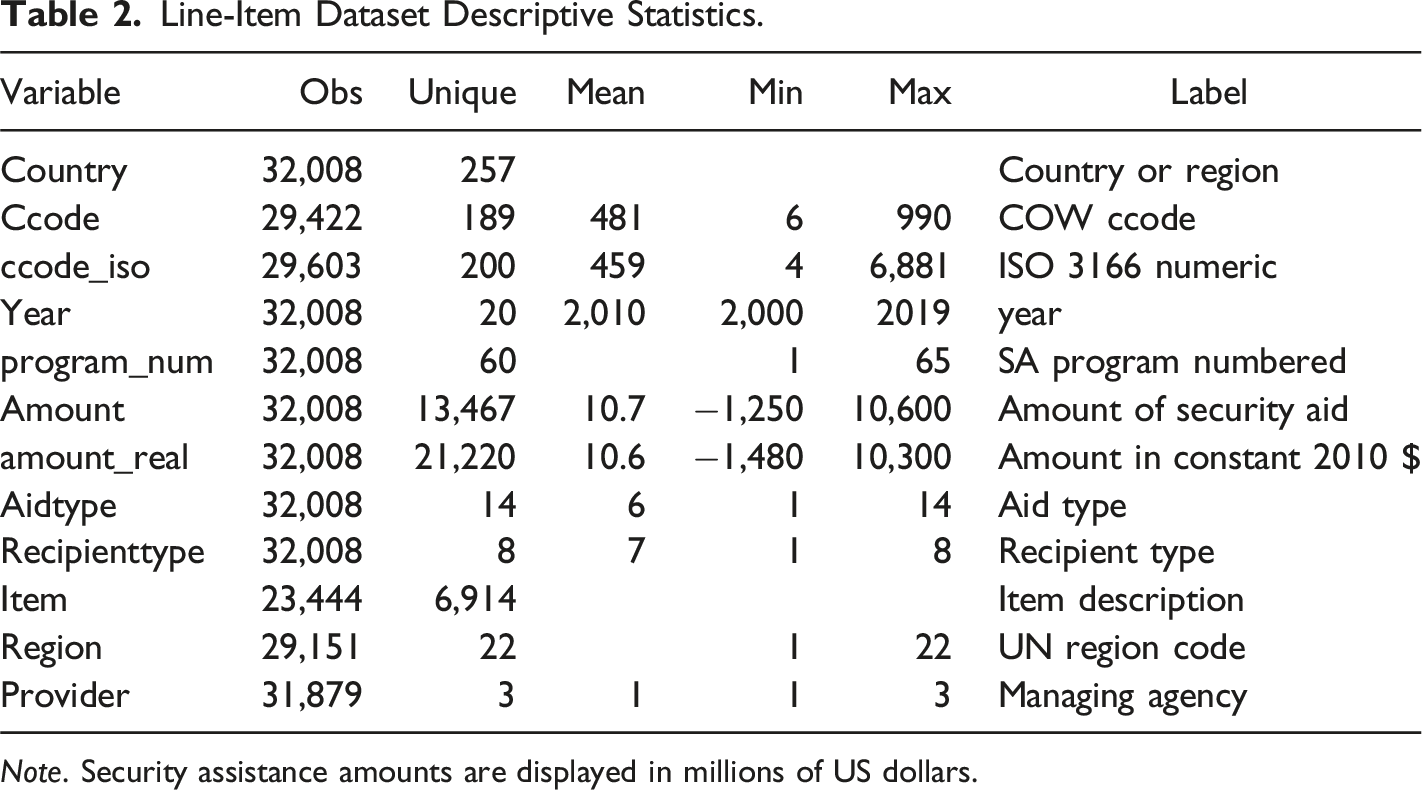
Note. Security assistance amounts are displayed in millions of US dollars.
In the second version of the dataset, the unit of observation is the country-year. This dataset includes observations for all member states of the United Nations in every year from 2000 to 2019. One variable records the total amount of security assistance a country received in a given year. Additional variables specify the amount of assistance the country received in each of the thirteen aid type categories, the amount of assistance provided to each recipient type, the amounts provided under Department of Defense and Department of State authorities, and the amount provided under each of the security assistance programs in operation between 2000 and 2019. To illustrate how data are aggregated from the line item to the country-year level of analysis, Appendix B shows a snapshot of the data for Niger in 2014.
Country-Year Dataset Descriptive Statistics.
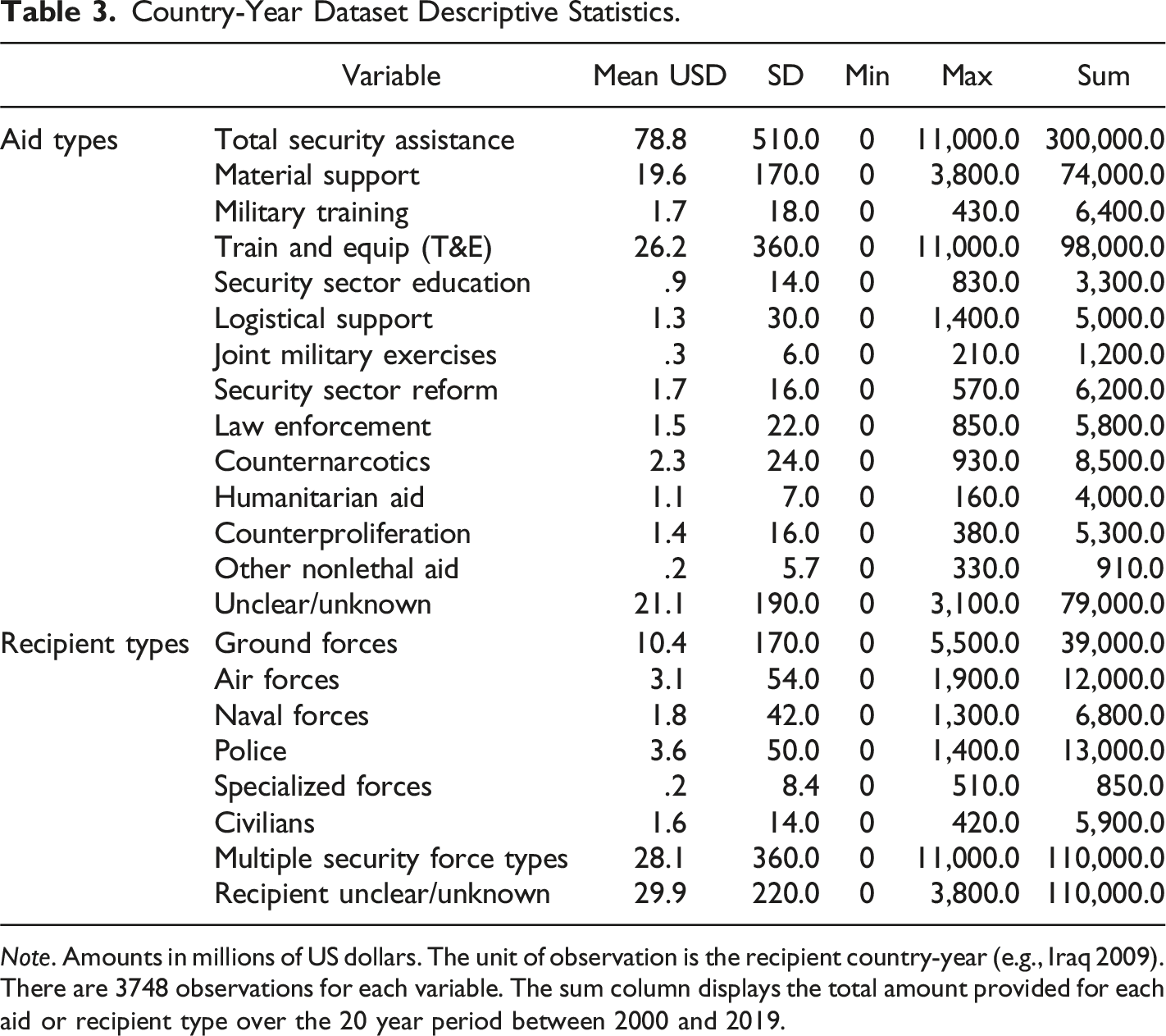
Note. Amounts in millions of US dollars. The unit of observation is the recipient country-year (e.g., Iraq 2009). There are 3748 observations for each variable. The sum column displays the total amount provided for each aid or recipient type over the 20 year period between 2000 and 2019.
In comparison to Afghanistan, Iraq received much smaller amounts of security assistance. The US provided about $33 billion in total security aid, all but $3 billion in the form of military training and material support, between 2000 and 2019. Other countries in the top 5 percent of security aid recipients include Colombia (up to $1.4 billion/year in military training, material, and counternarcotics aid); Egypt (approximately $1.3 billion/year in material aid); Israel (over $2 billion/year in material and train and equip aid); and Pakistan (up to $1.9 billion/year in military training, material, and counternarcotics aid).
We created two additional variables to measure the amount of aid countries received in two composite categories likely to be of interest to researchers: lethal aid and nonlethal aid. The lethal aid variable measures the total amount of assistance provided in the material support, military training, and train and equip aid categories. Nonlethal aid includes security sector reform, military education, humanitarian aid, counterproliferation programs, and aid categorized as “other/non-specified nonlethal assistance”. 4 The distinction between lethal and nonlethal aid is imperfect. Within the lethal aid category, for example, the material support category includes weapons, ammunition, and tanks, but also includes the construction of military facilities and funding for uniforms and troop salaries. Our reasoning is that this category is meant to identify types of aid that are most likely to increase the capacity of the state to use deadly force and/or to make the use of force by state security forces more lethal. Nonlethal security assistance is not meant to increase the state’s capacity to use deadly force and it would be difficult for recipients to use it for this purpose. Scholars who wish to create their own composite categories can easily do so.
Figure 1 shows how the number of countries receiving aid, and the amounts of lethal aid and total security assistance provided, change over time between 2000 and 2019. The data reveal several interesting patterns. The United States has provided some form of security assistance to approximately 93 percent of United Nations member countries over the past 20 years. But the claim that the United States “trains and equips almost every military in the world” (Reveron 2016) is not entirely accurate. On average, roughly half of the countries in the world receive some form of military training or equipment from the United States each year. Number of countries receiving aid and amounts of aid 2000–2019.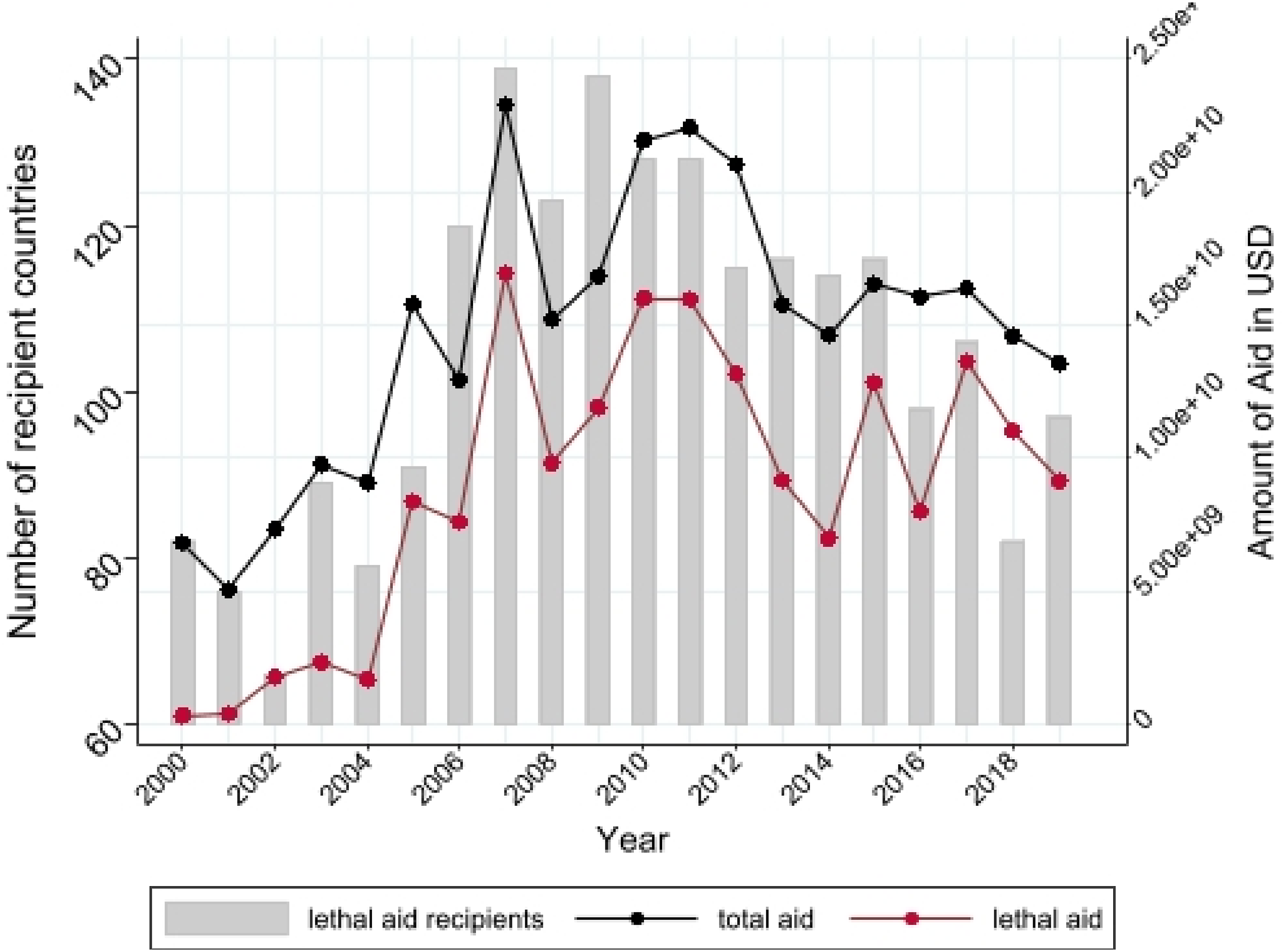
Early in the War on Terror, the number of states receiving lethal aid from the United States actually declined, from 82 states in 2000 to just 66 states in 2002. After 2005, the number of states receiving military training and material support began to climb, reaching a peak of 139 states in 2007. In addition to the number of states receiving lethal aid, the average amount of lethal aid states received, and the ratio of lethal aid to total security assistance, also sharply increased after 2005. Whereas lethal aid accounted for just 16 percent of the security assistance states received from 2000 to 2004, lethal aid averaged 66 percent of total aid between 2005 and 2019. In 2017, lethal aid made up 83 percent of security assistance; 106 states received an average of 129 million dollars in material support and military training and just 5.3 million in all nonlethal categories of aid combined.
Comparison to Other Sources of Data
Three other data sources provide access to some of the data provided by the USSASA dataset: the official government data provided at ForeignAssistance.gov, SIPRI’s Arms Transfer Database, and IMTAD-USA.
The closest match to the USASSA dataset is the data available at ForeignAssistance.gov (hereafter, FA.gov). At this site, the US Agency for International Development (USAID) and the Department of State provide public access to budgetary and financial information generated by U.S. government agencies managing foreign assistance portfolios. Data are provided on appropriations, obligations, and disbursements of funds for U.S. foreign assistance for fiscal years 2001 through 2023. 5 Funds are categorized as either economic or military assistance, as well as by multiple other categories according to standards developed by USAID and the Department of State, or as established by the Organization for Economic Cooperation and Development (OECD). Information is also provided about the funding, managing, and implementing agencies, funding account name, and “activity” funded.
In theory, these data could provide all the information provided by the Security Assistance Monitor about U.S. security assistance. In practice, there are significant limitations. Most critically, some funding amounts are missing from the FA.gov data; a significant amount of security assistance funding is categorized as economic, as opposed to military, aid; and information about the activity funded is redacted for approximately 33 percent of military assistance spending.
The tables in Appendix D online compare the USASSA data to the data available from FA.gov by country, year, funding agency, US purpose/sector name, and account names. These tables help to illustrate inconsistencies in the FA.gov data. A study restricted to assistance classified as military assistance in FA.gov would omit almost $109 billion in security assistance provided between 2001 and 2019. One reason is that a significant amount of aid provided under U.S. security assistance authorizations is categorized as economic assistance in the FA.gov data. Although definitions for military and economic aid are provided, we have found it impossible to determine how these categories are operationalized. While some security assistance classified as economic aid appears to fall into our “humanitarian” and “nonlethal” aid categories, other funding is clearly of relevance to researchers interested in the drivers and impacts of U.S. military aid. This includes, for example, billions in aid for counterterrorism, counternarcotics operations, and police training—activities which sometimes appear in the economic aid category, and sometimes appear in the military assistance bucket.
It also appears that some portion of the $109 billion discrepancy between the USASSA and FA.gov data is funding that is entirely missing from the FA.gov data. This funding is missing in an inconsistent pattern and for reasons that are not transparent. One issue appears to be that some programs and sources of funding are reported in some years, but not others. For instance, the Department of Defense Combating Terrorism Fellowship Program (CTFP) is reported only for FY2017, the amount is under $23.4 million, and the recipient is recorded as “World”. The USASSA dataset records total spending under the CTFP of $413 million in 181 countries from 2003 through 2019. For another Department of Defense program, the Counterterrorism Partnerships Fund, the FA.gov data lists amounts spent in only 2015 and 2017. In addition to showing similar levels of spending for this program in 2015 and 2017, the USASSA dataset reports disbursements from the Counterterrorism Partnerships Fund totaling over $1.5 billion in 2016.
Two final issues make the USASSA dataset preferable to the data at FA.gov. The data available at FA.gov are provided to the Foreign Assistance Data and Reporting Team (FA–DART) by the U.S. government agencies, departments, and offices that receive foreign assistance funds or implement foreign assistance activities. The site notes that these data are reported to FA-DART from over twenty different entities in various formats and reports, but, unlike the data on the Security Assistance Monitor site and in USASSA, there is no bibliography of publicly available sources a researcher could consult for further information. In addition, reporting agencies can redact data they believe “jeopardizes the priorities and interests of the U.S. government or the health and safety of its implementing partners”. 6 A description of the activity funded is redacted for over $74 billion in military aid, almost 33 percent of total military aid, between 2001 and 2019. The fact that the data available at FA.gov are submitted by over twenty different agencies, in formats and reports that change over time, may explain why there seem to be inconsistencies in how much is reported, and how it is categorized, from year to year.
The second data source with some overlap with the USASSA data is the Stockholm International Peace Research Institute (SIPRI) Arms Transfers Database (SIPRI 2022). SIPRI’s Arms Transfer Database is a comprehensive resource containing information on all major conventional weapons (MCW) transfers from 1950 to the most recent full calendar year. The major advantage of the SIPRI data is that they include all MCW transfers from all suppliers, not just the United States. However, two significant limitations make the dataset less appropriate for researchers interested in U.S. security assistance. The first is that the dataset does not include any information about forms of assistance other than major conventional weapons transfers. The second is that the dataset does not distinguish between weapons purchased by the recipient government and weapons provided as aid. 7 Researchers interested in both arms transfers funded by security assistance and U.S. arms sales to foreign countries may find the Security Assistance Monitor’s Arms Sales Database more useful as it provides data on sales of a wider range of defense articles and services by the U.S. government and American commercial vendors and the data can easily be merged with the USASSA dataset (Center for International Policy 2023).
The recently released International Military Training Activities Database-USA (IMTAD-USA) is the final source of data partially overlapping with the USASSA data (McLauchlin, Seymour, and Martel 2022). This dataset provides detailed data on all foreign military training provided by the United States from 1999 to 2016 based on the annual Foreign Military Training Report produced by the Departments of State and Defense and supplemented with additional government documents and secondary sources. Variables in the dataset include training location, program objectives, characteristics of the forces trained, the number of trainees, and training costs. This dataset provides more detailed information on military training programs than the USASSA data, particularly in regard to training location and the number of trainees in a program. IMTAD-USA is also particularly notable for its inclusion of classified training activities. The key difference between the IMTAD-USA and USASSA datasets is that IMTAD-USA only includes data on military training and materials provided as a component of training while USASSA includes all forms of security assistance.
Potential Uses of the USASSA Data
Over the last several decades, a voluminous literature has developed around the effectiveness and unintended consequences of development aid, but scholars have only recently begun to investigate the impacts of foreign military aid. Fortunately, academic interest in security assistance has risen sharply over the past 10 years. Recent studies have investigated whether security sector aid buys influence over recipients’ foreign policy behavior (Berg 2022; Martinez Machain 2021; Sullivan, Tessman, and Li 2011); the relationship between military aid and civilian targeting during armed conflict (Darden 2019; Jadoon 2018); the impact of US security assistance on state repression (Dube and Naidu 2015; Martinez Machain 2023; Omelicheva, Carter, and Campbell 2017; Sandholtz 2016; Sullivan 2023; Sullivan, Blanken, and Rice 2020); and the relationship between US military training and coup risk (Savage and Caverley 2017). The expansion of US security assistance as a counterterrorism tool has also prompted a flurry of increasingly sophisticated investigations into the effects of US military aid on terrorism (Bapat 2011; Boutton 2019; Danzell, Kisangani, and Pickering 2019; Kim, Li, and Sandler 2019; Neumayer and Plümper 2011).
Most studies, however, focus on a narrow subset of security assistance (e.g., training at the School of the Americas or the International Military Education and Training (IMET) program), or treat all military aid as equivalent—even though some security assistance is closer in character to what both scholars and policymakers have traditionally defined as humanitarian aid, while other types of assistance blur the line between foreign aid and proxy warfare. Lump sum and dichotomous aid/no aid approaches do not account for the possibility that particular kinds of military aid, or aid to different types of recipients (e.g., law enforcement versus military forces), have distinct impacts. Nor can we explore whether different factors drive the provision of various types of aid.
Preliminary evidence from a handful of studies that have attempted to disaggregate security aid types suggests that these distinctions matter. One example is provided in the literature on the association between military training and coup risk in recipient countries. In a widely-cited study based on data on the number of foreign military officers trained under two programs—International Military Education and Training (IMET) and the Combating Terrorism Fellowship Program—Savage and Caverley (2017) conclude that American foreign military training sharply increases the probability of a military coup attempt in the recipient country (543). However, when McLauchlin, Seymour, and Martel (2022) conduct a broader analysis with data on all US security assistance programs that fund military training, they find that only training provided under the IMET program (which accounts for just 30 percent of expenditures and 13 percent of trainees worldwide) is associated with higher coup risk. Another example is provided in a study by Omelicheva, Carter, and Campbell (2017), who explore the effects of security assistance on civilian targeting by state security forces during intrastate conflicts. They, too, disaggregate US military aid by program. The results are complex. The total amount of US security assistance is negatively correlated with civilian deaths. However, some individual programs, including Foreign Military Sales and the Combating Terrorism Fellowship Program, are associated with increases in atrocities.
Although these studies provide important insights, they tell us little about why security assistance programs have disparate effects. Could variation in outcomes be due to differences in the types of aid provided across programs, or the security sector actors that are the primary recipients of aid from different programs? To demonstrate the utility of our data, we provide a preliminary analysis of how US security assistance affects human rights violations by state security forces and domestic terrorism, with particular attention to whether the effects of security aid vary across types of aid. Our methodology attempts to address the strong likelihood that aid allocations are endogenous to these outcomes and a number of potential confounders that could lead to spurious correlations. Nevertheless, we cannot make any claims about causality in these models. Our main purpose here is to highlight potentially important relationships between types of US security assistance and salient measures of security in recipient states. We hope these preliminary results inspire additional, more sophisticated and robust explorations of these relationships by scholars.
Security Assistance and Population Security
For this analysis, we use the country-year dataset with observations for each UN member state from 2000 to 2019. We exclude Afghanistan and Iraq from the primary analyses because they are outliers in terms of the extraordinary amount of U.S. aid provided and the sustained U.S. military engagement in these countries throughout the period under investigation. Results from estimating models including these countries do not vary in any substantively meaningful way from the results we report below.
Key Independent Variables
To create the independent variables we use in the analyses, we generate 5-year moving averages of the amount of aid provided as lethal aid and the amount of aid provided as nonlethal aid and then apply the natural log transformation to these averages. To create the measure of lethal aid, we calculate the average amount of security assistance a country received as military training, material support, and comprehensive Train and Equip aid over the prior 5 years. Nonlethal security assistance includes aid for security sector education, security sector reform, humanitarian projects, and counterproliferation programs. Security assistance provided for logistical support, joint military exercises, law enforcement, and counternarcotics, as well as unknown or unclear purposes, is excluded from this analysis.
Using a lagged measure of average aid over a 5-years period partially addresses concerns about reverse causality as the aid allocation decisions will have been made at least one, and up to 7 years prior to the outcomes of interest. In addition, security assistance is an investment over time that is likely to take several years to influence levels of domestic terrorism or human rights conditions in recipient countries. Five years is a reasonable amount of time to expect investments in military training, material support, security sector reform, or education to impact our population security outcome measures.
Dependent Variables
Our first three models estimate the effects of lethal and nonlethal US security assistance on human rights conditions in the recipient country. To create the dependent variables for Models 1 and 2, we use the Freedom of Assembly and Association variable and the Physical Integrity Rights Index from the Cingranelli and Richards (CIRI) Human Rights Dataset (Cingranelli and Richards 2010)—updated through 2020 by the CIRIGHTS Data Project (Mark et al. 2023). The Freedom of Assembly and Association variable is a score ranging from zero (citizens’ rights to freedom of assembly or association severely restricted) to two (rights to freedom of assembly and association virtually unrestricted). The Physical Integrity Rights Index is an additive index constructed from the dataset’s measures of torture, extrajudicial killing, political imprisonment, and forced disappearance. It ranges from 0 (no government respect for these four rights) to 8 (full government respect for these four rights) (Cingranelli and Richards 1999). The dependent variable in Model 3 is calculated from the Political Terror Scale. Countries are coded annually based on the prevalence of political imprisonment, torture, extrajudicial killings, and other types of political violence by states against their citizens. Countries coded 1 are under secure rule of law. Each successive level represents a higher prevalence of physical integrity violations by state agents. The most highly repressive regimes are coded 5 (Gibney Cornett, and Wood 2022).
Models 4 and 5 estimate the effects of lethal and nonlethal US security assistance on levels of political violence in the recipient country. To construct these dependent variables, we use counts of the number of terrorist attacks (Model 4) and the number of terrorism-related fatalities (Model 5) in the country from the Global Terrorism Database (National Consortium for the Study of Terrorism and Responses to Terrorism 2022). We take the natural log of the terrorist attacks and fatalities variables to correct for distributions with long right tails.
Confounding Factors
Each model includes lagged measures of the dependent variable at t-5 and t-6 to partially account for the endogeneity of aid amounts and the fact that our outcome measures are likely to be correlated across time within countries. We expect, for example, that levels of terrorism in a country in 2004 and 2005 are likely to affect the amount and type of security assistance a country receives in the 2005 to 2009 period, and that the number of terrorist incidents and fatalities a country experiences in 2010 will be related to the prevalence of terrorism prior to this period. In robustness checks, we test models with different lag structures and find consistent results.
In addition to lagged values of the dependent variables, we include several control variables to isolate the impact of U.S. security assistance. Each of these variables may impact the amount and type of security assistance a country receives, and security outcomes in the state. We control for each country’s level of globalization (Gygli et al. 2019), population and GDP per capita (World Bank 2019) because the US may have more economic and strategic interests in larger, more globalized countries, while wealthier countries may be less likely to receive military training and weapons as aid because they can afford to purchase these goods and services. To more directly account for US strategic interests we also include a dummy variable indicating a country has a formal alliance with the U.S. (Leeds et al. 2002) and the natural log of U.S. troops stationed in the country (Allen, Flynn, and Martinez Machain 2022). We control for armed conflict onset in the past 3 years with data from UCDP/PRIO (Pettersson et al. 2021), as this may drive an increase in security aid and a deterioration in security conditions in a state. Two proxies for initial conditions in potential aid recipients—state fragility (Marshall and Elzinga-Marshall 2017) and whether the country was a stable democracy (Marshall and Gurr 2020)—are measured at t-5. These conditions may affect aid amounts and types, as well as prospects for improvement or deterioration in security outcomes in recipient states. Finally, all models contain year fixed effects to account for changes over time that affect all potential aid recipients.
Results
Security Aid and Population Security.
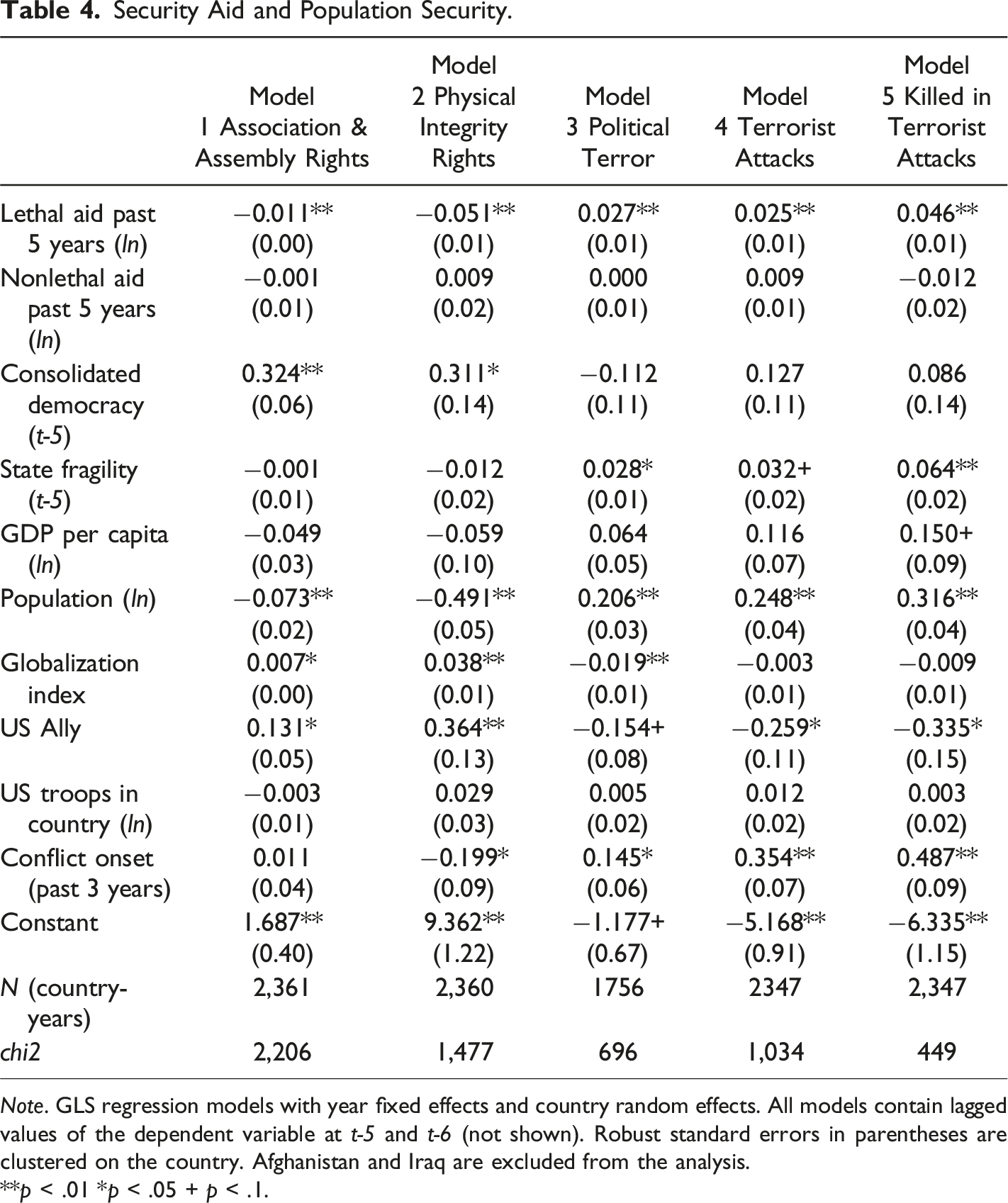
Note. GLS regression models with year fixed effects and country random effects. All models contain lagged values of the dependent variable at t-5 and t-6 (not shown). Robust standard errors in parentheses are clustered on the country. Afghanistan and Iraq are excluded from the analysis.
**p < .01 *p < .05 + p < .1.
Estimates for the control variables in the models are largely consistent with what is known about the correlates of state repression and political violence. Respect for freedom of assembly and association and for physical integrity rights are generally higher in stable democracies and in countries that are more integrated into global economic and political systems. Formal allies of the United States also appear to have better human rights conditions on average. Physical integrity violations tend to be higher in states with larger populations, and they increase with the onset of armed conflict. The onset of armed conflict in a country also significantly increases the number of terrorist attacks and deaths from terrorist attacks. Terrorism is more likely to increase over time in fragile states and in countries with large populations. All else equal, levels of terrorism are lower in countries that have a formal alliance with the United States. However, none of the security outcomes appear to be affected by the number of US troops stationed in a country after accounting for the other variables in the models.
Predicted Value of Outcome Variables as Levels of Lethal Aid Vary.
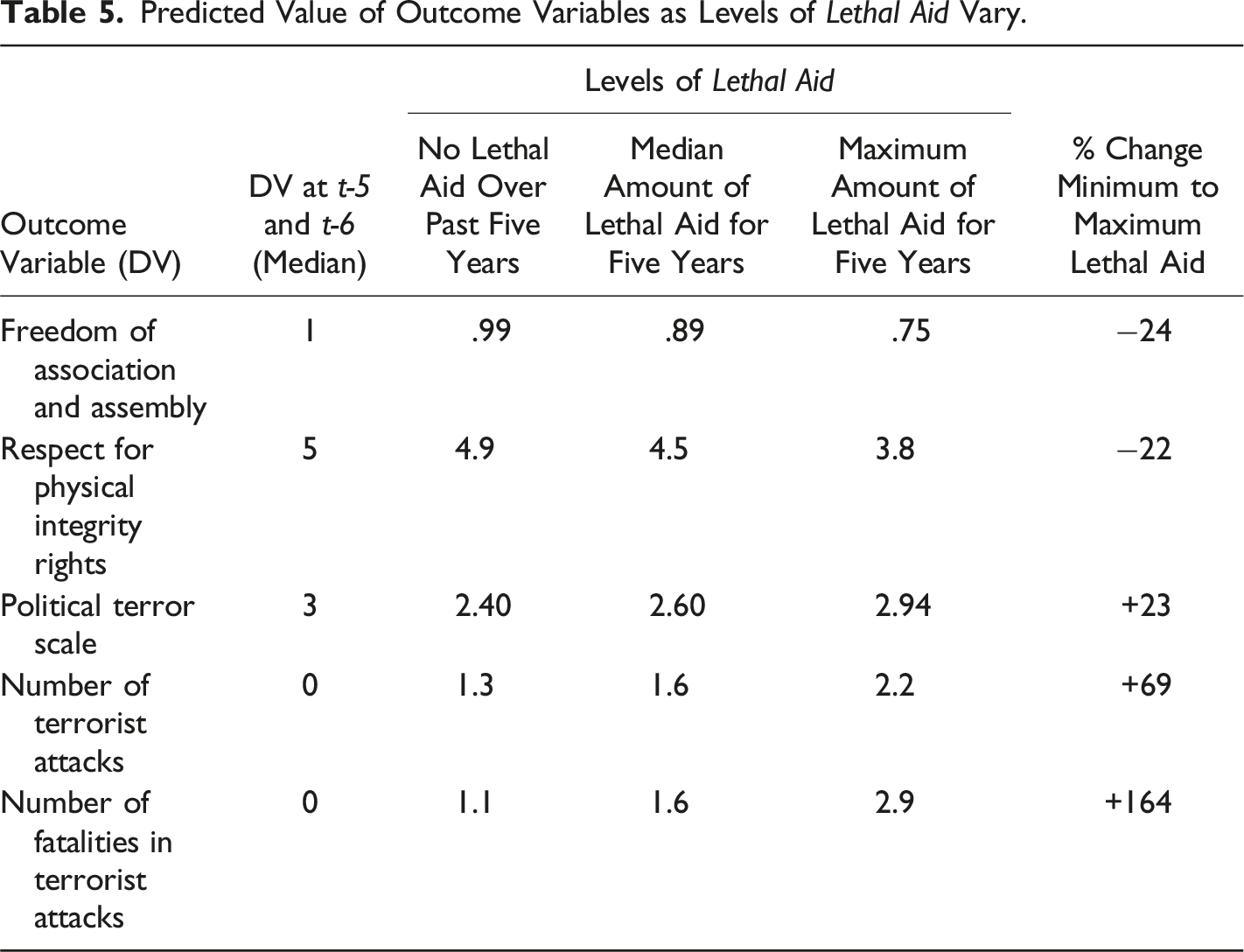
All else equal, countries that receive the maximum amount of lethal aid over 5 years are predicted to score 24 percent lower on CIRI’s Freedom of Association and Assembly index, and 22 percent lower on the Physical Integrity Rights index, than countries that do not receive any military training or material aid from the United States. A state with median values on all control variables in the model can expect their score on the Physical Integrity Rights index to drop from 5 at t-5 to 4.5 at t if they receive the median amount of lethal aid for 5 years. The pattern is similar when the dependent variable is the Political Terror Scale (PTS). A state’s score on the five-point PTS is expected to be more than half a point higher for states that receive the maximum amount of lethal aid, than for states that do not receive any lethal security assistance.
Turning to the relationship between U.S. security assistance and terrorism, we again see that only the amount of lethal aid countries receive has a statistically significant effect. If the amount of security assistance provided as military training and material support over a 5-years period increases from the median in our sample to the maximum, the predicted number of terrorist attacks increases from 1.6 to 2.2. Increasing the amount of lethal aid a country receives over 5 years from the minimum to the maximum, increases fatalities from terrorist attacks by 164 percent.
Each of these relationships deserves further investigation. There is no doubt that security assistance is endogenous to security conditions in recipient states, so we cannot conclude from this exploratory analysis that lethal aid is causing increases in state repression or fueling terrorism. We take several steps to address concerns about reverse causality and confounding factors, including directly accounting for the effects of past values of the dependent variable, but more sophisticated statistical modeling could provide more confidence about the causal impact of lethal aid. Process tracing in case studies could also contribute to greater understanding of the effects of military training and material support on human rights conditions and political violence. Moreover, there is much more work to be done to explore the effects of particular types of aid. Does assistance for security sector reform, counternarcotics, or law enforcement have its intended effects in recipient countries? Are there unintended consequences from providing these types of aid? We hope this dataset will provide scholars with the data they need to explore a wide range of important questions about the determinants and effects of providing particular forms of security assistance to a variety of security sector actors.
Conclusion
Despite the significant sums committed to foreign security assistance, and an increasing reliance on this tool to counter a wide range of perceived threats to national interests, we know much less about this foreign policy instrument than either economic aid or direct military intervention. This project is an attempt to provide researchers, policymakers, and the public with as full as possible an accounting of unclassified US security sector aid spending across the globe, including the specifics of what goods and services are being provided to which security sector actors with these funds. Our data clearly show not only the magnitude and geographic reach of US security sector assistance, but also its diversity.
Why is comprehensive, detailed data on US security assistance so important? As we enter a new era of great power competition, it becomes increasingly critical to understand this foreign policy tool. Advances in understanding the utility, risks, and limitations of this policy tool require a comprehensive source for detailed data on the amounts of various types of security assistance provided, and the recipients of that assistance over time. Although the security sector assistance included in this dataset is all provided by one donor, it is likely to have significant substantive impacts on governance, stability, political violence, interstate conflict, and a range of other phenomena of interest due to the magnitude and reach of this aid. The United States provides significantly more security assistance to many more countries than any other state. Up to 93 percent of countries in the world have received some level of security assistance from the US in the past 20 years. And scholars estimate that total US security aid is far greater than the aid provided by China, the UK, France, and Russia combined, although reliable data on security assistance provided by other states is much more difficult to obtain (Carrozza and Marsh 2022). Moreover, many low and middle-income countries, as well as fragile and conflict-affected states, receive very high amounts of US security aid relative to government revenue, and relative to the amount of international aid they receive for development. In some years, a handful of low and middle-income countries received more security assistance from the United States than Official Development Assistance from all OECD donor countries combined. Examples include Pakistan, Colombia, Egypt and Peru. And, unlike other forms of aid, security assistance is disproportionately channeled to one of the most powerful institutions in many nondemocratic countries—the military.
We see these data contributing to advances in research in three broad categories: (1) security aid impacts in recipient countries and regions; (2) the effects of security assistance on US national security and international relations; and (3) the determinants of variation in the magnitude, modalities, and recipients of security sector assistance. Examples of questions that could be explored include: • Are some forms of security assistance more effective at building partner capacity than others? • How do political, strategic, and economic factors explain differences in the portfolio of security aid of various types that a country receives? • Is the risk of civilian harm greater when lethal aid is provided to certain kinds of security forces? • How do different types of security aid impact civil-military relations in recipient states? • How do the amounts and types of security assistance the U.S. provides, and the distribution of this aid across countries, change with shifts in national security priorities?
We hope the availability of these data will spur more advanced research on security assistance as a foreign policy tool just as better data on alliances, sanctions, and the use of military force have advanced our understanding of those policy instruments.
Supplemental Material
Supplemental Material - Building Partner Capacity: US Aid to Security Sector Actors
Supplemental Material for Building Partner Capacity: US Aid to Security Sector Actors by Patricia Sullivan, Giovanny Rincon Alvarez, and Nathan Marx in Journal of Conflict Resolution
Supplemental Material
Supplemental Material - Building Partner Capacity: US Aid to Security Sector Actors
Supplemental Material for Building Partner Capacity: US Aid to Security Sector Actors by Patricia Sullivan, Giovanny Rincon Alvarez, and Nathan Marx in Journal of Conflict Resolution
Supplemental Material
Supplemental Material - Building Partner Capacity: US Aid to Security Sector Actors
Supplemental Material for Building Partner Capacity: US Aid to Security Sector Actors by Patricia Sullivan, Giovanny Rincon Alvarez, and Nathan Marx in Journal of Conflict Resolution
Footnotes
Acknowledgments
The authors are grateful to the Security Assistance Monitor at the Center for International Policy for sharing their data and expertise. Special thanks to Lauren Woods, former Director of the Security Assistance Monitor. Data collection and coding was powered by a team of excellent research assistants at the University of North Carolina at Chapel Hill, including Public Policy PhD and MPP students Juan Avilez, Frances Duffy, Megan Forrestal, Abhik Pramanik, and Mackenzie Webb, and undergraduate students Collins Alexander, Cate Byrne, Jared Dellamaestra, Stephanie Jeselson, and Chloe Young. We are especially grateful to Kyle Beardsley and Susie Colbourn at the Triangle Institute for Security Studies, and Jonathan Wilkenfeld at the University of Maryland, College Park, for their assistance and collaboration in securing funding for completion of the dataset. We thank DeeDee White and Brian Williams for grant management and administrative support. Lastly, we are thankful to the reviewers and editors of the journal for their valuable feedback.
Declaration of Conflicting Interests
The authors declare no potential conflicts of interest with respect to the research, authorship, and/or publication of this article.
Funding
The author(s) disclosed receipt of the following financial support for the research, authorship, and/or publication of this article: Research for this project was supported by a sub-award to the Triangle Institute of Security Studies from the Asymmetric Threat Analysis Center (ATAC), a joint program between the National Consortium for the Study of Terrorism and Responses to Terrorism (START) and the Applied Research Lab for Intelligence and Security (ARLIS) at the University of Maryland. ATAC is funded by the Department of Defense's Basic Research Office under Contract No. HQ003421F0481. Any opinions, findings, conclusions or recommendations expressed in this article are solely those of the authors and do not represent the views of the of the Department of Defense, the Triangle Institute for Security Studies, or the University of Maryland.
Data Availability Statement
The Online Appendix and replication material, including the data sets and codebook, are available at the JCR replication website at https://jcr.sagepub.com/. Updated versions of the dataset and codebook will be posted at  .
.
Supplemental Material
Supplemental material for this article is available online.
Notes
References
Supplementary Material
Please find the following supplemental material available below.
For Open Access articles published under a Creative Commons License, all supplemental material carries the same license as the article it is associated with.
For non-Open Access articles published, all supplemental material carries a non-exclusive license, and permission requests for re-use of supplemental material or any part of supplemental material shall be sent directly to the copyright owner as specified in the copyright notice associated with the article.
