




Abstract
Activists and protestors write grief as text to mourn losses, remember and document resistances to oppressive regimes, and present alternative futures. This article studies how grief is written, through letters and poetry from activists and their families in India, between 2019 and 2022, alongside the ethics of reading and (re)presenting such grief. Expanding upon the ethics of visual depictions of death to public and textual representation, the article posits grief writing as a mode of political action and mobilization. By witnessing and reading the words of imprisoned, murdered, and grieving protest participants, scholars and activists not only make sense of grief, but perform ‘wake work’ by attending to the dead beyond their pain and suffering, recognizing fuller, more holistic depictions of resistance, care and political action.
Suppose my daughter has to stay in jail for a really long time and there comes a time that she is not able to see me. I’m growing old, maybe I won’t be able to see her.
Introduction
Grief is a drowning heaviness. There is not often space for interrogations of security or political action when mourning; there is little room for critique and academic rigour in the wake of loss. Even memory slips away in our attempt to collect and preserve it, to know our place amidst grief. What, then, justifies writing on, of and for grief in contentious political contexts? How do activists, scholars and protestors turn to writing – ranging from poetry to letters from jail – to (re)present grief as political action? In this article, I examine the ethics of reading and writing grief, and the modes in which grief is written by activists in India’s sociopolitical environment between 2019 and 2022.
I write as a protestor and activist, from my position of fear (of repressive regimes and fundamentalist groups) and my anxiety. In writing with insecurity, I attempt to write grief in its own skin, with an honest texture. In the reading and writing of grief by extending existing conversations on the ethics of (re)presenting grief in visual forms, such as photographs and images, to that of text and literary practice, in contending with ways of reading and writing grief, I argue that jailed activists in India and their loved ones write their grief alongside presuppositions and imaginations of freedom; such imaginations, I claim, are essential to both academic thought and larger public understandings of political action and security: both domestic and international.
On 10 May 2021, Mahavir Narwal, a teacher, scientist, and member of the Communist Party of India (Marxist), died of COVID-19 complications (The Scroll, 2021). His daughter, scholar and activist Natasha Narwal, was incarcerated in India’s Tihar Jail for over a year along with Devangana Kalita and many others, under the draconian Unlawful Activities Prevention Act (UAPA) which allows for governments to label an individual as a ‘terrorist’ without need for evidence or cause. The two received bail in over three other cases lodged by the Delhi police in response to their participation in sit-ins and protests against the recently passed Citizenship Amendment Act (CAA) that excludes Muslims and other marginalized communities from pathways and safety nets to citizenship in India, the National Population Register (NPR) that documents citizen information including ancestry, and the National Register of Indian Citizens (NRC) that requires proof of citizenship by such ancestry. However, they remained in prison on UAPA charges, and Natasha was not permitted to visit her father before his death. Natasha was released on interim bail for three weeks, one day after her father’s passing. On 17 June 2021, Narwal and Kalita were released from prison.
In 2016, Rohith Vemula, a Dalit PhD scholar who had been recently unjustly suspended from the University of Hyderabad, wrote in his suicide letter: ‘My birth is my fatal accident’ (Vemula, 2016). His mother Radhika Vemula’s grief fostered a movement of sustained activism that pushed forth Dalit rights discourses (Henry, 2020). At Shaheen Bagh in 2019 and 2020, a key site of protest against the CAA-NRC-NPR, a crowd consisting largely of Muslim women gathered, wept, sang songs of resistance (‘Hum dekhenge’, meaning ‘We will witness’) and mourned the deaths in the 2020 Delhi pogrom. Aamir Aziz, a poet, sang, ‘Sab yaad rakha jayega’ (‘We will remember everything’). 2 Processions grieved and lamented; in human chains and candlelit marches protestors held hands; songs were sung not only to mourn those lost, but to direct grief towards a reparative function, addressing the structural oppressions that created the conditions for such grief.
Grief as such has been a perdurant part of resistance to religious discrimination, caste exclusion, patriarchy, racism and classism. Between 2019 and 2022, India has seen an uptick of civic resistance to oppressive political, legal and executive regimes including but not limited to the CAA, the Transgender Persons Act (TPA), police-assisted violence at Jamia Milia Islamia, the UAPA, the Farmers’ Acts, the illegal annexation of Kashmir, the Delhi pogrom and the IT Rules 2021. Coupled with pandemic-induced lockdowns, a nexus has formed between surveillance, detention, structural violence and state-sponsored institutional apathy. This nexus calls into question what it means to recognize the writing of grief as a political act, and how the ‘political’ is affected by the words of those grieving or being grieved. It leads scholars of international relations and security to ask how one can stand testament to grief and perform ‘wake work’ without the need to ‘create a space for mourning where it is prohibited’, without fabricating a ‘witness to a death not much noticed’ (Hartman, 2008: 8). In considering grief as ‘political action’, I consider political action to mean public acts of resistance against oppressive forces. I examine how reading and writing grief politicizes the subject – in the sense of ‘acknowledging the ways in which grief signals a political response to broader structural conditions of injustice’ (see also Gillespie, 2016: 580; Butler, 2009).
Olivia Rutazibwa (2021), a scholar of international relations, said: ‘International Relations is a science that affirms death, rather than life.’ Now, there is a need for international relations to contend with life in terms of its memory of death, the record of suffering and the written grief that influences political action. Reckoning with grief and its writing means contending with its material consequences and significance for participants and supporters in social movements, civil resistances and the mobilization of protest, as well as their kin. Analysing the grief and grieving of others involves committing our own incursions and violations – of privacy, trust and consent – for authors and subjects no longer alive (Hartman, 2008). As a protestor and activist, I do not write from an impartial position. My impartiality is a necessary counter-balance to the lack of focus on grief and its forms in international relations and security studies. This article, therefore, not only analyses grief as responses to death between 2019 and 2022 but also reflects on the ethical, methodological and narrative challenges and opportunities that come with reckoning with grief.
Writing and theorizing grief and its modes of transformation into political action requires an acknowledgement of its individual and collective manifestations; it demands an attentiveness to questions of agency alongside silence in protest identities, and calls to account for ‘wake work’ as care work (Sharpe, 2016). Wake work here includes the work of grieving, accounting for the causes of grief, and can be extended to actions taken to address and resist oppressive forces. While wake work can at times work to fight injustice, its importance is not limited to its capacity for political action, but rather exists on its own – as a mode of memory keeping and meaning making.
Wake work and the study of grief, whilst purposed towards honest narration and understanding, does not solely justify itself with its utility. Drawing from Saidiya Hartman, my writing of grief is: (1) not representation; (2) not utopian, nor capitalist wishfulness; (3) a project that connects the ‘then’ and the ‘now’; and (4) not intended for usefulness, but for attending to the capacity for life (Hartman, 2008). It is also an act of imagining where such written grief leads, where the people who are grieving are taking us through their mourning. Such writing is also an act of critical fabulation, an act of guided imagination not for utility but to reorganize the values and beliefs through which protest is understood (Hartman, 2008: 11). By doing so, we view those mourning in their wholeness, their potential for wholeness, their complexity, love and identity beyond pain (Krystalli and Schulz, 2022; Sen, 2021).
In this article, we will read the translated poetry of three activists: poetry and letters of Dalit scholar Rohith Vemula, some published posthumously; the writings of the scholar and political prisoner G. N. Saibaba, published prior to his death in October 2024; and letters written from prison by activist and scholar Natasha Narwal. They were authored in the years 2019–2022 and accessed from public record, blogs and news media. I selected these works particularly amongst the vast corpus of texts on grief by and with regard to activists and protestors in India in light of their direct relevance in the context of the CAA-NRC-NPR and Farmers’ movements and their personal importance to my activism and scholarship. I read them alongside accounts of resistance by marginalized peoples against government-enabled violence in India, 2019–2022. Placing myself in a (distant yet) intimate encounter with such writing, I address the ‘unmournable’ in political action and take care not to ‘fill in the gaps and provide closure where there is none’, but instead interrogate the modes of grief expression that are ‘required to imagine a free state or to tell an impossible story’ (Hartman, 2008: 10).
In this process, the research briefly revisits the ethics of centring and writing grief – what different styles of visual and textual representation mean for/with grief and their effects on observers. The article will first contextualize the selected authors by describing the larger environment of oppression in which they were placed, then proceed to consider the ethics of writing grief, drawing lessons from photography. It will then engage with Black scholarship to read the grief writing of Narwal, Vemula and Saibaba, to understand how such writings (and their reading) can be a mode of political action. Besides the research’s aims of documenting resistance movements in India (and its lessons for the Global South), it hopes to extend conversation on how gender, caste, religious and ethnic minorities channel their grief into effective mobilization, solidarity and political communication: to address structural injustices, to prevent the grief of others and build peace.
Contextualizing, narrativizing grief in India
To situate the geography of mourning and grief in the Indian subcontinent, one requires an understanding of key events in the past few years, of which I herein focus on the announcement of the CAA-NRC-NPR and the associated protests, violent responses to nonviolent protests, protest spaces and protesting communities, the subsequent Delhi riots, the Farmers’ Protests, and through the course of this period, the surveillance, harassment, detention, arrests and imprisonment of activists. These events happened between 2019 and 2022, and must be read in the context of other occurrences, including the annexation of Kashmir, the IT Rules 2021, the passing of the Transgender Persons Act and the COVID-19 pandemic. As Christina Sharpe (2016: 4) writes, ‘We experienced, recognized, and lived subjection, we did not simply or only live in subjection and as the subjected’.
There exists a distinct chronology of these events in contemporary Indian history, formed and narrated with oppressions and grassroots transgressions that set the stage for this article’s examinations of grief. This begins with the marking of 5 August as the day of Hindutva triumph. On 5 August 2019, a lockdown was imposed in Kashmir, with internet and cell services shut down and curfews instated (Roy, 2019). The Transgender Persons Bill was passed on the same day by the Lok Sabha of the Indian Parliament amidst widespread protests from trans and queer communities (Jain and Kartik, 2020). On 5 August 2020, the foundation stone was laid by Prime Minister Narendra Modi for the new Ayodhya Temple to be built on the site of the Babri Masjid (a mosque illegally demolished by a Hindutva mob in 1992), with many members of the original group who were part of the initial demolition present at the ceremony.
In late 2019, the government announced the Citizenship Amendment Bill (later passed into an Act) alongside the National Population Register and the National Register of Indian Citizens. The ruling BJP government stated the CAA to be a minority-inclusive Act, despite it excluding persecuted communities including the Baluchis, Ahmadiyas, Shias and Sufis in Pakistan, Hazaras in Afghanistan, Uyghurs in China and Bihari Muslims in Bangladesh. This, in conjunction with the NPR (to survey the Indian population) and the NRC (to verify key documents of ancestry to verify citizenship), formed a nexus of potential disenfranchisement for millions of Indian citizens who could not access the kinds of long-term documentation to prove citizenship (Jain and Kartik, 2020). Widespread protests arose against the CAA-NRC-NPR across the country, with a few sites emerging as symbolic spaces of resistance from 15 December 2019, such as Shaheen Bagh, Jamia Millia Islamia, Jama Masjid and Jantar Mantar in New Delhi. These spaces were largely led by Muslim women, with members of other communities supporting them.
Over the following months, prior to the outbreak of COVID-19, there were multiple instances of violence by Hindutva outfits, fringe groups and the police against protestors. On 15 December 2019, the police led a large-scale destruction of property and assault on student protestors at the Jamia Millia Islamia Institute in New Delhi, with video footage showcasing police deliberately damaging CCTVs and computer equipment, and dragging and beating students in the largely Muslim institution (Manivannan, 2021). On 5 January 2020, over 50 masked members, including those of the Bharatiya Janata Party’s (BJP) student wing, Akhil Bharatiya Vidyarthi Parishad (ABVP), attacked students and university property at the Jawaharlal Nehru University in response to their participation in the CAA-NRC-NPR protests.
The protests still persisted peacefully through these acts of violence. Sikh communities at Shaheen Bagh set up langar, and the description of Muslim women who led the protest site was that they ‘redefine carework as resistance’ (Desai, 2020). A library on Dalit rights and struggles was established alongside a shrine for Rohith Vemula. On 17 January 2020, Radhika Vemula, in an event organized by ‘We the People of India’, called upon Rohith Vemula’s suicide note where he wrote of people being reduced to ‘an identity to a vote to a number’, and stated that she would campaign against the CAA-NRC-NPR in his memory (Jain and Kartik, 2020).
From 23 February 2020, there were multiple waves of a pogrom in north-east Delhi by Hindutva outfits in predominantly Muslim neighbourhoods, with video footage showcasing supposed complicity by police forces (Rao, 2020). Over 580 Muslims were wounded, beaten and shot, with over 50 reported deaths, with video footage arising of policemen beating Muslim individuals and ordering them to sing the Indian national anthem. One of the individuals from the video died soon after. No arrests have been made against the officers in the video (Banka, 2022). The government delayed the release of compensation to victims of the ‘riots’, with legal and activist groups such as the Neev Foundation working towards achieving this financial relief over the past two years. The COVID-19 pandemic which followed resulted in a slowing down and conclusion of key protest spaces such as Shaheen Bagh, whilst activism against the CAA-NRC-NPR continued in other forms, resulting in an indefinite delay of the implementation of the framework nexus (Jain and Kartik, 2020; Manivannan, 2021).
Subsequently, in September 2020, protests resumed when the government of India passed three Farm Acts which, whilst claimed by the government to be of benefit to farmers, were met with large-scale protest from farmer communities. Protests grew and occupied strategic locations on highways surrounding New Delhi. The protestors, primarily Sikh farmers, were met with multiple instances of police resistance via brute force, including road spikes, water cannons, police brutality and blockades, but protest leadership continued to reiterate peaceful modes of protesting even in the face of police aggression and violence.
Recently, alongside this context of violence and resistance, India’s domestic security has seen a vast deterioration particularly in northern BJP ruled states, with a rise in hate crimes, a lack of executive and judicial recourse, and an increasing assault on the rights of marginalized communities particularly Muslims and Dalits (Bhat, 2020; Ganguly, 2021). With a recent judgement by the Karnataka High Court upholding the decision of schools in Karnataka to ban hijabs in the classroom, and calls from multiple Hindutva outfits for the rape and killing of Muslim women as a form of threat to dissuade interreligious marriage, one also sees a largely silent and apathetic government and political leadership. This is additionally exacerbated by the COVID-19 pandemic which resulted in over 3 million unreported deaths in India as per WHO estimates (World Health Organization, 2022).
Protests and resistances against the long-term jailing of activists who stood against the CAA-NRC-NPR, the Farm Acts, or the associated acts of the government continued during 2022 through online platforms, forums, publications and petitions. Activists continued to write from prison, with individuals such as Sudha Bharadwaj, Natasha Narwal, Devangana Kalita, Umar Khalid, G. N. Saibaba, Varavara Rao and Hany Babu authoring letters and books from prison detailing their experiences – of which this article refers to Natasha Narwal and the late G. N. Saibaba whilst viewing the role of their grief through these spaces of contentious politics.
Grief, in the context of such widespread death and suffering from diverse causes, is a form of reliving pain, loss and struggle, and thereby accounting for violences inflicted, often in cases where no official census, data, or bureaucratic record exists of suffering and death. Grieving is a mode of meaning making, creating space for increased political activity after loss, political mourning, ‘mobilising and utilizing the grief of ordinary citizens as a political tool of social change’ (Al’Uqdah and Adomako, 2018: 93).
The Indian case is notable in that the combination of these issues resulted in a distinct air of anxiety, grief and threat in the subcontinent, with intersecting factors of religion, caste, class and gender playing a key role in determining one’s (in)security, alongside the radicalization of youth, economic crises, and struggling healthcare and social infrastructure. Thus, the case of India particularly presents the need for broadened understandings of security and human security, specifically care-based approaches that consider a view of human security that is not atomized and individualistic but rather focused on collective social transformation, community empowerment, and institutional development.
Extending the ethics of grief from photograph to text
The study of grief with regard to social movements, activist spaces, and domestic resistances occurs in parallel with studying the ethics of analysing and documenting readings of grief. Is there an ethical way of writing about, learning of, understanding, (re)presenting the grief of others who are distant and far away, in geography, identity, and temporality?
Elizabeth Dauphinee contends with this question in her essay ‘The politics of the body in pain’. Examining the case of visual images being circulated of the tortures and crimes conducted at Abu Ghraib, she argues that there is an ethical impasse between the need to witness grief and pain and the impossibility of doing so through visual modes (Dauphinee, 2007; Sliwinski, 2004; Sontag, 2003). A visual record of harm can, by reducing people to their suffering, be itself a mode of suffering. Theorizing the writing of grief thus draws from lessons from its visualization in photography, as opposed to text which demands visualization.
All ethics is a demand for responsibility. The ethics of witnessing grief therefore draws scholars and practitioners alike to a Levinasian encounter with an unrecognizable and unreachable Other, what Timothy Pachirat calls the politics of sight, alongside responsibility in the ways in which grief is communicated to large audiences (Pachirat, 2009). Those who witness the suffering are placed in an intimate encounter, one that poses an interconnectivity between human lives, which forces us to recognize that our subjectivity is intricately constituted by our communities, families, and interactions with one another (Dauphinee, 2007). Dauphinee suggests that pain is ‘not an invisible, interior geography’ but that we can know the pain of others and respond to it (Dauphinee, 2007: 151).
Pachirat examines this politics of sight in specific context of the ethics of ethnography, where suffering and death is relegated to particular geographies of sight, where those mobilizing resistance, support, and who hope to address the causes of suffering engage in ‘concerted, organized attempts to create ruptures in zones of confinement, to render the hiddenness of the repugnant visible in an attempt to produce political and social change’ (Pachirat, 2009: 146). However, the activist or organizer is faced with the question of how such an act of ‘making visible’ must be undertaken. While in a photograph, violence is often visible, through text and the work of active visualization from reading text, grief is made visible.
Thus while the capacity for popular mobilization and the cessation of suffering and death is contingent upon its capacity for viewing, understanding and communicating the pain of others, this task of communication is complicated by a question of access – one of not only what forms of suffering, grief, mourning and pain are seen, but also how they are seen (Dauphinee, 2007; Scarry, 1985). Sliwinski (2004: 158) argues that when witnessing suffering, viewers are also faced with a failure of sight – where we witness the causes of the suffering but are unable to imagine or feel the suffering itself (Dauphinee, 2007: 145). Here, can words offer something pictures cannot? In this sense, as per Elaine Scarry, pain is both world- and language-destroying, where ‘to have pain is to have certainty; to hear about another’s pain is to have doubt’ (Dauphinee, 2007: 141–145; Scarry, 1985: 13).
There is a similar impasse with the magnitude of grief that people encounter in daily life – as both text and image. Media and news on killings, mass murders, political violence, genocide and recurring pogroms are overwhelming to a point where one is unable to understand the logic of such wide-scale death (Ramos, 2015). Yet, as Iván Ramos (2015: 301) states, ‘the crime scene, and the actions that produce it, remains impossible for us to approach, perhaps because to concede the weight of our grief would make living itself unsustainable’. Walter Benjamin wrote that witnessing war in itself often ‘takes away the ability to speak about it’ (Benjamin and Zohn, 1963; Ramos, 2015: 301), a poverty of communication which Dauphinee examines alongside the doubt that arises of another’s pain, of Jenny Edkins’ contemplation that when writing trauma, ‘what we can say no longer makes sense; what we want to say, we can’t. There are no words for it’ (Dauphinee, 2007: 142; Edkins, 2003: 8).
Images, yet, still hold power. Ramos (2015) writes about tactics of grief and mourning employed following the disappearance of 43 ‘normalista’ students in Iguala, Mexico in 2014, where the faces of the men were displayed across the country and beyond; by the act of display which was at once protest and grieving, they turned knowable, mournable. He writes: ‘Even if we failed to learn their names, we soon came to recognize their faces and thus expressed empathic solidarity with their loved ones’ (Ramos, 2015: 303). In many other national contexts, from the Vietnam War to to Asia and Latin America, images of the dead and disappeared are modes of remembrances, acts of political protests by those left behind, or as modes of shock and anger intended to instil outrage and remorse (Butler, 2009: 150; Ramos, 2015: 305). Butler examines photographs of the dead as holding the power to foster political action, broadening conceptions of human life, deepening ‘our capacity to respond with outrage, opposition, and critique will depend in part on how the differential norm of the human is communicated through visual and discursive frames’ (Butler, 2009: 77).
Text operates on a different scale of encounter, where those lost are not witnessed in Cartesian and Manichean ways that see the world in dualisms of good/evil, pain/loss, joy/sorrow. Rather text allows for more fluid vocabularies of hope and grief, what Keguro Macharia called the ‘we formations’, the work of artists, poets, workers and writers, and their reporting which Christina Sharpe considered to be ‘the orthography of the wake’ that makes domination in/visible and not/visceral (Sharpe, 2016: 21). Singer and scholar Nina Kivinen wrote:
The painful writing, writing in blood, writing in tears can turn to beautiful readings. Texts that change the world. Not as a single path through a forest but as a myriad of winding paths crisscrossing, juxtaposing and lingering. (Kivinen, 2021: 500)
She argued that thinking of, writing and reading grief in public helps ‘make grief part of the ordinary’ (Kivinen, 2021: 502). Other scholars have engaged with different forms of writing as a means of action. Brennan and Letherby wrote specifically of auto/biographical writing as a vehicle for unleashing grief as ‘an embodied self that both thinks and feels’ (Brennan and Letherby, 2017: 161). Spargo (2004) wrote of poetry and elegy as having always presented the writing of grief as a means of processing loss, reorienting from it, and creating new worlds in the wake.
Mourning, grieving through text, provides a language with a double register – literal and symbolic – for ‘describing what suffering was like’ and providing metaphors for freedom (Hall, 2001: 36). It allows one, as per Stuart Hall, ‘to name the unnameable, to consider the possibilities of cultural identification, of the different traditions of the people for whom, on the whole, there were no cultural models, the peoples at the bottom of the society’ (Hall, 2001: 31). The reading and writing of grief is both record and imagination – documenting the past, dreaming new futures, and allowing us to feel and act against injustices. As Butler wrote of the political work of mourning, it connects to ‘concrete claims for acknowledgement, justice, atonement, and reparation’, and contends with that which ‘remains unspeakable’ (McIvor, 2012: 428).
Making sense of grief
How do we make sense of grief? For scholars, studying the ethics of writing and reading grief is an attempt to better understand violence and conflict in non-militaristic notions, to view security narratives in care-based frameworks that include larger embodied needs of individuals and communities – the need for healthcare, for emotional well-being, for grieving to process the lost, for reorganization, and for protests as a means of effectively channelling the anger, sorrow and frustration of grief into forums of productive, nonviolent action.
Quoting Vargas and James, Christina Sharpe asks what happens when we ‘recognize Black death as a predictable and constitutive aspect of this democracy’ (Sharpe, 2016: 7; Vargas and James, 2012: 193). She asks: ‘What happens when we proceed as if we know this, antiblackness, to be the ground on which we stand, the ground from which we attempt to speak?’ (Sharpe, 2016: 7). It is a similar ground that those who grieve in India stand on, a ground red with the blood of Dalit, religious minorities, and transgender, queer and indigenous communities. By assuming the existence of an oppressive regime, therefore, this article progresses without attempting to prove or establish the existence of suffering but seeking to better understand it.
The reliance on personal narratives, letters, publications and stories of individuals and activists from across the country builds upon this ground. Incorporating the individual into a reassessment of security discourses, as per Hartman, is not ‘a personal story that folds into itself; it’s not about about navel gazing, it’s really about trying to look at historical and social processes and one’s own formation as a window into social and historical processes, as an example of them’ (Saunders, 2008: 7). By collating stories, songs, poetry, letters and memories otherwise left outside mainstream security discourses, we find ourselves attempting to ‘tell a story capable of engaging and countering the violence of abstraction’ (Hartman, 2008: 7; Sharpe, 2016: 8). These stories, and this impartiality, further reflect the disproportionate harm faced by these communities who grieve, the knowledge that ‘certain marginalized lives exist in a state of precarity whereby they are unevenly exposed to conditions of risk and violence’ (Gillespie, 2016: 580).
Rohith Vemula, in his poem ‘One Day’ (translated by the Centre for Translation at St Stephen’s College, Delhi University), wrote:
One day you will understand why I was aggressive. On that day, you will understand why I have not just served social interests. One day you will get to know why I apologized. On that day, you will understand there are traps beyond the fences. One day you will find me in the history. In the bad light, in the yellow pages. And you will wish I was wise. But at the night of that day, you will remember me, feel me and you will breathe out a smile. And on that day, I will resurrect. (Indian Cultural Forum, 2016)
The poem reflects the Dalit scholar’s suffering and death in prescient ways. The words ‘I will resurrect’, ‘you will remember me, feel me’ and ‘you will wish I was wise’ show Rohith mourning himself whilst alive, and his vision of us mourning him, remembering him. Rohith grieves himself – in writing ‘you will understand why I was aggressive’ he not only challenges the conceptions of Dalit activists as being overtly aggressive in their protests and resistances, but reorients the nature of such aggression as a legitimate, feminist anger. In the poem, our act of mourning, Rohith resurrects not as himself, but as a new Dalit-ness that has transcended the restrictions and stigma placed upon it by Brahmin, savarna and cis upper-caste cultures in India. When he calls on readers to remember him and ‘breathe out a smile’, he also calls on us to relinquish control of the body. As Kivinen writes, when she was asked where she felt grief, she felt it most profoundly in her chest: ‘it stops my breathing’ (Kivinen, 2021: 499). To breathe, here, as in singing, is to grieve. In Deepa Dhanraj’s documentary ‘We Have Not Come Here to Die’, Rohith’s mother, Radhika Vemula states, with her gaze on a portrait of her son on stage, ‘I see Rohith in all of you’ (Katyal, 2019).
Radhika Vemula here, mourning Rohith, not only channelled her grief towards the memory of Rohith, but towards the resistance of the institutional forces that resulted in his murder. State officials operationalized and further contested this grief and death in different ways. Narendra Modi once stated that Rohith was ‘a son of Mother India’, while the senior party members of the ruling BJP government called him an anti-national (Thapliyal, 2021). A year after his death, the Andhra Pradesh government declared that Radhika and Rohith Vemula’s Scheduled Caste status was ‘fraudulently acquired’ and that they belong to the OBC category, demanding her to provide proof that she belongs to the Dalit identity (Surepally, 2021). She questioned Prime Minister Narendra Modi, asking if her son was an anti-national, or a son of the country (Surepally, 2021). She continued to hold vigils and protests in his memory, despite attacks from multiple groups, including those questioning her Bahujan identity. As a mother mourning her son, Radhika Vemula located her grief beyond herself – as not only her own, but one that belongs to and is shared among those facing similar oppression as Rohith did. She presented a goal of mobilization rooted in accounting for injustices, confronting the causes of her suffering and grief.
In this sense, Radhika Vemula and the Centre for Translation have performed wake work by a careful direction of attention towards those parts of Rohith Vemula that are not purely constituted, in the eyes of the public, by violence itself. They defend the dead through a ‘vigilant attendance to the needs of the dying, to ease their way, and also to the needs of the living’ (Sharpe, 2016: 10). By reading his poetry, by understanding and presenting Rohith Vemula as a full human being, with dreams and aspirations, with love and a rigorous understanding of his future, we are given more than mere scraps or fragments of the archive – we are painted a whole picture of an individual who exists beyond his death and suffering. Rohith, thereby, is liberated ‘from the obscene introductions that first introduced them to us’ by his mourners, but also by himself (Hartman, 2008: 6).
Much as Saidiya Hartman wrote of thinking and working on an assumption of oppression, jailed activists in India too seem to operate on a presumption (and, sometimes, precognition) of death. This presumption is seen in regular themes surrounding grief and mortality in their writings. Gokarakonda Naga Saibaba, known as G. N. Saibaba, was a human rights activist, scholar and writer who at the time of this article’s authorship was serving a life imprisonment in India for alleged connections to banned left-wing organizations. In his writings from prison, titled ‘Why Do You Fear My Way So Much’, he wrote:
I still stubbornly refuse to die The sad thing is that They don’t know how to kill me Because I love so much The sound of growing grass. (Saibaba, 2022: 3)
In these words there is a pressing urgency – that his death was sought after by oppressive forces, the unnamed and unqualified ‘they’. Yet, the ‘they’ is clear to all those who read his work. In calling forth an imagery of the ‘sound of growing grass’, Saibaba not only drew explicit connections to his agency, his ways of (re)making sense of grief and the world around him, but further posited a nod to the farmers who continued to protest against the regressive Farm Acts in India during the time his work was written and published. Saibaba further drew attention to our notions of freedom in contestation to that of incarceration.
Elisabeth Wood cites Ramachandra Guha in her work to engage with the ways in which academics ‘infer the logic of insurgency from the “prose of counterinsurgency”’, which in the context of writing grief questions what qualifies as counterinsurgency (Wood, 2009: 122). In writing of, in a sense grieving his loss of freedom, in stating ‘they don’t know how to kill me’, Saibaba was not only reifying his notion of freedom but also that of revolution and resistance – not that the forces he resists do not have the capacity to kill him, but that his notion of death was stronger, that he dies when he decides to die, when his love of growing grass ceases.
By listening to these words and acting, resisting oppressive state structures with Rohith Vemula’s poetry and Radhika Vemula’s grief, love and affirmations as a mode of solace and faith, they are forging very real human bonds, generating relations and visions of life. Nelson (2013: 21) states that these bonds forged ‘through loss, trauma, and oppression and our grief reactions to these extreme, ongoing losses’ are common human bonds, but highly important, with the evolution of caregiving systems across different human cultures as a means of better understanding ourselves, our losses, and also to offer ‘a means of transforming our grief and loss into new attachments, and a guide to healing and hope’.
On 12 June 2021, The Caravan released a consolidated series of letters penned by Natasha Narwal and Devangana Kalita, members of the student activist group Pinjra Tod
3
and doctoral candidates, during their time in Tihar Jail in Delhi. On 27 September 2020, Natasha wrote:
Both hope and solace are precious commodities here. Women keep them tightly held to their bodies, braiding them in their hair, hiding them from the powers that are hell-bent on depriving them of it. But they trade in them generously among each other, holding each other, wiping tears, sharing their stories with each other. One learns from them every day – how to survive with dignity, how not to let this regime break you, even if you feel broken on days, how to hold oneself and each other and regain strength for another day. So many stories held between these walls and locks (chuppiyan hain zubaan ban kar phutne ko, dil mein gussa ubala ja raha hai) [These silences are about to burst into words, the anger in our hearts is simmering]. (Narwal and Kalita, 2021)
There is an urgent warrant of the dead in these lines; much as G. N Saibaba wrote of the ‘sound of growing grass’, Natasha writes of hope and solace, of women braiding them into their hair. There is, furthermore, a critical care that features, by which resistance functions within incarceration – of women caring for other women, of oral histories exchanged. In reading Natasha’s writing about stories, there is an even more urgent call to (re)consider the ways in which texts by jailed activists present an honest texture to their voice. In representing their voice and viewing them through the lens of care and grief, there is furthermore a need to, as Angela Lederach writes, ‘not edit out “their ways of speaking”’(Lederach, 2021: 467).
In Natasha’s subsequent letters from prison in late November 2020, she wrote about the suicide of Aishwarya Reddy, a student of Delhi University (Narwal and Kalita, 2021):
You know it has hit me really hard . . . really stirred so many emotions of anger, frustration, rage and helplessness. I have been seriously thinking and wondering how any resistance or struggle will stand in front of everyday, growing, brutal repression, which will only intensify further and engulf our world. (Narwal and Kalita, 2021)
Natasha’s notes about growing repression were immediately accompanied by messages of hope and resistance. She further wrote of how the arrests of activists Kalyani and Tanmay Nivedita for accompanying a survivor of gang rape to a courthouse in July 2020 shocked her, and extended her solidarity to their colleagues Tanmay and Shohini (of whom Shohini was actively working toward their release) (Narwal and Kalita, 2021). Natasha expressed how it disturbed her to hear of many other arrests, including those who were old and without respite. She quotes a line from Begum Akhta’s ghazal Aaj Jaane Ki Zid Na Karo: ‘Waqt ki qaid mein zindagi hai’, which translates as ‘life is imprisoned in the shackles of time’. Her letters during this time are even more poignant considering her father, Mahavir Narwal, at the same time recorded an interview where he stated the lines this article began with:
Suppose my daughter has to stay in jail for a really long time and there comes a time that she is not able to see me. I’m growing old, maybe I won’t be able to see her. (See supra note 1)
Mahavir Narwal’s words shortly before he died, read alongside Natasha’s writings of hope, grief and resistance from prison, reveal a collective sense of how we make sense of grief in the midst of oppression. The Indian judiciary, by denying Natasha her request for bail to be with her father when he was ill, deprived her of her ability to grieve in entirety in his presence. As Christina Sharpe writes, this is ‘the power of and in sitting with someone as they die, the important work of sitting (together) in the pain and sorrow of death as a way of marking, remembering, and celebrating a life’ (Sharpe, 2016: 10–11).
Reading Natasha and Mahavir’s words, now, scholars, citizens, protestors alike are faced with a complicated ethic of grieving: we are faced with the distinction between seeing and witnessing, a politics of sight that Naisaragi Dave engages with when they say, ‘[A] voyeur heightens the affective experience of being alive in his or her own skin (‘I have survived this moment and now I feel euphoric’); in witnessing, by contrast, that skin is shed, so that something in the person ceases to exist after the event is over’ (Dave, 2014: 440). The deprivation of Natasha’s ability to be with her father, to grieve in his presence, was a transformation of her wake work from one of mourning to one of courage. After her father died, Natasha was granted bail to be at his funeral. At his grave, clothed in protective gear due to COVID-19 considerations, Natasha raised a fist in solidarity (see Figure 1). This was Natasha’s wake work, a mode of attending to suffering ‘imagined and performed here with enough specificity to attend to the direness of the multiple and overlapping presents that we face’ (Sharpe, 2016: 22).
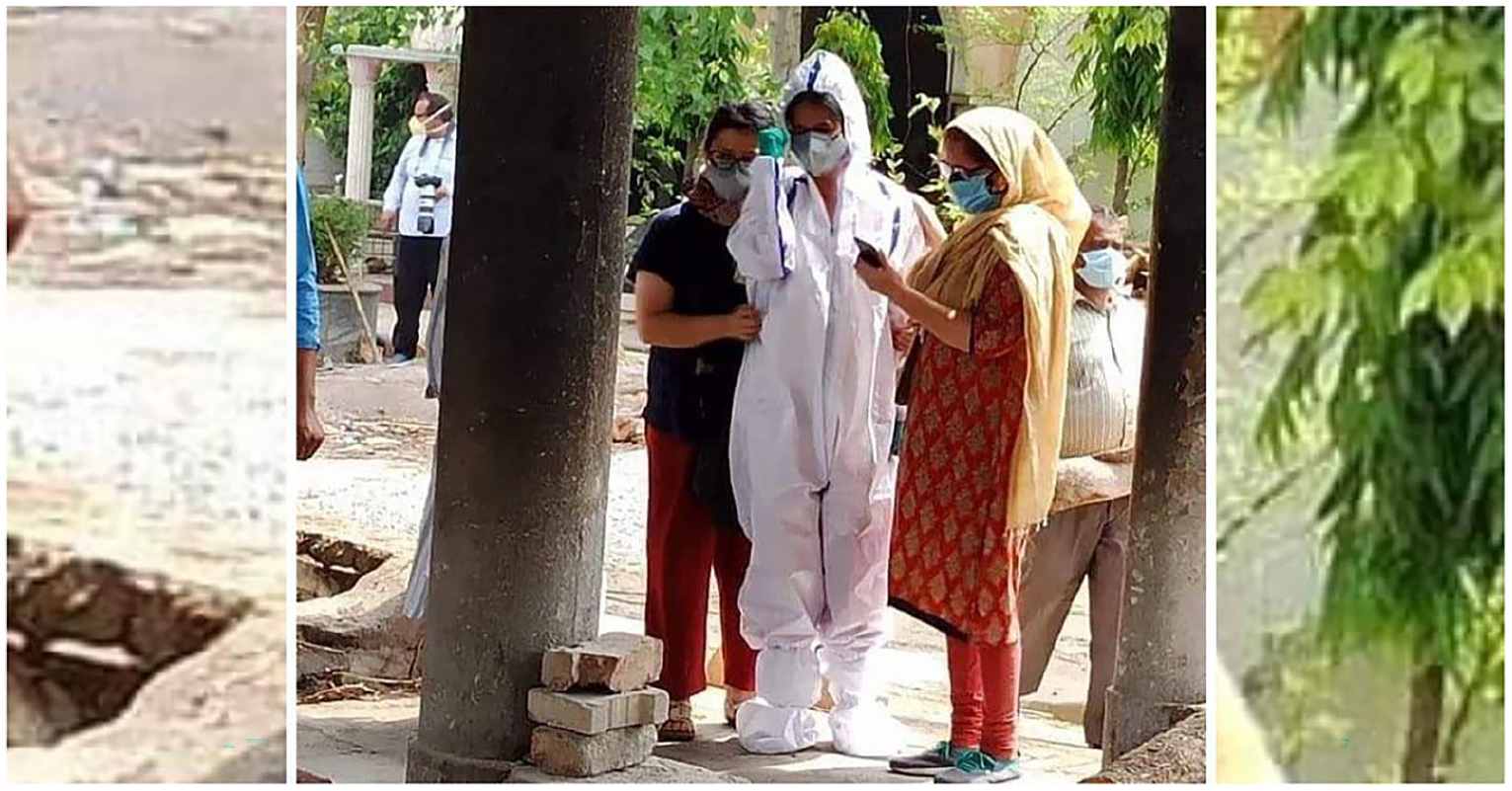
Natasha Narwal raising a fist in solidarity whilst on bail at her father, Mahavir Narwal’s funeral.
On 29 November, Natasha wrote about how she and other inmates joked that they should write jail survival manuals. She ended her letter as such:
I’ll leave you with a poem by an inmate I found in the old notes in the library: To the night of our togetherness below open skies When the moon will not be caged. Hum dekhenge!
4
Lots and lots of love and rage, N
In writing about togetherness, in calling forth images of revolution, testimony and witness, in her sign-off with ‘love and rage’, Natasha actively contributes to the creation of what Marianne Hirsch and Maria Stepanova term ‘postmemory’. They define postmemory not as an idea, movement or method, but ‘a structure of inter- and trans-generational transmission of traumatic knowledge and experience’ (Stepanova, 2021: 102). This, as per Stepanova, is not a project or a sensibility, but ‘something broader’, a ‘kind of internal language establishing horizontal and vertical lines of transmission’ (Stepanova, 2021: 102).
In the poetry and writing of activists discussed above, there is not only an earnest effort to narrativize and make sense of their intimate, deeply personal grief, but to also present it as a contribution to public memory, to record it in the archive of text and letters and literature that will perhaps outlive them. This honest effort is visible in Mahavir Narwal’s question of what would happen should he not be there when Natasha is released from prison, a heartbreaking resilience that directly confronts and challenges the oppressive regimes and forces that incarcerated Natasha and many others alongside, before and after her. As Maurice Blanchot wrote, ‘The disaster ruins everything, all the while leaving everything intact’ (Blanchot, 1995: 1–2).
Such writings of grief and grieving tend towards action through active reorganization. People who are grieving are forced to acknowledge that ‘the loss is indeed permanent and that life must be shaped anew’, to discard old methods of thought, life and action, and be drawn into a process of ‘reshaping internal representational models so as to align with the changes that have occurred in the bereaved’s life situation’, to ‘fill unaccustomed roles’ and ‘acquire new skills’ (Bowlby, 1980: 93–94). This is, in essence, an understanding that an old way of life has ended, cannot be returned to, and a new way of life must be shaped through the act of world making. It is an understanding that ‘something is dying, and we are desperate for something new to be born’ (Devich-Cyril, 2022). Reflected in the writings discussed in the previous section is a call for this reorganization, at times even before death and loss has taken place. As Christina Sharpe (2016: 5) writes, this is a question of wake work ‘as a problem of and for thought’.
The wake work, the writing of activists and our reading of those writings and their grief are ways of reorganizing and better making sense of the world through grief. As Krystalli and Schulz articulate, echoing Veena Das, Arthur Kleinman and Margaret Lock, it is a reliance on the vocabulary of ‘remaking a world’ to showcase the ways in which grievers both react to violence, make sense of it, and live and record a life in the wake of violence (Krystalli and Schulz, 2022: 4). Grieving allows those making sense of loss to remake a world that focuses on how communities ‘read, endure, work through, break apart under, transcend’ (Das, 2001: 3; Krystalli and Schulz, 2022: 4). Grieving also calls into question the ways in which we, as an audience to this grief, mourn Rohith Vemula, G. N. Saibaba and Mahavir Narwal, how Dalit, Muslim and other marginalized communities across India and the world have mourned them alongside Radhika Vemula and Natasha Narwal. It is an experience of vicarious grief, which, as per Rando, is a grief that is experienced on behalf of others through ‘imaginative or sympathetic participation’ (Rando, 2010: 1).
The study of grief asks us to understand the universality of this grief; that ‘our trauma is global, our grief is global, and our reorganisation must be global as well’ (Nelson, 2013: 26). This act of transforming global grief into global reorganization lays the foundations towards our understanding of political action, one that views the grief of activists, but also centres the grieving activists themselves as well mobilizing the experiences of those who witness activists’ grief. Through this interconnected, relayed act of witnessing, the study of grief helps scholars and activists perform wake work with the grieving, record the violence as well as the love and care that follows it, and through reorganization, participate in an act of repair and healing. It allows us to find ‘the agents buried beneath’ and identify the ‘accumulated erasures, projections, fabulations, and misnamings’ (Sharpe, 2016: 12).
Grief in the public sphere implicitly involves care work as a means of individuals caring for the bereaved. The CAA-NRC-NPR protests and Farmers’ movements saw public storytelling, sloganeering, songs and personal narrative representing modes of collective grief as performance (Butler, 2009; Manivannan, 2021). Such public acts are performative practices invoked in iterative forms over time, where the utterance of certain speech is the act itself (Wedeen, 2009: 87–88). These acts not only help (re)form the identities of protest participants and communities, but allow for protestors to ‘make their appearance’ in the world through public speech and action (Arendt, 1995: 179).
Noticing and paying attention to such grief as a critical feature of political action raises questions for further study. Firstly, there is that of intentionality: is grief intended to be political action, to be a tool for mobilization? Can grief be authentic, felt and valid, whilst also being simultaneously channelled for protest movements and movements against oppressive government regimes? Such questions also raise attention to the silences – the lives not grieved where they should be. The lack of expressing grief, in such a sense, is a political statement and act that warrants understanding. 5 Additionally, grief as expressed by bureaucrats and political leaders, operationalized for capitalist gain, and employed towards the oppression of marginalized identities and communities raises other questions about the ethics of reading, writing and speaking grief in the public sphere. All of these questions, ultimately, call forth the need for scholarship in critical security studies to consider the thin, almost non-existent line between speculating the ethics of grief and the policing of grief in its expressions and existences in the public domain.
The public-ness, here, is essential; it is in the public sphere that mourning and grief can be brought to notice and call the attention of the masses, to mobilize support that actively confronts and combats the causes of grief and death. In the case of Radhika Vemula channelling Rohith Vemula’s poetry, G. N. Saibaba’s writings of death and life, Mahavir Narwal writing about his daughter, and Natasha Narwal’s letters of love and rage, they each posit a warrant of the dead and a call to action – a demand to account for the harms caused to them and their loved ones. However, their words and writings are suppressed and reshaped for languages most palatable for wide audiences. In this regard, it is important to not consider metaphors of theatre or theatricality in viewing public grieving, in that there is no binary between ‘an on-stage and an-off stage, a fake or scripted actor or an authentic self, a strictly bounded public domain and a private one’ (Wedeen, 2009: 86). The act of public mourning is an act of presenting non-romanticized or ‘clean’ narratives of grief and the archive.
Roxani Krystalli speculates upon such grief and mourning by presenting a distinction between storytelling and research as ‘therapy’ and research as repair – extending this to a question of writing and reading grief ethically, what promises are made by grief as a call to action, and are they a source of repair (Krystalli and Schulz, 2022)? Whilst there is no universal generalization for whether grief is repair, in the instances of writings of activists listed above, the regular incidence of love, hope, solace, care, resilience, and the speculation of one’s own death and resurrection, provide a conscious resistance to the repression of mourning by marginalized identities. This writing of grief in the context of the suffering in the Indian state is an act of protest in itself. Elisabeth Wood, recounting Veena Das’ experiences in Sultanpuri, a neighbourhood of Delhi, discusses how younger widows and victims of communal violence were not permitted to mourn at all, how ‘social structures intervene in the way that emotions such as guilt and sorrow are formed, “the way the world can be reformulated,” and therefore how narratives can be told’ (Das, 1990: 390; Wood, 2009: 124).
Without accurate data or statistics to record deaths during protests and during the COVID-19 pandemic, grief and mourning captures resistances not present in institutional archives (Datta et al., 2020). Writing grief allows for ‘ethical, political, and ontological connections’ (Stanescu, 2012: 568) that permit those grieving to participate in ‘plotting, mapping, and collecting the archives of the everyday of . . . imminent death, and in tracking the ways in which we resist, rupture, and disrupt that immanence and imminence aesthetically and materially’ – archives that capture, in an almost clinical sense, only the suffering, violations and death (Sharpe, 2016: 13).
Conclusion
To write grief honestly is to not write oneself out of it. By writing about the grief of members of protest movements who are close to home, I wish I could share some of their burden. But while those who read their grief and care can perhaps empathize with them, we cannot experience it with them. As Katherine Gillespie writes, my ‘act of witnessing, though motivated primarily by ethical and political concern for improving . . . lives, was also integral to my professional advancement . . . As a witness in these spaces, I imagined that I would not contribute actively to the violence that was occurring’ (Gillespie, 2016: 578). In this case, I can only hope that I haven’t.
It is a similar position that scholars and practitioners of international relations and security studies hold. The writing and reading of grief is an intimate encounter, yet extremely public and political; it dreams alternative futures that simultaneously resist difficult realities and highlight the capacity for those suffering, imprisoned and killed to dream, feel joy and build communities. Paying attention to the reading and writing of grief will allow scholars to view security in more holistic terms. Grief holds meaning beyond its consignment to affect; its writing captures the violences that resulted in loss, the joy and rage that permitted contention and sustained resistance in political movements, and most importantly, understands security as a responsibility to remember the relations, the intimacies and the communities that create peace. In Kivinen’s words, ‘[G]rief is not black, nor dark nor scary. My sorrow is full of warm memories, hugs and kisses. And love. Lots and lots of love’ (Kivinen, 2021: 500). In accounting for these resilient intimacies, these living experiences, scholars are presented with the opportunity for justice and repair – if not in combating oppressions, to resurrect (as Rohith Vemula) the causes fought for by the dead and bereaved in our own writing, actions and solidarities.
I continue to directly and indirectly support the causes of many of the individuals whose writings feature in this article. As mentioned before, I do not write from impartiality. In writing about their grief and formulating narratives of their resistance, scholarship of grief and wake work should aspire to investigate ‘existing forms of well-being, recovery and healing and strong life-enhancing agency in unexpected places’ (Penttinen, 2013: 14), to identify stories as ‘a form of compensation or even as reparations, perhaps the only kind we will ever receive’ (Hartman, 2008: 4). Thus, reading and writing grief situates both writers and readers in a ‘space of productive attention to a scene of loss’ (Lowe, 2006: 208), providing us with an opportunity to acknowledge the simultaneity of harm and care (Krystalli and Schulz, 2022: 6).
But there is not much more that I, or international relations scholarship, can do. Acknowledging this limit, this impasse, is central to the study of grief. As Saidiya Hartman articulated in Venus in Two Acts, ‘I want to say more than this’ (Hartman, 2008: 2). But for now, ‘this’ is what stands: the message communicated by activists and protestors in their writings and their life that besides the defeat and the terror, there is their writing, there is ‘this’ – ‘the glimpse of beauty, the instant of possibility’ (Hartman, 2008: 8).
Footnotes
Acknowledgements
I am grateful to Roxani Krystalli and Louise Courbin for their diligent, warm, and rigorous feedback, and to Marie Berry, Milli Lake, Sinduja Raja, Soraya Zarook, and the Women’s Rights After War project for bringing this special issue to life.
Funding
The author(s) disclosed receipt of the following financial support for the research, authorship, and/or publication of this article: This research was made possible through doctoral funding from the Scottish Graduate School of Social Sciences, the Economic and Social Research Council, and the Sheana and Pierre Rollin scholarship.
