




Abstract
How does political imprisonment influence anti-regime protest? We argue that political imprisonment facilitates rather than stifles protest. Political imprisonment is a salient indicator of arbitrary rule creating ‘embodied grievances’. It enables the formation of dissident networks within prisons, and serves as a legitimating credential for former inmates to lead resistance. These mechanisms imply that political imprisonment is a self-defeating strategy, making it easier for the opposition to overcome their collective action problem. We test our argument with subnational data from the German Democratic Republic between 1984 and 1989. To account for endogenous latent dissent, we use originally collected archival data on local surveillance operations. Exploiting daily variation in the timing of protests in 1989, we analyze the long-term impact of political imprisonment on mobilization. Results from survival analyses lend support to our hypothesized relationship. Combined with semi-structured interviews to probe our mechanisms, our findings suggest that political imprisonment increases the likelihood of protest mobilization.
Introduction
“They tried to bury us. They didn’t know we were seeds.” — Dinos Christianopoulos, 1978
Popular mobilization in response to political imprisonment stands at the outset of one of the most formative experiences of Western civilization: the French Revolution. The Bastille was used to incarcerate several well-known regime dissidents and represented a powerful symbol of repressive rule in the 18th century. While the causes of the French Revolution are complex and multi-factorial, it is uncontroversial that the ‘Storm of the Bastille’ was its key trigger event. The destabilizing effect of political imprisonment is not limited to French history. In an equally formative chain of events, there is evidence that the current civil war in Syria began with an incident of political imprisonment in the city of Dara in March 2011. Inspired by protests in Tunisia and Egypt, teenagers sprayed anti-regime Graffiti on the walls of their school to express their dissatisfaction with the Assad government. Their ensuing confinement sparked wide public outrage, being allegedly vital for the spread of the protest movement to urban centers across Syria (Taleghani, 2017).
In light of these examples, the question arises if and how political imprisonment contributes to popular mobilization, or whether other factors explain this association. 1 This study tackles this question by investigating the long-term effect of political imprisonment on anti-regime protests. Previous research on the repression-protest nexus produced inconsistent findings suggesting positive (Carey, 2006; Rozenas and Zhukov, 2019), negative (Jeffries, 2002; Lichbach, 1987), or inverted U-shaped effects (Muller and Weede, 1990; Opp, 1994). We argue that these mixed findings partially result from a lack of attention to the specific effects of different tools of repression. While political imprisonment tends to be subsumed under the unitary concept of state repression, we argue that it creates unique effects that differentiate it from other instruments of repression.
We develop a theoretical framework that identifies political imprisonment as a self-defeating strategy associated with an increased risk of popular mobilization. Political imprisonment facilitates initial protest mobilization, the ‘first move’ that can spark large-scale collective action, both through (a) its direct impact on individual prisoners and (b) its indirect effect on the rest of the population. We argue that political imprisonment is conducive to the formation of opposition networks by facilitating the creation of social and ideational ties between dissidents (Kenney, 2017; Murphy, 2014). Political imprisonment brings dissidents physically together and contributes to the development of a collective identity based on the shared experience of incarceration O’Hearn, 2009. These mechanisms facilitate coordinated action and contribute to the formation of cohesive opposition networks. Moreover, political imprisonment provides a legitimating credential to future opposition leaders (Buntman and Huang, 2000). By enduring the hardship of imprisonment, prisoners demonstrate loyalty to the cause, which enhances their leadership capital. Political prisoners tend to pertain agency during imprisonment and sharpen their skills of resistance transforming prison to “a sort of graduate school for revolutionaries” (Mufson, 1990, p. 65).
Beyond the direct impact on prisoners, political imprisonment creates grievances in the wider population. Grievances are particularly likely to translate into popular mobilization if they are clearly attributable to the government (Thomson, 2017). Political imprisonment fulfils this condition since it tends to be perceived as result of deliberate policy choices of governments (Bell and Chernykh, 2019). The interplay of these mechanisms suggests that political imprisonment, rather than preventing mass mobilization, helps to solve the opposition’s collective action problem and facilitates popular mobilization.
We test our theory in a context where political imprisonment represented the only physical integrity rights violation that was systematically practiced by the state, enabling us to isolate its effect: the German Democratic Republic (GDR) in the 1980s. 2 We leverage subnational and temporal variation in political imprisonment to investigate its impact on popular mobilization in 1989 that famously culminated in the fall of the Berlin Wall. We exploit the fact that the East German Ministry of State Security (dubbed ‘Stasi’) operated with a federal structure with largely autonomous district offices (Lichter, Löffer, and Siegloch, 2021). Since repression is endogenous to latent dissent, we account for variation in local levels of opposition with newly collected data on ‘operative procedures’ (Operative Vorgänge, OVs), in which the Stasi registered all perceived dissidents that were subject to high-intensity surveillance.
Using Cox survival analyses and employing various robustness checks, our empirical findings show that East German citizens mobilized significantly earlier in counties with high levels of political imprisonment. This effect is present since the mid-1980s, suggesting notable long-term consequences of political imprisonment. We shed light on the underlying mechanisms, drawing on semi-structured interviews with former East German political prisoners. Our interviews suggest that political imprisonment was an important driver of local grievances in the GDR. Political imprisonment led to the sudden disruption of social networks, creating indignation among peers and colleagues. Family visits to political prisoners transmitted information about dire treatment of prisoners. While some released political prisoners contributed to the protests, the qualitative evidence suggests that local grievances among peers are the key explanation for the statistically and substantially significant link between political imprisonment and protests in the GDR.
Our study illuminates important and previously neglected effects of political imprisonment. While Pan and Siegel (2020) show that political imprisonment is associated with a backlash in online dissent, we demonstrate that a backlash may also occur on the streets. We consider the GDR as a ‘least likely case’ to uncover evidence in favor of our theory in light of a strong opposing deterrence effect in the GDR, resulting from unprecedented levels of surveillance and highly targeted repression (Gieseke, 2014). Given that this opposing deterrence effect attenuates the inciting effect of political imprisonment and lowers the likelihood to find support for our theory, our arguments may travel beyond this specific case. We contribute to the theoretical literature on political imprisonment (Buntman and Huang, 2000; Kenney, 2017) and to the empirical literature on the repression-protest nexus (Carey, 2006; O’Brien and Deng, 2015; Rozenas and Zhukov, 2019). Our study also adds to a growing body of research that exploits the timing of protest participation to draw inferences about the drivers of collective mobilization (Lawrence, 2017; Pearlman, 2013).
State Repression and Protests
Scholarship on the impact of state repression on protests demonstrates that repression can both encourage and deter protest (Carey, 2006; Francisco, 1996; Lichbach, 1987; Jeffries, 2002). In light of these ambiguous findings, scholars have sought to identify different conditions that determine whether state repression works as a deterrent or as an instigator. For instance, it has been suggested that the time dimension is decisive and that repression has a short-term negative and long-term positive impact on the likelihood of protests (Rasler, 1996; Rozenas and Zhukov, 2019). Other scholars have argued that the impact of state repression on protests is conditional on histories of civil wars (Bell and Murdie, 2018) or on regime types (Carey, 2009).
Another explanation for the inconsistent findings on the repression-protest nexus might be the (over-)aggregation of diverse types of repression. There is evidence that some instruments of repression create greater grievances than others (Payne and Abouharb, 2016). In particular, political imprisonment has been linked to stronger grievances than other physical integrity rights violations since it tends to be perceived as the result of deliberate policy choices of governments (Bell, et al., 2013). Political imprisonment deserves special attention as it is also connected to specific socializing experiences in prison that might contribute to opposition network formation (Kenney, 2017; O’Hearn, 2009). Political prisoners share the hardship of prison life, which fosters the formation of individual ties and the development of a collective identity. Despite such specific mechanisms, political imprisonment tends to be aggregated with other instruments of repression and we lack empirical evidence on its individual effect on popular mobilization. While scholars have compared the effects of different repressive tools on protest using, for instance, variation of CIRI physical integrity rights indicators (Bell and Chernykh, 2019), the independent effects of political imprisonment have not been isolated with a research design that holds other physical integrity rights violations constant. Our study exploits such a unique context where political imprisonment represented the only physical integrity rights violation that was systematically practiced by the state.
Scholars have advanced the body of research on the repression-protest nexus by developing strategies to account for the reciprocal relationship between state repression and protest (see Carey, 2006). Identifying the causal impact of state repression on protest is a thorny issue since both processes are endogenously related (Ritter and Conrad, 2016). State repression is unlikely to be employed at random but rather in response to prior dissent or in anticipation of future dissent. There is an almost deterministic relationship between levels of threat posed by the citizens and state repression as captured by the “law of coercive responsiveness” (Davenport, 2007, p. 7). Hence, it is likely that individuals or locations targeted by repression are systematically different from those that are not targeted. While some scholars have tackled this problem, their studies focus on the reversed impact of protest on repression or apply to the specific context of violent insurgencies (Ritter and Conrad, 2016; Lyall, 2009). There is a lack of studies on the effect of political imprisonment on protests that empirically account for the reversed impact of prior dissent on arrests.
Research on the repression-protest nexus has been also advanced by studies that shed light on the individuals that initiate protest events (Mesquita, 2010; Pearlman, 2013). The initiation of protest by so-called ‘first movers’ is connected to high risks and therefore deemed especially costly. Hence, the specific characteristics of first movers might contain valuable lessons on the factors that shape propensities of protesting. In contrast to individuals that jump on the bandwagon at a later stage, the decisions of first movers are unaffected by mobilization dynamics and therefore not endogenous to protests. Lawrence (2017) shows that first movers frequently come from families of political prisoners. We build on this strand of research by systematically investigating how political imprisonment affects the first-mover protests. Overall, we seek to advance our knowledge on the repression-protest nexus by isolating the effect of political imprisonment on the timing of protest initiation.
The Impact of Political Imprisonment on Protests
In the following section, we discuss how political imprisonment affects the likelihood of collective action in autocratic regimes. While state repression generally operates both as deterrent and as instigator of protest, we argue that the latter effect dominates in the case of political imprisonment due to several dynamics that are unique to this tool of repression. We theorize these specific effects of political imprisonment, differentiating between (a) its direct effects on prisoners and (b) its indirect effects on the rest of the population.
The Effect of Political Imprisonment on Prisoners
Political imprisonment might be an effective strategy to undermine anti-regime mobilization by incapacitating individuals with dissenting beliefs and deterring them from future anti-regime actions. It is immediately apparent how being deprived of their liberty limits individuals’ possibilities to organize anti-regime opposition. While the confines of a prison cell create a physical limit for opposition activities, the experience of political imprisonment could demobilize individuals beyond the time of their release. Political imprisonment is connected to substantial physical and psychological suffering, including the separation from families and friends, the uncertainty about release prospects, and potential exposure to violence from cellmates or prison guards. This experience may create long-lasting detrimental effects such as post-traumatic stress disorder (PTSD), which could undermine individuals’ capacity and willingness to challenge the regime (Willis, Chou, and Hunt, 2015). In response, released political prisoners may decide to maintain a low profile and to retreat from politics. In other words, political imprisonment may effectively silent dissidents.
To the contrary, it is possible that the experience of political imprisonment might strengthen individuals’ abilities to confront the regime. Political prisoners tend to develop a specific set of skills and strategies to cope with the hardship of imprisonment. These coping mechanisms are valuable resources beyond the time in prison. They include the strategic adaptation to the routines of the repressive apparatus or the development of covert modes of resistance (Sen, 2018). Evidence from psychological research suggests that some political prisoners experience post-traumatic growth, i.e. higher perceptions of personal strength and spiritual change (Salo, Qouta, and Punamäki, 2005). Reflecting on these dynamics, Murphy (2014, p. 258) argues that former political prisoners go out “somewhat tougher, somewhat more determined, better equipped for the struggles that lie ahead.” Political prisoners tend to use the time in prison to write and to educate themselves, which is illustrated by a large and independent genre of ‘prison literature’. Through the process of writing, political prisoners reflect on their goals and reinforce their ideological convictions.
Political imprisonment might also have the unintended consequence of facilitating the creation of dissident networks that are instrumental for resistance. Various prisons such as Long Kesh in Northern Ireland, the Mokotów prison in Warsaw, or Robben Island prison in South Africa have gained a reputation as breeding grounds for revolutionary groups (Kenney, 2017). Political prisoners become part of a ‘prison culture’ sharing the daily struggles of confinement and repetitive prison life. The shared experience of detainment has been described as a bonding experience (Voglis, 2002). The logic of homophily suggests that social ties are more likely to form among like-minded individuals. Political prisoners are like-minded in the sense that they share anti-regime beliefs or at least opposition to some policies. As stated by a former Irish political prisoner in the context of the Irish revolution: “friendships were formed more from intellectual affinities and common human interests than from arbitrary local association at home” (quoted in Murphy, 2014, p. 68).
Social networks formed among political prisoners are likely to take the shape of political groups. For instance, in former Rhodesia during Apartheid political prisoners created informal political institutions with elaborate hierarchies (Alexander, 2011). Political prisoners also recruit previously non-political captives for their political struggle, thus using the prison as a recruitment pool. Detained individuals are particularly responsive to such recruitment efforts, since the shock of detainment may create the necessity for a new orientation in life. In this vein, McEvoy and colleagues (2016, p. 298) describe prisons as “sites of radicalization.” While group confinement is especially conducive for recruitment, even in the case of solitary confinement political prisoners can develop a collective identity (Kenney, 2017). United by the shared experiences of perceived injustice, political prisoners tend to identify with other political prisoners and perceive their own suffering as sacrifice on behalf of a larger movement. O’Hearn (2009, p. 491) suggests that political prisoners are connected through “solidary cultures of resistance” that emerge in the context of shared experiences of resistance against repressive authorities. Hence, even in the absence of direct social interaction, political prisoners embrace a collective identity that facilitates group formation after release.
Recruitment and political mobilization are usually subject to collective action problems, especially in high-risk contexts in which individual participation is costly (Olson, 1965). When asked to join a movement to overthrow the government, each individual has an incentive to stay idle (to ‘free-ride’), since potential benefits of toppling the government will accrue to the whole population. In other words, when staying idle they profit from the movement without risking their own lives. However, collective action problems are attenuated when individuals can anticipate that others will join drawing on cohesive social networks of like-minded individuals (Diani and McAdam, 2003). Political imprisonment contributes to the creation of cohesive social networks and may, thus, facilitate collective action.
Political imprisonment also plays an important role in bestowing legitimacy on opposition leaders. Individuals that are imprisoned for their political beliefs demonstrate loyalty to their cause. Putnam (1976, p. 58) argues that “loyalty and political reliability […] are crucial credentials in all political systems, but they are particularly critical in revolutionary and authoritarian contexts.” If individuals go to jail because of their belief in certain principles, they send a credible signal to the population that they are determined to uphold these principles. Hence, political imprisonment provides a critical legitimizing credential for future leaders of resistance movements (Buntman and Huang, 2000). Examples of former political prisoners that became leaders include Nelson Mandela, Mohandas Gandhi, Aung San Suu Kyi, Václav Havel, or Benazir Bhutto. In light of such prominent examples, political imprisonment have been also described as “a sort of graduate school for revolutionaries” (Mufson, 1990, p. 65).
Mass mobilization critically depends on ‘first movers’ (Mesquita, 2010). First movers are individuals who initiate anti-regime protest, thereby acting as the vanguard of resistance (Lawrence, 2017). The behavior of first movers seems counter-intuitive since they expose themselves to high risks before any pay-offs through collective action can be anticipated. Van Belle and Douglas, (1996) argues that selective leadership benefits provide a rational explanation for why individuals decide to become first movers. Initiators of protests are likely to obtain selective benefits, such as influence over the goals of the movement or the prestige of leadership. In order to anticipate potential leadership benefits, individuals must expect to be considered legitimate leaders from the outset. Since political imprisonment enhances individual’s leadership capital, we argue that former political prisoners may be more likely to assume that they will be deemed legitimate leaders. Hence, former political prisoners might have higher incentives to become first movers and could thus be more likely to overcome the collective action problem.
The Effect of Political Imprisonment on the Population
Political imprisonment affects the likelihood of protests not only through its impact on released political prisoners, but also through its effect on the population outside of prisons. Political imprisonment sends a powerful signal to the population that the regime is determined to sideline its opponents and capable to manipulate the judiciary for its political goals. While the deterrence effect might be weaker compared to lethal physical integrity rights abuses such as extrajudicial killings, it could be strong enough to stifle public expressions of dissent (Francisco, 1996). The deterrence effect operates through dispiriting emotions such as fear and sadness that tend to impede action and lower the likelihood of collective mobilization (Pearlman, 2013). Political imprisonment could further undermine mobilization capacities by temporally removing focal points from opposition networks (D. Siegel, 2011). This could negatively impact the opposition’s coordination capacity, lowering the likelihood of anti-regime collective action.
On the other hand, it is possible that political imprisonment incites the population to rise against the regime. The detention of individuals based on political motives is a salient indicator of arbitrary rule. Such acts of arbitrary rule cast doubt on the legitimacy of governments and diminish loyalty to authorities. In turn, political imprisonment tend to create grievances that are defined as inter-subjective perceptions of injustice (Cederman, Weidmann, and Gleditsch, 2011). Grievances related to political imprisonment are directly connected to the fate of particular individuals. They are personalized and allow for identification with the victims of injustice, representing “grievances embodied” (Murphy, 2014, p. 58). Such embodied grievances provide resistance movements with powerful narratives. 3 Social movement studies demonstrate that ‘injustice frames’ play a decisive role in mobilization processes (Gamson, 1992). Several resistance movements even openly framed their struggles in terms of amnesty for political prisoners (e.g. Trevizo, 2014). Therefore, we argue that political imprisonment might create a tangible cause for mobilization.
While grievances provide a cause to revolt against the regime, empirical evidence suggests that grievances alone are not sufficient for mass mobilization (Cederman, Weidmann, and Gleditsch, 2011). Thomson (2017) demonstrates that grievances make unrest more likely only if they are clearly attributable to the government. Grievances that lie outside the reach of governments tend to have no impact on mobilization. We argue that political imprisonment uniquely fulfils this condition. Political imprisonment creates even more dissatisfaction than other physical integrity rights violations, since citizens tend to perceive it as the direct result of deliberate policy choices of governments (Bell, et al., 2013). 4 While other physical integrity rights violations might allow the government to deny accountability and blame rogue agents (e.g. Mitchell, Carey, and Butler, 2014), political imprisonment is directly sanctioned by government authorities. Consequently, grievances related to political imprisonment tend to be especially conducive to protest mobilization. 5
To summarize, political imprisonment creates both deterring and inciting effects on individual prisoners and on other citizens. We argue that among these opposing dynamics, protest incitement outweighs its inhibition. Especially in light of the network formation mechanism and clearly attributable grievances, which are unique to political imprisonment as a repressive tool, we suggest that political imprisonment has overall a positive net effect on the likelihood of popular mobilization against the regime. To the degree that these opposing dynamics may cancel each other out, this would only attenuate our estimates and thus render any evidence on protest incitement more conservative. We derive the following hypothesis to test our theoretical implication:
Empirical Case: The German Democratic Republic
We test our theoretical arguments with empirical evidence on the impact of political imprisonment on protests in the German Democratic Republic. We leverage sub-national and temporal variation in imprisonments and protests. In the following section, we introduce the empirical case of the German Democratic Republic with a focus on the final years before the popular revolution in 1989.
The Final Years of the GDR
The German Democratic Republic (GDR) was a Marxist-Leninist one-party state. It was founded in 1949 within the territory of the Soviet Occupation Zone in Germany after World War II. The Soviet origin and its perpetual tutelage shaped the political and economic system of the GDR. It was ruled by the Politburo of the Socialist Unity Party (SED) and organized as a centrally planned economy (Fulbrook, 1995; Weber, 2000).
The SED that had been founded through the forced merger of the Communist Party of Germany (KPD) and the Socialist Party of Germany (SPD) suffered from a legitimacy deficit since its inception. 6 Pervasive dissatisfaction about the absolute rule of the SED, widespread repression under the disguise of socialist goals, and economic under-development compared to Western Germany erupted in the workers’ protests in June 1953 (Dale, 2006). The protests began as a strike by East Berlin construction workers but evolved into a country-wide uprising against the SED-regime that was violently suppressed with the help of Soviet forces. Since this failed uprising, escape became the dominant form of political protest. Mass emigration was curbed with the construction of the Berlin Wall in August 1961, but discontent persisted as indicated by the attempts of thousands of citizens to illegally cross the wall (Malycha and Winters, 2009).
The major international impetus for opposition formation in the 1980s came from the Soviet Union, with the inauguration of Mikhail Gorbachev as general secretary of the communist party in March 1985. Gorbachev transformed the state under the principles of perestroika and glasnost. Under Gorbachev’s rule, the Soviet Union represented no longer a role model for absolute rule and massive repression. Instead of following Gorbachev’s example, the SED regime emphasized its autonomy vis-à-vis the Soviet Union, aiming to secure its absolute power position. The SED Politburo member Kurt Hager famously stated that “just because the neighbor is renovating, it does not imply that you have to change your own wallpaper” (quoted in Staritz, 1996, p. 341–342).
The SED sought to forestall potential resistance by using targeted repression. It drew on a highly sophisticated surveillance apparatus, equipped with an unprecedented network of secret informants. If citizens were perceived to be dissidents, they were registered in so-called ‘operative procedures’ (Operative Vorgänge, OVs) that institutionalized high-intensity surveillance (Engelmann, 2016). If sufficient evidence for anti-regime attitudes was available, the SED-regime imprisoned dissidents, which was supposed to have a “stabilizing impact on the rule of the unity party” (Spohr, 2015, p. 72). The Stasi operated with a decentralized structure being divided into 15 district offices that bore full authority over their respective territories Lichter, Löffler, and Siegloch, 2021). The district offices were subdivided into 219 county offices, which executed the commands of their respective district offices but differed substantially both in their surveillance capacities and in their propensities to imprison dissidents. 7
Despite the Stasi’s efforts to suffocate resistance, it could not prevent the popular revolution in November 1989. A key enabling factor for the emergence of the popular revolution was Gorbachev’s dictation that the USSR would no longer intervene in the domestic affairs of its satellite states. In light of this window of opportunity, the East German opposition became increasingly organized in citizen groups such as ‘Democracy Now’, or ‘Democratic Awakening’. Peace prayers held in Leipzig’s St. Nikolai Church evolved into the mass movement of the so-called ‘Monday demonstrations’ that spread through the whole GDR. The Stasi counted almost 400 demonstrations with more than two million participants between mid-October and November 1989 (Mitter and Wolle, 1990, p. 234). Ultimately, the SED regime was overthrown by a ‘spontaneous revolution’ that culminated in the fall of the Berlin Wall and resulted in the German unification (Opp, Voss, and Gern, 1995).
Political Imprisonment in the GDR
Political imprisonment represented the key tool of repression in the GDR. The SED regime imprisoned between 200,000 and 250,000 individuals for political reasons (Deutscher Bundestag, 1998). To provide incarcerations with a semblance of legality, the SED exploited ambiguous criminal law clauses. 8 It made excessive use of the laws of ‘crimes against the state’ and ‘impairment of state activities’ to punish perceived dissidents (Fulbrook, 1995). The law against ‘illegal connections’ was applied to outlaw any connection to citizens in Western Germany, reflecting the regime’s fear of capitalist infiltration.
We use these political laws to differentiate political prisoners from criminal prisoners. As suggested by legal historians, the political criminal law of the GDR included the paragraphs of the second chapter of the criminal code (crimes against the state), §213 (illegal border crossing), §214 (impairment of state activities), §219 (illegal connections), and §220 (public vilification) (see Raschka, 2000, p. 324). We classify the subset of prisoners that were sentenced with these paragraphs as political prisoners. 9 It is plausible that detentions resulting from these criminal charges were perceived as politically motivated by some East German citizens, and especially by those who were involved in the social networks of political prisoners. For instance, the outlawing of border crossings clearly reflected the SED-regime’s political objectives instead of aiming to protect the society from criminal threats. It is likely that at least a subset of the East German population—which is sufficient for our claims to hold—felt an elevated level of anger because of such politically motivated punishments in contrast to the punishments of common crimes such as theft or murder.
Information on individual prisoners is drawn from the digital prisoner database compiled by the Stasi and digitized by Horz and Marbach (2020). This database contains detailed information on the entire prison population including the criminal charges and the prior residences of all prisoners.
10
We filter the subset of prisoners charged with political criminal law and use their prior residences to match political imprisonment to counties. For an illustration of the spatial variance in how each county administration implemented political imprisonment, Figure 1 shows the county-level share of political imprisonments per 100.000 citizens for 1988.
11
Share of political imprisonment per 100.000 citizens (year: 1988).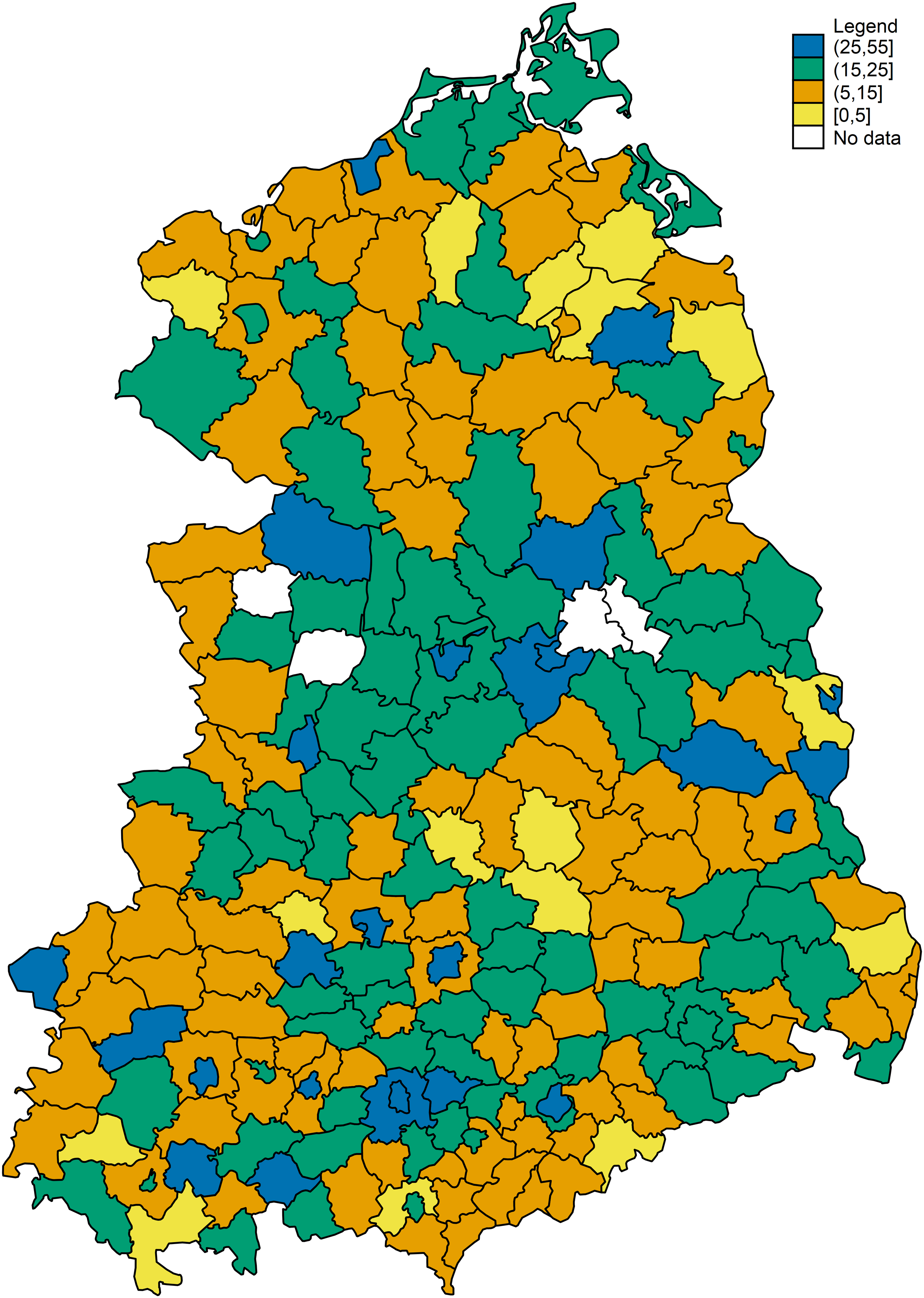
Research Design
The Stasi created detailed records on all monitored individuals as well as on its own surveillance activities through an internal control group (Engelmann, 2016; Fulbrook, 1995). We draw on these rich data to operationalize our concepts of interest. One of the authors coded and digitized records on surveillance operations in the Stasi’s archives in Berlin. 12 Additional information is drawn from digitizations by Horz and Marbach (2020), Crabtree, Darmofal, and Kern (2015) and the Statistical Yearbooks of the GDR (Staatliche Zentralverwaltung für Statistik, 1984-1989).
Operationalization
We operationalize our explanatory concept with the number of political imprisonments per county-year between 1985 and 1988. Data are taken from the digital prisoner database, compiled by the Stasi and digitized by Horz and Marbach (2020). The measure captures the number of newly imprisoned individuals for political reasons per county-year. In our analyses, we use yearly counts for each county from 1985 to 1988, as well as the cumulative sum of political imprisonments across these years.
To operationalize our outcome of interest, it is not reasonable to capture ‘whether’ a county mobilized or not: when the wave of protest action broke out in 1989, there was barely any county that did not experience large-scale mobilization. Instead, we turn to ask ‘when’ a county mobilized, and code the time until a county’s first protest occurred, calculated in days since the first protest in Leipzig. To measure the ease with which the collective action problem was overcome in each county, we code the sequence of protest events that swept the country in 1989. Starting with the first protest in Leipzig, a protest cascade was triggered affecting increasing numbers of counties until the whole country was in uproar. We measure counties’ initial mobilization at each point in time leading up to the fall of the Berlin Wall, expecting counties that experienced more political imprisonments in the years before to be quicker able to overcome the collective action problem.
We argue that it takes on average a lower threshold for a county’s population to mobilize when many others have done so already, knowing that it will find safety in numbers. At the beginning of the mobilization period when only few counties started protesting, the fate of the opposition movement is still unclear and the risk of repression may loom large. Therefore, deciding to be among those leading a collective action and to be a ‘first mover’ requires high resolve.
13
The time variable denotes the number of days it takes a county to mobilize, counting from the first Monday demonstration in Leipzig on September 4th 1989, until the day of each county’s first protest. The protest data visualized in Figure 2 are taken from Crabtree, Darmofal, and Kern (2015).
14
Distribution of time until county mobilization.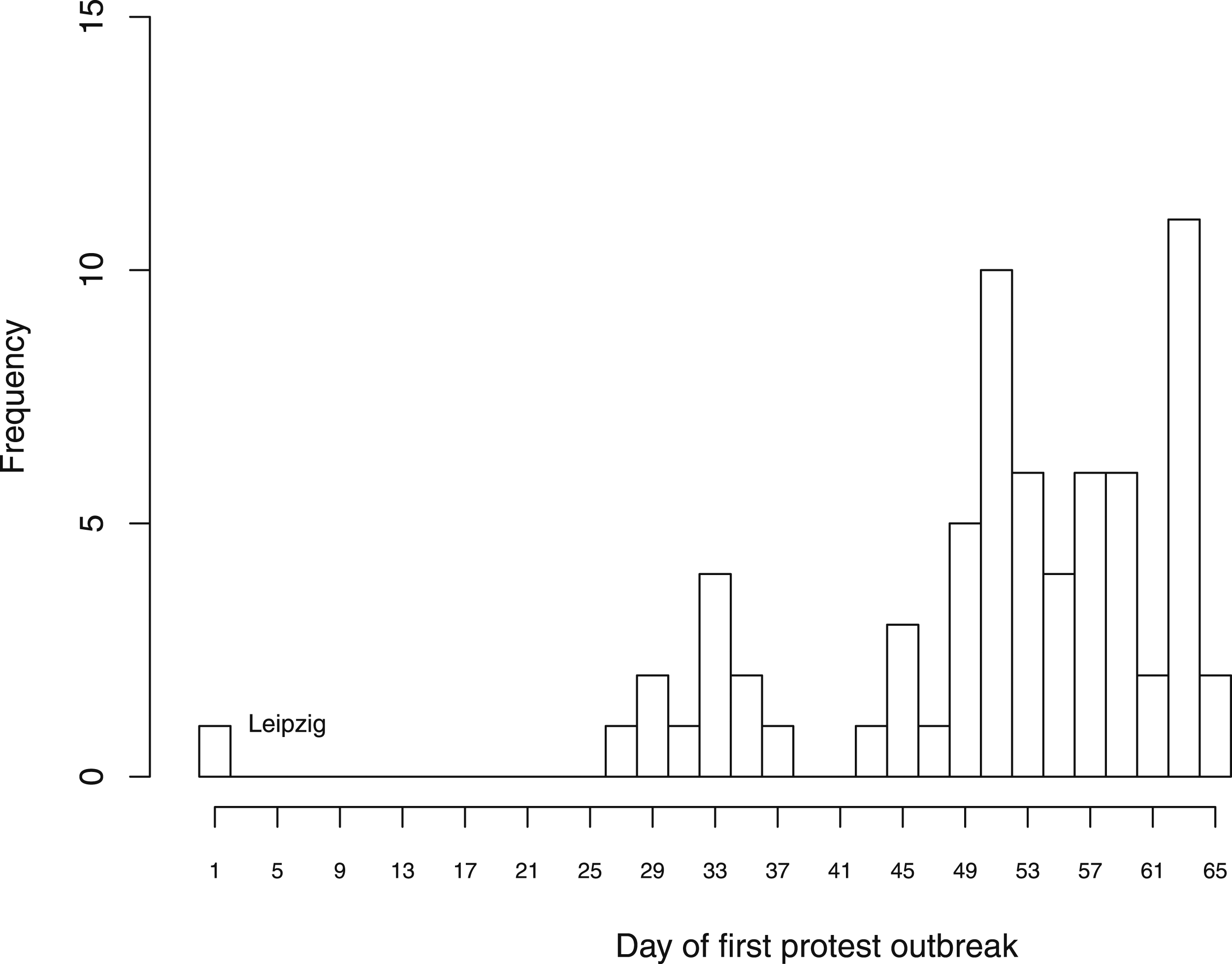
Local Variation in Latent Dissent
When estimating the treatment effect of political imprisonment on mobilization, there are concerns over endogeneity that may threaten our inference. Reversed causality is of no concern due to the temporal setup of our treatment and outcome: protest action only occurred in 1989, and therefore it cannot have caused imprisonment in the years 1985–1988. However, this temporal lag does not mitigate endogeneity arising from spatial variation and a temporal dynamic in a mutual unobserved cause (cf., Bellemare, Masaki, and Pepinsky, 2017). Both variables may be functions of the ex ante underlying latent dissent in a county: more salient anti-regime attitudes and local opposition activities in a county were likely to lead to more imprisonment and facilitate mass mobilization. In this case, a county’s ex ante latent dissent would induce a spurious positive correlation between our treatment and outcome.
To address this issue, we proxy latent dissent among the East German population using originally collected data based on archival records on the county-level number of surveillance operations (Steinert, 2022). The Stasi ruled that all surveillance operations had to be registered by the heads of the county administrations. 15 If any evidence of oppositional attitudes was traced, targets of surveillance were registered in so-called ‘operative procedures’ (Operative Vorgänge, OVs) that authorized high-intensity surveillance. Hence, the number of the OVs per county administration approximates the number of individuals that the Stasi perceived to be hidden dissidents. 16 Drawing on the ex ante number of OVs per county grants us a unique way to proxy a county’s level of latent dissent as perceived by the Stasi. 17 The Stasi might have misperceived local levels of latent dissent. However, it was arguably the Stasi’s perception of dissent—in contrast to actual levels of latent dissent—that shaped the frequency of political imprisonments. Given the exceptional surveillance capacities of the Stasi across the GDR, these fine-grained records provide a promising measure to systematically capture local levels of latent dissent.
Other Confounding
We condition on several other factors that could confound the relationship between political imprisonment and protest. First, we condition on whether a county was a city county. Given that surveillance capacities were higher in cities, and that urban populations tend to have a higher propensity to protest due to different demographic and social compositions than rural populations, this variable is probably related to both imprisonment and mobilization. For similar reasons, we provide a continuous measure of urbanization based on the number of towns in counties. Both measures are taken from Crabtree, Darmofal, and Kern (2015).
We control for the logged population size of each county, since both the absolute number of political imprisonments and protest dynamics are a function of the number of citizens in a county. 18 The data for population sizes are taken from the Statistical Yearbooks of the GDR. Finally, we condition on the number of theater guests per capita in each district, drawing on the Statistical Yearbooks of the GDR. This measure proxies education levels and local levels of social capital, which correlate with both political imprisonment and protests: the Stasi frequently targeted intellectuals (so-called Intelligenzler), which were over-represented in opposition networks (Fulbrook, 1995).
In section 6.1 below, we list various robustness checks using alternative control variables. These capture, for example, levels of economic development, infrastructure development, demographic characteristics, and migration dynamics, the results of which are shown and discussed in the Appendix.
Model Specification
Based on the nature of our dependent variable, the time it takes for a county to join the anti-regime protests, we choose to use a duration model for estimation. We employ a Cox survival analysis, which assumes proportional hazards, but is agnostic towards hazards’ functional forms. As a robustness check, we re-estimate our models using OLS linear regression, the results of which mirror the duration models’ effect direction and significance levels.
Results
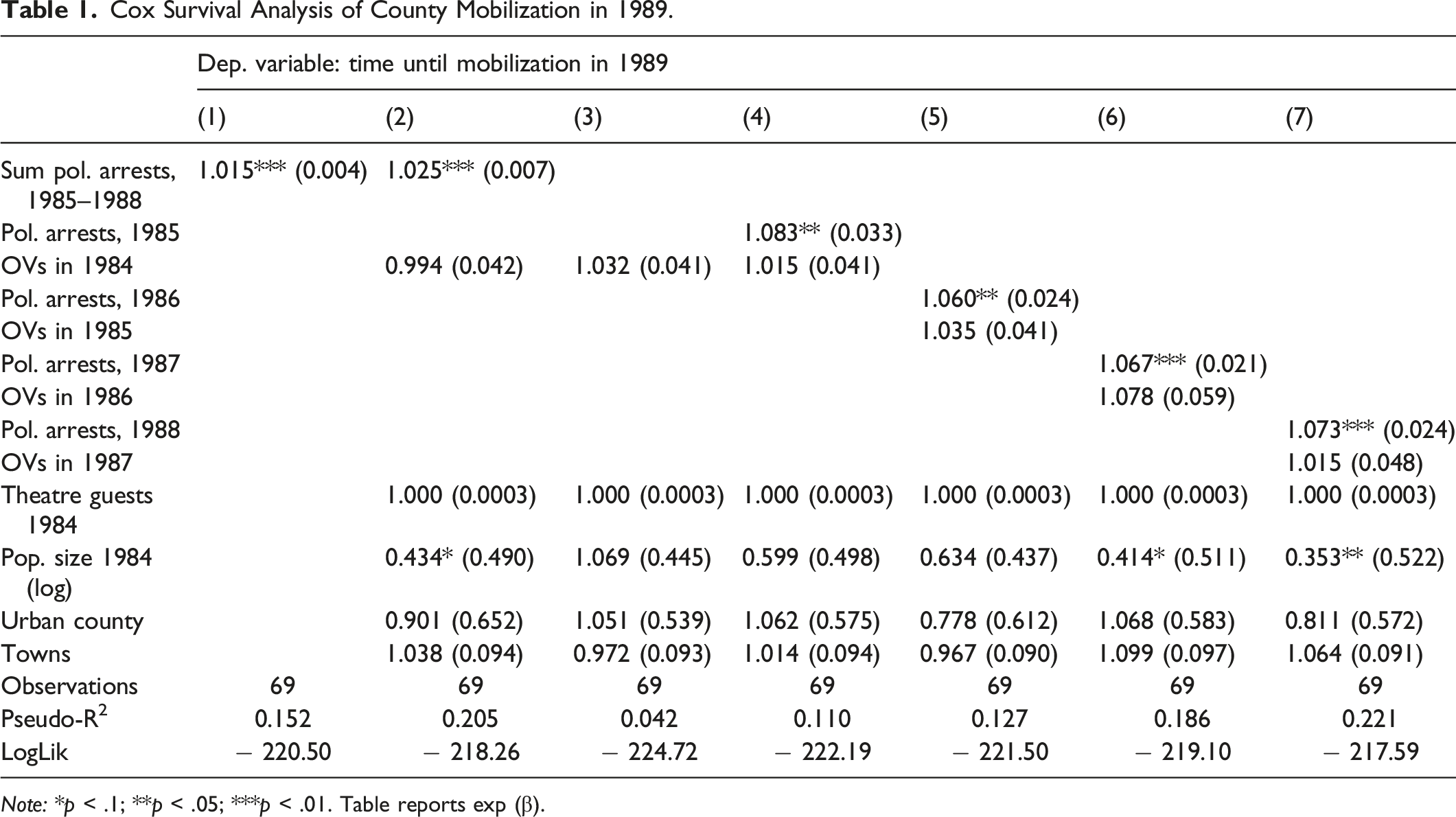
Cox Survival Analysis of County Mobilization in 1989.
Note: *p < .1; **p < .05; ***p < .01. Table reports exp (β). Predicted F(t) is based on the full model (2), Table 1. Low, median, and high numbers of arrests correspond to the variable’s 10th, 50th, and 90th quantiles respectively. Continuous covariates are held constant at their sample mean, other covariates at their sample median. Confidence intervals of the 10th and 90th percentiles overlap up until late October, and are omitted to ease interpretation and avoid cluttering the graph. A figure with confidence intervals is included in the Appendix.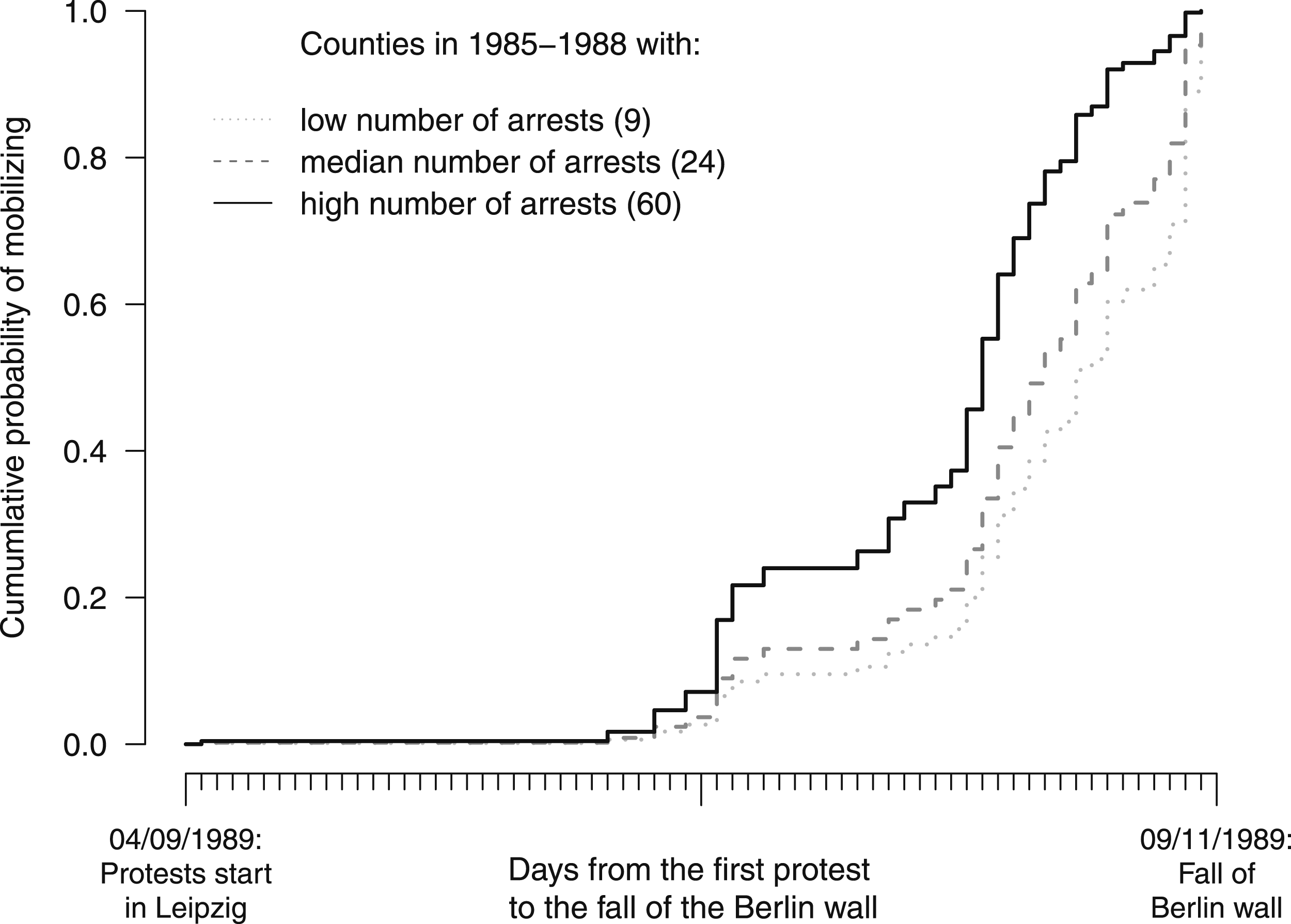
Taking political imprisonment into account substantively contributes to explaining the variation in counties’ protest timing: based on the Cox’ pseudo-R2, the explained variation in protest timing decreases from 21% in model (2) to 4% when excluding political arrests in model (3). We also estimate a Random Forest model, which indicates that political imprisonment has the highest feature importance (increase of 51.4% out-of-bag MSE; see Appendix section A.5). In other words, when we compare all variables in our model, taking political imprisonment into account improves our ability to predict the timing of protests the most.
Models (4) through (7) disaggregate the effect of political imprisonments over time. The models provide separate effect estimates of counties’ political imprisonments in each year, accounting for the regime’s year-specific ex ante local threat perceptions. The results are consistent with the aggregate findings, indicating that each year’s political imprisonment exerts a substantively and statistically significant effect on mobilization in 1989. For example, one more arrest in 1988 renders a county’s mobilization in 1989 on average 1.067 times more likely. Intuitively, the amount of variation in protest mobilization explained by political imprisonment as indicated by the pseudo-R2 increases over the years leading up to 1989.
Robustness
We use Cox survival models, which assume proportional hazards. Testing this assumption using Schoenfeld residuals, we find no statistically significant increase or decrease in any of the variables’ residuals over time. We also explore the degree to which our findings depend on our modelling choice by fitting a linear model to the data, keeping the selection of variables constant. Table A.2 in the Appendix indicates that our inference based on a linear model remains similar. The results suggest that a county with two more political imprisonments in 1988 experienced mobilization in 1989 on average 1 day earlier.
As discussed in the research design, we use fine-grained archival data on OVs to proxy counties’ latent levels of prior dissent. However, by definition, a proxy does not perfectly capture the concept of interest. This is why we offer several alternative ways to operationalize latent dissent. First, we capture the number of municipalities in a county that experienced protests in 1953 to proxy latent dissent with a measure drawn form Crabtree, Darmofal, and Kern (2015). The popular revolt in June 1953 erupted in response to major dissatisfaction over the regime’s production quotas and constitutes the only significant protest against the SED-regime until 1989 (Weber, 2000). Analyses that use protest action in 1953 as proxy measure for latent dissent presented in the Appendix, Table A.3, corroborate our hypothesis.
Second, we use data on OPKs, which represent Stasi’s low-intensity covert surveillance operations as discussed in detail in the Appendix. We conduct an analysis using a combined measure of both OPKs and OVs. Third, we draw on fine-grained records of citizen grievance letters in 1984 to substitute OVs. East German citizens had the opportunity to air their discontent by writing grievance letters (Eingaben) to the regime (Class, Kohler, and Krawietz, 2018). The analyses’ results using these alternative proxies of latent dissent are listed in the Appendix, Table A.4. They are consistent with our main findings.
Additionally, we check our findings against a range of other potential confounders. Table A.5 in the Appendix includes several models accounting for potential foreign interference and attitude spillover, economic dynamics, infrastructure development, and demographic characteristics. Additional models in Table A.6 address the potential for migratory patterns obscuring our results. Across all analyses, the effect of political imprisonment remains substantially and statistically significant.
We conduct a placebo test in the Appendix, section A.3. We substitute political imprisonment, which is an observable and attributable form of repression, with so-called ‘decomposition measures’ (Zersetzungsmaßnahmen), which was a form of covert repression. Decomposition refer to the spread of rumors about dissidents, to the obstruction of their professional careers, and to the concoction of intrigues aimed at alienating them from friends and family (Fulbrook, 1995). We assume that just as political imprisonment, decomposition measures were used more in counties with higher levels of latent dissent.
20
Contrary to political imprisonment, however, decomposition measures usually remained unobserved by the wider population and unattributable even by the targeted dissidents themselves, and thus could not fuel mobilization. The main result of this analysis, which is based on originally coded archival data of decomposition measures, is presented in Figure 4. Depending on the model specification, we find a null or even slightly negative effect of this placebo on mobilization, despite the aforementioned positive confounding influence of latent dissent. This suggests that our attempts to condition on levels of latent dissent may be successful. The results put a bound on the potential bias arising from the endogenous assignment of repressive means, lending further support to our main findings. Predicted F(t) is based on model (4), Table A.7 in the Appendix. Low, median, and high numbers of arrests correspond to the variable’s 10th, 50th, and 90th quantiles respectively. Continuous covariates are held constant at their sample mean, other covariates at their sample median.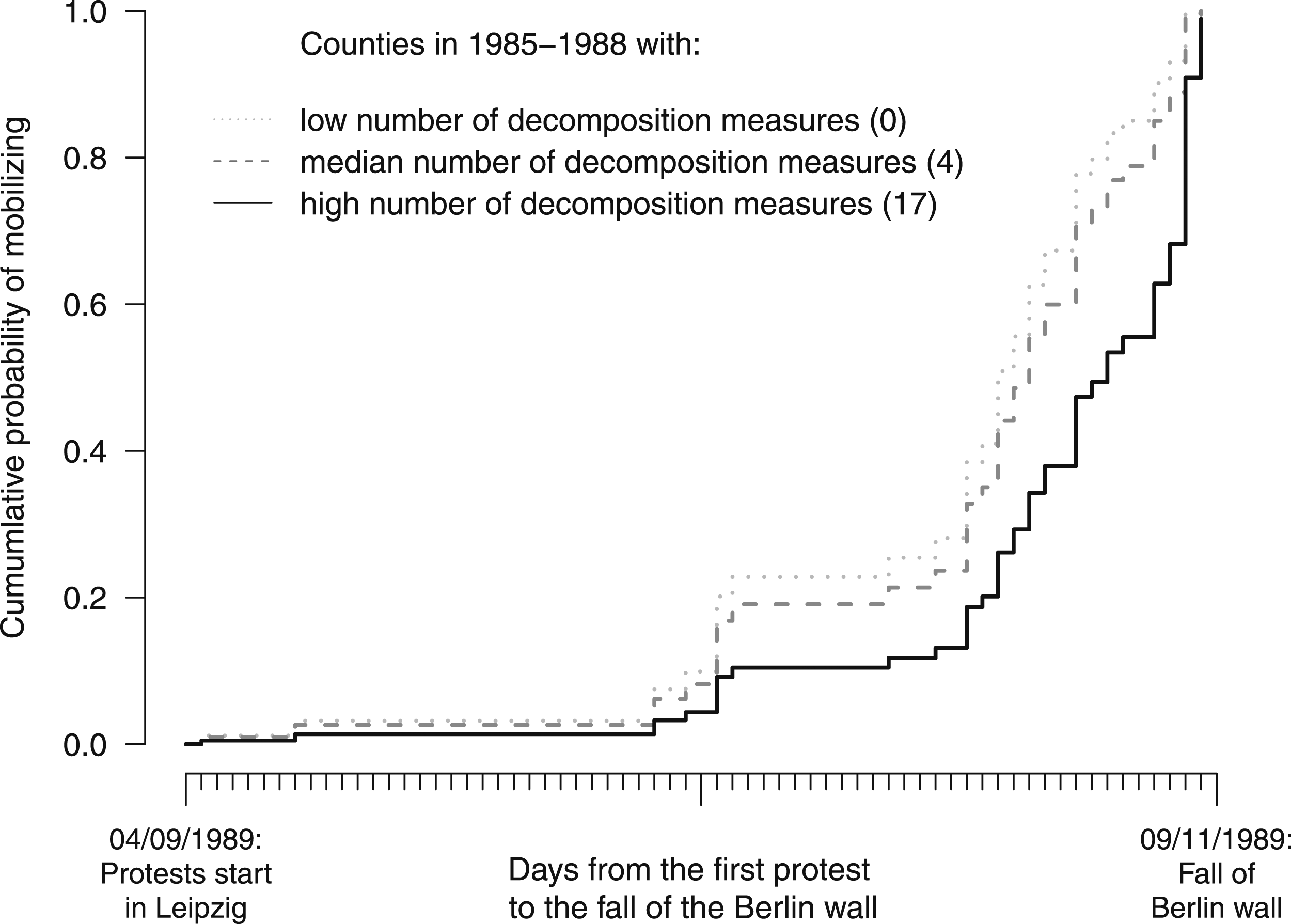
We conduct additional tests to address the issue of missing data. In our main analysis, we use cross-model list-wise deletion to standardize the number of observations in each model and thus facilitate comparison across models. This leads to a reduction of the sample to 69 observations and assumes that information is missing completely at random (MCAR). In the Appendix section A.4, we first present all results without cross-model deletion, re-gaining many observations. Second, we conduct multiple imputation and perform our analysis on the full (imputed) samples. Our results remain robust to these sample adjustments.
Probing the Mechanisms
We shed light on the mechanisms of why East German counties with high numbers of political imprisonment were more likely to mobilize by turning to qualitative evidence. We draw on a rich historical literature, as well as on semi-structured interviews with seven former East German political prisoners who were incarcerated during the 1980s. 21 The former political prisoners were detained in Stasi’s district prisons in Erfurt, Potsdam, Cottbus, Naumburg, Rummelsburg, and Karl-Marx Stadt.
To what extent do direct effects of political imprisonment on prisoners explain patterns of mobilization? Our interviews suggest that political imprisonment indeed facilitated the formation of dissident networks in East German prisons. East German political prisoners spent the bulk of their prison terms in group confinement. 22 Former political prisoners reported that up to 35 prisoners were confined in a cell, sharing one sink and one toilet. Unsurprisingly, social interactions between prisoners were common under these circumstances. A former political prisoner from Naumburg emphasized that they spoke about everything in the cell ranging from politics to the music charts. It was common to share food or cigarettes and to comfort others in their suffering. Summarizing these dynamics, he stated that “in prison I learned the meaning of solidarity” (interview #3).
East German political prisoners also utilized group confinement to educate themselves and each other, sharing their skills, cultural assets, and beliefs. A former political prisoner from Erfurt stated that “a physicist held a presentation about how to build a radio in the prison cell” (interview #1). A former political prisoner from Cottbus told us that he presented Bach’s fugue on a phonograph in the cultural room to his cellmates (interview #5). Several interviewees emphasized that bonding was especially likely with other political prisoners, who usually came from similar socio-economic strata in contrast to the criminal prisoners. Taken together, the qualitative sources suggests that political imprisonment contributed to the formation of dissident networks in the GDR.
Did these dissident networks that formed in prison play an important role in the protest movement in 1989? Empirical evidence suggests that the experience of state repression had indeed a positive impact on protest participation in the GDR. Based on a representative survey of Leipzig’s population in 1990, Opp and Gern (1993) show that self-reported experiences of state repression increased the likelihood of participation in the Monday prayers. For instance, one interviewed former political prisoner from Cottbus who was released in 1986 actively participated in the 1989 protests, and rose up to become a member of the so-called ‘Round Table’, which was a key actor in the political transition after the fall of the Berlin Wall. Our interviews also hint at an opportunity mechanism suggesting enhanced propensities of protesting for released political prisoners. For instance, one ex-prisoner who was released in December 1987 told us that it was nearly impossible to find a job since there was a general agreement not to hire ‘asocial people’ (interview # 4).
However, a substantial number of East German political prisoners from the late 1980s either had not been released by 1989. 23 or had been released to Western Germany as a result of the prisoner ransoms. The prisoner ransoms represented an informal series of transactions between the SED-regime and the West German government where at least 33,000 East German political prisoners were ransomed in exchange for goods or cash. 24 Hence, many former political prisoners could not participate in the East German protests in 1989 due to the fact that they had already left the state. This does not imply that political prisoner networks were irrelevant for the protests given that a subset of the political prisoner population was released in East Germany. However, the direct effects are attenuated by the fact that many prisoners were ransomed by Western Germany or still incarcerated at the time of protests.
Instead, indirect effects on other citizens appear to carry the most explanatory power for the positive association between political imprisonment and protest initiation. Our qualitative evidence supports the notion that political imprisonment created substantial grievances in local social networks. The key information channel through which the suffering of political prisoners reached social networks outside of prisons were reports of family members who witnessed prison conditions first-hand. A former political prisoner from Potsdam told us that he was allowed to write a letter to family members once a week (interview #2). Several ex-prisoners reported that it was possible to receive visits from family members. While written and verbal communication was self-censored out of fear of punishment, family members bore witness to the prisoners’ horrid physical conditions. Several ex-political prisoners stated that visitors were shocked by their physical appearance. For example, one former political prisoner from Naumburg told us to have lost 35 kg in prison (interview #3). Also in absence of direct contacts to prisoners, political imprisonment resulted in sudden disruptions of local social networks, provoking indignation among peers and colleagues. Thus, our sources suggest that political imprisonment created salient grievances.
These grievances had a local character since they resulted from eyewitness accounts or immediate experiences in local social networks. In the context of a dictatorial surveillance state, it is unlikely that information on detention conditions of political prisoners could spread on a national level. This supports the assumption underlying our quantitative analyses that local incidences of political imprisonment led to sub-national variation in the level of grievances, and thus sub-national variation in mobilization patterns. Empirical evidence suggests that local grievances related to political imprisonment fueled the protest movement in 1989, as some flyers of the protest movement in 1989 explicitly called for “pickets for political prisoners in the GDR” (TU, 2020). This provides prima facie evidence that grievances related to political imprisonment translated into protests. Thus, we contend that the grievance mechanism represents the key explanation for why political imprisonment was linked to anti-regime protests in the GDR.
Conclusion
This study set out to investigate whether political imprisonment increases the likelihood of mass mobilization against the regime. We argue that political imprisonment contributes to the formation of cohesive opposition networks and provides a legitimating credential for resistance leaders. It creates ‘embodied grievances’ that are clearly attributable to the government and, consequently, especially conducive to spark collective action. An interplay of these mechanisms suggests that the inciting effect of political imprisonment prevails over its deterring effect.
Quantitative evidence from the GDR supports our theoretical claims. We demonstrate that East German citizens mobilized earlier in counties with higher incidences of political imprisonment in the mass protests leading up to the fall of the Berlin Wall in 1989. Our results are robust to various proxies of latent dissent, including a novel measure of sub-national variation in the Stasi’s own local threat perception. This suggests that rising propensities of Stasi county administrations to encounter local dissent with imprisonment backfired in the protest movement in 1989. Qualitative interviews with former East German political prisoners suggest that the large-N pattern we identified is primarily driven by local grievances among peers and family members of political prisoners. Local social networks were disrupted and aggrieved by incarcerations, and prisoner visits transmitted information about dire prison conditions. These processes created indignation in local communities, fuelling mobilization in 1989.
To what extent can these findings be generalized beyond the GDR? We discuss the external validity in Appendixes A.6, suggesting that the GDR may represent a ‘least likely case’ for our hypothesis in light of a strong opposing deterrent effect. Nevertheless, generalizability needs to be treated with caution and empirical evidence from other political contexts is necessary to understand when and under which conditions political imprisonment contributes to anti-regime mobilization. Future research might want to establish the role of ‘permissive political conditions’ (Rozenas and Zhukov, 2019) that determine if and when the inciting effect of political imprisonment surpasses its deterrence effect.
To conclude, our study demonstrates how political imprisonment may be a self-defeating strategy for autocratic regimes. Confining people in prison may appear to be a ‘clean’ strategy for autocratic regimes to silence dissent and neutralize opponents. However, the evidence suggests that dissent cannot be locked up behind prison bars, at least not in the long run. Instead, our study suggests that dissent is nurtured by prison bars.
Supplemental Material
Supplemental Material - Political Imprisonment and Protest Mobilization: Evidence From the GDR
Supplemental Material for Political Imprisonment and Protest Mobilization: Evidence From the GDR by Christoph V. Steinert and Christoph Dworschak in Journal of Conflict Resolution
Footnotes
Acknowledgments
We are indebted to the former political prisoners for their time and willingness to talk to us. We thank Sabine C. Carey, Christian Gläßel, Marius Mehrl, and Katrin Paula for their excellent feedback. We are grateful for many useful comments and suggestions from the members of the University of Mannheim conflict research colloquium, the participants of the Oxford workshop on conflict dynamics, and of the Mannheim GESS workshop. Finally, we thank Moritz Marbach for kindly making the data on political imprisonment in the GDR available to us. Ethical approval for the semi-structured interviews was provided by the ethical review committee of the University of Mannheim. The authors contributed equally to this work.
Declaration of conflicting interests
The author(s) declared no potential conflicts of interest with respect to the research, authorship, and/or publication of this article.
Funding
The author(s) disclosed receipt of the following financial support for the research, authorship, and/or publication of this article: Christoph V. Steinert has been supported by the German Academic Scholarship Foundation.
Correction (July 2024):
Article updated online to interchange figures 3 and 4.

Supplemental Material
Supplemental material for this article is available online.
Notes
References
Supplementary Material
Please find the following supplemental material available below.
For Open Access articles published under a Creative Commons License, all supplemental material carries the same license as the article it is associated with.
For non-Open Access articles published, all supplemental material carries a non-exclusive license, and permission requests for re-use of supplemental material or any part of supplemental material shall be sent directly to the copyright owner as specified in the copyright notice associated with the article.
