



Abstract
Public vigilance campaigns and lateral surveillance programs in the USA have mobilized citizens for a broad range of security concerns: from post-9/11 perceived terrorist threats to more domestic forms of crime. Scholars have explained such efforts as an extension of state and police power, while others have shown that state surveillance reifies a broad range of historically racist and violent practices. This article brings together these explanations through a focus on vigilant citizenship: an ideal type of citizen who is watchful and reports anything suspicious to the authorities. Based on long-term ethnographic fieldwork with police officers and citizens in Miami, my work demonstrates how the policing of Blackness also involves more quotidian experiences and articulations of rights, responsibilities, and belonging. The empirical cases discussed here demonstrate how vigilant citizenship cultivates distrust, fear, and alienation, feeding into racist and violent practices by police officers and neighborhood watches. The conclusion suggests that the policing and surveillance of race become encoded in acts and experiences of vigilant citizenship, blurring the boundaries between the police and citizens.
Introduction: Public vigilance and lateral surveillance
The US government has a long history of mobilizing its citizens against a diversity of perceived enemies and racialized others, both domestic and international. During World War I, state agencies created posters and distributed them among citizens, who were instructed to watch out for and report suspicious activities (Reeves, 2017). Since then, public vigilance campaigns have been instrumental to the political ideals of a resilient population and a general level of preparedness among citizens. People have been monitored not only by public and private organizations but also by each other. Such initiatives are also known as ‘lateral surveillance’: a form of surveillance in which citizens watch and report on each other to the authorities (Larsen and Piché, 2009; Reeves, 2012). Considering the widespread fear of terrorism and domestic crime in the USA, discussions of public vigilance have only become more common. State institutions continue to expect, encourage, and require citizens to be vigilant – to develop a heightened alertness and awareness of their surroundings.
Scholars have examined the development and practices of citizens as security actors and their relationships with the authorities. Examples include neighborhood watches (Reeves, 2012), ‘citizen forces’ (Akarsu, 2020), and community policing programs (see, for example, Cattelino, 2004; Raschig, 2018). As the ‘eyes and ears’ of law enforcement, the mobilization of citizens is considered an extension of police and state power, demonstrating ‘the increasing complexity and mutual constitution of police and citizens, as well as the formation of state-sponsored vigilantism’ (Akarsu, 2020: 27). Others have shown how state surveillance programs and technologies perpetuate and intensify the policing of Blackness, feeding into existing fears of Black bodies and racist ways of seeing (Browne, 2015; Johnson et al., 2015). Indeed, violent acts by citizens have proved to be racially inequitable in ways that parallel police brutality in the sense that they, too, disproportionally affect the lives of Black and non-white citizens, while perpetrators still enjoy widespread support and are often found not guilty.
While particularly overt in a wide variety of self-defense and policing practices, racist rationalizations and normativity are also inscribed in what it means to do the right thing, or normalized expressions of citizenship rights, responsibilities, duties, and belonging. In this article, I use the concept of vigilant citizenship, which refers to an idealized and political community of citizens who are watchful and report anything that has a whiff of illegality or suspicion. While my use of ‘vigilant citizenship’ includes references to the popular mind-set of awareness (vigilance) and extra-legal actions to improve feelings of safety and justice (vigilantism) (Jeursen, 2023: 14), I mobilize this concept to refer to the ways in which people understand their rights and roles as private citizens – that they need to arrange for the security measures they deem necessary in a city characterized by high levels of crime and inequality. Vigilant citizens interpret security and respond to insecurity through what scholars have called ‘normative whiteness’: contextualizing situations and actions through racial categories that generate forms of privilege and disadvantage (e.g. Hurd, 2008; Low, 2008). My analysis of lateral surveillance and citizen vigilance allows me to demonstrate how vigilant citizenship helps to legitimize racist and violent acts by police officers and citizens alike, and informs daily and more mundane interactions and feelings of distrust that underlie physical violence against, and the surveillance of, racialized others.
On the basis of extensive ethnographic fieldwork with police officers and citizens in Miami in 2015 and 2016, I analyzed three different cases of lateral surveillance programs and citizen vigilance. The first case involves the Citizens on Patrol (COP) program, which is a national initiative to have police departments train citizens for the surveillance and patrolling of their neighborhoods. The second case concerns neighborhood watch groups that were set up by citizens with the formal and informal support of police and municipal officials. The third and final case concerns an attempt by police officers to ‘break the silence’ in a predominantly Black community. Yet they encounter much resistance and distrust as they interpolate citizens as vigilant citizens. While the police officers understand this, given the potential for backlash from within the community, they ignore that they are often a source of insecurity themselves. These examples demonstrate that the policing of Blackness goes beyond law enforcement, creating a blurred distinction between the police and citizens, and extends to everyday expressions of citizenship.
During my fieldwork in Miami, I worked with police officers as well as those who find themselves at the receiving end of violent and racist police practice. Both the Miami Police Department (MPD) and the Miami Beach Police Department (MBPD) accepted me as a researcher, and this work with the police raises questions about my own positionality and morality. Discussing ethnographies of police work, Didier Fassin (2017: 3) urges researchers to ‘reevaluate both the theoretical self-evidence of their object (policing) and their very relation to their subjects (the police)’. I tried to distance myself from racist statements and aggressive practices by police officers and citizens. Yet efforts to distance myself from policing agents, navigating my own ‘complicity’ (Hornberger, 2017), often failed: I am not a police officer, nor did I learn to become one or sympathize with them, yet I still stood next to or behind them.
I found that much of my work with the police triggered a mixture of emotions, including excitement (when they raced through the city using sirens) and fear (when they drew their weapons or became anxious), and I often felt troubled and unable to objectively assess what was happening, especially during intense and busy patrols (see also Herbert, 2017). Fassin (2017) explains that ethnography produces knowledge about policing in two main ways: through uncovering irregularities between policy and practice and through the discovery of everyday realities of police work. While I do not think I reveal the realities of racist policing to a broad audience (see also Ralph, 2020), my relationship with the police enabled me to be ‘attentive to the ordinary and the mundane’ (Fassin, 2017: 8) – in other words, to look beyond the more spectacular and visible forms of police brutality and white vigilantism and document more personalized accounts of citizens and police officers, accounts that can be ambiguous yet still speak to racist and violent practices and modes of looking.
In hindsight, it was difficult to oversee the ethical and analytical implications of what it means to study ‘repugnant others’ or ‘subaltern groups’, let alone both (Harding, 1991). I eventually grew increasingly uncomfortable with the part of my research that concerned exploring the experiences of Black Miamians. Skeptical of the idea that the empathy of a white European researcher is in any way beneficial to these groups in the USA, I foregrounded my work with the police and those on the other side of the power balance over more elaborate stories of Black citizens and experiences. I also realized that my appearance might evoke broader experiences of surveillance, of being watched and studied (see, for example, Martinez, 2016). My focus on normative whiteness in this article is also a way of studying power and inequality that I, as a Dutch white researcher, could access, and hence critically engage with. This role enables me to speak to issues of racism, surveillance, and policing in ways that go beyond giving victims a voice that has been long heard, yet often purposefully ignored.
Vigilant citizenship
Vigilant citizenship is a distinct elaboration of a citizenship agenda, ‘a normative framing of citizenship that prescribe[s] what norms, values, and behavior are appropriate for those claiming membership of a political community’ (De Koning et al., 2015: 121). In this case, this normativity is informed by neoliberal ideologies and policies, in which citizens are imagined as rational subjects capable of navigating assets and liabilities of their own accord, and therefore also individually liable for insecurity, misconduct, and illegal violence. Scholars of policing have sought to incorporate the phenomenon of citizen responsibility. Hayal Akarsu (2020), for instance, discusses how the Turkish National Police have invested heavily in community policing to curtail systemic police brutality. Akarsu (2020: 27) shows, however, how such attempts have led to what she calls ‘citizen forces’: a kind of ancillary police force in which citizens actually ‘help consolidate state power and aggravate state repression, especially against suspect Others’ (Jeursen, 2023: 12). Similarly, Andrew Newman (2012) uses the term ‘vigilant citizenship’ to conceptualize how state agencies mobilize citizens of lower-income neighborhoods in Paris for the purpose of monitoring and controlling each other, framed as a form of civic engagement. Sean P. Hier and Josh Greenberg (2009) refer to several government policies that promote the responsibility of citizens to arrange for their own security.
In mobilizing citizens for security purposes, state agencies have crafted the legal and societal contours of what it means to be vigilant. For instance, the US government has changed federal law to protect those who participate in lateral surveillance. Before such measures, whenever a person falsely accused someone of terrorism, for example, the accuser would risk legal prosecution. This changed, as the act of ‘saying something’ was increasingly framed as a citizenship duty, and lateral surveillance was identified to counter domestic acts of terrorism and organized crime. Especially after 2011, when the See Something, Say Something Act was introduced and passed through the US Congress, citizens became protected from libel action should they falsely accuse their peers (Reeves, 2017). The idea behind this shift was straightforward: the law needs to protect those who have a vigilant mind-set, instead of discouraging and punishing them.
Proponents of lateral surveillance suggest that the authorities, given the opportunity to investigate, will make assessments of guilt and innocence in a legal and just fashion. Yet the practice is shown to have many downsides: in fact, it compromises the justice system and endangers the lives of those involved (Natapoff, 2009). In practice, citizens might also be reluctant to collaborate, a practice colloquially referred to as ‘snitching’. They might distrust local police departments, considering them incapable of providing security, or they may even experience their presence and involvement as the actual source of their insecurity (Jeursen, 2023: 68). Lateral surveillance reflects, sustains, and intensifies a range of historically racist discursive practices, which are grounded in a broader fear of Blackness that manifests in and beyond the institutional realm of the police. Black citizens not only find themselves targeted by such practices, but also experience difficulties when trying to connect with political communities across different scales.
In the context of Florida, and the Stand Your Ground Law, the murder of Trayvon Martin in 2012 by neighborhood watch captain George Zimmerman stands out as a particular and horrific example of the ways many Americans interpret and enact their citizenship. Zimmerman argued that he acted in self-defense, and his lawyers successfully presented the appearance of Martin, who was in fact an unarmed Black teenager, as potentially threatening to a jury. ‘Zimmerman’s actions against Martin are far from surprising,’ Gau and Jordan (2015: 20) write, concluding that they are ‘a logical outgrowth of existing widespread prejudice and large-scale acceptance of racial profiling’. While the Stand Your Ground Law made it easier to justify Zimmerman’s right to defend himself in a court of law, the broader administration of justice – and the lack thereof for people of color – is indicative of a longer and racialized way of seeing and representing young Black men as suspicious and dangerous. Examining contemporary surveillance practices and technologies, Simone Browne (2015: 9) ‘locates blackness as a key site through which surveillance is practiced, narrated, and enacted’. Surveillance, as a ‘population management technology of the state’ (Browne, 2015: 11), is integrally about the reification of racial lines.
While the concept of vigilant citizenship helps to point out the systemic nature of violent and racist acts by police officers and private citizens, it also urges us to look past these acts as the only manifestation of white supremacy and whiteness. It shifts our attention to the ways in which racialized inequalities are part of everyday policing – as a way of living, and dealing, with perceived insecurities. Setha Low (2008) aptly explains how residents of gated communities in the USA desire a particular ‘niceness’ in the built environment. This rationale of niceness is fundamentally about keeping these communities exclusive and centered around whiteness and fear of others, about making ‘racist assumptions on the landscape’ (Low, 2008: 79). Likewise, vigilant citizenship is also a normative ideal, mobilized to maintain whiteness in community-building and livelihoods. Vigilant citizens are invested in a form of safety that is about differentiating between who belongs and deserves particular rights and who does not, not just for security purposes, but for the economic, political, and cultural preferences and possibilities that come with sustaining segregation.
A case in point concerns Amy Cooper, a white woman who called 911 when she encountered Christian Cooper (no relation), a Black man who was birdwatching in Central Park in 2020. When Christian had asked Amy to put her dog on a leash, she called the emergency number and told the dispatcher that an African-American man was threatening her dog. Meanwhile, Christian took out his mobile phone and recorded the interaction. The video went viral and eventually became a key illustration of the popularized notion of the ‘Karen’ (Jeursen, 2023: 156) – a pejorative term for a white, privileged, and racist woman and policing actor. In the words of Sherina Feliciano-Santos (2021: 262), a Karen is someone who acts to ‘police the acceptable bounds of blackness in white public space’. While vigilant citizenship clearly skews male, the by-now mainstream notion of the ‘Karen’ illustrates how both men and women have taken a central role in the everyday policing of Blackness.
In Miami, I observed how citizens were notified of their responsibility to collaborate with the police in various ways, especially through the news media. Local 10 News, a popular broadcaster in the metropolitan area of Miami, had a special item called ‘Get them off the streets’. In this item, a special crime reporter informed the audience of any citizens who had broken the law and were wanted by local police departments. He introduced the cases and urged viewers to contact authorities should they have any relevant information. Police officers, journalists, and local politicians considered the involvement of citizens necessary to provide law enforcement with probable cause and legal evidence, and in so doing enable police investigations and legal prosecutions. This is not to say that, without citizen help, police officers would be completely unaware of criminal activities. It is, for instance, widely known by police officers, citizens, and even movie directors that drugs are dealt with and used in Overtown. Hollywood producers and directors also reproduce this common knowledge in popular culture, as Sonny Crockett and Ricardo Tubbs visited the neighborhood to look for illegal drug transactions in the motion picture Miami Vice ((Jeursen, 2023: 72; Mann, 2006). To pursue judicial action, however, state agencies need citizens to actively share information with them.
Before moving on to the three cases of lateral surveillance, it should be noted that people of color in general suffer from violent and intrusive policing practices. This seems particularly relevant in the context of Miami, a city home to many Latin and Haitian Americans. Black, Latinx, and other marginalized communities experience policing as a public health issue, that is, as a threat to their well-being. In general, governmental policies differentiate between racial groups by privileging the position of some while oppressing others. Yet I found that the criminalization of Black residents and neighborhoods was particularly salient, as well as indicative of more national conditions and historical legacies of colonialization and apartheid.
Citizens on Patrol
The Citizens on Patrol (COP) program is a voluntary service offered and promoted by police departments throughout the United States. During the COP training organized by the MPD, police officers encouraged citizens to become the ‘eyes and ears’ of the police. The MPD community relations officer leading the training considered herself to be a good example: she knew everybody in her area, and other citizens notified her when there was a strange car in front of her house when she was away. ‘Although it was my uncle with a moving truck, it’s still an example of how you can help each other,’ she explained. ‘Pedophiles are found everywhere,’ the officer continued, producing an expression of light shock on the faces of the participants, ‘and they not only prey on young girls, but also on boys, and even the elderly. Yes, it’s terrible, but you want to know what and who you are dealing with – you want to be “ahead of the game”’ (Jeursen, 2023: 66). Police officers explained that the input and work of local citizens would make their work much more effective, and that it is essential for preventing and responding to everyday forms of crime. ‘You can’t give up on communication with the police – that’s when the criminal wins,’ another MPD police officer explained during the COP training.
During the training, I met with Paco, a Miami resident who regularly ‘patrolled’ his neighborhood. Since I was not a US citizen myself, I could not officially become a COP, but I could still participate in the classes. After talking about my research, Paco allowed me to join his group as a student-observer. He was especially happy when I offered the use of my rental car for a day. A week later, I met Paco’s COP group in front of a Presidente supermarket in Allapattah, a predominantly Latinx neighborhood adjacent to Overtown. Paco was there – with him, I spoke both English and Spanish – as well as two others who spoke only Spanish (Jeursen, 2023: 64). Once we had all taken a seat in my three-door red Toyota, the three of them began explaining to me what they observed and how they took notes. The MPD had provided them with a worksheet to fill out every week. Paco took a postcard from my parents from the glove compartment and used it as a ruler to draw an extra line on top of the worksheet, on which I had to write my name, since there was no room next to theirs. We made sure to put ‘participante/estudiante’ next to it, so that there would be no confusion as to my status (we did not want to break official policy). The worksheet was new, and the columns of ‘Date’, ‘Time’, ‘Location’, and ‘Activity’ were all still empty as Paco attached it to a clipboard and we began our patrol.
As I drove towards our first ‘stakeout’, Paco and the two others showed me their badges. One of them was using a clean, black leather etui to hold a shiny silver badge stating ‘Citizens on Patrol’ and ‘Miami Police’. Next to it was an identification card with his photo. I assumed that they all had their IDs with them in case local citizens confronted them about what they were doing, yet they explained that it was to justify their ‘patrol’ to police officers, who might wonder what they were up to. While COPs had to learn how and what to observe, they also needed to understand that under no circumstances could they or should they confront criminals or enforce the law themselves. The officers gave some tips on how to secretly record others with a mobile phone, but also stated that COPs do not enjoy the same rights as police officers: they will be held liable in the event that they use violence or break the law in any way: ‘We have firms, laws, and unions fighting for us – you do not,’ the MPD officer summarized.
‘Los viernes son buenos,’ 1 said Paco excitedly, adding in English that many people spend their money at the end of the week, and so this is when most things of interest to the COP group happen. Following his specific instructions, I parked the car in an alley overlooking the backdoor parking lot of a nearby supermarket, next to several dumpsters full of trash. Just a few minutes later, a heated argument began nearby in a group of 10–15 men. We lowered the windows of the car and understood that the dispute was about money. One of the men claimed that he had been robbed by some of the others and wanted his money back. Some of the men began to push him away. Some were without shirts, and we could see a handgun sticking out of one man’s belt. When the man claiming to have been robbed eventually left the scene, Paco immediately asked me to start the engine and drive backwards through the small alley. We parked again a little further down the main road.
Paco pulled out his mobile phone and called a man he referred to as ‘Capi’, short for ‘Captain’. Capi oversaw the COP group, but since he was a little older than the others, he often remained at home, where he functioned as the link between the MPD and the COP patrol group. Paco informed Capi of what we had just seen in the parking lot; Capi in turn called the direct number for the MPD police commander of Allapattah. Later, Capi called back and told our group that the commander would be sending a nearby police officer to have a look or would at least inform the police dispatcher of the situation. Paco explained to me that we would have to get away from the area before Capi could notify the police; after all, we did not want anyone to know that we were collaborating with the police, that we were also surveilling and patrolling the streets, as this could jeopardize our own safety as well as the potential to covertly observe everyday crime (Jeursen, 2023: 65).
During the rest of the COP patrol, we drove around a lot. Paco seemed to know his way around and was very specific in telling me where to go, how to drive, and where to stop. We drove through areas where a lot of people slept on the ground or hung out together in alleys behind a supermarket. Clearly, the areas the group was interested in were the lower-income parts of Allapattah and surrounding neighborhoods. We observed several people whom the group believed to be involved in local drug-dealing. A woman and a man repeatedly walked back and forth between a corner on the sidewalk and a back alley. Paco got out of the car to buy some candy from a nearby store and wrote down his observations of the ‘drug deals’ going on in front of us in great detail (Jeursen, 2023: 65). Again, we called Capi, but we also drove by his house in a wealthier part of Allapattah this time. Capi lived in a one-story house with a large American flag in the front yard. He walked with a stick and leaned inside the car to introduce himself to me. Paco described the dealers in detail to Capi, using another document provided by the MPD, explaining how to ‘describe a person’: what clothes they had on, their hair color, race, etc. Although we were not allowed to carry weapons during the patrol, Capi was happy to show me his gun, kept in a holster that showed through his white polo shirt. We eventually decided that we had observed enough for the day, and Paco urged me one more time to remember that our work was not to be discussed with anyone: ‘Mi familia, mi novia, o mi amigos – nadie!’ 2 (Jeursen, 2023: 65)
The narrative that the police depend on the input of local citizens was central to the COP program and repeated throughout the training. Paco viewed the surveillance of his neighborhood as both a privilege and a crucial responsibility. Despite the rarity of witnessing and reporting crimes to the police, and the infrequent follow-up by law enforcement on the group’s information, he still considered it essential. Still, their somewhat mundane form of surveillance of petty crime mimics police and state practice – their use of badges, documentation, and the performance of covert operations in particular are grounded in acts and experiences of vigilant citizenship. Patrolling specific areas and neighborhoods, these citizens perpetuate existing inequalities and socio-spatial segregation in Miami, watching for the racialized and suspicious others in these places.
A slice of citizenship
In a strongly air-conditioned conference room at the MPD, children and their families gathered with numerous police officers for the Do the Right Thing (DTRT) award ceremony. In the monthly ceremony, the MPD presents awards to children for demonstrating good citizenship and to police officers for exceptional actions in the line of duty. The awards are nominated and given by campaign leaders to children and officers whose conduct is deemed exemplary by their peers. Once everyone in the audience was inside, the ceremony began with the pledge of allegiance to the US flag on display on the podium at the front (Jeursen, 2023: 72). A commanding officer then introduced the different cases and presented the individuals who had been nominated, including a police officer who, while responding to a different situation, had gone beyond the call of duty to save a man who was choking, and a young girl who had proactively assisted a police officer when her friend had run away from home. In many cases, the nominees had shared secret information with local authorities without the consent of other citizens. That month’s award winner was the young girl mentioned above. Although her friend had told her about her plans in secret and had explicitly said that she should not tell anybody, the girl had nevertheless notified her friend’s parents and police officers. The involved police officers explained that they had been able to respond promptly and had brought the runaway girl home before anything could happen to her. The audience applauded as family and friends took pictures of the girl with the involved police officers at her side, with the US flag in the background.
The DTRT campaign was an official part of the activities of Miami’s police departments and was financed through confiscated drug money. It usually received around US$1 million per year and was specifically set up to involve children in primary and secondary schools, much like police school visits and other community-relations programs to acquaint children with law enforcement, including ‘Officer Friendly’. In an interview, the founder told me its aim was to improve ‘relationships between the youth and the officers’ in the city. During the summer, campaign leaders believed it was especially important to keep children from hanging around and thus getting into trouble. Police officers would therefore hand out coupons for free pizza to young people who they felt had displayed behavior that was reflective of good citizenship (see Figure 1) (Jeursen, 2023: 73). MPD police officers explained to me that ‘being a good citizen’ in this case generally involved an active collaboration with law enforcement officers. The coupon was jokingly called a ‘citation’, but, instead of having to pay a fine, the recipient could get a free pizza from Papa John’s Pizza Company.
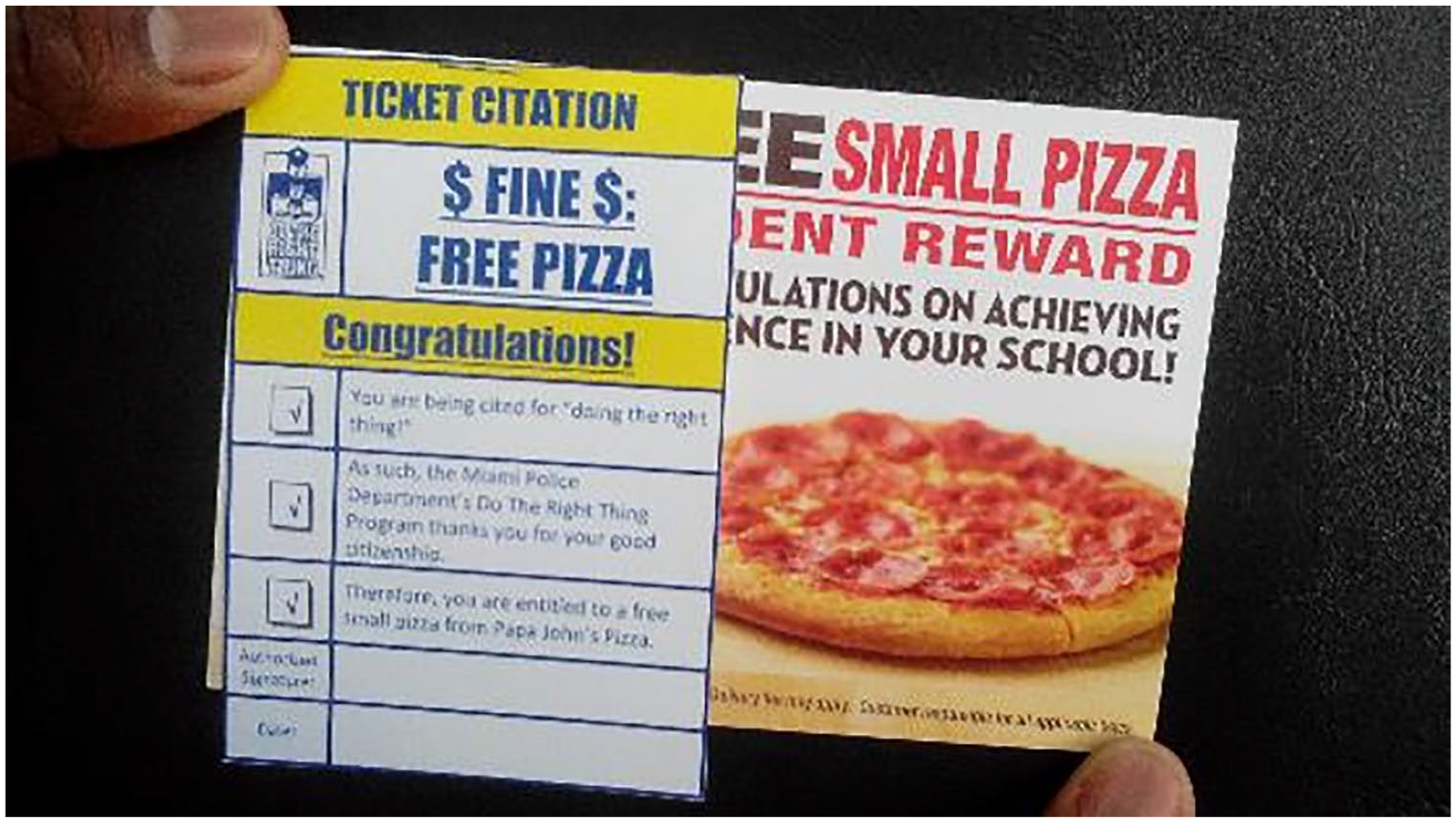
A ‘ticket citation’ from the MPD providing free pizza, August 2015.
The DTRT campaign illustrates how the relationship between police officers and local citizens is framed in terms of good, and thus vigilant, citizenship. It suggests that the duties of the ideal type of citizen include informing and collaborating with the authorities. MPD police officers and DTRT campaign leaders suggest that such actions should be rewarded. Likewise, the various neighborhood watch groups and captains I contacted in my research often aligned themselves with police officers and called on the police – framing them as an underfunded public service – to ramp up their security practices in their neighborhoods.
State attempts to have citizens ‘do the right thing’ also underpinned crime watch group meetings throughout Miami. The first crime watch group meeting I joined took place in a wealthy part of Coconut Grove. Susan, the group’s chair and a long-term Coconut Grove resident, warmly introduced me to the group and said that I was welcome to attend their meetings. Over the course of several months, I saw how members of the crime watch group and MPD police officers shared phone numbers, discussed information about crimes and criminals, showed pictures of suspects and videos of suspicious activities (Susan said she once recorded a drug deal in front of her home while hiding in her car), and explored possible juridical procedures in order to address feelings of insecurity and nuisances, such as overdue maintenance and poor lighting (Jeursen, 2023: 74). Neglecting larger structural conditions of inequality, participants in the meeting concluded that ‘even though someone is poor and addicted, he doesn’t have the right to break in’. While many encouraged Susan to announce her successes more widely to attract additional funding and generate political support (there were already 1400 people on her mailing list), she was reluctant to seek publicity. In part, she feared the repercussions, but she was also afraid that she would give other citizens the impression that the group was taking the law into its own hands. Especially considering what had happened to Trayvon Martin, she worried that they too would be considered vigilantes. Of course, Susan assured me, this was not what she envisioned her group to be.
Many of the participants at these meetings were white and/or Latinx and shared stories that reproduced dominant and racist interpretations of crime and belonging that criminalized predominantly Black communities and citizens. During one meeting, participants discussed a recent event that they referred to as a ‘roadside rampage’: young Black men had driven from a more ‘crime-ridden’ neighborhood to Coconut Grove, committing a series of crimes along the way, before finally crashing the car in Coconut Grove. In the story, as told by these participants, the men had also stolen body armor and a handgun from an unlocked police car (Jeursen, 2023: 75). These stories and examples of crime, and in particular the narratives of who belongs in a neighborhood, are clearly anchored in ideologies of maintaining cultural whiteness (Low, 2003). This is particularly salient in the rapid increase of Americans living in secured residential enclaves and gated communities, the creation of which is often shown to sustain and intensify discriminatory security practices and existing patterns of segregation as ways to defend a white life. Yet, beyond the walls of these gated communities, and as this example of community policing in Coconut Grove illustrates, a broader search for safety and security reorganizes American communities around a fear of, specifically Black, crime.
Many high-ranking police officers – including MPD Chief of Police Rodolfo Llanes – attended these crime watch meetings and praised the group members for their efforts. The group’s successes, such as lower crime rates, successful arrests, and additional funding, were celebrated and held up as an example for other crime watch groups throughout Miami (Jeursen, 2023: 76). City officials and lawyers looking for votes were eager to present their work during the monthly crime watch meetings, and high-ranking police officers seemed pleased with the group’s activities and involvement. While state agencies play an important role in the creation and growth of lateral surveillance programs, as does a perception of inadequate state interventions such as security provision, it is just as important to recognize that public vigilance is more than a modern expression of voluntarism. In the case of the Coconut Grove crime watch group, participants were either white and/or Latinx and shared stories that reproduced dominant and racist interpretations of crime. Other neighborhood crime watch groups and captains in middle- and upper-class parts of Miami often shared very similar stories and views: that some people belong in their neighborhood, and others do not.
One day I found a flyer in the mail announcing the first meeting of a new local crime watch group founded by one of my neighbors, Alejandra (Jeursen, 2023: 76). As the group’s captain, Alejandra went on to organize several monthly meetings, during which police officers and local citizens exchanged information, expressed concerns, and discussed possible solutions to security issues. After attending several of these meetings, I talked with her about how and why she had set up the group, especially how it affected her relationship with other citizens and police officers living and working in the neighborhood. Alejandra told me that the authorities had been unresponsive to her reports of the threats and her concerns about general safety in the neighborhood. In addition, Alejandra told me that she had received multiple threats from other citizens after she decided to set up the crime watch group. According to her, some criminal neighbors felt threatened by her presence and the activities she was organizing.
If you look at the end of my block, here at the stop sign, it says ‘citizens’ crime watch’. We earned it, let me tell you. We [neighbors] called each other in the middle of the night. It’s two o’clock in the morning and we’re calling, because one of us had to be vigilant that night, and on and on and on. So, thanks to the neighbors and everybody involved, you are here, on a block, that is crime watch–certified, and that has changed completely for the better. Night and day.
To Alejandra’s frustration, it took a lot of time before she managed to acquire the attention of higher-ranking officials in the MPD. Eventually, the police began to consider Alejandra’s initiative and determination to be a good example for other neighborhoods without a crime watch group. Many city officials – including the district commissioner – came out to celebrate the crime watch group’s successes in organizing local citizens and collaborating with the police, and to congratulate Alejandra on her efforts, which they saw as beneficial to the whole community.
After attending several crime watch group meetings in different Miami neighborhoods, I noticed how police officers, citizens, and city officials approached the communities they worked and lived in differently. These differences were, furthermore, reflective of a continuation of broader racial disparities in policing and surveillance. While white and Latinx citizens were urged to ‘fight’ for the right services and police presence – and were rewarded in their efforts to do so – Black citizens were reminded to ‘break the silence’ and disclose criminal activities to the police.
Crime Stoppers
MPD police officers and state officials frequently encourage Overtown citizens to share information on criminal activities with the police. This message is communicated in many ways, including verbally during crime watch meetings and outreach programs in the neighborhood, during which police officers actively look to interact with local citizens to discuss security concerns. In March 2015, ten-year-old Marlon Eason was shot and killed in front of his house in Overtown, where he was playing with his basketball. Directly afterward, MPD police chief Rodolfo Llanes released a statement condemning the murder and expressing his difficulty in understanding any violent act that results in the loss of a child’s life. In an interview with a CBS Miami reporter, Llanes explained that although he had directed police officers do to ‘all that is necessary to get to the bottom’ of the incident, ‘we cannot do this alone: we need the help of the community that we have sworn to serve.’ He urged viewers to contact the police with whatever information they might have: ‘no matter how small you think it is, it may be a key part of our investigation’ (Jeursen, 2023: 81; Local 10 News, 2015).
Over the next two days, police officers, supporting staff members, and citizens walked through the streets of Overtown and Allapattah. Their mission was to approach and speak to anyone they encountered. Even commanding officers visited certain apartment complexes to engage in dialogue with local citizens. Getting in contact with citizens was sometimes difficult, as many homes have an iron fence around the property, marking the boundary between private property and public street. The officers were reluctant to venture into any front yards, to trespass on private property and knock on doors, so instead they would hit the fence with their batons and raise their voices to notify anyone inside. If a resident did come out to talk, officers gave them a document detailing the incident and encouraged people to come forward with information (see Figure 2).
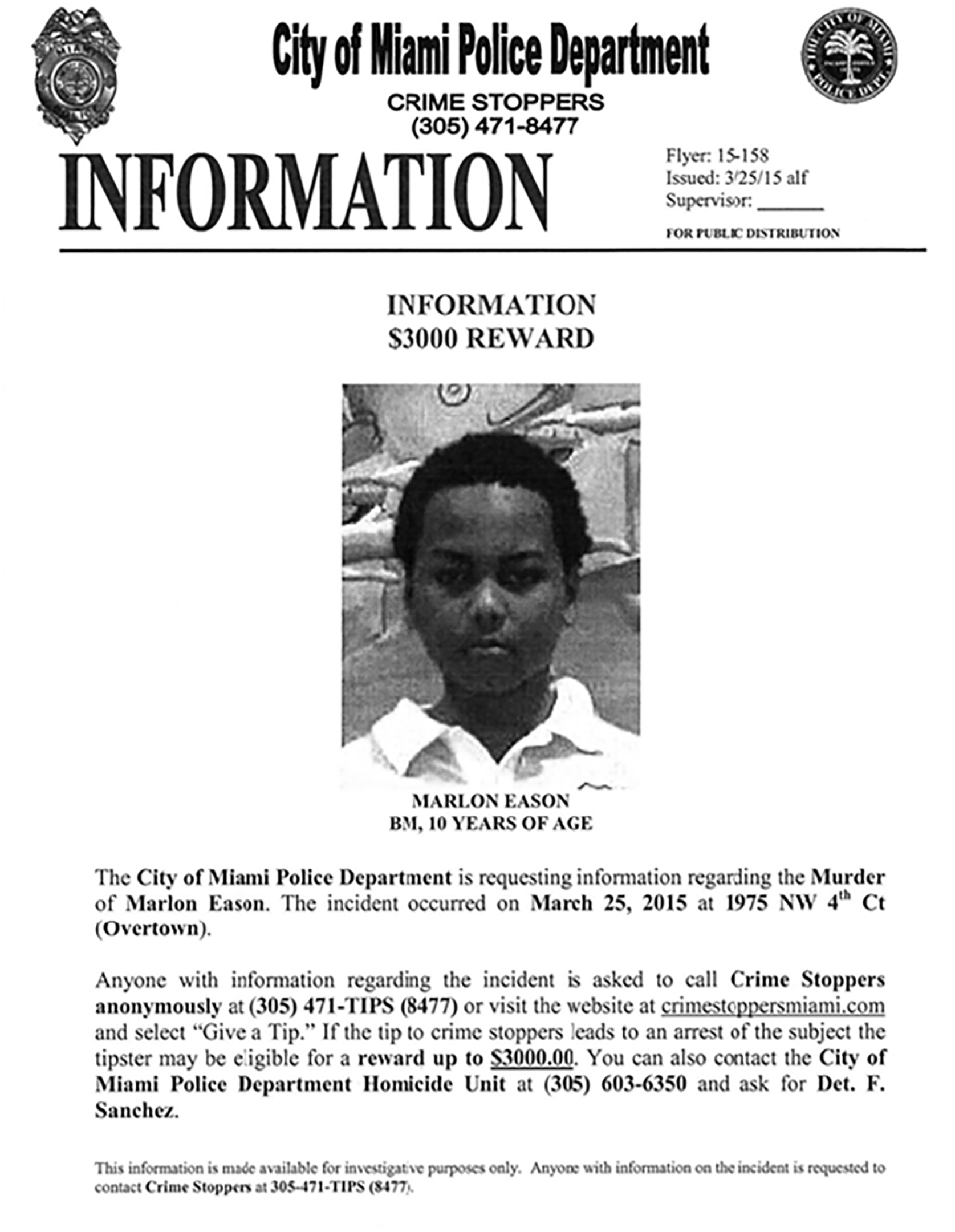
Document distributed after the murder of Marlon Eason, March 2015. Source: Miami Police Department.
The document indicated that the MPD sought to encourage anyone with information regarding the incident to call the Crime Stoppers phone number (the last four digits correspond to the word ‘TIPS’) or to visit a website where crimes can be reported anonymously. Tipsters were even eligible for a reward of up to $3000, should their tip lead to the arrest of the killer(s). It was common in Miami at the time of my research for police departments to hand out such rewards to those who shared key information with them. Crime Stoppers, a national organization, is well known in Miami, with signs throughout the city and in Overtown (Jeursen, 2023: 81). While directly connected to law enforcement agencies, the organization was specifically created to encourage local citizens who might be more hesitant to contact the police themselves to become involved in ‘crime fighting’ by sharing knowledge. To guarantee anonymity, the organization states that they do not trace any calls and they hand out rewards in cash through a confidential tip number.
Shortly after Marlon Eason’s murder, I attended the first local crime watch meeting in Overtown. While the meeting had been scheduled prior to Eason’s murder, MPD officers used the case to convey a sense of urgency. During the meeting, they explicitly stated that the involvement of citizens was essential for law enforcement to be effective – to find and apprehend criminals and provide a sense of justice to affected families and loved ones. It was during this meeting that I met Ruth, a long-term resident of Overtown, who appeared particularly involved in the neighborhood and wanted to share her concerns with the officers present that afternoon. Like Ruth, many other participants seemed to acknowledge the importance of police in their neighborhood, but also expressed their concerns regarding the MPD’s aggressive practices. Some also complained that Miami’s witness protection program was insufficient to ensure the safety of those who became police informants. They considered such programs crucial to overcoming the criminalization and precariousness of anyone who collaborated with law enforcement. Yet, at the same time, many residents were reluctant to discuss local information with the police, both because they felt the police were ineffective or even harmful to their communities and out of fear of repercussions.
Ruth invited me to her home in Overtown, and during our talks she informed me about her neighbor’s illegal business. She told me where he stored drugs, at what time in the morning he cooked his meth, and who sold it to customers. In the couple of hours that I spent with Ruth on the first day, I could hear people shouting the neighbor’s name as they walked up to the gate to complete their transaction. Ruth was frustrated by the situation. She felt as if she were being held hostage in her own home and that there was nothing she could do about it. In her words, she had to act in a way that suggested that she was ‘still cool’ with him and had no intention of talking with the police. Ruth was scared of what could happen and told me that the woman who had lived in her apartment before her had had to leave because of intensifying arguments. Ruth did not have the means to afford another place and did not want her relationship with her neighbor to reach the same level of distrust and aggression. Accordingly, she was very careful when interacting with him and his friends and contacts. Her involvement in local politics as an activist – she was an active member of Miami’s local Black Lives Matter collective, and she also interacted with lawyers, politicians, and police officers for both personal and political reasons – amplified her concerns and complicated her relationship with her neighbor.
Ruth’s concerns are illustrative of the complicated position that people find themselves in when law enforcement organizations and international anti-crime organizations expect behavior that is not complicit with local norms and the police are experienced as a source of danger. Ruth had detailed information on local drug deals and violent encounters in the neighborhood. Accordingly, an important part of her daily life was characterized by the danger that public vigilance campaigns posed to her. International anti-crime organizations such as Crime Stoppers and local police departments such as the MPD, in asking her to adhere to ideals of public vigilance, did not offer Ruth any opportunity to improve her daily life and safety. While Ruth supported efforts by the police and local citizens to find Marlon Eason’s murderer and bring them to justice, she was not sure how she could do so without jeopardizing her own safety, maintaining a good relationship with neighbors with violent tendencies. Indeed, attempts to create ‘good citizens’ did not accommodate the local context, where state-led lateral surveillance campaigns may cause tension and uncertainty in everyday urban life.
If informing police officers is a citizen’s duty, and a requirement to be part of a national political community, then Ruth was excluded. Her local environment made navigating her rights, responsibilities, and duties difficult, as nationally circulating norms did not match her neighborhood reality. Ruth did not feel part of a political community of vigilant citizens, and as an activist sometimes she even opposed collaborating with state agencies and government-led gentrification. But she also did not experience herself as belonging wholly to Overtown, a place where citizens distributed and used illegal substances.
Several days after Marlon Eason was murdered, his family members and other Overtown citizens organized a vigil in a local park. Many citizens attended, praying for Marlon and his mother while lighting candles and releasing balloons into the sky. Many attending the vigil expressed both sorrow and frustration: sorrow over the fact that a ten-year-old boy had been shot, but also anger that nobody seemed to know who did it. Citizens wore t-shirts that read ‘stop the violence’ and stated with certainty that finding and prosecuting the perpetrator would be the main way to bring justice for Marlon. Yet, for that to happen, they reasoned, citizens needed to feel empowered to ‘break the silence’ and ‘take back the streets’. But, like Ruth, many cannot and do not want to live up to these expectations of ‘doing the right thing’. By imposing white ideals of watchfulness and normativity in Overtown, police officers induced stress and insecurity. In other words, their efforts sowed distrust and actively undermined any articulation of collectivity and belonging not in line with the political ideal of vigilant citizenship, excluding many in the process.
Conclusion
Do the right thing is not only a reference to the MPD program; it is also the title of a 1989 film written, produced, and directed by Spike Lee. Situated in Brooklyn, New York, the film explores racial tensions in the neighborhood, which are amplified by the police killing of a Black man. In the story, the question of whether the main character ‘does the right thing’ concerns the justification of violence in the light of racialized injustices, specifically inciting a riot that causes property damage. Lee uses quotes from both Martin Luther King Jr and Malcolm X to present different understandings of violence as a response to structural inequality and systemic violence. Commenting on his own movie, Lee remarks that it is mostly white viewers who wonder whether the main character actually does the right thing – Black viewers seem to know the answer already. 3 The perpetual denial of white citizens when it comes to racial injustice, and their unwillingness to acknowledge and understand racism, is part of the reason why Lee dedicated the film to the families of six victims of both police brutality and racial violence.
Although lateral surveillance programs supposedly only mobilize citizens to become the ‘eyes and ears’ of local law enforcement, this vigilance is about much more than that. Engaging in a wide variety of self-defense practices, surveillance, and citizen powers, vigilant citizens are often operating in a legal gray area. Yet this situation is not the result of an unwillingness or absence of state agencies. In the United States, vigilantism has been a principal part of a longer institutional history of racialized violence that involves private and public forces (Jeursen, 2023: 79; Obert, 2018). At the same time, it is a bit of a stretch to argue that every citizen involved in lateral surveillance programs is a (potential) vigilante – public vigilance is not the same as vigilantism.
Many of the vigilant citizens I met were driven by personal motivations or were interested in their real estate investments, and so were looking to improve perceptions of safety and security to improve their own profits and social capital. Indeed, participants of crime watch group meetings were eager to point out that housing prices would go up because of their collective efforts. The examples of lateral surveillance provided in this article are just a small selection of the various ways in which residents are taught and enabled to surveil each other. Fingerprinting your children – as is recommended by the FBI and local child safety organizations – might increase the chances of recovering your child if they were to go missing. But how might this affect relationships within a family or community, and how does it shape the child’s perception of the world they live in?
Law enforcement agencies use the framework of ‘doing the right thing’ to build a community of vigilant citizens. Neighborhood watch groups thrive on notions of being vigilant, as an indication of their proactive and good citizenship. Police officers and local citizens considered lateral surveillance key for public safety, and articulations of being vigilant appear dominant in what it means to do the right thing. In practice, however, many of these collaborations and actions that blur the boundaries between the police and citizens sustain and intensify racial disparities already seen in everyday policing. Participants in neighborhood watches, and members who feel part of a collective of vigilant citizens more generally, were often driven by racialized fears and insecurity. Black Miamians are not only seen and policed differently through a lens of normative whiteness, but also because of the dominant understanding that doing the right thing will result in a just outcome, in an accurate assessment of guilt and innocence. Policing and surveillance, however, has done anything but provide justice to Black communities.
Footnotes
Acknowledgements
The author would like to thank all members of the SECURCIT+ reading group, and in particular principal investigator Rivke Jaffe and Carolina Frossard, for their input on earlier versions of this article.
Funding
The author disclosed receipt of the following financial support for the research, authorship, and/or publication of this article: The research on which this article is based was made possible with funding from the SECURCIT project of the Netherlands Organization for Scientific Research.
