




Abstract
The governing of uncertainty has been studied extensively within the interdisciplinary field of security studies. However, existing scholarship on security-related uncertainty focuses on the problem of its governance from the standpoint of Western-political macro-governmental regulatory regimes. To both rescale as well as decolonize existing scholarship on governing security-related uncertainty, this article brings security studies scholarship in conversation with ethnographic accounts of everyday uncertainty in Global South contexts. As a concept tied to unpredictable security futures, it introduces ‘ordinary’ uncertainty as a routinized experiential terrain of insecurity. One that is anticipatorily navigated by social actors operating at the micro-social scale. Drawing on fieldwork on ordinary uncertainty in Karachi, this article calls attention to the incredible amount of time and energy spent by urban residents who try to ‘stay updated’ with the ever-shifting security situation in the Pakistani megacity. They do this by gathering, exchanging and making sense of information circulating in their social circles, on the street, news channels and/or on social media platforms. By examining critical practices of information production and exchange in Karachi, this article reveals the politics of governing ordinary uncertainty in an unequal sociopolitical context.
Keywords
Introduction
On 16 January 2013, a Member of the Provincial Assembly (provincial parliament) belonging to the Muttahida Qaumi Movement (MQM) was publicly assassinated in Orangi Town, Karachi. Militant members of the ethno-political party vowed to avenge the killing, triggering a period of violent unrest in the Pakistani megacity. I was visiting Karachi for fieldwork during this time. I had planned to meet Perween Rahman (a prominent housing rights activist) at her office in Orangi Town the following day. I called Perween to confirm our meeting. On hearing what sounded like gunshots in the background, I expressed my concerns about the visit. The territorialized locality had a reputation for being ‘dangerous’ at times of heightened ethno-political conflict in Karachi, when militant affiliates of the MQM (which popularly looked after ethnic muhajir interests) and rival Awami National Party (an ethnic Pashtun nationalist party) frequently engaged in tit-for-tat killings. I was worried about my safety, but Perween laughingly shrugged off my concerns: ‘This is an everyday matter – just stay updated on halaat (the situation) as you would on the day’ she advised (Interview 11).
Perween was referring to the ordinary practice that millions of Karachiites participated in to manage everyday uncertainty. 1 Staying updated allowed residents to continue daily routines in a city where landscapes of danger and safety shifted in line with ongoing violence. While some routes or parts of the city became inaccessible and were ‘better avoided’, others remained open and safe. Staying updated involved relentless following, gathering and sharing of information and knowledge. Information relating to muggings, targeted killings, the ongoing gang war, riots and police operations circulated between urban residents in the form of eye-witness accounts, rumours, stories, advice, news reports and social media and SMS forwards. Karachiites situated this information within their knowledge of past events. They used it to speculate on the future course of events and decide on how best to navigate security-related uncertainty in the city.
This article critically examines everyday practices of ‘staying updated’ in Karachi as a form of living, managing and governing what I term ‘ordinary uncertainty’. Drawing attention to ‘ordinary uncertainty’ as an experiential terrain of insecurity, it examines how urban residents make use of social tactics and collaborative practices to anticipate and govern future insecurity. Through a focus on everyday practices of information gathering and circulation in the Pakistani megacity of over 18 million residents, this article responds to empirical and analytical gaps in security studies scholarship on governing uncertainty (Amoore and De Goede, 2008; De Goede, 2008; De Goede and Randalls, 2009). In constructing ordinary uncertainty as a problematic, and focusing on sociocultural knowledge practices as significant processes of urban security governance, this article rescales and decolonizes scholarship on the governance and politics of uncertainty (Adamson, 2020; Hudson, 2018; Lemanski, 2012). It does so by firstly critically engaging with settled knowledge (within security studies) on security uncertainty. This is done by giving primacy to everyday security practices and hence decentring more popular state-centric approaches within security studies scholarship. Secondly, by attuning to the diversity of experiences of governing uncertainty and drawing attention to the multiple forms of power relations that relate to the process. Given that this article transcends commonly found analytical dichotomies between everyday and macro-governmental practices in analysing the politics of governing security-related uncertainty, the projects of decolonizing and rescaling work hand in hand.
The politics of governing uncertainty has been studied extensively within the interdisciplinary field of security studies in the post-9/11 context. This scholarship is centred on governmental politics (Amoore and De Goede, 2008; De Goede and Randalls, 2009) or on the politics of policing terrorism within multicultural Western societies (Innes, 2006; O’Malley, 2011). It emphasizes the agency of rational state actors in governing security-related uncertainty, a form of uncertainty that is understood as an exception. It ignores the widely documented experiences of contexts in the Global South, where security governance is dispersed between state and non-state actors (Berents and Ten Have, 2017; Comaroff and Comaroff, 2007; Vigh, 2008) and where uncertainty relating to insecurity is routinized. In contrast, ‘ordinary uncertainty’ is not a governmental problem for the state to resolve. Instead, it is lived and managed by citizens through everyday practices of anticipation and speculation (Auyero et al., 2015; Monroe, 2016; Pengalese, 2012). Despite being an object of study in anthropological literature on everyday insecurity in urban contexts, ‘ordinary uncertainty’, its governance, and its politics excluded in academic knowledge-making within security-studies scholarship. I present this argument in more detail in the next section, while highlighting how micro-social and collaborative practices of managing ordinary uncertainty operate within Karachi’s context of non-hierarchical and pluralized security governance.
Decolonizing knowledge: Governing ‘ordinary uncertainty’ and the role of information
In the interdisciplinary field of security studies, uncertainty is conceptualized as a temporal dynamic of affective insecurity that demands action in the present (Crawford, 2011; De Goede, 2008; De Goede and Randalls, 2009; O’Malley, 2011). For security governors, it is an analytically complex security problem that is different from risk. While risk is a calculable probability, uncertainty is an incalculable and unpredictable situation. It is a situation of non-knowledge, an ‘unknown unknown’ (De Goede and Randalls, 2009; Massumi, 2007). Drawing on experiences of Western states and societies, especially in the post-9/11 context, this literature focuses on rational state institutions as primary actors governing uncertainty. 2 It highlights how operating under the precautionary principle, to preemptively halt activities that would cause widespread harm, security governors take forceful anticipatory action against threats that are yet to form. In the absence of determinable knowledge, the ‘future present’ is anticipated through speculative practices (Amoore and De Goede, 2008; De Goede, 2008; De Goede and Randalls, 2009). Developing a ‘security imagination’ is essential, and knowledge is gathered through creative practices that take wide-ranging information seriously: scientific models, official reports, cinematic representations, science fiction, fables, stories or even effects such as personal or collective fears, hopes and anxieties become significant (Anderson, 2010).
The politics of knowledge in relation to governing uncertainty is widely documented in security-studies scholarship. De Goede and Randalls (2009) elaborate that the spectre of a disastrous future depoliticizes governmental action that rests on creatively produced knowledge. The fear of catastrophic harm in relation to uncertain insecurity events legitimates preemptive action on threats yet to emerge. Such forms of governance signal managerial excess, depoliticizing unethical decisions citing technocratic advice (De Goede and Randalls, 2009; Huysmans, 2011). In addition, the spectre of future threat is often mobilized to deepen state power (Aradau and Van Munster, 2007; Dillon, 2007). While significant, the above-mentioned critiques are situated within Western sociopolitical contexts where the state (as a unified, primary actor) is privileged as central to security governance. This assumption does not apply to many contexts in the Global South, including in Pakistan, where the hybrid state is heavily politicised and is often productive of security-related uncertainty both in its constitution and through its operations to gain and retain power (Gayer, 2014; Rais, 2019). The postcolonial state is not a hegemonic governmental actor, and information is not specifically situated within the ‘official’ realm of governance. In Pakistan (and Karachi), state actors operate within formal and informal spheres of governance, and governmental information criss-crosses between formal state actors and citizens (Anwar, 2013; Farooqui, 2020). Everyday governance operates as a multidirectional entanglement (Marston et al., 2005) between official and unofficial, formal and informal (Anwar, 2013; Farooqui, 2020; Waseem, 2022).
In addition, other than notable exceptions (Hagmann, 2017; Huysmans, 2011), analyses of formal governmental institutional practices assume neat divisions between ordinary citizens and governmental/policy decision-makers. In contrast, security in Karachi is governed by multiple and intersecting state and non-state actors: the police, paramilitary rangers, intelligence agencies, private security providers, neighbourhood associations, citizen–state collaborations and ethno-political and sectarian criminal gangs (Gayer and Russo, 2022; Gazdar, 2011; Hussain and Shelley, 2016; Kaker, 2014). The plurality of security governance in Karachi is an outcome of fragmented and multiple sovereignty within Pakistan’s ‘hybrid regime’ (Adeney, 2017), where the powerful state military overlaps with the democratic political system. In the competition over political domination (Akhtar, 2019), the coercive branches of each segment of the hybrid state, the police and military, are deeply entangled in local politics. In this context, urban security governors confound rigid hierarchies or neat divisions. The relationship between state and non-state institutions tasked with governing security shifts among cooperation, competition and compromise (Gayer and Russo, 2022; Gazdar, 2011; Kaker, 2020; Waseem, 2022).
Ongoing processes of negotiation over state power and social control routinely play out in Karachi’s streets. As the routinized trauma of exceptional insecurity events normalizes over the years (Gayer, 2014), uncertainty becomes ‘ordinary’ for Karachiites. Such conditions of ordinary uncertainty are documented in anthropologies of uncertainty in Global South urbanisms (Cooper and Pratten, 2015; Simone, 2013; Zeiderman et al., 2015). This scholarship conceptually rescales uncertainty as an everyday encounter (Hudson, 2018; Leitner and Miller, 2007), governed by experiential anticipatory action that intersects societal and governmental actors. Such action ‘entails a way of thinking about what is taking place, of positioning oneself in relationship to events and places in preparation to move quickly’ (Simone, 2010: 291). It encompasses processes such as ‘everyday hedging’ (Newhouse, 2017), where people weigh out differing potential future outcomes to determine present courses of action, or ‘social navigation’ Vigh (2008, 2009), forms of anticipation that are ‘contingent upon our knowledge of the past, our experience of the here and now as well as the emergent or potential possibilities and difficulties within it, entailing that the map is never a static set of coordinates but a dense and multidimensional imaginary, which is constantly in the process of coming into being’ (Vigh, 2009: 429).
Understanding insecurity through everyday knowledge-making practices is essential for decolonising scholarship on governing security-related uncertainty (Adamson, 2020; Hudson, 2018). The focus on experiential anticipatory practices that rest on situated, local knowledges and citizens’ contextual engagement with their worlds counters state-centric approaches within security studies. Including everyday practices of collaborative gathering, sharing and processing of information on everyday urban events, opportunities and risks such as those documented in urban studies literature (McFarlane and Silver, 2017; Newhouse, 2017; Simone, 2013) works to address knowledge exclusions within security studies. Urban studies scholarship draws attention to people as conduits for circulating information (Simone, 2004). Such information offers clues on possible directions unfolding events would settle on. Recipients contextualize this information with their understanding of broader sociopolitical contexts. As Vigh (2009: 421) explains, Morning rituals, afternoon chats, greetings and routines merge with larger frameworks; at the first sign of trouble or anticipation of political conflict, the pitch and tone of already intense discussions change, the constant alertness to escape routes out of town heightens and securing necessary provisions becomes prominent as people anticipate short-rationing.
I witnessed this form of speculative anticipation in operation in Karachi during fieldwork. As introduced earlier, in January 2013, I called Perween Rahman to confirm our meeting at her office in Orangi Town. I did this on the advice of Samina, my hostess. Samina’s maid had cancelled her journey to work from the Garden area (between Clifton and Orangi Town), citing her fear of trouble along the route after the MPA’s assassination. On telling Samina that Perween had anticipated no trouble, while advising me to stay updated on halaat (the situation) during my journey, Samina advised me to wait and to follow the news for a bit. By the end of the day, tuning off from a live-streamed press conference on TV, Faizan, Samina’s husband turned to me and said ‘It’s not going to last. You can tell by their (political leaders’) tone that the skirmish is losing heat. There hasn’t been any counter messages from the ANP or the government. It could be an inside job, looks like they are moving on’ (Interview 12). Faizan’s armchair analysis seemed to have been right. The news had moved on to different topics by the next morning, signalling a fizzling out of tension. I proceeded to meet Perween later that day. Equipped with my trusty smartphone, I checked in on the multiple Facebook pages and Twitter handles recommended to me by various friends and interlocutors. I refreshed my Facebook app every couple of minutes while the driver periodically popped his head out of the window to shout ‘Sab theek hai?’ (is it all good?) at hawkers or rickshaw drivers hanging out on street intersections.
As my journey to and from Perween’s office was completed securely, I reflected on the extraordinary work that staying safe required. Looking out for news and making meaning from multiple information sources was necessary for ensuring security. While it seemed to work, I found the constant searching for and making sense of news incredibly taxing. Positioned as resilient, societies where urban residents speculatively and anticipatorily navigate uncertainty with little help from formal state institutions are lauded in policy and academic circles for innovatively, efficiently and effectively adapting to uncertain futures (O’Malley, 2011; Scoones and Sirling, 2020). The multidirectional and simultaneous construction of security governance in ordinary contexts may be a functional system, but it is essential to recognize its political implications. The remaining article analyses practices of information sharing and relations of exchange between different security governance actors to attention to the politics of circulatory information and that of governing ordinary uncertainty.
Methodology
This article draws on ethnographic fieldwork on everyday experiences of living and managing insecurity in Karachi, carried out for 12 months between 2013 and 2015. 3 Findings rest on fieldnotes, participant observations, informal interactions, and 44 formal structured and semi-structured interviews. I used purposeful and snowball sampling strategies to recruit interview participants across a variety of positions and roles in governing ordinary uncertainty. These included state security officials (including Home Minister Sindh’s and Ministry of Interior’s office, serving and retired Sindh police officials, retired officials from the Intelligence Bureau and Criminal Investigation department); non-state security officials (heads of security at banks, multinational companies and shopping malls, representatives of All Pakistan Security Agencies Association, members of the Citizen Police Liaison Committee); formal news makers and disseminators (including reporters, news-desk managers, news presenters and political analysts and talk-show hosts); and ordinary citizens (host families, friends, domestic workers, taxi drivers, shopkeepers, assistants in shopping mall, cleaners, media and police informers, social-media group members, risk analysts, journalists and public and private security officers and personnel).
I lived with two different host-participant families while conducting fieldwork: an upper-middle-class family located in South Karachi and a middle-class family in Central Karachi. 4 Personal observations and interviews with host families from within their networks (friends, community members, domestic workers) coupled with interviews and informal interactions with ordinary Karachites whom I encountered when navigating and moving through the city myself (taxi drivers, shopkeepers, mall workers, tea stall owners and customers from localities as diverse as Orangi, Manghopir, Hydri, Bahadurabad, Saddar and Clifton) ensured a representative sample across social class, gender, ethnicity and urban geography. My interlocutors, whether security officials or providers, news and media personnel or ordinary citizens, all occupied multiple and intersecting positions as knowledge makers and consumers. In navigating everyday uncertainty in Karachi, they were also meaningful actors within the urban security assemblage.
These interviews enabled me to understand the context of ordinary uncertainty in Karachi as well as its governance. My questions sought to understand the relationship how Karachiites made decisions on navigating safety/danger, and what methods they used to construct knowledge of the city’s security situation. Living with participant host families in Karachi and interviewing people as they kept one eye on the news allowed reflexive engagement with interlocutors’ experiences as insecurity events unfolded. Shared and mediated practices of staying updated on events became not only the subject of this research, but also tools for navigating uncertainty. I quickly found that information was a critical resource, and that those relying on it placed heavy emphasis on legitimacy of source. My fieldwork started focusing on how information was created, communicated and consumed by officials and ordinary citizens, and what counted as legitimate sources and why. In the process, I learnt the significance of news exchange platforms such as televised news, social media platforms (Facebook pages, WhatsApp groups, Twitter accounts) and of SMS forwards and email circulars.
To analyse the politics of information exchange and of governing ordinary uncertainty, I gathered, traced and followed information along essential mediums of information exchange that enabled ‘staying updated’: emails, social media shares/posts/forwards and news stories. To determine how news stories were formed, I traced sources along lines of communication. In the process, I interviewed information recipients, journalists, news editors, police officials and security analysts. To understand the reach and meaning formation of mediated information, I snowballed backwards to trace the source of information. I also purposefully sought participants who had received social media forwards to understand how they drew meaning from it. I organized my analysis by linking how different security actors and differently positioned citizens interacted with these mediums as content creators and users, and how they actioned and responded to information shared through them. Focusing on these lines of analysis enabled an understanding of the politics of circulating information, which I outline in detail below.
Ordinary uncertainty, circulating information and anticipatory action in Karachi
In 2013, Karachi was cited as ‘one of the most dangerous cities of the world’ (Khan, 2013). It was a significant year, marking the first transition of power between democratically elected governments in Pakistan’s 66-year history. As elections approached, violence picked up pace. Intersecting ethno-political, sectarian and criminal groups ramped up criminal activities to fund the electoral campaigns of their political patrons. Competing political actors resorted to violence to negotiate their future in the city (Gayer, 2014). In the struggle over power, armed skirmishes amongst intersecting ethno-political/religious/criminal militant political groups and between these groups and law enforcement agencies picked pace (Gazdar, 2011; Hussain and Shelley, 2016; Waseem, 2022). Meanwhile, in an attempt to regain prestige as public memory of its dictatorial regime (from 1999 to 2008) faded, the military was keen to re-establish its legitimacy in the politically and economically strategic city. In September 2013, it launched a military operation to dismantle militant groups it had previously patronized (Ur Rehman, 2015; Siddiqui, 2023). Karachiites worried about being caught in the crossfire, while remaining anxious about terrorist violence and ordinary forms of urban crime such as extortion rackets, burglaries, phone and vehicle snatchings and muggings.
The steady escalation of conflict in Karachi is known to emerge in a predictable pattern. Gayer (2014) describes this situation as one of ‘ordered disorder, as both violent actors and the contexts and terrains within which they operate show continuity. As violence became context, Karachiites understood danger and insecurity as spatiotemporally dynamic categories (Gayer, 2014). The targeted killing of an ethno-political party member in the one part of the city is known to set off violent skirmishes between rival groups in other politically territorialized locales. 5 Ensuing violence could last for days, although remaining limited to popular bazaars and working-class settlements. Working-class men belonging to marginal ethnic groups would be most vulnerable to violent events. They followed live updated knowledge of ongoing events to ensure personal safety (Kirmani, 2015, 2017). Meanwhile, middle-class Karachiites managed by avoiding routes through contested localities or bazaars.
Security governance in Karachi is a complex dynamic, managed by state and non-state actors. The former includes civil, military and civic authorities, while the latter include ethno-political groups, sectarian actors, criminal gangs, private security, civil society organizations and neighbourhood-level community watches. Public institutions have historically failed in looking after citizen safety, and citizens view miliary and democratic state security institutions with suspicion. Political parties in power at the local and provincial level often compete with each other and with the state–military to assert control over urban politics. Political and military regimes are publicly known to form alliances with notorious power-brokers including criminal actors, violent political groups and sectarian organizations (Gazdar, 2011; Kirmani, 2017). The politicization of the police coupled with its ineffectiveness in improving public safety compromised the institution’s legitimacy, earning it a reputation of being partisan, inefficient and corrupt (Waseem, 2022). While paramilitary rangers are more respected as an efficient and effective urban security force, intelligence agencies have a history of covertly manipulating local security dynamics to maintain their strategic interests (Fazila-Yacoobali, 1996; Gazdar, 2011; Ur Rehman, 2015).
Aware of the duplicitous politics of state institutions, and their penchant of withholding or manipulating information (Gayer and Kirmani, 2020; Siddiqui, 2023), in exchanging news information, interviewed Karachiites rarely trusted statistics or reports on the security situation provided by the official authorities. They preferred to look to the news, media analysts and their own social networks. Despite scandals of inappropriate ties between the media personalities and politicians, and news of ‘secret expenditure funds’ held by the Ministry of Information and Broadcasting (Yusuf, 2015), these information mediums remained more trusted. They had gained a reputation for being transparent and accountable, and for enabling democracy often at high personal cost to reporters, journalists and media houses (Yusuf, 2015; Zulqarnain and ul Hassan, 2016). While some remained hooked on buying hyper-local tabloids that fetishized neighbourhood-level gang violence (Gayer and Kirmani, 2020), others habitually followed live televised news or social media accounts. Popular private news channels airing hourly bulletins and news analysis shows hosted by trusted media personalities formed public opinion on urban security and politics. More literate Karachiites turned to Facebook pages, Twitter handles such as @Khi_alerts and SMS and WhatsApp to share and receive crime news, rumours of future strikes, terrorist attacks or violent skirmishes. Such mediums allowed real-time sharing of videos and images to substantiate personal experiences with traffic incidents, crime or violent events.
Facebook groups
At the time of this research, the most popular Facebook group for Karachiites looking to stay updated was Halaat Updates, which translates to ‘Situation Updates’ in English. The group had over 100,000 members in 2015.
6
It was set up in 2012, when urban political conflict was at a peak. In an interview, Mr Dubash (a businessman and founder of the group) revealed that Halaat Updates was set up to facilitate his delivery team to navigate Karachi’s streets safely and efficiently from their base in SITE. It served as a platform where riders (delivery drivers) posted live information on accessible, blocked or unsafe routes with pictorial evidence. The information was intended to allow the business to avoid delays. It was a surveillance system for working-class riders, who controlled information posted while remaining subject to it. To crowdsource more information, riders were encouraged to share details of their page with family and friends. ‘It worked amazingly well’, Mr Dubash stated (Interview 1). He continued: Anyone with a phone is a citizen journalist who reports an unbiased and real-time version of events in Karachi. As more people joined the Facebook group, we had more witnesses to share traffic updates, strike routes, crime stories, even mobile or CCTV footage of muggings. Over time, our community has become more varied and inclusive. It includes men, women, young and old. Shopkeepers, police officers, journalists, housewives, students, delivery boys, store workers, businesses, professionals. The group does more than support my delivery riders. It ensures Karachiites from Clifton to Orangi to Landhi stay safe. (Interview 1)
In the screenshot of a post on Halaat Updates (Figure 1), a member asks the community for an update on Karachi’s ‘situation’ on the day of a political strike call. Within an hour, the post received over 80 replies. Real-time comments on safe routes helped the person who posted and other community members decide their future course of action. Some followed the post, commenting on it with an ‘F’ to follow the post. Others commented to ask questions on specific routes, while some tagged friends and family to make them aware of the situation. A comment stating that roads should be open given that it is a strike and not a protest drew laughing emojis from community members. Seasoned Karachiites knew that it is important to check in on the city’s security situation on strike day. Passing cars could draw the ire of passioned strikers and attract violent attacks. Writing in roman Urdu, another poster advised on the uncertain security future of a strike: ‘Its all clear for now, but we don’t know what it will be like when you head back’.
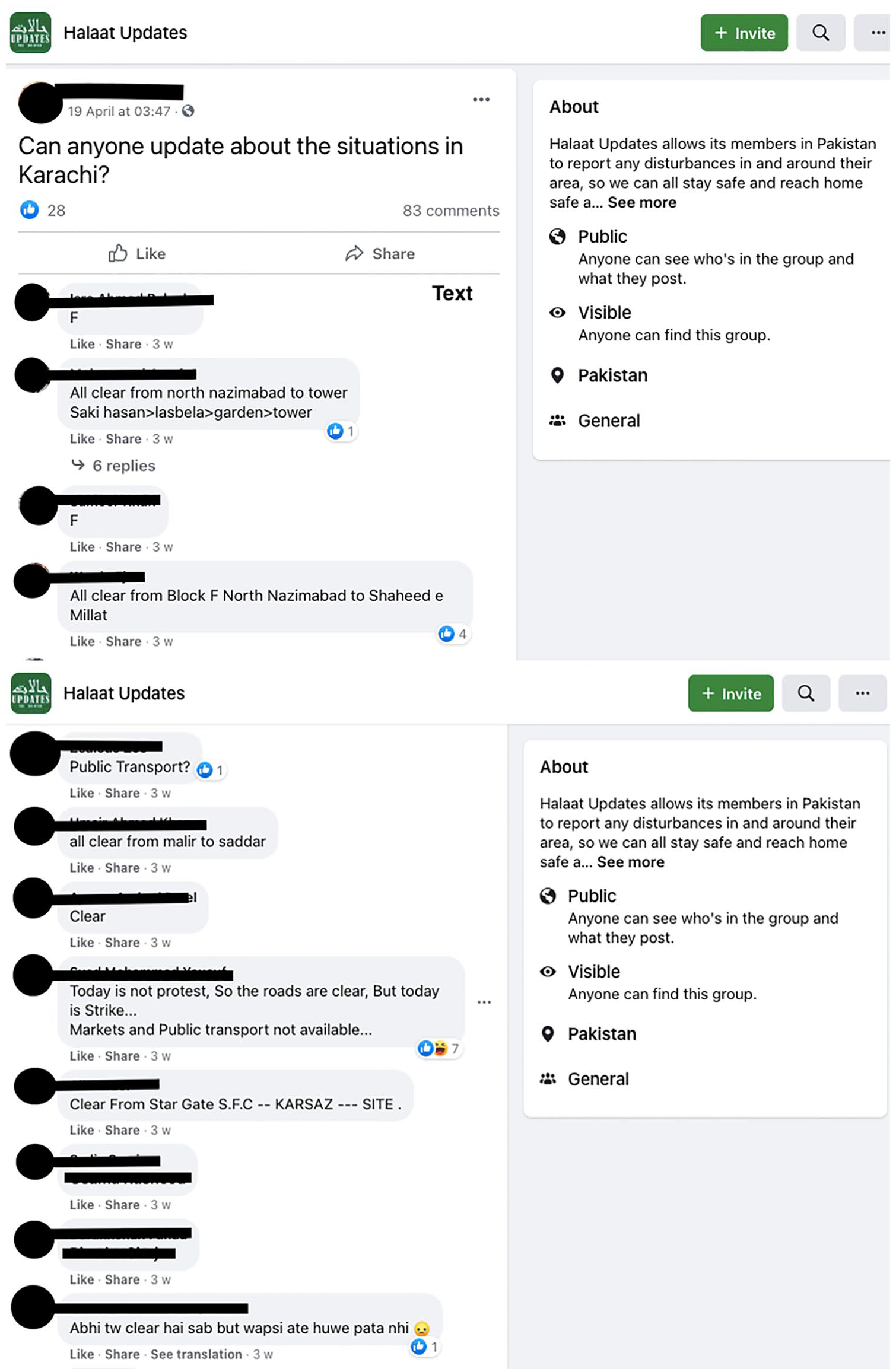
Screenshot from Facebook group ‘Halaat Updates’ from 15 March 2014.
Interviewed members of Halaat Updates emphasized that the Facebook group provided them with ‘credible’ information. They respected the admins for maintaining group discipline and integrity. Posts that were partisan, incited hate politics, generated rumours or spread fake news were removed and those posting such content repeatedly were banned from the group. Unfiltered, real-time information could be inquired for, produced and consumed in any way possible by group members. As a platform for sharing and discussing insecurity incidents, the group enabled usually sceptical Karachiites to ‘witness’ events. This was an important ritual for establishing credibility to stories, especially given the pervasive environment of suspicion, rumour, and accompanying production of ‘fake news’ (Gayer and Kirmani, 2020). Given this reputation, the platform served as a source of information for journalists and, paradoxically, also ‘official’ information producers such as police officers and intelligence officials.
While social media use and consumption in Pakistan is dominated by (mostly male) internet-connected English-speaking middle class (Yusuf, 2015), soaring sales of internet connections (PTA, 2015) improved social media inclusivity in Karachi. 7 In 2015, social media use in Pakistan became more widespread especially since Facebook became free to access (with no extra data charges) for the 76.5% of Pakistanis who owned mobile phones (PTA, 2015). 8 During this time, Facebook became one of the most widely used apps to consume news (Zulqarnain and ul Hassan, 2016). In addition to Facebook, security information also circulated through communication channels such as email, WhatsApp and SMS messages. The integration of social media apps on a smartphone facilitated the sharing of information across different technologies and mediums. While internet-based platforms and mobile phones were not universally used mediums of information gathering and sharing, they had exceptional reach across different income groups in Karachi. Sharing and cross-posting, however, put incredible strain on those who involuntarily found themselves on the receiving end.
SMS and WhatsApp forwards
An alert was brought to my attention through a conversation with Naima, a teacher who lived in Lalazar and worked in Clifton. Naima, showed me an SMS message (in Urdu) that she had received as a forward from a friend a couple of days ago: ‘High security Alert. 2 extremists have entered DHA. Avoid going out’ (dated 9 February 2013).
9
She was very upset by the message, and angrily said: What does this mean? Tell me how I am supposed to react when I get random texts like these – obviously from well-wishers. But this kind of nonsense is making life unbearable for me. Who are these two people? What do they mean ‘entered DHA’? Is DHA a fort? Anyone can enter DHA! How long are they in DHA for? Is the police after them? What are they wearing? When is it safe for me to go out? My exercise class is in DHA, my children visit friends living there, the cinepax is there! Every day, I get some text or the other warning me and it just freaks me out. (Interview 2)
Naima expressed her frustration at this message, which appeared on her mobile phone unannounced and unexpected. Its ambiguity compounded uncertainty, while the intimate medium of communication demanded urgent attention. Naima understood the message in the context of escalating Al-Qaeda terror threats in Pakistani cities. The terrorist group routinely targeted crowded spaces of consumption and/or worship, buildings that represented state power (government offices and military establishments) and foreign consulates. Since Naima lived and worked at a distance from DHA, the threat did not affect her essential routine. It did potentially affect her and her family’s social life especially as there was no cutoff date to the threat. The uncertain information played on her imagination and heightened her sense of insecurity. She reported keeping track of the situation by gathering information from friends and colleagues, listening more actively to news and rumours and to watching out for people and things out of place. Naima also felt upset at being unfairly positioned as a passive consumer of unwanted information: ‘I don’t subscribe to these different forums on security situations because they stress me out. But I still can’t avoid such messages appearing on my phone’ (Interview 2). Paradoxically, despite feeling out of control after receiving such messages, Naima went on to forward these to friends and family, possibly magnifying others’ anxiety. ‘There is always a niggling sense of doubt. What if this one is genuine?’, said Naima (Interview 2).
The circulation of obtuse SMS and WhatsApp messages generated anxiety for Karachiites across gender, class and age. Zulfiqar, a 58-year-old cleaner who lived in Shershah Colony and worked at the cinema in DHA, had received a similar SMS message warning of an impending terrorist attack. Despite the risk of working at a potential terrorism target and with customer numbers declining over immediate weeks, Zulfiqar’s employers expected him to report to work as usual. He explained how coming to work having received this warning left him feeling suspended in an affective state of anticipation. While relieved at reaching home safely at the end of each day, Zulfiqar felt more nervous the following day. ‘If the SMS is true, then there’s a higher chance something will happen the next day’ (Interview 3), he explained. In the context of uncertainty, respondents inhabiting anxious subject positions became ‘neurotic citizens’ (Isin, 2004: 225). While Naima tried to control her insecurity by staying updated, Zulfiqar seemed to give up as a way of managing his anxiety. Responding with ‘us poor people, we are alive today, who knows about tomorrow?’ (Interview 3), Zulfiqar signalled to precarity being a common condition of the urban poor living in Karachi.
The process of situating information and responding to it was linked to people’s subjective understanding of the world as well as with their own past experiences with uncertain events. I found that interlocutors inhabiting different social positions, such as Naima and Zulfiqar, found themselves positioned very differently in relation to the uncertain information. 10 While the uncertain event itself presented similar feelings of anxiety, its emotional and actional response was contingent on urban sensibilities developed through experiences of affluence and the marginality.
Email forwards
Intersections of class, age, privilege and worldliness played an important role in helping Karachiites to exercise choice in how to respond accordingly. But also to sift credible forwards from fake news. This was evident from my interactions with more globalized Karachiites such as Hassan, a senior banker who worked near Teen Talwar and lived in upscale DHA. Sharing the WhatsApp message shown in Figure 2 with me, Hassan pointed to the scribbled writing ‘not a joke’ next to the image title ‘Warning from Police’. ‘Well-meaning advice, but how can I take this seriously? I’m definitely not forwarding this one on. The amount of times it says “not a joke!!!”’, Hassan laughingly shared (Interview 4). He explained how he suspected this was ‘one of those forwards that start in California and end up in Karachi’.

Widely forwarded WhatsApp message shared by Hassan, a research participant in Karachi, from 18 November 2014.
Showing awareness of the untraceable nature of forwards, and of their infinitely circulatory nature, Hassan explained that his scepticism was a function of both language and context. Pakistani police lacked infrastructure and initiative in sharing public warnings such as these. ‘Even if the warning was “written” by a source close to the police’, Hassan continued to infer ‘the language sounds so American! “gas receipt, shift to park” etc’ (Interview 4). When probed on what kind of information he would share, Hassan explained how he got safety warning forwards from colleagues working at his bank which were ‘100 percent genuine’ (Interview 4). Here, Hassan was making reference to security warnings issued by a dedicated in-the-know head of security at his workplace.
In most reputable multinationals operating in Pakistan, a retired yet well-connected high-ranking army officer holds the position of chief security officer. Amongst other things, the officer is tasked with sharing security risk levels per locality with office staff, and relatedly briefing armed private security guards staffed at office entrances. The position holder is one of the city’s many ‘urban specialists’ (Hansen and Verkaaik, 2009: 16), who by virtue of their skills and connections, are able offer intelligible knowledge on invisible and uncertain security futures. These are predominantly ex-army men, given their tight networks with other security managers (serving and retired) and connections within multiple security agencies.
I interviewed one such specialist, ‘Colonel’, chief security officer at a large multinational corporation with multiple offices across Karachi. Colonel confidently stated that his employers received the most ‘valid’ insider knowledge on the security situation in Karachi. This knowledge was gathered through regular conversations with friends and juniors in the intelligence services, police departments, and the army: Sometimes agencies have information they can’t share with the public to avoid panic. Or with each other because of fear of leaks. The army, police and different intelligence agencies all compete with each other, so information sharing between them is really poor. Also, there are professional rivalries within these organisations, so colleagues often keep information to themselves to advance their own interests or maybe get others in trouble. They have no problem sharing these with me though, because they are looking ahead. A good word will help them secure a similar job at the end of their official career. (Interview 5)
His position as an insider–outsider was helpful for Colonel in gathering encompassing intelligence from diverse and high-level official sources, who trusted Colonel enough to take him in confidence. Despite being a member of the public, he was ‘unofficially’ provided restricted information. This sharing of sensitive governmental information to an ordinary citizen revealed the class politics of security and securitisation in Karachi, where ranking officers often empathised with the predicament of middle-class and elite Karachiites suffering from urban insecurity (Kaker, 2014, 2020). Although this information was exclusively produced for a limited public, i.e. employees within the multinational corporation, it often escaped the closed network. Official memos on security alerts regularly spread outwards to networks of family, friends and friends of friends. This dichotomy within the public and private, official and non-official in relation to information exchange was worth examining more closely. In the course of my fieldwork, I was quickly made aware of how the lines between official and unofficial, public and private and real and fake news kept shifting and blurring. Sometimes by accident, but at other times as a purposeful plan to allow strategic security operations to unfold.
Televised news
At around 19:00 on 19 September 2013, the transmission of a popular Pakistani news analysis programme on Geo TV was abruptly interrupted. The words ‘Breaking News: Geo Exclusive’ flashed on the top of the screen. A news correspondent narrated that two dead bodies had been found dumped on Shahra-e-Faisal, a central avenue in Karachi. While waiting for the next update, a short video clip of ambulances rushing into the night was played on repeat. The excited corresponded continued: Viewers – this is important breaking news. Two unidentified bodies have been found on Shahra-e-Faisal. Our sources tell us these are possibly liked to the Lyari gang-war. Our news team had been despatched to the scene, from where we will share further updates. (Breaking News, 2013)
The style of this news flash was a standard form of communication for televised news in Pakistan. Competing with approximately 30 other news channels, anchors tried to keep the attention of viewers as events unfolded, despite having incomplete and limited information. On this occasion, I was interviewing Naveed and Asma at their home in Nazimabad, while the news played in the background. Eager to gather any additional information, Naveed changed channels. The same ‘exclusive’ news was breaking on all news channels. The reports on each channel were identical and equally ambiguous. The incomplete news played on repeat for over 15 minutes. Anchors claimed that ‘reliable sources’ had confirmed that one of the dead bodies belonged to a prominent player in the ongoing gang-war in Lyari.
Speculating that one of the dead may be Lyari gang leader Baba ladla or Arshad pappu, Naveed called his children home from after-school tuition. He followed up by text messaging family and friends’ groups: ‘Get back home and stay low. Avoid Shahra-faisal and Lyari. There is trouble in the city and things will get worse’ (Interview 10). Naveed’s prediction soon came true. Geo TV started updating its news stream, reporting a violent backlash in Lyari and in other parts of Karachi, linking the violence to the earlier reported incident. As the famous Lyari gang-war picked up pace, news anchors promised updates and details on numbers and identities of casualties.
In following the news story, I tuned into the next hourly bulletin. There was no follow-up to the sensationalized news. I failed to find anything the next morning and started searching for the story on online newspapers. There was no news on the two bodies dumped in Shahra-e-Faisal, or any report on the killing of senior members of the Lyari gang. Other than a general news report of a tally of casualties in random acts of violence in different areas of Karachi (including Lyari and nearby localities), it was almost as if nothing had happened (Dawn, 2013a).
To investigate the story further, I interviewed Omar, a crime correspondent at Geo News (a leading national news channel). Omar sheepishly explained that the news story was a huge mistake: ‘Basically our sources mislead us. They had and fed us a fabricated story. The channel ran it without proper procedure of confirming the news in a bid to be the first to break it’ (Interview 6).
Omar releveled that the ‘trusted, reliable source’ (Interview 6) was a local policeman who had provided regular ‘off the record’ tips in the past. Omar speculated that his source had likely been manipulated by security agencies. It was the start of the violent ‘Operation Lyari’ as part of the wider ‘Karachi Operation’, carried out by paramilitary rangers with support from intelligence agencies. Omar speculated that paramilitary forces had ‘leaked’ the news to select reporters to create a scenario that would activate Lyari gang members. In any case, it was significant that Geo News, a channel that enjoyed the highest viewership and public confidence in Pakistan, had aired the story without following required verification procedure. When questioned why this had happened, Hamza, the news desk manager at Geo TV Karachi explained: We had sent our boys out to the crime scene to witness the bodies and furnish details. We knew other news channels had the story and were sitting on it, waiting for verification. It was such a solid source, it had to be true! We ran it, but soon found out there were no bodies at all. (Interview 7)
Rival news channels also admitted to receiving intel from the same source and ignoring the verification process before airing the story. Imtiaz, the news desk manager at Samaa TV, a competing channel admitted that ‘the minute Geo ran the headline, we figured they must have solid proof. We couldn’t ignore it and had to go ahead to share it’ (Interview 8).
News on violence, especially in Karachi, sells (Iqbal and Hussain, 2017). In an environment where public funding is especially restricted and competition is tough, most news channels report on events in Karachi with urgency for being the first to air exclusives. To maintain their reputation as the leading news channel, Geo abandoned their usual verification process before breaking the story. Given similar experiences in the past, there was consensus between interviewed reporters, news desk managers and security analysts that security agencies had purposefully leaked this news to trigger gang activity in Lyari to aid arrests and identification of gang members. Those who unexpectedly found themselves in the wrong place without warning became casualties in the crossfire, while those forewarned by contacts in-the-know stayed away from the streets and remained safe. Despite the tragedy, the event fell off the news cycle without any calls to accountability. Karachiites had moved on, staying updated on next events. Kirdar, a shopkeeper in Lyari rationalized the public mood: Death is a part of life in this city. We don’t have time or energy to dwell on the whys of things here. There’s always something new and more worrying occupying us. To survive, we must live in the now, with our eyes and ears open. (Interview 9)
Circulating information: The politics of governing ordinary uncertainty in Karachi
Karachiites across the social spectrum acknowledged that information, whether heard from traditional news media, social media, emails or SMS, may be partisan, exaggerated, flawed, biased or, at worst, simply untrue. Despite this knowledge, they remained heavily vested in the exhausting work of gathering, exchanging news, sifting and making sense of wide-ranging information. In an environment where citizens had ceased to trust public institutions and officially shared information (Yusuf, 2011, 2015), residents interpreted the city by placing circulating conspiracies in relation to mythologies of past events (Hansen and Verkaaik, 2009). Just as we see in scholarship on security-related uncertainty, residents accepted imaginative fictional accounts as valid forms of information to avoid serious future harm (Anderson, 2010; De Goede, 2008). Positioned as resilient, societies where urban residents speculatively and anticipatorily navigate uncertainty with little help of formal state institutions are lauded for innovating to effectively adapt to uncertain futures (McFarlane and Silver, 2017; Scoones and Sirling, 2020). Qualities that governments are keen to replicate in uncertain western societies, where the public is over-reliant on state institutions (O’Malley, 2011). An analysis of anticipatory action in Karachi, however, highlights how such framings are far from ideal.
First, in Karachi, ordinary uncertainty and its everyday governance is a political dynamic that is routinely instrumentalized by powerful actors. Everyday processes of governing uncertainty produce a false sense of security, especially since the system is open to manipulation. Tracing the origins and lifecycle of the news story reveals the gritty political realities of mediated productions and flows of information. At the time of this research, having rejected ‘official’ sources for their lack of credibility, those following social media forwards, workplace circulars and televised news were largely ignorant of the non-hierarchical connections between state officials and private actors. The wider public blindly trusted news and social media, unaware of how the very institutions they did not trust (police and military) had penetrated them (Yusuf, 2011).
Second, in a community structured through interlinking formality and informality, legalities and illegalities (Farooqui, 2020; Waseem, 2022), unbeknown to the wider public, information regularly criss-crossed between official and unofficial sources. Corporate security heads, journalists, news anchors, police and intelligence officials routinely shared information with each other behind the scenes. Given its entanglements between civil society and formal state institutions in Karachi, mediated information was rhizomatic (Deleuze and Guattari, 1988). Police and intelligence officials followed public social-media platforms (such as Twitter and Facebook groups such as Halaat Updates) to gather information which they then circulated amongst professional (formal and informal) and private networks. As a result, it was impossible to determine the origin of information or even contain it. In travelling between people and across mediums, information crossed between officials, vested actors and passive consumers multiple times. It ruptured beyond its intended purpose, reworked by individuals, groups or social formations. Knowledge-making information was elusive, multiple and adaptable.
Third, in Karachi, sociopolitical inequalities meant that the ability to navigate ordinary uncertainty was not equally distributed. Successful navigation was contingent on the strength of people’s social networks. And on their ability to access information (online and offline), sift real information from fake and to comprehend a complex political context. While citizens did not trust information that was publicly disseminated by the police and military, they treated, privately shared information or ‘leaked’ security circulars as significant sources of intelligence. Citizens whose social networks did not include ‘people in the know’, or those who lacked the money, agency or capacity to own and operate smart phones (such as women, the elderly and poor) were left more vulnerable. They were more susceptible to loss and violence for being slow to catch on, or for ignorantly following wild stories, rumours or partisan sources (Dawn, 2013b).
Finally, given that ‘staying updated’ is not a collectively coordinated or directed action, the practice lacks any commitment towards collective public interests. It leaves the responsibility of governing uncertainty to citizens who lack power and capacity to ensure personal safety. This point was tragically brought home on 13 March, 2013, when Perween Rahman was shot dead by four gunmen soon after leaving her office in Orangi Town. Perween, introduced at the beginning of this article, had been practising ‘staying safe’ despite having received multiple death threats by actors affiliated with land mafias. As an urban housing-rights activist fighting on behalf of marginal communities, Perween had attracted the ire of local politicians, municipality officers and powerful land developers. Her latest work exposed how local politicians, government officers and police officials were partnered with land mafias in developing land for sale on the outskirts of Karachi. Sharing her findings during our meeting on 17 January 2013, Perween had an air of urgency and nervousness about her. On hearing of her death, recalling how she had referred to security-related uncertainty as an ‘everyday matter’ to be self-governed, her violent killing forced me to reflect on the brutality of this responsibility. In Perween’s case, staying updated with uncertain information had left her vulnerable to violence at the hands of powerful interests. The method helped desperate urban residents to survive. But it did not allow them to transcend unequal power relations or to dismantle oppressive structural regimes.
Conclusion
This article introduces ‘ordinary’ uncertainty as a routinised and experiential terrain of insecurity. Focusing on ordinary uncertainty allows us to shift our understanding of uncertainty from being a ‘problem’ that is preemptively governed by state actors, to an everyday event that is lived, managed and governed by intersecting state and non-state actors. It rescales (Lemanski, 2012) and decolonises (Adamson, 2020; Hönke and Müller, 2012) the scholarship on governing uncertainty by bringing focus on experiences of governance beyond the state and on the mutual constitution of structure and agency between variously positioned governmental actors (Adamson, 2020; Leitner and Miller, 2007).
Focusing on ‘staying updated’ as an anticipatory practice, this article critically investigates everyday forms of information making and exchange. Studying information and its circulations makes visible the dynamic and messy entanglements between governmental actors, ordinary citizens and trusted technologies. It reveals the critical role of mediators, people and technologies, in governing as well as shaping everyday insecurity. The method reveals that processes of governing ordinary uncertainty are dispersed in everyday life (Hagmann, 2017; Huysmans, 2011), blurring distinctions between civil and military, state and non-state, public and private. It recognises that everyday practices of information gathering and exchange are not isolated, but fold into and intersect with broader processes of security governance (Crawford and Hutchinson, 2016; Hönke and Müller, 2012; Huysmans, 2011; Lemanski, 2012).
Critical investigation of sociocultural practices of information gathering, management and exchange reveal the problematic ethics and politics of everyday practices of governing ordinary uncertainty in Karachi. First, we find that deregulated forms of security governance may allow for more flexible responsiveness but opens the system to unchecked exploitation. State and non-state governmental actors looking to expand influence and power rely on ambiguity to further their political interests. They regularly instrumentalize uncertainty at the cost of citizen safety. Second, everyday practices of managing ordinary uncertainty magnify existing security-related vulnerabilities depending on peoples’ social positions. Finally, and relatedly, everyday anticipatory action at the micro-social level references a limited form of agency. One that allows survival but leaves marginal actors vulnerable to social exclusions or even manipulation. These findings are significant for those investigating governmental withdrawal in governing insecurity and uncertainty within and beyond the Global South (O’Malley, 2011). They beg us to question that in the absence of transparent public authority, whose job is it to organize the work of staying safe? And what happens when the government can offer limited forms of security: who is secured, to what extent and on whose behalf?
Footnotes
Acknowledgements
I would like to thank colleagues from the urban uncertainty programme at LSE Cities (2014) for inspiring and continuously supporting this project. I am also thankful to colleagues at the University of Essex, Goldsmiths Sociology, and the Criminology Reading Group for their care, comments and time in discussing previous drafts. In addition, I am deeply indebted to friends and participants in Karachi who made space and time for me and this research during very difficult times. And finally, I would like to extend gratitude to the anonymous reviewers of Security Dialogue for their constructive engagement, and to the editors for an accommodating review process.
Funding
Fieldwork for this research was partly funded by an internal LSE Cities research grant (2014).

Notes
Interviews cited
Interview 1. Mr. P. Dubash, Karachi resident, businessman, and creator of Halaat Updates, telephone interview, April 2015.
Interview 2: Naima, teacher and citizen, Karachi, February 2013.
Interview 3: Zulfiqar, cleaner and citizen, Karachi, February 2013.
Interview 4: Hassan, bank manager and citizen, Karachi, December 2014.
Interview 5: Colonel, chief security officer at MNC, Karachi, November 2014.
Interview 6: Omar, crime correspondent Geo News, Karachi, September 2013.
Interview 7: Hamza, news desk manager Geo News, Karachi, September 2013.
Interview 8: Imtiaz, news desk manager Samaa TV, Karachi, September 2013.
Interview 9: Kirdar, shopkeeper and citizen, Karachi, September 2013.
Interview 10: Naveed, longtime Nazimabad resident and key participant, September 2013.
Interview 11: Perween Rahman, Social activist and Director, Orangi Pilot Project. January 2013.
Interview 12: Faizan, Clifton resident and key participant, January 2013.