



Abstract
This article argues that the analytic of pharmacotic war can render visible a logic of ritual sacrifice in the US military’s use of games to attract, produce, and recycle war-fighters. Identifying the ancient framing of the pharmakon – a substance or process that functions as at once drug, poison, and cure – it shows how games function paradoxically to draw in, produce, and rehabilitate military life. The article makes this case by tracing the roots of Kenneth MacLeish’s ‘churn of mobilization and demobilization’ beyond the military’s instrumental calculations of institutional self-perpetuation, showing that this churn functions according to a logic of pharmacotic sacrifice that is not incidental to, but rather built into, their routine operation. It argues that (ex-)war-fighters function as a contemporary equivalent of the ancient pharmakoi, scapegoated and sacrificed figures into whom a polis poured its guilt and dysfunction in an act of ritual purification. Though rejecting any linear genealogy or transhistorical Western way of war, it identifies powerful resonances between the ancient pharmakoi and (ex-)war-fighters today. Drawing on extensive interviews with US military gamers and veterans, the article sheds light on the growing influence of games on the attraction, production, and recycling of (ex-)war-fighters in the 21st century. At the same time, by tracing the purificatory expulsion of war-fighters, it contributes a novel theorization of the pharmacotic logic of the US military’s war-making apparatus.
Introduction
It’s kind of weird and full circle. Gaming brought you into this world and it will take you out. (Interview 1)
Recent scholarship within and beyond critical security studies has explored how the bodies and lives of war-fighters are made available for war, used as instruments of state violence, and then, in a recurring ‘churn of mobilization and demobilization’ (MacLeish, 2020), either rehabilitated back into service or ejected into conditions of debilitation. This article argues that the analytic of pharmacotic war can further our understanding of this cycle of the attraction, production, and recycling/expulsion of (ex-)war-fighters, through an examination of the games used to recruit, train, and rehabilitate them. To make this case, it builds upon Kenneth MacLeish’s framing of the ‘churn’ in two ways. First, it traces the drivers of this process beyond the military’s instrumental calculations of institutional self-perpetuation, suggesting deeper historical, political, and ideological animating forces. Second, it demonstrates the extent to which this process functions according to a logic of ritual sacrifice. While, in prevailing accounts, military sacrifice is often treated as synonymous with loss of life (Åse and Wendt, 2019; Elshtain, 1991), we argue that current processes of attracting, producing, and recycling/expelling military life function sacrificially whether or not the end result is death. In other words, the analytic of pharmacotic war shows that sacrifice is not incidental to, or one possible outcome of, these processes, but rather built into their routine operation. In elucidating the role of games in the attraction, production, and recycling/expelling of (ex-)war-fighters in the 21st century, the article highlights their effects on the broader context of the pharmacotic quality of US militarism and offers a novel theorization of the sacrificial logic of the US military war-making apparatus.
The article begins by presenting the analytic of pharmacotic war. It outlines the etymology and meaning of the term ‘pharmacotic’, which refers simultaneously to the pharmakos (pl. pharmakoi) – the victim in a purification ceremony involving ritualized human sacrificial expulsion from the community – and to pharmakon, a substance or phenomenon that functions as at once drug, poison, and cure. Originally conceptualized in the aftermath of 9/11, we show that pharmacotic war remains pertinent for understanding the ways in which the US military’s waging of war on external enemies is mirrored in its war-like practices against its own personnel.
Having set out this conceptual framework, the article develops its analysis of pharmacotic wargames by tracing this drug–poison–cure logic of the pharmakon through the ritual sacrifices of military play. First, it shows that wargames operate as a familiar and pleasurable drug, serving as a powerful enticement to service by drawing in recruits who habitually game in their recreational lives. Second, it outlines how, as an efficacious training tool, wargames function toxically like a poison, by de- and re-subjectifying civilian subjects into war-fighters and preparing them for exposure to the harms of combat. Third, it shows that through the military’s repurposing of the very same militarized games for war-fighter rehabilitation and healing, wargaming serves as an ambiguous and even deleterious therapeutic tool for ‘curing’ the mental and physical scars of war. We offer the concept of the pharmacotic loop to capture this process of the attraction, production, and recycling of war-fighters.
Finally, the article argues that this sacrificial pharmacotic loop is broken when a war-fighter can no longer be recycled and is therefore ejected from service. Often experiencing alienation and debilitation following service, we argue that war-fighters come to function as a contemporary equivalent of the pharmakoi through their expulsion from both the military and the civilian worlds. This ritual ejection from these dual spaces functions, we suggest, to assuage policymakers, and society writ large, of their guilt for the post-9/11 US-led wars by casting out those who carried out violence in their name. Consequently, the article argues that while one may normally consider war-fighters to be sacrificed if they are killed in combat, the analytic of pharmacotic war shows that they are subject to sacrifice as a routine aspect of military life, whether they are recycled back into service, ejected from the military, or lose their lives.
Pharmacotic war
The theory of pharmacotic war was originally proposed in the wake of the 9/11 attacks to account for the relation between foreign wars and the internal ontopolitical dynamics then unfolding within the USA. It does so by exploring how political order and the political relations among internal groups and subjects are reconstituted before, during, and after wars through: (1) the targeted demonization and scapegoating of subaltern groups; (2) the normative social and political reconstruction, reframing, and redefinition of moral categories, and of related norms and standards of innocence, guilt, and responsibility that coalesce affectively around relations of sacrifice, victimization, and culpability generated through various kinds and forms of sacrificial political violence; and (3) processes of interpellation and subjectification productive of new, reconstructed/reconstituted individual and collective moral and political subjects (Debrix and Lacy, 2009: 34–53; George, 2002, 2003, 2005).
The term ‘pharmacotic’ is derived from the etymologically related ancient Greek words pharmakos – the victim in a purification ceremony involving ritualized human sacrificial expulsion from the community – and pharmakon, which meant both ‘medicine’ and ‘poison’, as well as ‘addictive narcotic, hallucinogenic substance’, ‘magic potion’, and what would now be called a performance-enhancing drug (George, 2003: 150). The political and philosophical implications of these complex semantic relations are explored in Derrida’s ([1972] 2016) essay ‘Plato’s Pharmacy’, which traces the paradoxical, ambiguous, and ultimately invidious societal effects of pharmacotic rituals performed as a mode of exorcism aimed at the (re)instantiation of the logos. For centuries, Greek cities, including democratic Athens, regularly practiced the pharmakos rite and related apotropaic scapegoat-expulsion rituals, both during calendrically scheduled festivals and in response to wars, famines, plagues, and other collectively traumatic events. These scapegoat ceremonies involved the selection of innocent victims who were at first honored, celebrated, and feted, then ritually humiliated, degraded, chastised, and finally either killed or expelled from the community, apotropaically bearing away the polity’s accumulated guilt and existential fears (Burkert, 1982: 65).
Responsibility for collective and individual crimes and injustices, and the violations of conventional peacetime norms associated with wars and other disasters, was inscribed and inflicted on the bodies and souls of the pharmakoi, and then cathartically eliminated through their stigmatization, castigation, and expulsion. This necropolitical ritual (Mbembe, 2019) psychologically transferred onto the pharmakoi the guilt produced by the excess violence that accompanies the suspension of moral and political norms in times of existential danger. The pharmakoi were typically chosen from the margins of society – castoffs, slaves, beggars, aliens, suspected criminals, the poor, deformed, physically ugly, or anyone whose identity, appearance, or behavior marked them as polluted (Burkert, 1982: 65; Compton, 2006: 14–15) – as ontologically or ontopolitically ‘guilty’ but otherwise innocent of any actual transgressions of the law. The term eventually became a general term of opprobrium or insult. The pharmakos was thus both a liminal, marginal subject and an unprotected target – one whose identification and selection as an appropriate sacrificial victim effectively reconfirmed and reinscribed the moral categories, demarcations, and boundaries of political membership, of the normal and the exception, the pure and the polluted, the inside and the outside of the community, good and evil (see Figure 1; Girard, 1977: 7–15, 93–99).
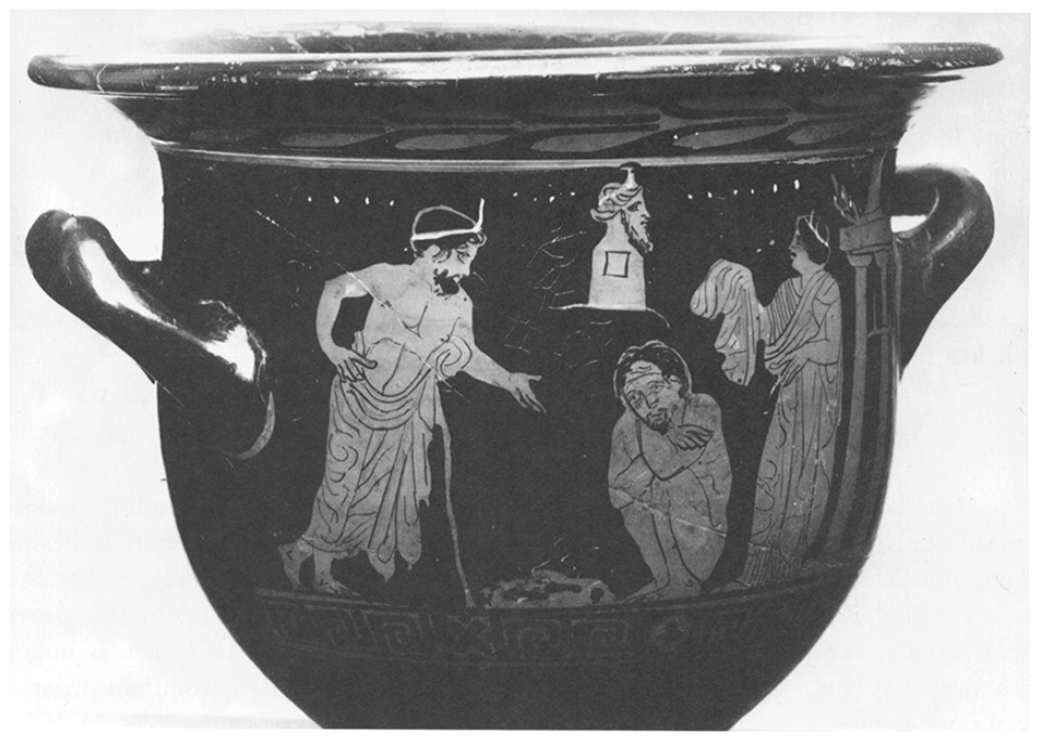
Thought to be perhaps the only surviving ancient depiction of a pharmakos. We are grateful to Dr. Vasso Pliatsika of the National Archeology Museum in Athens for her insights on this artefact, and to Dr. Myriam Fotou for facilitating them.
Central to the proper functioning of the pharmakos ritual is the morally and politically ambiguous duality of the pharmakoi themselves. As Frye (1957: 41–42) puts it, the pharmakos is precisely a ‘typical’ or ‘random’ victim, no more deserving of what happens to him than anyone else would be. . .. The pharmakos is neither innocent nor guilty. He is innocent in the sense that what happens to him is far greater than anything he has done provokes, like the mountaineer whose shout brings down an avalanche. He is guilty in the sense that he is a member of a guilty society, or living in a world where such injustices are an inescapable part of existence. The two facts do not come together; they remain ironically apart.
The ritual derives its mysterious power from the dramatic tension between the constructed ontopolitical ‘guilt’ of the pharmakoi themselves and the necessary moral and political arbitrariness, ambiguity, dissimulation, and duplicity entailed in the initial honoring and celebration of the pharmakoi, followed by their demonization, repudiation, and violent expulsion from the community. Pharmacotic sacrifice in its original form, then, should thus be understood as a kind of staged, ritualized, encoded acting out and displacement of the generalized moral disorder and civil disharmony that tends to accompany existential threats such as war or plagues. This projection transferred the accumulated guilt and remorse onto the scapegoated victim, and then expunged the evil by humiliating, punishing, and casting them out, along with the collective social and political toxins they bore (Bremmer, 2008: 189–191; Burkert, 1982: 59–77; Compton, 2006: 13).
In this way, the sacrificial victim served as a container or ‘poison vessel’ for that evil. Once expelled, the pharmakoi were described as a katharma – ‘that which is thrown away in cleansing, offscourings, the refuse of a sacrifice, purifications’, and the pharmakos ceremony was thus explicitly understood as a mode of collective social and political katharsis (Burkert, 1982: 65; Compton, 2006: 13–16). Their expulsion and disappearance enabled a post-trauma reconstruction of community political identity through selective communal remembering and forgetting. As Allen (2002: 205) has observed, ‘Every year the Athenians remembered to drive out the two scapegoats and to forget about them. Remembering and forgetting happen at the same time, and forgetting is not opposed to remembering but rather another form of remembering. Both are tools to be used in the construction of social memory’. The scapegoats ‘took away everything that could not be called Athenian and left behind only what the city wanted to remember as being Athenian’ (Allen, 2002: 204).
As Fotou (2016: 209n180) explains, Derrida argued that the pharmakos has been compared to a scapegoat whose expulsion from the city or death outside the city walls was deemed necessary at a time of disaster, invasion, famine or plague in order to placate the gods and purify the city’s interior[:] “The evil and the outside, the expulsion of the evil, its exclusion out of the body (and out) of the city – these [were] the two major senses of the character and of the [pharmakos] ritual.
Fotou continues: ‘One cannot fail to notice here the striking similarity between pharmakos with the later, Roman law figure of homo sacer.’ In times of political polarization or crisis, the purification of the city through the expulsions of the pharmakoi could serve as powerful ‘rites of aggregation’, provisionally restoring the unity of the polity and temporarily eliding its internal factional divisions through a process of community reharmonization and reattunement brought about through what Girard (1977: 77–85) calls ‘unanimous victimization’. The cathartic effects on the body politic produced by these rituals were thus simultaneously politically salutary, medicinal, invigorating, toxic, and addictive (Bremmer, 1983: 314–315, 2008; Forsdyke, 2008: 157–165; George, 2002, 2009; Hughes, 1991: 139–144).
In line with the pharmacotic principle that every medicine is also a poison and every poison, in the proper dosage, a potential cure, the punishment and expulsion of designated scapegoats functioned for these communities like the bite of the fiery serpent of Moses, or the diluted snake venom that Greek warriors carried into battle as a salve for their wounds, or the rust from Chiron’s spear that Achilles uses to heal Telephus’s wound inflicted by that same spear. Pharmacotic scapegoating functions like a vaccine or homeopathic microdose of the ontopolitical resubjectivizing that occurs during war itself. The displacement of evil onto and subsequent expulsion of the pharmakoi was described by contemporaries as ‘the medicine that heals the city’, a political therapeia (service, healing, or medical treatment) for any corruption or derangement of the political order (Compton, 2006: 3–4). The collective retribution inflicted on the scapegoat victims served mimetically to assuage or overcome the community’s latent, diffuse, inchoate, unspeakable fears, and expiate its collective guilt for unmentionable or unacknowledged crimes and injustices (on the political semantics of pharmaka, see Derrida, [1972] 2016; Girard, 1977: 295–297; Sissa, 1997; Stiegler, 2014).
It is our contention that echoes of the sacrificial logic at work in this pharmacotic tradition operate today in the treatment of US war-fighters caught up in the double binds of the post-9/11 cycles of mobilization and demobilization. Initially valorized and celebrated, it is well documented that following combat or service (ex-)war-fighters frequently experience alienation, scapegoating, and social exclusion (Belkin, 2012; Bulmer and Eichler, 2017; Higate, 2001; MacLeish, 2013). This article shares with MacLeish’s framing of the ‘churn’ an emphasis on the instrumentalization and fungibility of military life, and the ways in which the military’s waging of war on external enemies is mirrored in its war-like practices against its own personnel. It furthermore affirms with MacLeish (2020) the extent to which individual service members become targets of blame and scapegoating for both the injuries inflicted upon them during service and the violence they waged at the civilian world’s behest.
However, whereas MacLeish points to instrumental calculations of institutional self-perpetuation as the driver of these processes, we argue that there are deeper political, social, and ideological roots to be found. Viewed through the lens of pharmacotic war, this sacrificial logic is echoed in various forms of Western raison d’etat. While we do not claim a linear or causal history, we argue that illustrative resonances are perceptible in the ongoing logic of ritual sacrifice that help make sense of the present: The persistence of pharmacotic violence into the twenty-first century reminds us that all modern polities are politically descended, however distantly, from communities that practiced sacrificial pharmacotic rituals, and suggests the extent to which those communities remain haunted by the originary structuring effects of those practices. (George, 2003: 154)
The remainder of this article substantiates this claim by tracing the pharmacotic drug–poison–cure logic at work in the use of games to attract, produce, and recycle war-fighters. In doing so, it demonstrates that, whether or not they are killed in service, war-fighters’ dual expulsion from the military and civilian worlds contains echoes of the ritually sacrificed pharmakoi of ancient times.
Pharmacotic wargames
The empirical context through which this article examines this sacrificial logic is that of the games used to attract, produce, and recycle war-fighters. The study of recreational games in critical security studies and international relations has proliferated over the last decade (Berents and Keogh, 2018; Brown, 2017; Ciută, 2016; Jarvis and Robinson, 2021; Robinson, 2015, 2016; Salter, 2011). More recently, scholars have begun to examine the military applications of gaming (Hirst, 2020, 2021, 2022; Öberg, 2020; Robinson, 2019), an area of study that had broadly lain dormant since the publication of the second edition of James Der Derian’s book Virtuous War: Mapping the Military–Industrial–Media–Entertainment Network in 2009. Outside the field, important work has similarly traced the relationship between the military and entertainment spheres (Lenoir, 2000; Stahl, 2010). Seeking to contribute to the revivification of this area of study, in the following sections we document the roles played by games in a pharmacotic drug–poison–cure loop of the attraction, production, and recycling of war-fighters.
In the last decade, the US military has been promoting a renewed gaming effort across its recruitment, training, and rehabilitation regimes. Capitalizing on the skillset of the young gamers, commanders and instructors have begun to appreciate the power of gaming as a communication, pedagogical, and therapeutic tool. Officially beginning with the Department of Defense–wide memos issued by then US Secretary of Defense Hagel (2014) and Deputy Secretary of Defense Bob Work (2015), this wargaming renaissance played a significant part in the Third Offset Strategy (3OS) that focused on closing the gap with near-peer adversaries across technological and human domain/dimension capabilities (Hirst, 2020). Gaming has thus become a key element of service members’ experience from the beginning to the end of their careers (Hirst, 2022).
The target of these gaming activities is the potential or actual service member, a figure imbued with manifold ambiguities (Hirst, 2021). Scholars interested in critical military studies, 1 martial empiricism (Bousquet et al., 2020), and embodied sociology (McSorley, 2014) argue that an engagement with those who wage war is key to understanding and challenging global cycles of violence. As MacLeish (2013) explains, service members are at once agents, instruments, and objects of violence, and occupy a tension-ridden positionality through which many of the contradictions of military violences can be perceived. Following this imperative, and Rech’s (2014: 251) suggestion that ‘a critical approach to recruitment and militarism should . . . emphasise the specific effects of military promotion and “becoming military” for individuals’, the article draws in detail on interviews undertaken with current and former service members and wargames professionals in the US military.
The interviews conducted comprise part of a larger project titled ‘Producing Soldiers in a Digital Age’, funded by the British Academy and the Leverhulme Trust. 2 Seventy-three interviews, each lasting between 30 and 90 minutes, were conducted between February 2017 and January 2019. Interviews were held with designers, instructors, trainees, and veterans from the US Army, the US Marine Corps, the US Air Force, the US Navy, and the veterans’ gaming group Stack Up. 3 Thirty-eight interviews were conducted remotely, and 35 in person. In-person interviews were conducted during three fieldwork trips to the United States lasting between one and four weeks, and one fieldwork trip to Sweden lasting five days. Grounded in the critical and qualitative approaches of critical security studies (Aradau et al., 2015; Salter and Mutlu, 2012), the interview data used here are illustrative rather than systematic. As van Puyvelde (2018: 378) argues, interviews of this kind are useful precisely ‘to learn about individual beliefs, perceptions, and preferences’. Drawing upon these interviews, the remainder of this article sets out how, in their own experience, gaming contributes to the sacrificial production of (ex-)war-fighters.
Wargames as drug: Attracting warfighters
Since the end of conscription, the US military has been obliged to develop recruitment strategies to persuade personnel to enroll (Rech, 2014: 245). Involving some combination of incentives, threats, enticements, coercions, and exclusions (Enloe, 2015: 5), this task is not easy. Key to attracting personnel is the promise of ‘adventure and excitement that brings movies, video games, and military recruitment strategies into common cause’ (Crane-Seeber, 2016: 50). As Rech (2014: 245) elaborates, ‘the media of recruitment (posters, TV ads, online games) . . . deploy nationalisms, domestic histories and mythologies of warfare, and mediate anxiety, threat and otherness’ to persuade people to enlist.
Since the turn of the millennium, the US military has begun to understand that games are a powerful strategic communication resource. The launch of America’s Army in 2002 heralded a new era of recruitment games designed specifically to appeal to young gamers to boost dwindling recruitment numbers. Allowing players to participate in training regimes and presenting an appealing version of military life, this first-person shooter game exceeded all expectations, recording 15 million registered players by 2019 (Robinson, 2019: 11). Free to download and playable on console, desktop, and handheld devices, 41 versions of the game have been released to date. In addition, the expanded America’s Army franchise, in association with commercial games developers Ubisoft and Epic Games, has included the release of plastic ‘Real Hero’ action figures based on specific Army veterans (Achter, 2010: 51–54) and the touring Virtual Army Experience (VAE). At a rate of over 2000 per day, teenage and adult visitors at state fairs, air shows, car races, and spring break and music festivals in over forty states have experienced the VAE’s 20–40 minute immersive combat mission simulation in which they fight a terrorist/insurgent enemy using weapons mounted in Humvees and Black Hawk helicopters (Allen, 2009, 2011; Lewis, 2009; Salter, 2011).
The success of America’s Army in boosting recruitment is affirmed by advocates and critics alike. One of its creators claimed that the game is ‘the most cost-effective thing that the Army has ever done in recruiting’, while a survey conducted by the advertising agency Leo Burnett concluded that ‘30% of all Americans age 16 to 24 had a more positive impression of the Army because of the game, and, even more amazingly, the game had more impact on recruits than all other forms of Army advertising combined’ (Edery and Mollick, 2009: 141). Scholars within and beyond international relations have similarly argued it has become the military’s most valuable recruitment tool (Robinson, 2019; Salter, 2011; Schulzke, 2013). As one military wargames instructor explained, I played with toy soldiers and GI Joe and that was my gaming. Today, kids can get on America’s Army and play these web-based games or PS4 or whatever. That’s how they’re building their learning and understanding of military operations before they even come in and sign up. (Interview 11)
As this suggests, and in line with Der Derian’s (1990, 2000, 2003, 2009) analyses of the MIME-NET and ‘virtuous war’, the leisure and military gaming spheres have converged. As Rech (2014: 246) argues, there is now, much as with advertising, a scant difference between military-industrial, media and entertainment industries in the West with the effect that military public relations and recruitment happens at the interstices of reality and fiction, recreation and simulation.
This convergence reflects a reconfiguration of gamers and gaming culture. As one former Marine Corps reservist explained, playing videogames used to be taboo, a geek or a nerd activity. Now it’s become a much more accepted activity. . .. If you went back ten years ago and asked people ‘do you think you could earn a full-time income and support a family playing videogames?’ they would laugh at you. Now you have people whose job is to get up every day and play videogames on Twitch or YouTube. They’re getting paid to play videogames. (Interview 3)
As a former Army sergeant similarly claimed, there’s been a nerd revolution. A big part of it is because games have gotten so much better. The movie industry has started taking on comic book characters and suddenly they’re cool and it’s opened so many doors. I have to say nerds rule the world. It has made it OK to be smart. (Interview 5)
This reconfiguration has led to an increase in the proportion of recruits who are gamers. As one former Army captain noted, ‘it’s becoming more and more popularized and more and more mainstream. Notions like “only nerds or geeks do that stuff” [are decreasing]. I think it’s definitely just a matter of time before this is just standard operating procedure with the military’ (Interview 1). As two civilian games program instructors explained, the military is seeking out people that have had the skills that have come out of our [games design] program. Kids might go in trying to learn game design because they want to make Madden or Call of Duty or Pokémon Go, but all of these skills are being used by all of these different companies and militaries. These organizations are building their own game divisions – they are contracting them out, and even taking some of our training to learn these different skills because they realize that it is a way to train people that reaches not just digital natives [but] just about anybody in a way that engages them. (Interview 8)
The games developed are designed to appeal to existing trends in the civilian gaming world. As one designer noted, ‘the military is using games that do have more of that commercial feel for recruiting’ (Interview 10). As an instructor similarly relayed, ‘even at a recruitment level, you join the military because you get to play with good toys’ (Interview 9).
As scholars have noted, America’s Army seeks to humanize and sanitize the Army and cultivate a public image conducive to boosting recruitment (Allen, 2009, 2011; Lewis, 2009; Robinson, 2019; Schulzke, 2013). As Allen (2009) explains, the Army predictably seeks to frame the experience in a highly scripted manner that communicates a positive message to participants (especially teenagers) about the career opportunities available in the Army. It does this not only through multiple videos, but also through use of America’s Army, the VAE simulation, and multiple recruiters, drill sergeants, Real Heroes, and SMEs. . .This effort to humanize the Army is very intentional.
He continues: ‘The visitors to the VAE are a force that has not yet been mobilized, and the VAE serves as a conduit that could be the first step in actualizing the potential of this labor pool.’ As Salter (2011: 368) similarly notes, America’s Army is ‘a technology of the soldier-citizen – a way for the US government to construct a particular virtual American subjectivity that recognises itself as part of a general war machine even as it abstracts from the corporeal reality of violence’.
In addition, the VAE’s use as a data-mining initiative has been documented. Attendees’ driving licenses were scanned on entry and their inclinations towards joining recorded, after which they received phone calls and emails from recruiters (Allen, 2009; Lewis, 2009). Indeed, the data-management company responsible for collating this material on behalf of the US Army notes on its website that ‘though the VAE will garner much attention for being a realistic and compelling war simulator, the purpose of it is clear – to collect actionable information that allows the Army to recruit more effectively. Every aspect of the experience is geared toward delivering positive messages about the Army and collecting information that can be leveraged post-event’ (Allen, 2009).
America’s Army’s function as a training tool has also been noted. As Allen (2011) explains, prior to signing up, the game immerses players in elements of basic training, including land navigation, weapons testing, and decisionmaking under conditions of stress. Salter (2011: 368–369) similarly notes that AA’s missions are played as a single player training scenarios or cooperative online battles, and involve the accomplishment of specific military goals (the capture or defence of intelligence, VIPs, or the conquest/defence of a strategic space or asset) within a pre-described set of rules of engagement. In this way, AA is a ‘top-down’ shooter, far more over-coded with rules than most.
For these reasons, as Lewis (2009: 13) argues, the VAE is best understood as a ‘twenty-thousand square foot traveling digital simulation built to train the masses to engage the enemy and defend freedom’. The central aim, she continues, is not to sell war to the masses, nor is it an exercise in infotainment. Instead, its goal is ‘to temporarily promote a target market from virtual citizen to virtual hero for the purpose of interpellating this particular set into a full-immersion, didacto-romantic narrative that shapes the meaning of both killing and dying’ (Lewis, 2009: 14, emphases in original). The ensuing sensory overload of the experience, she posits, serves to initiate the players’ symbolic death, and the subsequent recruitment shames the disoriented player for not having already enlisted (Lewis, 2009: 19).
This reading lends weight to Allen’s (2011: 40) contention that the VAE should be read as a biopolitical apparatus that attempts to ‘regulate, analyze, and administer the subjectivities of both soldiers and civilians from the interior, bypassing more localized modes of subject formation traditionally centered at specific disciplinary institutions such as prisons, schools, factories, hospitals, or barracks’. As this suggests, the intervention is not so much cognitive as affective, impacting upon players at both conscious and pre- or unconscious levels. As Allen (2011: 46) explains, like other war games of the past such as Kriegsspiel, civilians and soldiers alike are gaming against an abstract enemy, but this enemy now operates within the framework of biopower, working to produce a ‘hybrid subjectivity’ that is constituted 'outside the institutions but even more intensely ruled by their disciplinary logics’.
In this first step of the pharmacotic loop, games function as a familiar and pleasurable drug, serving as a powerful enticement to service by drawing in recruits who habitually game in their recreational lives.
Wargames as poison: Producing war-fighters
Following recruitment, games are used extensively by the US military to create war-fighters. Military training works by ‘disciplining, monitoring, and cultivating of the body’ (MacLeish, 2013: 11) through a process of ‘breaking it down and subsequently rearranging it in a meticulous and minute fashion’ (Dyvik, 2016: 141). Such a process is at once destructive and generative of body and subjectivity: ‘training breaks you down and then rebuilds you in a different way – that’s the way they make soldiers’ (Green et al., 2010: 1483). Training thus amounts to a process of subjectification through which a person’s mind and body are fundamentally altered, the central aim of which ‘is to reconfigure body-selves towards the functional imperatives of military objectives’ (Paul Higate cited in McSorley, 2014: 116). Alongside the experience of conflict occurs a deep ontological transformation (McSorley, 2014: 117), as well as a normative shift in which troops are taught to take enormous pride in their new bodies, stripped of excess, and their new sense of self. From uniforms to finely toned muscles to posture, the military works to produce a new body with a new identity. (Crane-Seeber, 2016: 49)
Such a process is highly affective, involving the formation of a ‘unit mindset’ bound together by strong familial bonds of brotherhood (Schrader, 2019: 69–70).
Key to successful training is ‘bypassing photoempathetic identification’ (Schrader, 2019: 66, citing John Protevi). This involves the overcoming of conventional behavioral inhibitions, patterns, triggers, and thresholds, bypassed through ‘operant conditioning’ (Protevi, 2009: 146–155). Central to this process is the phenomenon of ‘switching on’ (Basham, 2013: 13; see also Dyvik, 2016: 142; Evans, 2020: 39; Higate, 2013), which refers to the development of ‘new modes of somatic attention’ (Higate, 2013: 115) developed through ‘countless technical compulsions’ (MacLeish, 2013: 12) that produce ‘new ways of moving’ (Evans, 2020: 38). Read in this way, training is about getting a ‘feel for the game’ (Evans, 2020: 48). As a Royal Lancers officer put it, the army is ‘all a big game. “[You must] learn the rules and just play the game”’ (Evans, 2020: 48).
The US military currently uses a range of games in its training regimes, including board games, matrix/seminar games, videogames, and augmented and virtual reality (A/VR) games, in addition to vehicle/weapons simulators and computer-assisted command-post exercises (CPXs). They span the spectrum of strategic, educational, training, and experimental games, and focus on remits including future planning and scenario rehearsal; skills, language, and ‘cultural sensitivity’ training; unit cohesion and morale; and physical and psychological recovery following injury. Games employed by the military are variously developed in-house, by contractors from the recreational games industry, and used ‘off the shelf’ in their commercial form. A number of offices and research teams have sprung up in this renewed effort – including the Defense Wargaming Alignment Group (DWAG) that, through its $10 million incentive fund, funded 58 games by 2017 – along with a central wargaming repository at the Cost Assessment and Program Evaluation (CAPE) group housed in the Office of the Secretary of Defense (OSD), which by 2016 had accumulated over 550 wargames, 260 organizations, and 212 support tools (Gorak, 2016: 5). In addition, wargaming publications and handbooks offering best-practice guidance have proliferated across the services (Joint Chiefs of Staff, 2017; Markley, 2015; TRADOC, 2015), and wargaming programs and courses have similarly increased (Appleget et al., 2016; Bestard, 2016; Norwood and Jensen, 2016; Pournelle, 2017).
In addition, war-fighters’ off-duty gaming is capitalized upon by leadership. Following the logic that even ‘down time’ is often filled with training (Higate, 2013: 116), and that barracks are sites of instruction (Evans, 2020: 39), games bring training into service members’ free time. As one former Marine Corps reservist relayed, ‘my direct commander . . . saw the advantage of it as a competitive strategy, as a motivational strategy. He said: “we’ll get some food down here so you guys can have a tournament”’ (Interview 3). This reflects a broader trend in which ‘late modern military institutions with organizational cultures that increasingly resemble those of their civilian counterparts are also today less prone to rely on nakedly authoritarian means to ensure individual compliance and dependability’ (Bousquet et al., 2020: 107).
Among advocates and critics alike, the effectiveness of games across a range of training areas is affirmed. In the context of the need for adaptive decisionmaking, ‘digital and video simulation (live action figures with a computer-generated image, or CGI, backdrop) develop individual motor skills, but we can speculate that they also increase the desensitization effect of training. Because images are so lifelike, they activate the photoempathic identification present in most. Repetition of the training attempts to produce the desired desensitization’ (Protevi, 2009: 157). As one Stack Up worker similarly noted, I think that videogames have the ability to desensitize people to certain issues. It’s not so much “Hey, am I taking someone else’s life?” It’s “Am I doing my job as I’m told, as I need to do it for the greater good?” (Interview 4)
In addition, because they allow for multiple iterations, games can embed rote training aims through the cultivation of mental and physical muscle memory and new reflex actions. As two military gaming instructors put it, in many training environments ‘there is a desired outcome that is “the preferred outcome”. Games training is designed, through exposure and repetition, for you to learn to “do the right thing”’ (Interview 13). As Evans (2020: 49) explains, the process of becoming a trained soldier and finally acquiring the prereflexive practical sense of the institution (doxa) requires the continual repetition of new ways of moving and holding oneself until . . . the synthesis of knowledge and action come to pervade the soldier’s very flesh until that which was formerly external and alien becomes prereflexive.
As one instructor put it, ‘What you’re trying to do is stimulate learning which is changing the neural pathways. What’s being changed is inside the student’s mind, and so anything having to do with changing the neural pathways in your training audience is learning’ (Interview 12). Two instructors likewise noted, ‘Some games and learning have been used to help people kind of rewire the brain’ (Interview 8).
The implication of this is that ‘contemporary military training cuts subjectivity out of the loop’, at least as we usually understand it (Protevi, 2009: 156). In its place, we find a ‘real-time networking’ collective, created through an ‘application of video games that goes above the level of the subject’. Such ‘affective entrainment’ produces an ‘emergent group’ that functions through distributed decisionmaking. In such a context, it is the group that is the ‘practical agent’, operating at ‘the thresholds of the individual subjectivities of the soldiers’ (Protevi, 2009: 157–158). The profundity of this de- and resubjectification is shown in its continuation after service, and often against the wishes of trainees. (Ex-)war-fighters frequently describe an inability to ‘switch off’ (Higate, 2013: 116). Experienced as ‘a constant state of bodily activation’ (MacLeish, 2013: 118) in which soldiers’ ‘bodies as much as their minds . . . refused to calm down’ (pp. 123–124), a debilitating result is the feeling of being ‘pinned between involuntary sensory impacts and involuntary institutional compulsions’ (p. 56).
Training therefore generates a series of highly disruptive de- and resubjectivizing movements, and often issues structurally contradictory demands of trainees that can result in ‘ego uncertainty’ and risk ‘identity diffusion’ (Belkin, 2012: 39). Such confusion promotes obedience by entrapping service members in ‘confusing webs of double binds’ through intense pressure to perform specific, and often unattainable, behavioral norms – in particular through visions of an impossible warrior masculinity (Belkin, 2012: 34). The particular cruelty of this process is the unavoidable failure that is baked into these processes. As Belkin argues, military masculinity is structured by irreconcilable contradictions that trainees nevertheless commit themselves earnestly to embodying. As Dyvik (2016) also notes, the trainee’s body ‘becomes “the target for new mechanisms of power” on both the individual and collective level’ (p. 141, citing Michel Foucault). The disproportionate levels of homelessness, criminality, substance misuse, mental health issues, sleeplessness, and self-harm experienced by veterans is thus linked not to want of attainment in military terms, but rather to institutional mechanisms of ‘perpetual catch-and-release, [the] boom-and-bust of mobilization and demobilization, anticipating, instrumentalizing, and leaving behind military life’ (MacLeish, 2020: 202). For many veterans, however, this institutional intuitional logic is masked by a framing based on individualized failure. In this second step of the pharmacotic loop, games function toxically like a performance-enhancing poison, by de- and resubjectifying civilians into war-fighters who are then exposed to the harms of combat.
Wargames as deleterious cure: Rehabilitating war-fighters
Following training, deployment, and injury, war-fighters often undergo rehabilitation designed to recycle them back into service. Just as with recruitment and training, the military has found uses for games in the management of (ex-)service members’ ‘damaged or unruly bodies [which are] freighted with an excess of symbolicity that threatens to undermine war efforts and to dissociate injured veterans and civilians’ (Achter, 2010: 47). Since the 1990s, the US military has been exploring the use of games and virtual reality as tools for managing and treating post-traumatic stress disorder (PTSD) and other mental health problems experienced by (ex-)service members. At the center of these developments is the Institute for Creative Technologies (ICT) at the University of Southern California. Under the leadership of Albert ‘Skip’ Rizzo et al. (2010), the ITC team developed Virtual Vietnam in the late 1990s, and more recently Virtual Iraq (later renamed Bravemind), both gamified exposure-therapy systems for treating combat-related PTSD. Currently used at over sixty treatment and research sites, Virtual Iraq is the manifestation of how ‘technological advances in the areas of computation speed and power, graphics and image rendering, display systems, tracking, interface technology, authoring software, and artificial intelligence have supported the creation of low-cost and usable PC-based VR systems’. This has led, its creators explain, to a new discipline of ‘clinical virtual reality’ that promises to transform the future of veterans’ mental health provision (Rizzo et al., 2010: 115).
The use of virtual reality for PTSD treatment has generated interest in the Anglo-American press (Halpern, 2008; Parkin, 2017), but scholarly literature remains scant. As Derby (2016) explains, ‘Virtual Iraq has been spared the critical scrutiny of America’s Army and retail violent video games, perhaps because it is sanctioned as therapeutic and potentially curative under the medical model of disability’. However, the close relationship between training and rehabilitation gaming should give us pause. Prior to creating Virtual Iraq, ITC was a key architect of the Full Spectrum Command training game used in the Army, which was subsequently released under the popular commercial title Full Spectrum Warrior (Derby, 2016). Indeed, it was from this combat training game that Virtual Iraq was developed (Halpern, 2008). Capturing the pharmacotic paradox, the US military uses ‘war video games and other visual culture to promote violence that causes PTSD and, simultaneously, to clinically treat PTSD’ (Derby, 2016). As one interviewee noted, the training aspects are profound, and then after the fact it’s like the opposite effect. [First,] you’re training to desensitize or involve yourself in a situation, or understand a certain weapon system, and then, afterwards, once you get out, you’re able to use it almost to forget that same stuff that you trained for. (Interview 7)
Falling under the rubric of cognitive behavioral therapy (CBT), the ‘prolonged exposure’ or ‘immersive’ approach of Virtual Iraq involves retelling the story of trauma in order to reduce its overwhelming power (Halpern, 2008), thereby restoring the functionality of the service member. The core aim has been to eradicate PTSD symptoms through VRT, thus restoring the client to an able-bodyminded state, or to precondition clients to trauma thus rendering them more able-bodyminded. . .[The] military could also benefit economically by way of reduced 'turnover' of soldiers with mild PTSD. These personnel might be more likely to reenlist if their mental health needs were addressed soon after combat in a progressive manner via early VR assessment and treatment. (Derby, 2016)
The aim, then, is to promote functional recovery.
In addition, the military has faced criticism for the systematic misdiagnoses of conditions in the service of budgetary interests, and investigations into flagship facilities like Walter Reed in the mid-2000s demonstrated entrenched problems with veterans’ care (Enloe, 2010; Howell, 2011). This is compounded by the intense stigmatization of mental health treatment, which, as MacLeish (2013: 120) notes, is repeatedly cited as one of the most significant barriers between troubled soldiers and the balm of medication and psychotherapy: the shame of emotional frailty and debility, the more general stain of mental illness, and the imagined (and false) link between the posttraumatic stress and violent behavior.
Because of this intense stigmatization and the risk of demotion or job loss, interviewees explained how mental health services are often inaccessible. As one former Marine Corps reservist noted, service members are very limited in the help that they can receive. If you are in pain and you’re taking too much pain medication, they’re going to put you out. If you have anxiety or depression, you can’t always get the treatment that you would in the civilian world because they will make you leave. (Interview 3)
In addition, medication and treatment tend to focus on managing the symptoms of, rather than substantively addressing, veterans’ mental and physical injuries, often masking, rather than curing, conditions/symptoms (MacLeish, 2013: 118).
There is a politics to, and vested interests at work in, the governance of (ex-)war-fighters’ mental health and trauma (Howell, 2012: 215). As Edkins (2003: 50) explains, ‘What the therapeutic process attempts to do then is to make the veterans’ feelings of guilt, shame and anger into pathological symptoms. Their feelings are to be overcome, not expressed. They are to accept the route to cure suggested by therapy.’ While the ‘D’ in PTSD has been challenged on the grounds that ‘disorder’ is an inappropriate label (MacLeish, 2013: 127–128; Schrader, 2019: 76n2), the newer diagnoses of moral injury and traumatic brain injury serve to reframe psychological suffering as more closely aligned to (physical) wounds. Despite this, there remains a politics to even revised diagnoses. For example, as MacLeish (2018: 131) argues, at the same moment that it depathologizes sufferers, moral injury reinscribes a problematic distinction between legitimate and illegitimate violence that ‘normalizes and even allies itself with the military apparatus that empowers, disciplines, and exposes soldier bodies and lives’.
Compounding this, (ex-)war-fighters are often made to feel individually responsible for their trauma and the extent to which they are able to recover. As one former Marine Corps staff sergeant explained: my depression came very much from feelings that I had let my team down, and that I was a failure, that I was failing my family and the people that I worked with, the people I trusted. That now my career is ending, right, I couldn’t be a bomb-squad guy anymore – that was real. I was facing the end of my military career. (Interview 6)
Framing the self as an object for improvement, (ex-)war-fighters are evaluated in relation to their conformity with norms of productivity and behavior (Howell, 2011: 107). As Kitchen (2018: 47) notes, in this framing, ‘the functions of security are “responsibilized” down to individuals’, and recovery deemed a reflection of individual effort or will, obscuring the military’s responsibility for both the injury and rehabilitation (Enloe, 2010: 164). A normative pressure is thus applied to (ex-)war-fighters that insists on a ‘new wholeness’ (Achter, 2010: 59) attained by ridding themselves of marks of trauma and disorder (Howell, 2011: 89).
A further instrumentalization occurs when (ex-)war-fighters are deployed in public relations campaigns designed to boost recruitment and legitimize foreign policy misadventures. The use of rehabilitated bodies to present resilience and renewal (Belkin, 2012: 58) serves to protect or enhance recruitment by demonstrating that service members can thrive after combat. As Achter (2010: 64–65) explains, whether they are depicted ‘running alongside the president, biking, lifting weights, or appearing in popular video games, the symbolic rehabilitation of the veterans’ bodies is crucial to recruiting young people to the military’. In the context of gaming, this is most notable in the use of recovered veterans as avatars in American’s Army (Achter, 2010; Lewis, 2009). In such a logic, injury, and the failure to recover from injury, appears as a moral failing on the part of the individual, and this has the effect of silencing questions about institutional responsibilities (MacLeish, 2013: 112, 2018: 131). In this final step – the military’s repurposing of the very same militarized games to recycle the war-fighter back into service – games serve as an ambivalent and even deleterious therapeutic tool for ‘curing’ the mental and physical scars of service that they themselves helped to inflict.
Breaking the pharmacotic loop: Expelling the pharmakoi
If recycling through rehabilitation programs is not possible, a war-fighter may become interpellated as both no longer useful to the military and a problem for the civilian world. MacLeish (2020: 199) describes this process as ‘demobilization’, meaning the point at and process by which war-making subjects become problematic to the institutional and state forces that have no further use for them and to the civil and political orders of peacetime, homefront, or 'post-conflict' to which they are seen to pose a threat.
This transformation occurs, importantly, not because war-fighters rejected or failed some element of their military de- and resubjectification. On the contrary, it is through the successful completion of these processes that (ex-)war-fighters can find themselves beyond utility for the military and intolerable to the civilian world.
Framed variously as an ‘excess’ (Schrader, 2019), a ‘residue’ (Higate, 2001: 453), and ‘surplus bodies’ (Higate, 2013: 113), following service war-fighters often experience a sense of disjuncture with the civilian world and the military. A mutual alienation (MacLeish, 2013: 195) can ensue in which war-fighters pose a challenge to the civilian world because, simply by returning home, they bring foreign wars into their national and local communities (Bulmer and Eichler, 2017: 162). This experience of rift and contempt is often acutely felt by many service members. As one former Army communications officer explained, There’s a big disparity or big gap between the civilian world and the military. They don’t know who we are or what we are. They have so many negative connotations with some of the words they associate us with, like PTSD. They think some of us are broken. They don’t want to go near us because we’re dangerous because we have PTSD, and we’ve been trained to do whatever. (Interview 2)
As this suggests, (ex-)war-fighters are commonly treated as ‘figures of exception, subjects of legally mediated reconciliation, pathologized targets for rehabilitation, or retrospective scapegoats’ (MacLeish, 2020: 199).
War-fighters are at intervals, and with fluctuating evaluation criteria, welcomed into and expelled from the military (MacLeish, 2020). In the early 2000s, the introduction of the ‘moral waivers program’ allowed many previously ineligible people to enlist in the military (Belkin, 2012: 48). From around 2012, a contraction began through which previously qualified service members found themselves deselected. As MacLeish explains, individual soldiers’ worthiness shifted with the Army’s budget and its human resources needs. [Their] physical and mental integrity were directly interwoven with military prerogatives of mobilization and demobilization – that is, the ability to put people and resources in motion for war-making purposes and then to release or abandon them as needed. (MacLeish, 2020: 196, emphasis in original)
For those ejected war-fighters, this exclusion extends into the reintegration programs intended to facilitate their transition into the civilian world. The military emphasizes ‘concerns about the social, political, and economic costs of “failed” transition. A veteran is considered to have successfully transitioned when he or she has adapted to the requirements of civilian society’, demonstrating the nakedly instrumental logic animating reintegration efforts (Bulmer and Eichler, 2017: 166–168). Service members are not effectively ‘untrained’ or ‘unprogrammed’ (Bulmer and Eichler, 2017: 166–168), but are rather left to their own devices to manage ‘the malaise of being sidelined by physical injury, and car crashes, petty crime, breakups, and bad behavior at once exceptionally destructive and normalized by military cultural norms and institutional demands’ (MacLeish, 2020: 195). In short, ‘a soldier or veteran may be called a subject of transition or reintegration, but in practice they are fundamentally framed . . . as a “problem” imposed by demobilization upon the institution and the prevailing social order’ (MacLeish, 2020: 202, emphasis in original).
In addition to their potential or actual exclusion from the military, (ex-)war-fighters describe the experience of being rejected by the civilian world. The logic of service-member rehabilitation relies on a demarcation of ‘an innocent and welcoming “civilian” world into which ex-military subjects might “transition” or “reintegrate”’ (MacLeish, 2020: 196). This logic ring-fences the civilian world as unaffected by, and without responsibility for, the violence of war by excluding those contaminated by it. In other words, the civilian realm’s claims to innocence and clean hands rely, paradoxically, on the failure of the substantive reintegration of (ex-)war-fighters. To admit such figures would be to contaminate the civilian realm with war’s stains. The war-fighter is thus doubly excluded following service, facing expulsion from the military and the civilian world alike. Through this dual expulsion, (ex-)war-fighters are interpellated as a contemporary equivalent of the pharmakoi: once celebrated and heroized, they are ritually sacrificed to absolve the policymaking and civilian worlds of their responsibility for the wars fought at their behest.
Conclusion
This article has argued that the analytic of pharmacotic war can further our understanding of the attraction, production, and recycling/disposal of (ex-)war-fighters when used to examine the games used to recruit, train, and rehabilitate them. Building upon MacLeish’s framing of the ‘churn’ by tracing its drivers beyond the military’s instrumental calculations of institutional self-perpetuation, the article identified historical, political, and ideological echoes in ancient practices of pharmacotic war and violence. In doing so, it demonstrated the extent to which the US war-making apparatus retains at its core a pharmacotic logic structured as ritual sacrifice – understood here not as the death of service members in combat but rather in the routine processes of their attraction, production, and recycling/ejection. Through the lens of pharmacotic war, it showed that this sacrificial logic is not incidental, but rather built into these processes, manifesting not when they go wrong but when they work as intended. As MacLeish (2020: 196) argues, using up and getting rid of soldiers is as crucial a condition of possibility for war as finding and making soldiers in the first place, and the two processes are bound together in ways both highly technical and viscerally intimate.
The article illustrated this by documenting the role of games in this pharmacotic loop, highlighting that the ‘problematic marriage between violence and entertainment, characterized by the very real, disabling consequences of war’ means that ‘the same game structures that are used to recruit young soldiers are recycled for treating the mental disabilities that soldiers acquire in combat’ (Derby, 2014: 19).
One ambiguity generated by this argument is that of the nature of the relationship between ancient and (post)modern sociopolitical and military configurations. In utilizing concepts and practices from the ancient world, we risk implicitly positing that the past can be superimposed upon the present as an explanatory mechanism. Rather than claiming a singular or intrinsic transhistorical Western way of war, or a direct genealogy, we intend here to highlight resonances or echoes of the past at work in martial logics and practices in the present. Despite this ambiguity, it is our hope that the analytic of pharmacotic wargames proves useful in the ongoing scholarly imperative to understand the growing influence of games on the attraction, production, and management of (ex-)war-fighters and their role in the sacrificial regimes of the US war-making apparatus.
Importantly, though they are powerful and enduring, such pharmacotic structures can be, and indeed are being, resisted. For example, and somewhat paradoxically, games are used by veterans for community-building, communication networks, and suicide prevention in grassroots groups like Stack Up (Hirst, 2021). Such repurposing of games – even first-person shooters set in theaters of war – has the capacity to challenge the sacrificial logic of military gaming, enacting a form of everyday resistance through mutual care and deinstrumentalization. Moving forward, further study of the ways in which games and related popular cultural artefacts are being repurposed to challenge the enclosures of the pharmacotic loop will be key if international relations is to grasp the power and potential of gaming within and beyond the military.
Footnotes
Acknowledgements
Aggie Hirst sincerely thanks the current and former US military service members, and wargaming professionals, who gave their time and insights during interviews. Special thanks go to Steve Machuga and his co-workers at Stack Up. She also thanks three research assistants who transcribed the mountain of interview recordings: James Bridgman, Thomas Hooper, and Marion Messmer. She is grateful also to colleagues at the King’s Wargaming Network and the War Studies Writing Sprints team for support and focus, and to Paul Kirby for his encouragement and erudite comments on the text. Larry N George wishes to thank Phil Baker, Tom Biersteker, Mary Caputi, Terrell Carver, Anand Commissiong, Bill Connolly, Stephen Cucharo, Francois Debrix, James Der Derian, Daniel Deudney, Joshua Dienstag, Mick Dillon, Fred Dolan, Tom Dumm, Kennan Ferguson, Jairus Victor Grove, Demetra Kasimis, Elanor Kaufman, Mark Lacy, John Lilly, Charles Mahoney, Kirstie McClure, Jeanne Morefield, Kathryn Morgan, Charles Noble, Anthony Pagden, Davide Panagia, Tejas Parasher, Julian Reid, Mike Shapiro, Giulia Sissa, Dimitris Vardoulakis, Cindy Weber, and Maja Zehfuss, for comments and conversations that have improved this work, and is grateful to Belinda Sunnu and the UCLA Political Theory Workshop, the UCLA Classics Department, and the organizers and participants on several panels at meetings of the International Studies Association, Western Political Science Association, Association for Political Theory, and American Political Science Association for their generous support and valuable insights. Writing time was made possible by the California State University, Long Beach sabbatical leave program.
Funding
The author(s) disclosed receipt of the following financial support for the research, authorship, and/or publication of this article: The empirical research for this project was funded by a Leverhulme Research Fellowship (RF-2018-573\7) and a British Academy/Leverhulme Small Grant (SRG\171460).

Notes
Interviews cited
1. Former US Army infantry and military intelligence officer, by phone, February 2017.
2. Former communications officer, US Army, in person, March 2017.
3. Medically discharged reservist, US Marine Corps, by phone, December 2018.
5. Former sergeant and EOD technician, US Army, by phone, March 2017.
6. Retired staff sergeant, US Marine Corps, in person, March 2017.
7. Former officer, US Marine Corps, by phone, December 2018.
8. Two wargaming professors, by phone, March 2017.
9. Military instructor/professor, by phone, May 2017.
10. Designer/instructor, by phone, February 2017.
11. Instructor, by phone, May 2017.
12. Instructor, by phone, April 2017.
13. Two instructors, in person, March 2017.