




Abstract
Countries all around the world are increasingly coordinating their strategic responses to global health emergencies inside specialized new command centres called emergency operations centres (EOCs). Those bunker-like EOCs are meticulously designed to function as the global health equivalent of war rooms and are rapidly emerging as the internationally preferred sites for ‘making’ global health security in the 21st century. This article advances an in-depth site-ontological investigation into those burgeoning EOC sites. It develops a three-step methodological analytics to reveal the specific economy of prefigurative power that EOCs exude in international relations and names this oligoptical power. The article further shows how this oligoptical power is fundamentally different from the more familiar Foucauldian notion of panoptical power and has very different ramifications as it circulates throughout contemporary international relations. Yet, precisely because the EOC exemplifies this global operation of oligoptical power, the article concludes, it can be considered as one of its international signal institutions – similarly to how the prison was once a critical institutional site for revealing the circulation of disciplinary power, the laboratory for performing the sociological examination of science, and the concentration camp for deepening the analysis of biopower.
Introduction
A very unusual room is located right at the heart of the headquarters of the World Health Organization (WHO) in Geneva. The room is entirely windowless and receives no natural light because it used to function as a basement cinema (Bartsch et al., 2009). Today, however, this room possesses considerable international significance because it serves as the WHO’s flagship Strategic Health Operations Centre (SHOC) – a state-of-the-art complex for coordinating international responses to acute global health emergencies like Covid-19. Among its many notable features, the bunker-like SHOC boasts a suite of automatically retractable computer monitors, a plethora of sophisticated telecommunications devices, and a dense mosaic of wall-mounted TV displays that visualize diverse outbreak data and stream live news feeds sourced from around the world. The SHOC also possesses dimmable ‘smart’ privacy glass, an autonomous backup power supply, an abundant food stockpile and even an airlock entrance – all to ensure that this critical site can continue to operate around the clock amid all of the international political pressures of a global health emergency (November and Leanza, 2014). Characterized by a hushed, concentrated and intense working atmosphere, the SHOC essentially serves as the WHO’s equivalent of a ‘war room’ for managing new infectious disease outbreaks – even if many WHO officials remain apprehensive about this military analogy.
If the SHOC is quite an unusual room, it is no longer unique. More than fifty similar outbreak management centres have recently been built inside national disease control organizations worldwide to improve responses to the growing number of global health emergencies – such as HIV/AIDS, SARS, pandemic flu, MERS, Ebola, Zika, Covid-19 and monkeypox (Christiansen, 2018; Smith et al., 2014). The WHO officially refers to such sites as public health emergency operations centres (EOCs) and defines an EOC as a physical location ‘in which designated public health emergency management personnel assemble to coordinate operational information and resources for strategic management of public health events and emergencies’ (WHO, 2019). Those bunker-like and highly secluded EOCs aim to assemble ‘under one roof’ all the specialist personnel, data and resources needed for managing acute outbreaks. They are thus meticulously designed to carry out a wide array of time-sensitive health emergency management functions – like coordinating strategic and technical meetings, sharing and displaying vital information flows, conducting outbreak surveillance, facilitating risk assessment and communication, undertaking logistics and planning, staging elaborate preparedness training exercises, and hosting official visitors (WHO, 2013: 3–4, 2014: 23). With various international initiatives now pushing for all countries around the world to operate such centres, EOCs are rapidly emerging as the internationally preferred and predominant sites for ‘making’ global health security in the 21st century.
This article initiates the in-depth social scientific analysis of those burgeoning EOC sites through a site-ontological investigation. The article thus builds upon site ontology to expound new methodological analytics that empirically capture and reveal the specific type of prefigurative power that EOCs exude in international relations. The article names this distinct global economy of prefigurative power oligoptical power. Such oligoptical power, the article argues, is fundamentally different from the more familiar Foucauldian notion of panoptical power. The social ramifications of oligoptical power are also very different from those of panoptical power as it circulates pervasively throughout contemporary international relations. Yet, precisely because the EOC exemplifies this global operation of oligoptical power, it can ultimately be considered as one of its international signal institutions – much like the prison was once a critical institutional site for revealing the circulation of disciplinary power, the laboratory for performing the sociological examination of science, and the concentration camp for deepening the analysis of biopower.
Site ontology and emergency operations centres (EOCs)
The global rise of EOCs has unfolded at pace. The first public health EOCs began operating less than two decades ago, when their operation was confined to a few high-income countries. In 2006, for example, one prominent EOC was spawned in the United States of America at the genealogical intersection of two domestic developments. On the one hand, older civil defence practices aimed at managing the fallout of a nuclear attack on the United States expanded after the end of the Cold War, as they sought to embrace a much broader ‘all-hazards’ model for the 21st century. At the same time, the public health field in the United States also widened its scope to incorporate a range of heath-based threats – ranging from biological and chemical terrorism through to emerging infectious diseases (Rose et al., 2017: S126). Catalysed by the events of 11 September 2001 and the rise of homeland security, the US government began creating specialist command centres for managing acute infectious disease outbreaks. In 2006, the US Centers for Disease Control and Prevention (US CDC) thus opened the ‘Marcus EOC’ at its headquarters in Atlanta, Georgia, at a reported cost of US$7 million (including extensive corporate donations). Today, this flagship EOC consists of a 24,000 square foot facility operating ‘24/7’, seating up to 230 people in a mission-control setup, featuring 85 workstations, 9 team rooms, and multiple data and geographic visualization platforms like RedSky, Dragon Fire and Epi-X (US CDC, 2003, 2019).
This move towards operating specialist EOCs soon also acquired an international dimension. In the aftermath of the first SARS outbreak of 2003, several international initiatives sought to formalize the core capacities that every state around the world should ideally possess to strengthen international responses to future infectious disease outbreaks – irrespective of where in the world they initially occur. Designating a central space within government health organizations where all the specialized personnel and vital information systems could quickly assemble in the event of a new outbreak was seen as central to those efforts. Thus, EOCs have also been heralded internationally as the future of outbreak management, and major international initiatives like the International Health Regulations (IHR) and the US-funded Global Health Security Agenda (GHSA) have been pushing for all countries to build their own EOCs moving forward (GHSA, 2014: 22; WHO, 2013: 6). That is why a growing number of new EOCs are now also being built across low- and middle-income countries in the Global South. With more than fifty EOCs already commencing their operations worldwide, EOCs are fast becoming viral sites in the double sense of the word: sites aimed at managing (predominantly) viral outbreaks, but sites now also ‘going viral’ around the world.
What kinds of power relations do these meticulously designed and increasingly networked ‘nerve centres’ of global health security exude in international relations? Methodologically, those power relations can be teased out with the help of site ontology. Site ontology builds upon the philosophies of Martin Heidegger and Ludwig Wittgenstein to contend that ‘the character and transformation of social life are both intrinsically and decisively rooted in the site where it takes place’ (Schatzki, 2002: xi). One of site ontology’s most prominent exponents, Theodore Schatzki (2003: 176), argues that ‘social phenomena can only be analysed by examining the sites where human coexistence transpires’. As EOCs rapidly emerge as the critical sites ‘where’ global health security is now ‘made’, they thus also become highly amenable to further site-ontological investigation (Schatzki, 2002: 63; see also Everts, 2016: 58–59).
When investigating sites, site ontology further distinguishes between two core analytical components: human practices and material arrangements. Practices are ‘organized human activities’ (Schatzki, 2005: 471) – such as ‘religious practices, political practices, economic practices, baseball practices, and cooking practices’ (Schatzki, 2003: 191). This practice dimension of site ontology already forms a key driver of recent interest in international practice theory and other practice-based approaches to the study of international relations (see Bueger and Gadinger, 2018). By now, those human practices have also been widely studied in the literature on global health security – even without explicit mobilization of site ontology. There are detailed accounts of various surveillance practices, governance practices, diplomatic practices, securitization practices, commercial practices for developing new medicines, outbreak simulation practices, data-sharing practices, biosecurity practices and legal practices (see, for example, Rushton and Youde, 2014). Thus, the human practices involved in the contemporary ‘making’ of global health security are increasingly well understood, even as they continue to evolve in response to new infectious disease outbreaks that continue to manifest in the 21st century.
If, however, site ontology is correct to contend that sites are ‘meshes’ of practices and arrangements, then what role does the site’s other constitutive component – its material arrangements – also play in the international processes unfolding around global health emergencies? A site’s material arrangements consist of the ‘set-ups of material objects. Whenever someone acts and therewith carries on a practice, she does so in a setting that is composed of material entities’ (Schatzki, 2005: 472). Thus, site ontology differentiates analytically between material arrangements and human practices while simultaneously ‘acknowledging their intimacy’ (Schatzki, 2019: 36). In notable contrast to human practices, however, those material arrangements have received far less direct analytical attention to date – both from site-ontological scholars of international relations and from specialist scholars of global health security. Here, site ontology can be harnessed further to tease out more explicitly what role these (so far largely neglected) material arrangements also play in the constitution of global health security. Overall, then, the site-ontological approach adopted in this article for investigating the power of EOCs is twofold: it follows site ontology in considering EOCs as crucial ‘sites’ in the contemporary production of global health security and mobilizes site ontology to deliberately shift scholarly focus onto the role that the material arrangements of EOCs play in/alongside the emergent human practices surrounding the management of global health emergencies.
The wider benefit (and even necessity) of analytically foregrounding those material arrangements is that they are profoundly prefigurative of social practice (Schatzki, 2019: 43). Material arrangements, site ontology contends, exert a subtle power of ‘prefiguration’ in the world – a ‘channelling’ set of power relations that essentially narrow the scope of uncertainty by conditioning future responses. Similar to more familiar notions like constraint or enablement, prefiguration essentially refers to how the ‘world channels forthcoming activity . . . how at any time the site of the social prefigures the flow of activity by qualifying the possible paths it can take’ (Schatzki, 2002: 44–45). Schatzki (2010: 140) mobilizes a deceptively uncomplicated example to illustrate this prefigurative power of material arrangements: ‘the pond makes it easy to let thirsty horses get a drink, hard to lead horses directly to the barn from the paddocks’. The materiality of the pond subtly channels the possibilities of future practice just by virtue of being there and by exactly how it is there. The site-ontological notion of prefiguration thus captures how a site’s material arrangements subtly shift the balance of possible future activity in one direction rather than another. Such prefiguration is broadly defined as ‘a qualification of possible paths of action on such registers as easy and hard, obvious and obscure, tiresome and invigorating, short and long, and so on’ (Schatzki, 2010: 140). All this also means that there is quite a radical insight about the nature of power residing at the heart of site ontology: there is always already a significant degree of (prefigurative) power involved in material arrangements simply being present at a site and in exactly how they are present. If that is true, then the material arrangements of EOCs, too, exert such prefigurative power in international relations.
That insight into the sociopolitical criticality of material arrangements opens a wider site-ontological research agenda: to tease out, capture and explore exactly how various material arrangements prefigure the social, and how different material arrangements also prefigure the social very differently. More sustained research is needed here because prefiguration does not just unfold along one singular axis of enablement and constraint – that is, how material arrangements make certain things possible and others impossible. Prefiguration is a rather more complex and multifaceted phenomenon that qualifies future action in a much more diverse manner. Prefiguration always operates along a multiplicity of concurrent registers or axes – such as ‘easier and harder, longer and shorter, more and less expensive, more or less time consuming, of greater or lesser nobility, normatively acceptable or unacceptable, flashier or more reserved, and so on. No theoretical limit exists to how many registers might be involved in prefiguration, either in general or on specific occasions’ (Schatzki, 2019: 43). Indeed, ‘the particulars of material arrangements prefigure the course of practices in indefinitely complex ways’ (Schatzki, 2010: 140). In-depth research is therefore needed because prefiguration is an intricate and nuanced phenomenon, and because different material arrangements prefigure the social in very different ways. Exactly how, then, do the material arrangements of EOCs prefigure contemporary international relations?
A prefiguration analytics: Inventorying, sifting and contact tracing
Before a more in-depth site-ontological investigation into the prefigurative power of EOCs can be carried out, a significant amount of methodological translation work is first required. That is because site ontology is primarily a philosophical body of work rather than a fully elaborated social theory (Schatzki, 2002: xvii), and there are consequently few studies using site ontology for in-depth empirical research (Loscher et al., 2019: 127; see also Bui et al., 2019; Lloyd, 2010; Woermann and Kirschner, 2015). To facilitate a more thorough analysis of the prefigurative power of EOCs, this article therefore builds upon site ontology to methodologically expound new analytics for empirically triangulating this prefigurative power of material arrangements in international relations. These prefiguration analytics consist of a three-step methodological process of site-ontological inventorying, sifting and contact tracing; and below they are mobilized to empirically investigate the material arrangements of a broad array of EOCs operating throughout different parts of the world.
Step 1: Inventorying – What is inside an emergency operations centre?
To capture the prefigurative power of a site’s material arrangements in international relations, the first methodological step is to empirically analyse the detailed ‘setups’ of material arrangements (Schatzki, 2003: 198). Those material arrangements consist of ‘assemblages of material objects – persons, artifacts, organisms, and things’ (Schatzki, 2006: 1864). Methodologically, this empirical analysis is accomplished by performing a detailed inventory of the site. Such site-ontological inventorying identifies, lists and categorizes all the assorted material objects present at a site – including materials that are virtually co-present, like circulating data flows and information infrastructures. That process of inventorying must be equally attentive to what/who is not present, or is even actively excluded, from a site under investigation. This initial process of inventorying must, moreover, explore how all of those material things are present and attend to how ‘these entities are connected to one another . . . [and] form arrangements – of connected entities’ (Schatzki, 2019: 36). The overall purpose of this first methodological step is therefore twofold: to analytically foreground the many different ‘things’ that are materially present at a site and to tease out the rationalities underlying the relational or spatial arrangement of those material objects found at the site.
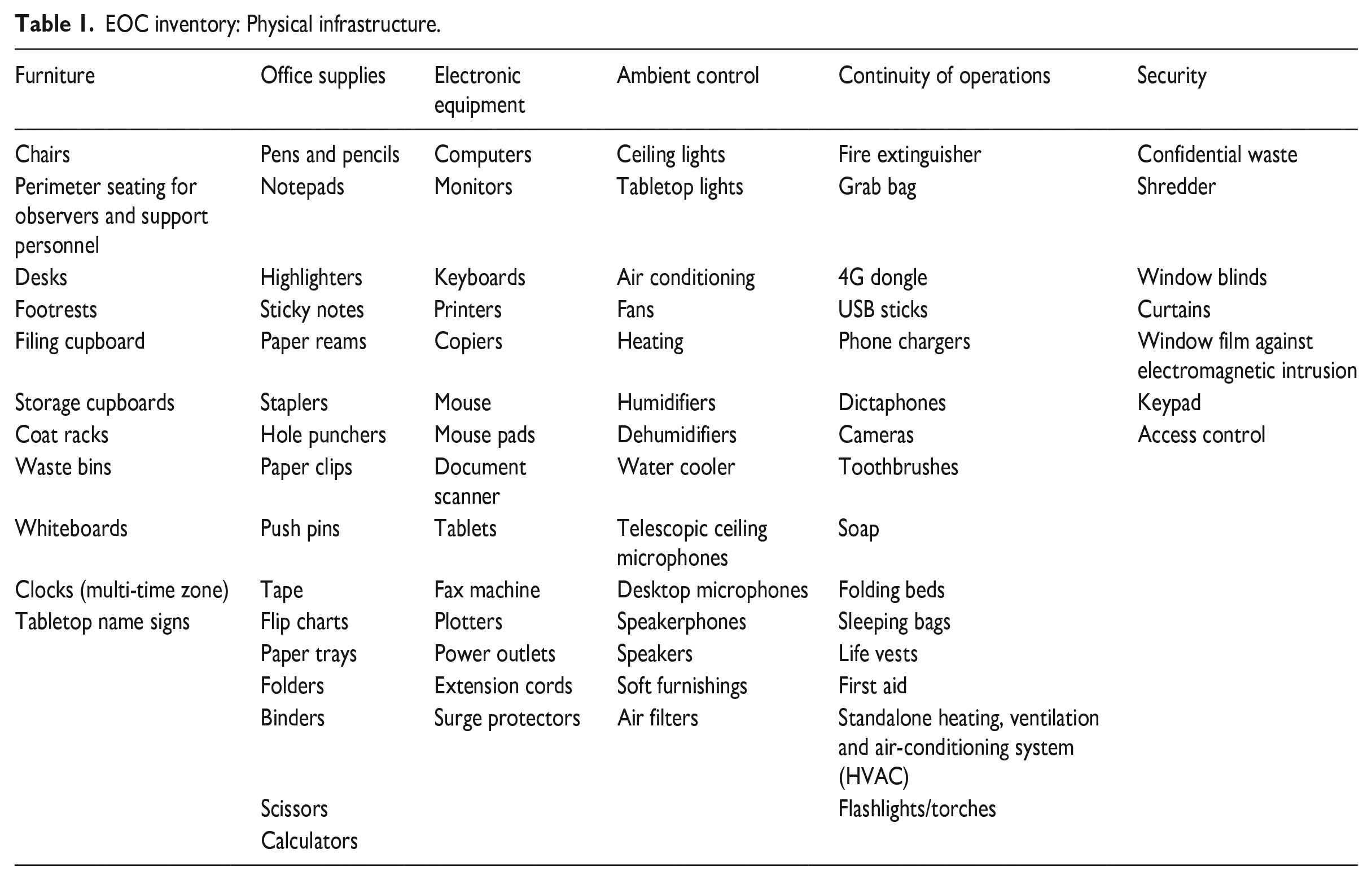
To perform such site-ontological inventorying, this study obtained detailed photographs taken inside more than fifty EOCs located in different countries around the world, operating in a very diverse array of political, socio-economic and cultural contexts. Closer analysis of those photographs revealed EOCs to generally be comprised of three material elements: physical objects, information and human resources (WHO, 2015: 5). EOCs thus consist of a physical infrastructure made up of a plethora of material objects – like furniture, office supplies, electronic equipment, ambient control systems, objects for ensuring continuity of operations and security systems (for a detailed inventory, see Table 1). The inside walls of EOCs are usually also hung with assorted maps, flow charts, organizational diagrams, bulletin boards, posters, flags, institutional emblems or portraits of government dignitaries.
EOC inventory: Physical infrastructure.
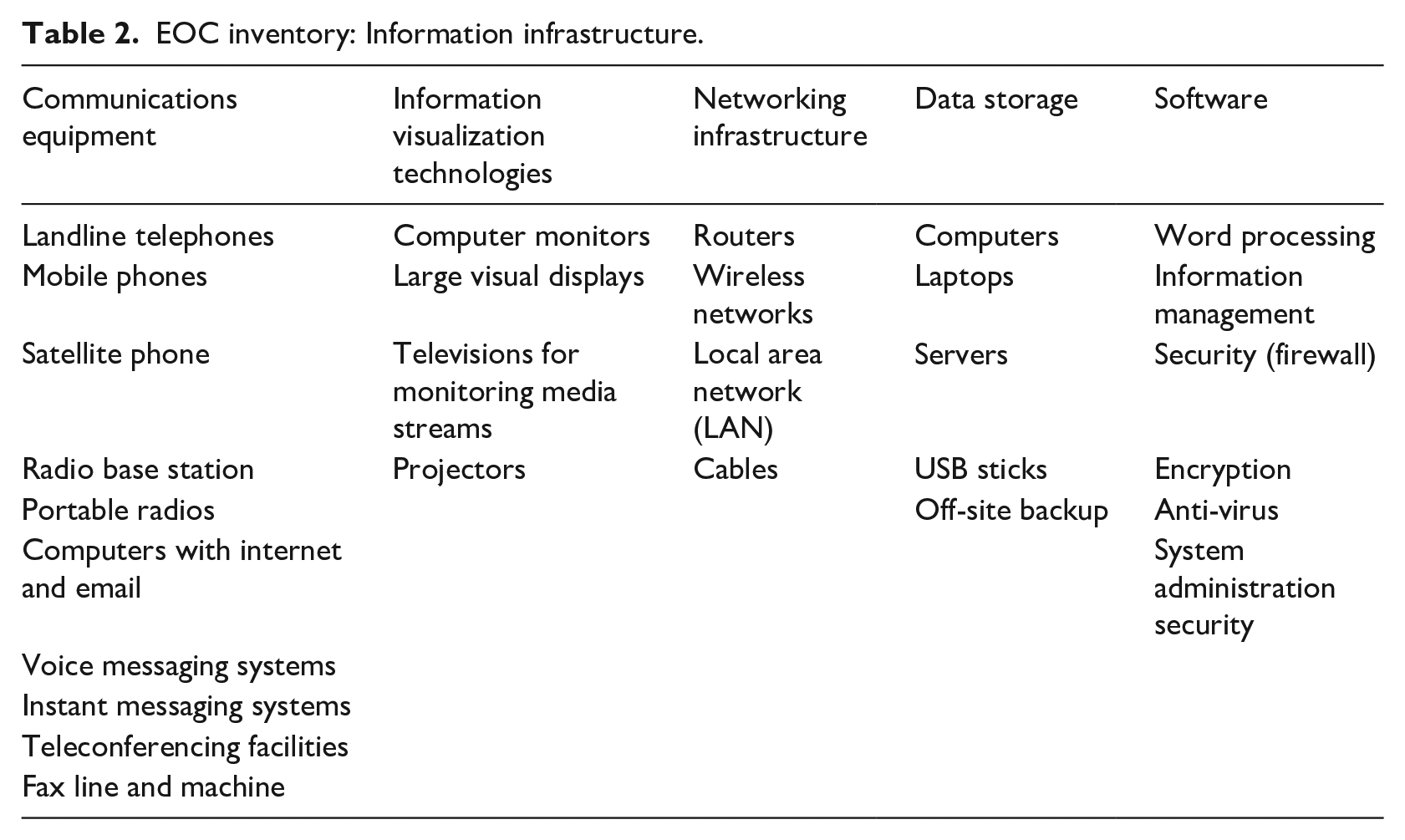
Site-ontological inventorying further revealed that EOCs are extremely data dense. EOCs process high volumes of event-specific information, such as outbreak alerts, surveillance reports, epidemiological data, situation updates and email communications. To manage all these informational flows, EOCs contain an array of electronic communications equipment, information visualization technologies, networking infrastructures, data storage facilities and software (see Table 2). Those information infrastructures utilized for managing the virtual co-presence of abundant data sources mark a second constitutive component of an EOC’s material setup.
EOC inventory: Information infrastructure.
Site-ontological inventorying further revealed that EOCs accommodate an array of human resources. During outbreaks, EOCs are usually crowded with expert health professionals trained in emergency response – but also with many facility managers, with technicians ensuring the functioning of critical technological systems, and with various supporting staff. Most EOCs thus operate strict criteria about who is permitted to enter the room and who gets to ‘sit at the table’, and have provisions from preventing any onlookers from seeing what is happening inside. People routinely excluded from EOCs are those deemed to be surplus to the requirements of managing an outbreak, lay people and members of the public. EOCs also exclude people not cleared to be privy to the sensitive information processed inside EOCs, or indeed anyone whose presence could distract from the concentrated workflows required. Outside of emergencies, by contrast, EOCs are marked by the frequent presence of many visitors, officials and foreign dignitaries – and this proactive hosting of visitors to EOC facilities is frequently identified as part of their official function (WHO, 2014: 23). In the first instance, then, site-ontological inventorying reveals how the material arrangements of EOCs usually consist of a trilogy of constituent components: physical objects, virtual information and specialist personnel.
This initial site-ontological inventorying can also identify the broader rationalities according to which all those material components are arranged inside EOCs. To investigate the logic of those interior EOC ‘setups’ more closely, the study analysed several other source materials like architectural drawings, design blueprints, models, floor plans and virtual tours of selected EOCs from around the world, as well as publicly available international best practice guidelines for EOC designs. Analysis of those additional data sources revealed how critical the rationality of centralization is to the interior design of most EOCs worldwide. The overriding objective driving the internal arrangements of EOCs is to bring all the vital experts and informational flows together as closely as possible, which is why their nomenclature also explicitly designates them as ‘centres’. Thus, all the material objects found inside EOCs are arranged so that everything essential to managing the emergency response can be assembled in a single space – potentially supported by a range of additional auxiliary, support and breakout rooms. EOCs are essentially designed to be extremely dense ‘contact zones’. This dense interfacing work also explains why people usually sit facing one another inside EOCs – allowing for direct visual contact between decisionmakers seated around a single table (or group of tables). The first and overriding rationality guiding the interior arrangement of material EOC setups is therefore one of centralization.
Continuity of operations is a second such rationality. This is because EOCs must be able to operate ‘around the clock’ during a crisis. To achieve such continuity of operations, EOCs usually utilize a shift roster for their assorted personnel. Many EOCs also operate sophisticated systems for calibrating the room’s ambience, allowing them to proactively manage human fatigue and to facilitate long working hours. Often, EOCs are also designed to survive a range of potential natural disasters or attacks, as they need to ‘be physically and environmentally secure, and accessible and survivable in the event of a threat or disaster’ (WHO, 2015: 24). EOCs thus contain many material objects that enable them to better withstand a range of potential disruptions: power cuts (backup generators), physical or terrorist attacks (video surveillance, dangerous goods scanning, access control), fire damage (fire extinguishers, sprinkler systems, grab bags), interruptions to telecommunications (multiple systems, off-site backup), severe weather (storm and lightning defences) and natural disasters (life vests, earthquake defences). Increasingly, EOCs also operate systems to make them more secure against cyber-attacks (WHO, 2015: 25). A second rationality guiding the material arrangement of EOCs is therefore the need for a stable and secure site that can operate continuously throughout an acute global health emergency.
Operational flexibility emerged as a final rationality underpinning the interior design of most EOCs. Health emergencies come in many different forms, ranging from localized outbreaks to national emergencies and major public health emergencies of international concern. Best practice recommendations for EOCs therefore include a recommendation for the use of a modular interior layout that can be rapidly reconfigured at short notice (WHO, 2015: 14). The redesigned EOC at the European Centre for Disease Prevention and Control (ECDC) in Stockholm, for example, can be internally rearranged in different modular layouts (boardroom, mission control, stadium, marketplace, bulls-eye, etc.) in under one hour – depending on how rapidly a response is required, how much information needs to be monitored, and how complex the health emergency becomes over time. This ‘plasticity’ of interior EOC arrangements (see Landecker, 2007) is frequently interwoven with economic considerations. Most public health organizations worldwide operate within a context of considerable budget constraints and experience significant institutional pressure on space. EOCs are therefore often designed as dual-use spaces that can also house a range of more routine and day-to-day functions outside of emergency periods (WHO, 2015: 25). EOCs can, for instance, double as institutional spaces for carrying out job interviews, teleconferencing, hosting workplace socials, and so forth. This diversity of functions explains why the process of inventorying also identified the presence of several unexpected objects inside EOCs – such as party games. Overall, then, this first methodological step of site-ontological inventorying advances the study of prefigurative power by analytically foregrounding all the different materials present at EOC sites and revealing the underlying rationalities guiding their arrangement inside EOCs.
Step 2: Sifting an EOC – Disentangling the practice–arrangement mesh
Following this initial inventorying, the site-ontological analysis of prefiguration further requires a second methodological step: teasing out the prefigurative power exuded by those material arrangements. This second methodological step aims to more closely explore how particular material arrangements enable and transform the human practices unfolding at the site. The ‘social’, for site ontology, is not a question of ‘practices, on the one hand, and material arrangements on the other, but a mesh of practices and arrangements, a mesh in which . . . practices are carried out and determinative of, but also dependent on and altered by, particular arrangements’ (Schatzki, 2005: 473, emphasis in original). Site ontologists have already identified multiple dynamics through which material arrangements can conceivably shape human practices at a site – bearing in mind that those dynamics are prefigurative (making some practices easier and reducing the likelihood that others will occur) rather than being fully deterministic or all-encompassing. Those dynamics include being causally related to a practice, being a necessary condition for an activity to unfold, triggering a reaction in a practice, and helping to disseminate practices across space and time (Schatzki, 2013: 35–36). Thus, the empirical investigation of prefigurative power must also evaluate which of those dynamics (or combinations of dynamics) are most pertinent at any given site. This second step of methodically working through those dynamics and analytically disentangling the relationship between material arrangements and certain human practices can be called site-ontological ‘sifting’.
To perform such site-ontological sifting of EOCs, it was insufficient to rely just on the static photographs used during the initial inventorying. Additional data sources were needed that could shed greater light on how the material arrangements identified during the inventorying interface with the human practices unfolding at EOC sites. Here, the study undertook further documentary and archival analyses of various EOC terms of reference, operational manuals, official reports and formal evaluations of past EOC operations. It also examined a wide range of publicly available video footage showing different EOCs in operation. Sifting through those additional data sources began to reveal the broader dynamics through which the interior material arrangements of EOCs subtly channel the contemporary management of global health emergencies.
Some material arrangements inside EOCs function as a cause, trigger or necessary precondition for specific health emergency practices. For example, EOCs contain a wide array of specialist information technology, telecommunications equipment and software directly configured for managing global health emergencies. These technologies are not readily available elsewhere but are necessary for efficiently coordinating all the diverse data flows that come into the EOC during a crisis. Specific material arrangements inside an EOC can also trigger or cause a practice to take place – like an email alert popping up, a telephone ringing, a piece of critical new data coming in, a significant news report flashing up on the screen, and so forth.
Site-ontological sifting further revealed how some material EOC arrangements adumbrate, or foreshadow, how those emergency response practices are intended to unfold during a crisis. EOCs contain multiple preconfigurative objects and systems like workflow models and standard operating procedures. During outbreaks, for instance, many EOCs deploy an incident management system (IMS) – a common, standardized and scalable organizational model covering management, operations, planning, logistics, finance and administration (WHO, 2015: 4). EOCs can also possess a concept of operations (CONOPs) that ‘describes how and when to engage different branches and levels of government as well as other partners (including international agencies) in the incident management system (IMS)’ (WHO, 2015: 4). This CONOPs lays out in detail how the different policies, functional elements and responsibilities of various organizations will work together during an emergency response. Some EOCs additionally operate within the juridical framework of a broader national emergency response plan (ERP) for responding to multidimensional health emergencies that extend beyond the competency of health agencies alone (WHO, 2015: 4). Such advance plans seek to ensure that all these interagency interactions do not have to be negotiated from scratch amid the acute political pressures of an emergency. Those systems are therefore also repeatedly honed during elaborate training exercises frequently staged inside EOCs – laying out in advance how those practices are intended to unfold during a future crisis (Samimian-Darash, 2021; Skryabina et al., 2017).
Site-ontological sifting finally also revealed how some EOC material arrangements co-disseminate emergency response practices. This is particularly true of information technologies like email, the internet and software that geographically extend emergency management practices beyond the walls of an EOC. Scholars of science and technology studies argue that information and communication technology (ICT) reconfigures relevant spatial and temporal relations to ‘make it possible to maintain one site as central by providing connections from that place to activities located elsewhere, and by tracking those activities against a standardized temporal order’ (Suchman, 1997: 45). The ICTs used by many EOCs around the world similarly create vital connections between control rooms and places that can be tens, hundreds and even thousands of miles away (Jarzabkowski et al., 2015). When a new outbreak unfolds, such ICTs can directly link the personnel inside the EOC with the epidemiologists investigating the latest outbreak in the field. If, for example, a report of a novel outbreak is received from the field, a separate team located inside the EOC can then start mapping the event, contact tracing or initiating any other responses that might be necessary (Everts, 2016: 59). This allows EOCs to support outbreak management ‘at a distance’. Many EOCs, moreover, are also routinely used for hosting media briefings and press conferences during health emergencies, thereby making them sites for socially disseminating emergency management practices to the broader public as well (WHO, 2020).
This second methodological step of site-ontological sifting further advances the overall study of prefiguration. It does so by generating a better empirical understanding of how the material arrangements present at a site enable, give particular form to, but also help to socially embed particular practices (Schatzki, 2013: 35–36). In the case of EOCs, all their material arrangements coalesce to effectively provide experts with a whole new vantage point from which they can now come to ‘see’ new global health emergencies as they unfold in real time – that is, from within the spatial confines of those new, secluded and bunker-like EOCs. Once inside those highly immersive EOCs, experts can begin to ‘see’ outbreaks differently because of the very specific way in which EOCs bring all the various information and data so closely together in one central space – providing health emergency professionals with a much more detailed, focused and comprehensive picture of those global health emergencies as they unfold. Indeed, the meticulously designed EOC interiors begin to resemble a new kind of elaborate ‘scene’ that health emergency professionals can learn to ‘read’ – by considering, interpreting and assembling in real time juxtaposed verbal reports, visual images and communications in a rapidly emerging situation (see also Luff et al., 2000; Suchman, 1997). Thus, site-ontological sifting reveals how the material arrangements of EOCs prefigure a significant epistemological transformation of global health emergency management – offering expert practitioners a new, and different, vantage point from which they can come to see, know and act upon lethal infectious disease outbreaks in the 21st century.
Step 3: Contact tracing – EOC-NET as a global material arrangement
The prefigurative power of EOCs is not confined to what unfolds inside those bunker-like sites, however. Site ontology recognizes that material arrangements can also form wider constellations. ‘Material arrangements’, Schatzki (2013: 34) argues, ‘form intense interconnected networks through which causal processes work, affecting both the arrangements themselves and the human activity that transpires amid them.’ Analytically, those connections emerging in-between material arrangements are just as significant for site ontology, and they mark a crucial mechanism through which practice–arrangement bundles can form wider ‘constellations’ (Schatzki, 2019: 45). This insight about the potential for material arrangements to form wider constellations is particularly pertinent to international relations because it opens the possibility for those broader constellations to be international in scope. Yet it also has methodological ramifications for the empirical study of prefigurative power because it means that material arrangements cannot be investigated solely as isolated and standalone sites. To tease out the full prefigurative power of any material arrangement in international relations, a third methodological step is still needed: to identify, map and explore those broader connections also forming in-between material arrangements. Methodologically, this final process can be accomplished through site-ontological contact tracing.
Such contact tracing entails a significant broadening of the analytical scope. In the case of EOCs, it requires the empirical analysis to move beyond the interior spaces of individual EOCs and to probe the external connections also forming in-between various EOCs located in different countries around the world. To perform this site-ontological contact tracing, the study needed to obtain further data still – sources that were less concerned with the interior designs of individual EOCs but that would reveal more about those equally significant international connections between EOCs. Such contact tracing was performed through a closer analysis of the emerging global network of EOCs called the international Public Health Emergency Operations Centre Network (EOC-NET).
EOC-NET was established by the WHO in 2012 to ‘identify and promote best practices and standards for public health emergency operations centres (PHEOCs), and to provide support to PHEOC capacity building in Member States for effective response to public health emergencies’ (WHO, 2015: 7). The core objectives of EOC-NET are thus to: help states build their EOC capacities; share lessons and experience; identify information needs and solutions; help create shared standards, procedures and protocols; develop tools to improve information sharing among EOCs during health emergencies; and develop training programmes (WHO, 2013: 5). Those international functions make EOC-NET an ideal site for carrying out this final methodological step of site-ontological contact tracing. The study therefore secured access to the comprehensive electronic SharePoint of EOC-NET hosted by WHO headquarters in Geneva. That electronic archive contains extensive official terms of reference, documents, guidelines, manuals, technical standards, reports and presentations regarding EOC-NET.
Such site-ontological contact tracing through EOC-NET begins to reveal the multifaceted international connections also emerging across EOCs operating in different countries. Many EOCs around the world are, for instance, connected mimetically. That is because newly built EOCs are often copies of, or broadly inspired by, the designs of already existing ones. Many new EOCs emerge as the direct result of close bilateral cooperation between one country already operating an EOC and another country requiring assistance to build a new one of its own (US CDC, 2016). During that process of bilateral cooperation, the designs of the existing EOC begin to flow directly into the creation of the new one being built. Alternatively, the design of new EOCs can also be inspired by the international best practice guidelines that EOC-NET has recently developed. Either way, those processes of building new EOCs reveal a deep mimetic connection between many of the EOCs now spreading around the world. They also reveal yet another way in which material EOC arrangements prefigure: by the mere fact of its physical existence, an EOC creates the possibility that others can make copies of it. Yet this international mimetic process can also generate new challenges when different countries must adapt these existing or modular EOC designs to specific local settings and diverse resource contexts in other parts of the world.
Beyond this close mimetic affinity, the contact tracing also revealed robust affective connectivity between many EOCs operating worldwide. In the current international political system, which lacks a central political authority, no sovereign state can be juridically compelled to build an EOC against its wishes. Yet many health organizations that are part of EOC-NET routinely and proactively showcase their EOCs to foreign dignitaries during official visits, which is why the initial inventorying also revealed the frequent presence of visitors inside EOCs during non-emergency periods. The material arrangements of EOCs create an exciting ‘atmosphere’ (see Reckwitz, 2016: 123), and foreign officials can thus experience a strong affective response when visiting a ‘flagship’ EOC. Visitors often experience their tours or visits to an EOC as special enough to subsequently post pictures of those visits on their social media accounts. This strong affective response triggered by EOCs is therefore critical for understanding their rapid global proliferation. Indeed, there is a kind of institutional ‘infectiousness’ that helps to account for why EOCs are ‘going viral’ in the 21st century. This, too, marks a way in which EOCs subtly prefigure the future through the stimulation of such affective international connections.
Beyond this mimetic and affective international connectivity, contact tracing finally also revealed many virtual connections between EOCs. A growing number of EOCs are becoming linked into a new global EOC network – or ‘safety net’ – via EOC-NET. This virtual network essentially seeks to harness the power of information technology to connect dozens of individual national-physical EOCs into an overarching global-virtual EOC. Such a virtual conjoining of EOCs, it is hoped, will help to engender a new global community of shared emergency practice – constituted and sustained by the many professionals becoming attached now to the operation of EOCs all around the world (Brencic et al., 2017: S185). Yet this process of systematically (re)ordering the management of global health emergencies, which is now well under way, also generates new governance challenges. That is because it necessitates the forging of durable connections between a plethora of decentralized EOCs spread across highly diverse institutional, political, jurisdictional, cultural and resource settings.
This global networking of EOCs renders their prefigurative power even more multifaceted and geographically expansive. Beyond the prefigurative dynamics unfolding inside any particular EOC, there are further dynamics engendered by the international connections forming in-between various EOCs. Here, the rapid international proliferation of new EOC sites begins to enable the creation of a mimetically/affectively/virtually interconnected global network through EOC-NET. In site-ontological terms, this international network effectively marks the emergence of a new global material arrangement or constellation. Thus, the final methodological step of site-ontological contact tracing reveals how the material arrangements of EOCs also prefigure a much wider international transformation in health emergency management. The growing number of new EOC sites currently springing up all around the world is encouraging a move away from the informal, ad hoc and largely responsive practices of past infectious disease outbreaks. Instead, those sites are channelling outbreak management towards becoming a much more proactive, strategic and internationally coordinated practice that is increasingly sited within a globally distributed network of capillary EOCs. In the end, the material arrangements of EOCs prefigure both an epistemological and an ontological transformation in the contemporary management of global health emergencies.
Oligoptical power: The prefigurative power of EOCs
The three-step prefiguration analytics expounded above have revealed that EOCs exude prefigurative power in international relations through their material arrangements – much like Schatzki’s earlier example of the pond that makes it easy to let thirsty horses drink but hard to lead them directly to the barn. Yet those prefiguration analytics also do more than that. They make it possible now to capture exactly how those material EOC arrangements prefigure international relations. Three such axes or registers of prefiguration have already been revealed through the prefiguration analytics. First, and just by virtue of being there, the material arrangements of EOCs make it easier (rather than harder) to bring tightly focused epistemic attention to global health emergencies and to produce a highly granular picture of those emergencies. That is because EOCs are new sites specializing exclusively in those events and assembling all the detailed information streams in one compact space. Second, and because of exactly how they are there, EOCs also make it easier (rather than harder) to coordinate strategic responses to global health emergencies – by concentrating all the key actors, information flows and logistical resources closely together in one compact site (WHO, 2015: 15). That is why EOCs are designed to be such small, dense and immersive spaces, with everything relevant to managing a global health emergency coming together in one compact site. Finally, the material arrangements of EOCs also make it easier (rather than harder) to internationally coordinate responses to viruses that proverbially ‘know no borders’ – by allowing a growing number of EOCs from around the world to become virtually connected through EOC-NET. Ultimately, the prefiguration analytics thus capture and reveal how EOCs exude a very distinct economy of prefigurative power in international relations – one that is constituted precisely by the concurrent operation of all three of those key axes of prefiguration.
What might this distinct economy of prefigurative power be called? An apt name for these global power relations exuded by EOCs in international relations is oligoptical power. The notion of the ‘oligopticon’ comes from the Greek word oligo, meaning ‘little’, and was initially coined in science and technology studies. Bruno Latour (2005: 181) used to term to capture a special category of local ‘connecting or structuring sites’ – like scientific laboratories, business offices, and so forth. Latour argued that control rooms of various types are prime manifestations of oligoptica. In his lesser-known work on the city of Paris, for example, he describes how ‘water, electricity, telephony, traffic, meteorology, geography, town planning: all have their oligopticon, a huge control panel in a closed control room. From there very little can be seen at any one time, but everything appears with great precision owing to a dual network of signs, coming and going, rising and descending, watching over Parisian life night and day’ (Latour and Hermant, 1998: 32). In his later work, Latour also mobilizes the example of an army’s command and control centre, which certainly ‘is not “bigger” and “wider” than the local front thousands of miles away where soldiers are risking their life, but it is clear nonetheless that such a war room can command and control anything – as the name indicates – only as long as it remains connected to the theatre of operation through a ceaseless transport of information’ (Latour, 2005: 181–182, emphasis in original; see also Bueger, 2015: 8). As the global health equivalent of war rooms, EOCs are quintessential examples of oligoptica operating in contemporary international relations. EOCs are also small, confined sites that concentrate a wide array of heterogeneous relations relevant to one specific dimension, or ‘slice’, of social life – in this case, the emergence of dangerous new global health emergencies. Unlike the oligoptica described by Latour, however, these EOCs do not just generate an urban, regional or national picture. Their internationally networked nature also allows EOCs to gradually build up a better global picture about the spread of new lethal viruses that proverbially ‘know no borders’.
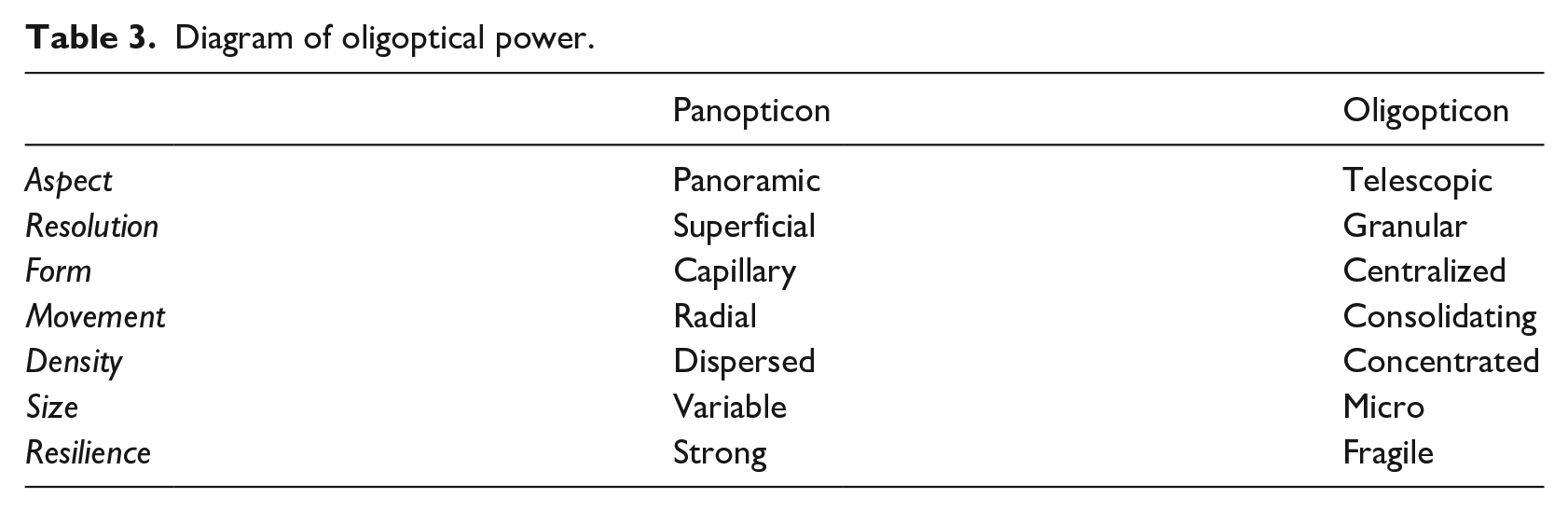
Latour never went on to conceptually develop this notion of the oligopticon in any extensive detail. His written thoughts on the matter are primarily confined to a small number of (often unconnected) references spread across his many writings. Yet it is possible to build upon those scattered references to delineate a broader diagram of oligoptical power that is globally exuded by EOCs. Latour himself, after all, had initially developed this notion of the oligopticon by directly contrasting it with the panopticon – the ideal prison designed by Jeremy Bentham in the 19th century that served as a broader schema for Foucault’s influential analysis of disciplinary power. Oligoptica, Latour argued, ultimately ‘see’ very differently from those much more familiar panoptica: ‘they see much too little to feed the megalomania of the inspector or the paranoia of the inspected, but what they see, they see it well – hence the use of the Greek word to designate an ingredient at once indispensable and that comes in tiny amounts’ (Latour, 2005: 181, emphasis in original). Oligoptica thus make possible ‘sturdy but extremely narrow views of the (connected) whole’ (Latour, 2005: 181); but that also makes oligoptica much more fragile in comparison: ‘Nothing it seems can threaten the absolutist gaze of panoptica, but . . . the tiniest bug can blind oligoptica’ (Latour, 2005: 181).
Schematically, then, the diagram of oligoptical power set out in Table 3 can be conceptually delineated and contrasted with the more familiar Foucauldian notion of the panopticon.
Diagram of oligoptical power.
In the end, the site-ontological prefiguration analytics thus do more than just capture that the material arrangements of EOCs prefigure contemporary international relations; they further reveal exactly how EOCs do so: through an oligoptical (rather than panoptical) diagram of power. This oligoptical power is fundamentally different from the more familiar Foucauldian notion of panoptical power, but likewise circulates very pervasively in contemporary international relations.
What are the broader ramifications of this global circulation of oligoptical power? In his incisive analyses of power relations, Michel Foucault famously argued that not everything is bad, but that everything is dangerous. Here, scholars of panoptical power conventionally point to the dangers of ubiquitous surveillance in society and the pervasive use of information technologies to control people’s private lives. They also warn that the societal circulation of panoptical power eventually culminates in the widespread self-disciplining of individuals. Thus, the standard critique of panoptical power is essentially that it tries to see ‘too much’, and this critique remains highly salient in the age of mass surveillance. What, then, are the concomitant dangers attending the global circulation of oligoptical power, which differs so fundamentally from panoptical power in its nature and operation?
The dangers surrounding oligoptical power are arguably the exact opposite of those of panoptical power. Oligoptical power does not try to see ‘too much’, but rather only sees ‘too little’. There are at least three ways in which the oligoptical gaze of EOCs arguably only sees ‘too little’ in the end. First, we have already seen how EOCs are meticulously designed to be very compact spaces. EOCs need to be physically small to produce a highly detailed and comprehensive picture of global health emergencies, and to also facilitate the dense coordination work that occurs inside those spaces. EOCs can only maintain that small size by operating very tight controls over who is allowed to come inside those spaces. Usually, only a very small number of select experts are permitted to enter EOCs to monitor an acute global health emergency, while everyone else tends to be excluded. Thus, EOCs risk becoming perceived as exclusionary silos, where only a select number of elite and technical public health specialists are permitted ‘to see’ those emergencies as they unfold. Epistemic discrepancies can, furthermore, emerge between how those select experts come to perceive a global health crisis from within the highly secluded and immersive confines of an EOC and what is actually happening outside ‘in the field’. One way in which the oligoptical gaze prefigured by EOCs arguably ‘sees’ only too little is therefore in terms of whom they permit to see those global health emergencies.
Second, EOCs arguably also see ‘too little’ because they only come to know outbreaks as quite exceptional events. The material arrangements of EOCs are geared up to better see global health emergencies, and that is clearly important given the increasing number of global health emergencies manifesting in the 21st century. Yet the growing frequency of such outbreaks suggests that underlying structural factors are also at play. Such structural factors fuelling the current epidemic of epidemics likely include wider social dynamics like global trade, urban expansion and deforestation, increased international travel, a growing world population, intensive agricultural and animal farming practices, wet markets, as well as the trade in animal-based food and exotic pets (Bengis et al., 2004; Daszak, 2020; Piret and Boivin, 2021). Others have also highlighted the role of broader socio-economic forces, such as the structural adjustment programmes that have led to the dismantling of public health services in several areas where outbreaks have occurred (Wallace, 2016). Yet EOCs are designed to perceive infectious disease outbreaks only in the moment of emergency. They cannot readily ‘see’ – nor ameliorate – the broader social and structural contexts out of which these outbreaks repeatedly emerge. A second way in which the oligoptical gaze prefigured by EOCs arguably only sees ‘too little’ is therefore in terms of how they see such global health emergencies – only at the moment of emergency.
Finally, EOCs arguably also see ‘too little’ because their oligoptical gaze focuses so narrowly on just one, and a very specific, set of global health challenges. EOCs are mostly geared up to see acute infectious disease outbreaks that can rapidly cross borders, thus also threatening populations and economies in high-income countries. EOCs are not, however, set up to readily see many other types of infectious diseases that are less acute or less threatening to high-income countries. EOCs similarly struggle to easily ‘see’ many other types of everyday illness and disease, including non-communicable diseases like cancers, cardiovascular diseases, mental health issues, diabetes, and so forth. Yet, in many countries around the world, the daily burden of those diseases still poses a far more significant and pressing societal challenge than the sporadic global health emergencies the world has recently witnessed. Addressing that broader disease burden will likely require longer-term investments in the underlying drivers of poor health, such as inequality, poverty and education. Yet those more ‘routine’ health issues continue to struggle to receive sufficient political prioritization and funding at the international level, and the oligoptical gaze prefigured by EOCs is likewise ill-equipped to capture those broader global health challenges. A third way in which the oligoptical gaze of EOCs arguably only sees ‘too little’, therefore, is also in terms of the highly constrained nature of exactly what kinds of diseases EOCs can see.
In the end, then, there is also a significant social price or cost attached to the oligoptical gaze that EOCs prefigure around global health emergencies. EOCs are only able to generate this intense epistemic focus on global health emergencies by backgrounding and even excluding many other things that are highly significant. EOCs can see with great precision only those types of health issues that are also perceived as being particularly threatening to high-income countries – dangerous infectious disease outbreaks that can quickly cross international borders. Yet EOCs mostly remain blind to the deeper structural drivers fanning those repeated outbreaks, while simultaneously backgrounding many other ‘non-emergency’ diseases that still pose a far more significant social burden of disease in many parts of the world. Ultimately, the prefiguration analytics thus reveal how there is also a subtle violence attending the oligoptical patterns of seeing and unseeing that are increasingly prefigured by a growing number of EOCs operating around the world.
Conclusion
In response to the growing number of new infectious disease outbreaks witnessed in the 21st century, countries worldwide are investing in the creation of new public health emergency operations centres. As those EOCs rapidly become the internationally predominant new sites for ‘making’ global health security, this article has initiated their in-depth social scientific analysis through a site-ontological investigation. The discipline of international relations has so far encountered site ontology mostly through its contribution to the ‘practice turn’ (see Bueger and Gadinger, 2018; Mattern, 2011). Yet site ontology also analytically distinguishes between human practices and material arrangements, and those latter material arrangements have received comparatively far less site-ontological attention to date. This article has therefore sought to rebalance the relatively one-sided appropriation of site ontology in international relations by analytically foregrounding the prefigurative power of material arrangements. Thus, the article mobilized site ontology to show how a site’s material arrangements continually ‘channel’ the possibilities of future activity. This means there is always already a considerable degree of power involved in material arrangements simply being present and in exactly how they are present at a site. To empirically capture and reveal this prefigurative power of material arrangements, the article expounded new prefiguration analytics consisting of a three-step process of site-ontological inventorying, sifting and contact tracing. Those prefiguration analytics contribute to the methodological development of site-ontological approaches, as well as the broader study of materials, materiality and materialization in international relations.
Mobilizing those site-ontological analytics also revealed the specific form of oligoptical power that EOCs exude in contemporary international relations. Such oligoptical power is fundamentally different from the more familiar Foucauldian notion of panoptical power in terms of its nature and operation. Its international circulation is therefore also attended by a different set of dangers. Whereas the widely noted dangers associated with panoptical power are that it sees ‘too much’, the risks associated with oligoptical power are conversely that it sees ‘too little’. Arguably, the oligoptical gaze prefigured by EOCs only sees too little in terms of whom they enable to see such global health emergencies (only a small number of experts), how they enable those global health emergencies to be seen (only at times of emergency), and what global health challenges they can see (only very particular types of disease). Yet, precisely because EOCs exemplify this international circulation of oligoptical power, they can ultimately be seen as one of its signal institutions – similarly to how the prison once served as a key institutional site of investigation for Michel Foucault’s analysis of disciplinary power, the laboratory for Bruno Latour’s sociological analysis of science, and the concentration camp for Giorgio Agamben’s analysis of biopower.
The site-ontological investigation of EOCs performed here also opens several other avenues for future research. In relation to the study of global health security, for example, there is scope for further site-ontological research into the human practices also unfolding inside EOCs. Given site ontology’s insistence that sites are ‘meshes’ of material arrangements and practices, the analysis presented here could be productively complemented with a more detailed ethnographic study of the various human practices taking place inside the highly immersive spatial confines of EOCs. In relation to security studies, furthermore, there is also future scope to broaden the empirical analysis of oligoptical power. What other kinds of oligoptica are operating across different sectors of national and international security? To what extent do their operations mirror or depart from the dynamics encountered here in relation to EOCs? Finally, there is also future scope to mobilize the site-ontological analytics expounded here to undertake a much broader analysis of prefigurative power in international relations. What other types of material arrangements exude similarly strong prefigurative power at crucial sites in international relations? How does the prefiguration of contemporary international relations by those other kinds of material arrangements differ from that of EOCs? Such research would allow international relations scholars to arrive at a deeper and more comprehensive understanding of the prefigurative complexity associated with different kinds of material arrangements in contemporary international relations.
Footnotes
Acknowledgements
I have benefitted from comments and discussions with participants at the ‘Global Health & Diplomacy: Configurations of Knowledge, Power and Policy’ workshop at the University of Vienna, the seminar series on the ‘Geopolitics of Risk’ at the École Normale Supérieure (ENS) in Paris, the ‘Situational Awareness: Sensing Insecurity and Coming Catastrophes’ workshop at the University of Hamburg, and the workshop on ‘Global Health and the Confluence of Science, Technology and Security’ at the University of Sussex. I am also grateful to James Fairhead, Alex Faulkner, Eva Hilberg, Matt Malpass, Kamran Matin, Louiza Odysseos, Anne Roemer-Mahler, Limor Samimian-Darash, Jan Selby, Margaret Sleeboom Faulkner, Dagmar Vorlíček and Louise Wise for commenting on earlier versions of these ideas. I would also like to thank Eva Hilberg for providing research assistance in the preparation of this article.
Funding
This research received no specific grant from any funding agency in the public, commercial or not-for-profit sectors.
