




Abstract
Approaching health security from a practice-theoretical perspective, this article advances our understanding of the everyday and locality in health security decisionmaking, and is guided by the following two questions: How is it determined when a health security threat is likely to be present at a point of entry? What knowledge informs everyday health security decisions at borders? Markedly little is known about health security decisionmaking, though conventional wisdom tells us that health security decisions are based on stringent processes and – importantly – anchored in epidemiological knowledge. The assumed primacy of epidemiological knowledge in health security decisionmaking is well illustrated by the SARS-CoV-2 pandemic: evidence-based responses emerged globally following sophisticated epidemiologic investigation. Are health security decisions always rooted in epidemiology? A 12-month period of non-participant observation of Port Health Officers – who, under the auspices of the 2005 International Health Regulations, are responsible for numerous prophylactic measures at the UK border – gives a unique, privileged entry point for understanding the health security decisionmaking process and tells a story that both questions the centrality of epidemiology and foregrounds the role of tacit knowledge and intuition in health security decisionmaking. This article, which draws on insights from the science and technology studies literature on tacit knowledge, shows how observed health risk taxonomies and corollary decisions in prophylactic border security are predicated almost exclusively on hunches and ‘just knowing’ that something ‘doesn’t feel right’.
Introduction
Approaching health security from a practice-theoretical perspective, this article attends to the routine decisions of, and modes of knowledge mobilized by, frontline actors responsible for prophylactic bordering in the UK. In so doing, it advances our understanding of the everyday and locality in health security decisionmaking. A burgeoning literature attends to questions of how security decisions are made. In particular, this literature considers discretionary security decisions in bordering spaces: when immigration, customs and border security practitioners are ‘empowered to exercise public authority and afforded scope to decide how that authority should be exercised in particular circumstances’ (Pratt and Sossin, 2009: 301; see also Hall, 2017; Heyman, 2009; Pratt, 2005). Notwithstanding, absent from this literature – and, curiously, the vast interdisciplinary literature on health security (for an overview, see Rushton, 2019; Rushton and Youde, 2014) – is consideration of how health security decisions at borders are made. I say ‘curiously’ in the case of the omission from the health security literature because, after all, health security, as a response to the threat posed by (the rapid international spread of) zoonotic, food-borne and/or emerging infectious diseases implies and is invariably understood in terms of spatial segregation: the separation of healthy life from diseased bodies (or disease-contaminated objects), attempts at containing outbreaks, and not least the policing of the flow and movement of anyone or anything potentially threatening to life – exogenous incursions into the social and political body from the ‘outside’. These longstanding, well-acknowledged linkages between health security and borders are discussed at length in the literature (Bashford, 2006a, 2006b; Price-Smith, 2008) and have been made especially conspicuous by the various novel ways in which the response to the currently ongoing SARS-CoV-2 pandemic has been ‘bordered’ (Ferhani and Rushton, 2020; Kenwick and Simmon, 2020). Based on extensive pre-Covid-19 fieldwork, this article sheds light on everyday health security decisionmaking at the UK border and is guided by the following questions: How is it determined when a potential health security threat is likely to be present at a point of entry? What knowledge are health security decisions predicated on?
Writing in mid-2021 against the backdrop of the ongoing SARS-CoV-2 pandemic, perhaps the above questions have yet to be given any rigorous attention in scholarship because the answers seem obvious (probably to the point of being axiomatic). Global public health emergencies are likely to pose intractable and recurring challenges throughout the course of the 21st century (Davies and Wenham, 2020; Harman, 2012; Lakoff, 2017; Wallace, 2016; Youde, 2020). Initially small and localized outbreaks – such as those of Middle East Respiratory Syndrome (MERS), pandemic flu, Ebola, Zika and Covid-19 – all heterogeneous in origin, prevalence, biological characteristics, transmissibility and virulence – in an age of ever-intensifying global circulation ‘can quickly spread across the entire world, killing millions in the process and infecting tens of millions more [bringing] harrowing devastation to lives, livelihoods and economies all around the planet’ (Elbe, 2021: 658). In sum, health security threats are invariably equated in both policy and academia with the rapid international spread of pathogens: contagion. Given this, then, any decision pertaining to the likely presence of a threat at a point of entry – when someone or something is likely to be ‘carrying’ and therefore potentially introducing a health security threat at airports, seaports and ground crossings – must, therefore, presumably be based on stringent processes and, crucially, anchored in epidemiological knowledge: the scientific, systematic and data-driven study of the distribution (who, when and where), patterns and determinants of health and disease conditions in given populations. Here, I am thinking in particular about evidence-based remedial measures, algorithmic epidemiological (‘syndromic’) surveillance (Roberts and Elbe, 2017) and the deployment of recent epistemic developments such as the ability to scientifically analyse genetic sequence information of pathogens in health security governance. Such sequence data can
accelerate the completion of risk assessments by helping scientists to quickly characterise a new pathogen, understand its virulence, identify its likely natural reservoir, and evaluate the overall threat it poses [which in turn] enables scientists to virtually perform molecular epidemiology by comparing the detailed sequences of many different viruses, thereby tracing where, how and how quickly a new virus is spreading geographically. During the recent outbreaks of Ebola and SARS-CoV-2, for instance, analysis of sequence data allowed tracking of their spatio-temporal spread and it showed ‘how different strains crossed borders and spread within countries’, allowing for evidence-based ‘border closures to limit its spread’ (Elbe, 2021: 660).
How could the likely presence of a health security threat at borders possibly be assessed without being rooted in the basic principles of epidemiology? In this article, which draws on an extensive praxiographic study of Port Health Officers (PHOs) in the UK, who are responsible for numerous, routine prophylactic measures at the UK border aimed at preventing the importation of infectious disease, I tell a different, and perhaps surprising, story about health security decisions. The World Health Organization (WHO) publishes official guidance aimed at informing the work of PHOs (and analogous frontline actors in other countries). This guidance stipulates: ‘Public health risks are identified by epidemiological evidence, direct observation or measurement (or any combination of these). The competent authority should evaluate the risk in terms of the epidemiological situation and the severity of the risk’ (WHO, 2011: 21). Despite this, over the course of my observations, something distinctive and unusual was going on: Myriad health security decisions were being made constantly – Huysmans’s (2011: 372) ‘little security nothings’ – and these were witnessed first-hand. However, these decisions were, for the most part, not predicated on measurement, and certainly not predicated on epidemiological knowledge in any way we might expect (i.e. data-driven epidemiology). Instead, PHOs ‘directly observed’ and ostensibly ‘just knew’ something ‘didn’t feel right’ (these phrases were repeated over the year to a point where they began to feel like mantras). On several occasions, practitioners turned to me and said, ‘Yeah, this one will be fine’ (or variations thereof), before starting the sanitary inspection of a ship. This initially took me by surprise: is it really possible to ‘just know’ a threat is present or absent? Are routine health security decisions really predicated primarily and in the last instance on intuition – on gut feelings and hunches? Why was there variability in the decisionmaking I observed? Why did health risk taxonomies and corollary decisions seem to differ wildly depending on the locality of observations? To help answer these questions, and to understand and deconstruct this apparent ‘just knowing’ at the UK border, I turn to the science and technology studies literature on tacit knowledge and intuition.
Why turn specifically to science and technology studies? Though tacit knowledge is one of the lynchpins of practice theory, there is a clear rationale for this manoeuvre: science and technology studies scholars – perhaps more than scholars of any other discipline – have long taken hunches and ‘just knowing’ seriously, and tacit knowledge has long been a ‘fundamental concept’ in thinking about and capturing the workings of scientific knowledge (re)production (Vogel and Dennis, 2018: 836). Illuminating and taking seriously the intricacies of tacit knowledge – defined here in the ‘classical’ science and technology studies sense of personal and private uncodified ‘know-how’ produced through trial and error, which is transmitted from person to person (Collins, 2010), and the pre-logical ‘tacit dimension’ (Polanyi, 1966) – enables us to make sense of and account for intuition in prophylactic decisionmaking. But surely there are stringent protocols to be followed? Indeed there are, and, as the science and technology studies literature suggests, codified, explicit knowledge like the WHO guidance mentioned above – ‘information or instructions that can be formulated in words or symbols and, therefore, can be stored, copied, and transferred by impersonal means, such as in written [“official” or otherwise] documents’ (MacKenzie and Spinardi, 1995: 45), which are seen as universal and devoid of context – should not necessarily be dismissed outright, but it should not be assumed to be the primary driver of the decisions discussed in this article. Moreover, as MacKenzie and Spinardi suggest of science (broadly conceived): if it ‘rests upon specific, hard-to-acquire, tacit skills, then there is a sense in which scientific knowledge is always local knowledge’ (MacKenzie and Spinardi, 1995: 46). This idea, then, goes some way towards helping us understand why decisions are inescapably contingent, as well as why, during the course of the study presented here, they seemed to vary depending on the particular locality in which they were made.
In the light of lacunae in consideration of the forms of knowledge involved in health security decisionmaking in international relations, this article breaks new ground. By drawing on extensive periods of fieldwork, it also presents unique empirical insights into banal, routine health security practice, which is a marked shift away from the histrionics of securitization theory – an approach embedded in the lore of health security research. The discussion proceeds as follows. First, the article begins by setting out the theoretical and methodological underpinnings of the research it presents: conceiving health security from a practice-theoretical stance gave rise to the adoption of appropriate praxiographic methods. In the second section, the article unpacks the idea of tacit knowledge and intuition in greater detail. Bringing insights from the science and technology studies literature, this section gives a nuanced theoretical reading of the apparent hunches in health security decisionmaking. In the third and final section, which is interlaced with vignettes, I demonstrate intuition ‘in practice’ by engaging with the empirical findings of the fieldwork.
Beyond Copenhagen: Health security as practice
The research presented here grew out of frustration with the predominance of securitization theory in the health security literature, and the initial motivation for the research was to consider the everyday workings of health security – something by and large overlooked in the literature. What (if any) physical and mental activities are health security practitioners doing on a day-to-day basis? What knowledge is enacted? What objects are used? In what communities are practices taking place? Where are such routine activities taking place and what do these sites look like? What training (if any) do practitioners receive? How do they make decisions? Such questions are given scant attention in the literature. Seemingly lagging behind the rest of critical security studies, the reliance on a securitization framework has resulted in health security research overwhelmingly focusing on exploring the framing of, and responses to, major outbreak events. The canon is replete with productive and insightful analyses of health crises, or else singular outbreak events, through the lens of securitization, which attend to securitizing actors, speech acts, exceptional measures, referent objects and audience acceptance (Curley and Herington, 2011; Davies, 2008; Elbe, 2006; McInnes and Rushton, 2013; Wenham and Farias, 2019; Youde, 2008). Admittedly, it would be unfair of me to suggest such a focus is necessarily ‘wrong’: writing in mid-2021, during a time of uncertainty and a state of emergency, I am cognizant of the worth and importance of exploring such outbreak events, and, regardless, securitization has opened fruitful lines of enquiry – both pertaining specifically to health issues and more broadly (Balzacq et al., 2016). Notwithstanding, the focus on singular events is superficial: Myriad critiques and revisions of securitization stress that its ‘logic’ is predicated on presentism and decisionism – a Schmittian ‘crisis modality’. Critical security studies has long stressed the significance of looking beyond moments of rupture by showing that security ‘works’ routinely at an everyday level outside the domain of the exception, and not simply in response to singular events (see, for example, Balzacq, 2008; Bigo, 2002; Huysmans, 2006, 2011). Rather than security being totalizing, as is suggested by securitization theory – a coherent modality of problem definition and problem resolution – security is in fact dispersed, unspectacular and not necessarily constructed linguistically through the use of exceptionalist grammar (McDonald, 2008). Such critiques of securitization, which foreground the everyday, were a springboard for this research, and the intention was to advance our understanding of the banal security routines that occupy the ‘space between’ health crises, and the fact that the fieldwork was undertaken pre-Covid-19 afforded unrestricted access to the everyday. I started with a normative given – that health has been linked with national and international security – and, in line with empirical and theoretical developments in critical international relations scholarship typically described as the ‘practice turn’ (Adler and Pouliot, 2011; Bueger, 2014; Bueger and Gadinger, 2015), the desire to move away from securitization directed my attention to practice theory, a collection of conceptualizations that focus on practices – socially meaningful, routinized patterns of action – as the core unit of analysis. Such patterns of action are a combination of (a) corporeal and mental activities; (b) material ‘things’ or artefacts and the ways in which they are operationalized; and (c) the background knowledge that gives practices meaning (this will be considered in more depth in the following sections).
The materiality of practice means that studying security practices entails engaging with security practitioners: seeking ‘proximity’ to the carriers (human or otherwise) of practice. ‘Turning’ to practice means assuming a total change in perspective and adopting a distinctive methodology. This is turn directs us to praxiography: a research strategy that aims to make sense of practices. On one hand, it entails direct observation of practices; on the other, ‘the praxiographer is interested in what is by definition not readily available: the implicit background knowledge. To reconstruct background knowledge requires interpretation’ (Beuger, 2014: 388). Though the two-pronged approach to engaging with practices described here is reductive (see Reckwitz, 2002; Schatzki, 2002), making sense of practices gives rise to the employment of specific methods: in many respects, participant/non-participant observation is the appropriate method for praxiographic research. Moreover, in an attempt to make sense of practices (as they may not speak for themselves) and to access background knowledge, in addition to observation, methods such as expert interviews may have a role in praxiographic research. Likewise, the analysis of documents may be of use – not only elucidating practices but also giving insights into background knowledge: ‘a major type of document for praxiography is manuals and handbooks that provide guidance on how to carry out activities’ (Beuger, 2014: 401).
Accordingly, 12 months between October 2018 and October 2019 were spent undertaking non-participant observation of PHOs at five sites across the UK: Manchester Port Health Authority, Mersey Port Health Authority, Manchester Airport, London Stansted Airport and London Gatwick Airport. PHOs are by training environmental health officers but receive no formal training in port health; instead, they learn and internalize knowledge ‘on the job’. In a reflection of quirks in the historical implementation of health security at borders, they are formally employed in two different ways. At airports, PHOs work within local authorities. So, time spent at Gatwick Airport was with the port health team within Crawley Council; Stansted Airport falls under the auspices of Uttlesford Council; and Manchester Airport is under the jurisdiction of Manchester City Council. At seaports, PHOs work in autonomous bodies known as Port Health Authorities (PHAs). Both PHAs as organizations and PHOs are responsible for two interlinked strands of routine, prophylactic work at the UK border. First is the detection, assessment, notification, reporting and control of public health risks at points of entry in order to prevent the international spread of communicable disease or contamination, which may result in outbreaks. This work ensures that the UK meets its obligations under the 2005 International Health Regulations (IHR), which were constituted to ‘prevent, protect against, control and provide a public health response to the international spread of disease in ways that are commensurate with and restricted to public health risks, and which avoid unnecessary interference with international traffic and trade’ (WHO, 2016: Article 2). 1 Rather than in response to public health events, what amounts to a cordon sanitaire is enacted continuously. Second is the control of imports: material objects (potentially) ‘threatening’ to public health. Here, another prophylactic, exclusionary cordon sanitaire is at play continuously, but is aimed at preventing ‘risky things’ – primarily, though not exclusively, foodstuffs: high-risk animal products potentially carrying zoonoses (hence the link to infectious-disease control) or high-risk foods not of animal origin (‘risk’ due primarily to contaminants that may or may not be naturally occurring) – from entering into the country. In this article, I focus on the first of these two regimes. Moreover, I focus on decisionmaking at seaports. Curiously, though routine infectious-disease controls do take place at both seaports and airports, the mechanisms at the former are considerably much more robust – which, in the light of Covid-19, has caused me to question the veracity of post-millennium global health security. In sum, I have vanishingly little to say about controls at airports because, as will become clear below, there is no ‘aircraft sanitation regime’ to speak of.
PHAs are responsible for sanitary inspections of all international voyaging ships, which are required to hold a valid Ship Sanitation Certificate (SSC), whose issuance is the responsibility of PHAs. 2 SSCs work under the auspices of and are a central (though esoteric) component of the IHR – the ‘primary international instrument and governance mechanism that guides collective behaviour in the event of a disease outbreak’ (Davies and Wenham, 2020: 1235). Representing an agreement between 196 countries, the IHR establish ‘minimum capacities to detect, assess and report public health events’ and set out measures to be implemented at ports, airports and ground crossings to stymie the spread of health risks to neighbouring (if applicable) countries. For their part, SSCs are certificates confirming the absence of public health risks on board ships, the issuance of which follows the inspection of a ship’s galley, pantry/stores, quarters, evidence of vectors/standing water, potable and ballast water, solid and medical waste, engine room and medical facilities. ‘When a public health risk exists, control measures that will reduce the risk to an acceptable level should be identified. The conveyance operator is responsible for controlling any onboard risks. Nevertheless, the competent authority should provide reasonable assistance to identify suitable and relevant control options’ (WHO, 2011: 34). In the case of a public health risk being identified, a Ship Sanitation Control Certificate (SSCC) is issued. Should no risks be identified a Ship Sanitation Exemption Certificate (SECC) is issued. Should risk be identified, control (i.e. remedial) measures equate to environmental, non-pharmaceutical countermeasures such as disinfection or disinsection. In the event of imminent public health risk being identified, PHAs (along with the Maritime and Coastguard Agency) will detain the ship until control measures have been applied.
SSCs are of particular importance for the prevention and control of public health risks on board ships on international voyages. They provide internationally recognized documentation regarding the sanitary conditions of a ship, while reducing the need for further and more frequent inspections of the ship during the period for which the certificate is valid (but with options for additional inspections under certain limited circumstances). (WHO, 2011: 15) SSCs are designed to identify, assess and record any public health risks, and the consequent control measures that should be taken, while ships are in port. Public health risks are identified by epidemiological evidence, direct observation or measurement (or any combination of these). (WHO, 2011: 21)
Throughout my fieldwork, I was privileged to observe over 70 ship sanitation inspections and ‘boarding inspections’ (random spot checks). There is more to the ship sanitation regime than can discussed here (e.g. administration and the requirement for ships to notify port operators/port authorities in advance of their arrival), 3 so the following discussion provides a snapshot of how a ship is inspected: in line with WHO guidance, it details how PHOs board and move around ships, observe and, in turn, identify the presence of (potential) health security threats.
‘Yeah mate, you just know . . . All this is more of an art than science, I guess’: Tacit knowledge and intuition
The previous section established that practices should be understood as a combination of bodily movements and mental activities; material things; and, finally, the background knowledge, which practices depend on – that which gives ‘the social and political its stability and provides for meaningful action’ (Bueger, 2014: 387). This idea of background knowledge needs more attention, though. While practice-theoretical approaches share a number of commitments, their core claim is arguably that
‘the social’, ‘the cultural’, and ‘the political’ are based primarily and in the last instance in implicit knowledge and meaning . . . a type of knowledge which is rarely verbalized and is hence not easily readable from signifiers, speech, and discourse. Practices are . . . the mediator and carrier of such knowledge. (Bueger, 2014: 386)
Numerous scholars have made developments regarding the knowledge underpinning practices. Schatzki (2002, 2005) advanced the idea of ‘background knowledge’, comprised of: (a) practical, ‘hands-on’ understandings, or know-how; (b) rules; and (c) a teleological structuring (i.e. that which sets the expected goal/purpose of a given practice). He suggests that rules are ‘explicit formulations that prescribe, require, or instruct that such be done, said, or the case’ (Schatzki, 2005: 471). The structuring he talks of ‘is an array of ends, projects, uses (of things), and even emotions that are acceptable for participants in the practice’ (Schatzki, 2005: 471). Similarly, Reckwitz’s (2002: 249) take on background knowledge is ‘in the form of understanding, know-how, states of emotion and motivational knowledge’. Both of these incisive, influential takes on background knowledge have made inroads into much of the international relations engagement with practice, and crucially both highlight a distinction between tacit and explicit knowledge. As I noted earlier, the international relations engagement with practice does acknowledge and discuss tacit knowledge – ineffable, practical know-how; however, my feeling during and immediately after my fieldwork was that current work is rather hazy about what tacit knowledge actually is and generally assumes it is aggregate. By this, I mean that tacit knowledge is understood by ‘reference to its opposite’ (Revill and Jefferson, 2014: 599) and tacit knowledge reduced to simply ‘whatever is not articulated’.
Explicit knowledge can be refracted and should be taken to mean a combination of two things: (a) ‘explicit, fully articulable knowledge that can be conveyed from the knower to a recipient by means of language’ (Revill and Jefferson, 2014: 599) and (b) Schatzki’s (2005: 471) rules: ‘explicit formulations that prescribe, require, or instruct that such be done, said, or the case’. These, however, should not be regarded as mutually exclusive. So, with ship sanitation inspections, PHOs may speak to one another either face to face or over the phone and offer guidance about an identified ‘problem’ or ‘risk’ on a ship (this did in fact happen twice throughout the fieldwork). However, in doing so, they may make reference to documents such as the IHR or the WHO (2011) Handbook for Inspection of Ships and Issuance of Ship Sanitation Certificates – that is, rules (‘explicit formulations that prescribe, require, or instruct that such be done, said, or the case’) that give practices context and meaning. Here, our attention turns specifically to tacit knowledge.
Science and technology studies has gone further than international relations in elucidating the specifics of tacit knowledge (Collins, 2010; Hutchins, 1995; MacKenzie and Spinardi, 1995; Mukerji, 2009; Revill and Jefferson, 2014; Vogel, 2006, 2013; Vogel and Dennis, 2018). The following typology of tacit knowledges is not necessarily accepted homogenously across science and technology studies. Notwithstanding, a multiplicity of forms of tacit knowledge can (or, rather, should) be taken into consideration when attending to security and/or international practices. Collins (2010), for instance, speaks of, inter alia, ‘logistically demanding knowledge’, ‘concealed knowledge’, ‘ostensive knowledge’, ‘mismatched saliences’ and ‘unrecognized knowledge’. These can all be regarded as forms of ‘inadvertent’ or ‘weak’ tacit knowledge’: ‘that which could, under certain circumstances, be rendered explicit but either through inability, unwillingness or practicality remains unwritten and implicit’ (Revill and Jefferson, 2014: 599). So, with the above example of PHOs asking each other for guidance, should the advice – the fully articulable knowledge – have been withheld (deliberately or otherwise), for whatever reason, that should be regarded as ‘weak tacit knowledge’. Emphasizing the importance of interaction between experts and/or assimilation, other important nuances in the science and technology studies literature on tacit knowledge include ‘communal’ or ‘collective’ tacit knowledge (Collins, 2007, 2010), which translates into ideas such as ‘local knowledge systems’ (Knorr-Cetina, 1991, 1992; Pickering, 1995). There are two broad conceptualizations of collective tacit knowledge in science and technology studies. The first, typified by MacKenzie and Spinardi (1995), suggests that various types of expertise may (or may not) be incorporated into a given community of practice working towards a common goal. The failure to incorporate expertise as required has the potential to result in stagnation (or, in practice-theoretical parlance, fluidity/ordering). The second is the idea of ‘communally synthesized tacit knowledge’ (Revill and Jefferson, 2014: 603; see also Vogel, 2006; Collins, 2010). This is born of ongoing interactions between experts: such interactions in turn give rise to ‘new forms of knowledge that become integrated in the community, rather than residing in particular individuals [and highlight] the embedded nature of knowledge in the social and infrastructural environment’ (Revill and Jefferson, 2014: 603. Both of these conceptualizations emphasize expert interaction – ‘something that human individuals . . . can acquire, because of their special and continual access to the location of the knowledge – which is the social collectivity’ (Collins, 2007: 261). The prophylactic controls discussed herein are predicated – at least in part – on local knowledge and can therefore only ‘work’ in the individual ‘sites’ – within the context of local systems of practice (Knorr-Cetina, 1991, 1992; Pickering, 1995). To illustrate:
[The PHO] invites me to take a seat in [their office and] begins checking pre-arrival notifications. . .. While several ships are due into the Port today, there have been no requests for SSCs. The ship movements are being crosschecked against a local and European database, and [the PHO] say that this forms the basis of the ‘local’ risk assessment process. The local database is colour-coded and contains details about each ship, as well as ‘sanitary conditions’ on board during last inspection/SSC carried out; same setup with the European database, though this is not colour-coded. The local database is a Microsoft Excel spreadsheet and apparently contains the details of hundreds – maybe more – ships. On entering the details of [the ship], including its port/country of registry, operator, and so on, the ‘sanitary conditions’ are apparently fine, so it is coded green. [The PHO] explains that this, combined with checking the pre-arrival submissions, forms the ‘daily risk profile’, with ‘amber’ and ‘red’ ships being ‘ones to look out for’. No ships are boarded today. (Field observation, January 2019)
The above describes the scrutiny of ships’ ‘pre-arrival’ information (see Note 3), and this vignette stresses the centrality of locally integrated knowledge to the prophylactic decisionmaking process. In this instance, the PHO decided not to act (i.e. not to board any ships due into port that day). Each PHA had conspicuously different and apparently unsystematic ideas about (a) what constitutes/the nature of public health risks, which never actually tallied with the WHO description (see Note 2), and (b) the ‘origin’ of potential risks: one PHO suggested how ‘[they] look at voyages and [are] always asking what risks are associated with particular countries’. The WHO (2011: 7) describes ‘affected area’ as a ‘geographical location specifically for which health measures have been recommended by WHO under International Health Regulations (2005)’. Despite this, while generally conflated with specific countries (i.e. the ship’s port of registry, where it had sailed from) or else with specific shipping lines, risk was conceived in markedly different ways depending on the authority (i.e. within each local ‘knowledge system’): some authorities ‘took issue’ with particular ‘dodgy’ countries (to politely paraphrase one PHO), while others did not. Moreover, this was seemingly never actually predicated on countries being affected as per WHO guidance – in other words, epidemiological knowledge as we would normally understand it.
‘We can know more than we can tell’ (Polanyi, 1966: 4): Tacit knowledge, intuition and security decisions
The final key idea from science and technology studies is somatic tacit knowledge. This is the corollary of the ‘limitations of the human body and brain’ (Collins, 2007: 257): the ‘sixth sense’, typified by the oft-cited example of riding a bike – something our bodies do but that cannot be articulated and thus transferred to somebody else. Instructions along the lines of ‘sit on the saddle and pedal’ or ‘try and balance yourself’ have little to no purchase. Instead, riding a bike is something learnt through trying, inevitably falling off, and trying again. In other words, some actions cannot be learnt from (explicit) instructions. Somatic tacit knowledge – learning by doing – is, in many respects, the ‘classical’ science and technology studies take on tacit knowledge. Though all of the above takes from science and technology studies are incisive, it is somatic tacit knowledge in particular that has profound implications for how we think about the health security decisions I observed, which in turn guides us first towards the tacit dimension and then to intuition. Linked principally with Michael Polanyi’s (1966, 2005) writings about scientific knowledge production (all of the above is indebted to his work), the tacit dimension is a more capacious take on tacit knowledge and also accounts for intuition. For Polanyi (1966), the tacit dimension – pre-logical knowing – is not comprised of simply somatic tacit knowledge (though this is central), but also includes feelings, imaginings, informed guesses and hunches – ‘passions’ – which may inform scientific discovery. Polanyi’s phenomenology does sound, at worst, occult and deeply abstract; at best, simply like highly subjective introspection. However, neurological and biological research does support the tacit dimension and ‘the idea that knowledge is an embodied process and that all our conscious attention is dependent on a whole range of unconscious, tacit processes’ (Nightingale, 2003: 162). Moreover, consciousness ‘is a private, first-person-perspective, subjective phenomena [sic] that brings neural images (like smells, memories and sounds) from tacit subsidiary awareness into conscious focal awareness’ (Nightingale, 2003: 162). Echoing Edelman (1992), from a neurological perspective, learning, categorization and memory are hard to divorce one from one another, and ‘many forms of memory can only be recalled by doing . . .[T]hese include many scientific and technical procedures’ (Nightingale, 2003: 157; see also Anderson, 1983; Edelman, 1989). This directs us specifically towards intuition.
Within Polanyi’s tacit dimension, intuition is the direct product of somatic tacit knowledge and can be taken to mean impulses about judgements or decisions: patterns that have been built up over time and lead to making sense of a given situation and deciding what course of action to take, instinctively, without conscious, deliberate reasoning. To explain: ‘Normal cognitive activity generates a set of mental states or beliefs that allow us to actively pre-empt the behaviour of the world’ (Nightingale, 2003: 160). When predictions turn out to be accurate, this ‘breeds [a feeling of] satisfaction’. On the other hand, when we fail to understand the world and cannot resolve problems, we ‘breed [feelings of] tension and conflict’ (Turro, 1986: 882). These gut feelings are trained during scientists’ apprenticeships so that ‘students who learn to tolerate the tensions that normally accompanies [sic] the process of resolving such intellectual conflicts often feel an excitement that is stimulating and rewarding in itself’ (Turro, 1986: 882). As scientists learn to solve problems, they learn to follow their gut feelings (Nightingale, 2003: 160). Hence, for science and technology studies scholars, intuitive gut feelings are personal – being predicated on individual experience – and have to be learnt ‘in the laboratory’ and cannot be articulated. As there is no formal training for PHOs, ‘gut feelings’ similarly must be learnt ‘on the job’.
‘My inspection starts as I get out of the car – you just know before you even get on’: Intuition in practice
This section explicates how ship inspections work, thereby showing ‘intuition in practice’. There is a clear ‘approach’ to undertaking the inspection of a ship, and clear order in which it is undertaken: an interview; an inspection and a closing interview/issuance (or not) of a new SSC. The sequence of the inspection is derived from explicit background knowledge, or rules – in this case, WHO guidance, which recommends that inspections typically include ‘a preliminary discussion with the ship’s operator or agent and the master on matters relating to the ship’s sanitation systems and procedures’ (WHO, 2011: 27). Moreover, guidance specifies that, as part of this ‘preliminary discussion’, there is a review of documentation, which is sent in advance to PHAs.
Generally, the inspector starts the inspection by introducing the team and outlining the objective of the inspection to the master. The inspector then receives information about operating conditions and safety rules on board from the master. This exchange should occur in a private space, if available. The inspection process is then outlined to the master, and the documentation in place is reviewed. (WHO, 2011: 29)
This is before the inspection itself, which would generally take from one to two hours and entails primarily the ‘direct observation’ of all areas of the ship. As touched on earlier, the WHO suggests that the identification of public health risks is predicated on epidemiological evidence, direct observation or measurement (or any combination of the three). However, my own fieldwork would suggest that what is seemingly at the heart of inspecting ships and identifying risks is direct observation, rather than ‘measurement’ or ‘epidemiological’ evidence.
We get out of the car, put on high-visibility jackets, hard hats, and the PHO takes their rucksack with them. Walking to the ship, the PHO points to the ship, nods and remarks: ‘It’ll be alright will this as it’s a Danish flag.’ We board the ship and introduce ourselves as Port Health, which apparently doesn’t register with the crew . . . Walking along the deck, the officer is having a very good look around – particularly at some small collections/pools of water on the deck. I ask about this and [they] explain about reservoirs/vectors.
4
(Field observation, November 2018) On boarding, we introduce ourselves as ‘quarantine’ and are directed to the ship’s office, and once there we are invited to take seats by the master who shakes our hands and offers us coffee. [The PHO] asks to see the following documentation: the ship’s particulars; the last SSC; crew list; MDH;
5
last ten ports of call; garbage log; waste declaration; last potable water sample; ballast log; sickness log and the ship’s medical certificate. After the document review in the office, a series of questions are asked, the answers to which are recorded down on an ERF form:
6
‘How is the ship, are you all well?’, ‘Any sickness on board?’, ‘Any animals or pets on board?’, ‘Where was your last port of call?’, ‘Where is your next port of call?’ (Field observation, November 2018) From the bridge, we begin to make our way around the ship. Carrying a torch and thermometer with [us], we inspect initially the ‘sanitary conditions’ in the crew’s quarters. [The officer] asks to look in a lower-ranking room. Entering, the officer looks around, holds [their] hand up to the air-conditioning duct and then takes a look in the bathroom. Once again, it is ambiguous what – if anything – [they] are actually looking for: the room is untidy, but beyond that it seems unclear what could possibly pose a ‘public health risk’ in here. Leaving the cabin, I ask [the PHO] what it is [they] are looking for. For once, I get a reply, though after a noticeable pause: ‘Well, it’s getting a sense . . . I don’t know really . . . I guess a feeling for generally how clean the ship is and how well it is managed. Obviously, as well, you know, any reservoirs or any signs of pests. We have ships riddled with them [see Note 4]. You get to know what’s what.’ We then move on to the ship’s hospital, where [the officer] asks to see the medical log and certificate once again, looks through both and questions the first officer about a recent case of ‘fever’ for which the captain prescribed paracetamol. The officer continues to look around, much like during the inspection of crew’s quarters. [Officer] sniffs the bed sheets, then looks up at me and says, ‘It’s often the best way to tell how clean something is.’ Goes into the bathroom and opens the tap and brown water runs out: ‘You need to make sure that all your taps are opened regularly – stuff like legionella grows when the water isn’t moving.’ We go down to the engine room: again, [the officer] is looking around – for what isn’t entirely clear. Finally, we move on to the galley/mess room, as well as the stores. [The officer] asks to see the cleaning schedule and logs, purchasing records of the food, as well as ‘in/out records’, pest record, which [the officer] asks them about – ‘Any cockroaches or anything within the past six months?’ – and finally asks to see temperature records for the fridges. [The officer] looks around the galley/stores vacantly. (Field observation, January 2019) Having carried out the inspection, we all return to the bridge. [The officer] says that everything is fine but to make sure that the kitchen gets a ‘good clean’. A new Ship Sanitation Exemption Certificate is issued: a thick sheet of paper, the PHA seal is adhered in a corner and finally stamped. Copies are taken; handshake with the captain; we are escorted off the ship: ‘Goodbye, sir.’ (Field observation, November 2018)

PHO boarding general cargo vessel (© Adam J Ferhani, November 2018).
The WHO Handbook for Inspection of Ships and Issuance of Ship Sanitation Certificates is nearly 150 pages long and is the official reference on how ship inspections should be undertaken. Is discussed earlier, the Handbook is an explicit formulation of prescribed ‘rules’. The Handbook proposes an order in which inspections could be carried out, and also ‘proposes a sequence of inspection areas’ (WHO, 2011: 135): in other words, which areas it recommends to inspect first, second, and so on (for instance, the guidance suggests starting with crew quarters before moving on to the galley, pantry and service areas):
It follows the rationale that clean areas should be inspected first, followed by technical areas. This sequence enables the inspectors to avoid cross-contamination. In some critical areas like galleys, inspectors should demonstrate good hygiene practice by wearing clean disposable clothing (e.g. aprons, gloves, hair covering). (WHO, 2011: 135)
The Handbook also suggests ‘technical equipment that could be available to ship inspectors to help them inspect ships’ (WHO, 2011: 137) – including devices such as protein-detecting swabs (‘to check appropriate cleaning of surfaces’) and vermin indicator spray, as well as more banal objects such as rubber examination gloves and watertight aprons. Crucially, though, the WHO Handbook has checklists for inspection of particulars in 13 areas: quarters; galley, pantry and service areas; stores; childcare facilities; medical facilities; swimming pools and spas; solid and medical waste; engine room; potable water; sewage; ballast water; cargo holds; and, finally, other systems and areas (WHO, 2011). The galley, pantry and service areas alone have a list of some 43 specific ‘sub-areas’ to be inspected. Some of these are documents (e.g. ensuring there is a food-safety plan in place) that would generally – though not consistently – be reviewed. Some ‘required’ areas – such as identifying ‘food handlers or galley crew members [with] exposed cuts and wounds’ and in turn ensuring that such wounds were covered with a waterproof dressing or otherwise treated in an appropriate fashion (WHO, 2011: 49), or identifying ‘evidence of accumulated soil and grease on previously cleaned food contact surfaces’ (WHO, 2011: 50) – were never once observed. Cargo stores were never inspected, and consequently no risks were identified in that context. Evidence of medicines that had passed their expiry dates in the ships’ hospitals was never identified. Galleys that seemed ‘sanitary’ to me were invariably regarded as ‘in need of attention’ by PHOs; conversely, on one ship, what appeared to me to be rodent droppings were either not seen or overlooked (presumably – or, certainly, hopefully – the former). Technical equipment, most notably devices such protein-detecting swabs (which work by detecting protein residues, which are a sign of contamination), was never carried. Examination gloves were never worn. The sequence of inspections varied depending on the PHO. This is a vanishingly small number from a myriad possible examples.
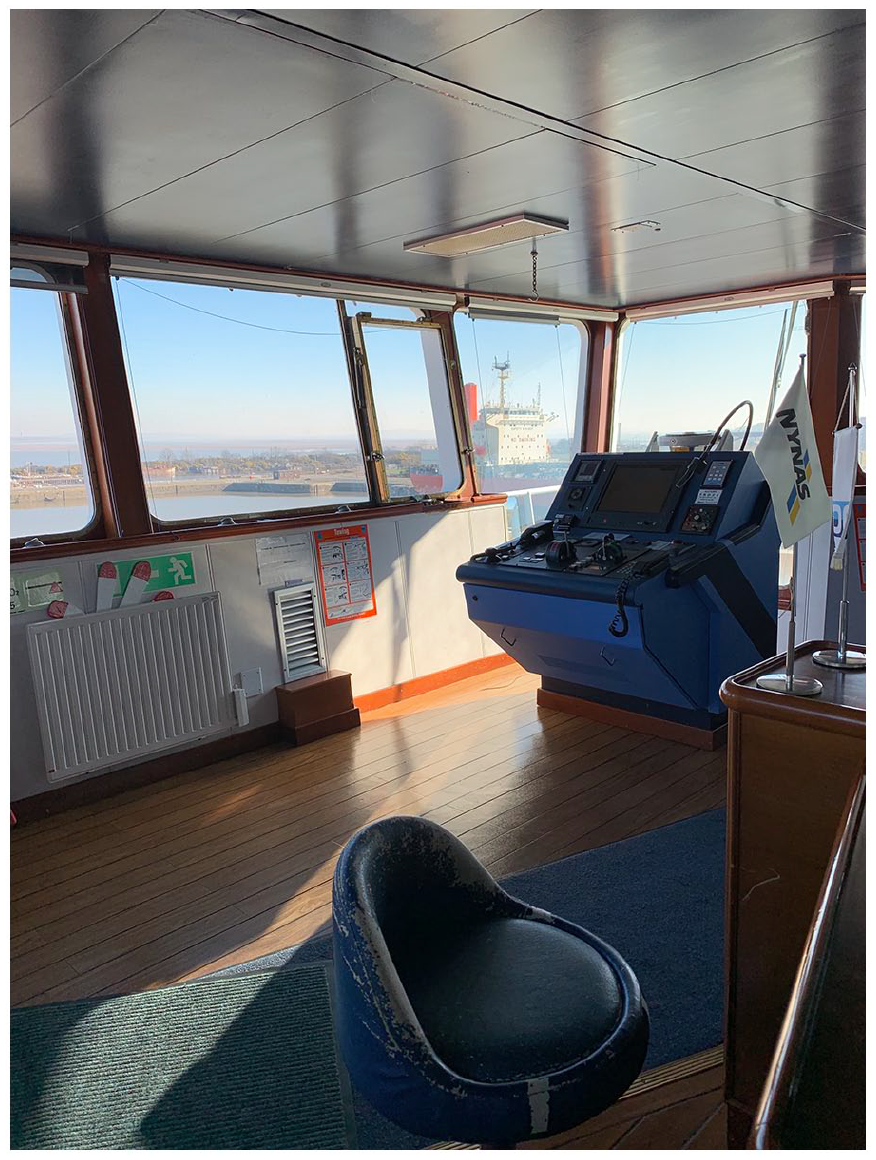
View from the bridge (© Adam J Ferhani, February 2019).
As with the previous discussion of local knowledge, my point here in detailing official guidance (i.e. explicit background knowledge) is that, with this strand of health security practice at least, there is seemingly – for the most part – conspicuous disconnect between explicit background knowledge and what is actually taking place on the ground during ship inspections. However, this is by no means to suggest that explicit background knowledge is irrelevant: the IHR and corollary written ‘rules’ give meaning and context to ship inspections as practice. Similarly, it is also not to suggest that inspections were not robust: on the face of it, the suggestion of disconnect could be construed as my suggesting that, at best, PHOs are lax in undertaking ship inspections and, at worst, months of prophylactic malpractice were observed. I am no expert, after all, and am no position to pass judgement on the vigour of inspections. Instead of suggesting anything like malpractice, in line with the discussion in the previous section, this disconnect instead highlights the role of tacit knowledge generally, though particularly somatic tacit knowledge and intuition. Scientific knowledge production in the public imagination is generally at odds with what takes place in the laboratory. As science and technology studies suggests, the entire idea of trial and error is not consonant with ideals of reproducibility: ‘public accounts of science can differ considerably from informal accounts of how science actually takes place, and these public accounts frequently conceal the importance of tacit knowledge’ (Revill and Jefferson, 2014: 601). 7 Disconnect between the ship sanitation regime’s explicit background knowledge and the actual inspection of a ship is commensurate with the science and technology studies example of riding a bike: ‘[most] humans can demonstrate their knowledge of bike-riding only by bike-riding’ (Collins, 2007: 258). Here, the fact that PHOs could not once articulate to me what they were actually looking for on board is not because it could not be formalized per se; rather, it remained tacit because their knowledge could only be demonstrated in the act of undertaking a ship inspection. Put differently, the quotidian decisions attended to herein are predicated primarily, and in the last instance, on personal, practical know-how: beyond instances of looking for specific evidence of public health risk on board vessels as outlined by the WHO (e.g. signs of vermin or other vectors, or looking over ‘required’ documents), by and large, in the words of one PHO, what is at play is primarily looking around and ‘getting a sense [or] a feeling for generally how clean the ship is’.
As PHOs ‘get to know what’s what’ over time – which does make sense insofar as there is no formal training and they instead learn ‘on the job’ – then ‘just knowing’ that something ‘doesn’t feel right’ can be construed as tacit knowledge in practice. Put differently, this ‘just knowing’ – rather than anything occult – is intuition, which is the direct upshot of tacit knowledge: patterns built up over time (‘on the job’), making sense of a given situation (the presence of public health risks on board vessels) and deciding on what course of action to take (whether to issue a SSC or otherwise), instinctively, without conscious, deliberate reasoning. ‘Gut feelings’ are personal – based entirely on individual experience – learnt not ‘in the laboratory’ but on the bridge, in the galley or on the deck. As such, they cannot be articulated. This, in turn, gives rise to ‘a priori (intuitive) backdrop of expectations’ enabling ‘instantaneous comprehension or apprehension of an object or an event in the past, present, or future’ (Turro, 1986: 886, 900). This pre-logical knowing acts an unconscious ‘filter’ and therefore contours conscious prophylactic decisions.
Conclusion
How is it determined when a potential health security threat is likely to be present at a point of entry? What modes of knowledge are health security decisions predicated on? My inspiration for this article stems from an observation from the field: that during my 12-month praxiographic study of PHOs and lengthy periods of non-participant observation, for the most part practitioners seemingly ‘just knew’ something ‘didn’t feel right’. Rather than seeing, as I assumed (wrongly) would be the case, decisions being anchored in epidemiological knowledge – the scientific, systematic and data-driven study of the distribution (who, when and where), patterns and determinants of health and disease conditions in given populations – instead, I witnessed frontline practitioners primarily making prophylactic decisions based on something intangible: hunches and gut feelings. Accordingly, defining tacit knowledge in the ‘classical’ science and technology studies sense of uncodified ‘know-how’ produced through trial and error, this article presented a nuanced reading of the ‘just knowing’ that underpins everyday health security decisions. Accounting for not just tacit knowledge but also the pre-logical ‘tacit dimension’ (Polanyi, 1966) enables us to make sense of and account for such intuition and hunches. Personal, practical know-how gives rise to intuition, which is, in turn, experience translated into practice: impulses about judgements or decisions patterns that have been built up over time and lead to making sense of a given situation and deciding on what course of action to take, instinctively, without conscious, deliberate reasoning. These intuitive ‘gut feelings’ are personal – being predicated on individual experience – and have to be learned ‘on the job’: ‘a priori (intuitive) backdrop of expectations’ enabling ‘instantaneous comprehension or apprehension of an object or an event in the past, present, or future’ (Turro, 1986: 886, 900). Given that there is no formal training for PHOs, these ‘gut feelings’ similarly must be learned ‘on the job’. In sum, this article advances our understanding of the everyday and locality in health security decisionmaking.
So what? What possibilities does this article open up for the political and for research? How should this article lead us to think differently about health security decisionmaking and health security more broadly? Unfortunately, my overall message in this article is probably not going to offer much in the way of comfort or reassurance (far from it, in fact) with regard to health security or indeed pandemic control. It would be remiss of me to neglect the obvious at this point. World events have happened since this fieldwork, which attended to some of the routine practices enabling and maintaining the International Health Regulations – the ‘primary international instrument and governance mechanism that guides collective behaviour in the event of a disease outbreak’ (Davies and Wenham, 2020: 1235) – which were instituted to ‘prevent, protect against, control and provide a public health response to the international spread of disease in ways that are commensurate with and restricted to public health risks, and which avoid unnecessary interference with international traffic and trade’ (WHO, 2016: Article 2). Ship Sanitation Certificates – as a central though neglected preventative or prophylactic component of the IHR – are meant to keep us safe? This? If I had told you, outside the context of this article, that one of the key insights from my time at the coalface – the only real frontline of defence against nasties such as the SARS-CoV-2 virus – is that practitioners paid attention to features that they learned to treat as revealing, such as how the smell of bed linen can give important clues to the likely presence of a health security threat, you would probably have laughed and looked at me incredulously, to say the least. I appreciate that this might not be the case in other communities of practice responsible for ship sanitation inspections (and that may well form the basis of a future, fruitful research agenda). Notwithstanding, while I have not necessarily sought to downplay sophisticated prophylactic mechanisms (such as surveillance systems), this article has shed light on a rather unsophisticated, obsolete regime – one, for the most part, curiously devoid of epidemiological knowledge. If there is a form of legitimacy being given to security decisions through their assumed anchoring in epidemiological knowledge, what does this mean for locating intuition at the prophylactic border against an assumed ‘scientific’ backdrop’? If, increasingly, in the context of increased automation and standardization in decisionmaking the legitimation for bordering decisions is technology and, therefore, how decisions are embedded in technicized (i.e. algorithmic) bordering, what does this mean for intuition at the prophylactic border? The foregrounding of intuition in this article raises important questions about the modes of knowledge underpinning and legitimating health security – something international relations needs to pay closer attention to.
Footnotes
Acknowledgements
Sincere thanks to the anonymous reviewers for judicious and generous comments on earlier iterations of this article, as well as to the editorial team of Security Dialogue for their efforts and generosity throughout such a trying time. Thanks to Simon Rushton and Lisa Stampnitzky for their comments on earlier versions.
Funding
The author disclosed receipt of the following financial support for the research, authorship, and/or publication of this article: Funding from the Economic and Social Research Council (ESRC) under Grant no. ES/J500215/1 is gratefully acknowledged.
