




Abstract
This article uses the example of the Mogadishu International Airport zone and takes a spatio-temporal lens to explore how (sovereign) power unfolds in international interventions that aim at building a sovereign state. I show that the Mogadishu International Airport zone emerges as an elastic frontier zone that contradicts the sovereign imaginary intervenors aim to project and undermines many of the taken-for-granted boundaries that states tend to produce. The Mogadishu International Airport and similar zones emphasize the centrality of logistics and circulation in interventions, but also point towards their temporal and liminal character. Modularity became the material answer to the demand to secure circulation while adapting to the rapid rhythm and short timeframes of statebuilding. Modular designs enable the constant adaptation of the intervention terrain, allow intervenors to deny their power and imprint and facilitate the commercialization of supply chains and intervention materials. Sovereign power that operates through such zones becomes modular itself. It is exercised as an adaptable, in parts exchangeable, and highly mobile form of power that operates through crises and emergencies. The spaces and materials created by modular forms of sovereign power remain elusive, but nonetheless stratify experiences of power and security.
Introduction
This article uses the example of the Mogadishu International Airport (MIA) zone to investigate how international interventions materialize. It asks in which power relations these materializations are imbued and what meanings they emanate; it also explores what they tell about the way sovereignty is imagined and how sovereign power unfolds. The MIA zone comprises a fortified area in Mogadishu, from where the United Nations and many other international actors are rolling out programmes aimed at building a state while alleviating human suffering and fighting an Islamist insurgency. In the absence of a (functioning) central government and state apparatus, international actors have taken on crucial governing functions, jointly with national, regional and local actors. 1 While building a state, international actors arrange, order, erase and take control of space. The spaces they generate, however, emerge in stark tension to the sovereign imaginary that depicts state and government as unitary and the government as a supreme authority exerting its rule over a demarcated and nationally integrated territory and its people. I differentiate between sovereignty as ‘hermeneutic category – a way of understanding and representing the world’ (Walker, 2006: 155 – and sovereign power as a practice of establishing sovereignty, a power that may neither be exercised by state actors nor take state form (Edkins and Pin-Fat, 2004: 3). Sovereignty, thus, can be conceptualized as an idea and aspiration that shapes a variety of, at times contradictory, (spatial) practices through which political authority attempts to project itself as a central and supreme authority overcoming political fragmentations and societal divisions (Hansen and Stepputat, 2005: 3–4). Statebuilding interventions follow this aspiration, but the spaces they create rather point to the internationalization of statehood. After all, international intervenors exert important functions in policymaking and the governing apparatus (Schlichte, 2017: 115; also Cox, 1981: 146f.), and invoke a ‘higher moral authority’ (Fassin and Pandolfi, 2010: 9) to take over or at least share sovereignty (Krasner, 2005).
A broad body of literature has critically engaged with such interventions and identified challenges to building and socially anchoring governmental institutions. 2 Intervenors often create façades of statehood (Chandler, 2006: 189–194) that enable national elites to fine-tune ‘strategies of extraversion’ (Bayart, 2000) and the appropriation of aid. Such practices of extraversion were already identified as detrimental to the objectives of peace- and statebuilding in Somalia (Hagmann, 2016). This article, however, does not study the effects of international interventions on the highly fragmented political landscape in Somalia or on the lineage and religious sentiments that feed into the fragmentation. Instead, I use a micro-political perspective to rethink power relations in global politics (Solomon and Steele, 2016). The empirical example of the MIA zone demonstrates how a spatial and material micro-analysis can contribute to our understanding of the different ways sovereign power is operating across sites and population groups (Ong, 2006; Sidaway, 2007). I show how statebuilding interventions simultaneously preconfigure and contradict the spatial order they seek to enact. Statebuilding blurs many of the taken-for-granted boundaries that emerge as state effects (Mitchell, 1991). The modalities and power relations of state-in-the-making practices, however, develop own effects as they initiate how sovereign power is configured in an environment problematized as fragile and dangerous. Other than the argument that the state is internationalized and sovereignty shared or taken over – albeit both of these characteristics may be applicable too – I show that sovereign power foremost becomes modular. It operates as an adaptable, in parts exchangeable, and highly mobile form of power that operates through crises and emergencies while constituting what Weizman (2007: 5) has described as frontier zones, ‘shifting, fragmented and elastic territories’ that contradict the territorial fixes suggested by sovereign statehood.
This argument is developed in the following steps: the first section selectively charts a steadily growing body of research on material and spatial aspects of the international. It puts a special emphasis on works on infrastructures and logistics and the way they shape globally changing geographies of state power (Bachmann and Schouten, 2018; Cowen, 2014; Easterling, 2016; Khalili, 2017; Ong, 2006; Sassen, 2006; Tsing, 2009; Ziadah, 2019). The section foregrounds the centrality of circulation for the production of space but also draws attention to the material assemblages and political technologies that make spaces (appear) static and stable (Steinberg, 2009; Thrift, 2006: 141). I use this section to outline how sovereign power unfolds through tensions and frictions created by the drive of political power towards spatial containment and of capital towards circulation, and introduce zoning as a political technology that mitigates these tensions.
The following three sections provide a spatial, material and temporal analysis of the MIA zone, which emerged, so the argument holds, as a spatial answer to the operational entanglement of defence, development and diplomacy in statebuilding (Constantinou and Opondo, 2015). Zoning provides international interveners with a secure space from where they can try out and experiment with recrafting sovereign statehood, but they thereby, paradoxically, promote extrastatecraft, a form of power that operates ‘outside of, in addition to, and sometimes [. . .] in partnership with statecraft’ (Easterling, 2016: 15). The examples of the container village and the Hesco wall show how the specific temporality of statebuilding finds its material expression in modular designs. Modularity enables the constant adaptation of the intervention terrain and allows intervenors to deny their power and imprint, but also attests to the commercialization of interventions. Two final sections show that infrastructural assemblages, however modular or transient, continue doing something as they mediate and stratify embodied experiences of power and security. The concluding section brings the arguments together and shows how a micro-spatial analysis can contribute to our understanding of practices and modalities of sovereign power.
Emergent geographies: About circulation and infrastructural power
Following the problematization of state-centric representations of territoriality in international relations by Agnew (1994), academic studies have shed light on spatial modalities of political power. They opened theoretical frames and key concepts in international relations to explorations of, for example, material and spatial manifestations of peace (Björkdahl and Kappler, 2017), violence and security (Bilgin, 2004; Muller et al., 2016) and aid (Smirl, 2008, 2015). Authors have challenged dominant spatial understandings of sovereignty as constituted through enclosures (Brown, 2010: 45) and looked into technologies representing sovereign spaces in the form of maps, policies, surveys and concepts that simultaneously generate, order and hierarchize political spaces (Bilgin, 2004; Gregory, 2004). In this respect, the relation of borders, walls and borderlands to sovereignty has gained renewed attention (Aradau and Blanke, 2010; Brown, 2010; Goettlich, 2018; Mezzadra and Neilson, 2013; Ozguc, 2021; Weizman, 2007).
Another body of research explores the relation of states and cities as the two most dominant spatial manifestations of modern politics, often emphasizing their uneasy relationship (Curtis, 2016; Hirst, 2005: 7; Tilly, 2010). Historically, the concentration of power and capital in European cities enabled the rise and global expansion of the territorial state (Giddens, 1987; Tilly, 1990). Cities continued to facilitate circulation (Foucault, 1978: 29), but lost political autonomy when they were subsumed under the sovereign power of states. The walls that once dominated, pacified and protected urban residents were transposed to demarcate the state’s territory and provided the state’s claim of territorial sovereignty with a physical form. New socio-spatial technologies, ranging from passports, pass-laws and fingerprints to statistics, cartography and registers, combined the management of space with the management of men (Foucault, 2016: 146) 3 and enabled the territorial state to provide order based on geography (Goettlich, 2018: 208). 4 The imaginary of the state as a boxed-off container, cartographically represented by straight lines, and imagined as a unity of government, territory and population, gained traction in this process (Giddens, 1987: 172; Taylor, 1994).
The container metaphor, albeit regularly criticized, is in many respects telling. The proliferation of intermodal shipping containers was analysed as an outcome of intertwined commercial and military interests (Chua et al., 2018; Danyluk, 2017: 634; Khalili, 2020; Levinson, 2016), which historical research has also identified as a driver of state formation. While states played a crucial role in the constitution and global expansion of the world market (Polanyi, 1978), containers emerged as part of global circulatory flows that states helped to standardize and to accelerate (Levinson, 2016). In conjunction with digital technologies, containerization also enabled the integration of capitalist production and circulation into lean and just-in-time production systems (Danyluk, 2017: 630–631). This integration further facilitated large-scale investments in infrastructures and logistics that have been reconfiguring the global organization of space while diminishing the state’s power to nationally regulate capitalist accumulation (Cowen, 2014; Danyluk, 2017; Harvey, 2004: 63–66).
The global cities literature has in this respect emphasized how the abilities of some cities to place themselves as hubs, directing and administering global flows, led to their rising political power vis-à-vis states (Brenner, 2004; Sassen, 1991) while expanding planetary urbanism (Brenner and Schmid, 2015). Zoning increasingly configured the expansion and densification of circulatory systems across the planet and became a preferred spatial technology for urban development since the 1970s (Easterling, 2016; Ong, 2004, 2006). 5 Zones comprise a ‘designated physical area’ (Bach, 2011: 100) set apart from the state or city in which they are located, where they function as switch-points, (re-)routing global flows and interweaving infrastructure and logistics. Zones provide capital with a ‘spatiojuridical loophole’ (Clouette and Wise, 2017: 12), as they allow multiple and overlapping regulations that accelerate networked forms of production and circulation (Bach, 2011: 100).
Analysing zoning technologies in East Asia, Ong (2000, 2004) emphasized how states, to remain competitive, experimented with variegating and graduating sovereignty, relegating some governing functions to foreign corporations while differentiating sociopolitical privileges alongside the productivity of population segments. Zones, therefore, started to cross through state territories and increasingly challenge the image of the state as a politically, culturally and socially closed-off container (Trouillot, 2001: 130) and of sovereignty as unified ‘authority from above and outside of society’ (Mitchell, 1991: 92f.). Instead, actors use the domestic, transnational and in-between jurisdictions in zones for the speedy generation and circulation of capital and thereby perform extrastatecraft (Easterling, 2016: 15–17), a concept that captures spatial and infrastructural activities that can, as required, partner with, promote, bypass or oppose statecraft. Zones meanwhile exist in multiple forms and mutations (Murray, 2017: 232–276) and are increasingly undergirding global spatial reconfigurations as they are crosscutting territorial boundaries and promoting new logics and spatial operations of political power, sovereignty and citizenship (Bach, 2011; Mezzadra and Neilson, 2013: 205–242; Ong, 2004, 2006).
Collier (2009) invited scholars to empirically investigate these rearrangements of operations of power in new spatial configurations. The article follows this request and uses the MIA zone as an example for the investigation. The empirical material was generated accidentally (Fujii, 2014) as a by-product of observations and interviews I conducted during three stops in the MIA zone in 2017, 2018 and 2020. The first visit was in the context of a peace and reconciliation conference; 6 the second was to research displacement and urbanization (securityonthemove.co.uk), and the third was to explore international statebuilding. The empirical material is based on field notes and photos I made while walking or driving through the MIA zone, and on chats with aid workers, private security employees, hotel and restaurant employees, drivers and consultants. In 2020, I also conducted more formal interviews on statebuilding and use some of this material below.
Assembling the Mogadishu International Airport zone
The Somali state apparatus collapsed in 1991, in the context of a civil war against a military dictatorship that had lasted for over two decades (1969–1991). Somalia’s southern and central regions have since then been characterized by violent conflicts. Several international attempts to broker peace were complemented by two large-scale military interventions: the first humanitarian intervention of the United Nations (1992–1995) and, since 2007, the African Union Mission to Somalia (AMISOM). The failures of the UN intervention are well documented (Clarke and Herbst, 1997; Lyons and Samatar, 1995). Most international organizations left the country with the withdrawing UN forces. Aid to Somalia decreased considerably and was remotely managed after 1995. Some organizations maintained ‘field offices’ operated by Somali employees, others outsourced their operations to local contractors while international staff only entered the country for shorter ‘field missions’ (Bakonyi, 2011: 295–325).
This situation started to change in the context of the Global War on Terror. State failure was now reinterpreted as a global security threat. A new reconciliation initiative brought the Somali faction-leaders (warlords) to the negotiation table in neighbouring Kenya. At the turn of 2004/05, after two years of negotiations, the participants formed a transitional federal government (TFG). In the meantime, however, the newly established Islamic Court Union had taken over governing functions in Mogadishu and expanded speedily across southern and central Somalia (Skjelderup et al., 2020) before it was eventually stopped by the Ethiopian army. Ethiopia intervened on the side of the TFG, ousted the Islamists and enabled the TFG to establish its seat in Mogadishu by the turn of 2006/07. The TFG received support from AMISOM, which increased the number of troops from around 1,600 in 2007 to over 20,000 personnel. AMISOM and the TFG were soon challenged by an Islamist insurgency, spearheaded by Harakat al-Shabaab al-Mujahidin (al-Shabaab), an Islamist organization formed from militant remnants of the Islamic Court Union.
Due to the unfolding warfare in Mogadishu (2008–2011), remote management of aid programmes continued but aid flows increased considerably. Al-Shabaab was forced to withdraw from major Somali cities in 2011 and 2012. International organizations now established offices in Mogadishu, mostly in close vicinity to the international airport and in an area that was, in popular parlance, soon referred to as the green zone. Shortly before the TFG’s mandate ended, then Prime Minister Mohamed ‘Farmajo’ publicly requested the UN–Somalia to establish its headquarters in Mogadishu, arguing that the UN operates headquarters in more dangerous countries such as Iraq or Afghanistan (BBC, 2011). In May 2013, the UN Security Council acceded to the request of the Somali government (S/RES/2102/2013) and decided to base the newly established United Nations Assistance Mission in Somalia (UNSOM) in Mogadishu, to be headed by the UN Secretary-General Special Representative (UNSG-SR) to Somalia. 7 The UNSOM was mandated to integrate and centralize UN programmes. The newly nominated UNSG-SR, Nicolas Kay, explained that the UNSOM would henceforth galvanize international support for the country to enhance programming efficiency (UN, 2014: 9).
In the meantime, however, Al-Shabaab continued its attacks. In June 2013, shortly after the formation of the UNSOM, the Islamists attacked the UN compound in the green zone, causing at least 15 casualties. Nicolas Kay insisted in a press statement that international personnel would not be evacuated from Somalia this time: ‘the UN is here to help and we are here to stay’ (Sheikh, 2013). His statement reflected the adoption of a new security strategy encouraging UN organizations and staff to ‘stay and deliver’ even in dangerous contexts (Egeland, et al., 2011: n.p.; Jackson and Zyck, 2017). The recommendation to ‘shift from risk aversion [. . .] to risk management’ (Egeland et al., 2011: 2), together with the attempt to integrate UN missions, facilitated the relocation of UN offices from the green zone to what soon became known as the Mogadishu International Airport zone, a heavily fortified urban enclave at Mogadishu’s re-opened international airport (photo 1).
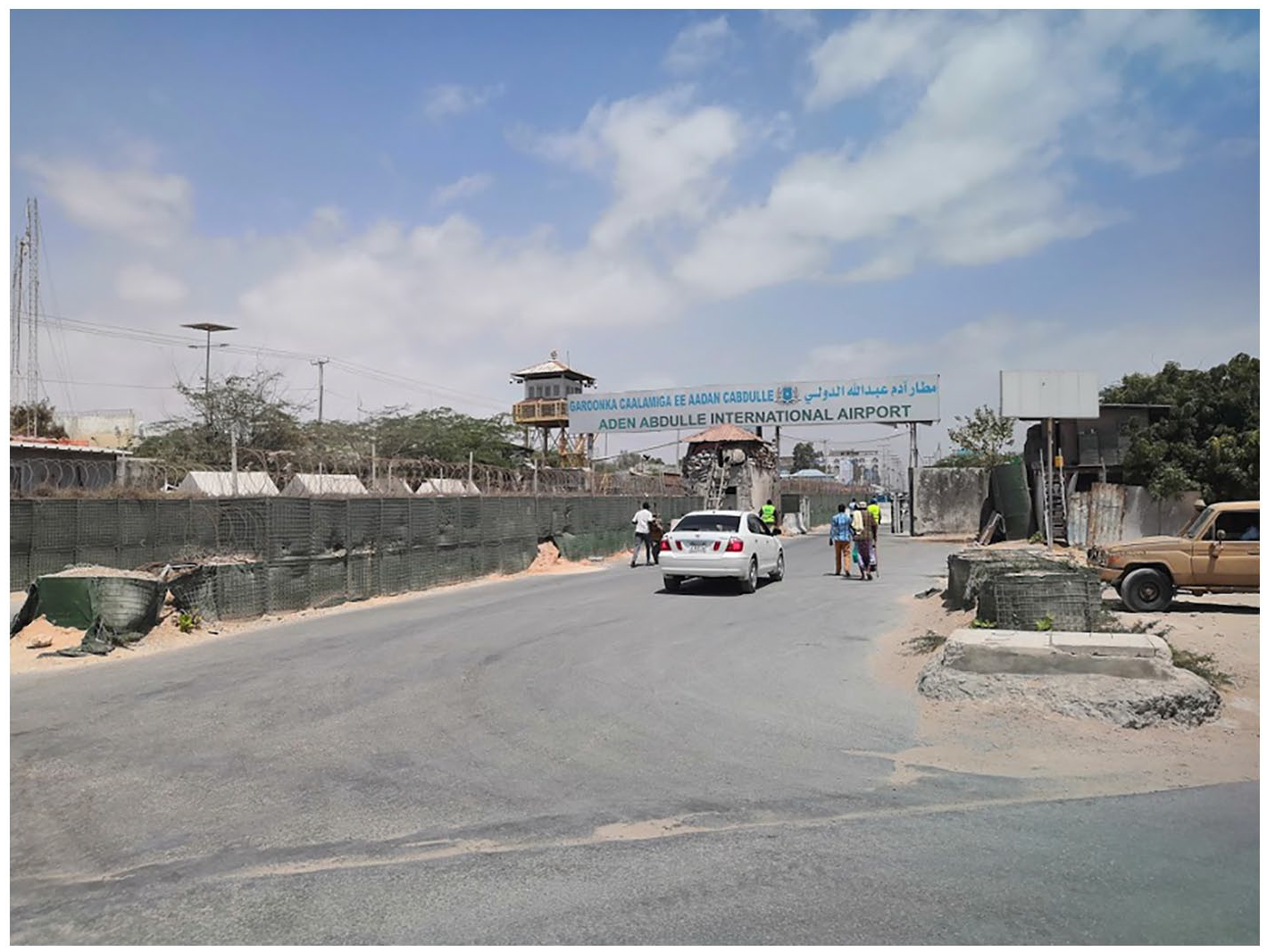
‘Entry to Mogadishu International Airport’ (all photos by the author).
The need to maintain supply chains for troops and aid workers made the security of the international airport a priority task for the first AMISOM contingent arriving in Mogadishu from Uganda in March 2007, 8 which, therefore, also established its headquarters and a military camp in its immediate proximity (Williams, 2018: 49–50). Diplomatic and aid organizations then looked for vicinity to the AMISOM for security and the airport for logistics, thereby initiating an assemblage of offices, embassies, warehouses and hotels into what eventually became the MIA zone. Located at the southwestern corner of the city, the MIA zone is shielded by the airport on one side and the Indian Ocean on the other. It hosts UN organizations; diplomatic offices and the embassies of, for example, the EU, USA, China and Kenya; the command centre of the AMISOM; military training facilities; warehouses; private security and logistic companies. Integrating the ‘archipelago’ of fortified and heavily guarded aid compounds (Duffield, 2012: 477) into one spatial template reflects the entanglements of military-, diplomatic-, humanitarian- and development-oriented operations that characterize statebuilding interventions. It follows the circulatory logic of free zones, as its main aim is to secure circulation, albeit here to increases the efficiency of international operations while shielding international experts and organizations, their installations, goods and technologies from a potentially hostile environment. Embedded in a security dispositif, spaces and materials in the MIA zone are primarily arranged to manage risks emanating from circulation (Foucault, 1978: 37). The next section zooms further into the MIA zone to analyse its material and temporal features.
Militarized intervention designs: Securing international circulations
Security is increasingly enacted as the government of mobilities, dividing good from bad circulation and assembling technologies and infrastructures that enable connectivity while filtering movements in ways that tame unpredictability (Aradau and Blanke, 2010; Foucault, 1978: 37; Salter, 2013; Sparke, 2006). The usual spatial reactions of the aid industry to threats – selective withdrawal, remote management and bunkerization – provide examples for risk management strategies that maximize good circulation (aid, experts, supplies) while diminishing risks for international staff by separating them from potentially dangerous populations (Duffield, 2010, 2012; Smirl, 2008, 2015). The formation of a highly secured zone for aid workers, such as the green zone in Bagdad or the MIA zone in Mogadishu, provides a spatial answer to two regularly raised demands: to end withdrawal from conflict zones and to better integrate statebuilding programmes. The spatial integration of international offices around the airport mobilizes synergies of military, commercial and aid infrastructures. Zoning enables the relative smooth circulation of international civilian and military personnel, consultants, advisors and business people into and out of the MIA zone and between similar zones in other Somali cities. It provides switch points for circulation, and answers to the need of experts ‘to move rapidly across networks of aid and interventions’ (Walters, 2011: 139) while providing the supplies that sustain their work. The steadily increasing number of hotels demonstrates the busy movement and the nearly daily workshops prove the equally busy schedules of statebuilders.
The space inside the MIA zone is constantly evolving with new construction sites and a seemingly ever-increasing number of buildings, warehouses and other facilities (photo 2).
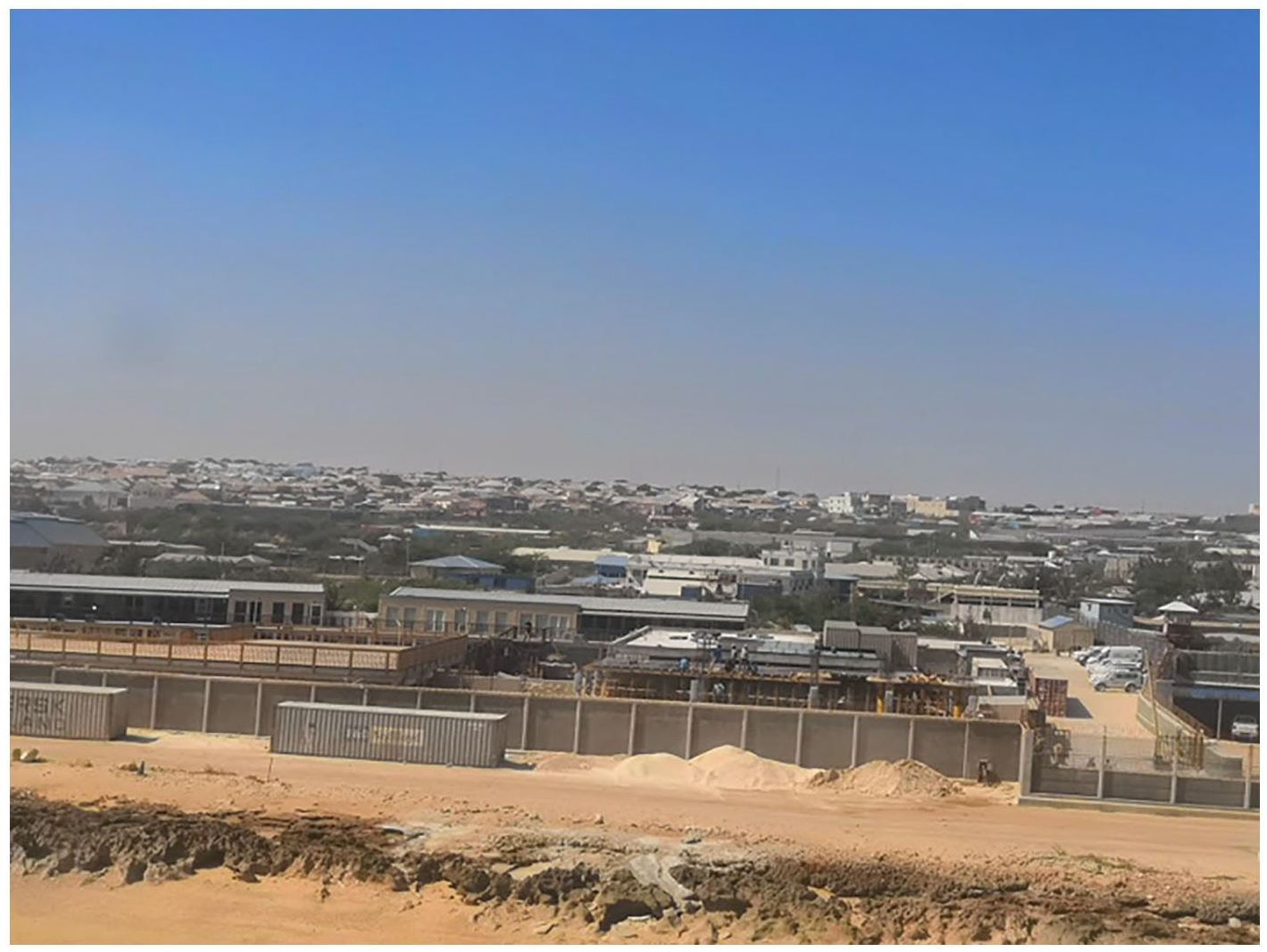
‘MIA zone’.
Containers are omnipresent. They are used to transport goods, serve as storage units in warehouses, are transformed into hotel rooms, garages, workshops or gyms, conjoined to walls or just emptied and left in the open to rot. The zone’s morphology and the ubiquity of containers attest to the importance of logistics for waging wars and delivering humanitarian aid (Cowen, 2014: 25-35; Ziadah, 2019) and indicate the commercialization of both militaries (Moore, 2017) and aid (Pascucci, 2021).
The airport is the main point of arrival for international staff and visitors. People who pass the airport’s security controls can move within the zone without further security checks; however, entry to offices, hotels or other facilities are further regulated and tightly monitored. Buildings are surrounded by perimeter walls and fences while crash barriers and bollards aim at preventing the deadly impacts of crashing or exploding vehicles. Watchtowers and video cameras attest to constant visual surveillance and the blurring boundaries between private and public life within the MIA zone. Armed security personnel in watchtowers and at gates looks out for suspicious movement and ensure that entry and exit to the compounds are ordered and channelled through designated gates (photo 3).
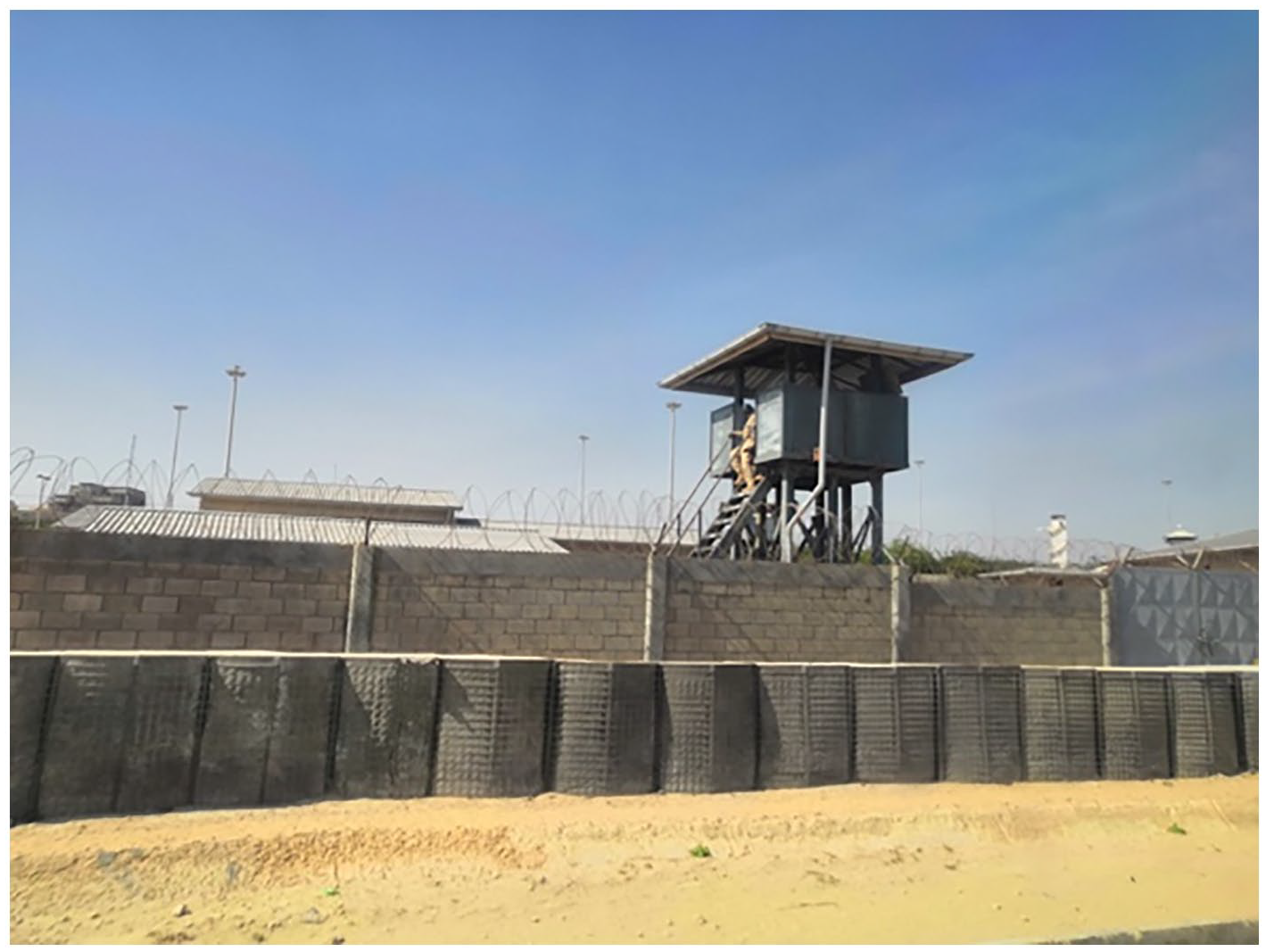
‘Watchtower in the MIA zone’.
The UN compound within the MIA zone, for example, has three main entries. Shutay, a Somali UN employee who lives in Mogadishu, describes the barriers surrounding her office in the UN compound. After passing the security checks at the Medina Gate, one of three points of entry to the MIA zone, Shutay calls a UN driver and waits until he drives her to the UN compound, to either: T-Junction, Hospital Gate or Umas gate – which are the three access gates to [Name of UN organization] where I work actually. [. . .] I come in through one of those three gates. Then, when I stand at the gate, I have another screening, that is the one you know.
9
But we have that access IDs which open the gate of screening. Then, I again get through that machine [scanner], then from there, I swear I will be walking, walking, walking like six minutes to another gate that’s called UNSOS gate. Again, there is no screening but there is another machine and you just press [a button], and it shows you are coming in or going out, it records this, everybody who gets in and who goes out. That’s how I reach the office. (Interview 1)
Within the MIA zone, layers of physical and social barriers, screenings, scans, permits and regulations are enacting security by filtering movement. Electronic identity badges guide and register the movement of staff. Visitors can enter most office compounds only on invitation and have to undergo body and luggage scans. Their names and identity document have to be pre-registered at the reception, where they leave the document upon entry and pick it up again when leaving. Cars are thoroughly checked for explosives before they can enter designated parking areas that are surrounded by blast-proof Hesco walls (see below).
The layers of fortification are matched by the multiplicity of rules and jurisdictions, as offices and workers are regulated by the codes-of-conduct of their respective organizations, while compounds are guarded and policed by private security companies that implement their clients’ standards. The MIA zone’s outer walls are guarded by AMISOM troops. The movement of armed combat vehicles, tanks and military trucks and soldiers is a regular appearance, as are military staff gazing from watchtowers or operating gates and checkpoints. Work, leisure and residential modes of living are densely assembled in the confines of the MIA zone. In late afternoons and at weekends, a strip of the sandy beach between the airport fence and ocean is packed with people jogging or walking, in groups or alone, sitting on cliffs, fishing or taking a short dive in the Indian Ocean (photo 4).
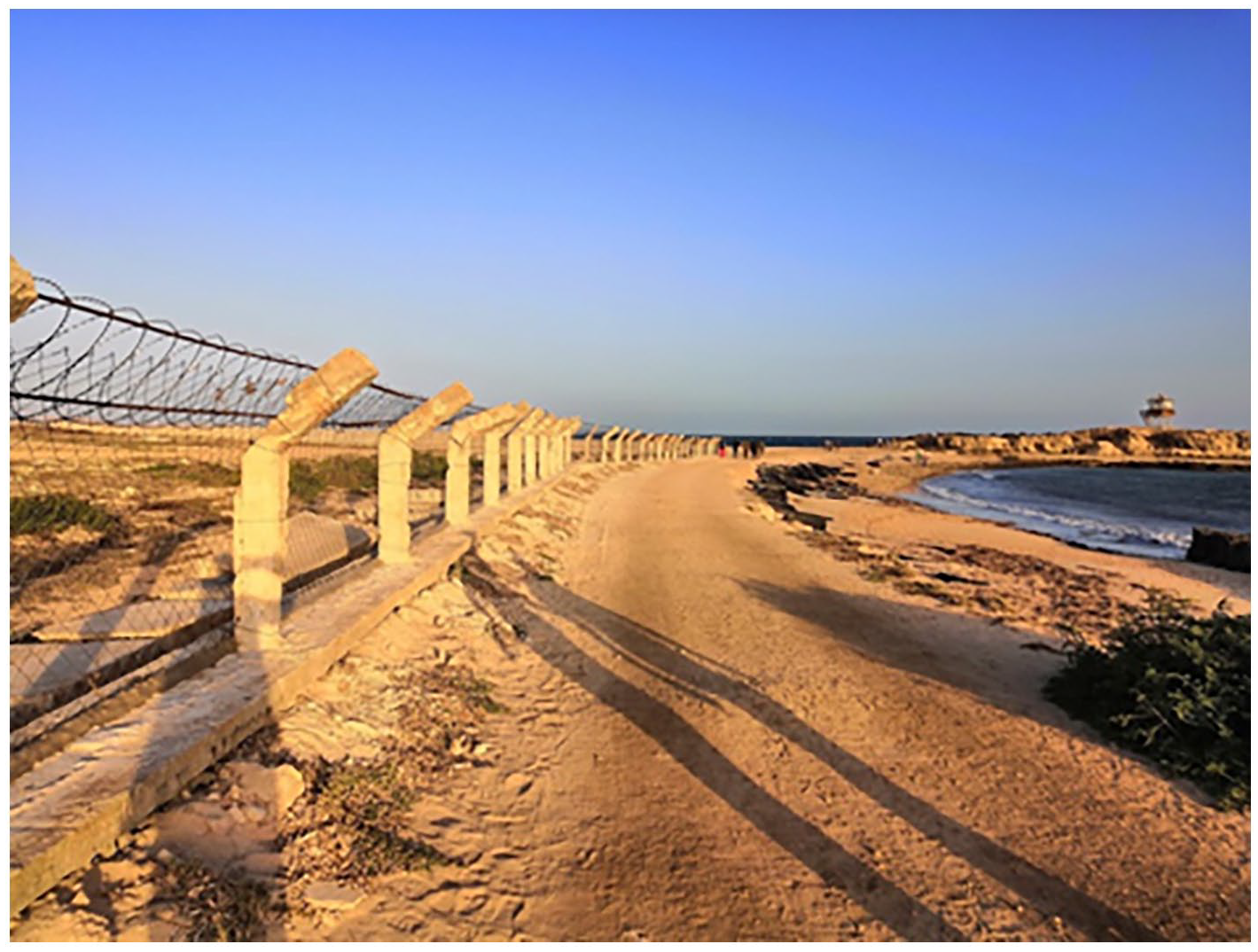
‘Beach promenade in the MIA zone’.
They often carry walkie-talkies or satellite phones to remain in reach in case of attacks. Watchtowers are established along the shoreline; helicopters cruise above it and boats patrol the coastal waters. The open exhibition of military technologies, the movement of military vehicles on the dusty roads inside the MIA, the frequent sight and noise of helicopters, the checkpoints and watchtowers and the omnipresence of barriers and walls invoke images of action movies. They foster a sense of danger, entrench impressions of a war zone and send a constant reminder of the insecurity and imminent risks to people working and living there.
Space inside the MIA is organized ‘along lines of vision and weaponry’ (Clouette and Wise, 2017: 14). It demonstrates the statebuilders’ ‘power of action’ (Popitz, 2017: 10–12, 25–29), a form of power that stems from the ability to hurt and to inflict harm and that forms the core of every state. Albeit defensive in rational and posture, the walls, barriers, gates and bunkers are established in anticipation of violence, thus they are not mainly an attempt to avert war but to prepare for it (Denman, 2019: 235). Walling, partitioning and zoning are anticipatory measures aimed at taming the risks of violence while preparing for its possibility.
The simultaneous expansion and acceleration of circulation and the proliferation of borders, however, also points to the decoupling of sovereign power from the state (Brown, 2010: 7–28; Mezzadra and Neilson, 2013). After all, a broad ensemble of state and non-state organizations and companies are rebuilding sovereign statehood. While doing so they exercise sovereign power, for example by using technologies of separation and control that are defining and ordering bodies while differentiating between those (inside) deserving protection and those (outside) left to self-protect, as I will show in the next sections. Their (spatial) practices point to a new and modular ‘modality of sovereign power that has multiple sources, follows heterogeneous dynamics, and which can be combined differently, and with different results’ (Langenohl, 2017: 135). 10 The boundaries in the MIA zone are, for example, continuously evolving, modulated alongside events, actor constellations, risks and threats and, of course, progress in governability of the world outside its confines. The next section attends to the specific temporality and corresponding modular materiality of intervention designs.
Modular transience: Containerization, militarization and commercialization of life
The MIA zone facilitates circulation while shielding infrastructures, supplies and people from an unruly environment. Such zones are established in reaction to wars, disasters and crises and therefore operate in a different timeframe than, for example, free zones. Intervention forces – humanitarian, military, civilian, diplomatic – are rapidly deployed into places where infrastructure is likely to be damaged or destroyed, but their installations are expected to disappear as soon as the crisis is under control. Modular designs and arrangements provide an answer to the demand to secure circulation while adapting to the rapid rhythm and short timeframes of statebuilding. Modularity enables the decoupling of compartments from an interconnected system and helps to contain the impacts of shocks on the whole system as damaged compartments can flexibly be re-arranged (Kharazzi, 2019).
The two most visible examples of modular systems in the MIA zone are the container village and the Hesco wall, both part of a seemingly ever-increasing intervention economy. Chelsea Village provides an example of a container hotel (photo 5).
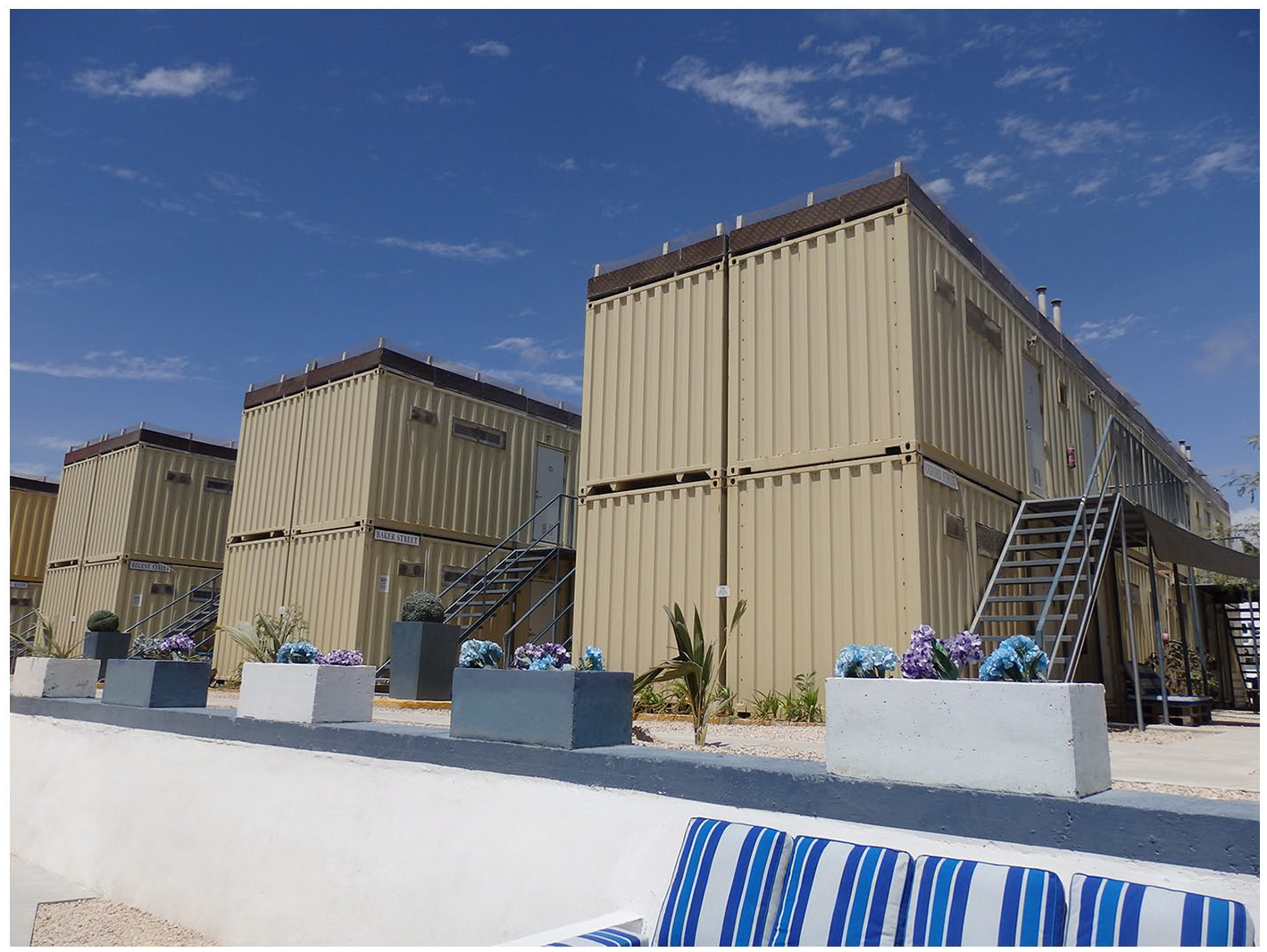
‘Chelsea Village’.
When I was invited by the UN to stay in the Chelsea Village in 2017, the hotel’s security manager guided the UN guests through the compound, emphasized the hotel’s safety, advertised its comforts amidst a risky environment and pointed towards protective and other measures that many of the neighbouring hotels lack. The manager also led the visitors to the bunker, where guests and hotel workers are requested to assemble in case of attacks.
For recreational purposes, a gym was arranged in an open container and a sitting area with benches and sun umbrellas, surrounded by buckets with artificial hydrangea flowers, invited the guests to relax. A vast roof terrace laid out with artificial lawn provided a view of the Indian Ocean while sunchairs reminded of holiday resorts, at least if one was able to overlook the militarized environment. Chelsea provided buffet meals and advertised its ‘hand-picked’ chefs from ‘a diverse mix of cultures and nationalities and with ‘experience in extreme environments’ (Enigma Alliance, 2020a: n.p.). Having ‘served in Iraq, Afghanistan and/or across the African continent’, the restaurant crew can provide guests with a range of dishes, even if they are ‘only emerging from a bunker’ (Enigma Alliance, 2020a: n.p). The combination of security and comfort aims at ensuring physical and mental wellbeing while ‘making the inhospitable, home’ (Enigma Alliance 2020b). The humanitarian ‘gesture of care’ (Walters, 2011: 145) is commercially expanded to those who make the delivery of aid to risky environments their profession.
Chelsea Village is the ‘flagship remote-site accommodation project’ of Enigma Alliance, a group of security-related companies with headquarters in Cyprus. Enigma Alliance provides ‘life support infrastructure’ in harsh places (Page, 2020: n.p.). The alliance was founded by Hart International, a British security company that also serves as the main security provider for Chelsea Village. This may explain why Chelsea arranged the straight-lined container accommodations in paths with London street names: Baker Street, Westbury Way and Oxford Street are reminiscent of the mimicry used in colonial urban designs (Jacobs, 1996: 20). However, Enigma is foremost a business model that sells its ability ‘to transform inhospitable areas into safe, comfortable and enjoyable experiences’ (Page, 2020: n.p.). The company offers a ‘range of modular products’ that can be set-up ‘in any part of the world’. Modularity provides an ‘end-to-end solution for clients who are operating in challenging environments’, combining protective measures with comfort: modular, transient, enjoyable (Page, 2020: n.p.). Chelsea Village charges $170 for one night, all-inclusive, and can, according to its YouTube advert, host 180 people (Page, 2020: n.p.). The hotel is usually fully booked, as the residential UN compound can no longer accommodate the ever-increasing number of international experts (Page, 2020: n.p.). The modular twin of the container is the blast protective Hesco wall (photo 6).
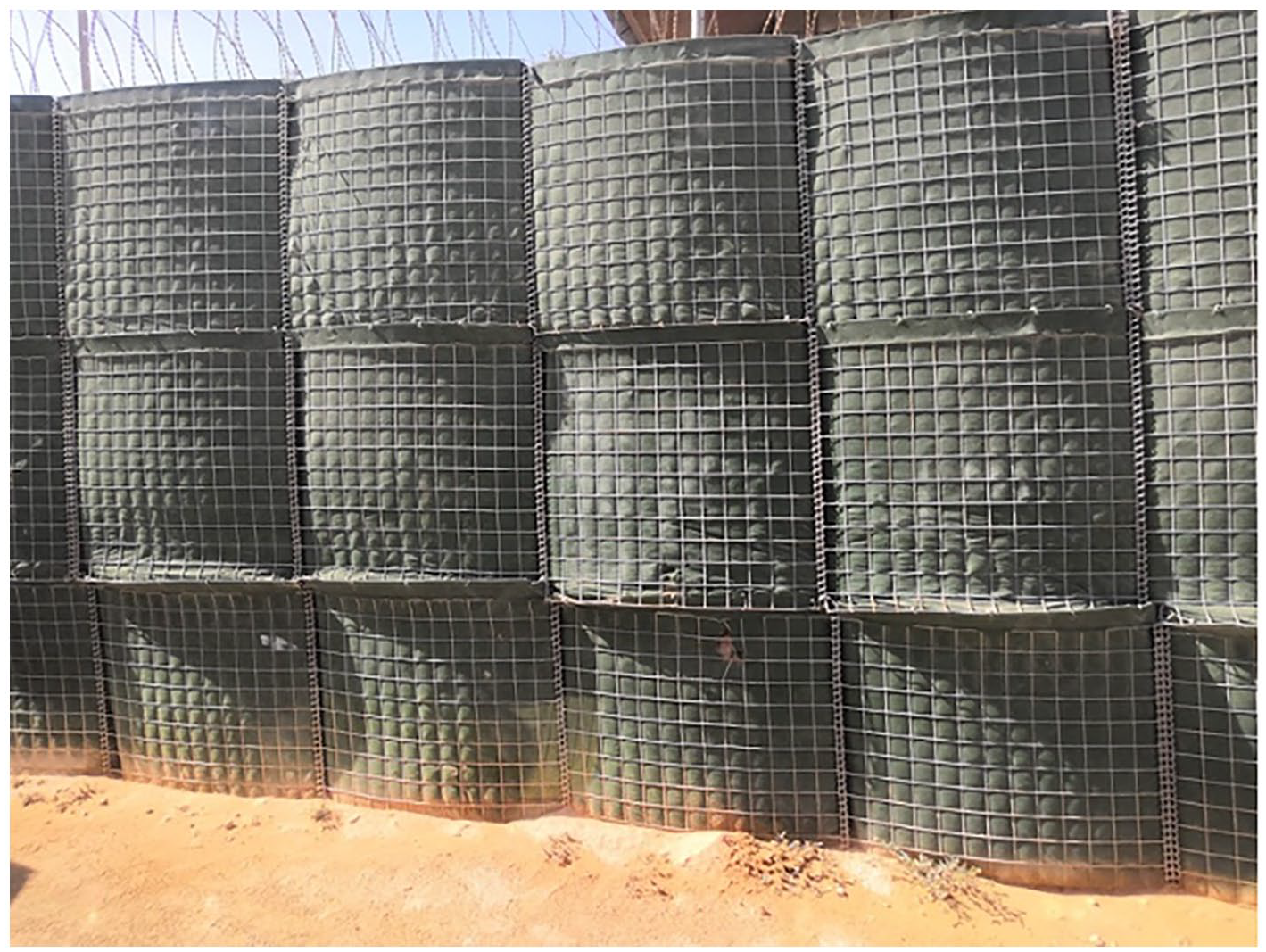
‘Hesco unit’ units [plural, JB].
Originally developed and still used for flood protection in the UK, Hesco walls also serve as perimeter walls and were, for example, used by NATO forces in Bosnia (Pickett, 1996) and military and aid installations in Afghanistan, Iraq and Mali (Andersson and Weigand, 2015: 528; Britch et al., 2018: 225). Composed of small ‘cage-like containers’ (Britch et al., 2018: 225; photo 6), Hesco walls can be flexibly assembled to different heights and potentially ‘unlimited length’ (Progressive Engineer, 2020: n.p; photo 7). The blocks are filled with sand to limit the pressures of explosions and shield from flying debris. Hesco, the main producer of the modular blocks (HescoMil), describes them as providing a ‘safe haven’ in ‘remote or hostile environments’ and advertises a range of modular products that can be assembled to ‘protect the protectors’(Hesco, 2020: n.p.). HescoMils can be swiftly assembled, adjusted, disassembled, transported and re-used elsewhere – ‘almost anywhere on earth’. Emptied and folded together to ‘relatively light, place-saving and thus easily transportable pieces’ (Progressive Engineer, 2020: n.p.) the Hesco-wall leaves ‘minimal environmental impact’, as ‘you can leave the area as you found it when it’s time to take your home, home’(Hesco, 2020: n.p.). Duffield (2010) criticized the aid industry’s neglect of the effects of their material installations. The answer seems to be to not leave materials behind. The MIA zone is composed of modules that can be speedily assembled, disassembled and, in different combinations, reassembled and used elsewhere. While destroyed buildings and ruins continue to evoke memory and meaning (Edensor, 2005; Stoler, 2008), modular spatial designs can disappear, allegedly without leaving an impact; forgotten and replaced. Modular assemblages, therefore, seem to defy Rabinow’s (2009: 55–56; also Walters, 2012: 77–78) attempt to analytically differentiate between apparatus and assemblage, thus between what is fluid, in flux and possibly only existing for a short moment in time (assemblage) and what is rather immobile and salient (apparatus). The salience of infrastructures and spatial arrangements that organize life in modular form ironically lies in their mobility and fluidity – to be arranged, adapted, modified, disarranged and moved elsewhere whenever necessary. The design of the intervention zone is an answer to the need to constantly shift, rearrange and reassemble border regimes that characterize the separation of sovereignty from the state while constituting variegated spaces of exception. In this respect, intervention zones also seem paradigmatic for Augé’s (2008: VII) non-places, everywhere-nowhere ‘places of circulation, communication and consumption’ impeding the development of history, relationships and identity. But when the intervenors eventually leave, so claims Hart International in its promotion video for Chelsea, they at least leave the country a better place (Hart International, 2020). What remains is the humanitarian imperative, albeit commodified and transformed into a promotion slogan. However, even if infrastructures are designed to disappear, they continue ‘doing something’ (Easterling, 2016: 13). The next two sections look into the way the socio-spatial arrangements are shaping bodily experiences.
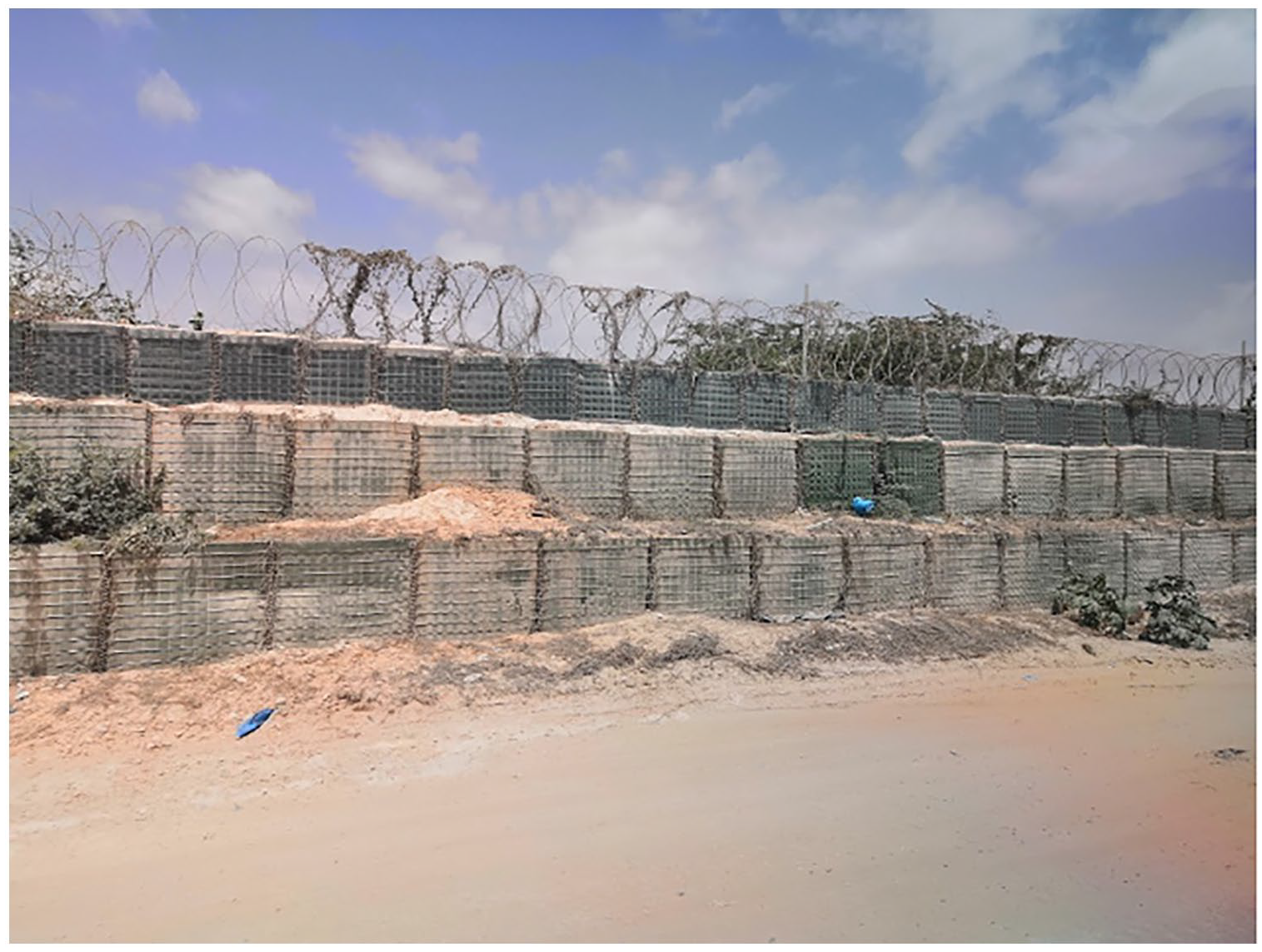
‘Hesco wall long’.
Experiencing (dangerous) circulations: Being there while keeping distance
The MIA zone facilitates movement by air but impedes movement by road. The UN Department for Safety and Security (UNDSS) determines risks and security measures and provides security clearance for UN staff travelling out of the MIA zone. Trips to Mogadishu are undertaken in armoured vehicles and are accompanied by at least two armed escort vehicles. They have a 90-minute time limit and bullet-proof vests need to be worn throughout: ‘If I go without this protection’, a senior UN official remarked, ‘they say that my life expectancy is 20 minutes. I’m not taking that, I don’t want to test that’ (Interview 2). Interviewees appreciated the work of the UNDSS, but David (Interview 3) also expressed frustration as the UNDSS ‘out of convenience – I mean it would be tough of course – but out of convenience, they just paint the whole country red. And so, it means there is zero access’. Interviewees also emphasized the costs of such 90-minutes trips, which amount to $1000.
Asked about the benefits of working from the MIA zone compared to remote management from Nairobi, interviewees highlighted the proximity to governmental partners and the ability to meet on short notice and in a more relaxed atmosphere. Most interviewees also addressed limitations of proximity enabled by fortified segregation. They pointed to failures of sensual registers or used ocular metaphors to describe feelings of remoteness and isolation. 11 Austin, for example, outlined how ‘you feel like there’s a veil, there’s always a veil’ (Interview 4). David only saw Mogadishu ‘through tinted windows’ of armoured vehicles (Interview 3), while Aart described an ‘inability to see well’ and ‘to observe’ that impedes ‘understanding what is happening’ (Interview 2). Several interviewees explained that they initially tried to visit partners more often, but out of convenience or to minimize expenses now meet inside the MIA zone. Despite spatial proximity and albeit the ‘work is interesting and also gratifying’, it remains, as David, expressed ‘remote, remote’ and ‘devoid of any contact with the beneficiaries’ except for those in the ministries (Interview 3). Programmes, therefore, continue to be remotely managed, only now from the spatially less distanced confines of the MIA zone. On the other side, however, remote management enhances, as Aart outlined, ‘local ownership’, ‘enforces’ reliance ‘upon our local partner’ and requires the transfer of responsibilities and decisionmaking from international to national staff and partners (Interview 2). It, however, also transfers parts of the security risks to national staff, as I will show in the following section.
Experiencing (dangerous) circulation: Overcoming distance - every day anew
The daily challenges the MIA zone generates for national workers were emphasized by Shutay, a woman in her early 30s who grew up in Mogadishu and has worked for the UN since 2015. She described how her daily journey from home to the MIA zone, which would normally take between 20 and 30 minutes, can last over two hours due to checkpoints on the way to the MIA zone, many operated by the Somali National Intelligence and Security Agency (NISA). 12 Here, she often has to leave her taxi and walk through security gates or is delayed because she is interrogated. At times ‘the checkpoint people, the NISA people, they tell me you cannot access, you cannot access, you need to leave or go by foot’(Interview 1). Shutay then has to try another route.
At the Medina Gate, Shutay waits to ‘pass the screening, where the AMISOM and UNSOM people are checking. Sometimes, they just punish you, sometimes they are nice and cooperative’ (Interview 1). Shutay feels that her safety is not adequately considered while she is forced to queue, remove her shoes, remove her Niqab and wait. Shutay described how she is interrogated, screened, touched and controlled before she can enter her office. Her daily experiences depend on the discretionary power of individuals operating checkpoints, some, as she puts it, ‘nice and cooperative’, while others ‘punish you’, reject entry, make her wait or force her to line up at the end of another, much longer queue (Interview 1). For Shutay, checkpoint encounters are unpredictable and require flexibility, time and negotiations. She often used the term ‘begging’ to express her powerlessness in these negotiations (Interview 1).
Waiting, as Bourdieu (2000: 228) outlined, is among the ‘privileged ways of experiencing the effect of power’. It requires the submission to the authority of others. For Shutay, waiting bears an additional security risk as she is afraid of being recognized as a UN employee by al-Shabaab. People may catch a glimpse on her ID, as ‘everybody is there, just stuck, and maybe sometimes casual labour, hundreds of casual labour. You don’t know who is who. You know, us, we work under pressure in Somalia’ (Interview 1). Only Shutay’s immediate family members know where she works, and she regularly refers to herself as hiding. Shutay does not ‘integrate much with [. . .] neighbours’ and wears her ‘hidden face, you know, the Niqab’ when leaving the house. Her sisters do the same, mainly, according to Shutay, to ensure that strangers cannot tell family members apart (Interview 1).
Shutay lives in constant fear. Once her neighbour was killed because they worked as a cleaner in the MIA zone. Before this, Shutay did not know about her neighbour’s job, as ‘we all hide’ (Interview 1). Shortly after, strangers approached her sister to inquire about Shutay: ‘Where is your sister? Where is your sister? Nowadays, I do not see her’. Shutay is convinced that these inquiries were related to al-Shabaab: Walahi Jutta, I used to cry those days. When I came home I was just crying. I am just working. I don’t offend anybody. I am just supporting my family and me personally. Nothing, that I have done to any person. Why am I a target? Why am I a target? (Interview 1)
When she went to her line manager who sent her to the UNDSS, Shutay was advised to move home. But she would then have to live without her family and pay rent, which she cannot afford as she is the main breadwinner. National employees weigh the risk of physical violence against the risk of precarity. Shutay carries a high risk when working with the UN, a risk that she feels is neither adequately acknowledged nor cared about in the same way as the risks facing her international colleagues.
When comparing experiences of international and national aid workers, both describe fear and insecurity related to their jobs, albeit in different ways. The inability of internationals to leave the MIA zone and their difficulties to see stands in contrast to the efforts of nationals to enter the MIA zone while trying not to be seen. The international high-end workers’ ‘right to the city’ (Lefebvre, 1967) remains restricted by walls, security protocols, armoured vehicles and convoys, and is reduced to the glimpses they can catch through the tinted windows of bulletproof cars and the top-down gaze from roof terraces of highly protected hotels. It is a gaze that limits sensory experiences, a gaze from above without sound and smell, segregated but close and (seemingly) protected. The walls that protect the international workers become a security risk for nationals who have to negotiate passage at gates and barriers, wait in queues with people they do not know and live in constant fear of being recognized. The tight safety protocols of the UNDSS and other international organizations working in Somalia do not account for the risks of people residing outside the highly protected zone.
Conclusion: About mobile and modular modalities of sovereign power
This article used the example of the MIA zone and applied a spatial and material lens to explore how sovereign power unfolds in military/statebuilding interventions. It emphasized the centrality of circulation and showed that statebuilders prioritize infrastructures, which Mann (1984) identified as conduits for state power. Infrastructures enable the state to penetrate societies and to arrange and order products, people and relationships. The analysis of the MIA zone, however, clarified that neither governmental nor infrastructural power are necessarily congruent with a state. The MIA zone constitutes a mutation of free zones and follows its logic. Drawing on synergies of military, humanitarian and diplomatic operations and infrastructures, the MIA provides a switch point for circulation and enables actors and materials to move along well-defined and heavily secured paths within the MIA zone and between similar zones in other Somali cities. In this respect, the MIA zone provides a spatial template for the integration of missions and for the time-bound and modular form of sovereign power that the humanitarian–military–diplomacy apparatus exerts while governing emergencies in dangerous environments.
Zonation in general, and the MIA zone in particular, point towards transformations of statehood and sovereign power. Mitchell (1991) has convincingly shown that the idea of central power (sovereignty) emerges as state effect as the divisions between state and society, politics and economic, public and private, inside and outside are generated during everyday practices that establish, bend, reinforce or transform state–society boundaries while producing difference. Zoning blurs and rearranges many of these taken-for-granted boundaries and develops its own effects. The MIA zone, for example, circumscribes a ‘sort of “no man’s land”’ (Fassin and Pandolfi, 2010: 9), an elastic frontier that is simultaneously exempt from and constitutive of order. Like other frontiers, the MIA zone is established to domesticate unruly spaces and, therefore, develops ‘a logic of rule’ (Korf and Schetter, 2012: 161) that I have identified as a modular form of sovereign power. Unlike the graduated and variegated sovereignty described by Ong (2000, 2004, 2006), modular forms of sovereign power are not facilitated by a state or government that aims at retaining its power in an increasingly competitive global economy and outsources and commercializes governing functions, but by a rather opaque ‘international community’ that imagines and aims at establishing a central power able to intervene, regulate and police the unorderly and dangerous world outside the zone.
Frontiers are by definition exceptional and temporal, to be dissolved once the appropriation of land, an essential act of sovereign power, is finalized and once the frontiersmen (and women) have established their version of order (Korf and Schetter, 2012: 157). Other than the classical frontier people, actors operating from the MIA zone neither aim at appropriating land nor at establishing themselves as bearers of sovereignty. Instead, they line up to help others to build a sovereign state, appropriate land (counterinsurgency), establish institutions, assemble infrastructures and generate knowledge about the world that surrounds them. They are, therefore, similar to states, producing spatialization and legibility effects (Trouillot, 2001: 132) that require further analysis.
Looking closer at the proliferation of zoning technologies, Bach (2011) and Murray (2017) have started to develop a typology of zones, and identified a ‘modular zone’. Building on examples of labour camps, off-shore platforms and extraction sites, the modular zone comprises transportable and moveable assemblages able to shift with the demands of the market. Studying off-shore oil production in Equatorial Guinea, Appel (2012), for example, detected modularity as a structuring principle of capitalist relations. Accordingly, modular arrangements allow commodities to appear untouched by sociocultural factors, removing them from the frictions that characterize production and distribution. Modularity, in this way, becomes a principle of the socially detached and frictionless world of consumption that capitalism is both imagining and projecting.
The analogies between the operation of capital on the oil rig and the operation of sovereign power in the MIA zone are illuminating. Everyday life in both is structured by mobilizations of ‘risk, safety and control’ (Appel, 2012: 702) and close-knit surveillance is complemented by measures to improve the health, safety and well-being of employees. Spatial detachment accentuates in both cases the unequal distribution of risks. Measures to protect people in the MIA zone are, for example, exaggerating the risks for those who regularly have to cross the border. Modularity attests in both cases to the primacy of circulation and the ceaseless adaptation, modification and innovation that advanced capitalism requires. The examples of the container hotel and the Hesco wall exemplify the insertion of a market logic while security provision, fortification and self-care provide entry points for commercialization and yet another example for the heterogeneous and multiple ‘projects of space and scale making’ that ‘enable capitalist proliferation and embroil it in moments of chaos’ (Tsing, 2005: 12). The capacity to exploit crises and to use them as springboards for development is among the salient features of capitalism that can feed on destructions and continuously reproduce itself in ever more innovative ways (Berman, 2010: 121).
However, there are also differences between both forms of modularity. The oil rig is spatially removed and put out of sight of citizens to escape both state regulation and citizen interrogation. The MIA zone, on the other hand, is established amidst the (imagined) capital city and as close as possible to the people it claims to serve. Although fortified spatial proximity continues to epitomize distance and remoteness, proximity is needed to project the image of sovereignty across the frontier. After all, the MIA zone does not primarily follow the requirements of the market but exerts sovereign power to establish conditions that allow the market to work and capital to circulate. The proliferation of walls and barriers is, therefore, not necessarily a sign of waning sovereignty, as Brown (2010) asserts, but point to a form of sovereign power that is mobile, modular and transitory and moves with the needs of capital or, as in the case of the MIA zone, with international forces that re-establish the (material) conditions for capital to circulate and sovereign power to operate.
The sovereign power such interventions display is temporal and modular, neither place-bound nor territorial, but travels and operates from whichever place it is needed, just in time to deal with wars and other emergencies. The material and spatial technologies emphasize the transitory character of this engagement. Like the containers and Hesco walls it helps to assemble, modular sovereign power operates to disappear. Modular designs are ‘unfixing’ spatiotemporal fixes, making them adaptable, transportable and often also re-usable; they dissolve binary spatial theorizations that oppose solidity, stasis and fixes with fluidity, mobility and movement (Hönke and Cuesta-Fernandez, 2017: 1077). Sovereign power that operates from and through elastic spaces is no longer conceived as ‘operating at a “higher level”’ (Ferguson and Gupta, 2002: 983; also Mitchell, 1991), but rather as an opaque geographical aside, composed of multiple and diffused forms of power that Easterling (2016) has identified as extrastatecraft.
Mogadishu residents, following the imaginary of sovereignty and reflecting on the opaqueness of modular power, often refer to the MIA zone as ‘a state in the state’ (Interview 5), or engage in rumours about the ‘real’ activities behind the walls and ‘real’ goals of international intervenors. 13 Speculations range from exploitation of resources to culturally unacceptable and criminal activities. Some people are convinced that al-Shabaab, the government and the intervenors cooperate in criminal ventures or jointly aim at destroying Somalia. The effects of modular sovereign power on the society it aims at ordering are, as these speculations indicate, yet to be analysed.
One could in this respect provocatively argue that neither the international nor the national statebuilders are particularly concerned about the establishment of territorial sovereignty. Infrastructures and logistics are about enabling connections ‘across fractured socio-political landscapes’ and not about overcoming differences between them (Schouten et al., 2019: 789). As long as circuits between the cities liberated from al-Shabaab and cities across the globe remain open, conditions seem sufficient for governing actors to receive juridical sovereignty allowing them to participate in international relations and to access multinational and financial institutions. Such forms of sovereign power within an imagined state space builds on the elasticity of the frontier and the modularity of its installation. The example of interconnected city zones in Somalia may be extreme, but they are part of global geographies of political power that escapes both the sovereign imaginary and monolithic state form.
Footnotes
Acknowledgements
Many thanks to Abdirahman Ali Edle and Roble Dahir, who accompanied me on walks and drives in the MIA zone. Thanks to Raphaela Kormoll who proofread and commented on different versions of this paper and to May Darwich for the many stimulating discussions on infrastructures and beyond. The independent reviewers provided helpful feedback that helped to improve the paper.
Funding
The author disclosed receipt of the following financial support for the research, authorship, and/or publication of this article: The Leverhulme Trust provided me with a generous research fellowship (RF-2018-642) that funded my third visit in the MIA zone and provided me with the time to write this article. ESRC/FCDO (ES/R002355/1) funded my previous research on urbanization and displacement that brought me to the MIA-zone.

Notes
Interviews Cited
For anonymity, I use aliases and withhold the exact interview date.