




Abstract
Critical prison studies have demonstrated how states use imprisonment and detention not only to punish individuals, but also to quell dissent and disrupt opposition movements. In protracted conflicts, however, the use of mass incarceration and unlawful detention often backfires on states as politically motivated prisoners exert their relevance by making imprisonment itself a central issue in the wider conflicts. Rather than retreating to the margins, prisoners have taken back prison spaces as loci of resistance, forcing both state authorities and their own external parties to engage with them seriously as political actors. This subversion of the prison space is not automatic, however; as this article demonstrates, prisoners have exerted the most influence on both authorities and their own factions when they have combined pragmatism and radicalism through multilevel strategies such as establishing praxes for self-education and organizing; using everyday non-compliance to challenge prison administrators; and occasionally, engaging in hunger strikes that exert boomerang pressure from external factions and solidarity networks on state authorities. Drawing from the case studies of Israel–Palestine, Northern Ireland and South Africa, this research shows how these radically pragmatic tactics create a ‘trialectic’ interaction between prisoners, state authorities and external networks, forcing direct and indirect negotiations regarding prisoners’ rights, and, at times, influencing broader conflict dynamics.
Introduction
Prisons often function as epicentres of protracted conflicts, with the state using imprisonment and detention as means of control, and detainees seeking to use the prison space for resistance, both internally and via solidarity with external networks. Prisoners and authorities are thus often in a back-and-forth struggle over rights and discipline both within and beyond the prison space, with prisons becoming unlikely and often-overlooked sites of confrontation, negotiation and, at times, compromise. Analysing prison-based resistance as a trialectic negotiation strategy, rather than a tactic solely for release, provides new insights into why prisoners resist, when authorities compromise and how prisoners influence conflict dynamics outside of the public eye.
What does prison resistance look like in practice? What tactics do prisoners use to pressure authorities and influence external parties? In turn, what measures do states use to control or prevent collective actions in prison? Which tactics ultimately convince one or both sides to compromise or negotiate? In this article, I explore these questions drawing from three protracted conflict case studies in postcolonial contexts in which imprisonment, detention and prison-based resistance have been significant in conflict dynamics: Israel–Palestine, Northern Ireland and South Africa. The comparative analysis indicates how, due to the protracted nature of the conflicts, prisoners adopted strategies of what I call ‘radical pragmatism’, employing multilevel tactics that 1) reinforced their own organizing capacity and self-discipline; 2) put daily pressure on prison authorities; and 3) appealed to external parties and solidarity networks at critical junctures. In combination, these actions, manifest in the establishment of ‘counter-order’ praxes and institutions, everyday acts of non-compliance and hunger strikes, respectively, forced direct and indirect negotiations that over time influenced prisoners’ rights and broader conflict dynamics.
There are many definitions of ‘resistance’, but most scholars agree that resistance refers to an oppositional act (Hollander and Einwohner, 2004; Johansson and Vinthagen, 2014); it is a ‘social action that involves agency; and that act is carried out in some kind of oppositional relation to power’ (Johansson and Vinthagen, 2014: 418). By definition then, resistance assumes an (asymmetrical) opposition of forces, which in the cases examined, involved prisoners acting in opposition to prison authorities and, at times, the colonial state. This does not discount that some prisoners may have viewed prison resistance as a tactic rather than a strategy, embedding it in broader global movements for revolution or decolonization. But the majority of former prisoners interviewed described their actions primarily as resistance to prison or state authorities within their specific conflict context. Indeed, many did see their actions as having transformative goals, but mainly by situating prison resistance as a central pillar of struggle in their specific liberation movement. Likewise, most participants in this study discussed their resistance in terms of securing rights, both in the prisons and in their respective national struggles. While some critical scholars have pointed out the limitations of human rights or civil rights frameworks in the context of resistance politics (Spade, 2015; Williams, 2010), the rights-based approach was most consistent across the historical case studies, underscoring the pragmatism that existed alongside radical actions.
The article is based on 45 semi-structured interviews with former prisoners and former prison authorities in Israel–Palestine, Northern Ireland and South Africa. Due to the sensitive nature of the topic, I relied partially on snowball sampling, but I intentionally sought out participants who had been imprisoned in different eras and in different prisons, as well as participants from different political parties. I employed an oral history approach, engaging with participants not only as subjects, but as theorists and analysts of their own experience with imprisonment and resistance, recognizing the ‘insurgent knowledge’ (Rodriguez, 2006) that former prisoners bring to this research. I used thematic coding to analyse the interviews, and I include quotes from the most representative interviews in this article, using first names or pseudonyms in most cases for confidentiality. Employing what Kelly Lytle Hernandez (2017) has described as ‘rebel archives’, or what Barbara Harlow (1987: 128) called ‘archives of resistance’, the article is also informed by prisoners’ letters, journals and other writings. As Harlow (1992: ix) noted, prisoners’ writings, like the oral histories, are not merely ‘raw material’ for academic analysis, but ‘an articulation of a critical perspective’ in themselves. Specifically, I consulted primary source materials archived in the library of the Abu Jihad Museum for Prisoner Movement Affairs at Al Quds University in Abu Dis, and the Prisoners section of the Nablus Public Library in the West Bank; the Robben Island Mayibuye Archives at the University of the Western Cape, and the Robben Island Museum (RIM) in South Africa; and Coiste na N-larchimí and Action for Community Transformation (ACT) in Northern Ireland.
The article is organized as follows: first, I draw from the existing literature on critical prison studies and civil resistance to establish the theoretical framework. Second, I provide a brief background on imprisonment and detention in each of the three case studies. Third, I describe the strategy of ‘radical pragmatism’ reflected in three key tactics, each with a different aim and audience, employed by prisoners in each context: the establishment of a praxis of self-government, everyday non-compliance and hunger strikes. Lastly, I analyse how these largely pragmatic tactics informed a trialectic dynamic that forced negotiations within prisons, often but not always enhancing prisoners’ rights over time, and informing broader conflict dynamics and activism.
Theoretical framework
This research draws from the complementary but rarely integrated literatures on critical prison studies and social movements, and situates both in the context of protracted conflicts. Critical prison studies (CPS) (Berger, 2014; Camp, 2016; Davis, 2003; Gilmore, 2007; Paik, 2016; Rodriguez, 2006; Thompson, 2016), though rooted mostly in the US context, offers insights on prison ‘as both a metaphor and locus for action . . . upend[ing] the notion of the prison as isolated and socially irrelevant’ (Siegel, 2018: 130–131). CPS scholars have demonstrated how those incarcerated have ‘transform[ed] the stigma of prison time into moral authority’ (Berger, 2014, quoted in Siegel, 2018: 131) and used the prison space ‘as an instrument for building community and galvanizing further mobilization’ for social and political movements (Siegel, 2018: 131). While most CPS scholars’ work focuses primarily on black prison organizing in the United States, the same phenomenon applies to the case studies in this research, in which prisons became sites of direct confrontation as well as catalysts for external mobilization. This research builds on two key concepts from CPS, integrated with social movement and civil resistance literature: the dialectic dynamic and the radicalism/pragmatism tension.
CPS rightly focuses on the ‘dialectic’ process between authorities and activists, first outside the prison, often leading to incarceration, and then inside the prison space. Jordan Camp (2016) focuses on this back-and-forth dynamic, illustrating how liberation movements flourish until they are repressed by state crackdowns, which then leads to more resistance, ‘ever gathering to the next crisis point’ (Siegel, 2018: 125). A. Naomi Paik (2016) takes a slightly different approach to the dialectic concept, looking at how resistance movements emerge in response to state oppression, rather than states responding to activists, yet still setting in motion the same dialectic dynamic.
The concept of the dialectic is prominent in social movement and civil resistance literature as well; for example, Gene Sharp’s (1973) theory of ‘political jiu-jitsu’, in which the use of force by authorities against activists ultimately backfires, reflects a dialectical dynamic. Though usually studied in terms of protest dynamics, the dialectic discussed in civil resistance literature also applies to the prison setting; for example, Majken Sorensen and Brian Martin (2014) highlight ‘dilemma actions’, which force opponents to either make allowances or use force, with the assumption that the use of force will ultimately backfire, reflecting a logic leveraged in hunger strikes. Similarly, Thomas Schelling’s description of civil resistance applies to the prison context as well: ‘The tyrant and his subjects are in somewhat symmetrical positions . . . It is a bargaining situation in which either side, if adequately disciplined and organized, can deny most of what the other wants, and it remains to see who wins’ (1967: 304; my emphasis). As Schelling suggests, the dialectic of resistance and repression can result in an indirect negotiation between activists and authorities.
The dialectic concept is crucial for underscoring the relational nature of repression and resistance that reflects dynamics evident in both prison activism and protracted conflicts. In the context of prisons within protracted conflicts, however, the ‘bargaining’ or ‘negotiation’ dynamic is perhaps better described as a trialectic rather than a dialectic. Indeed, as Jocelyn Hollander and Rachel Einwohner (2004) suggest, it is helpful to think of resistance as a process with three potential protagonists: an actor, a target and an observer. This is especially true in cases of imprisonment in protracted conflicts; while some prison resistance and repression stays within the prison in a two-way dynamic, the most effective and high-stakes resistance usually involves external pressure from political factions and solidarity networks as well. I thus situate the ‘negotiation’ processes that I explore in this research as a trialectic dynamic between prisoners (the primary actors), authorities (the primary targets) and external networks (the primary observers). As Figure 1 illustrates, the core power interaction remains between prisoners and authorities, who engage in a cycle of conflict and negotiation within prisons. However, in protracted conflicts, this interaction often influences, and is influenced by, actors beyond the prison space, with the most structural transformations manifesting when external actors leverage their positionality to further pressure the state.

Trialectic dynamic.
Both CPS and social movement studies also explore the tension between pragmatism and radicalism in prison organizing (Berger, 2013) and civil resistance (Snow and Cross, 2011). I use the term radical in the literal sense, drawing from the Latin for ‘root’, indicating a process or action that seeks to make a fundamental political or social change at the institutional or systemic level. Pragmatism, by contrast, focuses more on achievable incremental change within a given system. Pragmatism and radicalism may seem like opposite ends of a spectrum, but they are not mutually exclusive. Rather, as Dan Berger (2013: 14) notes, prison contexts often demand holding pragmatism and radicalism in ‘creative tension’ rather than juxtaposition, combining realistic demands and tangible goals with direct action and open-ended critique.
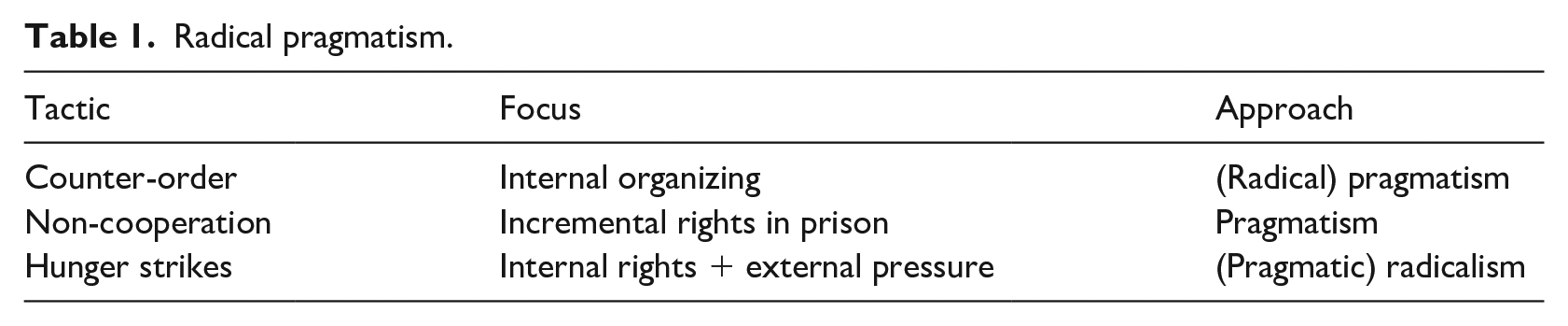
While Berger writes in the context of the decarceration movement, I extend his integrative approach to discuss how prisoners in conflict contexts use a multilevel strategy of radical pragmatism to navigate the trialectic dynamic between themselves, authorities and external networks. Prisoners’ tactics are radical in the sense that they aim for fundamental change within, and sometimes, outside, the prison system. Yet, crucially, they are pragmatic in the sense that they employ incrementalist tactics that reflect a sustained, accumulative approach, relying extensively on bold but relatively submerged actions before launching more high-profile hunger strikes. Specifically, I examine how prisoners enhance organization and discipline through the creation of self-governing praxes, or ‘counter-orders’ (Rosenfeld, 2004); how they pragmatically challenge prison authorities via ‘everyday resistance’ (Scott, 1985); and how they strategically leverage pressure on authorities from external networks via high-profile strikes. Mapped onto the trialectic dynamic, I use the framework in Table 1 (emphasizing that categories are not absolute) to indicate how prisoners use a radically pragmatic approach to self-organize, negotiate rights with authorities and instigate external pressure.
Radical pragmatism.
Contextual background
Prisoner resistance is present in almost every carceral space. 1 In this article, however, I focus on three contexts that, while politically, culturally and geographically distinct, all represent protracted conflicts, described by Edward Azar et al. (1978) as prolonged struggles by communal groups for basic needs such as security, recognition, acceptance, fair access to political institutions and economic participation (see also Ramsbotham, 2005). Further, each of the three cases represent sites of post-empire and postcolonialism, with at least part of the legal framework and prison system in each context influenced by Britain’s colonial presence. Crucially, each of the states borrowed policies from the British and from each other, especially in terms of mass incarceration, unlawful detention and interrogation. 2 For example, Israel’s justification for the use of ‘moderate physical pressure’ during interrogations in 1987’s Landau Commission 3 was based on the use of similar tactics by the British in Northern Ireland. Likewise, ‘preventive detention’ practices in all of the cases drew from previous British policies in India, Kenya and other former colonies (Conboy, 1978: 441). At the same time, prisoners in each of the cases learned from what prisoners in the other contexts were doing; for example, Irish prisoners adapted tactics from early Palestinian experiences with hunger strikes and vice versa (Shwaikh, 2018). Below I briefly describe the use of political imprisonment and detention in each of the three cases.
Israel–Palestine 4
Approximately 20% of the Palestinian population (and close to 40% of the Palestinian male population) has been detained or imprisoned at least once (Addameer, 2016: 4), including an estimated 500–700 minors every year (DCI). Some detainees have been in prison for decades, while others have been held for days or weeks at a time in detention, and others have been arrested on multiple occasions.
Widespread incarceration began after the 1967 war, coinciding with the start of the Israeli military occupation of the West Bank, East Jerusalem and the Gaza Strip. From the early days of imprisonment, Palestinian prisoners have mobilized to claim rights and improve conditions by engaging in acts of resistance that challenge the status quo of the prison system. Actions have included the development of alternative institutions (such as political, financial and educational systems within the prisons), non-cooperation (such as refusing to comply with prison protocols or refusing to work), refusal of family or lawyer visits, refusal of meals, individual hunger strikes and over 30 collective hunger strikes (Tahhan, 2017). Prisoners have used these tactics (as well as legal claims) to secure rights within the prison, challenge their individual detention or incarceration and further the Palestinian national movement.
Northern Ireland
Mass imprisonment and detention were used by the British during the Irish revolutionary period in the early 20th century, and again during the Troubles in the late 20th century. Over 30 hunger strikes were documented in Ireland between 1916 and 1923, culminating in a collective strike involving approximately 8000 Irish Republican Army (IRA) prisoners protesting the division of the island at the end of the Irish civil war, as well as their continued detention under the new Irish Free State (Healy, 1982). The hunger strike tactic was reprised by Irish prisoners during the Troubles, a three-decade conflict between Nationalists, Unionists and the British in Northern Ireland. In May 1972, Republican prisoners in the Crumlin Road Gaol launched a hunger strike to demand political status and improve prison conditions. This hunger strike, initiated by prisoners independently of the IRA leadership outside, importantly influenced the inclusion of prisoner status as an IRA precondition for talks with the British, resulting in the granting of ‘Special Category Status’. Though less than the official political status sought by prisoners, Special Category Status allowed for de facto POW-style lifestyles in the prisons, including free association and abstention from prison work and prison uniforms.
The revocation of Special Category Status in 1976 eventually led to the 1981 hunger strike in the Maze/Long Kesh Prison, led by Bobby Sands, in which ten prisoners died when authorities refused to negotiate (BBC, n.d.). The demands of the hunger strike were essentially to return to the conditions allowed by Special Category Status: the right not to wear a prison uniform; the right not to do prison work; the right of free association with other prisoners for educational and recreational activities; the right to one visit, letter and parcel per week; and the full restoration of remission lost through the protest. While the strike was called off before demands were met, British authorities granted partial concessions soon after, although special status was never restored. Moreover, the hunger strike attracted unprecedented domestic and international attention to the prisoners’ demands and to the broader conflict.
South Africa
Tens of thousands of South Africans were arbitrarily detained under the apartheid regime from 1962 to 1991. Over 3000 more were tried and convicted as (political) prisoners with non-whites (African, Indian and ‘Coloured’) held at Robben Island, which, as Fran Buntman (2003: 5) states, ‘was transformed by prisoners from a brutal “hell-hole” to a “university” for activists and political leaders’. Early acts of resistance focused on changing the living conditions on the island through a mix of hunger strikes and legal actions, as well as non-cooperation and organized political and cultural activities. Gradually, as Buntman (2003: 250) continues, ‘prisoners challenged the prison status quo not only because of poor treatment or the fact of their imprisonment, but also with the goal of using the prison as . . . a training school to develop social change agents to revolutionize the world outside and beyond the prison’. Robben Island became a physical and symbolic representation of the apartheid regime on the one hand but also of resistance to apartheid, and it was the site where early talks for broader negotiations commenced.
Radical pragmatism: The strategy of multilevel tactics
As Berger (2013: 4) notes, in the context of social movements, states often use imprisonment to repress radical activism by targeting those most likely to resist as well as those who have in fact resisted. This observation also extends to protracted conflicts, often considered as liberation movements by those most active within them, such that the policies of mass incarceration and arbitrary detention, by their very nature, result in many activists being imprisoned together. Like Berger (2013: 5), I do not argue that everyone in prison is a revolutionary, but rather point out that the state’s targeting in each case of ‘potential and latent threats’ resulted in high percentages of politically conscious individuals together in the prison space. While many of those incarcerated sought ‘radical’ change in the context of the broader external struggle, the fact that the majority were in fact seasoned activists enabled them to use the prison space strategically by combining pragmatic approaches with ‘radical’ tactics to self-organize, push for incremental rights within the prison and mobilize external pressure on authorities. In this section, I discuss how this ‘radical pragmatism’ was manifest in the establishment of self-organizing praxes, everyday acts of non-cooperation and hunger strikes.
Self-organizing for dignity and discipline: Establishing the praxis
In each of the cases, prison-based acts of resistance, and the gradual implementation of rights, would have been nearly impossible without the highly organized administrative systems developed by prisoners in the early years of imprisonment. Maya Rosenfeld (2004) uses the term ‘counter-order’ to conceptualize the self-governing systems that Palestinian prisoners developed as alternative institutions to the prison regime. However, prisoners are not only shadowing the state with these systems, but rather employing praxes that challenge the state’s very paradigm of power and order and reclaiming the prison as a space for self-determination and (delimited) autonomy. The prisoners’ administrative regimes, or praxes, looked different in each case study, but generally consisted of elected committees or leadership, sharing economies and covert systems of communication; in most cases, the self-governing regime also facilitated cooperation between different political factions. In each of the cases, the praxes developed over time, usually instigated when leaders of the national struggle were imprisoned in one place (Ashkelon Prison in Israel–Palestine, the H-blocks of Long Kesh in Northern Ireland and B Block at Robben Island in South Africa) and developed clandestine systems for relaying messages, coordinating actions and eventually holding secret elections and instituting committees.
While these self-governing praxes included many elements (see Norman, 2020), I focus here on the clandestine education curricula that anchored the counter-order in each case study, bridging radical ideology with pragmatic training and discipline. In all of the cases, the education systems developed by prisoners were essential in infusing their time in prison with a sense of purpose. On Robben Island, both formal and informal education took place across political parties, ranging from literacy classes to correspondence-based university classes. Academic study was valued for maintaining morale, bettering the community and providing a basis in political education (Buntman, 2003: 62–63), whether taking place covertly while working in the quarries or through formal study. As in the other case studies, political education was mostly organized by political faction/affiliation, with seminars, debates and discussions about politics and news. Importantly, however, academic education extended across political lines, and ‘classes’ were taught based on expertise rather than ideology, thus creating a basis for cooperation. As Buntman notes, ‘knowledge was clearly seen as power . . . and education was not seen as a zero-sum game, or as a weapon against others, but rather a source of advancement for all’ (2003: 262).
In Northern Ireland, though separate, both Republican and Loyalist prisoners also developed education curricula with similar aims of personal and collective betterment. As one former Loyalist prisoner recalled, ‘The education was especially important for youth like me. I wasn’t stupid, but I had left school as soon as I could. In prison, we had classes in Irish history, which we had never learned about in school. I started thinking about stuff that got me knowing and got me to reflect’ (Interview 1). According to one former Republican prisoner, the education system changed from a top-down authority-based system in the 1970s to encompass more critical thinking in the 1980s:
In the 1970s, we had organization and an education system, but it was very top-down. Then after the hunger strike I read [Paulo] Freire’s Pedagogy of the Oppressed [smuggled in with a fake cover]. Earlier I probably would have thought that it didn’t apply to us in Northern Ireland, that it was too Marxist, not suited to a command-military structure like we had. But now it made sense that we have this more communal approach, and to start seeing ourselves as agents of change and as revolutionaries, and not just as tough, macho rebels willing to take whatever was thrown at us. So we started to shift the way we did the education and the organization in the prison to be more communal. We made it more about reading about revolution, solidarity, combat liberation and critical thinking, and not just political lectures on history and politics. (Interview 2)
Similarly, in Israel–Palestine, ‘the pedagogy and the revolution [were] interwoven to create a revolutionary Palestinian pedagogical system’ (Nashif, 2010: 72). Both the political educational content and the learning process itself strengthened the prisoners’ autonomy, such that ‘reading/writing became the praxis of resistance . . . not just in and by itself but, more importantly, as part of the community-building process’ (Nashif, 2010: 74). Integrating process and content, the education system combined independent reading of progressive literature with political discussions and critical debates. As one former prisoner explained, ‘There were intensive educational programmes, intellectually and politically, to the level where the prison was considered to be as a school. It was very well organized, so the awareness was really high, continuously. This “school” was teaching the prisoners two things: to commit with the collective decision and to enrich their political and intellectual level in regards to the conflict. Therefore the infrastructure of the prisoners was very, very strong’ (Interview 3).
As in the other case studies, the Palestinian education curricula were organized by each political faction, though there were also group discussions between members of the different parties to compare ideas and philosophies. Studies also included analyses of other ‘liberation’ movements, such as Algeria and Vietnam, which were compared and contrasted to the Palestinian struggle. Other topics included social theory, especially the writings of Karl Marx and Friedrich Engels, political theory, history, military strategy, literature, and languages, including Hebrew. General courses that were not politically specific, including language, science and general history, were usually conducted as open forums, not divided by faction. All prisoners were expected to participate in the education programme, and it formed a core part of the daily schedule and regimen in the prison. When prisoners were allowed to congregate, classes were held in the morning, while independent study and reading took place in the afternoon and evening.
Of course, the right to study was itself constantly (re)negotiated. As Buntman writes, ‘rules and regulations regarding prisoners’ access to education improved and regressed in an array of ways over time. The inmates were continuously vulnerable to their jailers’ edicts and controls’ (2003: 64). Across the case studies, the right to study was often individually or collectively withdrawn as a form of punishment, and censorship and restrictions on books and materials was often used punitively. For example, in Israel–Palestine, prisoners initially had no access to pens or paper, and access to books was limited, rights that were eventually won through hunger strikes and resistance. Even when books were permitted, however, they were very few in number, and topics were limited to general culture and religious texts, with any political material prohibited and all books checked and censored by the prison administration. In later years, the prison administration would give and take the right to enrol in external correspondence courses as a form of privilege and punishment, respectively.
The education system was a radically pragmatic pillar of the prisoners’ praxis in each case, which provided a foundational structure for resistance, as well as a unifying sense of purpose and identity. As Avram Bornstein (2010: 466) writes, ‘instead of being isolated, dependent, and obedient, the organized prisoners buil[t] an identity of themselves as men [sic] on the front line of resistance . . . and at the political center of the struggle’. Indeed, the self-governing systems in general, and the education regimes in particular, proved integral to the relative successes of prison-based activism fostering the unity, discipline and coordination necessary to organize direct actions and strikes.
Pressuring prison authorities: Non-cooperation as everyday resistance
The discipline fostered by the praxes of autonomy proved essential in organizing for resistance. While hunger strikes perhaps represent the peak of prison-based resistance in each of the case studies, nearly all hunger strikes were preceded by other individual and collective acts of pragmatic, incremental resistance, including refusal to work at assigned jobs, acknowledge prison guards or comply with counting and searching protocols. These types of actions aimed to directly challenge the prison administration and force changes in policy by making the established system difficult to manage, and ultimately, unworkable for prison staff.
Actions were typically organized in response to specific policies. As Nidal, a Palestinian who was imprisoned in the 1980s explained:
Many things actually came, not through hunger strikes, but through direct challenging of the administration. For example, the strip-searching. They used to make prisoners take off their clothes in front of each other to search them, just to humiliate them. They knew there was nothing inside [our body cavities]. So the prisoners decided to challenge that. We said, okay, we won’t take off our clothes, even if the guards hit us, or we are punished in the isolation cells, or maybe punished by prevention from family visits. The prisoners were ready to take this risk and challenge that policy. (Interview 4)
Similar actions included refusing to stand for the prisoner counts that took place three times a day, and refusing to address the guards as ‘my lord’ or ‘my master’ (Interview 5).
Prisoners at Robben Island engaged in similar acts of non-cooperation, refusing to call their captors by the honorific baas, and refusing the tausa, or dance, a variation on the already humiliating strip-search in which prisoners were to leap in the air while clapping their hands and opening their legs (Hauser, 2012). Prisoners’ resistance to these types of degradations anchored their acts of protest in demands for dignity, such that ‘prison transformed the politics of respectability into subversion’ (Berger, 2014; Siegel, 2018: 132). Likewise, prisoners in Northern Ireland famously went to new extremes of non-cooperation in the blanket protest, in which they went without clothing after refusing to wear prison uniforms, and the dirty (or ‘no wash’) protest, in which they refused to leave their cells to use showers or lavatories or empty their chamber pots, eventually covering the cell walls with their own excrement.
These gradual actions served several purposes. Primarily, they aimed to challenge specific policies, such as the strip-searches or counting protocol. Moreover, they were sending a message to the prison authorities that the prisoners were willing to struggle and resist. As Nidal noted (Interview 4), ‘These kinds of steps were taken to reject specific measures. . . and to say to the prison administration that we are strong and we are ready to struggle against you.’ Buntman (2003: 260) also writes, ‘Although resistance has practical goals, such as the improvement of conditions, defiance and protest action are also important as statements or public declarations of the continued refusal of prisoners to submit.’ Further, these types of actions served as a sort of practice or training for the last-resort option of the extended hunger strike. Resistance in general gave practice in discipline and organization, while specific actions such as temporary refusal of meals helped prepare prisoners physical and mentally for prolonged hunger strikes.
Hunger strikes
Detainees and prisoners have used hunger strikes as political actions in conflicts around the world for over a century, extending beyond the case studies of this article to include suffragettes in Britain, Kurdish prisoners in Turkey and detainees at Guantanamo Bay, among countless others. Hunger strikes have been described as a form of ‘protest theater’ (Kavner, 2012), and identified by Sharp (1973) as a psychological form of nonviolent intervention. Indeed, hunger strikes function as a form of civil disobedience by creating political opportunities, sparking mobilization processes and forcing a dynamic of political jiu-jitsu, in which the ‘seemingly powerless can overcome a powerful oppressor’ (Scanlan et al., 2008: 320). By using their bodies as ‘political structures’ (Nietzsche, 1968) prisoners can redirect or reverse dynamics of power (Feldman, 1991); as McEvoy (2001: 45) writes, hunger strikes ‘offer a historical template from which to draw inspiration and legitimacy . . . they represented resistance through endurance and self-sacrifice’. While prisoners exercised pragmatism in deciding if and when to go on hunger strike, the act itself sought radical changes within and beyond the prisons, and often depended on external pressure for success.
In Israel–Palestine, hunger strikes have been used since the early days of incarceration, with over 30 documented hunger strikes by Palestinian prisoners. Over time, prisoners planned for hunger strikes through intense preparation, physical and mental, with experienced prisoners explaining to others how their bodies would respond day by day (Al Jundi and Marlowe, 2011: 141). Prisoners also sought to leverage external pressure, taking steps to coordinate the strike with other prisons and with political parties, organizations and families on the outside. The strikes resulted in a gradual realization of rights and improvement of conditions, including improved food and better bathing conditions; access to books, writing materials and eventually radios and televisions; and the establishment of negotiation policies between prisoners and the prison administration. Other early demands included cessation of beatings, reducing crowdedness in cells and allowing prisoners to cook their own food (Nashif, 2010: 51–52).
The specific demands of Palestinian hunger strikes varied over time and between prisons. They were typically written in a statement and communicated to the prison administration by an elected representative, ultimately forcing a negotiation process with the authorities. According to nearly all of those interviewed, while not all strikes were immediately successful, they were essential in pressurizing the prison authorities to gradually expand prisoners’ rights over time. A significant achievement of a 1976 strike was the right to establish an elected representative prisoners’ body, which served as the negotiating body with the prison administration. According to one former prisoner, ‘This was the beginning of reshaping the relationship between the jailers and the prisoners’ (Interview 6). Indeed, the recognition of a representative prisoners’ body that could speak directly with the prison authorities was crucial in establishing a new dynamic by which prisoners could negotiate policies and conditions directly, often averting other strikes.
Hunger strikes were less common in South Africa, where ‘Robben Islanders developed a legacy of negotiating with the authorities in the name of the smooth running of the prison’ rather than hunger strike (Buntman, 2003: 170). Usually these negotiations took the form of discussions with prison authorities following a written appeal. When such negotiations failed, however, or when relations with prison staff did not allow for negotiations to take place, the prisoners used hunger strikes as a tactic. The first major strike was in 1966, when nearly the entire prison population (over 1000 men) went on strike over the harsh conditions, forcing a change in the level of brutality and beatings, the quality of food and the access to cultural and academic activities organized by prisoners (Buntman, 2003: 36). According to Dede, a former prisoner, hunger strikes were renewed by incoming younger prisoners in the early 1970s following a regression of conditions (Interview 7). In this way, prisoners toggled between measured and confrontational modes of negotiation, with hunger strikes being the peak of resistance. Unlike the other case studies, the remote location of Robben Island meant that a hunger strike would not necessarily translate immediately to external mobilization and pressure because news took so long to travel out. Thus, as another former prisoner commented, hunger strikes were a ‘double-edged sword’ (Buntman, 2003: 172) that put prisoners in grave risk, so they had to have confidence that they could find a solution with authorities almost immediately.
In Northern Ireland, the infamous 1981 hunger strike was preceded by a number of hunger strikes, mostly led by Republican prisoners but often joined by Loyalist prisoners as well. The first major strike was in 1971 in the wake of internment (unlawful detention) by detainees held on the Maidstone prison ship in Belfast, which was closed soon after. In 1972, dozens of male and female prisoners in Northern Ireland went on hunger strike to demand political status. Individual hunger strikes continued through the 1970s, mostly by Republicans imprisoned in England, who were subject to force-feeding. Meanwhile, after the revocation of special category status in 1976, prisoners in Northern Ireland engaged in the blanket and dirty protests mentioned above for several years, before deciding on a hunger strike as a last resort. After an initial strike at the end of 1980 failed to gain concessions, prisoners organized a second strike starting 1 March 1981, with prisoners joining the strike in stages. The strike was eventually called off on 3 October, after the deaths of ten hunger strikers amid pressure from prisoners’ families for medical intervention. Three days later, the British government made concessions allowing prisoners to wear their own clothes, have more visits and obtain greater freedom of association, and reviewed prison work.
As Kieran McEvoy notes, ‘while. . . the strikes were perceived contemporaneously by the prisoners as a failure, both the prisons and the political landscape had been irrevocably altered by the hunger strikes’ (2001: 97). Notably, the successful election of hunger striker Bobby Sands as an MP before his death, followed by the election of several other hunger strikers, led to the IRA adoption of other strategies beyond armed struggle. Further, the international media interest in the hunger strike brought unprecedented attention to the Troubles in general and the prisoners’ struggle in particular, even as domestic support was initially difficult to garner and proved challenging to sustain.
Across all three cases, prisoners used structurally transformative but ultimately incremental tactics including internal organizing, non-cooperation and hunger strikes to maintain their morale, improve conditions and challenge prison authorities. Given the protracted nature of the conflicts, prisoners learned from their past experiences and adapted tactics accordingly, as when Republican prisoners shifted from a collective strike in 1980 to a progressive strike (one man at a time) in 1981. Prisoners also looked to strategies employed in other contexts; Palestinian and Irish prisoners in particular closely followed each others’ strategies via smuggled radios, updates from visitors, and even direct correspondence. Of course, prison authorities were also observing and adapting counter-tactics, resulting in a back-and-forth ‘bargaining’, with each group trying to pressure the other to concede or negotiate.
Trialectic negotiations
Prisoners did not employ multilevel tactics in a vacuum, but rather in a constant ‘negotiation’ with prison authorities. Prison administrators tried different preventive and punitive policies that both informed and were informed by prisoners’ actions. In turn, pressure from external networks, especially during hunger strikes, added another element to the dynamic, resulting in an agent–target–observer trialectic between prisoners, authorities and external networks. In this section, I discuss how the acts of radical pragmatism discussed above forced cycles of direct and indirect negotiations between these actors, resulting in the gradual realization of improved rights within the prisons. I focus on hunger strikes, as they were most instrumental in forcing these cycles of trialectic bargaining.
In each of the case studies, the state used imprisonment as a strategy of control in the broader conflict. Each case was characterized by mass arrests, unlawful detention (termed ‘administrative detention’ in Israel–Palestine and ‘internment’ in Northern Ireland) and the use of torture and cruel, inhumane and degrading (CID) treatment during interrogations for the varied purposes of discipline/punishment, preventive security, intimidation and intelligence gathering. At the prison level, however, authorities used a range of other tactics within their power to prevent, curb or punish prison-based resistance, constantly trying to stay a step ahead of prisoners. As Orit Adato, a former head of the Israeli Prison Service (IPS) commented, ‘it’s a never-ending struggle, who will be cleverer than the other, who will reach the next point’ (Interview 8).
Prison authorities especially sought to avoid prolonged, collective hunger strikes. States are obligated under international law to maintain the health of prisoners (Lines, 2008); 5 thus, hunger strikes intentionally aim to push the prison administration, or the state government, to the point that they can no longer ensure prisoners’ health, making internal prison administration difficult while simultaneously risking international shaming and condemnation. Furthermore, in protracted conflict situations, most states recognize that the death of a prisoner would galvanize the local population’s support for prisoners and spark renewed activism, resistance or violence (Vick, 2013); as a senior Palestinian minister commented in 2013, ‘If any of the prisoners die, we can’t control the Palestinian street’ (Ziad Abu Ein, as quoted in Vick, 2013). From prisoners’ point of view, hunger strikes are ‘successful’ when the state is pressured to negotiate certain rights or terms of release, be it to restore internal order, avoid international embarrassment and/or prevent more widespread mobilization.
In most cases, prison authorities used strategies such as ‘intelligence’, including relying on informers and watching for changes in prisoners’ behaviour, to prevent a strike from happening. As the former IPS director stated (Interview 8), ‘You have to identify the trends, the tension indicators; if it is regarding the conditions in which they are being kept, you should discuss it with them, quietly, to try to solve the problem if it is solvable.’ If authorities were unable to detect a strike, or were unwilling to negotiate, they tried to separate striking prisoners or transfer leaders, and implemented punitive measures such as taking away collective earned rights and making strikes punishable by solitary confinement.
Authorities also used force-feeding as a tactic to break hunger strikes, but its use varied between and within the case studies. The practice was not used in South Africa, and in Northern Ireland, force-feeding was not implemented on the island of Ireland after 1917 when a Republican leader died from effects of the procedure. Force-feeding was, however, used on Irish prisoners held in other parts of Britain, but ceased in 1974 following the death of Republican prisoner Michael Gaughan (Miller, 2016). In Israel–Palestine, force-feeding was used through 1992, resulting in the deaths of five prisoners, and controversially reauthorized in 2015 under the ‘Prevention of Hunger-Strike Injuries’ law (though not yet employed at the time of writing).
As noted by Orit, however, most prison authorities preferred to either prevent or stop a strike through negotiations, rather than getting to the point of force-feeding. It is important to note, however, that the prison authorities were often limited in terms of what they could negotiate if demands went beyond prison conditions to include release, status or official recognition, which were political decisions beyond the purview of wardens and prison administrators. In these cases, strikes struggled to be successful because the pressure put on the workings of the prison were not directly affecting those ultimately making the concessions. Successful negotiations were more likely if the demands related to conditions within the prison authorities’ mandate.
The success rate of hunger strikes varied considerably. Sometimes the timing proved difficult, especially if public attention was focused elsewhere; for example, Palestinian prisoners decided to call off a strike that ended up coinciding with the 1973 war because they could not sustain public interest in the prisoners’ struggle (Rosenfeld, 2004: 245). At other times, the prison administration simply refused to grant the minimum number of demands agreed upon by the prisoners. Even when strikes were deemed ‘successful’, change was only incremental. As Noor, who represented prisoners in negotiations with prison authorities in the 1990s, explains in Interview 9, ‘Some demands were accepted, others not. Basically, they gave us the little things, but refused the major things. Or they gave us things that they could easily take away again.’
Prisoners had to weigh potentially marginal gains against the certain physical toll that a hunger strike would take on their bodies. 6 According to Christo Brand, a former prison guard at Robben Island, a key reason Mandela and other older leaders would usually opt to negotiate rather than go on hunger strike was because of the physical costs, with many prisoners being sent to hospital, and being unable to exercise or even go outside due to the weakness brought on by lack of food (Interview 10). Though prisoners tried to prepare themselves for the physical demands of the strikes, many prisoners suffered from long-term health problems afterwards.
When and why were some hunger strikes successful? In terms of forcing negotiations or at least partial concessions, a ‘successful’ strike usually required activating the trialectic dynamic through both internal and external pressure on authorities. Internally, hunger strikes succeed when they make life inside the prison unworkable for the administration; as Nashif (2010: 65) notes, in a hunger strike, ‘the captive tells the jailer, “I will turn your game upside down”’. Indeed, one of the reasons the early Palestinian strikes of the 1970s proved successful was that the prison authorities could no longer manage the day-to-day operations of the prison with prisoners engaging in what was essentially prolonged civil disobedience, and at that time, the prison service did not have resources in place to manage the strikes.
By association, the size and scope of the strike influences the outcome, as the more prisoners engage in a strike, the more difficult it becomes for the administration to maintain control. The most successful strikes in both Israel–Palestine and Northern Ireland were ‘open’ (collective) strikes and included participation by prisoners across the prison system, including men and women. Strikes with this level of participation clearly put more pressure on the prison system than strikes by one or several individual prisoners, or strikes that were solely confined to one prison. The number of participants made it difficult for authorities to respond by measures such as isolating or moving strikers, and limited the extent to which authorities could use force-feeding. The preparation for the strike also contributes significantly to its success or failure. Planning for some Palestinian strikes began over a year in advance, with prisoners communicating across prisons, generating a specific list of demands and a negotiating strategy, physically and mentally ‘training’ for the experience, and developing a timeline for the strike.
In terms of external coordination, organization with outside groups, especially political factions, can greatly influence a strike’s outcome. In the case studies, the Palestinian Liberation Organisation (PLO), the IRA and the African National Congress (ANC), respectively, were essential in bringing attention to the strikes, garnering media coverage and organizing solidarity tents and local demonstrations, even at times when external faction leaders and prisoners were in disagreement over strategy. Hunger strikes also often attracted the interest of human rights organizations, international solidarity networks and community activists, drawing increased attention not only to prison conditions, but to the asymmetry of the conflicts themselves, often framed by allies as liberation struggles. This type of mobilization extended the hunger strikes from a tactic solely inside the prisons to one that could diffuse across political spheres and activist networks, increasing pressure to respond not only on the prison administration, but also on the state itself.
The relative success of strikes is also influenced by external local and global contexts. Locally, it is not a coincidence that two of the highly successful Palestinian strikes, 1987 and 1992, occurred during the first intifada, when political tensions were high, outside mobilization was strong, and it was perhaps in the state’s relative interest at the time to accommodate prisoners’ demands for improved conditions (rather than make broader political concessions). In the global context, Israel’s response to Palestinian strikes of the 1980s were no doubt influenced by the martyr status granted to the ten Irish prisoners who died on hunger strike in 1981, while the 1992 Palestinian strike shortly followed the release of Nelson Mandela and anti-apartheid activists from prisons in South Africa. In such contexts, agreeing to negotiate with prisoners on hunger strike helped prison authorities avoid the very real threat of prison riots, 7 and helped state authorities prevent or subdue further external unrest.
Prisoners’ resistance in general, and hunger strikes in particular, put pressure on prison authorities, augmented by additional pressure from external factions and networks. In turn, prison administrators and state authorities sought to impose their own forms of pressure, both preventive and punitive, to foil strikes and other actions. This resulted in a cycle of trialectic negotiations that, while not always successful for prisoners in the short term, resulted in the gradual realization of rights over time.
Conclusion
States use mass imprisonment and arbitrary detention in attempts to quell resistance movements, especially in post-empirical protracted conflicts like those discussed in this article. However, as this research shows, these policies often backfire as prisoners have been able to subvert the prison space and assert themselves as political actors, influencing dynamics both within and beyond the prisons. Rather than resorting to passive compliance or violent riots, prisoners demonstrated multilevel strategies of radical pragmatism, including self-organizing through the establishment of autonomous praxes and counter-orders, wearing down prison authorities through everyday acts of non-cooperation and mobilizing external networks via actions like hunger strikes. Prisoners’ actions both informed and were informed by authorities’ attempts to prevent or punish resistance, as well as external networks’ pressure and support, resulting in a trialectic dynamic of direct and indirect bargaining and negotiation that ultimately led to the incremental realization of rights within the prisons, and the leveraging of the prisoners’ issue to influence broader conflict trajectories.
Footnotes
Acknowledgements
The author is grateful to the editors at Security Dialogue and the anonymous reviewers for their insightful comments. Additional thanks to the Conflict & Change Working Group at UCL for its helpful feedback on the draft. Thank you also to the British Academy and the Senator George J. Mitchell Institute for Global Peace, Security and Justice at Queen’s University Belfast for supporting the research that informed this article.
Funding
The author disclosed receipt of the following financial support for the research, authorship, and/or publication of this article: The fieldwork which formed the basis for this article was partially supported by a British Academy Small Grant, reference SG151891.
