




Abstract
A recent wave of scholarship has drawn attention to the need for further engagement with the role of ‘the audience’ in securitization ‘games’. This article contributes to this discussion both theoretically and empirically by exploring the types of question an audience may ask of a securitizing actor before a securitizing act meets with success or failure. To do this, it offers a discursive analysis of all 27 UK parliamentary debates on the extension of proscription powers to additional terrorist organizations between 2002 and 2014. We argue first that these debates are characterized by a wide range of questions relating to the timing, criteria, mechanics, consequences and exclusions of proscription; and second, that these questions function as demands upon the executive to variously justify, explain, clarify, elaborate and defend decisions to extend the UK’s list of designated groups. Taking these questions seriously, we suggest, therefore allows insight into a variety of ways in which audiences might participate in security politics that are not adequately captured by notions of consent or resistance, or success or failure. This has empirical and theoretical value for understanding proscription, parliamentary discourse and securitization alike.
Introduction
An important driver within contemporary debate on the value and direction of securitization theory has been a perceived lack of attention to the makeup and role of the ‘audience’ in this framework. 1 In the theory’s original – ‘Copenhagen School’ – formulation, the audience is presented as playing a decisive role in the ultimate fate of any securitizing move (Buzan et al., 1998). Understood as ‘those the securitizing act attempts to convince to accept exceptional procedures because of the specific security nature of some issue’ (Buzan et al., 1998: 41), this formulation argued that a relevant audience must recognize and accept such an act in order that a particular issue be successfully transferred to the realm of security politics, with everything this connotes. It is this centrality of the audience that renders this approach to securitization intersubjective rather than decisionist (Roe, 2004: 281), because – understood thus – ‘successful securitization is not decided by the securitizer but by the audience of the security speech act’ (Buzan et al., 1998: 31). Thus, as Buzan et al. warn, there is a danger in overemphasizing the role and agency of securitizing actors, because ‘in some cases … it does matter how others judge the reasonableness of a securitization, because this influences how other actors in the system will respond to a security claim’ (Buzan et al., 1998: 30, emphasis in original).
Subsequent literature on securitization, both sympathetic and critical, has raised significant questions around this Copenhagen School approach to the audience. First are problems of underconceptualization (Balzacq, 2005; Stritzel, 2007; Roe, 2012). Of particular concern here is a perceived tension between a commitment to intersubjectivity on the one hand, and a commitment to the performative power of speech acts, with its attendant downplaying of an act’s recipient, on the other (McDonald, 2008; Balzacq, 2011; cf. Hansen, 2011). Second, authors such as Salter (2008, 2011) have problematized the audience’s homogeneity by drawing attention to the multiplicity of ‘settings’ in which security is performed and, concomitantly, the varying expectations, background knowledge and dispositions of disparate audiences. For Van Rythoven (2015), for instance, securitizing moves are constrained, and potentially frustrated, by the role of collective emotions such as fear within relevant audiences. Third is the risk that the Copenhagen School’s insistence on audience acceptance for successful securitization sets an unnecessarily high bar that may be ill-suited for analysing the production of many threats in ‘real’ empirical scenarios. As Balzacq (2011: 8) suggests, ‘threat images that become prevalent in a society, without explicit audience assent, cannot be captured in terms of securitization theory, nor participate in the development of the conceptual apparatuses of the latter’ (see also Huysmans, 2006; Oren and Solomon, 2015). And fourth, as Léonard and Kaunert (2011: 58–59) among others have argued, these conceptual problems matter because without knowing the constituents of a relevant audience, how to establish when acceptance has been given, or at what point the process of securitization is complete, it becomes far more challenging to ‘apply’ this approach within specific research contexts.
One consequence of this discussion has been further specification of the variable meaning and logics of ‘security’ in different contexts. McDonald (2015: 159), for instance, argues that ‘the practical effects of linking security with particular issues or policies – the implications of securitization – vary according to the different discourses of security that underpin the way particular issues are conceptualized and addressed by different political communities’ (see also Browning and McDonald, 2013). Here, a link may be drawn with related, but often conceptually distinct, explorations of ‘everyday’ or ‘vernacular’ security and their emphasis upon local understandings and narratives of threat (Bubandt, 2005; Jarvis and Lister, 2013).
A second, equally important, effect of these discussions has been a directing of attention to the ways in which securitizing acts are contested, resisted or otherwise challenged by different audiences. Tjalve (2011: 443) approaches this task conceptually, calling for greater theorization of ‘how forms of political order may set the context for, and systematically condition, processes of securitization/desecuritization’. Oren and Solomon (2015), in contrast, draw on work around political ritual to explore how practices of incantation – rather than ‘rational’ persuasion – may facilitate successful securitization. Balzacq’s (2015a) recent edited volume, however, stands out here, with its attempt to map the different ways in which ‘specific security formation[s are] … challenged, debased or extinguished’ (Balzacq, 2015b: 8). In different ways – and using distinct conceptual apparatuses from emancipation through to resilience and resistance – the contributions to that volume all contest the assumption that security discourses pass relatively unchallenged owing to the ‘fast-tracking’ of decisionmaking (cf. Aradau, 2004; Roe, 2012) seemingly required by the ‘urgency of emergency’ (Salter, 2011: 116) within the logic of security.
The present article contributes to these discussions by focusing on parliamentary debate around the proscription of terrorist organizations within the United Kingdom. These debates offer a particularly promising case through which to consider the role of the audience within security discourse for two reasons. First, although there is now a small but significant body of work on the security practices of parliamentarians – including in relation to counter-terrorism – legislative debates on proscription have remained almost entirely untouched (for relevant scholarship, see Huysmans, 2006; Huysmans and Buonfino, 2008; Neal, 2012; Fisher, 2015). This is both unfortunate and surprising. It is unfortunate because these debates offer a relatively compact case study through which to analyse justifications for, discussion around, and the granting of new security mechanisms. 2 As detailed below, the extension of proscription powers to hitherto unlisted organizations takes place within discrete and identifiable debates with immediately traceable consequences. The lack of attention to these debates is surprising, moreover, because the consequences of proscription, which include the banning of identified groups from a designated territory and the criminalization of membership of those groups, speak to precisely the kinds of security logic and consequence – boundary drawing, exclusion of others, exceptional powers – presupposed by the securitization framework.
A second reason for taking these debates seriously is that they offer an excellent opportunity to explore audience participation in the securitization ‘game’ that lies somewhere between straightforward acceptance and outright contestation. 3 As demonstrated below, parliamentary debate on the application of this power is characterized by a whole series of questions and comments not adequately captured by the binary yes/no model that so-called linguistic models of the securitization framework encourage. These questions stretch from issues of bureaucratic procedure to matters of fundamental principle. They include, inter alia, requests for additional information on the activities of, or threat posed by, particular organizations, as well as appeals for clarification on why specific organizations have been brought ‘to the table’ for debate. Taking these questions seriously, therefore, nuances understandings of the role different audiences might play in securitization dynamics by elaborating relatively neglected forms of participation. Just as an issue may not fall neatly into one or other of securitized/unsecuritized, so an audience’s response to a securitizing move might fall between acquiescence and opposition, or consent and resistance, at least initially. An analytical framework of five identified types of ‘security question’ is offered below to capture some of the ways in which legislators participate as audiences in this context.
The article’s contribution is therefore both empirical and theoretical. In the first instance, it presents a detailed and rich description of a particular security ‘game’ that draws on a significant body of original, and unresearched, primary material. In so doing, it provides an analysis that stretches across 15 years of UK political history and three distinct governments. This empirical contribution to existing work on political discourse around proscription, counter-terrorism and security is complemented by the article’s second – theoretical – contribution to contemporary debate on securitization. Here, our focus on how legislators question the executive contributes to recent elaborations of the role of disparate audiences within security politics. It does so first by providing a typology of distinct logics of enquiry structuring audience participation in this setting, and second, by highlighting the significance of these for the temporalities and fixedness of roles within security dramas, as well as for future investigation into intra-audience heterogeneities.
The article begins with an overview of proscription and its usage in the UK. This is followed by an introduction to the research from which this article draws and its discourse analysis methodology. As noted below, this involved an immersive reading of all relevant debates within the two Houses of Parliament between 2002 and 2014: 27 in total. The article’s third section introduces five types of questions that emerge in these debates, captured here as questions of timing, criteria, mechanics, consequences and exclusion. In the article’s final section, we argue that these questions function as demands on the executive – demands on the securitizing actor – to variously justify, explain, clarify, elaborate and defend the decision to proscribe one or more terrorist organizations. The article concludes by pointing to a number of productive future research areas suggested by our analysis.
Proscription and its analysis
The UK’s proscription laws, codified in Section 3 of the Terrorism Act 2000, empower the Executive, with Parliament’s assent, to outlaw specific organizations that: commit or participate in acts of terrorism; prepare for terrorism; promote, encourage (or unlawfully glorify) terrorism; 4 or are ‘otherwise concerned in terrorism’. 5 In addition to this statutory test, the Home Secretary may take into consideration discretionary criteria, including: the ‘nature and scale’ of an organization’s activities; the threat posed to the UK or its citizens overseas; the extent of an organization’s presence in the UK; and the ‘need to support other members of the international community in the global fight against terrorism’. 6 Where the Home Secretary determines to proscribe an organization, he or she must lay an order before Parliament, subject to the affirmative procedure. Both Houses must support the order for it to be passed, and – while the order must be debated by Parliament – it may not be amended in any way. Proscription takes effect following Parliament’s approval. 7
As of December 2016, there are 71 ‘international’ terrorist organizations proscribed in the UK under the Terrorism Act 2000, with 14 further organizations in Northern Ireland banned under antecedent legislation. For these organizations and their members, the effects of proscription are severe. As detailed by the UK Home Office (2015: 3):
Proscription makes it a criminal offence to:
belong, or profess to belong, to a proscribed organisation in the UK or overseas (section 11 of the Act); invite support for a proscribed organisation (and the support is not, or is not restricted to the provision of money or other property) (section 12(1)); arrange, manage or assist in arranging or managing a meeting in the knowledge that the meeting is to support or further the activities of a proscribed organisation, or is to be addressed by a person who belongs or professes to belong to a proscribed organisation (section 12(2)); or to address a meeting if the purpose of the address is to encourage support for, or further the activities of, a proscribed organisation (section 12(3)); and wear clothing or carry or display articles in public in such a way or in such circumstances as arouse reasonable suspicion that an individual is a member or supporter of the proscribed organisation (section 13).
These offences attract significant penalties, including seizure of an organization’s assets, and prison terms of up to ten years.
Given the significance of these powers, and – indeed – the post-9/11 glut of counter-terrorism scholarship, analysis of proscription in the UK and beyond has been surprisingly limited, especially from within security studies, international relations and political science (although see Sentas, 2010; Marques da Silva and Murphy, 2013; Ilbiz and Curtis, 2015). Legal scholars have, to date, led the way (e.g. Cameron, 2003; Hogg, 2008; Muller, 2008) in debating its implications. For some, proscription may have value – especially in nascent democracies – for channelling political dissent into legitimate processes (Finn, 2000: 66) or for assisting the public to determine which organizations are nonviolent and thereby deserving of support (Douglas, 2008: 98). Far more widespread, however, are concerns about the power’s utility (Walker, 2000) and capacity to achieve even its stated aims (Marques da Silva and Murphy, 2013: 202). Reasons for this include: fears that proscription is insufficiently nuanced to capture the disaggregated dynamics of non-state organizations (Goldsmith, 2007: 70–71); concerns it obstructs security agencies from ‘infiltration and monitoring’ for prosecution purposes (Walker, 2000: 15); and worries it may alienate communities from democratic processes, ‘making them more likely to resort to violence’ (Finn, 2000: 66; see also Nadarajah and Sriskandarajah, 2005; Muller, 2008; Gross, 2010).
More explicitly normative concerns approach proscription as anti-democratic (Hocking, 2003), eroding democratic freedoms by ‘chilling dissent’ (Marques da Silva and Murphy, 2013: 211; see also Douglas, 2008; Finn, 2000) and thereby potentially contributing to the creation of suspect (frequently diaspora) communities (Pantazis and Pemberton, 2009). Proscription orders, more-over, may also serve the interests of oppressive regimes overseas (Sentas, 2010: 163) and impede peace processes (Gross, 2010; Haspeslagh, 2013). Underpinning these concerns, for many, is the ‘infusion of politics’ (Muller, 2008: 128) into proscription decisions, creating a ‘politicized’ process driven too frequently by unrelated foreign policy interests (Shapiro, 2007: 548; see also Douglas, 2008).
Although undoubtedly important, this literature remains almost entirely focused on causal questions around proscription’s impact on terrorist groups or liberal democracy (Jarvis and Legrand, 2016). As such, it sheds little light on constitutive questions around the broader security politics that undergird the making and legitimation of this power. To address this imbalance – and, in so doing, to advance recent discussion on security audiences – the remainder of this article draws on material from each of the relevant 27 debates that took place within the UK’s Houses of Parliament between October 2002 and June 2014. These self-contained debates on the application of this statutory instrument represent every attempted – and ultimately every successful – addition to the list of proscribed organizations within the UK between the time of writing and the passage of the Terrorism Act 2000, as well as a House of Lords Amendment Order on the deproscription of the People’s Mujaheddin Organisation of Iran (PMOI). 8 The transcripts from these debates were accessed via Hansard and constitute a corpus of approximately 148,500 words.
Following collection of our data, each debate was subject to a discursive analysis around five primary themes derived iteratively via an immersive reading of this material using a ‘framework’ approach (Ritchie and Spencer, 2002). This involves a systematic sifting, charting and sorting of research material for the purposes of summarizing and classifying large volumes of data in a manner within the text’s own categories (Jones, 2000: 560). The five themes, identified inductively, referred to the following areas. First were general reflections on the UK’s proscription powers, with subthemes including descriptions of proscription; positive evaluations of proscription; potential limitations of proscription; and questions and criticisms regarding the implementation of proscription in specific circumstances. Second were constructions of self-identity, including of individual politicians, of Parliament, of government and of the UK. Subthemes here included expressions of cross-party consensus; references to the UK’s liberal heritage; accounts of the legislative process; and representations of the UK’s role and importance within global politics. The third theme concerned generalized reflection on the UK’s counter-terrorism framework, including expressions of vigilance, toughness or resilience; descriptions of the UK’s security and intelligence services; accounts of the challenges of counter-terrorism; discussion around international engagement; and debate on the importance of ‘balancing’ political values such as security and liberty. A fourth theme focused on constructions of otherness, including general descriptions of terrorism; articulations of the terrorist threat; and references to specific groups under consideration for proscription. The final theme was miscellaneous, under which was located additional material that did not fit neatly into any of the previous categories. Although this article draws on material from each of these, its focus is primarily on material identified in the first theme, given its emphasis on how security decisions are questioned in debates on proscription.
Questioning proscription
The following discussion is organized thematically around five types of questions identified in our immersive reading of the 27 parliamentary debates. These questions refer to: (i) the timing and (ii) criteria behind proscription decisions; (iii) the mechanics of proscription; (iv) the consequences of proscription for designated groups and others; and (v) other organizations not under consideration within a particular debate.
Timing
Matters of timing constitute a prominent theme within parliamentary debate on proscription. Although these occasionally focus on executive hastiness, perceived delays in the exercise of this power are a far more common concern. In 2002, for example, Oliver Letwin noted: ‘I want to probe the question of the timetable that led to the proscription of Jemmah Islamiyah today rather than at an earlier date’, asking ‘why this has taken so long’.
9
Similarly, in 2005, Conservative MP Patrick Mercer – in the case of Ansar Al-Islam, Ansar Al Sunna and Al-Qaeda in the Country of Two Rivers – wondered why the government had ‘taken so long to ban one, two, or possibly three organizations, that, so far as I can see, probably represent the same thing’.
10
Leader of the Liberal Democrats Nick Clegg asked of Jammat-ul Mujahideen Bangladesh and Tehrik Nefaz-e Shari’at Muhammadi, ‘why is the move to proscribe those two organisations only taking place now?’,
11
while Lord Dholokia, in the upper house, similarly asked:
Why, when we knew months ago of the bombings in at least 500 places in Bangladesh, are we only now being told about the proscription of the [Jammat-ul Mujahideen Bangladesh]? Why are we considering the proscription of the [Tehrik Nefaz-e Shari’at Muhammadi] now, when its role, attacking coalition forces in Afghanistan and Pakistan has been pretty clear?
12
Related, but more pointed, questions focus on whether particular political or conjunctural factors have intervened to force a decision at a specific moment. Liberal Democrat MP Tom Brake, for example, asked in relation to Tehrik-e Taliban Pakistan (TTP): ‘was it prompted by the attempted car bombing in Times [S]quare in May 2010? … has there been any evidence of any activity in the UK, or any expectation that any assets may be seized?’ 13 Keith Vaz, similarly, enquired of Al-Shabaab: ‘Have the Government received evidence that that particular organisation … has been involved in any of those activities? … Is that, therefore, why he has come before the House with this order?’ 14
The decision to proscribe the Lebanese organization Hezbollah at a moment of this organization’s apparent openness to dialogue was questioned in the relevant 2008 debate: ‘I am somewhat puzzled by the timing of the order … [given] the moves by Hezbollah towards the democratic process.’ 15 Elsewhere, it is the significance of public opinion that captures attention, as with Crispin Blunt’s asking whether the timing of Islam4UK’s proscription was related to that group’s ‘proposals for a demonstration and [therefore] in response to public pressure’. 16 Perhaps most pointed of all, however, are questions about the intervention of outside influence. As Lord Harris of Haringey asked of TTP (with emphasis on Hizb ut-Tahrir’s continued escape of proscription): ‘was there a specific request from the Government of Pakistan or perhaps the Government of the United States in support of such a ban?’ 17
Criteria
A second, related, set of questions focuses on the criteria underpinning proposed proscriptions. Simon Hughes, in 2002, for example, asked of Jemaah Islamiyah: ‘What triggered the Government’s view that the organisation should be proscribed? I understand the delicacy of the intelligence issues, but that organisation clearly has a reputation in the areas in which it is based’.
18
Whether proscription is tied to evidence of a direct threat to the UK or its interests is a common theme. Lord Ahmed, for example, in 2002, asked: ‘What evidence is there that a group operating in Uzbekistan or Lebanon is also a danger to British citizens in the United Kingdom?’
19
Conservative MP David Ruffley asked of Hezbollah: ‘Will the Minister share with us the evidence in his possession about Hezbollah’s fundraising activities in the United Kingdom?’
20
Keith Vaz asked similarly of Al-Shabaab two years later: ‘does the minister have any evidence that it is operating in the United Kingdom – where he is a minister and we are the Parliament?’
21
As did Diana Johnson, more recently, of the Indian Mujahideen (IM):
May I also ask whether there is any evidence linking that group to forces attacking UK troops operating in Afghanistan? … [Also] there is the issue of the extent of the organisation’s presence in the United Kingdom, and the question of whether any specific threat is posed to the UK. Is there any evidence that the IM is active in the UK, or receives direct support from it? Have the Government any estimate of the number of people in the UK who might be affected by the proscription of the group?
22
Fears of external interference again colour many of these questions of criteria. Alan Simpson, for instance, fearing that the UK’s list of proscribed groups served American interests – ‘We [the UK] have a proscription list that is friendly for the current US Administration’ – noted ‘a dreadful lop-sidedness to that sort of approach … [such that] we must ask what has changed to require their addition to our list of known risks or threats to the UK’. 23 John McDonnell, in the same debate, wanted to know: ‘how much [information] comes directly from British intelligence services and how much is provided by the CIA and others?’ 24 The use of torture worried Helen Goodman, who asked: ‘How will the Minister make a judgement in practice about whether people truly belong to the [Islamic Jihad Union], which is to be proscribed, or have simply been tortured into claiming they do?’ 25 Meanwhile, Baroness Harris of Richmond wanted to know whether proscription targets were listed by others: ‘Have other European Union member states, for example, imposed proscriptions on them? For that matter, have any other Government asked us to proscribe them?’ 26
Procedure
A third set of questions focuses on the mechanics of proscription, with parliamentarians asking how the outlawing of enemies works in practice. Simon Hughes, for example, enquired in 2002 whether a domestic threat was required for a group to be proscribed by the UK: ‘Is it sufficient for the purposes of the legislation for the Home Secretary to be of the view that a threat exists abroad?’
27
Douglas Hogg, the same year, asked of ministerial responsibility: ‘which Minister decides on proscription? I refer to the substance and not the form.’
28
Others enquire into this power’s flexibility: ‘As soon as organisations are banned, they change their name…. That is not a criticism; I am merely asking for information about how that can be controlled.’
29
This – recurrent – concern resurfaced most recently with the emergence of ISIS from Al-Qaeda in Iraq. As Diana Johnson noted in the relevant 2014 debate, this raised interesting questions around the origins of ISIS’s proscription:
The US State Department proscribed ISIS in 2004, when ISIS was known as al-Qaeda in Iraq. Will the Minister confirm whether it was regarded as a proscribed group at that time because it was an affiliate of al-Qaeda? In 2013, ISIS attempted to merge with the al-Nusra Front, another affiliate of al-Qaeda. That merger seemed to prompt the United Kingdom Government to list the al-Nusra Front as an affiliate of al-Qaeda, and therefore as a proscribed organisation. Will the Minister be clear about the status of ISIS at that time and why it was not specifically listed?
30
Baroness Smith, in the House of Lords debate on the same order, similarly asked: ‘I am trying to understand how such proscription orders work in practice. Was there a gap during which ISIL was neither proscribed as being part of al-Qaeda nor, until Friday, proscribed in its own right?’ 31
Parliamentary discussion on the mechanics of proscription also includes questions around international cooperation. Shabana Mahmood, in 2011, asked of TTP: ‘What co-operation has there been between the government and our allies engaged in operations in Afghanistan and other parts of the world in terms of proscribing it?’ 32 Conservative MP Tobias Ellwood asked of the Indian Mujahideen: ‘What international coordination is there to ensure that if such an organisation is proscribed in one country, it is proscribed in other countries that we see as our allies?’ 33 Lord Rosser wanted to know more of the UK’s encouragement of other governments to act similarly: ‘are we pressing other countries to take similar action in respect of this organisation?’ 34 Meanwhile, Mahmood sought further detail on ministerial discretion in the case of TTP: ‘[the] criteria seem to be perfectly sensible in providing the basic test against which a Secretary of State may decide to exercise his or her discretion, but will the Minister shed some light on how, in this particular case, they have been applied?’ 35
A particularly prominent source of procedural questioning is the mechanics of deproscription and the process by which organizations are removed from the Home Office’s list. Mahmood – in the debate discussed immediately above – asked: ‘Will the Minister give the House some details about the procedure by which the government intend to keep the list of proscribed organisations under review?’
36
Jeremy Corbyn, the following year, asked in a debate on the Indian Mujahideen: ‘What reviews have been conducted of all the other organisations on the list? Every time these orders come up, we seem to add to the list, rather than subtract from it.’
37
Diana Johnson, in 2014, sought justification for the UK’s continuing reluctance to remove groups from its list:
According to the independent reviewer’s website last summer, the Home Office had compiled a list of up to 14 groups that no longer met the criteria for proscription. Will the Minister confirm that that is correct?
38
In the same debate, she asked for elaboration on how individuals affected by proscription might appeal that decision:
does the Minister consider it appropriate to set out in detail how that [deproscription] procedure takes place, so that hon. Members can fully understand how an individual, who might put themselves in difficulty by coming forward, might access it and take it forward?
39
In a debate on Ansar Bayt al-Maqdi, Democratic Unionist MP Nigel Dodds sought similar clarification on the description of deproscription contained within an accompanying explanatory memorandum:
Paragraph 12 of the explanatory memorandum states: ‘If a proscribed organisation … applies to the Secretary of State for deproscription, the proscription of the organisation will be reviewed’. How does that work in practice? If an organisation and its members are illegal – proscribed – how do they have the locus to apply to have the proscription reviewed?
40
Labour MP Rudi Vis wondered whether the (common) practice of multiple proscriptions would impact deproscription decisions, whereby: ‘in 2001 we had one vote on the proscription of 21 organisations. If any of those organisations were to be de-proscribed … would there have to be a review of all 21 proscribed organisations, because there was just one vote?’ 41 Meanwhile, Keith Vaz wanted to know where responsibility lay for bringing forward deproscription requests: ‘Who makes the application when no members of the LTTE [Liberation Tigers of Tamil Eelam] are operating in the United Kingdom? Who will write a letter to the Home Secretary to say, “Dear Home Secretary, please de-proscribe us” when the group no longer exists?’ 42
Consequences
A fourth set of questions focuses on the outcomes of proscription. Although some of these concentrate on terrorism’s artefacts – ‘what becomes the status of such websites in British law once proscription has taken place?’
43
– most emphasize the consequences of this power for individuals or organizations. The use of proscription to smooth deportation, and the impact of this upon protections afforded by the European Convention on Human Rights, concerned Lady Hermon:
If a non-British national who is within the jurisdiction of the UK is a member of, or associated with, any of the four proscribed organisations listed in the order, can he be deported to a country where he will almost certainly be put to death or at least subjected to inhumane and degrading treatment or torture?
44
More wide-ranging, in 2006, was Mike Hancock’s request for greater information on the power’s application: ‘Can the Minister give us details of any charges that have been brought against individuals who have been involved with organisations since they have been proscribed? Have any of those charges led to successful convictions?’
45
Baroness Anelay, similarly, wanted to know: ‘Can the Minister … tell the House what direct action is taken by the police to deal with organisations after they are proscribed?’
46
Each of these questions invoked Lord Kingsland’s earlier, broader, enquiry into proscription’s evidence base:
The Government have already proscribed 39 organisations. Have they engaged in an assessment of the effectiveness of proscription as a means of protecting the citizens of this country against the terrorist threat? In other words, how successful has been the effect of putting organisations on the proscribed list? Have any of the proscribed organisations put on the list been closed down as a result? Is there any evidence to demonstrate that listing leads to increased terrorist arrests, or assists in seizing terrorist assets – or that listing simply drives these organisations underground and makes them harder to monitor? I use these questions as illustrative of a general request to understand exactly how the Government are assessing the effect of the policy they set out under the Act.
47
David Heath wondered about the worth of proscription, given the availability of less dramatic alternatives: ‘Why are so few prosecutions brought? Prosecuting for incitement could be more effective than the heavy-handed approach of proscription.’
48
Conservative MP David Ruffley asked about the existence of exploitable loopholes, with especial focus on Hezbollah: ‘What consideration has been given to the possibility of people getting around the proscription order?’
49
In a subsequent debate on Al-Shabaab, Baroness Neville-Jones – later appointed Minister of State for Security and Counter-Terrorism – asked about the consequences of proscription for diaspora communities, in the light of the UK’s counter-radicalization framework:
What, if anything, are the Government able to do to encourage UK diaspora communities here to exercise their responsibilities regarding that group? Obviously, we need to encourage people not to support it. As noble Lords know, we take the view that it is very important for the Government to promote the notion of shared values. Is anything being done to surround the proscription order in the area of what we might call ‘Prevent’?
50
Exclusion
A final type of question that returns repeatedly across these debates is on the status of groups not presently under consideration for proscription. Conservative MP John Redwood framed this question broadly during a 2006 debate on Al-Ghurabaa, the Saved Sect, the Baluchistan Liberation Army and Teyrebaz Azadiye Kurdista, asking: ‘How many organisations that are as bad as the ones that we are proscribing today should be proscribed?’ 51 More frequent, however, are enquiries about specific organizations deemed similarly – or more – worthy of this power than those under consideration, for instance: ‘I ask her what the situation is with groups such as the Al Aqsa Martyrs Brigades, which, for all I know, may be on a previous list’; 52 ‘Will the government explain why the external security organisation of Hezbollah is proscribed, whereas Hezbollah’s political arm and its guerrilla forces in south Lebanon are not proscribed?’; 53 ‘Why is Abu Hamza’s old group, the Supporters of Sharia, not proscribed?’; 54 ‘Why is the Muslim Brotherhood – a proscribed organisation in other countries … not being adequately dealt with here?’; 55 ‘Will the Minister explain why the [Students Islamic Movement of India] has not been included in the order?’ 56
Less common are questions on the deproscription of specific groups already on the UK’s list. In a 2002 House of Commons debate, for example, Simon Hughes asked: ‘will the Home Secretary say whether de-proscription of the LTTE is under active consideration? Which organisations currently on the list have appealed to the Home Secretary and, beyond him, to the commission?’ 57 Jeremy Corbyn asked a similar question in a critique of proscription’s stymieing impact on conflict resolution: ‘Can the Minister tell us whether he has any plans to review any other organisations that are on the list, such as those representing the Kurdish and Tamil communities, as a way of promoting political dialogue and discourse to bring about peaceful resolutions to conflict’? 58 Particularly pronounced, however, were those around the People’s Mujahedeen of Iran (PMOI) in debate before this organization was successfully deproscribed. Baroness Harris, for example, asked: ‘Do the government feel that it is time to look again at the proscription of the PMOI?’ 59 For, as Conservative peer Lord Waddington put it, the PMOI ‘always looked very different from the other bodies listed in the schedule … proscription was at Iran’s behest and borne of an understandable wish that we should be seen to be playing a full part in the international community’s fight against terrorism’. 60
Running through many of these questions is a concern with consistency and the selective application of this power. At times, this inconsistency is itself cause for explicit question, as in a 2006 House of Commons exchange begun with Liberal Democrat Mike Hancock asking whether such discrepancies generate ‘confusion and concern within the Muslim population in this country about the way in which some organisations are treated, whereas others are ignored for other reasons’. 61 Such inconsistencies were on Adam Price’s mind, too, when he contrasted the Islamic Jihad Union with the state of Uzbekistan in which it is located: ‘Should we not tread very carefully before proscribing an organisation that has less blood on its hands than a government with whom we still maintain diplomatic relations?’ 62
Questions, audiences and proscription
It is often argued that matters of national security see increased deference to political executives, even among elites such as those parliamentarians whose words are considered earlier (see Neal, 2012: 359). Indeed, proscription powers would appear an initially appealing candidate for such an analysis for two reasons. First, very explicit arguments about the need for parliamentary acquiescence constitute a recurrent feature of these debates. Such arguments include statements of ignorance about the proposed targets for proscription – ‘At the time of our last debate, I think that few members of the public had heard of Boko Haram’; 63 professions of trust in the executive – ‘We must, of course, give the Home Secretary the benefit of the doubt. I am sure she has looked at this case very carefully indeed’; 64 and assertions of the need for cross-party consensus on national security – ‘we will work with the Government to protect our national security, and in that spirit we will support the order’. 65
The second reason is that – in the UK at least – Parliament always acquiesces to the addition of new organizations to the list of proscribed groups, even when such organizations or the consequences of this designation are ill-understood. In the UK to date, every organization brought forward for proscription has been accepted by Parliament – a feature that becomes, perhaps, more telling given that relevant orders frequently list multiple organizations for simultaneous proscription, which must be accepted or rejected in their entirety (Legrand and Jarvis, 2014: 453). Thus, although one organization – the Mujaheddin e Khalq, also known as the People’s Mujaheddin of Iran (PMOI) – has successfully achieved deproscription and is therefore no longer on the UK’s list, there is considerable evidence of legislative deference in this context.
Yet, as the above discussion demonstrates, there also exists substantial indication of parliamentary deliberation and even scrutiny around proscription, much of which involves legislative questioning of the executive’s efforts (see Neal, 2012; Roe, 2012). The asking of questions such as those considered earlier clearly falls frequently short of the sort of contestation implied in prominent frameworks of audience engagement in security politics, such as, for example, discussion of desecuritization, reverse securitization and counter-securitization (Vuori, 2011: 192; although see Van Rythoven, 2015; Oren and Solomon, 2015). Indeed, the process of asking such questions – and having them answered – may simply be a step toward the granting of consent by this particular audience, forming part of a performance or even ritual of democratic accountability that does little more than legitimize this power’s deployment. Yet there is more taking place here than straightforward or immediate acceptance of an attempted securitizing act. For, as the above shows, these questions include quite significant appeals to the executive that it explain or justify a chosen course of action, and that it clarify the process and consequences thereof. In the above case of exclusion, moreover, we also see questions functioning as demands that the executive defend its decision not to take alternative courses of action. How parliamentary audiences participate in the security politics associated with proscription is, therefore, both important and diverse. Figure 1 offers a typology of these forms of participation, highlighting five logics of enquiry constituted by the above questions.
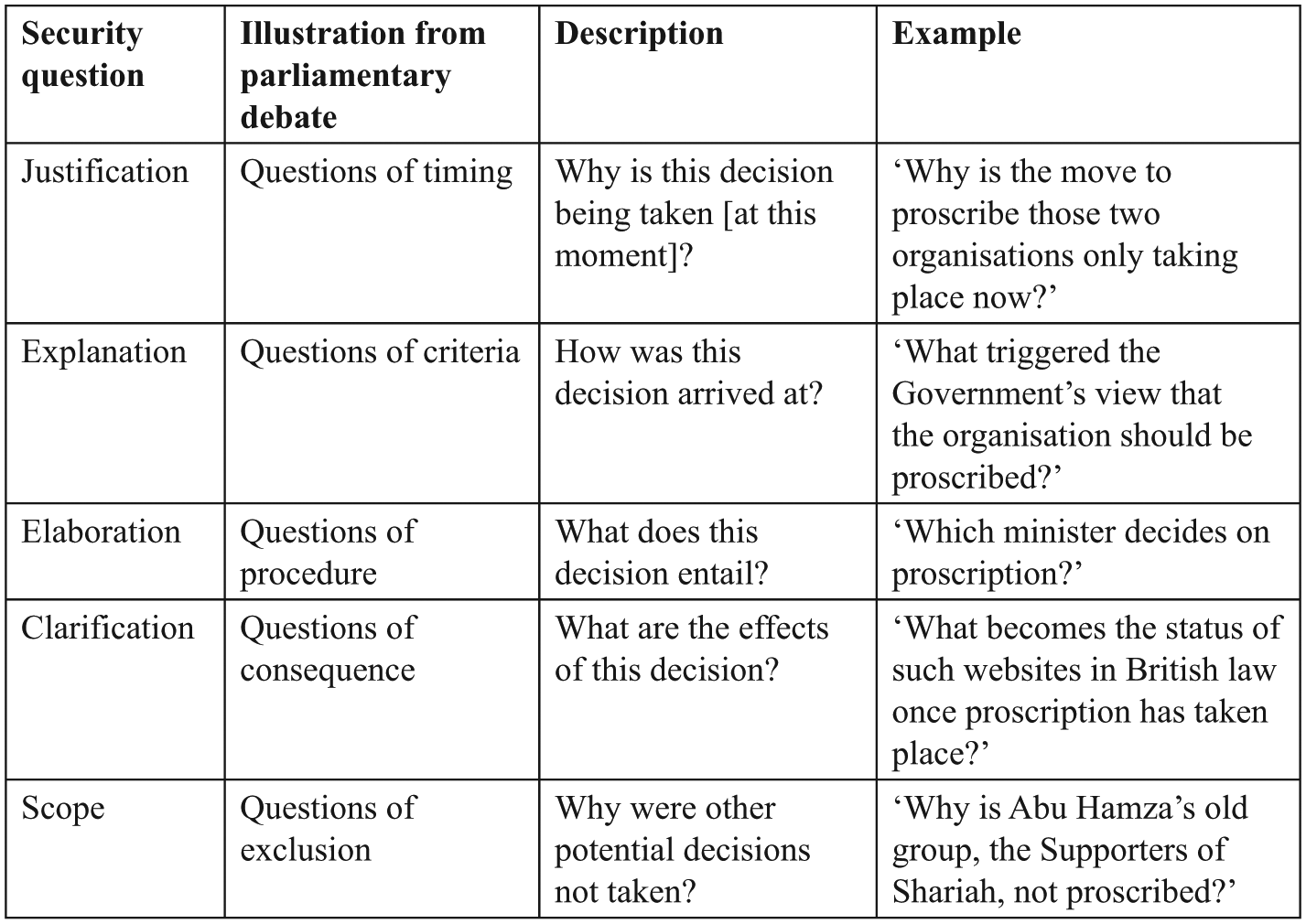
A typology of security questions.
Figure 1 clearly imposes artificial parsimony on the range of questions uncovered in our research. Its aim, however, is to illuminate the diversity of roles a particular ‘audience’ – parliamentarians – might play within a very specific dramatization of security and the importance of this for that drama’s unfolding. These questions are, importantly, asked in a bounded context that includes, among other things, general agreement on the government’s mandate to designate proscribed groups, respect for parliamentary institutions, a UK party system that circumscribes space for dissent, and – indeed – a set of codified rules around the appropriate form and content of questions. 66 As the House of Commons Information Office (2010) clarifies: ‘A parliamentary question must: either (a) seek information (“what, how many, when …”) or (b) press for action (“if he will …”)’. Where Buzan et al.’s (1998: 33) original framing of securitization proposed a grammar of security constituted by ‘a plot that includes existential threat, point of no return, and a possible way out’, the above analysis therefore illustrates some of the ways in which an audience might participate in the elaboration, refinement and even critique of such plots. This includes by asking questions around: the nature of the existential threat (questions of criteria and exclusion); when the point of no return was reached (questions of timing); and, indeed, the nature of the proposed way out (questions of procedure and consequence).
Some of these questions may function simultaneously as demands for justification and clarification. Other questions asked of securitizing actors in this or other contexts may not fit any of our five types. This, in a sense, is less significant than the typology’s primary purpose, which is to demonstrate a diversity of ways in which audiences might engage in the politics of security short of outright acceptance or contestation. A parliamentarian asking the executive who made a particular (proscription) decision, or why such a decision was made, does not necessarily imply, evidence or lead to the acceptance or rejection of such a decision. Yet at least in this context, such questions are an integral part of the discursive and performative politics in which security dramas play out, incorporating but extending beyond matters of legality and legitimacy that are vital to the efficacy of security practices (Balzacq, 2015b).
The impact of the above questions on the outcome of any particular debate, any parliamentarian’s vote or, indeed, any wider audience is some way beyond this article’s scope. As, indeed, are the spread of responses offered by relevant ministers in the context of these debates, although these do, inter alia, include: recognition of the validity of concerns raised by parliamentarians; reiteration of the challenges faced in proscribing specific groups; provision of explicit answers to substantive or procedural questions (such as clarifying where responsibility lies, delineating which factors underpin the listing of particular groups, outlining how cooperation takes place, or offering assurances on deproscription); and promising future information or answers, if only subsequently on Privy Council terms. Such answers are, at times, offered immediately after a question; at others, in a summary statement at the end of a debate.
Whatever the truthfulness, reasonableness or persuasiveness of such answers, the questions they follow pose, we argue, considerable analytical potential for extending and nuancing existing theorizations of securitization in at least three directions. In the first instance, taking such questions seriously contributes to the rethinking of securitization’s various temporalities prominent within sociological critiques of the Copenhagen School approach. Just as multiple unexceptional, unspectacular ‘little security nothings’ do much of the work in producing contemporary insecurities (Huysmans, 2011), we have shown that the audience’s role in securitization’s drama, too, extends back in time – prior to the ‘moment’ of decision – to include earlier, smaller, interactions with (in this case) the political executive. Exploring the operation of these interactions therefore not only sheds light on the shaping of a drama’s denouement, clarifying how the ‘urgency of emergency’ (Salter, 2011: 116) is produced within and across a period of time characterized by its own interruptions and pauses; it also – more obviously – expands understanding of the mechanism of justification often considered vital for successful securitization (cf. Oren and Solomon, 2015). Thus, where Balzacq (2015b: 6), drawing on Vuori (2008), argues that ‘justification is the mechanism that creates and sustains security practices…. Leaders make security practices essentially by arguing their case that X counts as a threat’, the above demonstrates that ‘leaders’ may be called upon to do far more than this, including having to clarify why other security practices and other threats were not pursued.
Second, the above analysis also problematizes the strict actor/audience separation integral to the initial formulation of securitization theory. In one sense, the above acts of questioning situate legislators as an independent audience scrutinizing the executive. At the same time, this scrutiny occurs within an intersubjective framework that entails non-questioning, or a priori consensus, around the normative probity of proscription, government’s democratic mandate, the power’s general appropriateness to the problem, and procedural rigour. Approached thus, the asking – and answering – of such questions also contributes to the reproduction of executive credibility through a performance of democratic scrutiny, positioning these parliamentarians as partners in the production and selling of a particular security discourse to wider (public) audiences, rather than – only – as ‘customers’ of such a discourse. This clearly blurs any neat distinction between actor and audience – highlighting the scope for movement between, or multiple occupancy of, these roles in security politics.
Third, our elaboration of the types of game played in parliamentary security politics also poses methodological insight for exploring heterogeneities within seemingly undifferentiated audiences. By centring the content of questions within our analysis, the above research points to considerable opportunity for future work on the constitution of cleavages, fractures or subsidiary audiences within singular settings populated by ostensibly identifiable (here, elite) communities (see Salter, 2008). Such work could draw upon tools within (critical) discourse analysis and related fields such as critical communication studies to map potentially pertinent relationships among topics, speakers and attributes (in our case, including party affiliation, House membership or constituency); and, in the process, to explore how members of internally differentiated audiences position themselves as critics of, or contributors to, securitizing moves over a period of time. 67
It is not, finally, self-evident whether proscription necessarily constitutes the type of security politics Buzan et al. (1998) had in mind in their initial discussion of securitization. On the one hand, efforts to add particular organizations to the UK’s list often lack the language of emergency frequently associated with the Copenhagen School framework. At the same time, an argument might also be made that these powers become increasingly normalized or institutionalized with each successive stretching of their scope to additional organizations (see also Buzan et al., 1998: 28). Engaging with audience questions, then, might perhaps be further justification for – as much as a consequence of – recent attempts to move beyond the strictures of the Copenhagen School approach to securitization, its importance in establishing this research agenda notwithstanding. 68
Conclusion
Parliamentary debate around the proscription of terrorist organizations offers an unusually compact window through which to explore the actor–audience relationship central to contemporary discussion around securitization. Although the lack of academic engagement with this power is surprising, its application and debate, we argue, furnishes significant insight into the varied and variable logics of security. Recent efforts by Balzacq, Neal, Roe, Salter and others to unpack the diversity of audiences and contexts in which securitization takes place galvanize this article’s attempt to offer a framework for understanding and exploring one type of audience engagement in a particular – and bounded – environment: the asking of questions to the political executive. Thus, the article’s contribution is, in the first instance, an empirical one, by virtue of its concentration on a hitherto-neglected site of security politics through an extensive discourse analysis of every relevant parliamentary debate on proscription.
The article also offers a theoretical contribution via the conceptualization and analysis of five logics of enquiry that emerge in an intermediate space of audience engagement where efforts at securitization are neither straightforwardly accepted nor contested. At least in this context, this particular audience – the legislature – emerges not as peripheral but rather as central to the politics of security in a way not particularly well characterized by binary distinctions between acceptance or rejection that reduce relevant audiences to the moment of decision. As we have seen, questions of would-be securitizers can function as appeals – perhaps even demands – for justification, explanation, elaboration, clarification, scope and, no doubt, more besides. And, as demonstrated above, this analysis has additional significance for thinking through the temporalities and fixedness of roles within security dramas, as well as for future investigation of audience heterogeneities.
With this in mind, our effort to take seriously the role of questions within security discourse offers a step toward further empirical and conceptual exploration of audience participation in security politics. Empirically, there is clearly considerable scope for comparative work on proscription debate from other parts of the UK Parliament, as well as in other parliaments worldwide. Powers of proscription are used widely, but with significant variation globally – making use of different criteria and bringing with them different consequences – such that we see surprising diversity in the lists of banned organizations among countries with otherwise similar counter-terrorism approaches. The scope for comparative work on how this is so – and the particularities of equivalent debates in comparable countries – is, therefore, considerable.
Developing this further, there is clearly also room for greater historical analysis of political debate around proscription’s precedents – and, indeed, related efforts to outlaw other actors such as political parties – which would no doubt uncover important genealogies at work in this power’s operation. Exploring whether similar security questions – and answers – emerge in relation to other security contexts (climate change, declarations of war and so forth) would also, importantly, shed light on whether appeals for justification, explanation, elaboration, clarification and scope are specific to proscription or counter-terrorism, as would investigation of the questions posed by other scrutinizing audiences such as courts of law, advocacy groups, international organizations or independent reviewers. Building on recent work on ‘vernacular’ security studies, questions also remain around the types of security questions asked in less rarefied settings in which security is invoked. At a conceptual level, finally, much more might be done on the status and implications of questioning in security politics more generally, with obvious connections to be made with the work of rhetoricians and linguists. Why, for example, do audiences even ask questions at all within security discourse? Do questions such as those considered here legitimize, undermine, challenge or otherwise affect securitizing actors? How might these effects be evaluated or known? How do non-linguistic dynamics including spatial and temporal contexts play into this? Indeed, how do the questions asked by particular audiences (in our case parliamentarians) impact upon others (e.g. publics or specific communities) and the questions they in turn ask?
Footnotes
Acknowledgements
Earlier versions of this research were presented to seminars at the University of East Anglia, Nottingham Trent University and Queen’s University Belfast, and at the 2015 Annual Conference of the British International Studies Association. We are grateful to all those who attended these events; to Elizabeth Cobbett, Alan Finlayson and Alexandria Innes for detailed feedback on an earlier draft; and to the four anonymous reviewers and the Security Dialogue editors for their insightful comments. Any errors remain ours alone.
Funding
This research received no specific grant from any funding agency in the public, commercial or not-for-profit sectors.