




Abstract
For three decades, the Canadian artist Lilian Broca has been creating art featuring biblical women: Lilith/Eve, Esther, Judith and Mary Magdalene. These are not single artworks, but series, presenting these women in the contexts of their narratives. In contrast with traditional artistic representations of these figures, dominated by the male gaze, Broca brings a feminist lens to their stories. Broca’s work not only converges with feminist theology and biblical studies, but she also uses this scholarship as part of her research, pointing to a fruitful and significant relationship between feminist art and academic theology.
Keywords
Introduction
In the history of Western art, there has been no shortage of artworks depicting biblical women, mostly by male artists, inevitably reflecting the male gaze, and with an emphasis on certain figures, such as Eve, the Virgin Mary and Mary Magdalene, Esther, Judith and Susanna. In recent decades, feminist scholars have turned their attention to artistic portrayals of biblical women as a form of reception, 1 since, as Kateusz observes, ‘biblical women are a good subject for analyzing biblical reception across time, traditions, artists, and methodologies’. 2 In addition, some women artists have subjected select biblical women to a feminist gaze. 3 However, a mostly unexplored question is whether feminist artists’ representations of biblical women have been affected by decades of feminist theology and biblical studies. 4 This essay highlights the work of one such artist, the Canadian Lilian Broca, which, I will argue, not only illustrates how a feminist gaze affects her portrayal of biblical women, but that in fact her art amounts to feminist theological expression, informed, in part, by feminist scholarship.
Since the late 1990s, Broca, a secular Jew, has been creating art featuring biblical women: Lilith/Eve (2000), Esther (2009), Judith (2015) and Mary Magdalene (2022). These are not simply individual pieces: each is a series, depicting significant scenes in the subject’s story. All of the subjects are famous biblical figures whose stories appear in myriad traditional artworks. On the following pages, I will show how Broca’s work presents these women against the grain of traditional artistic representations by highlighting aspects of their stories not traditionally portrayed in art, and by reading between the lines of the biblical narratives, assisted by extra-biblical material, ancient and modern. Beginning with the first of these series, a feminist retelling of the rabbinic Lilith legend, 5 I will show how Broca’s works deliberately depart from the artistic conventions that have developed around the biblical figures she has selected (Lilith/Eve, Esther, Judith and Mary Magdalene), bringing a feminist theological lens to their stories. 6
A Song of Lilith
Broca began the Lilith series in 1995, featuring, ‘a figure that I had come across two years earlier while doing research for an exhibition on goddesses’. 7 The work was first presented as a performance that included art, narrated text and music. 8 The book A Song of Lilith reflects the collaboration between Broca and the poet/novelist Joy Kogawa. The outcome is aptly described by the poet Daphne Marlatt as ‘a feminist Paradise Lost, . . . epic in its critical message, A Song of Lilith is a melodic and deeply spiritual long poem’. 9
Lilith, of course, is not a biblical figure, but the legendary first wife of Adam, likely inspired by the discrepancy between Genesis 1.27, where male and female are created concurrently in the divine image, and Genesis 2.21–23, where Eve, the first woman, 10 is created from Adam’s side. The apocryphal Alphabet of Ben Sira 78 (c. 700–1000 C.E.) relates that Adam was unhappy with his first wife, Lilith, made from the earth like himself, because she was argumentative and, in particular, because she refused to take the passive position in sex. Because Adam would not cooperate, Lilith uttered the ineffable name of God and flew away from him through the air. Adam immediately wanted her back, so God dispatched three angels to retrieve her, to no avail. Lilith declared that henceforth, her only function would be to afflict babies, with the proviso that she would desist if she saw the names of the three angels inscribed on an amulet. At the same time, she agreed to be punished by losing a hundred of her demonic offspring every day. Eve was then created to be Adam’s appropriately submissive wife.
Lilith was brought to popular consciousness in the late nineteenth century when Pre-Raphaelite painters and other Victorian artists represented her as a darkly romantic siren. For example, John Collier’s Lilith (Figure 1) portrays her as a beautiful young nude with flowing red hair and a large serpent coiled around her body from head to toe; the snake’s head lies on her shoulder under her loving gaze. 11 The scene is reminiscent of traditional renderings of Eve in the Garden of Eden, where Eve is in close proximity to the serpent, to whose temptation she willingly succumbs, for example Hugo van der Goes, Temptation of Adam and Eve (ca. 1425), Michelangelo, The Fall of Man (1512), William Blake, Eve Tempted by the Serpent (c. 1800) and John Dickson, Eve Tempted by the Serpent (1895). Under the male gaze, Lilith becomes a more sinister version of Eve, already associated with sin, temptation, death and even the demonic.
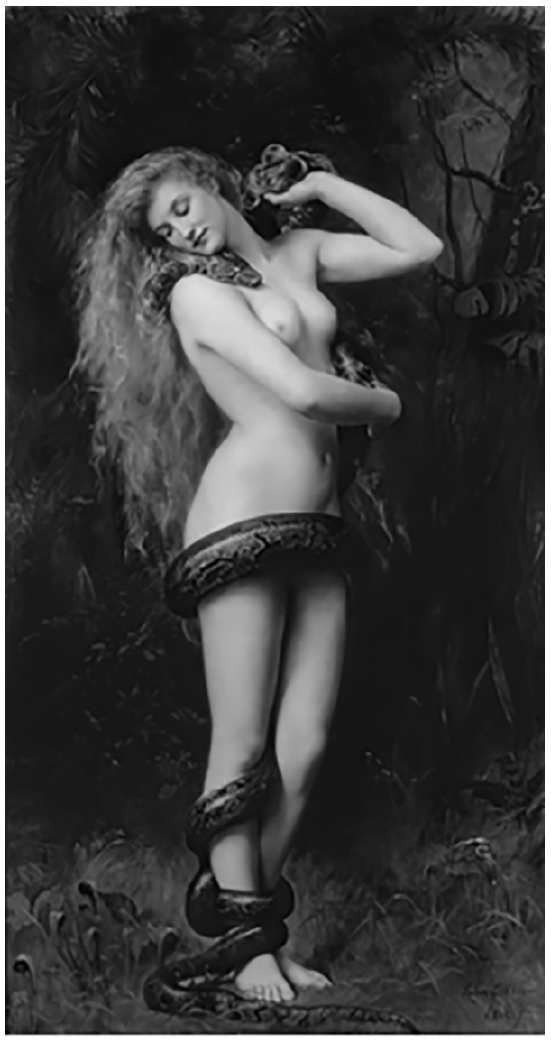
John Collier, Lilith (1892). 12
Rather than simply creating a single image of Lilith, Broca and Kogawa offer a feminist retelling of her legend in image and poetry. The first woman and man are created equal and relate to each other joyfully until Adam succumbs to the temptation to ‘lunge’ at his mate, 13 implying that the original sin was rape. Lilith, devastated, calls on the divine name to help her, and she is transported to the shores of the Red Sea. Adam, ‘the dominator’, 14 blames Lilith for abandoning him, and sends the three angels (portrayed as demons) after her, but she does not succumb to their temptation to subordinate herself to her husband. Only then is Eve ‘born of man’ to be his compliant servant, blamed for the Fall and terrified of Lilith, who is demonized as a succubus who afflicts men and kills infants. In reality, however, it is a man in the guise of Mammon who has set ‘Eve against Lilith, Man against man’. 15 The return of Lilith, the primal woman created from the earth, signals the reconciliation of Lilith and Eve, Woman and Man and humanity and the earth through love.
The 93 artworks in the series cannot be described in detail here; they can be viewed on Broca’s website. 16 Here, I will highlight five significant moments in the epic. The first, Adam Longing for Lilith (Figure 2), shows a hunched, sulking Adam filled with self-pity at the loss of his mate, blaming his victim for her defection: ‘His story has it/That Lilith is the abandoner – /He the first to abandon her, /declares himself the wounded one’ 17 – oblivious to the harm he has done her, and so unrepentant. Adam is cast as a narcissistic abuser, who blames his wife for his mistreatment of her.
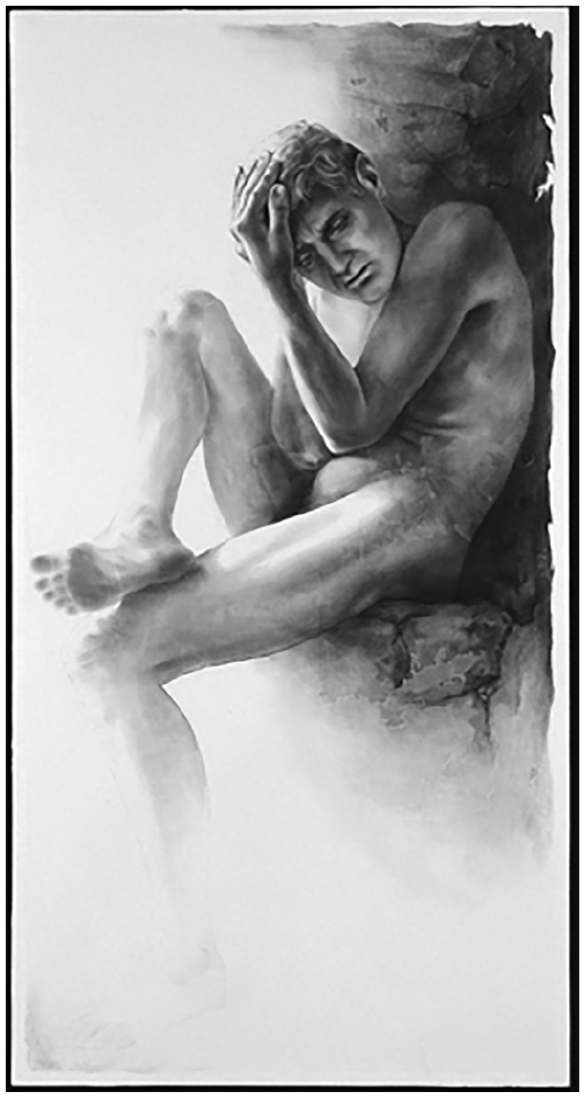
Adam longing for Lilith.
Lilith the Snake and Her Goddess Self (Figure 3) recalls Collier’s image of Lilith luxuriating in the serpent’s coils, but also the many depictions of the temptation of Eve, where Eve is inveigled by the demonic serpent. Here, however, the demonization of Lilith – and of the snake – are interpreted as a projection of the male imagination: ‘You and every powerful woman/Are bound and relegated/To the region beyond memory/To the land of legend/Where at the whim of mythmaking man/You are transformed into the needful/Demon of the race’. 18 The inset in the bottom left corner is an image that portrays ‘Her Goddess Self’, Lilith/woman in divine image. Lilith’s ‘goddess image’ is repeated near the end of the work, titled simply ‘Lilith’, 19 an image of life, love, the ‘breath of God’ and of the earth. 20
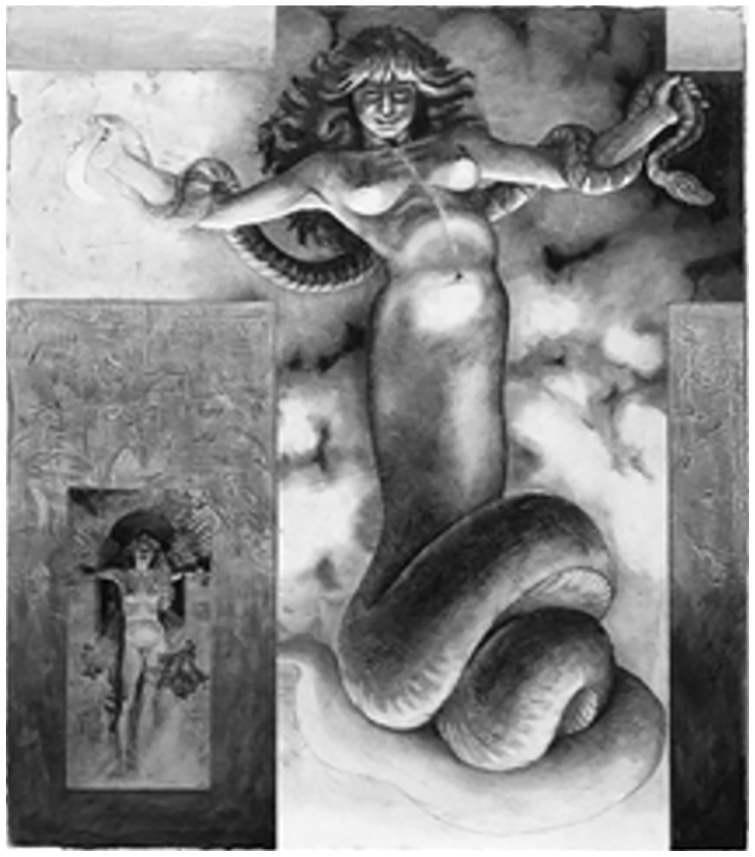
Lilith the snake and her goddess self.
The haunting Hush, hush, my babies, What is that sound? 21 (Figure 4) shows a veiled woman sheltering her children under her cloak, indoctrinated to fear Lilith’s harm, which is really inflicted by Mammon: ‘By such wailings/Lilith is demonized/While the three fiendish denizens/Goad the whole world to acknowledge/That Mammon, after all, is God – /that man is made for money,/Just as woman is made for man’. 22
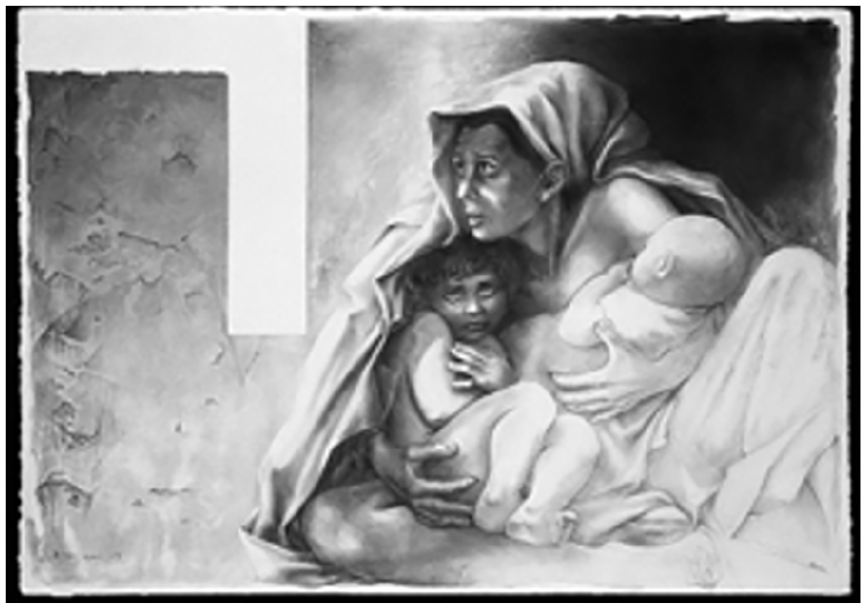
Hush, hush my babies, What is that sound?
Finally, Lilith and Woman (Figure 5) shows Lilith and Eve, primal women, hands clasped and raised in unity, not as rivals, enemies or opposites but as sisters, ‘Whole and equal,/Strong and beautiful/Gentle, free and wise’. 23 The two women, unmindful of the male gaze, sit on the earth (‘The Ground of Our Being’), reaching heavenward, affirming the ultimacy of Love, 24 no longer mired in the patriarchal view of women with its bifurcations between pure wife/mother and diabolic seductress. In Broca’s feminist reworking of the myth, the primary relationship to be healed is not between Adam and Eve (although this is also envisioned), 25 but between sisters.
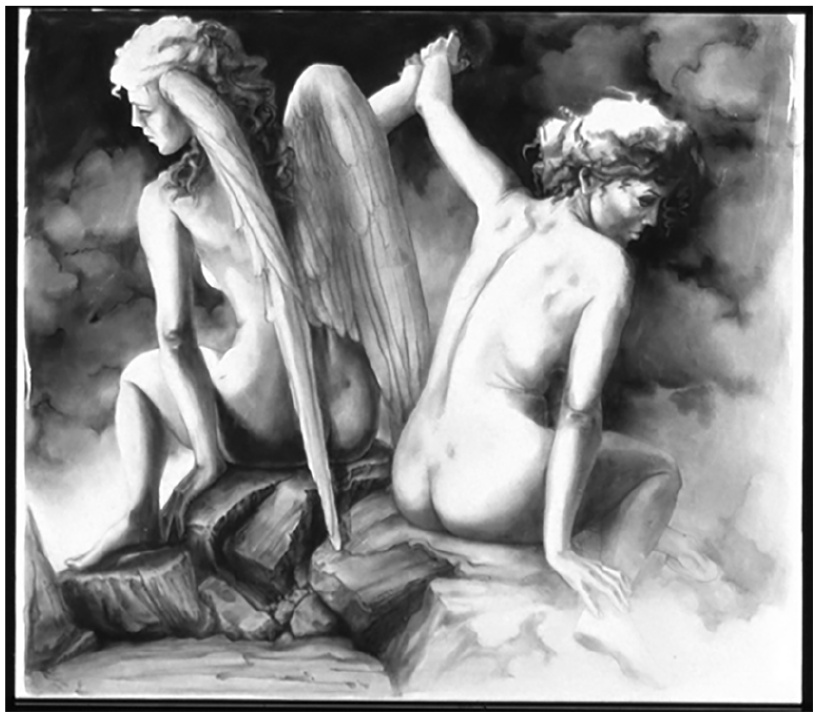
Lilith and woman.
According to Apostolos-Cappadona, in the Christian art of the High Middle Ages, Lilith was conflated with the serpent of Eden, since an innocent Eve would have trusted another woman, but not a snake. 26 The Lilith figure gained a new dimension in the late nineteenth century when the Pre-Raphaelites began to construe her as an archetype of demonic female agency over against the good and benevolent feminine ideal; sensual, sinful beauty contrasted with the spiritual woman. 27 Of course, both the demonic and angelic archetypes are male constructions of the feminine. This portrayal of Lilith was predated in Jewish interpretation, where not only Lilith, but Eve as well, was construed as deeply flawed. In some traditions, both primal women copulate with the serpent/Satan; Eve’s offspring with the demon are tainted with impurity, 28 while Lilith’s children are evil spirits. 29 As Kosior observes, ‘both women are construed first and foremost as sexual objects and reproductive vessels’. 30 Here, the two women are ‘two sisters’, as Kosior puts it, but neither is portrayed positively.
Broca’s Lilith, in contrast, is indebted to second-wave Jewish feminism, where Lilith is ‘a powerful female – probably the world’s first feminist’. 31 Rather than being opposites, or sisters in sinfulness, ‘the figure of Lilith represents the complementary half of Eve – the assertive, courageous and independent part’ who symbolizes equality and the reconciliation of ‘traditionally masculine and feminine traits’. 32 Cantor has deftly argued that Lilith amounts to ‘a negative, shadow role, the flip side of Eve’. Eve is the enabler (‘helpmeet’), Lilith, the disabler; Eve, the ‘mother of all life’, Lilith, a destroyer of life. In creating the Lilith shadow role, men are telling a woman that ‘if she is independent, assertive, free, as Lilith was, she’ll end up a frigid nymphomaniac childless witch’. 33 Broca’s series does not shy away from showing the raging, demonic side of Lilith, a projection of female behaviour rejected by patriarchy (Figure 6).
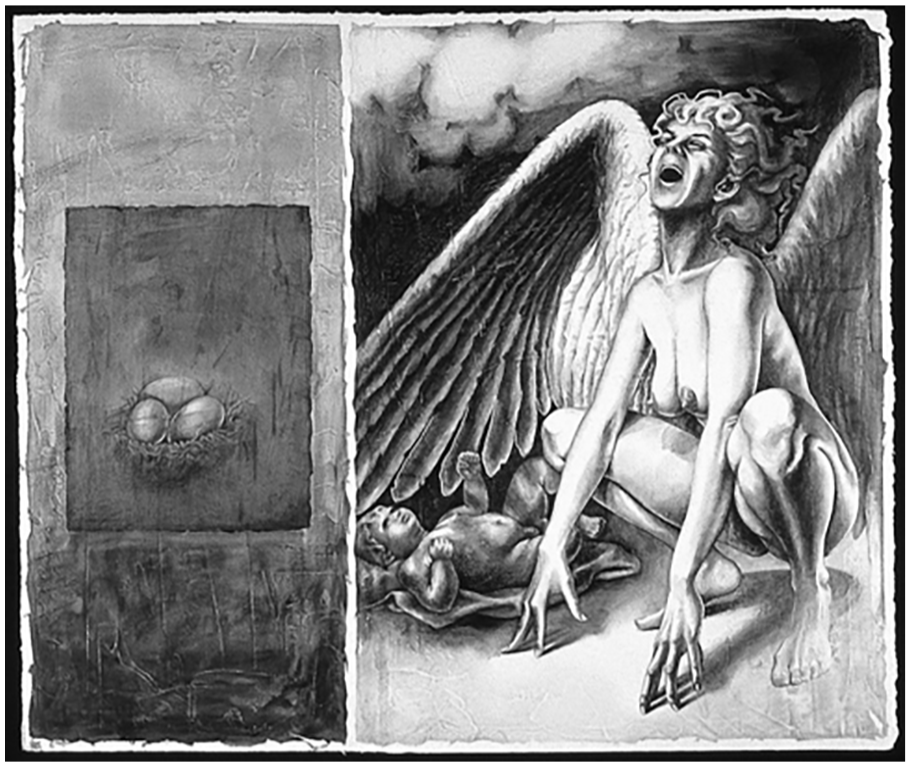
Lilith with baby and nest.
Queen Esther Mosaics
Broca’s other three biblical series are monumental mosaic works, a medium chosen by the artist to subvert its primary historical association with wealthy male patrons who chose which stories to sponsor, namely narratives of male achievement. 34 Rather than dwelling on traditional valuations of women in terms of beauty and virtue, Broca sought out women who exerted influence in politics, religion and society. 35 These are, in chronological order, Esther, Judith and Mary Magdalene.
Art historian Angela Clarke identifies these women as ‘ancient figures’, but, of course, they are all biblical. 36 Their biblical origins impart a level of fame, authority and prestige that, in Western culture, other ancient women seldom share. The subject of the Esther series is according to Apostolos-Cappadona, one of the female worthies, a prototype of the Virgin Mary. 37 Her heroic rescue of the Jews of the Persian empire is commemorated in the Jewish festival of Purim, which she is credited with founding (Esther 9.29–32). However, traditional art has tended to portray parts of her story, and those of the other subjects of Broca’s mosaics, that highlight culturally feminine roles and characteristics rather than heroism and authority.
Esther’s story is so well known that it does not need a summary here. Traditionally, artists have portrayed her as a beautiful, royal woman, sometimes with her kinsman Mordechai, often, following the deuterocanonical Addition D, 38 as a melodramatic heroine fainting both on her way to the throne room and in the presence of her husband, the Persian king Ahasuerus. Less often, scenes like her fateful banquet with the enemy of the Jews, Haman, and the king appear (Figure 7). A piece attributed both to fifteenth-century artists Sandro Botticelli and Filippo Lippi portrays three scenes in the Esther story: the lamentation of Mordechai, the swooning of Esther and Haman begging Esther for mercy.
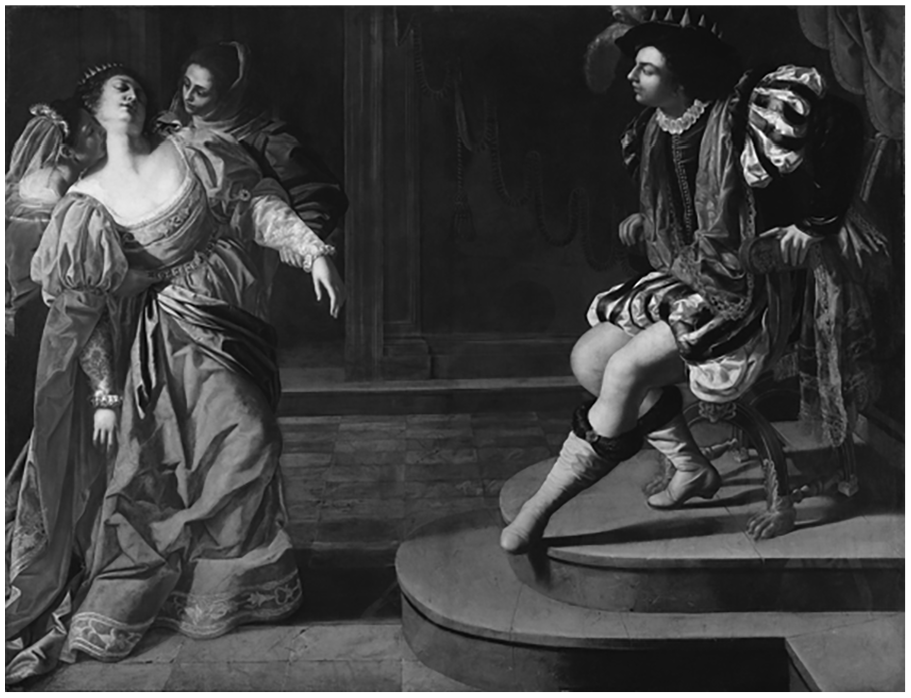
Artemisia Gentileschi, Esther Before Ahasuerus (1628–1636). 39
Broca’s series, Esther: The Hidden and the Revealed, contains 10 mosaics, tracing Esther’s growth from a passive ornament controlled by men to a brave and confident saviour of her people, a bold actor in the political realm. 40 Again, I will limit myself to the discussion of three. The first Esther’s Offering (Figure 8) portrays her as a young girl who has just won the competition to replace Vashti as queen. The ‘offering’ is the virginal Esther herself, who is willing to marry a Gentile king in order to save the Jews of the Persian empire. Dressed in white, symbolizing her virginal and moral purity, she fears what lies ahead but is determined to meet the challenge. The lion in the background and on her gown is a Persian symbol of royal power, and also a Jewish symbol of royalty.
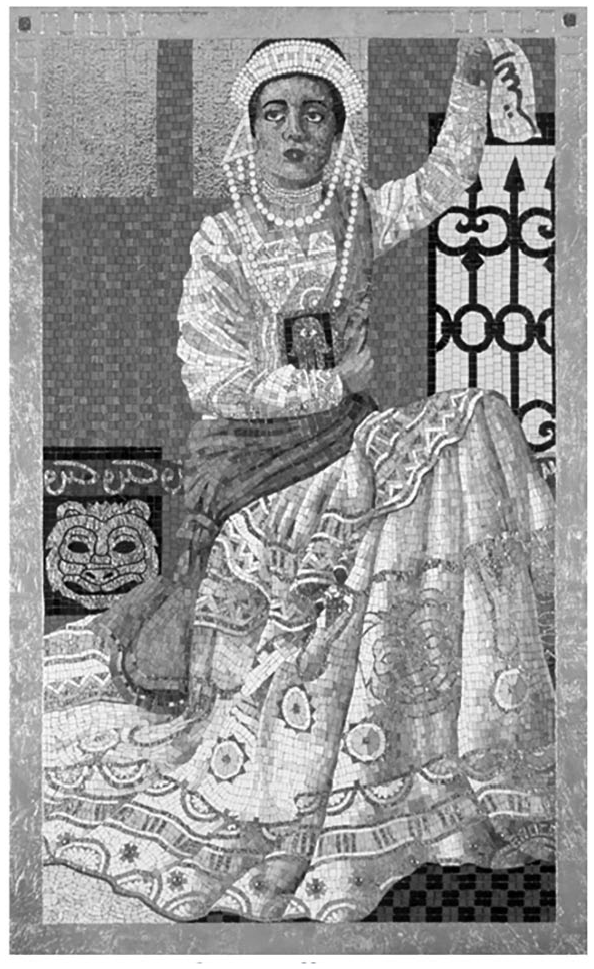
Esther’s offering.
Figure 9 depicts a standard scene in artworks inspired by Esther, where Esther appears before the Ahasuerus, but minimizes the social distance between the king and queen. Esther bows politely before her husband but does not abase herself, and the king reaches out, accepting her request to be received. Unlike the many scenes of a fearful, swooning Esther, she is aware of her surroundings and in control of herself. Both figures are accompanied by emblems of royal authority, the sceptre, the dragon and the manticore-like figure, a lamassu (a celestial being from ancient Mesopotamian religion bearing a human head, symbolizing intelligence, a bull’s body, symbolizing strength, and wings an eagle to symbolize freedom). 41 As in the other piece where Esther and Ahasuerus appear together (Queen Esther’s Banquet), the work is a diptych, signifying the separate worlds they inhabit: the harem and the court, woman and man and Jew and Gentile.
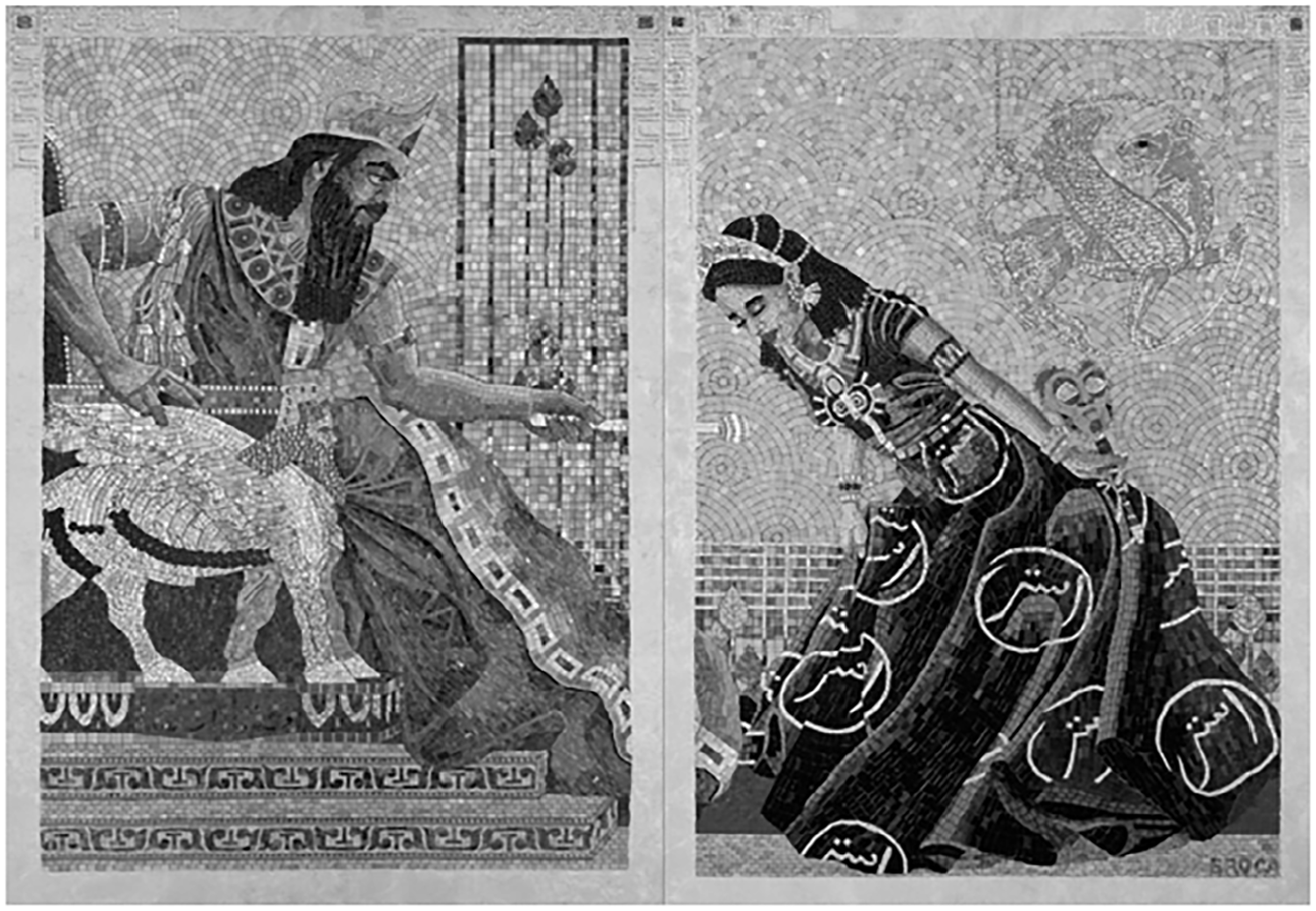
Esther seeking permission to speak.
In Figure 10, the final mosaic in the series, Esther is removing a mask, revealing her true identity not just as a Jew, but as a mature and confident woman. For Broca, the spilled cup of wine represents ‘the blood meant to be spilled once Haman’s order to kill all the Hebrews was accomplished – rather than that actually happening, due to Esther’s intervention, the blood/wine was spilled here, in the mosaic’. 42 The cup spilling over the frame can also be taken to imply the ‘spilling’ of Esther’s true identity as the empowered Jewish queen of a Gentile kingdom.
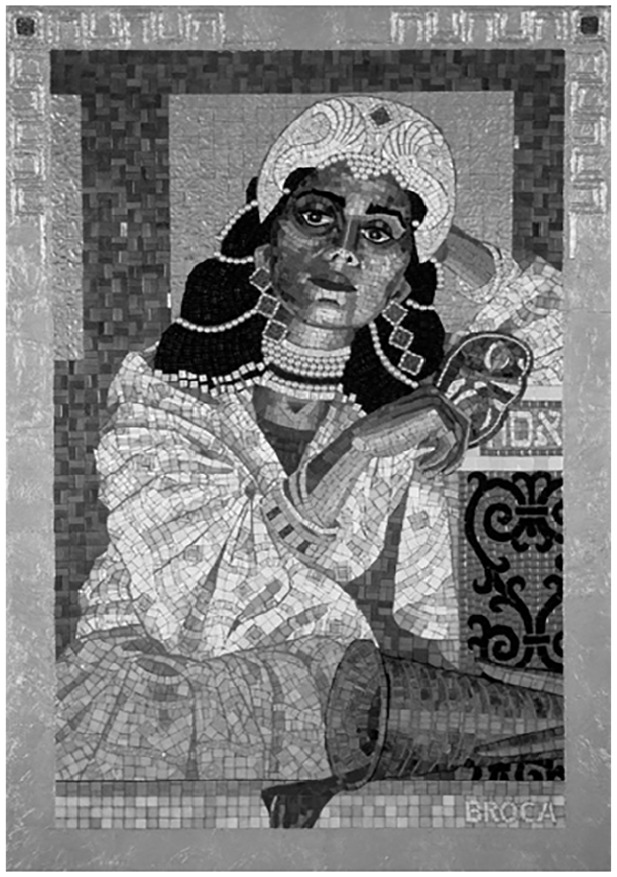
Queen Esther revealing her true identity.
Each work in the series includes a wrought iron design symbolizing the gates of the harem where Esther resides, presumably along with other women and eunuchs. 43 Broca explains: ‘Each mosaic has a different design depending on the role the wrought iron plays. Sometimes it is just a gate, a decoration, sometimes it’s the oppressive barred window, sometimes a frightening danger nearby, sometimes it emphasizes the vast distance between husband and wife despite them being married. Mostly it emphasizes oppression of women’. 44 In this last portrait, Esther leans atop the gate, symbolizing her mastery of her queenly role. The name Esther (in Hebrew), in its etymology of ‘hidden’ or ‘concealed’ (mōster), is partially obscured by the mask. Perhaps it is significant that in the Hebrew Book of Esther, 45 there is no reference to God, but there is scholarly consensus that the name Esther is theophoric; it is a form of Ishtar, 46 the great Akkadian/Babylonian goddess of love, beauty and war, a heavenly queen known throughout the ancient middle east, including Israel (see Ezekiel 8.14). 47
Judith
The story of Judith, a rich, beautiful and pious widow who takes the initiative to thwart an Assyrian invasion, is not well known by contemporary Christians due to its deuterocanonical status, but it has been a frequent subject of Western art. Like Esther, she is one of the ‘female worthies’, a model of ideal womanhood. 48 However, unlike Esther, an exiled orphan, Judith is a woman of substance in her hometown of Bethulia (likely meaning ‘virgin’), who takes daring action to save Israel. When Bethulia is besieged by the Assyrians and the city elders are ready to surrender, Judith approaches them with a bold plan to repel the enemy. She ventures out of the city, where she is arrested and brought to the enemy general, Holofernes, who is smitten with her beauty. For 3 days, she evades his advances, but on the fourth, he invites her to an evening banquet in his tent. Before he can have his way with her, Holofernes foolishly drinks so much that he passes out, and Judith takes the opportunity to behead him with the sword hanging above the bed where he planned to sleep with her. She and her slave woman return to Bethulia with the severed head of the general, which she displays triumphantly to the citizens. She subsequently travels to Jerusalem, where she offers the jewelled curtain that hung over Holofernes’ bed to the temple, culminating with a triumphant hymn composed and sung by Judith herself, retelling her story in poetic form (Judith 16.1–18). She returns home to her life of pious widowhood; for the rest of her 105 years, ‘No one ever again spread terror among the Israelites . . . or for a long time after her death’ (16.26). 49
The seven mosaics in the series highlight significant incidents in the Judith narrative (Judith chs. 8–16): Judith’s meeting with the elders, Judith praying in the desert, Judith’s meeting with the Holofernes, Judith with Holofernes in his tent, the beheading, her flight to Bethulia and Judith displaying the head of Holofernes.
50
Each image contains the edge of a torn page. Broca explains: Judith, the victorious warrior with courage and allegiance to her people, commits to and faithfully accomplishes her mission. In my works she becomes relevant to the contemporary woman in our society. As the black and white sketch unfolds onto the mosaic, slowly repairing, vivifying and reinvigorating itself into a full blown colour figure which reaches wholeness in the final scenes, the inherent symbolism becomes a continuous journey between antiquity and the present day . . . I am portraying a gradual rejuvenation of an ancient story through its retelling. The sketchbook page with its black and white graphite drawing is a twenty-first century prop. The images of the heroine’s plight and fighting spirit dressed in biblical clothing and placed in ancient surroundings provide a bridge across the centuries.
51
It is safe to say that the most popular scene in the Judith narrative has been the decapitation of Holofernes, the climax of Judith’s feigned seduction. Sometimes, Judith is portrayed as scantily clad or even nude (Figure 11), although Judith’s modesty, piety and loyalty to her deceased husband are emphasized in the text (Judith 8.1–8). Apostolos-Cappadona observes that ‘From the Counter-Reformation period forward, Judith was represented as a seductive femme fatale who rejoiced in the dreadful deed she had committed’. 52 Here, I will focus on two scenes that have seldom been rendered in art, followed by Broca’s take on the beheading.
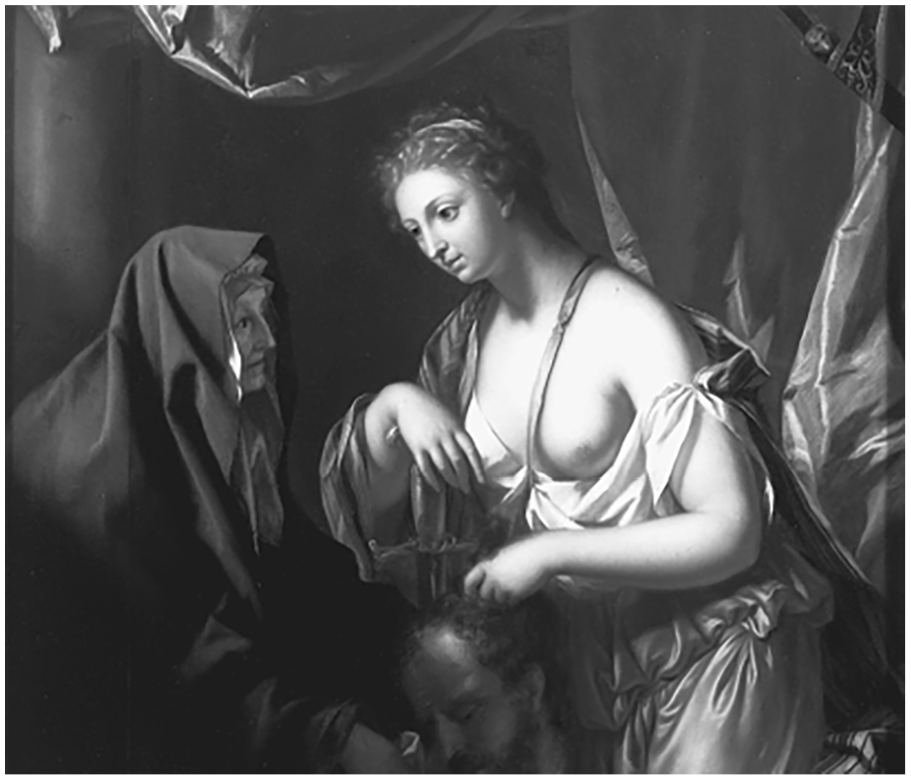
Philip Van Dijk, Judith with the Head of Holofernes (1726) 53
The first scene in the Judith series is Judith Meeting Bethulia Elders (Figure 12). Judith is shown alone, indicating that she is the only hero willing to defend Israel. She is dressed modestly and plainly, as befits a respectable widow. Her sorrowful appearance belies her concern for her city and her nation, and her disappointment in the town magistrates. She leans against the city wall, as if she is the only one willing and able to keep them standing.
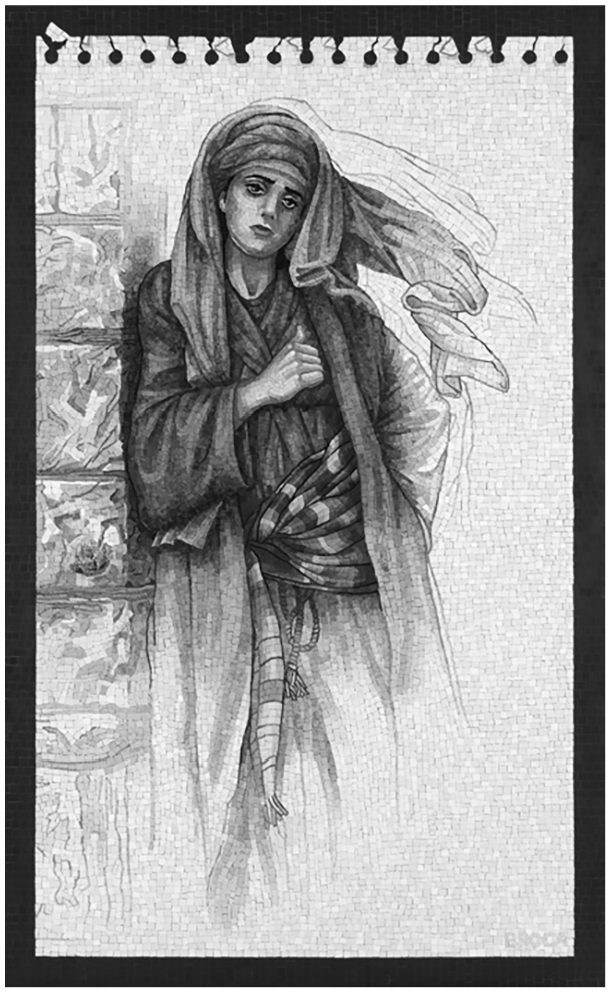
Judith Meeting Bethulia Elders.
Judith Praying in the Desert (Figure 13) shows the pious heroine, still clad in her widow’s garments after her meeting with the elders, praying for divine aid in the deception she intends to perpetrate on the Assyrians (Judith 9.10). She leans on an altar-like structure, reminiscent of the temple she is determined to save. Again, Judith is alone, symbolizing that she, assisted by God, is Israel’s only human saviour.
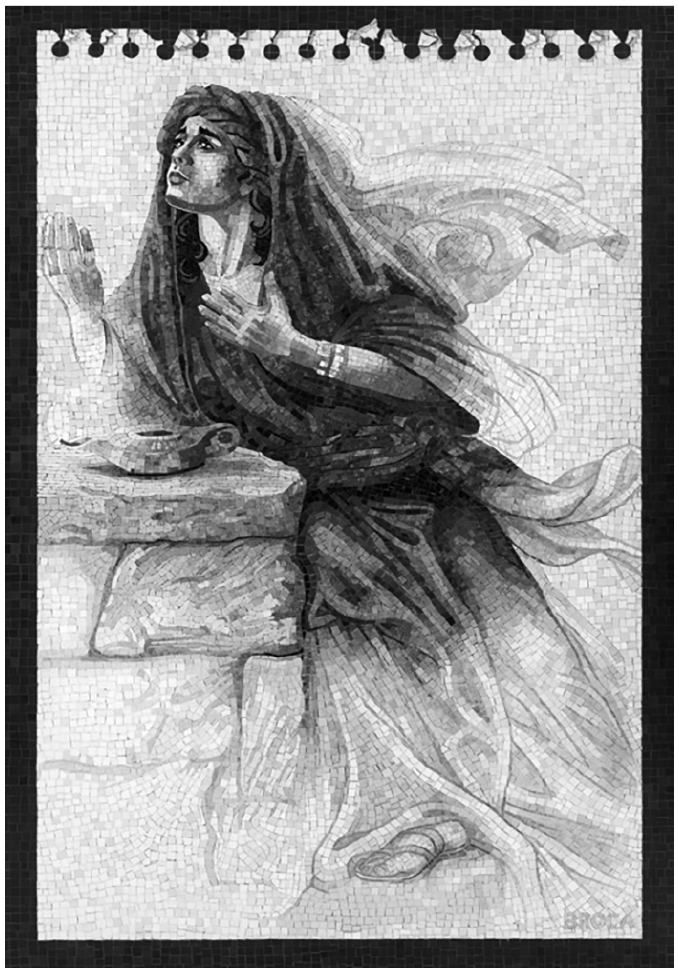
Judith Praying in the Desert.
Judith’s Revenge (Figure 14) goes against the grain of androcentric depictions of Judith as a sexy siren who relishes her act of violence.
54
Judith is fully clothed, and her face is contorted with anguished rage as she energetically wields the sword. Broca explains: I wanted Judith to be humane and sensitive to the fact that she had to take a man’s life. So, after a long deliberation in which I asked myself if I could ever kill a person, and reaching the conclusion that yes, I could if someone threatened my small children, I decided that she would have to appear completely mad in the scene of the beheading. Only with the idea that she replaced her children with the existence of Jerusalem which was threatened. This is the reason for her facial expression of a mad woman full of hate, one capable of such a terrible act.
55
Like Sisera at the hand of Jael (Judges 4.16–23), Holofernes dies in a tent by the strong arm of a woman. 56
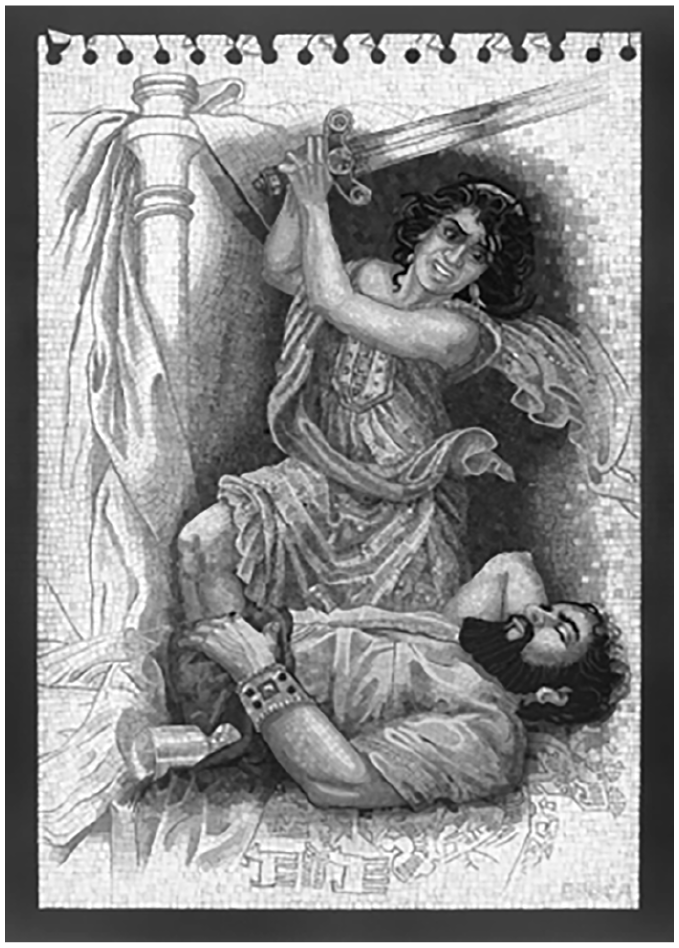
Judith’s revenge.
Broca’s depiction of the related scene Judith Displaying Her Trophy (Figure 15) shows the heroine back in Bethulia holding the severed head up by the hair, leaning forward on Holofernes’ sword. Here, the artist strove to convey Judith’s sorrow over her act of violence: She was already feeling the monumentality of her sin (albeit with God’s approval) and I spent hours trying to give her a sad expression in the eyes and only the faint smile by slightly lifting the corners of her lips. Moreover, I decided against the popular pose she appears in most Old Masters paintings, where Judith is mostly standing and proudly showing the enemy head. Instead, I sat her on a rock for this scene, giving her less pleasure in the actual act. If you hide the nose and mouth on her face you will see the sadness in her eyes.
57
Judith is luxuriously dressed and crowned, pointing to her regal status as the human agent of Israel’s salvation. The grapevines at her feet are a conventional symbol of Israel (Hosea 10.1; Isaiah 9.10), one of the ‘seven species’ of foods associated with the Holy Land (Deuteronomy 8.8).
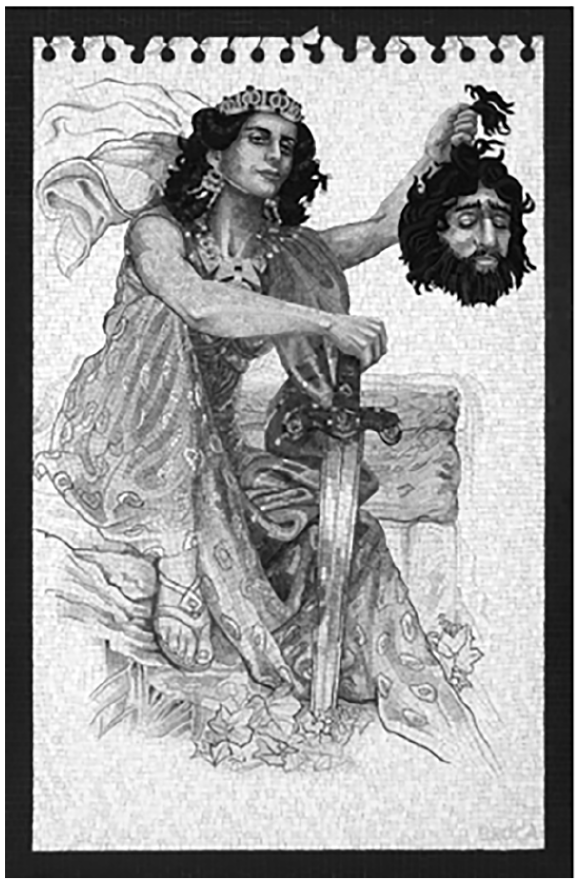
Judith displaying her trophy.
Broca’s valorization of Judith reflects her reclamation as a hero in feminist theology and biblical studies. 58 Tilford notes: ‘Among scholars and theologians, Judith becomes a strong female authority, who theologically outmaneuvers men in their interpretation of God’s will (e.g. Elisabeth Schüssler Fiorenza, In Memory of Her, 1983). Without divesting her of her sexuality, these modern interpreters find in Judith a model for the contemporary woman: wise, beautiful, and in control of her own destiny’. 59 This reassessment of Judith has even made its way into popular culture: ‘Now holding a gun, Hollywood’s Judith stands alongside her male counterparts to defend herself and her country (e.g. director H. Zieff, Private Benjamin, 1978). In novels, Judith figures become common heroines in romantic fictions (e.g. D. Rooidge, A Girl Called Judith, 1988) and a symbol of feminist awareness and autonomy (e.g. Aritha Van Herk, Judith, 1978)’. 60
Mary Magdalene Resurrected
Mary Magdalene is an unusual subject for a secular Jewish artist. Broca explains that she was interested in the Magdalene due to her frequent depiction in art: I was familiar with many paintings, sculptures and frescoes depicting Mary Magdalene; I visited several churches dedicated to her and saw half a dozen movies depicting her in multiple roles associated with Christianity. Yet I knew little of this enigmatic biblical figure. In my usual in-depth research for each new mosaic series, I discovered a surprisingly large amount of diverse and complex material on this subject.
61
These multiple roles include ‘ex-prostitute, a mystic, a celibate cave dweller, a helpmeet to Jesus, a courtesan, a repentant sinner, a weeping anointer, the matriarch of divinity’s secret dynasty and lately, a feminist icon’.
62
In this series, the complexity of the tradition is indicated by the quotations in seven languages/scripts at the bottom of each mosaic.
63
Broca further explains: Illuminated manuscripts became my unifying motif in all seven panels. Each panel becomes a ‘page’ from an illuminated manuscript. I felt it was very appropriate since these were used by monks to illustrate scripture for generations. After reading the various conflicting Magdalene stories I decided to insert in the panel designs texts in seven different languages that were spoken in the time of Jesus: Latin, Ancient Greek, Armenian, Amharic, Hebrew, Coptic and Aramaic. In this fashion I reveal the vision of a palimpsest, or an ancient parchment text with erasures that hid prior stories buried deep under the surface and as such, they support multiple Magdalene narratives.
64
Broca made the decision to follow the western conflation of Mary Magdalene and Mary of Bethany and went even farther by choosing to represent Mary and Jesus as a married couple. 65 The seven mosaics guide the viewer through a narrative shaped by this hypothesis: The Sacred Union, The Washing of Feet, The Anointing, Witnesses at the Cross, Noli Me Tangere, Defiled and Defamed and Awaiting Emmanuel. I will use four of these scenes to illustrate Broca’s feminist approach.
The preponderance of artistic renderings of Jesus’ anointing portrays the anonymous ‘sinful woman’ of Luke 7.36–50, misidentified as Mary Magdalene, bathing Jesus’ feet in expensive ointment and being forgiven for her sins (Figure 16). Invariably, she kneels (or even grovels) as she applies the ointment. Broca’s mosaic (Figure 17) follows Mark 14.3–9, where an unnamed woman of Bethany, here identified as the Magdalene, pours a jar of ointment over his head in an act of messianic anointing. In keeping with this narrative, Mary stands as the pours the ointment. Although Mark 14.9 foretells that the woman’s act will be told in her memory, in fact, it has been overlooked by the church and in art. 66 This is an error that has been addressed in feminist scholarship since the 1980s, but seldom in art.
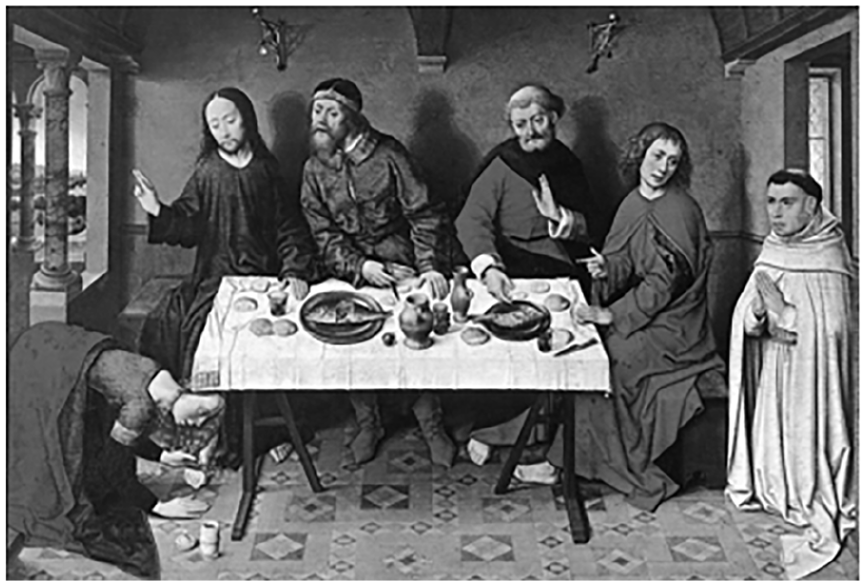
Dieric Bouts, Christ in the House of the Pharisee Simon (1440s). 67
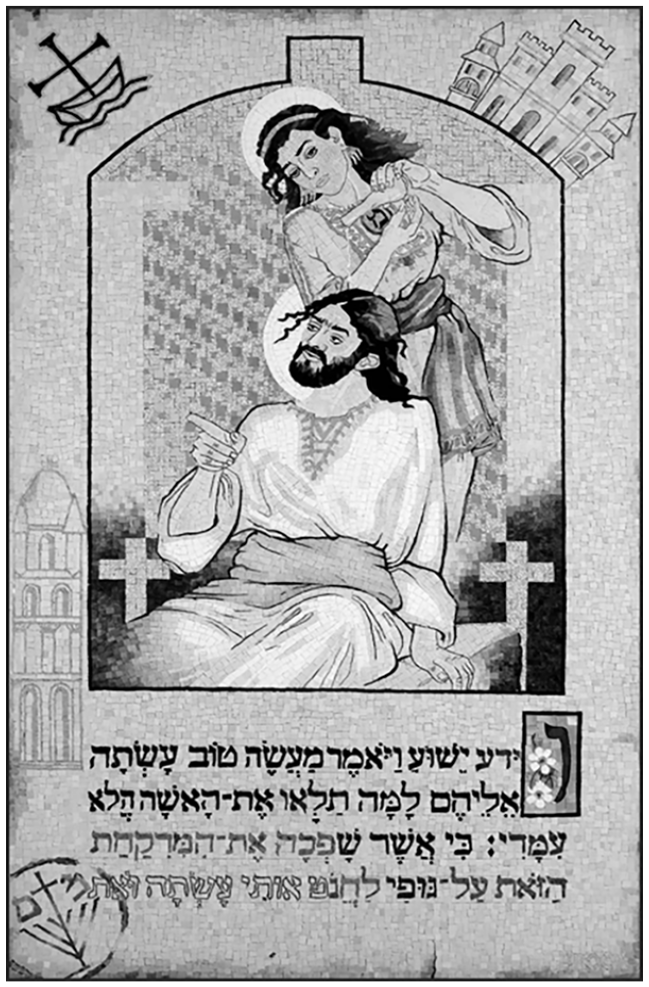
The anointing.
Broca’s rendering of the foot washing scene (John 13.1–17) places Jesus at the feet of Mary rather than vice versa (Figure 18). Whereas traditional art (e.g. Figure 19) invariably shows Jesus washing the feet of the male disciples (the Johannine account does not mention the gender of the disciples), Broca chooses to highlight the most prominent female disciple.
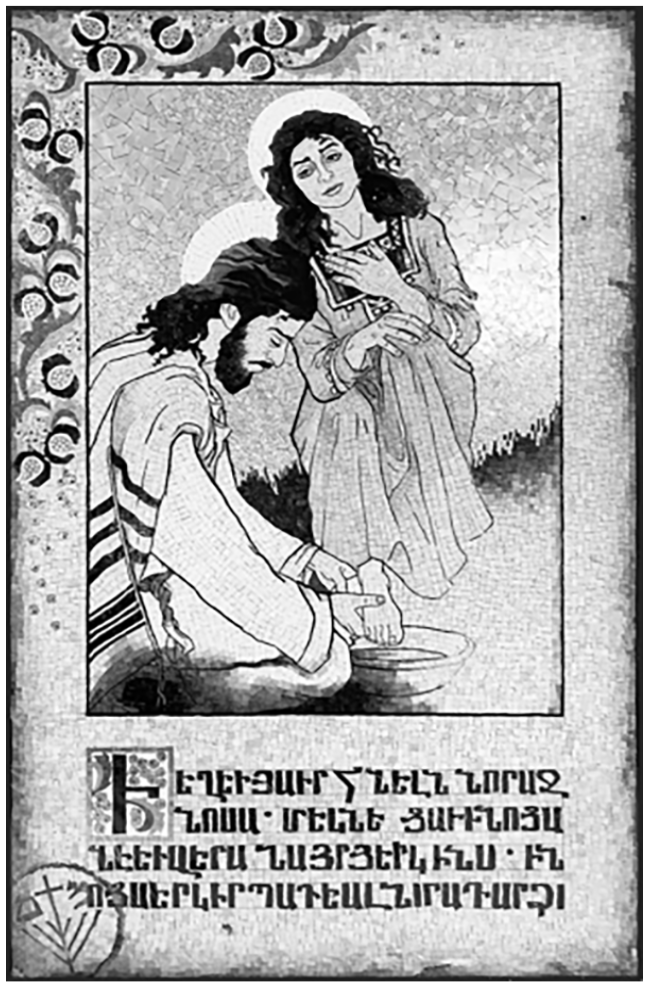
The washing of feet.
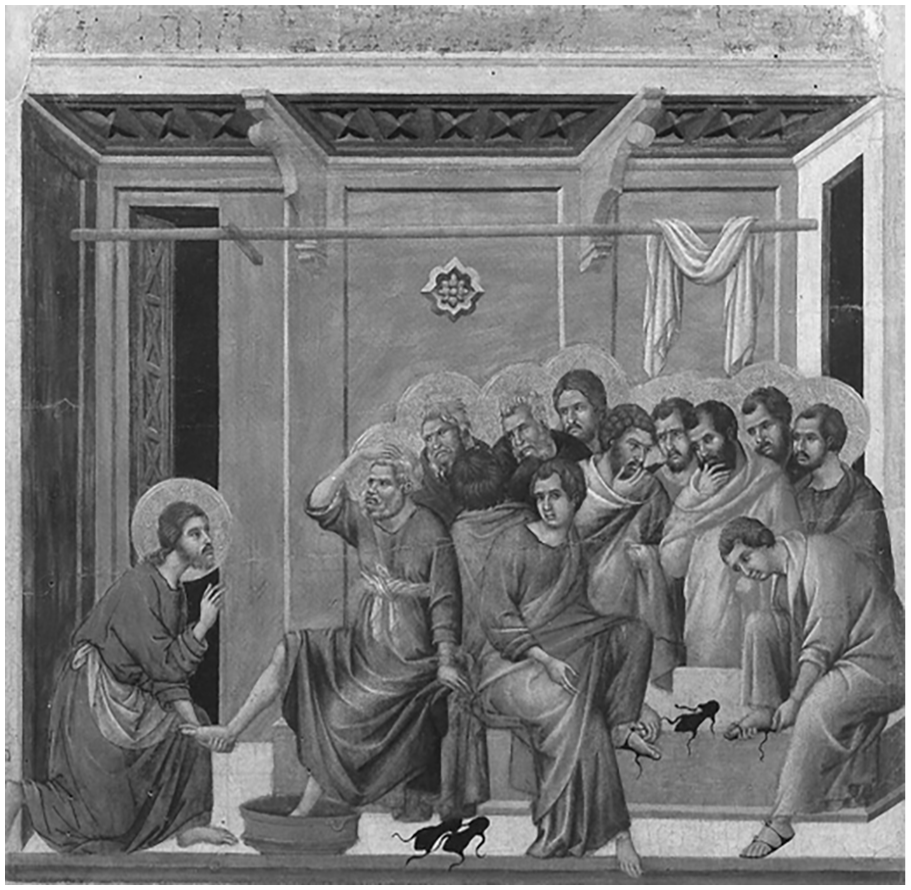
Duccio di Buoninsegna, The Washing of the Feet, 1308–1311. 68
Viewers unfamiliar with the Gnostic Gospels may not recognize the subject of Defiled and Defamed (Figure 20). 69 Three Gnostic texts represent Peter as Mary Magdalene’s critic and opponent, namely the Gospel of Thomas, Pistis Sophia and the Gospel of Mary. In Gospel of Mary 17.9-20, particularly, both Andrew and Peter reject Mary’s authority: ‘How is it possible that the Teacher talked in this manner with a woman about secrets of which we ourselves are ignorant? Must we change our customs and listen to this woman? Did he really choose her, and prefer her to us?’ (vv. 15–20). 70 In the mosaic, a distraught Mary turns away from a group of male disciples, led by a smirking, contemptuous Peter.
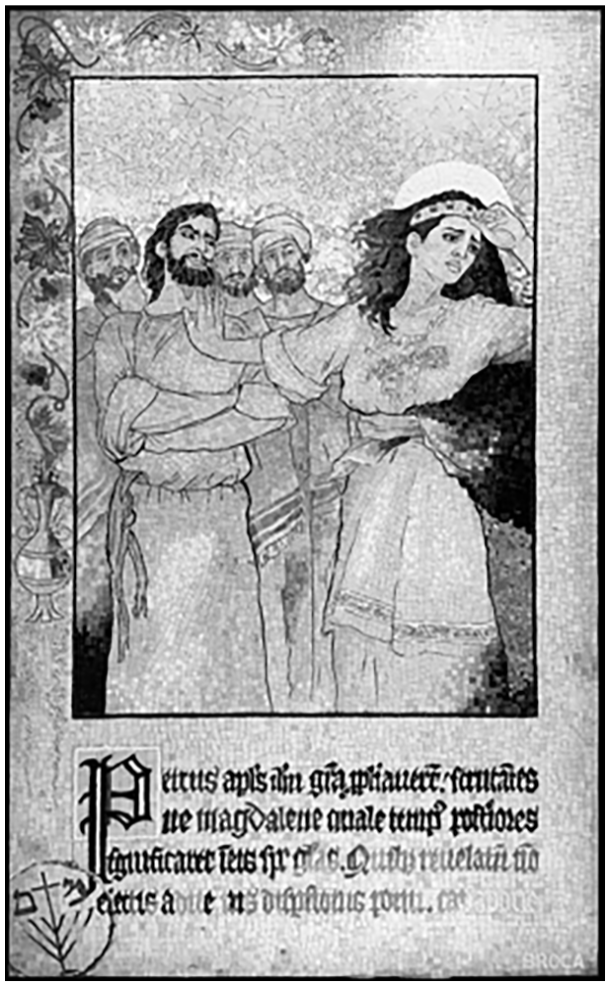
Defiled and defamed.
The motif of Mary Magdalene ‘defiled and defamed’ has another dimension. Since the sixth century, if not earlier, she has been misidentified as a sinful, vain, sensual woman ‘forgiven’ by Jesus – a perpetual penitent for a non-existent offence. The ‘penitent Magdalene’ has been the subject of countless works of Western art. 71 As Hoffacker notes: ‘This particular representation emphasized the Magdalene’s sinfulness as much as her penitence. However, once the redemption central to the Baroque imagination was stripped from her story in the Modern period, the saved sinner was reduced to her sin alone’. 72 In the mosaic, Mary’s palm is raised against the men as she leaves them, as if to reject this misogynistic trajectory of representation.
As mentioned above, Broca’s Magdalene deliberately fuses her character together with Mary of Bethany. More than a leading apostle, or wife of Jesus, for Broca, Mary Magdalene symbolizes the divine feminine in Christianity. 73 This aspect of her identity is highlighted in Mary Magdalene Awaiting Emmanuel (Figure 21), where Mary sits enthroned in the temple, bearing a pomegranate, which in Judaism, symbolizes both Torah and fertility. Beside her is an empty seat, reserved for the expected messiah; the hourglass in her right hand shows that she is waiting for her male counterpart. Broca explains: ‘Here I envision Mary M. as the Divine partner to Jesus who, in the Christian religion is considered Divinity. The research I have done leads me to believe that Mary Magdalene’s fate was not what Jesus had in mind and therefore, she remains a “goddess in waiting”. Her beloved Yeshua (Jesus) must come back to her and the reunion would bring balance to a patriarchal and androcentric religion’. 74 The scene recalls the ancient Jewish temple at Tel Arad, where two altars stand in front to two pillars, representing deities, likely YHWH and his divine consort Asherah. 75
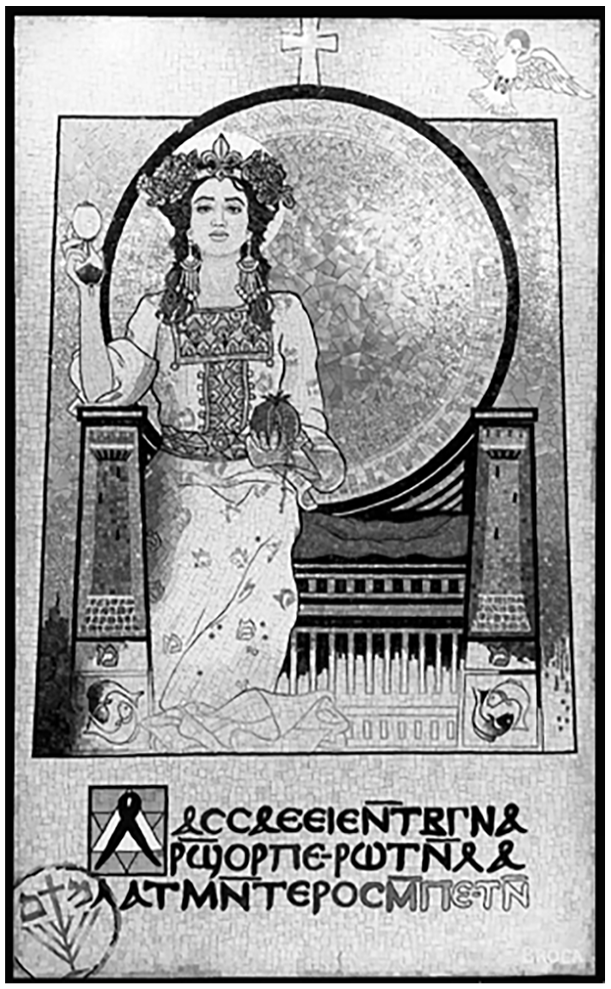
Mary Magdalene Awaiting Emmanuel.
Conclusions: Broca’s Feminist Theological Re/Vision
The Magdalene’s symbolic rejection of an art history that defames and defiles the Magdalene reflects Broca’s own feminist revision of biblical women whose stories have been trivialized, sexualized and even demonized. In this artistic enterprise, the interface with feminist theology is not simply a case of similar interpretations arising from similarly feminist outlooks. Broca has explicitly made use of feminist theology and biblical studies, as the lists of references in her published works suggest. 76 This does not mean that her artistic choices are based solely on feminist scholarship; for example, few biblical scholars would agree with the conflation of the Magdalene and Mary of Bethany, or that she was married to Jesus. That is, Broca exercises her creative imagination informed by, but not determined by, feminist scholarship. This illustrates the sometimes seemingly invisible, but actually quite immense, 77 impact of feminist scholarship on the wider society; in this case, on the arts. A scene from The Song of Lilith, Creation (Figure 22) foreshadows Broca’s very deliberate approach to revalorizing these tales: the naked Lilith/Eve, in a pose reminiscent of Michelangelo’s Creation of Adam, 78 reaches up towards the artist’s hand, whose reach extends beyond the page. In the upper right corner, the Hebrew word bereshith, ‘in the beginning’, appears above the drawing hand. The accompanying text reads ‘Through Lilith, through Magdala/Through woman’ 79 – a fitting prologue and epilogue to Broca’s four series on biblical women.
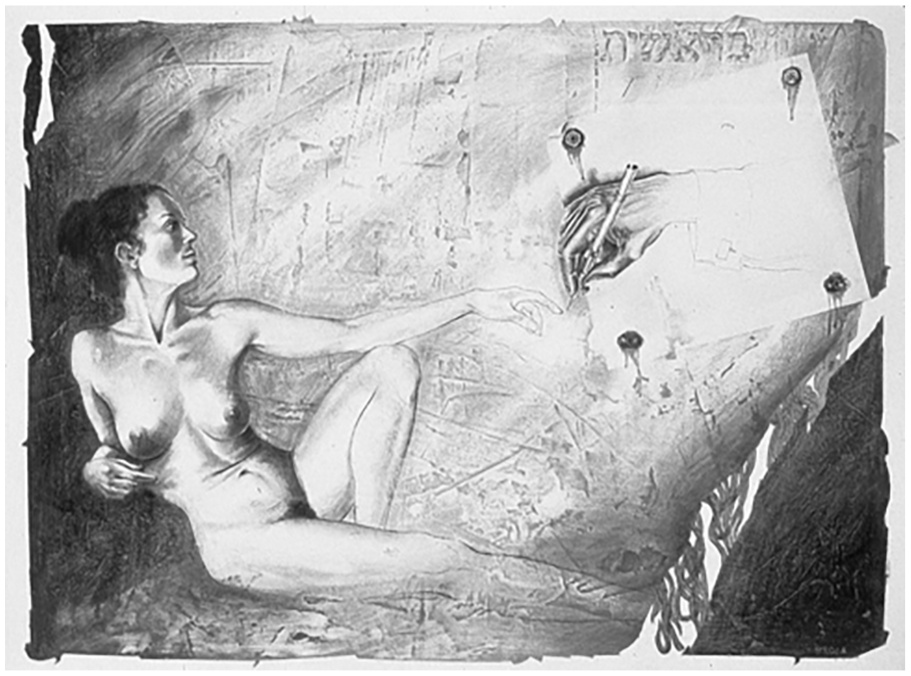
Creation.
Footnotes
Funding
The author(s) received no financial support for the research, authorship, and/or publication of this article.
1.
See Sölle D (1994) Great Women of the Bible in Art and Literature. Macon, GA: Mercer University Press; Ebertshauser CH, Haag H, Kirchberger JH, et al. (1998) Mary: Art, Culture, and Religion through the Ages. New York: Crossroad; Apostolos-Cappadona D (ed.) (2018) Biblical Women and the Arts, Biblical Reception 5. London: T&T Clark; Seijas G (ed.) (2023) Women of the Bible from Text to Image. London: T&T Clark.
2.
Kateusz A (2020) Biblical women and the arts (ed. D Apostolos-Cappadona). Catholic Biblical Quarterly 82(1): 162.
3.
See, for example Bar M (2023) Are there biblical women in contemporary art? In: Bible and women symposium, Bilbao, 12 June; Schlobitten YD (2023) Feminist artists and the bible: from Frida Kahlo to Cindy Sherman. In: Bible and women symposium, Bilbao, 12 June.
4.
An exception is Beavis MA (2008) The influence of feminist theology of Canadian women artists. In: Beavis MA, Guillemin E and Pell B (eds) Feminist Theology with a Canadian Accent: Canadian Contextual Feminist Theology. Ottawa, ON, Canada: Novalis, 291–308.
5.
Beavis MA (2008) The influence of feminist theology of Canadian women artists, 301.
6.
In the course of this research, I have consulted Broca’s website and publications, as well as carried on email conversations with her, and the interpretations in this essay draw heavily from her explanations. Where my own interpretations of her work are expressed, I take responsibility for any errors or omissions, while recognizing that artworks are inevitably open to interpretation.
7.
Kogawa J and Broca L (2000) A Song of Lilith. Vancouver, BC, Canada: Polestar, viii.
8.
Kogawa J and Broca L (2000) A Song of Lilith, ix–x.
9.
Kogawa J and Broca L (2000) A Song of Lilith, Cover endorsement.
10.
For critical text, see Börner-Klein D (2007) Das Alphabet des Ben Sira: hebräisch-deutsche Textausgabe mit einer Interpretation. Wiesbaden: Marixverlag.
11.
On the construction of Lilith in Pre-Raphaelite art, see Allen VM (1984) One strangling golden hair: Dante Gabriel Rosetti’s Lady Lilith. The Art Bulletin 66(4): 285–294.
12.
Source: Wikimedia Commons.
13.
Kogawa J and Broca L (2000) A Song of Lilith, 11.
14.
Kogawa J and Broca L (2000) A Song of Lilith, 36.
15.
Kogawa J and Broca L (2000) A Song of Lilith, 79.
17.
Kogawa J and Broca L (2000) A Song of LilithKogawa and Broca, 2000, p. 36.
18.
Kogawa J and Broca L (2000) A Song of Lilith, 52.
19.
Kogawa J and Broca L (2000) A Song of Lilith, 103.
20.
Kogawa J and Broca L (2000) A Song of Lilith, 104.
21.
Kogawa J and Broca L (2000) A Song of Lilith, 66. According to the artist, this image was inspired by William-Adolphe Bougereau’s Charity (1865).
22.
Kogawa J and Broca L (2000) A Song of Lilith, 70.
23.
Kogawa J and Broca L (2000) A Song of Lilith, 96–97.
24.
Beavis MA (2008) The influence of feminist theology of Canadian women artists, 303; Kogawa J and Broca L (2000) A Song of Lilith, 99.
25.
Kogawa J and Broca L (2000) A Song of Lilith, 102.
26.
Apostolos-Cappadona D (1994) Dictionary of Christian Art. New York: Continuum, 213.
27.
Allen VM (1984) One strangling golden hair, 285.
28.
Kosior W (2018) A tale of two sisters: the image of eve in early rabbinic literature and its influence on the portrayal of Lilith in the alphabet of Ben Sira. Nashim 32: 119.
29.
Kosior W (2018) A tale of two sisters, 119.
30.
Kosior W (2018) A tale of two sisters, 121.
31.
Cantor A (1976) The Lilith question. Lilith, 2 September, 1. For a survey of some of this interpretation, see Walton R (2011) Lilith’s daughters, Miriam’s chorus: two decades of feminist midrash. Religion & Literature, 1 January, 115–127.
32.
Kogawa J and Broca L (2000) A Song of Lilith, xx.
34.
Clarke A (2020) From virtue to power: explorations in female heroism–the mosaics of Lilian Broca. Journal of Mosaic Research 13: 297.
35.
Clarke A (2020) From virtue to power, 297.
36.
Clarke’s article does acknowledge the biblical origins of Esther, Judith and Mary Magdalene, but mostly describes them as ‘ancient’.
37.
Apostolos-Cappadona D (1994) Dictionary of Christian Art, p. 223.
38.
Esther 15 in Catholic Bibles.
39.
Source: Wikimedia Commons.
41.
Email correspondence with Lilian Broca.
42.
Email correspondence with Lilian Broca, 24 November 2022.
43.
Clarke A (2020) From virtue to power, 305.
44.
Email correspondence with Lilian Broca, 24 November 2022.
45.
The Greek translation of Esther adds several references to God.
46.
Lachs ST (1979) Hadassah that is Esther. Journal for the Study of Judaism 10: 220.
47.
Recall that in Figure 8, embroidered on Esther’s robe, and on the wall behind her, are lions’ heads – an animal widely associated with Ishtar. For Broca’s interpretation of the lion imagery, see  (accessed 4 September 2023).
48.
Apostolos-Cappadona D (1994) Dictionary of Christian Art, 196.
49.
All biblical quotations are from the NRSV.
51.
Email correspondence with Lilian Broca, 24 November 2022.
52.
Apostolos-Cappadona D (1994) Dictionary of Christian Art, 198.
53.
Source: Wikimedia Commons.
54.
See Ciletti E (1991) Patriarchal ideology in the renaissance iconography of Judith. In: Migiel M and Schiesari J (eds) Refiguring Woman: Perspectives on Gender and the Italian Renaissance. New York: Cornell University, 35–70.
55.
Email communication with the artist, 8 April 2023.
56.
Broca L, Campbell S, Clarke A, et al. (2015) Heroine of a Thousand Pieces: The Judith Mosaics of Lilian Broca. Vancouver, BC, Canada: Il Museo, 26.
57.
Email communication with the artist, 8 April 2023.
58.
For example, Brenner-Idan A (ed.) (2015) A Feminist Companion to Tobit and Judith. London: Bloomsbury.
59.
Brenner-Idan A (2015) A Feminist Companion to Tobit and Judith.
60.
Tilford N (2012) Judith and her interpreters. In: Newsom CA, Ringe SH and Lapsley JE (eds) Women’s Bible Commentary, Twentieth-Anniversary Edition, Revised and Updated. Louisville, KY: Westminster John Knox, 395.
63.
Clarke A (2020) From virtue to power, 308.
64.
Email correspondence with Lilian Broca, 24 November 2022.
65.
An influential proponent of the theory that Jesus and Mary were united in a ‘sacred marriage’, Margaret Starbird, appears in the documentary, Mary Magdalene in Conversation with Lilian Broca. Available at: (accessed 5 September 2023). See Beavis MA (2015) From holy grail to the lost gospel: Margaret Starbird and the Mary Magdalene romance. Journal of Religion and Popular Culture 27(3): 236–249.
66.
Elisabeth Fiorenza S (1983) In Memory of Her: A Feminist Theological Reconstruction of Christian Origins. New York: Crossroad, xiii–xiv.
67.
Source: Wikimedia Commons.
68.
Source: Wikimedia Commons.
69.
Here, the term ‘Gnostic Gospels’ is used in its popular sense of ancient Christian esoteric literature regarded as heretical by proto-orthodox Christians.
70.
Leloup J-Y (2002) The Gospel of Mary Magdalene. Rochester, VT: Inner Traditions, 37.
71.
See Hoffacker J (2020) The uncontainable sexuality of a penitent woman: the Magdalene between Baroque and contemporary art. In: Lupieri E (ed.) Mary Magdalene from the New Testament to the New Age and Beyond. Leiden: Brill, 253–276.
72.
Hoffacker J (2020) The uncontainable sexuality of a penitent woman, 277.
75.
76.
Kogawa J and Broca L (2000) A Song of Lilith, xxi; Broca L, Campbell S, Wosk Y, et al. (2011) The Hidden and The Revealed: The Queen Esther Mosaics of Lilian Broca. New York and Jerusalem: Geffen Books, 2011, 82; Broca L, Campbell S, Clarke A, et al. (2015) Heroine of a Thousand Pieces, 9. For the Mary Magdalene series, the artist consulted feminist scholars Mary Ann Beavis and Ally Kateusz, both featured in the Mary Magdalene documentary. See Broca L (2023) Mary Magdalene Resurrected Mosaics. Toronto, ON, Canada: Carrier Gallery, 51.
77.
As observed by Beavis MA (2023) Feminist interpretation. In: Boxall I and Gregory BC (eds) The New Cambridge Companion to Biblical Interpretation. Cambridge: Cambridge University Press, 234.
78.
Broca notes that this image was inspired by M.C. Escher’s Drawing Hands, 1948.
79.
Kogawa J and Broca L (2000) A Song of Lilith, 25.