




Abstract
This article responds to the general neglect of legal culture in the study of climate mobilities. It presents a case study of climate mobilities in an unplanned settlement in Maputo, Mozambique, exploring how legal culture influenced residents’ decision-making processes as they navigated climate-related risks in their daily lives. We demonstrate that legal culture can facilitate climate mobilities. However, we argue that the role of legal culture in enabling climate mobilities is potentially very complex. Our case study uncovered a nuanced ‘ecosystem’ of land laws in Mozambique, comprising two official systems – formal and informal. Despite their contradictory substantive content regarding land rights, these systems functioned symbiotically, allowing residents of unplanned settlements to mitigate the effects of climate risks. This apparent paradox is explained through the analytical lenses of jurisdiction, scale and temporality. We also argue that this ‘ecosystem’ of land laws can only fully be understood within the broader context of Mozambique's political economy, which attracts foreign investment and promotes urban development, often at the expense of those living in unplanned settlements. Future research into the significance of legal culture for climate mobilities must not only be attuned to the plurality of legal orders in play but also consider the scales and temporalities through which they operate. Furthermore, they must also interrogate the interplay between law and broader political, economic and social contexts.
Introduction 1
Climate change is the defining crisis of our time, 2 and as its inevitability has become apparent, both policy and academic focus has expanded beyond merely mitigating climate change to include strategies for, and practices of adapting to its impacts. As a result, climate change adaptation has emerged as an established and significant area of research within the broader field of environmental studies (Ford et al., 2011; Owen, 2020).
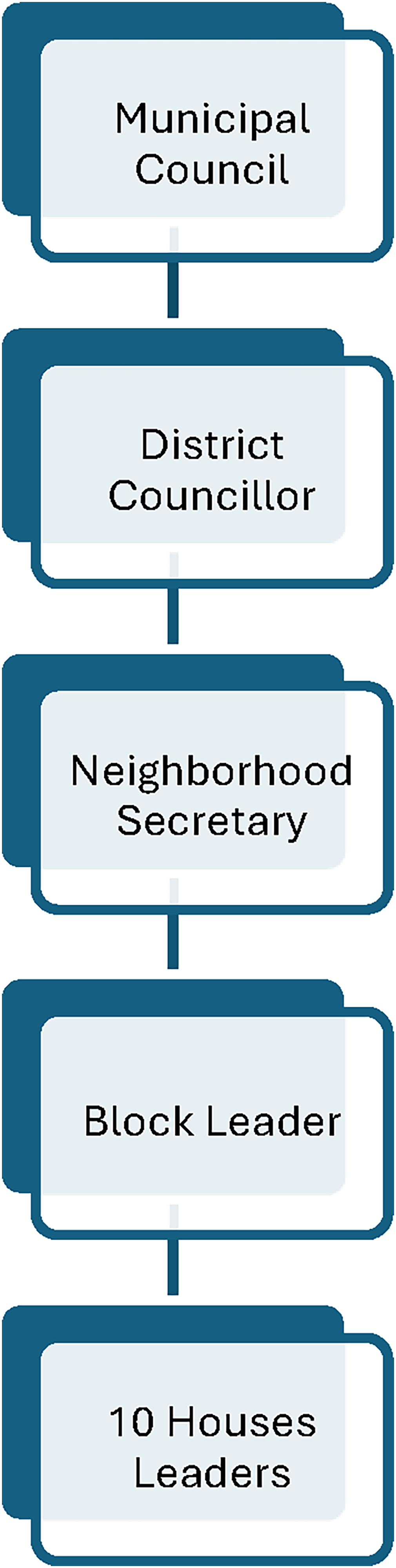
Hierarchy of local governance offices.
Within the field of climate change adaptation, there is growing recognition of the critical role that culture plays in shaping adaptation processes and outcomes (Adger et al., 2013; Few et al., 2017; Granderson, 2014; Rühlemann and Jordan, 2019). However, despite this expanding body of research, the examination of legality as an aspect of culture remains significantly underdeveloped. Drawing on Merry’s (2010) disaggregation of ‘legal culture’ into four dimensions – legal practices, legal attitudes, legal mobilisation and legal consciousness – a recent scoping review of the top ten scholarly journals with the most extensive climate adaptation content revealed that only 19 out of 1059 articles meaningfully addressed it (Hoddy et al., 2023).
The general neglect of legal culture within the broader study of culture's significance for climate adaptation represents a missed opportunity. Law plays a critical role in nearly all the ways various actors seek to mitigate the risks climate change poses to themselves and their communities (Garmestani et al., 2013). Given that legality is a fundamental aspect of social life and organisation, it is unlikely that we will fully comprehend adaptive practices without considering its significance.
This neglect of legal culture is particularly evident when examining an increasingly important aspect of adaptation: social practices of mobility, where people decide whether and when to move in response to climate-related risks (Warner et al., 2010). Yet, examining such ‘climate mobilities’ (Boas et al., 2019) with the aid of a legal culture lens holds significant promise, we suggest, not least because of the natural affinity between people's mobility decision-making and issues of land and property – a domain where the study of legal culture in non-climate adaptation contexts has been highly revealing (e.g., Santos 1977; Sieder 2014), including through scholarship published in this journal (see Harrington and Manji, 2017).
This article addresses the general oversight of the importance of legal culture in climate mobilities by presenting a qualitative case study conducted in an unplanned settlement 3 in Maputo, Mozambique. The study explores the role legal culture played in residents’ decision-making processes as they navigated climate-related risks in their daily lives. We demonstrate that legal culture can facilitate climate mobilities. However, we reveal that the role of legal culture in enabling climate mobilities is potentially rather complex. Our case study uncovered a nuanced ‘ecosystem’ of land laws in Mozambique, comprising two official systems, one formal, the other informal. Despite their entirely oppositional substantive content regarding land rights–one prohibiting land sales, the other permitting them–these systems functioned symbiotically, ultimately enabling residents of unplanned settlements to mitigate the effects of climate risks. Prima facie, this apparent paradox presents itself as something of a puzzle but can explained with the analytical tools of jurisdiction, scale and temporality (Valverde, 2015). Future research into the significance of legal culture for climate mobilities should, then, be attuned not only to the plurality of legal orders in play but also to the scales and temporalities through which they operate. We also argue that Mozambique's ‘ecosystem’ of land laws must be understood within the broader context of its political economy, which attracts foreign investment and promotes urban development, often at the expense of those living in unplanned settlements. Ongoing research into the role of legal culture in climate mobilities must, then, also interrogate the interplay between law and broader political, economic and social contexts.
The article is organised as follows: the next section provides an overview of the emerging literature linking legal culture to climate mobilities. We then introduce our case study, detailing the fieldwork conducted. Following this, we offer background information on Mozambique's legal system, along with a discussion of recent political, administrative and economic changes. We then present our findings on climate mobilities within the unplanned settlement. The next section analyses the impact of legal culture on these climate mobilities. Subsequently, we discuss the contribution of our study to the understanding of legal culture's significance for climate mobilities and its potential to inform future research.
Studies of Legal Culture and Climate Mobilities
Traditional doctrinal legal scholarship has much to say about climate mobilities, frequently drawn to the ways in which international, environmental and human rights law might be capable of responding. Questions are explored, for example, about the capacity of law to offer protections (e.g., Atapattu, 2020; Burkett and Sancken, 2020; Warren, 2016) or to address injustices associated with climate change mobility (e.g., Gonzalez, 2021; Thornton, 2021). Such work has clear value but also some important limitations. The enquiry, using doctrinal methods, focuses on the content of black letter law, usually steering clear of legal culture's significance for social practices of mobility. Moreover, it tends to concern itself with large-scale movements of people, frequently across borders, framing those on the move as ‘displaced people’ (McAdam, 2020), ‘climate change migrants’ (Helbling 2020) or ‘climate change refugees’ (Ni, 2015). Yet, the social reality of climate mobilities frequently involves less dramatic and more individuated practices of internal movement within countries, regions or cities (Boas et al., 2019). And climate risks usually represent only one of a number of ‘push’ and ‘pull’ factors informing people's mobility decision-making (Warner et al., 2010).
In contrast to traditional doctrinal legal scholarship, socio-legal studies that connect legal culture to climate mobilities are exceedingly rare. None of the studies identified in the previously mentioned scoping review specifically addressed climate mobilities. However, we are aware of a small number of recent publications that have begun to explore this interface, indicating that the intersection of legal culture and climate mobilities is only now emerging as an important issue warranting further investigation.
McDonnell (2021) has pointed to the significance of customary land law in Vanuatu for the design of climate resettlement policies. Her argument is that resettlement solutions that are closely tied to state responsibilities and human rights become ineffective by overlooking the customary tenure of land. She argues for an approach whereby resettlement solutions are negotiated through customary institutions, rather than formal state structures.
Mosneaga and Jacobs (2022) explored the rapid large-scale resettlement of residents in Beira (also in Mozambique) after cyclone Idai. They argue for attention to be paid to the multi-faceted aspects of climate mobilities, examining how government-led relocations were perceived by different actors. Post-Idai relocations incurred various forms of loss and damage that defy neat categorisation into ‘economic’ and ‘non-economic’ forms found in legal regimes. Equally, such losses were borne not only by those who relocated but also by those who remained in their homes, thus challenging the central image of the climate migrant.
Farbotko et al. (2022) present four case studies of the use of litigation around climate mobilities. They stress the importance of being open to complexity and particularity when exploring the relationship between rights consciousness and justice. Whereas for some, a right-based approach might focus on reparation for having been forced into mobility, or on protection from being returned to a place of risk, for others a rights-based approach might focus on litigating to preclude the need for mobility, seeking to force governmental authorities to take preventative action.
Velez-Echeverri's recent doctoral research (2023) similarly focuses on decisions about whether to litigate in the face of climate-related risks, examining climate-effected communities in Colombia who wanted to stay in, or return to their settlements. She examines the role that place attachment and violence played in triggering or constraining the turn to law, emphasising the importance of including considerations of personal and social risk when seeking to understand legal mobilisation, including around climate (im)mobilities.
As we can see, the socio-legal literature in this area is only just emerging and remains rather sparse. Nonetheless, each study highlights the potential significance of legal culture for climate mobilities, demonstrating that it can be significant in distinct ways. Collectively, these studies underscore the importance of paying close attention to the social practices and perspectives of ordinary people confronting climate risks in different contexts. Yet, there is still much to learn about the various roles that legal culture can play in climate mobilities. Our case study offers a new perspective on this question, stressing the role of legal culture in enabling mobility, rather than in merely protecting against it or responding to it ex post facto. We also demonstrate the value of the socio-legal analytical tools of jurisdiction, scale and temporality (Valverde, 2015) in exploring legal culture's potential role in relation to climate mobilities.
The Case Study
Fieldwork for our case study of climate mobility took place in Maputo, the capital city of Mozambique. As a country, Mozambique is highly vulnerable to climate-related extreme events, ranking highly in the Global Risk Index of countries affected by extreme weather events (Mosneaga and Jacobs, 2022). Maputo, its capital city, is located on the southern part of the coastal line and is Mozambique's most densely populated area. Given its coastal location, facing the Indian Ocean, Maputo is similarly vulnerable to the effects of climate change, with the main climate-related hazards being temperature increases, extreme events related to precipitation and sea-level rise (Castan Broto et al., 2013; UN-Habitat, 2009). Maputo's geological and hydrographical characteristics create difficulties for water drainage, exacerbated by dense urban occupation, thereby making local flooding a problematic aspect of life for many. Maputo also has noticeable coastal erosion problems, increasing the risk of flooding in the lowest topographical areas. The coastal areas of Maputo have experienced a proliferation of unplanned settlements, sustaining the vulnerability of such residents to the adverse effects of flooding (Castan Broto et al., 2014), including vector-borne diseases (Castan Broto et al., 2013). Our fieldwork took place in one of these unplanned coastal settlements. 4
The unplanned settlement in which fieldwork took place is made up of a number of ‘Blocks’ (quarteirão). Our research focused on a single Block, consisting of around 250 families. It is located on an incline next to the coast but also has some flatter wetland area, traditionally used for rice paddy, though it has increasingly become occupied by housing built by individual residents. The community is heterogeneous in terms of residents’ regional background, wealth and employment status. Flooding in this area lasts for months at a time, likely driven by a combination of factors, including increasing rainfall, the growth and densification of housing and the lack of infrastructure and drainage. Yet, the nature of residents’ exposure to the effects of flooding is varied. While those living on higher ground must deal with passing floods and rainwaters, those in the central area deal with stagnant water for months at a time. In many cases their building foundations sink into the sand, routinely resulting in interior flooding.
At the time of fieldwork, the Block was undergoing a ‘reclassification’ process as part of the municipal government's urbanisation plan, which offers a framework for the identification of neighbourhood areas to be rezoned, with the ambition of attracting investment for public-private partnerships towards urban improvement. Reclassification is, in part, aimed at reducing vulnerability to climate risks by way of creating better roads, waste management and utilities, as well as better drainage for flood waters (Castan Broto et al., 2013). The reclassification process in our case study Block was being delivered by a private architecture company in partnership with the municipal government. 5 The process consists of a topographic study and the creation of a Block Plan. The Block Plan parcels land into regular plots, larger than almost all of the existing unplanned plots, envisaging housing redevelopment and the creation of apartment buildings. It also identifies areas for the development of public spaces and public works, such as drainage, and indicates where streets require opening up to improve access.
Data from Block residents were collected by way of focus groups and interviews. We conducted four focus groups: three were organised on the basis of gender and age; 6 the fourth was gender mixed and included adult residents of all ages. We also conducted 23 semi-structured interviews with residents, including key local officials who lived there. Interviewees and focus group participants were recruited through convenience sampling, relying on our locally based team member to facilitate recruitment. Overall, 38 residents from 33 different households within the Block took part in the research. This sample was diverse in terms of gender, 7 length of residence 8 in the neighbourhood and, as noted earlier, age. The focus groups and interviews were semi-structured, organised around themes of everyday hazards and risks (including climate-related risks), responses to risks, changes within the neighbourhood over time, land transactions and mobilities.
We also interviewed the ‘Neighbourhood Secretary’, a local official with responsibility for the unplanned settlement in which the case study Block was situated, as well as eleven other relevant governmental and non-governmental actors. 9 These interviews were also semi-structured, aiming to shed light on themes of climate-related risk, climate adaptation and mobilities related to the case study Block and Maputo more generally. With stakeholders representing a range of governmental and non-governmental organisations and entities involved in one way or another in matters of urban land governance, separate topic guides were developed for each stakeholder interview, reflecting the organisation's areas of work, development programming or research.
All interviews and focus groups were conducted in Portuguese 10 by two members of the research team, both of whom are fluent in the language, and one of whom is a Maputo resident. Interviews and focus groups were, in the main, recorded and transcribed. In two interviews, no recording was made and immediate post-interview fieldnotes were taken instead. Recordings were transcribed and translated into English for analysis by an additional English-only research team member. Data were analysed by two research team members, one of whom had conducted the fieldwork and is fluent in Portuguese, the other of whom analysed the translated transcriptions. Any points of uncertainty around language and terminology were cross-checked with the local research team member based in Maputo. The data were analysed thematically, exploring themes of risks and responding to risks in everyday life (including climate-related risks), climate change adaptation, local governance, land transactions and mobility.
The research was conducted in accordance with the ethical permission granted by the University of York and complied with the ethical review guidelines of the Swedish Ethical Review Authority.
Politics, Administration and Law in Mozambique
Before we present our case study findings, we set out some broader context in this section. We focus on three themes which constitute essential background for understanding climate mobilities within the study and the role of legal culture within such mobility.
Politics and Administration in Mozambique
Since gaining independence from colonial rule in 1975, Mozambique has undergone significant change in terms of its political order. There was an initial period of socialist rule. The new Frelimo government made efforts to acquire control of the entire administrative apparatus of the country at all scales (Virtanen, 2004). This was intended to facilitate the delivery of a collectivist economic model and a classless society.
In urban areas, a highly centralised management system was introduced, dividing space into Neighbourhoods (bairros) and smaller units called Blocks (quarteirões) (Ginisty and Vivet, 2012). Localised ‘dynamizing groups’ (grupos dinamizadores) made up of Frelimo loyalists were introduced for disseminating ideology and organising residents along party lines within the neighbourhoods. These dynamising groups were instruments through which Frelimo could exert social and territorial control in urban settings (José and Araújo, 2007). Each group was assisted by designated ‘Block Leaders’ (chefes dos quarteirões) 11 within the neighbourhood who were, in turn, assisted by designated ‘Ten Houses Leaders’ (chefes de des casas). Centralised political power thus reached deep into local urban communities, including unplanned settlements. Through the hierarchical structure, authorities disseminated socialist ideas, implemented policy and retained political and territorial domination (Ginisty and Vivet, 2012; Cahen, 1985).
During much of the period of socialist rule, Mozambique endured a civil war. Ultimately, at the end of the civil war in the early 1990s, a new constitutional settlement was achieved (Hall and Young, 1991), reconstructing Mozambique as a democracy. Under external pressure, Mozambique was also reshaped as a neoliberal economy (Santos, 2006), seeking to attract growing levels of foreign investment into the country (Luiz et al., 2013). Further, following the transition to democracy, processes of decentralisation and municipalisation were implemented for the re-legitimation of the state at the local level. A system of elections for official posts at the local level was introduced (Bertelsen, 2016).
However, despite these reforms, certain elements of the earlier political order continued into the new democratic era. As Santos has observed, political transformations in Mozambique's recent history, whilst proclaimed as radical breaks from the past, were more complex in reality: ‘ruptures coexisted with continuities, blending explicit and self-proclaimed ruptures with unspoken continuities…’ (2006: 48). At the national political level, for example, since the transition to democracy the Presidency has always been held by a Frelimo candidate, the political party which had ruled under the socialist system. 12 The same is also true of political control of the municipal assembly in Maputo (Hankla and Manning 2017; Hanlon, 2021; Roque et al., 2020; Weimer, 2012). At the local administrative level, the posts of Block Leader and Ten Houses Leader were retained, albeit that they were accountable to a Neighbourhood Secretary (Secretario de Bairro). Yet, most new Neighbourhood Secretaries had previously been office holders under the socialist system, and Block Leaders also overwhelmingly continued to be Frelimo loyalists (Ginisty and Vivet, 2012). And while municipalisation disbanded dynamising groups and reincorporated their administrative functions into new neighbourhood structures, many former members came to occupy these new structures. The continuing hierarchy of local officials can be represented as follows (Figure 1):
Thus, we may observe that, while the system of highly centralised governmental control under socialist rule was formally disbanded following the new constitutional settlement of early 1990s, a basic structure of local governance within unplanned settlements remained intact. A hierarchy of local state officials with authority over local matters endured, albeit that they were no longer agents of the centralised state but rather officials of local government. They continued to exercise governance functions and have become central to the informal system of land law which we describe later in this article.
Legal System and Legal Pluralism in Mozambique
Following independence from colonial rule, the socialist Frelimo government dismantled the indigenato system that had been the basis for a separation between colonial and customary legal orders (Sachs and Welch, 1990; Santos, 2006), instantiated in two administrative models and two forms of law and justice (Araujo, 2012). Yet, consistent with the point made above about continuities co-existing with ruptures, elements of customary law and practice continued, being applied through the popular courts created by the socialist government (Kyed, 2013). Likewise with the transition to a liberal legal order in the early 1990s, elements of customary law endured. Indeed, according to Kyed, ‘the official system provided justice to a very small section of the population, with the majority of Mozambicans seeking redress through customary and community-based institutions’. (Kyed, 2013: 989)
This reality, following incremental statutory acknowledgement, ultimately received constitutional recognition in 2004, where, in Article 4 of the revised Constitution, the state recognised ‘various normative and dispute resolution systems that co-exist in Mozambican society, insofar as they are not contrary to the fundamental principles and values of the Constitution’.
Yet, while in one sense this constitutional change might be framed as a structural development towards decentralisation – a response in part to international donor demands – the politics of legal pluralism in Mozambique may actually be as much concerned with the extension and consolidation of centralised state power (Kyed, 2009). Moreover, while constitutional recognition of legal pluralism speaks to the many sites of dispute resolution in everyday Mozambican life, it actually may not say enough about the lived realities of legal pluralism for ordinary Mozambicans. Araujo (2012), arguing for what she describes as an ‘ecology of justices’ approach, observes: ‘Legal plurality in Mozambique is complex and unpredictable, and cannot be analysed based solely on what was or is provided for in legislation or from a single narrative’. (2012: 125)
Likewise, Kyed stresses that we must remain open to forms of legality that risk being excluded under conceptions of legal pluralism that emphasise ‘co-existing bounded systems’. Local officials such as Neighbourhood Secretaries, Block Leaders and Ten House Leaders, for example, perform dispute resolution functions in local settings and the risk here is that we overlook ‘informal practices of state officials, even when these seem to be the most legitimate in the eyes of the citizens’ (Kyed, 2013: 990). From the perspective of ordinary Mozambicans, then, the lived realities of law in everyday life may not match the more restricted image of legal pluralism that is acknowledged constitutionally. The lived realities of ‘interlegality’, as Santos puts it (Santos, 1987), will extend beyond, and be more complex than a distinction between state and customary law.
Thus, we may suggest that any exploration of the role of legal culture in relation to climate mobilities in Mozambique should be premised on an expectation of legal pluralism and complexity within such legal plurality.
Formal Land Law in Mozambique
A core element of urban development and the logic of private investment in contemporary Mozambique concerns land law: the capacity of private investors to profit from legal rights in land. When Mozambique gained independence in 1975, the ruling Frelimo party had vested all land in the state (Burr, 2005). Following the emergence of a liberal legal order, however, the national land law was significantly reformed in 1997. Whilst all land continued to belong ultimately to the state (Hall and Young, 1991), land use rights were created with the intention of promoting commercial investment (Unruh, 2005). The DUAT (Direito de Uso e Aproveitamento da Terra – ‘the right to use and benefit from the land’) is, in effect, a long lease. Sales of DUATs are prohibited 13 (Cabral and Norfolk, 2016) but their renewable 50-year duration offers long-term security of tenure for the DUAT holder.
In urban areas, DUATs may be obtained either on the basis of an individual's good faith occupation for at least 10 years or by direct allocation by the state (Fairbairn, 2013). 14 In both cases, however, the state retains regulatory control. DUATs are granted after a formal process of application and approval, which can be costly for applicants, excluding most residents of unplanned settlements (Kihato et al., 2012). Moreover, in urban areas, the awarding of DUATs is limited to areas covered by urban plans and to those areas where there is already some level of urbanisation (Jorge, 2016).
Thus, we may observe that, in Maputo, policies of public-private partnerships for urban development are closely tied into national formal land law. Private investment for the gentrification of unplanned settlements, including improvements that will address climate-related problems of flooding, is premised on the anticipation of the granting of a DUAT to investors, offering long-term security of tenure and a foundation for a return on capital investment.
Case Study Findings
In this section, against the backdrop of the above contextual information, we set out our findings about climate mobility amongst the residents of the case study Block, starting with their experiences of routine flooding.
Experiences of flooding emerged clearly in our interviews and focus groups as a significant source of difficulty for ordinary life in the Block. In general terms, there was a clear sense of the distinct unpleasantness and inconvenience of frequent flooding. More specifically, however, residents identified a number of risks in everyday life associated with flooding, with most participants having a sense of things getting worse over time. These are related to health, children's education, income, injury/harm within the home, injury/harm outside the home and sanitation. We consider these in turn.
As noted, the first risk related to residents’ health, particularly the health of children, and was associated with standing water. Stagnant water represents a risk of vector-borne diseases. And while adults understood this well, children did not: We can forbid them – ‘don't play in the water, don't play in the water!’ – but a child is a child and ends up forgetting and goes and plays there again. There are leeches, mosquitoes and lots of insects there. It's mostly the children who suffer a lot with that, because the water has no way of flowing out. It's stagnant. So, there are mosquitoes, there's a lot of disease. We suffer from a lot of diseases.
The second difficulty, which follows from the first, was the impact of flooding on children's education. As has been found elsewhere, the effects of climate change can be damaging for educational opportunities (Wamsler et al., 2012). As one interviewee put it: When the area is flooded and it's raining, the first thing is that a child can't go to school. They will miss lessons. They can't go to school and run the risk of disease.
The third risk, consistent with the findings of other studies (Wamsler, 2007; Wamsler et al., 2023) was financial. Flooding can sometimes impede people from being able to go out and earn their living. One focus group participant described it in the following terms: The floods affect our sales because, as you can see, our incomes… we don't have the conditions to have sufficient income within the household. Our income is those daily sales. If I don't go out today, I know I’m not going to eat. So, when the water is inside the house, then there's also no income in that house.
The fourth risk related to those who suffer internal flooding in their homes, with consequent risks of harm, particularly for children: When the rain starts, we have to wake up and watch out because we are afraid of being flooded and the children drowning while we sleep. I have to carry the children and put them on top of the tables. We have to sleep in the same bedroom to check on things. If we don't, a child will fall on their own in the bedroom.
Fifth, pools of standing water created by flooding represented a risk of injury for people when walking through them. The ground underneath was uneven and rocky in places. Participants noted that they sometimes suffer from consequent injuries to their feet. One interviewee noted, pointing to his feet: whenever you go out, you have to walk in the water. So, all those trips are harmful. Sometimes we’ve had wounds, as you can see. When they dry, the wounds heal. So, wounds appear, that's harmful.
Finally, flooding exacerbated problems of poor sanitation infrastructure. It was common for houses to use an enclosed pit as a toilet, which, during periods of flooding, could cause the human waste to escape the pit. for us to build a [septic] tank, to open a cesspit, all that, that's very complicated, because when the water comes, when the rain falls, everything mixes together and everything is spread… you can see [pointing] that bathroom is the type made from reeds or by placing tyres, putting tyres there and place a lid there… when it rains, in practice all that there gets flooded. The water tends to flow to other places, so the water is all mixed together, and with children who go and play there, because they have nowhere else to play… Life is difficult, yes, life is difficult.
As we can see, experiences of routine flooding exacerbated the already-existing difficulties of life in the Block, requiring continuous effort and struggle. Residents routinely had to manage a number of risks that were made worse by flooding. Thus, whilst flooding in itself was certainly unwelcome, unpleasant and inconvenient, our findings point to the significance of its interaction with other social and economic challenges in shaping residents’ mobility decision-making. Many of the 33 households we engaged with had an ambition to leave, particularly given the prevailing sense that things were getting worse over time. Despite long-standing and routine practices of coping with flood-related risks, such participants had a sense of approaching a threshold for leaving, albeit that the extent of the flood-related challenges residents faced conditioned the urgency they felt towards the desire to move. Thus, for some, the felt need seemed immediate:
All I want is to see someone coming and saying, ‘I want to buy this place’. I would sell and leave… If there's an opportunity of getting a house in a better place where we can see that there's no risk of flooding for the next 10 to 15 years, we’d accept.
For others, it seemed to be what might be considered a medium-term ambition: If someone appears who wants to buy, we would accept on the condition that he gives us a good house. We have children. We want a good house, better conditions than we have here… If they can't build a house for us, they can give us money and we will buy land. We will search and find it, buy it and build, build a house and leave here.
Other participants simply expressed a more general anxiety about when the optimum time for might be selling. As one interviewee put it: ‘Buyers will arrive, but it may be too late for us’. Another said: Every time it rains, this sand is washed away with the water. So, imagine in five years’ from now. What will it be like? In five years’ time, this wall won't exist. In some years’ time, it will get worse and worse… What is it worth, if I refuse their offer of perhaps one million today, for them to move me from here in five years’ time maybe for five hundred thousand?
Yet, as the above interview excerpt indicates, residents’ capacity to move from the settlement depended on finances. They needed to sell their current plot of land in order to have the money to find a better plot in another settlement, less vulnerable to risks of flooding. The opportunity for residents to sell their plots of land came mostly from private developers. The reclassification process and the plans for redevelopment thus represented the most promising opportunity for mobility for residents. A number of the participants we spoke to were hopeful that a developer's representative would approach them to buy their plot of land. As two of them put it: For us, it's an opportunity. We hope that one day they’ll reach here, and we will buy another place and build… When someone comes and wants to buy me out, the first thing I think is that I will escape those floods… A person looks at that as an opportunity to change their life, you know. They look at that as an opportunity to have a better life.
In such situations, a private developer's representative would negotiate with residents about an acceptable price for the plot of land. The majority of the people who have already left have done so through the [developers’ representatives] … If those people agree to leave, it's because they’ve sat down and done their calculations and see that, hey, it's worth it.
However, whilst such land sales may be the product of two-way private party negotiations, local state officials in the form of the Neighbourhood Secretary and the local Block Leader were involved. What was being sold in these land market transactions was the right to be recognised locally as the authorised possessor of the plot of land – an authorised possessor who could then anticipate the grant of a DUAT so that the land could be developed according to the requirements of the urban plan. Thus, while the right to the plot of land being sold in such transactions is not recognised within the formal system of national land law, it nonetheless functions as a route into that formal system of land law for the developer purchasers.
The local recognition as the authorised possessor of the land, which forms the basis of these transactions, comes from the Block Leader and the Neighbourhood Secretary. The Block Leader in particular exercises considerable authority over land possession. As two of our interviewees put it: He's the head of the area. He's the one who says that something can happen, or something can't go ahead. I can't just build in a place without his knowledge. He must say, ‘Yes, you can live there’ … It's not possible for someone to arrive and build a place without him knowing about it. Authorisation passes first through the Block Leader. I paid for the space at the authorities because, besides paying for the space, you have to present yourself to the Block Leader and pay for a declaration.
This ‘declaration’ is a written piece of paper that confirms that one is the authorised resident of a particular plot of land in the unplanned settlement. While issued by the Block Leader, it is stamped and affirmed by the office of the Neighbourhood Secretary. Thus, the Block Leader's and the Neighbourhood Secretary's authorisation, both of which come at a fee, are essential to informal land transactions. A number of our participants had obtained such declarations, or were in the process of doing so, so that they could be in a position to enter into market negotiations when approached by a developer's representative.
The Role of Legal Culture in Climate Mobilities in the Study
What is the role of legal culture in this account of climate mobility? At the heart of our account is the informal system of land law being operated with the support and assistance of local officials, enabling some residents to sell and move when they get to the point of feeling that life in the Block, including problems with flooding, has become too difficult.
Yet, in describing this as an ‘informal system of land law’, we must exercise some caution. The terminology of ‘informal settlements’ is ubiquitous within policy and scholarly literature about unplanned urban settlements, in which approximately one-quarter of the global population, one-half of the sub-Saharan African population, and three-quarters of Mozambique's population live. In an important paper reviewing the literature and underlining a socio-legal discomfort with the notion of the ‘informal settlement’, van Gelder sets out a number of apparent paradoxes regarding law and land in informal settlements (van Gelder, 2013). However, despite the helpful insights of van Gelder's socio-legal analysis, the concepts he operationalises and the way he puts them to use actually reveal an additional reason why the ‘formal/informal’ binary may be problematic for socio-legal studies. Van Gelder, in common with much social science literature on informal settlements, elides the concepts of formality and officialness. Consider, for example, the following assertion: ‘To recapitulate, we ought to be speaking of two normative realities in the Third World cities instead of one: official law in the legal city versus the informal systems of the illegal city’ (2013: 512). ‘The official/unofficial variable results from the political-administrative definition of what is recognised as law or the administration of justice, and what is not. In the modern state, the unofficial is everything that is not recognized as state-originated… The formal/informal variable relates to the structural aspects of the legal orders in operation. A form of law is considered formal when it is dominated by written exchanges and norms and standardized procedures and, in turn, is considered informal when it is dominated by orality and common language argumentation’ (2006: 46).
The (un)officialness of law, then, concerns the nature of law's relationship to the state, whereas the (in)formality of law is best considered as a description of legal method or the mode of legal operations. Legal orders will combine different combinations of these features.
Significantly for our case study of legal culture and climate mobilities, the system of land law that sits at the heart of our account was informal but official. Whilst ‘informal’ in the sense of lacking written exchanges, norms and procedures, it was nonetheless ‘official’ in the sense of being supported and sustained by the Neighbourhood Secretary and the Block Leader, both of whom are local state officials.
The importance of this distinction between formality and officialness goes beyond categorical nit-picking. It matters for our capacity to fully understand law and legality in our unplanned settlement and the relationship to climate mobilities. Our suggestion is that the informal/official system of land law was functionally linked to the formal/official national system of land law and its role in urban development, including the state's response to climate risks. Processes of urban development and gentrification, which included an ambition to be adaptive to climate risks, relied on the functionality of the informal system of land law in enabling the purchase of unplanned plots. The informal system of land law operated as a kind of voluntary ‘clearance’ of residents, making way for gentrification along the lines of the urbanisation plan. Thus, the distinctiveness of, and the connections between these official legal orders are an important part of the overall story of climate mobilities in our study.
The existence of two official systems of land law in our study presents, of course, something of a puzzle and paradox: whilst the formal/official system prohibited land sales, the informal/official system enabled them. How can it be that these two official systems of land law existed within the same space with diametrically opposed substantive content? The explanation is also one of legal culture, we suggest, and may be revealed by applying the socio-legal analytical tools of jurisdiction, scale and temporality. We explore these in turn.
In crude terms, jurisdiction performs a division of labour within a legal order, determining who gets to decide what. How was jurisdiction determined within the informal system of land law in our case study? The authority of the Neighbourhood Secretary and the Block Leader to legally govern land transactions derived, in the first instance, from their political status as the local representatives of the state. This determined the ‘who’ of jurisdiction. But the ‘what’ question – over what did they have the authority to legally govern? – was an issue of social fact. The nature of these officials’ jurisdiction emerges as a product of the legal consciousness of the neighbourhood's residents. As our data indicated, for many decades the Neighbourhood Secretary's and Block Leader's authority over who became an acknowledged owner within a Block was essential for sales and mobility that pre-dated the current process of gentrification and urban development. In this regard, a shared understanding of their capacity to govern land transactions had emerged within the community, no doubt under the shadow of their roles as dispute resolution authorities in relation to other community matters. In other words, their authority to confer marketable title was itself conferred on them by the community. People coming into and going out of the Block accepted the Block Leader's and Neighbourhood Secretary's capacity to say who was the authorised occupant.
A focus on scale also helps us resolve the paradox that the local officials in the unplanned settlement exercised their jurisdiction over land transactions in a way that was oppositional to the content of the national land law. The idea of scale as a socio-legal analytical device, borrowed from cartography, was first introduced by Santos (1987). As a metaphor, it helps us see that law operates in different spaces, at different scales, creating different legal realities. The fact that law operates at different scales permits a certain level of overall incoherence or inconsistency. What makes legal sense at one scale may not at another. Indeed, in his later work on Mozambique, Santos described it as a ‘heterogenous state’, pointing to ‘the coexistence of starkly different political cultures and regulatory logics in different … levels (local, regional, and national) of state action’ (2006: 44). Likewise in our study, land transactions comprised separate legal realities at the local and national scale. At the scale of the national, ultimate ownership of land was retained in the hands of the state, which regulated the granting of DUATs. But land law at the scale of the local neighbourhood operated to permit the market transfer of title in households’ properties. For sure, the developers who purchased such legal title would go on to engage with land law at the national scale, going through the lengthy and bureaucratic process of obtaining the DUAT in order to realise their investments. Nonetheless, it is clear that, in order for them to be able to do this, they first had to transact within the local legal order. Developers were thus legal actors at both national and local levels, whereas the sellers were actors only in the local legal order. Attention to scale is thus necessary for our understanding of local land law in our study site and its capacity to differ so profoundly from the national land law. Yet, whilst necessary, the focus on scale alone is insufficient. A consideration of temporality is also required, helping us to understand why local state officials exercised their jurisdiction over land law in this particular way.
As Valverde has stressed, there is a dynamic between space and time which can be important for socio-legal analysis. Adopting the notion of the ‘chronotope’, she notes: ‘being inspired by Bakhtin's important work on the way in which time and space interact and shape one another can greatly help us to produce concrete analyses in an open-ended manner…’ (2015: 37)
Applying this insight to our case study data, we can observe that a key difference between Mozambican land law at small and large scales concerns the extent to which it looks into the future. As we noted earlier in this article, Mozambique has undergone, in a relatively short period of time, a number of major ruptures in its political economy. Each rupture represented a fresh wholesale vision for Mozambique's future. Law at the scale of the national, then, reflects this sense of the long-term future. The land law of 1997 bears the marks of an earlier period of socialist rule whereby land was held by the state in perpetuity on behalf of the people, as well as the shift to a liberal political economy whereby inward investment was encouraged for a stronger economy. Yet, by way of contrast, if our focus ‘zooms in’ with greater resolution to examine the scale of the local neighbourhood, we can see that law is marked more by a concern with the shorter term. Local governance is driven by the pressing demands of everyday living. The Block Leader, who, as noted above, enjoys jurisdiction not just over land as a granter of ‘declarations’, but also over social order as a dispute resolution authority, operates within a more immediate timeframe. Thus, the logic around land transactions focuses not just on the particular and local (as opposed to the general and national), but also on the more immediate needs of residents and the local community. Thus, a consideration of temporality is important for our understanding of the operation of the informal local land law which enabled transactions that were prohibited under formal national law. Unlike the DUAT system of the national law, which is cumbersome and slow, the local system of land transactions could be quick and responsive, sensitive to the shorter-term needs of local residents. The land transactions discussed in our study were, accordingly, the point of connection between the ‘long’ time of the developers seeking a return on investments and the ‘short’ time of the residents seeking mobility from climate risks under a sense of time running out.
Discussion
The case study presented in this article illustrates the intricate relationship that may exist between legal culture and climate mobility. Climate mobility, we have seen, is complex, intertwining with social, political, economic and legal issues as much as with climatic ones. Moreover, law as a facilitator of climate mobility was implicated at more than one level. At the national level, we noted the 1997 formal land law, designed, in part at least, as a way of encouraging private inward investment. At a city level, we observed the municipal government exercising its legal powers of urban planning, seeking to create partnerships with private developers for urban development in unplanned settlements. Such private investment towards upgrading, including measures that tackle climate risks, depends on the longevity and stability of the formal national land law. It also depends on existing residents electing to leave so that developers may in due course become the holders of land title within the formal national system of land law and so benefit from their investments over time. Such a voluntary ‘clearance’ is enabled by the dire conditions in which residents live, including adversities that are linked to a worsening climate, to which the country, the city and the unplanned settlement are particularly vulnerable. Yet, in an interesting twist, the voluntary ‘clearance’ of existing residents is not directly enabled by the formal national land law, which is too restrictive to permit sales of individual plots of land. Accordingly, it relies on an alternative official, albeit informal, legal order, where land transactions are both possible and relatively easy. However, residents are weaker parties in market negotiations and, whilst achieving climate mobility, fail to reap the economic rewards that will likely come to the developers in time. As we can see, each strand of legality is interconnected and woven into a broader narrative of climate mobilities in our study site.
Given the dearth of research connecting legal culture to climate mobility, our study represents a significant contribution to this emerging enquiry, we might suggest. Our research focused on individual decision-making regarding when and whether to leave one's home in response to chronic flooding, rather than acute incidents. Additionally, our study emphasised the role of legal culture in facilitating mobility, rather than in preventing mobility or responding to it after the event. Our research thus offers a novel perspective on the function of legality in relation to climate mobilities and underscores the importance of closely examining specific legal cultural contexts when studying these issues.
Yet beyond the fact that our study has value as a new empirical contribution to a virtually nascent field, it also holds theoretical significance in sensitising future researchers seeking to examine this interface between legal culture and climate mobilities. Our study affirms McDonnell's insight (McDonnell, 2021) about the importance of examining the legal plurality of the contexts in which mobility decisions are made. It also stresses the importance of exploring legality at different scales within a given setting. This includes consideration not only of the ways in which legal rationalities at different scales may conflict with each other (Santos, 1987), but also of the fact that such conflict can, paradoxically, be symbiotic: their oppositional rationalities can sustain each other and, in combination, produce the conditions that enable climate mobilities. And this symbiosis of contradictory legal orders can only be fully understood within the context of the broader political economy. In this way, any future examination of legal culture in the study of climate mobilities must remain open to significant complexities, tracing the dynamics not just between legal culture and the changing climate but also between legal orders and their social, political and economic contexts.
Conclusion
As a social issue, climate mobility is likely to become increasingly significant over time. Exploring its legal cultural dimensions is a crucial aspect of its broader study. Our research suggests that in addition to examining how international and human rights law can address climate mobilities, we must also consider the role of legal culture, focusing on local and everyday contexts. The critical tradition of studying law in everyday life, combined with the framework of legal pluralism and the analytical tools of jurisdiction, scale and temporality, can enhance our understanding of how legal culture influences mobility decision-making for people facing climate-related risks in daily life.
Footnotes
Declaration of Conflicting Interests
The author(s) declared no potential conflicts of interest with respect to the research, authorship, and/or publication of this article.
Funding
The author(s) disclosed receipt of the following financial support for the research, authorship, and/or publication of this article: This work was supported by the Vetenskapsrådet, (grant number 2018-04305).
