




Abstract
This paper examines legal mobilisation in socio-environmental movements through the Caimanes case, a Chilean community opposing the Los Pelambres mining project. It integrates structural and agency perspectives, highlighting the community's adaptation to political and legal opportunities and focusing on distributive environmental justice. The study identifies two protest cycles: the first seeking compensation, leading to community divisions, and the second addressing mining externalities, fostering unity and solidarity. It discusses judicial mobilisation's limitations, including challenges in aligning community and legal advisors’ aims and constraints within the Chilean judicial system. The analysis, based on fieldwork and secondary sources, contributes to understanding legal strategies in environmental justice movements, emphasising strategic decision-making's importance.
Keywords
Introduction
For more than 60 years, scholars have explored social mobilisation from various angles, including behaviour (Blumer, 1951; Smelser, 1962), resources (Freeman, 1979; Jenkins and Perrow, 1977) and political opportunities (Tarrow, 1998). More recent theories have looked at social mobilisation through symbolic or cultural lenses (McAdam, 1999; McAdam et al., 2001). This diversity of approaches is also seen in studies on legal mobilisation (Andersen, 2006; Hilson, 2002; Koopmans, 1999; Sieder et al., 2005; Wilson, 2006). However, few studies have examined both the structural aspects and the agency within social mobilisation, especially in legal contexts (Buckel et al., 2024; Vanhala, 2012). This paper contributes to the discussion by analysing both the external context and the internal capabilities of social movements to use judicial resources. It focuses on Caimanes, a small farming community in northern Chile, which has primarily used judicial means to oppose Los Pelambres, one of the world's largest copper mines.
This study argues that the judicial mobilisation in Caimanes reflects the community's ability to seize opportunities at different conflict stages and to develop and maintain a narrative centred on distributive justice as a key aspect of environmental justice. The opposition in Caimanes emerged in response to the inequitable impact of extractivism (Smart, 2020), forming a movement based on the adverse effects of the project. This paper suggests that the movement's demands stem not from a desire for recognition or participation but from a reaction to the unfair distribution of the project's externalities and benefits, framed as an issue of distributive environmental justice (Fraser, 1996; Schlosberg, 2004; Young, 1990). From a structural point of view, this paper argues that the rise in legal mobilisation in Chile, as seen in Caimanes, is linked to the failure of the government's executive and legislative branches to safeguard the rights of communities impacted by extractive industries, particularly in remote areas. The case of Los Pelambres, backed by significant economic and political elites, highlights this issue, pushing social movements towards legal action to defend their rights. However, the decision to engage in judicial mobilisation, complemented by direct action, is not solely due to structural factors. An analysis of contention episodes in Caimanes reveals that the movement's strategies also derive from the leadership's capabilities and the support from various networks, illustrating how external and internal influences converge to shape the community's legal mobilisation efforts.
This paper expands on legal mobilisation literature by exploring both the advantages and challenges of this strategy. The response of the Caimanes community to the El Mauro dam project was not uniform, reflecting diverse internal perspectives and leading to varied protest dynamics. This analysis reveals how the community's legal strategy not only secured compensation from the mining company and acknowledgment of the project's negative impacts, such as water contamination and security risks, but also fostered a sense of achievement and solidarity among the protestors, particularly following favourable court rulings. However, judicial mobilisation comes with significant drawbacks, notably the need for costly external legal experts whose goals may not align with those of the community. Additionally, enforcing court decisions, especially against powerful economic and political interests, presents a substantial challenge. These factors are crucial for social movements to consider when opting for a judicial route to mobilisation.
The paper begins by evaluating legal mobilisation theories and then continues with a process tracing analysis of the episodes of contention that are marked by two large cycles of protest: (a) a cycle that aimed and ended up in a compensation from the company and (b) a cycle that has sought to evidence the externalities of the project. This approach helps identify key shifts within the movement and assesses the counter-strategies employed by the government and the company. The final section synthesises the study's insights into the benefits and challenges of legal protest strategies, considering the broader political and legal context for environmental movements in Chile and their inherent capabilities for such tactics. The case study is informed by fieldwork conducted between 2015 and 2023, alongside secondary data sources. Although data collection began in 2015, the gathered information covers the conflict's history since the early 2000s. The analysis is based on 28 judicial decisions related to Caimanes, supplemented by semi-structured interviews (with NGOs, government officials and company representatives) and discussions with key movement participants. Additionally, over 80 press articles on direct actions, legal proceedings and the movement's networking efforts support the findings.
Legal Mobilisation: Between Structure and Agency
Before delving into the theoretical discussion of legal mobilisation, it is crucial to clarify its scope. Legal mobilisation encompasses a range of actors and strategies, including -but not limited- to the judiciary's role in societal mobilisation, strategic litigation, lobbying by movements at private or public institutions, legal education campaigns and interactions with legislative bodies. In this study, I interchangeably use ‘legal mobilisation’ and ‘judicial mobilisation’ to specifically refer to strategic litigation by social movements in courts, a process also known as the judicialisation of protest (Vanhala, 2010: 6). This focus highlights how social movements leverage the legal system to advance their causes.
Scholarship on legal mobilisation and the judicialisation of protest often centre on the external political structures that influence the ability of social movements to engage with legal systems (Burgers, 2020; Epp, 2009; Galanter, 1974). This includes examining the political opportunities that enable these movements to utilise legal resources effectively. Conversely, some researchers highlight the role of the judiciary itself, focusing on the concept of access to justice. This perspective considers the internal dynamics of courts, including what issues can be legally pursued, who has the standing to initiate cases, and the timing of such actions (Fuchs, 2013; Hilson, 2002). Additionally, there's a strand of research that underscores the resources at the disposal of movements, such as supportive networks and legal representation, and how collective litigation can foster a shared identity among participants. Summarising, it is possible to identify three theoretical approaches to legal mobilisation: (a) political opportunities, (b) legal opportunities and (c) resource mobilisation (Vanhala, 2010).
Moreover, scholars focusing on political opportunities suggest that groups lacking the ability to directly impact the executive branch may turn to strategic litigation within the judicial system. This approach primarily examines the structural context surrounding social movements, rather than their resources (Vanhala, 2010: 10). Buckel et al. argue that contemporary strategic litigation, especially in climate and environmental law, are moving away from traditional parliamentary debate and decision-making towards legal arenas (2024: 24), highlighting the growing significance of the judiciary in addressing complex societal issues. The motivation for mobilisation arises from various external factors, including opportunities, challenges or threats faced by the group (Koopmans, 1999). Following this theoretical approach, Rachel Sieder, Line Schjolden and Alan Angell argue that challenges such as the erosion of effective citizenship rights, economic crises and the shortcomings of neoliberal policies in reducing poverty have driven people to seek redress through courts or similar structures to assert their claims and protect their rights (Sieder et al., 2005: 1). They further note that the judicialisation of politics becomes more prevalent in contexts where the legitimacy of a regime is increasingly tied to its ability to uphold the rule of law, including rights protection, due process and government accountability. This scenario is particularly relevant in the post-transitional democracies of Latin America (Sieder et al., 2005).
Critics of the political opportunity approach to legal mobilisation highlight that social movements may encounter political opportunities not just externally but also within their own structure. For instance, the decision to adopt a particular strategy or to embrace new collective demands can itself be seen as a political opportunity (Kitschelt, 1986: 63). Vanhala adds depth to this discussion by pointing out that research in this area often blurs the lines between legal and political domains without adequately distinguishing between the judicial and legislative branches of government. Vanhala observes that while some studies acknowledge the judiciary's role within the political sphere, they tend to overlook the fundamental differences in how the judicial and legislative branches operate. Specifically, she notes that the judiciary typically acts in a retroactive manner, assessing how existing laws have influenced the arguments of the parties involved. In contrast, the legislative branch is forward-looking, considering the future impacts of laws on the population (Vanhala, 2010: 12). This distinction underscores the need for a legal analysis that adopts a different language and actor analysis compared to traditional political analysis.
To transcend the analytical confines of the political opportunities’ framework, several scholars have pivoted towards examining legal mobilisation through the lens of access to justice. This approach concentrates on the ability of groups or individuals to engage with the judicial system, the role of judges and the overall functioning of the judiciary (Andersen, 2006; Hilson, 2002; Wilson, 2006). It represents a deliberate shift towards scrutinising the actors involved in legal processes rather than merely the structural conditions that facilitate or hinder legal actions. However, a common critique is that this perspective often overlooks the motivations and objectives of the social movements initiating legal claims. One of the important exceptions to this approach comes from Ellen Andersen, who highlighted the capacity and agency of the gay movement, arguing that they can influence the political structure generating windows of opportunities (Andersen, 2006: 8). She identifies four key elements that underpin legal mobilisation: (a) access to courts; (b) the attitudinal model of judges, which suggests decisions are influenced by personal and political biases; (c) the formation of support networks and (d) the influence of cultural and legal norms.
Despite its contributions, this approach has been critiqued for still relying heavily on the notion of structural opportunities, failing to fully account for the agency of social movements. Critics argue that the approach does not adequately consider how movements perceive and interpret the feasibility of accessing judicial avenues – not as an objective reality but through a subjective lens. This oversight underscores the need for a more nuanced understanding of how social movements internalise and comprehend political and legal opportunities. The recognition and exploitation of these opportunities are not solely determined by external structures but are also shaped by the subjective interpretations of individuals within movements. This dual process involves both the structural conditions that present opportunities and the internal dynamics of movements that recognise and act upon these opportunities. Therefore, a comprehensive analysis of legal mobilisation requires an integrated approach that acknowledges the interplay between external structures and the agency of social actors, emphasising the co-construction of opportunities by both the structural context and the perceptions or interpretative acts of movement participants (Goodwin et al., 1999; McAdam et al., 2001).
The theoretical frameworks of political and legal opportunities predominantly focus on the structural context, often overlooking the internal dynamics of social movements. In contrast, the essence of the resource mobilisation theory lies in its emphasis on the ability of social movements to harness both tangible and intangible resources for legal mobilisation. This perspective suggests that the strategic choices of a movement, whether towards political lobbying in the face of resource scarcity or judicial strategies when resources are sufficient (e.g., to afford legal representation), are directly influenced by its resource mobilisation capacity. However, this approach has faced criticism on several fronts. Firstly, it is not inherently evident that judicial mobilisation is more resource-intensive compared to other forms of activism. A comprehensive assessment of a movement's potential strategies is essential before drawing such conclusions (Vanhala, 2010: 23). Secondly, resource mobilisation theories often overlook the agency of movements. Vanhala notes, for instance, that movements predisposed to direct action might engage less in judicial mobilisation compared to those comprising legal professionals (Vanhala, 2010: 23).
In examining the dynamics of legal mobilisation, this paper highlights the critical roles played by structural frameworks (be they political or legal) and the availability of resources. Importantly, it introduces the concept of agency as a fundamental element that deepens our comprehension of these theoretical underpinnings. Within this context, agency refers to the ability of a community and its members to make deliberate choices, initiate actions and tailor strategies in alignment with their socio-legal circumstances. The proactive protests and legal challenges of the Caimanes community exemplify this notion of agency. Their actions not only increased the political visibility of their cause but also strategically emphasised their legal claims on a national level.
This study adopts a holistic view of legal mobilisation, recognising a spectrum of influences that drive the formation and progression of social movements. It explores how a movement's core values, objectives and narratives – significantly moulded by their external context – interact with internal dynamics such as leadership decisions and the backing of external allies. These elements are crucial for understanding social mobilisation not as a linear path but as a multifaceted process influenced by the community's interaction with leadership guidance and a wider support network. This approach transcends the conventional political structural theories that view the socio-political landscape as static frameworks of opportunity or limitation (Tilly and Tarrow, 2006: 440). Instead, it suggests that the socio-political and legal contexts are continuously negotiated and reinterpreted by social movements. This revaluation highlights agency as a manifestation of the community's ability to recognise, interpret and engage with these evolving opportunities (Goodwin et al., 1999). In this light, agency emphasises the proactive role of the Caimanes community in the legal mobilisation process. It showcases how their collective initiatives and legal actions are not merely reactions to their socio-political environment but also contribute to shaping it. This perspective underscores the dynamic interplay between the community's actions and the broader socio-political and legal landscape, illustrating the active engagement of the Caimanes community in the complexities of legal mobilisation.
The Case of Caimanes in Chile
This section analyses the dynamics of legal mobilisation in Caimanes, focusing on the community's contentious cycles against the Los Pelambres Mining project (MLP or the Company). It links structural opportunities to specific events that have shaped the movement's identity and resistance. Key factors include the development of these events, support from various networks and input from legal consultants, all contributing to protest cycles and impacting the participants’ organisational abilities. The community's organisational capacity, cohesion, cultural framework and discourse have been influenced by significant shifts in structure and agency.
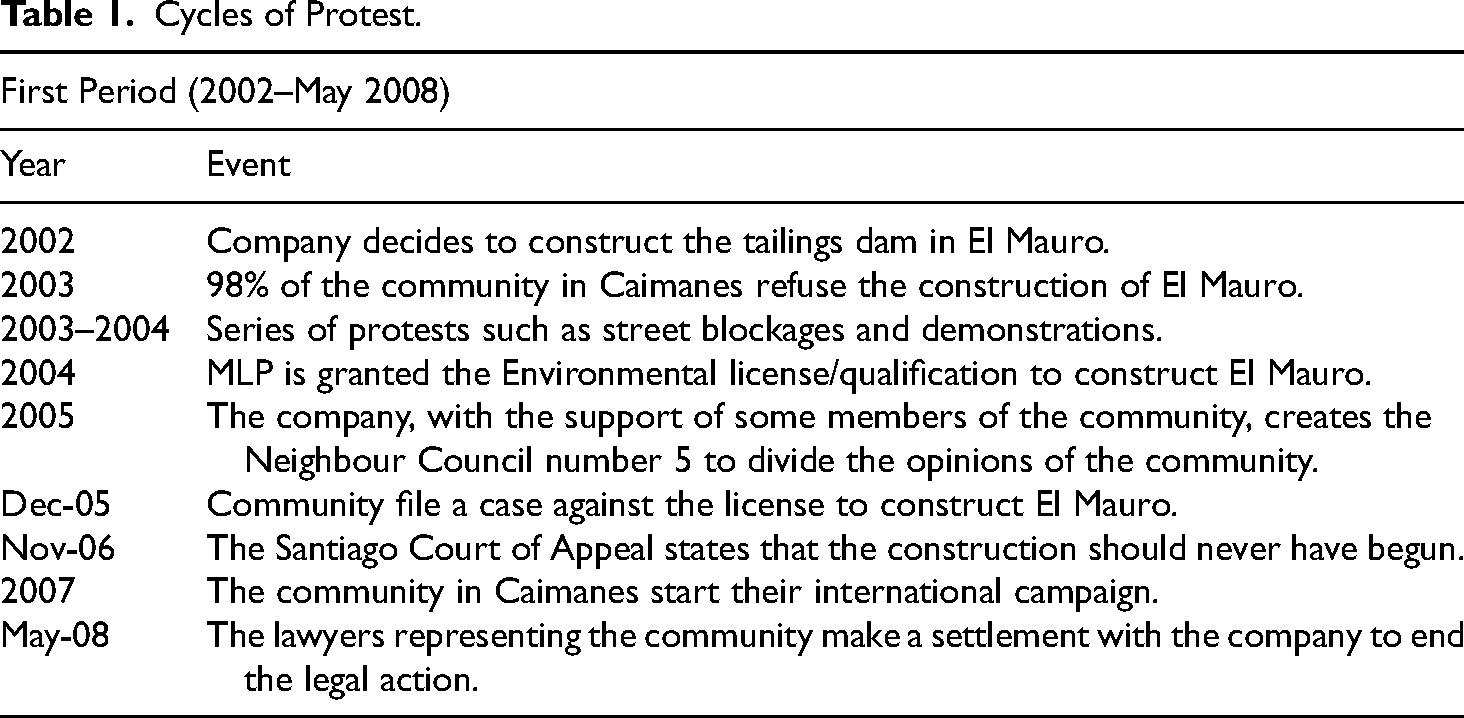
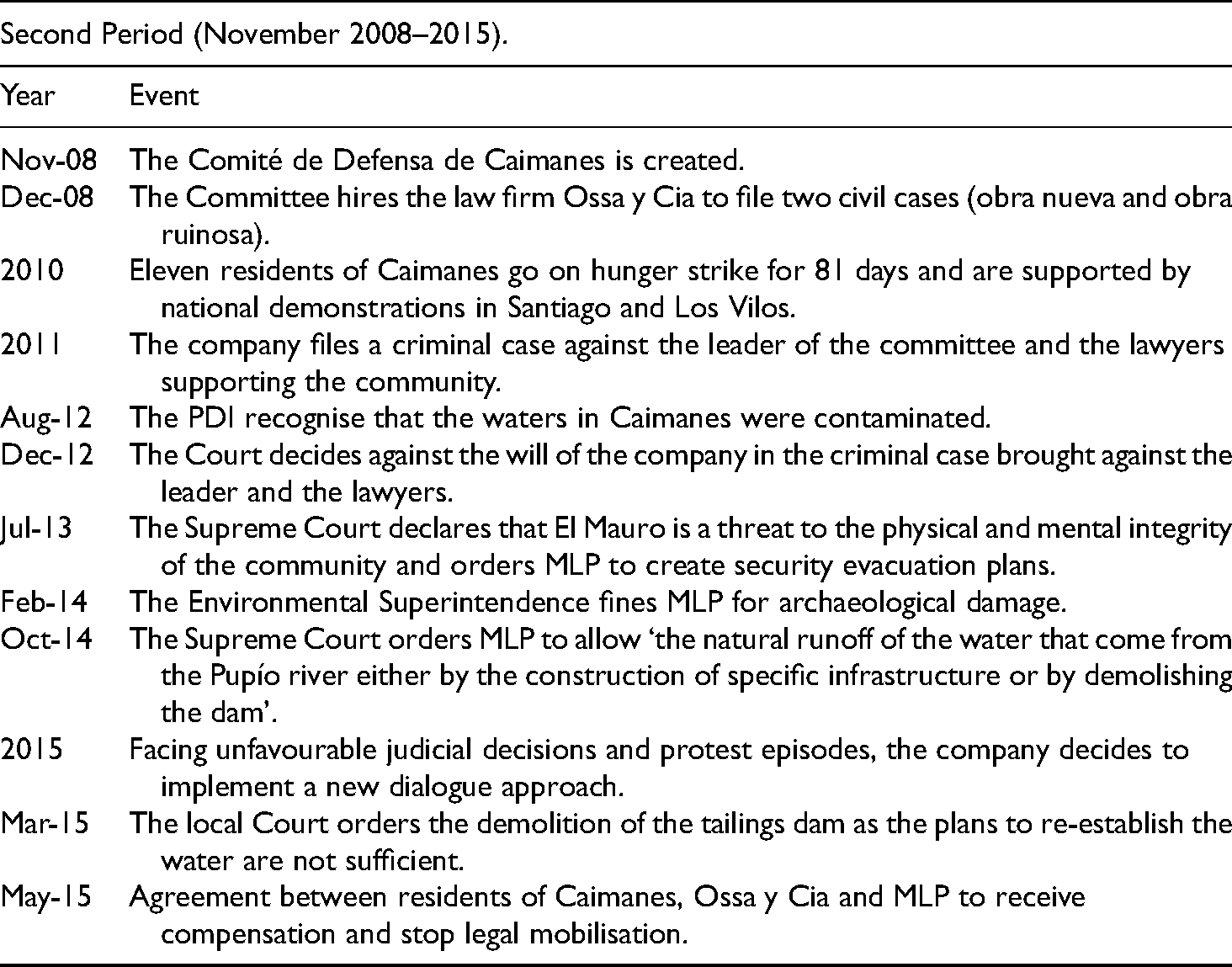
Analytically, the protest periods in Caimanes are categorised into two major cycles, central to the community's collective identity against the El Mauro tailing dam's construction and impacts (see Table 1). The first cycle began in 2002 with the company's decision to build the tailing dam and concluded in 2008 with an extrajudicial agreement that fragmented the community and movement. The second cycle commenced in 2008 with the formation of the Comité de Defensa Personal de Caimanes (‘the Committee’), reaching its zenith in cohesion and unity during the 2010 hunger strike and the 2014–15 street blockade. This cycle ended with the company adopting a new social responsibility strategy, offering compensation that led to another extrajudicial agreement, undermining the Committee's legal strategy.
Cycles of Protest.
The paper primarily focuses on the legal mobilisation of the Caimanes community. To streamline the analysis of the 30 legal cases presented by the community and referenced in this study, Table 2 has been created. This table summarises the cases, detailing the case name, subject matter, case number (Rol), deciding tribunal and whether the outcome was favourable to the community's objectives. These cases are crucial for understanding the motivations and decisions in each cycle and are frequently referenced throughout the paper. They also highlight the judicialisation of the protest, particularly the legal opportunities presented by the Chilean judiciary.
Summary of Legal Claims Presented By the Community of Caimanes.
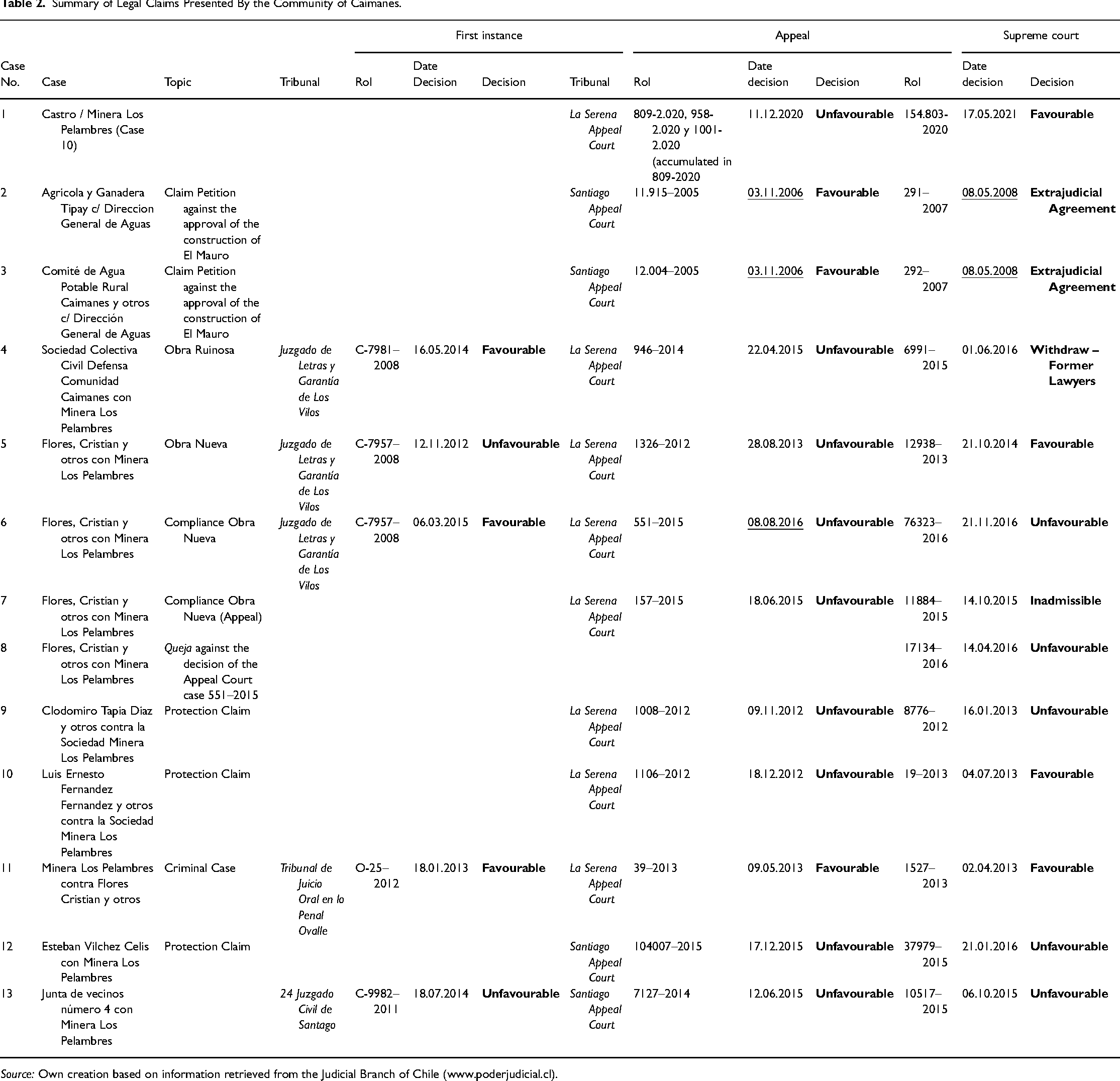
Source: Own creation based on information retrieved from the Judicial Branch of Chile (www.poderjudicial.cl).
First Cycle: Seeking Just Distribution of Benefits
The Construction of El Mauro, a Shift to Local Economy and the Catalyser for Discontent
The development trajectory of the MLP mining project significantly intersects with Chile's broader political and economic history. Its origins can be traced back to the early 20th century, notably with William Braden's explorations in 1914 in the Choapa Province, northern Chile. The mine, initially managed on a modest scale by the state company ENAMI during the 1970s, underwent significant transformation following Augusto Pinochet's privatisation policies. In 1978, Anaconda Minerals Corporation, a U.S. entity, acquired Los Pelambres, subsequently transferring rights to its Chilean subsidiary in 1979. The purchase of Anaconda's Chilean operations by the Luksic family group in 1986 marked the beginning of a new era for the mine. Despite its acquisition during the dictatorship period, the mine's substantial development unfolded under democratic regimes. In 1997, MLP received environmental clearance for large-scale operations, which began in earnest in 2000, marking a significant shift in the local economy and catalysing community discontent, particularly concerning the El Mauro tailing dam.
Central to the controversy was the initial proposal to construct the El Mauro tailing dam near Chillepín, which was later relocated to El Mauro, close to Caimanes, spurred by both community opposition and financial considerations. This relocation, while financially motivated, significantly impacted the traditional agricultural lifestyle of the Choapa valley, intensifying issues related to water usage, land privatisation and contamination (Nicolas-Artero, 2022).
In response to the proposed construction of the El Mauro dam, the community of Caimanes showcased a remarkable degree of civic engagement. In 2002 and 2003, self-organised community plebiscites demonstrated overwhelming opposition, with 98% voting against the project. These plebiscites were a direct expression of community sentiment, reflecting a broad consensus against the dam's construction due to concerns over environmental impact, cultural heritage and local livelihoods. Despite this clear opposition, the community faced internal divisions, exacerbated by the company's strategic social and economic programs under its Corporate Social Responsibility framework. This involved social and economic programmes, causing community division due to competition for grants in various sectors (Antofagasta Minerals, 2005: 41). The company's approach minimised community participation in the environmental approval process, with limited opposition from organisations and individuals (COREMA, 2004). The minimal community participation in the El Mauro project was partly due to internal divisions. Notably, a former leader from Caimanes highlighted the dichotomy within the community, where some members either underestimated the project's repercussions or felt constrained to oppose it openly due to the scarcity of local employment opportunities (Coordinadora por la Defensa del Agua y la Vida, 2008: 13).
Despite these divisions, opposition persisted. Concerns included the dam's impact on local geography and heritage, such as displacing families, damaging pre-Hispanic sites and altering the Pupío River's hydrology. While the Environmental Qualification was approved, the National Water entity (DGA) still needed to sanction the construction. The community contested this, claiming ancestral rights to the Pupío River's waters, which they argued MLP illegally appropriated. However, the DGA approved the project (resolution 1791/2005), amidst allegations of pre-emptive approval influenced by political pressure, particularly from former president Ricardo Lagos (Coordinadora por la Defensa del Agua y la Vida, 2008: 9).
Transition to Legal Mobilisation in Caimanes
At this stage, the Caimanes community's mobilisation discourse centred on rights, particularly water and territorial rights, framed within the concept of distributive environmental justice. This concept reflects how environmental risks distribution mirrors socio-economic and cultural inequities (Schlosberg, 2004: 522). The community's struggle was intensified by their geographical and political isolation. Chile's centralised politics, combined with its vast geography, led to isolated territories where social conditions (Bourdieu, 1977) are influenced by enclave economies, limited state presence and imbalanced power dynamics between communities and corporations (Rodriguez Garavito, 2012). Caimanes, a small community distant from urban centres, faced challenges in gaining recognition and support for their socio-environmental conflict.
A breakthrough came with the involvement of local elite Víctor Ugarte, who pursued legal action against the tailing dam's construction. 1 In May 2006, eight community leaders, representing Caimanes and Pupío alongside Ugarte, filed legal actions against the DGA's decision. This strategy was mutually beneficial: Ugarte gained community support for public pressure, and the community accessed legal expertise through Fernando Dougnac, president of the NGO Fiscalía del Medio Ambiente (FIMA). Fiscalía del Medio Ambiente (Environmental Prosecutor's Office) is a non-profit organisation dedicated to defending the environmental rights of communities in Chile. It plays a crucial role in providing legal support and expertise to those affected by environmental issues. This judicialisation marked a strategic shift, with community representatives stating, ‘we will not protest in the street. It is useless. We put all our trust in the decision of the tribunals’ (La Nación, 2006).
The legal approach yielded results. Six months after filing, the Santiago Appeal Court highlighted the economic motivations behind MLP's dam location and emphasised constitutional protections for community interests over economic activities (Table 2: case 2: Decided on 03 November 2006, par. 27). The court's decision was a significant environmental judicial victory in the national context (Infante, 2016), opening up opportunities for the movement to establish national and international networks. 2 An example was the community leaders presenting their case against the DGA and MLP at the Latin American Water Tribunal in 2007 that called for reparations for archaeological and ecological damages (Armijo, 2010). Despite these rulings, MLP continued the dam's construction, raising questions about judicial decision compliance and the courts’ enforcement capabilities.
Legally, the construction of the dam proceeded due to an extrajudicial agreement between the company and the claimants, sanctioned by the Supreme Court in May 2008. This resolution, while halting initial efforts to stop the project, significantly divided the community. The agreement stipulated a payment of 1250 UF (around USD$ 45,000) to each claimant (five organisations and five individuals). In a separate settlement, MLP agreed to pay USD $23 million to Víctor Ugarte, owner of Haciendas Tipay and Romero. Ugarte then distributed USD$ 3 million to his lawyer and approximately USD$ 4.5 million (2,227,680,000 Chilean pesos) to 117 Caimanes residents, suggesting they relocate from Caimanes. 3
This scenario surfaces critical legal and ethical considerations regarding the capacity of individuals and communities to waive essential human rights, such as access to water and a safe living environment. It highlights concerns over the legitimacy and ethics of a limited number of individuals making impactful decisions for the entire community without broader engagement or consent. While the Santiago Appeal Court's decision focused on the community's human rights, it did not impose precautionary measures, such as halting construction pending the Supreme Court's ruling. Notably, the agreement was reached when the dam's construction was nearly complete, evidenced by its operational commencement in November 2008, shortly after the Supreme Court's approval of the agreement.
During the legal battle, 23 families were displaced from El Mauro, some archaeological sites were salvaged, but many were buried under waste, and the Pupío River's flow was obstructed. Most families who received compensation from Ugarte and MLP continued residing in Caimanes, leading to significant rifts with those they purportedly represented. This situation, as will be discussed, led to a reconfiguration of the social movement in Caimanes and influenced the strategies of emerging leaders.
Second Cycle: Addressing the Unfair Distribution of Externalities
Formation of the Comité de Defensa Personal de Caimanes
In the discourse on the mobilisation of the Caimanes community against the construction of the El Mauro dam, it becomes apparent that the notion of ‘community’ is both complex and dynamic. Initially, the term suggests a unified group with common goals. However, the unfolding events in Caimanes reveal a more intricate tapestry of solidarity, division and re-solidification, challenging the simplicity of this collective identity. The formation of the Comité de Defensa Personal de Caimanes in November 2008 marks a pivotal moment of divergence within the community. This was not merely a continuation of opposition but a reconstitution of the community's very fabric in response to perceived betrayals and the varying impacts of the dam's presence.
Following the extrajudicial agreement, a significant portion of the Caimanes community, dissatisfied with the compensation and viewing the previous leaders as betrayers, established the Comité de Defensa Personal de Caimanes (‘the Committee’) on 19 November 2008. This new entity aimed to legally challenge the agreement and continue the fight against the dam's impacts. They hired the law firm Ossa & Cia, using funds from the extrajudicial agreement, to pursue civil litigation. In December 2008, the Committee filed two claims: one to halt the ongoing construction of the dam wall (‘obra nueva’ claim) and another alleging the construction posed a safety threat to the community (‘obra ruinosa’ claim), seeking the dam's demolition. These actions were grounded in the Santiago Court of Appeal's earlier decision.
The Committee's legal approach differed from previous efforts by directly targeting the company and its owners, the Luksic family, for the dam's adverse effects, shifting focus from state administrative responsibility to private accountability. The Committee's identity became defined by its opposition to Chile's powerful Luksic family, understanding the need to gain political and communicational traction, a challenging task given the Luksic family's influence. The divergences within the community, especially those manifesting in the wake of the extrajudicial agreement, were crucial in shaping the choice of protest strategies. The shift towards direct legal challenges against the company, spearheaded by the newly formed Committee, represented a strategic pivot influenced by the broader community's fracturing. These internal dynamics within Caimanes illustrate the fluid nature of ‘community’ as an analytical category, suggesting that collective identity and agency in social movements are continually negotiated through actions of both convergence and divergence.
Understanding the limitations of solely relying on judicialisation, the Committee initiated local campaigns to boycott Luksic companies and framed a narrative around power and political privilege disparities benefiting Antofagasta Minerals’ owners. The Committee highlighted instances of state co-optation, particularly in the case of Jorge Insunza, a former member of Michelle Bachelet's government. Insunza resigned after admitting to receiving over USD$ 300,000 for consultancy services to mining companies, including CODELCO and Antofagasta Minerals, while serving as a deputy and president of the Mining Commission (Alarcón, 2015). The community also pointed to potential corruption, such as local politicians receiving campaign funding from mining interests. Notably, the former Governor of Choapa Province acknowledged receiving campaign funds (Salamanca Chile, 2016). Further criticism was directed at Aurora Williams, Minister for Mining in Bachelet's and Gabriel Boric's governments, for her previous employment with a Luksic family company, and her secretary Adolfo Galindo, who resigned amidst allegations of favouritism towards MLP (The Clinic Online, 2015).
Sceptical of sporadic political support 4 and aware of the lengthy legal processes, they adopted a parallel direct-action strategy. The Committee's first significant direct action was a hunger strike initiated by 11 community members on 28 September 2010. This strike aimed to highlight the community's plight living under hazardous conditions due to the Mauro tailing dam and to demand their rights as recognised in the Chilean Constitution (Comité de Defensa Personal de Caimanes, 2010a). The strike garnered national attention and was a catalyst for further demonstrations, fostering local and national solidarity. Cristián Flores, a key community leader and Committee founder, played a pivotal role. Displaced from El Mauro and having experienced the conflict firsthand, Flores advocated for a combined legal and direct-action approach. The Committee's efforts, under Flores’ leadership, led to significant demonstrations, including a major blockade on 4 October 2010, which drew local authority attention. However, dialogue offers were initially rejected by the protestors in solidarity with the hunger strikers (Comité de Defensa Personal de Caimanes, 2010b).
The community's internal unity was symbolised through the use of black flags and billboards, representing opposition to the mining project. Using the theoretical approach elaborated by Blumer (1951), we can argue that the representation of a common enemy (represented in the company), the personal relationships of the group that have been enhanced with the episodes of direct action and the solidarity of the group with those that were in a hunger strike and the usage of black flags and billboards as a development of ceremonial behaviours, generated a ‘espirit de corps’ within the Committee (p. 205). As argued by Edwards (2014), ‘when the combination of these factors occur, the sense of belonging to the group is reinforced because they feel like they are part of something bigger than themselves. The result of ‘spirit de corps, then, is solidarity’ (p. 27).
The struggle gained further traction with a large demonstration in front of La Moneda (Chile's government palace), organised by 10 socio-environmental organisations in support of the hunger strikers (OLCA, 2010). This national visibility eventually led to political and religious support. The Catholic Church, represented by Illapel Bishop Jorge Vega, offered to facilitate dialogue, leading to the end of the 81-day hunger strike in December 2010. However, the dialogue table faced challenges, including the company's refusal to negotiate with Flores and disputes over the transparency of the process (Ossandón, 2010). This phase of the movement highlights the complexities of grassroots mobilisation against powerful entities and the importance of combining legal strategies with direct action to achieve recognition and address inequalities.
Persecution of Human Rights Defenders and Formation of New Networks
Post-hunger strike, Caimanes, particularly the Committee members, not only developed a strong identity and network support but also faced legal challenges from MLP. The community, symbolised by black flags representing the harm caused by MLP, gained national and international recognition for their resistance. A notable acknowledgment was the gold medal awarded by the Mayor of Pau, France, in April 2011, honouring their water rights defence (Quillier, 2011). In response to this growing movement, MLP pursued a counter-mobilisation legal strategy, accusing Committee leader Cristián Flores and the supporting lawyers (Ossa & Cia) of various criminal charges, including prevarication, criminal association, public disorder and forgery. This attempt to intimidate the movement's leaders ironically strengthened their resolve. In November 2011, MLP filed a complaint against Flores and the lawyers. The Committee countered with the ‘Defend those who defend you’ campaign, highlighting MLP's divisive tactics and their attempts to undermine legal defence for those wishing to remain in the Pupío Valley (OLCA, 2011). Alex Carocca, the defendants’ lawyer, praised the community's resilience despite pressures from the mining company (Porras, 2012). Support from external organisations, like the Asamblea del Agua, which represented 75 local movements, was crucial in backing the Committee's leaders (OLCA, 2012).
The public hearing in November 2012 at the Juzgado de Garantía Local of Los Vilos was a pivotal moment. It allowed the community to confirm past conflicts and build new support networks. Revelations included admissions from former community leader Myrella Ardilles about accepting donations from MLP for the 2008 extrajudicial agreement (Correa, 2012a) and former lawyer Fernando Dougnac's testimony regarding payments from Víctor Ugarte (Ossandón, 2012). These hearings strengthened the community's identity and garnered support from various organisations and international networks, including representation by the French NGO Fondation France Libertés at the United Nations Human Rights Council. 5 In December 2012, the Court acquitted Flores and the lawyers of all charges brought by MLP (Table 2: case 11). This decision was celebrated by the accused, who emphasised the importance of an impartial judiciary (El Observatodo, 2012). Subsequent appeals by MLP to the Appeal Court of La Serena and the Supreme Court were rejected, marking a significant victory for the community (Table 2: case 11).
Water Contamination and Divergent Institutional Perspectives: Legal Outcomes as Catalysers for Direct Action
During the criminal case against Caimanes community leaders, the Chilean Investigation Police (PDI) reported water contamination in Caimanes exceeding legal limits. On 27 August 2012, they found elevated levels of mercury, iron and manganese, attributing this to the El Mauro tailing dam (Policia de Investigaciones, 2012: 14). The Medical Association of Chile corroborated these findings, noting mercury levels 26% and iron levels 50% above national norms, potentially causing chronic health issues (Tchernitchin and Muñoz, 2012: 202). This report spurred new legal actions and protests. On 14 September 2012, 60 Caimanes residents filed a protection claim in the La Serena Court of Appeal, citing the PDI report and a 2005 Santiago Appeal Court decision highlighting the dam's threat to human life (Table 2: case 9). MLP's lawyers contested, arguing that Ossa & Cia was judicialising the protest, criticising the PDI's methodology and asserting the dam's advanced technology and non-potable water sources.
Controversially, the regional Health Minister's representative, Dr Osvaldo Iribaren, publicly drank water in Caimanes, suggesting the PDI's findings were inaccurate, which incensed movement representatives. This act led to renewed protests and blockades at the dam, with the community demanding humane treatment from authorities (Correa, 2012b). Legally, the La Serena Court of Appeal dismissed the community's claim, stating the right to health under the Chilean Constitution was not violated (Table 2: case 9). However, following new evidence of dam filtrations, 80 Caimanes residents filed another protection claim, which was also dismissed due to insufficient evidence (Table 2: case 10, Decision 18 December 2012, par. 8). The community's lawyers appealed, criticising the La Serena Court's consistent opposition to their claims. In a significant turn, the Supreme Court in Santiago ruled in July 2013 that the dam posed a threat to the community's physical and mental integrity (Table 2: case 10. Decision 4 July 2013, par. 9). It ordered MLP to develop security evacuation plans and mandated constant dam condition reports from public authorities (DGA and SERNAGEOMIN). This decision marked a crucial victory for the community, highlighting the importance of persistent legal action in environmental justice cases.
The Supreme Court's July 2013 decision catalysed a series of judicial victories for Caimanes. In February 2014, the Environmental Superintendence penalised MLP for non-compliance with environmental qualifications, imposing a fine for archaeological damages. In May 2014, the Los Vilos Tribunal labelled the Mauro tailing dam as a ruinous building (Table 2: case 4). This ruling spurred a significant demonstration in May 2014, where the community blocked the dam's entrance, insisting on compliance with the court's decision and cessation of dam operations (Correa, 2014). Further, in October 2014, the Supreme Court upheld the community's obra nueva claim, reversing earlier decisions by lower courts (Table 2: case 5). It mandated MLP to ensure the Pupío river's natural water flow, uncontaminated by the El Mauro dam. The Court's reasoning drew on international human rights treaties, emphasising the state's duty to prevent environmentally harmful activities, even if legally approved (Table 2: case 5. Decision 21 October 2014, par. 20). The Supreme Court's directive for MLP to devise a plan to restore the river's natural flow, or face dam demolition, was a key motivator for the community's largest street blockade. Following the Court's ruling, the community obstructed access to the dam, highlighting the dam's detrimental impact on their water sources, agricultural heritage and social fabric (Comité de Defensa Personal de Caimanes, 2014).
The 2010 hunger strike had initially galvanised national attention; now, the favourable court decisions fuelled the blockade, drawing media, political figures and NGO support. Movimiento por la Recuperación del Agua y la Vida (MODATIMA) was among the supporting organisations. After 60 days, a MODATIMA spokesperson lauded Caimanes’ resilience and the importance of unified resistance across different territories. Support also came from the No Alto Maipo movement. Spokesperson Marcela Mella linked their cause with Caimanes, citing shared environmental concerns since the Luksic group's involvement in the Alto Maipo hydroelectric project (MODATIMA, 2015). After 74 days, national police forcibly cleared the blockade, leading to allegations of excessive force and lack of legal authority for the eviction. A Committee leader criticised the apparent influence of private interests over law enforcement, urging public action to uphold court decisions. The National Institute of Human Rights observed the situation, condemning the police's disproportionate use of force (INDH, 2015: 31).
New Approach from the Company
Confronted with adverse judicial decisions and ongoing protests, MLP devised a new strategy focusing on dialogue with the Caimanes community. This shift was partly due to the recognition that community protests contributed to a decrease in copper exploitation in 2015 (Antofagasta Minerals, 2015: 41). Local tribunals, previously favouring the company, began ruling against it, notably the Los Vilos local Tribunal, which enforced the Supreme Court's decision demanding the natural flow of the Pupío River or the dam's demolition (Table 2: case 6). Amidst these judicial victories, the Committee organised a significant march in front of La Moneda to highlight the repression they faced during the street blockade (Gutierrez, 2015).
In response, MLP engaged in lobbying and community relations. Jean Paul Luksic, President of Antofagasta Minerals, met with government officials to discuss socio-environmental conflicts and the impact of protests on copper production. The government pledged short-term support for mining activities, including deploying security forces to prevent blockades (Esturillo and Pozo, 2015). In September 2015, MLP initiated dialogue with the community's lawyers and Committee members, aiming for an agreement on security, water and community investment. The pre-determined dialogue topics of water, security and compensation were criticised by movement leaders for lacking community input (Pizarro, 2015). The proposed agreement included security measures, water infrastructure, a community development fund of approximately USD$ 8.5 million and a personal donation of around USD$ 42,000 per family, subject to 70% community approval (Chile Transparente, 2015: 5). However, only 64% voted, rendering the election invalid. 6
Despite community resistance, MLP persisted in seeking an agreement, viewing it as crucial for the obra nueva and obra ruinosa cases. Ossa & Cia and 466 community members requested MLP to honour the proposed agreement (Ossa & Cia, 2015). The lawyers’ intention to secure a deal, potentially motivated by a 10% representation fee, eroded trust with community leaders, echoing the 2008 scenario with Fernando Dougnac. In May 2016, 552 community members (81.3% of those over 18) signed the agreement. The Committee, representing a minority, continued to view the dam as a threat and the compensation as insufficient. For MLP, the strategy proved effective, using the agreement in the obra ruinosa case and as evidence in the obra nueva case at the La Serena Appeal Court (Table 2: case 8). The Supreme Court in November 2016 accepted the argument that the proposed measures were adequate for the Pupío River's flow (Table 2: case 6). This development led to a new legal phase for the Committee, mirroring the 2011 scenario where neighbours sought legal action against lawyer Fernando Dougnac (Labrín, 2011). The Committee now pursued an unsuccessful criminal responsibility (prevarication) against the lawyers who negotiated with MLP, highlighting the complexities and challenges in legal mobilisation for environmental justice.
Since the agreement, community mobilisations in Caimanes have diminished, but they continue to employ successful judicial strategies in response to episodes of contamination. On 6 May 2020, Caimanes witnessed a toxic cloud originating from the ‘El Mauro’ tailings dam. The residents took action to protect their health and right to a contamination-free environment, filing a protection claim against MLP. The claim argued that the toxic cloud compromised their physical integrity and right to a clean environment (Table 2: case 1). On 11 December 2020, the Court of Appeals of La Serena rejected the protection action, concluding that the evidence did not demonstrate air quality alteration or toxic elements in the cloud, thus finding no attributable action or omission by the defendants. On 17 May 2021, the Supreme Court accepted the protection claim, directing the Environmental Superintendence to resolve within 90 days the administrative sanctioning procedures initiated from the complaints mentioned in the ruling (Table 2: case 1). Yet, the judicial decisions don’t meet the communities expectations, which led (in January 2022), residents to block access to the Luksic group's tailings dam, protesting the company's failure to attend a dialogue table where compensation for environmental damage was being discussed.
What can We Learn from the Cycles of Protest in Caimanes?
Discourses, Aims and Benefits of Judicial Mobilisation
The Caimanes case demonstrates social mobilisation as a dynamic process, influenced by both internal dynamics and external contexts. This analysis focuses on how these factors enabled the judicialisation of protests in Caimanes, revealing the interplay between structural opportunities, agency/capacity and strategic choices.
Firstly, it become evident that Caimanes’ judicial strategy emerged as a response to limited political opportunities and close ties between the company and political figures (Sieder et al., 2005: 1). The judiciary's perceived independence offered a pathway to bypass economic and political barriers. However, this approach's effectiveness often depended on national recognition and the location of the deciding tribunal. The Appeal Court of La Serena has never ruled in favour of the movement, and the local Tribunal of Los Vilos only decided favouring of the community after the Supreme Court did so. The hierarchical nature of Chile's judiciary and its legal culture presented both opportunities and limitations for social movements (Couso, 2005).
The internal composition of the movement, their resources and the networks supporting the mobilisation is also key to understand the decision of the community, to follow a judicial strategy. The community's limited experience in legal mobilisation was supplemented by support from local elites and lawyers. This strategy had mixed effects, sometimes not only causing division but also fostering solidarity and unity (‘spirit de corps’), particularly in counter-mobilisation efforts. The different phases of the movement correlate with a framing evolution that moved from seeking compensation to addressing the distribution of extractivism's externalities. Initially, the focus was on securing a share of the company's profits as compensation. Later, the emphasis shifted to preventing environmental harm and addressing systemic inequities that disproportionately affect isolated and impoverished communities.
What becomes clear is that judicial mobilisation was the primary strategy in both protests analysed cycles. Yet, judicial mobilisation was supported by direct-action and network creation. The first cycle aimed for compensation, leading to socio-economic divisions within the community. The second cycle, learning from the first, sought to address the project's externalities, leading to favourable court decisions and episodes of direct action that fostered unity and solidarity. The judicial approach can be effective for achieving specific goals, such as compensation, but faces challenges in broader political change, like recognising extractivism's externalities. Caimanes’ experience shows that combining judicial strategies with direct action can be more effective in addressing the limitations of legal mobilisation and achieving diverse aims of social movements.
Limitations of Legal Mobilisation for Socio-Environmental Movements in Chile
The Caimanes case highlights key limitations in judicial mobilisation for socio-environmental movements in Chile. One significant issue is the divergence between the movement's aims and those of supporting external organisations, particularly legal advisors. In Caimanes, lawyers from networks such as FIMA and Ossa & Cia initially supported the community but later pursued personal interests, jeopardising the movement's goals. This reflects a broader challenge in accessing justice, as isolated communities often lack local legal resources and rely on external firms, which may prioritise compensation over environmental justice. For instance, lawyers in Caimanes’ first cycle received US$ 3 million, and in the second cycle, they sought 10% of the company's compensation, about US$ 2 million. Legal aid or support networks could mitigate this issue, but such aid is scarce in Chile and much of Latin America, where litigation by poorer sectors often involves advocacy by social movements and NGOs (Sieder et al., 2005: 13–14). Moreover, Chile's socio-environmental movement is fragmented, further limiting judicial protest strategies. In Caimanes, external support fluctuated, leading to community fragmentation and diminishing the Committee's influence. A community leader from Caimanes described this as akin to receiving varying medical opinions, highlighting the confusion caused by differing advice from multiple organisations.
Before pursuing judicial mobilisation, socio-environmental movements should consider who can claim and the associated costs. Additionally, the time taken to reach court decisions may not align with the urgency of socio-environmental issues. In Caimanes, 30 decisions were analysed over 19 years, yet issues such as security and water contamination remained unresolved, questioning the judiciary's enforcement capacity. The Chilean judicial system's structure also poses limitations. While the Supreme Court has the political capacity to challenge powerful entities, enforcement is often delegated to lower courts, which may lack the capacity or face political and economic pressures, leading to non-compliance with higher court rulings. Access to justice thus extends beyond court access to effective enforcement of rulings. Furthermore, the Chilean judicial system does not typically create new rights, as seen in some Anglo-Saxon systems. The Supreme Court in Chile primarily consolidates and interprets existing legislative rights, unlike in Brazil, where lower courts can conduct constitutional reviews. This conservative, hierarchical and bureaucratic legal culture limits the judiciary's role in advancing socio-environmental justice (Couso, 2005; Sieder et al., 2005: 14).
Conclusion
This paper contributes to the understanding of social mobilisation, particularly legal mobilisation, by examining the case of Caimanes, a small farming community in northern Chile. It explores the community's opposition to the Los Pelambres mining project through judicial mobilisation, framed within the broader context of socio-environmental justice. The study reveals how the community's strategies evolved in response to structural challenges and internal dynamics, highlighting the interplay between external political and legal opportunities and the movement's capacity to mobilise resources and networks.
In dissecting the role of the community, this study challenges conventional monolithic representations, revealing ‘community’ as a fluid, contested space where diverse interests, identities and aspirations converge and diverge. This nuanced portrayal underscores the community's pivotal role not just as the backdrop for mobilisation but as an active, dynamic agent shaping and reshaping the contours of protest. Through the lens of Caimanes, ‘community’ emerges as both the subject and object of mobilisation, a space where the collective pursuit of socio-environmental justice is continually negotiated and redefined. Caimanes’ judicial strategy emerged as a response to limited political opportunities and close ties between the company and political figures. The judiciary's perceived independence offered a pathway to bypass economic and political barriers. However, this approach's effectiveness often depended on national recognition and the location of the deciding tribunal. The hierarchical nature of Chile's judiciary and its legal culture presented both opportunities and limitations for social movements. The internal composition of the movement, their resources and the networks supporting the mobilisation was also crucial in shaping the community's decision to pursue a judicial strategy. The internal dynamics of the movement, alongside their resources and the networks bolstering their mobilisation, play a pivotal role in defining the community's inclination towards a judicial strategy. This strategy, while sometimes creating division, has also engendered solidarity and unity, particularly in efforts to counter-mobilise.
Also, the empirical case study suggests that there is an evolution of the movement's framing from seeking compensation to addressing the distribution of extractivism's externalities. Initially, the focus was on securing a share of the company's profits as compensation. Later, the emphasis shifted to preventing environmental harm and addressing systemic inequities that disproportionately affect isolated and impoverished communities. Judicial mobilisation was the primary strategy in both protest cycles, supported by direct action and network creation. The first cycle aimed for compensation, leading to socio-economic divisions within the community. The second cycle, learning from the first, sought to address the project's externalities, leading to favourable court decisions and episodes of direct action that fostered unity and solidarity.
Central to this is the concept of ‘agency’ – the capacity of individuals and collectives within the community to strategically navigate, resist and engage with the socio-political and legal landscapes that frame their existence. The Caimanes community's strategic deployment of judicial mobilisation, underpinned by direct action and the cultivation of supportive networks, epitomises the nuanced exercise of agency. This case study illustrates agency not merely as reactive but as deeply proactive and reflective, driven by a conscious evaluation of the movement's goals, the available structural opportunities, and the potential for mobilising internal and external resources.
Furthermore, this research advances social movement literature by illustrating the transformative potential of legal mobilisation as both a strategy and a site of community agency. It elucidates the complex interrelations between legal frameworks, political opportunities and community dynamics, offering a more granular understanding of how legal actions – far from being mere procedural endeavours – serve as vital arenas for contestation, negotiation and identity formation within social movements. The empirical insights from Caimanes, particularly the community's adaptive strategies and the pivotal role of judicial engagements, enrich our comprehension of the multifaceted nature of socio-environmental mobilisation.
The paper highlights the limitations of the Chilean judicial system in advancing socio-environmental justice. The Supreme Court in Chile primarily consolidates and interprets existing legislative rights, where lower courts can conduct constitutional reviews. This conservative, hierarchical and bureaucratic legal culture limits the judiciary's role in advancing socio-environmental justice. Access to justice extends beyond court access to effective enforcement of rulings, a challenge evident in the Caimanes case. In conclusion, the Caimanes case study offers valuable insights into the complexities of legal mobilisation within socio-environmental movements. It underscores the need for movements to carefully consider their strategies, taking into account both the potential benefits and limitations of judicial mobilisation. The case also highlights the importance of understanding the interplay between structural opportunities, internal movement dynamics and the broader socio-political context in shaping the trajectories of socio-environmental struggles.
Footnotes
Declaration of Conflicting Interests
The author declared no potential conflicts of interest with respect to the research, authorship, and/or publication of this article.
Funding
The author disclosed receipt of the following financial support for the research, authorship, and/or publication of this article: This work was supported by the Comisión Nacional de Investigación Científica y Tecnológica, (grant number Fondecyt de Iniciacion N°11220195).
