



Abstract
The practice of forced marriage has been the subject of focussed attention over the past 15 years in Australia. The policy approach has largely centred on criminal law responses. In this paper we turn to the social safety net, supports available for those experiencing pressure to marry or in a forced marriage, and their families. We report on eight focus groups with 56 participants working in key frontline roles, drawing on their perspectives to advance our understanding of key features of the social response. We identify four key features: the first is relational; frontline workers observe that an effective social response is contingent on trusting, client-led relationships. Secondly, appropriate framing and considered language is highlighted as critical. The third and fourth features are structural considerations within a social response: Australia's migration and asylum-seeking system and the resourcing of relevant social services.
Keywords
The practice of forced marriage in Australia has been the subject of focussed government, community and media attention over the past 15 years. Under Australian law, a forced marriage is considered to have occurred when one or both of the parties to the marriage have not fully and freely consented. Forced marriage constitutes a violation of human rights and its impacts are varied and profound, affecting people's sense of self, health, economic status, and relationships to family and community. Legal and policy responses to the practice of forced marriage in Australia over the past 15 years have largely centred on criminal law responses, with less emphasis on supporting broader survivor and community led prevention work (Simmons and Wong, 2021). This paper emerges from the Speak Now project in which we turned our attention to the prevention of forced marriage in Australia. This paper sets out the important role of the social safety net for those experiencing pressure to marry or who are already in a forced marriage. We define a social response to forced marriage as the wide-ranging supports, services and educational activities that work to prevent, respond and support those affected by forced marriage. A social response involves individuals, families, communities, and government and non-government organisations. In this paper we build a picture of what an effective social response might look like, drawing on the perspectives of frontline workers.
The Legal Framework Around Forced Marriage in Australia
In International Law forced marriage is understood as a human rights abuse, with Article 16.2 of the Universal Declaration of Human Rights stating that “Marriage shall be entered into only with the free and full consent of the intending spouses”. In Australia, forced marriage was criminalised in 2013, and is considered a form of modern slavery (Simmons and Burn, 2013), and a form of family and gendered violence. A criminal justice approach to forced marriage has been dominant in Australia since the practice of forced marriage was criminalised and included as an offence in the Australian Criminal Code. While the prevalence of any form of modern slavery is difficult to quantify, forced marriage is currently the most common form of modern slavery reported to the Australian Federal Police. 1
Under Australian law, a forced marriage offence applies to the moment in time when a marriage is entered into. There is a precise legal definition of forced marriage in Australia: forced marriage occurs when one or both persons have not freely and fully consented to a marriage, because of threats, deception or coercion, or because the person is not capable of understanding the nature and effect of the marriage ceremony, or because the marriage was entered into when a party to the marriage was under 16. 2 The forced marriage offence applies to legally recognised marriages, cultural or religious ceremonies and registered relationships. The law covers marriages conducted in Australia and marriages outside Australia if there is an Australian nexus to what has occurred. Any person who exercises coercion, threat or deception over a person to obtain consent may be charged with a forced marriage offence, including family members, friends, marriage celebrants and religious leaders. In Australia forcing someone to marry is punishable by up to 7 years imprisonment or up to 9 years for an offence that is aggravated (the victim is subject to cruel, inhuman or degrading treatment), and up to 25 years if the person is a child and is taken overseas to marry.
In addition to criminal law responses, a forced marriage may be considered by the Family Court of Australia never to have been a valid marriage and it is possible to make an application for a decree of nullity to annul the marriage. 3 With the exception of the Family Law Act, 1975 there are currently few or limited provisions specifically addressing forced marriage in Australian civil legislation, including the areas of migration, family law, domestic and family violence, personal safety and victim support (with the exception of New South Wales and Victoria). The Australian Government has been consulting on civil protections and is working on a national approach to protection similar to the scheme in place in the UK. Such a scheme may provide protection of various kinds including in some circumstances to prevent people of any age from being taken overseas for the purpose of forced marriage (Commonwealth of Australia (Attorney General's Department), 2020; Simmons and Burn, 2013).
While there is a clear legal definition of forced marriage, the degree to which affected communities identify with this definition is far less clear. For example, the idea of consent is critical in the Australian definition of forced marriage, with an absence of consent from either party involved being a defining feature. However, as Simmons and Burn (2013) argue, forced marriage exists on a continuum of coercive practices, and where a case might fall on this continuum depends on numerous factors that may affect an individual's ability to fully and freely consent to marriage (see also Australian Muslim Women's Centre for Human Rights, 2019: 4). This means that “…in situations of heavy constraint the possibility for free and full consent is curtailed, perhaps even rendered meaningless” (Sowey, 2018: 268). Shariff (2012), writing about the United Kingdom, also questions the centrality of focus on consent, suggesting utility in a reframing of the discussion towards understanding motivations and drivers, familial power dynamics and so on. Following Ballard (2006), Shariff (2012: 557) sees “the heavily individualist model of consent inherent in the debate in the West” as markedly different to the marriage process within South Asian communities in the UK, where marital decision making is seen as a familial responsibility.
The practice of forced marriage was criminalised in 2013, and the Australian Federal Police investigate reports of forced marriage. As of end 2023, there has not yet been a successful investigation leading to a prosecution and conviction although one case is currently before the courts. While the attrition rate for all human trafficking and slavery cases is high (see Lyneham, 2021 for a discussion of the barriers to successful prosecution), there are two additional factors to be considered with those who have experienced forced marriage. Survivors are often under the age of 18 or young adults, and they are less likely to want to participate in a criminal investigation where a family member(s) is involved. Simply put, they do not want to take any action that could result in criminal sanction of their family members.
Additionally, there are limited protections available in civil law, and where they do exist, accessing the pathway to protection can be complex. Barriers to justice include lack of information about legal protections, distrust of authority, and lack of resources to obtain independent legal advice in an environment where pro bono legal services are stretched. Access to justice through either a criminal or civil law avenues can be lengthy and difficult to attain, further highlighting the importance of an effective social response alongside the legal pathways.
Constructions of Forced Marriage
A social response to forced marriage requires recognition that there are social drivers that need to be addressed. Situating forced marriage as a form of gender-based violence is one useful way of highlighting social drivers. While forced marriage has been criminalised in Australia, some States and Territories include consideration of forced marriage within domestic and family violence responses, although these responses are not consistent throughout Australia (Simmons and Wong, 2021). In the United Kingdom, forced marriage is recognised as a form of family or domestic violence at national level (Gangoli and Chantler, 2009). Simmons and Wong (2021) noted the recent Commonwealth parliamentary inquiry recommended a nationally consistent approach to family, domestic and sexual violence in Australia 4 , including recognition of specific forms of violence including forced marriage. Understanding forced marriage as a form of domestic and family violence would make available a broader suite of support services for people affected, noting that the suitability of mainstream family violence services in meeting the specific support needs of those experiencing forced marriage must simultaneously be considered (see Tan and Vidal, 2023 for a detailed discussion).
Forced marriage has strong potential to be positioned as a racialised practice, depicted as a cultural ‘issue’ associated with particular (racial) groups (see, for example, Prattis and El Matrah, 2019). Assumptions are made about who perpetrates forced marriage and why they do it. Given the well-established and significant harm of racism (see, for example, Abdel-Fattah, 2018; Bodkin-Andrews and Carlson, 2016; Paradies et al., 2015) this must be a central consideration in forced marriage responses. The social response to forced marriage must not further stigmatise racial or religious communities that are already subject to high levels of racism and surveillance.
When forced marriage is framed as modern slavery, or when those involved are described as having engaged in human trafficking, there are some key considerations to bear in mind, as the Australian Muslim Women's Centre for Human Rights (AMWCHR, 2019: 16) explains. There are sound reasons for using the human trafficking framework but it also presents certain challenges and must be managed carefully when working with Muslim communities… Many in Muslim communities find the language of human trafficking and slavery confronting and shocking, and therefore reject the connection between forced marriage and human trafficking and slavery. It is crucial therefore to be mindful of how the topic of CFM [Child and Forced Marriage] is to be introduced to communities and individuals.
Forced marriage as a form of human trafficking can also divert attention away from “the more routinised and hidden forms of parental control that do not involve the dramas of imprisonment or abduction” (Patton, 2018: 23). Additionally, it has been argued that some of the discriminatory policy responses to forced marriage that have been deployed in the UK, where, for example, foreign spouses (from outside the EU) must meet English-language requirements, are made possible by the trafficking framing (Gill and Mitra-Kahn, 2012).
In Australia, discussion of forced marriage makes a lot of the distinction between arranged marriages and forced marriages. Arranged marriages entail the acceptable involvement of family members, with ultimate decision making retained by the individuals entering the marriage. In forced marriage, free and full consent is not given. The motivation for making this distinction is clear, as policy makers do not want to problematise the common practice of arranged marriage, yet a binary distinction between arranged and forced marriage is also overly simplistic (Simmons and Burn, 2013, Sowey, 2018). While there are cases where coercion is very clear – for example, where there are children involved or in cases of significant violence – there are also: …situations of more subtle pressure, [where] it may be difficult to know whether a marriage should be described as forced, and even more difficult to collect legally admissible evidence of coercion (Rude-Antoine, 2005). As was found in the Tahirih Justice Center (2011) study… it is the more subtle forms of coercion that are the most common (cited in Sowey, 2018: 265).
The lived experience of those at risk of forced marriage shows that the demarcation between forced and arranged marriage is more fluid than usually contemplated in the Australian policy discourse (Simmons and Wong, 2021). This disjuncture between how young people, policy makers, and support organisations construct forced marriage is a significant barrier in the identification of forced marriage and is antithetical to prevention and early intervention work (Chantler and McCarry, 2020: 95). Navigating language around forced marriage, or pressure to marry as people with lived experience might more strongly identify with, is a skill that is required in effective community facing work. Using language and labels that a person does not identify with or that they object to can be distancing. We turn now to examine in detail the role of frontline workers in an effective social response to forced marriage.
The Role of Frontline Workers in a Social Response
The drivers and impacts of forced marriage are complex and multi-faceted, therefore an effective social response will involve a wide range of activity across multiple levels, from structural and institutional interventions (e.g., Australia's asylum and migration regimes), to community-based programs (e.g., education, settlement support for families, parenting initiatives), down to individual responses (e.g., provision of crisis and longer-term support). A rigorous social response encompasses prevention activity well before marriage is imminent, right through to crisis and recovery support.
In this context, frontline workers across a range of sectors can play a key role. A social response involves structural and institutional intervention, and frontline workers serve as a key point of intersection between those affected by forced marriage and the systems that both govern them, and seek to support them. For these reasons, in this paper we examine the capacities and challenges for frontline workers responding to forced marriage. Forced marriage, much like family violence, gender-based violence and other forms of modern slavery, is often not visible, but there can be unrecognised opportunities to support people being pressured to marry or in a forced marriage. Disclosures of being in a forced marriage or a fear of being forced to marry could be made with many different people, such as a friend or peer, a teacher at school, a faith leader or a health care provider. Our particular interest here is in the role of those working in key frontline professions.
We use the term frontline workers 5 to refer to individuals in community facing roles, who may come across those in or at risk of forced marriage within their work. We focus on six sectors: health, family and domestic violence, education (secondary and tertiary), refugee, migrant, and multicultural services, youth work, and faith communities. While recognising that this is not an exhaustive list of those who come into contact with people in or at risk of forced marriage, anecdotal evidence from the legal support service run by Anti-Slavery Australia at the University of Technology Sydney suggests that these are the sectors in Australia where forced marriage is most commonly encountered. The terminology we use here is in line with the National Plan to End Violence Against Women and Children 2022–2032 which refers to frontline services and frontline workers (Commonwealth of Australia (Department of Social Services), 2022).
Work with survivors indicates that at the level of providing support to individuals, as well as within communities, frontline workers can play a critical role in supporting those affected. Survivors of forced marriage have indicated that good support from frontline workers helped them to avoid a marriage, assisted them to leave, helped them undertake safety planning or to understand their options (Simmons and Wong, 2021). Equipping frontline workers to identify that someone is experiencing pressure to marry, and provide support, may make it more likely that a marriage can be avoided or delayed. Regardless of the ultimate outcome, appropriate support from a frontline worker may simply reduce the feeling of isolation that someone being pressured to marry, or already in a forced marriage, can experience. Awareness raising and capacity building around the issue are likely to strengthen the ability of frontline workers to identify a potential issue and provide appropriate support if needed. In their work on understandings of modern slavery more broadly within Australia's settlement sector, David and Salter (2022) describe frontline workers as ‘first responders’ with a critical role in mitigating exploitation.
While effective responses from frontline professionals could be critical in the trajectory or experiences of those in or at risk of forced marriage, the scarce research that has been done in this area suggests that officials in Australia have a low-level understanding of forced marriage (Simmons and Wong, 2021), or modern slavery broadly (David and Salter, 2022). The Royal Commission into Family Violence in 2016 found that frontline workers may not have the capacity to either identify forced marriage or refer those affected to appropriate support services (cited in Simmons and Wong, 2021). Recent research with survivors of forced marriage highlights just how important the response from a frontline worker can be when hearing a disclosure. …participants often recalled the demeanour and responses of the first frontline official they encountered in detail, and emphasised the importance of officials recognising the risks involved in seeking assistance (Simmons and Wong, 2021: 1653).
In Australia and elsewhere there is currently recognition by government that a broad upskilling of relevant frontline professionals will help identify those experiencing pressure to marriage, support them when and as needed, and refer them to specialist services when appropriate (see, for example, Commonwealth of Australia (Department of Social Services), 2022). The stated aim is to ensure that there is a wide base of foundational knowledge amongst frontline workers across a broad range of sectors, as well as awareness that further information and support is available for those as and when they need it. It is critical that support is culturally appropriate and trauma informed. The My Blue Sky 6 website has a set of resources designed for frontline workers working with people affected by forced marriage. Education or training for frontline workers has been a strategy used elsewhere to improve identification and response to forced marriage. For example, the Forced Marriage Unit in the United Kingdom has undertaken ‘road shows’ about forced marriage, and has produced resources for teachers, social workers, health professionals and policy (Gangoli and Chantler, 2009: 274). In 2022 Anti-Slavery Australia published the Frontline Worker Guide: Identifying and Responding to Forced Marriage in Australia, and in 2023 delivered training to over 1300 frontline workers and community members across Australia.
The support frontline workers can provide to someone affected by forced marriage varies widely, according first and foremost to the needs and wants of the person affected, the expertise of the service and the institutional setting. Support is driven by factors like the workers’ professional role, their cultural understanding, a person's citizenship or visa status, as well as the institutional context within which workers operate in Australia. Many of the most pressing needs of those experiencing pressure to marry, or wanting to leave a forced marriage, are basic survival requirements – safe and stable accommodation, financial support, psychological assistance and so on. In Australia those affected by forced marriage can be referred to a specialist support program – the Support for Trafficked People Program (STPP), administered by the Australian Government Department of Social Services and delivered by the Australian Red Cross – that co-ordinates the services required. Those who are eligible for the support program under the Forced Marriage Support Stream receive up to 200 days of intensive support. Up until end of 2023, to access support, the person affected had to consent to their case to be referred to the Australian Federal Police (AFP). Earlier research showed that involvement of the AFP was a significant barrier to some survivors receiving support, as many do not want to get their parents or families into trouble (Sowey, 2018), or are fearful or mistrustful of police. Notably in May 2023 the Australian Government foreshadowed a trial of an alternative referral pathway to the STPP that may allow those affected by forced marriage to be referred to the program without any engagement with the AFP. 7
The Speak Now Project
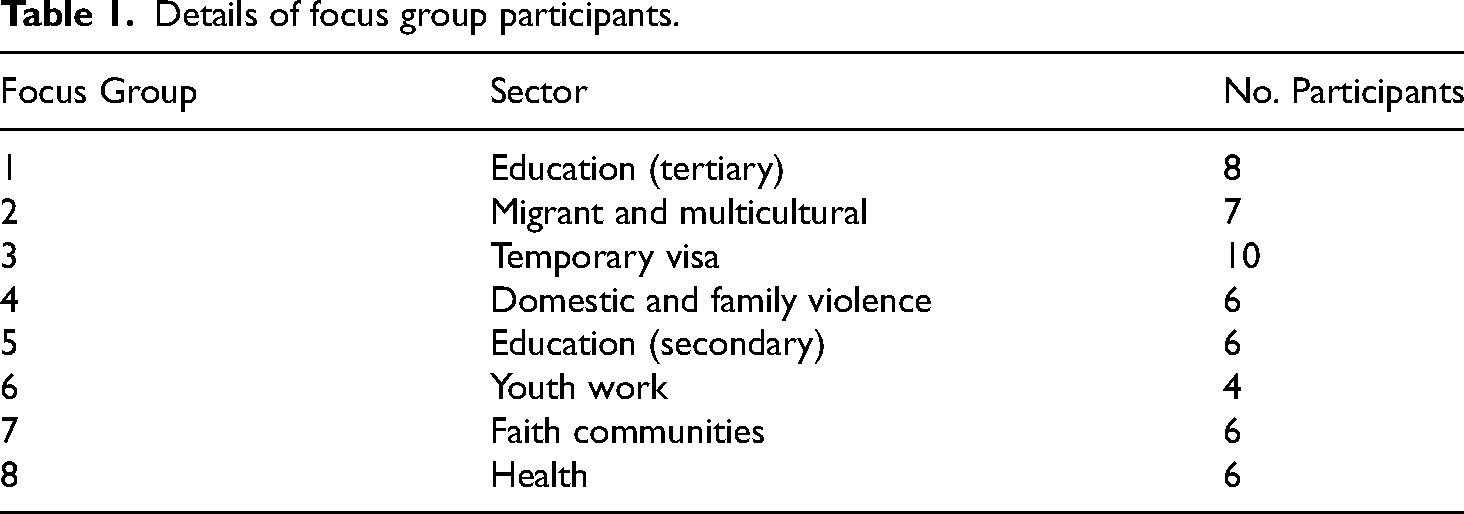
This research emerges from the Speak Now project at Anti-Slavery Australia, a project focused on forced marriage response and prevention in Australia. Ethics approval for the research was granted by the Human Research Ethics Committee at the University of Technology Sydney. In November 2021 we conducted eight focus group discussions with a total of 53 participants. As shown in Table 1, the focus groups were sector based, and attended by frontline workers from health; youth work; education (secondary and tertiary); family and domestic violence; migrant, refugee and settlement services; and faith communities. Participants were recruited by email and phone invitations to key organisations within each sector, across Australia, as well as through existing networks of the team and organisation. Interested participants completed an online form and were then invited to the relevant focus group. Participants came with a range of prior knowledge and experience of forced marriage. Participants elected to take part in a discussion about forced marriage, which indicated, at minimum, an interest in learning more about the issue. It is important to note the heterogeneity of our focus group participants, reflecting the diversity of frontline workers employed in these sectors across Australia. Participants came from a range of professional backgrounds, had a diversity of previous work experience, belonged to a range of different communities, and identified with different religions and cultures. The working environments of focus group participants, as well as frontline workers in these sectors more broadly, were also highly varied, ranging from large iNGOs or government departments, to small community organisations or migrant support centres. The large majority of participants identified as female, with only four of the 53 participants identifying as male. The higher proportion of female participants can partly be explained by the feminised workforce within some of the key sectors, such as secondary education, domestic and family violence and jobs more broadly within the social assistance area. Forced marriage itself is gendered, affected more women and girls than men and boys. It may also be that the topic of forced marriage garners greater interest amongst female workers.
Details of focus group participants.
Focus groups ran for approximately 1.5 hours and were structured as follows: (1) introductions to the facilitators, (2) a brief overview of the project and the purpose of the discussion, (3) reminder of key ethics information, (4) an introduction to forced marriage in Australia, and (5) group discussion. The group discussion typically took about 70 min of the 90-min sessions. The facilitators posed questions to prompt group discussion on awareness of forced marriage within participants’ organisations or sectors, the type of support available for someone in or at risk of forced marriage, identifying and responding to forced marriage, having difficult conversations, and approach to working with families and communities. We presented one or two (composite, deidentified) cases of people affected by forced marriage and at times participants used these case studies as a point of reference in their discussion.
Focus groups were audio recorded and transcribed verbatim. A coding framework was developed to identify key themes and a thematic analysis was conducted. NVivo was used to organise the focus group transcripts into relevant thematic areas, which came under the categories of prevention, identification, language and framing, challenges, resource needs and training. In the excerpts presented below, we identify the sector within which a participant primarily worked, but do not provide further information in order to ensure that particular individuals are not identifiable.
Considerations Informing a Social Response to Forced Marriage: Perspectives of Frontline Workers
The findings presented here explore some of the relational, discursive and structural considerations that inform a social response to forced marriage. We identified four key features of the social response to forced marriage from the perspective of frontline workers. The first was relational; frontline workers observed that an effective social response was contingent on trusting, client-led relationships. Secondly, appropriate framing and considered language around this issue was highlighted as critical. The third and fourth features we present here are structural considerations within a social response: Australia's migration and asylum-seeking system and the resourcing of relevant social services.
Working in Client-Led Relationships
From the perspective of the frontline workers in our research, an effective social response to forced marriage relies on strong relationship development between frontline workers and those affected by forced marriage, where frontline workers are led by those impacted. Focus group participants emphasised that support for someone experiencing pressure to marry, or in a forced marriage, happens in relationship, discussing the significance of relationship development in enabling them to work effectively.
Trust is critical in enabling frontline workers to support those in or at risk of forced marriage. One participant who worked with people on temporary visas reflected on the importance of time, and access to a safe space, for building trust. …there was a woman who had started coming to those events and then all of a sudden she started popping into our women's space a little bit more often. And just having little chats here and there, dropping little hints of things going on that weren’t right, you know, and it took over a year for this woman to then finally open up about what she was experiencing, and what she had experienced in her past (Temporary Visa FGD). I think that with disclosures about any of this sort of stuff, a lot of the time, it's like a semi disclosure. And it's a test… I’m testing teacher or counsellor or whoever to see if I’m going to be believed, I’m going to be supported, I’m going to be assisted. And if that's shut down at the first step, I mean… we’re gonna miss a lot more (Secondary schools FGD).
Many of the frontline workers we spoke to recognised that being led by their clients was essential, even if this was personally challenging at times. …at no point in this woman's life has she been shown or given space to make decisions. And the last thing she needs is another caseworker or service provider coming in and saying, you need to leave, you need to do this, you need to do that… sometimes our role is to help them in a way that we don’t agree with or that doesn’t make us feel good (Family & Domestic Violence (F&DV) FGD). …for them, you might see domestic violence is the biggest issue, but for that family, putting food on the table, and poverty might be something that they’re struggling with far more… (Health FGD). I think the way that service providers and clinicians, including myself, see risk for woman could be very different to the way that… they see for themselves. So for example, for this particular woman… safety for herself may not be as up there as the safety of her unborn child, and what kind of life this child may have, if she were to leave the situation, if she were to separate, all of that. So I think sometimes it's even hearing that perspective from the client about, you know what it is that worries them the most… (F&DV FGD).
Framing and Language
Forced marriage has been framed in distinct ways within the legal and policy environment in Australia, and the framing in that context does not necessarily align with how this issue is seen within affected communities. The language of forced marriage is used in the legal definitions, by policy makers and some frontline workers, however, this was not always language that communities impacted identified with. This section discusses the importance of appropriate framing and considered language in relation to this issue within a social response. We consider the implications of framing and language for frontline workers seeking to identify and respond to a concern.
Participants across a range of sectors indicated that affected individuals and communities, service providers and policy makers do not share the same language around forced and arranged marriage. But something I’ve noticed, when speaking with people about arranged marriage and forced marriage, the communities that we’re working with don’t have the same language around these things… (Migrant and Multicultural FGD). A lot of people – like forced marriage… they don’t understand it, or they don’t see it as like they’re in it. But when you can change the language a little bit, it will kind of help people open up a little bit more (Migrant and Multicultural FGD).
Framings of this issue need to bear in mind the wide variation in decision making processes around marriage, which includes individuals consenting to marry, but also families coming together to make more collective decisions around marriage (Prattis and El Matrah, 2019; Shariff, 2012; Wilson, 2007; Zeweri and Shinkfield, 2021). If those at risk of ‘forced marriage’ are distressed about the pressure they are experiencing, frontline workers are encouraged to approach conversations about marriage with an openness to listen and to learn more about the individual's personal values and goals, and their cultural and familial context. Building capacity of frontline workers to respond to distress should include building understanding that those being pressured to marry or in a ‘forced marriage’ will describe and understand their experience in diverse and wide-ranging ways..
The grey area between arranged marriage and a forced marriage was well described by one of the focus group participants working in the family and domestic violence sector. …there is a bit of a grey area that happens as well. And I think a lot of the time, lot of organisations might not be aware of it… I’ll try and unpack it the best way I can. A family will grow up here in Australia and then will have family overseas, for example. And from a young age, the child is sort of told and made aware that when you are of age, we have so and so overseas, great family. We’ll take you there you can meet them. And I guess this is where I say it's a grey area, generally speaking the person, the family member thinks that they’re doing a justice to the family… I’m the eldest. And this is just a path that I need to take… they try to wrap it up as an arranged marriage, because both parties have said yes, but then the reason it's grey is because to what extent do you really agree with this internally? (F&DV FGD).
Using open, exploratory language, rather than specific labels or terms that may be loaded for some people, was seen as the most appropriate approach. There are a range of reasons that people do not identify with the label of forced marriage. I think also non-judgmental kind of language… there's a meaning that you take from forced marriage, using that terminology… when I’m talking to clients, I just find out what they like, ask about their background and experiences and try to understand it from what they’ve been through, rather than direct questions using language like family violence or forced marriage that necessarily might not mean anything in their culture or have got other meanings that they don’t want to identify with (Temporary Visa FGD).
In the health FGD, participants felt that there were “very, very different levels of understanding of trauma” across the sector. One participant was a leading mental health practitioner and describes the need for assessment and screening tools in health settings to be culturally appropriate and trauma informed. …the difference between factually asking questions based on what we understand forced marriage to entail versus the questions that will actually translate to the individual and get them feeling comfortable to be able to share. There can sometimes be a very big gap between the two, particularly through the use of labels. We tend to approach questions through labelling, which doesn’t actually lead to helping the person feel safe and comfortable to speak openly. (Health FGD).
For community facing work, participants recognised there is existing infrastructure available within many of their sectors that could be used to raise issues around pressure to marry. There was significant support for raising these issues as part of the broader healthy/respectful relationships conversations that are currently happening. This approach aligns with the framing of forced marriage as an issue of gendered violence. It's one of those things that someone who perhaps could benefit from advice or information about family violence or forced marriage is 100% never going to pick up a brochure that's called forced marriage or family violence, or go to an information session that's called information about family violence or forced marriage. So I think it's finding ways to use language that speaks to that person… definitely echoing that when you’re engaging with them. (Temporary Visa FGD). So I think just to have that typical education, where we’re going to talk about forced marriage [no one is] going to show up. So the same thing happened, you know, let's talk about domestic violence, nobody's going to show up. But… what I did, I turned around and said, let's talk about healthy relationships. So everybody showed up, people wanted to talk about that (Migrant and Multicultural FGD).
A social response to forced marriage requires conscious consideration of the most appropriate framing of this issue, and sensitive navigation of language. These are skills required of frontline workers who encounter those affected by pressure to marry, and our participants observed that workers may be more or less practiced at this. Focus group participants highlighted the need for open, compassionate language, and to exercise caution around the use of labels.
Australia's Migration and Asylum-Seeking System
What is the structural context of a social response to forced marriage? One of the key structures referred to in our focus groups was Australia's migration and asylum-seeking systems, which frontline workers observed often intersected with forced marriage in Australia. Forced marriage concerns come from both Australian citizens or residents as well as people in Australia on temporary visas of various types. In addition, some people are experiencing pressure to marry out of concern to secure safe passage to Australia for extended family or friends (Zeweri, 2022). Our focus group participants who worked with temporary visa holders also noted that the visa regime in Australia, and associated beliefs about the system, prevents or delays people from seeking support. Participants reported both that misinformation about Australian visas is rife, and also that, amongst those holding partner visas, there is great fear about the possibility that someone will withdraw their sponsorship for a visa.
The ‘withdrawal of visa sponsorship’ is a concern frequently invoked in relation to temporary partner visas, but focus group participants with legal expertise noted that withdrawing sponsorship does not necessarily close off all options for people, and this discourse can serve as a barrier to people who may be in or at risk of forced marriage from getting “legal advice and pursuing what rights that individual might have” (Temporary visa FGD). Participants with expertise in this area indicated that there are sometimes pathways to permanency that people may not be aware of, but pursuing these pathways requires people to have the capacity to engage with services, and this is difficult if there are too many other immediate needs unmet. And I suppose for me the challenges there are that they do actually have pathways to permanency. But if there's too much pressure, there's too many other hurdles to navigate, that they won’t access, or won’t engage or aren’t able to engage with our service to be able to pursue those pathways, then that's the ending, basically (Temporary visa FGD).
Several participants who worked with people in Australia on temporary visas mentioned that some of their clients do not have any information about what their visa status is. This can be a very challenging situation, and hinders people's ability to know what their rights are and to exercise those rights, including in relation to marriage. I also think there's a bit of a barrier to people getting legal advice about their visa status, and sort of misinformation or people use that language of he's withdrawn the sponsorship… Often people come to us quite late in the peace when they could have come to us earlier. And they might have had more options than they end up with (Temporary visa FGD).
For those on temporary visas, this status added particular layers of complexity that need to be considered by frontline workers supporting them. …Yeah, look, a whole raft of things, transport, childcare, lots of different things that are just not available for temporary visa holders that just add a whole lot of – another layer of complexity. And I think that one of the big things is that threat of return or visas being cancelled, children taken away - all those sorts of things that end up happening (Temporary visa FGD). …in this situation where a mother is on a temporary visa, but her child is an Australian citizen, there's this huge power dynamic… the partner may be threatening to take the child away or deport her but the child would stay here – he is going to be difficult about custody… all of these factors really weigh in on to a temporary visa holders mind (Temporary visa FGD).
In considering a social response to forced marriage in Australia, Australia's migration and asylum-seeking system intersects with the ability of frontline workers to identify and support those in or at risk of forced marriage. Pressure to marry can be driven by a desire for extended family and community to reach safety and security in Australia (Simmons and Wong, 2021; Zeweri, 2022). The fear of deportation can serve as a barrier to disclosure, delaying or preventing those affected by forced marriage from accessing support. Focus group participants observed that the fear and uncertainty of temporary visa holders can affect their ability to establish effective, supportive and trusting relationships with service providers.
Resourcing of Frontline Workers and Key Sectors
Another critical structural issue from the perspective of frontline workers was the resourcing of health, educational and social services in Australia, where many of our participants were located. A strong social response to forced marriage depends on adequate resourcing of key sectors.
Workload and capacity issues were identified as barriers to identifying and supporting those affected by forced marriage. Many participants were working in organisations and sectors that were reported to be under-resourced. Identifying when someone is at risk of forced marriage, or even when someone is already in a forced marriage, can be time consuming and complex. Available time and heavy workloads can be barriers to both identification and provision of support. A focus group participant from the tertiary education sector told us that getting help for people within these situations “involves quite extensive advocacy support, to kind of get anywhere” (Universities FGD). Within the health sector, time and workload were key barriers to identification and support. A health worker reflected that it “takes a lot of time to explain system navigation. So, you know, explaining laws around what people's rights are, and that there are supports” (Health FGD). The presence of a partner, parent or child can also be a barrier to identifying family violence, including forced marriage. While the time investment involved in supporting someone at risk or in a forced marriage was seen as considerable, a person can also decide at any time to withdraw from the process (Youth Work FGD).
Focus group participants highlighted that client led practice required them to respond to a dynamic situation, and to support a person who may shift and change in what they want. It's pretty obvious, but I’ll say it anyway, just always being flexible and always being led by what's happening for the person now, what happened yesterday and then what they wanted yesterday could change at any moment. (F&DV FGD).
Related to time and workload issues, supporting people in or at risk of forced marriage can be a long process. The longevity of support needed butted up against support systems that were designed to deal most effectively with people in moments of crisis. However, forced marriage is best understood as a process that occurs over time rather than a discrete incident (Chantler and McCarry, 2020), and support needs therefore continue over extended periods of time. The pressure does not typically disappear, even if someone navigates their way around a particular incident or risk of being forced to marry. A participant working in family and domestic violence observed that they were well equipped to assist with visa issues, accommodation, managing “the sort of crisis side of it, but what happens after that, and the shame?”. Ongoing support after the crisis point was needed, and this participant felt that what clients needed was often much more than support services could typically offer. The biggest issue, and this is the same, whether someone's 12 or 50, is the cultural stuff you’re going to lose, you’re not just going to lose your relationship as would happen in generally speaking, in a white family or white Australian family, you’re going to lose your extended family, you’re going to lose your social capital, you’re going to lose the capacity to connect with others (F&DV FGD).
From the perspective of frontline workers, one of the most significant challenges for an effective social response to forced marriage is adequate investment in the key sectors which those affected interact with. Structural support – with appropriate training, funding and staffing – is crucial in strengthening the social safety net for those in or at risk of forced marriage.
Building a Picture of an Effective Social Response to Forced Marriage: Perspectives of Frontline Workers
There is increased interest in Australia in a social response to forced marriage, or the wide-ranging supports, services and educational activities that work to prevent, respond and support those affected by forced marriage. This is a welcome development, and in this paper we have emphasised the need to build understanding of what an effective social response to forced marriage looks like. This paper draws on the perspectives of frontline workers from a range of key sectors to advance our understanding of key features of the social response.
Given the limited published research on social responses to forced marriage, there is a significant gap in scholarly understandings of what effective social responses look like. There are, however, examples of excellent preventative work occurring within communities around this issue, and within a social response, investment in community led prevention work is critical. In this paper our focus has been on building understanding of effective social responses through insights from frontline workers in key sectors, important actors within a social response who may be able to provide support for individuals and families affected by this issue. In this paper four specific elements of effective social responses were identified and discussed. These elements reflect the views of the informants that we engaged with in the research – frontline workers. Other elements of an effective social response will emerge from engagement with different groups, and we acknowledge that survivors of forced marriage and affected communities should be front and centre in building this picture.
Trusting, strong relationships between those affected by forced marriage and frontline workers are key within an effective social response. A core capacity of frontline workers is their skill in offering client-led support, as they work in relationship. Client-led support for people experiencing pressure to marry involves listening as those affected navigate multiple, overlapping and intersecting issues in their lives, including pressure to marry. Being genuinely client-led should also be protective against cultural explanations for forced marriage, as it prompts frontline workers to see individuals and their circumstances holistically. Working in relationship with those experiencing pressure to marry may illuminate the social and structural drivers of forced marriage, and disrupt the view that forced marriage is a cultural practice (Gangoli and Chantler, 2009; Prattis and El Matrah, 2019).
Appropriate framing and considered language around this issue is a key element of an effective social response. The term forced marriage has a specific legal meaning, but outside of the legal and policy context, other language should be considered, to better capture the continuum of coercion that occurs (outside of the arranged/forced marriage binary (Sowey, 2018)) and that is meaningful for those affected. When considering the role of frontline workers in providing support, our research demonstrates that in most cases effective frontline work focuses on exploring how an individual is experiencing pressure to marry, how they are navigating this pressure (amongst many other situational and personal factors), and what support, if any, they would like. Effective frontline support then, according to our participants, is often best provided without the label of forced marriage. Frontline workers discussed the way that inappropriate language and labels around this issue could be distancing for those who are experiencing pressure to marry but do not identify with the labels used. Some participants found the term forced marriage to be stigmatising, and associated with particular racial and religious groups, as was found in previous research on media reporting on this issue in Australia (Patton, 2018).
A social response to forced marriage involves structural and institutional intervention, and frontline workers serve as a key point of intersection between those affected by forced marriage and the systems that both govern them and seek to support them. We highlighted the intersections between forced marriage and Australia's migration and asylum-seeking systems. Previous research has highlighted that pressure to marry is sometimes driven by a desire to secure safety and security in Australia for extended family and friends (Simmons and Wong, 2021; Zeweri, 2022). Fear of an adverse visa outcome can work to silence those concerned about being pressured to marry or in a forced marriage, and therefore acts as a barrier to accessing support. Frontline workers reflected on the huge amounts of energy required by those on temporary visas to access support just to have their basic needs met, making advocating for themselves in regards to other, more complex matters, potentially more onerous. A social response to forced marriage considers the role of Australia's migration and asylum-seeking systems as both drivers of forced marriage as well as barriers to support for those affected.
The other critical structural issue from the perspective of the frontline workers who participated in this research was the resourcing of health, educational and social services in Australia – a strong social response to forced marriage requires investment in the services that provide for social welfare. Frontline workers in health, educational and social services can provide an important social safety net for individuals and families affected by forced marriage, but require adequate resourcing to do so in a meaningful and holistic way.
The social response to forced marriage necessarily engages individuals, families and communities. Social factors – such as prescriptive beliefs about gender, experiences of trauma, displacement, exclusion and so on – often drive forced marriage and therefore social responses need to address these drivers across communities. A social response to forced marriage recognises wide ranging marriage decision making practices and family dynamics. Importantly, an effective social response avoids stigmatising particular racial and religious groups. We have sought in this paper to provoke consideration of what constitutes an effective social response to forced marriage.
Footnotes
Declaration of Conflicting Interests
The author(s) declared no potential conflicts of interest with respect to the research, authorship, and/or publication of this article.
Funding
The author(s) disclosed receipt of the following financial support for the research, authorship, and/or publication of this article: This work was supported by the Australian Government Department of Social Services under the National Plan to End Violence Against Women and their Children 2010–2022, and National Plan to Reduce Violence Against Women and Children 2022–2032.
