




Abstract
There is increasing recognition across Australian industries, workplace policy makers and researchers that domestic and family violence (DFV) is a workplace issue. DFV not only impacts victim-survivors’ engagement in the workforce but their work performance, job satisfaction, productivity and career progression. The economic costs of DFV to Australian workplaces are well documented; however, there is limited research capturing the workplaces’ experiences of DFV victim-survivors. Reflecting increasing acknowledgement of the need for workplaces to offer supports to employees who are experiencing DFV, in October 2022, the Commonwealth Government passed legislation that introduces a 10-day paid DFV leave provision into National Employment Standards. Recognising the critical opportunity that the new legislation presents for improving DFV workplace supports, this article offers victim-survivor led understandings of what is needed to ensure the new paid DFV leave provisions are introduced and embedded effectively across Australian workplaces. It centres the experiences of victim-survivors by drawing on the findings of a national survey and in-depth interviews conducted with over 300 Australian DFV victim-survivors. The findings are relevant to current policy and practice debates across Australia.
Keywords
Introduction
There is increasing recognition across Australia and internationally that domestic and family violence (DFV) is a workplace issue (Champions of Change Coalition, 2021; McNicol, Fitz-Gibbon & Brewer, 2022; Murray & Powell, 2008). DFV is a term used to capture all forms of abusive behaviour within intimate partner and family relationships, including family-like settings, that is violent, controlling, coercive and/or threatening (Department of Social Services, DSS, 2022). DFV can include physical assault, stalking, property damage, financial abuse and control, emotional abuse, verbal abuse, threats to harm, and other coercive and controlling behaviours (DSS, 2022). DFV is a gendered phenomenon, with women in Australia nearly three times more likely than their male counterparts to experience intimate partner violence (ABS, 2017). DFV can affect employees’ participation, performance and safety at work, often adversely impacting on relationships with co-workers. Perpetrators often target victim-survivors at their workplace and during work hours engaging in work interference strategies such as abusive emails and phone calls and physically presenting at the workplace (Fitz-Gibbon et al., 2021). There is growing consensus that workplaces can play a critical role in supporting employees affected by DFV (Champions of Change Coalition, 2021; KPMG, 2016; McCarthy, 2018; McNicol, Fitz-Gibbon & Brewer, 2022).
The economic costs of DFV to workplaces are well documented in terms of absenteeism, staff turnover, reduced job satisfaction and productivity (KPMG, 2016, Mighty, 1997; Reeves & O'Leary-Kelly, 1997). It is estimated that lost productivity related to DFV cost the Australian economy $609 million dollars in 2020/2021 with $235 million borne by employers (The National Council to Reduce Violence against Women and their Children, 2009). Research consistently shows that DFV impacts victim-survivors’ participation and engagement in paid work (LaVan et al. 2012; McNicol, Fitz-Gibbon & Brewer, 2022; Swanberg et al. 2006). A 2011 survey revealed that 48% of Australians experiencing DFV reported that their experiences of violence affected their capacity to get to work (McFerran 2011). More recently, the 2016 Personal Safety Survey found that one in five Australian women had taken time off as a result of a previous partner's violence (ABS, 2017). Similarly, one in 11 Australian women had taken time off work as a result of a current partner's violence (ABS, 2017). DFV victim-survivors are more likely to be late and absent (McNicol, Fitz-Gibbon & Brewer, 2022; Reeves & O'Leary-Kelly, 2007). Individuals experiencing DFV are likely to be operating at reduced job performance and low productivity (McNicol, Fitz-Gibbon & Brewer, 2022). The 2011 National Domestic Violence and Workplace Survey found that 16% of victim-survivors reported being distracted, tired or unwell (McFerran 2011), and a 2022 Australian study of over 3000 victim-survivors found that two in three victim-survivors reported that DFV impacted their ability to concentrate at work and to enjoy their job (McNicol, Fitz-Gibbon & Brewer, 2022).
Reflecting increasing acknowledgement of the need for workplaces to offer supports to employees who are experiencing DFV, since 2018, all Australian workplaces have been required to offer, at minimum, five days unpaid DFV leave (Fairwork Act 2009). In October 2022, following the finding of the Fair Work Commission of Australia's review into the DFV leave (Decision- [2022] FWCFB 2001), the Commonwealth Government passed legislation that introduces a 10-day paid DFV leave provision into National Employment Standards. The new legislation represents a significant step forward in recognising the need to provide workplace supports for employees experiencing DFV regardless of their employment type. It will provide access to paid leave for over 11 million workers in Australia, including full time, part time and casual employees. The new provision comes into effect in February 2023 (Fair Work Amendment (Paid Family and Domestic Violence Leave) Bill 2022).
Recognising the critical opportunity that the new legislation presents for improving workplace supports for employees experiencing DFV, this article offers victim-survivor led understandings of what is needed to ensure the new paid DFV leave provisions are introduced and embedded effectively across Australian workplaces. It centres the experiences and expertise of victim-survivors by drawing on the findings of a national survey and in-depth interviews conducted in late 2021 with victim-survivors currently employed across Australian workplaces. The article is structured into five sections. The first section reviews existing literature on DFV leave policies and the second section outlines the research design. The data analysis is presented in two sections: firstly, victim-survivors’ perspectives on DFV leave, including the availability, duration and conditions of access to DFV leave are examined. This is then followed by an analysis of the importance of workplace culture and victim-survivor views on the need for other workplace supports, such as flexible working arrangements and safety planning and protocols. The conclusion draws together the implications for policies and practices.
Domestic and family violence leave
As noted above, in Australia, since 2018 all employees have been entitled to five days of unpaid DFV leave each year of their employment, whether working full-time, part-time or casual (Fairwork Act 2009). This was introduced when the Australian Fair Work Commission (FWC) varied 123 modern awards to include an employee entitlement to five days of unpaid DFV leave ([2018] FWCFB 1691; Fair Work Act 2009 Cth, section 156). Since the 2018 FWC decision to introduce five days unpaid leave, numerous employers have sought to go above and beyond this minimum. A national review of non-public sector organisations conducted by the Workplace Gender Equality Agency (2021) found that 35.5% of organisations with 100 or more employees offered paid DFV leave and over 80% offered unpaid DFV leave (Commonwealth Government of Australia, 2021). Indeed, a systematic literature review of DFV leave entitlements across Australian workplaces conducted in late 2021 revealed significant variances across public sector policies and agreements (Seymour et al., 2021, see also Breckenridge et al., 2015; Murray & Powell, 2008). As noted in the introduction, in October 2022 the Commonwealth Government amendment the Fair Work Act to move the national required minimum provisions from five days unpaid leave to ten days paid domestic violence leave. This is significant reform for symbolic and functional reasons.
DFV leave entitlements recognise that employees may need time off work if they, or a close relative, are experiencing any form of DFV. Symbolically, providing the option to take approved leave sets a cultural standard in the workplace, contributing to establishing a safer and more supportive workplace culture for employees experiencing DFV. From a functional reasoning perspective, DFV leave is also critical in supporting victim-survivors who may not be able to attend work for numerous reasons. As Hughes and Brush (2015) explain, victim-survivors might need to attend court hearings, liaise with police officers, attend counselling, seek medical treatments, relocate and establish a new home, including the time required to find new schools for their children. Without the option to take DFV leave (paid or unpaid), victim-survivors are at increased risk of withdrawing from paid work or having their employment terminated due to absenteeism or perceived poor performance.
There is also increasing recognition of the importance of supporting DFV victim-survivors to remain in paid employment during but also after their experience of violence (see, inter alia, Champions of Change Coalition, 2021; Murray & Powell, 2008). The recently released National Plan to end Violence against Women and Children (DSS, 2022) embeds a key focus on recovery and healing, within which the need to support the financial security and economic autonomy of victim-survivors is recognised as critical. Research shows that women who are economically dependent on men are more likely to remain in an abusive relationship (Farmer & Tiefenthaler 1997), and that without access to DFV leave women experiencing violence are at increased risk of homelessness and financial instability (Cortis & Bullen, 2015). The forthcoming national roll out of paid DFV leave, if effectively implemented and embedded into workplaces across Australia, represents important progress in building workplace supports for DFV victim-survivors and as a result, enhancing the economic security of women impacted by DFV.
Recognition of the potential positive impacts of the new paid DFV leave highlights the importance of ensuring it is effectively implemented. To date, however, there is minimal qualitative research which provides implementation focused insights, including a dearth of research which examines the impact of DFV leave for victim-survivors (Seymour et al., 2021). There is increasing acknowledgement of the need to privilege the expertise of lived experience at all phases of policy design and law reform processes (see, inter alia, Fitz-Gibbon et al., 2022). This knowledge is critical to ensuring the implementation and operation of the new leave provisions meet the needs of the very category of employee for whom it has been introduced. This study seeks to address this gap and give a central voice to the lived experiences of DFV victim-survivors.
Research design
There is increasing recognition of the value of prioritising lived experience and foregrounding the perspectives of victim-survivors. The data collection for this study involved a multi-methods approach combining a national survey (in order to capture a breadth of views) with semi-structured interviews (to ensure depth of responses). The online anonymous survey combined a series of demographic questions with multiple choice and open-ended questions. The questions broadly invited participants to reflect on the ways that DFV impacted their working lives and whether they had access to support systems both within, and outside of, the workplace. Participants were also invited to identify additional support strategies that might have been useful to them. The survey ran for a 3-week period in November 2021 and was administered through the survey development software Qualtrics. Calls for participation in the online survey were advertised electronically through a range of platforms, including social media (Twitter, Facebook and LinkedIn), relevant national and state-based organisations, and our institution's monthly newsletter. Participants completed the questionnaire electronically. Ethics approval was received through the Monash University Human Research Ethics Committee (project ID: 30404).
Survey participants
A total of 302 victim-survivors completed the online survey. Participants could choose to answer some or all of the survey questions. Respondents self-allocated into employment type. Most respondents were employed in full-time ongoing work at the time they were experiencing DFV (56.5%, n = 160) and a further 7.8% (n = 22) were employed in full-time contract work. 17.3% (n = 49) were employed in ongoing part-time work, 3.9% (n = 11) in part-time contract and 10.6% (n = 30) in casual work at the time they experienced DFV. 3.9% (n = 11) selected that they were in “other” employment. Respondents were most commonly employed in the healthcare and social assistance industry (23.4%, n = 65). Followed by education and training (16.5%, n = 46), public administration and safety (6.8%, n = 19), retail trade (6.8%, n = 19) and financial and insurance services (5%, n = 14). 13.3% of survey respondents selected other and were invited to describe the industry they were employed in (n = 37). Where possible, we specify the industry that the survey respondent identified as having been employed in at the time they experienced DFV. However, our analysis looked across the experiences of Australian victim-survivors who were employed in a range of different industries and did not seek to be industry specific.
Respondents lived in every Australian state and territory with the majority living in Victoria (42.2%, n = 121) and New South Wales (21.6%, n = 62). Respondents also lived in Queensland (13.9%, n = 40), Western Australia (7.7%, n = 22), South Australia (7%, n = 20), Tasmania (3.8%, n = 11), Australian Capital Territory (2.09%, n = 6) and Northern Territory (1.7%, n = 5). The majority of survey respondents were from metropolitan locations (63.1%, n = 123). 22.1% of survey respondents resided in a regional area (n = 43), 13.8% live in a rural area (n = 27), and 1% live in a remote area (n = 2). Other characteristics of the study sample are presented in Table 1 (below).
Survey participants’ characteristics.
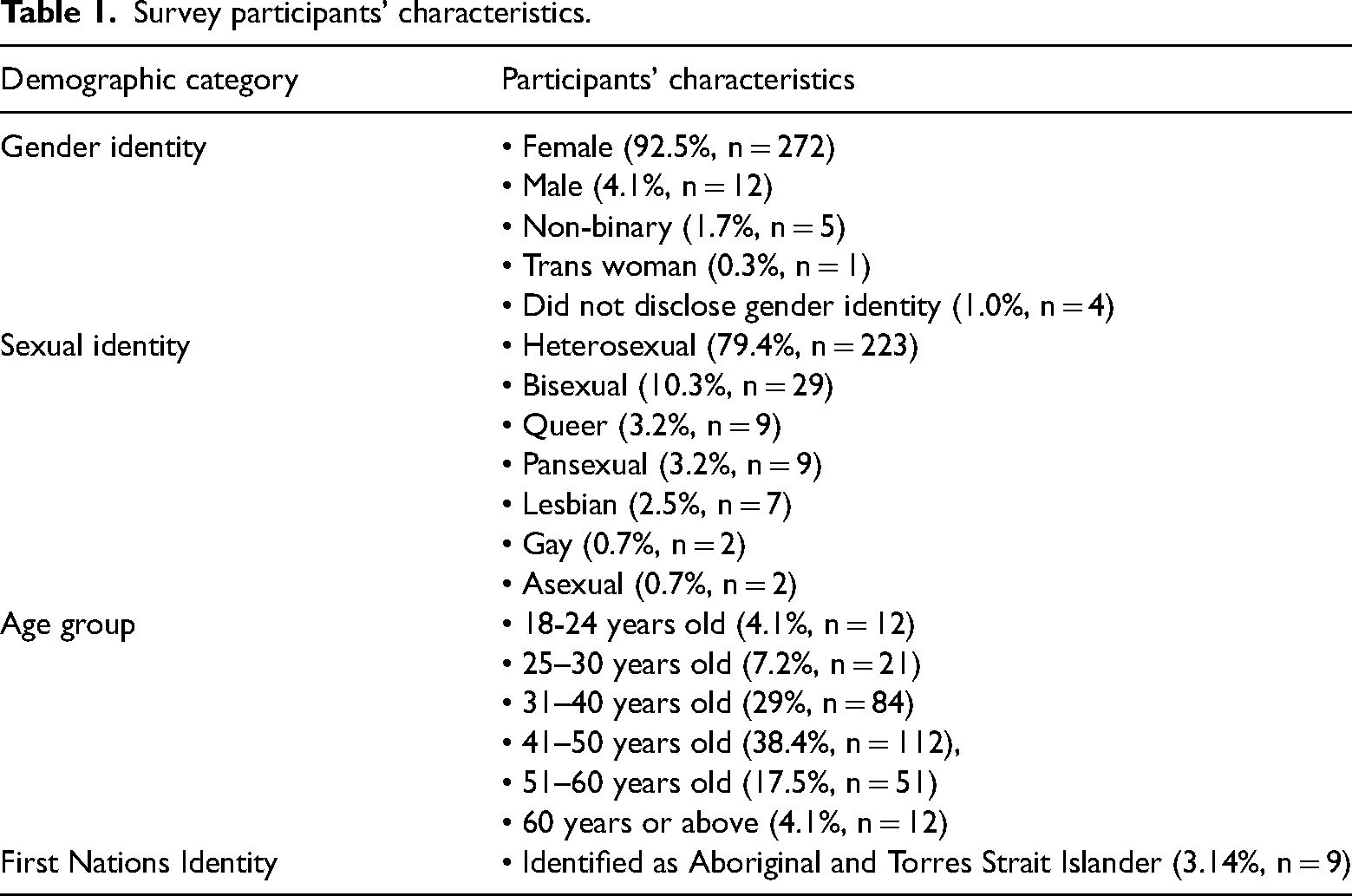
Noting that 92.5% of the survey sample identified as female, the predominant focus on female identifying employees in this article reflects the gendered nature of DFV, which has disproportionate impacts on women employed in varying capacities across Australian workplaces.
In-depth interviews
To supplement the survey data, all participants were asked if they consent to being contacted for a follow-up interview with a member of the research team. Interviews were used to gain more detailed insight into their views and experiences of accessing DFV leave, and additional workplace supports. Survey participants who nominated to participate in a follow-up interview were contacted via their preferred method (phone call, text message or email). A total of 42 victim-survivors were interviewed between November and December 2021. The interviews were semi-structured and thematic with respondents answering a series of open-ended questions (Kvale, 1996). The interview guide was kept deliberately broad so that each interview was tailored towards the participating victim-survivor's unique experience and expertise. Given the ongoing COVID-19 restrictions in Victoria (Australia) throughout the period of data collection, the interviews were held via telephone or Zoom. All interviews were, with consent, audio recorded and transcribed verbatim. Interview participants received a $50 honorarium in recognition of their time.
Data analysis
Data from the open-ended survey questions and interviews were thematically analysed to develop a rich description of victim-survivors experiences of accessing DFV leave and the impact of DFV on work participation, performance and career progression. Drawing on Bazeley (2013), and Miles and Huberman (1994), we engaged in a two-stage coding process using NVivo 12. First-level coding involved descriptive coding labelling passages of data with codes summarising data segments. Second level coding built on these summaries: refining, interpreting and grouping them into smaller analytical categories, themes or constructs. This second phase explored the interrelatedness of data within and across themes to construct meaningful explanations (Bazeley, 2013). This two-stage coding process is cyclical with researchers constantly moving from data to description to analysis (Bazeley, 2013; Miles & Huberman, 1994).
All interview participants were given pseudonyms. When survey participants are quoted, we provide their gender identity and work industry. This study was designed to provide a richly textured understanding of how DFV affects victim-survivors work experiences and the supports required to support victim-survivor's safety, recovery and ongoing engagement with work. The qualitative survey and interview questions were intended to provide analytic rather than statistical generalisation (Yin, 2009). As such, quasi-statistics, such as “some”, “many” or “all”, are used in the presentation of findings in this article.
Study findings
The findings from this research are presented here in two main sections – victim-survivor perspectives on DFV leave, followed by an examination of victim-survivor views on what workplace supports beyond DFV leave are needed. By starting with the analysis on DFV leave, we seek to draw attention to the factors integral to the effective implementation of the forthcoming national paid leave provisions. This analysis is ordered into four sub sections, examining the availability and the duration of DFV leave initially, following by an examination of the conditions to accessing leave and the impact of workplace culture on uptake. The second analysis section looks beyond leave provisions to explore what other workplace-based supports victim-survivors view as important, including flexible working arrangements, safety planning and protocols, and other supports. Throughout the analysis we draw heavily on direct quotes from victim-survivors who participated in this research in order to ensure the voices of lived experience are privileged in the presentation of the findings.
Victim-survivor perspectives on DFV leave
Access to, and experiences of, DFV leave – both paid and unpaid – were varied across the survey and interview participants. The following discussion explores the availability and extent of DFV leave entitlements including conditions required to access such leave. Around 53% of survey respondents (n = 162) reported that they did not have access to DFV leave during their experience of DFV. These respondents were employed across a range of industries and employment types.
In discussions about the availability of DFV leave, numerous interview participants spoke at length about how paid leave would have made a profound difference to their experience, with one interview participant exclaiming that access to paid DFV leave “would just be amazing” (Samantha). In particular, victim-survivors emphasised that having access to a period of paid leave would enable them to plan for their safety and better support their recovery. As one interview participant reflected: I just needed some time to get myself together, my headspace, get some treatments, just to see where I am today. I just couldn't believe what was happening to me because it was a number of assaults. It was just awful. (Bianca)
Some participants explained that having access to DFV leave would have enhanced their sense of personal safety. For example, one participant commented that had DFV leave been available, “My daughter would feel safe. I would feel safe”. For these victim-survivors the lack of paid DFV leave was closely associated with their experiences of economic insecurity during and after their experience of DFV. Research has consistently demonstrated the immediate and long-term financial impacts of intimate partner violence on the economic security of victim-survivors, particularly women (see, inter alia, Cortis & Bullen, 2015). These viewpoints demonstrate the role that the new legislation specifically, and workplaces more broadly, can play in supporting victim-survivors’ economic security – a key aspiration of the recovery pillar in the National Plan (DSS, 2022).
In order to capture the lived experiences of accessing DFV in the workplace, the remaining discussion focuses on those survey respondents and interview participants whose workplaces offered DFV leave, whether they elected to access it or not.
The availability of DFV leave
Of the 203 survey respondents, 20.2% (n = 41) reported that they accessed DFV leave (paid or unpaid) while 28.1% (n = 57) said that they accessed another form of leave during their experience of DFV. A small number of victim-survivors in this study reflected positively on the support they received from their workplace following their disclosure of DFV, highlighting the value of effective workplace supports. As one interview participant described: If I didn't have access to [DFV] leave, I would have lost my job, I would have lost everything… I don’t know if I would have survived … [paid DFV leave] was my lifeline. (Soraya)
Likewise, survey respondents described workplaces where they felt supported, believed and valued: My work was very supportive, so relationships were strengthened. (Survey respondent, female, financial and insurance services)
Due to him tracking my work contact details, I needed to inform my manager and colleagues to ensure I had an escape plan. They were extremely supportive, but I was new at that organisation and it wasn't the first impression I wanted to make! … Fortunately, due to understanding management and colleagues, it didn't impact my career. (Survey respondent, female, education and training)
My work have been very understanding and supportive since I disclosed [DFV] to them. There is a DV [domestic violence] policy which gives me extra leave. (Survey respondent, female, higher education)
However, a significant majority of participants in this study who accessed DFV leave still reported substantial challenges to continued work participation and a perceived lack of overall support received. These participants stressed that accessing paid DFV leave did not ensure that their work was unaffected by their experience. As captured in the following survey excerpts: People saw me have a breakdown at work from [my] ex-husband's abuse and I lost credibility because of this and lost work opportunities. I was told that I should never have let other people know or see the impact DV [domestic violence] had on me as I was not offered a job because of this and my future employment opportunities would be impacted. (Survey respondent, female, education and training)
Increased difficulties with manager who didn't understand what I was going through. Late for work on occasion as I was attending to the children's needs and increased anxiety meant I was easily distracted. (Survey respondent, female, legal)
Survey respondents described workplaces that offered DFV leave but where the response by management was highly unsupportive and, in some cases, discriminatory. As one survey respondent commented: I was criticised by my boss for setting a bad example for my team, for being the sort of woman who lets herself be abused (this intensified when on one occasion I had to bring my kids to work after a serious assault). I was performance managed by HR as a result of that and chastised for bringing my personal issues to work. It was horrible. … To keep my job, I had to hide what was happening and that meant going back to my perpetrator – so I did and copped another three years of bashing. (Survey respondent, female, financial and insurance services)
These experiences show how workplace cultures impact the utilisation of DFV leave entitlements. In particular, the expectation or requirement to disclose DFV was identified by survey respondents as the key reason they did not access DFV leave. Participants expressed concern about how their employers and/or colleagues would respond and how this would impact the way they were perceived in the workplace. As three victim-survivors explained: [DFV leave] was available but I didn’t want [my] colleagues to know my business and to spread gossip. In an emergency situation I would just walk out of work or not turn up. (Survey respondent, female, education and training)
I didn’t want to talk about [DFV], acknowledge it or admit to it because I was afraid of being stigmatised and put out to pasture. (Survey respondent, female, information media and telecommunication)
I would love to be able to be honest about it, and just say, “This is real. It's happened to me, and we need to support each other, and look after each other”. And I just feel like I can't, it's like this dirty secret that I have to just keep hidden, that my whole life has been difficult because of who I've been married to. And despite that, I've continued to try and do my job, but it certainly has prevented me from getting promotions and being recognised. (Caroline)
Some participants who were in senior management and executive roles described their seniority as an additional barrier to disclosing their experience of DFV. As one interview participant reflected: I didn’t want to bring up domestic violence, especially in that kind of senior role. It's not something you want to talk to your colleagues about, because they’re supposed to have faith in you, you’re supposed to be high performing. (Ki)
Notably, all survey respondents who accessed DFV leave were either employed in a full-time ongoing or part-time ongoing role, underscoring that permanent employment is a critical factor in ensuring economic security and ultimately women's safety. No casuals or contract workers who responded to the survey reported having accessed DFV leave. This is an important finding which has gendered implications. Women in Australia are overrepresented in casualised roles with limited leave entitlements, a trend that has been exacerbated since the outset of the coronavirus pandemic (Wood, Griffiths & Crowley, 2021). The challenges of precarious employment for workers experiencing DFV are highlighted in the comments of one survey respondent: I have been unable to progress my career at all. I am limited to working casually because I need to drop everything at a moment's notice to deal with whatever abuse the abuser is hurling at me next. I have zero support from work very much due to being casual. (Survey respondent, female, health care and social assistance)
Consideration of the unique precarity casual workers face highlights the significance of the recently introduced legislation which extends the paid DFV leave provisions to casual employees. This is particularly so given that women are overrepresented both as victim-survivors of DFV, and as casual workers. The findings from this study highlight the importance of ensuring availability of leave provisions for all employees (regardless of contract type), and more broadly the important role of secure employment in supporting victim-survivors’ freedom from violence (see also, Williamson, Foley & Cartwright, 2019).
The duration of DFV leave
Of the survey respondents who had access to paid DFV leave, the length of leave available ranged between one day and up to three months with the average number of paid DFV leave days available being 14 days. Survey respondents were also asked how many days of paid DFV leave they had taken. The number of days of paid DFV leave taken ranged between one day and up to 90 days. Approximately one third of survey respondents said that they fully exhausted their DFV leave provisions, while the remaining two thirds of participants reported that they had not exhausted the DFV leave available.
Over half of the survey respondents who had accessed DFV leave said that the period of leave offered had been sufficient. Of those who felt that the leave period offered was insufficient, there were varied views on what would have been a sufficient period of DFV leave. The suggested leave durations ranged from ‘longer than seven days’ to ‘years, the trauma lasts a lifetime’, with a number of survey respondents suggesting between two weeks and a month. This viewpoint aligns with emerging best practice recommendations which propose a minimum of 10 to 14 days paid leave, and ideally the introduction of unlimited DFV leave (McIlroy, 2021).
Several survey respondents stressed the need for discretionary judgement in determining the number of days of paid DFV leave made available. As two survey respondents commented: It really depends on the severity. I was lucky this time but if the [DFV] was severe and she needed more time in hospital five days would not have been sufficient. (Survey respondent, female, local government)?
I think it should accrue. I needed seven weeks in my situation, however, everyone's situation is different. (Survey respondent, female, manufacturing)
Some survey respondents explained that they were able to access additional leave at the ‘discretion’ of their supervisor, on negotiation, and on ‘an as needed basis’. These views reflect emerging best practice with some workplaces offering unlimited DFV leave entitlements (for example, Commonwealth Bank of Australia, 2019).
Conditions of access to family violence leave
Beyond the availability and extent of any DFV leave entitlements, the survey also asked victim-survivors whether they were required to exhaust other leave provisions prior to accessing paid DFV leave, and whether documentation was required to substantiate the leave claim. Of the 41 survey respondents who had accessed DFV leave in their workplace, just under 15% (n = 6) were required to exhaust other leave entitlements prior to accessing paid DFV leave. There were a number of survey respondents who explained that the DFV leave they accessed came out of their sick or carer's leave balance, a practice which has disproportionate impacts on women employees who are more likely to be both experiencing DFV and more likely to have primary carer responsibilities than their male counterparts.
Of the 41 survey respondents who accessed DFV leave, just under half (n = 19) were required to provide documentation to support their leave request. For the remaining survey respondents (n = 22), no documentation was required to support their DFV leave request. Survey respondents were asked to list what documentation they provided to their employees in order to access DFV leave. The victim-survivors provided a range of documentation including copies of intervention orders, letters from court/court documents, medical certificates, letters from legal counsel, statutory declarations, police reports and letters from a psychologist or psychiatrist. In several instances, survey respondents explained that they provided multiple documents to support their leave request. It was unclear from the survey responses provided whether the documentation submitted was specified by the employer or volunteered by the individual and whether additional documents had been provided to satisfy evidentiary requirements on the part of their employers.
The survey asked participants whether the expectation to provide documentation to support their request for DFV leave impacted their decision to access the leave entitlement. For the vast majority, the documentation requirement did not impact on their decision to access leave (83.3%, n = 15). However, for a small number of survey respondents the documentation requirement was viewed as a barrier to accessing the leave provisions. As one interview participant described: I didn't really want that information [court documents etc] on the HR system… at that time I didn't feel like I had much of a choice. (Soraya)
The burden of providing “satisfactory” documentation in order to access DFV leave is well captured by the following survey respondent: My manager also refused my application for Domestic Leave for me to attend my AVO hearing, asking for a copy of my AVO as proof. After I provided this, I was asked to provide a letter from the police to say that I attended my AVO hearing. When I could not get this information from the police, I was told I could take Annual Leave or Leave Without Pay. (Survey respondent, female, Health Care and Social Assistance)
These experiences point to the challenges that arise where documentation is required prior to a DFV leave request approval and are important to keep in view as workplaces (re)develop policies to implement the nationally required paid DFV leave provisions. The recent report of the Champions of Change Coalition (2021, p. 31) noted that, “[m]inimising supporting documents required to access support can also remove a potential barrier to employees seeking support”. These processes are also at odds with trauma-informed approaches that ensure victim-survivors feel believed and validated upon disclosure of their experience (McNicol, Fitz-Gibbon & Brewer, 2022).
The impact of workplace culture
A key theme emerging from survey responses and interviews was that where workplaces are considered unsafe and unsupportive, then the availability of any DFV policies are irrelevant. The administration of a DFV leave policy is just as critical, if not more, than the very existence of the policy itself. As two survey respondents explained: There were a lot of policies, procedures and resources “available” to support workers on paper. In reality, referrals were impossible to obtain, privacy was constantly breached, judgements were made by people that had no right or authority, breaches occurred and ultimately no services or support was offered. (Survey respondent, female, Health Care and Social Assistance) As a government entity there were numerous supports including EAP but they were all regarded as admitting weakness and there was an unspoken (and sometimes spoken) expectation that those in management and executive roles would not access these supports. I also knew that confidentiality was not maintained from my experience of other people's issues. (Survey respondent, female, Professional, Scientific, Technical Services)
In particular, participants reflected on the significant stigma associated with accessing DFV supports. This often occurred in workplaces where there was lack of DFV education. As one victim-survivor recounted: If you look at their DFV policy, leave and intranet page you’d give it full marks. The issue was, and is, that if you identify as a DFV victim in the legal profession – you’re marked and your career is over – it doesn’t matter what the policies say it matters what employers actually do and how they treat you. (Survey respondent, female, Financial and Insurance Services)
Another survey respondent recounted instances where her colleagues willingly ‘looked away’ from her experience of violence while also engaging in a culture of workplace bullying: People would see the bruises and not say anything. People would ignore the hints and never checked in with me. People would ridicule me for not eating or losing weight or not having the right work clothes etc. (Survey respondent, female, Government)
Victim-survivors’ reflections on poor workplace responses to DFV often extended beyond the accessibility of leave provisions and were largely focused on the responses that employees received from co-workers following disclosure. As one interview participant commented: The way my employer treated me was worse than the domestic violence itself … You can’t put up with copping it at home and copping it at work, it's just too much. … Please just treat me like a human. … The workplace just [wants] to get rid of you when you are experiencing domestic and family violence. (Charlotte)
Likewise, another survey respondent reflected on the insensitive behaviours of work colleagues: The workplace was the only place where I could escape his abuse, to remember who I was as a person and a professional. Outside of work I was stripped of my dignity, my safety, my ability to provide a loving and safe environment for my son. I really needed work to be a safe haven and although there were supports that I will forever be grateful for, the type of alternative work offered without regard for impact, and insensitivity, judgment and blame within some team interactions were unnecessarily insensitive if not cruel. (Survey respondent, female, justice)
These experiences are not anomalous. Recent Australian based inquiries conducted by the Australian Human Rights Commission (2020, 2021) have likewise documented the prevalence of unsafe and unsupportive workplace cultures.
Recognising the importance of supportive workplace environments, in the survey and interviews victim-survivors often described the type of work environments where they would have felt supported to disclose. Two victim-survivors described: Management training and employee awareness of procedures around how to identify, support someone like me in my experience. I was also very ashamed to share what was happening so knowing that there is a policy or process involving support instead of stigma for taking sick leave all the time. (Survey respondent, female, Electricity, Gas, Water, Waste Services)
It's all about the culture. You need the policies and procedures, but you also need that culture and you need people at senior levels saying, 'I support family violence victims’, and then actually doing it, showing it … you need family violence victims at senior levels going 'I grew up with family violence' or 'I stuck with my perpetrator for seven years and then I got out' and just outing themselves, because that's what makes us safe. (Rachel)
Although less common, some survey respondents provided positive anecdotes on how their workplace responded when they disclosed their DFV victimisation. These participants emphasised the positive impact of support and discretion from work colleagues, as captured in the comments of three victim-survivors: My work family rallied around me often. Some attended court to provide evidence. Some wrote statements. They covered for me (in terms of keeping things going) whilst I was absent. (Survey respondent, female, Professional, Scientific, Technical Services)
My colleagues were very supportive, they offered me somewhere to stay. I was offered support and information. They also encouraged me to leave the relationship and not to leave my job. (Survey respondent, female, Administrative and Support Services)
Workload discretely managed to ease my load. Colleagues stepped in at key points. Friendship & emotional support. I never felt like a freak or too much. I am absolutely convinced I never would have left my violent ex if it weren’t for the discrete, respectful help I received at work. (Survey respondent, female, Professional, Scientific, Technical Services)
These findings capture why creating supportive and trauma-informed workplace environments is a necessary first step for the effective operation of DFV leave policies.
Beyond leave provisions: Views on the need for additional workplace supports
In addition to DFV leave, victim-survivors participating in this study identified a range of workplace supports that assisted their continued participation in the workforce while experiencing DFV, as well as supporting their long-term trauma recovery. These workplace supports are examined below and organised into three key categories: flexible working arrangements, safety planning and protocols, workplace-based services and supports.
Flexible working arrangements
Numerous victim-survivors identified flexible working arrangements as critical to retaining their paid employment. Flexible working arrangements can include changes to hours of work, amendments to work patterns or work location, and a shift in the duties required in a role. As two survey respondents described: I spoke with my line manager who let me take as much annual leave as I needed, which turned out I was negative leave at times, but she still approved it. She also allowed my roster to be flexible and let me work around any issues. (Survey respondent, female, health care and social assistance)
Understanding that I needed specific days and times off to attend appointments or hearings. (Survey respondent, female, not for profit)
Given the dynamic nature of risk for victim-survivors of DFV, flexible working conditions were recognised by victim-survivors as an important form of support that can be provided by employers. Access to flexible working arrangements has additional benefits for DFV victim-survivors with caring duties, and flow on benefits for children. Respondents said they were concerned for the wellbeing of their children and that the option of bringing their children to work, or working from home with their children, would have been immensely useful.
Safety planning and protocols
A number of survey respondents and interview participants referred to the importance of opt-in workplace safety planning and protocols for victim-survivor employees. Examples provided included the introduction of security procedures and individualised safety protocols as well as advising other staff of the individual's safety needs. As two survey respondents explained: My staff team were briefed on the risk and his threats of murder suicide. A photo of him was placed at reception and staff were instructed to call police if he was seen in the vicinity. My boss was amazingly supportive. Our senior management were actively supportive. (Survey respondent, female, Public Administration and Safety)
There was a communication plan in place should the perpetrator attempt to call my workplace or make contact outside the premises. This was reassuring and supportive. (Survey respondent, female, Justice)
Interview and survey participants spoke highly of workplace safety plans. Acknowledging that for some victim-survivors getting to and from work can present risks during their experience of DFV, and into their recovery, a small number of survey respondents also noted the safety benefits of receiving alternative transportation support (such as a chaperone) to and from their workplace. As two survey respondents reflected: My work paid for an Uber in the afternoon to take me home, it was a different car each day, whilst I had no car as my ex was hassling me when I was walking home. (Survey respondent, female, Administrative and Support Services)
I did not know how to drive, and my partner used to drive me to work. The public transport to my work was not great. My colleagues gave me a lift to and from work. (Survey respondent, female, Administrative and Support Services)
Once at work, the importance of offering a safe parking space was also identified by victim-survivors as important, with one victim-survivor describing this as ‘amazing’. Giving meaning to the notion of door-to-door service, tailored supports like those described here can be essential to supporting a victim-survivor to manage their safety needs, and subsequently to be able to continue to attend and engage meaningfully in work. One interview participant suggested that such supports should be proffered through a peer-to-peer support person, whereby victim-survivors are allocated a trusted colleague, HR liaison or line manager to work closely with them to assess and determine their safety planning needs, including any flexible working arrangements. These victim-survivor led insights demonstrate the range of workplace-based supports that should be considered alongside the introduction of the new paid leave provisions to ensure comprehensive workplace responses to supporting employees experiencing DFV.
Additional workplace-based supports
Through the survey and interviews, victim-survivors identified numerous other workplace-based services and supports that would be beneficial to employees affected by DFV. These included:
Formal and informal employer support – particularly managerial support, Employee assistance programme (EAP), Workplace specific counselling service or programme, and Employee benefits programme. Counselling was available which I took, but it wasn't very useful. I ended up getting a private professional when I could afford it. (Survey respondent, female, education and training)
The most common workplace-based support cited was the EAP. While numerous victim-survivors noted that EAP had been made available to them, the majority of participants did not view the EAP as an effective mode of service provision explaining that specialised trauma-informed counselling was required for employees affected by DFV. As two victim-survivors described:
The counsellor was not helpful. I tried again a few months later and by then there was a huge waiting list. (Survey respondent, female, education and training)
Beyond the EAP, some participants called on workplaces to be more proactive in addressing DFV and to more widely advertise the support services that are available to employees. As one victim-survivor explained: “Have you thought about this? This is something that we can offer. This is the type of leave we can offer. This is how long it is. This is what it looks like. This is paid”. Looking at, perhaps, when they do come back on board, it might be - they might want to come back and do reduced hours, or they might need just a whole lot of flexibility that they might just need to drop something. (Survey respondent)
This level of proactive engagement with victim-survivors in the workplace requires a commitment to building awareness across the workplace, and a definitive shift from a traditionally reactive response model. As workplaces across all Australian industries move to offer greater policy commitments to supporting the needs of employees affected by DFV, there is a critical need to ensure all staff are equipped with basic DFV literacy and trauma informed training.
Conclusion
This article delivers important victim-survivor led insights on the implementation and operation of DFV leave, as well as the importance of broader workplace supports for victim-survivor employees. From early 2023, Australian workplaces will be required to provide access to up to 10 days paid DFV leave for all employees. This legislation represents a significant shift in recognising the critical role that workplaces can play to ensure victim-survivors are effectively supported to maintain paid employment during their experience of DFV, and to continue to engage with work throughout their recovery. The wider economic benefits of paid employment are significant. The high costs of lost productivity and employee absenteeism are well-documented, and research has clearly established the importance of women's economic security on their ability to safely exit an abusive relationship. As the new legislation comes into effect, there is significant work to be undertaken across Australian workplaces to ensure a culture and a policy environment where victim-survivors of DFV are safe and supported to thrive in paid employment.
This research finds that DFV leave provisions have a symbolic and a functional role to play in the framework of broader workplace responses to DFV. At the symbolic level, the introduction of paid DFV leave sends a clear message that the workplace recognises the need for victim-survivors to be supported financially during and following their experience of violence. It reiterates that DFV is everyone's business and reduces concerns about shame and embarrassment by affected staff. From a workplace practice perspective, this study indicates that paid DFV leave is only effective when embedded in safe and anti-oppressive workplaces, this is critical insight ahead of the new legislation taking effect in February 2023. This research reveals that low levels of DFV awareness and trauma-informed understandings among employers coupled with requirements to provide documentation in order to access leave ultimately undermine the goal of this policy response. These findings support the Australian Law Reform Commission (2011) recommendation that: There should be a core of basic requirements with respect to family violence leave, including that it should be paid, flexible and easily accessible where necessary, while containing sufficient safeguards to maintain the confidentiality of personal information and the integrity of the leave system.
Given the high prevalence of all forms of DFV across the Australian community, there is a critical need to better ensure that workplaces are able to effectively support victim-survivors to maintain employment and workplace engagement. While the new legislation will contribute to achieving this, it should not be viewed as the complete solution. Creating safe work environments requires ensuring that employees are not penalised or ridiculed for disclosing DFV victimisation. The development of comprehensive DFV workplace policies that build workplace awareness of DFV and support training on how to respond sensitively and confidentially when DFV disclosures are made can contribute to the creation of safe working environments for victim-survivors and should be introduced alongside the paid leave provisions.
Australian workplaces have a key role to play in supporting victim-survivors through their experience and recovery, effectively doing so will be critical to achievement of the National Plan's focus on recovery and healing. Leadership requires the introduction of policies that embed lived experience into their design and delivery, and a whole of workplace approach to implementation which demonstrates an authentic commitment to supporting victim-survivor's safety and financial independence. Over the last five years, there has been increasing recognition of the importance of DFV policies in workplaces and the October 2022 passing of the paid DFV leave legislation furthers that substantively. Presenting the voices and lived experience of over 300 Australian victim-survivors, this study provides timely evidence to why workplace policies must provide accessible and effective financial support for all employees that experience DFV and be implemented within broader workplace cultures that are committed to gender equality.
Footnotes
Declaration of conflicting interests
The author(s) declared no potential conflicts of interest with respect to the research, authorship, and/or publication of this article.
Funding
The author(s) disclosed receipt of the following financial support for the research, authorship, and/or publication of this article: This work was supported by the Fair Work Commission.
