




Abstract
In Canadian cities, unaffordable housing and the lack of community supports have led to an increase in the number of encampments in public spaces. Municipal governments argue that short-term shelter spaces are a reasonable response to the ongoing, amplified housing crisis. However, shelters are an example of the many ‘every day’ regulatory approaches used by public officials in related to unhoused people referenced by Johnsen et al., do not provide legal tenure, and are often unsafe for people and their possessions.
This paper examines the recent Canadian judicial decisions in relation to the eviction of encampment residents from public space to analyze what constitutes ’reasonableness’ in government decision-making in relation to short-term shelters. I argue that courts have called into question a key aspect of social control that relates to unhoused populations: the institutional belief that temporary shelters serve as a reasonable form of accommodation and an appropriate alternative to living in encampments. Recent legal decisions have challenged both this institutional belief and the methods used by officials to track which shelters are available. I conclude that the legal approach of using judicial review of administrative decision-making provides a means to challenge administrative decision-making that insufficiently scrutinizes the availability of accessible and appropriate shelter spaces for the specific unhoused people they intend to displace, raising the bar on shelter suitability. Judicial review of administrative decision-makers, a form of legal evaluation, offers a tool to confront what Katuna and Silfen-Glasberg (2014) call an ‘incompetence of rules’ in the social control of those living in encampments.
Introduction
The lack of affordable housing has led to significant vulnerability for Canada's most vulnerable residents (Farha and Schwan, 2020). Even before COVID-19 swept through cities and encampments proliferated (Buchnea and McKitterick, 2020: 43; Egan, 2020), Canadian cities relied on emergency warehousing approaches, notably short-term, temporary shelters, to address visible homelessness. While those with lived experience have long explained the challenges with shelters, local governments justified the eviction of encampment residents from public spaces with the offer of shelter indoor spaces as a reasonable response (Philippe, 2020; Riebe, 2022; van Wagner, 2020). And, until recently, courts agreed, with little scrutiny of shelter conditions.
This article focuses on the role of Canadian courts in setting ground rules for shelters when encampment residents are displaced. Canada serves as an important site of analysis given the extent to which courts have set the parameters for the regulation of public space and encampments. In this country, courts have played a crucial role in limiting forced evictions of encampments, which are considered to be the most extreme form of social control, as there is no option but to comply (Johnsen et al., 2018). By ‘social control’, I mean the ‘measures which seek to mould the behaviour of targeted individuals’, often through the regulation of people in public spaces and through modifications to the built environment (Johnsen et al., 2018). In Canada, the legal challenges to encampment evictions have almost exclusively focused on whether the by-laws permitting evictions are constitutional. This lies in contrast with the court's role in the areas of housing and homeless in many other jurisdictions, which often proceed under administrative or judicial review and with a greater focus on process in ensuring that people have suitable housing (Shelter, 2023).
In Adams, the leading Canadian case decided in 2009, a provincial court of appeal held that by-laws restricting encampments in parks and other public spaces are constitutional if adequate shelter spaces are available, meaning that the number of spaces must match the number of encampment residents. In 2022, a Canadian court considered for the first time whether an encampment eviction met the requirements of administrative fairness, rather than whether the by-law was constitutional. This decision, Bamberger, brought attention to the methods used by officials to identify which specific shelters are available and their suitability for encampment residents. I argue that Bamberger serves as an important precedent for two reasons: it challenges the presumption that the availability of any shelter is sufficient to justify encampment evictions; and it establishes that unhoused people have human rights and must be treated fairly. In so doing, the court considered the social control inherent in the treatment of unhoused people, especially in relation to temporary shelters as suitable accommodation. To put it another way, judicial review brought attention to the standards within shelters, not simply their blanket availability, and in so doing acknowledged that as a form of social control, shelters require scrutiny.
This article contributes to social control literature by focusing on the judicial review of local government decisions by the courts. Prior to Bamberger, courts were reluctant to prioritize the adequacy of shelters over their availability and would often defer to municipalities in the balancing of rights between encampment residents and other members of the public. However, in Bamberger, judicial review focused on the specific conduct of administrative decision-makers, highlighting what Katuna and Silfen-Glasberg (2014) call an ‘incompetence of rules’ in the social control of those living in encampments. Judicial review brought to light that administrative officials must abide by standards of fairness and pay attention to the specific needs of the people they serve. While shelters remain legitimized sites of discipline and regulation (Mahoney, 2019), the decision has displaced the notion that shelters are adequate for all unhoused people if spaces are available. This, I argue, is a small, but important judicial step with implications for other jurisdictions where the courts play a critical role in advancing housing rights, including the United Kingdom and the United States (Fitzpatrick and Watts, 2010: 114; Ploszka, 2020). Through the courts, shelters are acknowledged as a place of social control that does not always serve the needs of unhoused people. Officials must therefore be alive to shelter conditions and their specific suitability.
This article first frames shelters for unhoused populations as a form of social control, both in the literature and in case law. In the next section, I set out a brief history of the jurisprudence related to encampment evictions, explaining the role of shelters as appropriate mitigation efforts for municipalities such that restrictive by-laws are legally permissible. Section 3 focuses on the judicial history of CRAB Park, an urban park created through advocacy by residents of the Downtown Eastside, in one of Vancouver poorest communities, and managed by the Vancouver Board of Parks and Recreation. In Part IV, I analyze the Bamberger decision, which successfully used judicial review to call into question the factual basis upon which staff base their eviction decisions, including the way staff perceive the suitability of shelters.
In the final part of the article, I advance that in reviewing the reasonableness of government decision-making, the court acknowledged the importance of reliable data and recognizes the procedural rights of unhoused people. The case serves as a legal check on government staff, affirming that their decisions must be appropriately tailored to the residents involved, with procedural rights safeguarded. Importantly, the case's thoughtful consideration of the reasons why unhoused people resist shelter use – in particular social control – doesn’t expel the justification that shelters are a suitable alternative housing, but does set the groundwork for future decisions.
Social Control, Homelessness and Shelters
Canadian cities have faced an alarming rise in the number of people experiencing homelessness over the last two decades (Farha and Schwan, 2020: 5–6). This increase is attributed to the lack of investment in affordable and social housing starting in the 1990s, with an estimated 200,000 Canadians experiencing homelessness each year (Gaetz et al., 2013: 4–5). As of December 2020, at least 25,000 people experienced homelessness in a shelter or outdoors on any given night across 61 communities, a 14% increase over the 2016 count (Canada, 2018). Data gathering is poor in this area, with homeless counts widely criticized for not capturing the actual number of people experiencing homelessness (MacDonald et al., 2022). Still the numbers are disturbing. In Vancouver, for example, the 2019 Homeless Count identified 2223 unhoused individuals (The Homelessness Services Association of BC, the BC Non-Profit Housing Association & Urban Matters CCC, 2019: 28).
Encampments are one of many ways that unhoused people cope with homelessness. By ‘encampments’, I mean the establishment of informal settlements, often in tents and makeshift shelters, without access to adequate heat, water, sanitation and safety equipment, and subject to a range of enforcement measures including ticketing, eviction and trespass notices and removal or destruction of tents, shelters, equipment and personal possessions, by municipal officials including by-law officers, fire departments and police (Farha and Schwan, 2020: 5). I use the term ‘encampments residents’ to refer to those living in these locations as homes, and use the term ‘unhoused’ rather than ‘homeless people or person’ to highlight this view, as well as to highlight that encampment residents do not have any form of legal title or rights to the areas they inhabit. ‘Homelessness’ means the broad status of those who do not have available, secure or adequate housing. In the Canadian context, it is also critical to acknowledge that the rise of homelessness and encampments are grounded in historical dispossession of Indigenous lands (Anthony and Hohman, 2023; Thistle, 2017: 7).
The development of encampments has been met with a corresponding rise in government action aimed at dismantling them and displacing their residents, with shelters seen by officials as a safer and better alternative to living outside. Officials argue that temporary shelters serve as a reasonable form of accommodation and an appropriate alternative to living in encampments (Hartnett and Postmus, 2010). Shelters represent what Johnsen et al. (2018) call the tension between ‘softer’ and ‘harder’ means of social control in the degree to which unhoused people are forced to participate in programs and services.
Social control sits at the foundation of the shelter system, with the adoption of politics and practices that focus on behaviour modification, such as controlling who may be admitted, for what length of time, the kinds of belongings that may be kept, and requiring permission to engage in particular activities such as watching television (Hartnett and Postmus, 2010). Shelters are also seen by officials as a positive way of altering the behaviour of unhoused people (Johnsen et al., 2018). All temporary shelters engage in social control to some extent (Mahoney, 2019; Watts et al., 2018). Mahoney (2019) notes, ‘even the most benign forms of support are inseparable from coercive, regulatory, routinizing and surveillance strategies to which homeless populations are subjected’, but there is a range, with low-barrier shelters that do not require behavioural change considered ‘tolerant’ rather than ‘extreme’ (Johnsen et al., 2018). A troubling ingredient of social control in the shelter system is the routine neglect of rules by staff based on discretionary practices, although experts point to the orientation to social control – rather than discretion itself – which is at the heart of discriminatory practices and human right deprivations within the shelter system (Hartnett and Postmus, 2010).
Dismantling encampments reflects social control at its most coercive (Johnsen et al., 2018) and is premised on balancing the rights between users of public space, including the exclusion of other park users; impact on the surrounding community; alleged increases in criminal activity; increases in litter and refuse; and purported concerns regarding insufficient fire safety measures. Cases cite the cancellation of community events scheduled in the park (Vancouver Board of Parks and Recreation v Williams, 2014: para. 8), other members of the public feeling ‘scared to enter or walk near certain parks’ (Black v Toronto, 2020: para. 108). Negative impacts from encampment activity on neighbouring businesses and residential areas have also been cited, such as smoke from encampment bonfires entering apartments (Vancouver Fraser Port Authority v Brett, 2020: paras. 34, 79). In the Adams case, detailed in the next section, the Court concluded that housing people in temporary shelters is a way to meditate between the rights of different interest-holders. Given long waitlists for transitional or subsidized housing, encampments residents can find themselves on waitlists for many years without success (British Columbia v Adamson, 2016: paras. 15, 18; Tanudjaja v Canada, 2014: paras. 4–6).
However, a major point of contention between proponents and opponents of encampment evictions is the suitability of shelters for encampment residents, owing to a large extent to their restrictive rules and practices. Cases commonly cite examples of people who have sought out accommodation at shelters only to be turned away, often based on a lack of compliance with shelter rules (Victoria (City) v Adams, 2008: paras. 54–57). The reasons for being turned away can vary, but include those with addictions being denied access to shelters with a zero tolerance policy for drug and alcohol use; families and youth being unable to access shelters which do not accept children; and being banned from a specific space, sometimes for an indeterminate length, for minor rule infractions (Victoria (City) v Adams, 2008: paras. 45–46 and 56). As Herring (2014) notes, ‘encampments are not simply the product of inadequate shelter capacity, a form of homeless habitation that would simply disappear if more beds were made available indoors. They are rather preferred safe grounds that offer various moral and material benefits denied in the shelter’ (306).
These restrictions are rooted in social control. Shelters may have strict rules, regulations and oversight in place that residents struggle with (Abbotsford (City) v Shantz, 2015: para. 74; Victoria (City) v Adams, 2009: para. 50). A lack of strict compliance with these rules can lead to residents losing their space in shelters, for example, instances where they leave for any time during the night or fail to return to the shelter by a set time in the evening (Abbotsford (City) v Shantz, 2015: para. 53). Some shelters forbid animals, forcing individuals to choose between shelter and their pets (Vancouver Board of Parks and Recreation v Williams, 2014: para. 26; Victoria (City) v Adams, 2009: para 50). These often crowded and challenging environments are particularly difficult for those living with post-traumatic stress disorder, mood disorders, addiction and other conditions experienced at disproportionately high rates by unhoused individuals (Black v Toronto, 2020: para. 53; Vancouver Board of Parks and Recreation v Williams, 2014: paras. 24, 28–29). There is a general lack of autonomy and humanization of unhoused people, a recurring theme in encampment case law, with outreach and support workers often finding it difficult to find housing or shelter options ‘that respect the needs of the clients and treats them in an honourable and respectful manner’ (Abbotsford (City) v Shantz, 2015: para. 49).
Unhoused people have long cited the advantages to living in encampments over temporary shelters (Young et al., 2017). They highlight the psychological benefits provided by the community; the comparative safety and security; the proximity and access to public services and outreach; and the barriers to and insufficiency of shelters and alternate housing. Noise, lack of privacy, concerns over personal safety and the associated lack of consistent sleep also make shelters challenging for those trying to re-establish stability in their lives, work or seek employment (Victoria (City) v Adams, 2009: paras. 51–53). The mental health benefits flowing from encampment communities have been espoused by both experts and encampment residents. Experts point to the increased stability and security provided by encampments, leading to a reduction in stress, establishment of healthier sleep patterns and the mitigation of some mental health challenges (Vancouver Fraser Port Authority v Brett, 2020: para. 69).
The centralized location of encampments also provide greater proximity and consistent access to pharmacies, safe consumption sites, medical care and other services and encampments’ fixed placement allows for community and outreach groups to build relationships and provide support to residents (Black v Toronto, 2020: para. 101). Community organizers express concern over the safety of encampment residents ‘when they are driven further from site and into locations where they are not easily found’ (Abbotsford (City) v Shantz, 2015: para. 213) and the loss of relationships built between outreach organizations and residents when encampments are dismantled (Black v Toronto, 2020: para. 127). Given the long-cited concerns with shelters, within which social control forms a foundational objective, residents have outlined the relative safety and security found in encampments for both their possessions and person, viewing them as safer alternatives to shelters or camping alone and helping maintain their control over the ‘personal belongings which anchor themselves to their humanity’ (Abbotsford (City) v Shantz, 2015: para. 71; Vancouver Fraser Port Authority v Brett, 2020: para. 64).
Legal Challenges to Encampment Evictions
Before looking ahead to the use of judicial review in encampment cases and the corresponding implications for social control, it is important to look back to the decisions and legal developments around encampments in Canada. The jurisprudence is important, as court decisions – not legislation – have set the bar for what is permitted in terms of encampment evictions. Most cases involve municipal governments seeking injunctions from the court to enforce the removal of encampments. Cases involving encampments established on public property, commonly parks and rooted in claims of by-law violations. The by-law provisions cited in encampment cases vary, but broadly relate to prohibitions of remaining in parks or public places outside of posted hours, erecting tents or other temporary shelter or obstructing public pathways. While by-law prohibitions largely pertain to public spaces, in some instances ‘Good Neighbour’ by-laws allow private property owners to restrict activities that occur as a by-product of an established encampment, such as allowing a parcel of land to become or remain unsightly, accumulate rubbish or be the source of repeat nuisance service calls (Hermer, 2020).
The Charter of Rights and Freedoms [the Charter] forms Part 1 of Canada's Constitution. Section 7 of the Charter reads, ‘everyone has the right to life, liberty and security of the person and the right not to be deprived thereof except in accordance with the principles of fundamental justice’. Section 7 has been the main basis by which those living in tent encampments have challenged laws and by-laws seeking to evict them. The Court in Adams recognized that unhoused people are entitled to erect overnight shelters in public parks under section 7 of the Charter where there were inadequate shelter spaces. In Adams, the court explained the benefits of encampments including improved health, access to services, safety of person and possessions, sense of community as well as responsiveness to concerns raised by the police and fire departments. These findings were based on testimony from service providers, community organizations and encampment residents, and they confirm arguments advanced by frontline groups and scholars. The court found that granting an injunction to end the encampment would simply shift ‘harms’ to other areas and concluded the balance of convenience was ‘overwhelmingly in favour’ of unhoused people (British Columbia v Adamson, 2016: para. 183).
The decision in Adams represents a significant milestone in setting minimum requirements for local governments in the area of encampments evictions. The Court's interpretation of the Charter was informed by Canada's international law obligations in ensuring that the government's approach was constitutional (Victoria v Adams, 2009: paras. 100, 122, 125). The Court affirmed that while preservation of parks is an important objective, the by-laws did not meet the minimal impairment requirement and had deleterious effects disproportionate to the weight of their purpose (Victoria v Adams, 2009: paras. 200, 204, 207, 215).
The decision in Adams is narrow, however. The Court affirmed that the legislature can limit access to parks based on the objective of maintaining the environmental, recreational and social benefits of parks (Victoria (City) v Adams, 2009: para: 122). The court also narrowed the remedy, striking down only the portions of the by-laws that spoke directly to the prohibition of temporary abodes, not the entire sections which contained them Victoria v Adams, 2009: para. 159). Most significantly, the Court limited the language defining the temporary nature of the shelter at question, declaring that the impugned by-law provisions were inoperative in relation to ‘temporary overnight shelter’ rather than the more broadly worded ‘temporary shelter’ (Victoria v Adams, 2009: paras 160, 166). Put simply, the constitutional rights from Adams restricted this right in two important respects: the right is exercisable when the number of unhoused people outnumber the available indoor sheltering spaces; and the right to erect a temporary shelter is confined to overnight hours.
Following this decision, the City of Victoria passed new by-laws which allowed for overnight sheltering, but prohibiting them during the day (Abbotsford (City) v Shantz, 2015: para. 275). Some other municipalities adopted similar by-laws. For example, the Vancouver Park Board amended the Park Control bylaw to remove bans on erecting temporary structures and sheltering overnight in park space (City of Vancouver, 2020), allowing temporary shelters from dusk until 7:00 AM the following day, with those taking temporary shelter having until 8:00 AM to dismantle their shelter and move, along with many other restrictions on where and how shelters may be established (City of Vancouver, 2020). This approach – allowing overnight shelter in parks while requiring people sheltering to dismantle their shelter each morning – was endorsed in a later case, Shantz, with the Court viewing it as balancing ‘the needs of the unhoused people and the rights of other residents of the City’ (para. 276). The Court in Shantz found a deprivation of the encampment residents’ section 7 rights along with similar lines to Adams, and likewise declared the impugned by-law provisions of no force and effect, but further limited the scope of this declaration to the prohibition of ‘overnight stays between 7:00 p.m. and 9:00 a.m. the following day’ specifically (paras. 279–280).
Although the ratio of shelter space to people experiencing homelessness forms a key part of the judicial analysis in encampment cases, advocates noted several significant difficulties inherent to this calculation. First, the total number of unhoused people is difficult to identify with any precision – both the number of residents in a given encampment and the total number of unhoused people in a given municipality is difficult to calculate and final tallies are likely to result in underestimates (Vancouver Board of Parks and Recreation v Williams, 2014: para. 39–42). Second, there is not a reliable and consistent metric for determining what the total available shelter space is on a given night. Whether all shelter space is at capacity is in inadequate metric, as ‘it is not possible to determine if the fact that there were spaces not occupied on any given night was due to lack of demand or to operational difficulties with the shelters (Victoria v Adams, 2008: para. 49)’. Fluctuations in the availability of emergency shelter not available year-round additional also confounds this calculation (Abbotsford (City) v Shantz, 2015: para. 47). Barriers to entrance for people with addictions, children, pets and more means that open shelter space will not be equally accessible to all individuals experiencing homelessness. Given the many challenges in this assessment, advocates have questioned whether ‘a municipality can realistically ever prove that it has made available sufficient shelter space to meet a vast range of current, individualized needs’ (Malik and Van Huizen, 2015: 5).
Advocates repeatedly challenged the calculation of ‘adequate’ shelter space, focusing in particular on the plethora of rules in shelters, including curfews, and restrictive rules about alcohol and drugs, suggesting that these indicia of social control be interpreted as leading to ‘insufficient accessible shelter space’ (Abbotsford (City) v Shantz, 2015: paras. 46–82). In 2021, in Prince George (City) v Stewart, the lack of sufficient and appropriate indoor options was an important factor in denying a statutory injunctions and enforcement order against encampment residents by the City of Prince George. While the application in one of two encampment sites, the municipality was unable to establish that viable alternatives were made available to unhoused people (Prince George (City) v Stewart, 2021: para. 84). The court held the existing shelter beds were not ‘low barrier’ enough to provide for accessibility, citing the eligibility criteria that precluded those with mental health or substance abuse issues, as well as those who did not have identification (Prince George (City) v Stewart, 2021: paras 67–68). Notably, the court considered the considerable number of Indigenous Peoples amongst the encampment population and the context of colonialism, including the legacy of residential schools (Prince George (City) v Stewart, 2021: paras. 69–71). The court also noted the cold weather, and the lack of both suitable housing and daytime facilities, suggesting that sheltering at nighttime may also be extended to daytime situations.
The next section considers a 2022 case, which considered an encampment eviction in a different way: by challenging that the administrative decision-makers who issued eviction orders. Rather than challenging the constitutionality of the by-law, the case challenged whether the fairness of the public official's decision. This case, I suggest, has added expanded scrutiny of shelters as a means of addressing homelessness by highlighting the procedural rights of encampment residents.
Challenging Encampment Evictions in Vancouver's CRAB Park
CRAB Park is a green space located on Port Authority lands, adjacent to the principle docking location for incoming yachts in the city's downtown, as shown in Figure 1. The area is in close proximity to both Gastown, one of the city's busiest tourist destinations, and to Vancouver's poorest area, the Downtown East Side (DTES). CRAB Park was created in 1987 following extensive advocacy for the purposes of creating a park for DTES residents, who otherwise have very little park space (Port of Vancouver, 2020).
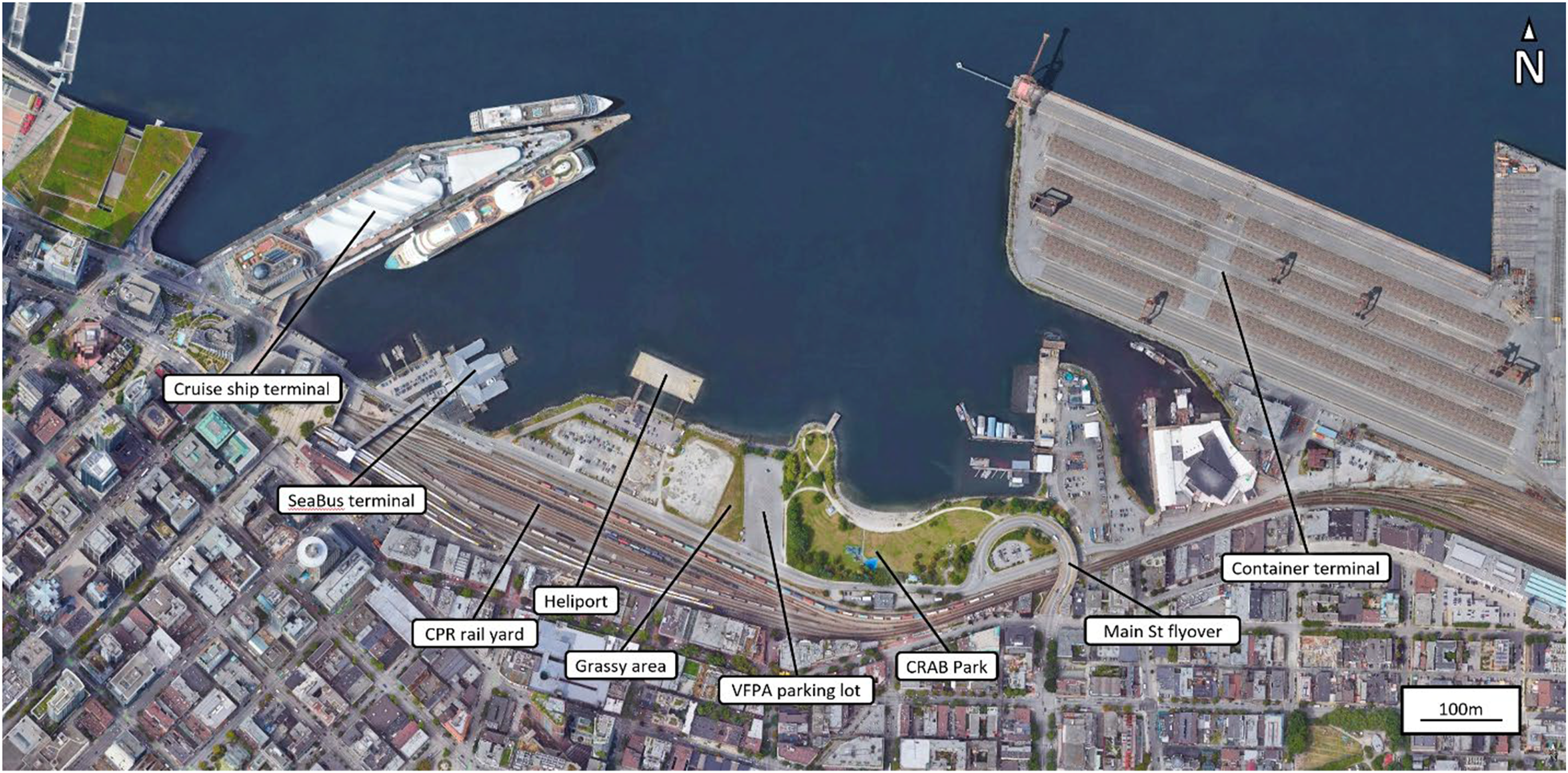
Pre-encampment Google Earth Pro satellite image of the vicinity of the encampment in VFPA v Brett, showing the Port Authority parking lot, adjacent grassy area, CRAB Park, heliport, CPR rail yard, SeaBus terminal, cruise ship terminal, Main Street flyover and Centerm container terminal. Imagery date: 29 June 2019. Imagery © 2022 CNES / Airbus, Maxar Technologies, Map data © 2022. Used in accordance with Google Geo Guidelines.
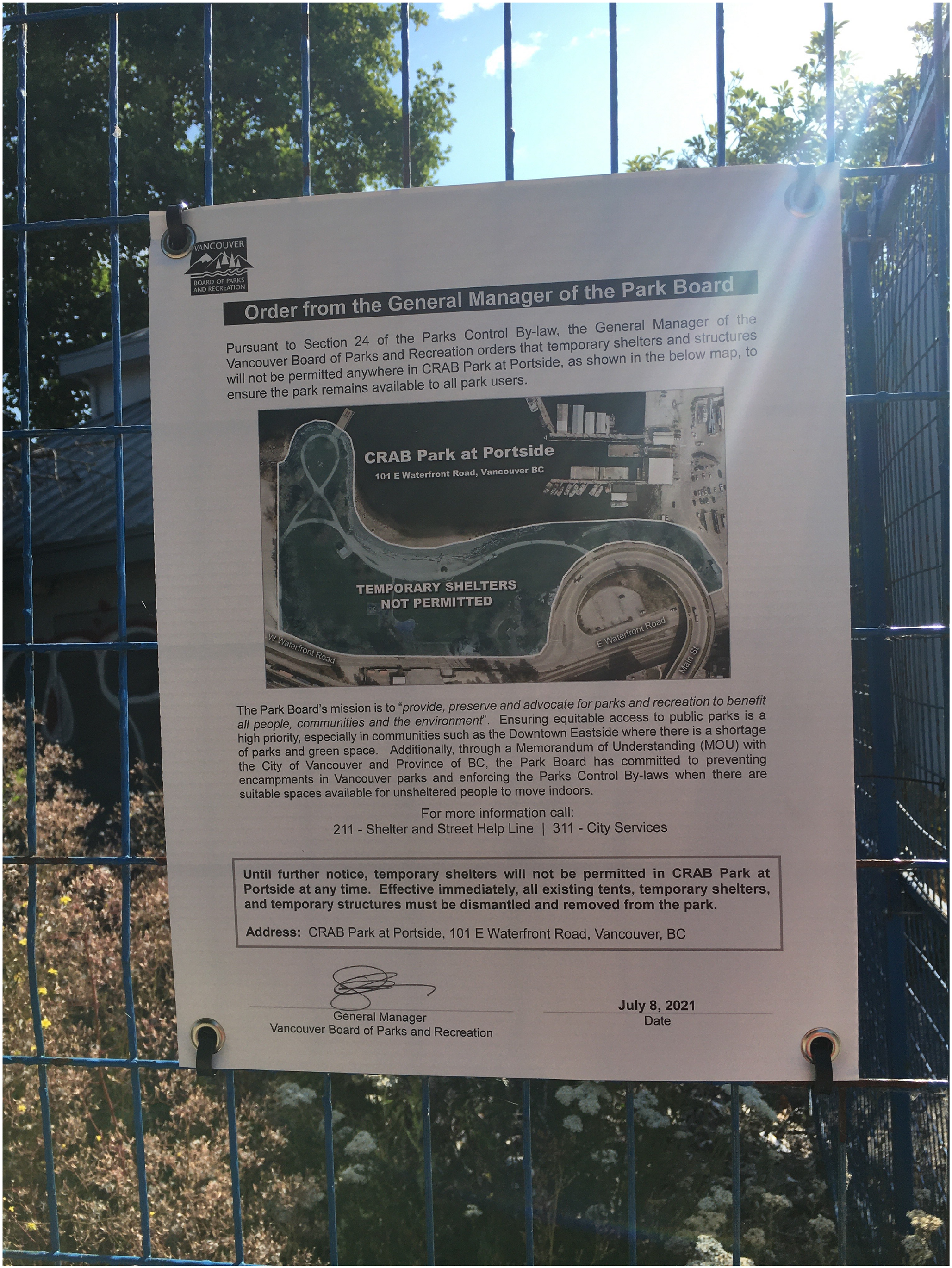
Notice, General Manager of the Parks Board (July 2021), photograph by Fiona York.
Encampments on CRAB Park
The federal Crown owns CRAB Park and adjacent lands on behalf of the Vancouver Fraser Port Authority (Canada Gazette, 2007). Even though the park is on federal lands, CRAB park is managed by the Vancouver Board of Parks and Recreation (the ‘Park Board’). CRAB Park's location on federal land is notable given the federal government's recent recognition of a right to housing in the National Housing Strategy Act (NHS Act), which came into force in 2019. Section 4 of the NHS Act recognizes that the right to adequate housing as a fundamental human right affirmed in international law; recognizes that housing is essential to the inherent dignity and well-being of the person; and seeks the progressive realization of the right to adequate housing as recognized in the International Covenant on Economic, Social and Cultural Rights (National Housing Network, 2019). The NHS Act has not been raised in any cases to date.
For context, Canada, British Columbia and the City of Vancouver have each adopted UNDRIP to guide relationships with Indigenous Peoples and, in the case of all three governments, to commit consistency between domestic laws and the Declaration (City of Vancouver, 2021; Declaration on the Right of Indigenous Peoples Act, 2019 ; United Nations Declaration on the Rights of Indigenous Peoples Act, 2021 ). Article 10 of UNDRIP states that: ‘Indigenous peoples shall not be forcibly removed from their lands or territories. No relocation shall take place without the free, prior and informed consent of the [I]ndigenous peoples concerned’.
Canadian courts have recognized the right to self-determination applies to urban Indigenous Peoples and communities (Ardoch Algonquin First Nation v Canada (AG), 2004; Canada (AG) v Misquadis, 2002). Indigenous advocates have advanced their right to be involved in the development of policy and responses to encampments and homelessness and should not be displaced without consent (Indigenous Housing Caucus Working Group, 2018). The Union of BC Indian Chiefs has specifically said in relation to encampments, ‘[t]he forced decampment and removal of campers, including Indigenous Peoples, is in direct opposition to statements made by the Park Board, City's commitment to reconciliation and BC's commitment to the implementation of the Declaration on the Rights of Indigenous Peoples’ Act’ (York, 2021). In an open letter, the Union of BC Indian Chiefs, Pivot Legal Society, the BC Civil Liberties Association, Aboriginal Front Door and the former UN Special Rapporteur on the Right to Housing have acknowledged that ‘the forced displacement of Indigenous peoples from the CRAB encampment is out of step with reconciliation and contravenes their human rights to free, prior and informed consent’ (Smith, 2021).
In a 2020 Court decision, the Port Authority sought an injunction to stop encampment residents and others from using lands designated as a parking lot based on the argument that the Port Authority's regulations prohibited the use of the lands for encampments (para. 38). The Court held that the Port Authority lands are ‘private property and not intended for public use’ (Vancouver Fraser Port Authority v Brett, 2020: para. 98) because the applicable regulations generally disallowed the use of the Port Authority lands for encampments. He also stated that residents have violated the regulations by engaging in disallowed activities (i.e., causing a fire, and building, placing, moving and engaging in unsafe and unhygienic activity) and therefore their removal was warranted (Vancouver Fraser Port Authority v Brett, 2020: para. 56).
The Court did not engage with the claims of two experts concerning the psychological and mental health benefits of encampments and held that the Charter did not protect the rights of encampment residents (Vancouver Fraser Port Authority v Brett, 2020: paras. 71, 72, 75, 99). The decision also failed to acknowledge the National Housing Strategy Act or government obligations under UNDRIP (National Right to Housing Network, 2019). Importantly, the Justice noted that the City and Province have developed a comprehensive plan to make alternative living arrangements and emergency accommodation like shelters, along with other supports (Vancouver Fraser Port Authority v Brett, 2020: para. 110). The Justice did not explore in any detail the governmental plans, including whether the form of accommodation was suitable for encampment residents.
After the Brett decision, an encampment was set up in CRAB park on a different part of Port Authority lands, one that is meant to be accessible to the public. By June 2021, there were an estimated 79 structures and about 130–150 people living in the park (Fraser, 2020; St Denis, 2022). When an eviction order was brought this time, a different legal strategy was used, as explored next.
Judicial Review and Shelters: Scrutinizing Administrative Decision-Makers
Under Canadian law, when a government decision-maker makes a decision, the common law rules of administrative law allow for the person affected by it to challenge it on two grounds: a lack of procedural fairness or that the substance of the decision is deficient. In Canada (Minister of Citizenship and Immigration) v Vavilov, 2019 (Vavilov), the Supreme Court of Canada (SCC) radically changed both the framework for determining the standard of review and the method that courts will apply when conducting judicial review of administrative decisions. There is now a presumption that the standard of review is reasonableness except in very specific circumstances, like if the legislature has indicated a different standard (Canada (Minister of Citizenship and Immigration) v Vavilov, 2019: para. 10). According to the court, the reasonableness standard of review is meant to respect the fact that the legislature has conferred on the administrative body the power to make the decision, although Vavilov appears to have reduced the deference accorded to tribunals (Daly, 2020).
When conducting reasonableness review, the reviewing court must start with the reasons given by the decision-maker to justify the decision (Canada (Minister of Citizenship and Immigration) v Vavilov, 2019: para. 83). To assess the reasonableness of the decision, reviewing courts should review the reasons in the context of the applicable law and relevant facts; and assess the quality of the reasoning. The reasoning provided must be clear, coherent and cogent, without logical fallacies like circular reasoning or unfounded generalizations, or reasoning that doesn’t justify the outcome (Canada (Minister of Citizenship and Immigration) v Vavilov, 2019: paras. 103–104). Importantly, the SCC clarified that the reasons given must ‘reflect the stakes’ for the person affected (Canada (Minister of Citizenship and Immigration) v Vavilov, 2019: para.133). Decision-makers must ‘demonstrate that they have considered the consequences of a decision and that those consequences are justified in light of the facts and law’ (Canada (Minister of Citizenship and Immigration) v Vavilov, 2019: para.135).
Prior to the BC Supreme Court's 2022 decision in Bamberger, there were no judicial review applications regarding tent encampments, meaning no cases brought that challenged the decision of administrative actors empowered under local by-laws. Instead, the encampment cases focused on whether a municipality as an administrative body enacted a by-law that was constitutional based on provisions of the Charter. The Bamberger case was the first judicial review of administrative actions taken to close encampments. Encampment residents brought a judicial review of two orders issued by the General Manager of the Parks Board: one which prohibited any overnight sheltering in CRAB park, and a second that closed a portion of CRAB park to address damage allegedly caused by the encampment. The residents successfully challenged the decision on the basis that it was unreasonable and procedurally unfair.
Using the Vavilov framework, the court examined the chain of logic based on the decision-maker's reasons for the decision (Bamberger v Vancouver (Board of Parks and Recreation), 2022: para. 84). The court ruled that the conclusion reached by the Park Board's General Manager that sufficient and appropriate indoor sheltering options were available for CRAB Park residents was unreasonable (Bamberger v Vancouver (Board of Parks and Recreation), 2022: paras. 87–88). The decision was based on three conclusions.
First, a reasonable decision in these circumstances requires the General Manager to satisfy herself that she was ‘truly protecting the constitutional rights of the Petitioners in seeking out a proportionate balance between their rights and the right of members of the public to use the Park’ Bamberger v Vancouver (Board of Parks and Recreation), 2022: para. 97). Given that the constitutional rights of the vulnerable residents were in the hands of the General Manager, reasonableness in those circumstances required her to do more than to simply accept the statements of BC Housing, the governmental body that oversees shelter availability, before making those orders. The Court ruled that ‘reasonableness’ in these circumstances required the General Manager to give serious consideration to the constitutional rights of the Petitioners and the interests of the broad public by knowing exactly what spaces were available and that they were suitable for those at CRAB Park (Bamberger v Vancouver (Board of Parks and Recreation), 2022: para. 97).
The Orders (one depicted in Figure 2) made no mention of the constitutional rights of those experiencing homelessness to shelter overnight in public parks, and the focus was on maintaining public access to the park (Bamberger v Vancouver (Board of Parks and Recreation), 2022: para. 86). As such, the Court ruled that there was little evidence in the record that the General Manager ‘seriously turned her mind to the Charter rights of those affected by the Orders’ ((Bamberger v Vancouver (Board of Parks and Recreation), 2022: para. 86). When making an order that has significant and harsh consequences for the constitutional rights to life, liberty and security of a highly vulnerable population, reasonableness requires ‘more than an unquestioned reliance on conclusory statements provided by another government office’ (Bamberger v Vancouver (Board of Parks and Recreation), 2022: para. 97).
Second, the Court ruled that the General Manager did not have a reasonable factual basis for her conclusion because she had insufficient information before her (Bamberger v Vancouver (Board of Parks and Recreation), 2022: para. 96). The advice she relied on had no details regarding numbers, locations or suitability of these spaces, and there was no evidence that she sought out that information. For the General Manager's conclusion to be rationally supported, there must be enough indoor spaces for the number of unhoused persons who were sheltering in CRAB Park, the indoor spaces must be available to those sheltering, and the indoor spaces must be suitable to them. The decision detailed the affidavit evidence exemplifying how difficult it is to access the indoor spaces, how often restrictive their requirements are, and the lived experiences of people at CRAB Park trying to find housing (Bamberger v Vancouver (Board of Parks and Recreation), 2022: paras. 110–120).
Third, the Court rejected the Parks Board's argument that even if there was no suitable indoor sheltering space, the Petitioners’ Charter rights were not unreasonably impacted because they could shelter at any number of other parks in the city, and that persons experiencing homelessness do not have a right to shelter in a specific park (Bamberger v Vancouver (Board of Parks and Recreation), 2022: para. 139). The Parks Board ‘simply assuming’ that the CRAB Park residents can find somewhere else to go does not give their section 7 rights the necessary priority and ensure minimal impairment of those rights. CRAB Park residents showed that being near the Downtown Eastside is essential because of access to services and amenities (Bamberger v Vancouver (Board of Parks and Recreation), 2022: paras. 141–143). As a result, the Court stated that it was incumbent on the General Manager to satisfy herself that closing the last major park in or near the area to overnight sheltering would not adversely affect the ability of encampment residents to access the services and other facilities needed to survive (Bamberger v Vancouver (Board of Parks and Recreation), 2022: para. 147).
Judicial Review and Social Control in Encampment Evictions
The Bamberger decision unambiguously clarifies that administrative decision-makers are important legal actors in enforcing by-laws that relate to encampment residents. Based on Bamberger, local governments – including local bodies like park boards – must go beyond ensuring that there are available indoor spaces for the number of unhoused persons, to having appropriate data demonstrating that indoor spaces are suitable. And, in doing so, the court clarified that the Charter rights of encampment residents must be considered when the General Manager makes decisions. This decision acknowledges that shelters may be inaccessible for unhoused people based on their use of social control measures, and that unhoused people are entitled to procedural fairness. The decision thus shifts the bar in two important ways, both of which are relevant to social control.
First, and most importantly, the case established that shelter space must be appropriate for the specific unhoused person involved. Not any shelter space will do. The decision emphasized the challenges that unhoused people have with indoor shelters: ‘Persons sheltering in the Park have deposed, unsurprisingly, that the state of being homeless is difficult and dangerous. They universally state they would prefer to shelter indoors but they dispute there are sufficient indoor spaces to shelter them. They say the spaces that are available are not suitable to their needs’ (Bamberger v Vancouver (Board of Parks and Recreation), 2022: para. 31). These needs include: shelters with locked doors for survivors of physical and domestic abuse; places that permit sheltering despite lack of identification; and shelters which supply secure locations for belongings (Bamberger v Vancouver (Board of Parks and Recreation), 2022: paras. 118–119). The case clarified the obligations on government actors to provide shelters that come closer to serving the specific needs of vulnerable populations.
The court's acknowledgment of the preference of unhoused people to stay in encampments because of the dehumanizing and unsafe constraints in shelters is consistent with social control literature. As was stated in Bamberger, accounts of encampment residents include specific challenges with shelters that relate to their social control processes, such as long waits, strict curfews, not being able to stay with partners or pets, demeaning treatment by staff, and the inability to store their belongings (Herring, 2014). Another overlap between the decision and literature is a preference for encampments over shelters in many cases. When asked why they ‘choose’ to camp as opposed to other alternatives, unhoused people focus on the benefits of the camps as compared with shelters, not whether or not shelters are available (Herring, 2014).
Second, the court took issue with staff's reliance on information from another government agency that there were sufficient available spaces to shelter CRAB Park residents. In fact, staff had no specific information about what indoor sheltering was available and could not affirm its suitability. The court displaced the often unchecked discretion afforded to administrative decision-makers who enforce rules as against unhoused populations (Katuna and Silfen-Glasberg, 2014), acknowledging the rights of encampment residents to procedural safeguards. These requirements provide a check on state action such that encampment residents are seen as people with rights (Bamberger v Vancouver (Board of Parks and Recreation), 2022: para. 69). Indeed, the court went even further by elevating the rights of encampment residents to be heard ‘above ordinary users of the Park, or even particular users of the Park, such as (to take counsel's example) a soccer team whose game is cancelled when a field is closed for maintenance’ (Bamberger v Vancouver (Board of Parks and Recreation), 2022: para. 63). The decision goes farther than any other in emphasizing that unhoused people should be understood as autonomous, human rights agents (Farha and Schwan, 2020).
It is important to note, however, that despite these steps forward in recognizing the rights of unhoused people, Bamberger does not fundamentally displace the notion that temporary shelters are a reasonable form of accommodation and an appropriate alternative to living in encampments (Hartnett and Postmus, 2010). The court does not frame the existence of shelters as an issue in and of itself, as noted in the following statement: ‘None of what I have said is intended as criticism of the staff and volunteers … I have no doubt that [staff] work tirelessly to shelter and house the homeless population of Vancouver. The ever-growing nature of the problem must be a frustration to them and make it particularly challenging to stay on top of the work and get ahead of the problem’ (Bamberger v Vancouver (Board of Parks and Recreation), 2022: para. 151). In this sense, it is the lack of shelter spaces, not their very existence, that leads the Court to set aside the Parks Board's decision.
In addition, this case also does not specifically engage with the right to housing enacted at the federal level even though CRAB Park is located on federal lands (Farha and Schwan, 2020). Nor does the court does not outline the required consultation process, including adherence to Indigenous consultation requirements (Farha and Schwan, 2020). This is a missed opportunity to engage with the right to housing and the rights of Indigenous Peoples living in encampments in the Canadian context (Biss et al., 2022). This case, like all others in Canada, focuses on the specific encampment in question and does not recognize a positive right to housing. Given recent developments in case law (The Regional Municipality of Waterloo v. Persons Unknown and to be Ascertained, 2023), there is opportunity for jurisprudence to develop in this area, bringing it closer in line with approaches in the United Kingdom and the European Union, whereby local governments must adhere to statutory requirements in the area of housing security.
Nonetheless, the case has already had implications for the role of the courts in relation to administrative decision-makers and their engagement with unhoused people. In January 2023, in another Canadian province, the court adopted Bamberger's reasoning that ‘If the available spaces are impractical for homeless individuals, either because the shelters do not accommodate couples, are unable to provide required services, impose rules that cannot be followed due to addictions, or cannot accommodate mental or physical disability, they are not low barrier and accessible to the individuals they are meant to serve’ (The Regional Municipality of Waterloo v. Persons Unknown and to be Ascertained, 2023: para 93). In other words, shelters must not simply be available, but accessible to those who will be living in them. By focusing on administrative action rather than the by-law itself, the court makes clear that rules and practices are as meaningful as the laws themselves, including shelter practices. In other words, social control practices can be used as a basis to argue that shelters are inaccessible.
Conclusion
At the outset of the COVID-19 pandemic, the former United Nations Special Rapporteur on the Right to Adequate Housing, Leilani Farha, called on state parties to ‘declare an end to all forced evictions of informal settlements and encampments’ and instead, create emergency plans to assist encampment residents including providing adequate resources, as listed above (Farha, 2020:1–2). The literature shows that encampments are the result of both absolute homelessness and the poor conditions of the temporary shelters and low-income housing provided to unhoused people (Boyd et al., 2016; Fast and Cunningham, 2018). Municipalities routinely respond to encampments with trespass orders and temporary shelters, both of which aim to control the freedom and conduct of unhoused people (Johnsen et al., 2018; Mahoney, 2019).
Courts act as an important check on local government action, in Canada and elsewhere (Fitzpatrick and Watts, 2010). Beginning with the Adams decision in 2009, courts have gradually required more protections for unhoused people before encampment evictions will be permitted. Until 2021, municipal trespass orders would be valid only if sufficient shelter spaces were available, endorsing the notion that availability of shelter spaces is sufficient, regardless of their condition or the needs of unhoused people. Bamberger shifted the requirements, emphasizing that officials must turn their minds to the details, including precise information on the suitability of housing and the human rights of encampment residents. In so doing, the social control aspects of shelters came under considerable scrutiny, as onerous restrictions and rules are a major reason why unhoused people find shelters unsuitable. In addition, Bamberger, for the first time, recognized that encampment residents are not only owed procedural fairness, their rights are constitutionally protected.
Given the lack of adequate housing in Canada, encampments will continue to exist in parks and other public spaces. The legal approach to encampments in Bamberger raised the standard of treatment owed to encampment residents, calling attention to the lack of adequate housing, the inadequacy of temporary shelters and the rights to notice and other procedural safeguards. The use of judicial review brought into sharp view the relationships between the actions of administrative actors and the social control exercised through the shelter system. Officials have obligations to unhoused people as a result of human rights protections like the Charter. The court recognized that the social control inherent in the shelter system is part of the reason these spaces are inaccessible to unhoused people, bringing shelters into sharp rebuke.
Footnotes
Acknowledgements
The author is grateful to the many wise colleagues who helped me in crafting this piece, especially Estair Van Wagner, Michel Vols, Lieneke Slingenberg, Jessie Hohmann, Nick Blomley, Erin Dej and two anonymous reviewers. The author is also indebted to Fiona York, Julia Riddle and residents of CRAB Park for their insights. Their suggestions and questions made this article so much better. Thanks also to Pedram Gholipour for outstanding assistance. All errors and omissions are my own.
Declaration of Conflicting Interests
The author declared no potential conflicts of interest with respect to the research, authorship, and/or publication of this article.
Funding
The author received no financial support for the research, authorship, and/or publication of this article.
