




Abstract
This study explored how participatory disciplinary systems in democratic (open) schools reflect distinct models of students’ collective rights to participate in decision making embedded in different patterns of legal socialisation. Drawing on semi-structured interviews with students, educators, and parents from three democratic schools in Israel, the study revealed contradictory approaches. One student participation model subscribes to a strictly legalistic approach, grounded in a criminal justice discourse and encompassing all aspects of the school's everyday life as well as after-school hours. A second model of participatory practices operates a flexible disciplinary system derived from mediative and therapeutic principles, applying procedural rules only in severe cases. The differences between the models indicate that participation does not inherently shape the contours of schools’ disciplinary systems. They challenge the dichotomous discourse in the literature on participation rights and legal socialisation, contrasting punitive vs. participative disciplinary methods and coercive vs. consensual approaches towards rules.
Introduction
I don’t believe it's good to educate people to sue whoever bothers them … I think they need to learn to solve [things] between them and not go to court. … In my view, it's even terrible that it's part of democratic education.
Democratic schools are distinguished by a high level of student participation in all aspects of school management, including the disciplinary system. Participatory disciplinary methods are considered a fulfilment of children's rights to participation (Osler, 2000; Perry-Hazan and Lambrozo, 2018), anchored in the UN Convention on the Rights of the Child (1989, hereinafter UNCRC), and a valuable alternative to traditional punitive methods (e.g., Darling-Hammond et al., 2020; Gogos, 2020; Prud’homme, 2012; Smokowski et al., 2018). Studies on participatory disciplinary methods, such as peer mediation, restorative justice, and school-based youth courts, have highlighted their benefits; however, critical inquiries into the ramifications of such methods are lacking. A similar uncritical approach has characterised research on children's participation rights in other domains. The current study addresses these gaps in the literature.
The paper opens with a theoretical background comprising three subsections. The first subsection reviews the participation rights literature and highlights the lack of critical literature in the field. The next subsection reviews the research on legal socialisation, referring to how institutions socialise children to develop different law-related values, attitudes, and behaviours (see Tapp, 1991; Tapp and Levine, 1974). Implementing children's rights in schools, including participation rights, is part of children's legal socialisation processes. Most legal socialisation studies have focused on relationships with the law and its representatives, particularly with the police (e.g., Granot et al., 2021; Kaiser and Reisig, 2019; Kupchik et al., 2020; Tyler et al., 2014); however, scholars concur that the legal socialisation process occurs in non-legal institutions such as schools (Tapp, 1991; Tapp and Levine, 1974; Trinkner and Reisig, 2021; Trinkner and Tyler, 2016). The last subsection focuses on democratic schools and describes the contextual background for the current study. Next, we outline the research design, which draws on data collected from students, educators, and parents from three democratic schools. The findings compare two distinct disciplinary models, both of which serve whole-school participatory approaches. In one of these models, the participatory practices were reflective of a strictly legalistic approach, drawing on a criminal justice discourse and encompassing all aspects of the school's everyday life as well as after-school hours. In the other model, the participatory practices comprised a component of a flexible disciplinary system that drew on mediative and therapeutic principles, applying procedural rules only in severe cases.
The final sections of the paper use insights from studies on participation rights and legal socialisation to discuss the implications of these different approaches. The school discipline literature has highlighted the contrast between punitive and participatory approaches (e.g., Armour, 2016; Osler, 2000; Perry-Hazan and Lambrozo, 2018). Similarly, the legal socialisation literature has linked the application of participatory practices with a consensual orientation towards the law, differing from a coercive orientation (Tyler and Trinkner, 2018; see also Tapp, 1991; Tapp and Levine, 1974). Our findings challenge this dichotomous approach. We argue that student participation is not monolithic; it may be embedded in distinctive approaches that could have vastly different educational implications. The sharp contrast between the two described participatory approaches indicates that, despite common perceptions of student participation in school discipline, such participation does not inherently shape the contours of the school's disciplinary system. The applied participation policy may be integrated into an overarching punitive and coercive architecture determined by adults, possibly socialising children to develop an uncritical approach towards unjust rules determined by democratic participatory procedures.
Children's Participation Rights
This study investigates democratic schools, which endorse an ethos sanctifying student participation (see Gawlicz and Millei, 2022; Korkmaz and Erden, 2014). Children's participation rights are anchored in the UNCRC (1989). Article 12 of the UNCRC requires countries to ‘assure to the child who is capable of forming his or her own views the right to express those views freely in all matters affecting the child.’ Moreover, the child's views must be given due weight in accordance with the child's age and maturity (Article 12). Hence, participation rights encompass two interrelated rights: children's right to express their views and their right that their views will be given due weight.
Participation rights is a complex term comprising several elements and can be implemented at various levels (e.g., Hart, 1992; Lundy, 2007; Perry-Hazan and Somech, 2023; Shier, 2001). The distinction between individual and collective participation rights holds particular importance for the current study. Individual participation rights refer to the child's right to participate in decisions that affect their own life. Collective participation rights refer to the right of groups of children to participate in decisions that affect children as a group (UN Committee on the Rights of the Child, 2009: 9–10).
Participation rights gained a fundamental status, as participation was recognised as one of the four general principles of the UNCRC (UN Committee on the Rights of the Child, 2001, 2009). This status was re-established in a critical examination of those principles (Hanson and Lundy, 2017). Many scholars have studied ways to implement participation rights effectively (e.g., Cossar et al., 2016; Lundy et al., 2011; McEvoy and Lundy, 2007; Sargeant and Gillett-Swan, 2019; Sinclair, 2004; Todd, 2012). Importantly, they have also drawn attention to the barriers to implementing these rights (Shier et al., 2014; Tisdall, 2015; Vis et al., 2012).
Those supportive approaches often neglected to note the ramifications of participation rights (see Perry-Hazan, 2021), with some scholars arguing that promoting participation has become a ‘moral crusade’ (Lewis, 2010: 15) or an unchallenged ‘mantra’ (Tisdall and Punch, 2012: 251, 254) that mutes critical voices. Moreover, prominent theoretical models have not clearly distinguished between individual and collective participation (e.g., Gal, 2017; Herbots and Put, 2015; Lundy, 2007). Studies have also failed to address the impact of children's collective participation on the rights of individual children (Zak-Doron and Perry-Hazan, 2023). This uncritical trend may have emerged due to the artifact of children's rights scholars personally inclined to advocate for these rights, thus side-stepping potential pitfalls (Quennerstedt, 2013).
Thus, critical research on participatory practices in education is scarce (see Mitra, 2018; Perry-Hazan, 2021). Several studies have indicated that mandatory participation may disregard students’ rights not to participate (e.g., Hanna, 2021; Lefstein et al., 2020) or deepen educational inequalities due to the tendency to label children who do not participate as problematic and deviant (e.g., Bragg, 2007; McKay, 2014). Perry-Hazan (2021) offered a theoretical framework that conceptualised conflicts between participation rights in school and other student rights and emphasised the need for further research on those conflicts.
Legal Socialisation in Schools
Legal Socialisation Within and Beyond the Legal World
Implementing rights in school, including participation rights, is a component of children’s legal socialisation. During childhood and adolescence, people develop law-related values, attitudes, and behaviours through legal socialisation (Tapp, 1991; Tapp and Levine, 1974). Legal socialisation encompasses values, attitudes, and behaviours towards the law and law-related representatives and institutions (Fine and Trinkner, 2022; Trinkner and Reisig, 2021).
Whereas many legal socialisation studies have focused on relationships with the law and its representatives, particularly with the police (e.g., Granot et al., 2021; Kaiser and Reisig, 2019; Kupchik et al., 2020; Tyler et al., 2014), scholars agree that the legal socialisation process extends far beyond the legal domain (Tapp, 1991; Tapp and Levine, 1974; Trinkner and Reisig, 2021; Trinkner and Tyler, 2016). More than three decades ago, Tapp (1991) theorised that legal socialisation begins in early childhood, as children's perceptions are shaped through their interactions with authority in various arenas, such as school and family. Other studies supported this hypothesis, linking school experiences with adults’ law-related attitudes and behaviour (e.g., Claes et al., 2012; Fine and van Rooij, 2021; Kupchik and Catlaw, 2015; Nivette et al., 2022; Tyler and Trinkner, 2018). The school experience is considered an essential step in the process of legal socialisation as it comprises an intermediate stage between the informal and personal authority of the family and the formal, impersonal authority of the law (Tyler and Trinkner, 2018).
Coercion and Consent in Schools
Trinkner and Tyler's legal socialisation model differentiated between two main orientations towards the law: coercion and consent (Trinkner and Tyler, 2016; Tyler and Trinkner, 2018). In their actions, parents, educators, and law representatives can facilitate one orientation or the other. A coercive orientation derives from using power and punishment to deter people from rule violation by making it not worthwhile. In contrast, a consensual orientation is based on the promotion of positive values, trust, and legitimacy towards the law to facilitate voluntary deference towards the law (Mazerolle et al., 2021; Trinkner and Tyler, 2016; Tyler and Trinkner, 2018). Prevalent policies typically facilitate a coercive orientation, where compliance with the law is based on deterrence and considering risks and benefits (Tyler and Trinkner, 2018). However, studies suggest that the promotion of a consensual orientation is both possible and effective (Mazerolle et al., 2021; Trinkner et al., 2018; Trinkner and Tyler, 2016)
In this context, Tyler and Trinkner (2018) identified three dimensions of authority relations that authority figures must consider to promote a consensual orientation: (1) How authorities treat civilians, which should convey respect, dignity, and concern; (2) the decision-making process, which should be neutral, consistent, and transparent; and (3) a recognition of appropriate boundaries, meaning that authorities should respect the limits of their rightful power. Trinkner and colleagues (2018) found that individuals’ evaluations of police behaviour on these three dimensions formed a strong predictor of legal legitimacy, which, in turn, was associated with more compliant behaviour.
The distinction between coercion and consent and the dimensions of authority relations promoting a consensual orientation towards rules are highly relevant to the context of school discipline. Many schools apply punitive disciplinary policies that rely on deterrence and punishment despite the vast body of research indicating such policies are ineffective and discriminatory (e.g., Kupchik, 2010; Mittleman, 2018; Morris and Perry, 2017; Perry and Morris, 2014; Ramey, 2015; Skiba et al., 2011; Sullivan et al., 2013). Punitive policies facilitate a coercive orientation towards the law that may hold negative ramifications, such as less civic participation (Kupchik and Catlaw, 2015) and more delinquent behaviour (e.g., Skiba et al., 2014).
An alternative approach to school discipline tries to instil positive values and attitudes that will result in consensual compliance with rules (see Trinkner and Tyler, 2016; Tyler and Trinkner, 2018). One way to achieve this goal is simply by treating students fairly. Perceived justice and fair treatment are associated with less violence and delinquent behaviour (Donat et al., 2012; Gottfredson et al., 2005; James et al., 2015; Sanches et al., 2012) and higher teacher legitimacy (Gouveia-Pereira et al., 2003, 2017).
In addition, student-teacher bonds play a vital role in the in-school legal socialisation process. Better attachment to teachers and the school can improve teacher legitimacy (Nivette et al., 2020) and prevent delinquent behaviour (Payne, 2008). A supportive school climate is also associated with less bullying and delinquent behaviour (Cook et al., 2010; Gottfredson et al., 2005).
Applying democratic norms and procedures in school, which emphasise the importance of student participation in decision making, may also contribute to facilitating a consensual orientation towards the law (see Tyler and Trinkner 2018). Indeed, Claes and colleagues (2012) found that an open classroom climate, where students are encouraged to develop and express their own opinions, strongly affects political trust. Similarly, Treviño and colleagues (2017) found that a democratic school environment predicts students’ expected participation and attitudes towards diversity.
Various approaches to school discipline are based on participatory practices, such as peer mediation (Johnson and Johnson, 1996), restorative justice (Darling-Hammond et al., 2020; McCluskey et al., 2008), and school-based youth courts (Smokowski et al., 2018). Studies have shown that these approaches reduce student misbehaviour and improve school climate (Darling-Hammond et al., 2020; Johnson and Johnson, 1996; Smokowski et al., 2018). However, there is a paucity of critical inquiry into the implications of some of these approaches (see Ispa-Landa, 2017; Philipson, 2012).
Boundaries of School Authority
The first two dimensions in Tyler and Trinkner's (2018) model—treatment and decision making—have received considerable scholarly attention (e.g., Donat et al., 2012; Gottfredson et al., 2005; Gouveia-Pereira et al., 2003, 2017; James et al., 2015; Sanches et al., 2012). The third dimension, regarding the boundaries of authority, is far less researched, especially in the school framework. The scant literature on this topic has shown that students acknowledge the boundaries of their teachers’ authority and would not comply with teacher demands that breach those boundaries (Yariv, 2009).
According to Tyler and Trinkner's model, breaching the boundaries of the school's authority facilitates a coercive orientation towards the law (Trinkner and Tyler, 2016; Tyler and Trinkner, 2018). Such a link has been demonstrated with regard to the police: Individuals believing that the police respect the boundaries of their own authority were shown to demonstrate higher levels of police legitimacy and compliance with the law (Huq et al., 2017; Trinkner et al., 2018). However, to our knowledge, no similar studies have been conducted on bounded authority in schools. Moreover, the concept of bounded school authority has rarely been addressed in the literature (Tyler and Trinkner, 2018; Yariv, 2009).
The current study contributes to the legal socialisation literature by describing two models of school discipline that are similar in many ways but differ concerning the boundaries of the schools’ authority. The study also contributes to legal socialisation research in two other aspects. First, whereas legal socialisation studies have typically focused on youth of low socioeconomic status, the current research investigates democratic, alternative schools, where most students come from families of high and middle socioeconomic status. Second, this research employs qualitative methods––rare among legal socialisation scholars––that provide novel and significant insights into the legal socialisation processes (Barak-Corren and Perry-Hazan, 2021; Carr et al., 2007).
Democratic Schools
The term ‘democratic schools’ describes educational institutions that involve students in the school's management through democratic procedures (see Korkmaz and Erden, 2014). Students in democratic schools are equal participants in all school practices and enjoy high levels of autonomy (see Korkmaz and Erden, 2014; Wilson, 2015). Students can determine their own schedules, and the entire student body can actively participate in the school's management (Hecht and Ram, 2010). Democratic schools’ disciplinary systems are typically based on committees comprising several students and one or two teachers as adjudicators (Greenberg, 1991; Hecht, 2010; see also Prud’homme, 2012). As both students and teachers are allocated one vote (see Greenberg, 1991; Hecht, 2010), the rulings and verdicts are essentially decided by the students, who comprise the majority of the tribunal.
Most literature on democratic schools has been published by democratic schools’ founders (e.g., Greenberg, 1991; Hecht, 2010; Neill, 1960), whereas academic research on democratic schools has remained scarce. Wilson (2015) studied decision-making processes in an American Sudbury school and identified informal power structures that challenge the school's formal egalitarian ideology. Gawlicz and Millei (2022) studied the different uses of children's voice in a Polish democratic school. They found that only some participation modalities were acceptable in the school meetings and that the children's voice was used to empower the children but also to exclude children who presented undesired behaviour. Contrary to other participatory disciplinary practices, almost no research has addressed disciplinary committees in democratic schools. An exception to this lacuna is the research of Prud'homme (2012), who studied conflicts that emerged during the disciplinary procedures in a Canadian democratic school.
Among the various extant models of democratic schools, this research examined schools that adopted two different models: the Sudbury model, which follows the model of the Sudbury Valley School, and the Hadera model, which follows the model of the Democratic School of Hadera. The Sudbury Valley School was founded in Massachusetts, USA, in 1968 as part of the ‘free school’ movement that flourished in the USA during the 1960s and 1970s. These schools’ ideology sought to maximise the children's freedom and autonomy, maintaining that most adult interventions were unnecessary or even harmful to the children's well-being (Hecht and Ram, 2010; Miller, 2002). The Democratic School of Hadera was founded in Israel in 1987. This school's ideology was inspired by earlier free schools, including the Sudbury Valley School. However, the Hadera model aspired to adapt the free school ideology to global changes since the 1960s (Hecht, 2010; Hecht and Ram, 2010), including the emergence of the children's rights discourse. Inspired by the UNCRC, one of this model's fundamental assumptions is that a child needs protection and support to thrive (Hecht and Ram, 2010): children ‘need clear boundaries to feel real freedom’ (p. 14). Thus, a fundamental difference between the two models is that whereas the Sudbury model sought to maximise freedom, the Hadera model was founded on the belief that some boundaries and adult interventions are required for the child's optimal development (Hecht and Ram, 2010).
Research Design
Objectives
This research explored how participatory disciplinary systems in democratic (open) schools reflect distinct models of students’ rights to participate in decision making, which are embedded in different patterns of legal socialisation. The study contributes a critical perspective to the study of children's participation rights, which has been inclined to view participation as a monolithic practice with only positive implications and has not sufficiently distinguished between collective and individual participation. It uses studies of legal socialisation to develop this critical perceptive and challenges the prevalent theoretical dichotomies of punitive vs. participative methods and coercive vs. consensual approaches towards school rules. Moreover, the research addresses a gap in the research on democratic schools by focusing on these schools’ disciplinary systems.
Methodology
The study was conducted during 2019–2020 in three democratic schools in Israel. Two schools (School A and School B) follow the Hadera model, and one (School C) follows the Sudbury model. School A is the largest of the three, with more than 600 enrolled students aged 4–18, whereas School B is a smaller and newer school, with more than 200 enrolled students aged 6–18. School C is the smallest school in this study, with about 100 enrolled students aged 4–19.
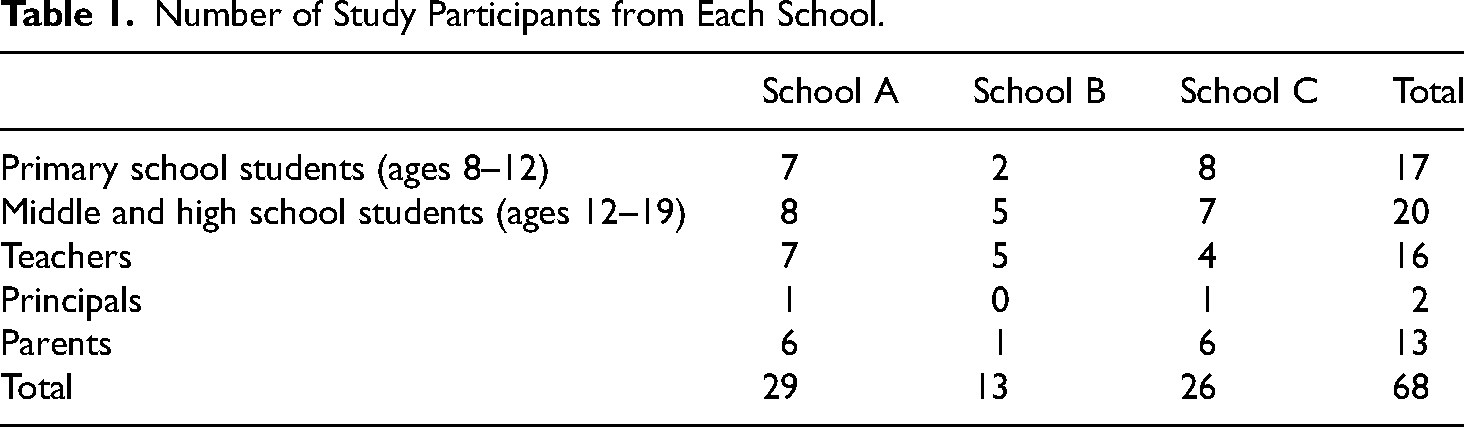
The study applied a qualitative methodology. It drew on 68 in-depth semi-structured interviews with 37 children aged 8–19, 16 teachers, 13 parents, and two school principals (see Table 1). We also collected and analysed relevant documents, including school rules, relevant forms, and documents that define the discipline committees’ responsibilities and ideology.
Number of Study Participants from Each School.
The first participants were recruited with the assistance of the school principals. They presented the research to the school communities, inviting them to participate. Many participants approached us in response to those invitations, either by e-mail or in person, during our school visits. These participants provided contacts of other potential participants after receiving their approval. In addition, we approached random teachers in the schoolyards, asking them to participate in the research.
The research procedures were approved by the Ministry of Education (approval #10938) and by our university's IBR (approval # 218/18). Adult participants signed consent forms prior to the interviews, and students under 18 provided parental consent. Assent forms in plain language were provided to the students and signed by them.
All the adults and 16 children participated in individual interviews, and the remaining 21 children participated in focus groups of 2–3 children. Most participants (n = 53) were interviewed in person, primarily in their school and sometimes in other spaces at each participant's discretion. The remainder of the participants (n = 15) were interviewed remotely via Zoom when the schools were closed due to local COVID-19 lockdowns. The interview protocols highlighted the school's disciplinary system's characteristics, the participants’ experiences with it, and how they perceived it. All interviews were recorded and transcribed.
We used a grounded theory approach to analyse the data (Strauss and Corbin, 1998). To ensure reliability, each author reviewed the transcriptions independently and formulated tentative categories. We discussed the ideas and agreed on themes highlighting distinctions between the Hadera-model schools (School A and School B) and the Sudbury-model school (School C). We conducted a literature search to better understand our findings (Charmaz, 2008) and consulted the literature on legal socialisation. We then refined the coding scheme and used Dedoose software to analyse the data. The final coding scheme comprised three themes comparing the different school types: (1) discourse quality—legal v. educational\mediative; (2) boundaries of authority––wide v. narrow; and (3) disciplinary system–strict v. flexible.
We used pseudonyms and a three-element code when referring to the study's participants in the Findings section. The first letter (A\B\C) signifies the school; the second letter signifies the individual's role in school (S = student, E = educator, P = parent); the third element is a serial number. Thus, three sets of serial numbers were ascribed to students, educators, and parents. Some students were interviewed in focus groups; thus, students were assigned a fourth serial number, indicating the number of the interview. For example, A.S1(1), A.S2(1), and A.S3(1) refer to three students from School A, who participated in the same focus group. In addition, we mention participants’ age whenever we refer to students.
Two Contradictory Models of Participation: The Differences Between the Schools’ Participatory Disciplinary Systems
This section elaborates the distinctions between the schools’ participatory disciplinary systems. These distinctions concern three interrelated aspects: the type of disciplinary discourse, the disciplinary authority's boundaries, and the level of strictness or flexibility of the procedure. For each aspect, we compare the findings from Schools A and B (the Hadera-model schools) with those from School C (the Sudbury-model school). This comparison reveals vast distinctions, manifested in substantially different approaches to children's participation rights.
Different Disciplinary Discourses in the Participatory Procedures
‘We’re not Dealing with Emotions’: Legal Discourse
Participants from School C referred to the disciplinary procedures using terms from the legal world. For example, the procedures in the committee are called ‘trials,’ and the adjudicators are called ‘judges.’ The two parties are termed ‘prosecutor’ and ‘defendant.’ Other legal terms like ‘appeals,’ ‘verdict,’ and ‘evidence’ were also common. During the trial, the judges are required to examine the facts, decide what rule was broken, if any, and determine an appropriate response or punishment based on the facts and the relevant rule. For example, Jacob (C.E14) described School C's disciplinary system as follows: The judicial authority works on different levels. … We have the [disciplinary committee], the [appeal committee], and above it, there's our parliament, which also serves as a supreme court. … One can file an appeal once on every decision … [The adjudicators] first ask the defendant, ‘Did it happen or did it not?’… then they start calling the witnesses … after hearing all the testimonies … they decide if a law was broken, and if so – which law … then there's a decision which may include a sanction. There's this friend of mine who is also my neighbour. He sued me, and nothing came out of it. Because technically, I didn’t violate any school rule. … And I told him that I didn’t mind because if I really broke a rule, I would deserve the punishment. But I didn’t, so no wonder they decided [there was] ‘no reason to sue.’
‘He Cried, and It Was Very Touching’: Mediative and Educative Discourse
In Schools A and B, we found a different discourse, one that draws on non-legal language and the emotional and educational aspects of conflict resolution. The procedures in those schools were called ‘discussions,’ the adjudicators were called ‘committee members,’ and the parties were called ‘summoner’ and ‘summoned’ or ‘inviter’ and ‘invitee.’ Rather than quarrying for facts, the committee members focus on mending the relationship between the parties and helping the involved students reach personal insights. Accordingly, Schools A and B participants described their disciplinary procedure as semi-mediatory rather than judicial. Norah (B.E11) described this approach by quoting a dialogue between two students during a discussion: ‘The child [who broke a school's rule] said something like: What now? Aren’t you giving me a punishment?’ so [a student committee member] told him: ‘You didn’t understand. This committee is not for giving punishments. It's for finding solutions.’
Another prominent discursive aspect in the interviews with participants from Schools A and B was the focus on emotional and educational aspects. While describing a successful discussion, educators and committee members rarely mentioned the committee's resolutions. Rather, they mentioned the levels of emotions and understanding that were achieved. The following excerpts exemplify this point: Norah, B.E11: There was this kid who was ostracised. And then the three kids who led it were invited [to the committee]. [They] didn’t get a very severe response, but we were able to talk about it … and after it was over, [one of the aggressors] texted him, and he wrote ‘I’m sorry’… and they were able to tell him why they were so mad at him. Maya, A.E5: It was a very meaningful committee, so empowering, so amazing. He cried during [the committee], which was very touching because there was some understanding and reconciliation.
The Boundaries of the Participatory Committees’ Authority
‘If I Leave a Marker Open … I Can Be Sued’: Wide Boundaries of the Disciplinary Authority
The boundaries of the disciplinary authority in School C encompass almost every aspect of the students’ everyday lives. For example, to use the microwave, draw with markers, or play one of the board games, one must first go through specific ‘training.’ The school rules determine the contents of this training and specific rules for using each item. For example, a section of the school rules regulates the usage of a popular board game called ‘Catan’: 2.5.30. Catan cooperative 2.5.30.1. Eating or drinking near the Catan is forbidden. 2.5.30.2. Catan shall be stored in the conference room. 2.5.30.3. Those who use Catan shall be registered on the users’ list in the room. At the end of use, they shall put it back in its place and record that it was returned. 2.5.30.4. To play Catan, one must be trained by a member of the Catan cooperative. Training includes going through the Catan rules and a practical demonstration of assembling the Catan. One will be considered trained when a cooperative member decides they know how to assemble the Catan.
The disciplinary committee also judges minor conflicts between students. The relevant school rule in those matters is usually one of a few very general rules prohibiting violent behaviour and ‘harming human dignity.’ Those terms are attributed to an expansive definition. For example, some students were tried for shouting or ignoring a friend who spoke to them. One student reported that he was tried and punished for accidentally bumping into another student, as he described: ‘I ran … and accidentally bumped into someone, and he fell … I helped him up, and I forgot to apologise (Dean, C.S29(21), 10 years old).
The boundaries of the disciplinary authority in School C are also very wide in that they apply outside school hours and territory. Students in this school may press charges against each other over incidents transpiring outside the school grounds. As Jacob (C.E14) described: Even if it happens on WhatsApp, in the afternoon, in the summer holidays, and it affects [what happens in] school, you can sue. … You can sue for anything. … There have been cases where siblings have sued each other for annoying each other at home. [My children] are sued mostly by their siblings. … My three children were suspended [from school] because their siblings sued them… the first time they called me to say that [the second child] is suspended, it was because [the first child] sued him. [The first child] sued [the third], and [the third] was suspended.
‘The Children Should Resolve their Conflicts by Themselves’: Narrow Boundaries of the Disciplinary Authority
In Schools A and B, the boundaries of school authority were much narrower. Most Schools A and B rules resemble behaviour guidelines more than disciplinary directives. According to the participants, the incidents that reach the disciplinary committee are almost exclusively cases of interpersonal conflict or severe harm to property. Consequently, discussions in the disciplinary committees in those schools are far less common. Most respondents (educators and students alike) reported that they were summoned to the committee twice or less during their time in school. Many educators and some students were never summoned.
Schools A and B participants regarded the disciplinary committees as a last resort. In most cases, students preferred to resolve conflicts by themselves or with an educator's assistance. This approach was also encouraged by educators, as Dan (A.E2) explained: The belief here is that the children should resolve their conflicts by themselves. [Indeed,] a child requires assistance and support, [but] on the other hand, we believe there's an element in it that weakens the one who asks for assistance. It reflects their inability to resolve a conflict independently.
Strictness and Flexibility in Participatory Disciplinary Procedures
‘Zero Tolerance for Violence in the Craziest Sense’: Strict Discipline
School C endorsed a strict, punitive approach. In most cases, breaching rules resulted in some form of punishment. Common punishments included suspensions and various restrictions for the student defendant's movement or actions in school. The restrictions are usually related to the incident. For example, Eliana (C.S26(18), 10 years old) described an incident when her friend pressed charges against her following a loud dispute: There was this incident with the petting zoo … we were there, and we started arguing … how to pick up [the animals] and [my friend told me] ‘you can’t take them out’ and – stuff like that … [The Committee decided that] I wasn’t allowed to enter the petting zoo for six days.
This zero-tolerance policy applies to all students involved in violence, regardless of the defendant's circumstances or personal attributes. Consider the following example, in which the defendant was a student with a disability: Jacob, C.E14: There was a child here with Tourette syndrome. No! You aren’t allowed to swear in school … he was here for five years. … There were suspensions; there were conversations. … One of the solutions that [the child and his family] offered is a ‘rampage room,’ where it's OK to hit [objects]. [But] no. It won’t happen. It's forbidden to hit in school. Or a punching bag, for instance … no! He should learn how to control [himself]. It's OK to be upset; the question is what you do with this feeling.
‘Usually We Don’t Punish’: Flexible Discipline
The discipline in Schools A and B was less strict and more flexible. Most of the discussions in the disciplinary committees of those schools did not result in any punishment. Suspensions were rarely issued in School A, and educators from School B did not recall any case of suspension. Ben (A.S4(2), 17 years old) explained this policy as follows: There are sanctions, and we usually use them only if there's no understanding. … It also depends on the kid that was offended. If he feels that everything is OK, that he is satisfied, and he thinks it will be OK in the future – there's no reason to punish the other kid. … We believe that he hurt others because he was hurt. Once we mend the wounds of both of them, a punishment becomes unnecessary, as it would only cause confusion and frustration. We provide them with ‘good tools,’ which is like bringing them a flower, and the child has to water it for a week … and then even if he's in the middle of a game, he must restrain himself, come and water the flower, and only then he may proceed. Or making a clay statue for the child who was hurt, or writing their name in clay … the first time we don’t [issue any sanction], but on the second [time], we start with the ‘good tools,’ and on the third … if it's serious, we punish; but usually, we don’t punish, only on rare occasions. Orna, B.E9: If I see a child who is going through a difficult time, and sometimes I know why, I want to protect his privacy, and I know that because he's going through those things, he's acting in a certain way, crying and shouting all day and rampaging. … I won’t invite him to [the committee]. I will consult with [the principal]; I can also ask that we postpone [the committee] and see if it's really necessary. Dan, A.E2: There are young children … it would be very difficult for them to postpone [the procedure]… with the youngest, we don’t really wait for [the committee], we rather use the same non-violent communication tools, here and now. Betty, B.E12: There are very few children, one or two that I can think of … that we know that [the committee] isn’t good for them … so, we do it a bit differently. A.S.1-2(1), Ella, nine years old, and Ruth, 10 years old: Ella: I think there should be more discipline in it. Ruth: It should be more serious, not just saying, ‘Don’t annoy her, and she won’t annoy you.’ Ella: [They should say] ‘One more time….’ Ruth: ‘…and you will be suspended.’ There should be a greater threat. A.S10-11(7), Ethan, 13 years old, and David, 12 years old: Ethan: Nowadays, the committee doesn’t inflict punishments, and it's really bad. I don’t remember what they do today. David: Nothing. Ethan: There are no punishments, no nothing. You can take someone to the committee and- what? No one will be punished.
Can Participatory Procedures Be Punitive and Coercive? Towards a Critical Analysis of Children's Participation Rights
This research compared two models of participatory disciplinary systems in democratic schools. These models reflect conflicting approaches to student participation rights, which are embedded in different patterns of legal socialisation. The revealed distinctions challenge the dichotomous discourse in the literature on participation rights and legal socialisation, which has contrasted punitive vs. participative disciplinary methods and coercive vs. consensual approaches towards rules.
The participatory practices in School C reflected a legalistic approach, drawing on practices and a discourse inspired by criminal justice systems. All aspects of this school's everyday life are regulated by the school rules, with the participatory disciplinary procedures driven by facts, rules, and punishments. The legalistic approach also manifests in the school discourse and its strict zero-tolerance policy. Moreover, the disciplinary committee's authority in School C is extensive; the school does not recognise other spheres of authority. It encompasses even minor misbehaviours and incidents occurring outside the school premises and after school hours. This legalistic approach undermines students’ ability to make choices, which is one of the foundations of participation rights. It also prioritises the collective aspects of participation, relating to the committee's authority, over individual aspects, relating to the voices of children entangled in disciplinary incidents.
In contrast, the participatory practices in Schools A and B were part of a disciplinary system drawing on mediative and therapeutic principles. Disciplinary incidents in those schools are treated primarily as interpersonal conflicts, emphasising students’ feelings and relationships. Consequently, the conflicts discussed in the committee are examined from a relational perspective rather than a legal one. This perspective is manifested in the prevalent discourse and the malleability of the outcomes. Moreover, the rules in those schools are used chiefly for severe cases. Minor conflicts are resolved by the students themselves or with a teacher's help without engaging formal authority. This approach requires ongoing flexibility, which is embedded in children's needs and evolving capacities and serves the individual aspects of their participation rights.
Studies on participation rights and legal socialisation can facilitate our understanding of the implications of each of these approaches. The moral foundations of participation rights aim to promote children's autonomy as subjects of rights (UN Committee on the Rights of the Child, 2009: 1). Studies on school discipline have typically differentiated between punitive approaches that are embedded in criminal justice discourses and various alternative approaches that promote student participation and highlight their autonomy (e.g., Armour, 2016; Osler, 2000; Perry-Hazan and Lambrozo, 2018).
Similar distinctions are also prevalent in the legal socialisation literature, which has linked participatory practices with a consensual orientation towards the law, differing from a coercive orientation (Tyler and Trinkner 2018; see also Tapp 1991; Tapp and Levine 1974). Legal socialisation scholars have emphasised that a consensual orientation towards rules and authorities’ recognition of appropriate boundaries of their rightful power promote legitimacy and compliance with the law (Trinkner et al., 2018; Tyler and Trinkner, 2018). In contrast, a coercive orientation towards rules and systems of rules that do not recognise other spheres of authority is associated with higher rates of delinquency and less civic participation (Kupchik and Catlaw, 2015; Skiba et al., 2014; Tyler and Trinkner, 2018).
Our study challenges these dichotomies and shows that student participation does not inherently shape the contours of the school's disciplinary system. It could be integrated into a punitive legalistic disciplinary system, incorporating coercive and consensual elements. Therefore, differing forms of children's participation may foster different patterns of legal socialisation, each with distinctive implications.
In light of the above, participatory practices might be exploited to justify punitive systems despite evidence pointing to their negative ramifications, including ineffectiveness and discrimination (e.g., Kupchik, 2010; Mittleman, 2018; Morris and Perry, 2017; Perry and Morris, 2014; Ramey, 2015; Skiba et al., 2011; Sullivan et al., 2013). Moreover, when students are those who determine the rules, it becomes easier for adults to shed their responsibility for the consequences of a punitive policy by highlighting its democratic nature. School C students in our study did not criticise the coercive nature of the school disciplinary system. This acquiescence raises questions concerning how student participation might silence critics of the decisions students make or of the school's participatory practices. Furthermore, the legitimation that students develop towards the school rules and the wide boundaries of school authority might be later transferred towards the boundaries of authority in other spheres. For instance, such legitimation based on democratic procedures may serve authoritarian regimes that undermine democratic values and human rights.
Our study also contributes broader insights to the literature on participation rights. Prominent perceptions of children's participation rights are often monolithic (Perry-Hazan, 2021; Tisdall and Punch, 2012). One reason children's participation is perceived as monolithic is the insufficient attention accorded to possible conflicts between children who make decisions regarding their own lives and those who make decisions regarding their peers. Prominent models of participation rights have not clearly differentiated between participation in individual decisions and in collective decisions (e.g., Gal, 2017; Herbots and Put, 2015; Lundy, 2007). Other models addressing participation in collective decisions did not explore its interactions with participation in individual decisions (Hart, 1992; Perry-Hazan and Somech, 2023). Our findings indicate that scholars of participatory practices should attend more carefully to practices that encompass both individual and collective decisions. Our study also highlights the need for more critical studies about participation rights and their moral underpinnings.
The limitation of this study concerns its focus on a single country. Future studies may expand the inquiry and examine participatory disciplinary procedures in democratic schools worldwide. The critical inquiry of various participatory methods in school discipline, such as peer mediation, could also be expanded in future work. Although numerous studies have discussed the ramifications of zero-tolerance policies (e.g., Dunning-Lozano, 2022; Hoffman, 2014; Kupchik, 2010; Welch and Payne, 2018), only few studies have offered a critical evaluation of alternative policies (e.g., Palmer, 2014; Philipson, 2012). In addition, future studies can further examine Tyler and Trinkner's (2018) model of legal socialisation. More contextual studies may reveal the delicate interactions between the different components of the model: decision-making processes, treatment of civilians, and boundaries of authority. Another important question for future studies relates to gender differences in implementing different approaches to school discipline. Gender concerns may arise in light of studies highlighting the masculinity of prevalent legal language and conflict resolution strategies (e.g., Conaghan, 2013; Roberts, 2016; Van Wormer, 2009).
Concluding Remarks
Whereas the substance of the schools’ disciplinary decisions was determined by the children, the schools’ regulations and trials were not subject to the children's discretion. Rather, their participation was part of a broader approach whose architecture was determined by adults. Democratic education challenges how society perceives children and childhood and proposes an alternative that grants children freedom and self-governance within a democratic structure of school governance (see Hecht and Ram, 2010). Democratic schools often justified their approach by adopting a human rights discourse (Greenberg, 1991; e.g., Hecht, 2010). However, free choice implies having access to the relevant information and the discretion of choosing from among alternatives (see Lundy, 2007; Nir and Perry-Hazan, 2016). In the context of school discipline, students need to be aware that conflicts in school can be resolved in many ways, with each promoting particular desired behaviours (e.g., social norms, mediation, and restorative justice). Having children participate in determining the disciplinary structure carries particular importance, given that parliaments, voting, trials, judicial authority, and other democratic methods and institutions were invented by adults to serve adults in the management of a state. Participation rights are embedded in an assumption that fulfilling children's autonomy requires specific adaptations to children (UN Committee on the Rights of the Child, 2009, paragraph 1). Copying and pasting democratic architectures from the world of adults might obscure the need for adaptations that may manifest a better fulfilment of participation rights as well as a better process of legal socialisation.
Footnotes
Acknowledgements
We thank Benny Benjamin for helpful comments, and the interviewees, for devoting us their time.
Declaration of Conflicting Interests
The authors declared no potential conflicts of interest with respect to the research, authorship, and/or publication of this article.
Funding
The authors received no financial support for the research, authorship, and/or publication of this article.
