




Abstract
Since the 1980s, the global dimensions of institutional child sexual abuse have become increasingly apparent. In some countries this has had a profound impact locally. In Australia, one such place has been the storied town of Ballarat. Throughout Australia's Royal Commission into Institutional Responses to Child Sexual Abuse, Ballarat became a significant focus of the Inquiry. As local abuse became clearer, colourful ribbons began appearing at sites throughout the town. This article investigates the meaning of such a response, and its role in relation to survivor testimony. Transforming into a movement that persists to this day, the effect is to reconsolidate a community's ‘difficult heritage’ of institutional abuse into a more celebrated story of rebellion and protest. The originality of the article stems from the contribution it makes to understanding community-level responses to institutional abuse, and the role of ritual in the formation of collective memory.
Keywords
Introduction
Since the 1980s, the global dimensions of institutional child sexual abuse have become increasingly apparent. This burgeoning awareness has been precipitated by sustained and penetrating revelations across an array of institutional sites. Against this backdrop, questions of recognition and redress have been brought sharply into focus. Traditional responses such as criminal prosecution and civil litigation have been extremely limited in the degree to which they have offered adequate relief in the aftermath of such abuse, particularly given the scale at which it has been perpetrated. In comparison, considerable attention has been given to public inquiries, redress and apologies (Daly, 2014a, 2014b; Sköld, 2013; Sköld and Swain, 2015; Swain et al., 2018; Wright, 2014, 2017). Indeed, the regularity with which public inquiries have been enacted has led this to be described as an ‘age of inquiry’ (Wright et al., 2017b). To date, high profile examples have been enacted in around 20 countries that include Australia, Belgium, Canada, Denmark, England and Wales, Finland, Germany, Iceland, Ireland, the Netherlands, New Zealand, Northern Ireland, Norway, Scotland, Sweden, and the United States (Daly, 2014b: 5). This global trend has also been significant at the domestic level, with such inquiries often being called upon to perform a particular role in the deployment of nation-building discourses (McDonald and Oldfield, 2023; Gleeson and Ring, 2020: 109).
It is not only at the international and national levels that a reckoning regarding institutional abuse has been sharply felt. In some countries this has had a profound impact locally. In Australia, one of the sites most dramatically affected has been the storied town of Ballarat. Located in the south eastern state of Victoria, approximately 100 km west of Melbourne, Ballarat has long held a celebrated place in Australian history. It was the epicentre of Australia's goldrush in the 1850s and the famed site of the iconic Eureka Stockade in 1854, an uprising against excessive taxation and militarised policing. These events have become the subject of folklore, with Ballarat now widely described as the home of Australian democracy. More recently however, a darker history has come to prominence. The image of the town has been transformed by awareness of institutional child sexual abuse.
Throughout the course of Australia's Royal Commission into Institutional Responses to Child Sexual Abuse, Ballarat became a significant focus of the Inquiry (McPhillips, 2017; Wilson and Golding, 2017; McDonald and Oldfield, 2023). As the scale of historical abuse throughout the town became clearer, locals responded by attaching colourful ribbons to institutional sites associated with such abuse. This response has become a movement that persists to this day. Transcending Ballarat, it has become national in its reach, and at times international. Known as Loud Fence, this phenomenon is the subject of this article. While official responses on the part of states and institutions have received significant scholarly interest, much less attention has been given to unofficial and informal responses to institutional child sexual abuse. Speaking to this gap, this article investigates what it means for a local community to visually mark out historical abuse in the form of colourful ribbons tied to institutional sites. Emerging as a response to local survivor testimonies that were a central feature of the Royal Commission, I demonstrate how these testimonial dimensions – which characterise many recent public inquiries into institutional abuse – precipitated a social context in which the local community was affectively impelled to respond. If the reception of testimony broadly speaking has been the subject of little theoretical analysis (Kennedy, 2004: 51), this is even truer in the case of institutional abuse testimony. My argument is twofold: that the emergence of Loud Fence helps enliven the ethical dimensions of witnessing such testimony; and second, that the enduring persistence of this phenomenon in the years since underscores the importance of ritual in the formation of collective memory. The originality of the article stems from the contribution it makes to understanding community-level responses to institutional abuse, and the way Loud Fence demonstrates what visual histories can contribute to state responses via local acknowledgment practices.
Structurally, I begin by situating the emergence of Loud Fence within the context of the Australian Royal Commission, and sustained revelations of systemic abuse throughout institutions associated with the Catholic Church in Ballarat. In the context of official mechanisms which increasingly foreground the testimony of survivors, I show how Loud Fence arose as an affective response to such accounts. I then move to explore the form of Loud Fence in closer detail, both situationally as an expression enacted on individual fences, and its collective form as a phenomenon that reconsolidates the town's identity. Such is the work of local acknowledgment, I argue, that this response transforms institutional child sexual abuse from a ‘difficult heritage’ into a broader story concerning the town and its celebrated history of resistance. Taken together, the article illuminates local acknowledgement practices as a means for thinking about collective responsibility in the wake of widespread harm.
Situating the Emergence of Loud Fence
Echoing the way that institutional abuse has been discovered internationally, in Australia recognition of the scale of such abuse has been considerable. Throughout the 1990s and 2000s a succession of watershed inquiries began to paint a portrait of sexual abuse as a particular dimension of past welfare practices (Swain, 2015: 290). These included inquiries into the Stolen Generations (Human Rights and Equal Opportunity Commission, 1997), 1 child migrants (Australian Senate 2001) and care leavers (Australian Senate, 2004). Aligning with a succession of high profile media controversies across a multitude of institutions, by the latter 2000s political and public awareness of such abuse was well and truly nascent. This culminated in the November 2012 announcement by former Australian Prime Minister Julia Gillard of the Royal Commission into Institutional Responses to Child Sexual Abuse. Established in January 2013 and running for five years, it was the largest, longest and most expensive such inquiry in the country's history. In the few years since it has quickly come to be recognised as one of the most noteworthy inquiries of its kind internationally (McAlinden and Naylor, 2016; Wright et al., 2017a: 1). Across 444 days of public hearings, and private sessions with 8013 participants, evidence was heard into more than 1000 institutions ranging from schools, religious institutions, youth detention centres, healthcare, orphanages, sporting organisations and others (Royal Commission into Institutional Responses to Child Sexual Abuse, 2017a: 36). One such institution was the Catholic Diocese of Ballarat (Royal Commission into Institutional Responses to Child Sexual Abuse, 2017b).
Catholicism has been ingrained in Ballarat since the arrival of miners in 1851. Over the intervening years, several prominent educational institutions were established including St Alipius Boy's School and St Patrick's College. Previously esteemed institutions, these came to represent notoriety in the wake of the Royal Commission. Throughout 2015 and 2016, the Royal Commission conducted a series of public hearings as part of a case study into the Ballarat Diocese (Royal Commission into Institutional Responses to Child Sexual Abuse, 2017b: 104). Over the course of these hearings, 17 adult men gave evidence of their abuse at the hands of Diocesan officials. Representing just a fraction of those abused across Ballarat's Catholic institutions, the truer figure is far, far higher. While child sexual abuse is notoriously difficult to accurately measure, the Royal Commission established, for example, that at St Alipius alone in the single year of 1971 every male teacher and the school's chaplain were sexually abusing children (McPhillips, 2017: 139).
As these survivors were giving evidence, colourful ribbons began appearing on the fences of Catholic institutions throughout Ballarat. In the days, months, and now years that have followed, this perceptibly simple gesture known as Loud Fence has become a widespread phenomenon that acknowledges the sexual abuse of children, particularly (although not exclusively) abuse that has been perpetrated by Catholic officials (see Figures 1 and 2). Throughout Australia, for example, Loud Fences have appeared widely across much of the country. Most recently, for example, they became a flash point in the lead up to the funeral of the internationally prominent church official, Cardinal George Pell, 2 who was himself born and raised in Ballarat (Knaus and Cassidy, 2023; see Figures 3 and 4). Internationally, while Loud Fences do not retain the same visual currency elsewhere as they do within Australia, they have also appeared at locations that include the Vatican in Rome, Boston and New York, London, China, New Zealand, Bali and Galway Bay in Ireland (Harvey, 2019; Johnstone, 2020; Wilson and Golding, 2017: 862).
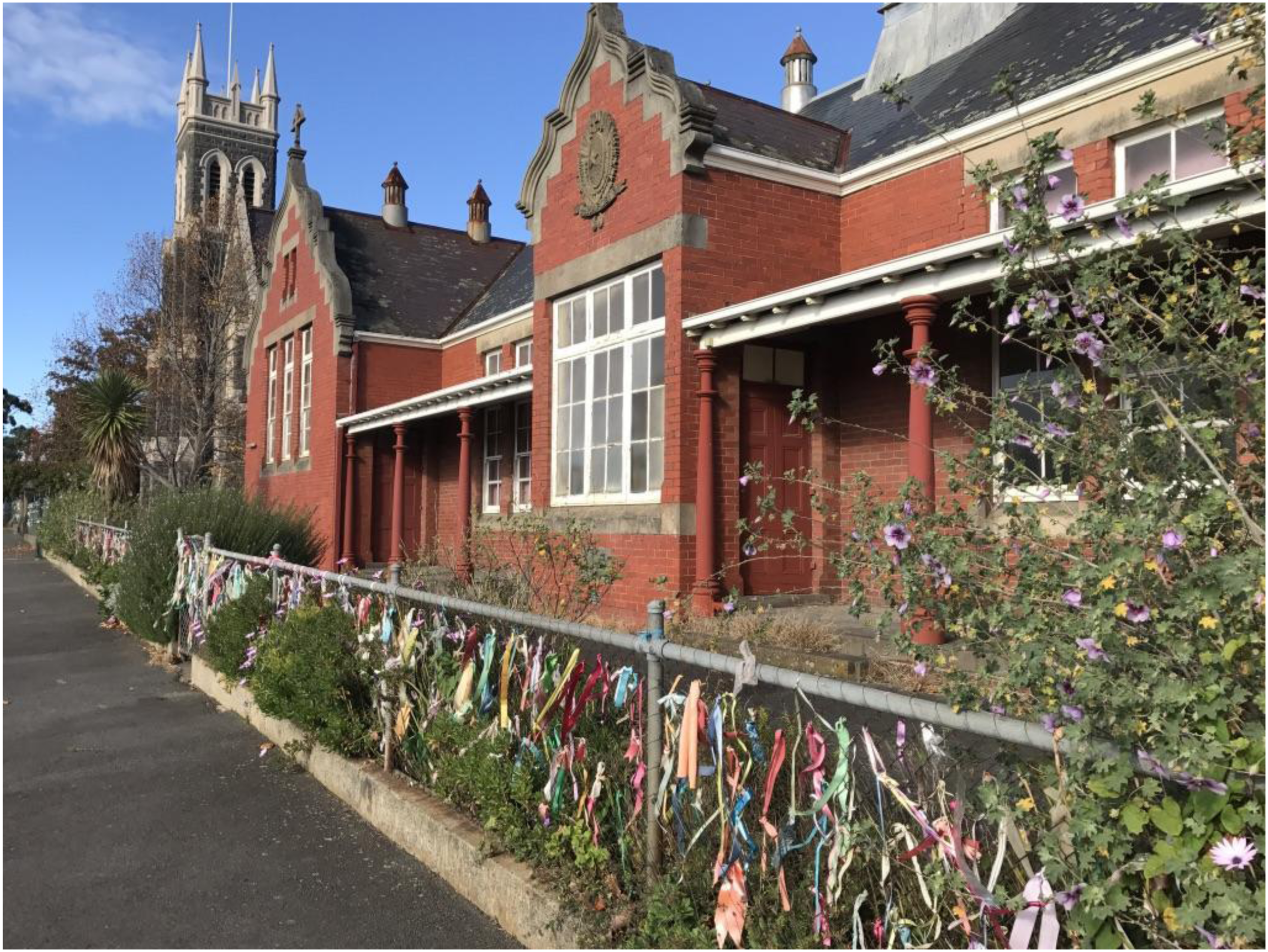
St Alipius Primary School, 2017. Copyright – author.
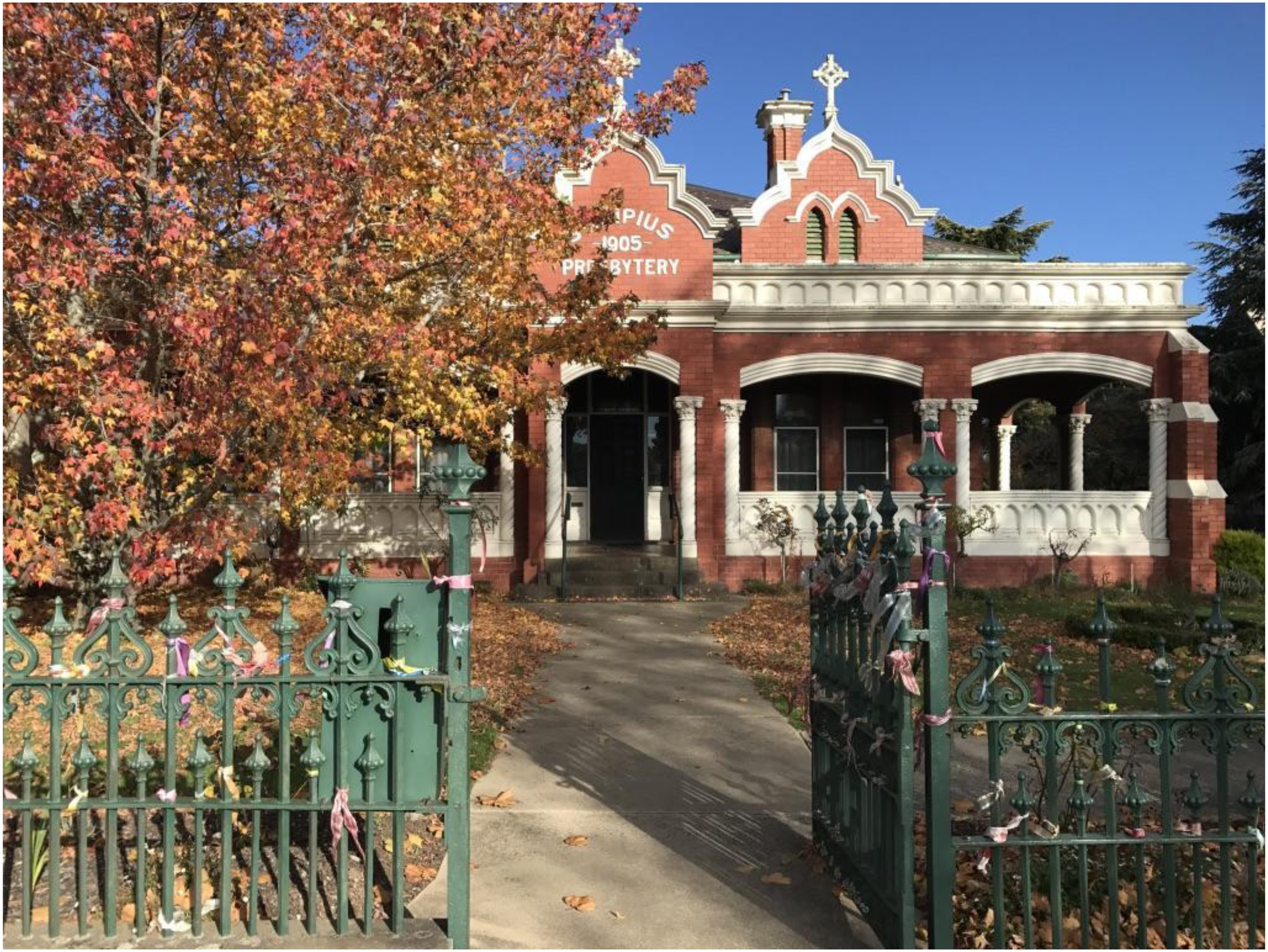
St Alipius Presbytery, 2017. Copyright – author.
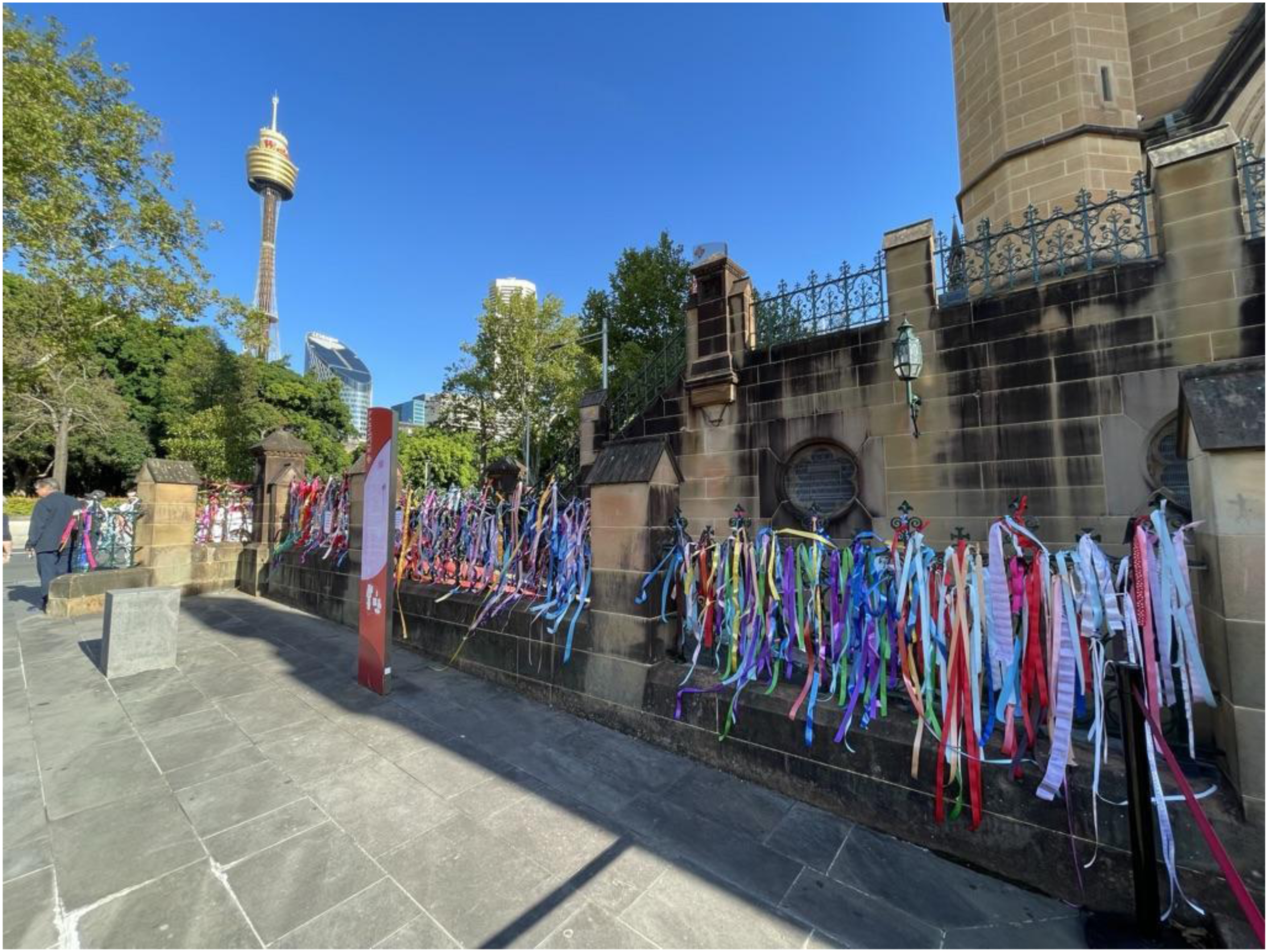
St Mary's Cathedral, Sydney, 2023. Copyright – author.
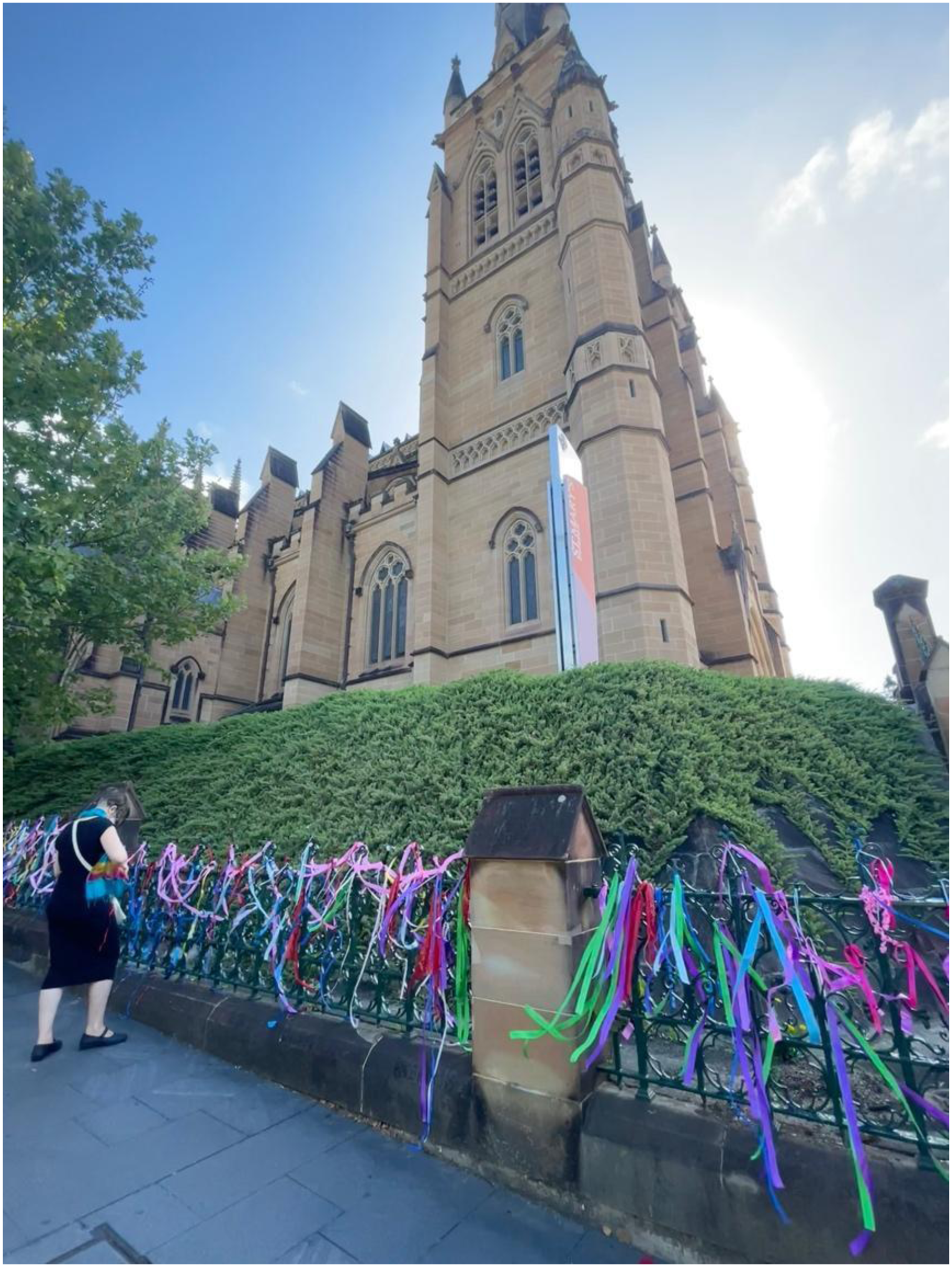
St Mary's Cathedral, Sydney, 2023. Copyright – author.
The ribbons that constitute Loud Fences are by their nature ephemeral. Sometimes they last a day. Other times they endure in spite of their precarity. Collectively, they have taken on a sacred quality and news of their removal is typically met with anger, followed regularly by their swift replenishment. Institutional responses also differ widely. Although they initially appeared without the permission of property owners, in some places they have received institutional support in response. This has included institutional representatives themselves tying ribbons to fences. In a select number of cases, Loud Fences have been rendered permanent in the form of built monuments or memorials that incorporate visual cues referencing the more ephemeral form that preceded them. Elsewhere, institutions have been much less accommodating (Peacock, 2017). At the time of writing in 2023, some eight years on from their original appearance, ribbons continue to proliferate both within and beyond Ballarat. The Loud Fence movement shows no signs of coming to an end.
Testimony and Responsibility
To understand the emergence of Loud Fence as a local practice of acknowledgment, it is instructive to position it among a broader suite of responses that have arisen in the aftermath of institutional child sexual abuse. Overwhelmingly, scholarly attention has coalesced around responses that are official in nature, be they on the part of states or institutions. Although inquiries into the abuse and maltreatment of children have a much longer history, the first to investigate institutional abuse as a distinct social problem was the United States Senate Hearings on Abuse and Neglect of Children in Institutions in 1979 (Daly, 2014b: 5). Inquiries have since proliferated across much of the western world, underscoring their status as the most dominant mode of response. In some of these places, the number of inquiries themselves has been significant (Wright et al., 2017b).
While Loud Fence is a distinctly different response to institutional child sexual abuse than a public inquiry, its emergence was deeply intertwined with the Royal Commission and its public hearings into the Diocese of Ballarat. One question that may be asked is why, with many other public inquiries having previously been established to inquire into institutional abuse, it was this inquiry and not an earlier iteration that provoked the response it did. There was no such response, for example, when a Victorian parliamentary committee travelled to Ballarat in 2013 to hear evidence as part of its inquiry into the Handling of Child Abuse by Religious and Other Organisations. What differentiated the Royal Commission, then, was the fact that it employed a case study methodology that comprised local hearings centring local survivors. In this respect, its testimonial dimensions warrant emphasis. In the course of harrowing accounts of abuse, what had previously been a subject of some general knowledge in the local community came to be personified in those survivors whose evidence was foregrounded as a key organisational feature of the inquiry.
The emphasis that was placed upon testimony as a key facet of the Royal Commission was not an inevitable feature of the inquiry, and serves to differentiate it from other inquiries into abuse and neglect that have preceded it. In her historical account of public inquiries into child abuse and maltreatment, Swain (2014, 2016) usefully contrasts inquiries that are driven by testimonial accounts of survivors with earlier incarnations where other voices were afforded prominence. A creation of the late 20th and early 21st centuries, the new mode she identifies ‘is marked by a shift in focus from the policy markers to the victims whose testimonies constitute the greater part of the evidence’ (2014: 5). The testimonial dimensions of the Australian Royal Commission embody this broader trend. More than this, however, the emergence of Loud Fence in this context highlights a broader conceptual point about how the testimonial significance of such inquiries should be understood. Transcending its status as an organisational feature of the inquiry, and an autobiographical account of a survivor's past, the fact that a collective response arose in the way it did underscores the significance of the social context that accompanies the testimonial address. As Roseanne Kennedy (2004: 49) writes, ‘testimonies are “social utterances” which intervene in a present social context, rather than simple representations of a past event’. This is particularly true of testimonies outside of a narrow legal context, which are highly regulated according to the strictures of criminal law. It follows, then, that across a diverse range of cultural sites, testimony has been accorded a particular role with respect to collective memory (Kennedy, 2004, 2008, 2013), and its affective dimensions help illuminate the contemporary context in which the past is made meaningful.
The fact that testimony was experienced as so tangible and forceful it occasioned a response in the form of Loud Fence demonstrates its dialogic function. In her influential work on testimony, for example, Shoshana Felman reminds us of the social and ethical relations testimony inaugurates: ‘to testify is thus not merely to narrate but to commit oneself, and to commit the narrative, to others – to take responsibility’ (cited in Felman and Laub, 2002: 204; original emphasis). By understanding testimony as dialogic, notions of responsibility thus come into focus. Despite this however, issues surrounding its reception have received little attention (Kennedy, 2004: 51). If this is true as a general statement, it is even truer in the case of institutional abuse. Crucial to my argument is that the initial appearance of ribbons came about as a response driven by such a sense of responsibility. So, while testimony brings experiences of past harm at the hands of Catholic institutions into circulation, having been given a public face and been made knowable by local survivors, it was not enough for this to simply be heard: witnessing demanded something by way of a response. While the cathartic potentialities of traumatic testimonies have been widely considered elsewhere, Loud Fence reveals the social context of such testimony, and the impact of this upon a local community. There is thus a testimonial power that emanates from, but also exceeds victims-survivors.
The way institutional abuse inquiries have come to foreground the testimony of victims-survivors is indicative of how these inquiries have been indebted to transitional justice mechanisms, in particular truth commissions that are designed around the accounts of victims. As a project that seeks to redress mass violence and human rights abuses (Balint et al., 2014; Gready and Robins, 2014; Nagy, 2008), transitional justice has become the dominant mode by which to do justice in the aftermath of such harms. Notwithstanding important criticisms that have often accompanied them, various truth commissions have made the foregrounding of victims a deliberate strategy to transform common knowledge about widespread harms into official acknowledgment. In contrast to criminal trials which pivot around a defendant's culpability, truth commissions thus privilege the voices and testimonies of victims (Bickford, 2007: 1000, Minow 1998a, 2008). Underscoring how ‘the application of transitional justice discourses and practice has extended beyond its paradigmatic context … to consider other large-scale or systematic human rights abuses in historical, colonial-era contexts or in modern peaceful consolidated democracies’ (Gallen, 2016: 332), a similar logic can be seen in how survivor accounts have become a characteristic feature of institutional abuse inquiries.
The value of considering transitional justice in relation to state responses to institutional abuse can be drawn out in another, less legalistic way. Since the 1980s, a rich cultural tradition within transitional justice has flourished that explores alternative responses to conflict and authoritarianism. Rather than being led by states, these unofficial, alternative responses tend to be deeply enmeshed within specific local contexts, and form part of a wider interest in local justice in such contexts (Lundy and McGovern, 2008; McEvoy and McGregor, 2008; McGregor, 2008). Sometimes they mimic official state responses, as in the case of peoples’ truth commissions (Bickford, 2007; Henry, 2015). Elsewhere they take the form of artworks, performances, or other counter-memorials (Simić, 2014, 2017; Stan, 2012, 2015). While state responses are enacted ‘from above’, a distinguishing feature of unofficial practices is that they come ‘from below’ and are thus more deeply intertwined with local communities. As McEvoy and McGregor have said, ‘the term “from below” is increasingly used to denote a “resistant” or “mobilising” character to the actions of community, civil society and other non-state actors’ (2008: 3). For this reason, they often seek to fill the void of an absence of satisfactory state responses. Elsewhere – as in the case of a practice like Loud Fence – they may arise not in isolation from, but alongside measures on the part of states. While demarcations between these categories are not always absolute, the basic distinction between official and unofficial responses helps illuminate a diverse set of community-initiated practices that are often overlooked in more legalistic approaches. Unofficial responses in transitional contexts do not seek to do away with law; however they have been particularly influenced by feminist critiques which highlight the shortcomings of legal-centric approaches to reparations (Fineman and Zinstagg, 2013; Minow, 1998b; Simić, 2014, 2017). Eschewing a legalistic preoccupation with formal institutional sites, Simić (2014: 55) argues that such accounts help to emphasise how ‘much of the creative energy comes “from below”, from victims’ and survivors’ groups and community and civil society organisations’. Indeed, part of the significance of Loud Fence is that it helps draw attention to the way local communities may respond to abuse occurring in their midst.
The distinction between official and unofficial responses in some respects mirrors the plural ways in which testimony is deployed. As a juridical function of law, testimony is highly regulated according to strict rules of evidence. However, as the Royal Commission and Loud Fence attest, it has also come to perform an important role beyond formal legal sites, particularly in relation to public memory. This is often well demonstrated by cultural sites like museums, which in comparison to law tend to draw upon testimony expansively. Thinking about this distinction in relation to testimony is helpful not only in illuminating the socio-legal salience of testimony across a multitude of sites. As Kennedy (2008: 60) observes, the distinction between legal and cultural is highly gendered, as is the use of testimony across each: ‘whereas cultural institutions value personal stories and symbolic artefacts, which can be used to engage visitors, law favours an adversarial, impersonal approach to testimony’. By understanding the emergence of Loud Fence in the context of testimonies that were foregrounded in the Royal Commission, it becomes clear how testimony is much more than an organisational feature of contemporary abuse inquiries. As an effect of its dialogic form, it became a means through which a local community response was precipitated. Further, it shows how the distinction between legal and cultural, or official and unofficial, can be more indelibly intertwined than they might otherwise seem. Beyond the semi-juridical site of the Royal Commission, the charge of testimony was experienced by secondary witnesses outside the confines of the chamber in which survivors gave evidence.
The Situational Form of Loud Fence
Having shown how Loud Fence arose in the context of local survivor testimonies, I now consider it as a practice of acknowledgment. I do so first in relation to its situational form, as a collection of bright ribbons tied to institutional fences, and next, its collective form as a phenomenon that has continued to transform the townscape of Ballarat since it first appeared in 2015. In broad terms, acknowledgment represents the opposite of denial (McMillan and Rigney, 2018: 772), comprising public expressions that validate victims-survivors. Attempting to establish a break with the past, such responses are didactic in their desire to bring awareness to wider audiences and may be led by individuals, groups and/or states. It is clear how official responses like public inquiries have the potential to comprise this function, which helps explain why survivors have fought so tirelessly for them. On the other hand, while Loud Fence may lack the eminence of such an official response, it is nonetheless notable as an innovative form of acknowledgement that is visually centred and locally embedded. It therefore demonstrates, in part, the potential for public inquiries to promote broad forms of memorialisation. In describing Loud Fence as a form of acknowledgment I therefore mean to figure it in relation to those practices of memorialisation and commemoration that have been more widely recognised in response to mass violence and atrocity. Diverse in form, these may comprise public memorials such as monuments and sculptures, museums, days of memory, educational curriculum and so forth. As with Loud Fence, many of these are visually oriented. In this way, they tend to differ to other official responses to institutional abuse, whether it be a public inquiries, apology or compensatory redress.
The composition and visuality of Loud Fences share aesthetic features in common with makeshift or spontaneous shrines such as those that mark roadside fatalities. Ferrell writes that ‘each shrine creates a new sort of cultural space, remaking the roadside as a memorial to a life lost, salvaging something of the sacred from the profanity of noise and litter’ (2004: 252; see also Santino, 2006). Elsewhere Thomas (2006: 19) has pointed to the way in which ‘spontaneous shrines articulate pain, make the rest of us take notice of the death, consecrate a site of loss, and mark untimely deaths’. These observations underscore the fact that such memorials intertwine private loss with public space. In the case of Loud Fence, issues of public and private are similarly intertwined. If the function of the fence is to demarcate private property, Loud Fence remakes this into a cultural space – a public memorial – to those whose abuse occurred behind institutional walls. In doing so, it becomes a memorial to innocent children, with the ribbons functioning as sacred paraphernalia marking individual and collective loss.
While Loud Fences share features in common with roadside and other spontaneous shrines in terms of how they commemorate loss, one differentiating feature relates to the question of responsibility. In the case of the roadside shrine, for example, matters of fault are rarely invoked. What tends to matter is not who may have been responsible for an accident that causes loss, but the loss itself. The same is not the case for Loud Fence. Notwithstanding the fact that it arose as an act of solidarity to those survivors who gave evidence in public hearings before the Royal Commission, the spatial dimensions of Loud Fence mean that the practice cannot be understood solely as commemorative. While it has come to transcend institutional sites associated with such abuse, the fact it arose on institutional fences underscores how the institution itself was a key part of its meaning. The effect then is to instil responsibility along with commemoration. Irrespective of the views, permission, or consent of institutions in whose name the abuse occurred, both grief and shame are embodied in the ribbons that are placed on such fences. They point an accusatory finger.
In this respect, Loud Fences are troubling. Fences constitute private property, functioning to demarcate borders and to regulate the movement of bodies. Loud Fence however reconfigures and subverts this. The private property of the fence becomes a public metaphor for coverup, through which victimisation and responsibility are displayed. And the very public nature of this functions to invite questions. Tied to a solemn institutional site such as St Patrick's Cathedral, their colour and movement may give the appearance of festive decorations, for example (see Figures 5 to 7). As Wilson and Golding (2017: 868–869) have written, ‘the visual irony of using brightly coloured ribbons, adorning the often sombre peripheral fabric of a venerable institution, to signify deeds dark enough to permanently blight the lives of many of their victims, seems to contradict the inherent gravitas of the “classic”, or establishment, heritage site’. Such is the troubling nature of Loud Fence. The buoyancy and vibrancy of ribbons interrupt institutional solemnity, disrupting the venerable institution as one that is complicit in the harmful abuse of children.
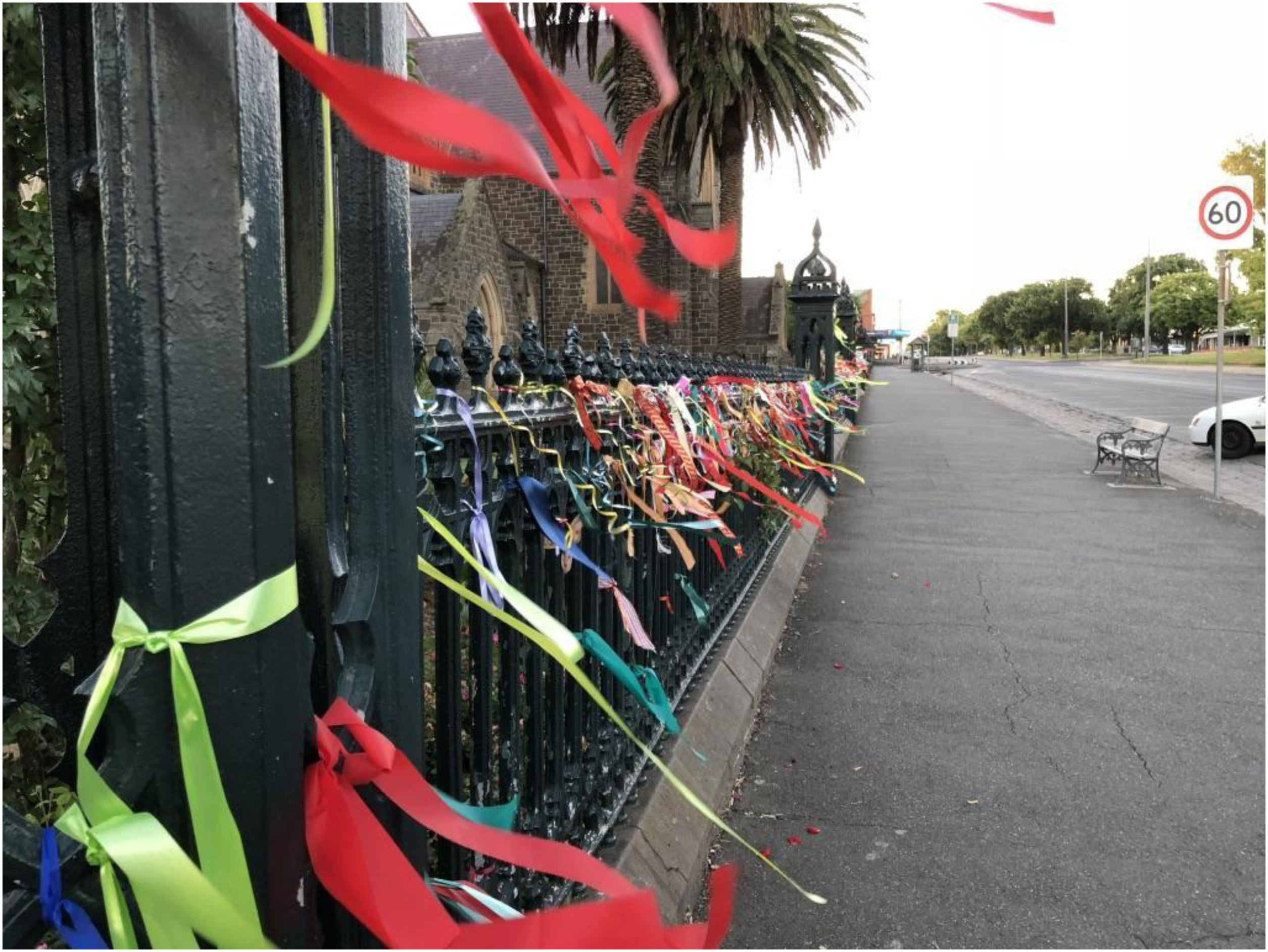
St Patrick's Cathedral Ballarat, 2018. Copyright author.
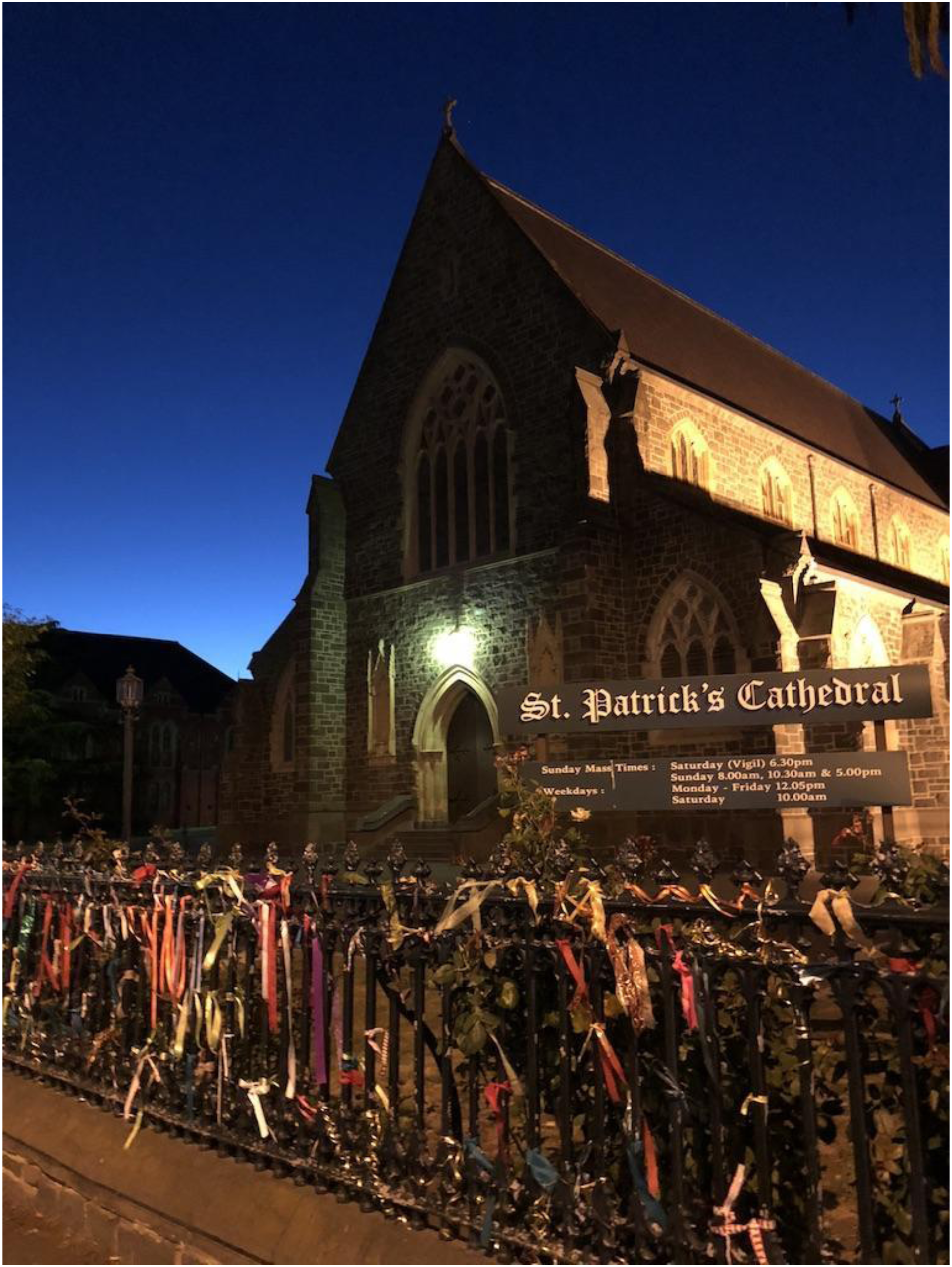
St Patrick's Cathedral Ballarat, 2018. Copyright author.
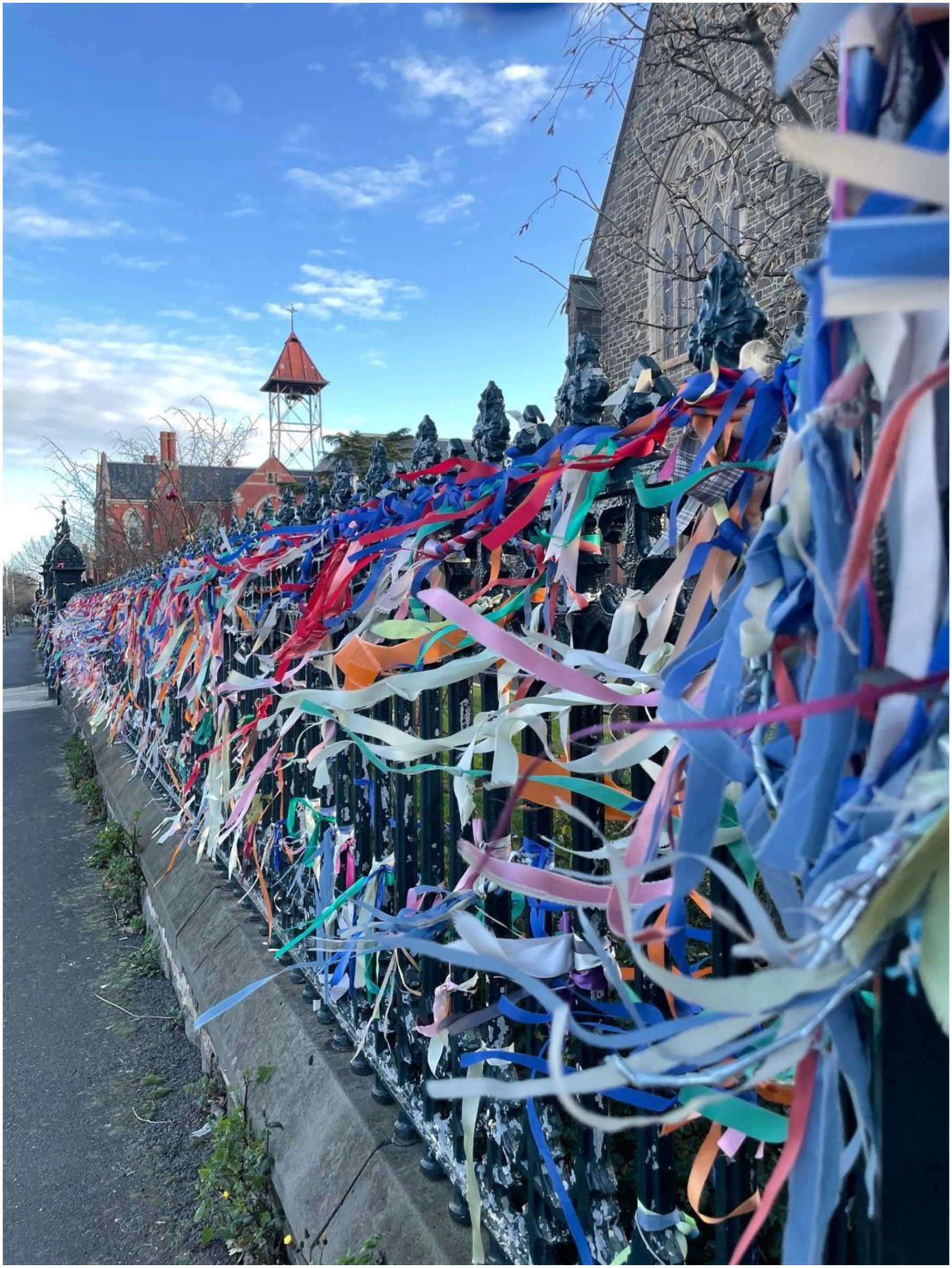
St Patrick's Cathedral, 2021. Copyright author.
This underscores a dualistic function at work within Loud Fence, and which is central to the motivation that drove locals in the wake of the Royal Commission's public hearings. Borne out of an institutional betrayal and a desire to express sympathy and support to those abused, the visuality of Loud Fence operates in both a literal and figurative sense: the ribbons are bright and colourful, and through their placement, they help to visualise something that had otherwise been suppressed and hidden. Loud Fence therefore makes literal the complicity of these institutional sites. In this way, it is not about individual offenders but rather the institutional coverup and denial that occurred on such a devastating scale.
The question of what it means to respond in the form of colourful ribbons tied to the fences of institutional sites highlights an important movement whereby the communicative significance of acknowledgment moves from the realm of testimony and language, to become aesthetically and materially embodied. This aligns with the emphasis scholars like Rosanne Kennedy (2008) have placed on the cultural reception of testimony. Outside of a juridical context, for example, testimonies have been used to rich written effect in memoirs and autobiography, in song, film, museums and other visual forms. In this way, the import of testimony cuts across not only legal but also cultural domains. While these varied usages of testimony have been recognised elsewhere, in the case of institutional abuse recognition has remained limited. Part of the novelty of Loud Fence, then, is the way it responds to testimony using a visual form, and is situationally expressed onto institutional fences. Set against enduring silence and coverup, the ribbons draw attention to the fence as a metaphor for institutional silence. In so doing, this silence is figuratively and visually interrupted through an explosion of colour.
Returning to the idea that unofficial responses often arise in the absence of a lack of sufficient action on the part of states, the emergence of Loud Fence was not indicative of any such shortcoming. Rather, so affectively powerful were the testimonies of abuse heard within the Royal Commission's public hearings they compelled a collective form of acknowledgment outside of it. In this respect, the burden of responsibility did not just fall to the Royal Commission. It was a burden felt by many, and community members responded en masse. Such may be the affective charge of testimony.
The Collective Form of Loud Fence
I have thus far investigated the form of Loud Fence as a collection of ribbons on institutional fences. However, the fact that this response transformed into a collective movement demonstrates how Loud Fence has come to mean more than the sum of individual fences adorned with ribbons. In this way Rather, form functions in a more expansive sense. This can be seen most tangibly at the level of the townscape, whereby the adornment of colourful ribbons transforms the public image of the town.
In broad terms, streetscapes are rich sources of cultural meaning. This is underscored by their diverse appeal to scholars across the humanities and social sciences. For socio-legal and criminological thinkers, for example, streetscapes have come to be recognised as important sites in which crime and justice can be writ large (Fileborn and Vera-Grey, 2017; Halsey and Young, 2006; Klippmark and Crawley, 2018; Millie, 2019; Young, 2014). While this has given rise to sensory and aesthetic accounts of streetscapes, for example, for the purposes of this article the re-inscription of the visual streetscape that occurs by way of Loud Fence evokes issues of heritage, memory and identity. Cities and their built environment are often tangible, material expressions of memory. Ballarat is no different in this respect. As Macdonald (2008: 2) has written, ‘the idea that places should seek to inscribe what is significant in their histories, and especially their past achievements, on the cityscape is longstanding and widespread’. Wars and conflict are routine ways in which this typically manifests. In the case of Ballarat however, this is eclipsed by its history in relation to Australia's 19th century goldrush, and the associated Eureka Uprising. These events gave rise to a foundational narrative that endures in the built form of the townscape, and which continues to punctuate the collective identity of Ballarat. To demonstrate how these legacies have been redeployed in the context of Loud Fence, a brief overview is useful. While the particulars of this story may seem highly local, the broader socio-legal significance arises from how Loud Fence repurposes this narrative to transform a heritage of institutional abuse into something more celebratory.
Ballarat's status as a disproportionately working-class community with a strong Catholic profile can be traced back to the goldrush. While its early mining population was lured by the promise of wealth, corrupt military policing and excessive taxation caused significant hardship. An organised campaign of resistance saw thousands gather in a series of mass meetings to demand civil liberties and democratic representation. Hostilities were further exacerbated when miners swore allegiance to an alternative flag, the Eureka flag, and erected a stockade. As the story is told, this culminated in Australia's first and only recorded armed civil uprising in which 27 people were killed, mostly miners.
What do these 19th century historical events have to do with 21st century moves acknowledging institutional child sexual abuse? Though at first glance far removed, in the wake of Loud Fence the two have come to be closely intertwined. In the months following the Eureka Uprising, in the face of enduring public dissent, suffrage was extended to all adult males in the colony, and several miners were elected to parliament. For this reason, the event continues to be celebrated as a bedrock of Australian unionism and it is widely described as the birth of Australian democracy. In this sense, it has all the hallmarks of a conventional heritage that continues to be widely narrated. On the other hand, institutional child sexual abuse has come to embody a legacy that is much more unsettling. There are few places that have not been marked by loss or trauma on a significant scale. In some places however, this past represents such a magnitude that it cannot simply be closed over. Using the example of Nuremberg in the wake of the Holocaust, Sharon Macdonald (2008) introduced the concept of difficult heritage to describe places marked by such a dilemma. Highly influential in the field of cultural heritage and museum studies, Macdonald (2008: 1) describes difficult heritage as ‘a past that is recognised as meaningful in the present but that is also contested and awkward for public reconciliation with a positive, self-affirming contemporary identity’. In comparison to a conventional heritage in which a materially enshrined past endures as a source of pride, a difficult heritage as a concept distils those instances in which a much more troubling legacy is at stake. More than something that is uncomfortable, it represents a legacy that is so difficult it cannot be overlooked.
Returning to the scene of the Royal Commission, I have discussed how its testimonial dimensions brought renewed public focus to abuse throughout the Catholic Diocese of Ballarat. Exemplifying this in her concluding statements, counsel assisting Gail Furnace (Royal Commission into Institutional Responses to Child Sexual Abuse, 2017c: C8767) described how the Ballarat case study heard ‘that it is a divided community’, marked by families and siblings that are estranged, and ‘groups within the community who are at war with each other over the response they have to the history of child sexual abuse in this community. While these divisions existed prior to the Royal Commission, the public hearings can be understood to represent the moment when the difficult heritage of institutional abuse and its impact upon the community assumed such a public face that it could no longer be overlooked or ignored. Rather, it needed to be reckoned with. Beyond simply those survivors who gave evidence, the dialogic nature of this testimony meant that its reach across the community became too difficult to ignore. Far from an historical problem consigned to the past, this deep collective impact is what was so demonstrably – and devastatingly – conveyed through the Royal Commission.
Understanding this as a difficult heritage is valuable because it helps capture how such a legacy demands to be mediated. For Macdonald (2008: 186), negotiating strategies can range from ‘demolition, amputation, profanation, reconstruction, looking elsewhere, commemoration, art, education and moral witnessing’. In a similar vein, Loud Fence can be regarded as Ballarat's negotiating strategy. For a town that is now commonly described as an epicentre of institutional abuse, at the collective level Loud Fence helps mediate this confronting reality. It does this by positioning Loud Fence within a broader story of rebellion and uprising. The sexual abuse of children is of course vastly different to the events at Eureka, however the way the story of Loud Fence as a movement is told positions it as a contemporary manifestation of a broader logic of resistance to tyranny. While there is no pride to be had in the abuse of children, a movement that commemorates victims while also indicting institutions thus contains the ingredients that enable it to be reconsolidated as a new iteration of a broader story of rebellion.
The Work of Acknowledgment
The way in which Loud Fence has come to figure as a new iteration of a broader story of the town's history of rebellion is most evident in the contemporary usage of the site where the uprising occurred. Namely, over the last decade it has been home to the Museum of Australian Democracy at Eureka (MADE). Broadly speaking, MADE tells the story of global democratic struggles dating back to the Magna Carta. These include movements for independence, resistance to fascism, the Universal Declaration of the Human Rights and the fall of the Berlin Wall. For a town whose foundational narrative remains widely invoked, the existence of a dedicated civic museum that positions the history of the Eureka Uprising within this broader international context is not surprising. What is most instructive for the purposes of this article, however, is a Loud Fence exhibit that was added to the museum in February 2018 (see Figure 8). Accompanying a replica fence on which ribbons are tied is an exhibit label that reads: The Loud Fence movement shows how the values and spirit of Eureka live on in Ballarat's citizens, who combine solidarity, courage and action to make changes for a better and fairer society. This representation of the Loud Fence movement in this museum that interprets the site and history [sic] the Eureka Stockade uprising of 1854, creates an opportunity to consider protest and collective action in Ballarat across two different cultural and historical contexts.
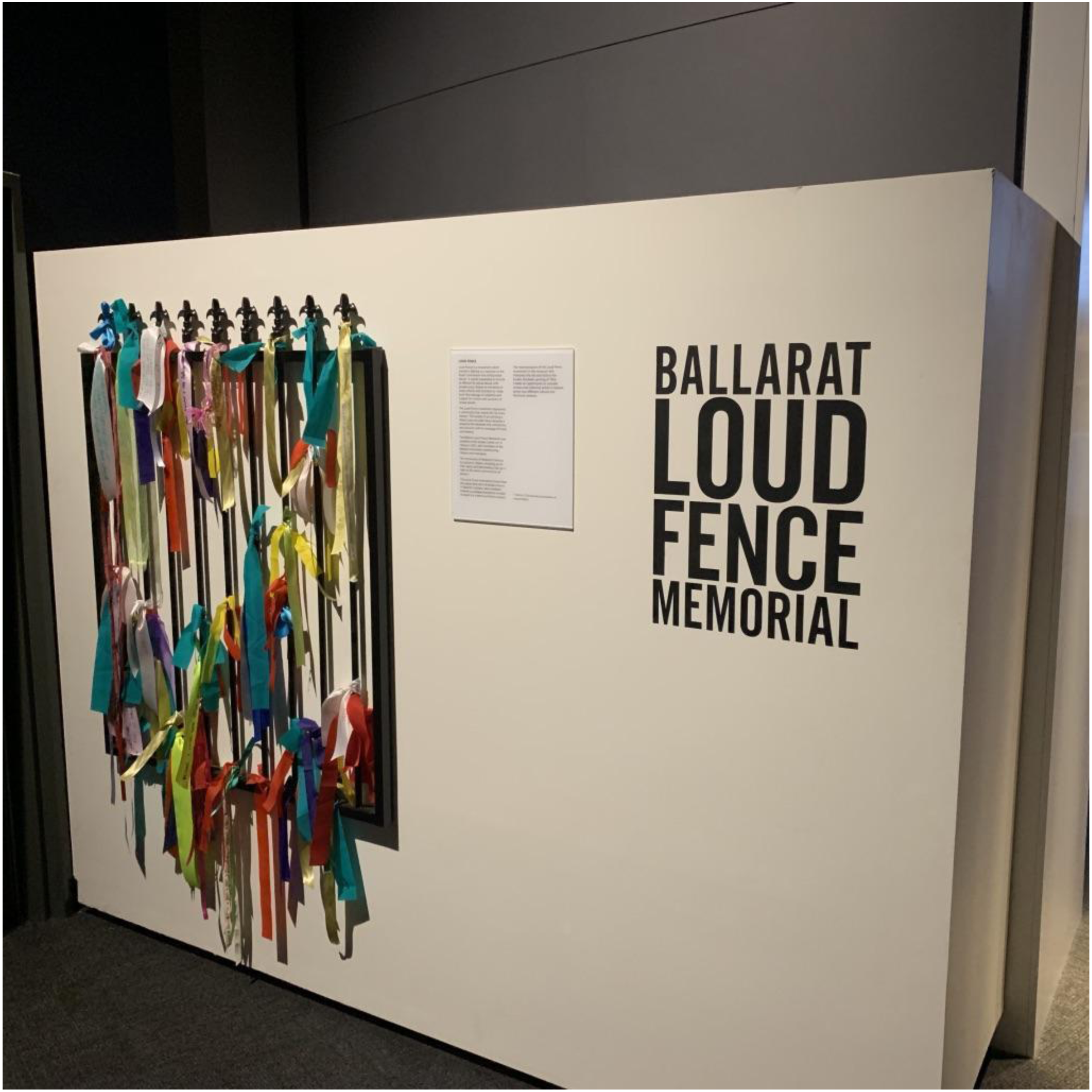
Loud Fence exhibit, Museum of Australian Democracy at Eureka (MADE), 2019. Copyright author.
On the other hand, it would be misplaced to take from this that acknowledgment comes to be guaranteed through the inclusion of a Loud Fence exhibit in a museum dedicated to democracy. In the same way that the ribbons of Loud Fences are ephemeral and precarious, so too is the formation of a town's collective identity around this. This underscores that the work of acknowledgment is never complete. Further, it risks implying that the status of Loud Fence within the town's officially sanctioned history is enshrined permanently. This is not the case. While Loud Fence has become part of Ballarat's officially celebrated identity, to be incorporated as an exhibit in a museum dedicated to democracy does not ensure that the story endures. The ribbons that comprise Loud Fence may continue to proliferate across Ballarat and elsewhere, as indeed the 2023 death of Cardinal George Pell demonstrated. But these ribbons do not just exist. Over time colours fade and they disappear, sometimes maliciously. And then new ribbons appear. In this respect, acknowledgment requires enduring work.
The toll of labour that goes into Loud Fence arises from the specificity of each individual ribbon that comes together to comprise the collective form of Loud Fence. In what has preceded, my attention to scale has shifted from the situational to the collective. The tissue connecting these scales is ritual. In broad terms, ritual has an important social significance. This is particularly true of its role in relation to memory. For Emile Durkheim (1995: 379), ritual was a means of commemorating social beliefs, serving to ‘maintain the vitality of those beliefs and to prevent their memory from being obliterated – in other words, to revitalise the most essential elements of the collective consciousness and conscience’. While contested, his work has proven influential in relation to social memory, providing a foundation for more recent attempts to conceptualise how societies seek to preserve the past. A seminal example is Maurice Halbwach's (1992) work on collective memory. Of consequence to the construction of collective memory for Halbwachs was the distinction between autobiographical and historical dimensions of memory. While autobiographical memory is personally experienced by an individual, historical memory is experienced through written and other records like photographs (Coser, 1992; Halbwachs, 1992; Jarman, 1997).
The significance of ritual to Loud Fence arises in part from the ritualistic function of tying ribbons to institutional fences. Occasioned by personal testimony, I have argued that Loud Fence emerged as a dialogic expression of solidarity and remorse. It this respect, the ribbons are sacred, and their enduring re-placement demonstrates how ritual is embedded in the re-articulation of collective memory. More than that, it underscores the role of visuality within this. Writing in the context of parades and visual displays in Northern Ireland, Neil Jarman (1997: 8) has shown how ritual practices are stylised, rhythmic and repetitive, functioning to performatively invoke a sense of collective identity. While ineffective in conveying detail, the ambiguity of rituals which rely upon a visual mode of meaning ensures they can be highly effective in ‘conveying generalities, moods, atmosphere and impressions and in condensing numerous ideas within a small space or amount of work’ (1997: 15). The same is true for a ribbon tied to an institutional fence. While it does not convey the rich personal or autobiographical detail that was conveyed so powerfully by those survivors who testified before the Royal Commission, through its simple, repetitious and atmospheric visual appearance it re-produces the community's collective memory of abuse within its midst.
While Durkheim's work on ritual has been influential, one important criticism relates to his narrow focus upon rituals that commemorate celebratory legacies or, as he put it, ‘glorious memories’ (Durkheim, 1995: 379). To repurpose a question Wagner-Pacifici and Schwartz have evocatively asked, ‘suppose a society is divided over the meaning of the very event it selects for commemoration’ (2010: 153). Writing in the context of the Vietnam Veterans Memorial in Washington DC, they argue that the key to its ability ‘to bring off commemoration of a dark and controversial part of the past comes to rest on the surrounding society's interaction with the Memorial itself’ (2010: 163). While these rituals differ from those Durkheim described in the sense that they do not reflect a past that is a source of glory, in the case of such a difficult past Wagner-Pacifici and Schwartz conclude that ‘people may need more ritual to face a painful and controversial part of the past than to deal with a painful part of the past about whose cause and meaning there is agreement’ (2010: 164; my emphasis). Considered in the context of a legacy of institutional child sexual abuse, a similar point rings true. The ritual of tying ribbons to institutional fences, and the toil that Loud Fence represents in aggregate form, is indicative of how a difficult heritage of abuse demands such ritual. In the absence of such a heritage, the ritual itself would not be necessary.
Conclusion
In this article, I have investigated a local form of acknowledgment that has arisen as a response to a difficult heritage of institutional child sexual abuse. While there has been much scholarly interest in the recent discovery of institutional abuse, few have considered the impact of this discovery outside of the context of formal responses on the part of states or institutions. My engagement with Loud Fence addresses this oversight, revealing how a dynamic relation may come to pass between state response and local community. The significance of this cuts across how testimony may be understood, the potential impact of state responses, and in terms of how communities negotiate a difficult heritage that has occurred in their midst. By reading the emergence of Loud Fence as a response to the testimony of local survivors who gave evidence before the Royal Commission, I have shown how such testimony is much more than an organisational feature of the inquiry mechanism. While it has increasingly come to serve a role of immense significance in many inquiries, the ramifications of this exceed such inquiries. Equally, its impact can be felt well beyond them. By attending to the local reception of this, new insight is brought to bear on how official mechanisms can effectively engage the communities in which they operate. In the case of the international discovery of institutional abuse, this brings thicker analytic insight into what such a macro development means within those sites in which it has been most acutely experienced. In doing so, the public nature of the public inquiry mechanism is given new meaning.
Weaving through the article is a complex interplay between public and private. From the inquiry mechanism through to the object of the fence itself, notions of private and public take on a complex form throughout. The public inquiry hears private accounts of abuse for public audiences. The institutional fence is made into a public canvas that commemorates these personal accounts. The private fence, then, becomes a public meeting point on which private paraphernalia is tied in the form of ribbons. As Wagner-Pacifici and Schwartz (2010: 164) observe in relation to expressions of grief that are performed at the wall of the Vietnam Veterans Memorial, ‘the scenes of mourning are not altogether private affairs. These scenes make palpable a collective loss known to all’ (Wagner-Pacifici and Schwartz, 2010: 161). A similar logic manifests in the case of Loud Fence. Expressions of commemoration make public not only the impact of abuse upon private individuals. Rather, the collective impact of abuse upon the community is also rendered visible by the many Loud Fences that have proliferated throughout Ballarat (and beyond) in the years since ribbons first began to appear in 2015.
A key part of the conceptual value of a difficult heritage is that it does not simply describe a legacy that is uncomfortable or troubling, but one that requires recognition – where ignoring the past is no longer tenable. Loud Fence represents a response to this impulse, and functions both as an acknowledgement and a negotiating strategy. Through its function in mediating the difficult heritage of institutional abuse, it looks back and looks forward. The point is not to uncritically valorise unofficial community responses. To borrow the words of Martha Minow in relation to responses to mass conflict and atrocity more generally, whether they be official or unofficial, ‘they depart from doing nothing’ (1998a: 4). Likewise, McGregor writes in the context of transitional justice that ‘informal approaches must not be eulogised unquestioningly’ (2008: 61). In line with these measured observations, my objective is not to romanticise Loud Fence or bestow upon it a potential that it otherwise lacks. The ritual act of tying ribbons is by definition a response. It cannot, and does not, change the past. Despite this, that Loud Fence is limited in such terms does not render it meaningless. Through a grounded account of a local response that has arisen in the aftermath of prolific abuse, I have shown how the articulation of loss and shame onto institutional fences represents a novel manifestation of ritual. This is at odds with how ritual typically manifests at sites of religion. Whereas it has been more traditionally understood in relation to expressions of faith within institutional contexts, the adornment of ribbons embodies a secular display onto, rather than within, a place of faith. Finally, while the endurance of Loud Fence entails toil, the ritual work of acknowledgment is such that despite its ephemeral form, its vibrancy persists as a vivid visualisation of prolific abuse throughout one such community.
Footnotes
Acknowledgments
I am indebted to the colleagues who reviewed early versions of this paper: Nesam McMillan, Ashley Barnwell, Kate Gleeson, and Geoffrey Mead. Sincere thanks also to the anonymous referees for their helpful comments and very constructive suggestions.
Declaration of Conflicting Interests
The author declared no potential conflicts of interest with respect to the research, authorship, and/or publication of this article.
Funding
The author received no financial support for the research, authorship, and/or publication of this article.
