




Abstract
Complaints processes and their governance in UK higher education (HE) have received little critical scrutiny, despite their expanded role under the increasing marketisation of HE. This article draws on interviews with students who attempted to make complaints of staff sexual misconduct to their HE institution. It outlines four groups among the interviewees according to the ‘remedy’ that they obtained, describing how most interviewees could not access the services of the Office of the Independent Adjudicator for Higher Education in England as they could not complete internal institutional complaints processes. The failure of most complainants to obtain remedy, and the difficult experiences of those who did, reveals the inadequacies of using an individualist, consumer-oriented model for addressing discrimination complaints in HE. The article also contributes to discussions of justice for sexual violence survivors, suggesting that community-oriented remedies are needed alongside formal administrative justice processes to address power-based sexual misconduct in institutions.
Introduction
Complaints processes in UK higher education (HE) have received little attention within academic research, despite recent public scrutiny (Lee and Kennelly, 2019; Lee and West, 2019), and their governance and regulation across the sector has received even less consideration. In England and Wales, the main body that oversees student complaints is the Office of the Independent Adjudicator for Higher Education (OIA), the independent student complaints scheme for England and Wales. Nevertheless, the OIA receives very few complaints about sexual misconduct or indeed about issues relating to discrimination more generally (Office of the Independent Adjudicator for Higher Education, 2019a, 2020a). This is not because staff sexual misconduct is a rare occurrence; around 10% of all women postgraduate students are subjected to this (Cantor et al., 2019: xiii), and of those who report, most are dissatisfied with how their higher education institution (HEI) handled the issue (National Union of Students, 2018).
There is, therefore, a gap between what we know about the number of students who are subject to sexual misconduct, the number who report to their institution, and the number who access the OIA’s services. It is possible that the low numbers of students going to the OIA indicate that they are satisfied with internal complaints processes and are receiving appropriate ‘remedies’ for their complaint from their institution. However, as outlined below, existing research evidence suggests this is not the case. Therefore the question remains: why are students not accessing the service of the OIA? Exploring this issue requires looking into the effectiveness of the regulatory framework for complaints within UK HE for addressing discrimination and harassment, and as complaints mechanisms are part of consumer protections for students, these discussions can shed light on the extent of students’ power as consumers of HE. More widely, examining complaints processes can also illuminate the question of justice looks like for sexual violence survivors. This article extends ongoing discussions in this area into administrative justice spaces within institutions, while opening up discussions of what appropriate ‘remedies’ might look like for complaints relating to staff sexual misconduct. 1
In order to explore this issue, the article draws on interviews with 14 students and 1 early career researcher who reported or disclosed staff sexual misconduct to their UK HEIs between 2010 and 2017 to outline the remedies that were available to them and to analyse this in relation to sector policy and guidance. This study forms part of a larger body of work on staff sexual misconduct in HE (Bull and Page, 2021; Bull and Rye, 2018; Bull et al., 2019, 2020; National Union of Students, 2018; Page et al., 2019). While the article is relevant to any jurisdiction with a sector-wide ombuds framework for overseeing student complaints such as Australia or many countries in Europe, the empirical data focuses on England. Its main contribution is to provide a critical overview of complaints processes within HE in England and to reveal the extent to which this system is effective in providing remedy for staff sexual misconduct, in this way contributing to debates on what justice could look like for victim-survivors of power-based sexual misconduct within institutions.
The article first introduces this discussion of justice for sexual misconduct victim-survivors, then gives a brief overview of the current sector landscape for student complaints in UK HE, contextualising this internationally, before introducing the specific context and methods for this study: staff sexual misconduct. It then gives an overview of the ways in which interviewees in this study were or were not able to access ‘remedy’. Finally, it situates this discussion within the changing regulatory landscape in England, before outlining what remedies could look like for those who have been subject to sexual misconduct in higher education and exploring how governance mechanisms could incentivise this.
Justice for Sexual Misconduct Victim-Survivors
Recent discussions in this journal (Antonsdóttir, 2019; McGlynn and Westmarland, 2019) and elsewhere (Daly, 2011, 2014; Fileborn, 2017; Fileborn and Vera-Gray, 2017; Herman, 2005; McGlynn, 2011; Zinsstag and Keenan, 2017) have explored models of justice that sexual violence survivors want and need, finding evidence that existing models of justice do not serve these needs. An influential article framing this discussion is Judith Herman’s study of 22 men and women in the US who had been subject to or witnessed sexual or domestic violence as adults and/or children (2005). Herman found that her interviewees wanted validation and acknowledgement of the crime from their community, as well as vindication, i.e. for ‘their communities to take a clear and unequivocal stand in condemnation of the offense’ (2005: 585). Overall, their vision of justice was about ‘healing a damaged relationship […] between the victim and his or her community’ (p. 597).
These findings are developed in McGlynn and Westmarland’s more recent UK-based study, which argues that justice for this group was not linear but instead ‘kaleidoscopic’ and was primarily about ‘envisioning a world free of violence against women’ (2019: 196). Themes that emerged within this vision included consequences for the perpetrator because of their actions; recognition that the victim-survivors have been harmed and victimised by the perpetrator but also by the wider community; being treated like a human being by the system; and wider prevention of sexual violence and education for change (2019).
Such discussions of the ‘justice needs’ and interests of victim-survivors (Daly, 2014: 379) have primarily occurred in relation to the criminal justice system. Exceptions include Antonsdóttir’s study documenting victim-survivors’ need to reclaim physical and social spaces from perpetrators, across a range of sites (2019) and Fileborn and Vera-Gray’s work on the desired justice responses of Australian women who had been subjected to street harassment (2017), including the possibilities for justice from online disclosures (Fileborn, 2017). However, victim-survivors’ justice needs have been less considered in administrative justice settings such as workplaces and higher education institutions (although see for example Antonsdóttir, 2019). In higher education, recent discussions of justice have primarily focused on naming of perpetrators as a means of getting justice that is inaccessible by other means (eg Anitha et al., 2020) or on student-student sexual violence (see for example Harper et al., 2017), rather than staff-student sexual misconduct.
The concept of ‘remedy’, as defined below, is an important part of administrative justice complaints processes, including those in higher education. In the UK context, policy and practice are still at a relatively early stage in relation to formulating remedies and sanctions for student-student sexual misconduct (Humphreys and Towl, 2020) and there are no agreed standards for sanctions or remedies for staff sexual misconduct (The 1752 Group and McAllister Olivarius, 2020). In the US, there have been calls for a wider range of responses, including increased transparency and victim-led resolution policies (Clancy, 2018; National Academies of Sciences, 2018: 144). However, in administrative justice models, as exemplified here by higher education sector guidance for student complaints in England and Wales, the concept of ‘remedy’ is intended to provide justice in the context of formal processes. The next section therefore outlines complaints processes and situates the concept of remedy within this context.
Complaints Processes and Their Oversight Within HE
The governance of complaints processes, as part of wider systems for safeguarding student rights, is under discussion in a variety of jurisdictions. For example, a policy statement in 2020 from the European Higher Education Area, covering 49 countries, committed to ‘safeguarding student rights through legislation’ […] through dedicated measures and structures, such as student ombudspersons or similar solutions that already exist in many EHEA countries’ (Køhlert, 2020). In Australia, the Tertiary Education Quality and Standards Agency (TEQSA) upholds providers’ compliance with the statutory Higher Education Standards on a systemic level, taking action only if ‘there is a serious risk to students or to the quality or reputation of the higher education sector’ (Tertiary Education Quality and Standards Agency, 2020), while for individual complaints ‘providers must make provision for review by specified independent third parties (other than TEQSA) in the event that internal processes do not resolve a complaint’ (May, 2019: 6). However, questions have been raised in Parliament about the efficacy of this process (Parliament of Australia, 2020a), revealing that despite high profile scandals, TEQSA has never made a finding of non-compliance against a university in relation to sexual assault or harassment (Parliament of Australia, 2020b). 2 Despite these policy developments and disputes, academic literature does not appear to have engaged with this issue.
In the UK, sexual misconduct complaints are channelled through existing HEI complaints processes. 3 Formal complaints processes in many UK HEIs appear to be a surprisingly recent development. In a 1998 survey Staniford and Brown found that 34% of institutions responding (n = 28) did not have a formal student complaints process in place (2003: 21). This finding followed on from the Dearing Report’s recommendation in 1997 that HEIs ‘review and, if necessary, amend their arrangements for handling complaints from students’ (National Committee of Inquiry into Higher Education, 1997: 244); clearly some institutions needed not only to amend but also devise such processes. Formal oversight of institutional complaints processes was finally established in 2003, following momentum on this issue throughout the 1990s, when the OIA was set up to provide external oversight of HE complaints processes. Membership became mandatory for HEIs in the 2004 Higher Education Act for institutions in England and Wales, at the same time as undergraduate tuition fees were raised to £3000 per year. In the other UK countries ombuds provision across all public sector organisations is covered by with the Scottish Public Services Ombudsman, set up in 2002 (Harris, 2007: 571) and the Northern Ireland Public Services Ombudsman, set up in 2016 to replace previous provision.
If students in England and Wales have completed all levels of the complaints process within their HEI, including appeals stages, and are dissatisfied with the outcome, their institution is required to signpost them to the OIA. The OIA reviews unresolved complaints from students about their HEI. The remit of the OIA’s powers are as follows: To reach our decision, we look at whether the provider has properly applied its regulations and followed its procedures, and whether the procedures themselves were reasonable. We’ll also look at whether the provider’s final decision was reasonable. (2020b: 1)
A cornerstone of the OIA’s practice is to encourage both parties to settle as early as possible (2020: 1). However, the OIA can also recommend the HEI offers ‘remedy’ to the student. Remedy is a legal term that refers to ‘any of the methods available at law for the enforcement, protection, or recovery of rights or for obtaining redress for their infringement’ (Law, 2018: 932). As well as remedy, the OIA may make recommendations to the HEI about how to improve their practices. As the OIA is not a regulatory body, it does not have the power to compel HEIs to take any actions or to impose sanctions. However, through its ‘Good Practice Framework’ (OIA, 2018a) it lays out how complaints should be handled and if HEIs do not follow its guidance, the OIA will find against them in reviews. The OIA monitor compliance with their recommendations and publish information about non-compliance in their annual report (2019a: 12); there were only two institutions named in 2018, supporting the OIA’s claim that institutions almost always comply with their recommendations (2018a: 23).
In their most recent annual report the OIA note that in 2019 they received 2,371 complaints, an increase of just under 21% on 2018 (1,967). There has been an incremental increase since tuition fees were tripled to £9000 per year in 2011–2012; there were only 1,341 complaints in 2010 (OIA, 2019a: 6). Various commentators, including the OIA themselves, have argued that this rise in student complaints is evidence of a move towards a more consumerist student identity that follows the rise in student fees in England over recent decades (Furedi, 2011; OIA, 2018a). Indeed, within the regulatory landscape for higher education in England and Wales, complaints are part of consumer protections. The Competition and Market Authority is one of the institutions that makes up this regulatory landscape, and in 2015 it issued guidance on how HEIs should be complying with consumer protection law, including the requirements for complaints processes (Competition and Markets Authority, 2015). However, even Universities UK, a lobby group representing HEIs in the UK, notes that ‘the time and investment that students commit to their studies, and potential disruption if they are dissatisfied, means they are in a relatively weak position as customers’ (Universities UK, 2016: 3). Examining student complaints processes can therefore shed light on the power of students as consumers.
Despite this guidance, as Harris (2007) points out, a consumerist lens is not the only way to conceptualise complaints. Student complaints in higher education can also be seen through the lens of a citizenship model of the student, drawing on theories of administrative justice whereby complaints are part of a set of mechanisms that ‘concern how we interact as individuals when the government, or those working on its behalf, act in ways that appear wrong, unfair or unjust’ (‘What Is Administrative Justice?’, 2015). These competing lenses through which to view complaints mirror the lack of clarity around UK higher education institutions’ status as public or private. Other than a small number of fully private institutions that are outside the scope of this discussion, ‘almost all universities in the UK are technically private corporations operating within the public interest, although for some purposes (for example freedom of information law and public procurement), they are treated as public bodies’ (Farrington, 2013: 4–5). Therefore, as well as being subject to consumer protection laws, HEIs as public bodies are subject to the ‘public sector equality duty’ of the Equality Act (2010), and successful legal challenges relating to discrimination within the complaints processes have been taken under this. They are also subject to judicial review (Mitchell, 2015). As a result, higher education complaints processes do not fall clearly into either an administrative justice or a consumer rights perspective. This ‘hybrid’ nature of HEIs (Farrington, 2013: 5) is also evident in their complaints processes, as this article outlines.
Critical discussion of the OIA and its role are sparse. However, lawyer Matthew Wyard suggests that HEIs are aware of the ‘the tentativeness of the OIA’s remedies’ and notes that this approach is at odds with the increasing marketisation of the sector; if students are being treated as consumers they should expect more robust oversight of complaints. For example, Wyard suggests changes around transparency and financial remedies: If the OIA made all of its justified complaints public or, as its rules permit, required appropriate financial remedies that genuinely reflect the losses suffered (going well beyond discretionary awards for “inconvenience and distress”), it would pose a genuine threat to universities and their reputations. (2016: n.p.; see also Harris, 2007: 602)
Within the OIA’s guidance for addressing student complaints more widely, there is no specific provision for discrimination and harassment complaints; these are subsumed under the category of ‘non-academic complaints’. Nevertheless, the OIA have released a briefing note on sexual misconduct complaints in which they agreed that students could contact them before completing internal complaints processes within their institution if ‘their attempts to raise or pursue a complaint are being delayed or obstructed’ and they would ask the HEI to speed up their process (Office of the Independent Adjudicator for Higher Education, 2018b). The OIA’s guidance on staff-student non-academic complaints has also been criticised for failing to give parity to staff and student complainants, and therefore contravening the Equality Act (2010) (Bull et al., 2020).
More generally, they note that ‘we work closely with the Office for Students [OfS; the new regulatory body for the HE sector in England, established in 2018] […] and other sector organisations to ensure that any systemic issues that we identify can be addressed’ (Office of the Independent Adjudicator for Higher Education, 2018a). In order for such ‘systemic issues’ within an HEI to be identified, multiple students (presumably from the same institution) therefore need to have taken complaints to the OIA, who would then pass on these issues to the OfS to ‘take action’ on these. This situation is currently evolving, however, as in 2020 the OfS opened up a consultation around how it would regulate institutions’ prevention and response to harassment and sexual misconduct in higher education. This consultation could be seen as an acknowledgement that the current model of complaints is not sufficient to ensure that equality duties, or indeed the duty of care that HEIs owe to their students, are upheld (even while this duty of care remains unclear in the law (Universities UK, 2019)).
Overall, it can be seen that HE sector governance in England for addressing discrimination or harassment issues through complaints processes relies on students being able to complete their internal institutional complaints processes and progress their complaint to the OIA. Whether this is indeed a fair assumption is explored throughout the rest of this article. I now turn to examining existing evidence on how these processes work in practice.
Discrimination-Related Complaints
Comprehensive data on remedies and outcomes for complaints within individual HEIs is not currently available. Within HEIs, the OIA suggests that ‘appropriate summary information should be given to staff and students, including students’ unions, on the actions taken in response to concerns, complaints and academic appeals’ (2018c: 27), and while some institutions publish this data publicly (including in a few institutions, specific data on sexual misconduct complaints), others do not. Once complaints reach the OIA, the majority are not upheld; out of nearly 2000 complaints received in 2018, 54% were found to be not justified, and only 20% were justified, partly justified, or settled in favour of the student (2018: 11).
However, there is evidence that for discrimination complaints, this system is not working as designed. In a study on racial harassment in universities, the Equality and Human Rights Commission (EHRC) found that around 30% of student complaints of racial harassment had been investigated and not upheld and in 33% of cases action was taken against the perpetrator, but fewer than 1 in 10 students who made complaints (about either staff or other students) felt that the outcome they received was reasonable and most of the students for whom the university had taken action on their complaint ‘said they didn’t understand the reason for the decision that was made’ (2019: 76–77). Just 1 in 20 student complaints were appealed (2019: 80), and only a few students in the study went forward to the OIA. These findings – that many students believe that their HEI is failing to adequately address complaints of racial harassment but are not using existing external mechanisms to review complaints – suggests that these mechanisms are not working for racial discrimination complaints.
This finding is borne out by examining the proportion of complaints the OIA received in 2019 about discrimination issues (across all protected characteristics): only 4% (n = 87) of their complaints (2020: 1) were in this category. Despite these findings, the EHRC found that ‘institutions felt they were handling racial harassment complaints well’ despite most not gathering any data to demonstrate this (2019: 83). Similarly, Sara Ahmed in her interviews with students and staff who had made discrimination complaints within HE, found that they had to become ‘institutional mechanics’, having to make complaints about the institutional response as well as about the discrimination itself, and as a result complainants in her study were unlikely to reach a satisfactory outcome (2018: n.p.).
This low proportion of racial harassment complaints reaching the OIA could therefore be due (at least in part) to difficulties getting to the end of internal complaints processes. These internal processes should, according to the OIA Good Practice Framework, involve three stages: early resolution, i.e. an informal approach at department or faculty-level; the formal stage; and review stage (2018b: 12). Nevertheless, as outlined below, these three stages constituted a significant, usually insurmountable, barrier for complainants, and the similarities between the EHRC’s findings and the experiences from this study, as outlined below, are striking.
Indeed, as around 10% of female postgraduate students and 2.3% of female undergraduate students are subject to staff sexual misconduct (Cantor et al., 2019: xiii), there is a mismatch between the likely prevalence of staff sexual misconduct in HE and the number of complaints received by HEIs (where data is available) and by the OIA. In a UK-based survey of 1839 current and former students, 41% had experienced sexualised behaviour from staff members and 10% of these had disclosed or reported it to their institution (n = 81) and out of these, only 1 in 10 were fully satisfied with the way the institution had handled the issue (National Union of Students, 2018); this is in line with low reporting of sexual harassment and violence more generally.
It can be seen, therefore, that the claim by the OfS and the OIA that ‘systemic issues’ will be identified and acted upon does not appear to be borne out. This raises questions about the interaction between HEIs’ internal complaints processes and the OIA; the effectiveness of the ‘remedies’ that the OIA recommends; and more widely, as to the role of complaints processes in addressing discrimination and harassment in HE, suggesting that handling discrimination issues on an individualised complaints model is inadequate and is unlikely to offer the kinds of justice outcomes that victim-survivors are seeking.
Methods
The first author, Anna Bull, carried out interviews with 15 women who had been subjected to staff sexual misconduct and had attempted to report to their institution (a further interviewee who attempted to report solely to the police is not included here). A longer account of methods can be found in Bull and Rye (2018). Interviewees were recruited via the National Union of Students’ survey (2018) (n = 11) or via campaigning organisation The 1752 Group (n = 4). In order to gather detailed accounts of complainants’ experiences and to give them an opportunity to talk about their experiences in their own words, interview methods were used.
Eleven interviewees were white UK students and four were international students, of whom three were students of colour. At the time of the sexual misconduct occurring, eight were PhD students, three undergraduate students, three were Master’s students and one was an early career researcher who attempted to report on behalf of herself and PhD students in her department. Although the study was open to all genders, only women came forward to participate. Ethics approval for the study was gained from University of Portsmouth Faculty of Humanities and Social Sciences ethics committee, and the study followed ethical guidance from Campbell et al. (2019). All names, and some identifying details, have been changed to ensure anonymity. Interviews explored the experience of misconduct; the impacts of interviewees’ studies and lives; and their experiences of disclosing or reporting their experiences. The analysis below focuses on one aspect of this data: the outcome of their disclosures or reports and any remedy they were able to access.
Overview of Outcomes and Remedies
In Table 1, interviewees are organised into four groups according to the type of remedy that they received – or didn’t receive – following their report. Below, we analyse the ways in which each of these groups obtained, or were unable to obtain, remedy, and compare it to the policy framework outlined above.
Overview of outcomes and remedies.
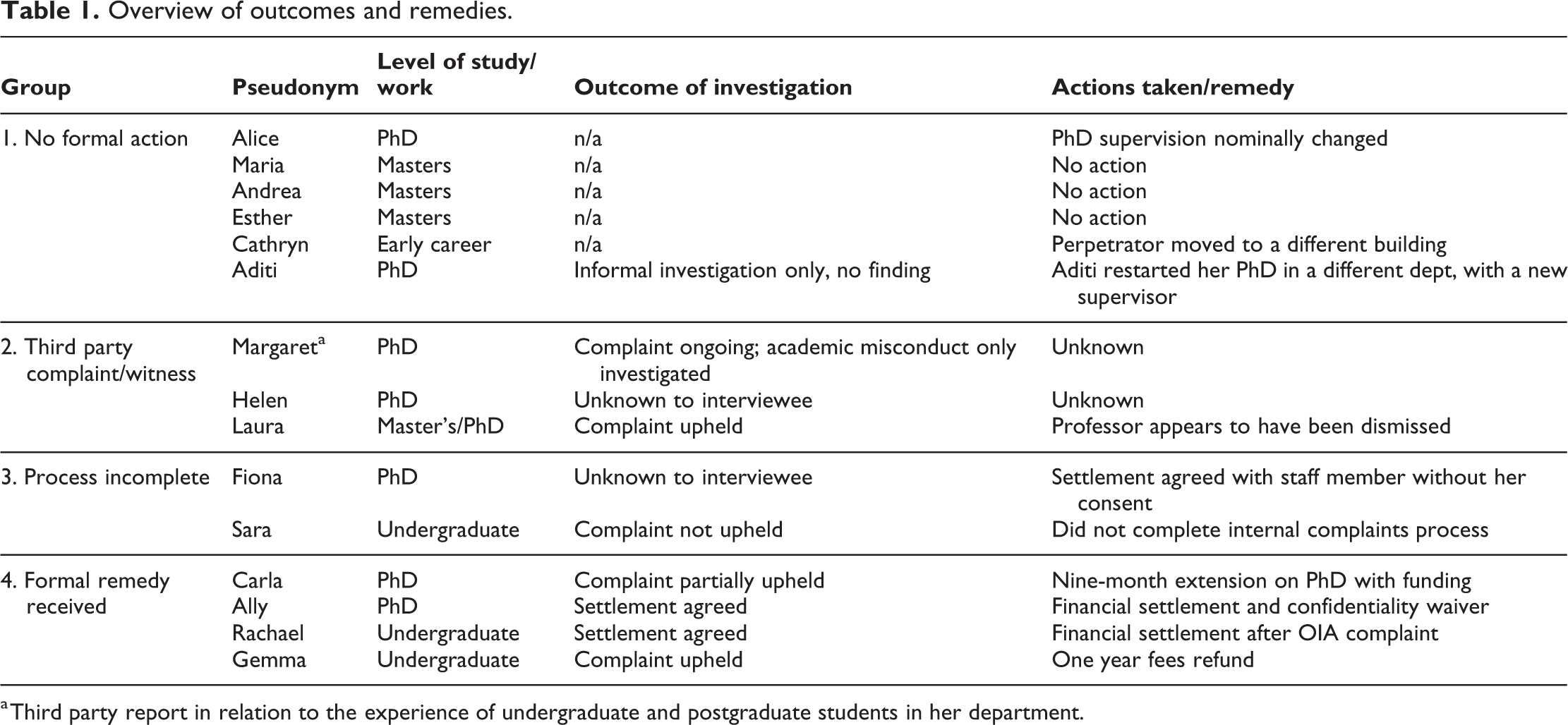
a Third party report in relation to the experience of undergraduate and postgraduate students in her department.
Group 1 – No Formal Action Taken (Alice, Aditi, Cathryn, Esther, Andrea and Maria)
Six interviewees were blocked or dissuaded from reporting to their institution or were unable to get a formal complaint acted on by their institution (see Bull and Rye, 2018). This meant that there was no possibility for remedy. For three of this group, informal action only was taken, and three further interviewees found that no action at all was taken.
It should be noted that all of this group wanted formal action to be taken. A lack of formal action meant that there was no possibility for remedy, nor was there any oversight or accountability for any of the institutions involved. For these interviewees, therefore, existing governance and accountability structures entirely failed them. This highlights a perhaps insurmountable problem in the current OIA system: that their services are not accessible for those whose complaints are not taken up formally by their institution.
Group 2 – Third Party Complainants and Witnesses (Helen, Laura, Margaret)
This group consists of three interviewees who were involved in a complaints process on behalf of others. Two were named or contacted by other women who had been victimised by the same staff member to give evidence to support their complaint, and one tried to make a complaint after becoming aware of two students being victimised by the same staff member in her department. Overall, this group were not offered any remedy as they were not the primary complainant or victim. This highlights an issue with the individualised nature of complaints processes for dealing with systemic issues where multiple students and/or staff are likely to be targeted by the same harasser (Bull and Rye, 2018; Cantalupo and Kidder, 2017). Witnesses who have been subject to sexual misconduct themselves need to also have the option of having rights, or at a minimum, support and protection from victimisation during the complaints process.
Group 3 – Process Incomplete; In Limbo (Fiona, Sara)
For these two complainants, their complaint was initially acted on and formal investigations were launched, but there was no clear outcome to the process. Fiona had made a complaint of sexual harassment during her PhD against a lecturer in her department, and after graduating was working in the same department as him. The complaint had been upheld, but the lecturer had appealed it on the basis of procedural errors, while also launching his own grievance and having further complaints brought against him for victimisation after retaliating against one of the complainants. These different complaints processes piled up on top of one another and the institution eventually agreed a settlement with the lecturer that enabled him to remain in post, without Fiona’s knowledge or agreement.
A second interviewee in this group was Sara. She went through both an informal and then a formal stage of investigations within her institution. After this, there was one further round of complaints to complete before she had exhausted the internal complaints process and could go to the OIA. However, after two rounds of complaints processes, her physical and mental health was severely impacted and she had entirely lost faith in the university’s processes due to multiple failures in the process. She described how: I was really depressed and I felt suicidal, because it seemed like, no matter what I do, with or without evidence, nothing is going to change […] I would’ve gone for the [second stage of formal complaints], but obviously it was pointless, so I didn’t bother. I couldn’t really listen to them talk about how it’s all my fault anymore.
Group 4 – Formal Remedy Obtained (Carla, Ally, Rachael, Gemma)
Four students managed to obtain formal remedy from their institution. For two of these, the remedies were offered by the institution after an internal process, while the other two had to resort to external agencies to gain remedy: in one case, the OIA, and in another case, legal action against their institution. All of these students received some form of financial recompense, whether a tuition fee refund or payout, for example for ‘stress and inconvenience’. Carla received a 9-month extension for her PhD, including her funding being extended.
In order to understand why such apparently successful outcomes were not, in fact, adequate, this section discusses these four students’ experiences in detail. First, however, it examines in more detail the idea of ‘remedy’.
The Problem With Individualised ‘Remedies’ for Discrimination Issues
In the case of upheld complaints, the OIA recommends remedies that the HEI should offer the student. It states that ‘the aim of our Recommendations is to return the student to the position they were in before the circumstances of the complaint’ (2019: 4) and describes the types of remedies that might be offered: The remedy might be an apology, an explanation of any actions the provider has taken as a result of learning from the complaint, or an academic or financial remedy, depending on the nature of the concern, the impact on the student, and what the student is seeking. (Office of the Independent Adjudicator for Higher Education, 2018c)
Battling to Access Remedy from HEIs
The only interviewee to whom remedy was offered without her having specifically fought for it was Gemma, who went through a distressing 9-month complaints process after being subject to sexual harassment from a lecturer. She had dropped out of the first year of her undergraduate degree following this experience, and after her complaint was upheld she was offered a tuition fee refund. When she returned to her university the following year she changed her degree course in order to avoid the lecturer who had harassed her, unable to continue studying the subject she was passionate about.
By contrast, Carla, Rachael, and Ally had to battle to get financial and academic remedies rather than them being offered by the institution. Carla managed to access a form of remedy from her institution after one round of complaints process. The complaint, from her fellow PhD students and herself, was partly upheld but in order to receive remedy they had to put together a further claim evidencing the loss of time and academic support that this experience had entailed. Eventually Carla’s institution offered a 9-month funded extension on her and her co-complainants’ PhDs and £1000 for ‘damages’.
As an international student, Carla was on a visa linked to her student status. If she refused this offer and took the complaints process to the next level of internal institutional complaints, which she would have liked to do, she risked her visa running out while she was still within the internal institutional complaints process (the first round had taken 7 months). She therefore had little option but to take this offer, despite her dissatisfaction with it, and so the OIA was not accessible to her at all. The remedy she had received did not address the various impacts of this experience including psychological harm through being subject to years of controlling, harassing behaviour; time lost through the unpaid work that she had ended up doing for her supervisor; and loss of academic confidence.
A third interviewee in this group, Ally, had finished her PhD and started a job at a new institution. She had been diagnosed with post-traumatic stress disorder as a result of being subjected to sexual misconduct, and the complaints process had exacerbated this condition. She had finally decided to walk away from the prolonged, traumatising case, at which point the lecturer sent a defamatory email to her research collaboration group. She described: At that point, I absolutely blew my top […] All I wanted to do was be able to protect myself, because I couldn’t even reply to this defamatory email by saying, “Actually, there’s this new process where the charges were upheld […].” I couldn’t even do that.
Remedy was therefore very difficult to access from HEIs themselves, and where it was available it did not ‘put things right’. According to the policy framework described above, the OIA should have been accessible to these students when institutional responses failed. However, Ally had not considered going to the OIA with her complaint because they were not able to offer what she needed: protection from defamation. The career and personal risks of defamation or other forms of victimisation from the perpetrator (including threats of physical harm) were experienced by four other interviewees as well as Ally, so this needs to be considered as a significant gap in the OIA’s powers.
To sum up, interviewees did not take their complaints to the OIA due to lack of faith that the OIA would be effective; lacking time on an international student visa to do so; the outcomes they wanted not being on offer; lack of clarity over the OIA’s remit and bureaucracy; and most importantly, being unable to finish internal processes at their institution, due to their lengthy and distressing nature.
The OIA’s Remit
These factors meant that, despite all interviewees being dissatisfied with their institution’s responses, only one managed to access the OIA. This was Rachael. An undergraduate student, she thought she had completed the complaints process at her university because she’d received a letter saying that her complaint had been upheld with no remedy offered, but this letter had not outlined appeal options or signposted her to the OIA as it should have done. Eventually, after suffering further harms as a result of the misconduct and poor response to her complaint, she learned about the existence of the OIA, who signposted her to a final round of internal complaints process at her institution. With support from the OIA, she finally managed to get her university to complete her complaint, which included a 70-page report to which she had to write a response.
Following the OIA’s intervention, the university offered Rachael £5000 for ‘inconvenience’. The OIA recommended that she accept this, because if she went to the next stage of dispute it might be withdrawn. As she described, however: I felt like I’m at the whim of the OIA because only they know their remit and their bureaucracy. I don’t have a full understanding of that. I want a moral result and they’re telling me that I can’t get that with them. So I go with what I can get which is this little bit of money which doesn’t even touch what I think this deserved. So I just had to- at that point I thought I’m going to go back to [the] start here, or do postgrad, I can’t carry on. So it was a huge decision to make to stop it there. I didn’t want to, but at the same time I knew that they managed to up it to £5,000 and that’s a tiny amount of what it should be, but it’s a massive amount of money to me. That’s a big difference and so I decided to stop because I didn’t really have anywhere else to go. They made me feel like to take it to review stage would be such a vulnerable position and that I would have to go through a report again. They said I would have to read another big document like [the 70 page report]. […] I was just broken and so I stopped there.
Furthermore, as noted above, the OIA’s stated approach is to encourage universities and students to settle as early as possible (2020: 1). However, once a settlement is agreed this has the result of closing the case and therefore, preventing any further review of the complaint or failings of the University and any opportunity for the OIA to make recommendations to the University. Rachael’s experience suggests that where there is early evidence of poor practice in relation to discrimination complaints (which are by nature systematic) – in this case an extremely lengthy process – there needs to be provision for reviews to be conducted and procedural recommendations to be made regardless of whether settlements are agreed.
What Should Remedy Look Like for Sexual Misconduct in HE?
As outlined above, for the four interviewees where remedy was forthcoming, it was primarily financial. However, none of these thought that this remedy was satisfactory. This is perhaps surprising given that their accounts were in many ways the success stories. Indeed, both Carla and Gemma’s experiences, in receiving compensation after one round of complaints processes lasting 7 and 9 months respectively, could be seen on paper as positive outcomes. They did not experience it this way. When asked if there was anything that her university did well, Gemma replied, ‘I don’t think they did anything right’. Similarly, Carla was appalled at her university’s handling of her complaint and described her overwhelming sense that no-one in the university cared in the slightest what happened to her or her co-complainants.
One reason that this remedy was not seen as successful by complainants was that financial remedy was not, for the most part, what they were seeking. Even those who mentioned financial remedies as one of the outcomes they would like to see stated that this was less important than other outcomes. As outlined in Bull (under review), the main reasons interviewees in this study gave for making formal complaints of sexual misconduct were to prevent other women being targeted; as part of ‘doing the right thing’ and fighting for justice; to protect oneself; or for academic or career-related reasons, for example to be able to complete or continue their studies.
As discussed above, previous research has documented the ways in which existing justice processes do not fit sexual violence survivors’ desires and needs for justice (Herman, 2005; McGlynn and Westmarland, 2019). Indeed, Herman found that money was ‘more important as a public symbol of the perpetrator’s guilt rather than as private compensation’ (2005: 590). The major point these studies have in common is the requirement for the involvement of the victim-survivor’s community as part of a process of recognition and validation, as well as preventing future harm. Indeed, this community-oriented aspect of justice would seem to be particularly relevant in higher education where disciplinary, departmental, or cohort communities can be a hugely important part of students’ identities and day-to-day lives.
Such a model of justice is in clear contrast to the main form of remedy (i.e. financial) that was available to interviewees in this study. The OIA do state that ‘we will consider any remedy proposed by the student or the provider, but it is important that the remedy proposed is achievable’ (2019: 2). However, the individualised nature of complaints processes does not allow the kinds of community-oriented models of justice that are required for discrimination complaints.
Nor are restorative justice models likely to be helpful in this situation; as Daly (2011: 10) notes, ‘restorative justice processes (or other types of informal justice practices) are set in motion only after a suspect has admitted to an offence’ (see also McGlynn, 2011: 829). Daly suggests that justice mechanisms need to ‘encourage more admissions to offending’, when offending has indeed occurred (2015: 381). However, for most interviewees in this study, the staff member who had targeted them did not give any indication of feeling that they had acted wrongly. Furthermore, as McGlynn highlights, critiques of restorative justice have highlighted its inadequacy for addressing domestic violence ‘due to its integration of psychological and physical abuse, the often lengthy pattern of coercive conduct and the common need for continued contact’ (2011: 833). These concerns are also valid for most of the accounts of staff sexual misconduct described above, about half of which were characterised by a pattern of grooming and boundary-blurring behaviours (Bull and Page, 2021), and most including patterns of targeting multiple other students and staff (Bull and Rye, 2018). Therefore, restorative justice is unlikely to be effective or safe in staff-student sexual misconduct cases.
A better way forward would be combining formal justice mechanisms with wider community remedies, drawing on models of ‘transformative justice’ which ‘seek to disrupt the underlying structural and cultural causes of violence and inequality’ (Fileborn and Vera-Gray, 2017: 207). In the context of street harassment, Fileborn and Vera-Gray describe how their participants wanted more preventative and educational measure that transformed gender norms, rather than relying on the ‘retrospective’ models of justice after the harm had occurred (2019). However, such transformation needs to be coupled with effective formal justice mechanisms. One immediately achievable step for such formal justice mechanisms is to be more ambitious in the academic remedies offered. Such remedies need to take into account time lost, interruptions and changes to courses and learning, the labour of working on a complaint, and the trauma of experiencing not only sexual misconduct but also, often, ‘institutional betrayal’ (Smith and Freyd, 2014).
However, from the evidence in this study, HEIs appeared not only to have no awareness or interest in collective remedies, but also put significant barriers in the way of achieving them. One of these, as mentioned in Ally’s case, above, is the current standard practice of not sharing outcomes of complaints or disciplinary actions taken with complainants or the wider community. However, the Equality and Human Rights Commission’s recent Technical Guidance on sexual harassment challenges this practice and recommends that outcomes and disciplinary sanctions should be shared with complainants (2020; see also Bull and Page, 2021; Bull et al., 2020). More ambitiously, UN Women’s guidance on tackling sexual harassment in a post-#MeToo era recommends ‘publicly disseminated sanctions against perpetrators, regardless of their status or seniority’ (2018: 5, our emphasis). However, such exposure has been critiqued as individualising the problem while wider issues continue (Phipps, 2020: 92). Such community acknowledgement also requires an upheld finding or admission of responsibility by the perpetrator, a challenging step given the poor quality of complaints processes documented in Bull and Rye (2018; see also Ahmed, 2018; Equality and Human Rights Commission, 2019; National Academies of Sciences, 2018: 82).
Therefore, while public sharing of outcomes is disputed and collective remedies unavailable, some degree of transformative justice can still be achieved through acknowledgement, validation, and collective reflection on past abuses that were not addressed adequately at the time. As outlined in Bull and Rye (2018), interviewees’ ideas for how higher education should address this issue included the HE sector, and individual HEIs, admitting there is a problem, and working towards openness and communication about this issue. One interviewee, Helen, described how her disciplinary community had been going through a period of reckoning after high profile sexual abuse scandals. For her as a survivor of intimate partner abuse from a lecturer within her department, this was powerful and validating. These accounts suggest that, as Daly (2011: 22) documents, ‘memorials, days of reflection or action, and cultural performance’ can ‘help validate and support victims/survivors’, 4 as long as the whole departmental or disciplinary community participates willingly. Indeed, along these lines, the OIA does note that a remedy could include ‘an explanation of any actions the provider has taken as a result of learning from the complaint’ (Office of the Independent Adjudicator for Higher Education, 2018a). Employing this option much more frequently and fully for sexual misconduct complaints would be one small step towards working towards the transparency that interviewees hoped for.
Overall, it can be seen that for students in this study, the current model of complaints handling and remedy proved inadequate. Not only did interviewees need – and fail to obtain – academic remedies addressing the harm to their studies and action taken to safeguard other students and staff, but these wider transformative community and transparency-oriented remedies were very far from being available.
Conclusion: The Changing Sector Landscape
Drawing on interviews with students and early career staff who had attempted to report staff sexual misconduct to their institution, this article has focused on the remedy or outcomes that they obtained. There were four groups among interviewees: first, those where the institution took no action or inadequate, informal action only on their complaint or disclosure; second, those who were a witness or third party to a complaint (even if they had been subject to misconduct themselves) who did not receive any remedy or information about the outcome; third, those for whom the process was incomplete; and the fourth group, who did manage to obtain formal remedy, usually in the form of financial compensation. None of the interviewees thought that the remedy they had obtained succeeded in ‘putting things right’, in the OIA’s terminology (2019b). The remedies obtained, in being primarily financial, were in keeping with a private or consumerist model of complaints, and did not safeguard complainants or others from further harm from the staff member, nor address the harms they had suffered during the complaints process. The article also explored why interviewees for the most part did not access the services of the OIA. The main reason for this was that the internal complaints process within institutions – if it was even accessible to them at all – was so protracted and distressing that they were unable to continue the process long enough to access the OIA. These findings raise questions as to what remedy should look like for sexual misconduct complaints, especially given that research shows that acknowledgement and vindication from their community and protection of themselves and others are the main justice needs for sexual violence and harassment victim-survivors.
The OIA came into being alongside the marketised model of higher education, as fees were increased in 2003. It is important to acknowledge that prior to this there was even less possibility for remedy for students who were subject to sexual misconduct (Carter and Jeffs, 1995). However, its complaints handling, in line with this history, works on an individualised model that is not adequate to address discrimination and harassment complaints, 5 and shows that students still have little power or voice in relation to discrimination issues within an apparently consumer-oriented system. Despite this, the OIA could recommend a wider range of remedies, including those that require higher levels of transparency and involve the academic, departmental, or institutional community, as well as more robust and ambitious academic remedies. This should include the OIA working with the Information Commissioners’ Office to introduce transparency measures as part of the remedies offered; an important step for public accountability and rebuilding trust in the HE sector. They also need to do more to support improvement of HEIs’ processes for dealing with sexual misconduct, while ensuring their own staff have expertise on discrimination issues.
However, the issues raised in this article need to be situated within tendency within the current competitive, marketised higher education sector to prioritise institutional reputation over tackling discrimination and harassment, as Sara Ahmed has described, whereby ‘diversity work’ becomes ‘a form of public relations’ that is ‘mobilized in defense of an organization and its reputation’ (Ahmed, 2012: 143, 145). More generally, the discussion above reveals that complaints processes are, overall, not an adequate mechanism for addressing discrimination issues in HE, whether for individual students or on a wider structural level, and the OIA is not set up to address systemic discrimination issues. It therefore raises questions as to how, in practice, the OIA are working with the OfS to address such issues (Office of the Independent Adjudicator for Higher Education, 2018a). It also raises wider questions around tensions within systems of redress that seek to incorporate both administrative justice or citizenship perspectives with private or consumerist perspectives, tensions that deserve more detailed exploration by socio-legal scholars.
While this article has focused on England and Wales, the points raised are also relevant to other jurisdictions where regulatory regimes deal separately with ‘systemic’ and ‘individual’ issues, such as Australia, or jurisdictions where there exists a sector-level ombuds model for complaints redress. In England, the institution that has shown knowledge, expertise and leadership in this area is the Equality and Human Rights Commission and as they are independent from the HE sector they are well placed to support this work. However, as their budget and workforce were cut by over half in 2012 (Ramesh, 2012) they are not currently adequately resourced to do so. If the universities minister is serious about tackling discrimination issues, she should provide ringfenced funding to the EHRC to tackle structural discrimination in HE. While the EHRC do not currently have any regulatory powers over HE institutions, their expertise and leadership should be drawn on by the OfS and OIA in joined-up sector reform that recognises the ways in which individual (OIA) and structural or systemic (OfS) issues are connected. An urgent aspect of this work is to rebalance the burden from the individual to the institution in tackling discrimination, in order to avoid asking students to go through several rounds of complaints processes within their institution when they experience discrimination. Overall, it is clear that current processes for accountability and remedy for sexual misconduct in higher education are failing and independent oversight is urgently needed. The direction of travel must be towards incentivising transparency and treating discrimination issues as systemic rather than individualised.
Footnotes
Acknowledgements
The authors would like to thank all of the interviewees who participated in this research for sharing their experiences in order to contribute towards making positive change. We would also like to thank Sharna Brenner and Dennis Farrington for signposting us towards relevant resources, as well as Vanessa Munro, Nicola Young, and two anonymous reviewers for very helpful feedback that contributed substantially to the development of the article.
Declaration of Conflicting Interests
The author(s) declared no potential conflicts of interest with respect to the research, authorship, and/or publication of this article.
Funding
The author(s) disclosed receipt of the following financial support for the research, authorship, and/or publication of this article: This work was supported by the Higher Education Funding Council for England, grant MO1.
