




Abstract
Most sociolegal research on juries and other forms of lay participation in criminal justice has been limited to questions of how lay people make decisions. This article proposes expanding this focus through a conceptually and methodologically novel examination of the recent incorporation of lay decision-makers in Argentina’s criminal justice system. Based on fieldwork conducted in the province of Córdoba, the article follows jurors as they enter the courthouses, unsettle normalized everyday practices and spatiotemporal arrangements, and encounter multiple authorities that define their role and legitimate belonging therein. The work of these multiple entities, the article argues, locates jurors in ambiguous situations between public and private spaces of the courthouses, and ultimately accentuate their alterity vis-à-vis legal professionals. Drawing on an ethnographic approach inspired in actor-network theory and on Mariana Valverde’s sociolegal elaborations of Bakhtin’s notion of chronotope, the article looks at this judicial reform as a site for fruitful examination of law’s multiscalar power dynamics, and it argues that legal institutions be investigated as flexible, fragile, and contingent assemblages of practices beyond their official representations.
Keywords
Introduction
Hugo, 1 a janitor I befriended at Córdoba’s main criminal courthouse during my fieldwork in Argentina, was complaining about the ongoing pay struggle of municipality workers. According to him (and the union-loathing media he was referencing), their wages were an already unjustifiably high percentage of the city’s budget. To my reply that such percentage was even higher in the judiciary, he argued, ‘Municipalities are made of things: lamp posts, asphalt, traffic lights, parks, waste trucks…. The Judiciary is people, at the end of the day it is people knowing things and making decisions’. He concluded: ‘We just need paper and some printers, not much more’.
This conversation on what the judiciary is made of might have seemed to Hugo a bit off-topic - he knew that I was interested in the incorporation of lay decision-makers into criminal trials. Nevertheless, his statements captured the very core of my interests – law’s materiality, the times and spaces of judicial practice and authority, and how these are affected by the incorporation of lay participants into the assemblage of things, people, and practices that make up the criminal justice system.
Although Argentina’s National Constitution has mentioned the criminal jury in three separate clauses since its first version in 1853, no form of lay participation was implemented in federal justice or in any of the provinces’ court systems until the 1980s (Bergoglio, 2011; Cavallero and Hendler, 1988; Hendler, 2008). 2 With the return of constitutional rule following the last dictatorship (which lasted from 1976 to 1983), a process of legal and judicial reforms ensued, including profound modifications to federal and provincial criminal processes. Although it was not at the core of the agenda of international agencies or local reformers (Langer, 2007), the visibility of and activism for lay participation in criminal adjudication increased during this period. The province of Córdoba reformed its constitution in 1986, allowing the incorporation of lay people to the decision of judicial cases, and in 1991 passed the law enacting the country’s first criminal mixed tribunal. 3 In 2004 the province brought into force a new system – a mixed tribunal of eight lay persons and three judges who together decide verdicts by majority rule. Jurors are summoned to take part in the decision of a single case (the most serious murder cases and cases of public corruption). 4
This research follows jurors into Córdoba’s criminal courthouses, and discusses how their incorporation into routines, spaces, and procedures unsettles taken-for-granted practices and boundaries. Jurors find themselves in places and schedules that were not imagined or designed to include them, and they encounter regular inhabitants who find cohabiting these time-spaces with them problematic. The conflicts that arise over jurors’ spatiotemporal belonging in courthouses’ everyday workings are adjudicated by and through human and nonhuman entities, giving place to a fragile, contingent, and occasionally contradictory aggregate of governance work that simultaneously grants lay people with markers of status yet excludes them from physical and symbolic spaces. My analysis finds that this network of authorities that claim some degree of jurisdiction (Valverde, 2009, 2014a) over jurors’ legitimate location and status leaves lay people in an ambiguous position between those who belong and those who are outsiders, forcing them to navigate between public and private spaces of courthouses in ways that ultimately accentuate their alterity vis-à-vis jurists.
Methodologically, I trace this assemblage of lay decision-makers into criminal courthouses through an ethnographic study inspired by actor-network theory (ANT) (Latour, 1993, 1996, 2005; see also Callon, 1986; Law, 1999). Combined with a conceptual framework that relies on Mariana Valverde’s sociolegal reworking of the Bakhtinian notion of chronotope (Valverde, 2014b, 2015), the result is an expanded gaze that incorporates rules, spaces, temporalities, and the people who are bound by them without aprioristically assigning any primacy, turning their interactions into the empirical question. In this sense, this article offers modest yet important proposals that rejuvenate methodological approaches and conceptual tools for interrogating legal institutions and their relationships with ordinary people. The next section discusses the potential of these proposals in relation to jury and lay participation research, a distinctively fertile field of sociolegal research that has so far been limited in methodological reach and theoretical depth. The main empirical sections follow, focusing on the role of architectural and other material and spatiotemporal features of courthouses and the maneuvers of different authorities in defining jurors’ legitimate belonging therein.
Expanding the Gaze: Toward a Chronotopical Understanding of Courthouse Governance
Sociolegal research on lay participation has been focused on concerns over jurors’ decision-making processes and their outcomes. Emerging mostly from the Anglophone world, research has covered possible biases in jurors’ decision-making, including in matters of race and ethnicity (Brewer et al., 2000; Garvey et al., 2004; Kovalev, 2011; Sommers, 2006; Thomas, 2010); gender and sexual stereotypes (Ellison and Munro, 2010); and political affiliation (Levine, 1983, 1992). Scholars have also looked at other factors that influence jurors’ decision-making, such as judges’ summaries and complex questions (Thaman, 2007; Zander and Henderson, 1993); and the use of ‘fact-law’ distinction as a mechanism to narrow jurors’ competence (Hannaford-Agor and Hans, 2003). Popular psychosocial approaches interested in deliberation group dynamics and their influence in decision-making are also examples of this trend (Hastie, 1993; Kaplan and Martín, 2006; Krivoshey, 1994). Following the expansion of lay participation across the globe over the last four decades (Hans, 2008, 2017; Park, 2010), empirical research on mixed tribunals – the preferred institutional form of most recent reforms – has included the relative weight of lay participants’ contributions to final decisions (Rennig, 2001); jurors’ perception of procedural fairness (Machura, 2007); their likelihood to acquit or condemn as compared to professional judges (Bergoglio and Amietta, 2012); and the influence of judges’ status characteristics on group dynamics and trial outcomes (Ivković, 2007).
Methodological designs have also been geared toward questions of jurors’ decision-making. Most jury research relies on statistical studies of aggregates of decisions, posttrial surveys, or in-depth analyses of mock trials (Diamond and Rose, 2005). A relatively small number of studies on real juries have employed qualitative methodologies. Harold Garfinkel famously studied the activity of deliberating juries as a specific method of social inquiry, finding that jurors altered their commonsensical decision-making processes by filtering out the elements not considered as relevant to ‘the case’ (Garfinkel, 1967: 104). His ethnomethodological approach has been used by scholars to elucidate jurors’ deployment of the idea of justice as they deliberate and decide cases (Maynard and Manzo, 1993). With many statutory restrictions on approaching lay decision-makers, only a handful of jury studies have used in-depth interviews with jurors. These have included questions of how and why decisions are made and on issues such as the gendered or racialized nature of these processes (Howarth, 1994; Steiner, 2002, 2003; Steiner and Argothy, 2004).
The centrality accorded to decisions is certainly not surprising; they are a cornerstone of legal research’s authorized sources, especially in common law countries that have produced the bulk of lay participation studies. Most importantly, the emphasis on decision-making reflects sociolegal scholars’ legitimate concerns with the force of law as excerpted over defendants (and victims), and with how and why jurors readily lend their ‘authorizing voice’ to law’s violence (Sarat, 1995: 1119). My study’s most significant contribution to the field, and to sociolegal research more broadly, lies in a conceptual and methodological approach to investigating lay participation that destabilizes decision-making as the sole legitimate researchable matter in the field. Instead, I propose that lay participation be analyzed as a broader network of power-laden processes. Methodic ethnographic observation shows that such participation is continuously constituted as an object of governance by myriad authorities through multiple instances of verisdiction (Foucault, 1978, 2014; Rose and Miller, 1992). Entities that range from projury activists imagining lay participation’s broad societal effects, to judges who decide cases with lay jurors, and the court personnel who accommodate them in courthouse spaces must creatively consider lay participation from different scalar perspectives. This turns ‘lay participation’ into a multifarious phenomenon best described as a series of epistemologically distinct and qualitatively diverse governable substances (Santos, 1987; Valverde, 2005, 2009). Such an understanding opens a space to interrogate and theorize law’s diverse ways of exercising power that may significantly expand the gaze of sociolegal studies more generally - both during and beyond hearings, deliberations, and decisions.
This article focuses on the courthouse as the setting of a jurisdictional scale in the governance of lay participation. Examining the courthouse – conventionally deemed a site and continent of judicial activity – as a hybrid assemblage of things and practices (Latour, 2010) entails acknowledging the theoretical and empirical relevance of both its physical spaces and its temporal arrangements. Sociolegal studies have seen an uptick in debates on the governance of spaces as a result of a well-reported and researched trait of contemporary liberal governance: spatial designs regulate conducts without apparently hampering subjects’ autonomy or freedom (Delaney, 2010; Merry, 2001; Silbey and Ewick, 2006). Even so, courthouses have yet to become a central foci of research within this trend; most studies investigating connections among spatial design, social and political phenomena, and power dynamics have looked at courtrooms (Hajjar, 2005; Mulcahy, 2007, 2010; Resnik et al., 2013). 5 Mariana Valverde (2014a, 2015) posed a conceptual challenge to this body of work by casting doubt both on the centrality of space as an isolated category in sociolegal research and on its implied theoretical primacy over time. She turned to literary critic and philosopher Mikhail Bakhtin’s term chronotope: ‘the intrinsic connectedness of spatial and temporal relationships that are artistically expressed in literature’ (Bakhtin, 1981, quoted by Valverde, 2014a: 66–67; see also Scholz, 2003). Chronotopes, which in Bakhtin’s account define the specificities of literary genres, become in Valverde’s extrapolation a useful tool to study the enmeshment of time and space in legal settings without assigning more weight to one over the other. The courthouse, which we intuitively see as ‘a place’ (as we do with any building), becomes in this light a set of mutually defined temporal and spatial arrangements with changing configurations, and within which different truths and power games are played at different times.
By decentering judicial decisions and looking closely at courthouses’ myriad spatiotemporalities, we can expand our gaze to practices, places, and times that ‘the Law’ itself tends to avoid acknowledging as its own. In this article, this is foundational to appreciating the multiple ways in which jurors’ experiences of belonging and their roles are governed within and around legal processes. It is, more broadly, an effective tool in sociolegal studies’ ongoing task of challenging commonplace and expert (self-) representations of judicial activity (Barrera, 2012). My methodological inspiration in actor-network theory (ANT) is crucial to this style of analysis. ANT has become increasingly applied in sociolegal studies (Riles, 2001; Silbey, 2011; Valverde, 2011), but its most influential use in the study of law remains Bruno Latour’s ethnography of the French Conseil d’Etat (2010). Latour’s work puts forward the study of law as a way of arranging the social world rather than as a field that is produced through external social causes, thus rejecting canonical explanations of the operation of law – from the sociological determinism of Bourdieu’s field theory to Luhmann’s systems theory and orthodox doctrinal approaches (Latour, 2010: 256–260). Latour offers an understanding of law, noted by others, ‘as a network of people and of things in which legality is not a field to be studied independently, but is instead a way in which the world is assembled, an attribute that is attached to events, people, documents, and other objects when they become part of the decision-making process’ (Levi and Valverde, 2008: 806).
Thinking in terms of networks helps to open the black box of judicial reform, such as the incorporation of lay decision-makers to criminal justice, and to rethink what are normally seen as different stages (e.g., ideal design and practical implementation, inspiration of traditional sociolegal ‘gap studies’) as the actual workings of associations, translations, detours, and movements undertaken by actants. Their influence on the overall unfolding of the network cannot be taken for granted but needs to be discerned empirically (Latour, 2010). Importantly, this involves avoiding aprioristic ontological divides, including those consecrated by the modern culture–nature divide between human and nonhuman actants, which can each be enrolled in governmental ends. These, Latour argues, have caused the limelight of the discipline to create blind spots for sociological analyses (Latour, 2005). ANT’s importance to the analytical strategy of this article is threefold: orientating the ethnographic study of dynamic processes of coetaneous production, utilization, and circulation of (legal) knowledge claims in governing incorporation of lay participants; highlighting the necessarily contingent nature of the outcomes of such processes (invisible to doctrinal legal approaches and overarching sociological explanations); and paying attention to the role of nonhuman actors therein.
The following analysis looks at the fragile, shifting, and occasionally contradictory governance of accommodating jurors in the courthouses’ times and spaces. An ethnographic approach, understood as a conception and practice of knowledge, seeks to describe and interpret a particular setting to make it intelligible to those who do not belong to it (Guber, 2011). Methodologically, it involves the researcher’s immersion in the context of study for the rigorous observation of its everyday practices in their own time and space (Burawoy, 2010: 2). In line with other contemporary critical ethnographies of state institutions, however, the focus in this article does away with ethnography’s traditional concerns with the description of cultures and the search for meaning to look instead at the materialization of modern governance in specific, located practices (Inda, 2005: 11). During 7 months in 2012–2013, I conducted systematic observation of routines and proceedings at criminal courthouses at four different sites of the province of Córdoba, Argentina. This included (1) trial hearings with and without lay participants and (2) courthouse routines, in both in public (i.e., corridors, halls, cafeterias, and court counters) and private spaces (i.e., court’s offices, waiting and deliberation rooms); and during, before, and after working hours. The fieldwork also included close reading of relevant documents (i.e., case files, decisions, legislation, and transcripts of constitutional and legislative debates); and interviews with individuals who served as jurors (n = 33), judicial officials, including judges, prosecutors, clerks, and assistant clerks (n = 18); lawyers (n = 6); and projury activists and reformers (n = 5). Additional interviews and archival research were conducted in short visits to Buenos Aires and La Plata. Access and recruitment were greatly facilitated by previous professional and research contacts.
The research project and procedures for selection and recruitment for participants and for my observations at courthouses were approved by the University of Manchester Research Ethics Committee, and were conducted in accordance with the agreed ethical protocol. 6 I obtained informed consent from all interview participants. Although criminal trial hearings are public in Córdoba, I sought permission to observe hearings from presiding judges; informed parties of the nature of my role and the reason for my presence; and handed summary information letters to individuals involved whenever possible, including jurors, clerks, and police officers. I also informed parties that I would not conduct any observation if they objected to it, although this was never the case. Permission to conduct observation in public and certain private spaces of courthouses was, as is often the case in institutional ethnographic research, a dynamic and ongoing process. Informal conversations and other interactions in the courthouse were used for this research only after consent from the participants was obtained via summary information letters.
These and other ethical intricacies of ethnography’s naturalistic approach to the study of social phenomena, most of which stem from the critique to the inappropriateness of standards emerging from biomedical research, have been the subject of abundant literature (Fassin, 2006; Fine, 1993; Mapedzahama and Dune, 2017). In institutional contexts (e.g., courthouses), notions of access and consent can only be understood as a dynamic process with precarious and always provisional results (Plankey-Videla, 2012: 19). The researcher builds rapport with a wide range of individuals, traversing both sides of the now classical debate on ‘studying up’ rather than ‘studying down’ (Gusterson, 1997; Nader, 1972). During my time at the courthouse, I interacted with the rules and authorities regulating my own access to different locations (which, as the article argues, can never be fully taken-for-granted). This entailed building rapport with top criminal lawyers; young interns; janitors; jurors; clerks; senior judges; relatives of defendants and victims of crimes; and other courthouse dwellers, objects, and spaces. This unfolded in all manners of relative and mutable power equations in which I was in control as the researcher, working with those with and without class, gender, or status privileges. Throughout the process, I strived to remain open and honest (periodically reminding my interlocutors about my position and aims as a researcher), mindful of contextual power imbalances, and reflective of my situation and status.
From Alterity to Ambiguity: Jurors and Courthouse Spatiotemporal Governance
In three of the four districts of Córdoba’s courts system where my fieldwork took place, the criminal justice functions in purpose-built venues constructed over the last 20 years. This relatively robust situation, as far as estates are concerned, is part and parcel of the judicial ‘renovation’ that has taken place in the province since the 1980s. One of my interlocutors described this renovation as consisting of ‘two tracks’, meaning the legal edifice (in which reforms to criminal justice procedures played a crucial role) and the physical edifice (that is, courthouses). In the words of this interlocutor, these were ‘the aesthetic side of the reform’, championed mainly by the late Roberto Loustau Bidaut, chief justice of Córdoba’s Superior Tribunal of Justice (TSJ) from 1983 to 1995. The flagship building is the Palacio de Justicia II (usually called Tribunales II, and the term used hereafter). Tribunales II hosts the criminal justice system of the primera circunscripción (first judicial district), roughly covering the Capital City and its suburban areas and nearby smaller cities and towns, and serving about half of the province’s population. Designed in 1993 and opened in 1998, its contemporary architectural style contrasts with the neoclassical Palacio de Justicia I, which was built in 1936. The latter is a centrally located building that houses the Civil and Commercial courts and some of the Labor Law courts, as well as the TSJ, a library, an archive, and several administrative offices. Tribunales II is located about 1 mile from the City Centre, in the Güemes neighborhood, and is the core of a bigger architectural project called the Polo Judicial (Judicial Pole), which in the future will concentrate the Domestic Violence courts, the Investigating Police and the Labor Law courts in a single location. 7 Tribunales II has two wings, one of which is reserved for 11 trial courts; the trial prosecutors’ offices (there is one prosecutor per trial court, who is always situated immediately opposite the corresponding court); and the Cámara de Acusación (Court of Appeals). The other wing, whose corridors are normally more crowded by lawyers and members of the public, holds the investigating prosecutors and public defense offices. The alcaidía, 8 library, archive, and other administrative offices are located in the basement.
Calling Tribunales II a flagship is a double entendre as its design is meant to evoke the bow of a ship, symbolizing a modern and forward-looking justice service (see Figure 1). 9 The anchoring to the past, however, remains a strong signifier in some of its features. Guidelines in the contest for its design included that it could not exceed the four stories of the original Tribunales I, as a sign of deference (despite the original site being more than a half-mile away). Also, the name of the courthouse is inscribed on the contemporary building as Palacio de Jvsticia II, presumably to honor the Roman roots of the Argentine legal system and as a nod to an illustrious distant past that court bureaucrats periodically exalt. 10 Temporal references are thus not absent from the conception, design and aesthetic details of this physical place. Past and future coexist – in both cases through ahistorical, timeless references to time – while the absence of the present, from which the law seems to conveniently detach itself, remains conspicuous.
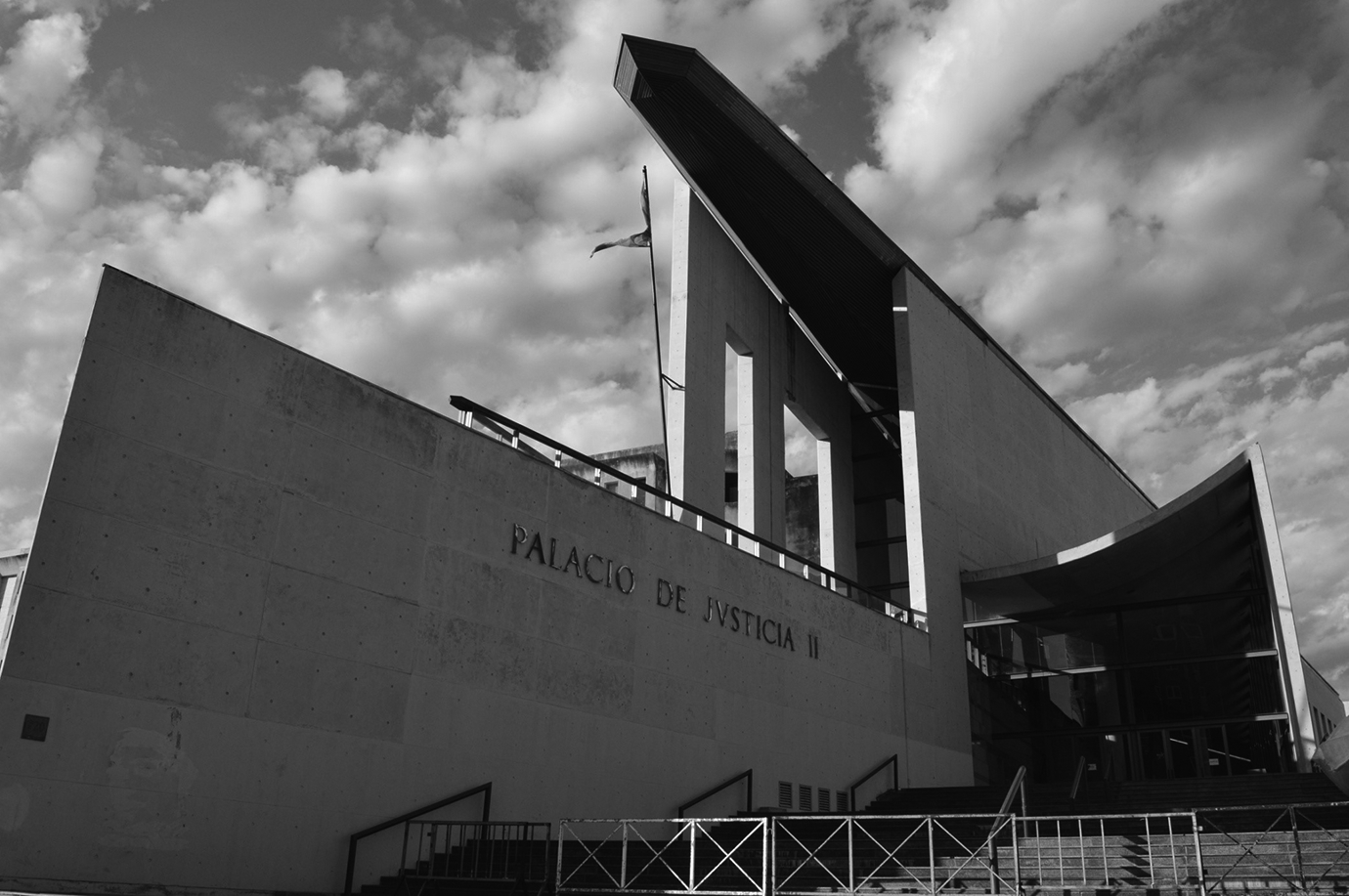
Tribunales II.
When jurors are not around, the inner workings of Tribunales II seem to adjudicate matters of space and time in relatively unproblematic ways. This is, to a large extent, related to the precise design of the building’s interior spaces, built with three nuclei of horizontal and vertical circulation: one for judges and other officials, one for the public, and one for prisoners. This disciplinary machinery coordinates circulation flows, accesses, visibilities, and invisibilities seemingly successfully. Joined with the temporal dimension that defines the uses and meanings of the spaces, clear lines are drawn between those who should and should not be in a place at a specific moment. This is of course not to say that practices always match the rules governing spaces. Many lawyers and trial prosecutors, for instance, circulate through private spaces of courthouses, despite being formally identified as outsiders to them. Still, persons circulating through in inhabiting sections of the building have clear information or indications as to whether they can or cannot be in each space at a given time.
It is appropriate here to bring jurors into the picture and ask whether the architectural design reflects a conception of the courthouse that involves the presence and activity of lay decision-makers. The answer, put simply, is no. Córdoba’s courthouses are imagined for a judicial chronotope (Valverde, 2015) that does not include lay participants as part of official proceedings, places, and schedules – even in recently built venues that belong to the era of lay participation in the province’s criminal justice. In this context, the situation of jurors within the spatiotemporal arrangements and normalized everyday workings of the courthouse can be best described as ambiguous, creating tensions and conflicts for their accommodation. These conflicts are adjudicated by the action of myriad human and nonhuman actants, from janitors to material status markers, which define jurors’ access to and role within courthouse spaces and times. The incorporation of jurors tends to be more complicated in the informal physical and symbolic spaces (i.e., corridors, waiting rooms, toilets, cafeterias, recesses within hearings, and moments of socialization) than in formal ones (i.e., trial hearings and deliberations). This article’s stretching of the judicial space’s spatiotemporal researchable matter beyond traditional sites (such as courtrooms) is thus relevant and revealing.
Let me resort to my observations from Tribunales II in Córdoba’s Capital City to illustrate these points, starting with the site and time of judicial authority par excellence: the courtroom during trial hearings. In the building, only the courtroom of the Cámara de Acusación (Court of Appeals), more spacious than those of the trial courts, has been especially furnished to fit the panel of eight (plus four substitutes) lay participants (Figure 2). Mixed tribunal trials, however, are always held in the smaller hearing rooms of each court. Ad hoc sitting arrangements must be made when jurors are included – some clerks even ignore the existence of the properly furnished courtroom at the Court of Appeals. Accommodating jurors in hearings is not perceived as an important matter by court officials and judges, thus necessary arrangements are decided by assistant clerks or even janitors. 11 Their decisions usually remain undisputed, but occasionally conflicts arise. This means that minutes before a courtroom becomes the theater for a criminal trial, with all the knowledge and power effects conventionally attached to it, they host very different truth games, with significant jurisdictional claims made and pitted against each other to define no less than the legitimate location of the lay decision-makers. In one of the trials I observed, for example, the janitor had positioned eight chairs for jurors in front of the elevated platform where the judges were to sit, leaving no room for the substitute jurors (only three in this case), who he placed in the first row with the spectators. A member of the Juries Office, which oversees administrative issues related to lay participation, checked this courtroom before the hearing and disliked this arrangement, finding it unacceptable that the substitutes were among the audience. He went into the court offices, came back with the janitor, and, after a short discussion that included arguments on jurors’ status and integrity, he made the janitor relocate all the jurors to two parallel rows of six chairs near the defense lawyers and defendants, and perpendicular to them – an ‘American movie jury pattern’ that, perhaps due to these popular culture influences, is the most common arrangement in the trials at Tribunales II.
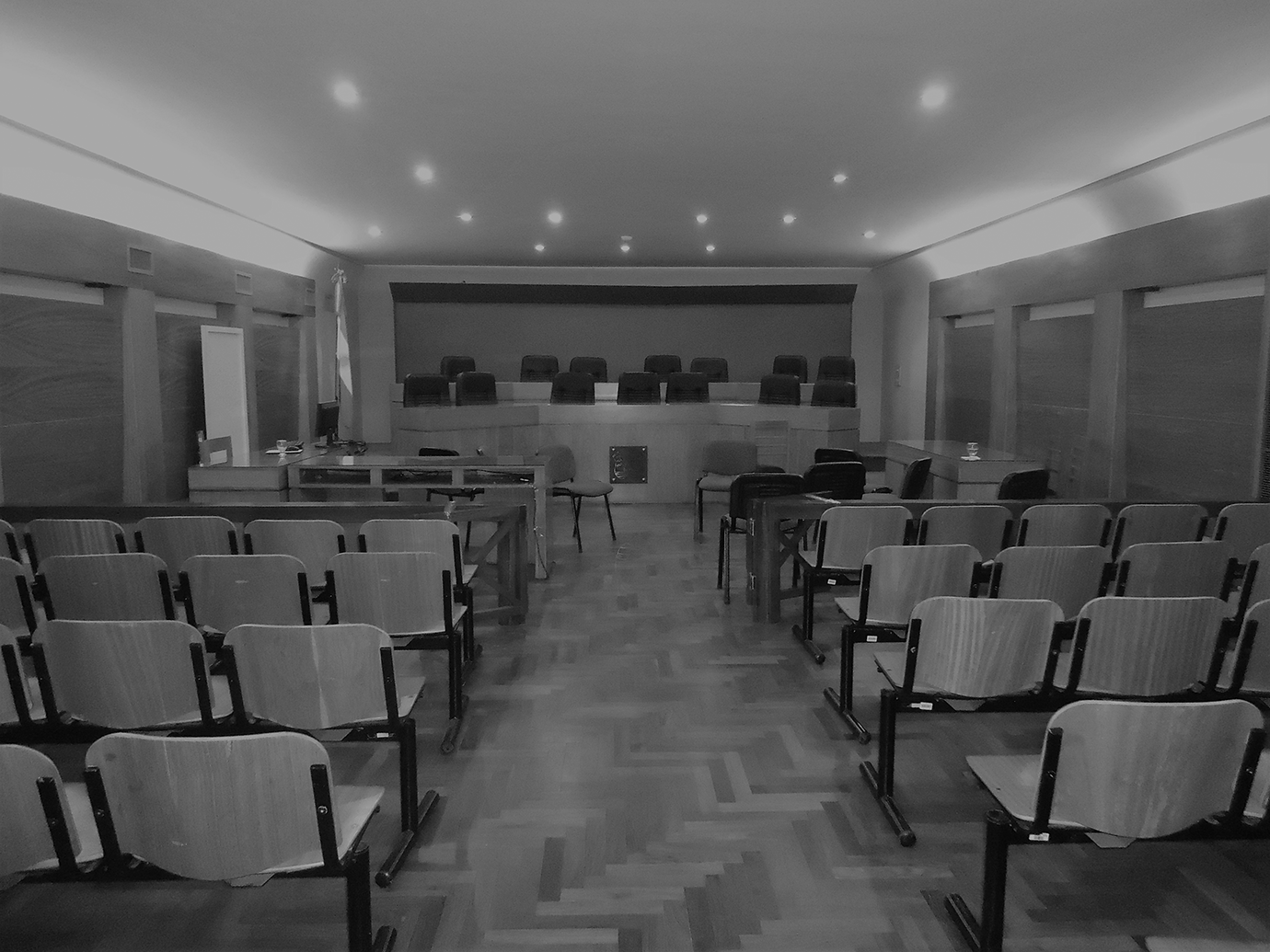
Court of Appeals, Hearing Room. The three seats in the center of the podium are for judges and the remaining ones for jurors.
In smaller sites outside the Capital City, spanning 10 criminal courts in nine judicial districts, the situation is compounded by acute temporo-spatial constrains. A single set of furniture travels across the province to accommodate jurors in the courtrooms. This means that the Juries Office must orchestrate the scheduling of mixed tribunals to avoid concurrent trials in different sites; a clerk creates the schedules and authorizes via phone calls which courts may proceed with setting dates for trials. If an overlap occurs, one of the courts will have to improvise with furniture. The starkest contrast with the space afforded courtrooms in the Capital City, as far as I could observe, was in the criminal court in the town of Tardecita, where the court’s hearing room – located in a rented building opposite the main square – is too small even to accommodate the nomadic furniture set. Instead, the first two rows of audience seats are reserved for jurors. The lack of proper spatial resources creates inconvenience and prompts complaints, and the unfulfilled promises of improved conditions were regularly brought up in my conversations with court staff. These conditions, however, also elicit creative practices that are relevant to my argument. Alicia, an experienced assistant clerk in Tardecita’s court, told me of a trial with jurors that was expected to attract strong public attention, triggering her concerns over accommodation in what is an already undersized courtroom. Alicia considered asking municipal authorities to make the local theater available for the trial, but town officials argued that too many seats would remain empty. She took her idea further and invited secondary schools in the area to bring students to observe the trial and then she helped teachers prepare special coursework on the experience.
With scarce resources, creative practices such as this convey not only the claim to competently decide law’s place (a form of jurisdiction) but also the preferred meaning of ‘participation’ in this particular legal setting. It is certainly an expanded meaning when compared to the one limited to the more or less autonomous intervention in the delivery of a verdict that marks the epistemologically limited conception held equally by most legal experts, judicial officials, reformers, activists, and sociolegal scholars. Beyond this (somewhat) normative evaluation, and to avoid overromanticizing the episode with Alicia, the most relevant theoretical points of this illustration are the flexible, fragile, and highly contingent relations among time, space, law, and meanings of participation. Central to the outcome in Tardecita was Alicia’s successful translation work and enrollment of people and things, from municipal authorities and school students to limited spatial resources, and her own accumulated legal knowledge. Perhaps most importantly, these decisions, just like the ones of the janitor and clerk in the previous vignette, were made by authorities with no formal entitlement or legal power to adjudicate these matters.
Cohabiting Law’s Everyday
The complications jurors pose to the assumed normality of courthouse spatiotemporalities are not limited to the courtrooms during hearings. Their arrival has entailed adjustments to the configuration of taken-for-granted times and spaces of the courthouse’s everyday activities. Some adjustments have proved thornier than others for court personnel. Conflicts over jurors’ status and legitimate location and belonging can be traced in multiple daily mundane matters and in formal and informal spatiotemporal dimensions. I will illustrate this argument through three examples of my fieldwork observation: the use of name badges that facilitate jurors’ access to the courthouse; their incorporation in a symbolic time-place-practice of the courts (i.e., breakfast); and jurors’ use of the courts’ private toilets.
The security located at the entrance of Tribunales II epitomizes jurors’ transition from full alterity to an ambiguous mix of outsider and authorized status. Police are located at the extreme left of a thirty-foot-wide main entrance leading to the three-story-high central foyer. Relatives of defendants in trials, clients of public defense lawyers, and people summoned as witnesses are the regular subjects for routine security checks. Judicial officials, clerks, and employees who choose not to use their own segregated entrance – plus other known regulars of the building such as lawyers, journalists, waiters, and vendors – are allowed to bypass security out of convenience. When jurors first come to the courthouse, they are treated as any other first-time visitor. They go to security, have their names and reasons for their visit recorded, and walk through the metal detector. At their first contact with the Juries Office, jurors are given name badges that certify their status for the duration of the trial and allow them to use the officials’ entrance. If they prefer to continue to use the main access, the badges spare them the security check. In smaller sites, where security controls are less developed, other prerogatives are conceded to jurors, like parking spaces in judges’ car parks. Although mostly symbolic, these instances of law’s power and embodied materiality are crucial to the definition of jurors’ status during their temporary stay in courthouse spaces. Conventional representations of judicial authority are destabilized in this work to look beyond jurors’ embodiment in decisions of trials; their unique standing is also channeled in the courthouse everyday workings through material markers of status and signs of differentiation and spatiotemporal belonging. A name badge that facilitates access, allows skipping security and softens the police gaze on an outsider, widens spaces and times of legitimate permanence.
In interviews and conversations, several jurors mentioned these status markers as central elements in their generally positive evaluations of the experience. One early morning I met Patricia, a juror in the case I had been observing for a few days. She was sitting in the foyer of the still-nearly empty building, knitting as she observed the first movements of people. She explained to me that she used the taxis provided by the Juries Office to first drop her children at school and then come to the court directly afterward, the downside to it being a long wait, as she was summoned only for 9 a.m. That morning I had gone through security – something I would occasionally choose to do during my fieldwork, despite looking like and mostly being treated as an ‘insider’. Patricia saw me coming from the police post, and her first remark was related to her status regarding security control. She told me that the first day she arrived in the courthouse she had gone through the strict control (which she was spared now thanks to her juror badge), and wondered what would have happened had she brought her knitting that day. She had not, and she ended up incredibly bored during the wait. She also wondered whether other people without juror badges would get away with bringing in metallic knitting needles. In any case, she concluded, she felt more comfortable in this public foyer being observed by police officers than in the court of her case under the gaze of the young female assistant clerks – ‘snots’ – who, she felt, were not at ease with her arriving so early.
As Patricia’s closing remarks suggest, jurors do not automatically belong to every courthouse space and time by virtue of their status or the material indicators that differentiate them from regular outsiders. In informal times and spaces, where the disciplining and categorizing tools of the law are less available to justify decisions, accommodating jurors makes court staff especially uneasy. When a mixed tribunal trial is scheduled, jurors are usually summoned to arrive at 8:30 or 9 a.m., although trials seldom start before 10 in the morning. 12 It is common to hear complaints about the waiting time, but for most jurors this is not as problematic as it may seem. They rapidly get used to the idea of devoting an entire work day to this activity and adopt a resigned attitude to the fact that hearings never start on time. 13
A consequence of the lag is that jurors need to be put somewhere during this waiting time; but without a dedicated space for them, this becomes a matter of case-by-case adjudication. In some courts, jurors must wait in the public corridors, usually until relatives of defendants and victims arrive for the trial. Yet the most common practice is that early-bird jurors are allowed into the private spaces of courts’ offices, which are filling with clerks, officials, and other court workers. This means not only sharing a place but also a widely held practice in Córdoba’s criminal courts: breakfast. A truly chronotopical concoction of time, space, and practices, breakfast at the courthouse is, for court staff, a heavily symbolic space of temporarily diluted hierarchies. There is time for informal chats to recap workplace issues or the news of the day before the morning’s rush. As mundane as this may seem, breakfast at the courts is a chance to observe how uneasy this sharing can be for court officials. On one occasion when I was at breakfast with a group of assistant clerks and clerks, 14 jurors were waiting in the Sala de Acuerdos – a room where judges deliberate trials. This room is furnished only with a hexagonal table, three armchairs (one for each of the courts’ judges) and one or two bookshelves. As a waiter from the courthouse cafeteria entered carrying a tray of coffee and pastries, a judge who was just arriving asked where the food was being delivered. Hearing it was the jurors’ breakfast, he commented sarcastically to me: ‘I want to apply for a position as a juror. Do you know where I can do that?’ Some cross-talk followed among the assistant clerks. They concluded that the jurors had placed the order themselves instead of waiting for a court clerk or Juries Office assistant clerk to do it for them. The discussion then moved to payment. Jurors’ breakfasts are paid by the Juries Office from their budget for jurors’ allowances, which also includes jurors’ transportation and daily payment. At this point, an assistant clerk addressed me directly to make a point: court staff have to pay for breakfast; jurors, who get paid for their work at the courthouse, should also pay for their food. ‘The state is paying for them, and the state is all of us’, she said, and added that she prefers to order jurors’ breakfasts herself when she is in charge of a case to ‘keep some control’. Minor money expenditures and keeping and reasserting some sort of control over familiar spaces remain critical to the adjudication of the mundane tensions that jurors’ belonging creates at the intersection of the ‘public’ and the ‘private’ at the courthouse.
One more example of the governance of another courthouse space can illustrate further the complex public-private spatiotemporal dyad, its many dimensions, and its role in the puzzle of jurors’ belonging and status. When I asked a group of assistant clerks about the most problematic issue the incorporation of jurors had brought (expecting to excerpt some debate about sharing the power to judge and punish, or to hear their preoccupation for defendants’ rights in the face of commonsensical punitiveness), they did not hesitate: their main concern lay with the use of the court’s private toilets. Assistant clerks, clerks, and officials, they told me, periodically collect money among themselves for toilet paper and cleaning products, which are not provided by the judiciary; and they pay a little extra to maintenance staff who keep them clean. After a few trials with jurors, they had detected ‘overuse’ of the toilet paper supply and deficiencies in hygiene maintenance. They decided that jurors could no longer use this toilet and would instead be asked to use the public toilets located in courthouse corridors.
The breakfasts – paid for by workers’ themselves yet publicly funded for jurors – left courthouse bureaucrats frustrated and justifying their attempts at control over some diffuse protection of taxpayers’ money. On the other hand, the ‘doubly private’ nature of the courts’ toilets (privately funded and spatiotemporally private) left, in their view, no doubt as to their spatial-control jurisdiction, and to jurors’ subjection to it. The demotion of jurors to the status of ‘general public’, at least with the use of this specific space, is not simply a matter of convenience. These mundane decisions on the belonging of jurors become part of the network of the incorporation of lay participation and have repercussions when coupled with the courts’ fragile assemblage of routine practices. My last ethnographic vignette will help explain this.
The setting is the final hearing in a murder trial in which five men are accused of killing a moneylender. It is Friday at noon and the end of a week of hearings filled with witnesses’ declarations laying bare the deficiencies in the police investigation. It was clear that the defendants would be acquitted. With only the closings of the prosecution and defense pending, a short recess is called. In the corridor, the defense lawyers and prosecutor chat animatedly, in stark contrast to the tense recesses during the week. The mood changed when one of the jurors appeared. On his way to the public toilets, the juror effusively congratulates the defense lawyers, clapping the youngest on his back, saying: ‘Well done, Doctors’.
The lawyer reacts: ‘No, no, you can’t say that, please’. After the juror leaves and the ensuing moment of awkward silence, he says to me: ‘They don’t know, they have no idea, they should be told about this kind of thing’.
The remaining few minutes of the recess are devoted to a serious discussion among the all-law-educated party. I seem to be the only one who considered the ‘misconduct’ of the juror insignificant, especially after months of observing officials and lawyers periodically stretching legal rules and conveniently breaching the formalities of proceedings. In the view of the legal professionals involved, endowed with the necessary intellectual capital and training in the deployment of postures and performances of objectivity (Bourdieu, 1987, 2003), this outsider was misinformed about the formalities of the law, especially venerable as they relate to the impartiality of an adjudicator. 15 What is relevant to my argument in this article is that it is the very materiality of the juror’s presence and conduct that rendered the naturalized workings of this rule visible in this particular time and space. The need for the juror to travel through this public space at that crucial time was opened by the decision as to which private spaces these ambiguous characters are entitled to and from which they are excluded. The accentuation of the jurors’ alterity vis-à-vis legal professionals and their modes of conduct can be understood, in turn, as both an effect and a constitutive part of the very demarcation of jurors’ legitimate spatiotemporal belonging.
Concluding Remarks: The Law and Its Spatiotemporal Boundaries
While I was immersed in observing courthouse routines, I was also analyzing a completely different scale of the governance (Valverde, 2014b) of the introduction of lay participation: reading jury trial bills and legislative debates, and interviewing projury activists in several Argentine cities. From across the political spectrum, these reformers mobilized different, even contradictory, political rationalities; and they expected lay participation to produce a broad range of societal effects, from democratization of the judiciary to its legitimation and to harsher punishments (Amietta, 2016). They did, however, all seem to agree on one point: the potential of lay participation to bring commonsensical understandings of law and justice to the realm of overly technical and bureaucratized truth-seeking processes of the criminal justice system. This is a claim shared by conventional and scholarly wisdom on lay participation (Dzur, 2012; Finkel, 2001). Elsewhere I have challenged this view (and the very divide between the ‘everyday’ realm and the sphere of Law [capital L] that it implies) and argued that jurors’ arrival to Argentine criminal proceedings entailed instead the incorporation of new elements to an already contingent and mutable balance of formal and informal, and even legal and illegal, practices that make up judicial proceedings (Amietta, 2019).
My analysis of jurors’ incorporation to the multiple spatiotemporal dimensions of courthouses adds an extra layer of conceptual and empirical substance to these discussions. The use of the notion of jurisdiction in a critical vein implies not limiting oneself to the ‘natural’ move from a bigger to a smaller scale of governance, but to take seriously the qualitatively different nature of the interventions of multiple authorities as the network is knitted together (Valverde, 2009, 2010, 2015). Such differences relate to the kind of priorities they put forth, the objects they make visible and those they conceal, and the temporalities (historical and nonhistorical) and spatialities they have in mind (Santos, 1987). The myriad authorities that regulate jurors’ everyday assemblage to the courthouses do, I claim, exercise forms of jurisdiction and of verisdiction (Foucault, 2014) that simply target a qualitatively different governable object than those of authorities looking at this phenomenon of participation through a broader scale. This includes the macro-social scale of reformers who advocate for introducing lay participation as a device to seismically transform, democratize, and/or legitimize the judiciary and its way of judging and punishing. When it reaches the courthouses, as discussed in this article, lay participation simply becomes a qualitatively different governable object – one governed with different audiences, spatial and temporal frameworks, values, aims, and understandings of participation in mind. My first point thus relates to law’s multiscalar operation. The plurality of legal governance and the inadequacy between these scales is, importantly, not an obstacle. Quite the opposite. A point that conventional sociolegal ‘gap studies’ miss is that law’s scalar complexity actually guarantees its smooth operation on the condition that it is presented as ‘already itself governed’ through the invisible operation of jurisdiction (Valverde, 2009: 141).
A methodological strategy that allowed me to sidestep accepted divides to observe these multiple scales at work emerged after conceiving of the courthouse as a hybrid; that is, an inherently unstable network that is the aftereffect of certain associations of ideas, persons, and things being set in motion (Latour, 1993). The systematic observation of courthouse routines and informal interactions among courthouse inhabitants laid bare how practices toward the governance of lay participation traverse and void the well-established public-private and spatial-temporal dyads, and materially and symbolically force jurors to navigate between them. The analysis showed that, far from rigidly determining the possible conducts, belongings, and hierarchies of the different actors within it, courthouse spaces are defined and redefined on different temporal scales and through multifarious practices as jurors are accommodated. As such, I suggest this matter may be fruitfully studied as complex spatiotemporal arrangements best captured by the notion of chronotope (Valverde, 2014b, 2015). This chronotopical approach – the adjectival form is purposefully here used to avoid any claim that there is such a thing, ontologically existing, as the judicial chronotope – highlighted the flexible relationship among authority, status, and meanings of participation and the ambiguous location of jurors in the courthouses’ places and times. Rendering the work of multiple authorities visible has allowed me to connect their jurisdictional work with its effects in terms of everyday practices. I have previously claimed that this ambiguity works toward producing and reproducing jurors’ constitution as outsiders and law’s ‘others’ when their spatiotemporal dislocation and inadequacy to the written or unwritten rules of courthouses is called out by legal professionals, in contrast to the normalization of the breaches to proceedings when they come from jurists themselves (Amietta, 2019).
The study of the multiscalar operation of a sociolegal hybrid and observation of jurors’ incorporation therein also allowed me to document law’s own awkwardness with its ambiguous and contingent materiality. Just as Tribunales II contains signs of respect for the past and promises of a better future, it detaches law’s working from the present. I observed how the law tries to externalize spaces and times that are hard to acknowledge as their own. Yet I also saw how legal or quasi-legal truth claims continue to be involved in the spatiotemporal governance of mundane instances, such as related to breakfasts, corridors, waiting spaces, and toilets. This is despite these not being regarded as events or spaces of judicial practice and authority and left to the governance of barely visible authorities, even when they stretch the justice’s spatiotemporal limits and force it to occupy unexpected spaces (like a small-town municipal theater), or travel from one site to another in the form of an itinerant set of furniture. Law is pluri-scalar, but also pluri-spatial and multi-temporal, and much of this material plurality (which is fragile and contingent because it is made of practices that are governed by multiple authorities) will not be part of law’s official story of its welcoming, and defining the belonging of, laypersons to criminal justice proceedings. But just as law’s multiscalar materiality escapes doctrinal approaches, so too its powerful effects on contingent configurations remain invisible to sociolegal studies that focus only on legitimate researchable spaces such as judicial decisions or seek macro-social sociological explanations. This article suggests instead that scholars creatively incorporate more of these scales in lay participation and sociolegal research more broadly.
Footnotes
Acknowledgements
I would like to thank the Juries Office of Córdoba’s Judiciary and the individuals who shared their working times, spaces, and experiences with me. The ideas in this paper were first conceived in discussions within research teams led by María Inés Bergoglio at the Centre for Legal and Social Studies, National University of Córdoba, Argentina. For this and many other things I am indebted to her. I presented earlier versions at the panel ‘The role of methodology in the study of law’ of the 2017 LSA Annual Meeting in Mexico City and the seminar of the Grupo Derecho y Sociedad at the Catholic University of Chile in August 2018. For their comments in these forums and other stages of the research process, I am grateful to Leticia Barrera, Daniela Bolívar, Sandra Brunnegger, Eve Darian-Smith, Jeanne Hersant, Vanessa Munro, Hannah Quirk, Toby Seddon, Rachel Seoighe, Ezgi Taşcıoğlu, Mariana Valverde, Mary Vogel, and the two anonymous reviewers of Social & Legal Studies.
Declaration of Conflicting Interests
The author(s) declared no potential conflicts of interest with respect to the research, authorship, and/or publication of this article.
Funding
The author(s) disclosed receipt of the following financial support for the research, authorship, and/or publication of this article: This research was funded by the University of Manchester’s School of Law PhD Scholarship and subsequent Research Support Awards for travels and fieldwork. I also received funding from the project ‘La consolidación de estrategias participativas en la Justicia Penal: Consecuencias sobre la administración de justicia y su relación con los ciudadanos’ of the Secretariat of Science and Technology, National University of Córdoba (SeCyT, Res. 162/12). The writing up was completed during secondments funded by the INCASI Network, an EU Horizon 2020 RISE programme under the Marie Skłodowska-Curie actions (GA No 691004,  ) coordinated by Pedro López-Roldán (Autonomous University of Barcelona).