




Abstract
The current growth of criminal background screening for non-criminal justice purposes observed in the Global North is also found in Latin America. The aim of this article is twofold. First, it contextualises, analyses and discusses recent changes in criminal record policies in Latin American jurisdictions. Second, the article focuses on Argentina – a jurisdiction that has not passed any significant reforms to mitigate the disclosure and the effects of criminal records for employment purposes. Specifically, attention is devoted to worker co-operatives created and owned by people with a criminal record – a strategy specifically designed to overcome post-sentence discrimination in the employment setting. Through the analysis of semi-structured interviews conducted with members of Argentine worker co-operatives, we explore the reasons behind the establishment of these organisations as well as their advantages in terms of reintegration and desistance from crime. The article concludes by examining the extent to which this ‘resistance strategy’ against stigma and discrimination in the labour market can be replicated in other countries of the region.
Introduction
Instances of criminal records-based employment discrimination have been attested in recent decades in different Latin American countries, such as Chile (Mavila, 2007), Peru (De la Cruz, 2016) and Argentina (Gastón, 2019). Previous research has depicted employers’ background checking as standard practice in recruitment processes – and this even occurs when several laws prohibit employers from asking for a criminal record certificate for most jobs (Carnevale, 2016). Thus, some countries, such as Venezuela, have chosen to explicitly forbid employers from asking for a criminal record certificate from job applicants. Others, such as Mexico, Ecuador and Chile, more generally forbid employment discrimination on any grounds. However, these prohibitions have not been sufficient in practice to prevent employers from overlooking them and requesting a criminal record certificate from applicants in job search processes. This trend has been particularly acute during recent economic crises where unemployment is higher and there are lower incentives to employ former offenders (Campos Reynoso, 2017). Widespread criminal background checking leads to exclusionary outcomes from legal labour markets for formerly convicted individuals (Carnevale, 2016; García, 2017; Gastón, 2019), notwithstanding the fact that employment has been detected as a crucial factor in the process of desistance from crime (Maruna, 2001).
The aim of this article is twofold. First, we contextualise, analyse and discuss recent legislative trends across Latin America affecting the disclosure, use and expungement of criminal records. In particular, we focus on reforms enacted from 1991 to 2020 in 14 Latin American countries, namely, Argentina, Brazil, Chile, Colombia, Costa Rica, Ecuador, El Salvador, Honduras, Mexico, Panama, Paraguay, Peru, Uruguay and Venezuela. What emerges is a coexistence of mitigating and aggravating reforms regarding the management and use of criminal records outside the criminal justice system without any trend emerging clearly. On the one hand, between 2001 and 2016, different countries have passed laws aimed at limiting the time limits for disclosure, use and expungement of criminal records. On the other hand, since 2004 specific registries for sex offenders have been created in the region with fewer protections in terms of disclosure of the information contained. Argentina was the forerunner and was soon followed by countries such as Chile, Colombia, Peru, Uruguay, Ecuador and Paraguay. Second, we direct our attention to a particular ‘resistance strategy’ against the exclusion of people with criminal records developed in Argentina: Work co-operatives created by individuals with a lived experience in the criminal justice system. Over the past few decades, Argentina has not passed any significant reforms to mitigate the disclosure and, more generally, the effects of criminal records for employment purposes. Rather, criminal record policy has become stricter, especially with regard to specific categories of offences. This is the context in which worker co-ops run by people with a criminal record developed. Through the analysis of in-depth interviews with 12 co-op members, we explore the reasons behind the establishment of these organisations and their advantages and disadvantage as a way of supporting re-entry. The study finds that, despite a few drawbacks, the ‘co-operativisation’ of labour market re-entry offers a promising model to unlock the doors that too often hinder the successful reintegration of criminal justice-involved individuals. This article contributes to the global debate on the diffusion and effects of criminal record checks from a Latin American perspective, discussing the specific policies, practices and social dynamics at play in this previously understudied region as far as criminal records, their management and their adverse consequences are concerned.
Recent trends in criminal record policy across Latin America
Academic debate on the legislative evolution of regulations regarding criminal records in the last three decades has for the most part centred around developments in the United States and Europe (e.g. Corda, 2016; Jacobs, 2015; Jacobs and Larrauri, 2012; Larrauri and Rovira, 2020), leaving trends in other regions outside of the scope of such inquiries’ analysis. The United States is usually seen as the epicentre of the criminal background checking epidemic in recent decades, combining a ‘right to know’ absolutism with regard to government activities with technological development and for-profit commodification of criminal history data by private commercial actors (Corda, 2016; Corda and Lageson, 2020; Jacobs, 2015). In contrast, continental European countries have been traditionally depicted as having higher protections against an unwarranted disclosure and dissemination of criminal records outside the criminal justice system and comparatively favourable criminal record clearance regimes in place (e.g. Herzog-Evans, 2011). However, recent years have witnessed a tendency to partly moderate the adverse effects and indefinite disclosure of criminal records in the United States (Flake, 2018; Selbin et al., 2018), while, conversely, collateral consequences of criminal records have increased in number and impact in the European context (Corda et al., 2023). Due to the lack of research in other contexts, it has been assumed that this was a global phenomenon. However, has that really been the case? Understanding the extent to which policies converge or diverge in regions of the world other than the ‘usual suspects’ in the Global North allows for a better understanding of alleged global trends while creating room for imagining new solutions to long-identified problems.
Before focusing on recent changes in criminal record policies in Latin American jurisdictions, some historical background is worth noting. National registries of convictions were created in Latin America in the first half of the 20th century, mainly through legislation directed to tackle re-offending of ‘habitual’ criminals. Registries of criminal convictions were established in Chile (1925), Argentina (1933), Brazil (1941), Colombia (1953) and then gradually all across the region. These were designed to collect and process criminal history information and provide a database to be used primarily in criminal proceedings (Carnevale, 2016). During the second half of the century – a period characterised by the spreading of military regimes in the region (Arratia, 2010) – reforms were introduced so individuals could get access to their own criminal record certificate. This soon became a ‘Trojan horse’ (Damaška, 1968), since third parties, such as recruiters, could request these certificates as a condition for employment. From this moment on, getting information on individuals with criminal records started to become more frequent (Carnevale, 2016; Fernández Ramírez, 2020).
Around the late 1970s, as many Latin American countries began their transition to democracy, human rights emerged as a topic of public debate associated with experiences of massive repression and state terrorism under dictatorships and authoritarian governments in countries like Brazil, Uruguay, Argentina, Peru and Chile. At that time, the influence of ‘resocialisation’ theories in the penal field was highly prominent in contexts marked by a Fordist production logic as well as an idea of social inclusion through employment within the rising ‘social state’ (Rivera Beiras and Salt, 2005). Related to the ideal of resocialisation, criminal records arose as one of the major issues that people who passed through the criminal legal system had to face. For instance, in Argentina, a year after the return of democracy, in 1984, the expiration of conviction records was established by law (Act No. 23.057). This means that after 10 years from the expiration of the prison sentence, the information on a criminal conviction must be deleted from the record and cannot be reported either outside or inside the penal system. 1 Another example of this trend is a 1979 reform establishing a criminal record-keeping system adopted in Venezuela under which it was ‘forbidden for any company or person to require individuals, on the occasion of job offers and in matters related to labour recruitment, to present criminal records’ (Article 8).
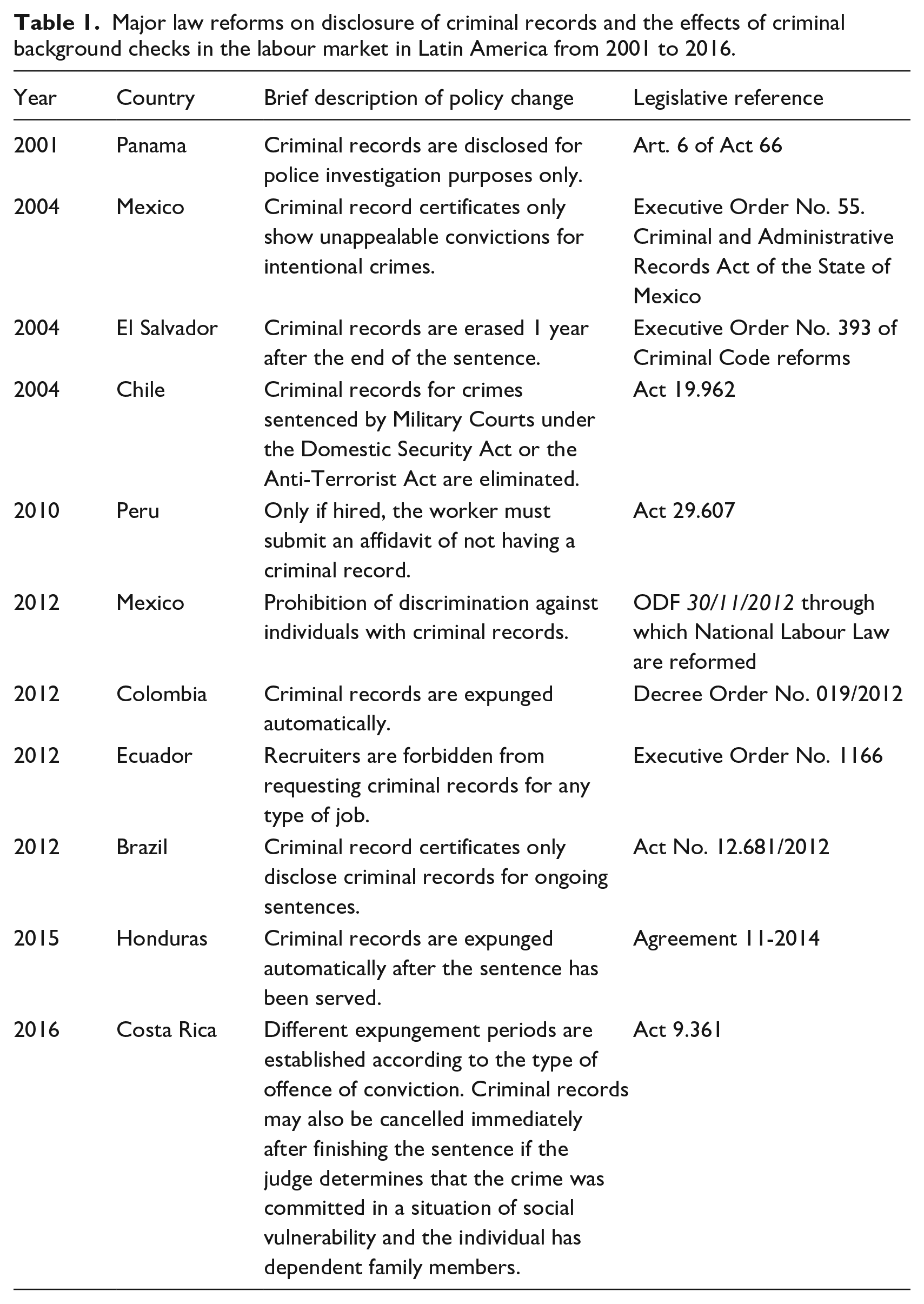
In the last two decades apparently contradicting trends in the area of criminal record policy can be identified in Latin America. Especially from the early 2000s onwards, legislative reforms were passed in several countries shortening the periods for criminal records to become expunged and limiting the use of criminal records outside the criminal justice system. Table 1 shows that reforms limiting the disclosure, use and expungement periods were introduced in Panama (2001), Chile (2004), Mexico (2004, 2012), El Salvador (2004), Peru (2010), Colombia (2012), Ecuador (2012), Brazil (2012), Honduras (2015) and Costa Rica (2016). At first glance, one might be tempted to infer that these changes were produced as part of the so-called ‘Pink Tide’ – the rise of ‘left-of-centre’ and ‘radical social democratic’ governments in Latin America characterised by a strong antagonism towards the previous spreading of neoliberal policies throughout the region (e.g. Chodor, 2014; Lievesley and Ludlam, 2009), 2 giving way to what was hailed by many as the beginning of ‘post-neoliberal’ times in the region. It has been noted, however, how penal policy trends under left-leaning populist governments have been characterised by tensions and contradictions, with no clear trajectory easily identifiable (Sozzo, 2018). Also, measures aimed at reducing criminal record-related punitivism were enacted in several countries not belonging to the ‘Pink Tide’ group, as highlighted in Table 1. These were regarded as necessary in light of growing awareness of the negative consequences of criminal records especially with regard to employment (Carnevale, 2016). Moreover, the participation of government-independent actors has been observed with the initiative to produce these reforms. In Costa Rica (2016), it was generated as a result of a reflection process driven by civil society organisations with the aim of shortening the time limits for the cancellation of criminal records upon completion of the sentence when a situation of vulnerability is verified. This had mainly the intention of alleviating the consequences of a criminal record for women (Peña, 2018).
Major law reforms on disclosure of criminal records and the effects of criminal background checks in the labour market in Latin America from 2001 to 2016.
One of the main exceptions to this process of changing policies was Argentina. Despite the fact that between 2003 and 2015 Argentina had governments embracing a post-neoliberal approach in policymaking (Sozzo, 2016), there were no reforms passed limiting the disclosure of criminal records for non-criminal justice purposes.
In the described climate of penal policy contradictions, more recently there has been an expansion of collateral consequences of criminal records arising, in particular, from sexual offences. This can hardly be characterised as the product of a yet again changing political environment that witnessed the weakening of ‘post-neoliberal’ governments in several Latin American countries in more recent years and the return to power of more conservative leaders and parties (Gallegos, 2018; Lynch, 2020) which ran on platforms that included an overall ‘tightening’ of criminal justice policies (Goñe Gutierrez, 2018). Rather, the adoption of ‘selective’ punitive reforms affecting individuals convicted of a sexual offence seems to respond to a specific logic aimed at ‘neutralising’ a certain subset of the criminal justice-involved population (Logan, 2009; Yung, 2010). The most visible legislative reform of this kind has been the creation of specific registries for sexual offenders with lower protections concerning the disclosure of this information and higher availability outside the criminal justice system. Argentina was the first country to initiate such a trend. Since 2004, provincial laws began to be enacted that created such registries and allowed individuals to have the possibility of accessing their own criminal record certificate for sexual offences and present it if requested by a recruiter. These provisions were introduced in the provinces of Buenos Aires and Córdoba, which account for 45% of the country’s population (Instituto Nacional de Estadísticas y Censos (INDEC), 2010) as well as in the less populated provinces of San Luis, La Pampa, Chubut, Santa Cruz and Tucumán. In 2010, the province of Misiones took a step forward by mandating that public and private institutions carrying out activities involving children, people with disabilities and the elderly request a certificate of sex offences prior to offering any type of employment. Later on, similar provisions were introduced in other countries such as Chile (2012), Colombia (2018), Peru (2018), Uruguay (2019), Ecuador (2019) and Paraguay (2020; Fernández Ramírez, 2020; Luque-Gonzalez and Medina-Chico, 2018; Pérez Riquelme, 2018). The reforms implied greater accessibility of these records to third parties and further restrictions on taking up employment, especially where contact with children or the elderly is involved. However, they have not yet reached the intensity of restrictions found in the United States and United Kingdom, where, for example, post-release supervision, restrictions on where they can live and meet and community notification have been imposed (Ackerman et al., 2011).
In addition, criminal records in the region also imply serious restrictions during the criminal process. In Argentina, Brazil, Colombia, Guatemala and Peru 3 having a criminal record might prevent accessing conditional release. Likewise, in Chile, a criminal record limits the application of sanctions other than imprisonment such as community service or economic reparation. In Argentina, Bolivia, Brazil, Ecuador, Guatemala, Peru and Mexico having a criminal record may make being sentenced to conditional imprisonment difficult. 4
To sum up, mitigating and aggravating reforms pertaining to criminal record policy across Latin American jurisdictions do not allow clear and unifying trends to be identified. Likewise, it is not possible to squarely link them to broader strategies or trajectories in penal policymaking. Rather, the reforms discussed followed specific patterns in different sub-areas and fields in response to different needs and debates.
The ‘co-operativisation’ of re-entry in Argentina: A resistance strategy to overcome post-sentence discrimination
As previously observed, not only did Argentina not pass any significant criminal record reform as part of its package of ‘re-socialising’ reforms enacted during the years of so-called ‘Kirchnerism’ (Sozzo, 2016) but it was also the first Latin American jurisdiction to initiate the enactment of selective punitive reforms against sex offenders regarding criminal record disclosure for employment purposes. It should therefore come as no surprise that Argentina is also the country where a very innovative and highly significant ‘bottom-up’ initiative to overcome the burden of a criminal record in the employment setting was developed – namely, work co-operatives established and managed by criminal justice-involved individuals.
Criminal records in Argentina were first regulated in 1933 with the establishment of the National Registry of Recidivism and Criminal and Prison Statistics. This legislation was amended only once afterwards, in 1979. It is worthwhile noting that both pieces of legislation were passed during de facto military regimes. From a comparative perspective, the terms of retention of criminal convictions on the registry are among the longest lasting ones in Latin America, and there is no differentiation based on the gravity of the offence of conviction. Furthermore, it allows unrestricted access for individuals to their own criminal records certificate. Under this system, job applicants are often pressured to apply for their own criminal records certificate to present it to an employer (so-called enforced subject access), hence facilitating employment discrimination (Carnevale, 2016; Gastón, 2019). In the absence of national-level responses aimed at limiting the adverse effects of criminal records, attempts have been made at the local level. For example, in the City of Buenos Aires the Equitable Job Search Act of 2021 was passed with the goal of promoting equal opportunities when identifying talent, recruiting and accessing jobs under equal and non-discriminatory conditions. Pursuant to this Act, it is forbidden for job offers to include restrictions regarding criminal records of persons who have served their sentence in full or based on any other piece of information not relevant to the job. In this context, lacking comprehensive legislative reforms, co-operatives comprised of people with criminal records have emerged as a new way of offering an informal response to alleviate the effects of post-sentence employment discrimination suffered by criminal record holders (Gastón, 2019; Otero and Barrera, 2020).
Experiences of co-operativism promoted by criminal justice-involved individuals started in 2010 in a Penitentiary Unit located in the city of La Plata (Province of Buenos Aires). There, a group of people deprived of their liberty, their families and criminal record holders created the first co-operative of this kind, which manufactured textiles and leather goods (García, 2017; Krombauer et al., 2015). Co-operatives are defined as ‘people-centred enterprises, owned by their members, who control and direct them to respond to common economic, social and cultural needs and ambitions’ (Alianza Cooperativa Internacional, n.d.; see also Fernández, 2006). In 2011, the Argentinian Worker Co-operatives Federation (FECOOTRA) created the ‘Area of Cooperativism in a Context of Confinement and Release’ to foster and encourage these types of co-operatives (Krombauer et al., 2015). Co-operatives managed by people with a criminal record in Argentina emerged in a context marked by an increasing precarity of public services directed to support former offenders and the complete lack of other community actors, such as charities or religious organisations, that may have helped to overcome this gap (García, 2019; Otero and Barrera, 2020; Sozzo, 2016).
In the first quarter of 2022, the unemployment rate in Argentina was 7%. In terms of qualification, the majority of the unemployed are operational workers (48.8%), followed by unskilled personnel (38.8%; INDEC, 2022). Although there are no data on the market exclusion rate of people with a criminal record in Argentina, when in prison only 12% completed secondary education and, also, only 12% had been trained in a profession (Sistema Nacional de Estadística sobre Ejecución de la Pena (SNEEP), 2021). Therefore, most of the people leaving prison will probably go to look for work in the segments where the unemployment rate is higher.
This form of organisation spreads rapidly among formerly incarcerated individuals. Currently, across Argentina there are 55 production units composed by individuals with a criminal record which function as co-operatives. These co-operatives currently employ about 1500 members. Of the 55 co-operatives, 5 are comprised exclusively by people currently in prison. 5
Previous exploratory literature on the emergence of work co-ops run by people with a criminal record pointed out that a basic reason for their creation was the difficulty for criminal justice-involved individuals to obtain a good job on the traditional labour market (García, 2019; Gastón, 2019). Co-operatives are a way to overcome regulatory obstacles, such as legislative bans prohibiting ex-offenders from working in particular positions, as well as unfavourable treatment by private employers more generally (García, 2019). Also, co-operatives have been linked to the use of proactive strategies by people with a criminal record to overcome obstacles generated by stigmatisation, including disclosing their conviction to challenge the prejudices of employers and society (Gastón, 2019).
From a comparative perspective, work co-operatives comprised people in prison can also be found in Puerto Rico (Gordon and Nembhard, 2020; Weaver and Jardine, 2022). However, no co-operatives of this kind have emerged in Argentina’s neighbouring countries such as Uruguay 6 or Chile. 7
In the Global North, there have been some instances of co-operativism based on people with criminal records. In the 1970s, at a time of decline of the welfare state in Italy (Collazos, 2007), ‘social co-operatives’ were born, initially known as ‘solidarity co-operatives’, aimed at offering services to vulnerable groups. In 1991, Law 381/1991 on Social Co-operatives was passed, creating a type of co-operative aimed at integrating disadvantaged people into the working world, a law in which those who are or have been in prison are explicitly included. These co-operatives are supported through access to tax benefits, direct contracts with the public administration, professional support and access to special public funding sources (Segués Peña, 2020; Thomas, 2004). Membership organisations of people with a criminal record can also be found in Sweden. In the absence of a co-operative law, organisations integrating people with a criminal record in Sweden are mostly formed as economic associations and have the possibility of using state-subsidised wages to support job creation (Weaver, 2016).
These organisations have been noted for providing not only employment opportunities, but also financial, legal and family support to people with a criminal record, thereby fostering social integration. Without robust evidence, in Italy and Sweden, participation in co-operatives has been linked to lower recidivism rates (Segués Peña, 2020; Weaver, 2016).
Methods
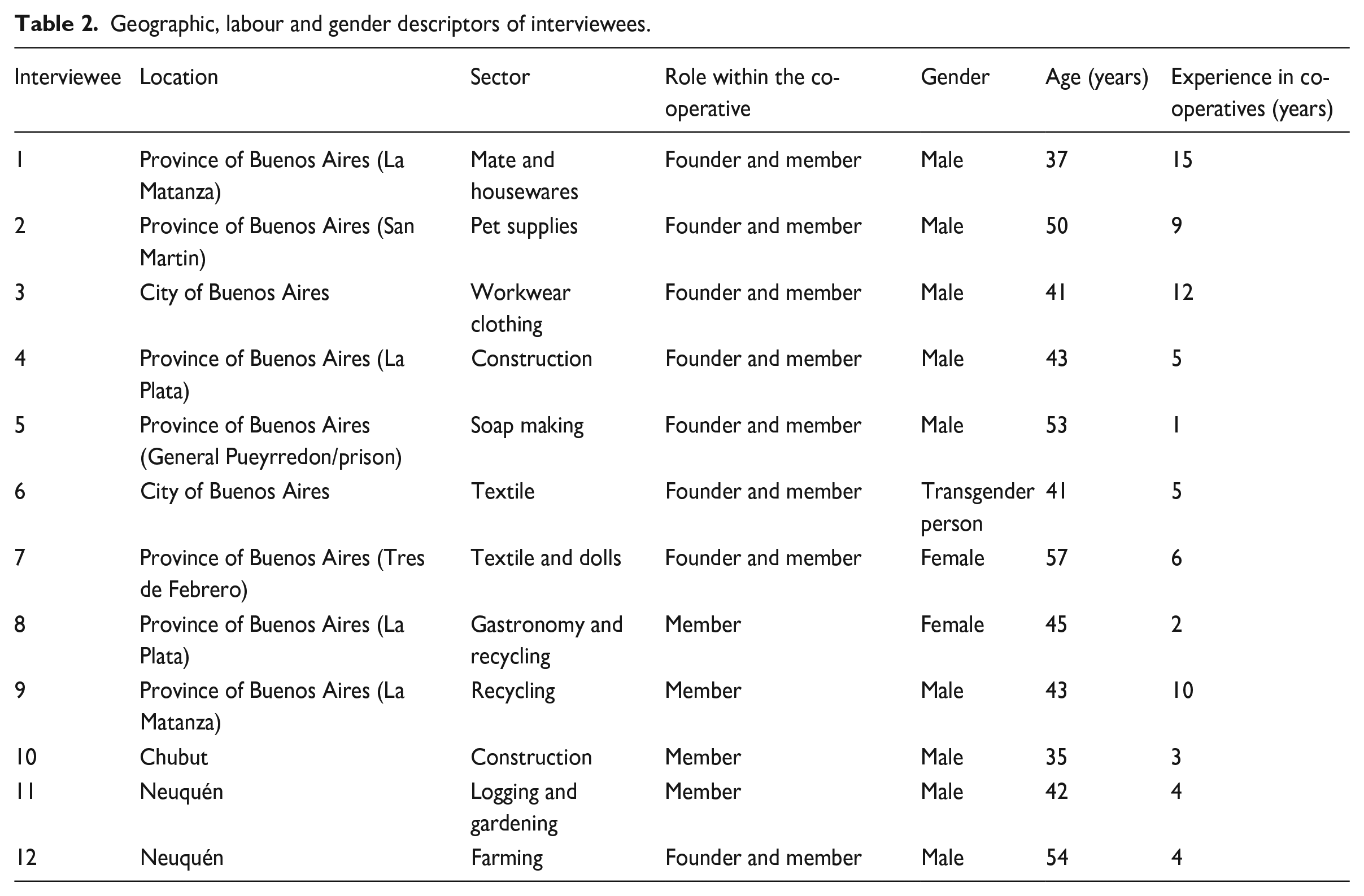
For the present study, 12 in-depth semi-structured interviews were conducted between October 2021 and April 2022 with participants who were members of these co-operatives. The aim was to explore the potential of co-operatives as a strategy to overcome post-sentence discrimination for criminal record holders. We interviewed members of co-operatives operating in the City of Buenos Aires and in the provinces of Buenos Aires, Neuquén and Chubut. The sample included nine men, two women and one member of the transgender community (see Table 2). The sample was purposefully selected based on previous contacts of the researchers with existing co-ops. The aim was to include persons from different types of co-ops and different levels of experience in them, with different gender identities, and working in different regions of the country. Some of the interviewees are among the founding members of the co-operatives in which they work while others joined them later. Interviews were conducted in Spanish by one of the researchers who used his personal computer (password protected) to record them. They lasted between 30 and 70 minutes and were terminated when further inquiry provided no significant new themes or information.
Geographic, labour and gender descriptors of interviewees.
Based on their review of the literature, the researchers established an interview guide divided into five thematic areas (request of criminal records by the employers, type of work currently conducted, previous jobs, the work inside the co-op and links between the co-op and the criminal justice system). These areas were later used for the thematic analysis of the interviews. The researchers followed an oral consent process, in which they explained the characteristics of the research and the background of researchers to the potential interviewees and obtained an informed oral consent from them. The interviews were conducted in a comfortable environment for the interviewee and signs of distress in the participants were monitored during the process. During the transcription process, names, places and sensitive identifiers were redacted. Pseudonyms were randomly assigned to interviewees.
Interviews were analysed using the qualitative analysis software ATLAS.ti with the aim of establishing commonalities, differences and interrelationships in the information collected (Gibson and Brown, 2009), following the principles of grounded theory (Charmaz, 2011; Glaser and Strauss, 1967). Four main themes emerged during the interviews: (a) the role of co-operatives in overcoming the obstacles that criminal records pose for job searching; (b) their role in providing solutions to overcome other collateral consequences of criminal records; (c) their role in providing a favourable context to develop narratives capable of fostering desistance from criminal behaviour and self-respect and (d) challenges and limitations of co-ops.
Excerpts from the interviews presented in what follows were translated by a professional translator and counter-checked by the two authors. In terms of positionality, both authors are men who work as criminal lawyers in the Public Defence system and only part-time in academia. Our experience from working in the Public Defence system allowed interviewees to feel confident to talk about sensitive issues related to their time in prison and the problems that this creates for them today.
Results
This section details the results of the research based on the four main themes that emerged from the interviews.
Assisting in overcoming the obstacles of criminal records in the labour market
The interviews showed how the co-operatives helped the interviewees in finding a job that generates enough income to sustain themselves and their families after their release from prison. Co-operatives of people established and managed by individuals with a criminal record in Argentina cover different areas of production, such as textiles, serigraphy, graphics, gardening, gastronomy, carpentry, recycling, care for the elderly, blacksmithing, construction and rural activities. Some of the interviewees pointed out the importance of co-operatives as their only option after being released from prison: It’s not like you choose co-operativism because you think that it’s much better than capitalism, but because you can’t get another job since you have a criminal record. This forces you to either commit new crimes or get organised within the ‘popular economy’.
8
(Interviewee No. 4, Construction co-operative worker) Bear in mind that I finished school in prison; this is my first job, and this is the first job for a lot of us. (Interviewee No. 1, Mate and housewares co-operative worker)
There are co-operatives outside of prisons, but others also have an extension inside the prisons. These extensions help to create training opportunities for inmates to be job-ready for when they are released. From the moment they begin serving their prison sentence, interviewees manifested their belief that, after regaining their freedom, this circumstance will become an obstacle to get a job through traditional channels. As one interviewee noted: Our goal inside and outside prison is to have a job when we leave. The main goal is for it to be inside and outside [. . .] so that the person who started working in the co-operative inside, can keep working there once he is outside. (Interviewee No. 5, Inside-prison co-operative worker)
Providing solutions to overcome the obstacles of other kinds of collateral consequences
Interviewees frequently stated that work co-operatives are a channel not only to avoid lack of employment but also to overcome collateral consequences in other areas. Participation in the co-operatives has no time limit and, as shown in Table 2, some members have been working in the co-operatives for 10 years or more, which allows them to address objectives beyond employment. First, co-operatives provide a housing solution to those who exit prison and do not have a place to live. The loss of social ties generated by prison usually means that those who leave prison do not have a place to spend their first nights in freedom, and the physical premises where the co-operatives’ economic activity is carried out is also used as a residence by many of them. These general characteristics of the co-operatives can be observed in the following quote: Those who leave, if they want, will have a place to sleep and a place to work until they get something better, but they don’t [necessarily] have to get something better. (Interviewee No. 5, Inside-prison co-operative worker)
Some co-operatives of people with a criminal record also welcome and include family members of people who are currently in prison. Including family members allows for alleviation of the economic consequences that incarceration entails for the family. This way, work co-operatives cover two relevant aspects of a successful comeback to society beyond prison walls: employment but also the strengthening of social ties. This composition – formerly incarcerated individuals and family members – makes it possible to create a workspace that serves as a safety net, allowing for a productive reintegration sustained over time. From this angle, co-operatives enable their members to build and develop new life projects while also representing a tangible opportunity to lead a better life for them and their families. As one interviewee observed, Previously we used to require [to join the co-operative] that you had to have been in prison, but subsequently, when we started to talk about it, about prison, we couldn’t help but consider that the problems it creates don’t just affect me, but also my family. There are people who have family members, who have husbands in prison, and they have to feed their husband, because the prison doesn’t provide for them, and their children. So, we invite that woman [with an incarcerated husband] to work with us. (Interviewee No. 4, Construction co-operative worker)
Facilitating the development of narratives favourable for desistance from crime
Co-operatives are also perceived by their members as a tool to achieve social reintegration and as a space to help those who are further behind in the process. Members of co-operatives with lived experience in the criminal justice system usually offer workshops about co-operativism in prisons where they provide information about the role they play when it will be time to be released, teaching how to create co-operatives and carry them through. Several interviewees stressed that establishing new co-operatives does not respond to just one personal and individual goal. People who are further ahead in the reintegration process are inclined to establish work co-operatives or expand the ones they are already part of to create more jobs for those who are ‘lapsing behind’, but it has not been observed that the co-operatives provide any support or follow-up to those who leave the co-operatives. Also, members of the work co-operatives usually interact with former fellow inmates still incarcerated to let them know about the existence of this option. Then, those who are ‘further ahead’ in the reintegration process, knowing the challenges that getting a job entails, help and support those who are released from prison. On this point, one of the interviews noted, We are going to look for those who wouldn’t be given anything [. . .] a friend calls me up and says that a guy from my area has been released, who’s been in prison since 2000, he’s spent all his life in prison. He was desperate, he said that when he went in there weren’t even cell phones. A 48-year-old man who spent most of his adult life in prison, who’s gonna give him a job? Nobody, except for projects like ours [. . .]. Here, we have 0 per cent recidivism. This is what vindicates what we do here. (Interviewee No. 1. Mate and housewares co-operative worker)
Another interviewee added on this point: We say that our co-operatives make safety policies. Not with a firearm, nor with a stick, or repression or punitivism, but with inclusion. Each kid that we welcome has not been back to prison, and each kid that has not gone back to prison is one less victim, so that is safety. (Interviewee No. 12, Rural activities co-operative worker)
These narratives about helping others were particularly prevalent in one of our interviewees who was a transgender, suggesting that this commitment to help others might be particularly prevalent within communities that face additional stigmatisation other than having a criminal record: It’s a co-operative made up of women, transgender people, transvestites, migrants and released women. All fellow women who have been through incarceration. It’s intended for fellow women [. . .] It’s a space for companionship, for providing tools and jobs to fellow women. Also, the organisation has the goal of working together with prisons in the Capital City and Province of Buenos Aires to accompany fellow women who will be released from imprisonment. Letting them know that the co-operative exists, and, well, that our doors are open to welcome them, to give them jobs and accompany them [in the reintegration process]. (Interviewee No. 6, Textile co-operative worker)
Challenges and limitations of co-ops
The main challenge for co-operatives stems precisely from a collateral consequence of conviction. Article 64 of the Co-operatives Act in Argentina establishes that people with a criminal record for larceny, theft, fraud, bribery, emission of bounced checks, crimes against public administration authority, crimes against the constitution, operation and liquidation of corporations cannot be part of the board of directors of co-operatives, the executive committee that sets the strategy of the co-operatives and supervises their activities.
This impossibility represents a significant regulatory obstacle as its literal interpretation prevents a pre-defined group of people with a certain criminal history from creating a co-operative by themselves. This leads to cases of co-operatives that are formally registered as such and others using family members to overcome this obstacle, as evidenced in the following quote: Q: Did you have any difficulties with getting registered due to having a record? A: Even though there’s two of us who started everything, provided capital etc., we couldn’t be President or be in charge of operations. He signed up his wife, and I signed up mine for the formal roles to be able to manage it. Even though we manage it in practice, we can’t be designated as President or Secretary. (Interviewee No. 9, Recycling co-operative worker)
There have been also instances in which government agencies have been flexible regarding the enforcement of the Act. According to an interviewee, after receiving reassurance from the regulatory body tasked with overseeing the implementation of the Co-operative Act that they will not enforce Article 64, their co-operative became the first one in Argentina where the board of directors was comprised entirely of people with a criminal conviction. This is a favourable precedent to support work co-operatives for criminal justice-involved individuals in the future. However, a formal amendment to the Act would ensure that the possibility for people with a criminal record to create a co-operative is no longer dependent upon the discretion of the Act’s oversight body. 9
Another limitation observed in the co-operatives is the difficulty to include women. Although the integration of the co-operatives according to gender has not been obtained in detail, it can be captured from the interviewees’ accounts that most part of their members are males.
10
Beyond this, difficulties have been reported in including women as a result of the lack of training in manual tasks carried out by some co-operatives and the impossibility of these organisations to alleviate the consequences of an unequal distribution of care tasks, as one of the interviewees pointed out: In order to include women, you have a double problem, because women have their own problems. Some have no training in masonry. You also have that women are mostly single mothers because their husbands are in prison, they are still single mothers, and where do they leave their children? You get sick, you have a lot of absences and the productive capacity drops. We don’t have a way to deal with it. Moreover, the co-operative does not generate income to pay a nanny, it provides just enough income to live on. (Interviewee No. 4, Construction co-operative worker)
This type of limitation can generate negative experiences for women who want to join these co-operatives and marginalise them to form only those that are exclusively made up of women: I was the only woman and some of the people were very sexist. I didn’t have a very good time. When I got back from my holidays, they told me that I had no more work and they didn’t explain why. I am currently working in another recycling co-operative made up only of women. (Interviewee No. 8, recycling co-operative worker)
Discussion
Argentina has one of the harshest regulatory regimes in Latin America regarding criminal records. The country has the longest waiting periods in the region for expungement (up to 10 years after completion of the sentence), with no distinction between crimes. In addition, unlike what happens for the most part in other Latin American countries, individuals can request their own certificates of criminal records, therefore facilitating recruiters’ access to them (Carnevale, 2016; Gastón, 2019).
As attested in the interviews, the development of co-operatives not only provides job opportunities in a hostile labour market environment for individuals with a criminal record but also encourages the strengthening or re-establishment of family ties and the cultivation of a sense of helping others.
In Argentina, co-operatives have made it possible, as it has been the case in Italy and Sweden, to generate, in an adverse context, employment opportunities for those with a criminal record and to provide support for their families. As a difference, the countries of the Global North have shown better conditions in terms of regulations, economic and professional support than those found in Argentina. This adversity has forced their members to take on the responsibility of creating and sustaining these co-operatives on their own. In turn, co-operative members in Argentina have taken on the responsibility of helping those who are ‘lapsing behind’ by teaching in prison the importance of co-operatives as a tool in their release and generating new jobs within their organisations for those who are released.
The help of co-operative members provided to other individuals with a criminal record could indeed benefit them. The literature on desistance has provided evidence of a link between helping others and the decreased likelihood of engaging in criminal activity (Brown, 1991; LeBel, 2007). For many convicted and formerly convicted people in the 1970s, mutual help was considered a key component for ‘going straight’ (e.g. Erickson et al., 1973; McAnany et al., 1974). Helping others can be a factor that helps in one’s own process of desisting from crime. Maruna (2001) refers to the ‘wounded healer’ to indicate people who empathise with the stigma of those they help while, at the same time, remembering their own stigma and seeking to heal both pains. In addition, previous literature refers to the benefits of ‘peer’ mentoring. Mentors may aid with different activities and also help build relationships that allow individuals to release their suffering, unburden the self of grief and find a new direction (Buck, 2018).
Our work does not allow us to know the effectiveness of these co-operatives in achieving desistance, and there is neither official data nor previous literature that allows us to point to this relationship in Argentina. However, we have been able to observe that the members of these organisations perceive them to be useful in preventing recidivism, as it is the case in those observed in the Global North (Weaver, 2016), facilitating the development of a narrative of desistance from crime. In addition, the average time spent working in the co-operatives of the interviewees is more than 6 years. This implies stability in employment that may favour desistance from crime (Laub and Sampson, 2001).
Furthermore, co-operatives might become a space where stigma does not have to be hidden, therefore improving the well-being and chances of reintegration for people with a criminal record. Co-operatives can indeed be regarded as a resistance strategy and as identity safeguarding organisations with regard to stigmatisation imposed by others in addition to their key role in favouring labour market reinsertion (Barbero, 2009). The space provided by the co-operatives for people who leave prison allows them to re-write their stories (Maruna, 2001), offering the opportunity for rebiographing and develop a new identify that is more consistent with their new ‘self’ (see Rotenberg, 1987) informed by a newly developed sense of self-worth and self-respect, which is key to living a significant, satisfying, blossoming life (see Westwood, 2017).
In addition, in the context of co-operatives people with a criminal record do not have to hide their past in prison and can challenge their stigma. Also, participating in these co-operatives may enable their members to feel a sense of moral value and legitimate pride for their achievements within the organisation. Co-operatives provide material and social resources to develop a new life plan which allows members to develop and find a new sense of self.
As it emerges from our analysis, co-operatives could be a solution in Argentina’s neighbouring countries to some of the key problems related to post-sentence discrimination in the employment setting originating from having a criminal record. Even under more favourable criminal record regimes, other Latin American countries should regard the described ‘co-operativisation’ of re-entry as a sound public policy option, thereby allocating funds for their creation, growth and consolidation. Whereas legislation may vary among the countries of the region, promoting the creation of co-operatives adapted to the reality of each country would provide people with a criminal record with a useful tool to deal with issues related to the discrimination within society and the labour market that, alas, routinely characterises the post-prison release stage.
The expansion of these co-operatives should also be considered in the Global North. Although the regulations on criminal records and the context of the precarity of public policies and services to address the employment problems of people with criminal records that prompted their creation in Argentina are different, the Global North could take advantage of the development of co-operatives – both in terms of turnover and diversification of activities (International Cooperative Alliance, 2022) – to expand and provide this tool for the social inclusion of people with criminal records. This will require the development of public policies or the involvement of civil society in the process of disseminating this form of organisation among people with a criminal record and in the creation of mechanisms for its promotion and economic funding.
In addition, existing barriers in some jurisdictions in the Global North that prevent parolees from connecting with each other should be removed (Harding, 2003). Finally, it should be observed that the laws regulating these types of organisations do not have impediments or limitations for the participation of people with criminal records, as has been found in Argentina.
In Argentina, a crucial first step to encourage their expansion would be to reform, or at least consistently ease in practice, the provision of the Co-operatives Act that forbids people with some types of criminal records from creating them. The second step should involve measures to enable women to participate equally in these organisations.
Our positionality allowed us to get a good overall approach to the interviewees. However, when interviewing female and transgender respondents, being male researchers may have influenced responses; this should be considered for future research. In addition, future research on co-operatives should be directed at assessing the specific role of co-operatives in reducing recidivism, in particular studying the differences between the trajectory in crime and employment of those who join co-operatives. Furthermore, it would be worthwhile to conduct ethnographic studies of co-operatives to dive deeper into the everyday operations and the meaning these organisations have for their members, and how this transforms their pathways to desistance.
Conclusion
In this article, we have shown how recent trends in criminal record policy in Latin America have not been seemingly dictated by major shifts in the political ideology of governments across the region but, rather, reflect contingent – at times even contradicting – logics pertaining to the management and disclosure of criminal history information. In the specific Argentine context, absent any comprehensive reform aimed at mitigating criminal record-related discrimination on the labour market and with punitive regulations enacted in recent years, work co-operatives created by people with a criminal record has emerged as an important resistance strategy in favouring re-entry, contrasting stigmatisation and fostering desistance and rebiographing (Maruna, 2001). The phenomenon of co-operativisation of re-entry observed in Argentina represents a model that may inspire other countries of the region and beyond to provide meaningful second chances for people released from prison with the heavy burden of a criminal record. This article also pointed to the need for expanding research on collateral consequences of criminal records beyond the US and European borders. In particular, the study of these issues in the Latin American scenario allows identifying how particular economic, political and social contexts may lead to the development of new policies and practices to limit the lingering detrimental ramifications of having a criminal record.
Footnotes
Acknowledgements
The authors are grateful to the anonymous reviewers for their helpful and constructive comments. Alessandro Corda, Marti Rovira and Elina van’t Zand-Kurtovic provided great support throughout the process. We would also like to thank Andrew Henley and the other authors of this Special Issue for their helpful feedback on earlier versions of this article. Finally, we would like to thank Marcelo Aebi for his help during the final stage of revision of the manuscript.
Declaration of Conflicting Interests
The author(s) declared no potential conflicts of interest with respect to the research, authorship, and/or publication of this article.
Funding
The author(s) received no financial support for the research, authorship, and/or publication of this article.
