




Abstract
This article focuses on individual perceptions of the legal protection afforded to living apart together (LAT) partners in Belgium. Drawing on semi-structured interviews with 54 individuals engaged in an LAT partnership, this study explores the meaning LAT individuals attach to their union and investigates the relationship between their understanding of their relationship, their legal expectations and views on legal reform. Our findings indicate that, in Belgium, LAT individuals do not expect marriage-like family law legal provisions within their union. On the other hand – given the nature of their relationship – LAT individuals believe they should be granted the same family-based benefits as those enjoyed by their cohabiting or married counterparts. A differential between LAT-individuals’ legal expectations and views exists according to their socioeconomic status. Relationship expectations play a role as well, albeit indirectly, with transitional and undecided LAT individuals being somewhat more concerned about legal issues than individuals in permanent LAT arrangements.
Keywords
Introduction
In Belgium, as well in other industrialized countries, partnerships in which the members do not share a common dwelling (living apart together, or LAT) are growing increasingly visible (Beaujouan et al., 2009; Levin, 2004; Levin and Trost, 1999), particularly among divorced and widowed individuals (De Jong Gierveld, 2004a; Ghazanfareeon Karlsson and Borell, 2002). Estimating the incidence of LAT is a complex task, for individuals engaged in LAT partnerships are not registered in any official statistics (Borell and Ghazanfareeon Karlsson, 2003). In addition, a generally accepted definition of what precisely constitutes LAT is absent. As a consequence, estimates of LAT vary strongly, both within and between countries. These methodological draw backs and the resulting lack of accurate estimates notwithstanding, European cross-national studies on the LAT phenomenon do reveal that, similar to the initial spread of unmarried cohabitation (Kiernan, 2004), LAT partnerships are currently more prevalent in Northern and Western Europe than in Eastern and Southern Europe (Liefbroer et al., 2012).
Despite the fact that the non-residential partnerships are practiced by increasing numbers of people, in Belgium, legal recognition of these unions is non-existent. Irrespective of the duration of the relationship, in the eyes of Belgian law, no ties exist between partners in an LAT union. How LAT individuals themselves perceive their legal status is unknown. The major part of the existing research on LAT couples has been descriptive, revolving primarily around mapping out their demographic characteristics (Reimondos et al., 2011; Strohm et al., 2009), their motives for engaging in an LAT union (De Jong Gierveld, 2004b; Levin, 2004) as well as their daily practices. To our knowledge, no research currently exists which discusses the legal treatment of LAT couples or the legal expectations of the individuals involved. This is an important shortcoming for two reasons: first, LAT relationships are gradually affecting an increasing number of people and there are well-founded reasons to expect that these unions will continue to grow in the near future. The more common a living arrangement becomes, the greater the likelihood that legal issues might come to the fore which need to be resolved. Second, marriage’s declining popularity in favour of new informal unions has led, in many Western jurisdictions, to debates on how these partnerships should be treated from a legal perspective. Until today, this debate has focused solely on the legal treatment of non-marital cohabitation (Barlow, 2006; Barlow and James, 2004; Forder and Verbeke, 2005) and the legal situation of partners in an LAT union has been ignored. The aim of the current study is to address these shortcomings by exploring in depth how LAT individuals perceive their legal status and to examine their legal expectations and views on legal reform.
Previous studies have shown that LAT partnerships are a heterogeneous category, with some LAT unions showing close similarities to marriage and others being a distinct arrangement, not in any way comparable to marriage. Does the meaning LAT individuals attach to their union shape their legal expectations and views on legal reform? In order to answer this central research question, we undertake a two-step analysis. The first part of the study will focus on LAT-individuals’ definition of their partnership. Do LAT individuals see their arrangement as permanent or transitional? The second aim of the paper is to examine LAT-individuals’ legal awareness and investigate whether perceiving LAT as a stage or as a permanent arrangement influences their legal expectations and views regarding the way they should be treated from a legal perspective.
LAT and the Belgian Legal System
Historically, the legal definition of the family was grounded upon the nuclear family, consisting of a heterosexual married couple with biological children living together in a common dwelling. This nuclear family was the sole institutionalized arrangement, protected and promoted by legal and cultural institutions (Fineman, 1993). Over recent decades, the structure and dynamics of family life have undergone substantial changes and the married couple with children has become one lifestyle among many others. Even though today’s families do no longer conform to the traditional model of the nuclear family (Johnson, 2004), in many areas of Belgian law, the married couple persists being the dominant type of family. Individuals who do not fit this nuclear family model are excluded from family regulations and benefits. This is the case in several rules of family law, for example, where it comes to the right to maintenance during marriage and after the breakdown thereof. In family property law, only the shared residence of married partners enjoys a particular (protective) status and the legal participation in the capital accrued during the relationship under the statutory matrimonial property regime is only ipso jure applicable to spouses. In inheritance law, only partners in a marital relationship are entitled to a legitimate portion of the deceased’s estate. In social security law – traditionally more open than other branches of law when it comes to acknowledging new types of relationships – some important rules remain in which only the spouse (even divorced or widowed) is granted some protection. This is, for instance, the case in pension law.
The past decades, cohabiting and married couples have become virtually indistinguishable (Cherlin, 2004; Kiernan, 2004). Cohabitants not only live together under the same roof, they have also started to perform marriage-like functions, among which the most pertinent is the bearing and rearing of children.
As upon today, there have been a variety of policy responses to the emergence of cohabitation in different European countries (Barlow, 2004; Claude and Thery, 2001; Schrama, 1999). In Belgium, unmarried cohabitants have gradually been granted a number of legal rights similar to those enjoyed by married couples. This is certainly the case for registered cohabitants, otherwise known as partners in a ‘legal cohabitation’. Some marital family law protection is extended to registered partners. For example, when confronted with a relationship crisis, partners can apply for an interim court order. Furthermore, as spouses, registered cohabitants are not entitled to dispose off the shared residence in a manner that endangers the further enjoyment thereof. In tax law, more specifically in the area of income tax, registered cohabitants are fully assimilated to married partners, thus enjoying the same benefits, for example, with regard to the deductibility of the premiums paid for a life insurance policy. Assimilation also applies with regard to inheritance tax and gift tax. Under certain conditions, the registered cohabitant enjoys the same social security rights as the surviving spouse, in the event of an industrial accident or an occupational disease with fatal outcome. In labour law, the provisions on paid leave of absence enjoyed by spouses are correspondingly applicable to registered cohabitants. Vis-à-vis other statutory regulations, registered cohabitants are protected, yet to a limited extent compared with spouses, for example, partners in a legal cohabitation entitled to some limited intestate rights in the succession of the predeceased.
The gradual granting of a number of legal rights similar to those enjoyed by married couples, also applies to partners in a de facto cohabitation, albeit to a considerably lesser extent (Forder and Verbeke, 2005). Only in a limited number of provisions, all types of relationships (which involve cohabitation) are treated alike. In Flanders, de facto cohabitants enjoy the same advantageous inheritance and gift rates as married and registered partners (Article 48 Flemish Inheritance Tax Code; Article 132/1 Flemish Registration Tax Code). In several regulations within social security law, for example, with regard to unemployment insurance (Article 110, Section 1 Royal Decree of 25 November 1991 on Unemployment Regulation) or labour disability insurance (Article 225, Section 1 Royal Decree of 3 July 1996 implementing the law on mandatory insurance for medical care and benefits), cohabitating partners are treated in the same way as married partners. In criminal law, particularly in the regulation with regard to physical violence, it is seen as an aggravating circumstance that the offender and the victim have (had) a relationship, whether they are married or living together outside marriage (Article 410 Criminal Code).
LAT-individuals’ legal status contrasts sharply with that of their married and (registered) cohabiting counterparts in Belgium. Whether LAT partnerships are permanent or transitional and whether or not they function in a marriage-like fashion, in the eyes of the Belgian federal legislator, competent for family law issues, LAT couples do not exist. LAT partnerships are also ignored in other branches of law by both the Belgian federal and regional legislators. LAT-partnerships’ legal treatment has some noteworthy consequences for the partners involved. In the domain of family law, for instance, LAT partners are not entitled to any legal protection in case of relationship breakdown by separation. In the event that one partner is deceased, his LAT partner is not entitled to paid leave of absence. LAT partners can only apply for the so-called leave for compelling reasons, which is an unpaid leave of absence (Article 30bis Law on Employment Contracts). Likewise in non-registered cohabitation, an LAT union does not confer automatic inheritance rights. Unless there is a will, LAT partners, even in a committed relationship, are excluded from the division of their partner’s property and assets. If an LAT person dies intestate, his/her estate will be distributed to his/her children, and in their absence, to the next closest group of living relatives, whether they are parents or grandparents (Article 731 Civil Code (CC)). If the deceased leaves no known heirs, the entire estate goes to the State. Furthermore, if LAT partners inherit by will or if they endow each other, they are treated as complete strangers and are liable to significantly higher taxes than are married or cohabiting couples (Article 48 Flemish Inheritance Tax Code; Article 131 Flemish Registration Tax Code). For example, for an inheritance amounting to €150,000, the tax due by married or cohabiting partners amounts to €10,500, whereas the tax due by LAT partners runs up to €77,500; the latter pays well over 700% more.
In some provisions where the rules are primarily based on the personal ties between the persons involved, the LAT union is not even taken into account in the absence of other eligible persons. For example, when it comes to the representation of an incapacitated patient who has not appointed a representative himself, the sole reason for distinguishing between, for example, a next of kin and a partner in an intimate relationship seems to be the fact that the latter is assumed to be in a better position for expressing the wishes of the person involved. The legislator has provided a cascade system, in which the LAT partner has no place, not even after the adult children, the parents or the adult siblings of the individual. In subsidiary order, the doctor responsible looks after the best interests of the patient (Article 14 Law on Patients’ Rights).
Methodology
The findings presented in this article rely on semi-structured in-depth interviews with 54 male and female LAT individuals, carried out in Belgium (Flanders) in 2011 and 2012. Most interviews were individual, but when possible, both partners of the same couple were interviewed, albeit in an individual format. A semi-structured interview approach was chosen since it allowed us to obtain basically the same information from each person whilst simultaneously providing us with flexibility for eliciting individual perspectives (Kvale, 1996).
Sample Recruitment
We collected our theoretical sample employing Haskey’s criteria in defining LAT, that is, two persons are engaged in an intimate relationship, live in their own household, regard themselves as a couple and are recognized as such by others (Haskey, 2005). Participants were recruited in two stages. During the first stage, a variety of sources were employed, including friends and colleagues, as well as Facebook and discussion forums on the Internet. This pilot round of recruiting resulted in 16 interviews. In the second stage, we advertised for volunteers in a family-related magazine. This magazine has a wide coverage among different types of families and guarantees a better representation of the population. This second round resulted in 38 interviews.
Characteristics of the Sample
Our sample comprised 54 LAT individuals, 24 of which were part of a couple. Of the 54 individuals, 17 interviewees were male and 37 were female; 41 were divorced, 4 unmarried and 9 widowed. The divorced interviewees were aged between 38 and 63 years; the four never-married women were aged between 30 and 68 years; and the nine widowed participants were aged between 40 and 66 years. All except seven interviewees had children, 16 of whom lived with minor children. All interviewees were white and heterosexual. In terms of socioeconomic status, participants were skewed towards higher socioeconomic groups, with their educational level ranging from secondary education (n = 18) to higher professional education (n = 20) and university (n = 16). As for employment status, 42 interviewees were employed in a professional or managerial occupation, 9 were pensioned and 3 interviewees were in receipt of an unemployment benefit. The duration of the LAT union varied from 5 months to 34 years with an average duration of 5.7 years. Interviewees and their partners lived at a distance varying from 1 to 100 km.
Data Collection and Analysis
By means of semi-structured open-ended questions lasting approximately 1 hour, and conducted in the privacy of their home, participants were asked to discuss their reasons for engaging in an LAT arrangement, their relationship expectations, their legal expectations and views on legal reform. The interviews were tape-recorded and fully transcribed, after which they were analysed with the aid of a qualitative data analysis software program (Nvivo9). Names and identifiable details have been changed to ensure the confidentiality of the participants. Data analysis was conducted employing grounded theory principles (Strauss and Corbin, 1990). In the initial, preliminary analytical phase, we read the entire interviews multiple times in order to become familiar with the data and marked emergent key ideas and themes with a series of open codes. Furthermore, memos were made to record insights and ideas while reading the interviews. Afterwards, we adjusted our initial coding scheme to include new codes, refine overly broad codes and remove non-relevant codes. In the second phase, we clustered our data in more general categories, involving a process called axial coding. Finally, we employed our interview guide and major research questions as our lens for analysis and interpretation.
Results
Meaning of LAT
In order to uncover the relationship between the meaning LAT individuals attach to their union and their legal expectations and views, we first explored participants’ motives for entering an LAT arrangement and their expectations regarding the relationship’s future. This analysis sheds some light on whether LAT is seen as a transitional state leading to cohabitation or an alternative to cohabitation. In order to categorize our interviewees on grounds of their relationship expectations, we draw upon the LAT typologies of Levin (2004) and Roseneil (2006) (Table 1).
Relationship expectations.
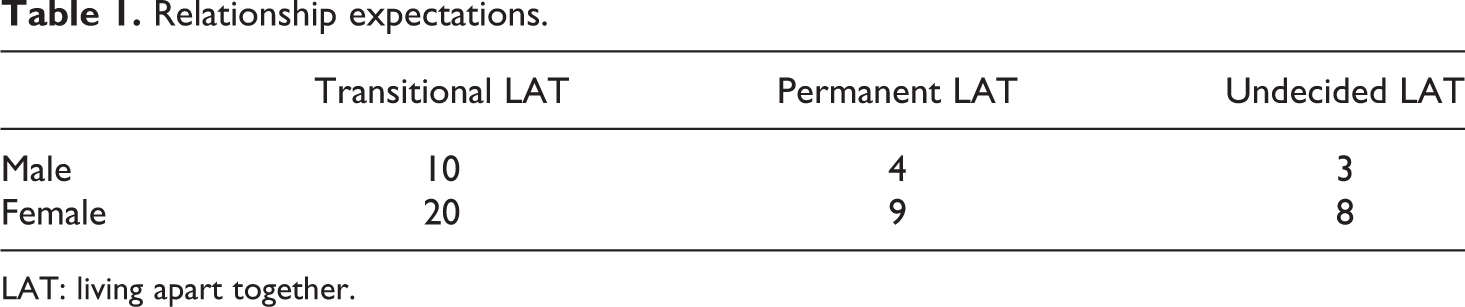
LAT: living apart together.
Transitional LAT
Interviewees belonging to this group all expressed a more or less strong desire to cohabit with their partner. Their current LAT arrangement was not a deliberate, but a rational decision, largely motivated by (a combination of) practical considerations, such as the care for (minor) resident children, a large distance between the partners’ homes negatively affecting working conditions or an expected financial loss in the event of cohabitation (Levin and Trost, 1999). The argument most frequently mentioned for postponing cohabitation among LAT individuals with resident children concerned not wanting to burden one’s children with drastic changes that cohabitation would necessarily entail, such as a change of residence or having to reside permanently in the presence of a new partner (with children). Some women declared having developed a particularly close and interdependent bond with their children after their divorce, which they did not yet feel ready to relinquish. Whatever personal considerations for having decided to enter an LAT union, this did not reflect what interviewees envisaged for their future. As Mireille (53 years old, divorced, 3 years LAT) stated: ‘When I love someone, I want to be with that person as much as I possibly can … build up a joint life and grow old together … .’ Establishing a joint life and growing old together were important, but not the sole motives for interviewees to prefer cohabitation over LAT. To many, cohabitation clearly was the key marker of long-term commitment and authentic coupledom: ‘If you truly choose someone to be with, then you go live together. Then, it’s suburban bliss’ (Katrien, 47 years old, divorced, 4 years LAT). LAT was viewed (by both partners) as a temporary arrangement that will result in cohabitation as soon as the perceived obstacles currently hampering the set-up of a joint household are dealt with. Some interviewees had a clear idea of when exactly this transition to cohabitation is supposed to occur, perhaps when resident children have left the home or partners have reached retirement age, whilst others took a more reserved stance.
It is notable that, notwithstanding their explicit desire to cohabit, interviewees
appeared largely satisfied with their temporary – ‘both/and’ – solution (Levin, 2004). The overall tenor
was one of acceptance and trying to make the best of it. A likely explanation for
interviewees’ overall satisfaction might be found in their feeling of coupledom, or as
Guy (43 years old, divorced, 5 years LAT) expressed it: ‘I don’t mind being
alone ‘cause I don’t feel alone’. Not being together on a permanent basis was
not felt to be negatively affecting the bond between the partners. The partners have
frequent contact, engage in joint activities, go on holidays together and help and
support each other with household and child-related tasks. To some, it felt as if they
were actually cohabiting or married. In describing what their partnership means to them,
several interviewees even explicitly distanced themselves from the concept of LAT:
LAT means there’s someone to make love to, to see a movie with or visit a
restaurant. And afterwards, you return home and you’re rid of her. This
relationship isn’t like that. I return home, but my heart stays with [name
partner]. In theory, it’s an LAT-relationship, but in practice, it isn’t!
(Frederic, 51 years old, divorced, 3 years LAT)
It is noteworthy that this positive stance towards coupledom in LAT was less present
among interviewees who found themselves forced into living apart due to obstacles on
their partner’s side, such as resident children in the partner’s household or a
partner’s (temporary) reluctance to cohabit. Being denied cohabitation clearly made
these interviewees feel incomplete:
I’m a very home-loving and motherly type of woman. Each his own life: that’s
not how I am. So if I really were to choose, I would prefer to cohabit with
someone. I miss togetherness … being on my own, 3 or 4 days, in the evening no-one
saying, “goodnight”. I find that difficult. He knows that but he laughs it off a
little, like, you have to learn that, or, it’s not that bad … (Valerie,
53 years old, divorced, 10 years LAT)
Whilst some managed to resign themselves to the situation, others admitted they were sometimes questioning the relationship and its future: whether to continue or abandon it.
Interestingly, our data reveal that explicit wishes and intentions to cohabit expressed
by both partners by no means guarantees that a transition to cohabitation will actually
occur, not even when all barriers have disappeared. Relationship expectations are
dynamic and might change over time, therefore, LAT arrangements being entered into with
expectations of cohabitation may gradually become permanent and vice versa. Jolanda told
us that, through the years, she and her partner gradually got used to living apart and
increasingly started to organize their lives apart from one another. Whilst both of them
still wished to cohabit, they seemed to have reached a point of no return:
I’m not saying there is no longer a desire to cohabit, there still is, but
he wants me to go live with him, and that does not sit too well with me now. My
children live around here, meanwhile, I’ve got grandchildren … (Jolanda,
71 years old, divorced, 27 years LAT)
Permanent LAT
This group of ‘willing’ LAT individuals (De Jong Gierveld, 2004a; Levin, 2004; Roseneil, 2006) consists of two subgroups of
which the first experienced the end of their previous marriage due to the death of their
partner. These widowed men and women have no intention of investing in a joint life and
regard their relationship as companionship rather than real partnership. The main goal
of the relationship is to spend spare time with their partner, do fun things together
and enjoy each others’ company with no further strings attached. The motives of the
participants in the second subgroup are a little different. These individuals
experienced a marital break-up and prefer living separately from their partner in order
to maintain their independence and autonomy. Contrary to their widowed counterparts, for
whom LAT simply best meets the partners’ personal preferences within their current stage
of life, these interviewees seemed to actively reject cohabitation. As Helene (57 years
old, divorced, 2 years LAT) testified:
Throughout the years, I’ve come to realize that I’m actually a real
LAT-union type of person. It’s impossible for me to live together with someone
with whom I’m intimately related. I need to be able to turn inwards within myself.
If one day, my partner would change his mind…No…I guess the relationship will be
over then.
Several interviewees declared that, even though they themselves preferred and intended to maintain their LAT arrangement, they did expect to cohabit at some point in the future, when they have reached old age or are no longer capable of taking care of oneself due to severe illness or physical incapacity. Marijke (56 years old, divorced, 3 years LAT) told us that her partner refuses to maintain the arrangement for the rest of his life and postulated cohabitation as soon as both of them are retired from work: ‘He has already told me that if I refuse to cohabit once I’m retired, he’ll look for someone who will…so, he’s pushing me somewhat … ’
Undecided LAT
The group of undecided LAT individuals is rather heterogeneous. To some interviewees,
their current LAT arrangement had not been a practical or explicit choice, but a silent
continuation of the single life they led before they met their current partners. These
interviewees had no clear idea about the relationship’s future. They were not explicitly
pro- or anti-cohabitation – it simply had not been a topic of discussion yet given the
early stage of the relationship. The issue might come up one day, but not necessarily.
These respondents would wait and decide and see whatever the future brings. Other
interviewees were doubtful about whether or not to transform their relationship into
cohabitation. Expressed doubts mostly concerned giving up one’s private space and home,
as well as fear that the partnership would go wrong:
During the first years, I fantasized about living together. That was my
ultimate dream. But as time went by, we got to know each other better and better,
and I started to realize: oops, this and that trait … So I don’t know. To be
continued. (Denise, 38 years old, divorced, 8 years LAT)
Even though all LAT partnerships are in a way uncertain with regards to their future, undecided LAT partnerships are – in the eyes of our respondents – the most unstable given that they are on the verge of either transitioning into cohabitation or becoming more permanent. This is particularly relevant in partnerships that are still young. The longer an LAT arrangement lasts, the greater the likelihood that it will eventually become permanent. Furthermore, it is notable that decision-making regarding the relationship’s future is often postponed indefinitely. Interviewees declared to live in the here and now and rather not think about the future, and as a consequence, everything remained the same. Herman (72 years old, divorced, 27 years LAT) was one of the few interviewees who did express concerns about the future: ‘We’re both getting older. Suppose something happens to me, or to [name partner]? Or we can’t drive a car anymore, what then? We live 60 km from each other: that’s quite a distance. What will happen then?’
Legal Status of LAT
This second aim of the article concerns the perception of LAT partners on the legal status of their LAT union. First, we investigate our interviewees’ overall legal knowledge and beliefs, that is, what do LAT individuals know about their current legal position? Second, we turn to our participants’ private situation and discuss their legal expectations within their LAT union. Finally, we discuss LAT-individuals’ views on legal reform.
Legal Knowledge
In order to obtain an idea of our LAT-individuals’ general legal awareness and beliefs, we asked them whether they could tell us more about their current legal position. This question caught many by surprise. ‘I’ve never really thought of that’ was a common reaction. Most interviewees admitted to not knowing precisely what their legal situation entails but assumed they would not be entitled to anything. Only few interviewees stated firmly: ‘we are legally strangers!’ When elaborating on the topic and asked why they assumed a legal framework would be absent, several reasons were stated, of which the first had to do with the absence of a community of life between the partners. Several respondents reinforced their reasoning by contrasting their partnership to that of couples living together. Through the sharing of a household, the lives of cohabiting couples become materially interwoven and it is therefore evident that these partnerships are granted legal protection. LAT partners, on the other hand, lead separate lives, have no shared home and are not economically interdependent; therefore, in the event of separation or death, there is nothing to protect. As Helene (57 years old, divorced, 1 year LAT) expressed it: ‘LAT-relationships are more emotional than they are material.’ A second reason for interviewees not to be surprised by the absence of a legal framework related to the informal nature of the relationship: ‘No-one officially knows we’re a couple. Everything we own is on separate names: homes, bank accounts, insurance policies … ’ (Willem, 55 years old, divorced, 12 years LAT).
Whilst, in general, participants had an accurate perception of the absence of a legal framework within their union, their legal knowledge proved to be superficial and fragmented. The absence of family law legal protection in the event of relationship breakdown due to separation or death appeared to be largely common knowledge. Other legal consequences of their non-residential partnership, such as high inheritance taxes or no entitlement to paid leave of absence (owing to severe illness of the partner or a deceased in the partner’s family) were spontaneously mentioned only by a small number of interviewees.
Questioned about their opinion on LAT-couples’ differential legal treatment as compared
to couples sharing a household, varying reactions came to the fore. Some declared that
they had no clear view on this issue. They had always taken their legal status for
granted without scrutinizing it, either because their legal status is of no concern in
their current partnership or out of a strong belief that the law is what it is and
nothing can be done about it. Others considered lawmakers’ ignorance of LAT partnerships
perfectly logical and understandable. In order to prevent legal chaos, legislators have
to draw the line somewhere and that line is one’s domicile:
Suppose my neighbour is a wealthy man and I become aware that he has become
very sick … he dies and soon afterwards I show up, claiming that we were engaged
in an LAT-union for 20 years. No one can provide proof to the contrary since he’s
dead. One could easily have 20 LAT-unions and claim: “I’m the partner of …
”. (Mireille, 53 years old, divorced, 3 years LAT)
Several interviewees made a more nuanced distinction between, on the one hand, legal
provisions concerning the community of life, such as protection of the family home or
intestate inheritance rights and, on the other hand, benefits resulting from two
individuals being related, such as leave of absence to care for their partner, status as
next of kin for hospital visits and medical decisions and low inheritance taxes. Whilst
the absence of the first type of legal consequences was largely found logical in view of
LAT-partners’ separate material lives, the absence of the latter was no longer
considered fair. LAT partners indeed produce no tangible proof of their relatedness
through the sharing of a household or by means of formal ties; they do have an affective
bond that is in many ways comparable to that of married and cohabiting couples. The
law’s ignorance of this meaningful relationship was felt to be discriminatory:
Only those who are living under the same roof are considered to be a real
couple: that’s not correct, is it? I’m sure there are a lot of people living under
the same roof who are less committed to one another than some couples living 45 km
away … (Kristel, 47 years old, divorced, 5 months LAT)
Legal Expectations
Our data show that many LAT individuals see LAT as a step towards cohabitation, whilst the minority view is that LAT is a preferable alternative to cohabitation. Still others have no clear future expectations. To what extent do relationship expectations shape legal expectations? In order to answer that question, we turn to our interviewees’ private situations and discuss their personal legal expectations within their current arrangement.
Transitional LAT
Participants seeing LAT as a temporary arrangement appeared to be very heterogeneous with regards to their legal expectations. Some interviewees declared not to have any legal expectations within their current arrangement. Both partners have their own place and finances and assets are kept separate. If the couple were to separate, no financial or material issues requiring legal support would arise. Inthe event of death, no problems are expected either. No need is felt to pass over personal belongings to the partner. The children will receive their inheritance, therefore, high gift or inheritance taxes are not a concern. The absence of couple-based rights is not an issue either: if something were to happen to one of the partners, one would be creative enough to figure out a good solution. As Frederic (51 years old, divorced, 3 years LAT) summarized his legal status: ‘I “feel” connected, and to me, that’s most important!’ It is notable that in the minds of these interviewees, legal protection is strongly coupled with cohabitation. The prospect of cohabitation is the main incentive to start thinking about the legal aspects of one’s relationship and the way in which things should be legally arranged. In the meantime, whilst awaiting the transition to cohabitation, no problems are expected to arise and if they did, they would not be problematic: ‘there is a solution to anything’.
Others stated that their legal status did generate some concerns. Some mentioned
being bothered by the absence of entitlement rights in the event of their partner’s
death, such as a widow’s pension or the usufruct of their partner’s house. Still
others expressed worries regarding the destination of their estate in the event of
death. It is notable that legal expectations mentioned were all death-related. In the
event of separation, no marriage-like legal consequences, such as, for example, the
possibility to apply for spousal support, were expected, not even when a marriage-like
exchange of financial support had occurred during the relationship. Having made joint
purchases did not generate a legal need either. If the relationship were to go wrong,
no arguments over money were foreseen and if they did occur, interviewees were
confident that both the partners would be fair and mature enough to resolve the matter
effectively. The only interviewee worrying about his legal position in this respect
was Paul (46 years old, divorced, 3 years LAT):
[Name partner] and I bought a house together, of which one-third is mine
and two-third is hers. With married couples, in the event of death, the
surviving spouse can remain in the house. Yet, we depend upon the goodwill of
the heirs. To me, that’s a real problem. From one day in the other, I could be
out on the street.
More concerning than the absence of family law legal protection, it was interesting
to note that several LAT individuals expressed serious worries about the informal
nature of their partnership and the consequences that this might have for the partners
involved. Contrary to marriage, which is an institutionalized partnership in the eyes
of the law and the public, LAT couples do not exist, or as Diana (40 years old,
widowed, 8 months LAT) described it: ‘In the beginning, we were just friends.
We went on holidays together, I slept in my children’s room, [name partner] in
another room. But what’s the difference for the law now? Nothing! There’s absolutely
no difference at all!’ The absence of a formal tie between LAT partners
created a twofold concern among our interviewees, of which the first had to do with
the partners’ public identity as a couple. Whilst a married couple establishes its
couple-identity in front of a wider public through the formal ceremony of marriage,
LAT partners lack the means to prove that they are indeed coupled. This marked
preoccupation with not being able to formally position oneself as a couple revealed
itself most pertinently by LAT partners imitating aspects of the marriage ceremony by,
for instance, wearing a ring or throwing a joint party. Yet, besides affecting their
feeling of coupledom, the absence of a public couple identity appeared to generate a
substantial deal of insecurity regarding legal position and rights in both the private
and the public sphere. This legal insecurity was most strongly felt in the event of
accident, disease or death of the partner: what if something were to happen to my
partner? Will I be informed? Will I be granted access to an emergency or intensive
care unit? Will I get to be involved in decision-making? The awareness of being
strongly dependent on the goodwill of others, such as the partner’s relatives, was
felt to be considerably frightening:
One of the things we’ve recently arranged … in our mobiles. I said: I want
you to put ICE (in case of emergency) next to my name. I want others to see
right away that I’m the one who needs to be informed first. It would really
freak me out if I was only the fourth or the fifth to hear the news.
(Barbara, 54 years old, divorced, 2½ years LAT)
An additional, frequently heard concern among interviewees with minor children
related to the legal position of their partner towards one’s children in the event of
death: would their partner be able to maintain contact with their children? Would he
or she be granted parental responsibilities? Several interviewees strongly wished to
safeguard their partner’s position in this respect. Interestingly, while some
interviewees felt that, given their affective bond and importance to one another, LAT
partners should be granted decision-making capacity regarding each other’s person and
assets in the event of illness or death, other interviewees were clear that relatives
should come first:
If we were cohabiting, that would be something else, since then, his home
would be mine as well. That would carry more weight in legal terms, as I would
be considered much more his partner.
To me, that’s a huge difference! (Valerie, 53 years old,
divorced, 10 years LAT)
Permanent LAT
Permanent LAT individuals were, as a group, strikingly homogeneous with regards to their legal expectations. A legal framework was of relevance to none of these interviewees. Reasons given for not needing or wanting any framework were largely similar to those expressed by their transitional counterparts without legal expectations: no shared finances, their own place and their children as legal heirs. Several widowed participants explicitly stated to prefer a legally ‘loose’ relationship in order not to complicate their estate and to safeguard their children’s legal rights. The lack of family-based benefits, such as paid leave of absence or a next of kin status, was not an issue given that these participants were either (nearly) retired or trustworthy in the goodwill of the partner’s relatives. Interestingly, whilst transitional LAT interviewees grounded their arguments solely on objective facts, several permanent LAT interviewees also reported subjective motives for seeing no use in legal protection. These individuals not only find a legal framework unnecessary but, in a way, they also rejected it. The stories of Marijke (56 years old, divorced, 3 years LAT) and Helene (57 years old, divorced, 1 year LAT) illustrated this well. Even though these women were clearly aware that by moving in with their partner, they would be better off both legally and financially, this would not bring them to even consider cohabitation. In their opinion, cohabitation not only equals a loss of freedom, its pursuit in view of financial and legal security signals an inability to take care of oneself. To these women, the ability to manage without legal protection was a matter of pride and a confirmation of their self-image as independent women. Furthermore, in the event of relationship breakdown, the absence of legal framework was advantageous: ‘If we’re tired of each other, it won’t cost us anything. We just say “bye” and we’re done. That’s easy!’ (Marijke, 56 years old, widowed, 3 years LAT).
Undecided LAT
The group of undecided LAT individuals was as heterogeneous as their transitional counterparts. Whilst some interviewees expressed clear legal expectations, others did not. Several interviewees declared that, given the early stage of their relationship, their legal situation and its consequences had not yet been a topic of discussion in the relationship. Given the heterogeneity of this group, these LAT individuals will not be further discussed separately.
Legal Steps
It is notable that while several interviewees expressed clear legal concerns, none had taken any legal steps to address their legal situation. Even participants who explicitly mentioned that they wanted to arrange the division of their estate, they had not made any legal arrangements, and yet, several of these partnerships had already lasted several years. Legal expectations did not seem to pass the stage of ‘maybe we should’, ‘perhaps we could’ or ‘if then, we surely would’. Words and intentions were not put into action. Explanations offered for this inactivity were varied: the time had not yet been right, legal arrangements were no longer worth the effort in view of the couple’s cohabitation plans or one did not know which legal steps to take. Moreover, even though interviewees were well aware of the importance of making legal arrangements, this awareness clearly did not dominate the couple’s daily life. Rather, the occurrence of external events, such as a divorce or sudden death in the couple’s entourage, seemed to trigger the couple to reflect on their legal situation and the importance of taking legal action. Yet, once this trigger had passed, the couple’s attention to it weakened and life resumed its normal course: ‘We’re living today and we’re happy. That’s most important. But suppose, tomorrow, they tell me I’ve only got 3 months left, then I would definitely do what’s necessary’ (Guy, 43 years old, divorced, 5 years LAT).
Few participants had actively been seeking solutions to address their legal situation. Lara (49 years old, divorced, 8½ years LAT), for instance, told us that her partner, who is childless, had designated her in a duo legacy in order to free her of any inheritance tax. Machteld (50 years old, divorced, 10 years LAT) intended to propose marriage to her partner whilst still retaining separate residences. This ‘best of both worlds’ scenario would be profitable to both herself and her partner: as a spouse, she would be legally entitled to rights in the event of spousal death, such as a widow’s pension, whilst at the same time, her partner would be able to keep his residential autonomy and freedom: ‘In marriage there is an obligation to cohabit, but the partner is the only one who can claim that. No one else can. So what if you don’t?’ (Helene, 57 years old, divorced, 2 years LAT). Even though formal marriage might be a way of addressing the legal aspects within LAT and this ‘creative solution’ was mentioned by several interviewees, some reservations towards this way of handling legal matters did emerge as well. Some felt it wrong to marry solely for the benefits it generates whilst at the same time pretending one is unmarried by living separately.
Views on Legal Reform
In order to gain an idea of our participants’ stance towards the need for legal reform, we asked them whether or not a legal framework ought to be available for couples engaged in an LAT partnership. This question appeared to be complex, encompassing both an emotional and a rational component. To a first small group, the conclusion was crystal-clear: no legal reform is needed. Each type of relationship has its pros and cons and that is something you know in advance. Either you face the consequences of your decision or you protect yourself by transforming your relationship into cohabitation or marriage: ‘I think lots of people engage in LAT, solely for financial reasons, in order not to lose any benefits. Fine with me, but accept the rest too then’ (Denise, 38 years old, divorced, 8 years LAT). In these interviewees’ opinion, there are sufficient alternatives available. Creating any more statutes would make things increasingly complex and open the door to malpractice. In order to underpin his stance towards legal reform, Frederic (51 years old, divorced, 3 years LAT) compared his relationship with that of an engaged couple: ‘A couple might be engaged for 5 or 6 years, and the day before the wedding, something serious might happen. These couples are at risk as well. You can’t make legal arrangements for everything…’
A second group of interviewees stated that, although they did not find it necessary for themselves, when reflecting upon other scenarios, they could easily think of situations in which a legal framework might actually be a good idea, such as when partners are childless, financially less well-off or live-in discord with the partner’s surroundings. A final group of interviewees strongly believed that LAT partnerships ought to be legally recognized: ‘LAT is a new type of partnership and it’s about time policy makers start to bear that in mind!’ (Mireille, 53 years old, divorced, 3 years LAT).
When asked to further specify the content of this desired legal reform, a popular
proposal was to create a new legal category of ‘LAT’, comparable to registered
cohabitation, and attach to it a list of rights and duties. In order to belong to this
legal category, LAT couples would have to comply with some formal requirements, such as
recording themselves as a couple in a public registry. What this list of rights and duties
ought to entail was not entirely clear, although there was an overall agreement in
granting LAT partners the same family-based rights and benefits as their married or
cohabiting counterparts, such as a next of kin status in the event of disease, accident or
death of a partner as well as the same low amount of inheritance or gift taxes. While a
relatively large group of interviewees was enthusiastic about the idea of formalising
one’s LAT union and having the means to ‘prove’ one’s coupledom to the outside world,
others were more reserved and stressed; the importance of LAT couples having the right to
freely choose to stay outside this new legal category:
The anarchistic model should remain optional as well, that is, for what it is,
we spend our time together but no further strings attached. My relationship is
no-one’s business and I can do whatever I want, with no legal consequences attached
to it. (Helene, 57 years old, divorced, 1 year LAT)
Alice (43 years old, divorced, 1½ years LAT) had a pronounced opinion regarding the availability of a formal statute for LAT partnerships. In her opinion, LAT-couples’ non-statute increases the chance of people engaging in cohabitation or marriage for the wrong reasons, namely, to obtain legal rights. This negative reasoning for entering into cohabitation increases the risk of the relationships going wrong, which, in view of the currently significant numbers of couples separating, is far from ideal: ‘If a formal statute would be available, I would be much less worried. It would not keep me from cohabiting or getting married sooner or later but I would definitely take more time for it’.
Discussion
Our research had two aims: first, to explore the meaning LAT individuals attach to their union and second, to investigate whether this meaning influences LAT-individuals’ legal expectations and views. Do our findings shed light on this issue? Our data reveal that as a whole, LAT individuals are well aware about the absence of a legal framework and are not deeply concerned about it. Yet, some important nuances must be noted. First, our data provide a clear case for differentiating between family law legal protection and family-based legal benefits. Aside from a few notable exceptions, the absence of family law legal protection is not found relevant given the absence of a shared life. Since no common patrimony with the partner is created, no patrimonial protection is expected. In the event of a break-up, partners can resume their separate lives. The absence of inheritance rights is found to be acceptable given that LAT partners have not contributed to each others’ estate and existing children are entitled to what is theirs by right. Whilst this is the majority view, several interviewees do consider the disregard of LAT partners in inheritance law problematical, in particular in situations where children are absent or joint investments have been made. It is unclear as to whether our participants’ views correspond with public beliefs about how the law should handle inheritance issues in case of LAT partners. Existing studies that examine public attitudes on inheritance and intestacy solely focus on unmarried cohabitants, family members, friends and carers (Humphrey et al., 2010; Williams et al., 2008).
A similar gap in literature emerges with respect to the relationship between an LAT individual and his or her partner’s children. Our findings indicate that, when minor children are involved, legal concerns often relate to the legal standing of the partner towards one’s children in the event of death, and yet, this aspect of LAT is completely disregarded in research, both within and outside law. Over the past several years, a vast amount of literature has accumulated on the protection of the married and cohabiting step-parent–stepchild relationship with respect to custody, visitation and child support (Barlow, 2004; Bowman, 2012; Mason et al., 2002; Silverman, 1992). Whilst legal rights are increasingly extended to unmarried cohabiting step-parents, the relationship between LAT individuals and their partners’ children is not even taken into consideration. In Belgium, the sole legal remedy – except for will-making – available to LAT individuals for continuing their relationship with their partner’s child in the event of death or relationship dissolution is Article 375bis CC, according to which every person being able to prove to have a ‘particularly affective tie’ with a minor child, has the right to maintain personal contact with him/her and can apply to court in order to enforce that right.
Whilst, as mentioned earlier, the absence of family law legal provisions is largely found unproblematic, the assumed connection between coupledom and cohabitation does generate concerns. Given that LAT partners do not share a household, they are not considered a real couple and consequently excluded from family-based benefits and rights, such as paid leave of absence and next of kin status. Interestingly, this legal non-statute appeared to bother our female interviewees more than it did their male counterparts. Whilst several female LAT individuals were preoccupied with proactively trying to address their informal statute and finding ways to position themselves as couple, men seemed to trust that, when things do matter, their partnership will be seen and treated as that of a ‘real’ couple.
Perceiving LAT as a temporary arrangement does not, as such, create legal expectations, nor does viewing LAT as a longstanding arrangement. Future expectations do play a role, albeit indirectly, in terms of sociodemographic characteristics. Transitional (as well as some undecided) LAT individuals are, contrary to their permanent counterparts, generally younger, caring for dependent children and employed, all factors that may create legal concerns for them, regarding the position of the partner towards one’s children in the event of death or the right to paid leave of absence, for example. Such legal concerns are absent among permanent LAT individuals since the latter no longer have any dependent children in the household and are mostly (nearly) retired.
The meaning LAT individuals attach to their partnership seems to be an even more important predictor of legal expectations. In general, transitional and permanent LAT individuals differ strongly in their views both on their partnership and on how they should be treated from a legal perspective. Transitional LAT individuals often perceive themselves as a cohabiting or married couple and behave in similar ways. This marriage-like behaviour expresses itself most pertinently through partners assuming parental roles, sharing household tasks and exchanging financial support. Were it not for the obstacles currently discouraging cohabitation, these couples would have already been cohabiting. Except for their separate residences, these couples ‘feel’ and ‘are’ marriage-like and believe they ought to be granted similar legal status, particularly concerning the ‘immaterial’ aspects of their partnership. Permanent LAT individuals, on the other hand, neither see their partnership as a marriage-like joint enterprise and nor do the partners behave as such. The couple’s main goal is to spend time together and enjoy each others’ company. The partners are not concerned by being denied legal recognition. Instead, most prefer to be legally unbound. The heterogeneity among the undecided LAT is less univocal, although, as a whole, these LAT individuals are somewhat less inclined to advocate a legal framework.
LAT individuals advocating legal reform do, as mentioned earlier, generally not expect family law legal protection similar to that enjoyed by married or cohabiting couples. The greatest stumbling block is felt to be the legislators, as well as public and private institutions, which stipulate cohabitation as a condition to be granted benefits. Since LAT partners do not share a common household, they are excluded from these benefits, even though they might feel as related as their married or cohabiting counterparts. This aspect of LAT is found to be fundamentally unfair. Therefore, these interviewees believe that legislators, as well as public and private institutions, ought to relinquish their household-based approach towards coupledom and grant intimate partners rights and benefits on the basis of their existing bond. In order for LAT partners to prove they have an intimate bond and so be granted couple benefits, there ought to be a way or procedure to formalise their union.
It is furthermore notable that no pronounced gendered legal expectations emerged from our data. In general, the absence of a legal framework was no more a concern or issue to women engaged in LAT union than to men. Yet, some interesting differences between our male and female respondents did come to the fore. Our data showed that, with regard to inheritance, LAT partners generally do not feel the need to pass on personal belongings to their partner in the event of death. An important motive underlying this stance is the presence of children and the importance attached to what is theirs by right. Interestingly, this conviction was markedly adhered to more strictly by women than by men. Whilst several male interviewees, in order to financially safeguard their partner, intended to pass on some of their belongings or savings to their partner, female LAT individuals showed no such preparedness. This finding corresponds with the findings of Humphrey et al. (2010) who explored people’s intentions in relation to will making. The authors found that men were more likely to say they would leave everything to their spouse or partner in their will while women were more likely to leave everything to their children. Men’s preoccupation with financially safeguarding their partner might reflect the fact that the role of breadwinner still has significant value attached to it – even when a female partner is financially independent.
A second difference between male and female LAT individuals emerged in their views on law reform. Those being radically opposed to law reform were all men. Women generally took a more nuanced stance. Whilst several women did not find a legal framework necessary for themselves, they never repudiated law reform as such.
Finally, even though there are means available to LAT couples to make some private legal arrangements, for example, will-making, it is false to assume a couple will indeed take legal action. Our data clearly indicate that, despite having good intentions to address one’s legal situation, legal steps are postponed, a pattern also found among unmarried cohabitants (Barlow et al., 2005). An often heard reason for postponing legal steps is the temporary nature of LAT and the prospect of cohabitation. Still, the process of moving in together is often slow and long, requiring several successive decisions to be made and implemented in concrete activities (Levin and Trost, 1999). LAT unions might easily end or be dissolved through death before cohabitation had the chance to occur.
Implications
Drastic changes in family life raise important social and legal questions, policymakers and legislators cannot turn a blind eye to. However, how to adequately respond to these new challenges often remains unclear. Informed by a substantial body of legal and sociolegal literature, in most Western jurisdictions the rise in unmarried cohabitation has been (and is still being) addressed by increasingly granting (registered) cohabitants marriage-like legal status. LAT partnerships, in contrast, are ignored in both sociolegal literature and law. LAT-partnerships’ neglect is worthy of attention for two key reasons. First, it ignores today’s social reality in which intimate and family relationships develop and evolve. High divorce rates, improved transportation and travel as well as increased use of the Internet are all the factors that increase the likelihood of private and family relationships extending across household boundaries (Stewart, 2001). Second, LAT partnerships are experiencing amidst a broad continuum of intensity and structural commitment. Whilst a minority of LAT couples wished to avoid structural and legal commitments, for most, LAT is an arrangement entered into out of necessity (Liefbroer et al., 2012). The latter are often quasi marriage-like in fact and might bring about far-reaching legal consequences in the event of relationship breakdown due to separation or death.
Our article does not provide an answer as to what the legal response to LAT partnerships should be. The legal status of LAT partnerships proved to be a complex issue on which many participants had no clear view. Expressed views were often vague and ambiguous, as were the factors underlying these views. This ambiguity made it difficult to reach clear conclusions. Currently, legislators enforce norms by `referencing a historically based meta-narrative about the nuclear family' (Fineman, 1993: 388). Our findings indicate that this household based approach in regard to regulating intimacy falls short in addressing the challenges associated with contemporary family life. Without a substantial rethinking of what constitutes contemporary families, the needs of a small but significant number of people in nontraditional, dual-household partnerships will continue to be ignored.
Since non-residential committed partnerships are under-examined, social and legal science has provided us with little guidance for policy reform in this arena. In order to inform legislators about how to legally treat this ‘new family form’ (Levin, 2004) this ‘blind spot’ in research needs addressing. As for directions for future research, it would most certainly be beneficial to study LAT couples whose partnership ended through separation or death. These couples could provide useful information on whether or not legal issues have occurred in the event of relationship breakdown, offering legislators and policymakers stronger grounds to recognize the importance of non-residential partnerships. More research is also needed to determine whether the existing policy with regards to LAT partnerships matches public attitudes on how these ‘unconventional’ partnerships ought to be legally treated.