



Abstract
Linguistic negation has been described as a natural foregrounding device, with some researchers noting that foregrounding with negators is not always marked grammatically, but also semantically or through textual effect. However, most studies focus on the use of sentential negation (e.g., not, no), whereas other expressions of negation, such as affixal negation, remain understudied. Recent research indicates that affixal negation is used by speakers to convey a variety of opposite meanings, often in creative and subtle ways. This study is a systematic investigation of the use of negative affixes in an oppositional discourse, namely discourse on race in the USA. The dataset is a specialized corpus, The Corpus of the Non-Fictional Writings by Ta-Nehisi Coates (COCO) (468,899 words, 1996–2018). Methodologically, the study combines corpus linguistic techniques with co(n)textual discourse analysis. The results show that affixal negation in COCO, particularly with the prefixes un-, non- and anti-, is used by Coates to disrupt patterns of collocations, fixed expressions or phrases, producing either lexically or semantically deviant instances. Thus, affixal negation has a foregrounding effect and a potential to introduce evaluative clashes in a discourse. The findings, examined through the lens of linguistic creativity, indicate that Coates employs affixal negation to perform various functions: from explicit foregrounding (e.g., as attention-seeking devices) to a subtle critique of societal norms and established institutional order (e.g., renaming concepts to offer an alternative perspective on reality).
Keywords
1. Introduction
Affixal negation is a complex and relatively understudied phenomenon in the domain of linguistic negation (Joshi, 2020). Previous linguistic studies focused mainly on formal and semantic characteristics of negative affixes in English. However, recent research extends the study of this phenomenon into the area of co(n)textual meaning, pragmatics, stylistics and discourse analysis. Affixal negation, as one linguistic expression of opposition in language, also has a potential to be used creatively either by coining neologisms or adding layers of meaning to text (Jeffries, 2022: 148). This paper presents a corpus-based investigation of the use of nine negative affixes in English (un-, non-, dis-, iN-, 1 de-, mis-, mal-, a(n)- and -less) and the prefixes anti- and counter- in the context of an oppositional discourse, namely discourse on race in the USA.
Oppositional discourses are often fragmented, requiring compilation of specialized corpora. This study analyzes the works of Ta-Nehisi Coates, a contemporary African American writer, recognized as ‘the most important essayist in a generation […] who changed the national political conversation about race’ (Fear, 2019). The dataset is The Corpus of the Non-Fictional Writings by Ta-Nehisi Coates (COCO), comprising 468,899 words and covering the period 1996–2018.
The following research questions guide the linguistic enquiry: RQ1: Which negative affixes are attested in the corpus? RQ2: How frequent is affixal negation in COCO compared to a reference corpus? RQ3: Which negative affixes are used by Coates in creative ways? RQ4: What are the contextual meanings and functions of creative instances of affixal negation in this oppositional discourse?
Coates employs affixal negation as a foregrounding device, which is also goal-oriented as the author’s deviant uses of negative affixes serve to highlight his alternative view of reality. From the perspective of linguistic creativity, it can be argued that creative uses of affixal negation in COCO have several functions such as (re-)naming, attention-seeking and construction of multi-layered meaning.
The following sections present the theoretical framework and previous research on affixal negation in English as well as the dataset, methodological approach and the results.
2. Theoretical framework
Linguistic negation, as a logical operator, is used by speakers to construct semantic opposition by ‘relat [ing] an expression e to another expression with a meaning that is opposed to the meaning of e’ (Horn and Wansing, 2020), as in (1). (1) (a) The sun is shining. (b) The sun is
However, the seemingly simple act of negating an expression is complicated by multiple ways speakers have at their disposal to operationalize negation and convey various dimensions of semantic opposition. Thus, negation goes beyond formal logical matters and expands into complex mechanisms of the construction of meaning. Negation can be expressed morphologically, syntactically, semantically and/or pragmatically. For example, speakers of English can construct oppositional meanings using negation markers (e.g., not, no), negative affixes (e.g., un-, non-, a(n)-, iN-, de, dis-, -less) or polarity terms (e.g., nowhere/anywhere; nothing/anything).
One important aspect to be considered is the scope of negation: wide/sentence negation versus narrow/constituent negation. Therefore, it is useful to distinguish between negation at the sentence level (i.e., sentential negation), as in (2a), and negation at the constituent level (i.e., affixal negation), as in (2b). (2) (a) He is (b) He is
Negation is understood as a phenomenon of semantic opposition (Horn and Wansing, 2020). However, recent works extend the study of negation to pragmatics (e.g., Horn, 1985; Jordan, 1998; Nahajec, 2021). Speakers negate something that has a particular relevance, which could be linguistic and contextual or based on the shared societal and cultural knowledge of a particular group.
Since negation is a marked option, it generally has a foregrounding effect, or ‘motivated deviation from linguistic, or other socially accepted norms’ (Leech, 2008: 30). However, affixal negation is more complex as it reflects the overlapping nature of notions such as lexicalization, productivity and lexical creativity. On the one hand, some frequently used negated words become lexicalized and lose the ability to “stand out” in a discourse as their compositionality becomes blurred. In other words, the meaning of a negated word might not be easily extracted from the meaning of its parts, affix and base. On the other hand, research on lexical creativity shows that speakers use word formation patterns, often the most productive ones in a given variety of a language, to create neologisms (e.g., Hohenhaus, 2007). Thus, negative affixes become a natural mechanism for constructing nonce words that denote the opposite meaning of the whole base or of an attribute associated with the base (e.g., unhotness, nonlyricists, ahistorians).
The following subsections discuss some important concepts relevant to the study.
2.1. Affixal negation
Affixal negation in English implies the use of the core negative prefixes un-, non-, iN-, dis-/dys-, de-, a(n)-, mis-, mal- and negative suffixes such as -less. In some literature, this type of negation is referred to as lexical negation (e.g., Andreou, 2015; Dahl, 2010) or morphological negation (e.g., Jeffries, 2022; Nahajec, 2021). To ensure consistency and cross-reference with previous studies, this paper adopts the term affixal negation as it is the most frequently used term in the literature to describe the process of word formation with negative affixes. Therefore, affixal negation is here defined as a subtype of lexical negation (which also includes antonymy) and refers to a derivational type of affixation (rather than inflectional affixation) (Joshi, 2012).
In addition to the nine negative affixes mentioned above, the prefix anti- and its variant ant- are also included in the analysis. This is because, according to Bauer et al. (2013: 417), one of the distinctive uses of ant(i)- is the expression of negative meaning (e.g., antihero), in addition to attitudinal meaning (e.g., anti-government demonstration) and medical/scientific usage (e.g., antidote). In line with previous studies (Nahajec, 2021), two other peripheral prefixes, counter- and contra-, are also considered.
2.2. (Affixal) negation in context/discourse
Based on previous studies of negative affixes in English and the data from The Corpus of Contemporary American English (COCA) (Davies, 2008), Bauer et al. (2013: 384) conclude that language users do not hesitate to attach negative prefixes to a variety of words, and even though some derived forms ‘might seem odd or marginal when encountered out of context, or when judged against our intuition, [they] are both possible and natural when encountered in context’. In other words, the study of affixal negation goes beyond formal and semantic characteristics of the negative affixes and takes into consideration pragmatics, discourse factors and contexts in which instances under investigation occur (e.g., Horn and Ward, 2004; Jordan, 1998).
In stylistic studies, the function of linguistic negation has been linked to its effect to evoke both positive and negative scenarios, as it rejects the perceived or created expectation of its positive counterpart (Jeffries, 2022; Nahajec, 2021). This effect of negation can be observed in various forms of negators. However, considering the scope of negation, it is important to note that affixal negation occurs at the constituent level, not at the sentence level, as illustrated in (2). In other words, instances of affixal negation often appear in sentences that are grammatically affirmative (not negative), which means that attention to the co-textual meaning in the use of affixal negation is particularly important.
In addition to linguistic context, investigation of language and linguistic phenomena should not be carried out in a vacuum, detached from social and political contexts. It can be argued that Ta-Nehisi Coates’s writings, though thematically diverse, have an overarching theme of race relations and racial disparities in the contemporary USA. In an interview with PBS, Coates (2017) states that his writing process over a 20-year period has been a quest to find an answer to the question about disparities between Black families and the broader community in contemporary U.S. society. Thus, Coates’s language use is fine-tuned to the social and political environment at the time of writing.
2.3. Productivity, lexicalization and linguistic creativity
As mentioned above, the notions of productivity and lexicalization are important when discussing affixal negation from the perspective of linguistic creativity.
Morphological productivity refers to regular and frequent patterns in word formation processes. Though productivity can be seen as a feature of morphological innovation, some scholars attempt to distinguish between productivity as rule-governed and creativity as rule-changing (e.g., Bauer, 2001: 98); while others prefer to consider creativity as rule-related and ‘the difference between creativity and productivity as a cline’ (e.g., Hohenhaus, 2007: 16). However, the term productivity incorporates two dimensions: the availability of a morphological process and its actual use in performance, or profitability. Thus, the distinction between productivity and creativity ‘may well be a matter of definition rather than something which can be determined from data’ (Bauer, 2001: 213).
The term lexicalization describes a process by which new word coinages become established and then ‘diverge from the synchronically productive method of word-formation’ (Bauer, 2001: 45). The loss of compositionality of meaning is particularly associated with semantic lexicalization. For example, word formations such as discover, discredit, dissident, deport, deprive are etymologically complex dis- and de- prefixed words, but, over time, they tend to lose their compositionality and become lexicalized (Bauer et al., 2013: 360, 375).
Previously, it has been argued that only the negative prefixes un- and non- are productive in Present-Day English (PDE), whereas a- is semi-productive and the rest of the negative prefixes are rarely or never used to coin new lexical items (e.g., Bauer and Huddleston, 2002; Kjellmer, 2005; Zimmer, 1964). However, based on data from COCA, it has recently been attested that all the negative prefixes can, to various degrees, be used by speakers to produce new words (Bauer et al., 2013: 361).
The linguistic creativity of speakers is not limited to ‘naming’ or producing new words. Linguistic creativity, in a broad sense, extends from the coinage of nonce words to various degrees of compositionality of derived words, to new contextual uses of established forms (e.g., Hay, 2007; Hohenhaus, 2007). But which instances of affixal negation can be considered creative? Some core characteristics have been proposed in identifying creative uses in language: such uses are uncommon and, therefore, infrequent; they contain an element of surprise (unexpectedness); and they are marked by innovation and expressivity (Kuznetsova et al., 2013). Such lexical creativity contributes to ‘the construction of discourse meaning… in subtle and interesting ways’ (Munat, 2007: xiv). Furthermore, creativity in discourse can also have a social impact as it allows language users to ‘create new kinds of social identities and social practices and to challenge existing social structures and relationships of power’ (Jones, 2016: 62).
In relation to the current study, it is important to note that African American English (AAE) has been described as a main source of linguistic innovation in American English (e.g., Grieve et al., 2018; Smitherman, 2006). Thus, Coates’s language could potentially reflect innovative uses associated with AAE.
3. Literature review
Over the past century, scholars have been attempting to approach the study of affixal negation in English in terms of productivity and constraints. As Tottie and Neukom-Hermann (2010) note, earlier studies were based on intuition and introspection in regard to observations of affixal negation in natural language (e.g., Horn, 1989; Jespersen, 1917; Lieber, 2004; Zimmer, 1964). More recently, the availability of digital (ized) databases and linguistic software tools allows researchers to observe usage more systematically. Access to large usage-based linguistic datasets (e.g., electronic corpora for written and spoken forms of language) provides empirical data to confirm, refine or challenge previous assumptions (e.g., Bauer et al., 2013; Horn, 2002, 2005). Furthermore, corpora and corpus linguistic tools have been used by researchers to investigate affixal negation from an empirical perspective (e.g., Kjellmer, 2005; Tottie, 1991, 1999). Such empirical studies take different approaches to English affixal negation depending on the type of data employed and the overall research aims.
Recently, the study of negation expanded into the realm of pragmatics, stylistics and discourse. However, most studies focus on the use of sentential negation (e.g., not) as well as other forms of the construction of opposites in poetry, song lyrics, prose literature and media discourse (e.g., Hidalgo-Downing, 2000, 2002; Jeffries, 2010; Nahajec, 2009, 2019; Watson, 1999). 2 Affixal negation is explicitly discussed only in a few stylistic studies of negation. For example, Jeffries (2022) discusses the use of affixal negation in contemporary poetry and its textual effects, whereas Nahajec (2021) extends the study of expressions of negation beyond poetics and literary works into the area of politics, ideology and communication, and provides a comprehensive study of negation, including a close examination of affixal negation in context and its relation to the reproduction of ideologies and social norms.
These studies identify and highlight creative uses of affixal negation. However, such creativity does not necessarily imply the coinage of new lexemes. It often involves unique combinations of the derived forms with other linguistic elements of the discourse. In the context of contemporary poetry, Jeffries (2022) observes that, while affixal negation has a potential for lexical innovation, there seem to be only a few occurrences of neologisms with negative affixes. It is interesting that instances of affixal negation in contemporary poems frequently appear ‘superficially uncontroversial’, without lexical or grammatical deviance (e.g., unnatural growth), but semantically foregrounded (Jeffries, 2022: 147).
The morphological process of affixation was included in analyses of lexical creativity in the alternative music scene, such as Hip Hop and rap in López Rúa (2010). This study investigated various morphological processes in a corpus consisting of 562 names of singers and bands that use English as their means of expression. The results show that the negative affixes such as un-, de-, mis-, dis-, non-, anti-, mal-, -less occur in the corpus displaying rule-governed (productive use) and rule-breaking (deviant use) creativity (e.g., Unexpect, Defleshed, Mischosen, Discreate, NonIron, Anti-Ear, Maldroid, The Beat-less). Overall, the study concludes that music artists use the rules of language (including affixation) productively or deviantly, in order to meet pragmatic, aesthetic, intellectual and social needs.
The interaction between affixal negation and linguistic creativity in English is also briefly mentioned in Koptjevskaja-Tamm et al. (2024), a cross-linguistic study of lexical and derived antonymy. Even though English is not in the study’s sample, the authors note ‘creative synonymy' in online language use on social media when it comes to derived antonyms in English. Such a strategy is utilized by speakers to avoid (perceived) censorship or blocking of prohibited terms, for example ‘the use of unalive(d) to refer to “kill(ed), die(d), commit(ed) suicide”' (Koptjevskaja-Tamm et al., 2024: 48).
The present study offers an innovative approach to exploring affixal negation and its functions in the context of an oppositional discourse. By bringing together a theoretical framework on negation, co(n)textual meaning and linguistic creativity, the study contributes to our understanding of the intertwined nature of affixal negation as a morphological process and the construction of oppositional meaning in a discourse.
4. Data and methodology
This section describes the process of data collection and extraction and presents the methodological approach.
4.1. Data
The dataset for this study is a specialized corpus, COCO (Hathaway, 2019), comprising 350 full-text articles and a monograph (468,899 words) written by Coates over the period 1996–2018. Publicly available online articles were retrieved from 10 U.S. news outlet websites (The Village Voice (VV), Washington City Paper (WCP), The Washington Post (WP), Washington Monthly (WM), Mother Jones (MJ), The New York Times (NYT), O: the Oprah Magazine (OM), The New Yorker (NY), TIME (TM) and The Atlantic (ATL)); the monograph is The Beautiful Struggle: A Memoir (2008/2016). The corpus contains only the running-text online articles. Multimodal components such as audio, video data or hyperlinks were not included.
COCO is a suitable dataset for the current study in terms of authenticity and representativeness. The issue of authenticity is addressed by including only texts/parts written by Coates: any co-authored texts were excluded and any identifiable utterances/quotes by other writers or interviewees were manually removed. However, the original texts with the quotations and multi-modal data were also preserved for contextual reference at the later stages of analysis.
The issue of representativeness is addressed by including nearly all the articles published by Coates in the period 1996–2018 on a variety of topics and from various sources. As previously noted, though the texts in COCO are thematically diverse (e.g., hip hop, social and cultural issues of the African American community, politics), the overarching theme is race and race relations in the U.S.
The corpus is stored as 42 text files organized by year and publication. The storage format allows the researcher to create sub-corpora parallel in structure and content, making it possible to compare data points over time and across publications (for more information on the corpus compilation and design, see Hathaway (2020)).
The corpus data is not publicly available due to copyright restrictions. However, to ensure transparency and accountability in linguistic research, the list of texts included in the corpus and the primary data generated in this study (e.g., word lists, etc.) are available in the OSF repository: https://osf.io/26k87/.
4.2. Analytical framework
Prefixes and suffixes are not easily extracted from large amounts of data. As Duguid (2010) points out, typographically, prefixed words can be spelled as a single word or with a hyphen. Moreover, as in cases with negative prefixes in COCO, approximately 50% of all word types with each prefix are hapax legomena, 3 with only one instance of a particular token in the whole corpus. Thus, words containing negative prefixes do not typically appear at the top of the word-frequency lists.
The starting point for analysis was the alphabetically ordered word list of all items in COCO (27,313 items). The list was generated using WordSmith tools 7.0 (Scott, 2016). For the analysis of negative prefixes, sub-lists were created. The sub-lists included all the words beginning with the strings un-, non-, iN- (i.e., in-, ir-, il-, ig-, im-), a-/an-, de-, dis-/dys-, mal-, mis-, ant(i)- and counter-. The prefix contra- was excluded from analysis due to low numbers of occurrences in COCO. 4 Additional searches with search parameters un*, a*, de*, etc. (where * represents a “wild card” which stands for any number or type of characters following the particular string) were made to double-check the accuracy of the quantitative data extracted via the word-frequency list. In addition to prefixed words, words with the negative suffix -less were extracted. In order to retrieve all the relevant instances of -less in COCO, the search parameter *less* was used (where * represents a “wild card” as described above). This search parameter was chosen because the suffix -less-, in addition to being preceded by a number of characters (i.e., base word), can also be followed by a string of characters, that is another suffix such as -ness and -ly (e.g., homelessness, aimlessly, etc.).
The next subsection describes the selection process in which all the hits in the sub-lists were manually examined in order to identify relevant tokens containing the negative affixes.
4.3. Selection process and exclusions
The complexity of affixal negation in English is due to the co-existence of multiple negative affixes. The native negative affixes are the prefixes un-, mis- and suffix -less, which can attach to native and non-native bases. The remaining negative prefixes, non-native in origin (e.g., de-, dis-/dys-, iN-, mal-, non-), can also attach to both types of base and are living prefixes in PDE as well as an etymological element which is part of many lexicalized forms (e.g., deny, deprive, devolve, disclose, discover, malaise, etc.). Therefore, a two-step selection process was implemented.
The initial selection of relevant instances was based on etymological characteristics of the item: if, based on information in the Oxford English Dictionary (OED) and/or previous research on negative affixation, the word is etymologically comprised of a negative prefix and a base (free or bound), it was counted as a relevant instance. Following Bauer et al. (2013), a broad definition of negation is applied here, which includes various semantic types of negativity (e.g., standard negatives, privatives, reversatives and pejoratives).
The second part of the selection process was based on distinguishing between lexicalized items (e.g., detract, devolve, antagonist, innocent, ignorant, etc.) and items that are analyzable in PDE. In other words, this criterion was based on the compositionality of the item and its transparency in meaning.
It is important to note that the previous studies that provided manual quantitative and qualitative analysis of the use of affixal negation in a corpus (Nahajec, 2021; Tottie, 1991, 1999) excluded, for example, instances of lexicalized items that etymologically and theoretically would be considered instances of affixal negation. Tottie (1999: 263) notes that innocent was omitted because it ‘had probably ceased to feel like a negative in late Middle English’. Different criteria for selection are justified by the overall purpose and research questions of the studies. Tottie (1991) provides a comprehensive description of negative affixes in the spoken and written corpora she investigated, defining relevant instances as formally and semantically negative expressions and including negative affixes attested in the data – such as the prefixes a-, dis-, in-, non-, un- and the suffixes -less and -out. Tottie (1999) compares affixal and non-affixal negation and selects all instances of adjectives with the prefixes un-, in- and dis-, noting that a- and non- were not freely used in Middle English; moreover, only true negatives were included, and reversative uses were excluded.
Nahajec (2021: 60–66) focuses on the notion of absence and provides a more comprehensive description of affixal negation which is based on Bauer and Huddleston’s (2002) classification and the online OED etymology of the English core negative affixes – a-, de-, dis-, ex-, -free, 5 i/n/-, -less, non- and un-, including both negative and reversative meanings, with affixes such as anti-, contra- and counter- included as peripheral. Thus, though the studies mentioned above provide quantitative analysis of affixal negation in corpora, the results are not directly comparable due to differences in the selection process.
In the present study, the two-step selection process is motivated by an attempt to account for and provide a linguistic description of the use of affixal negation in COCO both from the etymological perspective as well as from the perspective of the use of affixal negation in discourse. The latter also provides a set of data points that are, to some degree, comparable to the previous studies by Tottie (1991) and Nahajec (2021). The data generated by the two-step procedure provide a basis for comparison for future studies of affixal negation in English, both synchronically and diachronically.
As mentioned above, the sub-lists of words beginning with the negative prefix strings (e.g., un-, iN-, non-, etc.) were manually examined in order to ensure relevant instances of words with negative prefixes based on etymology and then on analyzability. To ensure transparency and replicability of the study, the step-by-step selection process is described below: Step 1 (Etymological selection): Words lacking an affix were excluded, for example the UN, union, miserable, male, dismal, bless, decision, illness, dis-records.
6
Words containing an affix, but not a negative one, were excluded. For example, some prefixed words contained a prefix with a different meaning, for example in- with the sense “in, into; to, towards” which is semantically and etymologically not negative (e.g., invade, invasion, inbound, immigrant, etc.). Instances such as nevertheless, nonetheless, unless do not etymologically contain the suffix -less. According to the OED, nevertheless and nonetheless contain the adverb less, whereas unless contains the adjective less. Such instances were excluded. Items such as the borrowed Latin phrases persona non grata and non sequiturs were considered not relevant and therefore excluded. Words with a negative prefix that are part of proper nouns - names of artists/groups (e.g., Unspoken Heard) or organizations (e.g., the Student Nonviolent Coordinating Committee, Payless (footwear retailer)), titles of songs, albums, books (e.g., Undying Love, The Miseducation of Lauryn Hill) or part of quotations (e.g., utterances produced by other speakers/interviewees, song/poem lyrics, etc.) were excluded from analysis because such words did not directly represent Coates’s language use. One exception was the instance of misunderstood in (3), where the title of the ‘chapter’ is assumed to be invented by the author. In (3) and the text excerpts that follow, the relevant words with negative affixes are marked in bold type.
(3) Street professors presided over invisible corner podiums, and the Knowledge was dispensed. […] They lectured from sacred texts like Basic Game, Applied Cool, Barbershop 101. Their leather-gloved hands thumbed through chapters, like “The Subtle and
The list of all the relevant tokens of affixal negation in COCO selected on the basis of etymology is available in Appendix 1 and via the OSF link: https://osf.io/26k87/. Step 2 (Analyzability: Lexicalization vs Compositionality) • Items that etymologically contain a negative prefix but are not analyzable in terms of compositionality, and thus not transparent in meaning (e.g., detract, disclose, innocent, regardless, needless [to say], etc.) were excluded. Such words are considered lexicalized and arguably might not even be analyzed as morphologically complex (Bauer et al., 2013: 360). The guiding principle was the degree of parsing, i.e. how frequent is the derived word compared to the frequency of the base (e.g., Hay, 2007; Hay and Baayen, 2002; Hay and Plag, 2004). The procedure was performed using a large reference corpus of contemporary American English, COCA (Davies, 2008). Proportion values above 1 show that the frequency of the derived word is higher than the base word, indicating that the derived form is more likely to be considered lexicalized. However, other factors (e.g., the morphological complexity of derived forms or polysemy of base forms) were also taken into consideration.
7
The proportions of derived versus base forms are presented in Appendix 2 in the OSF repository. • Instances of nouns formed by conversion from verbs with negative prefixes (e.g., discount, mistake, etc.) were closely examined in context. For example, items like discount(ed) can have different meanings depending on the context: it can be used as a noun or a premodifier of a noun, as in (4), or as a verb (5).
(4) But in Southeast you come upon the Skyland shopping center, a depressed jumble of run-down stores, most of them (5) Banks, who has joined with Russell Simmons’s Hip-Hop Summit Action Network to launch “One Mind. One Vote,” says that throughout the Florida presidential election scandal, he heard from listeners who felt their votes were being
The verb mistake and its variants, such as mistaken and mistook, were instances of the negative prefix mis- and the base take (verb), as in (6). (6) It is apparently impossible to
The noun mistake(s) as in (7), formed from the verb mistake by conversion, was also considered a relevant token because, even though there is a different stress pattern, the base take is used both as a verb and a noun in PDE. Thus, the instances of mistake(s) (noun) (21 hits), as well as discount (noun) (4 hits), were included for analysis. (7) Almost a decade later Bush, by then the president of the United States, decided that he, and the rest of the country, had made a
The list of all relevant tokens of affixal negation in COCO selected on the basis of analyzability is available in Appendix 2 and via the OSF link: https://osf.io/26k87/
4.4. Identifying creative uses of affixal negation
As discussed above, instances of linguistic creativity in discourse exist on a cline from salient nonce words to more covert manipulation of formal and semantic aspects of an interlocutor’s linguistic repertoire. Identifying such creative uses in a corpus is not an easy task as there is no established (automated or manual) procedure (Littlemore and Tagg, 2018; Tagg, 2013). In this study, the identification of creative uses of affixal negation in a corpus was partly based on the notion of morphological productivity and the degree of parsing (see Step 2 and Appendix 2). This procedure has a potential to uncover more salient instances. For example, the word unblackness occurs twice in COCO and, compared with the reference corpus COCA, the proportion of the derived form (0 occurrences) versus base form blackness (2961 occurrences) is 0. Thus, unblackness can be considered to be on the salient end of the cline of linguistic creativity for users of American English. In addition, insights from lexical semantics and pragmatics and formal characteristics of negated words were taken into account (e.g., a recent increase in productivity of nonce un-verbs and un-nouns (Horn, 2025)). However, more contextualized creative uses are not as easily discovered. In this case, manual examination of negated words was carried out, with particular attention paid to disruptions of fixed expressions and idioms (e.g., loud and
5. The use of affixal negation in COCO
5.1. Quantitative analysis
This section presents the summary of the quantitative analysis of affixal negation in COCO.
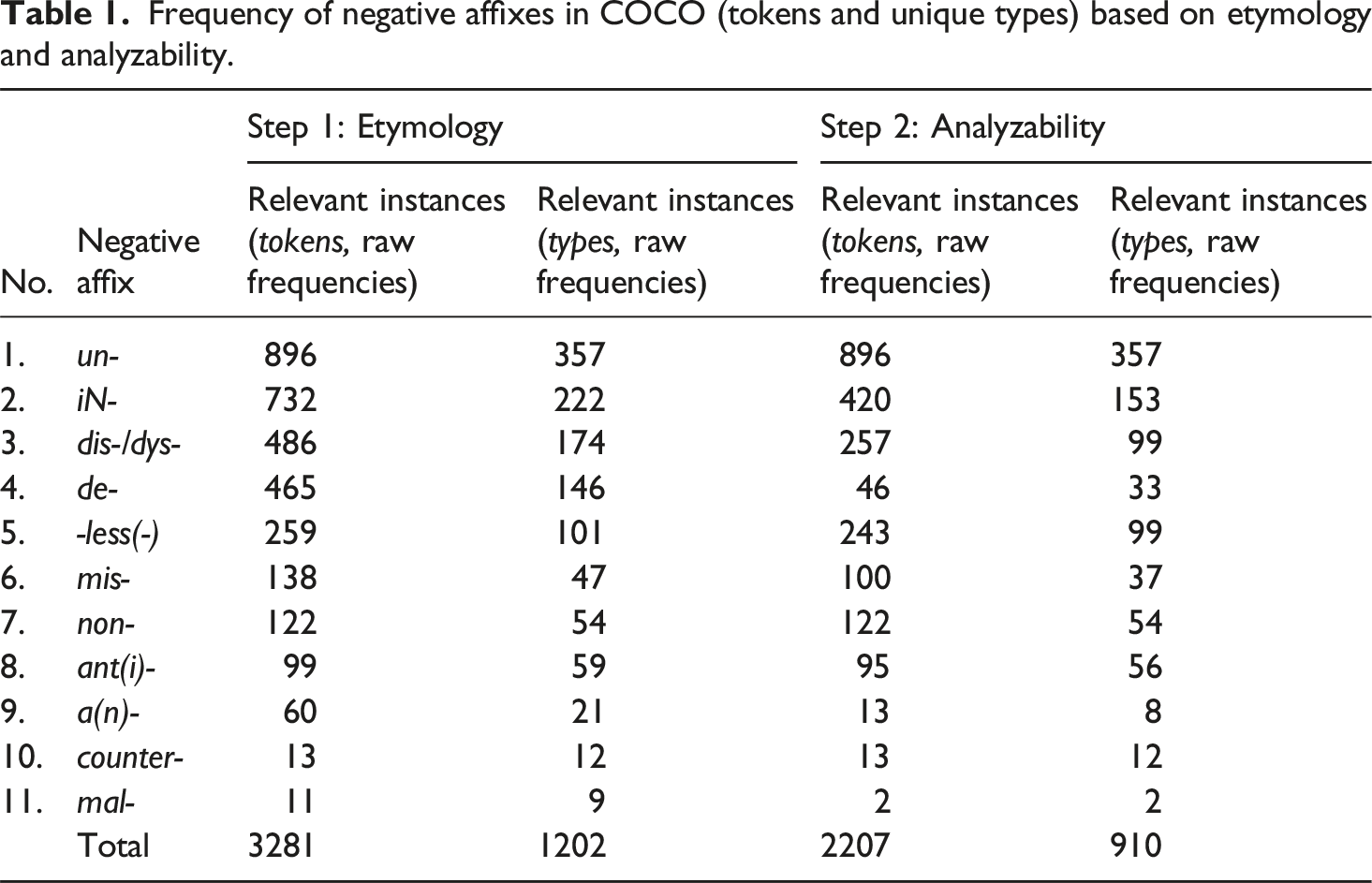
Frequency of negative affixes in COCO (tokens and unique types) based on etymology and analyzability.
The distribution of the relevant instances of affixal negation in COCO based on analyzability is presented in Figure 1. Distribution of negative affixes in COCO based on analyzability (tokens, raw frequencies), total of 2207 tokens.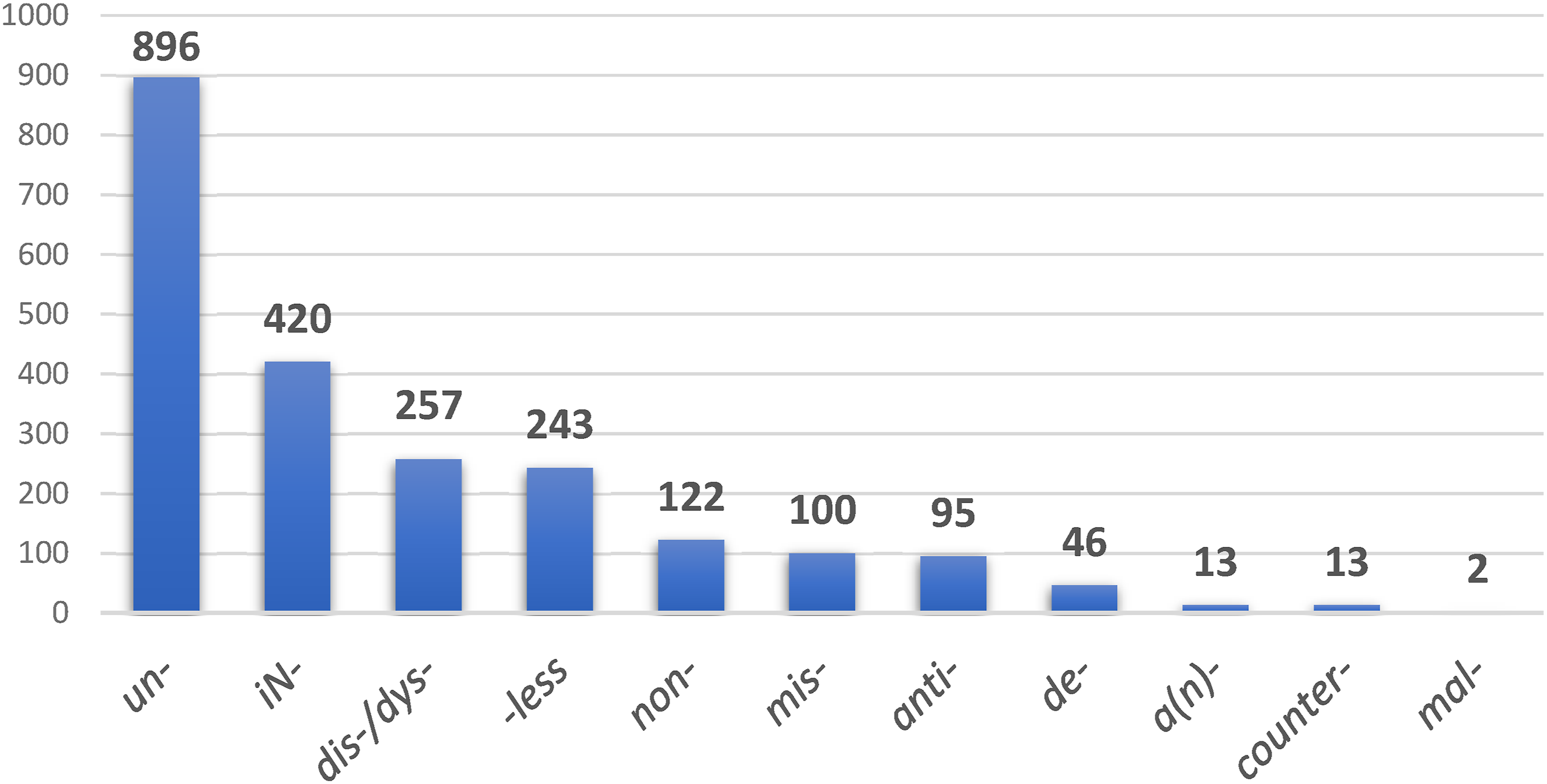
As shown in Table 1 and Figure 1, all of the nine negative affixes and the prefixes anti- and counter- are attested in COCO. Most of the negatively prefixed words exhibit various degrees of lexicalization. For example, in COCO, the majority of word types etymologically derived with the prefixes de- and mal- are lexicalized (78%). The differences in total number of occurrences between the selection based on etymology and that based on analyzability are either nonexistent or minimal with the four prefixes un-, non-, anti-, counter- and the suffix -less.
The most frequent negative affix in COCO is un-, which is not surprising as this highly productive prefix has maintained its status as the most commonly used one throughout the history of English (Mazzon, 2004), despite the competition in late Middle and Early Modern English with the synonymous prefixes iN- and dis- of French and Latin origin (Nevalainen, 1999: 380-381). Un- attaches to both native and non-native bases and to a range of word classes (e.g., adjectives, adverbs, nouns, verbs).
The prefixes of Latin and French origin, iN- and dis-, entered the language during Middle English, whereas de- appeared in the Early Modern period. These non-native prefixes expanded the English lexicon, attaching mostly to non-native bases as ‘the creation or borrowing of […] many new terms often creates the need to introduce contraries, depreciatives, privativies, etc.’ (Mazzon, 2004: 74). As seen in Table 1, considering the differences in the frequency of types between those selected based on etymology versus analyzability, approximately 30% of the items derived with these prefixes are lexicalized in PDE.
Based on etymology, the rate of affixal negation in COCO is seven tokens per 1000 words (3281*1000/468899), whereas based on analyzability, the rate is 4.7 tokens per 1000 words (2207*1000/468899). The latter measure can be broadly compared to the rates of affixal negation in the studies by Tottie (1991) and Nahajec (2021). Tottie (1991: 46) identified 209 instances of affixal negatives in a 50,000-word written corpus, which corresponds to the rate of 4.18 tokens per 1000 words 8 ; whereas Nahajec (2021: 181) identified 221 instances of affixal negation in a 51,500-word written corpus, or the rate of 4.3 tokens per 1000 words. As mentioned previously, the results are not directly comparable given differences in the selection criteria as well as the type of data: British English in the 1960s (Tottie, 1991), British English in 2008 (Nahajec, 2021) and (African) American English in 1990s-2010s (the current study). However, the comparison still shows similar results in the rate of affixal negation across written corpora of English, which is approximately four tokens per 1000 words.
5.2. Statistical modelling
The absence of a baseline in determining the frequency of affixal negation in COCO is problematic. Therefore, an attempt was made to conduct a more direct comparison of the use of four negative affixes, anti-, non-, counter- and un-, in COCO and a comparable reference corpus. These four affixes were selected because they displayed minimal differences between numbers of tokens based on etymology and numbers based on analyzability. In other words, the automatized extraction of the relevant tokens with the four affixes would not require any extensive manual clean-up. The FROWN corpus, one-million-word corpus of 1990s American English (AmE) published written texts, was chosen as a reference corpus. This choice was motivated by the availability of a comparable corpus (e.g., time period, variety of English, text types and genre) (McIntyre and Walker, 2019). The format of the corpus (.txt or .csv) was also important because the relevant data points had to be counted per text rather than for the whole corpus (e.g., Egbert and Schnur, 2018; Lijffijt et al., 2014). Also, the FROWN corpus was compiled in a way that made it possible to divide it into two subcorpora: FROWN-Informative (FROWNinf) (9 text categories; 374 texts; ca. 750,000 words) and FROWN-Imaginative (FROWNimg) (6 text categories; 126 texts; ca. 250,000 words). 9 In COCO, the monograph/memoir (ca. 53,000 words) was considered an outlier due to its length, and only articles and essays, COCO-A (350 texts, ca. 413,000 words) were included in this statistical procedure. Considering that count data with no upper bound are used in this analysis, the Poisson regression model with brms was selected as a statistical procedure in R (Bürkner, 2018; Winter and Bürkner, 2021). The R script, codes and the modelling output are available via the OSF link: https://osf.io/26k87/.
Mean and median frequency values per 1000 words for anti-, non-, counter- and un- in COCO-A, FROWNinf and FROWNimg.
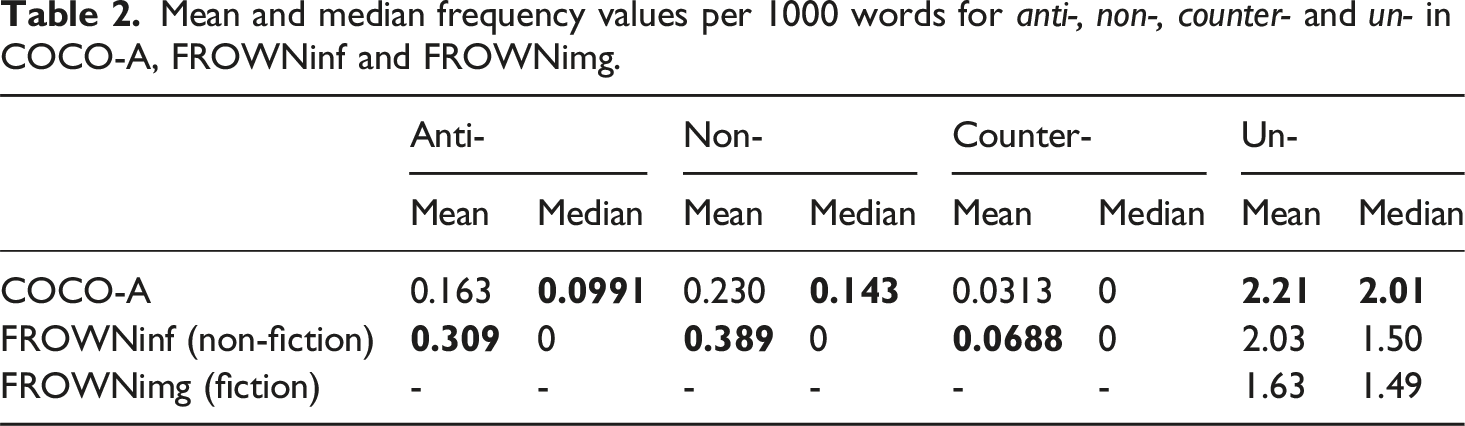
The frequencies of words with anti-, non- and counter- are lower in COCO-A compared to FROWNinf, but there is a higher probability of these prefixes occurring in a text in COCO-A compared to FROWNinf. For these prefixes, the mean value is higher in FROWNinf, but the median value is higher in COCO-A. Only the un- prefixed words were frequent in all three corpora to enable comparison between COCO-A, FROWNimf and FROWNimg. The observed frequency of un- in COCO-A is higher than in FROWNinf and FROWNimg. Based on the observation that frequencies of anti-, non-, counter- and un- are low in FROWNimg, it can be argued that the use of these prefixes is primarily associated with non-fictional rather than fictional writing.
As shown in Figure 2, the un- prefixed words were predicted to be nearly as frequent in COCO-A as in FROWNinf and more frequent than in FROWNimg. Frequency estimates of un- prefixed words in COCO-A, FROWNinf and FROWNimg based on Poisson regression model.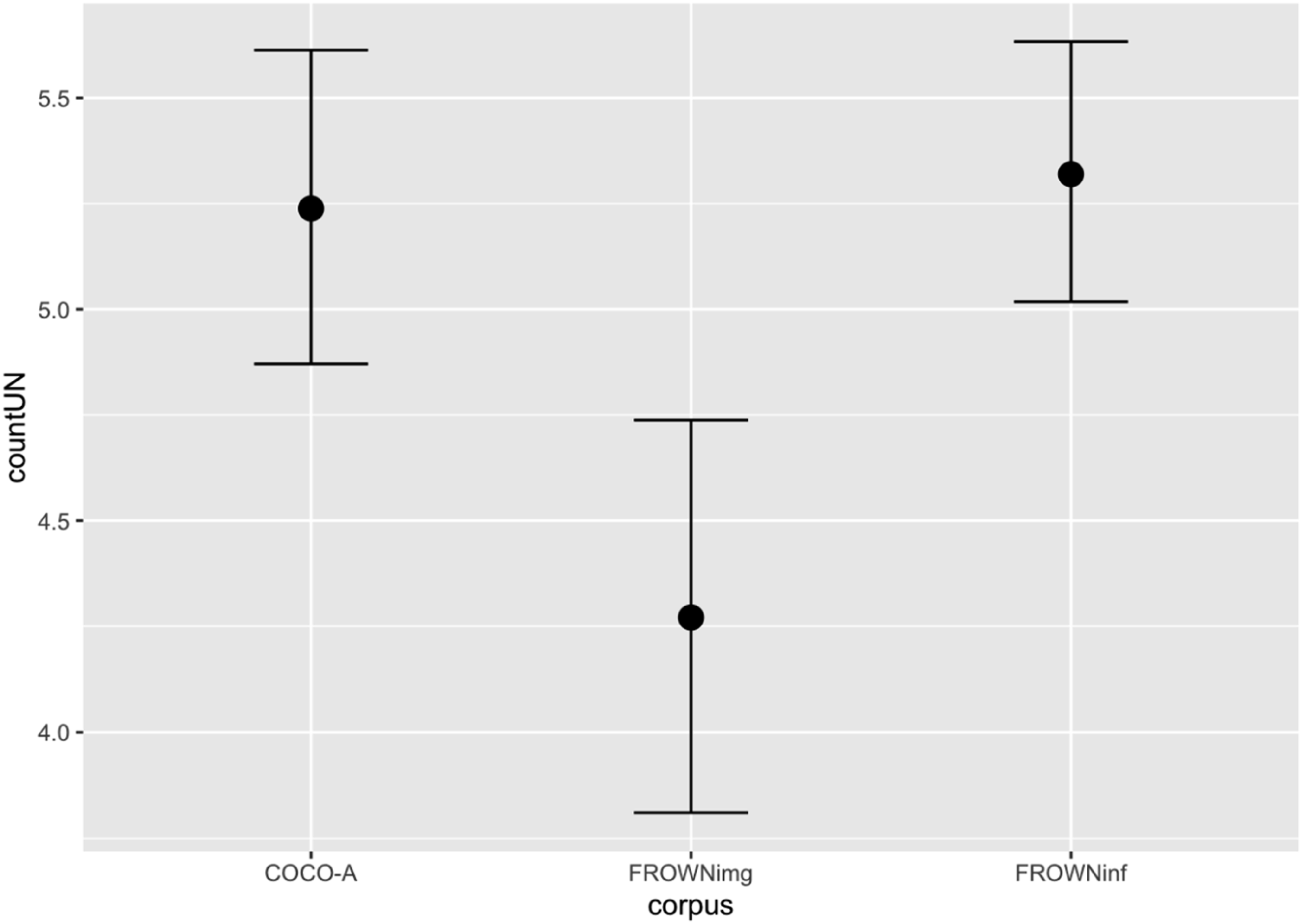
Implementing the procedure based on the degree of parsing (see Step 2 and Appendix 2) along with manual examination of the concordance lines, a number of creative uses of affixal negation were identified in COCO, particularly with the prefixes un-, non- and anti. Thus, it can be argued that Coates blends informative and imaginative/creative styles of writing. The following subsections present a description of some formal characteristics and creative uses of the three prefixes, followed by a discussion of how this type of negation is used by Coates in his oppositional discourse to challenge ideological and societal norms.
5.3. Creative uses of negative affixes in COCO
As mentioned previously, all negative affixes exhibit some degree of productivity in PDE. Often, new words are created on the spot, for a specific situational context, resulting in neologisms with low token counts (Bauer, 2019: 116). For example, in COCO two instances of nonce formations with the prefixes a- and de-, as in (8) and (9), were identified using the procedure based on the degree of parsing (see Step 2 and Appendix 2). In addition, neither ahistorians nor depower is attested in the OED; however, the latter appears in Wiktionary and occurs 6 times in COCA (but only twice in a similar context as “depowering somebody” rather than “something”). (8) Most of these folks are carefree (9) The feminist critique is in the air now. If my rendition of Black Panther wasn’t created by that critique, it breathed the same air. I can’t really kill off or
The more morphologically productive prefixes un-, non- and anti- offer a range of examples of linguistic creativity in COCO. Nonce formations like unstupid in (10) and non-smile (11) both display grammatical and semantic deviation. In (10), unstupid is ambiguous in terms of its word class as the construction get you to could be followed by either a verb or a noun. Semantically, the prefix un- attached to verbs or nouns suggests the reversative meaning: in this case, either going through the process of undoing the state of being stupid (verb) or reaching a “destination”, the place of “being unstupid”. As Horn (personal communication, January 15, 2025) points out, nonce un- verbs (and un-nouns) increasingly display a liberative meaning as they imply freeing oneself from an undesirable quality, for example the reversal of “being stupid”. This example also showcases the current development of convergence of the two etymologically distinct un- prefixes. (10) So that should get you to (11) I thought of an image from last February, when Michelle Obama, in a gray sweater and a
In (11), the productive prefix non- is combined with the noun smile to create a natural-sounding nonce word, non-smile. In addition, Coates’s use of non-smile in a coordinated noun phrase a gray sweater and a non-smile, simultaneously evokes and rejects the notion of “putting on a (fake) smile”. In other words, Coates criticizes the expectation of media (and society) of how the future First Lady should look and act. Other creative contextual uses of established forms are discussed in the section below.
The productive prefixes un- and non-, as well as anti-, are the only prefixes in COCO that attach to individual words (e.g., nonevent), compounds (e.g., anti-crime wave) and to noun phrases or adjective phrases forming multi-word units (used as adjectives/premodifiers) as in (12)–(14). (12) Think of Michelle Obama’s sharp sense of humor and her insistence on viewing her husband as mortal, and how both traits were derided during the campaign as (13) That trend eventually extended to such (14) Wright’s world is emblematic of the African Americans he ministered to, people reared on the
Considering formal characteristics of negative affixes, prefixes are considered non-category changing, that is the prefix does not usually change the word category of the base to which it is attached (e.g., unhappy is an adjective, as is the base happy; nonviolence is a noun like its base violence, etc.). However, there are instances of nouns negated with un-, non- and anti- that are used as premodifiers in noun phrases, as well as some instances of negated compounds and phrases (e.g., nonparty elections, anti-crime wave, etc.). 10 Negated noun-noun compounds, in particular, illustrate a more established phenomenon of creative compounds which are frequent in English (Benczes, 2005).
In COCO, over 50% of the un-, non- and anti- prefixed items display adjectival uses: adjectives (e.g., unserious, nonpoor, antisocial), adjectival participles (e.g., unwed, uninspired, nonaggravated) or adjectival nominals (e.g., anti-immigration [measures], anti-gravity [elements], nonparty [elections]). The remaining instances of anti- and non- occur with nouns (e.g., anti-MCs, antihero, anti-Americanism, nonevent, nonconformity, nonanalysis). However, the prefix un- occurs with adverbs (e.g., uncleverly, unfairly) (ca. 10%, 88/896); verbs (e.g., unearth, uncover, unseat) (ca. 7%, 61 tokens) and in nominal uses (8%, 73 tokens) (e.g., unbelievability, unblackness, unconvention). The latter category incorporates what has been classified by Horn (2005: 337) as deadjectival formations: nominalized un-adjectives (e.g., unblackness, unhotness) and deadjectival nominals (e.g., unfreedom is a nominalization of unfree). Such nominal uses are discussed in detail in the subsection below, Affixal negation and critique of societal norms.
In semantic terms, the prefix un-, being able to attach to a variety of bases, covers a range of meanings associated with negation: contrary and contradictory negatives, privatives and reversatives (Bauer et al., 2013: 367). Additionally, it usually implies evaluation. In contrast, the prefix non-, which is typically neutral in evaluation, negates the descriptive aspect of the base (Horn, 2002: 9) and productively ‘divides the world in two’ (L. Bauer, personal communication, July 8, 2022). The instances of the non-evaluative attitude prefix anti- in COCO were categorized based on three distinct uses (Bauer et al., 2013: 417): attitudinal meaning (e.g., anti-racist) – 73% (69/95), medical/scientific use (e.g., antidote) – 8% (8 tokens) and negation as “opposite to” (e.g., antihero, the anti-Tupac) — 19% (18 tokens). It is worth noting that in real-life language use, the first and third types of meaning are both oppositional and not easily separatable as in (15). The interpretation of the prefix in anti-convention is ambiguous; it is attitudinal as well as negative because it indicates the entity anti-convention, an event organized in opposition to the Republican convention. (15) TV network uses a marathoner to win the
The following section presents the analysis of contextual uses of the un-, non- and anti-derived items in COCO examined from the perspective of linguistic creativity.
5.4. Contextual meanings and functions of affixal negation in COCO
The markedness of linguistic negation contributes to its function as ‘a natural foregrounding device’ (Hidalgo-Downing, 2002: 121). As mentioned previously, the foregrounding effect of affixal negation can be subtle and not easily recognizable. Negative affixation can be used in ways that can be lexically or grammatically deviant (e.g., the coinage of nonce words), but also in ways that are semantically or pragmatically marked. For example, the linguistic environment or societal and cultural context might create a sense of dissonance or clash between the derived word and the linguistic environment in which it is embedded.
Based on the results of statistical modelling described above, Coates’s use of affixal negation is not significantly more frequent compared to the reference corpus FROWN, but Coates uses this linguistic expression of negation creatively in his writings, both in explicit and also in subtle manners. The following subsections illustrate such uses and identify their possible functions in a discourse.
5.4.1. Wordplay in article titles
Article titles and advertising are the areas where foregrounding can be done explicitly. Here, linguistic creativity functions as an attention-seeking device (ASD) and is exhibited in all sorts of wordplay (Hohenhaus, 2007: 23). An ASD-type wordplay can be achieved by creative uses of word formation patterns, by graphemically or phonetically deviant uses of familiar, established expressions, etc.
Various forms of wordplay are exemplified in titles of newspaper/magazine articles from Coates’s earlier writings (1996–2004). Most of the articles from this period were thematically grounded in the contemporary Hip Hop scene; they were published in The Washington City Paper and The Village Voice, which are both “alt-weeklies” (alternative newspapers). Such newspapers can be described as an alternative form of the press, as it supplements the mainstream press’s topics of coverage and is geared toward a younger, hipper audience (Lerner, 2024). Coates’s wordplay in titles includes the exploitation of phonetic similarities to established expressions (e.g., Evolutionary War; Falling Starr, alluding to an American rapper, Fredro Starr), elements of riddles (e.g., Not as (16) Democracy (17) Heir (18) Rhyme and (19) Bloodied but (20) Loud and (21) Keepin’ It
The use of affixal negation in these titles functions as a general foregrounding device, or more specifically, as an attention-seeking device. The prefixed words – inaction, inapparent, unreason, unclear, unreal, – are not novel formations as they are attested in general language use. They become marked instances because the negative prefix is inserted into fixed expressions (e.g., idioms, catchphrases, and anomalous collocations) (Moon, 1994, 1998). In other words, the foregrounding effect is achieved by morphologically negating one of the constituents in a fixed expression (e.g., loud and clear vs loud and
Additionally, the foregrounding function can also be emphasized both lexically and semantically, as in (19). In this case, it is not a negative prefix that is added to the fixed expression, but the base of the prefixed word that is switched (Bloodied but Unflowed vs the phrase Bloodied but Unbowed). Here, the word unflowed is a deviant lexically, phonetically and semantically.
By using affixal negation to disrupt the non-compositionality of the fixed expressions in titles, Coates utilizes wordplay as a mark of his personal style and to draw attention to his work. Furthermore, such wordplay is a ‘vehicle for achieving recognition and affirmation’ within the African American community (Smitherman, 2006: 64). In other words, in the earlier stages of his career, Coates’s writings explicitly reflect improvisation and playfulness with language, including affixal negation.
5.4.2. Multi-layered meaning
Another function of the creative use of affixal negation in COCO could be described as a construction of multi-layered meaning. In (22), the nominal compound crime wave is negated by anti-. (22) New York itself is in the midst of an
In fact, there are a number of complex processes at play. On the one hand, the prefix anti- negates the first constituent of the compound, the noun crime. In this case, the meaning of anti- is attitudinal, showing opposition to what is denoted by the base, that is “against crime”. Thus, the whole expression could be interpreted as “a wave [of actions] against crime”. On the other hand, it could also be argued that the scope of negation of anti- covers the compound noun as a whole, not only its first element. In this case, the meaning of anti-crime wave would imply an entity that is opposite to “crime wave”. Since the meaning of crime wave is described as ‘a period of marked increase in the incidence of crime’ (OED, 2025), the meaning of anti-crime wave would imply the opposite, “a period of marked
However, in the case of anti-crime wave, it could be argued that the prefix simultaneously negates both the attributive noun crime and the whole expression crime wave. The extended context of (22) gives us clues to the writer’s word and meaning formation processes. The preceding paragraph (22a) refers to anti-crime measures taken by the city of New York, namely “Operation IMPACT (Integrated Municipal Police Anti-Crime Teams)”. The paragraph that follows, (22b), refers to the result of these anti-crime efforts, namely the decreased crime rate. (22a) Lately they’ve begun lining up by the dozen on Flatbush, and when I see them a warm fuzzy feeling blooms in my bones. Suddenly a late-night stroll is, well, a slightly safer stroll. The honor guard is courtesy of Operation Impact, a program the city expanded last month in hopes of subduing the worst havens for crime. So far the results have been promising. New York itself is in the midst of an (22b) According to the FBI, New York has the lowest crime rate of any city in the country with over a million people. In December, The New York Times reported that New York was roughly as safe as Ann Arbor, Michigan—population 100,000 (COCO-2004-VV).
By playing on the duality of the meaning of the prefix anti- (attitudinal and negative meanings) and exploiting collocational patterns with the word crime (e.g., anti-crime measures/efforts and crime wave), Coates innovatively constructs a multi-layered meaning of anti-crime wave in the text.
5.4.3. Affixal negation and critique of societal norms
In corpus linguistic research, it has been observed that information is packaged and presented in the form of collocates – frequently co-occurring words which tend to become fixed phrases. In discourse, ‘such phrases thus become entrenched in language use and the information within them becomes difficult to pick apart or criticize’ (Baker, 2010: 127). As discussed above, in his early career, Coates exploits the foregrounding function of affixal negation by inserting negative affixes into fixed expressions in article titles. From 2005 onwards, Coates’s writings appear in national publications such as TIME and The Atlantic. At this later stage in his career, the author seems to creatively use affixal negation to critique societal norms or an established institutional order more subtly. Here, affixal negation is used to (re-)name concepts in order to present them from an alternative perspective (as Black American) in contrast with the mainstream narrative.
As previously mentioned, the un- deadjectival formations such as unblackness in (23) and unfreedom in (24) can be described as a blend of a type of nominalization and an un- adjective. (23) The idea that blacks should hold no place of consequence in the American political future has affected every sector of American society, transforming whiteness itself into a monopoly on American possibilities. [..] Slavery, Jim Crow, segregation: these bonded white people into a broad aristocracy united by the salient fact of (24) For African Americans,
Semantically, such formations evoke the concept of (nominal) privation in Aristotle’s sense, as ‘“lack of X” in a context where one would expect X’ (Horn, 2002: 37). In other words, the lack of a particular property implies an assumption that such property is expected to be naturally present in the referent.
It could also be argued that such assumptions could be shared in a particular community based on a set of norms and expectations. For example, in (23), the abstract noun unblackness, which refers to the absence of Black people in every sector of American society, is contrasted with the preceding noun phrase the salient fact. The contrasting notions of salience and absence evoke the dual effect of the negator un-: the obvious presence of whiteness and the obvious absence of blackness. Coates employs this juxtaposition to highlight the alternative view of reality. Thus, affixal negation is used here by Coates as a discourse strategy to critique the established institutional order in American society.
In the context of (24), the noun unfreedom is juxtaposed with the predicative expression the historical norm. The privative meaning of un- in the subject unfreedom, as “a lack of something [freedom] that should be a norm”, clashes with the subject predicative which equates unfreedom to “the norm [for African Americans]”. Once again, the negative prefix un- in this co-textual environment highlights an awareness of dual “realities”: the notion of freedom as the norm in the history of American society and the opposite notion of unfreedom for a particular group within that society. Thus, Coates presents an alternative point of view to critique the one-sided mainstream narrative of American history.
These examples illustrate the creative use of affixal negation in the context where its privative meaning disrupts an expectation of what is perceived as a “norm”. Thus, it could be argued that affixal negation, particularly prefixation with un-, can be a vehicle for what Partington (2017) describes as, ‘evaluative clashes’, in a discourse. Such evaluative clashes are skillfully employed by Coates in his critique of societal norms and established institutional order.
6. Conclusion
Using the Corpus of Non-fictional Writings by Ta-Nehisi Coates (COCO) as a case study, this paper has proposed a framework for analysis of affixal negation in a corpus. The results indicate that the use of affixal negation is employed in various functions by the author. All nine core English negative affixes and the prefixes anti- and counter- are attested in COCO. The rate of affixal negation in the corpus, 4.7 tokens per 1000 words, seems to be consistent with previous findings for rates of affixal negatives in written corpora (Nahajec, 2021; Tottie, 1991). However, since COCO represents the language use of only one writer, more research on rates of affixal negation in various types of written corpora is needed to determine if the results of this study can be theoretically generalized for written English. The comparison of frequencies for the four prefixes in COCO-A and the reference corpus, FROWNinf, has shown a lower frequency for anti-, non- and counter- in COCO-A and a similar rate of un- in both corpora, as it also highlighted consistent use of negative affixes in Coates’s writings.
The instances of affixal negation in COCO, particularly the un-, non- and anti-derived forms, were subjected to close reading and analyzed from the perspective of linguistic creativity. As the comparison of these affixes in COCO and FROWN suggests, Coates’s use of affixal negation displays a blend of features associated with both informative and creative styles of writing. In other words, the writer uses the negative prefixes such as non- and anti-, which are primarily associated with the informative (non-literary) style of writing and creatively embeds them into his texts to highlight the alternative perspective of his writings. This indicates that Coates’s use of affixal negation incorporates and balances informativity and expressivity.
The study identified nonce word formations (e.g., unstupid, ahistorians, non-smile, anti-crime wave) that displayed lexical and/or grammatical deviation. In addition, the study has identified various functions of creative uses of affixal negation in COCO. It has shown that Coates effectively uses affixal negation as an attention-seeking device, as a tool to construct multi-layering effects in a text and as a way to (re-)name concepts in order to critique societal norms and established institutional order. In other words, affixal negation is used as a foregrounding device in Coates’s writings, which also highlights the potential of affixal negation (particularly with the prefixes un-, non- and anti-) for creating evaluative clashes in a text and for use as a negation strategy in oppositional discourse.
Supplemental material
Supplemental Material - Affixal negation and linguistic creativity: A corpus-based case study of negative affixes in Ta-Nehisi Coates’s discourse on race
Supplemental Material for Affixal negation and linguistic creativity: A corpus-based case study of negative affixes in Ta-Nehisi Coates’s discourse on race by Yulia Hathaway in Language and Literature
Supplemental material
Supplemental Material - Affixal negation and linguistic creativity: A corpus-based case study of negative affixes in Ta-Nehisi Coates’s discourse on race
Supplemental Material for Affixal negation and linguistic creativity: A corpus-based case study of negative affixes in Ta-Nehisi Coates’s discourse on race by Yulia Hathaway in Language and Literature
Footnotes
Acknowledgements
I would like to express my gratitude to Koenraad De Smedt, Øyvind Gjerstad and Kevin McCafferty for constructive comments on earlier drafts, to Torodd Kinn and Jerzy Nykiel for discussing morphology and etymology with me and to Christian Mair for providing access to FROWN. Many thanks to Carl Börstell for help with converting the corpora into an R-readable format and to Vadim Kimmelman for help with the statistical modelling. I am also grateful for insightful comments from two anonymous reviewers.

Funding
The author received no financial support for the research, authorship, and/or publication of this article.
Declaration of conflicting interests
The author declared no potential conflicts of interest with respect to the research, authorship, and/or publication of this article.
Data Availability Statement
Due to copyright, the dataset used in this study is not publicly available.
Supplemental material
Supplemental material for this article is available online.
Notes
Author biography
References
Supplementary Material
Please find the following supplemental material available below.
For Open Access articles published under a Creative Commons License, all supplemental material carries the same license as the article it is associated with.
For non-Open Access articles published, all supplemental material carries a non-exclusive license, and permission requests for re-use of supplemental material or any part of supplemental material shall be sent directly to the copyright owner as specified in the copyright notice associated with the article.
