



Abstract
The language of written fantasy has been amply studied, with extensive research on authors such as JRR Tolkien, Robert E Howard, or Aldous Huxley. The study of television language, on the other hand, is attracting increasing attention, even though the scope of such research often encompasses a single TV show rather than whole genres. Given the renewed interest in all things fantasy, this study seeks to analyze the language of fantasy TV series from a corpus-stylistic perspective to open new paths for linguistic inquiry. First, I depart from a theoretical distinction that relies on Mandala’s (2012) overview of the field and James and Mendlesohn’s (2012) definitions of fantasy as a genre; I consider some of the traits they associate with written fantasy and propose a taxonomy of the different types of fantasy worlds in television. On the basis of this, I design my own TV fantasy corpus by sampling three episodes from fifteen American fantasy TV shows (2011–2021) and compare it against Davies’ TV Corpus (2021). Using a corpus-based approach, I implement a POS (part-of-speech) and semantic analysis of the corpus and consider whether, and if so how, the language of fantasy in television reflects the same characteristics scholars have identified in written fantasy and general television discourse. In doing so, I aim to contribute to the understanding of the style of fantasy as a genre and assess whether fantasy TV series are characterized by particular linguistic features.
1. Introduction
In this paper, I study the language of fantasy television series from a corpus stylistic perspective to provide a preliminary description of the language and style employed in this genre and medium. Television series have been defined as important social and psychological phenomena (Bednarek, 2018; Harmes, 2020), inasmuch as telecinematic discourse has been acknowledged to provide us with a number of insights into society’s shifting values over time and its perspectives on different issues (Csomay and Young, 2021; Quaglio, 2009; Trotta, 2018; Werner, 2018). Fantasy has likewise been considered by many as a genre for testing the limits of society and bringing otherness to the front (Adams, 2017), as well as ‘the perfect literary mode in which to explore (and explode) our assumptions about “innate” values and “natural” social arrangements’ (Lefanu, 1989: 13). Regardless, others (Attebery, 2003) claim that fantasy has long been ignored by or considered an inappropriate object of study in academia, despite its pervasive character.
I use here Piazza et al.’s (2011) definition of telecinematic discourse, which encompasses both television and cinema language, though due to space constraints I only address TV dialogue here. The language of TV series has, in fact, been approached from a variety of perspectives. Drawing on sociolinguistics, Coupland (2007) or Queen (2015), for instance, underscore TV’s capacity to shape our sociolinguistic environment to varying degrees (Coupland, 2007: 185), or to act as an important source of information about both language and society (Queen, 2015: viii). The potential of TV series may be particularly poignant if we consider the globalized context in which we live, where millions of people consume the same television series at the same time across the globe. With regard to its cultural impact, Mittell (2015: 37) argues for the ‘cultural legitimacy’ of telecinematic discourse because that legitimation somehow vindicates that scholarly attention be devoted to it (see also Androutsopoulos, 2012; Queen, 2013, 2015). Besides TV’s great cultural impact, Bednarek (2018) also highlights its artistic value. And yet, despite the recent trend and growing interest in analyzing television dialogue, scholars are also aware that fictional mass media still require much more specialized attention.
My departure point for this study draws upon the assessments of previous scholars regarding written fantasy, primarily because most of the existing research concerns fantasy in this particular format. I aim to expand on the existing body of work by looking at the way language is used in a completely different medium, namely telecinematic discourse as defined above. For this purpose I initially apply a corpus-driven approach subsequently expanded by a detailed analysis of the results obtained, in which I implement a qualitative concordance analysis of the most frequent types. Thus, I start by comparing the language of 15 US fantasy TV series against the downloadable sample of Davies’ TV Corpus (2021) using Wmatrix (Rayson, 2009). In doing so, I focus both on the parts-of-speech components (POS) and semantic categories to assess the characteristics of the genre when compared against general TV discourse and whether some idiosyncratic features may emerge as specific to the fantasy genre.
My target corpus is the Fantasy TV Corpus which has been personally designed and compiled following Bednarek (2019), Veirano (2018), and Egbert and Baker (2021). The dialogue of the TV series in the corpus has been manually transcribed in its totality to be an accurate depiction of what is actually uttered on screen (see Section 3 for details). I depart from Bednarek’s approach in that I do not focus on keyword lists but consider POS and semantic categories instead. As often acknowledged by scholars (cf. Scott and Tribble, 2006), I look at the distinctive content of the corpus. That is, I consider its aboutness as well as its style on the basis of semantic and POS tags respectively because of the preliminary insights it may offer for analysis. For instance, as will be explained in depth in Section 4, I analyze the POS tag ‘PNQO’ (object pronoun whom) because it signals formality, which has implications for the genre as a whole, not because it is used by a certain character or in one of the series more often than in others. My study is exploratory in nature and builds on what previous scholars have argued with regard to the genre of written fantasy, on the one hand, and telecinematic discourse in general, on the other.
2. The fantasy genre
2.1. Fencing off fantasy and secondary worlds
Despite many attempts, a broad, generally accepted definition of fantasy as a genre simply does not exist. A number of authors, scholars, and critics have shared their views on what it is that makes fantasy fantasy or which works belong to the genre. It is precisely this resistance to any definition that has caught the attention of theorists such as Jackson, who considers that the value of fantasy resides precisely on its ‘free-floating and escapist qualities’ (Jackson, 1981: 1). Thus, it seems as if variability and heterogeneity are salient characteristics of the genre of fantasy. Its origin in diverse fairytales, folklore, and myths makes it difficult to capture a common set of factors that unequivocally account for all that is considered fantasy. However, the concept of genre evokes a sense of unity and a framework from which structure emerges. As noted by Alexander (2018: 256), ‘genre structure is vitally important […] representing the core modality of the organization of narrative systems’. As opposed to its sibling genre – science fiction – fantasy still resists being segmented into clearly identifiable subgenres that most fans, critics, and writers agree on (James and Mendlesohn, 2012). It should also be borne in mind that the fantasy label is at the mercy of the television industry and publishing houses, whose subjective criteria and nuances may shift as much as those of critics and theorists. The different segmentations of the genre or which works are categorized as such are partly due to the variability of the genre itself but also derive from commercial and aesthetic factors. As for commercial factors, there has always been fantasy on the market but modern fantasy, as we know it, is claimed to have emerged from Tolkien’s Lord of the Rings (LOTR henceforth) (James, 2012) in the 1950s. Before that, fantasy and science fiction were largely ignored by criticism, which ‘dismissed [them] as beneath notice’ (Attebery, 2003: 45) and ‘all but invisible’ (Wolfe, 1986: 11). This was so much the case that even Nineteen Eighty-Four and Gulliver’s Travels were only accepted as great works of literature when they were thought of as more mimetic than fantastic in nature (Mandala, 2012).
Some of the major theorists in the field such as Tzvetan Todorov, Rosemary Jackson, WR Irwin, and Colin Manlove seem to agree on the fact that fantasy is ‘about the construction of the impossible’ (James and Mendlesohn, 2012: 1). Fantasy is a narrative that relies on the manifest violation of what is often considered or accepted as possible and, critically, it has been a term applied to any kind of literature (and extended to TV series that share similar thematic characteristics) that does not prioritize realistic representation (Jackson, 1981). The fantastic invariably constitutes a perturbation in the established paradigm, toying with the concept of estrangement and, even when a straightforward explanation of the phenomena is conceivable, such explanation proves futile within the limits of the fantastic. As argued by Todorov (1973), a tale that exhibits strange events does not allow for an internal explanation of that strangeness. Thus, in this paper, the ‘impossible’ is used to refer to a full degree of separation from the possible that literally estranges the narrative from reality. The ideas of the impossible and estrangement are core to my work as much as they are for the genre as a whole, given that the concept of the ‘impossible’ is the main criterion for the selection of my data.
When I employ the term ‘fantasy’ henceforth I specifically refer to those works that thematically rely heavily on the general idea of the impossible, be it magic abilities, fantastical creatures, worlds detached from our own or instances of resurrection. In addition to this, I propose a distinction within the genre of fantasy itself, which seeks to account for the different degrees of connection between the worlds portrayed in the fantastic and our own world. For this purpose, I consider Wolf’s (2012) claims, which take into account the relationship between our actual world and the secondary fantastic world(s) created in fantasy, an unusual concept before Tolkien brought it into the mainstream (James, 2012). Wolf proposes that there are different types of secondary worlds depending on how detached they are from the primary/actual world. For instance, the planets that appear in Star Trek are more secondary than Jeff Davis’ depiction of Beacon Hills (California) in Teen Wolf. However, Wolf also declares that for a world to be considered secondary, it must have a distinct border of some type that sets it apart from the primary world. I, on the other hand, propose a three-fold distinction according to how close both worlds are (depicted in Figure 1). This distinction is the result of a qualitative approach to TV series. That is, the compilation of the corpus also involved a preliminary study of the data which brought to the fore the existence of certain thematic patterns in the TV series. These thematic patterns, therefore, were considered from a corpus stylistic perspective to investigate how the language of TV series project these particular features which allowed me to consider the relationship of those patterns to fantasy TV series as a genre. As Mendlesohn (2008: 276) points out, ‘genre and genre structure are a dialogue instead of a rubric and the same should be true of genre analysis’. Therefore, my distinction is intended as a road map rather than as prescription, given that it can be useful for delimiting closely related (sub-)genres that make use of similar thematic and structural devices. Separated worlds, mixed/overlapping worlds, and merged worlds, respectively.
In my own approach to the definition of fantasy, thus, I consider works in which secondary worlds are completely detached or separated from our world and thus have their own timeline, geography and laws (for instance, The Wheel of Time, The Witcher). Secondly, in other works secondary worlds are somehow linked to the primary world or contained within it, what I term mixed or overlapping worlds. For instance, a secondary world that is reached through a portal or some sort of incantation. This sort of world contained within the primary world may function according to its own laws and follow its own timeline or simply mimic those of the primary world (as in Locke & Key, The Chilling Adventures of Sabrina). Finally, other fantasy works depict secondary worlds which are totally merged with our world; that is, the fantastic occurs in a well-known location of our geography. In this last category, however, there is also an element of disruption that functions as the catalyst that introduces estrangement and hence justifies the ‘fantasy’ label (cf. Teen Wolf, Russian Doll). If mimetic fiction serves as a mirror to our world, fantasy lives within the cracks of that broken mirror, drawing on estrangement to adopt different shapes.
My proposed reformulation of Wolf’s classification of fantasy worlds, therefore, seems to afford a more comprehensive definition of fantasy as a genre in that it allows to include features that appear to characterize contemporary works as well as fantasy in formats other than the written, as is the case here. As explained in Section 4, this distinction also has effects on the language that is used by the characters, since merged or overlapping fantastic worlds require more realism to keep the events and language grounded in the everyday lives of the characters. Although due to space constraints I am unable to pursue it in this article, I suggest that the theoretical distinction I propose here can also be a useful parameter to account for fantasy as a genre, whether it is in the written or multimodal medium.
2.2. The language of fantasy and TV
It is true that fantasy as a genre has received a great deal of attention since its confinement to the fringes of academic criticism but there seems to be a distinctive gap in research when it comes to the actual language employed. Several authors point out how the study of fantasy is mostly restricted to metaphorical and thematic elements (Mendlesohn, 2008) and that there is ‘nothing dealing with the language of the fantastic that goes beyond aesthetic preference’ (Mendlesohn, 2008: 1). Mandala (2012) stands out as one of the scarce studies dealing with the language and style of fantasy literature. Her work sheds light on several of its prominent traits: the use of archaisms, a preference for simple (yet effective) language, experimentation with language contact, and the crafting of multi-dimensional characters even when they may be typically labeled as ‘archetypes’. However, it is worth noting that her findings pertain specifically to fantasy literature and not to TV series, which only adds an extra dimension to her assertion that the examination of style in fantasy (literature) has fossilized. This lack of academic engagement seems anomalous given the fact that fantasy can be all-pervasive, ‘infiltrating other genres, the literary mainstream, otherwise conventional movies and TV programs, commercial art and advertising, music, theatre, design’ (Wolfe, 2002: 27). As concerns a more general vision of fantasy language, Mandala (2012) argues that comments on style suggest that the language avoids complexity and instead tends to make use of ‘staid, unadorned prose’ (Mandala, 2012: 18). The same critique was issued by Irwin as far back as 1976, which contended that fantasy is by definition stylistically plain. This contrasts with the findings by Montoro (2018) who, on the basis of a number of linguistic features and variables, concludes that fantasy is ‘more syntactically complex’ at the specific level of the Noun Phrase than other sub-genres of popular fiction, such as crime fiction, chick lit, and thriller. This apparent clash in terms of simplicity/complexity is discussed in depth in Section 4.
As claimed above, if the study of style in literary fantasy is fossilized or stagnated, the situation is even more pronounced in the case of fantasy TV series. There is a distinct lack of linguistic research on TV dialogue that is representative of the language of the fantasy genre. This notable scarcity further emphasizes Mandala’s assertion about the stagnation in examining style at genre level. While valuable research has indeed been conducted on the language of fantasy TV series, (particularly on specific shows), it is challenging, if not impossible, to make generalizable claims applicable to the genre as a whole. This difficulty arises from studies often being based on limited data, as highlighted by Bednarek (2020). One example is Reichelt's (2021) work on Buffy the Vampire Slayer, which examines the impact of different affixes on characterization in this particular TV series. My study, therefore, seeks to remedy the lack of research engagement with the language of fantasy in general, while also contributing to the study of TV dialogue as a particular variety of language. As it concerns the latter, Bednarek (2018) provides the most detailed description of TV dialogue in the US up to date using keyness analysis, though she focuses on n-grams and word forms. For this purpose, Bednarek uses the Sydney Corpus of Television Dialogue (SydTV), which contains around 275,000 words from sixty-six different TV series first broadcasted between 2000 and 2012. I adopt a similar approach to the study of fantasy since I also use a corpus stylistic methodology supported by keyness analysis but focusing on POS and semantic categories. As per the characteristics of US TV dialogue, Bednarek highlights (and confirms findings from previous research such as that of Quaglio (2009)) that TV dialogue selectively imitates unscripted language and includes features associated with spontaneous conversation. For instance, the SydTV corpus shares around 1,003 word-forms with the Longman Spoken American Corpus (Bednarek, 2018). In addition, TV dialogue places emphasis on the here-and-now on the basis of personal pronouns, (in)formal terms of address, or discourse markers. Colloquial and informal language also features in the list and Bednarek argues that the use of such a register “may contribute to the ‘willing suspension of disbelief’ on the part of audiences” (2018: 137), something vital in fantasy. ‘Emotionality’ or ‘expressivity’ are also key features of TV dialogue, regardless of series or genre according to Bednarek. It comes as no surprise to find expressivity or emotionality as a key feature across all genres or series given that this is one of the main resources for entertainment and engagement, keeping audiences interested by exploiting emotional or dramatic tension. Besides Bednarek’s findings, genre diversity has been acknowledged to play a role in language use in television (see Sardinha and Veirano (2019) among others). Therefore, it is interesting to explore the specific features of language use in fantasy TV genres rather than TV dialogue as a general register. This may yield further insights into genre-specific language use.
3. Methodology
Fantasy TV corpus composition.
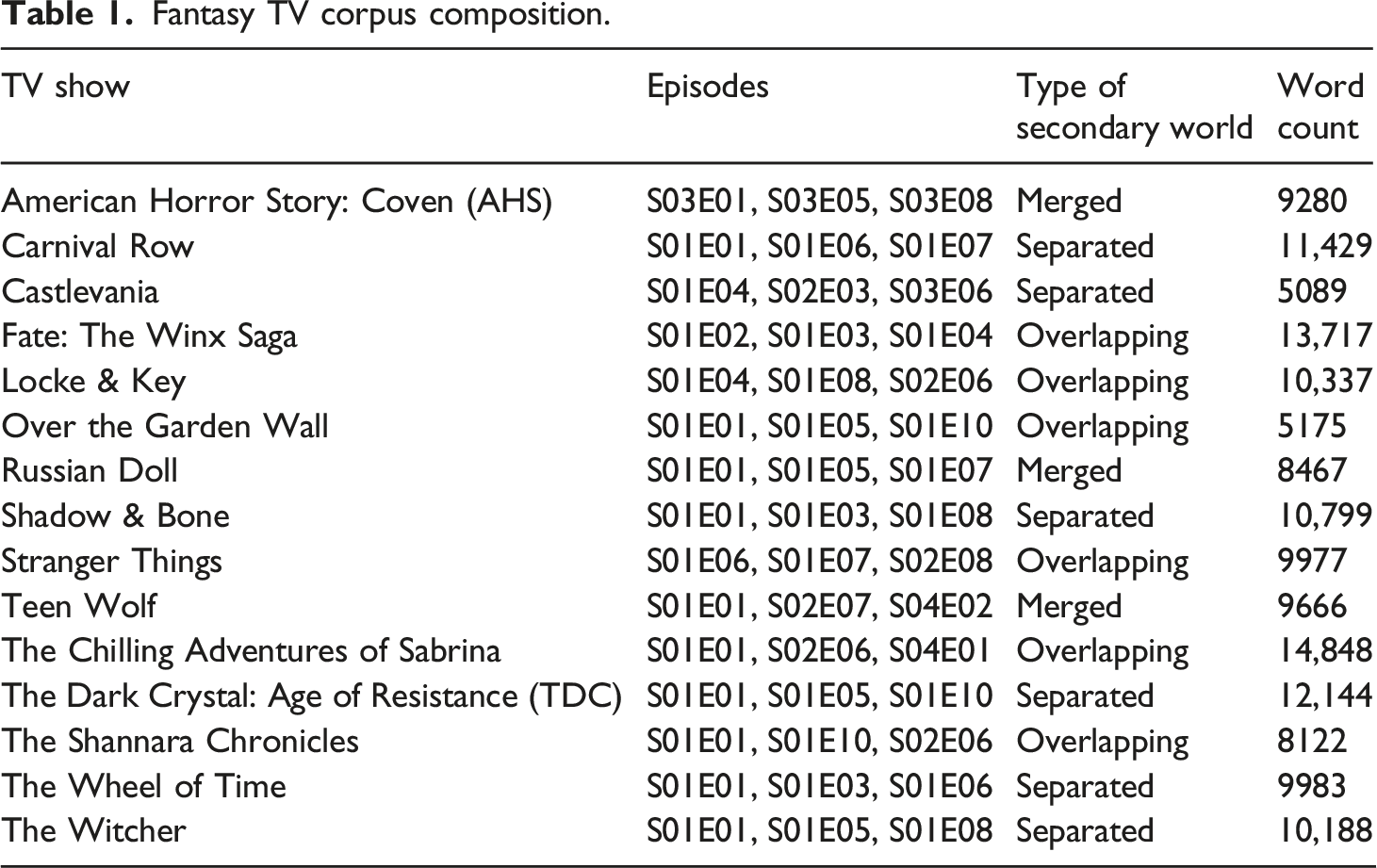
My corpus has been compiled following Bednarek’s (2018) guide to the SydTV Corpus. This guide offers a comprehensive list of conventions and variables to take into account when building corpora to explore TV language. For instance, it makes recommendations related to punctuation, off-voices, noises such as laughter or grunts, and filled pauses or discourse markers. The guide also suggests deleting stage directions and making explicit the character that speaks by keeping their name within angle brackets. One of the limitations of creating TV corpora regardless of the method – as is often the case with spoken corpora – is the inability to make contextual information explicit. This potentially leads to valuable information being ignored because it is not linguistically marked, e.g., flashbacks, flashforwards, or conversations taking place in alternate realities or by means of telepathy, phenomena that occur commonly in science fiction and fantasy. Despite these drawbacks, Bednarek’s guide is the most comprehensive and functional to date so I have adopted it for the creation of the Fantasy TV Corpus.
For the actual transcription of my corpus, I have considered the threefold distinction of methods for designing film and TV series corpora made by Veirano (2018), i.e., scripts, subtitles, and transcriptions but have combined the usefulness of each to compile my own corpus (for detailed discussion of advantages and disadvantages associated with each method, see Veirano’s work). Thus, I downloaded scripts 1 for each episode and made use of the subtitles available at streaming platforms. These served as the template against which to check the actual dialogues while listening to the various episodes. This makes the resulting data more robust and trustworthy than just using one of them and, furthermore, allowed me to amend errors and accurately transcribe what was uttered by characters on screen. This is commonly known as triangulation which, in research, is considered as a strategy to test validity through the convergence of information from different data sources, theories, or methods (Egbert and Baker, 2021).
The reference corpus I use in this study is a sub-sample of circa three million words from Davies’ (2021) TV Corpus. The full version of the TV Corpus (available at English-Corpora.org, which also contains useful information such as release year, country of origin, word frequency, genre, etc.) is made up of subtitles from 75,000 episodes (1950s–2010s), amounting to a total of 325 million words. It must be acknowledged, though, that the TV corpus has some limitations. As Davies (2021) explains, the subtitles which make up the corpus were collected online and thus many of them rely on optical recognition. This may cause problems related to the accuracy of the language, especially with regard to non-standard varieties, accents, and fast-paced dialogue. A second issue that arises from using the TV corpus is the impossibility of separating the downloadable sample in genres because the file does not contain any indication as to where a given TV series begins and ends or the name of the character speaking. Additionally, the labels assigned to the components of the corpus seem to be incomplete or are highly subjective.
Statistical criteria and cut-off values.

4. Results and discussion
The following is the result of comparing the Fantasy TV Corpus against the TV Corpus (Davies, 2021) using Wmatrix. As mentioned earlier, I undertake two sorts of analyses in which I pay attention both to the POS and semantic categories above the cut-off values established for the different statistical measures (see above). In looking at both sets of tags, it is my goal to unveil the linguistic patterns underlying fantasy TV series. It should also be borne in mind that my corpus is larger than others used in previous studies which makes extrapolating results more plausible.
4.1. POS analysis
Over-used POS categories.
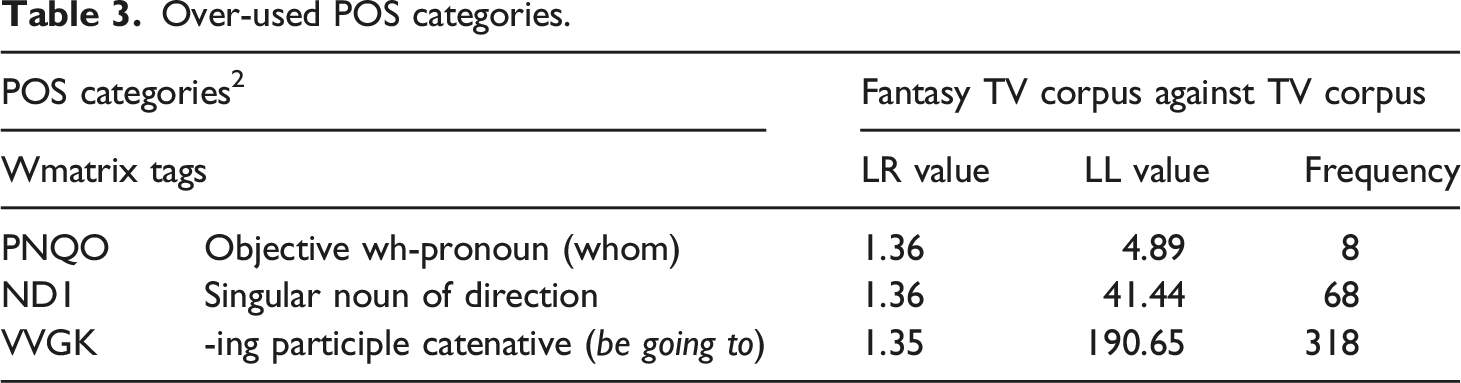
The first category to which I turn is ‘ND1’ (singular noun of direction), which includes types such as north, east, south, etc.). This category is used a little over two times more often in the Fantasy TV Corpus than in the TV Corpus, as well as the PNQO and the VVGK categories, which display almost identical LR values. As suggested by various scholars (Alexander, 2018; Ekman, 2013; Hynes, 2018a, 2018b; Robertson, 2018a), estrangement in terms of space and time is a recurrent motif in fantasy literature. Deictic oddity is at the core of fantasy works, whether in literature or television, since the genre must tell us about a nowhere that suddenly is. Stories usually come alive with a where and a when but in fantasy, there is not a when and a where that we can use as reference because these may have never existed in the first place. Greer (2012: 144) explains it as follows: ‘imagine, if you will, the now and here of nowhere’. Secondary/alternative worlds created anew place special emphasis on the locations and geography of the world itself. Explicitly mentioning locations and directions appears to have a function in the fantasy genre as readers and audiences can have a sense of the distance between different places or follow the developments of the geopolitics of the world. That is, language is used so that the audience can become acquainted with and navigate the geography of the fantasy world in order to understand important events and facts related to the narrative.
(1) … they’ve headed east, towards the White Tower. (The Wheel of Time)
(2) Arathim have been sighted as far south as the Great Sog. (TDC)
(3) … not to be caught. They fled as far south as they could. (AHS)
(4) They’ve tracked it 40 kilometers north of here. (Fate: The Winx Saga)
In the Fantasy TV Corpus, both kinds of resources (cardinal directions and place names) appear combined as in (1) and (2). These examples are taken from secondary worlds detached from what we know; thus, it is important for the language of the series to explicitly mention directions and place names. With this linguistic aid, the audience may begin to establish connections between different locations in the secondary world and why they may be important for the development of the narrative. The White Tower (1), for instance, is one of the most important centers of activity in Tar Valon, a region of the secondary world in The Wheel of Time, since the powerful organization of the Aes Sedai operates from within its walls.
As mentioned above, another goal of explicitly mentioning directions and locations is to be able to have a sense of the distance between different places or to follow the developments of the geopolitics of the world, as in (3) and (4). In (4), the life of an instructor depends on finding the creature who hurt him and has now fled as far as 40 kilometers. The distance is crucial here because the window of time to revert the effects of the wound is limited and the farther the creature goes, the harder it will be to apprehend it. When seen together, the types within the ND1 tag comprise a kind of verbal cartography, e.g., north, east, south, west, east Ravka, west coast, among others. Verbal cartography is an essential component of world-building (Hynes, 2018b), especially in the kind of fantasy that creates worlds from scratch.
The use of the ND1 tag (‘singular noun of direction’) is important for an additional reason. It functions as a linguistic anchor that the audience can use to place themselves in the fantasy world. The types within this category show that cardinal directions and locations are useful to deal with the estrangement produced by the story itself. Such an anchorage can be crucial if one takes into consideration that the secondary world can function very differently from the one we are accustomed to:
(5) But Trollocs invaded from the west… (The Wheel of Time)
(6) … but Nilfgaard’s trying to go north. (The Witcher)
In (5), for instance, the Trollocs could not have arrived from the west had they not used a portal. Thus, spatial information provides audiences with tools to comprehend events, characters, and relations between them within the larger context of the fantastical narrative (Robertson, 2018b), since in addition to following the narrative and the development of events, audiences have also to become acquainted with what a Trolloc is or why it is relevant that the nation of Nilfgaard is trying to move north in (6). Maps have also played an important role in fantasy; in fact, some scholars (Ekman, 2013) consider them ‘synonymous’ with the genre. Maps do a great deal for world-building and the audience’s immersive experience as they help visualize spatial relations, as well as demarcating and concretizing ‘historical, linguistic, economic, and cultural relationships of an imaginary world’ (Hynes, 2018b). In some worlds, engagement with their maps is an essential element of interaction and integral to the narrative itself since by ‘hinting at unexplored areas, maps encourage speculation [and] by codifying the geography, they encourage consistency’ (Wolf, 2012). For instance:
(7) How could a town be marked on a map if it’s on the side of a mountain? (Fate: The Winx Saga)
(8) It’s like I can feel the map in my blood, like it’s part of me. (The Shannara Chronicles)
Under such an assumption, maps can be attributed the power of enticing and delimiting narratives. For instance, example (7) opens the discussion to what could have happened so that a whole town has disappeared from its location in the map, whereas example (8) endows the map with an organic quality so that it can be internally felt through a character’s blood. In short, locative expressions are a significant linguistic resource in fantasy that can help audiences situate themselves and deal with fantasy’s sense of estrangement, bearing on a practical function and, to a certain extent, being responsible for the creation and coherence of the secondary world.
I now turn to the ‘VVGK’ tag (LR = 1.35; LL = 190.65), which contains different forms of the catenative verb be going to. The results of the Fantasy TV Corpus coincide with those reported in Werner (2021), as pertains the use of non-standard variants such as gonna or gotta, which are associated with informality. In particular, Werner (2021) highlights the general increase in the use of these forms in TV across time.
Types within the category ‘VVGK’.

As argued by Adams, science fiction (as is the case with other forms of popular culture such as fantasy) must appeal to the mass market and consequently minimize ‘language-based estrangement’ (2017: 337), since successful estrangement cannot be over-estrangement. To balance out estrangement and fantasy’s apparent formality, screenwriters might resort to a phenomenon in TV dialogue that Heyd (2010) has termed ‘staged orality’. Therefore, the informality of grammar in television is defined as ‘staged’, which entails that some forms are favored over other choices in this medium. That is, screenwriters draw on informal conversation structures such as choosing gonna over going to and other language alternatives to – as Levshina (2017) argues – imbue narratives with a certain degree of realism. The issue here remains that realism can be considered a counterproductive goal for fantasy at first glance. In the case of my corpus, this tension between formality and informality, however, can account for Adams’s (2017) claims with regard to maintaining a crucial balance between estrangement and over-estrangement in fantasy. Thus, an analysis of POS tags can actually account for the way previous scholars have described certain thematic characteristics in the genre in much more accurate ways.
Having said this, a detailed analysis of the concordances reveals additional aspects worth investigating. The more informal, non-standard form of the tag ‘VVGK’, gonna, interestingly features much more prominently (see Figure 2) in those TV series in which the alternative worlds overlap with our own real world (202 vs. 45, out of 247 total instances of gonna). That is, the informality associated with this tag results primarily from the use of colloquial exchanges in the primary world, not in the secondary one. Thus, I argue that whatever realism is derived from the use of non-standard forms in the Fantasy TV Corpus can be attributed to the type of relationship between the primary and secondary worlds. In that sense, realism is brought into fantasy precisely when it is needed, i.e., in alternative worlds that, to a certain extent at least, set part of their development in the ‘real’ world. My proposed taxonomy of fantasy, therefore, allows for a consideration of the relationship between worlds in much more nuanced ways than perhaps was the case before. Frequencies of gonna in different alternative worlds.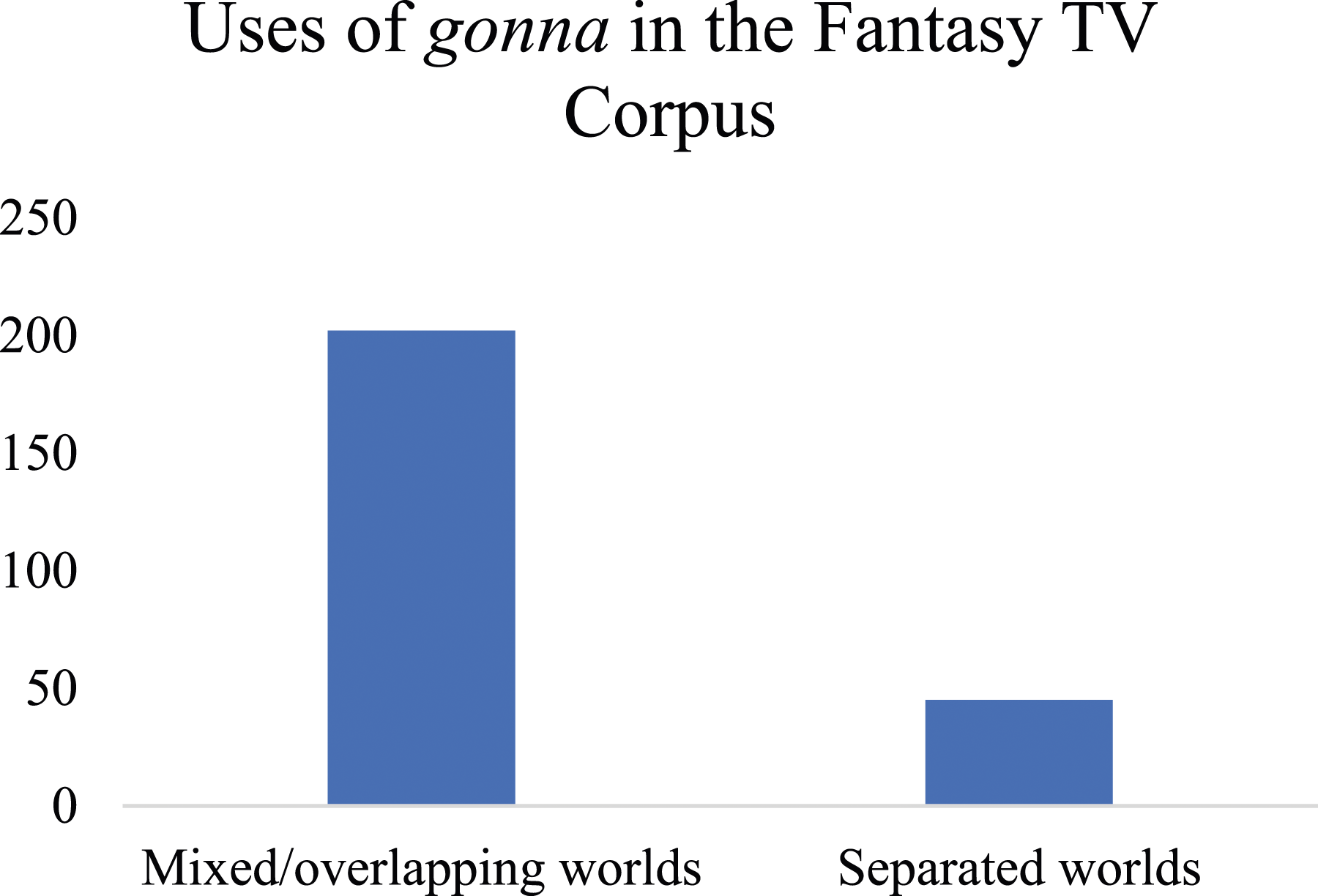
Next, I look at the ‘PNQO’ category (LR = 1.36; LL = 4.89), which is concerned with the object pronoun whom. If informality is a feature associated with non-standard forms, the pronoun whom stands on the opposite end. The fact that both linguistic features associated with producing in- and formality are over-used at statistically significant levels points at a certain tension or competition in the language of fantasy in television. (In)formality, then, becomes a sort of volume wheel that can be amped up or turned down in accordance with the screenwriters’ necessities. In a mass market/popular culture context, formality, for instance, may be more prominent where estrangement and distance between the audience and the world is emphasized, though toning it down making use of different linguistic resources can also be useful when engagement is desired. Again, of the eight occurrences of whom in the Fantasy TV Corpus, all of them take place in secondary worlds detached or overlapping with the real world (Carnival Row, The Chilling Adventures of Sabrina, The Chronicles of Shannara, and The Wheel of Time).
It is important to remember that, despite the fact that the genre of fantasy in particular needs to satisfy quirky linguistic requirements, television series are constrained by the predominantly spoken medium of television, which results in a combination of informal (e.g. gonna) and formal forms (e.g. whom) derived from the influence of the medium and genre, respectively. For instance, Greer (2012: 136) claims that ‘to speak of the unseen – of ghosts, gods, spirits – or evoke another world, we often use a language set apart from the vernacular. It may be simple or formally elaborate’. Mandala (2012) also investigates archaic language use in fantasy and concludes that ‘when the alternative world is a past world, the use of archaic forms can be a significant aspect of style’ (94). However, in the Fantasy TV Corpus, whom is not only used in potential pasts. Instead, half (4 out 8) of the uses of whom in the Fantasy TV Corpus happen in chants and invocations in the series The Chilling Adventures of Sabrina, which given their ritualistic nature demand a more elaborate and elevated language register. As such, whom seems to be the predetermined choice: (9) Dark Mother, to whom we owe so much, hear our plea… (The Chilling Adventures of Sabrina).
(10) O, Might Dark Lord, by whom all things are set afire… (The Chilling Adventures of Sabrina).
In order to contribute to the audience’s willing suspension of disbelief, (9) and (10) make use of formulaic expressions in which whom can be seen as the most conventionally formal linguistic form, thus drawing on real-world experiences to assert ‘believability’. Therefore, my distinction of fantasy types according to how the two worlds interact seems to align with the use of (in)formal language. That is, the closer to our world, the more likely to include colloquialisms in TV dialogue. This tension between (in)formality and believability in fantasy exerts additional pressure on language, which is molded to accommodate these clashing factors.
4.2. Semantic analysis
Over-used semantic categories.
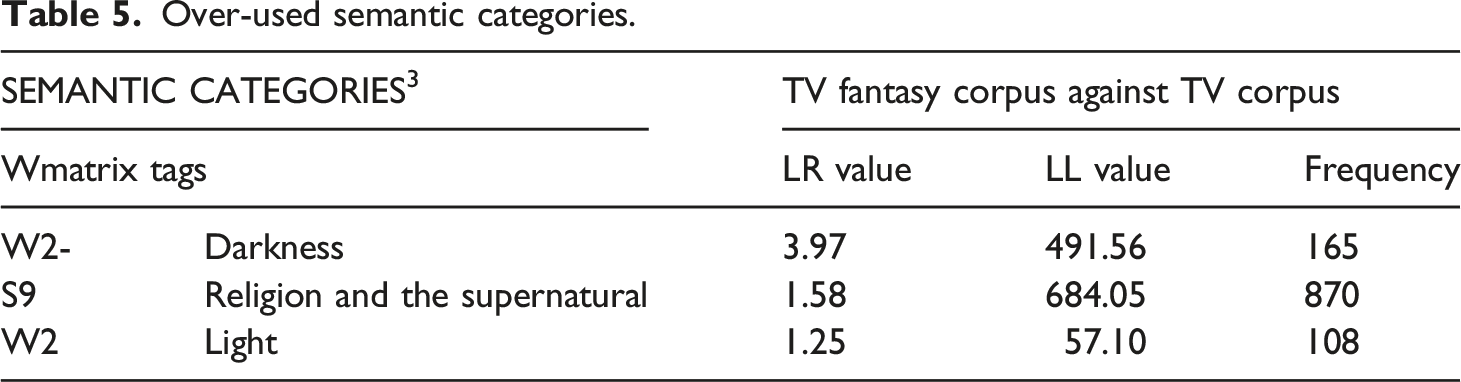
The first category I examine is W2- ‘Darkness’. This category displays the highest LR value (3.97), which means the types in this tag are used nearly 16 times more in the Fantasy TV Corpus than in the TV Corpus. The types in the W2- ‘Darkness’, (darkness and dark) – and those in W2 ‘Light’, see below – may be said to encode one of the broadest patterns in fantasy, that of the villain/threat on the one hand and the hero/savior on the other. According to Alexander (2018), the power of a genre lies in its recurrent structures, so it is not surprising to find that both categories are over-used in the Fantasy TV Corpus: (11) … protect us from the imperial darkness that threatens our soul. (The Witcher)
(12) … no more light ever again, only perpetual darkness. (The Chilling Adventures of Sabrina)
(13) The Dark One is waking. His whispers are already in the backs of our mind! (The Wheel of Time)
Fantasy worlds, to some extent at least, depend on a threat, villain or antagonist force of some kind, which is somehow portrayed by darkness. In example (11), for instance, darkness is explicitly linked with a threat, let alone the fact that it is premodified by imperial. This allows the audience to actually pinpoint the referent as the kingdom of Nilfgaard in The Witcher, which has launched a conquering campaign over the neighboring lands. Moreover, example (12) refers to ‘perpetual darkness’, which elevates the character of the threat it poses to humankind. In doing so, the obstacle to overcome is amplified by linguistic means, given that the so-called ‘perpetual darkness’ is never featured on screen.
Often, when the reader or audience is first dropped amidst the secondary world, there is a community, land or country that was free or happy in the past and now endures or is about to endure some sort of oppression at the hands of an evil force of some kind (Wolf, 2018), as in example (13) from The Wheel of time. In this particular fantasy TV series, The Dark One was defeated long ago but returns in a never-ending cycle of death and reincarnation to submit and establish its reign of terror. Therefore, the Fantasy TV Corpus draws on the long-standing western tradition of darkness being synonymous with evil or danger. In addition to ‘imperial’, darkness is also pre-modified by ‘terrible’, ‘crushing’, and ‘suffocating’ or described as a ‘blanket’ that comes to harm people in some way (Figure 3), which is intended to magnify the scale of the threat. Concordance for ‘darkness’ in the fantasy TV corpus.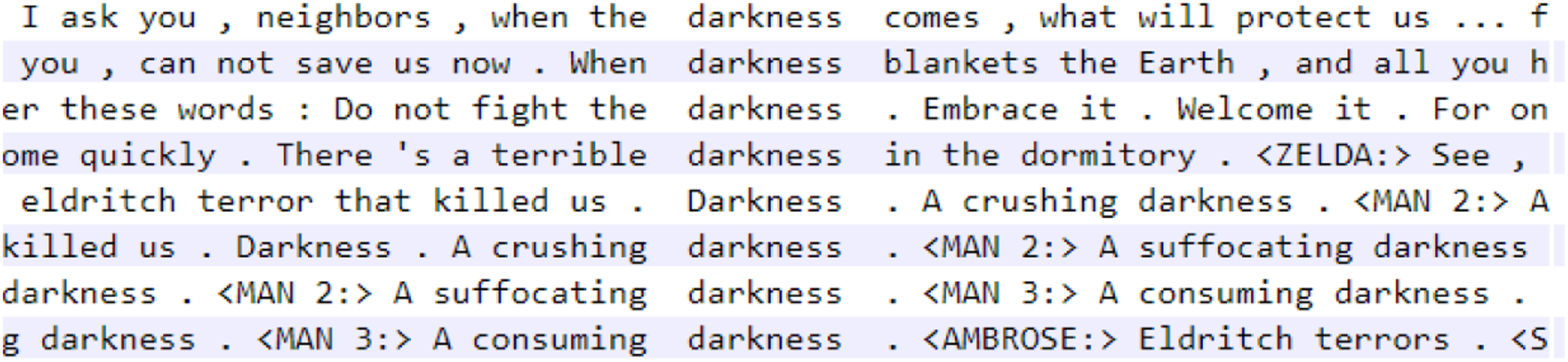
The full potential of the ‘Darkness’ category is realized when its counterpart, the W2 category ‘Light’ (LR = 1.25; LL = 57.10), is discussed, which brings to the fore a darkness-light dichotomy. Types within this category include, though not exhaustively, types such as: light, shine, lights, rainbow, daylight, shone, rainbows, illuminate, etc. (ranked from most to least frequent). This motif and the two antagonist forces may be considered to constitute one of the basic pillars of fantasy (see also Montoro (2023) on the same dichotomy in modern vampire fiction). In the same way as darkness encodes a threat or a pending doom, light is often considered to be a source of goodness.
(14) Thank the Light. (The Wheel of Time)
(15) Light, give me strength. (The Wheel of Time)
(16) Depart now in the Light. (The Wheel of Time)
(17) When darkness triumphs, light shall die. (The Shannara Chronicles)
(18) … this pool of absolute Darkness that’s gonna consume the entire world if we don’t stop it with a light bright enough to banish it. (The Chilling Adventures of Sabrina)
Thus, light fulfills various functions in the Fantasy TV Corpus. Sometimes it is thanked (14), some other times it becomes a beacon of protection and a source of strength and bravery against the dark evil force (15 and 16). More often, light and darkness are two opposing forces stuck in an eternal struggle, as in examples (17) and (18) where it is impossible that they can co-exist. This pattern appears to be pervasive in fantasy, regardless of the actual realization of the hero and the villain.
Finally, I pay attention to the category S9 ‘Religion and the supernatural’ (LR = 1.58; LL = 684.05). This category contains 146 different types (witch, druid, vampire, magic, among others). Despite the expected overuse of types within this category, the weight they hold in the Fantasy TV Corpus can be explained by their relation to characters’ identities and what is often termed the ‘aboutness’ of the text (Philips, 1989). The key words included in what can be considered the ‘aboutness’ of the text are, precisely, indicative of the content and, according to McIntyre (2013: 1184) ‘can in many cases be disregarded’. Given the content of the TV series included in the Fantasy TV Corpus, it should be expected that the supernatural features as a highly relevant category; however, close analysis of the Fantasy TV Corpus uncovers interesting thematic patterns that might otherwise go unnoticed. In keyness analysis, ‘the individual meanings of texts are taken out of focus, to be replaced by the character of the whole’ (Kilgarriff, 1997: 232). In this sense, the ‘aboutness’ of the text points directly at the characters which feature in the series as well as their supernatural identities. This becomes even more relevant if we take into account that the most frequent types of this category in the reference corpus are used in colloquial/formulaic expressions: Not a chance in hell; You look like hell; God, I miss you; god, it smells; etc. In the Fantasy TV Corpus, on the other hand, the type god, for instance, is used to make direct allusions to specific deities: (19) … some dark god wakes. (Carnival Row)
(20) God is in all His churches… (Castlevania)
(21) … to look for your sleeping god. (Castlevania)
What I mean with this is that the difference between categories is picked up on by Wmatrix but manual analysis shows how there is a substantial qualitative difference in the way god is used in both corpora. The type of uses, referents, and themes they point to are very different.
In fantasy, the dual identity of characters tends to remain hidden since ‘the relation of the individual subject to the world, to others, to objects, ceases to be safe’ (Jackson, 1981: 29). The link between pop culture, fantasy TV series and the matter of identities has been extensively explored in academia, as evidenced by studies such as Johnson (2016) and Whittaker (2020). The issue of the self- and relational identities was also used by Todorov (1973) to divide the contents of the fantastic into those dealing with the I and those dealing with the not-I. Whereas the former focuses on the subject’s identity, the latter mainly concerns the relation of the self with the rest of the world. In exploring the concordances within the S9 ‘Religion and the supernatural’ category, it can be seen how the most common pattern that relates a supernatural identity to danger, whether to one’s self or to others, is recurrent in the Fantasy TV Corpus. In examples (22), (23), and (24) witches are hung or burned and vampires are hunted down merely due to what they are. It is their otherness and self’s identity that makes them dangerous. Example (25) illustrates how one’s identity is not only dangerous for the world but for one’s own self because of the consequences of tapping into certain abilities.
(22) … thirteen witches were hung in the forest. (The Chilling Adventures of Sabrina)
(23) When witches don’t fight, we burn. (AHS)
(24) Very good. A vampire hunter and a magician. (Castlevania)
(25) … it is an ancient rite. Blood magic, very dangerous. (The Shannara Chronicles)
In this respect, therefore, fantasy seems to lend itself well to exploring the issue of identity by problematizing it. In line with this issue, fantasy has also been considered a subversive genre or a genre that challenges society’s unrevised assumptions and the establishment 4 (Adams, 2017; Esberk, 2014; Jackson, 1981, among others). The metaphorical association between light and goodness and darkness and evil seems to be further exploited here in relation to the issue of identity. The progressive conceptualization of the other as ‘demonic’ inevitably leads to the polarization of good and evil which I have discussed above and, indeed, adds to that debate. Specifically, the same type of duality is reflected in the dichotomic characterization of ‘good identities’ and ‘evil identities’ and the overuse of other types in the category S9 ‘Religion and the supernatural’. As Montoro (2023) discusses, the links between these specific categories might have implications for social discrimination, whether on the basis of race or other social aspects. In the Fantasy TV Corpus, the otherness of certain characters entails that they are considered a danger to their world, regardless of their intentions or interests. These results from the comparison against general TV appear to suggest that fantasy might offer a better canvas for the exploration of diversity and acceptance among other social issues and practices which, clearly, needs further exploration.
5. Conclusions
In this study, I have employed corpus stylistic techniques to analyze some of the idiosyncratic attributes of the fantasy genre in the medium of television, thereby contributing to the broader discourse on its style. As stated in previous sections, existing scholarship on fantasy and science fiction in TV predominantly centers around analysis of isolated TV series rather than looking at these series being the by-products of a specific genre. Consequently, in this study I have attempted to address this gap by looking at a larger number of TV series. This approach affords reliability regarding the potential for extrapolating results and making generalizable claims about the style of fantasy in the televisual medium. Furthermore, I have focused on a more recent dataset and the application of diverse methods of data collection. This concerted effort ensures that my corpus is not only more representative of the linguistic characteristics or modern fantasy TV series, but also enhances the overall representativeness and relevance of the findings.
At first glance, the language of fantasy TV may not immediately appear markedly distinct from general TV language, given the results brought about by the comparison with the TV Corpus. Upon applying the established cut-off values, my analysis shows that the genre of fantasy in TV appears to display few differences with general TV dialogue which, considering the nature of the medium, is not entirely unexpected. It is plausible that a different corpus linguistics method or approach may yield further insights into this matter, particularly at levels other than POS/semantic tags. What my analysis has brought to the fore is the fact that the medium of television seems to influence the language employed to a larger extent than the genre of fantasy itself. This is evidenced by some of the features derived from the POS and semantic analyses. For instance, the tension between (in)formality emerges as a characteristic influenced by the register of television, aligning in part with some of Mandala’s observations (2012), who demonstrated how fantasy may rely on archaisms and other markers of formality to imbue such worlds with a sense of linguistic realism. Additional characteristics of the language of fantasy in television include a strong emphasis on deictic formulae and a multitude of resources to manifest the dichotomy between good and evil. The Fantasy TV Corpus corroborates previous claims with respect to the issue of identity, underscoring fantasy as a fertile terrain for the exploration of identities divergent from conventional norms. Besides linguistic inquiry, I have proposed a taxonomy of fantasy worlds contingent on the relation between the primary (or real) world and secondary (or fantasy) world. This distinction can further inform the study of the genre. The analysis of the category ‘VVGK’ (be going to) has also brought to the fore the manner in which the primary and secondary worlds interact in fantasy and has facilitated the observation of nuances of linguistic choice. In a sense, it is as if fantasy imports the linguistic features of one world to another when they overlap totally or partially. Conversely, this manner of import occurs less frequently in narratives featuring separated worlds, where the introduction of invented languages becomes a more prevalent phenomenon.
Future avenues for research include multimodal analyses to complement the struggle between light and darkness highlighted here. Notably, future scrutiny of the findings pertaining to the ‘VVGK’ (be going to) category is necessary, considering the distinct nature of the TV Corpus (Davies, 2021) compared to the Fantasy TV Corpus. In short, the former comprises subtitles, which may not conventionally favor the gonna variant over going to even when the former is targeted. The Fantasy TV Corpus also affords an opportunity to investigate fantasy as a standalone genre, independent from science fiction – since, historically, these genres have been considered akin and often studies in tandem. Such an analysis could expand on telecinematic language with a specific emphasis on cinema, not addressed here. Finally, the collection of a corpus of fantasy literature and subsequent comparison with the findings of this study could shed light on whether differences are more rooted in the chosen medium or the inherent characteristics of the fantasy genre itself.
Footnotes
Declaration of conflicting interests
The author(s) declared no potential conflicts of interest with respect to the research, authorship, and/or publication of this article.
Funding
The author(s) disclosed receipt of the following financial support for the research, authorship, and/or publication of this article: This work was supported by the Vicerrectorado de Investigación y Transferencia, Universidad de Granada (Contractos Predoctorales FPU and Universidad de Granada-Banco Santander).

Notes
Appendix
POS and semantic categories above the cut-off values selected for the statistical criteria.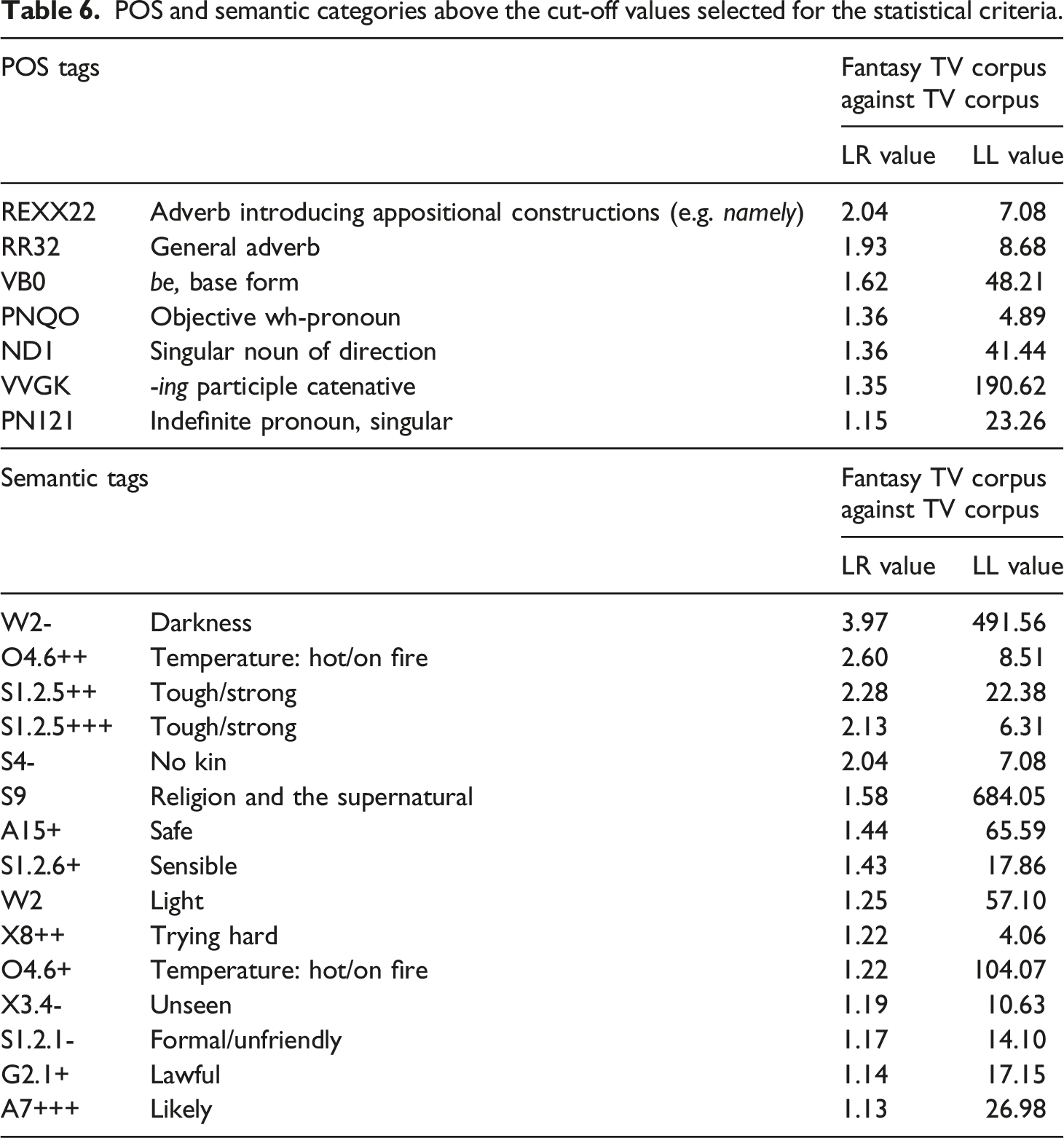
POS tags
Fantasy TV corpus against TV corpus
LR value
LL value
REXX22
Adverb introducing appositional constructions (e.g. namely)
2.04
7.08
RR32
General adverb
1.93
8.68
VB0
be, base form
1.62
48.21
PNQO
Objective wh-pronoun
1.36
4.89
ND1
Singular noun of direction
1.36
41.44
VVGK
-ing participle catenative
1.35
190.62
PN121
Indefinite pronoun, singular
1.15
23.26
Semantic tags
Fantasy TV corpus against TV corpus
LR value
LL value
W2-
Darkness
3.97
491.56
O4.6++
Temperature: hot/on fire
2.60
8.51
S1.2.5++
Tough/strong
2.28
22.38
S1.2.5+++
Tough/strong
2.13
6.31
S4-
No kin
2.04
7.08
S9
Religion and the supernatural
1.58
684.05
A15+
Safe
1.44
65.59
S1.2.6+
Sensible
1.43
17.86
W2
Light
1.25
57.10
X8++
Trying hard
1.22
4.06
O4.6+
Temperature: hot/on fire
1.22
104.07
X3.4-
Unseen
1.19
10.63
S1.2.1-
Formal/unfriendly
1.17
14.10
G2.1+
Lawful
1.14
17.15
A7+++
Likely
1.13
26.98