



Abstract
The development of uses of reader (third-person and vocative) are investigated in the Corpus of Late Modern English Text (1710-1920) with regard to frequencies and functions. Overall, reader declines, indicating a shift away from nominal and more formal style. Third-person uses are more common than vocatives, which cluster especially in the early nineteenth century and in emotive, personalized texts. A functional analysis is carried out on treatises and narrative fiction. Readers are positioned and (dis)aligned with the writer through the use of possessive pronouns, quantifiers and adjectives in contrast to bare unmodified uses. Reader occurrences may be explained as metadiscourse (Hyland, 2005) or intersubjective uses. They involve the reader in responsive thought or action with the text and steer them towards interpretations. They are also integrated into emotive and attitudinal contexts, in which overt attention is given to the face needs of the reader.
Keywords
1. Introduction
A famous quotation from the novel Jane Eyre (ch. 38) may be used to introduce the topic: (1) Reader, I married him.
Crucially, this is a line addressed by the narrator (Jane) to the reader of the novel, thus breaking through the barrier from the inside to the outside of the story world, from the intradiegetic into the extradiegetic realm. Similar uses are found in non-fictional texts, such as (2) I intreat my Reader to think
Here the author, in this case the philosopher Berkeley (1735), refers to his readers. In both cases an apparently closed text world or a monologic text is opened to the recipient side in a quasi-interactional move. It is of interest why this is done at all and why it is done in different ways. Variation may be connected to the occurrence in very different genres, in one case a novel and in the other a treatise. Also, the two quotations are from 1847 to 1735, respectively, and they evoke an impression of old-fashioned style, raising the question of stylistic change over time.
The aim of this corpus-based study is to investigate the occurrences of the explicit inclusion of the reader in the text, as realised by the lexeme reader, in the period 1710 to 1920 (based on the Corpus of Late Modern English Texts, cf. §4). The temporal focus is thus the Late Modern English period, linguistically speaking, and the periods of Enlightenment, Romanticism, Realism and Naturalism in cultural and literary terms. The research questions to be answered are the following: • How does the frequency of such uses of reader change over time? • What is the distribution of reader, and specifically of reader address (as in (1)) as the most striking use, across time and genres? • What are the functions of reader occurrences in novels and treatises? • How is the actual reader positioned by such contexts, e.g. through modifiers?
The linguistic, and partly literary, concepts related to reader uses will be outlined in Section 2, while Section 3 deals with the diachrony of texts, genres and styles as a necessary embedding of such uses. After the data and methodology for this study have been introduced (Section 4), Section 5 will present and discuss the results.
2. Including the reader in the text
Looking for the word reader in texts, one finds occurrences like the following: (3) She was (4) It would be easy to add a greater number of examples of this fallacy, as well as of the others which I have attempted to characterize. But a more copious exemplification does not seem to be necessary; and (5) I waited now his return; eager to disburthen my mind, and to seek of him the solution of the enigma that perplexed me. Stay till he comes,
(3) will not be a major focus here, because reader does not refer to a recipient of Richardson’s text, but describes a person or character in the storyworld who is discussed by the narrator; we here have a fictive figure, that is a fictional reader (Stewart, 1996; cf. Birke, 2016 for such a reader). Examples (4) and (5), in contrast, are of key interest, since they use the word reader interpersonally, referring to any reader of the text. While (5) achieves this effect by a second-person vocative use, (4) is overtly similar to the third-person use in (3), but nevertheless is understood to refer beyond the text to the persons involved in the reading process. The choice of the very word reader highlights the practice of reading as opposed to listening, and thus also the important historical transition to a silent, individual reading culture (Stewart, 1996: 14). 2 The use of the word in the singular further emphasises the habit of solitary reading (cf. Ong, 1975: 17).
From a literary perspective, the addressed or otherwise included reader in nineteenth-century fiction has been the subject of a monograph by Stewart (1996). According to Stewart, it is the figured reader or narratee who functions as the target or addressee of reader uses. Invoking the reader marks the ‘site of an implicated response’, which together with the ‘reciprocal contingency’ of narrator and audience introduces subjectivity into the narrative (Stewart, 1996: 23, 27). The reader may be invoked as a member of an interpretive audience, which is prevalent in the eighteenth century. Nineteenth-century novels weave the reader more intricately into the text, ‘by narrating with and through you, to write you more directly (…) into the plot’ (Stewart, 1996: 398).
The treatment here will proceed from a linguistic perspective and take the interconnected concepts of metadiscourse, involvement, intersubjectivity, and positioning as points of departure. Hyland’s (2005) metadiscourse model is concerned with the linguistic means of indicating writers’ awareness of their audiences’ needs, capabilities and expectations and of conducting an interaction by explicitly mediating between message and audience. While the goal of the so-called interactive type of metadiscourse is for readers to ‘recover the writer’s preferred interpretations’, the interactional type aims to ‘involve readers by allowing them to respond to the unfolding text’ (2005: 49–50), in other words, to overtly align readers with narrators/characters, and to engage in an imagined dialogue. This is realised by means of linguistic forms that help to build a relationship between writer and reader, such as engagement markers like imperatives for suggestions (e.g. consider) or reader reference (e.g. you/the reader can see that). As we will see, uses of reader also occur in metadiscourse contexts that are commonly realised by other means, such as cross-references (by endophoric markers, e.g. in phrases like in section 4), or intertextual references (evidentials, e.g. according to X). Involvement, already mentioned under metadiscourse, is more generally a typical, even constitutive characteristic of everyday casual spoken interaction and is an effect of the psychological needs of interlocutors, of the experiential embedding of conversation and the phatic component inherent in it (cf. Besnier, 1994: 280). Features which are frequent in involved discourse are, among others, first and second person references, references to speaker’s mental processes, discourse/pragmatic markers, emphatic particles, vagueness and hedges, and direct quotes (Chafe, 1982: 46–48; cf. also Biber and Finegan (1989, 1992) in Section 3). Reader, regardless of its formal use, clearly invokes the second person in written communication (note also the co-occurrence with you in (5)), while contextual association with intelligent, his own experience in (4) and share the confidence in (5) show further involvement aspects. Nevertheless, reader as opposed to you (especially if you is absent from the text) stands out as a less involved choice.
The concept of intersubjectivity focuses on language uses indicating ‘attention to the social self of the hearer’, here the reader (Ghesquière et al., 2014). Intersubjective uses can be classified into three groups, namely attitudinal (attention to the reader’s face needs, e.g. intelligent in (4)), responsive (eliciting an action from the reader, e.g. Berkeley’s adhortation to think in (2)), and textual (steering the reader’s interpretation of the text, e.g. highlighting the significance of I married him (not he me) in (1)). In particular the last two groups show clear overlap with metadiscourse categories.
Finally, (other-)positioning (Harré and Langenhove, 1991) ascribes characteristics, attitudes and alignments to persons referred to by the choice of specific pronouns, vocatives, or descriptive nouns. The choice of reader itself is already a form of positioning, as the person addressed is restricted to their reading activity per se or their habit of reading either novels or treatises. It is mainly this aspect of the interlocutor that is singled out as important by the writer, although others may accompany it (e.g. intelligent). The pronoun you, in contrast, would be less restrictive, always meaning the whole person and thus not necessarily conveying positioning on its own.
Further differences between the reader formula and uses of you consist in the more casual, involved character of you, its medial independence (not fixed to speech or writing), but also the ambiguity of you. Sorlin (2022: 12–20, based on Kluge, 2016) distinguishes six different kinds of ‘You’ between the poles ‘self’ versus ‘other’ and ‘personal’ versus ‘general’. You1, You2 and You3, respectively referring to ‘I’, ‘I as representative of a larger entity’ and ‘anyone’, are not relevant for addressing the reader and neither is her You6 for ‘cases where the narrator is speaking on behalf of the protagonist’ (Sorlin, 2022: 17). You4 meaning ‘you in front of me as representative of a larger entity’ refers to the (implied) reader and You5 ‘the person in front of me’ to either a narratee or to a character taking part in reported dialogues. You4 may be taken to correspond to reader in that it does not address a specific, unique addressee but a plural set of referents, in fact the authorial reader. In You4 and in reader uses, the real flesh-and-blood reader is of course free to either accept or reject the positioning inherent in them. Equally, the real reader may self-ascribe an addressee position – one that is perhaps not fully developed in the text. As all uses of you exert a strong interactive pull (on account of the not fully suppressible meaning ‘the one addressed’), they invite such self-ascriptions even in the case of, e.g. You1 and You2. The form reader is thus less ambiguous than you; it is also attached to the medium of writing, and more formal in nature.
3. Texts through time
Texts are shaped by both authors and audiences and they change according to their respective purposes, needs, and aesthetic preferences. It is to a large extent these textual uses that drive and/or spread language change, so that the diachrony of texts and that of language need to be looked at together. In other words, the linguistic history of a language is to a large extent its textual or discourse history (Diller, 2001: 3); this may constitute a link to literary history, with the linguistic interest extending to all kinds of texts. The feature in focus here is not a systemic linguistic feature but a stylistic one. Thus, the focus lies on larger stylistic changes, which reader may be part of and which are mainly visible in terms of frequency shifts. Stylistic features are not inherently necessary to a genre (unlike, e.g. address terms in letters); they are optional and based on the author’s choice. Nevertheless, stylistic features may align with certain genres more than with others. Linguistic approaches to stable or variable styles in discourse comprise, for instance Biber’s multi-dimensional approach (Biber and Finegan, 1989, 1992), discourse universes (Schlieben-Lange, 1983), and discourse traditions (Koch, 1997).
In Biber’s model, the dimension ‘involved versus informational production’ is of interest, which contrasts a more interpersonal and oral style (with, e.g. first and second-person pronouns, present tense use, emphatics, amplifiers, hedges, wh-questions) with a more informational and literate one (e.g. use of many nouns, attributive adjectives, prepositions). A historical analysis of texts from various genres in the seventeenth century along this dimension shows all of them to be fairly informational (or literate) and to become even more so across the next 200 years, with a special peak in the eighteenth century. Interestingly, reader straddles the two poles of the dimension by being involved/interpersonal in function and at the same time informational in form (a noun instead of the pronoun you). In contrast, later on, in particular in the twentieth and twenty-first centuries, texts are marked by increasing oralization or colloquialization. We might therefore expect to see more frequent uses of reader in the eighteenth than in the nineteenth century in the corpus, following the cline from a more literate, here nominal, to a more colloquial use. One might moreover assume to see more interpersonal uses of you in later periods, but following this up is beyond the scope of the present investigation.
While the multi-dimensional approach applies across all textual production, discourse-universe and discourse-tradition models focus on specific registers or genres – in this study mainly the genres novel and treatises. Texts belonging to a discourse universe or tradition form a more or less loosely unified group adhering to the same principles or norms regarding what is possible and desirable in a text, standards or rules for common structural and linguistic realisations, and a shared purpose (Koch, 1997: 45, 49; Schlieben-Lange, 1983: 140, 148). Crucially, discourse traditions allow change by means of constant recombination of conventional and innovative features (Koch, 1997: 60–61). The degree of (simulated) interactivity may be part of the norms of a discourse type, with novels as more involved texts probably allowing for a higher degree than the more factual treatises. Of course, both the amount and the formal realisations (reader, you, etc.) of interactivity may be subject to change. In many cases it can be expected that individual discourse traditions are at least partly in line with overall period-typical stylistic preferences or development, unless the genre is highly specialised in its purposes and needs.
4. Data and methodology
Composition of the corpus: CLMET 3.0.
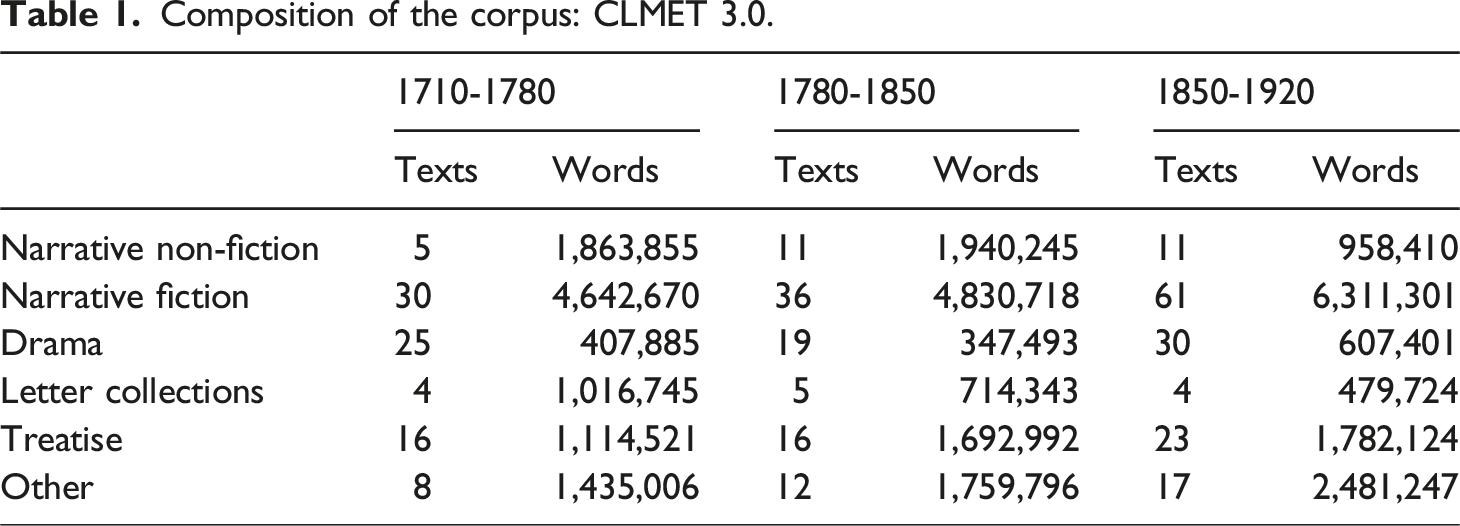
In a first step, the complete corpus is used for a general overview, while the more detailed investigation (Sections 5.2 and 5.3) focuses on the two genres of Narrative Fiction (henceforth shortened to Fiction) and Treatise. 4 These are maximally distinct genres in terms of purpose and text-typological realisations and thus presumably also differ with regard to reader uses. Fiction is mainly narrative, but it may also contain descriptive passages, typically includes (some) dialogue, and has a narrator but also characters speaking. Treatises are typically expository, but also descriptive and argumentative 5 in so far as they outline problems and argue for possible solutions. They are produced by a person who combines the roles of author (composing the words), animator (doing the speaking or writing), and principal (responsible for the content and opinions) (cf. Goffman, 1981: 144–145).
The item reader was used as a search term for concordancing with the help of WordSmith 7.0. Only the singular is focused on, as it is the stronger interpersonal signal, more easily allowing identification for the actual individual reader. The concordancing results reveal the distribution across time, genres and individual texts, as well as typical collocations (e.g. adjectives) of reader. A manual analysis distinguishes between the three different uses of reader illustrated above (examples 3-5) namely between purely descriptive uses (see (3)), second-person address (vocative) (see (5)), and third-person address/reference (see (4)). Of these only the two latter ones are considered in the functional analysis. The functional analysis is conducted on the basis of the surrounding co-text of the reader use and also, if necessary, considers the overall nature of the work.
5. Results and discussion
5.1. Diachronic and generic trends
The search for reader in CLMET yielded 3039 occurrences (88.3 per one million words, henceforth pmw), which makes it two and a half times as frequent as plural readers (1220 hits). Focusing on the diachronic development first, we see in Figure 1 that there is a clear and steady decline of such uses across the two hundred years from 120, via 99, to 52.5 occurrences pmw. The diachronic development of reader (pmw).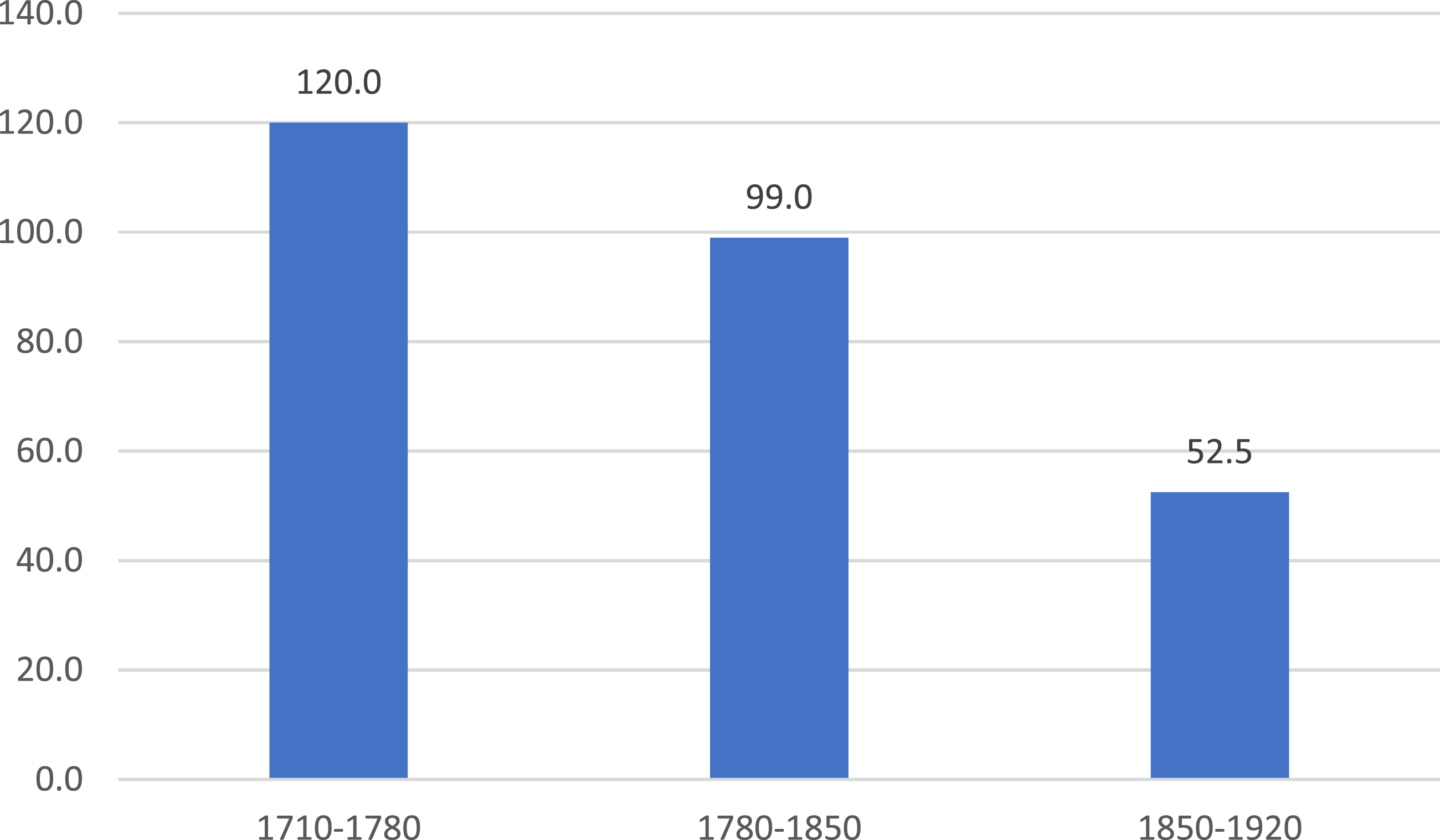
The high figures in the eighteenth century may be accounted for by the fact that the period is characterised by more pronounced literateness (a nominal style) and that a more noticeable transition to silent reading could be argued to induce more explicit reminders of the individualised reading process. The loss of more than 50 percent from the first to the third period may be taken as a style shift, during which reader uses become less fashionable.
Factoring genre into the diachronic development, we get a more diverse picture, as seen in Figure 2. While Drama and Fiction mirror the trend seen in Figure 1, Letters show the opposite development.
6
The other three genres display wavering behaviour. Narrative Non-fiction is actually less untypical than it seems to be the case at first sight. The great peak in the middle period is due to one single outlier text, De Quincey’s Confessions of an English Opium Eater. This has a very high usage of reader, which also shows how sometimes individual authors write against the stylistic trend and may obscure the overall development. Without this text, the first and second corpus periods are almost identical regarding frequency, followed by a slight fall in the third. The main trend-bucking interest in Figure 2 is thus Treatises, where reader first drops and later rises again.
7
Reader in genres over time (pmw).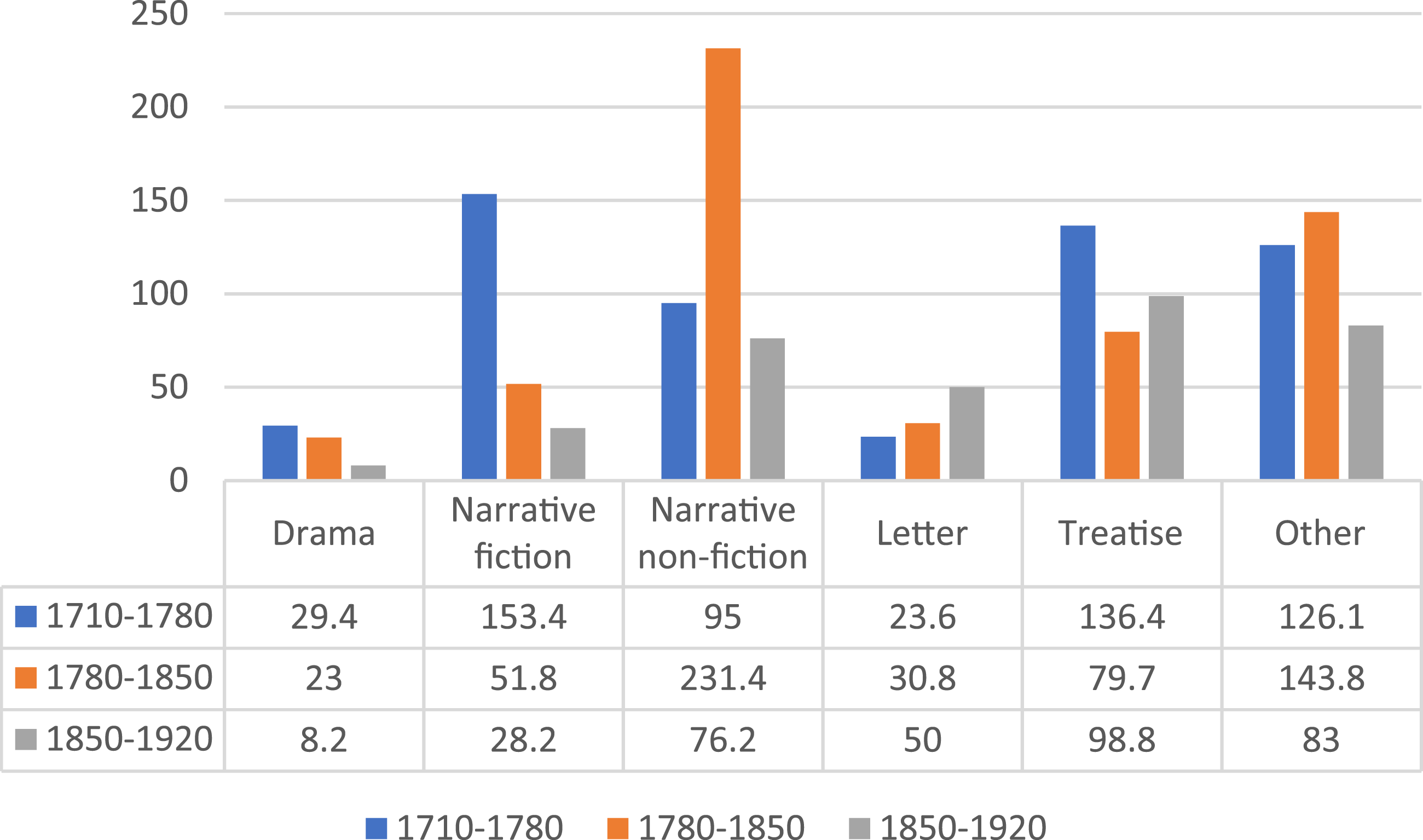
It is also of interest how pervasive the use of reader is within a genre, that is how many of its texts contain it (that is textual dispersion of the feature). Interestingly, the two groups which by their labels seem least unified (Narrative Non-fiction and Other) show the greatest dispersion with 81% of texts in the respective genres containing reader (not shown in Figure 2). Treatises follow very closely (78%), with Fiction (70%) and Letters (69%) not far behind. In all of these texts, concern with, and interest for, readers can thus be attested for a majority of their producers. With a mere 22% of texts showing hits, Drama clearly disfavours such use. Here reader is indeed most common in paratexts, apart from a few descriptive uses (as in example (3) above) within the plays. The drop in numbers may have to do with a declining use of paratexts.
Vocatives, as opposed to other uses, overall show no constant, but rather a rise-fall development, as shown in Figure 3. Vocative use is rare, wavering around the 10% mark with 7, 13.6 and 6% of all uses in the respective periods. However, the second-period rise shrinks to 10.8%, if one takes Jane Eyre out of the equation. This novel has an extremely high incidence (205 pmw) with as many as 31 vocatives among its total 39 occurrences of reader. While Jane Eyre is something of an outlier, vocatives are certainly more typical of the second period and of Fiction (13% of all uses) than of Treatises (only 1.5%). In both genres, most reader addresses take the third-person reference realisation with 78% in Fiction and 86% in Treatises. This leaves only 9 (Fiction) and 12% (Treatises) for the descriptive use of fictional reader, which are thus not very important.
8
Vocative versus third-person uses of reader.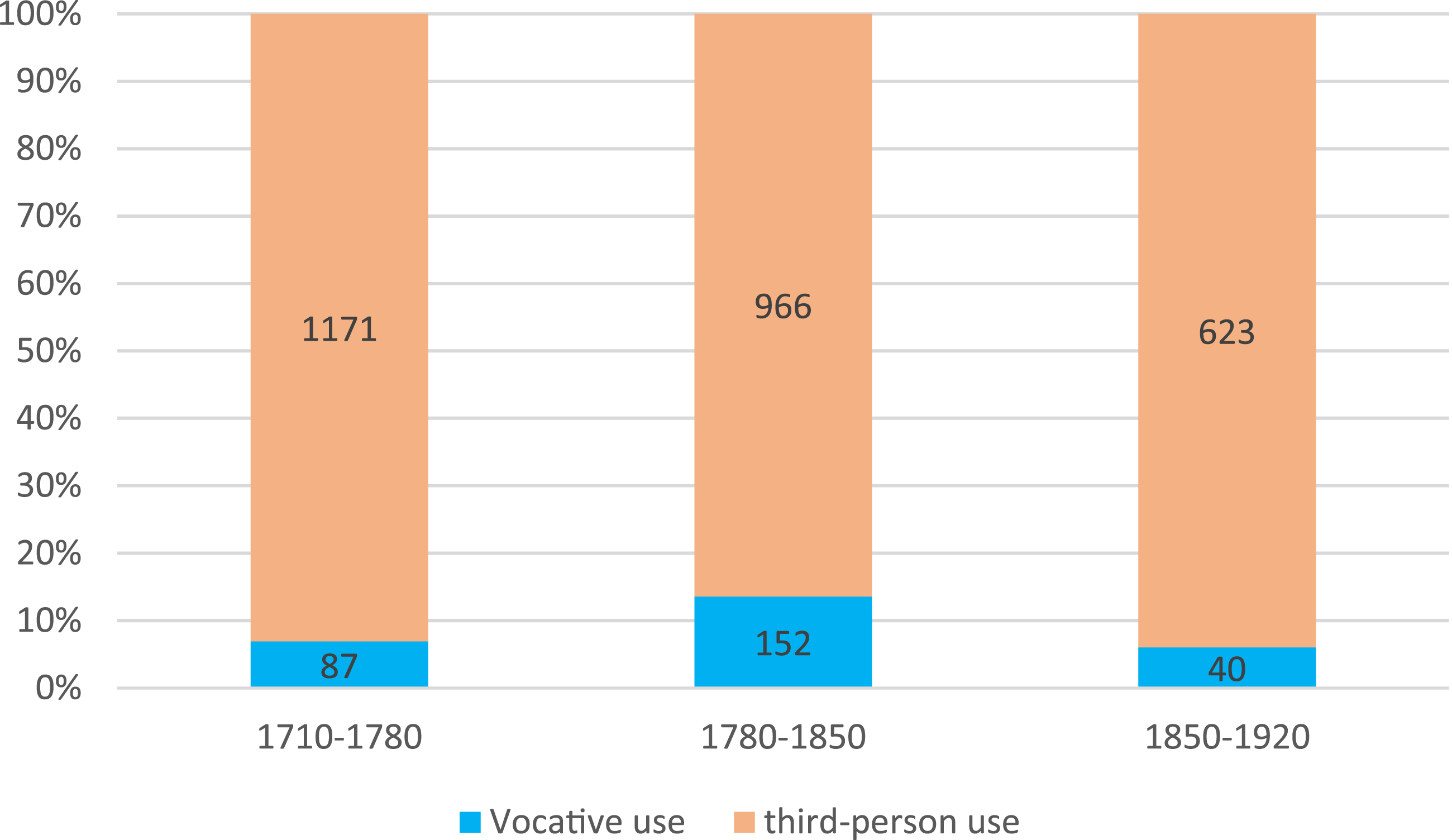
5.2. Functional perspective 1: Positioning the reader through collocates
As mentioned in Section 2, words accompanying reader (or more technically: collocating with it) can be used to position or characterise the reader further, that is to ascribe qualities or features to them that may be desired or undesirable in the writer/narrator’s view. Collocations thus use these features as a site of author-reader interaction. Such labels and qualifying attributes can produce a closer reader-writer alignment or, in contrast, disalignment. This section will focus on the absence or presence as well as the nature of such collocates.
Most vocatives (56%) occur in the bare, unmodified form, as in (2) above. Similarly, as many as 74% of third-person forms occur with just an article (a, the), as in (6): (6) I guessed at once (as perhaps
Such bare forms may be seen as relatively neutral, non-positioning forms as opposed to the remaining cases, where an adjective specifies certain characteristics of the reader or pronouns indicate explicit alignment (see below). However, positioning may also happen elsewhere in the context other than by means of immediate modifiers as in (6), where cleverness is attributed to writer and (tentatively) reader. In what follows I will nevertheless focus on immediately adjacent collocates for reader as the most striking use. As Figure 4 shows, it is in the third period that the positioning potential of premodifying adjectives is made greatest use of, while alignment via pronouns is more common in the first period and then declines. Immediate left-hand (L1) modifiers of third-person reader uses (all genres).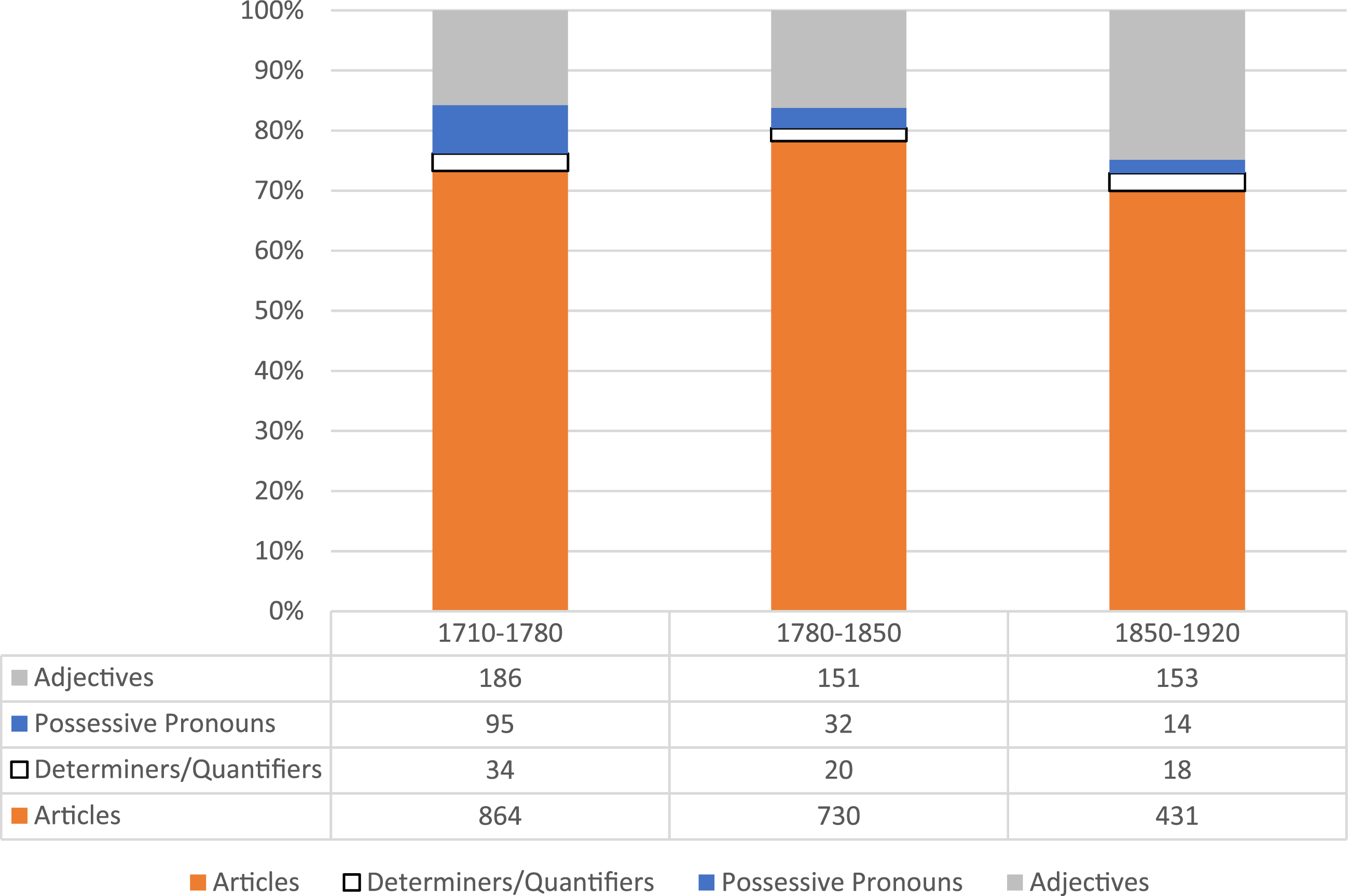
Focusing on possessive pronouns modifying reader in Treatises and Fiction, a frequency difference immediately becomes apparent. Fiction uses are accompanied by a possessive in 8.2% of all reader occurrences in this genre, but only half as often (3.7%) in Treatises. Linking the reader to another person seems to be more important in Fiction. Furthermore, Fiction predominantly uses the first-persons forms my and our (7, 8), thus connecting the author/narrator and the reader, or, putting it more strongly, ‘appropriating’ the reader. The plural our with its royal-we associations, which does not occur in Treatises, seems to make the narrator stand above the reader, that is, to feel superior to them. Whereas the second person possessive your (9) is only used in Treatises, third-person his (10) is found in both genres: (7) lest some few should think he acted more disinterestedly than indeed he did, we think proper to assure (8) but we had not Curiosity enough to enter it, nor Faith enough to believe a ridiculous Fable that is told concerning it, (…) which I shall put down here, and leave (9) THIS is the truth of the matter, which you shamefully misrepresent and declaim upon, to no sort of purpose but to amuse and mislead (10) Which however, he seems desirous
In both (7) and (8), the communicative dyad of writer (we, I) and reader (my/our reader) is co-present in the sentence, creating a bond by joint mental action. In addition, the writer embraces and claims the reader as part of his or her in-group. The interaction here is between writer and reader, while in (9-10) it takes place primarily between the present author and another writer, with the reader constituting a sort of battleground between them. Berkeley and Brown intend to convince the reader, who is positioned as a (previous) reader of another author, that they themselves know better and can convey a more trustworthy report. The reader is supposed to take the side of the present author. Given that such uses are specific to, as well as commonplace in, Treatises and flourish in the early period, it can be seen as typical of the public controversies carried on in the seventeenth- to eighteenth-century press (cf. Fritz, 2002). Explicit personal attacks in public discourse as in (9) tend to be avoided in later periods in the emerging negative-politeness culture with its emphasis on restraint, mitigation and personal freedom (cf. Jucker, 2020: ch. 9). The rare uses of the third-person possessive in Fiction may refer to characters reading in the text (cf. example (3)), or, as in (9b), the author/narrator comparing himself to another writer in a manner not indicating intellectual dispute.
Other determiners/quantifiers are mainly items like every, each, and any (see (11)): (11) What these are will be obvious to
Examples like these are usually more emphatic variations on the reader, since they claim the largest possible group of readers sharing the same thoughts and agreeing with the present author. Thus, one can call (11) a clearly argumentative use, which is in line with such constructions being more frequent in Treatises (5.4%) than in Fiction (2%).
As shown in Figure 4, adjectives are the most common L1 collocates, which characterise the reader and/or put them into a certain category (in contrast to the reader, which is neutral or indiscriminate) (Sorlin, 2022: 139–140). The characterisation may pick out an intended or implied reader or even an unwanted reader (Sorlin, 2022: 142). Across the three periods, the proportion of adjective modifications of all reader uses is on the rise (15.2 > 13.5 > 23.2%), which may reflect its usefulness for authors.
In examples (12-13) the reader is given the positive characteristics learned and civilized, presumably attributes the writers would also apply to themselves. The linking of writer and reader continues, as the actions attributed to the reader are in line with the desires of the writer (cf. readily perceive) and there is explicit bonding between reader and writer (cf. you and I): (12) The (13) Thus,
In (13) the narrator explicitly aligns with the reader, styling both ‘you’ and ‘I’ not only as civilized, but also refined, polite and witty, and disaligns from the type of people represented by stereotypical greengrocers. Given these similarities, it is not surprising that the reader is also dear to the writer. In the context in which this passage occurs it serves to create a contrast between narrator and reader on the one hand and the character Amelia, on the other hand, who ‘has not fallen in the way of means to educate her tastes or her intelligence’ (Vanity Fair, chap. 62). Both distancing and arousing of compassion might be intended here.
The rare negative collocates may be defused to some extent by explicitly attributing them to another writer (14), or by making the writer seem considerate to all reader groups (15). In turn, all readers who do not need the explanation provided in (15) may consider themselves informed and knowledgeable; implicit here is thus also a positive attribute: (14) It must be owned, that after you have mislead [sic] and amused (15) Rackets (I might observe, for the sake of
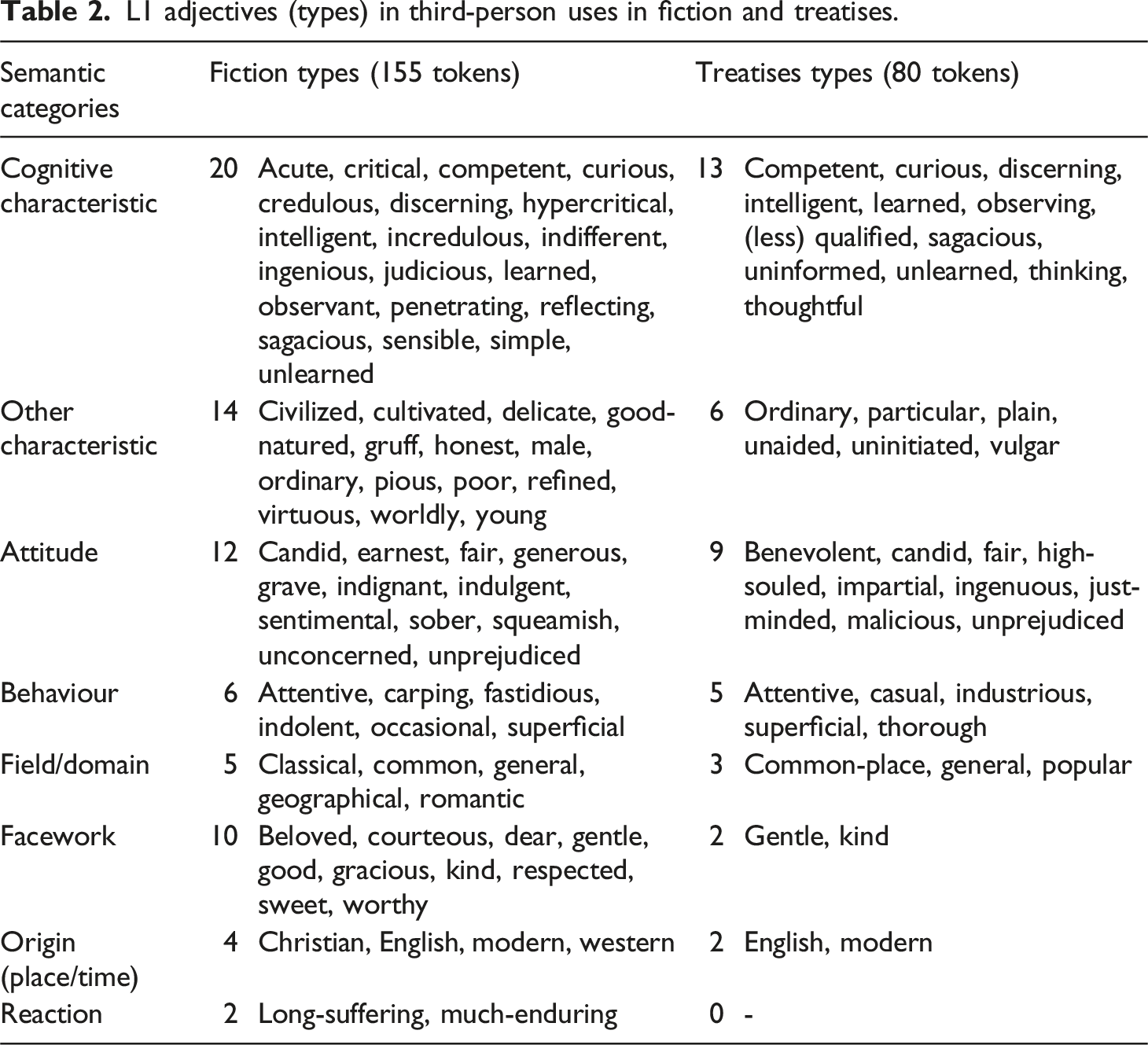
Finally, negative adjectives may indicate concern for a potential negative reader reaction or also invoke an undesirable reader, as can be possibly seen in example (16). With the overtly patronising “my dear sir”, Thackeray starts a paragraph-long illustration of why the preceding reader’s question is actually stupid. Discerning readers, it is implied, could have worked this out themselves. (16) How is this?
L1 adjectives (types) in third-person uses in fiction and treatises.
L1 adjectives (types) in vocatives in fiction and treatises.
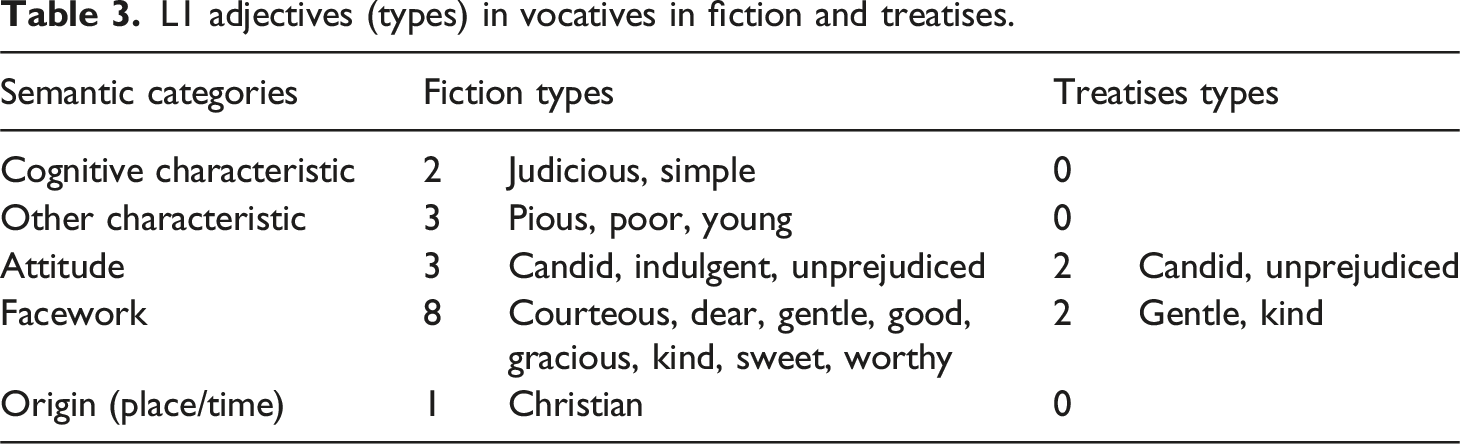
What is noteworthy regarding the categories employed in Tables 2 and 3 is that, overall, it is very personal traits of the reader that are dominant here (
The categories field/domain and origin refer to more general and permanent reader characteristics, namely their interest in or choice of reading matter and their personal placement in place and time. What both categories have in common is that they lend themselves to constructing in-groups and out-groups. A certain work (or chapter) might be meant for the group of, say, geographical readers but be unsuitable for others; highlighting this explicitly can be helpful. Regarding the category origin, the recurrent terms Christian, English and modern may seem superfluous, as these characteristics simply applied to the reading market. Singling out such readers explicitly only makes sense if the content is, e.g. non-Christian or historical and thus ‘alien’ to the readers. At other points, the use will strengthen the pre-existing identity and in-group feeling.
The category
Table 3 displays no new or different items (that is none that specialise in vocative use), but the most common descriptors from Table 2 reappear (e.g. judicious, candid, unprejudiced, dear, gentle, good, Christian). It is of interest that
To sum up: positive terms and thus positive positioning are preponderant. This result correlates with the importance of politeness and facework uses. There is some noticeable continuity across periods, but nevertheless also great variety in adjective choices, indicating period- and author-specific choices. And finally, the reader is overwhelmingly styled as an educated, cultivated, suitably critical, open-minded and conscientious person, which leads to the conclusion that mostly the intended reader is invoked.
Among vocative uses there are three types not covered so far, namely the constructions O reader, brother reader, and Mr Reader. The emphatic and emotive address, here illustrated in (17) from Fiction, where it combines with an imperative, is actually much more common in the category Narrative Non-fiction, which includes (presumably personalised) biographical texts and travel writing. It occurs in the first, and most prominently in the second, corpus periods. It may be important to note that the second period coincides mostly with the literary movement of Romanticism, which was also known for its emphasis on emotions. (17) The phantom approached him with an easy step, and, lifting up her veil, discovered (believe it,
Mr Reader produces a more formal and distanced impression. It is found in only two texts, a dialogue in Punch magazine and a novel by Griffith, as in (18), where it co-occurs with an equally distanced negative politeness strategy (give me leave): (18) HERE give me leave,
The peculiar phrase brother reader is an idiosyncratic form only used by Thackeray. While the positioning possibilities illustrated here remain a minority of all reader uses, their proportional rise over the two hundred years covered show their usefulness for many writers. It can also be argued that more frequent use might have been counterproductive: reader itself is a fairly marked stylistic feature, and highlighting the reader phrase by modifiers makes it even more conspicuous. Such constructions are most effected if they are used sparingly and with perfect aim.
5.3. Functional perspective 2: Reader within metadiscourse
The functional perspective will focus again on Treatises and Fiction, which are generically very different and, as shown above, also show divergent developments regarding reader uses. While there is clear decline in Fiction, uses in Treatises first fall and then rise again, reflecting perhaps a recognition of the usefulness of the feature by writers in this genre. For a functional analysis the context of reader is crucial, as the noun reader on its own has referential and involved functions, pointing to the communicative counterpart of the writer. Its use within various propositions and speech acts makes it take part in a larger function.
In terms of the metadiscourse model, each use of reader constitutes an engagement marker, acknowledging the presence of, and constructing a relationship with, the other. In (19) the author posits an attentive reader of the text, one who can therefore also draw the necessary conclusions in line with what the author wants to impart. The statement contains an implicit compliment, which pays attention to the reader’s face needs, and thus can be seen as attitudinal intersubjectivity. Moreover, (19) performs a kind of positioning (Section 5.2), and it is framed in a more interactional style. (19) Acting on language, those qualities generate a specific and unique beauty—“that other beauty of prose”—fitly illustrated by these specimens, which
What makes the metadiscursive nature of the passage ‘the reader needs hardly be told, after what has been now said’ especially evident is that it can easily be omitted from the surrounding text and its argument. The author-reader relationship is conducted in addition to the main message. The focus on cognitive state(s) of the reader, e.g. understanding and concluding in (19), is very common in Treatises, in line with the fact that these are informative and argumentative texts. Joint thinking about the content creates involvement and also alignment through shared knowledge. This is further enhanced if interactiveness is introduced, as in (20), which attributes a question to the reader in reaction to the previous discourse, which can then be answered by the writer. The subjective perspectives of reader and writer are intertwined in a multiple responsive sequence. (20) Yet we commonly speak as though we had an idea of the Earth -- as though we could think of it in the same way that we think of minor objects. What conception, then, do we form of it?
Even more interactive than the above reader-ascriptions are directive uses, as in (21) and (22), with the performative verbs request and beg. The passages again ask for cognitive involvement of the type necessary to make the author’s line of argument work (cf. engagement markers bear in mind, allow me the same liberty). Often these requests are somewhat mitigated (cf. would in (21)): paying intersubjective attention to the reader’s face needs through politeness work is perhaps more successful (cf. Sorlin, 2022: 131–132). (21) It is to the opposite extreme of character that our attention must now be given. And here I would request (22) If this argument appear satisfactory, it is well. If not, I beg
Note also that in these examples, as in many other cases (in fact in 31.5 % of all Treatise data), the authorial persona is explicitly ‘present’ in the context (through relevant first-person pronouns, that is self-mentions in metadiscourse) and creates a conversational dyad, or, in other words, an imagined dialogue with the reader. Some directive uses are phrased more indirectly, but nevertheless clearly point to some reader involvement; in (23) this involves the activity of singing: (23) Now any one may readily convince himself that resonant vocal sounds can be produced only by a certain muscular effort additional to that ordinarily needed. If after uttering a word in his speaking voice,
Crucially, activities are also linked to cognitive involvement, that is understanding better by means of further action.
Shared cognitive states as above in Treatises are also a focus in fictional uses, especially those that I would characterise as plot-related. The most straight-forward case is found in (24), where the reader is reminded of some knowledge they (should) already have, and this is often accompanied by a metadiscursive cross-reference (here last chapter) enabling the reader to go back to that passage if necessary. (24) Mr Nightingale changed colour at these words; but Jones, without regarding it, proceeded, in the liveliest manner, to paint the tragical story with which
Other passages refer to upcoming information, partly involving the reader in arriving at certain conclusions, and partly arousing their interest (25). (25) However, though he was satisfied with regard to the colonel’s suspicions, yet some chimeras now arose in his brain which gave him no very agreeable sensations. What these were,
Here, reader is integrated into metadiscoursal endophoric marking (cross-referencing to other parts of the text), which in modern texts is usually phrased completely impersonally, e.g. in the previous chapter, see forthcoming volume.
In (26), similar to (24), the reader is reminded of certain information (the inconsistencies of John’s character) whose importance in the context (his conduct during the present evening) is furthermore emphasised. The explicit highlighting of reader understanding is to direct the reader’s interpretation of a character and their actions as well as to underline the importance of exactly this line of thinking. (26) It is necessary to keep these inconsistencies of John’s character in view, that
In this as in example (27), it is the writer who regulates the reader’s mental operation, intersubjectively leading towards a joint interpretation of the text. We can note that, in Fiction, the reader’s thinking is presented as more determined and less open to negotiation than in Treatises. The reader’s conclusion in (27) is presented as necessary and unavoidable. Through the link with common wisdom, reader expectations are posited and then met, which may strengthen reader alignment by co-constructing an intersubjective mental text: (27) It is the observation of a very wise man, that it is a very common exercise of wisdom in this world, of two evils to chuse the least.
A group of passages that is fairly common in Fiction comprises clearly emotive uses. While all reader occurrences increase involvement in a general sense, the following concern more closely the inner life of narrator and reader. In (28), the narrator shows explicit concern for the feelings of the reader, also announcing appropriate action so as to spare the reader more emotional discomfort. (28) ‘[…] They squeezed the heads of some with knotted cords till they pierced their brains, while they threw others into dungeons swarming with serpents, snakes, and toads.’ But it would be cruel to put the reader to the pain of perusing the remainder of this description. (Scott, Ivanhoe, 1819)
The narrator here showcases a caring attitude towards the reader, which can be interpreted as an extension of the writer’s emotional attitude regarding the proposition uttered in metadiscourse: in a sense the narrator in (28) intersubjectively extends his own revulsion to the reader. Possibilities of intersubjectve sharing are also clearly visible in the following two examples, in which the reader is invited into the narrator’s innermost self: (29) Was it possible, after all, that Mr. Falkland should be the murderer? (30) I believed unhesitatingly both in his forecast of human destiny and in the practicability of his astonishing scheme, and
In (29), the reader is made to co-experience (cf. Sorlin, 2022: 144), and then to judge, one of the narrator’s emotionally coloured thoughts. While seeming to reinforce a negative judgement, the passage may in fact rather induce a feeling of compassion. In (30) the narrator tries to make the reader comprehend his justified fearful reaction, and he does so by contrasting two situations and asking for the reader’s sympathetic imagination. If the reader reacts as desired, there is intersubjective alignment between narrator and reader. Such instances of intersubjective sharing also tend to involve an explicit hiatus, since the passages interrupt the plot, and this additionally provides a kind of textual emphasis.
My last examples have also shown prominent uses of the pronoun I. Indeed, the co-occurrence of reader and first-person pronouns in the same sentence, which here refer to the narrator, is clearly more common in Fiction than in Treatises (and not only restricted to emotive uses), with a total of 41.8% (Fiction) versus 31.5% (Treatises).
6. Conclusion
Let us now come back to the questions posed at the beginning. On a general functional level, interactional reader uses (that is those referring to the communicative dyad) work very similarly in both Fiction and Treatises. In both cases, they encourage reader engagement, whether it concerns considering and understanding plot developments or arguments by the author. They also induce reader alignment with the fictional narrator (/character) or the author, through empathy or agreement asked for and potentially granted. In both cases they also help readers steer through the textual world, by reminding them of earlier content, foreshadowing later discourse, and (in Treatises) also pointing to upcoming discourse. Reader positioning via adjectives, even if not very frequent overall, also works very similarly across the two genres, with the same categories used more or less frequently. The fact that two such different genres are nevertheless so similar at an overarching level speaks for a common textual need.
Regarding change as shown by frequency, the use of reader has declined over time. The decline in most public discourse indicates a shift in stylistic attitudes and preferences, which raises the question whether this is due to functional or formal reasons. What argues for formal reasons is that this decline is in line with the general developments towards more oral and thus less nominal styles (see Section 3 above). The small opposite trend in Letters and Treatises shows that the functional motivation behind such uses persists. Thus, different genres may have evolved and started to prefer other formal means for the same functions (involvement, intersubjectivity) at different points in time. Establishing how first and second-person pronouns, imperatives, questions, epistemic and evaluative adverbs (among other devices) develop in these genres may go some way towards providing answers to the question. Only the vocative reader use is of a type not amenable to substitution by other narrative strategies. Interestingly, it has turned out to be diachronically and generically the most restricted use, namely flourishing especially in the early nineteenth-century Romantic period and occurring in what are clearly more emotive and (inter)personalised texts.
Footnotes
Declaration of conflicting interests
The author(s) declared no potential conflicts of interest with respect to the research, authorship, and/or publication of this article.
Funding
The author(s) received no financial support for the research, authorship, and/or publication of this article.