This paper explores the development and establishment of intensificatory tautology (specifically, size-adjective clusters, e.g., “great big plans,” “little tiny room”) in the history of English. The analysis suggests that size-adjective clusters appear in the Late Middle English period as a result of the functional-structural reorganization of the English noun phrase. It is only towards the end of the Early Modern English period that they start to become (relatively) productive in the language, and in Present-Day English that they acquire a wide(r) intensifying functional range (i.e., adjective modifier, emphasizer, degree intensifier) and become associated with informal, spoken-based registers. More broadly, the paper suggests that more research is needed as regards the role of collocation in processes of intensifier creation in the noun phrase and, more generally, as regards how collocation interacts with word-formation processes in this context.
1. Introduction
Intensification in the noun phrase has traditionally been associated with prenominal slots and patterns involving collocations with degree adverbs (e.g., “very happy/really sweet boy”; see Huddleston & Pullum 2002:531-532). This is, of course, not the only available option: previous literature comments on the central role of adjectives as “the natural locus of intensification” and notes that adjectives constitute the basis of a “varied set of intensifying devices” that range from “standard” phrasal patterns involving adverb and adjectival sub-modifications (e.g., “stunningly beautiful,” “very happy,” “pure bliss,” “terrible bore”) to more “peripheral” options involving, among others, affixes and blends (super-special, gigantamous) or intensifying compounds (red-hot, ice-cold drink) (Cacchiani 2017:1; see also Renner 2008; Cacchiani 2010; Benczes 2014; González-Díaz 2017, 2018). As “core” intensifying strategies, degree adverbs in intensificatory phrasal patterns have received ample attention in previous literature, in terms of both their history and their distribution (e.g., Peters 1994; Lorenz 2002; Ito & Tagliamonte 2003; Méndez-Naya 2008). The coverage of peripheral strategies is by contrast much more limited and often confined to aspects of their synchronic distribution.
This paper adopts a corpus-based approach to explore one of the above-mentioned peripheral adjective intensifying options; namely, what Huddleston and Pullum (2002:561) label “intensificatory tautology” (e.g., “big huge house,” “tiny little bird”). My aim is twofold: to chart the diachronic development of tautological intensification in English and to contribute to a wider understanding of the role of collocation in processes of intensifier-formation.
The paper is organized as follows: section 2 summarizes previous literature on intensificatory tautology. Section 3 describes the methodology used in the study. Section 4 is devoted to a diachronic analysis of tautological intensification in English. In section 5, the results of the analysis are contextualized in relation to other tautological noun phrase (NP) premodifiers. The implications of the study for further research are described in section 6.
Some terminological clarification is due before proceeding further. First, the terms “repetition,” “reduplication,” and “tautology” are all used in the literature to refer to accretive patterns, i.e., cases featuring “the accumulation of apparently ‘redundant’ linguistic material in the marking of one category within the same structure” (López-Couso 2019:335; see also Lehmann 2005). Reduplication and repetition are often associated with various types of formal replication (e.g., “old old house,” “very very happy”; cf., e.g., Haspelmath 2002:274; Hohenhaus 2004; Huang 2015), whereas tautology tends to be reserved for cases of semantic/functional duplication (e.g., subject matter, more easier). My study is concerned with tautological patterns only (great big, tiny little). Second, adjectival tautological patterns include a great variety of options (cf. modern examples such as remote rural, various different, or whole complete). Following Huddleston and Pullum’s (2002) approach, however, this study considers only the most frequent [adjective + adjective] (i.e., Adj. + Adj.) tautological combinations, that is, those created by the juxtaposition of two synonymous size-adjectives (e.g., big fat, great huge, tiny little). The terms “(tautological) size-cluster” and “size-adjective cluster” will be used indiscriminately to refer to the phenomenon throughout the paper.
2. Previous Literature on Size-adjectives and Tautological Intensification
As noted in previous literature, adjectives “typically denote properties, many of which are gradable” (Murphy 2010:222). Size-adjectives are no exception, i.e., they attribute a dimension-related property to a nominal referent, placing it on a particular point on a scale (Bierwisch 1989). Such scale-mapping is flexible and dependent on both the nominal referent they modify and the context of use (Lorenz 1999:56; Murphy 2003:39, 2010:223); note, for instance, that long in a long road (‘of great physical length’) does not mean the same as long in a long song (‘of great temporal length’). As these examples show, the types of scales upon which size-adjectives map their denotations are varied: physical dimension (e.g., massive dog, small car), non-physical dimension (e.g., big voice, little yelp), temporal (e.g., little minute) and, metaphorical scales (e.g., ‘importance or difficulty,’ as in, e.g., great/massive help, little/small mistake, fat lie).
Size-adjectives also vary in their schematicity. Adjectives such as great or massive are more schematic (i.e., they do not denote any specific type of dimension and can therefore map meanings onto a wider range of dimensional scales) than others such as long, tall, fat, or deep (which often indicate one physical dimension, i.e., length, depth, width).
1
The characteristics of size-adjectives described above also pertain to the size-cluster explored here. As regards scale-mapping, compare for instance, a tiny little house or a massive great bungalow (physical dimension senses) with a tiny little detail/massive great problem (metaphorical senses). Concerning adjective schematicity, two different patterns can be observed in size-clusters: cases where two (or more) schematic adjectives co-occur (e.g., a massive great flask of coffee, great huge problems) and cases where we have a combination of more and less schematic adjectives (e.g., big tall ceilings, big fat man). In these latter cases (combination of more and less schematic size-adjectives), and when scale-mapping concerns a physical dimensional scale, one may want to read the adjectival sequence as a coordinative structure (e.g., a big fat man is a man who is big and fat). Note, however, that often the less schematic size-adjective is encompassed by its more schematic counterpart (i.e., a fat man is ‘a man of generous width’), therefore creating the emphatic, reiterative dimensional meaning associated with intensificatory tautology.
Intensificatory tautology is, as noted in section 1, a type of accretive strategy. Cross-linguistically, accretive constructions are pragmatically marked: the juxtaposition of two tokens of the same syntactic/semantic element makes the structure superficially uninformative (i.e., it flouts Grices’ Maxim of Quantity; Sperber & Wilson 1995:220). Such redundancy is, however, not seen as uninformative but rather interpreted as an exploitable mechanism (Huang 2015:85; see also Culpeper & Kytö 2010:143). Previous cross-linguistic scholarship has associated semantic doubling with four main functions (e.g., Adamson 1999:557-559; Rubino 2005:19; Benczes 2014:440; López-Couso 2019):
(a) explanatory purposes, i.e., cases where a loanword is paired with a native coinage that makes clear the meaning of the borrowing (e.g., plain and simple; rich and plentiful);
(b) foregrounding of “key ideas,” as repetition makes them formally more salient;
(c) stylistic/rhetorical embellishment, usually associated with formulaic language and aureate styles;
(d) intensity/emphasis. The semantic doubling produces an additional emphatic load under the iconic principle of “more form entails more meaning” (e.g., very extremely happy).
Previous scholarship also notes that tautological structures tend to be short-lived: they often appear in times of transition and only develop into a permanent fixture in the system if/when they become associated with a specific functional niche (Méndez-Naya 2017:268).
As regards tautological adjectival structures, recent morpho-syntactic research has explored tautological synonymic compounds (TSCs) in English (e.g., teeny-weeny) showing not only their “non-redundant” nature but also highlighting their role as source construction for newly-developing intensifying blends (e.g., terrifitastic, ginormous; Benczes 2014:442; also Renner 2008). The specific size-adjective clusters that occupy us here are briefly discussed in Huddleston and Pullum (2002:562). They observe that these tautological patterns are frequently found with adjectives of “very large” or “very small” size (e.g., great big, tiny little), often in informal styles and oral domains. Structurally, they see them as standard cases of “stacked modification,” i.e., structures in English where the rightmost adjective first creates a nominal with its corresponding noun (e.g., [big house] ‘a house of a large size’) which is subsequently modified by the leftmost size-adjective for intensificatory purposes (e.g., [great [big house]] ‘a house of an exceptionally large size’). Recent work has however taken issue with several of Huddleston and Pullum’s (2002) claims. Coffey (2013:64) for instance questions the “emphatic” nature of tautological intensification, whereas Matthews (2009, 2014:100) problematizes Huddleston and Pullum’s (2002) view of the stacked nature of adjective clusters, suggesting instead that both adjectives jointly modify the head noun as a single unit. More recently, González-Díaz’s (2018) exploration of the formal and functional behavior of size-clusters in Present-Day English (PDE) suggests, in line with Matthews (2014), that these tautological units are emphatic unitary constructions, semantically and syntactically akin to Benczes’ (2014) TSCs noted above. González-Díaz’s (2018) also shows that tautological size-adjective clusters in PDE have a wider semantic and functional distribution than has hitherto been acknowledged (see also section 4.4).
When, how, and why tautological intensification appeared in English is in need of further exploration. As shown by the literature review above, previous accounts of intensificatory tautology only concentrate on specific aspects of its present-day distribution. It is therefore the purpose of this paper to contribute to our current understanding of intensification by offering a diachronic exploration of the rise and establishment of tautological size-adjective constructions in English and of the wider diachronic implications of this development for the intensificatory mechanisms operating in the English NP.
3. Material and Method
The present study is corpus-based.
2
The PENN collection (PCME2 [1150-1500], PPCMBE [1500-1720], and PPCMBE [1700-1911]), the ARCHER corpus (1700-1970), and the British National Corpus (BNC) (1960s-1990s) were used as the main data sources for the analysis. ARCHER includes American English texts; for this paper, however, only British English data were considered. Other collections and individual works (e.g., the Early English Books Online [EEBO] corpus,
3
Mandeville’s travels and Celia Fiennes’ travelogue:) were also consulted to confirm the robustness of the observed patterns. Middle English was taken as the starting point for the analysis, as previous sources have consistently noted that complex premodifying strings (i.e., strings with two or more adjectives; e.g., “a big black car”) do not appear in English until this period (Fischer 2006; Fischer & Van der Wurff 2006).
All corpora consulted include part-of-speech-tagged versions of the texts, which proved to be instrumental for the retrieval and selection of the data. Relevant patterns were found through a general search for two consecutive adjectives (using the tag search [*_jj *_jj]) in the diachronic corpora. For the BNC, the tool Phrases in English was used to retrieve all [Adj.+ Adj.] 2-gram clusters with a minimum of two tokens of frequency.
4
The results from all these searches were then manually pruned down to include only those clusters featuring size-adjectives. In the case of the EEBO corpus, however, the original general search [*_jj *_jj] yielded too many hits (over 200,000 per century) to allow manual searches. A process of automatic thinning was applied to the data and a sample of 15,000 tokens was scrutinized per century.
5
As will become evident in subsequent sections, although the largest multi-genre historical British English corpora available to date have been used for the analyses, the overall raw data frequencies are low across most periods under investigation. The overall patterns of development that these data suggest are however robust enough to merit confident interpretation and indicate further lines of enquiry that will hopefully be taken up in future analyses of intensification in English.
4. Analysis
4.1. General Results
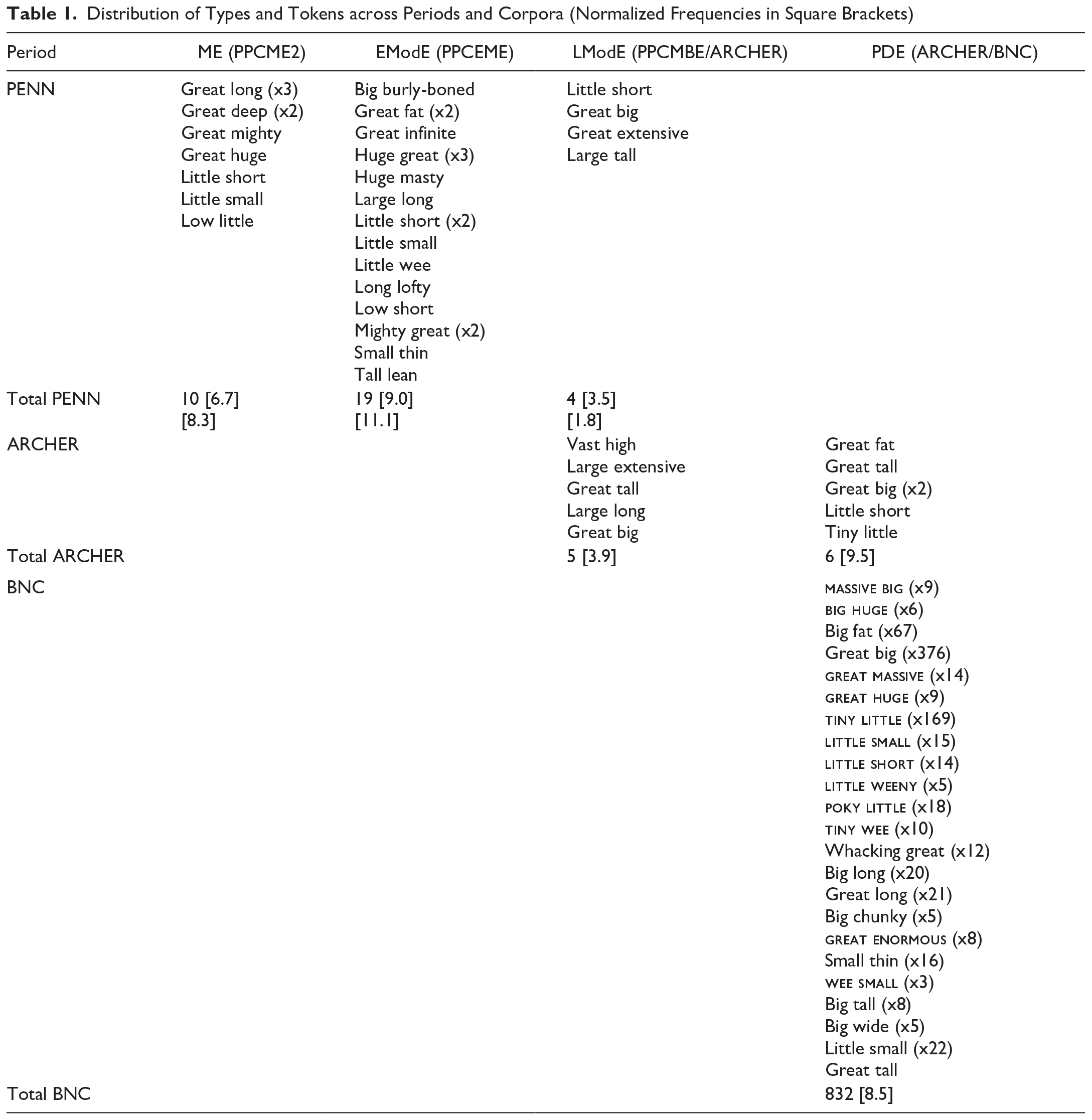
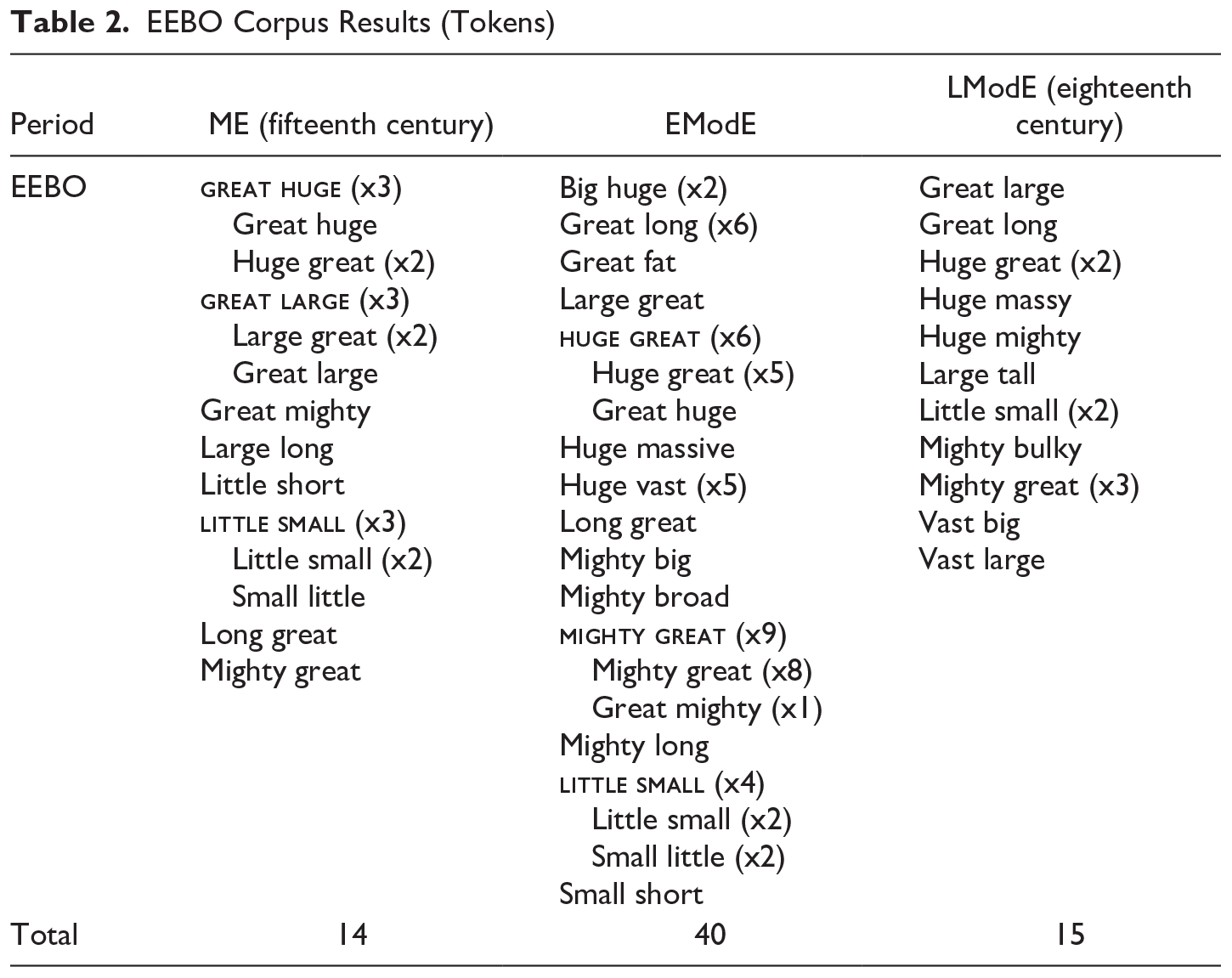
Tables 1 and 2 summarize the results of the analysis across periods. Small caps indicate cluster types, e.g., big huge stands for the patterns big huge and huge big. Pattern-specific distributions of reversible clusters are given in smaller font below (PDE data excepted; see González-Díaz 2018 for an analysis and discussion of cluster reversibility in PDE). Normalized figures are provided in square brackets in the tables. In the case of the EEBO corpus, however, no such normalization could be carried out due to the data-thinning process noted in section 3.
6
The EEBO tokens will therefore be considered a way of providing further qualitative information on the patterns and trends observed in the analysis of the other corpus data examined here (see Table 2).
The data are limited, and the overall quantitative distribution across corpora (i.e., the normalized figures) is non-linear: there is a slight increase between ME and EModE, a significant dip in Late Modern English (LModE), and a subsequent increase again in PDE, but the frequency does not reach EModE levels. As regards type-distribution, the results show a gradual diversification of clusters in EModE and Present-day English (see sections 4.3 and 4.4). Whereas most size-clusters feature the use of great (for the large-size clusters) and little (for the small-size ones) in ME, the EModE data record new adjectives entering the pattern (see clusters such as huge masty, large long, small thin, etc.). New size-combinations are also attested in Present-day English (e.g., whacking, poky, or enormous in clusters such as whacking great, poky little, or great enormous). Diversification of cluster types is likely to have impacted on the above-mentioned frequency increase of cluster tokens across time (note the noticeable increase in normalized token frequencies in EModE and PDE in Table 1) . Considering cluster flexibility matters, the corpora tentatively indicate greater linear variation for some clusters over others (e.g., compare the reversibility of huge great or little small as opposed to great big across the corpora consulted). Furthermore, if we compare cluster types across time, PDE seems to be the period with a higher frequency of reversible clusters.
4.2. Size-adjective Clusters in ME
Tautological size-adjective clusters in English are a late ME development: the first attested examples come from the 1400s (see 1 and 2).
(1) Also wyteth wel +tat Babyloyne +te lesse where the Soudan duelleth & the cytee of Cayra +tat is nygh besyde it ben grete huge cytees [. . .] (PPCME2,CMMANDEV/ID, 327.664.M3)
7
‘Also be aware that Babylone the Less (where the Sudan is located) and the city of Cairo (that is very close to it) are great huge cities’
(2) And ouer al his bodi +ter wol rise litel smale bleynes +te whiche +tou schalt aspie bi felyng of +tynhonde [. . .] (PPCME2, CMHORSES/ID, 89.36.M3)
‘And over all its body, there will appear little small blisters, which you shall investigate by feeling [them] with your hand’
Structural reasons need to be invoked here as a major factor facilitating the general development of the pattern. The Old English (henceforth OE) NP structure had a part-of-speech organization that dispreferred the juxtaposition of two pre-nominal modifiers of the same type (unless joined by coordination). Thus, when two OE characterizing adjectives were used to qualify a noun, they were either “straddled” across the noun (a big dog happy), coordinated (if used attributively; e.g., a big and happy dog), or introduced by the so-called “and-adjective” construction (a big dog and happy; see Fischer 2000, 2006). It is only in (late) ME that the OE grammatical NP order is reanalyzed as a syntactic one. As a result, the present-day scope of modification starts to develop, allowing for the accommodation of two or more adjectives prenominally and without a coordinator (Feist 2011:168, 174). This means that, until the 1400s, un-coordinated size-adjectives are unlikely to be consecutively placed before the noun.
The limited combinatorial possibilities of the adjectives entering the tautological size- clusters in ME have already been briefly commented on in 4.1. Clusters invariably include either great (for large-size clusters) and little (for small-size ones) and, in most cases, these latter lexemes occupy the leftmost slot of the cluster (e.g., [great + [Adj.]] / [little + [Adj.]]). In this connection, recent work by Méndez-Naya (2017) and López-Couso (2019) on accretive structures suggests that leftmost positions in tautological clusters are often occupied by the semantically more general element and/or the element with the widest range of functions. An explanation along these lines may apply to the size-clusters explored here, particularly of the large-size type. First, adjectives such as great (or mighty) and little are (relatively) general in their semantics in that they do not denote any specific type of dimension (e.g., length, depth, thickness). Second, they also have well-established metaphorical meanings (e.g., [lack of] ‘importance’ or ‘value’). Third, the OED shows that they are polyfunctional, featuring both adjective and adverbial use across OE and ME (note that only tokens where such polyfunctional elements perform adjectival functions have been included in this paper). By contrast, those lexical elements occupying the clusters’ rightmost positions (e.g., deep, long, small) tend to denote a type of dimension and often perform adjective-only functions in ME.
It is precisely the above-mentioned polyfunctionality of the leftmost element of the cluster that makes many of these early (large) size-adjective clusters syntactically ambiguous between cases of submodification (where the first adjective functions as a degree modifier of the subsequent adjective) and unitary co-modification (the size-cluster acts as a unit that modifies the following noun). Although it is not possible to assert with total confidence the interpretation of each individual example, the latter, co-modification reading of the size-cluster, is often supported by contextual evidence. Consider for instance (3) and (4). In both cases the size-clusters are premodified by degree intensifiers (right and so), which indicate that great large and great huge are to be interpreted as a unit.
(3) [. . .] he overthrew hit rote and all in such wise that the root that cam out of the earth made a right great large whole so parfounde and deep / that the bottom of the cave was sen plainly [. . .] (EEBO, A05232)
(4) And twelve lyons so great huge and large / That of this work bare up the charge [. . .] (EEBO, A06558)
In addition, a number of size-clusters were attested in translations from Romance languages (often French and Latin; 30 percent of the PPME2 tokens and 78 percent of the EEBO examples). A close look at the original sources suggests that the size-clusters are not calques but the result of the translators’ attempt at finding functional equivalents between source and target language (“cultural filtering”; see Kranich, Becher & Höder 2011). In these contexts, the English size-clusters are often found as equivalents to adjectives with a salient scalar component. For instance, French vigoreux (‘vigorous’) in (6) inherently conveys the meaning of ‘large quantity or amount.’ The important point to highlight here is the “adjectiveness” of the equivalence created by the translator, equating a single-adjective lexeme to a relevant size-cluster (see 5). (Note, in this connection, that the adverbial function of mighty as a modifier of adjectives (i.e., ‘very’) seems to be consistently attested only from the sixteenth century onwards (cf. OED, s.v. mighty C), hence the preference for an adjectival interpretation of the lexeme in 5.)
(5) Meduse that alway put her in the most strength and frayes / and moste prees by myghty grete corage / for to entretene & to holde to geder her men [. . .] (EEBO, A05232)
(6) Meduse qui se boutoit touhours es plus forts destrois et es fortes presses par vigoreux courage pour les hommes entretenir [. . .] (Lefèvre, Raoul, ca. 1460, The recuyell of the historyes of Troye)
Functionally, ME tautological clusters are mainly attributive-only constructions and are used as unitary noun modifiers, often to denote the physical dimension of their nominal referent (although non-physical and metaphorical dimension readings are also attested). For instance, mighty great in (5) records the ‘large quantity’ of Medusa’s courage, whereas in (7), the size denotation of grete longe is mapped onto a metaphorical scale of difficulty (i.e., it is ‘a hard toil’).
(7) Bot +tat +tat Moises mi+gt not come to se bot seeldom, & +tat not wi+t-outyn grete longe trauayle, Aaron had in his power, bicause of his office, for to se it in +te temple [. . .] (PPCME2,CMCLOUD/ID,126.738.M3)
‘But that Moses might not come to the boat [ark] infrequently and that, not without great long effort, Aaron had in his power, because of his position, to see it in the temple’
4.3. Size-adjective Clusters in EModE and LModE
As shown in Table 1, the EModE period witnesses the (relative) type and token expansion of size-clusters in the language. Two reasons may be behind the change. One reason could be the continuous “unfolding” of the NP structure towards the present-day functional distribution. In EModE, the syntactic organization of the ME NP is re-analyzed semantically, which allows for the interaction of nominal premodifiers and, as a result, the development of interpersonal, subjective meanings in the prenominal slot. It is, in this respect, no coincidence that emphasizer functions of originally descriptive adjectives such as utter, sheer, or pure “flourished” in EModE (Feist 2011:180). As Vandewinkel and Davidse (2008) note, in the case of pure, it was its pre-nominal occurrence with adjectives such as chaste or fresh (with which they share some semantic features relating to physical and metaphorical “cleanliness”) that led to the loss of its descriptive meaning (pure ‘unmixed’) and its use to “reinforce the sense of its accompanying adjective rather than independently attribute a quality” (Vandewinkel & Davidse 2008:269). The change also entails a shift from more objective to more subjective meanings. Thus, while in its descriptive sense pure attributes a quality to a nominal reference (a substance that is unmixed or unadulterated), emphasizer pure conveys speaker-based emphasis; i.e., it “has a heightening effect on the noun” it modifies (Quirk, Greenbaum, Leech & Svartvik 1985:429), specifying “degree at the same time as [it] convey[s] an evaluation of the reliability of the proposition” (Paradis 2000:233). Consider for instance cases such as pure luxury (or for that matter, other emphasizer uses such as utter/sheer disaster). In these cases, pure (or sheer, utter) denotes the speaker’s appraisal of the situation or event as a highly (un)desirable one.
Second, the category of dimensional adjectives (particularly large-size ones) is enlarged in EModE through borrowing and lexico-semantic change (Feist 2011:180), thus enhancing the potential for new size-clusters to appear. The adjectival increase is reflected in Table 1: vast (in great vast) and masty (in huge masty) only became part of the English size-adjective wordstock from 1500 onwards (OED, s.v. vast, adj. 1; s.v. masty adj.; 1b.).
(8) [. . .] some few of these stout and resolute soldiers with these little engines, do often put to flight a huge masty Bear [. . .] (PPCME,HOOKE-E3-P2,168.208/ID)
8
The quantitative growth of size-adjective clusters appears to be halted in LModE, with a noticeable drop (from 11.1 to 1.8 tokens per million words) in their overall frequency with respect to the EModE data. Qualitatively, however, some new (large) size-combinations are attested, as illustrated in (9).
(9) The Bay of Biscay, turbulent as it is, has no billows that mount like those on this great extensive ocean [. . .] (PPCMBE,COOK-1776,13.37/ID)
As regards functional distribution, there does not seem to be a noticeable change from the ME period. All size-clusters recorded across both periods feature, as in ME, noun modifier readings, with a preference for physical dimension denotations (see 8 and 9).
4.4. Size-adjective Clusters in PDE
PDE is another period of expansion for size-adjective clusters. Low-frequency combinations are, of course, attested (e.g., great tall, big wide in Table 1). The data show, however, the consistent presence of particular size-adjectives across clusters, namely, great, big, and little (e.g., great {massive, huge, enormous}; little {tiny, poky, weeny, small}; big {fat, chunky, huge}).
Table 1 also suggests that the number of reversible size-cluster types increases in PDE (on the reversibility of tautological size-clusters in PDE, see González-Díaz 2018). However, this suggestion should be taken with a pinch of salt due to the noticeable differences in size between the BNC and the historical corpora used in the analysis.
The most noticeable PDE change seems nevertheless to have taken place in the functional distribution of the size-clusters. The noun modifier use described in sections 4.2-4.3 is still widely attested (as in 10 and 11).
(10) We carry a little small radio that’s the local one so anyone in Harlow carrying a radio would be able to talk [pause] to Harlow police station, yeah? (BNC-FM7177)
(11) [. . .] you walk along the side and then you come to the point where there’s a bend in the river and there’s these gorgeous great enormous stepping stones [. . .] (BNC-G4G76)
Two other functions are, however, recorded in PDE. First, as has been suggested in previous literature, emphasizers are “epistemic markers” (Paradis 2000:233; see also Quirk, Greenbaum, Leech & Svartvik 1985:429). They cut across noun modifier and intensifier functions in their emphatic attribution of a speaker-based judgement on to a nominal referent. Syntactically, emphasizers are attributive-only elements and, unlike noun modifiers, do not accept degree modification (as they themselves act as specifiers of degree). While not very frequent, emphasizer uses are attested among the size-cluster examples, as in (12)-(14). The baby in (12) does not refer to a “large-size infant” but to an adult who the speaker is not very sympathetic towards. In this context, great big works with the noun to convey both degree emphasis and negative affection. Similar emphatic negative readings can be obtained from (13), whereas (14) works the opposite way, i.e., with whacking great conveying the speaker’s emphatic positive appraisal of the alibi, rather than a qualification of its (metaphorical) dimension (see González-Díaz 2018).
(12) She pushed me over and said, ‘I knew it wasn’t nobody, yow great big baby!’ (BNC-CMD2453)
(13) ‘Can’t you understand, you great big stupid asqueroso, I was close to getting it out of him, the information I need to prove my husband is not imagining things’ (BNC-GV6 2182)
(14) But she’s got a whacking great alibi, sir.’ (BNC-HWM 1237)
The third function of size-clusters in PDE is that of intensifier subjunct (Quirk, Greenbaum, Leech & Svartvik 1985:469, 589). There is, however, only one example attested in the data, (15). In (15), lump of ice cannot be simultaneously large (great big) and small (little) in size, which means that the interpretation of great big in this example is that of an intensifier (‘very’ little lumps of ice; Quirk, Greenbaum, Leech & Svartvik 1985:589; González-Díaz 2018:12). Given that there are no repeated uses of great big in this function, or similar examples featuring other size-clusters in the data, one should read this instance as the result of an ongoing but yet incipient developmental trend.
(15) Erm how about erm when it’s great big little lumps of ice falling down what do you call that ends in ail? (BNC-FMG299)
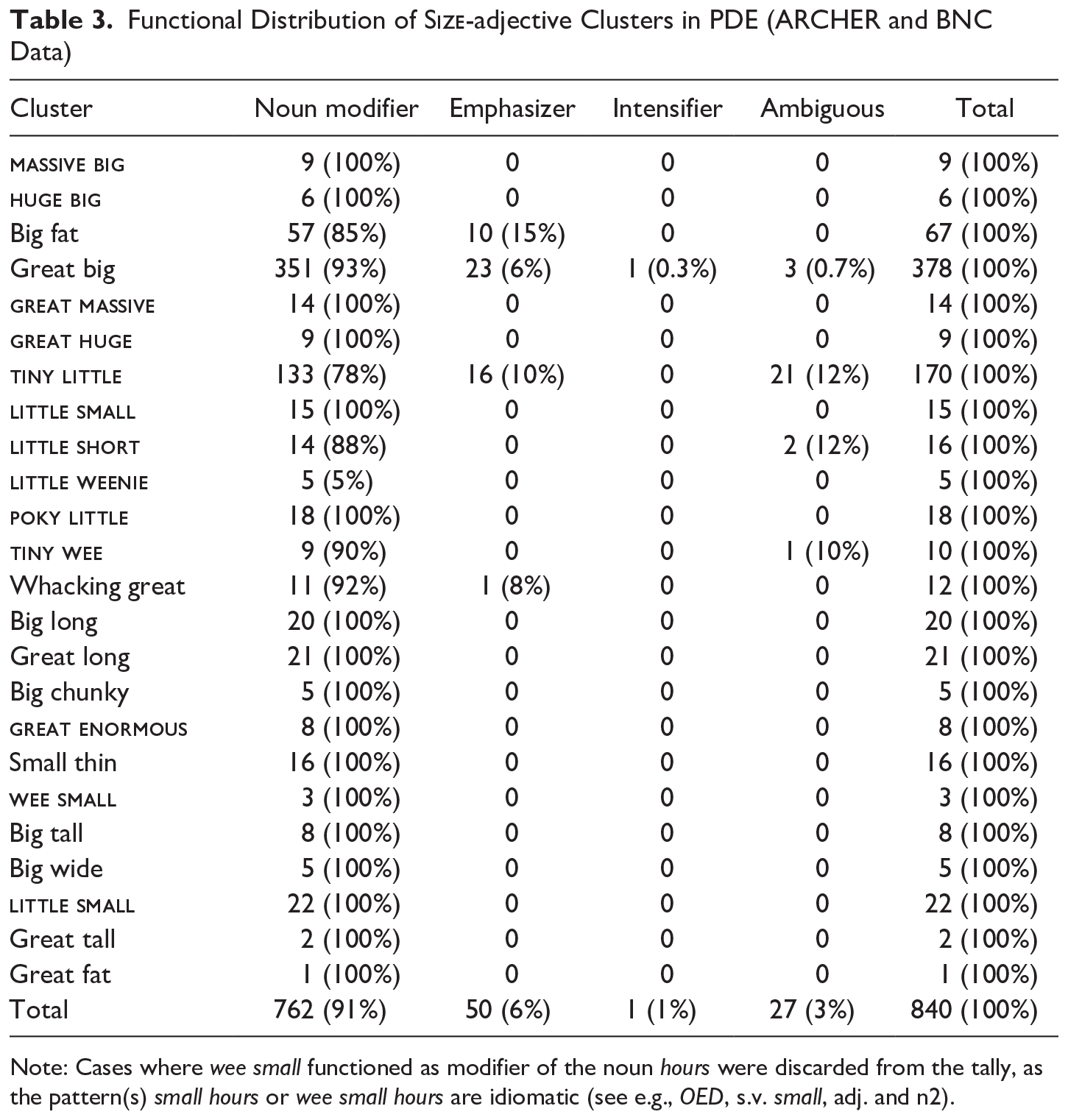
Table 3 summarizes the distribution of functions across clusters in PDE. Noun modifier functions constitute the most frequent use(s) of all types of size-adjective clusters (circa 90 percent across all clusters). Emphasizer and developing-intensifier functions are noticeably less frequent (6 percent and 1 percent, respectively), and particularly associated with specific size-clusters, namely, great big, big fat, and whacking great. These three are among the non-reversible clusters recorded in Table 1. Their “fixedness” has not gone unnoticed in previous literature. Coffey (2013:56) indicates that “‘great big’ may be best considered as a fully lexicalized phrase,” whereas for instance whacking great has a separate lexical (sub) entry in the OED (s.v. great, adj. and adv. 3c). Frequent co-occurrence of lexemes sharing core semantic features may lead—as in this case—to the (co-) lexicalization of the elements within the cluster (see, e.g., Lorenz 2002:149; Arnaud, Ferragne, Lewis & Maniez 2008:111). Furthermore, in this particular case, the tautological nature of the combination(s) further foregrounds their degree import (“more form stands for more meaning,” see section 2), thus making them prime candidates for undergoing well-established pathways of grammaticalization (i.e., adjective > degree adverb; see Hopper & Traugott 2003; Traugott & Dasher 2005).
Note: Cases where wee small functioned as modifier of the noun hours were discarded from the tally, as the pattern(s) small hours or wee small hours are idiomatic (see e.g., OED, s.v. small, adj. and n2).
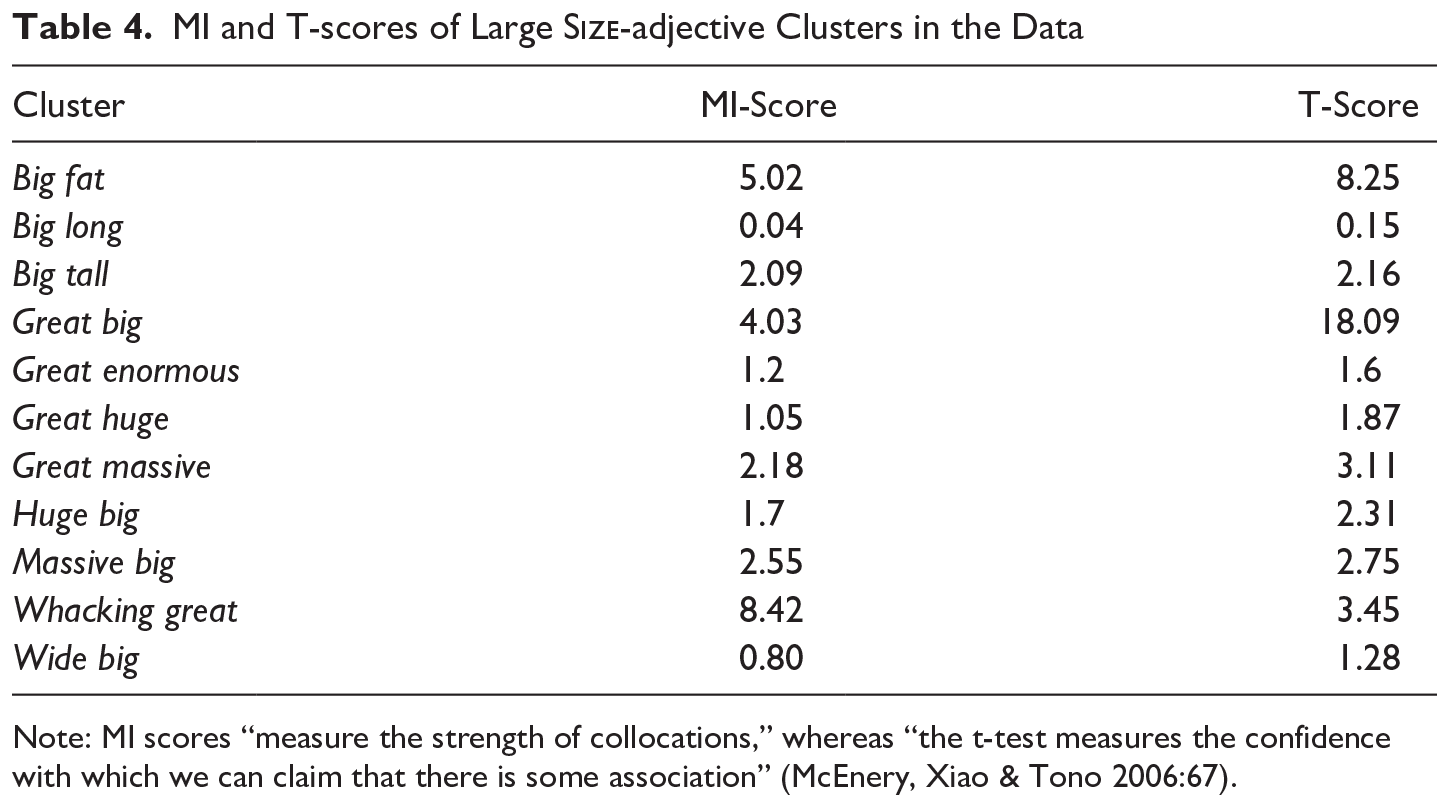
The perceptive reader may nevertheless question what makes these three clusters more prone to fixation (and further lexicalization) than the other size-clusters considered in this paper, as some other clusters examined in the paper also appear to be non-reversible, and all clusters are originally tautological and emphatic units. In this respect, statistical tests of collocational significance show that the adjectives in great big, big fat, and whacking great have the highest MI- and T-scores of all the clusters considered here (see Table 4). This, in turn, facilitates their routinization and subsequent reanalysis as a single unit (see Bybee 2003:603; Ghesquière, Davidse & Van Linden 2013:107).
Note: MI scores “measure the strength of collocations,” whereas “the t-test measures the confidence with which we can claim that there is some association” (McEnery, Xiao & Tono 2006:67).
All in all, the data analysis indicates that the PDE period is one of stabilization and expansion for size-adjective clusters: stabilization, in the sense that the patterned structure of the clusters seems to consolidate itself in a lexico-grammatical frame (see Moon 1998) with a “fixed” slot occupied by well-established schematic dimensional adjectives (e.g., big, great, and little) and a variable slot where other (and often less frequent) (near)synonyms are accommodated. As regards expansion, the functional growth of the clusters has been noted above. Admittedly, such growth is at present mostly associated with particular size-clusters—yet it does indicate the (type-) productivity of the construction.
5. Tautological Intensification in the English NP: A Contextualization
The previous sections have explored the development of tautological intensification in the history of English. They show that tautological size-clusters are, in a very general sense, a “side-effect” of the unfolding of the NP structure and, more specifically, of the gradual development of a syn-semantic scope of NP modification. The present section aims at contextualizing the development of tautological size-clusters within the broad area of NP premodification and accretion.
As discussed in section 4, prior to the development of a semantic scopal modification (which allowed the appearance of prenominal adjectival juxtaposition), multi-adjectival NP modification was normally conveyed by coordination and/or postposition ([Adj.&Adj.] as in great and big dog or [Adj. N Adj.] as in great dog big). Accretive adjective structures of the type Adj.&Adj. were well-entrenched in the language as instantiations of what previous scholarship has labeled as “repetitive word pairs” or “repetitive binomials” (Koskenniemi 1968:11; Schaefer 2012:288). Similar functions to those described in section 2 (see a-d) were associated with these coordinative accretive patterns. The rise of tautological size-clusters in English meant the addition of a new option to the intensificatory functional space of the NP. It is therefore the aim of the next section to explore the possible “competition” between tautological options (e.g., massive great house versus massive and great house), with a view to offering a better understanding of the establishment of size-clusters in the history of English.
5.1. Coordinated versus Non-coordinated Tautological Size-adjective Patterns in English: A Quantitative Comparison
Due to reasons of time and space, only the PENN and ARCHER collections (1150-1970) were used for this analysis. All tautological coordinated size-adjective patterns were retrieved from the corpora through the search string [*_jj *_conj *_jj] (where conj stands for ‘any kind of conjunction’). For the sake of completeness, the structural adjective options noted for OE/ME (ambilateral adjective placement and and-adjective construction; see 4.1) were also included in the analysis, although the short-lived nature and low frequency of these options was a priori expected.
8
As in section 3, the results from the general search(es) were then manually pruned down to those featuring only two synonymous size-adjectives. Cases where each element of the coordination is further submodified by an adverb were discarded from the tally in order to provide as symmetrical a comparison with (non-coordinated) tautological clusters as possible (see 16 and 17).
(16) Bedwere smyte of hes heuede, and bryng it to +te hoste to shewe ham for a wonder. for it was so grete & so huge. (PPCME2,CMBRUT3,85.2578/ID)
‘Bedwere cut off its head and brought it to the host to show it as an extraordinary thing because it was so great and so huge’
(17) For the erthe is full large & full gret & holt in roundness [. . .] (PPCME2,CMMANDEV,123.2991/ID)
‘Because the earth is full large & full great and preserved in roundness [it is ‘round’]’
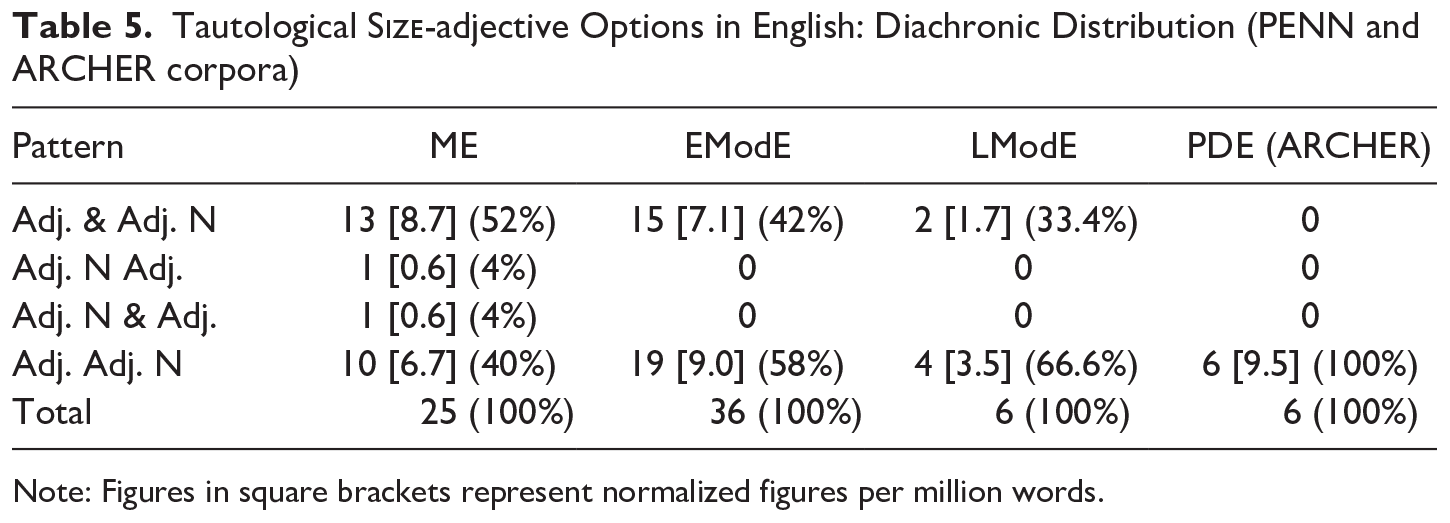
Table 5 summarizes the frequencies of the two patterns across time. The results show the gradual demise of coordinated tautological patterns and the parallel rise of the size-adjective clusters. By the end of the LModE period, virtually no coordinated patterns are attested. Conversely, the frequency of tautological size-clusters has noticeably increased across time. Ambilateral and and-adjective constructions are, as expected, not operative after the ME period.
Note: Figures in square brackets represent normalized figures per million words.
No significant differences among coordinated size-adjective patterns and size-clusters were observed in terms of the nouns that they combine with (a balanced range of concrete and abstract nouns), nor in the meanings that they convey (a preference for physical dimension senses, but where non-physical and metaphorical dimensions are also attested; see 18 and 19). There are also no clear patterns in the functions that they perform (noun modification). The only noticeable difference concerned syntactic position: whereas tautological size-clusters are mainly attributive constructions (98 percent across the ME to LModE periods), the coordinated tautological adjective patterns show a more balanced distribution between attributive and non-attributive (predicative and postpositive) positions (40 percent of non-attributive examples across ME to LModE; see 17). This positional difference between structure types is statistically significant (χ2(1, N = 69) = 10.81, p >.01). One should note in this respect that coordinated size-patterns are prosodically and syntactically “heavier” structures than size-adjective clusters and therefore more likely to allow predicative placement in line with the principle of end-weight (Rosenbach 2002:37; Berlage 2014:24).
(18) [. . .] +tere is often feres in +tat playn; and +tere becometh the water gret & large [. . .] (PPCME2,CMMANDEV,69.1731/ID)
‘there are often fairs in that land, and there becomes the water great and large’
(19) [. . .] the best drinke they had, they called Beueridge, halfe wine and halfe putrified water mingled togither, and yet a very small and short allowance [. . .] (PPCME,CLOWESOBS-E2-P2,40)
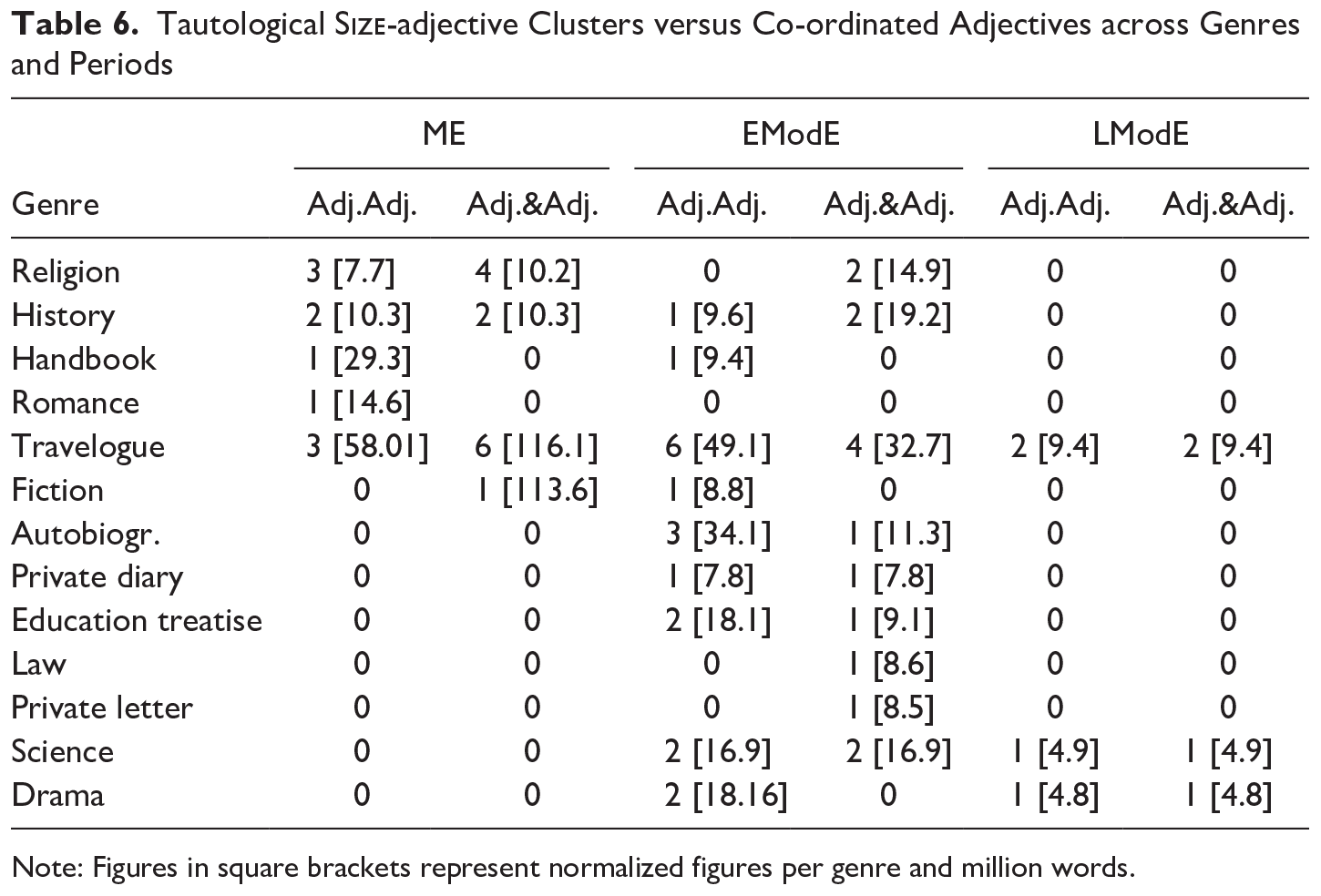
Coordinated and non-coordinated size-adjective patterns also seem to be similarly widely distributed across genres (see Table 6) but with a noticeable preference for travel writing across periods.
Note: Figures in square brackets represent normalized figures per genre and million words.
5.2. Coordinated versus Non-coordinated Tautological size-adjective Patterns in English: A Qualitative Comparison
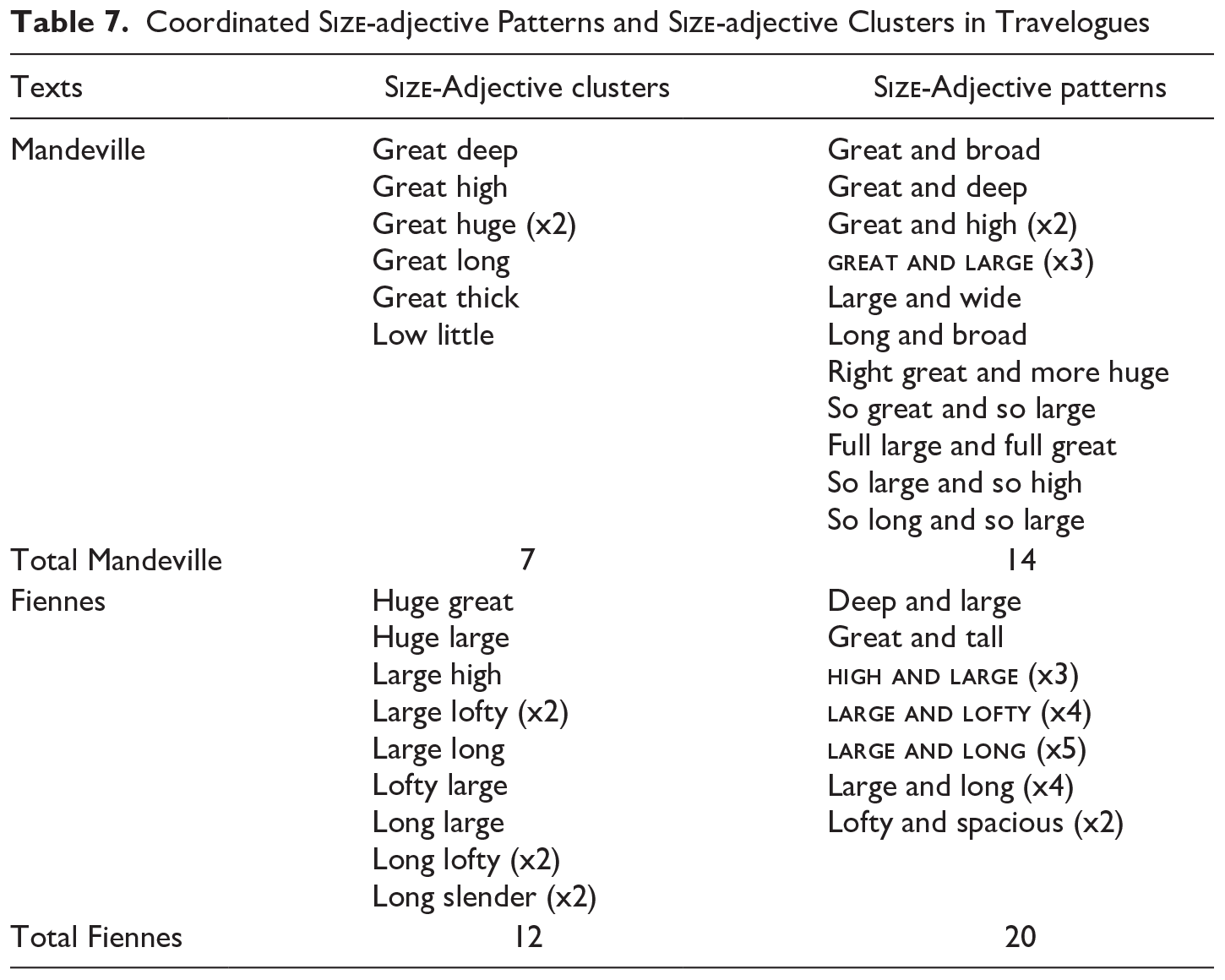
A close, qualitative look at the use of the two strategies in context is instructive to further assess whether differences between the two structures are one of style. The texts selected for this analysis come from travelogues (the text-type where both size-adjective patterns and clusters are consistently attested across time; see Table 6) and two particular works, i.e., Mandeville’s travels (circa 1400) and Celia Fiennes’ Through England on a side saddle in the time of William and Mary (circa 1698). The analysis of the PPCME2 and PPCME data (see Table 6) indicates that both works feature a sizeable number of examples of either strategy and come from two different periods, thus providing a clearer picture of their stylistic-pragmatic competition across time.
Full versions of the works were obtained through the University of Pennsylvania’s open online resources (Fiennes) and The Internet Archive (Mandeville) and made into .txt versions.
9
MonoconcPro 2.2 was used to make wordlists of both works, from which all size-adjectives were retrieved. Concordances for those size-adjectives (with all their spelling variants) were created and examples where two co-occurred, syndetically or asyndetically, were selected.
10
Table 7 summarizes the results of the analysis.
Across both texts, the types of nouns modified by the coordinated patterns and the size-clusters are the same, i.e., nouns referring to natural elements, cities, peoples, and places (see examples in this section). This is, of course, something to be expected, as ME and EModE travelogues are supposed to provide contemporaneous readers with “objective” information about peoples and locations that they are unlikely to visit. Focusing now on the use of coordinated size-adjective patterns versus size-clusters, both texts record the greater syntactic variability of the coordinated patterns in their ability to accommodate submodifiers for each of the adjectives of the pair (see, e.g., 20)—which is not possible for the cluster option. In terms of pragmatics, however, no noticeable differences are attested between them. Both seem to be deployed for emphasis and stylistic effect. They often appear in the proximity of another size-adjective (often one of the ones in the respective pair), to enhance the lexical variation of a text, as in the deployment of different dimensional options: “long walk” versus “large long pond” versus “great pond” in (21), and great versus “huge great pieces” in (22).
(20) Also the cytee of Cayre is right gret and more huge +tan +tat of Babyloyne the lesse And it sytt ahouew toward the desert of Syrye a lytill abouen the ryuere abouesoyd. (Mandeville, ch. 7, p. 29)
‘Also the city of Cairo is very great and more huge than that of Babylon the Less. And it sits [unclear] towards the desert of Syria a little above the river abovesaid
(21) Then you pass on to a long green walke . . . and just at the End of the pleasure garden begins a Large and Long pond or Cannall—ye Length of the walke, wch is its bank cut fine. [. . .] here is another great pond on the Right side of the house, and two more in the grounds belonging to it on the Left. (Fiennes, A further description of Epsome Hamption Court and Windsor, p. 82)
(22) There are great Coale pitts of the Channell Coale thats Cloven huge great pieces: they have great wheeles that are turned wth horses yt draw up the water [. . .] (Fiennes, My great journey to Newcastle and to Cornwall, p.148)
5.3. Discussion
My study indicates that the establishment of size-adjective clusters in English can be best described as a case of a functional-structural renewal. Both size-adjective patterns and size-adjective clusters share the same functional niche (emphatic adjectival meanings), from which the size-adjective clusters quickly oust the coordinated constructions. Structural and stylistic reasons may have helped in this respect. First, the above-mentioned restructuring of the NP organization meant that stacked adjective strings became the “norm” because of their more efficient and compact way of conveying information. To elaborate, Biber, Johansson, Leech, Conrad, and Finegan (1999:600-601) point out that, whereas co-ordination makes “the logical relationships among premodifiers explicit,” stacked adjective strings “can represent a large number of different structural/logical relations.” Size-adjective clusters structurally align with the newly-developed stacked adjective pattern, a fact that may have helped their establishment (through analogy with [non-tautological] stacked adjectives).
Second, coordinated tautological patters were, in OE and ME, stylistically-marked strategies associated with the conveyance of emphasis in rhetorical, formal styles (see 5.1 on repetitive binominals). Two aspects may be noted in this respect: first, repetitive binomials “ha[d] become [. . .] commonplace and tripling was required” for emphasis by the end of the sixteenth century (Adamson 1999:557). Second, those rhetorical styles that favored the use of binomials were “in decline” by the mid-seventeenth century. This in turn may have also contributed to the establishment of tautological size-adjective clusters as a new and—more importantly—stylistically unmarked emphatic option in the language (Adamson 1999:557-559).
Finally, it is worth noting here previous literature’s association of size-adjective clusters with informal, spoken environments in PDE (Huddleston & Pullum 2002:562; González-Díaz 2018:5-6). However, the data analyzed here suggest that such an association may be a (relatively) recent one: consider, in this respect, the diachronic preference for size-adjective clusters to appear in “written-based and purposed” genres (Culpeper & Kytö 2010:18) such as history or religious treatises, and, more importantly, their consistent association with travelogues (at least until the end of the LModE period; see Table 6). The historical association of size-clusters with travelogues is an interesting one. Modern travelers’ accounts often focus on the personal experience of the traveler and are “hardly informative about the places visited” (Gerbig 2010:154-157). By contrast, earlier (sixteenth-nineteenth century) travelogues “show much more concern about location or orientation [. . .]. [T]he focus is on reaching destinations, which makes the actual traveling process itself very newsworthy” (Gerbig 2010:154-157). size-clusters perfectly fit the stylistic bill of the earlier travelogues in that, as shown in (20)-(22), they are deployed to add emphasis and lexical variety to passages where spatial descriptions are key. Sociohistorical and cultural factors (e.g., the rise of the novel, technological and societal changes) led to the decline of the popularity of the travelogue. As noted by Zold (2014:225), however, “in seventeenth- and eighteenth-century Europe, travel narratives constituted one of the most widely read genres in literature, second only to theological texts.”
While more research is of course needed to substantiate the claim, it may be suggested that the two above-mentioned factors, namely, (a) the use of size-clusters as a stylistic resource (providing emphatic lexical variety) and (b) the sociocultural salience of travelogues in earlier periods, may have decisively contributed to the maintenance of size-clusters in the language (see the comments in section 2 on the disappearance of accretive strategies) and their further consolidation across genres: note, in this respect, that travel writing is, diachronically—and stylistically—related to genres such as fiction, diaries, or educational treatises (McKeon 1987; Blanton 1997; Bohls 2005).
6. Conclusion
At the most local, construction-specific level, this paper suggests that intensificatory tautology is a “side-effect” of the general functional expansion of the premodifying NP slot and, in particular, of the development of scopal modification. The analyses also show that, although a “minor” strategy, the overall (relative) frequency of tautological intensification increases in the history of English, and that it is in PDE when the construction expands its functional range (emphasizer and intensifier functions are attested by the side of their original noun modifier senses) and pragmatic distribution (the PDE association of size-adjective clusters with informal, spoken environments; see the comments in section 4.3).
At a more general level, the study shows the need for a wider understanding of the role of collocation in processes of intensifier development. Previous scholarship has demonstrated that collocations are “an important locus of grammatical development” (Torres Cacoullos & Walker 2011:238). In the particular case of intensifying constructions, it has also been consistently shown that collocation of (near-)synonymous adjectives often leads to the delexicalization/grammaticalization of the leftmost element and a subsequent development of degree-related functions (e.g., Mustanoja 1960:326; Vandewinkel & Davidse 2008; Ghesquière, Davidse & Van Linden 2013 on pure; Breban & Davidse 2016 for very). In the case of the size-adjective clusters that occupy us here, however, co-occurrence appears to lead to co-lexicalization and the entrenchment of a relatively abstract size unitary [Adj. + Adj.] pattern (which allows the productivity of the construction). Further work is therefore needed to explore and categorize the different ways in which collocation-based phenomena contribute to intensifier-creation in the NP and, more generally, how collocational matters interact with word-formation processes in these contexts.





 in English Language and Linguistics), the language of Jane Austen and her contemporaries (González-Díaz 2014 in Language and Literature and González-Díaz 2016 in Linguistics and literary history, John Benjamins), and collaborative work that has produced the first historical corpus of British schoolchildren’s writing (Yañez-Bouza and González-Díaz 2018 in Digital Scholarship in the Humanities).