



Abstract
Cognitive stylistics offers a renewed focus on readerly or audience interpretation, but while cognitive stylistic tools have been applied in the investigation of literary texts, their application to TV, film and screen has been more limited. This article examines the cognitive stylistic features of the voiceover narration in the first TV series adaptation of The Handmaid’s Tale to explore the representation of June/Offred’s ‘split selves’ and how these are mediated through a prominent ‘filmic composition device’. Through analysis of voiceovers and corresponding production choices in series 1, this study explores, first, how the different modes of communication – both choices of visual production (such as shallow-focus shots) and linguistic features (such as ‘you’ address and container metaphors) – combine to show Offred’s split perspective; and second, how these stylistic elements work to foreground the key themes of the series, such as imprisonment, objectification and surveillance.
Keywords
1. Introduction
The Handmaid’s Tale TV series, first broadcast in 2017, is based on the 1985 novel of the same name by the contemporary Canadian author Margaret Atwood. The series is set in a dystopian future America and follows June, also known as Offred, and her life as a Handmaid – a woman who is forced to bear children for wealthy families – under the theocratic totalitarian regime of Gilead. June/Offred has been placed in the household of one of the leaders of this regime, Commander Fred Waterford, and his wife Serena, and the first series follows June/Offred as she adjusts to her new life. Since its release, the series has received great critical acclaim, winning 8 Emmy Awards from 13 nominations as well as two Golden Globe awards for Best Television Series and Best Actress for Elizabeth Moss (who plays June/Offred).
The series is described by critics as particularly timely and prescient, representing themes and social issues which on occasion move a bit ‘too close’ to those in the current political climate (Fienberg, 2017). Indeed, when talking with The Guardian in an interview about her inspiration for the content of the book, Atwood (2017) acknowledges that ‘[w]hen it first came out it was viewed as being far-fetched’. She went on to add, ‘when I wrote it I was making sure I wasn’t putting anything into it that humans had not already done somewhere at some time’. For this reason, Atwood refers to The Handmaid’s Tale narrative as speculative fiction rather than science fiction (and makes a clear differentiation between the two genres, the former of which is categorised by its combination of narrative fiction with known social contexts) – and labels it, more specifically, as an Orwell-inspired ‘classic dystopia’ (Atwood, 2004: 516).
The novel features June/Offred as the first-person narrator who recounts her experiences in short sections that detail her present day and her previous life, as well as some of the events leading up to the inception of Gilead. In contrast to the sustained first-person narrative in the text, the series adaptation focalises the narrative through multiple characters – such as her friends, Ofglen and Moira; her husband, Luke; and the Commander’s Wife, Serena. June/Offred’s story remains prominent, however, and she is the only character given a voice through interior monologue. The focus on June/Offred in the series serves to personalise her voice and story, but ‘because of the torturous training she’s subjected to under Aunt Lydia (Ann Dowd), she conveys her deepest and most personal thoughts via voiceover only’ (Fienberg, 2017). As the analysis in section 4 of this article will explore, these voiceovers are often accompanied by ‘lingering close ups’ which create a strong sense of ‘claustrophobia’ for viewers (Hinds, 2017).
This article builds on previous stylistic approaches to film/drama which have combined analyses of verbal and visual choices (see McIntyre, 2008; Piazza, 2010) to explore these impressions of claustrophobia in The Handmaid’s Tale, series 1. Significantly, this article proposes a cognitively informed account of telecinematic style, which, while gaining interest in contemporary research in cognitive stylistics (see, for example, Gibbons and Whiteley, 2019; Gordejuela, 2019; Hoffmann and Kirner-Ludwig, 2020), is an area which has not yet been examined extensively. The analysis presented here further considers how the narrative is represented by both a distinctive filmic narrator and through the ‘split selves’ of the protagonist June/Offred. These ideas are introduced in the next two sections.
2. Point of view representation: novel to screen
Stylistic studies of film and TV have traditionally placed emphasis on the analysis of dialogue from a pragmatics perspective (see, for example, Bousfield, 2007; Sorlin, 2016; Statham, 2015) and on the adaptation of book to screen (e.g. Forceville, 2002), whereas film studies approaches traditionally explore visual cues alone. Recent accounts, however, have argued that a combined analysis of verbal and visual codes in film and other visual narratives would benefit from further exploration, especially given that language analysis has not historically been a priority in film studies (McIntyre, 2008; see also Piazza, 2010; Piazza et al., 2011). McIntyre’s (2008) study of Ian McKellen’s Richard III, for example, identified that traditional film studies approaches can overlook the use of dialogue and the interaction between language and non-language choices, and also can tend to fall at either end of the scale in terms of level of detail; exploring either macro-level issues of a film or a micro-analysis of specific frames. To provide an analysis that takes into account all of these considerations, McIntyre applies ideas from deixis, discourse structure and pragmatics alongside a breakdown of the visual elements of McKellen’s soliloquy scene. Through this account, McIntyre (2008) argues, first, that it is both ‘possible and profitable to incorporate the analysis of production and performance with a more traditional, text-based stylistic analysis of drama’, and second, that such analysis produces a more holistic, stylistically nuanced discussion; for ‘[o]nly by doing this are we able to accurately describe overlapping elements of production and identify in detail specific stylistic effects’ (p. 326).
It could be argued that the more prominent stylistic effects in the The Handmaid’s Tale series relate to viewers’ understanding of June/Offred’s character, specifically, as the ‘teller’ of the ‘tale’. However, though June/Offred narrates part of her story, film studies theorists also acknowledge the presence of a ‘filmic narrator’ (cf. Bordwell, 1997) in telecinematic narratives. To refer to this role, Jahn (2003) uses the term ‘filmic composition device’ (hereafter FCD) instead, as this label indicates that ‘the cinematic narrator is not a homogenous, monolithic agent with a humanlike voice’ but rather can be seen as ‘a separate agent or group of agents’ (Ghaffary and Nojoumian, 2013: 270) who put together what is seen on screen. In other words, there is not one single filmic narrator but a collective FCD, assembled by choices from a number of people, including the camera operator, the producer, the director and so on.
The FCD is strongly characterised in The Handmaid’s Tale series, and viewers acknowledge the production choices as being particularly distinctive or stylised (see Yuan, 2017, for an account of some of the more striking style choices with accompanying commentary from director Reed Morano). Such distinctive mise-en-scène style choices in the series relate to the use of colour, lighting, costume (see Bordwell and Thompson, 2001) and the sustained use of symmetrical composition (discussed in more detail in section 4). In the series, lighting is manipulated in the Gilead and pre-Gilead narrative strands, for example: Gilead scenes are filtered through a sepia/yellow tone, while pre-Gilead is brighter and has a colder/bluer tone. Such a contrast suggests that these different states are filtered through contrastingly more ‘realist’ as compared to more ‘romanticised’ lenses by the FCD. Similarly, colours are manipulated in other mise-en-scène choices such as costume. The different social roles of the characters are represented through different uniforms, mostly set through primary colours, with the deep red of the Handmaids’ clothes in particular often foregrounded in otherwise colourless scenes. These general choices regarding lighting, arrangement and tone mean that that ‘voice’ of the FCD is distinct and ‘striking’ (Yuan, 2017), and arguably never fully backgrounded.
Combining these ideas from film studies with stylistic concepts seems logical, as there are many intersections between film theory and theories of narrative. Indeed, Alber (2017) touches on this in his account of perspective and consciousness representation, and argues that ‘the overlaps between novelistic and cinematic strategies of consciousness representation are interesting and striking’, but that ‘they have hitherto been overlooked’ (p. 280). Alber (2017) suggests that interior monologues in film work analogously to those examples in prose, but while he categorises interior monologue as those examples in film which contain ‘longer passages of uninterrupted direct thought’, these are ‘usually without any narratorial mediation’ (p. 280). If we allow that the narrator is formed by the FCD, then its marked presence throughout the series can be seen to mediate, collaborate with and at times counter the verbal content of June/Offred’s voiceover. These ideas will be expanded on in further detail in the analysis sections (4 and 5).
2.1. Interior monologues as ‘split self’ presentation
Emmott (2002) uses the term ‘split selves’ ‘very broadly to include all cases of a character or real life individual being divided and/or duplicated in any way in a narrative’ (p. 154). In her account, Emmott explores the duplication of both characters and real-life individuals, examining examples from both fiction and non-fiction medical ‘life stories’. These examples consider individuals who ‘perceived themselves to be “split” [. . .] because of a transitory sense of experiential discontinuity or because of a traumatic life change’ (Emmott, 2002: 170). This idea is relevant for The Handmaid’s Tale, in which audiences encounter multiple iterations of June/Offred’s character. She is duplicated from the outset of the series: audiences learn in episode 1, for example, that her name is June but also Offred, identifying her pre-Gilead names as well as conferring her status as belonging to the Commander Fred in Gilead. Of course, more superordinately, she is also the ‘Handmaid’ whose tale we are listening to. She is further duplicated through flashbacks in other episodes: in episode 4, for instance, she is shown in her former life with her husband Luke and daughter Hannah when they visit a fair, while also revealed to be in her bedroom in Gilead as she mentally recounts the memory. In these contexts, the division of selves is signposted through visual splicing as well as through verbal choices (e.g. a shift in tense in the voiceover narration when returning to Gilead).
Emmott (2002) suggests that split self presentation might be ‘inherent in the narrative form, since first-person narratives generally invoke a current self reporting on a past self’ (pp. 153–154). Arguably, the inclusion of interior monologues in film similarly always encodes a split self presentation. Interior monologues are used ‘to convey a character’s thoughts, feelings or motivations at the auditory level’ (Alber, 2017: 277). In the voiceovers in the series, the narrating June/Offred we hear (June/Offred1) at the auditory level is contrasted with the silent June/Offred we see (June/Offred2), and at times further compared with the ‘enactor’ (Emmott, 1992) of herself we might see in a flashback (June/Offred3). In such cases, the representation of June/Offred occurs across modes and the voiceover is spatiotemporally displaced from the current visual narrative, which in turn also serves to foreground the FCD. Viewers may become aware of the artifice of the construction as the narrative is not a natural one, but rather one which has been edited or re-framed by the FCD.
The idea of mediation and the re-telling of narratives is a central theme in The Handmaid’s Tale novel. Like other Atwood narratives, the narrative has a reveal at the end of the story which re-frames the content of the rest of the tale (see Harrison and Nuttall, 2019): an epilogue finishes with a conference set in 2195 at which academics are discussing Gilead, long after its dissolution. It is revealed that June/Offred’s story presented in the first 300 pages of the book were a transcription of a series of cassettes recording her account. This framing is referenced in the adaptation’s first series, but not explicitly. After the opening sequence of episode 1, which recounts June/Offred being captured and her daughter, Hannah, being taken away, there is a quiet (compared to the noisy chase scene which precedes it), audible ‘click’ of an audio cassette recorder just before June/Offred begins her first interior monologue voiceover (see analysis in section 4). Such signposts suggest that this re-framing will be acknowledged in the series as it continues, though it remains to be seen how the epilogue will be addressed at the end of the final series. Consequently, it can be argued that a preoccupation with The Handmaid’s Tale narrative, across both novel and series, concerns the ownership, or mediation, of voice, and the removal of (narrator) agency. This theme is also identified in the title itself: the story is a ‘tale’, which is a label that ‘removes it at least slightly from the realm of mundane works and days’, while the term ‘story’, conversely, ‘might well be a true story about what we usually agree to call “real life”’ (Atwood, 2014: 309). Audiences are therefore primed for a narrative removed from ‘real life’, even though the themes and content are highly familiar.
3. Voiceovers in The Handmaid’s Tale
The data for the analysis in the following sections (4–5) consist of the transcription of the voiceovers in the 10 episodes of The Handmaid’s Tale, series 1 (MGM and Hulu, 2017). The number of voiceovers ranged from 1 to 14 per episode, with a mean of 5 per episode across the series. In the analysis that follows, each voiceover is referenced according to the episode and where it appears in the chronology of voiceovers for that episode (e.g. 10.4). Following Piazza (2010), for some parts of the analysis, key sections of the data (verbal text) are represented in tables alongside the corresponding production choices (visual text and notable paralinguistic choices). The analysis will not consider the non-speech sound stream which makes up the third channel of communication in film and TV (Toolan, 2014: 462) as this is beyond the scope of the article, although the diegetic and non-diegetic sound and music choices are also noteworthy.
The first episode comprises the highest number of voiceovers (14), which are mainly used for narrative exposition (‘The knock is prescribed ’cause tonight this room is her domain. It’s a little thing, but in this house, little things mean everything’, 1.11), or to voice June/Offred’s response to the conversation that is not diegetically vocalised (‘I kind of want to tell her that I sincerely believe that Ofglen is a pious little shit with a broomstick up her ass’, 1.3). The function of the voiceovers changes across the series, however, and they become a means of suggesting June/Offred’s rhetorical dialogue (‘Am I not the first he’s invited to this room? What happened? Did she say the wrong thing?’, 4.8), or a way of signposting the introduction of a flashback (‘She comes to me so clearly in the bath’, 1.10). This happens most frequently in episode 4, ‘Nolite te bastardes carborundorum’. 1 In this episode, June/Offred has been banished to her room and has not been allowed to leave the house for some time due to a fall-out with Serena. June/Offred becomes frustrated and depressed, calling up past memories as a means of coping with her present reality. In contrast, particular episodes have significantly fewer voiceovers, and this occurs when the episode departs from June/Offred’s focalisation: episodes 6 (‘A Woman’s Place’) and 7 (‘The Other Side’), for example, are centred on Serena and Luke’s backstories, respectively, and feature only one voiceover from June/Offred in each episode.
The next two sections of analysis build on these initial observations to explore the verbal and visual style choices that accompany the occurrences of the voiceovers, and to examine, first, how they function in the series, and second, how this impacts on the representation of split selves.
4. Offred onstage
One of the most distinctive visual techniques used in the The Handmaid’s Tale, which frequently accompanies the use of June/Offred’s voiceover (June/Offred1), is the prevalence of symmetrical-composition shots to represent June/Offred2: the ‘self’ shown on screen. These are cinematic shots with near-perfect symmetry, popular with director Stanley Kubrick (see Kolker, 2015), and which work by drawing viewers’ attention to a specific focal point at the centre of the scene. Such staging is seen to create a sense of uneasiness or dread because viewers can be positioned to wait for the focal point to be revealed, and because the uncanniness of the composition can indicate a sense of entrapment (Pezzotta, 2013: 80). In The Handmaid’s Tale, this composition can be frequently observed with June/Offred’s figure or face forming the focal (or ‘vanishing’) point of the scene (see Figure 1). 2 Doors and windows also frequently form the centre point of a scene, which helps foreground the central themes of imprisonment and surveillance that run throughout the series (see section 5.2).
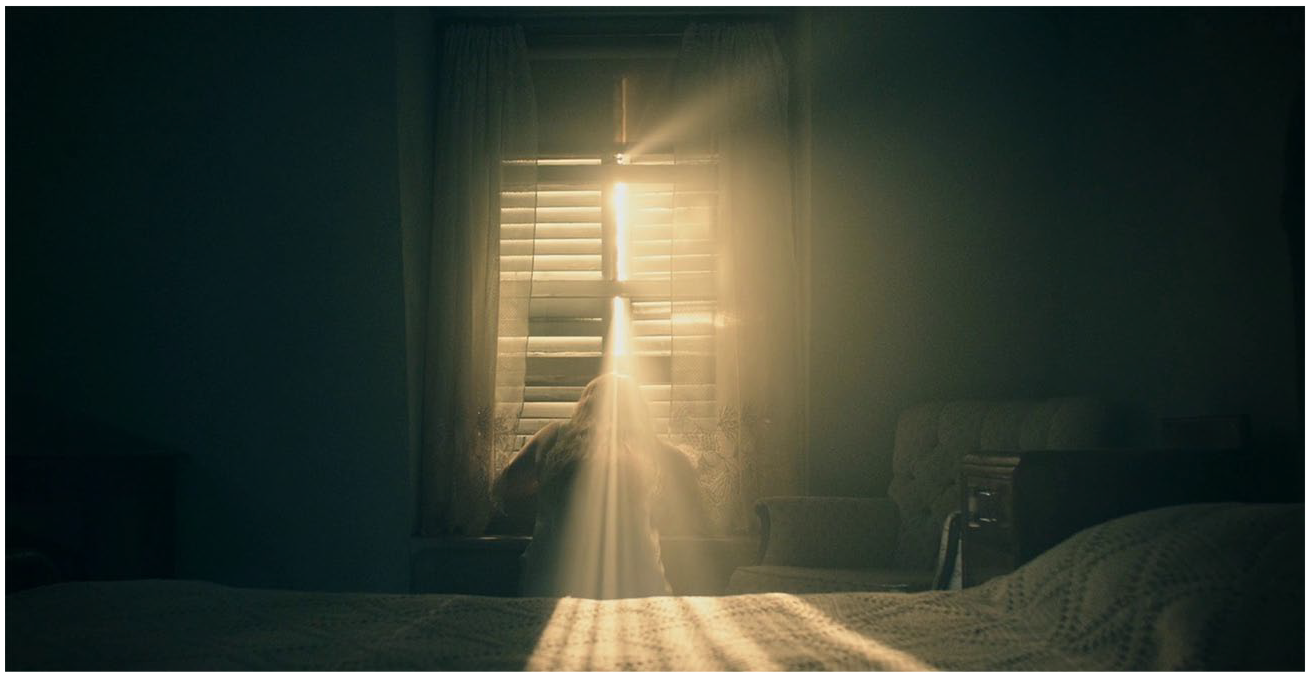
Symmetrical composition from episode 4, ‘Nolite te bastardes carborundorum’, (MGM and Hulu, 2017).
The Handmaid’s Tale’s use of symmetrical composition, however, differs from traditional applications of this composition as the depth of perception is often much shallower, and the vanishing point is not always placed far away from the camera. Shallow focus is ‘an approach in which several planes of focus are incorporated within a single image’ (Mamer, 2008: 19). When this occurs in conjunction with voiceovers, viewers are positioned close to a particular character (or object) in the scene who is represented in great detail and clarity, and other elements of the scene are backgrounded through schematisation or visual ‘modalisation’ (Kress and van Leeuwen, 1996). This configuration can be seen in the shot reproduced in Figure 2.
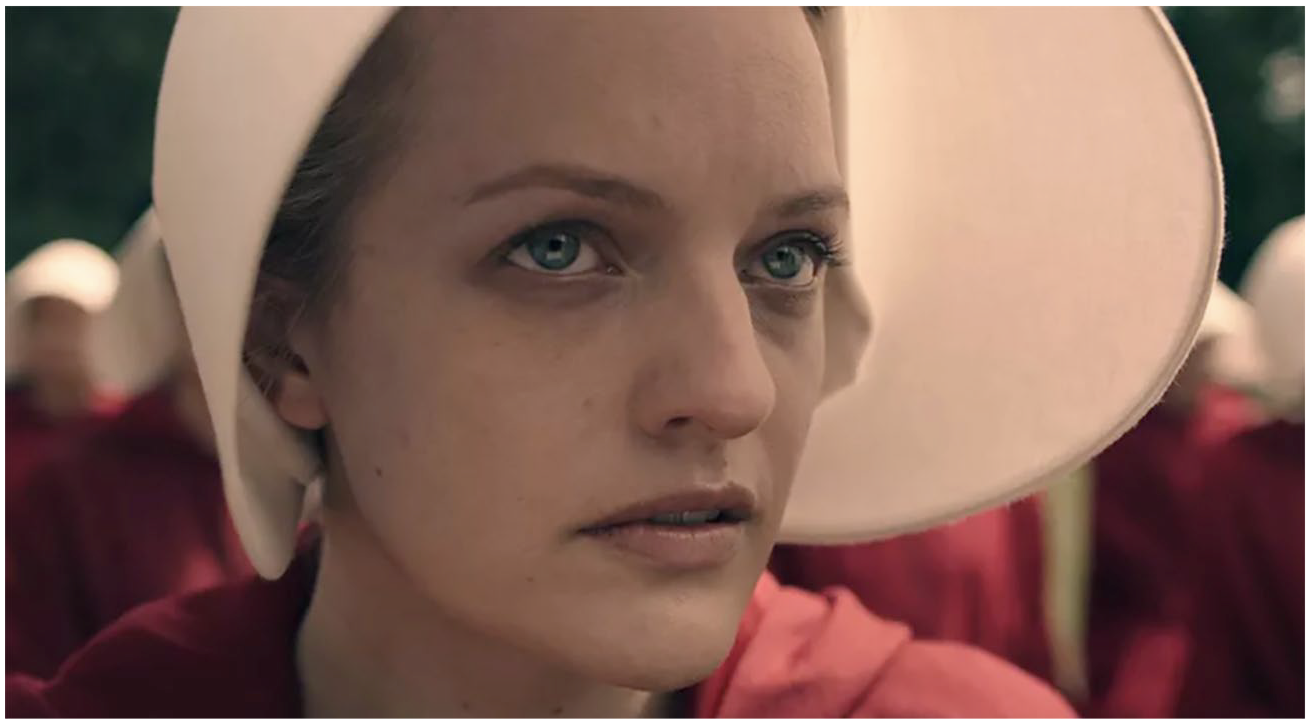
Shallow-focus shot from episode 1, ‘Offred’, (MGM and Hulu 2017).
During voiceovers and in other scenes throughout the series, June/Offred’s face is shown very clearly, very close to the camera. These close up shots allow the audience greater emotional connection to a character but also increase the sense of claustrophobia generated by such an arrangement, and the close alignment with a character perspective (both literally and figuratively) can become, at times, uncomfortable. It is this discomfort that means that the conjunction of a voiceover with a close up of character face is typically associated with horror (e.g. Alber (2017: 277) describes how the use of this technique in Hitchcock’s Psycho is somewhat ‘disconcerting’). Furthermore, such a close focus on the character’s face narrows the visual field and therefore restricts the visual information offered to viewers. In turn, this physical constraint mirrors the metaphorical implications of June/Offred’s limited perspective in Gilead.
Film theory states that when a character’s gaze is off to the side, viewers are primed for a ‘point of view’ shot (Branigan, 1984). Also called a ‘subjective shot’, this occurs where ‘the camera assumes the position of the subject in order to show us what the subject sees’ (Branigan, 1984: 103). In these kinds of sequences in The Handmaid’s Tale, viewers anticipate that the next scene will reveal the object of the character’s attention. Instead, what happens here is that, rather than follow the line of June/Offred’s gaze, the camera remains on her face for extended sequences. This heightens the intimacy felt between viewer and character and arguably further contributes to the feeling of claustrophobia generated by the series. Both shallow-focus and symmetrical-composition techniques can be observed in the shots that accompany the first voiceover of series 1 (see Table 1).
Verbal and visual text of voiceover 1.1.
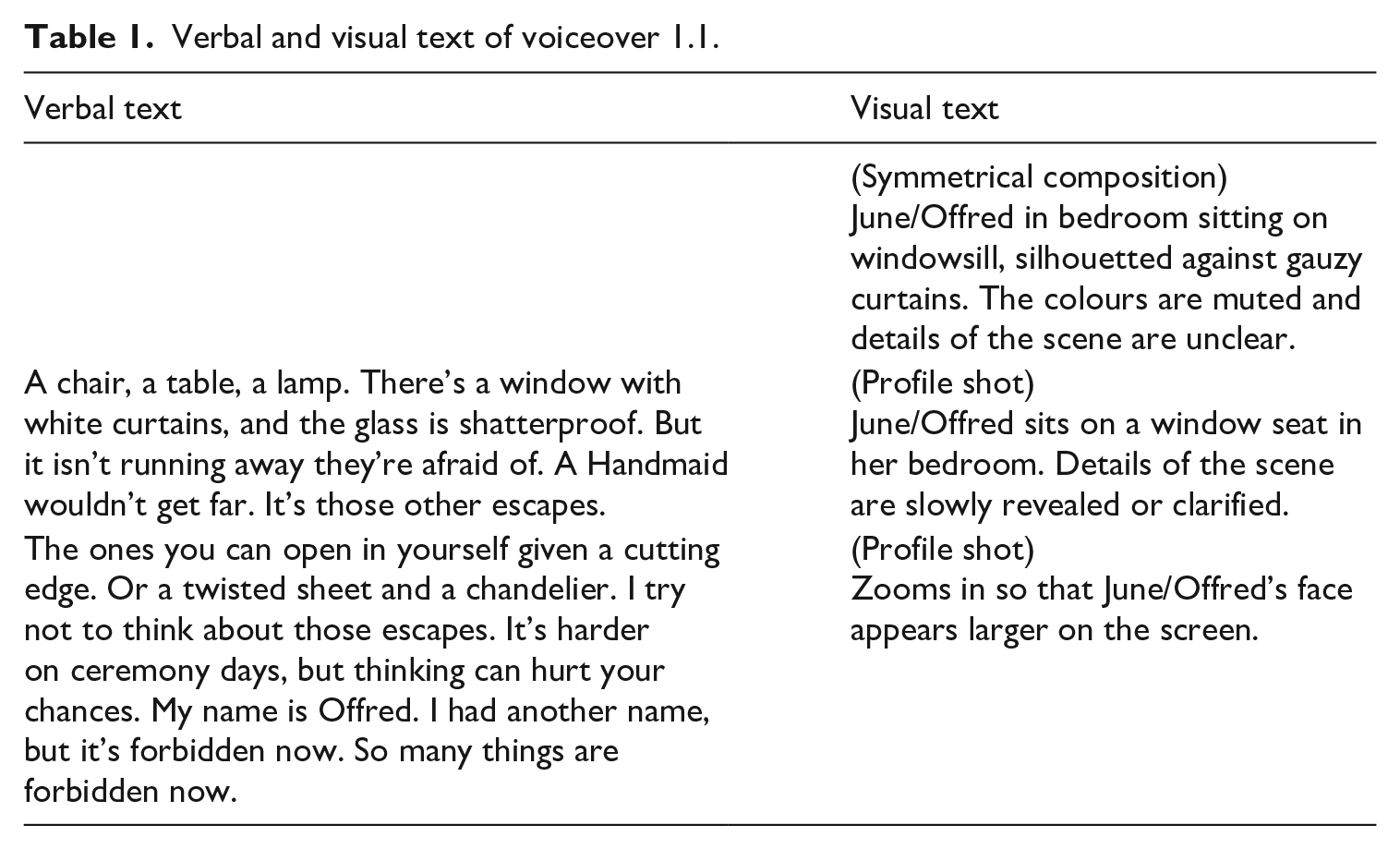
June/Offred1’s narration mirrors the opening sentences of the novel, which show a sequential ordering of items is listed in an atemporal (‘A chair, a table, a lamp’) and then present-tense narrative (‘There’s a window with white curtains’). Nuttall’s (2014) analysis of this scene in the prose narrative identifies how this sequence of attentional frames can create a ‘collage’ or ‘puzzle’ effect (p. 98), thereby challenging readers’ conceptualisation of the fictional world represented. In the visual text of this voiceover, viewers’ conceptualisation of the scene is challenged through the fact that the silhouette cast by June/Offred and the hazy light/contrasting darkness in the rest of the shot renders details difficult to discern initially. The sequential introduction of objects in the room is brought out visually, however, as the scene progresses – though these details relate to June/Offred (the colour of the dress, her facial expression), rather than those objects in the room she is describing. This creates a zooming in effect where the camera moves closer and closer to June/Offred’s perspective as the voiceover progresses, but without clarifying what she describes. Although she is the focaliser of the scene, she increasingly becomes the centre of attention. In other words, audiences contemplate her visually, while she contemplates other things verbally.
These techniques both isolate June/Offred’s position in space and also create separation between her and her surroundings. This division occurs in the verbal text where June/Offred can be seen to separate herself mentally from her new situation. She distances herself from the rest of the Handmaids (she states, for example, that ‘A Handmaid wouldn’t get far’ rather than associating herself with that group: ‘I wouldn’t get far’), as well as the means of escape available to those in this group, as evidenced through the use of distal deixis (‘it’s those other escapes’), and even despite the fact this is a preoccupation of her thoughts (‘I try not to think of those escapes’). The ‘otherness’ of her new identity is also explicitly mentioned when she references that she had ‘another name’. Given that the nominal profiles in the start of the voiceover relate to objects in a domestic setting (‘A chair, a table, a lamp’), the reference to ‘opening an escape’ could initially be interpreted literally; viewers might think of opening a door to escape. However, the addition of ‘in yourself’ indicates the physical act June/Offred is describing, referencing the body as a kind of container in which pathways can be opened (see section 5.2 of this article). The episode finishes with June/Offred stating ‘My name is June’, though audiences may be aware that the episode is titled ‘Offred’. Consequently, even at the macro-level of the episode, this division of self has been acknowledged.
At other points in the series, the visual text and choices of the FCD work in concert with the verbal text. In voiceover 2.2 (outlined in Table 2) in the second episode, ‘Birth Day’, for example, June/Offred’s verbal text similarly acknowledges a division and separation between herself (‘us’) and the rulers of Gilead ( ‘them’), and she questions whether to categorise herself among the latter group (‘There is an “us”?’). The verbal text moves from being epistemically modalised (‘it seems imagined, like secrets in the fifth grade’; ‘It doesn’t seem as if it should be the true shape of the world’) to more categorical: ‘Now, darkness and secrets are everywhere’. Unlike the visual choices in voiceover 1.1, however, there is some support from the FCD as to the content of the verbal text: namely, the bars of the gate she is standing next to are visible as she is talking about this societal division.
Verbal and visual text of voiceover 2.2.
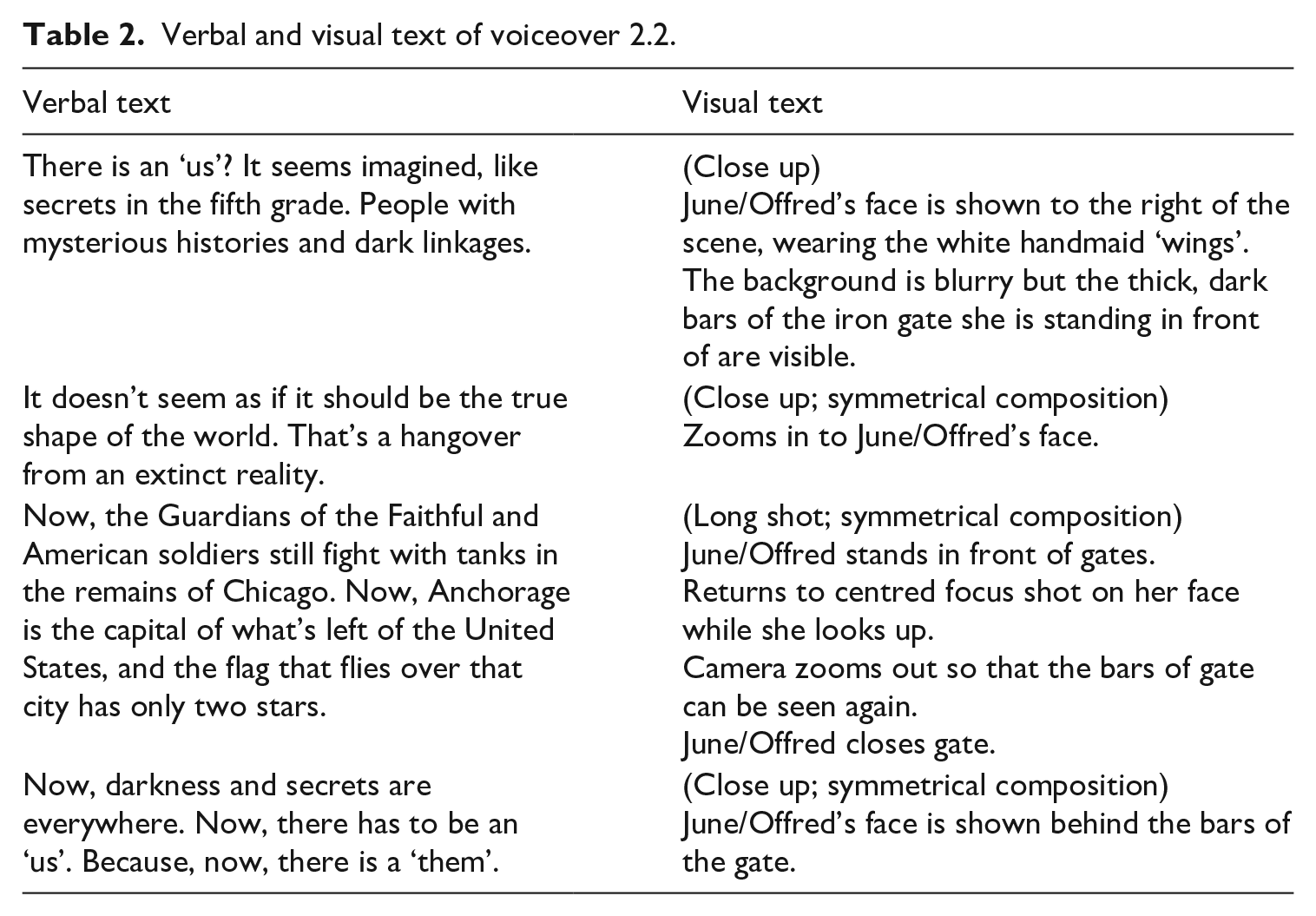
The rest of the verbal text mimics a political template. June/Offred provides exposition of the current situation and a comparison with the past by mentioning ‘Now’ in three successive declarative sentences, and by acknowledging the new Heads of State (‘the Guardians of the Faithful’) and the new capital (‘Anchorage’). Despite these rhetorical choices which are hallmarks of spoken political discourse, as Fienberg (2017) notes in her review, Offred is able to reveal her thoughts ‘via voiceover only’. This lack of freedom is foregrounded by the FCD on the visual level. One of the only discernible parts of the background are the bars of the gate, for example, and the camera follows her physical movement in front of, to behind, the bars of the gate. The FCD becomes collaborative at this point; unifying the voice of June/Offred1 with the visual presentation of June/Offred2.
Observing June/Offred visually while she contemplates other matters verbally creates a clash between the familiar and the impersonal, which is a phenomenon also brought about through the choice of shallow-focus shots alongside voiceover narration. Kozloff (1988) argues that voiceovers are a humanising device (p. 128) (see also Piazza, 2010: 178). At the same time, however, shallow-focus cinematography is associated with unreality, since its use ‘can create a purposefully less realistic image – one that manipulates viewer attention and suggests different planes of action both literally and figuratively’ (Mamer, 2008: 19). Consequently, the interplay between image and text in the scenes where a voiceover is accompanied by a shallow-focus shot of June/Offred’s face creates an unsettling imbalance between artifice and reality. The voiceover humanises her, but the choices of the FCD detaches the audience from her character. Such a tug-of-war between the metaphorical and the humanised again could be argued to foreground the division of the self represented here: June/Offred is both humanised to viewers and objectified in her current surroundings. The FCD shows her as an isolated character who narrates what is on her mind, but does not visually reveal what she is thinking about. Although there are moments of collaboration where symbolic references are made in the visual text (as in the latter example of the bars of the gate), the objects of her contemplation are not revealed in detail to viewers.
This first section of analysis has demonstrated how the verbal and visual texts work together to represent June/Offred as someone divided and introspective; exploring the representation of how she channels her thoughts and agency inwards rather than outwards. In addition, June/Offred is represented as a character whom audiences are invited to contemplate as the object of attention, even while she dwells on other topics. The next section explores how June/Offred is further divided through audience address (5.1) and recurrent metaphor choices (5.2).
5. June/Offred: further divided selves
5.1. Addressing ‘you’
Given that the Handmaid’s ‘tale’ in the book is a recording of June/Offred’s tale, viewers may be expecting an intended recipient for her narrative to be revealed. However, June/Offred’s isolation is further emphasised through the absence of a clear addressee, who remains ambiguous at both the verbal and the visual level. Across the series as a whole, June/Offred’s gaze is rarely directed to the audience explicitly. This is unlike, for example, the character Francis Underwood in the House of Cards series who directly engages the viewer with second person address and whose monologue is delivered on the same diegetic plane as the scene (see Sorlin, 2016). Despite June/Offred’s central positioning and the direct close ups of her face, her gaze during voiceovers is often just off-centre, looking at an unknown point out of sight (see Figure 2) and not directly at the audience.
Similarly, the verbal text also represents an ambiguous addressee, in that the ‘you’ referent changes across the series. At times, the address can be regarded as simply ‘generalized’ (Herman, 1994), with June/Offred commenting on facts which are relevant universally in the world (‘You can wet the rim of a glass and run your finger around the rim and it will make a sound’, 4.6), or in Gilead, specifically (‘The chances for a healthy birth are one in five, if you can get pregnant at all’, 2.4). This type of ‘generalized’ you address can also be seen in voiceover 1.1, mentioned in the previous section, where June/Offred mentions of ‘you’, ‘yourself’ and ‘your chances’ – although given the content of the verbal text here, this could also be considered a form of telecinematic ‘self-referential’ address (Gibbons and Whiteley, 2019) in which June/Offred relays potential options to herself via interior monologue. This dialogue between selves can also be seen at other points in the series where June/Offred more performatively assumes the role of different enactors. At the end of episode 3, for example, in reference to not being pregnant despite the hopes of the household, she admonishes herself with ‘No ice cream for you this month, young lady’ (3.4). At other points, June/Offred enacts other characters in the series. At the end of voiceover 1.13, for instance, she says (echoing Moira’s words from an earlier flashback), ‘Keep your fucking shit together’.
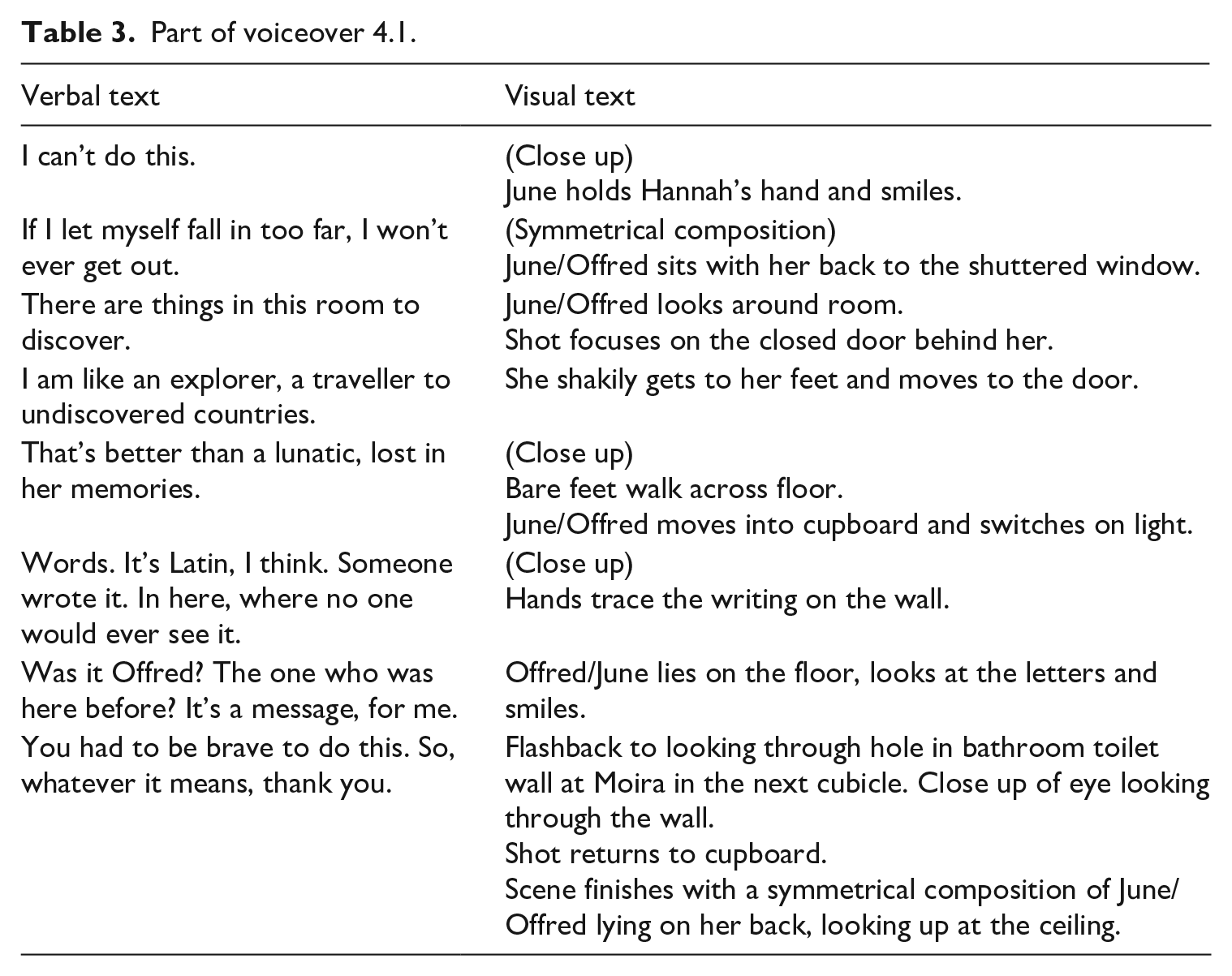
Occasionally, however, the ‘you’ has a clear referent within the series that is not June/Offred. In her only voiceover in episode 7 (‘I love you so much. Save Hannah’, 7.1), unusually she is absent from the visual text, which shows Luke reading the letter while June/Offred1’s voice narrates. Similarly, June/Offred addresses the previous Offred through a voiceover in episode 4, in response to reading a hidden scratched message in a cupboard in her room: ‘You had to be brave to do this. So, whatever it means, thank you’ (4.1). These are examples of ‘fictionalised horizontal address’ (Herman, 1994) which reference a character on the same diegetic plane of the story (rather than being, for example, a direct plea to the real-world audience). Occasionally, this horizontal address functions outside of the confines of the voiceover through either spoken discourse (on the same diegetic plane as the narrative) or through written text representation. This can be observed in episode 8, where, in response to a gift from Serena of a jewellery box with a dancing ballerina in the lid, June/Offred states via voiceover ‘I will not be that girl in the box’ (8.4), and then writes ‘you are not alone’ on the wall in her bedroom cupboard. A combination of both horizontal address and self-reflexive address can also be observed, as in the moment where she addresses Moira, but then switches in the final two directives: ‘Moira, you wouldn’t stand for this shit. You wouldn’t let them keep you in this room for two weeks. You’d find a way out. You’d escape. Get up. Get your crazy ass up’ (4.7).
However categorised, the ‘you’ invites viewers to consider the addressee of June/Offred’s tale, and therefore further evokes the transcription template mentioned in the epilogue of the novel. The performative aspect of the voiceover and the ‘you’ address are reminders that this is a tale about her life, which might be oriented towards a particular person or audience. In addition, the number of characters directly addressed (Moira, Luke, past/future Offred) function as signposts of June/Offred’s multiple social roles: wife, mother, friend, Handmaid. At the same time, the use of self-referential address is a clear indication of her split selves. She has no one to talk to within the confines of Gilead, and therefore can ultimately only narrate thoughts to herself.
5.2. (Container) metaphors
This final section of analysis explores how June/Offred’s presentation of self is further split through the metaphors in the series. Building on the earlier work on self and container metaphors by Lakoff (1996), Emmott (2002) considers particular manifestations of how container metaphors are used in fiction and non-fiction narrative representations of the self. Looking at The Diving-Bell and the Butterfly (Bauby, 1998), for example, she examines how a
Key metaphors which run throughout The Handmaid’s Tale relate to body parts and their metonymic relationships to the wider world. An ‘Eye’, for example, is the term for someone who spies for the Gilead authorities (‘Maybe he watches me. Maybe he’s an Eye’, 1.4), and eyes are foregrounded in the visual text frequently (as in the final scene described in the visual text in Table 3). Similarly, hands are also referenced across both visual and verbal text. Of course, they form part of the term ‘Handmaid’ itself, and the various refrains spoken to each other in greeting also echo both of these choices (‘By his hand’; ‘Under his eye’). While, ‘In Gilead, hands and feet are pronounced non-essential tools’ (Staels, 2008: 458), the concept of hands as representing agency is nevertheless acknowledged, and is so poignantly in the line from the final voiceover of the series: ‘I have given myself over into the hands of strangers’ (10.5). These metaphors draw on culturally entrenched ideas of both agency and surveillance, and the isolation of particular body parts is also emblematic of the wider objectification of Handmaids in Gilead. Such ‘chains’ of repetition (Forceville, 2002) consequently support the de-humanisation of June/Offred, which is further acknowledged in comparisons she makes between herself and animals (‘Washed and brushed like a prize pig’, 1.10; ‘We’re two-legged wombs’, 2.3) or inanimate entities (‘This is what I feel like, this sound of glass. I feel like the word “shatter”’, 4.6) and via explicit ‘othering’ through negation (‘I don’t want to be a doll, hung up on the wall’, 3.3; ‘I will not be that girl in the box’, 8.4).
Part of voiceover 4.1.
The most prominent metaphors, though, like in Emmott’s (2002) analysis, relate to a superordinate
This voiceover continues after June/Offred experiences a flashback to a time pre-Gilead where she was with Luke and Hannah at a fair. The present tense ‘I can’t do this’ marks a shift from the previous part of the voiceover, which is narrated in the past tense, and therefore shows a spatiotemporal lag: June/Offred is aware that she should not dwell on memories for the sake of her mental health (as signposted in the verbal text), but is reluctant to return to the present (as indicated by the delay in the visual text). Here, this discordance between the verbal and the visual texts suggests not only this reluctance but also her disorientation in this episode. Despite her self-instruction, she is in part becoming ‘lost in her memories’ (see Giovanelli and Harrison, 2018: 12–16, for a discussion of how the
The first metaphor observed here is
Similarly, June/Offred draws on an ‘elaboration’ (Lakoff and Turner, 1989) of this first metaphor in her description of
6. Conclusion
This analysis has combined concepts from film studies with ideas from cognitive stylistics to explore how the visual and verbal choices in this first series work to show the ‘split’ presentation of June/Offred. Building on the work of previous studies (McIntyre, 2008; Piazza, 2010), this combined approach has further demonstrated how ideas from these two areas can be successfully synthesised to produce a holistic, multimodal analysis that captures the experience and interpretive effects elicited by telecinematic narratives. June/Offred is not one character, but many, and is represented through a division of mind and body, through her various social roles, and through how these are shown via the various enactors of her character through time. As the final analysis in section 5.2 observed, her divisions of self can also be explored through the metaphors she draws on to describe her feelings and mental states. While Emmott (2002) argues that instances of splitting are a phenomenon that ‘arises[s] naturally from the nature of the human self and from the form of narrative’ (p. 161), in The Handmaid’s Tale, this division seems to be a central preoccupation of the narrative.
The analysis has also argued that the performance of interior monologue through voiceover narration in TV and film always encodes a kind of split self representation. In such narration, the monologue is grounded in a speaking self who is spatiotemporally removed from the self shown on the screen. In The Handmaid’s Tale, the world viewers see on the screen is experienced with a sense of immediacy (through the physically close camerawork, for example), but while voiceover narration is meant to be a humanising device (Kozloff, 1988), it also creates a sense of artificiality as audiences are also aware that the verbal stream is grounded in a different time and place than the visual text. In this first series, this has the effect of distancing June/Offred from her own tale and makes it seem as though she is a witness to the scene, rather than as someone experiencing it firsthand. The stylised choices of visual production (such as the mise-en-scène choices and the use of symmetrical-composition shots) further mean that the FCD’s role is never fully backgrounded, and this lingering presence creates an overarching theme of surveillance or filtered narrative. In other words, and as in the book, in Gilead your account is always one which is mediated; one which is never entirely your own.
Footnotes
Declaration of conflicting interests
The author(s) declared no potential conflicts of interest with respect to the research, authorship and/or publication of this article.
Funding
The author(s) received no financial support for the research, authorship and/or publication of this article.
