



Abstract
This paper builds on findings on variation in Elizabethan grammar, analysing the syntax of negation in a large number of Shakespearean stage dramas and those of his contemporaries. It shows that Shakespeare differed substantially from them grammatically and stylistically. His contemporaries most often adhered to the emerging standard pattern of avoiding Subject-Verb syntax and multiple negation, whereas Shakespeare made much greater use of it, especially in coordinate contexts. In other contexts, use of multiple negation by other authors was usually for characterological purposes, whereas in Shakespeare it is employed as a stylistic resource regardless of the character’s social standing. These findings are interpreted against the background of sociolinguistic research on diachronic English syntax, showing that higher-status individuals led the change away from multiple negation. The differing outcomes are related to Shakespeare’s provincial background and non-participation in a university milieu, distinguishing him from the ‘golden triangle’ background of his contemporary dramatists.
1. Introduction: The problem of Shakespeare's grammar
When in his early poem ‘L’Allegro’ Milton compared ‘learned’ Jonson with the more mercurial Shakespeare, he clearly discerned a contrast between the two dramatists, one deceased a decade and a half beforehand and the other still living: “Then to the well-trod stage anon/ If Jonson’s learnèd sock be on,/ Or sweetest Shakespeare fancy’s child,/ Warble his native wood-notes wild.” 1 By designating the Stratfordian as ‘fancy’s child’, he no doubt sought to distinguish Jonson’s classical inspiration from the unchecked imagination he saw in Shakespeare’s work. From our modern perspective, influenced retrospectively by the Romantic reception of Shakespeare, it is easy to interpret Milton’s lines as an encomium, not a critique. Yet Milton’s use of the words ‘native’ and ‘wild’ suggests that Shakespeare’s language would surely have struck contemporaries as lacking something, or at least as differing from Jonson’s. As a gifted classical linguist and himself a poet, Milton was well placed to evaluate dramatic poets of an older generation who were his contemporaries or near-contemporaries, and to discern their stylistic features and idiosyncrasies. 2 It is reasonable, therefore, to credit Milton’s judgment on Shakespeare’s work with some foundation in its contemporary reception. Something in his linguistic preferences no doubt prompted this distinctive image that evokes a rustic, free-spirited Pan-like figure.
Our modern notion of Early Modern English as ‘the language of Shakespeare’ is a common, but over-simplified one. While in many respects his language is broadly representative of his time, in some areas it differs noticeably from that of his contemporaries, accounting for a growing perception of Shakespeare’s ‘bad grammar’; Black and Shaaber’s (1937: 3–4) study of his 17th century editors pointed out that the emendations of various known and anonymous figures, including printers and compositors, dealt not only with typographical errors contained in the First Folio, but also with perceived grammatical solecisms.
Milton’s appraisal of Shakespeare was certainly prophetic in the light of the recensions carried out by succeeding generations of critics and adaptors. The playwright’s ‘native woodnotes wild’ clearly required taming in the minds of later 17th and 18th century scholars and theatre practitioners. Some self-appointed enhancers of his texts made radical changes, not only to his plots and characters, but also to his grammar and diction, whereas the works of Jonson and other contemporaries were generally not subjected to this treatment. What motivated Milton’s and, to a greater extent, later critics’ and practitioners’ slightly patronising perception of Shakespeare is likely to have been the Stratford man’s provincialism and lack of classical university education.
On the other hand, university-educated contemporaries and those educated in London, such as Jonson, where the language of the court reflected linguistic innovation, were perceived as being in step with developments, presumably because they were more ‘learned’. While Shakespeare’s plays were broadly more popular than the majority of those of many of his better-educated contemporaries during his lifetime, their reception appears to have been less favourable immediately after his death. Milton’s brief pen picture acknowledges the originality of his linguistic and literary creative powers, but it is noteworthy that in ‘L’Allegro’ Jonson as dramatic author takes precedence over him. With subsequent shifts in literary tastes from the Romantic era onwards, however, Shakespeare achieved preeminence over all of his contemporaries, Jonson included. The 18th century editions of Nicholas Rowe and others tended to obscure the fact that there are marked divergences in grammatical usage that distinguish Shakespeare from other dramatic authors; these point to a provincial, small-town background and a less advanced education, resulting in a lack of awareness of ongoing grammatical evolution, that is, to his being behind the curve of language development, as other dramatists embraced the changes. In the present study, Shakespeare’s use of multiple negation (Singh, 1973) – traditionally known as ‘double negation’ – will be compared with that of his contemporaries, the classically educated Jonson and other university-educated contemporary dramatists, on the basis of historical sociolinguistic research into its prevalence in the Elizabethan period. This will, it is hoped, shed a more focused light on why Shakespeare’s language appeared, to his peers and to scholars in subsequent generations, rough-edged and even ‘wild’.
Hope (1994: 8) found with reference to Shakespeare’s ‘native English’ grammar that ‘he was more able to exploit variation than most of his contemporaries.’ The reference in his title to Shakespeare’s ‘native English’ implies that the dramatist spoke and wrote, in general terms, the English of his time. At the same time, he demonstrates how Shakespeare ‘tended to lag behind’ other dramatists of the late Elizabethan and early Jacobean period with regard to a number of grammatico-syntactic tendencies in Early Modern English, including the progressive regulation of ‘do support’ (Hope, 1999: 253). Shakespeare’s dramatist contemporaries were less inclined than him to use recessive syntax, specifically subject-verb inversion, in stylistically similar dramatic texts (Ingham and Ingham, 2013). 3
Shakespeare’s grammar may therefore be somewhat less representative of Early Modern English than some commentators, such as Abbott in his Shakespearean Grammar, have suggested: “[t]he object of this work is to furnish students of Shakespeare and Bacon with a short systematic account of some points of difference between Elizabethan syntax and our own.” (Abbott, 2003: 1) He briefly refers to the use of multiple negation in the following terms: “This idiom is a very natural one and quite common in E[lizabethan] E[nglish].” (Abbott, 2003: 295) Later commentators such as Blake 4 and Barber 5 have also discussed its use in Early Modern English in relation to Shakespeare, but it has been represented as a matter of free variation, rather than as a sociolinguistic marker associated with provincialism and lack of higher education. Wales (2001: 192) has argued that, although Shakespeare hailed from Warwickshire, ‘there is very little significant linguistic evidence of this in his plays’, and she sees his use of grammar as broadly typical of that of other Elizabethan and Jacobean dramatists. In what follows, Shakespeare’s and other dramatist contemporaries’ usage in this linguistic domain is compared quantitatively, so as to establish what linguistic foundation there may have been in the perception of his language as different in character from theirs, giving rise to Milton’s qualitative judgment on his dramatic texts.
2. Variation in negative syntax

‘He never suffered any death’

‘… that he had not given him any money’



Jacobsson (1951) noted that where Shakespeare used the inversion pattern, it did not co-occur with MN.

Negation in Shakespeare has been studied specifically by authors such as Singh (1973) and Blake (1983), who have described in some detail the negative patterns and the uses to which they are put in the dramatic works. Singh’s study notes that multiple negation in Shakespeare’s texts is still quite frequent. However, previous research has not fully explored the possibility of considering how distinctive Shakespeare’s linguistic preferences in this domain were, in relation to the usage of his contemporaries. An advantage of negation as a domain for comparing them with Shakespeare is that substantial research has been conducted by Terttu Nevalainen and her colleagues into the sociolinguistic parameters of variation in this area. Linguistic change usually involves a period of co-existence between variant forms, preferences for one or other of which are socially marked. This was the case in the syntax of negation, as shown in Nevalainen and Raumolin-Brunberg (2003), a study based on personal correspondence, the form of written language closest to individuals’ ordinary usage in the absence of oral data. Their findings showed that the tendency towards single negation in the later 16th century was identified with certain social groups rather than others. In correspondence written between 1569 and 1599 multiple negation was used in less than 20% of possible contexts by middle and upper rank writers, but nearly 40% of the time by lower rank ones. Higher status individuals (royalty, nobility, gentry, and the clergy) were by the later decades of the century very strongly avoiding multiple negation, as were professionals and richer merchants. These strata had in common a superior education, at grammar school and university: aristocratic and gentry families typically sent their sons to Oxford and Cambridge. University attendance was by this time quite widespread within the upper ranks of society: roughly 900 students matriculated per year by around 1580 (Stone, 1964).
In Nevalainen and Raumolin-Brunberg’s correspondence data, Subject-Verb inversion after the clausal conjunction nor rose to about 80% in the last four decades of the century (p. 129), from having stood at 25% in the second quarter. Although regional differences on this variable were not investigated as such, it was shown that inversion was taken up sooner by correspondents associated with the royal court in London than elsewhere in the country. It may be recalled that Puttenham’s oft-quoted Art of English Poesie advocated as a model the usual speech of the court, of London and ‘the shires lying about London’ (Puttenham et al., 2007 [1589]: 5), rather than provincial speech. Thus in terms of word order as well as of the choice of form (n-word versus indefinite), the later 16th century was a period when variants used in negative clauses were indicative of a language user’s background and status in society, educational and social. They therefore provide us with a useful tool with which to compare Shakespeare’s grammatical choices against those of writers whose attendance at one of the universities would have familiarised them with the more socially favoured linguistic preferences at those institutions.
In the next section Shakespeare’s dramatist contemporaries selected for their educational background are briefly surveyed, so as to identify those whose negative syntax usage might be expected to reflect their educational experience. There was at that time a wide range of authors whose backgrounds varied in different ways and who cannot always be conveniently categorised. Some were university-educated, some were not. A further factor concerned the respective dramatists’ habitual place of residence, since some were mainly or exclusively resident in London, while others spent more time in the provinces in their formative years. For methodological reasons, the focus here will be on the clear cases of dramatist contemporaries known to have attended university, as they allow us to ascertain how influential this factor was. However, Jonson is also added as a major dramatist of the period whom Milton, as was noted above, specifically compared with Shakespeare. We analysed only works by those born within 10 years either side of Shakespeare’s 1564 birth date. Equally, our study uses plays commonly considered to be single-authored, excluding the many works of the period known or generally thought to have been collaboratively authored.
3. Shakespeare’s dramatist contemporaries
A university education was the privilege of most of Shakespeare’s non-aristocratic playwright peers: Christopher Marlowe (Cambridge), Samuel Daniel, George Peele and Thomas Lodge (all Oxford) and Thomas Nashe and Robert Greene (both Cambridge) evidently benefited from the opportunities it afforded them. Other playwrights, such as George Chapman, (Oxford), and Thomas Heywood, (Cambridge), who were writing and getting their plays produced around or after the turn of the century, were contemporary with Shakespeare in his early 17th century period. These university-educated dramatists gained the opportunity to further their career aspirations on the basis of their superior education, rather than inherited social status. At the same time, they were able to rub shoulders with the nobility at university and at court, and subsequently enjoyed the patronage and general support of aristocrats. In addition, their cultural sophistication was enhanced by the Latin-medium curriculum in all subjects. Regular practice in rhetoric was also an intrinsic part of the university curriculum, seemingly setting the university men apart from those who did not enjoy the privilege – at least in their own eyes, judging by the 1592 pamphlet entitled Greene’s Groatsworth of Witte.
There is no evidence of a university education in Shakespeare’s case. The sparse extant records suggest that he spent the first two and a half decades of his life in the West Midlands, or at least the provinces, before arriving in London at the end of the 1580s or the beginning of the 1590s. It seems safe to argue, therefore, that influences on his language use would have come from outside the ‘golden triangle’ of Oxford, Cambridge and London during the formative period of his life and well into adulthood. In contrast, the so-called ‘university wits’ group of Marlowe, Greene and Nashe (Cambridge) and Lodge and Peele (Oxford) all spent their formative educational years inside that socio-cultural sphere. Together with the older Lyly, whose trademark euphuistic style was influential, they dominated the playwriting scene in late 1580s and early 1590s London.
Marlowe (1564-93) attended The King’s School, Canterbury on a scholarship and subsequently Corpus Christi College, Cambridge at age 16. He received his B.A. degree in 1584, followed by the conferral of a delayed M.A. degree. Marlowe’s six tragedies were all completed in a 5-year period between 1587 and 1592. Peele (c.1558-98) was born and grew up in London and educated at Christchurch College, Oxford, where he completed his M.A. degree in 1577, and then acquired one at Cambridge in 1579 for good measure. He became a translator and playwright in London in 1581. Greene (1558-92) enrolled at St. John’s College, Cambridge, where he took his B.A. and later at Clare Hall, Oxford, taking his M.A. degree in 1583, after which he moved to London where he completed several dramatic works. Nashe (1567–1601) was the son of a clergyman from Lowestoft, Suffolk. After taking a B.A. at Cambridge in 1586, he stayed on to work on his M.A. but went to London in 1588, without completing it, and earned his living there by writing plays, tracts, pamphlets and poems. Lodge (1558–1625), who was born in London and whose father was Lord Mayor, was educated at Trinity College, Oxford, where he took his B.A. in 1577 and then studied law at Lincoln’s Inn, London, in 1578. He eventually settled in London and authored several dramatic works.
The work of those contemporary university-educated writers working outside the Lyly-influenced circle of ‘wits’ include, notably, Chapman, Daniel, and Heywood. Like the ‘wits’, their writing bears the stamp of considerable scholarly training, in addition to their autodidactic efforts. Chapman (1559–1634), grew up in Hitchin, Hertfordshire. He attended Oxford in 1574, 6 but left without completing his degree. Daniel (1562–1619) was born near Taunton, Somerset. He studied at Magdalen Hall, Oxford from 1581, but, like Chapman, left before taking his degree. Thereafter, he published stage works including tragedies. A university-educated dramatist born slightly later, and therefore less active during the earlier period of Shakespeare’s dramatic writing, was Thomas Heywood (early 1570s–1641). He is thought to have been the son of a clergyman, was born in Lincolnshire, and studied for a short period at Cambridge, but left without earning a degree in 1593. He moved to London where he became a playwright.
Jonson was of special interest in respect of the research issues studied here. Although he did not attend university, he was taught at Westminster school in London by the classical scholar William Camden, and subsequently remained under the latter’s intellectual influence. Through him, Jonson became familiar in his formative years with a variety of English used by highly educated speakers sensitive to current grammatical preferences. Whether that might have influenced his use of negation in similar ways to the practice of the ‘university men’ remains to be seen. Jonson resided in London, rather than Oxford or Cambridge, but the location and setting were surely not crucial factors. Rather, the influence of the university milieu on dramatists’ language would have been conveyed via regular exposure to the discourse they employed. However, Jonson is known to have spent some time working in a lower-status occupation in London and abroad and thereby mixing with more demotic speakers, so it is possible that their MN use had a substantial influence on his language.
Virtually all of the above contemporaries of Shakespeare were first and foremost writers rather than actors, or actor-managers, and evidently saw themselves as literary figures, even if they sought commercial advantage, whether successfully or unsuccessfully, from their writings. The various metaphorical references in Greene’s Groatsworth of Witte commonly held to refer to Shakespeare, suggest the perceived lower standing of Shakespeare the actor, as opposed to the university-educated gentlemen ‘wits’. This points to the interest of comparing their language with his, especially with respect to a linguistic variable known to have had distinctive sociolinguistic associations, and to evaluate what the language of the Shakespeare texts may tell us as regards the linguistic identity of their author.
4. Methodology
For the purposes of this study, a corpus of negative syntax data was assembled from Shakespeare and his university-educated contemporaries other than Jonson, who for the reason given above is studied separately, in §6. Only plays standardly taken to be single-author works were used, in online versions of the texts listed in the ‘Sources’ section at the end of this paper. 7 Electronic searches of those texts were conducted, using as probes the relevant linguistic items relating to the constructions in question (see section 2 above). No existing corpus-based account of the syntax of negation was available, either for Shakespeare or for the contemporary dramatists studied. The investigation took the form of two separate analyses. The first was concerned with how far authors used the newer inversion of Subject and Verb pattern in clauses introduced by nor, cf. example (8) above, rather than the older non-inversion pattern, cf. example (7) above. Only data where nor introduced a full clause with a Subject (nominal or pronominal) were analysed. Results were categorised as V(erb)-S(ubject) or S(ubject)-V(erb) depending on whether inversion was employed. It was also noted whether, in clauses introduced by nor (full or subjectless), the sentence negator was provided, e.g. (invented) I have not spoken to the queen, nor (I) will not. This type of context was found to provide a clear discriminator between Shakespeare’s and other authors’ usage.
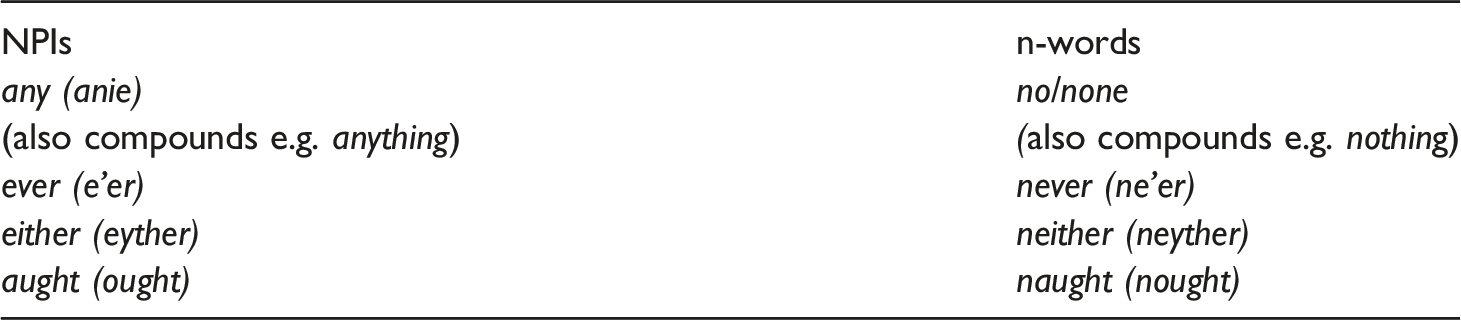
Instances of NPIs were counted only where they were in the scope of sentential negation, i.e. following not, nor or an n-word governing their syntactic position.

Here, none and any both stand in the scope of the negative expression never, and were individually scored as ‘MN’ and ‘NPI’ respectively.
The data thus obtained, and categorised as described, are presented in the following section.
5. Results
Subject-Verb inversion in nor clauses.

The data are displayed graphically in Figure 1 below:
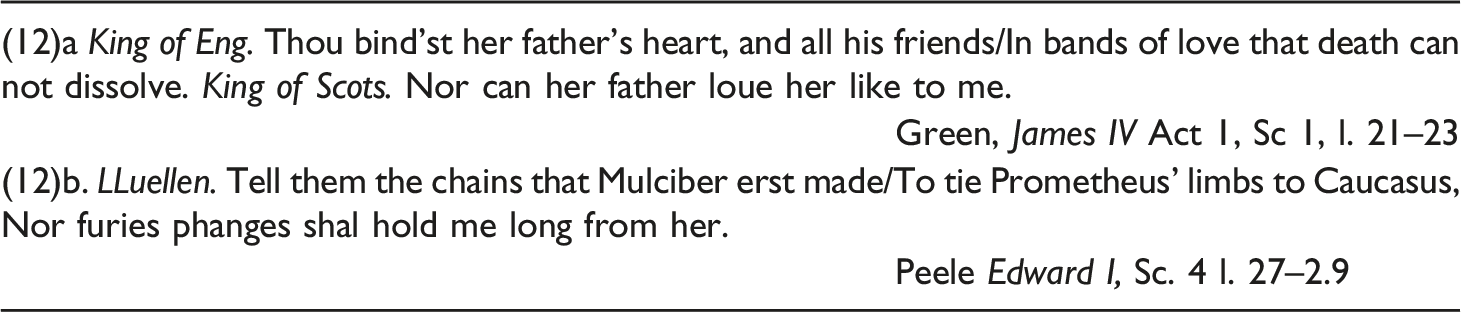
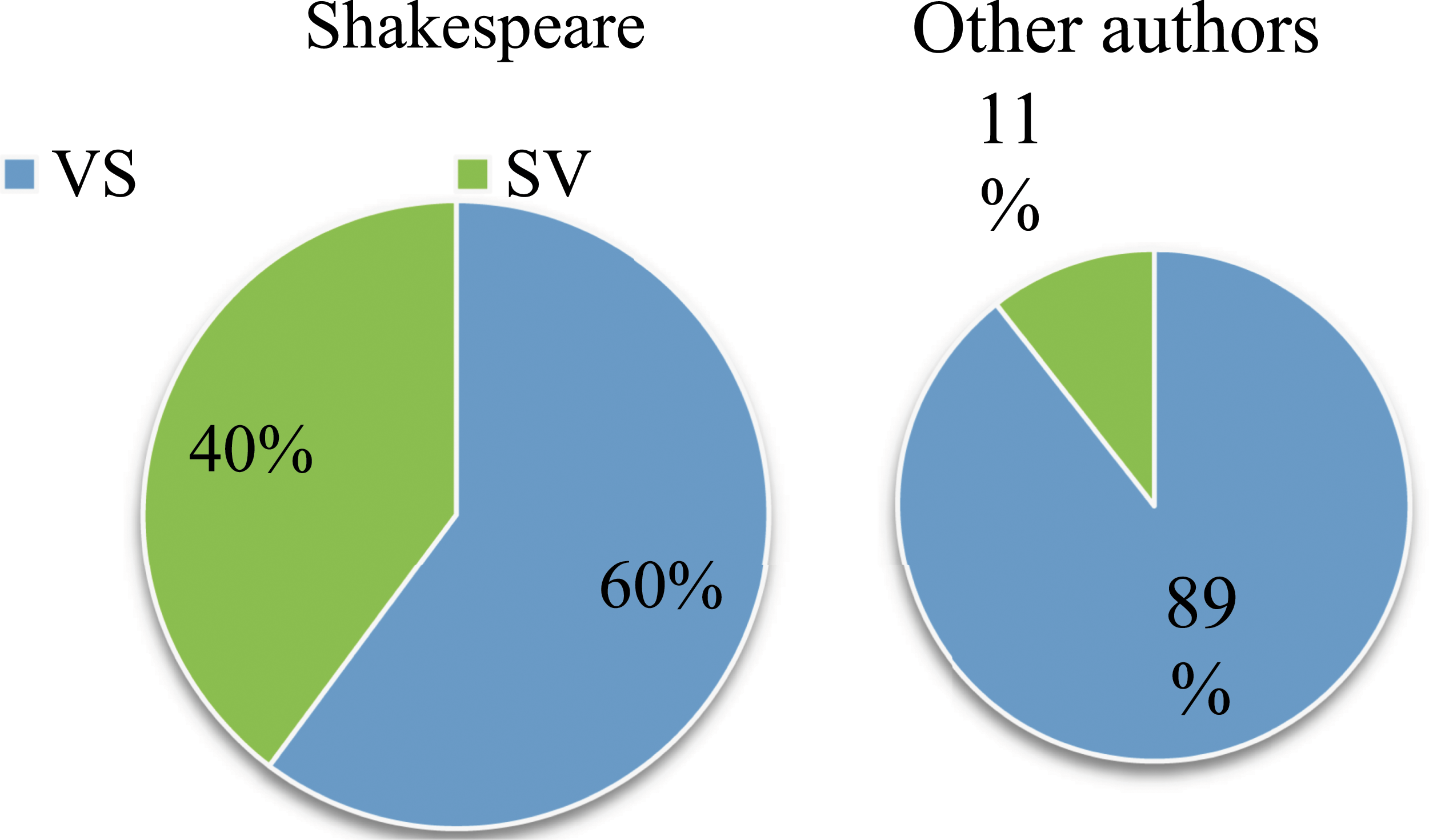
Percentages of VS/SV in Shakespeare and other authors compared.
Use of Verb-Subject or Subject-Verb syntactic order after clause-initial nor.
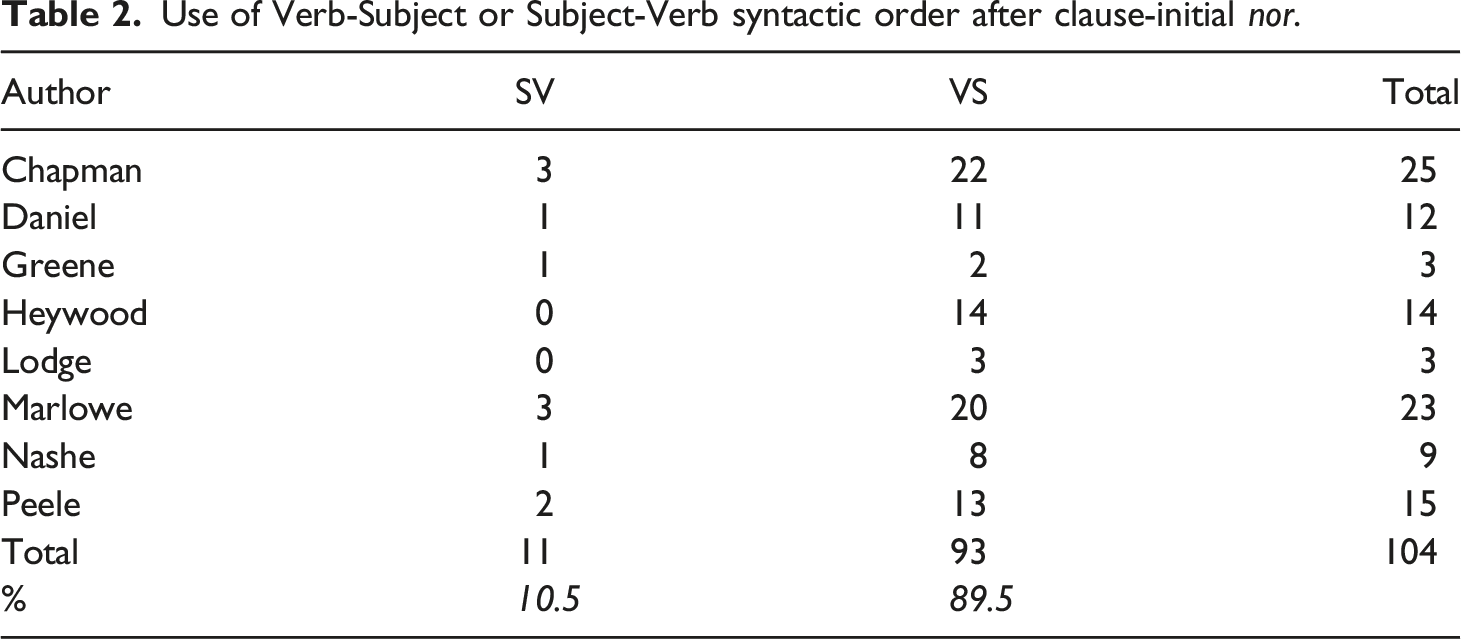
Especially in cases with a substantial number of data-points, the strongly dispreferred status of this construction is quite clear, as compared with Shakespeare’s much less decisive 60–40 preference for VS order.
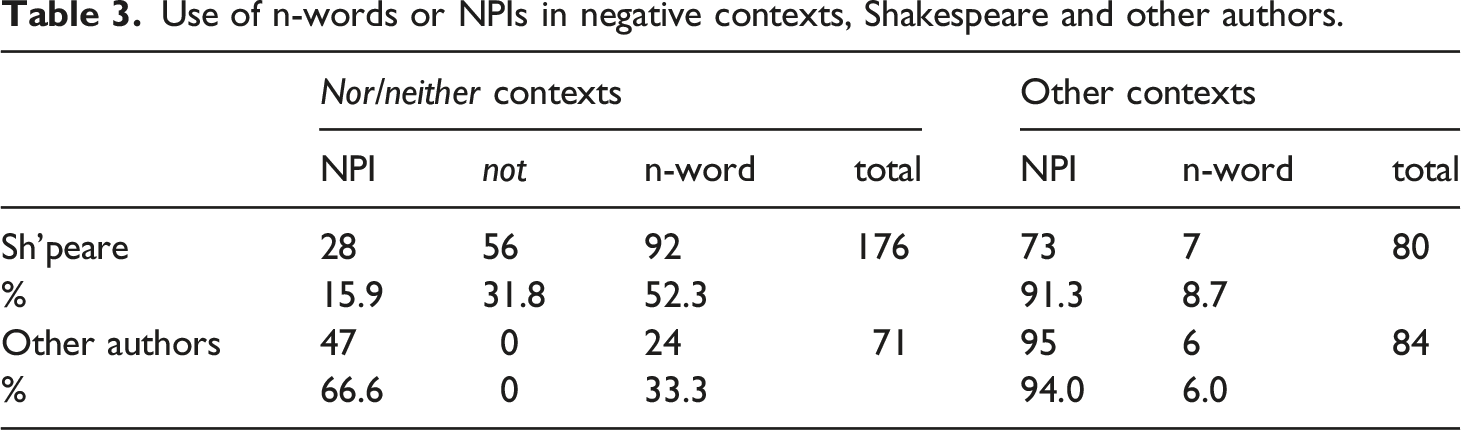
Turning next to the occurrence of n-words or of NPIs in contexts with a governing negative expression, the following results were obtained (Table 3):
These data are represented graphically in Figure 2:
As Figure 2 clearly shows the differences between Shakespeare and his university-educated contemporaries lay in the nor/neither contexts. In other contexts, the frequencies were almost identical. Use of n-words or NPIs in negative contexts, Shakespeare and other authors.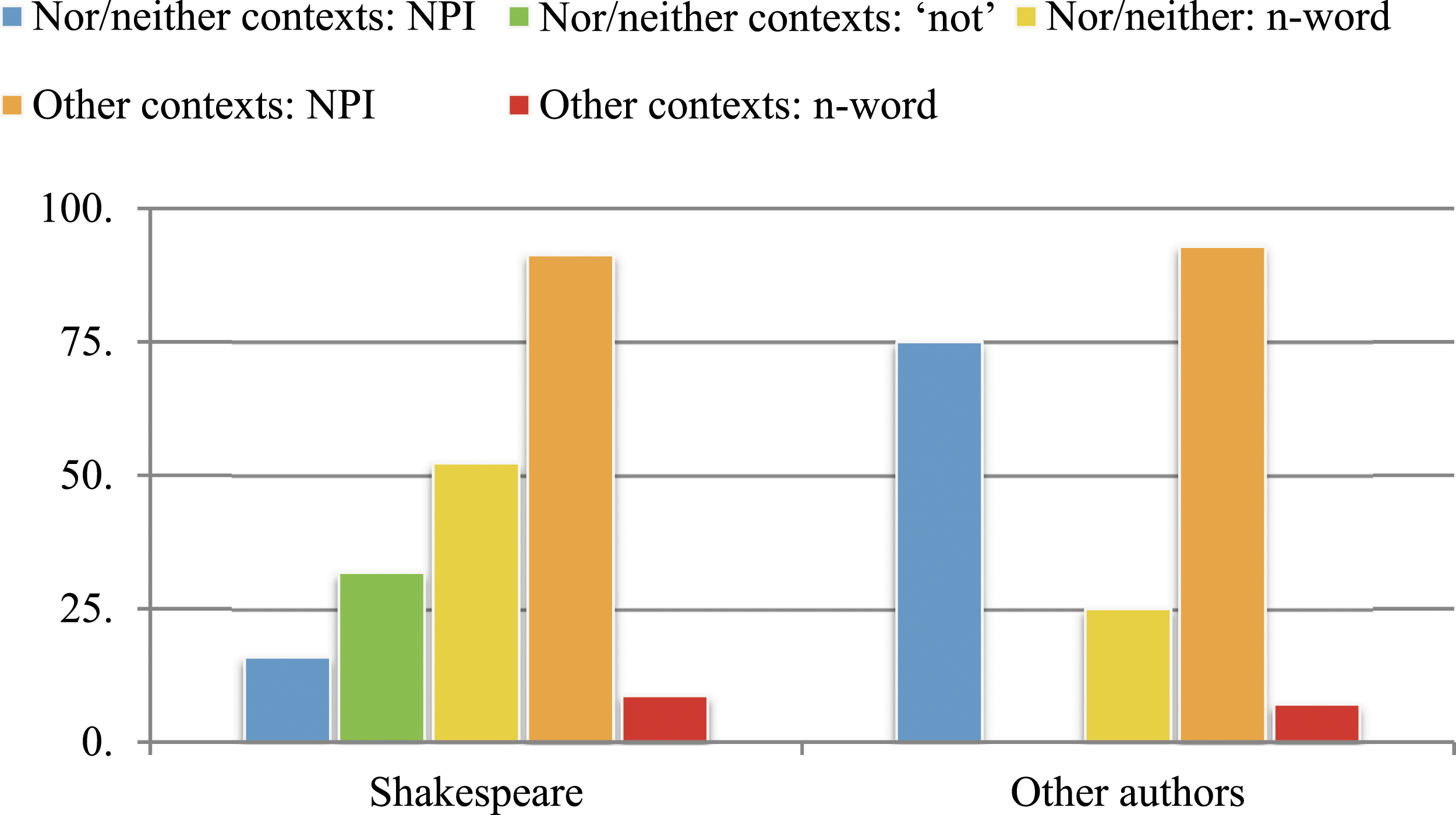

This construction never cropped up in the other authors’ data, where MN in coordinate clauses involved only the co-occurrence of nor/neither with an n-word.
Use of n-words or NPIs in negative contexts, Shakespeare and other authors.
Non-assertive polarity items (NPI) versus multiple negation (MN), other authors.
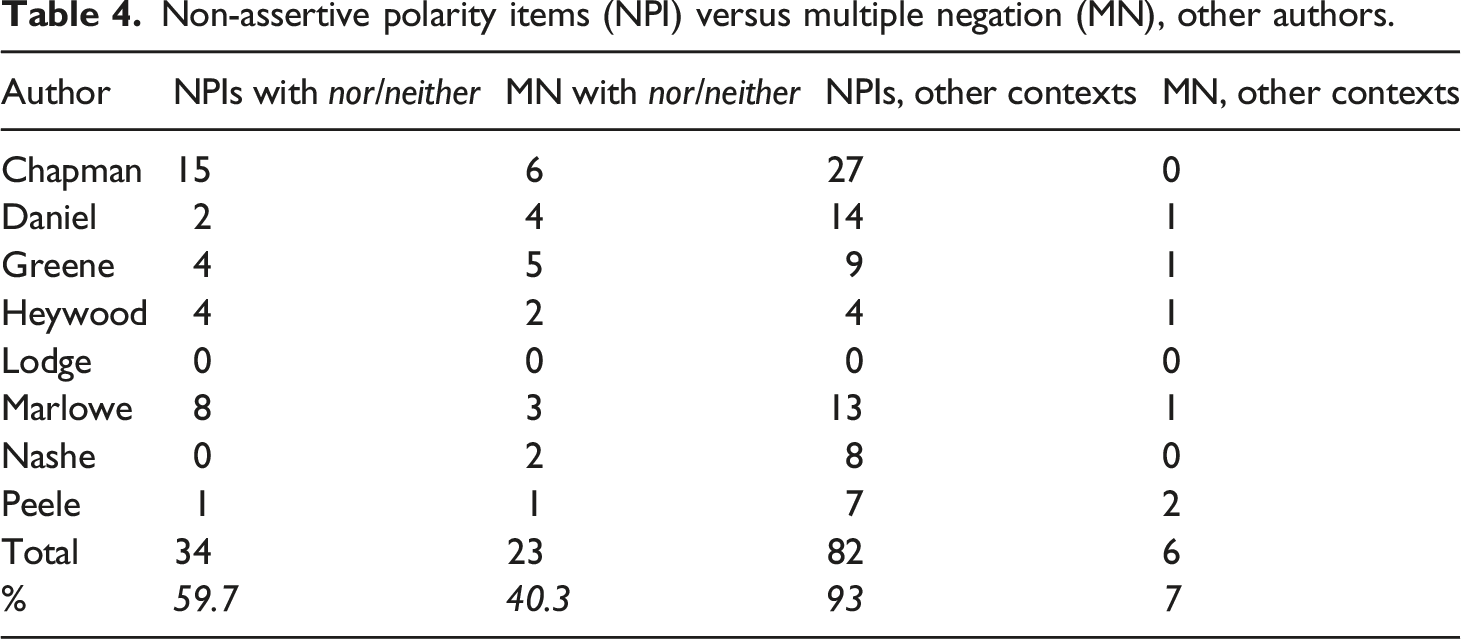
The overall rate of MN, putting both types of context together, was exactly 20% (See Figure 3 below), consistent with the strong tendency to avoidance found in later 16th century educated writing (Nevalainen and Raumolin-Brunberg 2003). MN was higher in nor/neither contexts (40%) than elsewhere, as would be expected, given the lag this context was shown by these researchers to have displayed in the shift away from MN in the language generally. In both contexts, then, the usage of these dramatists was very closely aligned with what would be expected of highly-educated language users of the period. In Shakespeare, however, as also shown in Figure 3 above, the frequency of MN in both contexts combined came to no less than 61%, a dramatically higher proportion than in other authors. Overall proportions of NPIs and MN in Shakespeare and other authors.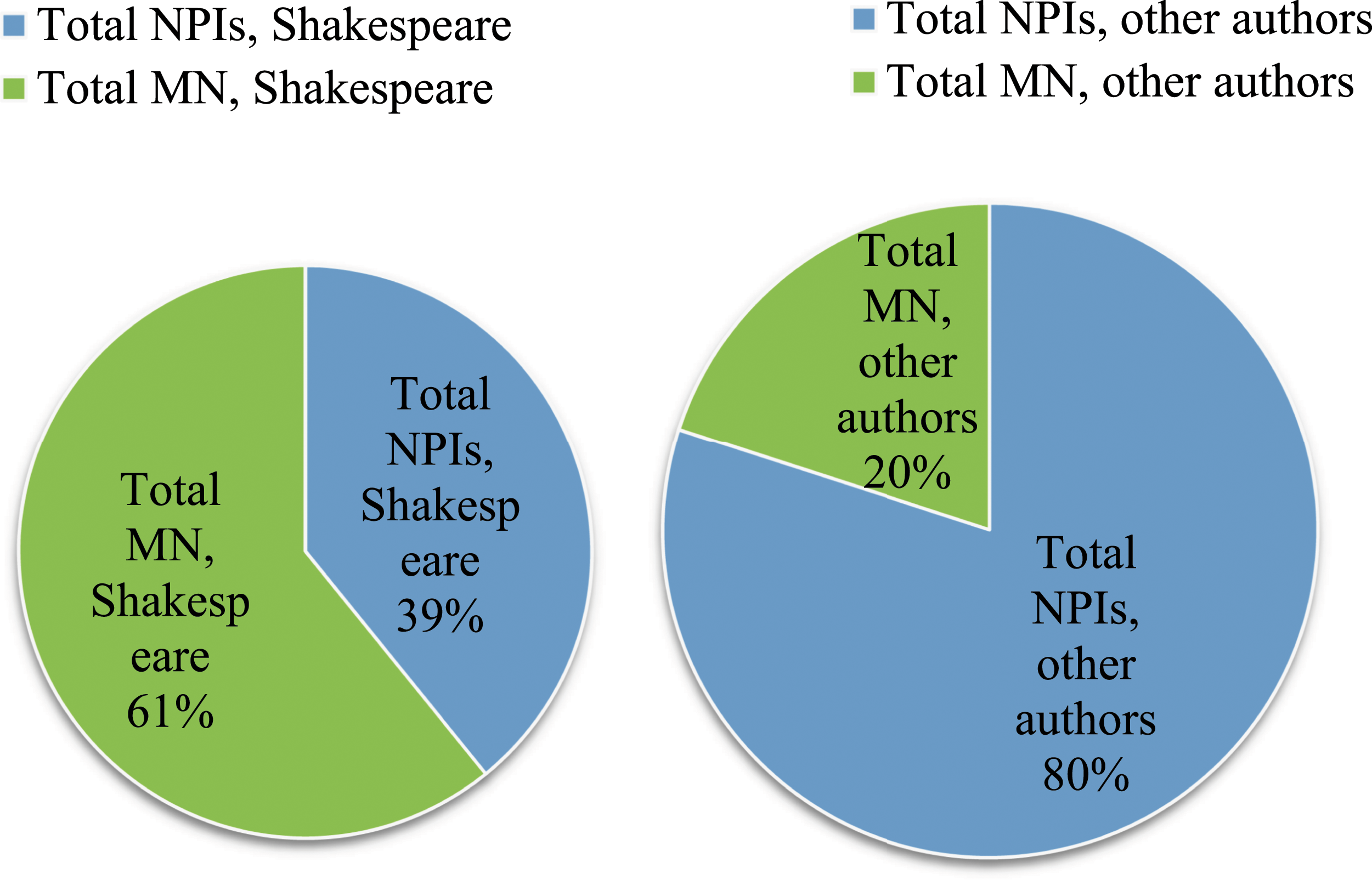
6. Jonson
To investigate how Jonson’s use of negation patterned, whether closer to Shakespeare’s or to that of the ‘university men’, ten of his dramatic works were analysed. These were selected to be a mixture of comedies and tragedies for which Jonson is principally known and was the sole author.
Subject-Verb order in nor clauses, Shakespeare and Jonson compared.

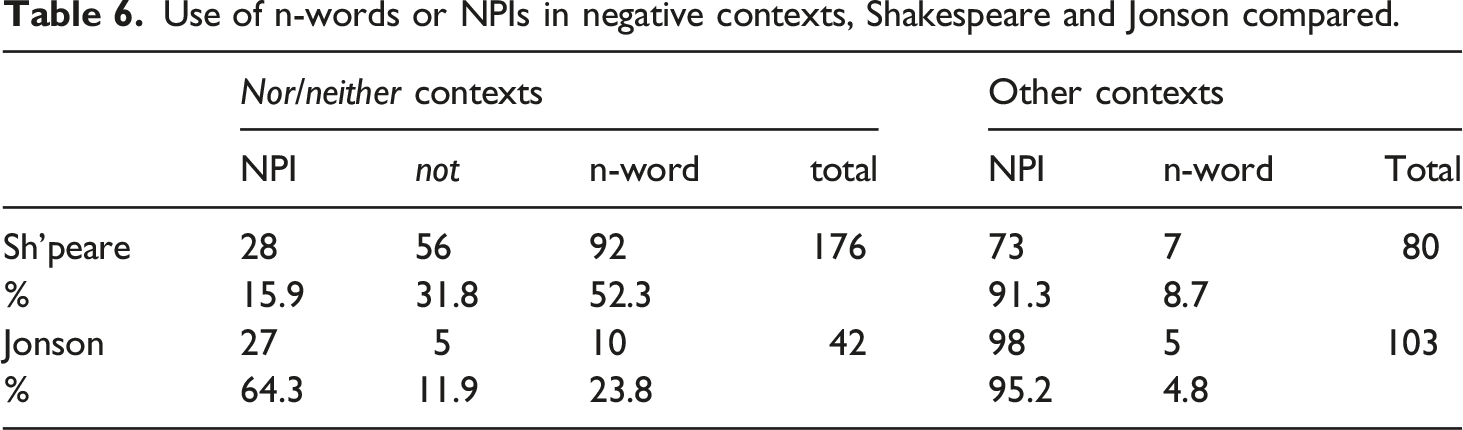
Use of n-words or NPIs in negative contexts, Shakespeare and Jonson compared.
Jonson’s low rate of Subject-Verb syntax in nor clauses, compared with Shakespeare’s, follows the tendency in 17th century usage mentioned above (Nevalainen and Raumolin-Brunberg 2003).
Turning next to n-word or NPI choice, Table 6 compares Shakespeare and Jonson on this measure:
Here the Jonson-Shakespeare comparison is more nuanced, as was also the case with the other dramatists. In clauses other than those introduced by nor/neither, all tended very strongly to avoid MN. Shakespeare and Jonson both employed MN in under 10% of occurrences. In nor/neither clauses, however, Jonson was very close to the other dramatists (see Table 3) in the frequency of his use of MN (23.8%), which contrasted sharply with Shakespeare’s MN use, occurring a little over half the time.
7. Discussion
The findings in the two preceding sections reveal clear differences between Shakespeare’s use of negation and that of his contemporaries, and also regarding the characterological purposes to which they may have put formal options in the expression of negation in their period. A quite sharp contrast between Shakespeare and other authors (including Jonson) has been uncovered, both in the frequencies of those formal options and in whether and how the use of those options was put to authorial purposes. These points are discussed in turn.
Formally, contexts other than those introduced by nor/neither display low use of MN by all playwrights. However, in the nor/neither contexts there is a very strong contrast between Shakespeare and the other authors. As was shown in Tables 3 and 4, the former used it some 84% of the time either with not or an n-word, whereas in his contemporaries aggregated the frequency of MN is only 15% (12% in the case of Jonson, see Table 6). Evidently, what was with them no more than a residual possibility was with Shakespeare a strongly favoured preference. It far more often went hand-in-hand with use of SV order in nor clauses (Jacobsson, 1951), and even in some such cases with the use of the negator not, entirely absent in the other authors, apart from Jonson. 9 Stylistic and stylometric studies of Shakespeare (e.g. Craig and Kinney, 2009) have shown that certain aspects of his language and poetics developed considerably over the 20 years or more of his writing career. Interestingly, this development did not include a marked shift away from multiple toward single negation; he was found to be still utilising it liberally in plays as late as Cymbeline (7 MN uses out of 11 contexts), The Tempest (6 MN uses out of 11 contexts) and The Winter’s Tale (20 MN uses out of 28 contexts).

Further example occur in Greene’s The Scottish History of James IV, Daniel’s The Queens Arcadia and Heyward’s A Woman Killed with Kindness:
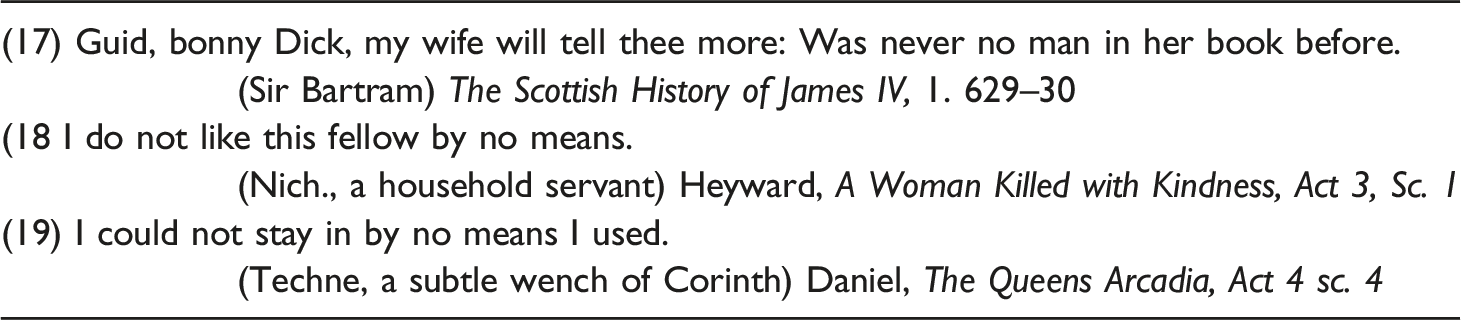


The above examples of both MN and NPI usage are patently characterological, as they are in the usage of Jonson’s contemporaries other than Shakespeare. In Jonson’s case, it is noticeable that he avoids MN entirely in his extant tragedies, Sejanus (1603) and Catiline (1611), in both of which its use by high-status characters would, it is argued here, have sounded a false note.

The first of these is spoken by Celia, Duke Frederick’s daughter and cousin to Rosalind; the second, by Helena brought up in a high-status household, and the third by the deposed monarch, Richard II. That Shakespeare saw no stylistic incongruity in using such sociolinguistically marked syntax in these non-coordinate contexts strongly indicates that his usage was not characterological, as in the cases of lines from Peele, Greene and Jonson cited above. While the medieval setting of Richard II might be argued to call for syntactic archaism, archaic syntax is not appropriate in either As You Like It or Twelfth Night. 10 The evidence therefore points to Shakespeare’s lack of awareness of the prevailing tendency for non-coordinate multiple negation to be avoided by university-educated authors and by those in educated social circles in London, except as a stylistic device for characterological effect.
It is true, as mentioned by both Barber and Blake, that MN could in this period still be used for emphatic purposes, a function assumed in Modern English by negative inversion (VS) with an NPI (see ex. (8) above). The latter construction was greatly preferred by the other playwrights, rather than SV syntax with MN, as Shakespeare commonly used. On the reasonable default assumption that Shakespeare’s characters are no more and no less emphatic overall than those of his contemporaries, our interpretation is consistent with Barber’s observation: the above-average use Shakespeare made of MN is a general syntactic trait in his writing, rather than a device for making his characters’ speech acts sound more insistent.
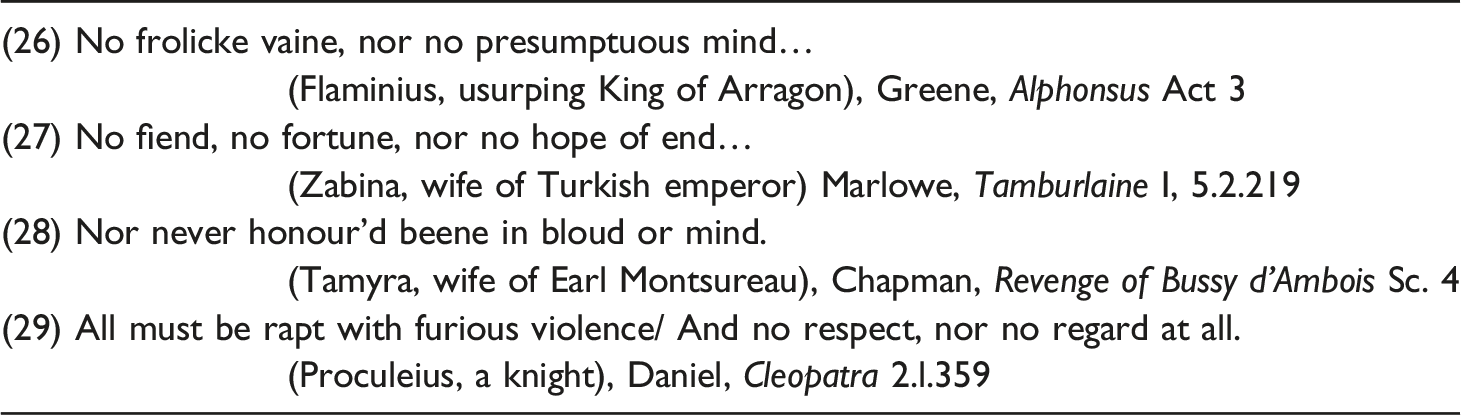
These examples would presumably not have struck contemporaries, or Milton, as out of keeping with the language of educated society at the time. Examples (26)–(28), however, which involve ordinary clauses, show Shakespeare’s lack of concern to follow the preferred usage of avoiding MN in these contexts.
On the basis of the findings obtained in this research, it is possible to establish a broadly binary paradigm of grammatical usage by Shakespeare and contemporary dramatists, as regards MN/NPI preferences: Type A represents choices based on an educated sociolect (equivalent to Milton’s epithet “learnèd”) orientated toward a social norm and consciously modulated according to dramatically motivated, characterologically relevant contexts. This corresponds to the grammatical usage of Shakespeare’s university-educated contemporaries, as well as Jonson. Type B, represented by Shakespeare, reflects preferences and habits belonging to a more vernacular sociolect (equivalent to Milton’s use of the word “native”). Whereas Type A is consistent with a more norm-based, contemporary style of dramatic writing, Type B corresponds to a more spontaneous, personalised approach.
As our data shows, Shakespeare’s usage was variable and non-characterological in its application. He saw no stylistic reason to avoid MN in favour of NPIs, since his adult grammar usage embraced both options, thus mixing his native sociolect grammar with the grammar usage he acquired as a young playwright. So, while the culturally normative grammar of the educated sociolect had been replacive for Jonson in his formative years, for Shakespeare, acquiring it at a more mature stage of life, it was additive. Thus, in non-characterological multiple negation, Shakespeare’s recessive grammatical tendency varies more markedly from acquired norms than that of his contemporaries. As such, it very likely remained in touch with the ordinary provincial speech of his time, as compared with the consciously stylistic discrimination between MN and NPI options of his university-educated contemporaries.
It might be argued that Shakespeare’s recessive patterns reflect the appropriateness of archaisms in the speech of his characters, bearing in mind the past-era settings of a great number of his plays. However, this argument does not stand, since, Jonson’s modern-day comedies apart, virtually all the plays of Shakespeare’s contemporaries were, likewise, set in past eras.
8. Conclusion
Based on an extensive sample of dramatic texts, this study has sought to demonstrate that Shakespeare stood apart from the emergent grammatical usage of his time regarding the variable syntax of negation, and did not handle variation in its patterns stylistically, as his contemporaries did. It has been established that other authors use MN almost exclusively for characterological purposes, which is not a representational strategy in Shakespeare. Whereas they clearly manipulated MN as a conscious stylistic resource, with Shakespeare NPI/MN variation does not appear to depend on character and status representation. This study offers a fresh finding for studies of Shakespearean language, one that confirms the influence of his provincial upbringing and distinguishes him from other authors. It also calls into question the notion sometimes advanced for pedagogical purposes that his usage can reliably be taken as linguistically representative of the period.
The evidence of this study helps explain why, for Milton and other highly educated near-contemporaries, Shakespeare’s language sounded both ‘native’ and ‘wild’ in comparison to that of the ‘learned’ Jonson. Nonetheless, as the latter judiciously predicted in his First Folio encomium, Shakespeare’s evident differences from the university-educated authors would not prevent him eclipsing them, and in the more conscious and aesthetic uses of poetic language his usage was not, of course, determined purely by his provincial background. So much is not at issue. What has been explored in the present study is a more routine aspect of language, at the often purely instinctive level of syntax. Shakespeare’s deployment of non-standard grammar forms is so well known as to be a cliché, but, as was discussed above, the implications of his strikingly frequent use of MN have been surprisingly neglected. It is not suggested here that multiple negation was the main or only reason that Milton perceived Shakespeare’s style as idiosyncratic and “native”; nevertheless, it must have been a distinctively divergent grammatical feature associated with the author’s – for Milton and his circle – unsophisticated provincial upbringing.
Neither is it being claimed that not having a university education necessarily determined a writer’s grammatical preferences: Jonson’s usage with this feature demonstrates that this was not the case. Rather, a group norm has been observed in the data analysed, to which Jonson adhered and from which Shakespeare departed. Jonson showed that an individual could compensate for the lack of a university education, with Camden as a proxy for higher learning.
It is acknowledged that in this paper only one area of language has been studied. Other features could be usefully added to further illuminate questions related to Shakespeare’s background and divergences from more highly educated contemporaries, if they can be placed within a framework of interpretation relating to sociolinguistic background information. Such studies may support the argument for a more nuanced Shakespearean grammar than those proposed in a number of generalising models from Abbott onward. It may be that other grammatical features of the Shakespeare dramatic canon, such as the well-known misagreement of subject and verb (Abbott §333–335), leave behind a footprint as to the provenance and educational background of its creator.
Open Source Shakespeare (excluding plays known to be co-written)
https://www.opensourceshakespeare.org
https://onlinebooks.library.upenn.edu/webbin/book/lookupname?key=Jonson_C_Ben_C_1573%3F_D1637
Chapman: Bussy d’Ambois and The Revenge of Bussy D’Ambois https://www.gutenberg.org/files/20890/20890-h/20890-h.htm#Bussy_Text
Tragedy and Conspiracy of Byron https://quod.lib.umich.edu/e/eebo/A18404.0001.001?view=toc
Caesar and Pompey https://quod.lib.umich.edu/e/eebo/A18425.0001.001?view=toc
Daniel: Philotas
https://quod.lib.umich.edu/e/eebo/A19812.0001.001/1:14.5?rgn=div2;view=fulltext
The Queenes Arcadia: https://quod.lib.umich.edu/e/eebo/A19835.0001.001?view=toc
Cleopatra
https://etheses.whiterose.ac.uk/28438/1/Tragedie_of_Cleopatra_volume_one.pdf
Greene: James IV: http://www.luminarium.org/editions/jamesfourth.htm
Orlando Furioso: http://www.luminarium.org/editions/orlando.htm
Alphonsus: https://quod.lib.umich.edu/cgi/t/text/text-idx?c=eebo;idno=A02091.0001.001
Friar Bacon: http://elizabethandrama.org/the-playwrights/Robert%20Greene/Friar-Bacon-Friar-Bungay/
Heywood, If you Know not me, you Know Nobody Parts I and II
https://quod.lib.umich.edu/e/eebo/A03208.0001.001/1:2?rgn=div1;view=fulltext
https://quod.lib.umich.edu/cgi/t/text/text-idx?c=eebo;idno=A03217.0001.001
A Woman killed with Kindness: http://www.luminarium.org/editions/womankilled.htm
Lodge, Wounds of civil war: https://archive.org/stream/woundsofcivilwar00lodguoft/woundsofcivilwar00lodguoft_djvu.txt
Marlowe, all plays: http://www.marlowe-society.org/christopher-marlowe/links-readings-etc/texts/
Nashe, Summer’s Last Will: https://archive.org/details/pleasantcomediec00nash/page/n6/mode/2up?q=never
Peele, Old Wives Tale http://elizabethandrama.org/the-playwrights/george-peele/the-old-wives-tale-george-peele/
Edward I: https://quod.lib.umich.edu/e/eebo/A09224.0001.001/1:2?rgn=div1;view=fulltext
Alcazar: https://quod.lib.umich.edu/e/eebo/A09221.0001.001?view=toc
Bess of Hardwick’s letters: https://www.bessofhardwick.org
Correspondence of Robert Dudley, Earl of Leicester. Bruce, John, ed. Camden Society Publications, 1844.
Thomas Nashe, The Terrors of the Night: http://www.oxford-shakespeare.com/Nashe/Terrors_Night.pdf
Shakespeare Documented:
Footnotes
Declaration of conflicting interests
The author(s) declared no potential conflicts of interest with respect to the research, authorship, and/or publication of this article.
Funding
The author(s) received no financial support for the research, authorship, and/or publication of this article.
