



Abstract
I present a posthumanist approach to literary interpretation using stylistic analysis. It is posthumanist since i) digital cameras/audio-video resources and editing applications prompt multimodal readings of literary works unlikely from human intuition alone; ii) anthropocentrism in literary texts is defamiliarised. I highlight how stylistic analysis can be used productively for developing multimodal creativity in posthumanist reading by motivating audio-video edits and effects. I model using Anne Brontë’s poem ‘Home’ (1846). When read only with intuition, ‘Home’ communicates young Brontë’s yearning for her family home. In contrast, this article has a non-intuitive digital multimodal realisation of this poem where a young Californian stuck in London because of pandemic (Covid-19) travel restrictions yearns for her home state in the aftermath of wildfires linked to anthropogenic climate change. This posthumanist transformative reading, flagging the negative repercussions of humans for their planetary home, defamiliarises the poem’s anthropocentric normality. Importantly, I show how stylistic analysis of ‘Home’ motivates creative use of audio-visual edits and effects in the posthumanist multimodal reading. The article makes contrast with standard interpretive practice in stylistics (‘humanist stylistics’). It also reflects on the value of posthumanist stylistics for extending students’ creative thinking in an educational context.
Keywords
1. Introduction
I present a posthumanist approach to literary interpretation using stylistic analysis. It is posthumanist since i) digital cameras/audio-video resources and editing applications prompt multimodal readings of literary works unlikely from intuition alone; ii) anthropocentrism in literary texts is defamiliarised. I highlight how stylistic analysis can be used productively for developing multimodal creativity in posthumanist reading by motivating audio-video edits and effects.
Posthumanism is scholarly reflection on the posthuman condition; scholars who do this are posthumanists (discussed in Section 2). Crucially, I also discuss the link between posthumanism and creativity. In Section 3, I highlight posthumanist use of stylistic analysis, as different from traditional ‘humanist stylistics’. I apply this to Anne Brontë’s poem ‘Home’ (1846) in Section 4 and Section 5. Reading only from human intuition, ‘Home’ communicates the young Brontë’s yearning for her family home. The posthumanist reading is a non-intuitive digital multimodal realisation where a young Californian stuck in London because of pandemic (Covid-19) travel restrictions yearns for her home state in the aftermath of wildfires linked to anthropogenic climate change. This transformative interpretation, connecting with human grief for their damaged planet, defamiliarises the poem’s anthropocentric normality. I also show how posthumanist use of stylistic analysis motivates creative audio-visual edits and effects in the multimodal reading.
2. Posthumanism and creative production
2.1 Humanism
Posthumanism implies ‘after humanism’. ‘Humanism’ presents moral life as possible without religious belief. It emphasises science, reason and human rights. A flourishing life in humanism is where we act autonomously and rationally, free from beliefs with no evidential basis (Copson and Grayling, 2015). European humanism developed circuitously from Ancient Greek philosophy, Arabic-Persian philosophy, the Renaissance and The Enlightenment to contemporary enterprises such as ‘Humanists International’, which also embraces non-European humanist traditions. 1 Humanism’s assumptions are not always explicit; for example, humans are the most important species (‘anthropocentrism’) and our consciousness distinguishes us from machines (Nayar, 2014). Many humans, unaware of humanist philosophy, take such assumptions for granted.
Broadly speaking, there are two types of posthumanism: ‘non-anthropocentric posthumanism’ and ‘techno-posthumanism’. 2 I discuss each in turn.
2.2. Non-anthropocentric posthumanism
Non-anthropocentric posthumanists criticise anthropocentric humanist norms (Braidotti, 2013; Herbrechter, 2013). For instance, human delusional over-importance obscures our dependence on the biosphere evidenced by detrimental anthropogenic effects. This is not to say that humanists are unaware that over-exploitation of planetary resources without caring about repercussions has self-harmingly produced the Anthropocene. (The Humanist 2022 Amsterdam Declaration states: ‘We recognise that we are part of nature and accept our responsibility for the impact we have on the rest of the natural world’). 3 A key difference between humanists and non-anthropocentric posthumanists is that the latter exhort us to ‘decentre’, no longer seeing ourselves as life’s hub, viewing humanity not only as enmeshed with the biosphere but with reduced status in a ‘species cosmopolitan’ (Nayar, 2014: 152). Nevertheless, non-anthropocentric posthumanism does not necessarily entail a radical break with humanism. One of its intellectual strengths is reframing humanist thinking and scholarship ‘…to determine what ought to be salvaged, reformed, or abandoned’ (Nichols and Campano, 2017: 248). Despite the ‘post’ prefix, humanism is rarely absent from discussion of posthumanism; we should hardly wish to be ‘post’ everything in humanism, such as the commitment to science, reason, truth and human rights.
2.3. Techno-posthumanism
In the 21st century, we operate in a new reality – the postdigital ontology. ‘Postdigital’, a shorthand for ‘post digital revolution’, refers to digital devices and internet access being so woven into our lives that we take them for granted (Abblitt, 2019; Savin-Baden, 2021). That the postdigital ontology blends actual life with digital virtual life is having a marked effect on the human condition. We increasingly operate not as humans, optionally aided by machines, but as co-constituting ‘human-machine assemblages’ (Savat, 2013: 63-82) or more simply ‘posthumans’. Techno-posthumanist thinkers commonly highlight cognitive expansion from human and digital tools entanglement:
4
…human cognition is collaborating with machine cognition to extend its scope, power, and flexibility. (Hayles, 2012: 41-42)
Clark (2008), likewise, conjures an ‘extended mind hypothesis’. For both Andy Clark and Katherine Hayles, contemporary human knowing does not operate from an autonomous mind inside a ‘skin-bag’, but from processing distributed across a network of brain, body and technology where the distinction between human and intelligent technology is blurred. Unlike hammers, spades, etc., digital tools are not just passive objects for our control. They are also ‘delegated actor[s]’ extending the agency of their users with ‘researchers and their digital tools co-constitut[ing] each other’ being ‘parts of the extended cognitive system’ (Tsao, 2018: 375).
Co-constituting human-digital assemblages involve intra-action. Interaction assumes we are in control when we use non-digital tools like hammers. In contrast, once humans are entangled with and take prompts from digital tools, agency emerges from within the human-digital tool assemblage – hence intra-action (Hollett and Ehret, 2017). That is to say, intra-active agencies – somewhere between intention and non-intention – do not lie exclusively in humans, but in the dynamic in-between-ness of human and non-human (Barad, 2007). An intra-active human-machine assemblage may seem far-fetched like some sci-fi fantasy. In fact, techno-posthuman subjectivities – new outlooks from entanglement with digital technologies – already exist and many are mundane – in gaming, for instance. When the avatar we identify with is killed, we emote, feel frustrated, etc. Drivers and pedestrians delegate navigation to SATNAV apps which, in turn, intra-actively prompt their routes. Charities increasingly offer VR immersive experience of lives of the less fortunate (e.g. of a refugee camp). 5 Many people already spend significant time decentred in human-machine assemblages, allowing static, mobile, wearable digital tools and assistants ‘prosthetically’ to co-constitute their experiences.
This techno-posthuman effect of the postdigital ontology is not necessarily beneficial; for example, addictive social media can drive mindless advertisement consumption. 6 One ethos of this article is that humans should be rational, thoughtful, autonomous actors, entering freely into human-machine assemblages having reflected critically on their benefits and freely depart them too (see Section 6). As before, humanism cannot be far from posthumanism. Another ethos of this article is that techno-posthumanism and non-anthropocentric posthumanism can be combined in reading poetry. I highlight how a poem can be read within a de-anthropocentrising human-digital tools/resources assemblage, producing a multimodal interpretation flagging negative impacts of humans for the biosphere.
2.4. Transformative creativity and posthumanities
2.4.1. Saturation of the image
A revolutionary characteristic of the postdigital ontology is unprecedented image saturation: Just before the turn of the twenty-first century, a host of digital-media technologies (computers, internet, video games, mobile devices, and many others) unleashed the largest flow of digitally reproduced words, images, and sounds the world has ever witnessed […] The digital image thus gave mobility to the image on a scale never before witnessed in human history. […] This sea change in image production and circulation is nothing less than the equivalent of a Copernican revolution in our time. The centrality of the movement and the mobility of the image have never been more dramatic. (Nail, 2019: 1)
Design, photography and video apps furnish endless possibilities for creative manipulation of digitised images. We can use these apps to intra-act with our minds to stimulate creativity unlikely from unaided imagination – posthumanist creativity. Consider musician and artist John Squire. His 2019 London exhibition, ‘Disinformation’, 7 was of large-scale oil paintings of photographs altered using filters from the apps Photoshop and SnapChat. He deliberately ‘confused’ the editing software by ‘overloading’ it with instructions, and painted the resulting odd images. Unpredictability is valuable for invention (Harford, 2016). Squire was decentred as sole source of creativity through intra-action with digital tools, opening up perspectives that his imagination was unlikely to generate alone. Arguably, Squire is simply in a long tradition of using aleatory techniques in art, music, literature, etc. (from Latin ‘alea’ meaning ‘dice’), introducing randomness into the creative process to foster the unexpected (Cropley and Cropley, 2009). Tristan Tzara’s/William Burroughs’ cut-up writing, and Brian Eno’s ‘Oblique Strategies’ for music composition are among the best known from the 20th century. Squire’s use of apps, however, is radically different – his paintings’ starting points are the results of software.
2.4.2. Digital multimodal transformation
Another example of posthumanist creativity is Alan Liu’s ‘Literature+’ module where students transpose Shakespeare’s ‘Romeo and Juliet’ into a social media platform, mapping characters’ social relations, filling out personality profiles, etc. Techno-posthumanist Peter Mahon comments: …students have to make critical decisions about what is important for understanding the characters in the play, plotting the networks of their relations, etc., and finding creative ways of adapting the play to the new medium. This type of digital transformation, in other words, actually makes students pay closer attention to the specificity of the text they are transforming. (Mahon, 2017: 259)
In one sense, Liu’s approach might be said to develop Rob Pope’s re-writing pedagogy, where the literary text is transformed into a different genre – advert, love letter, etc., heightening student awareness of the literary text’s stylistic craft (Pope, 1995). Yet re-writing pedagogy is embedded within print culture. Liu’s approach is not a re-writing, but a digital multimodal transformation.
Mahon furnishes other examples for students, using apps to transform classic sci-fi novels – Frankenstein, Blood Music, etc. – into storyboards for videoing, for instance: Other possible digital transformation of texts could include, but would not be confined to: audio recordings of a [literary] text, that could incorporate sound effects and music; video recordings of re-enactments of the [literary] text that could also incorporate dance or other visual materials and techniques; hypertextual annotations of a text’s allusions, using video and/or audio files… Mahon (2017: 259-260)
For Mahon, such transformations are outside the digital humanities (humanities scholarship using computational techniques, e.g., Berry, 2012; Terras et al., 2013). They fall, instead, under the newer posthumanities because they dislodge the human self as centre of gravity (Mahon, 2017). Students’ imaginations both impact and are impacted by the tools. As human-digital tool assemblages, operating as techno-posthumans beyond the domain of ‘digital humanities’, they appreciate literary works in ways unavailable to solely human interpreters.
2.5. Techno-posthumanist reading
2.5.1. Barad and diffraction
A mode of reading associated with posthumanism is ‘diffraction’, originated by Donna Haraway, developed by Karen Barad. In physics, diffraction refers to bending and spreading of waves after encountering an opening in a barrier (Figure 1). By analogy, diffractive reading involves passing one text through another, creating new relations and provoking ‘ripples’ of thinking moving outwards in novel directions (Barad, 2007: 30). The focus is thus not on what the researcher does with the data, but what the data does to the researcher, who experiences surprise and productive change. This entanglement of human with data, together with accompanying transformative repercussions, it is claimed, makes diffraction a posthumanist reading (e.g. Van der Tuin, 2016). This is not convincing, however. After all, reading literary and non-literary texts diffractively through different perspectives (e.g. feminism, Marxism, post-colonialism and psychoanalysis) is standard. Diffraction pattern.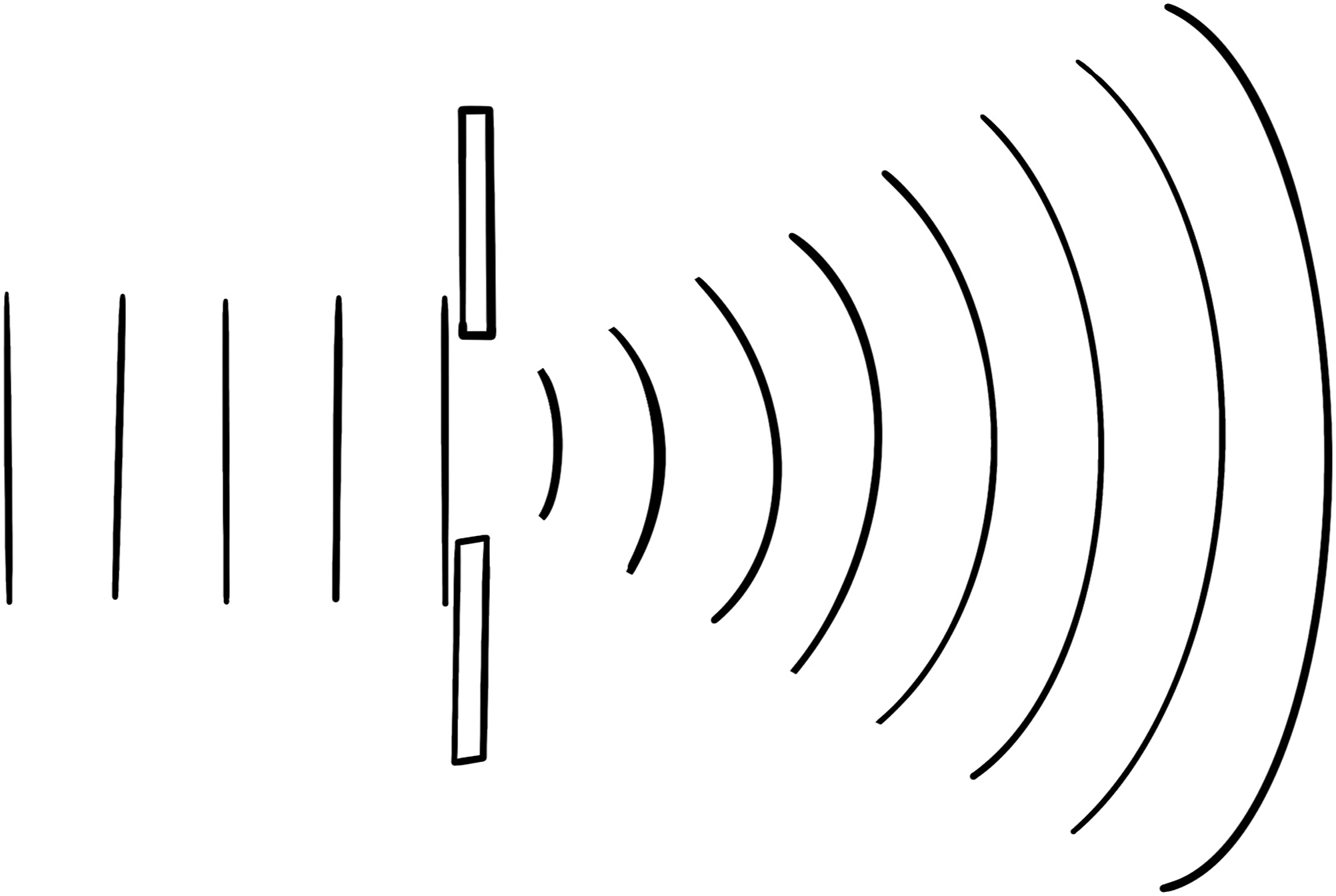
Barad’s diffractive readings do not employ text analysis software nor other digital tools (Barad, 2007, 2014, 2018). My view is that, since techno-posthuman subjectivities are a direct effect of the new postdigital ontology, then if diffractive reading is to be considered posthuman it should be digitally-diffractive. Indeed, there are already mundane forms of digitally-diffractive reading within human-machine assemblages. Sociologist, Deborah Lupton (2018), views use of fitness apps in this way. The app user examines their current fitness diffractively through the continual feedback on number of steps taken, etc. This, in turn, leads intra-actively to further transformation of fitness with the user prompted by the results to adjust their exercise regime. The popularity of fitness apps makes this techno-posthuman subjectivity commonplace. The posthumanist reading of a poem in Sections 4 and 5 is inspired by Barad – though importantly it is digitally-diffractive.
2.5.2. Deleuze, eisegesis and assemblages
Philosopher Gilles Deleuze (1925-1995) is a key philosophical influence on transformative creativity in the posthumanities (e.g. Braidotti, 2019; Lau, 2018). Along with Barad’s diffraction, Deleuze’s creative approach to reading influences my techno-posthumanist procedure here. He has little interest in interpreting literary texts exegetically (‘reading out’), standard reading practice where interpretation is grounded in evidence from the text and, as far as possible, the intentions of the author. For Deleuze, interpreting literary texts using exegesis reduces creative potential for reading (Davis, 2010: 56-80).
8
Instead, to open up creative possibilities for interpretation, experimentally connect the text with things outside of it: A book exists only through the outside and on the outside. A book itself is a little machine […]. [T]he only question is which other machine the literary machine can be plugged into, must be plugged into in order to work. (Deleuze and Guattari, 1987: 4)
Connect the literary text with ‘…other things, absolutely anything’ and see what creatively comes through (Deleuze, 1995: 9). In Biblical hermeneutics, the approved way of reading is exegesis. The opposite form of reading eisegesis (‘reading onto’) involves projecting alien contexts onto a text. Biblical scholars decry eisegesis for hindering appreciation of God’s intended meaning (Zuck, 2002: 216-17). Eisegesis is a derogatory term in Biblical and other hermeneutics. In contrast, Deleuze reappropriates eisegesis as a positive way of reading that more likely leads to creative interpretation than exegesis.
Deleuze’s anti-exegetical approach to reading derives from an ontology of relations, flow and creative becoming and an exhortation to augment these conditions. Much of life is mired in dysfunctional ideas and out-of-date behaviours (e.g. from slavish reading of religious texts and national myths). Deleuze urges novel connection-making to ‘unblock’ life, dynamic free-flowing life being made through multiple new relations. Key to this outlook is his concept of ‘assemblage’: …a multiplicity which is made up of many heterogeneous terms and which establishes liaisons, relations between them,… (Deleuze and Parnet, 2006: 52)
Humans both initiate assemblages and are changed within their heterogeneous relations. Mahon’s posthumanist examples earlier for transformatively reading literary texts are Deleuzean in spirit in making assemblages of literary text, dancers and video makers and, in turn, eisegetically altering the reader’s view of that text via multiple novel relations. Moreover, where a literary text is connected to disparate constituents in an assemblage, anthropocentricism associated with exegetical reading – where the text’s primary connection is to the human mind – is reduced. Lastly, David Savat’s expression, ‘human-machine assemblages’ (2.3), is a patent nod to Deleuze’s use of ‘assemblage’ as well as his relations focus.
2.5.3. Creative reading and techno-posthumanist diffractive-multimodal assemblages
Barad’s diffraction and Deleuze’s assemblage are related – eisegetically connecting a text to something ‘outside’ – de-emphasising the text as ‘interior’ store of meaning. 9 Deleuze’s 20th-century proto-posthumanism could not exploit 21st-century digital tools/resources. Yet exhorting a literary text to be connected to ‘absolutely anything’ hardly precludes this. Inspired by both Barad’s diffraction and Deleuze’s assemblage, Sections 4 and 5 connect a poem to audio-video resources from the world-wide-web and video-editing/enhancing tools to afford its creative reading. Deleuze’s relations-based ontology merges seamlessly with 21st-century postdigital connectivity of actual and virtual life facilitated by the internet. And, reflecting Deleuze’s outlook, we do not have to accept the existing order of actual-virtual relations, but can generate new ones in inventive human-digital assemblages.
Techno-posthumanists recognise limitations of human cognition endowed haphazardly via evolution for creative reading. Human intuitions are not easily inventive. If they were, artists, writers and musicians would not use aleatory techniques to disrupt habitual thinking/behaviour. A hallmark of creativity is making unusual connections to foster unpredictability, as creative thinking handbooks concur (e.g. Judkins, 2015; Lucas and Spencer, 2017), and reflected in Deleuze’s promotion of unusual assemblages of relations for unleashing invention. The techno-posthumanist reader recognises aleatory value from a different interpreting unit to the mind's intuitions – an intra-acting human-digital tools/resources assemblage. This reader acknowledges that surprising interpretation of poetry is more readily achievable through the relations of digitally-based juxtaposition and recontextualisation than solely via human intuition. Such interpretation is not then exegetical. Rather, emulating Baradian/Deleuzean reading, it is eisegetical, in juxtaposing alien audio-video digital context, connecting a poem into an assemblage of heterogeneous relations and reading it diffractively.
2.6. What might a posthumanist reading of a poem look like?
2.6.1. Web-based audio-video facilitating diffractive-assemblage reading of literary text
An example. Anne Brontë’s poem ‘Home’ (1846) contains these lines: And wildly through unnumbered trees The wind of winter sighs:
The original context is mid-nineteenth century, rural North Yorkshire. There is of course no audio-visual record of that context. In the twenty-first century, I can use a search engine or ‘hyper-read’ 10 for contemporary rural Yorkshire winter and its wind, and read these lines digitally-diffractively through ample results. Perhaps I should just conjure northern England countryside and wind from my human memory and imagination. But that would be a ‘humanist’ cognitive frame relying on i) memory which fades and is unreliable; ii) imagination which can only conjure (what it considers) prototypical experience. I have not visited recently rural North Yorkshire in winter; I do not recall its wind. My intuitions are impoverished alongside the ‘non-human memories’ of rural North Yorkshire and its winter wind that can be found on the world-wide-web uploaded by tourists, etc. Yet the above multimodal digitally-diffractive reading is hardly creative since there is no unusual connecting of materials to foster unpredictability (2.5.3).
2.6.2. Creative diffractive-assemblage reading of a literary text
‘Home’ is a 28-line poem expressing Anne Brontë’s homesickness as a young governess working at Thorp Green Hall in North Yorkshire in the early 1840s.
11
This was a grand environment: 25. Though all around this mansion high 26. Invites the foot to roam,
Despite her plush surroundings, Brontë misses her family home (Haworth, West Yorkshire) and the bleaker surrounding countryside of Haworth Moor: 11. But give me back my barren hills 12. Where colder breezes rise; 13. Where scarce the scattered, stunted trees 14. Can yield an answering swell,
Imagine another scenario, a non-anthropocentric posthumanist one: a US citizen from California in her early twenties, stuck in London due to Covid-19 pandemic travel restrictions in winter 2020-21. 12 Like Anne Brontë, she is homesick, but for an unusual reason. She wants to experience the aftermath of recent Californian wildfires linked to climate change. Now imagine this scenario realised as a video using hyper-read online creative commons footage of the wildfires and their outcome. Digitally-diffractively, we read references to home in Brontë’s poem via these shots. This unusual connection intra-actively transforms previous human intuitions of the poem. For example, ‘barren hills’ (11) and ‘stunted trees’ (13) are now metaphorised as references to burnt nature; shots of iconic London sites constitute the grand ‘nonhome’ references. Fresh eisegetical meaning has been creatively activated in intra-action of poem, reader and digital technology, exceeding Brontë’s original intentions. Indeed, these unusual connections generate more intrigue than merely using audio-video of Yorkshire (2.6.1). Echoing Peter Mahon (2.4.2), ‘Home’ has been read techno-posthumanly in a digitally multimodal, transformative manner where the human imagination both impacts upon and is impacted by digital resources, with intuition dislodged as the centre of gravity of interpretation. Reflecting a Deleuzean outlook, new relations have been created – between an originally print-based artefact and a digital one. And from a non-anthropocentric posthumanist vantage, the negative repercussions of humans for their planetary home defamiliarises the poem’s anthropocentric normality. Techno-posthumanism and non-anthropocentric posthumanism have been combined. Section 4 shows the whole poem receiving this treatment. (Lastly, to be clear, I am not claiming that hyperreading is posthumanist. It is the use I make of hyperreading in Section 4 which is posthumanist).
This posthumanist reading is developed in Section 5 vis-à-vis stylistic analysis of ‘Home’. It is to the role of stylistic analysis in posthumanist reading of poetry that I now turn.
3. Posthumanist stylistics and poetry
3.1. Humanist stylistics
Stylistic analysis has traditionally been used to provide rigorously evidence-based checks on interpretive arbitrariness and to support exegetical interpretation (e.g. Burke, 2014; Stockwell and Whiteley, 2014). Here is Mick Short, a key figure in stylistics: ….detailed and systematic stylistic analysis can be seen as an aid to our understanding and appreciation of the text under discussion as well as providing a rational language-based account to support interpretation… (Short, 1996: 27) …interpretations of poems are like hypotheses, which can be checked by analytical work. (Short, 1993: 9)
Aside from the explicit assumption that stylistic analysis aids understanding and supports exegetical interpretation, implicit assumptions are: • exegetical interpretation is separate from the text being interpreted; • exegetical interpretation and stylistic analysis are separate; • exegetical interpretation emanates from intuitive ideas produced from the human mind.
All ‘humanist stylistics’ assumptions.
Stylistics, with antecedents as distant as ancient rhetoric (Burke, 2014), developed principally during the 20th century vis-à-vis a particular technology – print. Print’s long history, dating back to the 15th century in Europe, obscures the facts that it: i) is a technology; ii) implicitly influences acceptable reading practices such as understanding/interpretation in stylistics. Print produces a physical static literary text, separate from its interpretation. The hermeneutic process of exegesis, where a reader proposes textual support for an interpretation, appears natural. Despite the computing revolution, exegetical print-based assumptions still influence acceptable screen reading of digitised literary texts (Abblitt, 2019).
3.2. Posthumanist stylistics
3.2.1. Reflecting the techno-posthuman condition
Short (above) was writing during the world-wide-web’s infancy; 1993 was the year Tim Berners-Lee disseminated source code for the first web browser. 13 Thirty years later, we operate in a radically different postdigital ontology where human life is networked with digital resources/tools which, in turn, blurs the boundary between human and intelligent technology – the techno-posthuman condition. Humans have a seismically new reading context for literary texts – operating as human-digital tools assemblages (2.5.3). How to use stylistic analysis posthumanly in a human-digital tool assemblage once we have produced a creative audio-visual reading of a literary work, that is, a multimodal eisegetical interpretation?
3.2.2. Relational function of stylistic analysis
Stylistics uses linguistic frameworks for systematically describing style. Linguistic frameworks are neutral with regard to humanist or posthumanist reading. Emulating a postdigital ontology of entangled actual and virtual relations, my use of linguistic analysis in posthumanist reading of a poem is also relational. That is to say, I use stylistic analysis to motivate links (‘relations’) between the multimodal interpretive reading and digital tools. In so doing, stylistic analysis expands the interpretive human-digital tool assemblage.
On a decentring and aleatory posthumanist connection-making ethos, the more unpredictable the relations we make between a literary work and digital tools, the more likely interpretation is inventive (cf John Squire example in 2.4.1). A poem is a set of relations: i) its parallelisms (repetitions of sound, rhythm, grammar etc) and ii) its disconnections deviation from standard language or ‘internal deviation’, i.e., deviations from repeated patterns set up in the poem. The relations described by stylistic analysis can be plugged into a posthumanist multimodal reading to motivate further unpredictable relations with other digital tools, thereby augmenting creativity in the poem’s multimodal reading. I do this in Section 5 with audio-video editing/effects apps. A key advantage of stylistic analysis for posthumanist reading is that, aside from appreciating craft, subsequent enhancement of multimodal creativity using audio-video edits and effects is non-arbitrary.
In sum, there are two stages to a posthumanist stylistics: i) unusual connection of digital multimodal material with the literary text; ii) stylistic analysis motivating audio-video edits and effects.
3.3. Posthumanist stylistics versus humanist stylistics
Unusual multimodal-based juxtaposition with a poem – leading to its eisegetical interpretation – exceeds human intuition. This should be clear in the creative posthumanist reading of ‘Home’ (2.6.2), which interprets it digitally-diffractively with images of contemporary California post-wildfires. A corollary is that stylistic analysis cannot logically be used to provide support for posthumanist transformational reading which uses non-intuitively generated audio-visual material with no correlates in the poem. Interpretations based on intuition or using stylistic analysis to support intuition carry humanist assumptions.
While in humanist stylistics the literary work and its interpretation are separate, posthumanist multimodal reading subsumes the literary work through voice-over and/or subtitles (see Section 4). In further contrast with humanist stylistics, interpretation and linguistic analysis are not separate in posthumanist stylistics either. Instead, the final multimodal interpretive product subsumes stylistic analysis, linguistic analysis intra-acting with audio-video editing/effects apps and their user to develop creative interpretation in aleatory fashion. Unlike humanist stylistics, in posthumanist stylistics linguistic analysis is one component within a human-digital tools assemblage. It should be clear, I hope, that though linguistic analysis is not used to support interpretation, it does not follow that posthumanist stylistics is unrigorous. After all, it still requires systematic linguistic description of the literary text. And reiterating, because this description is used to extend the creativity of the multimodal reading, this development is not arbitrary.
Section 4 models a posthumanist multimodal reading of ‘Home’ (seven stanzas; 149 words). Section 5 uses a stylistic analysis to motivate audio-video edits and effects.
4. Posthumanist interpretation of ‘Home’
4.1. ‘Home’ by Anne Brontë
4.1.1. The whole poem
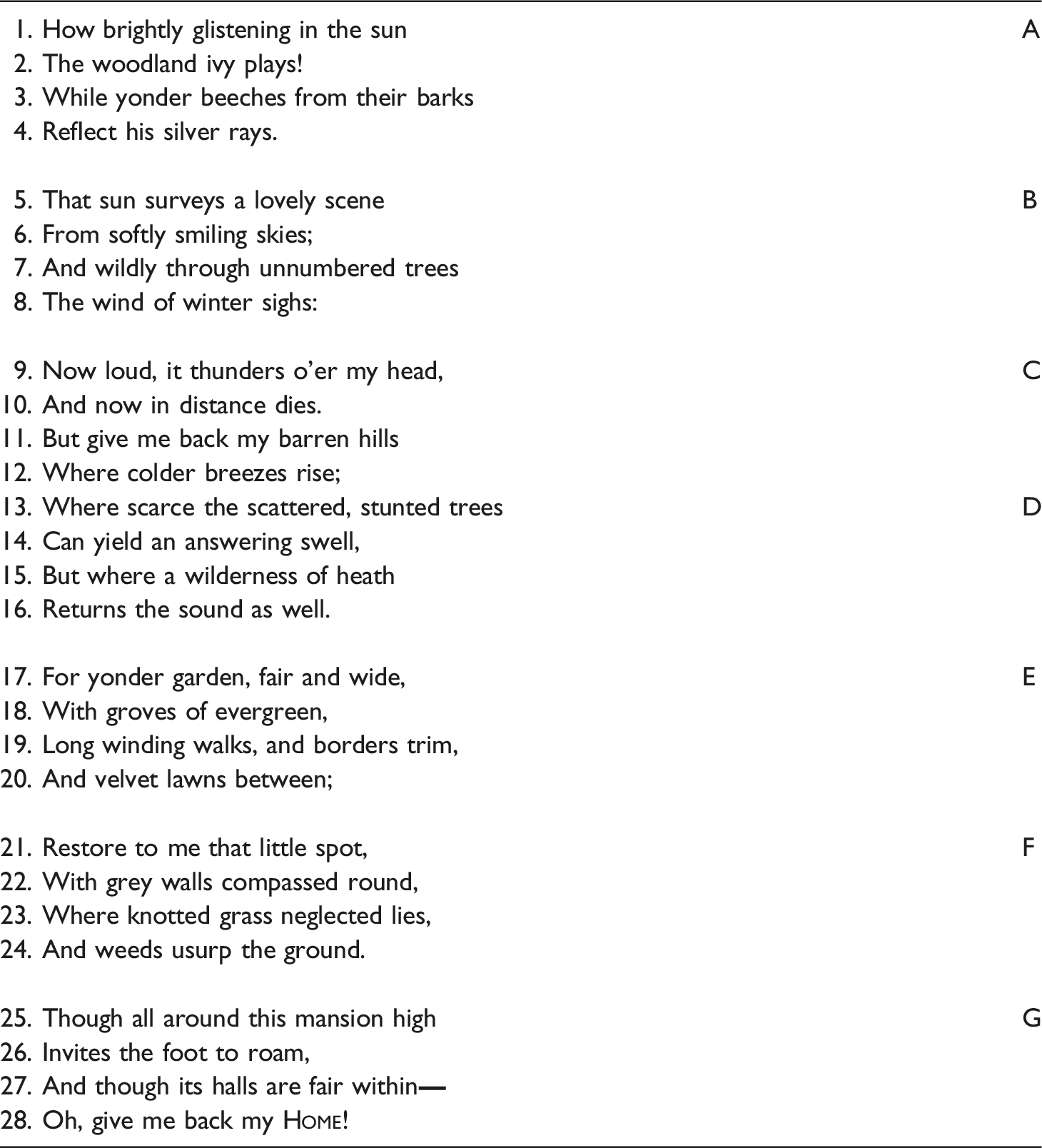
4.1.2. Humanist reading
Humanist and posthumanist readings are not mutually exclusive. Both are possible for the same text by the same reader. Indeed, where the posthumanist reader engages with a poem originally intended for non-techno-posthuman consumption, such as Brontë’s ‘Home’, they will be a humanist reader first. By this I mean that they rely on human memory and intuitions for understanding the poem exegetically, according to standard hermeneutic procedures, before eisegetically interpreting it as a techno-posthuman.
On an exegetical understanding, Stanzas A, B, E and G detail Anne Brontë’s grand surroundings while Stanzas C, D and F highlight her (desire to be) home. Irony is apparent on humanist understanding of ‘Home’: stately home and verdant garden do little to vanquish Brontë/the persona’s homesickness for ‘barren hills’ (11) and ‘stunted trees’ (13). Stylistic analysis helps account for literary effects in humanist engagement. For instance, repeated use of the approximant /w/ (e.g. ‘
4.2. Adena’s video
The context for this posthumanist reading is a second-year undergraduate module. Students produce digitally-inventive multimodal interpretations of poems, using stylistic analysis to develop their creative visions. Initial stimulus for transformative multimodal reading of ‘Home’ was work by a former student, Adena, a study-abroad undergraduate from California. She attended our university for a year taking predominantly business and marketing modules, and my module as an elective without a linguistics background. Returning home during the winter vacation, she videoed wildfire remnants on her mobile phone. Stanzas C, D and F – referring to Brontë’s real home – were interpreted diffractively via images of California in the wildfires’ aftermath. Echoing 2.6.2, stanzas A, B, E and G were shot diffractively as iconic London scenes, analogous to Anne Brontë’s grand surroundings. For example, Adena shot ‘mansion high’ (25) as an amalgam of Tower Bridge, Westminster Abbey and Buckingham Palace.
4.3. Posthumanist reading highlighting anthropogenic climate change
I wanted to model for students a double posthumanist reading – one not just based on a co-constituting interpreting unit of human + digital tools (techno-posthumanist), but creatively defamiliarising a poem’s anthropocentrism too (non-anthropocentric posthumanist). In Brontë’s time, the poem’s human yearning for home is understandable. In the context of i) anthropogenic global emergencies affecting the planetary home of numerous species aside from humans; ii) contemporary transport infrastructure (Thorp Green Hall to Haworth is less than seventy kilometers), ‘Home’s’ theme diminishes in significance.
While the natural environment of Anne Brontë’s home was implicitly stable, that of Adena’s home is not. Climate change makes wildfires regular occurrences in California, visibly changing its landscape. Adena’s film did not highlight the anthropogenic causes of the wildfires. My aim, with her consent, was to make her diffractive reading (4.2) doubly posthumanist by adding hyper-read video and my image and sound manipulations spotlighting the Anthropocene (see 4.5). 14 Adena happily donated her video as a resource for this purpose, agreeing to edits/additions, as well as those driven by my stylistic analysis. She redid her voice-over using a better quality microphone and was paid 70USD in Amazon vouchers.
Once I began the double posthumanist reading, it was impractical and indeed uncomfortable using Adena’s original film. I opted to shoot my own scenes on a mobile phone (e.g. my videoing of Stanzas A, B and E has the narrator in central London’s Regent’s Park in winter, a ‘Royal Park’, and therefore linked to my wide shooting of Buckingham Palace (‘mansion high’, Stanza G) at the end. Rather than add to, I chose to replace Adena’s shots with creative commons footage of Californian wildfires and their aftermath. While Adena shot wildfire devastation from ground level, the creative commons video was shot with aerial drones dramatically showing the extent of the devastation. This also suits my purposes in highlighting the value of incorporating audio-video from the world-wide-web archive into posthumanist multimodal reading of a poem.
In shooting my own footage as well as repurposing web-based audio-video, I am far from diminishing Adena’s creative stimulus. For this reason, she is credited as co-filmmaker. Indeed, since students have the option to produce a video in a pair, with this film I model collaborative creativity on the module. The video
15
of ‘Home’:
4.4. Posthumanist literary criticism and creative defamiliarisation
Such double posthumanist reading constitutes posthumanist literary criticism, a new field ‘retraining readers to think outside anthropocentric and humanistic habits’ (Braidotti, 2019: 133). Retraining is achieved in at least two ways. The first examines exemplars of non-anthropocentric imagination in posthuman artworks, sci-fi literature, etc. (Lau, 2018: 348). The second raises critical awareness of anthropocentric literature (Braidotti, 2019: 133). If such awareness-raising only involved critique, however, it would quickly reach a ho-hum dead-end.
Posthumanist literary criticism antidotes such dead-endness by combining criticism with creative transformation, echoing Peter Mahon (2.4.2). The critical-creative purpose is to defamiliarise anthropocentrism (Braidotti, 2019: 133; 139-144; Lau, 2018: 47). As a result Critique and creativity become praxis that actualizes the formation and realization of alternative, affirmative figurations that counter dominant, majoritarian representations of the subject. (Lau, 2018: 347)
The implications are significant for the traditional humanities: …critical thinking needs to be redefined, in a move that combines posthumanist criticism with post-anthropocentric creativity and affirms the continuity of all beings with the PostHumanities. This entails a serious discussion of what, of the Humanist past, can and should be salvaged. (Braidotti, 2019: 146-7)
In my double posthumanist interpretation of ‘Home’, I defamiliarise anthropocentrism further by framing the film as follows: a young Californian woman reflects on winter wildfires in her home state while stuck in London from Covid-19 travel restrictions. Covid-19 is a disease associated with a bat-incubating virus to which humans are far more vulnerable. It was declared a pandemic by the World Health Organisation on 11th March 2020. My Regent’s Park setting for the London ‘nonhome’ parts of the poem chimes with the pandemic lockdowns of 2020-21. Indoor activity in public places (e.g. non-essential shops, restaurants and bars) was proscribed for fear of infection spread, with citizens encouraged to walk in parks for exercise and mental well-being. The video reads stanzas A, B, E diffractively via the Covid-19 lockdown context, the narrator affirming the restorative power of being in nature through fresh eisegetical meaning activation (e.g. ‘That sun surveys a lovely scene’ (5); ‘Long winding walks’ (19)) during the bleak winter UK lockdown of 2020-21.
I now detail some examples from my hyper-reading for defamiliarising ‘Home’s’ anthropocentrism through digitally-diffractive multimodal interpretation.
4.5. Hyper-reading to facilitate digitally-diffractive multimodal interpretation

I synced drone footage of burned forest with ‘wilderness of heath’. For line 16, I added the ‘sound’ of one young campaigner’s impassioned speech, thus transforming intuition of the line. Burned ‘wilderness’ (15) caused by climate change ‘returns’ (16) a full-hearted response. The poem’s anthropocentrism/humanist understanding is further defamiliarised with her words ‘humanity is currently causing the sixth mass extinction of species’. 17
Another added image is a burning Earth seen from space (Figure 2) for stanza G’s ‘Oh, give me back my H Burning Earth cinemagraph synced with ‘Oh, give me back my H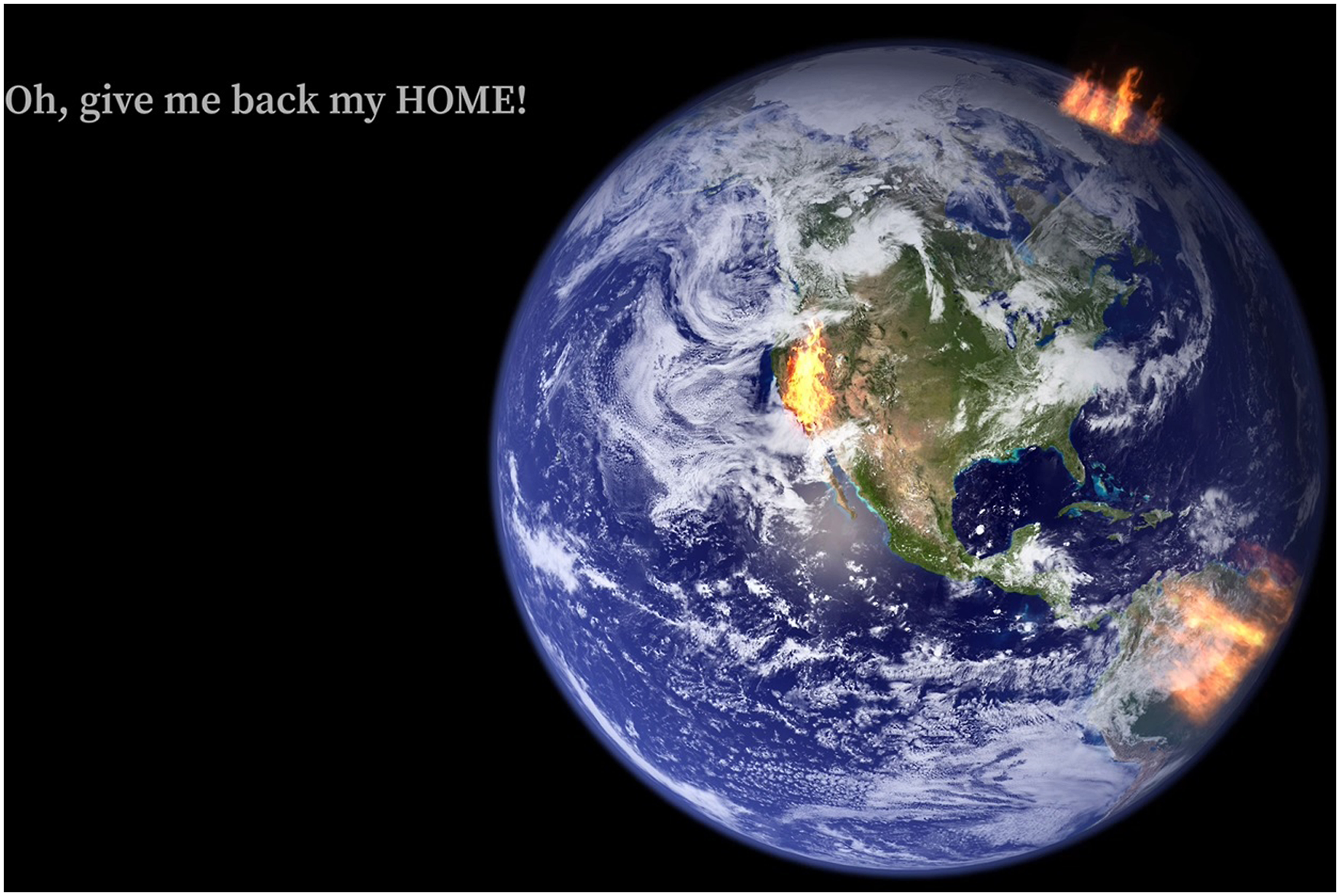

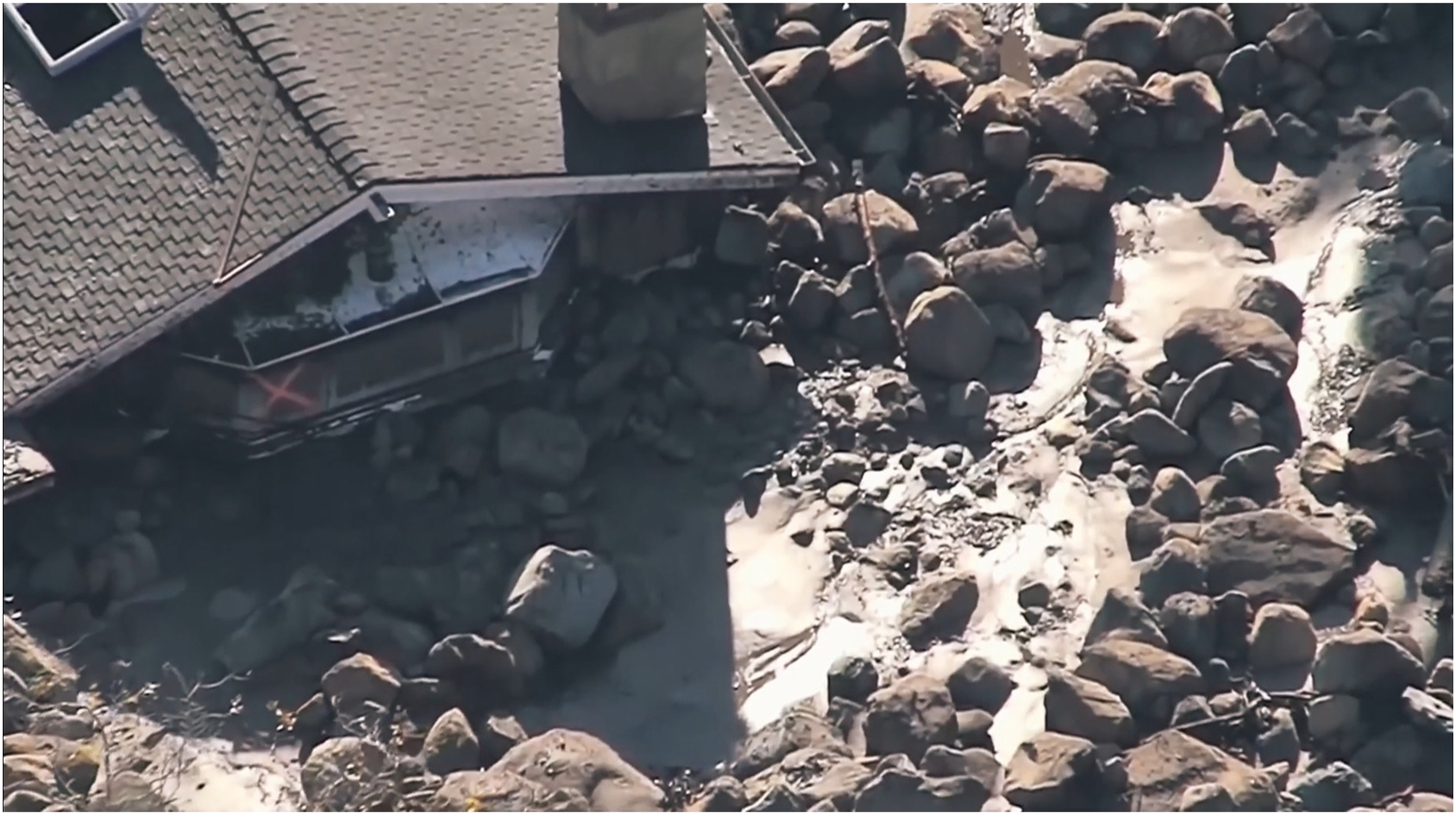
‘grey walls compassed round’ (22).
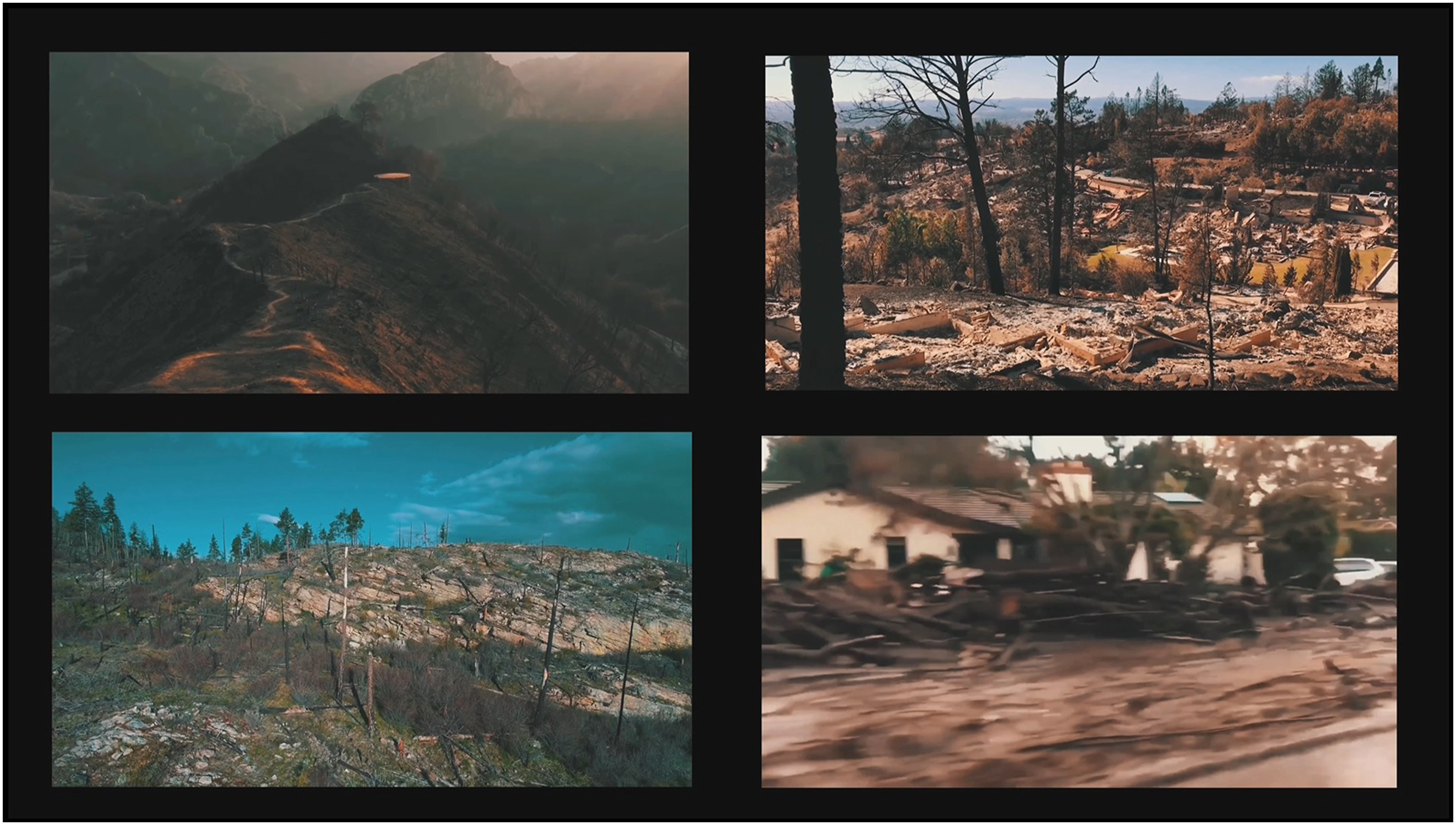
Here then is a good example of diffractive-assemblage-based multimodal reading product dependent on the world-wide-web digital video archive – that is, not possible or far more inconvenient to produce pre-web. In addition, I metaphorised ‘weeds usurp the ground’ (24) as unwanted debris caused by fires (Figure 4). These metaphorisations were not intuited from reading the poem. They emerged from intra-action between the poem, mind and hyper-read video of wildfire aftermath. ‘weeds usurp the ground’ (24).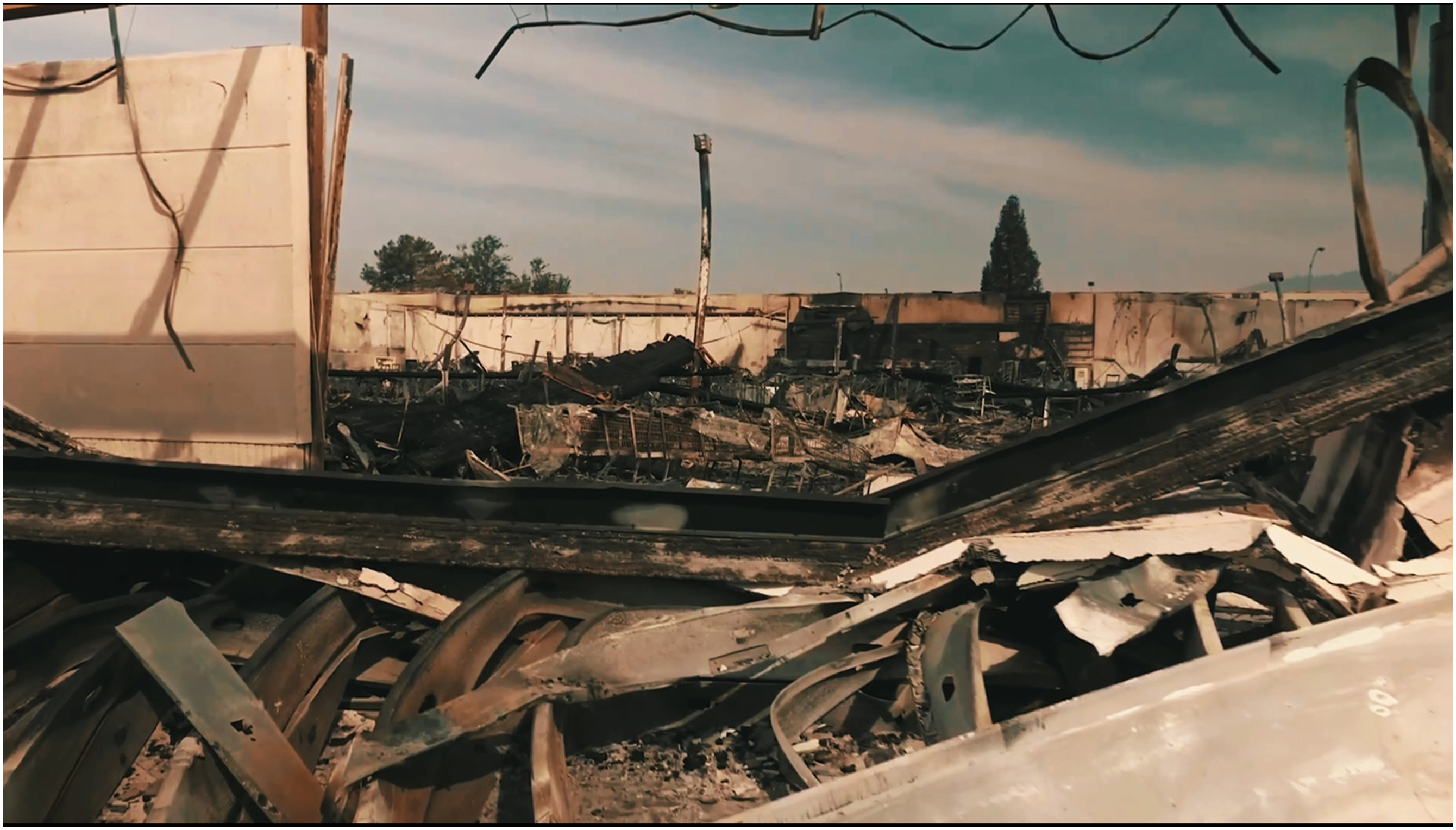


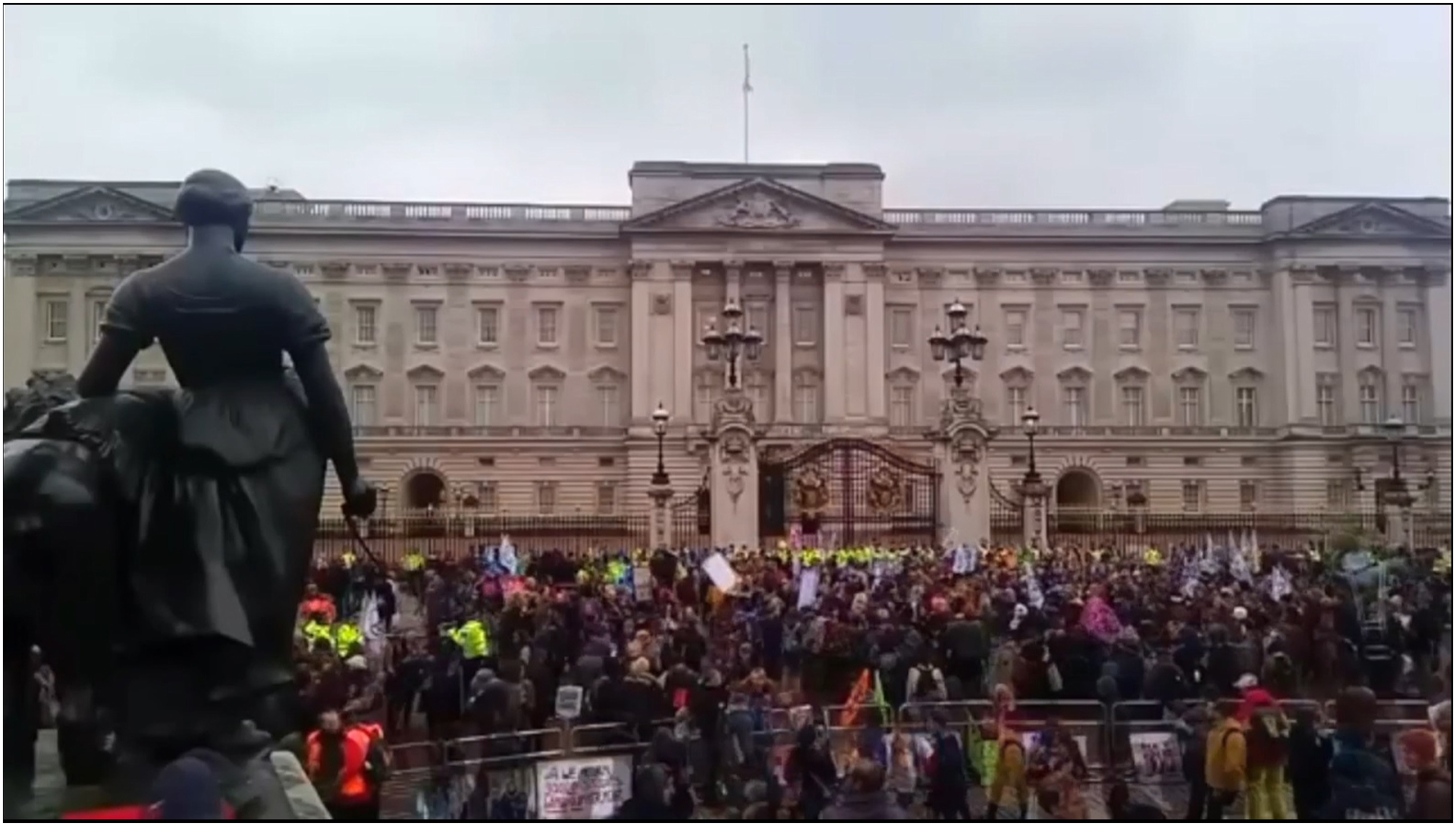
‘all around this mansion high invites the foot to roam’ (25/26).
I move to stylistic analysis. Echoing Section 3, in the next section I use linguistic analysis to plug into this double (techno- and non-anthropocentric) posthumanist interpretation to motivate further unpredictable connections with other digital tools, augmenting the reading’s creativity. I do this using audio-video editing/effects apps.
5. Stylistic analysis to motivate audio-video edits and effects
5.1. Sound enhancement
5.1.1. Parallelism
I commented in 4.1.2 how, on a humanist interpretation, repeated sibilant sounds ( /s/, /z/ and / tʃ/ ) and the approximant /w/ (Figure 6) evoke the ‘wind of winter’ (8) blowing ‘wildly through unnumbered trees’ (7) around Thorp Green Hall and the ‘colder breezes’ (12) of Haworth Moor. Foregrounded sound patterns across ‘Home’.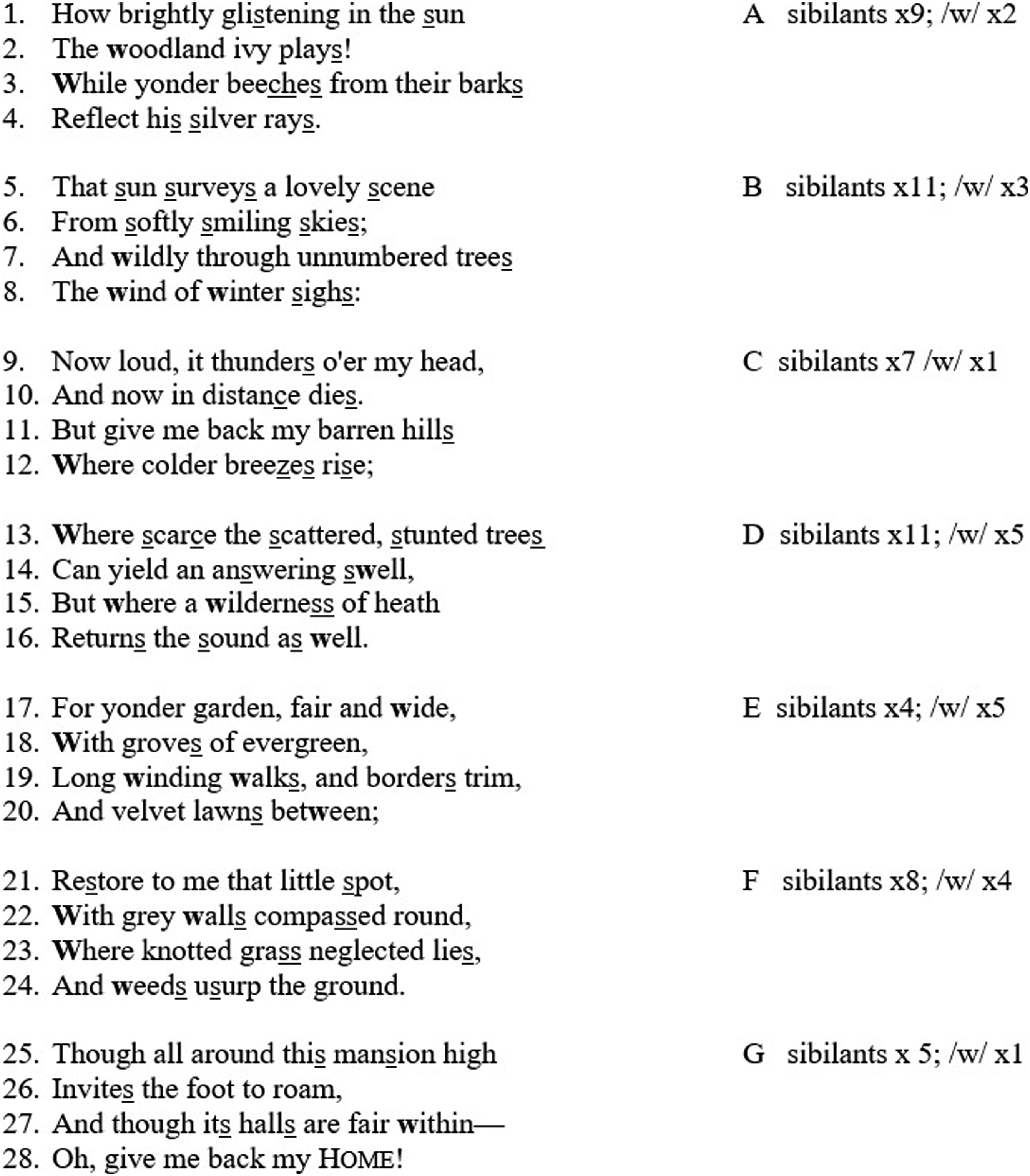
How might these phonological parallelisms motivate use of sound in the posthumanist reading? High winds in California, such as Santa Ana winds, accelerate wildfires. 22 Motivated by these sound repetitions, wind was added to the film soundtrack. ‘Wildly through unnumbered trees’ (7) takes on new eisegetical significance. The /w/ repetitions also drive inclusion on the soundtrack of water-bearing helicopters. The sibilants intra-actively motivate addition of hissing audio as fire is extinguished. They also connect with rainfall-initiated debris flows in the wildfires’ aftermath. Sibilants are fricatives – flowing sounds. For stanza F, I added flowing-water audio to link to mudslides from rainfall undammed by destroyed forest. Sibilant stylistic analysis also intra-actively prompted my continuing the flowing-water audio into stanza G, which focuses on London. This intra-active connection came from learning that London, and much of the UK, is vulnerable to flooding as sea levels rise from climate change. 23
5.1.2. Internal deviation

The poem’s only hyphen in line 27 reinforces this semantic disconnection in the final couplet. So too does the capitalised ‘H
There is another dimension to this internal deviation. Line 28 is the only line which does not contain a sibilant or /w/ sound (Figure 6). These absences mobilise the following idea: from space we would not hear wind, water-bearing helicopters, hissing of extinguished fires nor flowing water. Accordingly, I omitted audio including voice-over for this final line, superimposing just line 28’s text on the burning Earth cinemagraph. This depersonalising enhances the universal message of the double posthumanist reading – return pre-anthropogenic climate change Earth!
5.2. Visual enhancement
5.2.1. Contrasting part of speech frequencies in ‘home’ and ‘nonhome’
Recall (Section 2) the posthumanist ethos of making fresh relations to facilitate creativity. One way of generating these is through contrast. I thus divide the poem into ‘home’ (59 words) and ‘nonhome’ (90 words) (Figure 7). Brontë’s poem divided between ‘nonhome’ and ‘home’.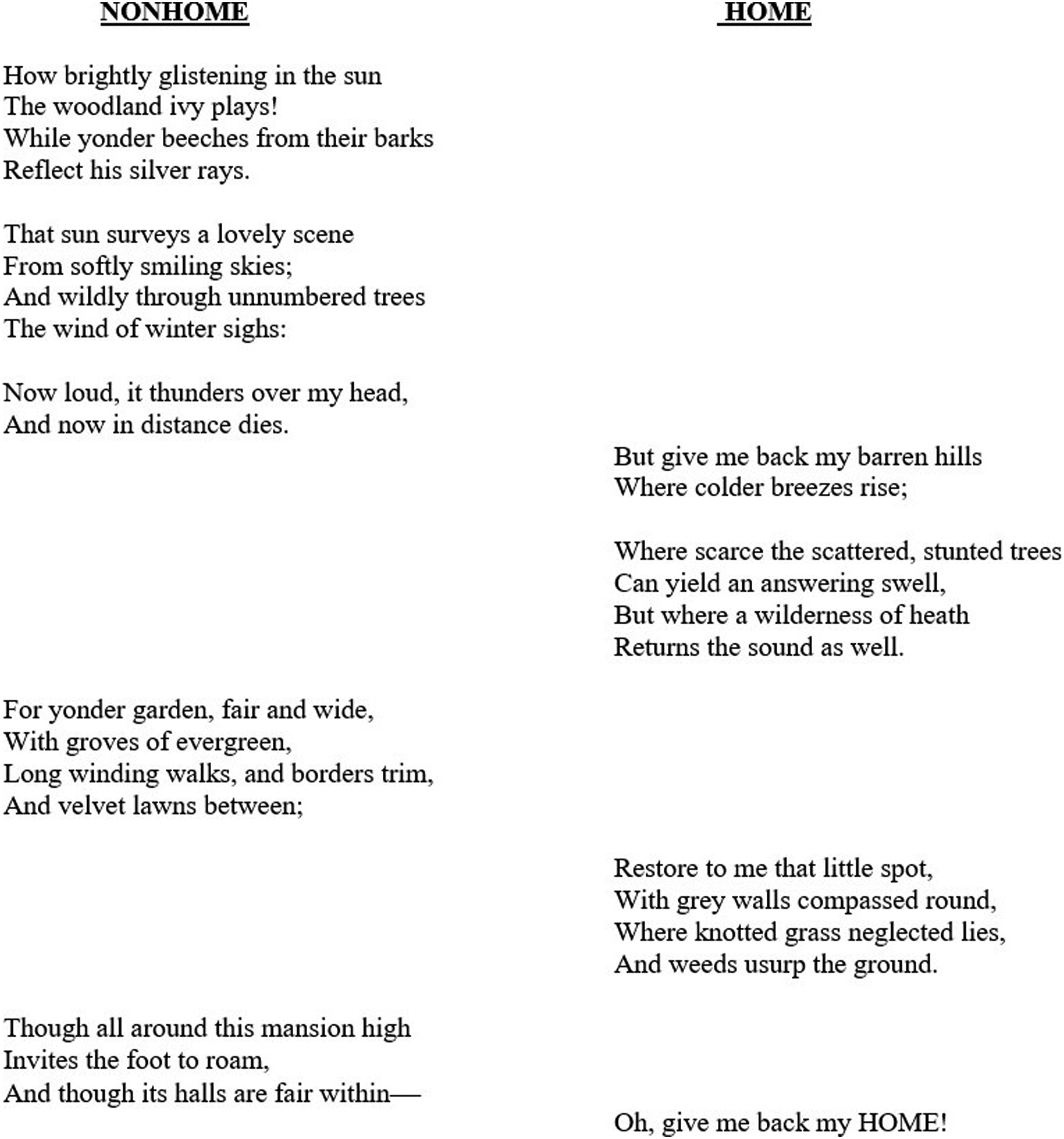
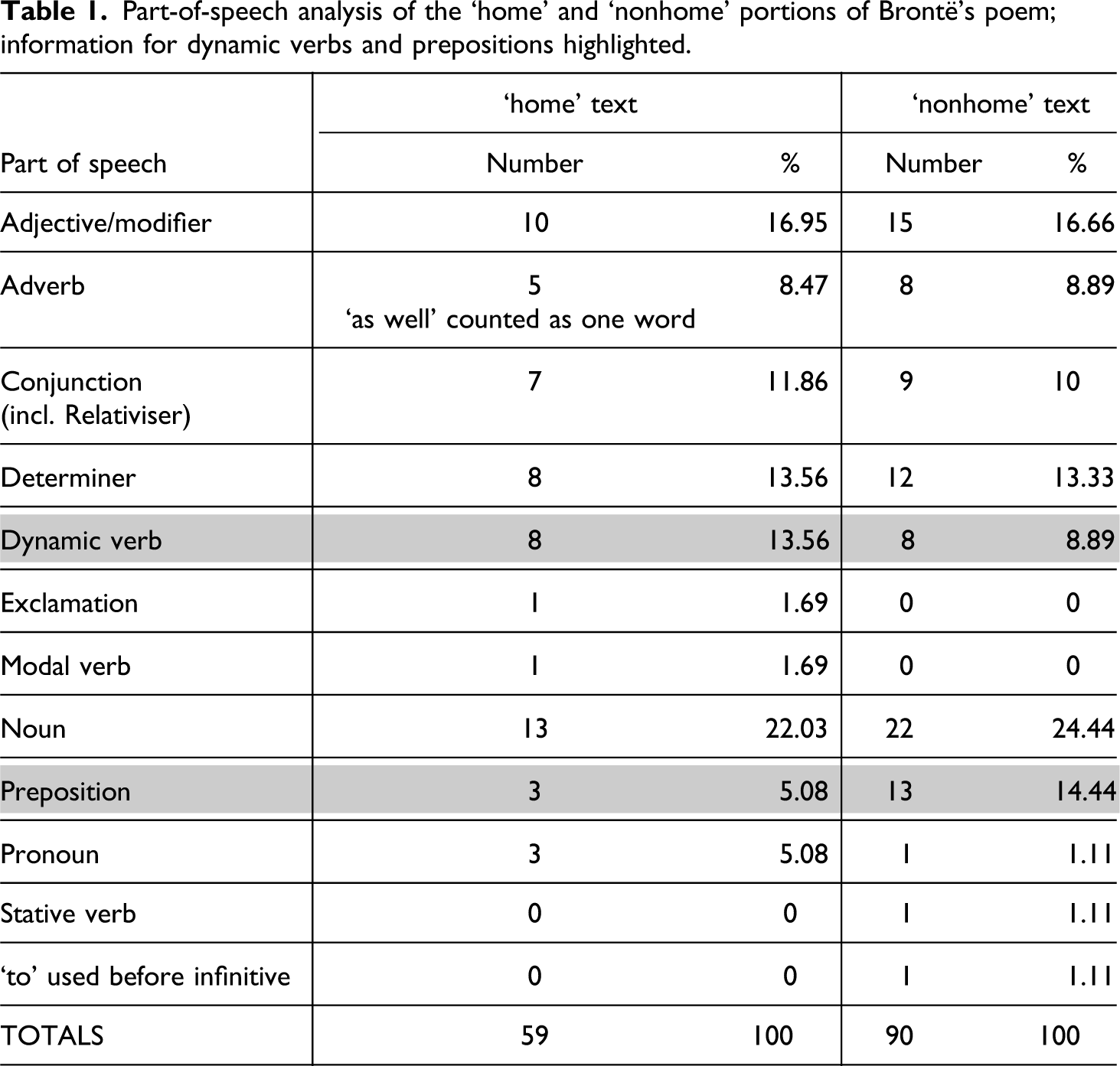
Part-of-speech analysis of the ‘home’ and ‘nonhome’ portions of Brontë’s poem; information for dynamic verbs and prepositions highlighted.
5.2.2. Contrastive visual dynamics for ‘home’ and ‘nonhome’ I
As Table 1 shows, preposition counts/percentages are: ‘home’ portion (x3; 5.08%) and ‘nonhome’ portion (x13; 14.44%). Eleven out of the thirteen prepositional phrases (PPs) in ‘nonhome’ reference the environment (Figure 8). In only one of these eleven environment referencing PPs in ‘nonhome' is the PP part of a grammatical subject in a clause - ‘the wind 11 out of 13 prepositional phrases referencing the environment (‘nonhome’ portion). Environment in grammatical subject position (‘home’ portion).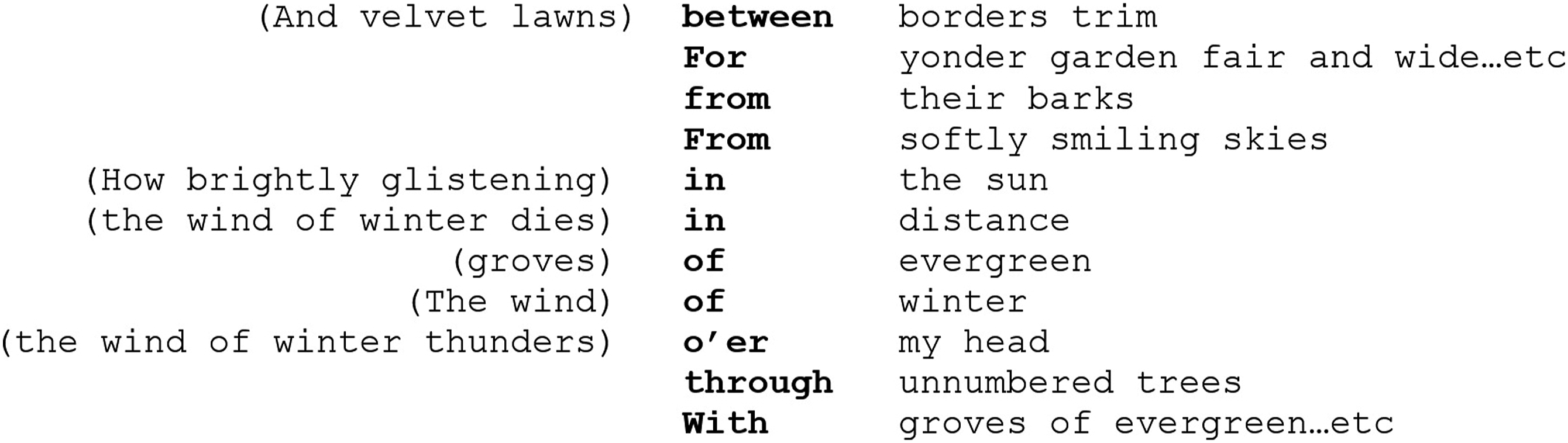
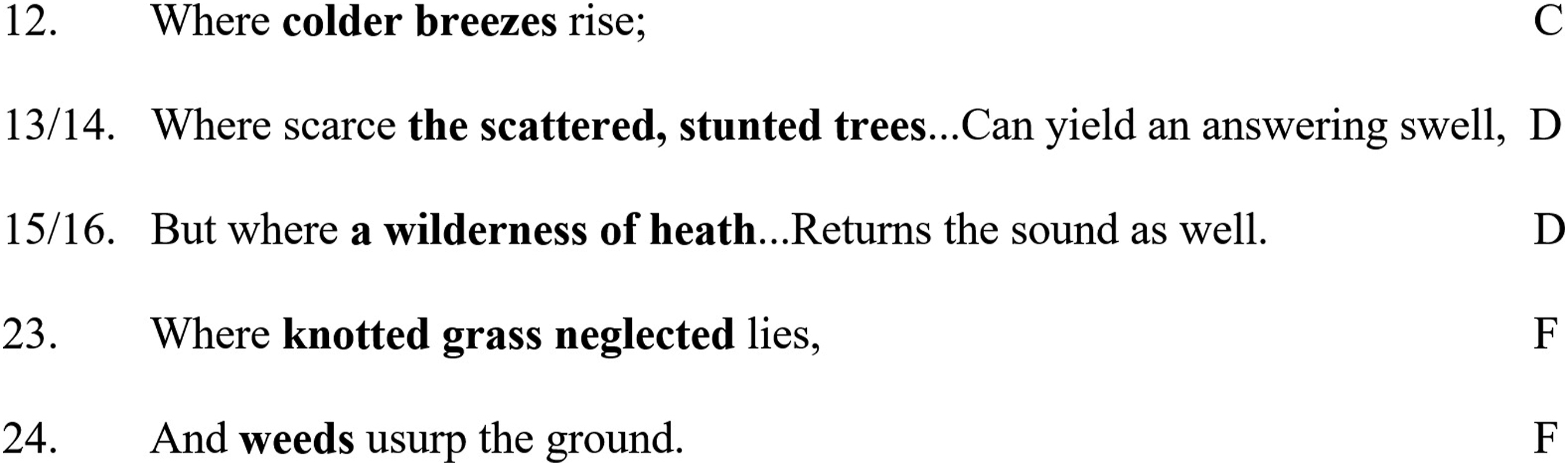
Not only prominence, but agency in ‘home' too. Of the five clauses in Figure 9, three are transitive (lines 13/14; 15/16; 24). Moreover (Table.1), there is greater relative frequency of dynamic verbs in ‘home’ (13.56%) as compared with ‘nonhome’ (8.89%). Given the greater prominence/agency of the environment in ‘home’ and its greater concentration of dynamic verbs, I edited the California wildfire aftermath scenes to depict the environment more dynamically than in the ‘nonhome’ London scenes. This was made relatively straightforward by the sourced drone footage already being dynamic. The implicit message from this editing is that the wildfire aftermath in California concerns the female narrator more than London.
Conversely, since Figure 8 shows a high degree of parallelism for elements of the ‘nonhome' environment not in grammatical subject position, ‘nonhome’ shots of Regent’s Park are less dynamic, edited for slow staccato effect. The narrator longs for California. Despite the restorative effects of Regent’s Park during the Covid-19 lockdown, London is a ‘drag’.
5.2.3. Contrastive visual dynamics for ‘home’ and ‘nonhome’ II

Repeated words in ‘home’ and ‘nonhome’.
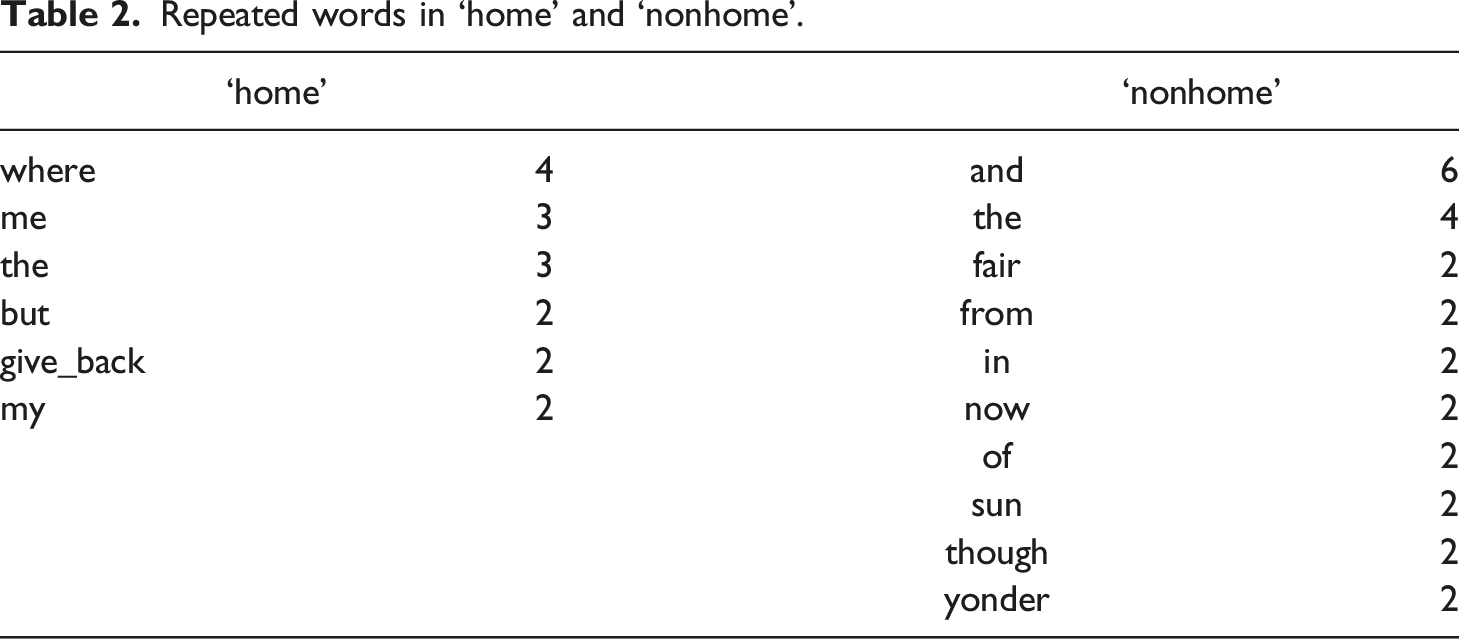
In stanza E, ‘and’ co-ordinates noun phrases and an adjective phrase in a long description, minus verb phrases, of the Thorp Green Hall garden. This means an absence of clauses which could realise dynamic meanings with grammatical subjects functioning as agents. Motivated by this absence, for stanza E I edited video of Regent’s Park in an especially non-dynamic/staccato manner.
5.2.4. Superimposition of images in Californian scenes
‘Where’ (x4) is the most repeated word in the ‘home’ portion (Table 2). In fact, there are five instances since ‘where’ is ellipted in line 24. All instances front clauses with nature in subject position. We have then parallelism unique to the ‘home’ portion (Figure 10). ‘Where’ clause parallelisms. ‘Where’-clause parallelisms motivating parallel scenes of wildfire aftermath.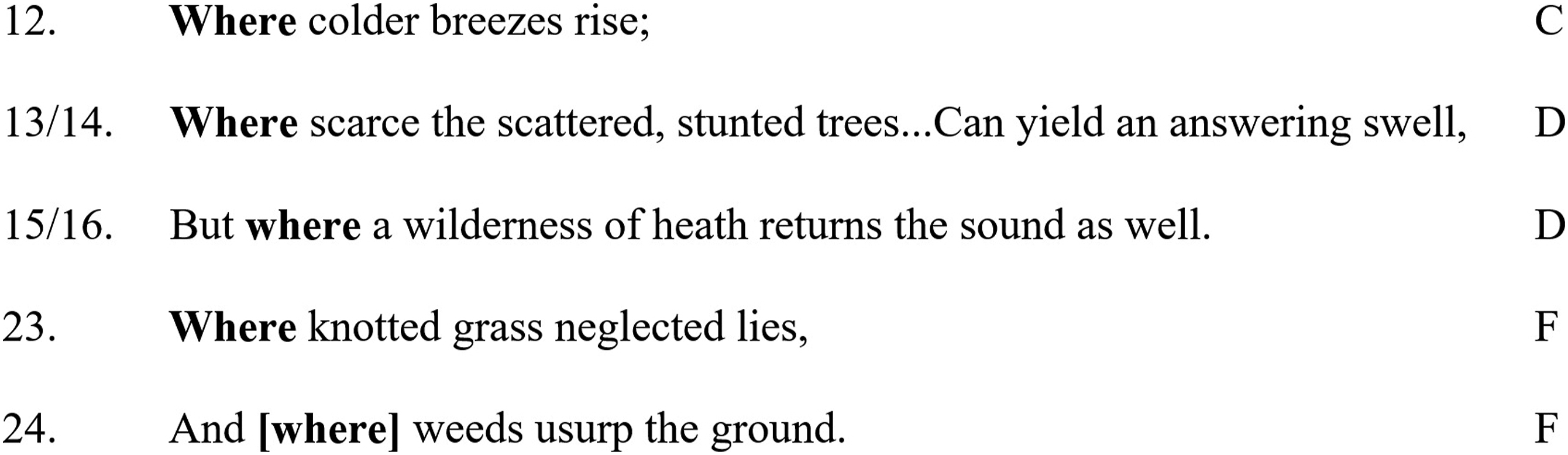
5.2.5. Superimposition of London and California

Linkage is also created by the second word of each phrase starting with /g/ and each PP occurring in the second line of each stanza. Interestingly, though both lines are in iambic trimeter, ‘With grey walls compassed round’ – referring to home – has more words. This motivates a longer shot of line 22 than line 18, communicating that the narrator is more interested in boulders surrounding houses in the aftermath of the wildfires (4.5; Figure 3) than evergreen London. Moreover, the parallelism evokes intensely that the narrator reflects from afar, that is, Regent’s Park (‘groves of evergreen’). Motivated by this parallelism, the grey boulder ‘walls’ become tinted with green.
This is a good place to discuss why i) posthumanist stylistics does not rely principally on intuitions about the literary work; ii) linguistic analysis cannot be used to support posthumanist multimodal reading. My connecting i) ‘grey walls’ (22) with ii) grey boulders from incinerated forests carried into urban areas via rainfall-induced mudslides exceeds human intuitive understanding of line 22. This link came from unpredictable intra-action between an assemblage of freshly hyper-read video, mind and the poem. Above, stylistic analysis extended the posthumanist interpretive assemblage unpredictably. That is to say, analysis of the above parallelism developed emergent video creativity by intra-actively motivating my green tinting of the grey boulders. I say ‘motivating’ not ‘supporting’ since I did not know I would tint the boulders before analysing this parallelism.
5.2.6. Superimposition of London and Earth from space

‘Mansion high’ (25) and ‘my HOME’ (28) are noun phrases consisting of two words, beginning with /m/ and /h/, and featuring at the end of their respective lines. As in Sections 4.5 and 5.1.2, I synced ‘mansion high’ (25) with Buckingham Palace, including video footage of young climate change activists and the environmental campaign group, Extinction Rebellion, protesting outside the palace. Motivated by the above parallelism, for line 28 I merged my wide-shot of Buckingham Palace and the burning Earth (Figure 12), gradually fading the former, leaving just the cinemagraph (Figure 2). New implicit meaning is created through this superimposition. ‘Mansion high’ (25) refers not only to Buckingham Palace but also to Earth as ‘palatial home’ of all humans with another tacit communication: if only humans could revere their planetary home as much as a tourist attraction. Merging of burning Earth and Buckingham Palace motivated by ‘mansion high’ (25) and ‘my HOME’ (28) parallelism.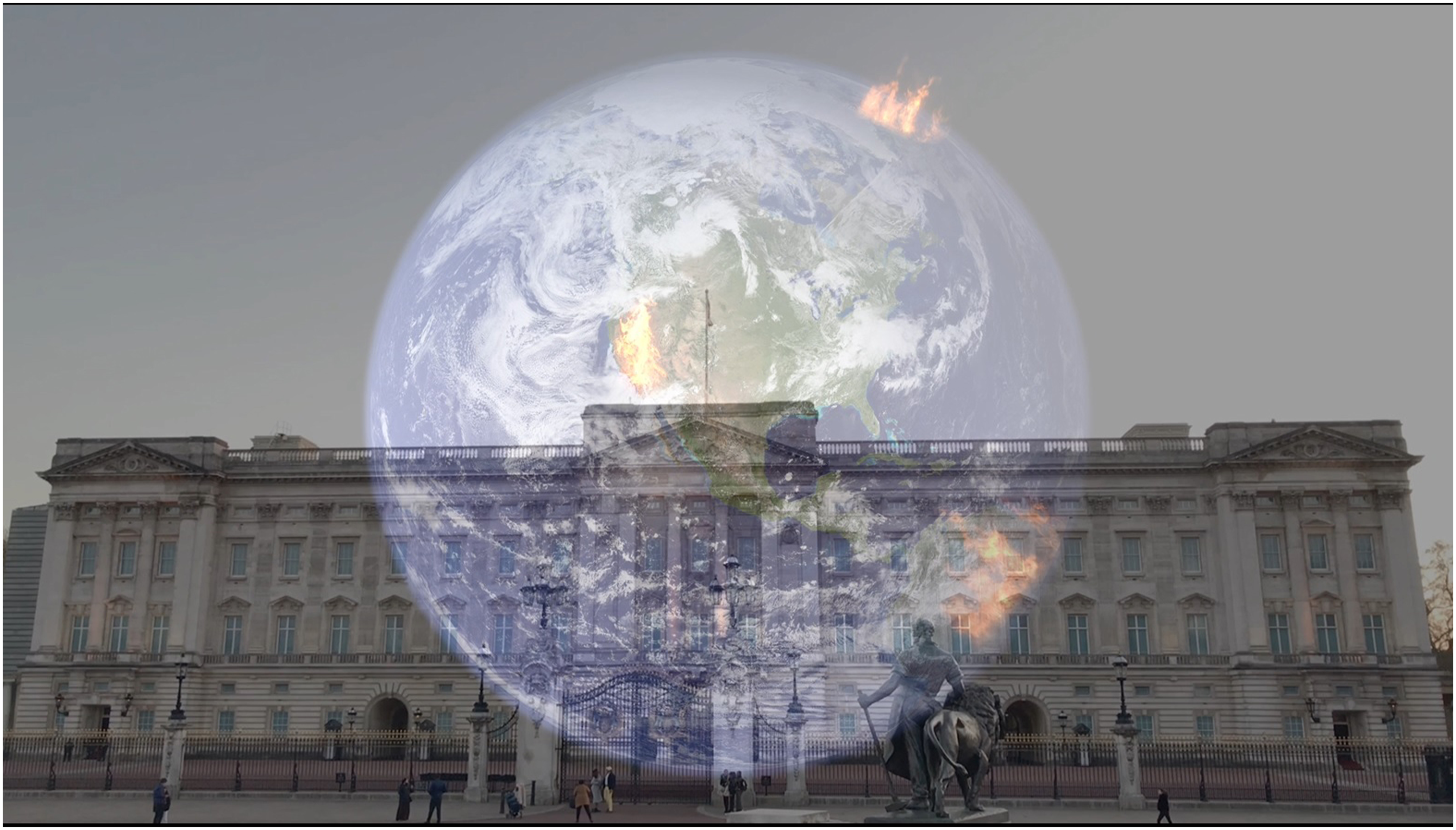
6. Reflection
6.1. Summary
This article has presented a posthumanist stylistics and modelled a double posthumanist reading – techno-posthumanist and non-anthropocentric posthumanist – where: i) a printed-based poem was interpreted diffractively in a human-digital tools assemblage that intra-actively decentred human intuition; ii) unusual juxtaposition of cinematic scenario with a poem led to creative multimodal reading unlikely on human reading alone; iii) the poem’s anthropocentrism/humanist understanding was defamiliarised via hyper-read digital resources highlighting anthropogenic climate change; iv) stylistic analysis was used intra-actively with freshly-made/existing audio-video material to motivate editing and effects.
6.2. Creative value of stylistic analysis in posthumanist reading
I used linguistic description to articulate literary craft systematically, as is standard in stylistics. But I showed new value for systematic description of style too:
motivating creative development of posthumanist multimodal reading of a literary text.
So I did not use linguistic analysis to support an interpretation, an explicit assumption of humanist stylistics associated with print-based literacy. That would also have implicitly assumed the interpreting unit is the human mind and that interpretation: i) is exegetical, ii) emanates from intuition, iii) is separate from the literary work and its stylistic analysis. Instead, in this posthumanist approach, stylistic analysis is one intra-acting component of a human-tools assemblage of other intra-acting elements (cameras, editing apps, hyper-read video, etc.), meaning interpretation of the literary work is inextricably bound up with its linguistic analysis.
I indicated ways in which stylistic features can be used to motivate audio-video edits and effects creatively. Stylistic analysis does not have to be deployed only post-production. It can be used in production also, for instance, motivating shot choices and acting (see O’Halloran, 2022a). 25 I have exemplified the approach using a short lyric poem; a poetic extract from a novel or play could have been employed instead. Lastly, though linguistic analysis is not employed to support interpretation, it does not mean posthumanist stylistics is unrigorous. It still needs systematic linguistic description of the literary text. Moreover, because this description is used to augment the multimodal reading’s creativity, this extension is non-arbitrary.
6.3. ‘Digital artefact’ as posthumanist reading product and other possibilities for creative assemblages
The pre-digital terms ‘film’ and ‘video’ should be understood loosely so as not to restrict the range of digital possibilities for transformatively creative multimodal interpretation of literary works. ‘Digital artefact’ is better. Moreover, not every digital artefact need (only) involve human voices/actors (or dancers, etc.). For example, how might a ‘world-building’ game 26 be incorporated into a posthumanist response to a literary work vis-à-vis stylistic analysis? Or video gaming? An animation app? Augmented/virtual reality technology?, etc. Not every digital artefact needs to be a multimodal interpretation. It may just involve sound, for example, posthuman music created in human + music-software assemblages (Trippett, 2019). Since in the postdigital ontology the digital is woven into our lives – which will include analogue technology – it does not follow posthumanist reading should use digital tools exclusively. This article did not pursue how digital and analogue technologies (chalk, marker pens, whiteboards, etc.) could be used intra-actively in tandem with stylistic analysis to foster inventive posthumanist reading of a literary text.
6.4. Relationship between humanist and posthumanist literary interpretation
6.4.1. Digital eisegetical transformation of exegetical understanding
Print-based poetry presupposes exegetical understanding within human processing parameters. So a posthumanist eisegetical interpretation of a print-based poem assumes such understanding in the first instance. That is to say, the posthumanist reader produces a digital multimodal transformation of exegetical understanding. This is not a ‘re-writing’ – a description linked to print-based literacy.
In starting from print-based exegetical understanding, it might be objected that posthumanist eisegetical transformative reading of a poem is ‘not what it is about’. Yet such a rejoinder implies that despite i) the contemporary postdigital ontology of humans networked to digital tools/world-wide-web and ii) techno-posthuman subjectivities being commonplace, the objector interprets print-based poetry only within humanist and thus anthropocentric parameters, where interpretation is exclusively exegetical emanating from intuitive ideas produced from the human mind. Humanist reading and posthumanist reading are not mutually exclusive.
6.4.2. Employing digital tools in literary interpretation is not necessarily posthumanist
To be clear, using digital tools does not in itself make literary interpretation posthumanist. For example, employing a digital camera to film a human interpretation of a literary work is not posthumanist; neither in itself is corpus stylistics’ deployment of text analysis software and digitised corpora (see O’Halloran, 2022b). Nor does utilising digital tools lead necessarily to non-anthropocentric readings. A key difference between a humanist reader who uses digital tools and a posthumanist reader is philosophical outlook: the techno-posthumanist reader assumes limitations to solely human cognition for creativity without digital aleatory techniques. Reading a literary text is techno-posthumanist where the reader deliberately makes intra-active connections with audio-visual digital resources/tools to prompt decentring of human intuitions about that text, affording creativity unlikely from human cognition alone. Where techno-posthumanism conjoins with non-anthropocentric posthumanism, this decentring will also deliberately defamiliarise anthropocentric norms in the literary work.
6.4.3. The importance of human agency in creating techno-posthuman subjectivities
In bringing together techno-posthumanism and non-anthropocentric posthumanism, it may seem I am downplaying the human contribution in fostering these subjectivities. Far from it. Intra-active entanglement of human and digital tools/virtuality is unavoidable in the 21st century for most humans. 27 We should be critically-aware, making prudent, rational, autonomous choices about which human-digital assemblages to construct, thus hopefully averting internet addictions. Moreover, we should avoid being sucked into mindless dehumanising time-sapping techno-posthuman assemblages serving corporations and advertisers’ interests. Sustaining/augmenting our mental health is self-evidently important. (Did not the Covid-19 pandemic lockdowns of 2020-21 reinforce that online communication is no substitute for face-to-face contact?). The intra-active benefits of digital tools/resources should always be meditated upon.
We do not then abandon humanism in constructing techno-posthuman subjectivities. The two are inextricably linked since prolonging/enhancing our i) mental equilibrium; ii) autonomy and agency are necessary for generating beneficial techno-posthuman subjectivities. There is another reason for this inextricable linkage of humanism and techno-posthumanism, one relating to this article. Producing digital multimodal non-anthropocentric interpretations of poems is acting posthumanly to develop human creative thinking. This may seem contradictory. Yet humans have, for a long while, generated human-technology assemblages to disrupt their habitual thinking and behaviour – the technology can be as simple as rolling dice to decide an outcome. 28 A human-digital tools assemblage is yet another aleatory assemblage – albeit with far more sophisticated technology.
6.4.4. Humanist stylistics and techno-posthuman subjectivities
It is easier to produce creative interpretation of poetry as an eisegetical digital juxtaposer/recontextualiser than as a hermeneutic exegete. This standpoint hardly obviates humanist understanding of poetry and thus humanist stylistics. Reflecting 6.4.3, many of us need strategies to shun obsessionally repetitive and thus restrictive digital behaviours releasing pleasurable dopamine, but bestowing little benefit to us or anyone else. One strategy is to defamiliarise our habitual use of intelligent technology by generating what is promoted here: novel entanglements with digital tools/resources such as creative eisegetical multimodal interpretation of poetry. Another strategy is, following a long stint in the digital realm, to contemplate what it means to be human, facilitated amongst other things by reflecting on a print-based poem. Appreciating stylistic craft can facilitate acute meditation on human themes in the poem and, in turn, help recuperate human agency, augmenting human conation for circumventing human-digital tools assemblages furnishing us or others little gain. Engagement with literature in humanist stylistics thus has a key role to play in deepening reflection on what it means to be human and to possess human agency, in turn helping inform beneficial choices of techno-posthuman subjectivities.
6.5. Teaching posthumanist stylistics
6.5.1. Setting up the pedagogy
A posthumanist stylistics pedagogy is straightforward to set up given ubiquitous ownership of laptops, tablets, mobile phones, etc., and the young’s ease with digital literacy. Freely available online tutorials mean much teaching of video creation can occur outside the seminar. 29 Alternatively, it is possible to bypass mobile phone (etc.) filmmaking and expect students only to download and edit creative commons footage from the web for their multimodal interpretations of poems. Yet videos can lack vitality if they completely rely on existing footage. Moreover, it is fun for students to ‘get out there’ and collaborate in a video shoot.
Students with some background in film-making will, self-evidently, create more polished digital artefacts than those who do not. Inventive digital expressions which are also beautiful should be encouraged. Yet, since creative thinking is fostered in the processes of: • unusual mashup of novel storied scenario with a literary work; • stylistic analysis motivating creativity in the video; • making a digital artefact;
students’ products need hardly be works of art.
6.5.2. Enhancing creative thinking
Why flag the creative thinking process? In the Fourth Industrial Revolution (Schwab, 2016), as AI increasingly interpenetrates the workplace, employers seek creative thinkers to realise the possibilities of this revolution.30 A by-product of a posthumanist stylistics pedagogy – enhanced creative thinking – augments employability. Cognitive flexibility is a prerequisite of creative thinking (Mlodinow, 2018). With students developing both humanist understanding and posthumanist interpretation of a literary work, their cognitive flexibility is augmented. Boosting creative thinking is hardly only about increasing employment chances. It is essential to realising life’s opportunities, to mental well-being, addressing socio-political problems and global challenges, including anthropogenic ones, as well as those emanating from the Fourth Industrial Revolution.
Footnotes

Declaration of conflicting interests
The author(s) declared no potential conflicts of interest with respect to the research, authorship, and/or publication of this article.
Funding
The author(s) received no financial support for the research, authorship, and/or publication of this article.