



Abstract
This article analyses the degree to which readers report a perceived sense of closeness to the events depicted in ‘Belgium’, the opening story of Mary Borden’s The Forbidden Zone. Theoretically, I draw on Ronald Langacker’s Cognitive Grammar, which models language primarily through its notion of construal, an aspect of which claims that -ing forms impose an internal perspective on a scene that results in the interpretative effect of it being ‘close by’. This study tests this idea empirically by utilising a quantitative tool (Likert scale) to elicit two sets of verbal data, which are then analysed qualitatively. My analysis demonstrates that readers respond to the events in the story and articulate the relationship of particular language features to their responses in different – and often surprising – ways. The study is the first in stylistics to empirically test the interpretative effects of verb forms as theorised by Cognitive Grammar and thus contributes new knowledge both by exploring how the landscapes of First World War literature are experienced by readers and analysing how the language of those landscapes may give rise to particular reported effects.
Keywords
1. The Forbidden Zone
Mary Borden (1886–1968) was an American writer who served as a volunteer nurse with the French Red Cross during the First World War, during which time she set up two field hospitals, first in Flanders in July 1915 and then on the Somme in October 1916. The Forbidden Zone, a collection of short stories and poems, all of which describe in vivid detail her time at the Front, was first compiled in 1917 and eventually published in 1929 as one of the many ‘war books’ that became popular in the late 1920s (see Falls 1930). The original 1929 edition contained two sets of stories, ‘The North’, and ‘Somme: Hospital Sketches’, followed by an epilogue of five long free verse poems.
1
The book is effectively a survey of the various landscapes of the Front and the events and soldiers connected to them. Borden (1929: i) emphasises the importance of space in her rationale for the collection’s title that appears in her preface: I have called the collection of fragments “The Forbidden Zone” because the strip of land immediately behind the zone of fire where I was stationed went by that name in the French Army. We were moved up and down inside it; our hospital unit was shifted from France to the Somme, then to Champagne, and then back again to Belgium, but we never left “La Zone Interdite”.
In story after story, the reader is led across the various landscapes of war and invited to share the experiences of characters and witness the effect of conflict on the land. Many of the stories begin with the narrator setting out specific deictic parameters of place. For example, in ‘Bombardment’, the landscape is introduced as ‘The unconscious map lay spread out beneath it: the wide plain, the long white beach and the sea, lay there exposed to its speeding eye’ (5), while in other stories, the events are introduced and told relative to the spatial position of the narrator, whose stance the reader is invited to share: ‘There is a captive balloon in the sky, just over there’, ‘The Captive Balloon’ (11); ‘Below my window in the big bright square’, ‘The Square’ (13); ‘All these little men coming out of their boxes along the road’, ‘Sentinels’ (17); ‘High white clouds were moving slowly towards Belgium, moving without movement through a sky ineffably blue, superb castles of white vapour, floating towards a land called No Man’s Land’, ‘The Regiment’ (21).
Generally, the stories in the collection emphasise the intense visual aspect of the worlds they depict. Written in a modernist style with fragmented narratives and time frames and novel, dislocated images, the stories represent war in very different ways to more mainstream contemporaneous accounts. For example, Kaplan (2004: 35) reads the collection as ‘[…] the psychological instability of perception. In this book, raw edges are equated with the narrator’s raw nerves’. And, Schaff (2021: 236) argues that Borden transforms ‘the gritty, sordid realism of war into highly aestheticized images’. Other literary-critical analyses of The Forbidden Zone highlight both the visual quality of Borden’s writing and its potential for establishing an emotional connection with the reader. It is variously described as ‘one of the most experimental pieces of writing to have emerged from the war’ (Freedman 2002: 109), ‘a photograph of her experience’ (Harbison 2019: 1) and consisting of ‘virtuoso passages of visual manipulation’ (Hutchison 2013: 292). Hutchison explicitly comments on the potential effect of the language as offering ‘an eerie perspective, distant yet intimate, translating what is happening into a primarily visual event, cataloguing the horror and beauty of war with photographic clarity’ (2013: 293). Speaking specifically about the opening story, ‘Belgium’, Hutchison argues that it ‘engages the reader’s senses in complex and disturbing ways’ (2013: 284).
Literary-critical responses to The Forbidden Zone thus tend to foreground a felt and highly emotional and embodied readerly experience. More generally, this dual focus on the connection between language and the experience is central to current work in stylistics on the language of landscapes (Douthwaite et al., 2019; Virdis et al., 2021). As Douthwaite et al. (2019: 2) suggests The term [landscape] refers firstly to the description of concrete physical worlds, and secondly, but crucially, to the experiences those worlds engender […] and in particular to the linguistic means employed to describe those physical phenomena and the experiencing of those phenomena.
There is also evidence that readers do respond to The Forbidden Zone by emphasising a perceived sense of closeness to the actions of the novel. Although the book is relatively less-well known compared to other war memoirs and was out of print for many years until being reissued at the turn of the 21st century, a small number of online reports of reader responses exist. An analysis of a corpus of the 25 short responses that exist on Goodreads, coded using predetermined codes relating to embodied senses and experience, reveals that readers do talk about the novel in distinctive ways: 1. A 2. The Forbidden Zone, which was first published in 1929, is a collection of impressionistic pieces of fiction which 3. The stories in this book are beautiful, 4. This certainly isn’t an easy read, with (added emphases)
2. Reader response
More broadly, the consideration of reader response data alongside textual analysis is now firmly established as an integral part of contemporary stylistics (see for example, Whiteley and Canning 2017 for an overview). As Stockwell (2020) argues, cognitive poetic studies rightly need to align stylistic analyses with the study of readerly behaviour in order to be more than simply linguistics or simply psychology. Generally, reader responses have been generated from two kinds of approaches, defined by Swann and Allington (2009: 248) as either ‘naturalistic’ or ‘experimental’. In the former, reading is observed in naturally occurring setting such as reading groups and data generated from online reviews, which are then qualitatively analysed to examine the ways in which readers report their responses to texts in specific contexts. In the latter, more controlled conditions are set up that test particular textual features which may be analysed using quantitative methods. As Bell et al. (2019) argue, although each methodological paradigm has its affordances, it can be quite difficult to find a useful middle point between on the one hand, the study of a specific textual feature and, on the other hand, generating as rich a source of verbal data as possible. They highlight, however, that in some cases, researchers have managed to adopt a mixed-methods approach successfully (e.g. Kuijpers et al., 2014), and thus propose viewing naturalistic and experimental approaches as two ends of a methodological continuum. In their article, Bell et al. range across paradigms to combine aspects of the experimental (the isolation of a specific textual feature) and the naturalistic (the reporting of readers’ experiences of reading) in an examination of the interpretative effects of ‘you’ in digital fiction. My study, which forms the basis of this article, is partly modelled on their work and is explained in more detail in Section 4.
As a starting point, then, this article addresses a clear gap in the literature: that there have been few reader response studies of First World War writing. This fact is surprising given that literary-critical analyses tend to emphasise the emotional and embodied nature of reading poetry, prose and drama written during or about the war. Das, for example, argues that poetry written by those with experience of the Front is hard hitting, vivid, proximal, foregrounds the tactile and the interaction of human form within confined spaces and so allows the reader privileged access to the ‘immensity and chaos’ (2005: 37) of warfare. In her discussion of Wilfred Owen’s war poems, Zettelmann (2018: 1) stresses this point more strikingly, drawing on the principle of embodied simulation (Barsalou 1999; Bergen 2012) to claim that the experience of reading Owen necessarily involves immersion into the world of the poem, which in turn is experienced as though the reader were there: It is through its limited perspective and its concomitant restrictions of movement, perception, cognition and affect that Owen’s poetry emulates real-life experience in a convincing three-dimensional fashion. Reading Owen,
More generally, reading First World War literature is often framed as a markedly emotional experience. For example, Cole (2007: 485) talks of ‘the searing pain that cuts through war verse’ as both a thematic concern but also, crucially, a readerly phenomenon, echoed in Loschnigg’s (2021: 45) description of trench poems as displaying ‘brutality in their harsh abruptness’. Broadening out the description to all genres, Schaff (2021: 65) uses the term ‘powerful aesthetic representations’, and Hynes (1992: xi) defines First World War literature as inherently emotion-generating in its ‘images of radical emptiness – as a chasm, or an abyss, or an edge’. The genre is inextricably centred on experience, whether that be of the soldier turned writer or memoirist, or any other kind of ‘war work’ (Watson 2004: 7) and the subsequent emotions that those experiences both represent and engender in the reader. In my own work, I have attempted to address the need to examine the relationship of linguistic form and readerly interpretation more carefully. For example, in Giovanelli (2014), I draw on Cognitive Grammar to examine the distribution of verb forms and reference point relationships across Sassoon’s early trench poem ‘A Working Party’ (Sassoon 1917), arguing that the foregrounding of patterns lend itself to specific constraints in mental scanning and subsequently positions the reader to experience the description of the events of the battlefield in a particular way. Taking an empirical approach, in Giovanelli (2022), I examine a corpus of 92 reader reviews of a later collection Counter-Attack and Other Poems (Sassoon, 1918). The reviews highlight that readers report both feeling close to the action of the poems and responding emotionally to them. Neither of these studies, however, aims to explore how specific language choices might be responsible for the ways in which readers report their experiences. The remainder of this article thus aims first to provide a focus on the interpretative effects of one linguistic variable (the -ing present participle form) and, second, to complement established work in stylistics and narrative studies on similar phenomena related to readers’ reports of different types of proximity, for example, on psychological projection and readerly alignment (Whiteley 2011), on character empathy alignment with characters (Bray 2007), on transportation and post-reading impact (Green 2004) and on bodily sensations and emotions when reading (Kuijpers and Miall 2011).
3. Cognitive Grammar, the -ing form and proximity
The phenomenon tested in this article is theorised in Langacker’s Cognitive Grammar (Langacker 1987, 1991, 2008) and specifically concerned with the notion of construal, which relates to the idea that meaning resides not only in the content of an expression but also in the way that the content, or scene, is presented or construed. Langacker (2008: 55) outlines four ‘construal phenomena’: focussing relates to the selection of aspects of the scene for viewing; prominence relates to the foregrounding and backgrounding of selected content; specificity relates to the level of precision with which the scene is viewed; and perspective relates to the viewing position or arrangement (Langacker 2008: 73) that sets out the overall relationship between those conceptualising a scene (speakers, writers, listeners and readers) and the scene itself. One aspect of perspective relates to how specific verb forms evoke certain scanning paths by which the reader tracks the events in a scene. Finite verbs denote processes where each successive state is scanned by the reader as it unfolds through time and impose what Langacker (2008:111) terms ‘sequential scanning’. For example, the finite verb ‘run’ in ‘They run along the road’ distributes attention across a series of discrete points that are tracked in succession from the start to end of the entire process and viewed in ‘real-time’ (Langacker 2008: 111). In contrast, non-finite verb forms such as participles and infinitives, as well as nominalisations, atemporalise processes and invite the reader to scan a scene in a more holistic and cumulative manner, imposing ‘summary scanning’ (Langacker 2008: 83). Langacker theorises that summary scanning creates an effect similar to a multiple-exposure photo where each stage is superimposed onto the others that precede it. For example, the non-finite participle ‘running’ in ‘running down the road’ distributes attention across all states of the process simultaneously rather than on its individual states one at a time. It should be noted, however, that sequential and summary scanning are not mutually exclusive and instead exist along a continuum, whereby a conceptualiser has the option of imposing either mode of scanning at different stages across the overall construal of a scene (see Langacker 2008: 111).
As well as imposing summary scanning on a scene, -ing forms profile (focus attention on) non-processual relationships that construe a specific, and internal, part of a longer process. As Langacker (2008: 120) explains In one way or another, participles invoke a certain vantage point for viewing the processual content. English shows this fairly clearly. The so-called present participle, formed with -ing, takes an “internal perspective” on the verbal process.
In Cognitive Grammar, -ing forms profile a limited temporal immediate scope (Langacker 2008, 63), excluding the start and end points of the entire verb process which remain, using Langacker’s common theatre metaphor, ‘off-stage’. As an example, in ‘fighting the enemy’, ‘fighting’ would be summary scanned and only its internal portion excluding the beginning and end points of the verb would be ‘on-stage’; the use of the finite forms ‘fight(s)’ or ‘fought’ in contrast would profile the entire process. This relationship is modelled in Figure 1, where the on-stage immediate scope (IS) denotes the conceptual content profiled by the use of the -ing form and the off-stage maximal scope (MS) with its excluded points X (beginning) and Y (end) of the entire verb process backgrounded. In contrast, the finite form ‘fought’ collapses the distinction between immediate and maximal scope. Maximal and immediate scope in the -ing form (adapted from Langacker 1991: 209).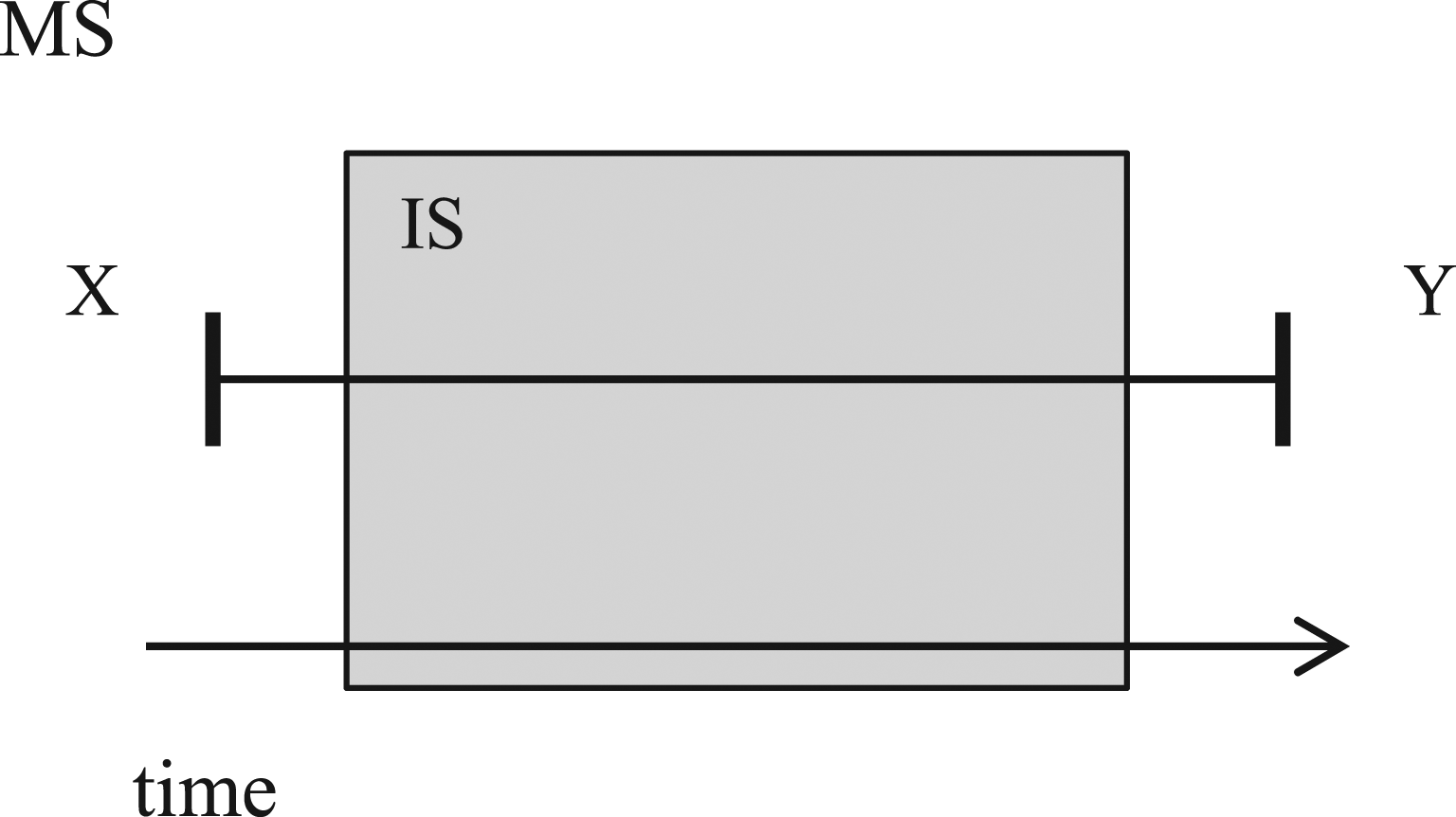
Drawing on Langacker’s emphasis on an ‘internal perspective’ and his distinction between immediate and maximal scope, Verspoor (1996: 438) argues for a schematic meaning of the -ing form that construes an event as being ‘very close by’. Given that an -ing form imposes a construal whereby the event’s boundaries are excluded from the conceptualiser’s perceptual field, the scope of attention is subsequently limited to a small portion of the event. Following Langacker, Verspoor suggests that the limited viewing arrangement profiled by an -ing form must inherently schematise the individual states of the process, suspend sequential scanning, and impose summary scanning with the effect that any action depicted by the verb is construed as though ‘in progress’ (1996: 438). Figure 2 models the use of an -ing form and the subsequent limited perceptual field with the attended event construed as proximal to the conceptualiser. The construal effect of the -ing form (adapted from Verspoor 1996: 438).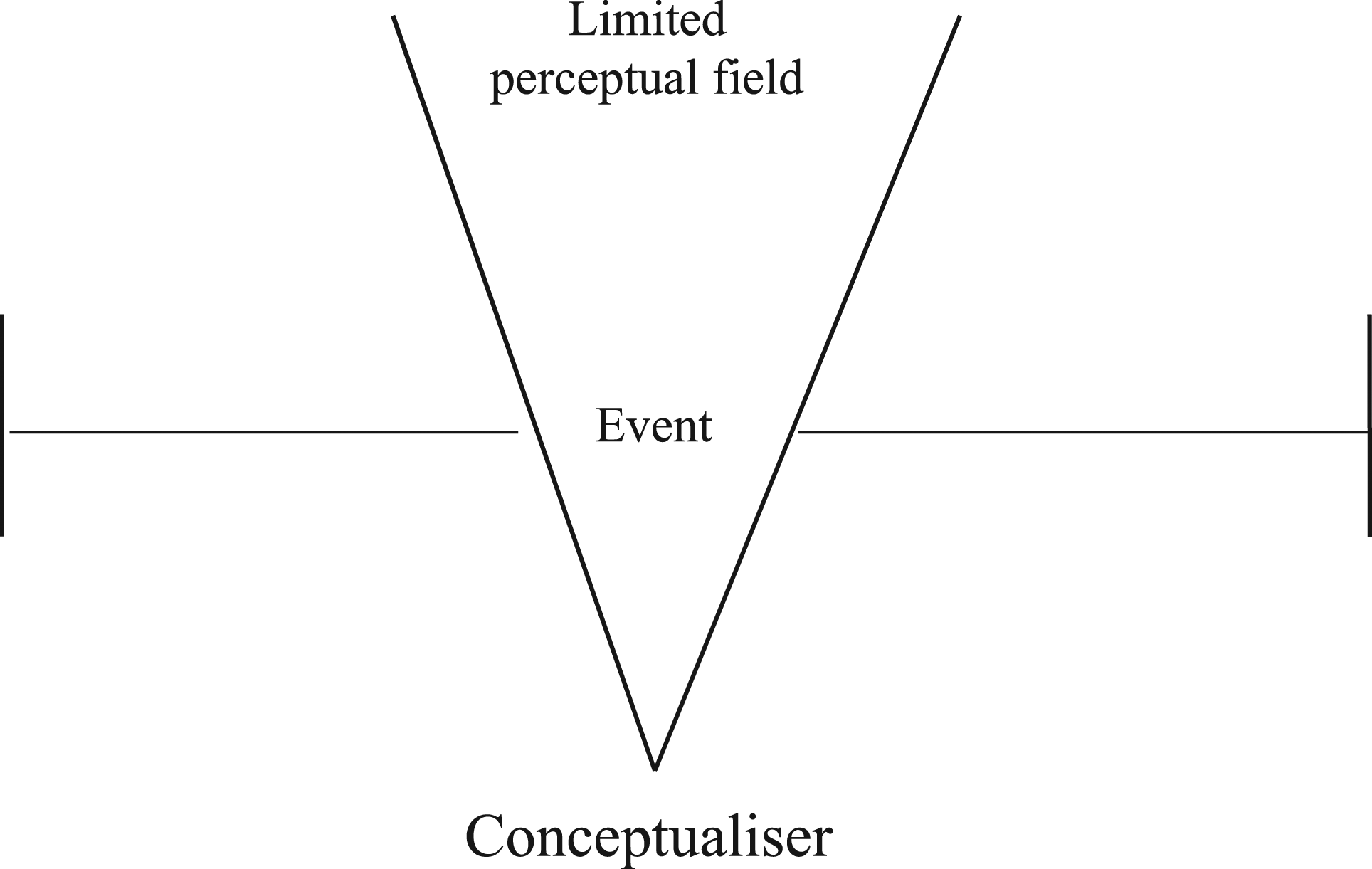
The theoretical premises of Cognitive Grammar and cognitive linguistics more generally are said to have ‘psychological plausibility’ (Stockwell 2015: 443) since they draw on concepts that have been tested and validated across the cognitive sciences and adhere to the cognitive commitment (Lakoff 1990) that operationalizes language within the frame of general cognition. This validity is generally taken by stylisticians as sufficient enough to give credit to concepts and ideas. Despite the claims of Cognitive Grammar that particular forms carry meanings and therefore may conceivably give rise to specific interpretative effects, much of the theory has yet to be empirically tested within contemporary stylistic scholarship. Where studies do exist, they tend to focus on the wider discourse strategies undertaken by readers in the light of goals, for example, in work on re-reading (Harrison 2017; Harrison and Nuttall 2019), and on how readers reconfigure particular construals (Browse (2021). Some interesting exceptions that test specific construal phenomena as theorised by Cognitive Grammar can be found in Harrison and Nuttall (2021) who examine how readers align themselves with particular points of view during the reading and re-reading of a short story; in Hart (2015, 2018), who demonstrates how different construals position readers to interpret political protests and the actors involved in different ways; and in Cushing (2021) who outlines how using Cognitive Grammar as a pedagogical tool encourages students to see various kinds of meaningfulness inherent across different construal phenomena.
4. Methodology
The remainder of this article brings together my own short analyses of parts of ‘Belgium’, the opening story in The Forbidden Zone with responses generated by asking a group of readers to read a paragraph of the story at a time and respond to a specific textual feature. ‘Belgium’ was chosen because the story has 25 instances of the -ing form, variously distributed across its 10 paragraphs. It is also undeniably a story that focuses on landscapes; the story begins with a homodiegetic narrator who leads the reader in a panoramic sweep of the Belgian landscape as the rain falls and the ground turns to mud, pointing out the partly destroyed villages and farms and the people who still inhabit them. The narrator then leads the reader to the headquarters of the Belgian Army and the ‘uncouth, dishevelled’ soldiers (Borden 1929: 2), before panning across to focus on the King, a band that plays for the Army in the front of the village shops, and finally the nihilism that confronts the Belgian soldiers trapped in the seemingly never-ending reminders of war. The story ends with the narrator imploring the reader to follow them away from the village back to Dunkerque, with a somewhat ironic comment that the Belgian King has himself left his headquarters. The final ‘Come away’ (Borden 1929: 4) completes what is effectively a series of spatial diversions across the decimated Belgian landscape.
As well as containing a significant number of -ing forms, the story has many language features that might conceivably be deemed to invite closeness or projection into the world of the text and thus facilitate an ‘embodied perspective’. These include the extended use of the second person pronoun ‘you’ and various kinds of spatial, temporal and social deixis. I was, however, interested in testing the theoretical claims made by Cognitive Grammar regarding -ing forms and perceived readerly proximity and thus had the following two research questions:
– to what extent do -ing forms appear to impose an internal/proximal viewing perspective as theorised by Langacker and Verspoor?
– how might -ing forms interact with other language features to give rise to feelings of closeness to the scene being described and be articulated as such by readers? My methodology drew on and partly replicated a protocol devised and discussed by Bell et al. (2019), who use Herman’s typology of the range of possible referents of ‘you’ (Herman, 1994) to examine how readers of digital fiction position themselves in relation to various uses of the pronoun. In order to mitigate the difficulty associated with generating verbal data about a specific textual feature in a more naturalistic context, Bell et al. adopt a mixed methodology in which readers are first asked to comment on their response to the referent of ‘you’ using a Likert scale. This initial question is then used to further elicit verbal data which can be analysed qualitatively alongside the authors’ own analyses of the text in order ‘to demonstrate the nuance of the reader’s response to a particular stylistic feature and thus the complexity of the stylistic feature itself’ (Bell et al., 2019: 243–44). In my study, I replicated their design, with some modifications, using it to examine the extent to which it is possible to see how the language of ‘Belgium’ influences the ways in which the story’s landscapes are experienced by readers. The reader response study consisted of 16 participants, all of whom were first or second year undergraduate students on English programmes at Aston University, UK. All had some familiarity with general descriptive linguistics, stylistics and First World War literature although none had studied Mary Borden or The Forbidden Zone before, and none had studied Cognitive Grammar. The participants read ‘Belgium’ paragraph-by-paragraph online using www.onlinesurveys.ac.uk and answered three questions on each paragraph, resulting in a total of thirty responses from each participant. The first question used a Likert scale to examine the extent to which participants reported feeling close to the events depicted in ‘Belgium’. 1. Focusing on the verbs only, how close do you feel to the characters, situations and events described in this paragraph? Not at all--Very little--A little--Quite a lot--A great deal I wanted to examine the difference, if any, that participants would report based on the distribution of -ing forms across each of the paragraphs. The responses allowed for a numerical overview of how readers responded to each of the paragraphs but, following Bell et al., were largely used to ‘elicit qualitative interview data about the nature of that conceptualisation’ (2019: 248). In order to mitigate as much as was possible against the inevitable subjectivity that comes with interpreting words (Cohen et al., 2011: 384), I also provided the following definition of ‘close’:
The first question relates to the use of verbs in the paragraph and how close these make you feel to the characters, situations and events described in the story. ‘Close’ refers to the extent to which the situation and events are presented in a way that makes you feel physically near to them. Think about the form of the verbs in the paragraph as well as their meanings. Choose the answer that best fits the paragraph as a whole.
The second question was designed to elicit verbal data that could be then qualitatively examined and so align the initial responses along the Likert scale to specific language features as identified by the participants. 2. Please explain your answer to Question 1 by giving and commenting on specific examples that make you feel this way. The third question was designed to generate more qualitative data which could be used comparatively with the answers to question 2 and examine the extent to which other language features might be responsible for readers’ responses to each of the paragraphs. 3. Are there any other examples of language in the paragraph that you feel make you feel close to the characters, situations and events? Please give specific examples and comment on how they make you feel as a reader. Following a pilot study,
2
8 of the participants answered on the original story (henceforth ‘Belgium A’), and the remaining 8 answered the same questions on an altered version of the story (henceforth ‘Belgium B’) in which all of the -ing forms had been rewritten as finite verbs maintaining the same tense as the original. The altered version allowed for the isolation of a specific linguistic variable, following a text modification protocol established in other similar studies (see for example, Bray 2007; Simpson 2014).
5. Results
Number of -ing forms in ‘Belgium A’ and responses to ‘Belgium A’ and ‘Belgium B’.
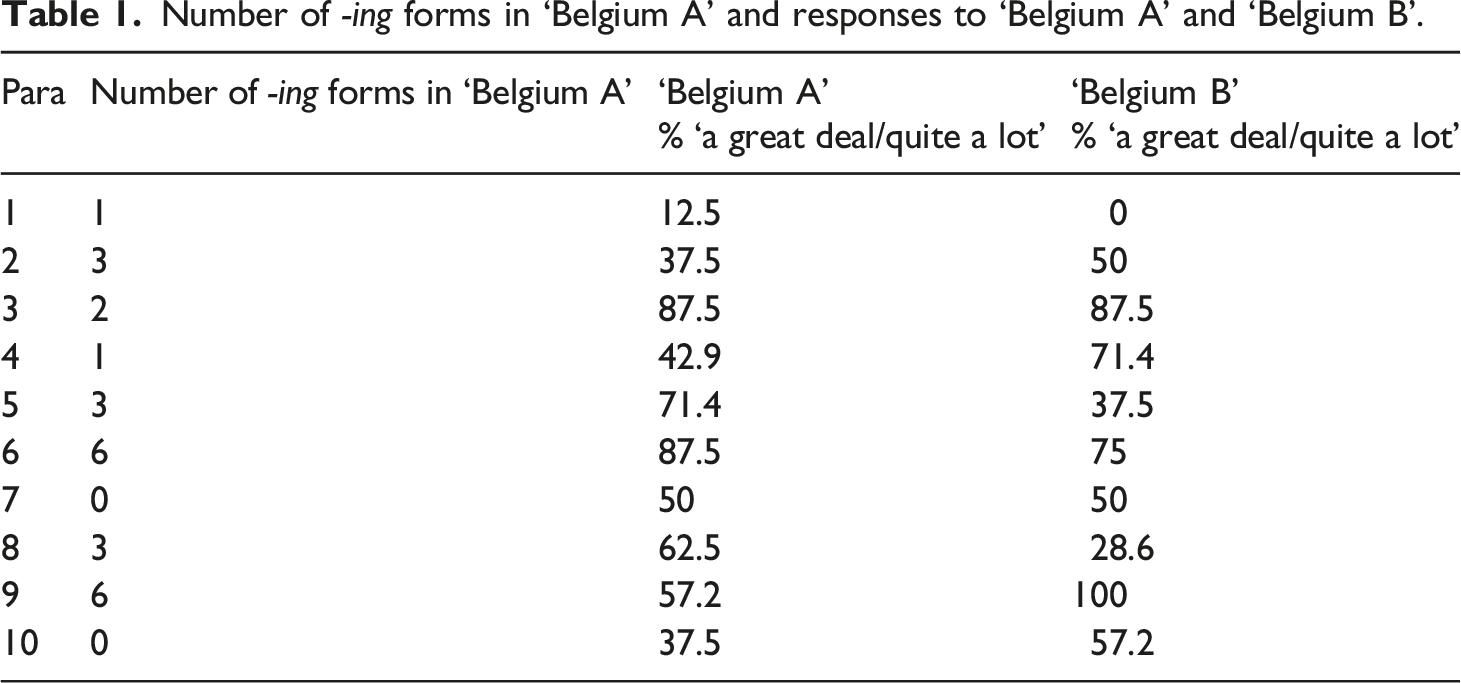
Table 1 highlights that generally readers responded in different ways to the story, both across different versions of ‘Belgium’ and within each version. It appears that (except for in one case) that readers of ‘Belgium A’ reported a greater sense of closeness when reading paragraphs with more -ing forms. In turn, fewer readers of ‘Belgium B’ appeared to report a sense of closeness although the results are not entirely dissimilar and in four cases (paragraphs 2, 4, 9 and 10), the percentage of readers of ‘Belgium B’ reporting closeness to the events was higher than in ‘Belgium A’.
6. Analysis
‘Belgium A’ and ‘Belgium B’ versions of paragraphs 6 and 9.
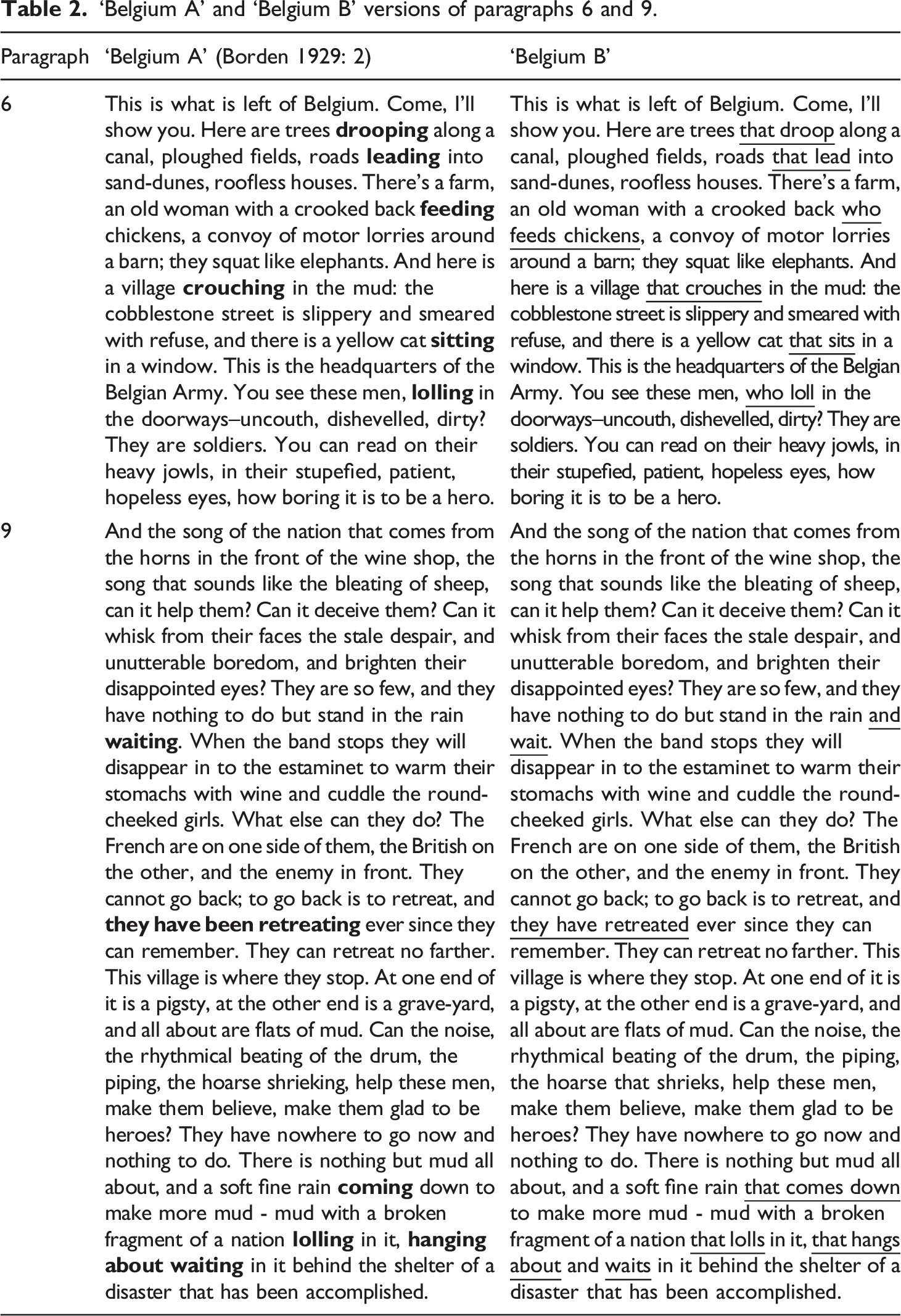
A hypothesis based on Cognitive Grammar’s theorisation of -ing forms would have participants reporting greater feelings of proximity when reading these paragraphs. Interestingly, while readers of ‘Belgium A’ reported a greater sense of closeness to paragraph 6, fewer did when reading paragraph 9. In turn, ‘Belgium B’ readers reported greater proximity to paragraph 9 than they did to paragraph 6. Taken together, the 2 paragraphs provide particularly useful data for examining the interpretative effects generated by -ing forms and the extent to which readers draw on other language features in their responses. In each of the following sub-sections, I first present a brief stylistic analysis of the paragraph under discussion to identify how language features might position the reader as theorised by Cognitive Grammar. Following Bell et al. (2019), these analyses are then compared to my reader response data to examine how readers report the effects of language in describing the landscapes of Borden’s story.
6.1. Paragraph 6
Paragraph 6 contains six -ing forms, all of which function as noun modifiers. The first two, ‘drooping’ and ‘leading’, invite the reader to scan the landscape along a series of horizontal paths encoded in the prepositional phrases ‘along a canal’ and ‘into sand-dunes’. The others, ‘feeding chickens’, ‘crouching in the mud’, ‘sitting in a window’ and ‘lolling in doorways’ project more static scenes involving various characters in the story. As theorised by Cognitive Grammar, all of these forms impose summary scanning and profile an internal perspective on the event being described. In addition to these -ing forms, however, there are other language features that could conceivably position readers to feel a sense of closeness to the events of the story. For example, the narrator uses both proximal (‘This’, ‘These’, ‘Here’) and more distal (‘There’) spatial deictic forms to survey the landscape and place the reader relative to the events described therein. The narrator might also appear to make the reader as a co-textual participant by using the deictic verb ‘come’ and by extensively using the second person pronoun ‘you’. And the scene is frequently subjectively construed (Langacker 2008: 77–78), placing the discrete perspective of the narrator ‘on stage’ through the use of both figurative language, ‘squat like elephants’ and evaluative adjectival forms, ‘uncouth’ ‘dishevelled’ ‘stupefied, patient, hopeless eyes’ ‘how boring it is’.
Five responses to questions 2 and 3 by readers of ‘Belgium A’ are discussed here: A62 (who answered ‘A great deal’ to question 1), A63 (‘Quite a lot’), A65 (‘A great deal’), A66 (‘Quite a lot) and A67 (‘A great deal’). Interestingly in the responses to question 2, only 1 participant (A66
3
) who read ‘Belgium A’, mentioned the -ing forms explicitly. The ‘trees drooping’ is a clear image, as well as the fields and sand dunes. The ‘old woman with a crooked back feeding chickens’ is a particularly striking image, as well as the cat sitting in the window, as both of those images are a bit of normality amongst the chaos of ‘roofless houses’, army headquarters and soldiers. The woman and cat make me feel closer to the scene, as these are images I am able to conjure up easily. […] reinforces the importance of the mud and ‘lolling’ is also repeated, this time in reference to the soldiers and the fact that they are relaxed rather than in action makes me feel closer to the scene (A66)
A66 frames their response in visual terms, ‘a clear image’ and ‘a particularly striking image’. Although they do not explicitly mention a sense of internal perspective, they emphasise how the description facilitates a response from the reader, for example, in their comment ‘conjure up easily’. These comments echo the readerly alignment theorised in Cognitive Grammar as a result of the imposition of summary scanning, and also align with those literary-critical and online responses discussed earlier in Section 2. Other responses to question 2 reported by readers of ‘Belgium A’ identify the use of the deictic verb ‘come’, described as ‘inviting me into this world’ (A62) and bringing ‘the scene close to my perspective’ (A65). A62 builds on their response by outlining the relationship that ‘come’ constructs with the narrator; here, they explicitly outline the spatial orientation of the verb as a way of drawing the reader towards the narrator and consequently resulting in greater connection with the world of the text. Aligned to my own stylistic analysis, A62 conceptualises the reader specifically on a journey with the narrator through the landscape of ‘Belgium’ that is marked through the use of the deictic verb ‘come’; A63 offers a similar response but this time presents the relationship with the narrator as a hierarchical one, arguing that the use of ‘come’ is suggestive of a more commanding tone.
Readers of ‘Belgium A’ responded to question 3 by highlighting other language features beyond verbs that they considered as attentionally salient. A62 develops their point raised regarding the reader’s relationship with the narrator by commenting on the use of the second person pronoun, which evokes ‘an exclusive experience’. This is also reported by A67 who speaks of the effect of an ‘intimate experience’. Interestingly, A62 who had previously highlighted the importance of ‘come’ in their response to question 2, suggests the use of deixis with "here" shows a sense of time which helps to conceptualise this event as the narrator walks the reader through. Also, through the narrator revealing personal sights such as: "There’s a farm, an old woman with a crooked back feeding chickens..." This makes me feel close to the situation, seeing the narrator share their experiences with me, as the reader, as though I were perhaps their friend.
It is interesting to note that A62 explicitly mentions a section of the paragraph that contains an -ing form but does not allude to the form of the verb itself (although the question had prompted them to do so), instead pointing out the overall effect of a perceived closeness to the narrator, who is sharing experiences as ‘perhaps their friend’. It is conceivable that the -ing form plays a role in this sense of readerly alignment but that the effects are either imperceptible or else part of a more integrated sense of proximity that results from a number of language features (deixis, pronouns) together with existing reader knowledge or a predisposition to respond to particular events in a certain manner.
Readers who responded to ‘Belgium B’ also drew attention to the deictic verb ‘come’. B65 (who answered ‘A great deal’ to question 1) reported a sense of elevated intimacy ‘[…] as though I am witnessing the scene with her’. An interesting contrast with readers of ‘Belgium A’ was the focus on the use of adjectives in describing phenomena such as vividness, detail and a greater sense of familiarity with the scene being described. Readers tended to make more connections to the use of adjectival forms in ‘Belgium B’ even though these were unaltered from those in ‘Belgium A’.
6.2 Paragraph 9
Paragraph 9 also contains 6 -ing forms. 5 of these, ‘waiting’ (appearing twice), ‘coming down’, lolling’, and ‘hanging about’ function as noun modifiers relating to either to the soldiers or to the country as a whole, in the grip of what appears to be interminable rain and the ubiquitous and ever-growing threat of mud that envelops the village. The 6th, ‘retreating’ is the main verb in the present perfect progressive form ‘they have been retreating’, which describes the systematic regression of the Belgian Army. There are also a number of -ing forms in this paragraph which are nominalisations rather than that profile verb processes: ‘the bleating’, ‘the beating’, ‘the piping’ and ‘the shrieking’. These like participles impose summary scanning but, because they are nominal forms, profile a ‘thing’ rather than the component states of a verb process (see Langacker 2008: 120). 4
In a similar way to paragraph 6, paragraph 9 also has a number of other language features that could be conceivably regarded as facilitating readerly proximity to the scene. These include: the rhetorical questions ‘can it help them? Can it deceive them? Can it whisk from their faces […]’ that appear towards the beginning of the paragraph; prepositional phrases that position the reader spatially ‘in front of the wine shop’, ‘The French are on one side of them, the British on the other, and the enemy in front’; the repetition of ‘mud’, a motif that Borden’s narrator draws on from the very beginning of the story; and an increasing sense of desperation that builds up through the paragraph largely through the use of morphological and syntactic negation of ‘nothing’, ‘no farther’ and ‘cannot’, and the lexical negation of ‘broken’ and ‘disaster’.
Three responses to questions 2 and 3 by readers of ‘Belgium A’ are discussed here: A91 (who answered ‘Quite a lot’ to question 1), A92 (‘Very little’) and A96 (‘A great deal’). In their response to question 2, A91 comments that ‘scenarios are suggested whilst the action is taking place so the scene feels very compact as if it is taking place in present real time’. Interestingly, again although there is no mention of -ing forms here, A91 appears to describe one possible interpretative effect of the imposition of summary scanning: a compactness as a result of the profiling of each state as mass-like and homogenous (Langacker 2008: 121). Overall, however, participants who read ‘Belgium A’ did not report feeling as close to the action in paragraph 9 as they did paragraph 6, despite both versions having the same number of -ing forms. One reason for this may be the overriding effect of other prominent features previously discussed. For example, A92, who was one of the 2 participants who reported ‘Very little’ in their response to question 1 suggests that the overall negative tone of the narrator has now, by this point in the story, become uninviting: […] the narrator has lost faith in the Belgium army, and the outcome of this war. This makes me feel not very close to the situation, the verbs used to question are not inviting, and rather have the opposite effect. The verbs "beating" and "shrieking", do not make me feel very close either, and rather a bit disappointed because of this outcome, I feel like prior to this the narrator seemed more optimistic which make me feel close, now the narrator sees the defeat, their despair is seen in their verb choices, that now distances the reader.
The cumulative effect of the narrative focus on the desolation of the Belgian landscape and the perceived shift in tone and mood also appeared to influence another comment that A92 makes: the use of the deictic verb 'go back' also shows a distance as opposed 'come' which was used before, also shows this loss of moral, as the narrator perhaps now tries to push away the readers.
A92 also identifies this sense of dislocation in their response to question 3, by drawing attention to the abundance of negative constructions which ‘make me feel a lot less close because these words put up [sic] like a wall’. A similar effect on narrative cohesion albeit within a strikingly different interpretative frame is reported by A96. In contrast to A92, A96 reported that the repeated motifs of the rain and mud strengthen the connections with the fictional world of ‘Belgium’. They also view other features such as the spatial orientation and metaphorical construal of Belgium being located between the French and the British and the gradual sense of stasis as the Belgian Army is forced back to retreat as evoking a sense of closeness: ‘I feel close to the soldiers by this point, like I am able to understand the way the speaker perceives them’. Here, A96 specifically draws attention to -ing forms although interestingly again, the interpretative effects of these forms are framed in broader terms as part of the overall narrative: ‘The relaxed verbs, “lolling”, “hanging” and “waiting” contrast with the emergency and futility of the situation and the dangers of war’. The modifier ‘relaxed’ highlights the perception of these verbs as less urgent compared to the descriptions (in finite forms) of the war; this distinction most likely refers to the semantic import of these words but could also be related to grammatical form given that -ing participles, as theorised by Cognitive Grammar, present a set of events that are atemporalised and scanned in a summary manner.
Participants responding to ‘Belgium B’ did so with an overall greater sense of closeness to the story. 4 responses are discussed here: B91, B93, B96 and B97 all of whom answered ‘Quite a lot’ to question 1. Interestingly, in response to question 2, participants tended to articulate the importance of the verbs (regardless of their form) in creating a cumulative effect of character that stretched back across the entire story, so as B96 describes it, ‘I feel close to the individuals returning from war. The camaraderie between the soldiers also encourages a feeling of closeness’. There was also a perceived sense of narrative urgency (see Simpson 2014): referring to the finite non-modalised forms that present largely material and behavioural processes in the story, B93 described a ‘rush of verbs’ that generate a sense of closeness and fast pace. Finally, participants’ responses to question 3 highlighted the use of rhetorical questions. B91 comments on how ‘the use of questions again and the narrator answering its own questions through vivid visualization, it agonizingly paints the pictures of helplessness and defeat’, and B96 explains how ‘the repetition of questions makes the reader feel directly questioned which bring them closer to the situation’. In line with comments made by readers of ‘Belgium A’, B97 suggests that the sustained use of questions results in an alignment between narrator and the reader, who is ‘influenced by the narrator’s perception and viewpoints’.
7. Discussion
This study demonstrates that readers vary in how they responded to the original story (‘Belgium A’). It seems that generally paragraphs in ‘Belgium A’ with a higher number of -ing forms appear to create a sense of proximity and that readers reported feeling closer to the situations, events and characters in the world of the story than in paragraphs that contain fewer -ing forms. However, the qualitative data show that readers did not always explicitly comment on grammatical form even when they argued that the descriptions resulted in a sense of feeling close to the events and characters described. It may be, therefore, that some of the perceived interpretative effects of the -ing form as theorised by Cognitive Grammar are not always noticeable and remain below the surface, or else seem intuitive and are described using common response strategies such as the senses, vividness, detail and so on. In these instances, despite the instruction that participants should focus on language features, it could also be the case that, in a similar way to the findings reported by Bray (2007) in his study of free indirect discourse and empathy, readers drew on non-linguistic phenomena to articulate their feelings about the story.
My comparative analysis of responses to paragraphs 6 and 9, which contained the highest number of -ing forms in ‘Belgium A’, raises some interesting implications, both theoretically and empirically, for a theory of the interpretative effects of -ing forms. Given that in paragraph 9, readers of ‘Belgium B’ reported a greater sense of closeness to the narrative than those reading ‘Belgium A’, it is clear that the large number of -ing forms had relatively little effect on readers. Indeed and as reported, responses to other narrative features and the overall narratorial stance, particularly the increased sense of desperation, appeared to have had a greater perceived influence on how readers responded to the story. Given that all readers of ‘Belgium B’ responded to question 1 on paragraph 9 in a positive manner, it seems that any consideration of the degree to which -ing forms are responsible for readers adopting an internal perspective should also take into account the influence of other linguistic features on readers such as deictic forms, second person pronouns and figurative language, as well as non-linguistic phenomena related to the perceived relationship with the narrating voice to which some readers made reference, and to any emotional connections formed with the story. 5 It is also clear from responses that readers reported a cumulative effect whereby they developed representations and responses over the course of a reading, often using previous knowledge as a reference point against which to compare newly emerging interpretations. This was observed in some of the responses to paragraph 9 which compared readerly alignment with the narrator with previous points in the story.
These results identify the need for further work on Cognitive Grammar and its use in stylistic analysis given the importance the theory attaches to the notion of construal as well as its consequent commitment to the inherent meaningfulness of specific syntactic forms and patterns. Langacker’s theorisation of the inherent meaningfulness of -ing forms appears sound when measured through the analysis of abstracted short clause-level examples. With more complex narratives involving different kinds of readers, however, the effects of -ing forms and how they are processed and interpreted may well be much more nuanced than is suggested. In this way, it is clear that studies such as the one I have undertaken that examine the practical application of a theoretical, clause-level theory can help develop the theory itself, what Stockwell (2008: 121) refers to as a ‘virtuous feedback loop […] whereby analytical explorations serve to re-fine the grammar further’.
It is also important to recognise that the subjects of this study were university students and thus represented a particular type of reader. That is, as undergraduates studying English language and/or literature, they are likely to be primed to notice particular language choices and, equally given the framing of the study and the focus of the questions, be inclined to align specific language features to particular interpretative effects. Although none of the students had knowledge of Cognitive Grammar or had studied Borden’s work before, they most likely fall between what Nikojaleva (2014: 19) terms ‘expert’ and ‘professional’ readers in so far as they engage with texts ‘intellectually and emotionally’ and demonstrate emerging skills but not wholly complete skills in responding to texts ‘deliberately, systematically, critically and analytically’. This is important to note given that their responses may be very different to, on the one hand, civilian, lay readers and, on the other hand, professional academics who have largely been responsible for providing readings of texts using and making claims about the interpretative effects of Cognitive Grammar; see for example, the two collections by Harrison et al. (2014) and Giovanelli et al. (2021a). In addition, although ‘Belgium’ was presented in its entirety rather than decontextualised extracts and the study thus replicated how the story might be read in other more ‘natural’ (Hall 2008: 30) contexts, the reflective nature of the task where participants were asked to pause and after questions after each paragraph may have affected responses. There is some caution, then, in terms of any claims that can be made about the generalisability of my findings.
8. Conclusion
The analysis and discussion in this article highlight several key findings. First, The Forbidden Zone and, specifically, ‘Belgium’ are texts that offer linguistically rich descriptions of landscapes and thus provide stylisticians with valuable examples both of the language of First World War literature and of how readers report their experiences of engaging with the text. This study then offers an important step in empirically examining claims made about the nature of reading First World War literature, particularly concerning the embodied nature of meaning. Second, my mixed methodological approach combining initial rating scale responses with qualitative analysis of data generated by follow-up questions provides a rich, nuanced set of observations about how this particular group of readers responds to each of the paragraphs of Borden’s story. This article exemplifies, through analysis of an interesting genre, Bell et al.’s claim that they ‘offer a new method that can be used to investigate textual features in all kinds of text’ (2019: 241). Finally, yet importantly, this article is the first to test the theoretical claims made by Cognitive Grammar on how -ing might position readers, specifically by examining the extent to which the limited immediate scope invoked in the -ing form results in readers reporting feeling close to the construed scene. My results and analysis demonstrate that more investigation into this phenomenon is needed; in the case of ‘Belgium’, such investigation could include greater analysis of how other textual features might equally position readers close to the action of the text. More generally, this article also highlights how other claims made by Cognitive Grammar on the possible effects of various construals on readers need to be empirically tested. The recent rise in researchers drawing on Cognitive Grammar in contemporary stylistics is based its perceived improvement on other grammars (see Browse 2018) both in terms of its exploratory power and its psychological plausibility. Yet, as Giovanelli et al. (2021b: 283) argue, the theoretical coherence of the model and indeed its attractive intuitiveness in outlining the iconic nature of grammar need real scrutiny ‘in context using empirical evidence’ in order to further develop our understanding of how a clause-level theoretical grammar might best be useful for stylistic analysis.
Footnotes
Declaration of conflicting interests
The author(s) declared no potential conflicts of interest with respect to the research, authorship, and/or publication of this article.
Funding
The author(s) received no financial support for the research, authorship, and/or publication of this article.
