



Abstract
Woolf’s work has been the object of several studies concerned with her experimental use of techniques of speech, thought and consciousness presentation. These investigated the way in which different perspectives coexist and alternate in her writing, suggesting that the use of such techniques often results in ambiguous perspective shifts. However, there is hardly any empirical evidence as to whether readers experience difficulty while reading her narratives as a result of these narrative techniques. This article examines empirically readers’ responses to extracts from Woolf’s two major novels – To the Lighthouse and Mrs Dalloway – to provide evidence for whether Woolf’s techniques for the presentation of characters’ voices, thoughts and perspectives represent a challenge for readers. To achieve this, a mixed-methods approach that combines a stylistic analysis with a detailed questionnaire has been employed. Selected extracts that were hypothesised to be complex due to the presence of free indirect style and/or interior monologue were modified by substituting these with less ambiguous modes of consciousness presentation, such as direct speech or direct thought. Readers’ responses to the modified and unmodified versions of the same extracts were compared: results show that the presence of free indirect style and/or interior monologue increases the number of perspectives identified by readers, suggesting that this technique increases the texts’ difficulty, laying a more solid ground for future investigations.
1. Introduction
Within literary studies, the term ‘difficult’ has been used in different ways, generally pointing to texts that are believed to be challenging to understand due to deviant uses of lexical items, syntactic structures that break the rules of written language, and unintelligible or elusive references. 1 In order to investigate and define the linguistic properties which make texts challenging, several studies focused on poetry, examining poems that are considered obscure and inaccessible (Castiglione, 2013, 2016, 2017; Purves, 1991; Yaron, 2002, 2003, 2008, 2010). More recently, Castiglione (2019) offered an updated and detailed description of the various aspects that can produce difficulty in poetry, pointing out how previous models overlooked readers’ response and emphasised the importance of empirical methods to determine what can be considered difficult.
It is surprising how rarely a similar approach to difficulty has been applied to prose. Literature on the investigation of difficulty in narrative texts is almost non-existent, and even rarer are empirical studies of it. As pointed out by literary critics, difficulty is often presented as a non-specified feature of a text, which prevents a clear understanding of its ‘meaning’. Crucially, a disruption to the narrative flow is often caused by specific linguistic features. These are often not easy to identify, not only because of the large amount of textual material but also because they are strongly related to the writer’s idiosyncratic use of language, as well as to genre and cultural/historical schemata, making the investigation of difficulty in narratives extremely challenging.
Starting from the questions Is this text difficult? and What makes this text difficult? and in agreement with Castiglione (2013) on the importance of empirical methods to identify and define literary difficulties, this research aims to address this gap in the literature, undertaking an investigation of difficulty within two texts: Virginia Woolf’s To the Lighthouse and Mrs Dalloway. After providing an overview of the theoretical assumptions regarding the difficulty of these two novels, this article provides an analysis of readers’ responses to the features that are considered to contribute to such difficulty. This empirical examination is designated to validate – or discredit – the theoretical assumptions of difficulty concerning the two novels and to provide insight into further exploration of difficulty within narrative texts.
2. Difficulty, modernism and free indirect style
Modernist literature is typically qualified by critics as being obscure and complex. Diepeveen (2003) writes about reading modernist literature as ‘an experience. [. . .] a barrier to what one would normally expect to receive from a text, such as its logical meaning, its emotional expression, or its pleasure [. . .] the experience of having one’s desire for comprehension blocked’ (p. x). Modernist narratives feature a departure from previous literary traditions, limiting the role of the narrator and breaking the spatial and temporal constraints of the traditional plot in an attempt to convey the complex dynamics of real life experiences (Morris, 2003). This is realised in particular through the use of experimental narrative techniques for the presentation of speech, thoughts and consciousness (feelings, perceptions and states), which are particularly relevant in Woolf’s works.
As one of the most prominent writers of the Modernist movement, Virginia Woolf’s novels and critical essays are often referred to in discussions concerning consciousness presentation. Her writing is considered difficult by several literary critics, and her novels are believed to represent a challenge for readers (Diepeveen, 2003; Goldman, 2006; Mahaffey, 2008; Quigley, 2015). This is supported by a number of informal surveys, where her novels feature prominently. 2 In line with literary criticism, these surveys highlight aspects of her writing that seem to represent a major challenge for readers, in particular the perceived lack of a plot, the sometimes incomplete or intricate syntax, and the difficulty in understanding whose perspective or voice is presented within a specific extract. These challenging aspects of her writing can be regarded as the result of her experimental use of techniques of speech, thought and consciousness presentation.
Such techniques have been described by several models – the most popular one being that of Leech and Short (1981). These identify the different techniques used to represent voices and thoughts, classifying them according to specific syntactic boundaries. As Palmer (2004) and Sotirova (2013) suggest, however, these models often appear to simplify the presentation of fictional consciousness, forcing it into categories that exclude expressions of characters’ inners states, which are not readily translatable into articulated thoughts. Sotirova (2013) and Rundquist (2014) propose instead a model that combines a closer linguistic description of the categories of consciousness presentation with increased attention to their semantic effects and on the different facets of the fictional minds they portray. In accordance with Sotirova (2013) and Rundquist (2015), this article uses a taxonomy that draws on several existing models, focusing on the following techniques for the presentation of speech, thoughts, perceptions and internal states: Free Indirect Speech (FIS) and Free Indirect Thought (FIT) (Leech and Short, 1981), Represented Perception (RP) (Brinton, 1980) and Consonant Psychonarration (PN) (Cohn, 1978), along with Interior Monologue (IM) (Cohn, 1978) and Free Direct Speech (FDS) (Leech and Short, 1981). The first four are encompassed under the umbrella term free indirect style (Rundquist, 2016; Sotirova, 2013).
FIS presents characters’ utterances without the typical marks of direct speech (DS), featuring the expressive constructs and discourse patterns of a character’s spoken language. Similarly, FIT expresses characters’ thoughts featuring the character’s language patterns, without reporting the articulated thoughts directly. In contrast, IM can be distinguished from techniques of free indirect style as it renders a character’s thoughts in their direct form. While it also omits speech marks, its narration, in contrast to FIT, is consistently in the first person. The same difference exists between FIS and FDS, the latter describing an instance of non-signalled DS. FIS, FIT and IM render a character’s verbalised speech or thoughts, reducing the narrator’s presence to a minimum. The two following categories, on the contrary, convey the characters’ perceptions or states without expressing verbalised thoughts. These are formally closer to the narratorial ‘voice’, even though they do not necessarily imply the point of view of a narrator, which only exists as a ‘means’ to report those perceptions and feelings. These are RP, which describes the narrative world as filtered through a character’s point of view, and PN, which conveys a character’s state of mind, feelings or other mental operations in the voice of the narrator, but without implying an external vantage point. A comparative example of the different techniques is presented below (examples partly adapted from Leech and Short, 1981):
Techniques of free indirect style, along with IM and FDS, are prominent in both To the Lighthouse and Mrs Dalloway, which focus almost entirely on the representation of characters’ voices and consciousnesses. Woolf’s experimental use of these techniques allows her to play with points of view, almost fusing together characters’ perspectives and voices by juxtaposing characters’ points of view and by abruptly switching between various techniques of consciousness presentation, thus creating a dynamic experience where the reader has access to multiple facets of the characters’ minds. Her writing is comparable to a ‘camera-like’ motion, where the observation point suddenly and quickly shifts from one position to another, inside and outside characters, offering insights into the various minds while allowing an outside perspective of the represented fictional world. This effect is realised through an extreme fragmentation of the narrative, both in terms of storyline and in terms of syntax. The syntactic deviance can be considered an effect of the shifts between perspectives and between modes of consciousness presentation, and a result of Woolf’s use of free indirect style, IM and FDS. Notably, Woolf’s way of handling these techniques often makes it difficult to understand whose voice and/or consciousness is represented, and to understand what act is being portrayed (thoughts, speech, feelings or perceptions), as well as to understand where the boundaries between the different techniques are located in the text.
The following extract from To the Lighthouse offers an example of some of the complexities resulting from Woolf’s use of these techniques to portray fictional consciousnesses and points of view, demonstrating what makes them challenging for readers to understand. The passage, described by Leaska (1970: 107) as ‘a sequence of startling and often ironic juxtapositions, but also designed [as] a mental hall of mirrors furnished with human emotions, reflections, memories’, is taken from one of the most well-known scenes in the novel, where the Ramsays and their guests are sitting at the dinner table and have just started their meal. The conversation and their attention are initially directed to the main dish, which works as a convergence point for Mrs. Ramsay’s and Mr. Bankes’ perspectives.
[1] ‘It is a triumph’, [2] said Mr. Bankes, laying his knife down for a moment. [3] He had eaten attentively. [4] It was rich; it was tender. It was perfectly cooked. [5] How did she manage these things in the depths of the country? [6] he asked her. [7] She was a wonderful woman. [8] All his love, all his reverence had returned; [9] and she knew it. (Woolf, 1994: 72)
The initial DS in [1] and the following adverbial in [2] draw the reader immediately to Mr. Bankes’ point of view, that is maintained in the following sentence He had eaten attentively. The final adverb attentively links the sentence not only to the previous discourse – Mr. Bankes’ initial observation derives from his being attentive – but also connects [3] to [4], where Mr. Bankes’ impressions are conveyed more directly through FIS/FIT, as the parallelism it was . . . it was . . ., and the use of the past tense. Interestingly, there is no way to know whether these words are uttered (FIS) or simply thought (FIT), and there is no formal marker signalling that the character producing them is indeed Mr. Bankes, though this is the most likely interpretation. It is interesting to notice how here – and often in both novels – Woolf seems to use RP/FIT in [3] as a ‘bridge’ that pushes the reader into Mr. Bankes’ perspective before this becomes explicit in [4] with his articulated thoughts/words. The past tense in the opening of [5], How did she, and the spatial deictic reference these things signal again the presence of FIS, which is confirmed by the following reporting clause in [6]. While [7], [8] and [9] present the typical features of FIS/FIT – the past tense, the third person pronoun, the attribute wonderful, the evaluative nouns love, reverence and the past perfect – their interpretation is more ambiguous.
Once again, it is not possible to determine whether these represent spoken discourse or mental thoughts. More importantly, although the previous clauses might initially prompt the reader to interpret [7] and [8] as expressing Mr. Bankes’ evaluation of Mrs. Ramsay, 3 the final and she knew it in [9] surprises the reader with a potentially different point of view. Although [9] relates to – and appears to result from – the previous clause, because of the conjunction, the verb knew suggests that this could be interpreted as PN, and that it could be conveying Mrs. Ramsay’s viewpoint rather than Mr. Bankes’. This calls for a potential reassessment of [8], which on one hand could be portraying Mr. Bankes’ feelings for her, while on the other it could represent Mrs. Ramsay’s perception of his feelings for her. It is also possible, as suggested by Cui (2014), that this might be a case of representation of a shared experience, connecting the two characters. It is impossible to determine whether one interpretation is more valid than the other (and this alone calls for an empirical approach), but what is certain is that the understanding and the interpretation of this particular sentence is not an easy one. It is also interesting to note how here – and frequently in both novels – Woolf juxtaposes the different techniques of consciousness presentation within a single sentence to create syntactic discontinuity and alternates between thoughts, speech, perceptions and feelings between one character and another.
3. Identification of perspective and methodological considerations
Woolf’s texts have been used by several scholars to explore questions about fictional voices and theorise the role that techniques of speech and thought presentation, including free indirect style, play in the representation of narrative perspective and focalisation (Brooke et al., 2016; Miall, 1989; Van Peer et al., 2007; Wilson, 1981; Zunshine et al., 2003; Zyngier et al., 2007). Only a few studies, however, investigated readers’ attribution of perspectives within her novels empirically.
Sotirova (2006) used a questionnaire to understand how actual readers interpret a selected passage from D. H. Lawrence’s Sons and Lovers containing instances of free indirect style that made the attribution of perspectives ambiguous. She asked participants with no prior knowledge of free indirect style to identify whose point of view was presented in each sentence by ticking one of the characters listed in a multiple choice answer, or one or more of the proposed characters. Three of the four groups were also asked to provide information about their educational background and their reading practices. When comparing responses for each sentence, results showed that almost one-third of the participants (32.9%) selected multiple perspectives, especially in sentences featuring free indirect style. In these sentences, the participants’ consensus also decreased. This provides some support for a perceived dual or even multiple perspective. Notably, in most of the cases, the multiple selection consisted of the narrator along with one character, as expected if we consider the linguistic markers of free indirect style.
Bray (2007) also investigated how readers respond to free indirect style. Similar to Sotirova (2006), he asked participants to identify voices within two literary passages – one from Jane Austen’s Pride and Prejudice and one from Charlotte Smith’s Marchmont – by selecting either one named character, the narrator only, both the narrator and the character, or by declaring their inability to decide whose point of view was presented. Participants in Bray’s study were first-year English undergraduates at the University of Stirling, none of whom had any specialist knowledge of free indirect style. Results showed again that attributions for sentences containing free indirect style varied between readers. Experiencing a dual voice seemed to belong to a very small, specialised group of readers: those who were familiar with techniques of consciousness presentation.
Following these results, Sotirova (2016a) examined readers’ responses to a passage from Virginia Woolf’s Mrs Dalloway featuring frequent shifts in point of view and explored how they might be influenced by the readers’ literary experience. A small group of participants (15 undergraduate students of English at the University of Nottingham and 8 postgraduates, of which 3 were non-native speakers of English) was asked to identify perspectives and to signal the boundaries between points of view. Results showed that postgraduate students with knowledge about free indirect style opted more often for a dual voice interpretation, assigning perspective to a character and to the narrator at the same time. They appeared to be generally more sensitive to free indirect style, suggesting that experience with Modernism and knowledge about techniques of speech and thought presentation could play a role in how readers interpret points of view.
Neither Bray nor Sotirova asked participants whether they found the texts difficult to interpret, and they did not distinguish between different modes of consciousness presentation, asking readers to indicate only whose ‘point of view’ or ‘voice’ was expressed in the texts. They did not account, therefore, for differences in the interpretation of verbalised speech and thoughts versus non-verbalised thoughts/perceptions, the alternation of which may contribute to the difficulty of Woolf’s novels. Moreover, they presented readers with texts in which the sentences were numbered, and this might lead participants to attribute point of view according to the imposed divisions. In free indirect style, the play of shifts between characters’ ‘voices’ and between different modes of consciousness presentation often goes beyond syntactic divisions, with shifts happening at times within one sentence, and other times involving more than one. By forcing the reader to evaluate the perspective for each sentence, Sotirova and Bray reduced the possible outcomes of perspective attribution. Finally, their investigations did not make use of any statistical analyses, relying instead on the visual and intuitive interpretation of their results.
More recently, Cui (2017) explored the attribution of perspective in three extracts from different authors: Jane Austen’s Sense and Sensibility, Katherine Mansfield’s ‘Life of Ma Parker’ and Virginia Woolf’s To the Lighthouse. Crucially, she included online reading measures in her investigation. Participants were asked to read the texts on a computer screen twice, and their reading times were measured. They were then asked to identify whose point(s) of view the whole passage was narrated from and to rate the passage in terms of perceived difficulty. Cui found a higher degree of agreement in perspective attribution for passages with no shifts between points of view compared to those featuring shifts. With regard to difficulty, a passage with shifts was rated as slightly more difficult than the others (but no statistical analysis was provided). Finally, Cui says that the reading times were ‘roughly consistent’ with the results of the rating of difficulty, showing slightly longer reading times for extracts that were considered more difficult by readers.
These studies seem to support the hypothesis that free indirect style poses a challenge for readers. This article builds on the past findings and investigates readers’ responses to Woolf’s experimental use of free indirect style, IM and FDS. Crucially, previous investigations have had some key limitations, which this article tries to address in an attempt to provide a more systematic investigation and to provide statistical evidence to validate existing claims.
Sotirova (2006) and Bray (2007), for instance, provided participants with texts from several different authors. This may be problematic not only because of the broader differences in ‘style’ between authors but also because the ways in which they made use of techniques of consciousness presentation can be very different and achieve potentially different effects. Woolf is certainly not the only author having used free indirect style; Jane Austen, for example, did too, and yet it is very rare that an actual reader would find Austen’s writing challenging or confusing. Even authors who are closer to Virginia Woolf’s use of these techniques, such as Katherine Mansfield, are not typically considered difficult. While the investigation of extracts by a single author might be less generalisable, they would provide insight into why Woolf’s style poses a particular challenge for readers. Moreover, previous studies provided participants with texts that were already subdivided into segments or sentences, sometimes even numbered ones. This is problematic, in particular within the context of free indirect style. It is exactly the lack of syntactic boundaries and the ‘fusion’ of thoughts and voices that often creates an interpretative difficulty. It is not infrequent, especially within Woolf’s novels, to find parentheticals suddenly breaking one sentence to present a different thought or perception, only to be completed several lines later. A division – especially when sentences are numbered – would mislead readers, (1) suggesting that the events represented in the narrative happen in sequence – when often this is not the case – and (2) preventing them from seeing the text as a complex whole, where the jumps between viewpoints can affect a single word as well as a whole paragraph. Therefore, in this study, texts were presented in their original form, with the original paragraphing and with no indication of sentences or segments for attribution. This should allow participants to attribute perspectives freely and to do so by assigning them to sections of text as long or as short as they find necessary.
A third factor that appears to have been overlooked by previous studies concerns the reader’s knowledge of essential co-textual information. To our knowledge, none of the studies analysing readers’ responses to narrative texts provided participants with any sort of introductory information about the narrative texts they were about to read. As argued by Emmott (1997), there might be a great difference between the reading of a short text created ad hoc and an original piece of literature, as for the latter the information about the fictional world and about the characters’ way of thinking and expressing themselves is built gradually, and over a longer period of time. Because it was not possible to have a sufficient number of participants read two entire novels, they were provided with a few introductory sentences which gave them some context for the extracts they were about to read and some essential information about the characters, which is knowledge they would have when reading the entire text.
A further concern was that if readers were immediately asked to signal perspectives and voices, they would not read the extracts normally, focusing instead strictly on their task. Such a design might make the reading process less natural and would affect the difficulty ratings. It was therefore decided to ask participants to read the text once with no other task required of them, after which they made judgements about the texts’ difficulty. The perspectives and voices attribution task was carried out after a second reading of each extract.
4. Study I
4.1. Objectives
In order to provide further evidence for the claim that Woolf’s writing is indeed challenging for readers – in particular her two novels To the Lighthouse and Mrs Dalloway – this article investigates how readers attribute viewpoints in selected extracts from the two novels. These extracts feature techniques of speech and thought presentation which might make the identification of perspectives and voices challenging. In the study, original extracts are compared with modified versions of the same extracts where the ambiguities related to the use of such techniques have been altered or removed. If original texts are more difficult to understand than modified ones, the former should feature a wider variety of attributions – thus eliciting greater disagreement – in comparison to modified texts, where thoughts and perceptions should be more easily attributable to one character or another due to the elimination of potential ambiguous features and the addition of attributing clauses. Moreover, when asking readers to comment on the texts’ difficulty, original extract should be perceived as more complex in comparison to their modified counterparts. At the same time, this study aims to investigate whether readers’ literary background and reading habits affect their interpretation of the texts or the level of difficulty they perceive.
4.2. Materials
In order to evaluate whether difficulty in Virginia Woolf’s Mrs Dalloway and To the Lighthouse arises from the way in which perspectives are presented, specifically in relation to the use of free indirect style, eight extracts were selected (five from Mrs Dalloway and three from To the Lighthouse) that contained instances of various techniques of speech, thought and consciousness presentation. For each extract, a modified version was created, where the hypothesised difficulties arising from the use of different modes of consciousness presentation and from the conflation of different perspectives were removed or altered. The alterations to the original texts concerned the various forms and features of free indirect style, and were aimed at removing the potential ambiguities that might impact perspective attribution, by rendering the text in such a way as to clearly distinguish narratorial voice from character’s voice and thoughts, as well as one character’s voice or thoughts from another, and thought from speech. Every attempt was made to preserve as much of the original language as possible in the modified extracts.
FIS and FIT were transformed, respectively, into DS and DT by replacing third person pronouns with first person pronouns, as well as by modifying deictic reference and verb tense to match the direct discourse, and by adding attributing clauses when strictly necessary. Thoughts were italicised, to distinguish them from speech, which was instead rendered with quotation marks. Since RP and PN are not used to express verbalised thoughts, but instead convey character subjectivity through the representations of experiences or feelings, a decision was made to turn both into narratorial discourse with no psychological viewpoint. This was achieved by removing words and expressions that were idiomatic, empathetic to a character or expressive of their point of view. It is important to consider that both RP and PN are seen by some scholars as closer to narratorial representations (Leech and Short, 1981; Semino et al., 1997), which only report the character’s perspective, but do not represent it. Altering them to match a more neutral form of narration seemed a reasonable and less invasive choice than rendering RP and PN as a character’s thoughts, which would have meant changing much more of the original text. The distinction between the different forms of free indirect style was crucial for creating the stimuli, as the modifications were different for the different types of free indirect style. In some cases, it was impossible to modify the original sentence while preserving its entire meaning at the same time; such instances, although included in the two versions of the text presented to readers, were not considered in the analysis of either of the two versions of the extract.
4.3. Participants
Fifty-two participants took part in the study (14 males, 38 females), all of whom were native speakers of English. Their average age was 37.8 years (with a median of 29). Twenty-eight participants (53.8%) were university students, 10 (19.2%) were lecturers and teachers, either currently working or retired. The rest of the participants were members of local reading groups. Participants had different levels of education: 9 (17.3%) had completed high school, 24 (46.2%) had or were completing a bachelor’s degree, 6 (11.5%) a master’s degree and 13 (25%) a PhD degree. Fifty-one participants (98.1%) declared that they read for pleasure, with an average of 34 books per year. Nineteen participants (36.5%) had previous experience with modernist literature, and some of them had already read Virginia Woolf’s To the Lighthouse (14 = 26.9%), Mrs Dalloway (8 = 15.4%) or other works by Virginia Woolf (10 = 19.2%).
4.4. Procedure
The questionnaire asked participants to assess the difficulty of the extracts and to identify and attribute perspectives. Four versions of the questionnaire were designed, each containing four distinct extracts: two original ones and two modified ones. Participants never saw the original and the modified version of the same extract. The questionnaires were initially provided in printed form, but in order to reach more participants, a second electronic version (in doc format) was created, with identical content. Participants who completed the electronic versions could comment in the text using their preferred word processor, but they could not modify the document. Overall 29 participants completed a paper questionnaire and 23 a digital one. 4 No correlation was found between either perspective attribution or difficulty ratings and the format of the questionnaire.
Each participant completed one questionnaire, reading four different extracts, two original and two modified ones. For each extract, participants were asked to read it once, then to turn the page (or slide down to the next page for the electronic versions) and to summarise the extract without looking back at the text. They were also asked to answer an open question about the content of the extract – these were extremely simple questions aimed at verifying whether they were reading the text with sufficient attention – and a second open question assessing whether they found the extract challenging and, if so, why (‘Do you think this extract is difficult or challenging? If so, what do you think makes it difficult?’). On the next page, participants were presented with the same extract, double-spaced: they had to re-read the extract and to signal whose perspectives they identified, specifying whether they thought that the expression of the characters’ consciousnesses in the story was in the form of verbalised speech or whether they thought it conveyed characters’ thoughts. They were instructed and provided with an example (see Figure 1).
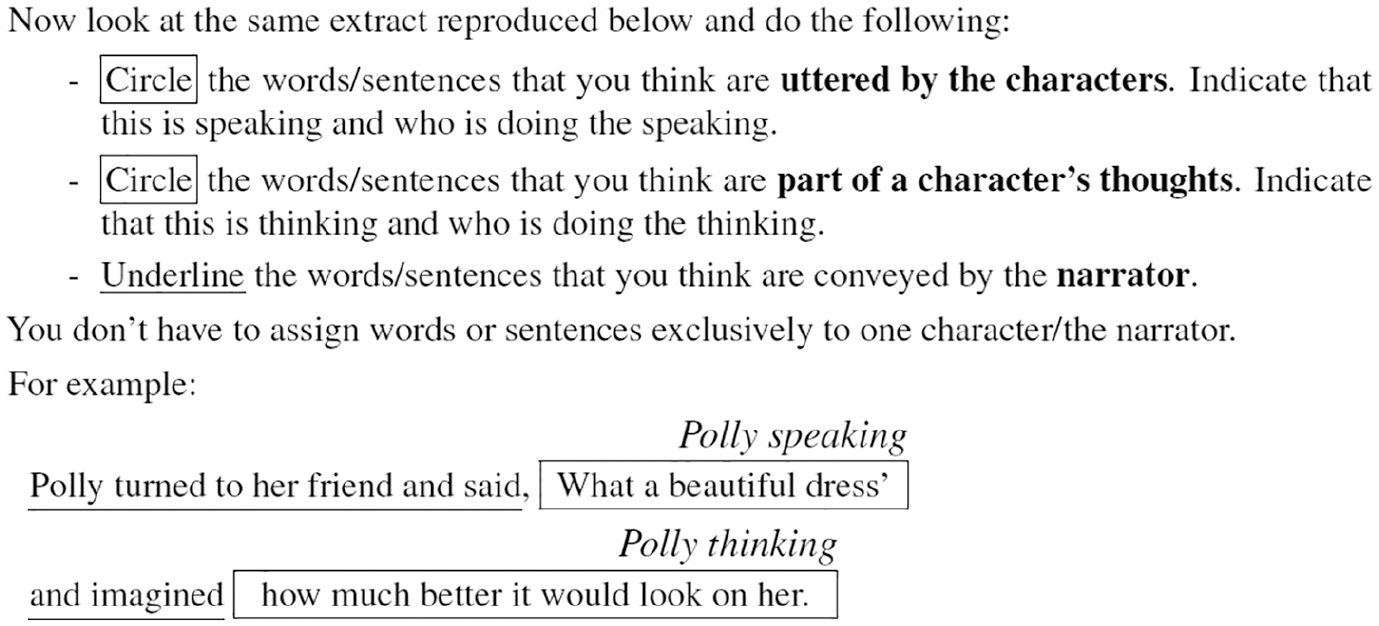
Second reading instructions.
Participants were free to attribute perspectives and voices to individual words, clauses, single and multiple sentences, or even entire paragraphs. This allowed for complete freedom to divide the extracts according to their own interpretation of the texts. In order to provide some understanding of the characters and the scene, a brief summary of a few sentences was provided before each extract. This introduced the main characters and set the scene, and was intended to ensure that participants had enough information to understand the situation depicted in the extract, for example: The Ramsays (Mrs. Ramsay, Mr. Ramsay and their daughter Minta), Lily Briscoe, Paul Riley, William Bakes and Charles Tansley are sitting at the table. The dinner has started and the ‘Bœuf en Daube’ is served.
Participants were asked to go through the questionnaire page by page and told not to look back to previous pages after completing each section. After completing the questionnaire, they returned it to the researcher together with a signed consent form. If a reader only filled part of the questionnaire, the completed sections were still included in the analysis. This resulted in an unequal number of participants reading each extract.
4.5. Analysis
Processing of the data was done in two stages: first, responses for each extract in each condition (modified/unmodified) were collated. The following example from one of the extracts presented to participants will be used to demonstrate how this was done.
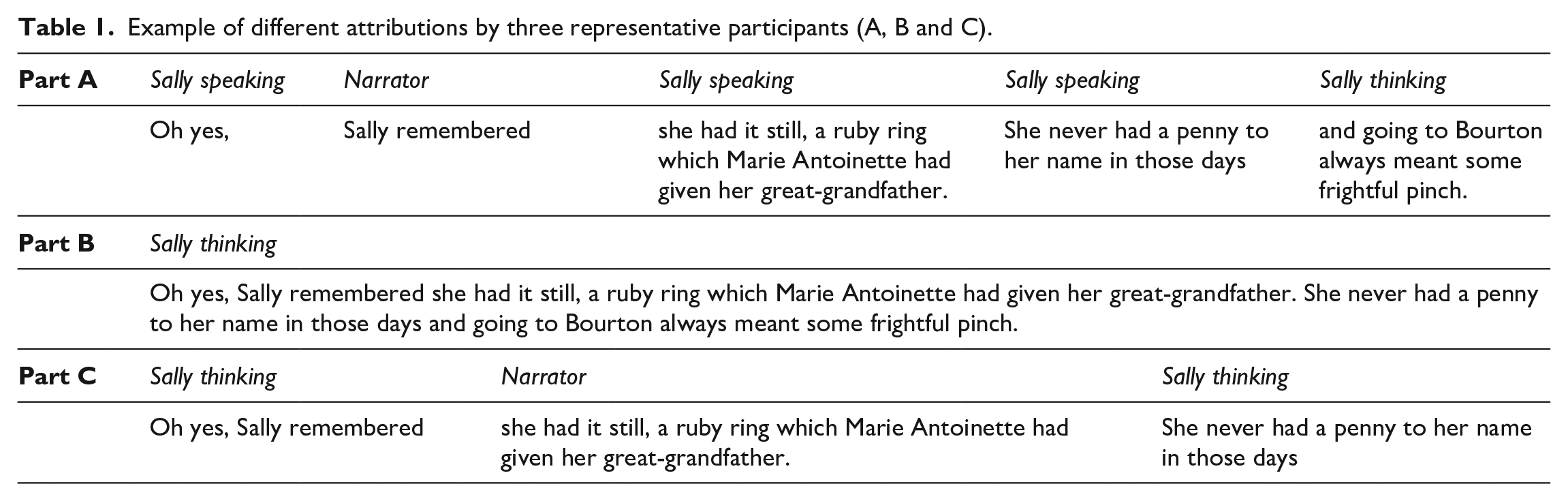
Oh yes, Sally remembered; she had it still, a ruby ring which Marie Antoinette had given her great-grandfather. (Woolf, 1996)
Table 1 shows the way in which three participants divided the text while attributing voices and viewpoints. Participant A divided the sentence into five segments according to his or her understanding of viewpoints, while Participant B attributed the whole sentence to a single perspective and Participant C divided it into three segments. For instance, Participant A grouped Sally remembered; separately from the following text, while Participant C grouped together Sally remembered; she had it still. In this case, Sally remembered; and she had it still, were counted as separate segments in our analysis. In this way, the smallest segment would be accounted for, as demonstrated in Table 1, where the resulting collated divisions for the sentence are presented.
Example of different attributions by three representative participants (A, B and C).
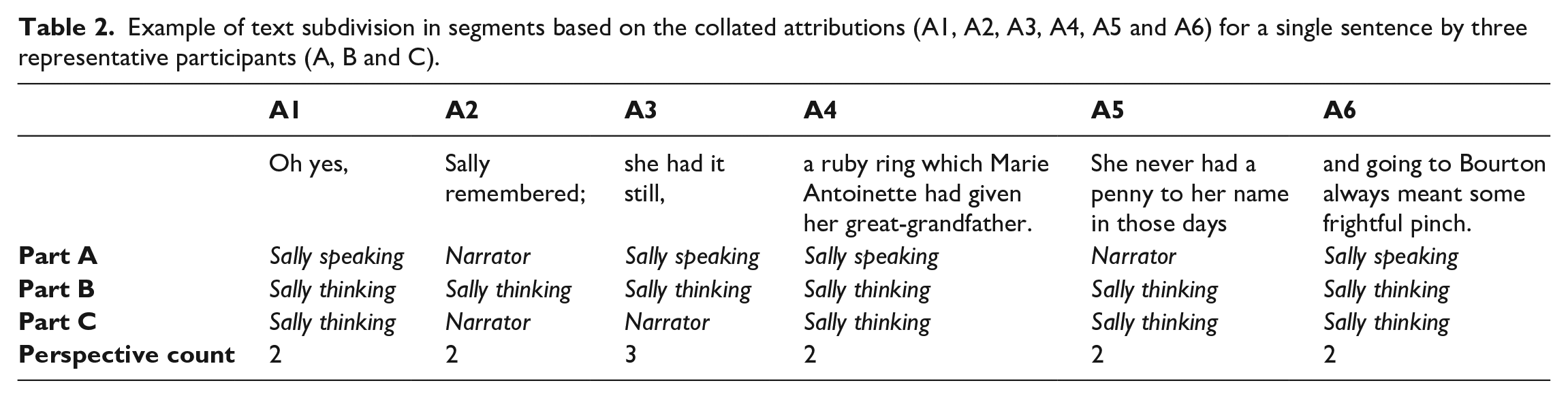
The second stage of the analysis looked at the attributions participants made for the various segments. As can be seen in Table 2, because Participant B only made one attribution, the perspective Sally thinking is applied across all segments. For each segment, it is possible to see how many different attributions have been made across all readers, which is shown at the bottom of Table 2. Crucially, this strategy allowed us to take into account all of the possible attributions to the smallest segment of text. After collating the responses, the maximum number of segments for each extract was applied to its respective original/modified version – depending on which of the two had more segments. The number of attributions was therefore observable for each segment in both the original and the modified text, allowing for an exact comparison.
Example of text subdivision in segments based on the collated attributions (A1, A2, A3, A4, A5 and A6) for a single sentence by three representative participants (A, B and C).
5. Results
5.1. Difficulty
For each extract, readers evaluated the perceived difficulty by answering the following question: ‘Do you think this extract is difficult or challenging? If so, what do you think makes it difficult?’ Answers were converted into a 3-point difficulty scale (1/low, 2/medium, 3/high). For instance, if participants explicitly stated that the extract was difficult – describing with attributes such as ‘very hard’, ‘challenging’ or ‘difficult’ – their rating was assigned a 3. If they stated that the extract was relatively clear but explicitly mentioned some features as being challenging or difficult, their difficulty rating was considered to be a 2. If they stated that they understood the extract without problems, and did not signal any specific difficulties, their difficulty rating was assigned a 1. Table 3 shows the distribution of low, medium and high difficulty ratings and their average value in original versus modified extracts.
Difficulty ratings distribution in original versus modified extracts.

A paired t-test of the aggregated values per extract was carried out in R Development Core Team and Team RC (2017) and revealed that the presence of free indirect style increased the subjectively experienced difficulty by about 0.63 points on a 3-point scale and that this difference was very significant, t(7) = 5.62, p < .001 5 ; the degrees of freedom are estimates based on the Satterthwaite method. 6 Cohen’s effect size value (d = .91) suggests a high significance. When comparing individual extracts, it appeared that all original passages had a higher difficulty rating than their modified counterparts and that this difference was significant in particular for extracts 2, 4, 6 and 8 (see Figure 2(a) and (b)).
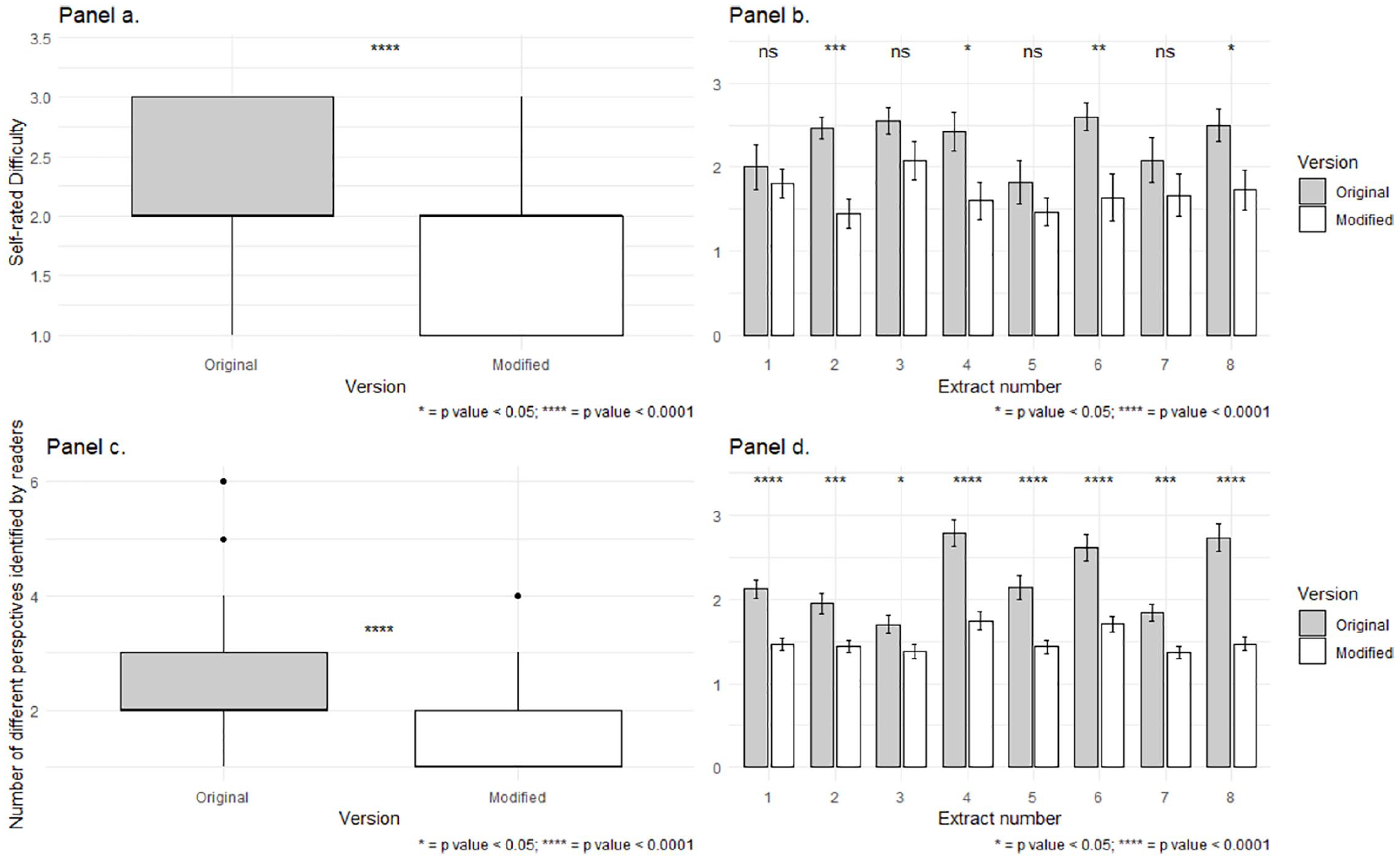
Average difficulty ratings (top) and number of perspectives identified (bottom) for original versus modified extracts across all extracts (a and c) and for each extract individually (b and d).
A linear mixed model that took into account random factors (i.e. the difference between participants, between the various extracts, the readers’ experience with modernism and their reading habits) confirmed that the difference between difficulty ratings for original versus modified extracts was significant and that it depended strongly on the modifications (β = –0.6, SE = 0.1, z = –5.99, p < 0.001).
5.2. Number of perspectives
Readers had to signal whose ‘voice’, ‘thought’ or ‘perspective’ they identified in the extracts. A paired t-test was carried out and revealed that the number of perspectives and modes of representation identified in the original extracts were significantly higher in comparison to modified extracts, both in general and for individual extracts (see Figure 2(c) and (d)). In fact, the presence of free indirect style increased the number of different perspectives and modes identified by about 37%, which was a significant difference, t(7) = 7.75, p < .001, with Cohen’s effect size value (d = .98) suggesting a high significance.
A linear mixed model accounting for random factors (i.e. the difference between participants, the individual extracts, the readers’ experience with modernism and their reading habits) confirmed that the difference between the number of perspective and voices identified in original versus modified extracts was significant and that it depended on the modifications (β = –0.74, SE = 0.01, z = –72.11, p < 0.001).
Crucially, the difficulty rating and the number of perspectives identified correlated (R = 0.38), indicating that an increase in perceived difficulty corresponded to greater disagreement among readers in the way they interpreted the extracts.
5.3. Individual factors
When completing the questionnaire, readers were asked to provide some personal information and some details about their reading habits, including how much they typically read and what, whether they had experience with modernist literature, and whether they had previously read Mrs Dalloway and/or To the Lighthouse.
An analysis of variance of the individual factors showed that none of these influenced the difficulty ratings or the number of perspectives identified. There was no difference in ratings between participants with different educational levels or reading habits, and ratings were not different between readers with or without experience with modernist literature or with Virginia Woolf’s novels.
6. Discussion
This study investigated how the presence of experimental techniques of consciousness presentation affects the perception of difficulty and the interpretation of perspectives in extracts from Virginia Woolf’s To the Lighthouse and Mrs Dalloway. The aim was to understand whether the impression that her novels are difficult – an opinion shared by actual readers as well as by literary scholars – depends on the use of such techniques and on the presence of the shifts between viewpoints and on the juxtaposition of modes of consciousness presentation.
Previous studies investigating readers’ responses to shifts in perspectives suggest that free indirect style poses a challenge for readers and that this is typically related to the difficulty in identifying which character is speaking or thinking (Bray, 2007; Cui, 2017; Sotirova, 2006, 2016b). By looking at free indirect style in general, none of these focused on the peculiar features that distinguish the use different authors make of such techniques, and none of these made use of statistical tools to provide empirical support for their claims. This study tried to fill this gap and to provide quantitative evidence showing whether perceived difficulties in Woolf’s To the Lighthouse and Mrs Dalloway are caused by her use of speech, thought and consciousness presentation techniques.
In this study, responses to original and modified extracts – ones where the potential ambiguities relating to the attribution of perspectives were altered or eliminated – were compared. Each participant had to rate four extracts in terms of difficulty and to signal whose perspective they thought was represented in the text, that is, which character/s they believed was thinking, speaking or narrating the extract. The results of the study showed that the presence of free indirect style increased the number of perspectives identified significantly, for all of the extracts, as well as the self-reported perception of difficulty. These results are in line with our assumptions: they suggest that free indirect style poses a challenge for readers and that the reason for this can be attributed to the lack of clear boundaries between characters’ speech, characters’ thoughts and narration that arises from these techniques. This makes it difficult to identify who is thinking/speaking and whether the identified character is thinking or speaking. This study lays the ground for further investigations on how the various categories of free indirect style influence readers’ processing of literary texts.
Somewhat surprisingly, and in contrast with some earlier studies (Sotirova, 2016b), the results of the questionnaire suggest that there is no correlation between participants’ interpretation of the extracts and their educational level, their reading habits or their previous experience (or lack thereof) with modernist literature, their age or their gender, and that this is true also for the level of difficulty perceived.
While it is difficult, if not impossible, to point to a single linguistic feature as the cause of an interpretative difficulty, it appears that in these two novels, Woolf’s use of techniques of speech, thought and consciousness presentation contributes to the texts’ difficulty. Notably, the eight extracts from To the Lighthouse and Mrs Dalloway that were investigated here are representative of what is believed to be the most difficult aspect of the two novels: her use of techniques of speech, thought and consciousness presentation. Woolf softens and often removes the boundaries between perspectives (Cui, 2017; Rundquist, 2015; Sotirova, 2006): such juxtaposition, along with the syntactical inconsistencies resulting from missing references, ellipses and colloquialisms, represent a potential difficulty for readers, such that it is not always possible to come to a single interpretation of the represented fictional world, and thus to understand whose voice/thoughts or perceptions are being presented in the narrative. Crucially, Woolf’s use of these techniques poses a challenge for readers not only in terms of whose perspective is represented, but also in terms of what facet of the characters’ perspective is being presented.
Some issues with this study also need to be kept in mind. First, the inclusion of the word ‘difficulty’ in the questionnaire might have biased participants to focus on the difficulty of the extracts. However, because the question about difficulty was posed after each extract (original and modified ones), this should affect both versions and therefore not influence the difference in responses between original and modified texts. Second, despite our effort to minimise changes as much as possible, any modification inevitably changed the original texts, slightly altering their syntax and therefore potentially their reception. To limit the impact of this phenomenon, every word or sentence that was added to the modified versions to make the identification of perspectives easier – for example, the conjunction ‘that’ or the inquit ‘he or she said’ – was excluded from the analysis.
In sum, this study showed that readers perceive texts featuring free indirect style, IM or FDS as more difficult than texts featuring only DS and IS. The greater disagreement in the attribution of perspectives in original extracts in comparison to modified ones shows that readers are likely to struggle interpreting such texts.
This outcome has two important implications: on the one hand, it adds empirical value to existing theoretical assumptions about the potential difficulty posed by Woolf’s use of speech, thought and consciousness presentation techniques, laying solid ground for future investigations of free indirect style and of difficult narratives in general. On the other, it calls for further explorations of the differences among these techniques – which need to be analysed individually and compared to each other – and how their juxtaposition influences the text’s interpretation, to understand the specific semantic and syntactic properties that elicit the readers’ perception of difficulty. Crucially, this study also shows that experience with Modernism and familiarity with Woolf’s writing played no role in the perception of difficulty. This, too, requires further investigation and sound empirical evidence.
Footnotes
Declaration of conflicting interests
The authors declared no potential conflicts of interest with respect to the research, authorship and/or publication of this article.
Funding
The authors received no financial support for the research, authorship and/or publication of this article.
