



Abstract
In this paper, we study gendered patterns of body language descriptions in children’s fiction. We compare a corpus of 19th-century children’s literature with a corpus of contemporary fiction for children. Using a corpus linguistic approach, we study gendered five-word body part clusters, that is, repeated sequences of words that contain at least one body part noun and a marker of gender. Our aim is to identify and describe differences between the description of male and female body language across both corpora. We find that in the 19th century, there are not only fewer clusters for female characters, but the functional range of these clusters is also limited. The contemporary data suggests a trend for male and female clusters to become more similar with the clusters illustrating an increasing range of options for the description of female characters and their interactional spaces.
1. Introduction
Gender is one of the fundamental structuring principles of our society. It is constructed in different ways in different discourses. Crucially, gender is not a stable concept. Its construction changes over time. Children’s literature represents cultural norms and values, and hence is an important source for children to learn about gender norms. As Reynolds (2011: 34) notes, ‘writing for the young has considerable potential to influence what its intended readers regard as normal, good, acceptable, important, unjust, or to be feared.’ Gender norms are often presented implicitly. The description of fictional characters, their actions, as well as social relationships and interactions expose children to common patterns of gendered behaviour. Common patterns that are shared across a number of texts link the fictional worlds in literature to the cultural contexts in which they are produced and received. Thus, the study of fiction allows us to study how behaviours and norms have changed over time.
In the 19th century, children’s literature reached its first ‘golden age’ with classics like Alice’s Adventures in Wonderland. Nevertheless, research specifically focused on children’s literature is fairly recent. As Nikolajeva (2016: 133) points out: ‘[u]ntil relatively recently, children’s literature research was predominantly inspired by cultural theory viewing the child and childhood as a social construction rather than a material body existing in a material world.’ This has gradually changed with the ‘material’ turn and research focusing on aspects such as ecocriticism (Curry, 2013) or fashion (Vaclavik, 2019). Such research explores ‘in more detail the complex relationship between perceptible phenomena and their representations in children’s fiction; between the physical body and its immaterial, linguistic fictional portrayal’ (Nikolajeva, 2016: 13). Importantly, the child reader is a ‘novice reader’ (Nikolajeva, 2014), not only in terms of limited cognitive and affective skills, but also in terms of limited life experience. So children learn through texts.
Our focus is on textual patterns of a particular type of gendered behaviour – body language. Body language is an important part of the material world that is portrayed in fiction. It does not only refer to the physical body of fictional characters but also shows how fictional people interact with one another as well as with the material world they inhabit. The study of gender will inherently be comparative – part of the definition of gender is through the description of differences and contrasts. Additionally, due to its close link with cultural practices, a diachronic study can shed light on gendered behaviour through comparison. In this article, we compare gendered body language in 19th-century children’s literature with contemporary fiction for children. The golden age of children’s literature is a good starting point for a comparison with contemporary texts. As Reynolds (2002: 97) notes, still ‘much current thinking seems in many ways to map the attitudes of the late-Victorian period’.
Although current research into gender and children’s literature involves various approaches (for an overview, see, for example, Hateley, 2011) including linguistic analysis (e.g. Malmkjær and Knowles, 1996; Sunderland, 2011; Hunt, 2015; Eberhardt, 2017), this is the first study to systematically explore linguistic descriptions of gendered body language in children’s literature. We work with two different data sets: a corpus of 19th- century children’s literature and a corpus of contemporary children’s literature. Our aim is to identify and describe some of the most prominent gendered differences in each corpus, before then comparing these differences across the two time periods. In the 19th century, gender was mainly constructed in binary terms of femininity and masculinity, so we concentrate on this contrast. In Section 2, we begin by contextualising our linguistic approach to body language descriptions, and Section 3 introduces the corpora we work with and explains our methodology. In Section 4, the analysis focuses on the 19th century data set and in Section 5 on the contemporary data, before we draw together conclusions in the final section.
2. Body language in fiction for children
Research on fictional body language relates to the wider context of non-verbal communication. From a literary perspective, the most comprehensive descriptive framework to date was developed by Korte (1997). Korte (1997: 3–4) defines body language ‘as non-verbal behaviour (movement and postures, facial expressions, glances and eye contact, automatic reactions, spatial and touch behaviour) which is “meaningful” in both natural and fictional communication’. For the classification framework that Korte (1997) develops, she draws on both real-life as well as fictional categories. Body language plays an important role in the process of characterisation, where the link between real-world information and textual features is key, too. Within the theoretical context of corpus stylistics and cognitive poetics, characterisation is a process in the mind of the reader that combines the processing of textual cues with real-world background knowledge (Culpeper, 2001). In his approach to mind-modelling, Stockwell (2009) particularly emphasises the similarities in the way in which readers perceive real and fictional people. Corpus linguistic methods support the identification of textual cues for characterisation in general and body language in particular (Stockwell and Mahlberg, 2015). Especially repeated lexico-grammatical patterns are useful starting points to find common body language, that is, body language whose main function is not to set individual characters apart from others, but descriptions of what appears like natural body language (Mahlberg, 2013). Such seemingly natural body language that is shared by fictional characters across a range of texts provides important insights into social, cultural, and especially gendered norms. This approach to body language contributes more widely to research into fictional descriptions of common patterns of human behaviour highlighting the close link between literary and cultural history that is increasingly addressed in digital humanities studies (e.g. Underwood et al., 2018).
As with body language more generally, gendered types of behaviours might be more or less explicitly presented in fiction. A striking example is the following from Mark Twain’s Adventures of Huckleberry Finn (1884) (also discussed in Eschholz, 1973). Huck dresses up as a girl but gives himself away by his body movements: You do a girl tolerable poor, but you might fool men, maybe. Bless you, child, when you set out to thread a needle don’t hold the thread still and fetch the needle up to it; hold the needle still and poke the thread at it; that’s the way a woman most always does, but a man always does t’other way. […] And, mind you, when a girl tries to catch anything in her lap she throws her knees apart; she don’t clap them together, the way you did when you catched the lump of lead.
A body, as a physical object, may seem to be ‘a self-evident concept’ (Violi, 2008: 54). Similarly, conventionalised gestures might be taken as straightforward to decode. However, perceptions of the body as well as conventionalised behaviours cannot be accounted for without reference to their cultural contexts. And even then, descriptions of body language in literature do not necessarily map neatly onto our perceptions of body language in the real-world. As Korte (1997: 88) observes, literary body language was strongly conventionalised well into the 19th century and ‘a decline in the use of conventional body language is one of the important developments in the twentieth century’. To decode body language in fiction, the reader will need both real-world knowledge and knowledge of literary conventions. Fiction for children is a place where some of this knowledge will be acquired.
In the field of children’s literature, questions around embodiment and meaning making are gaining increasing interest (Nikolajeva, 2016), but so far no systematic attempt has been made to describe the literary conventions of body language. This may be due to the fact that common patterns of body language descriptions are exactly that – common, as opposed to striking. It is usually the striking descriptions, as in the Huckleberry Finn example, and unique features of fictional characters that receive attention. To identify patterns of body language descriptions that readers are less consciously aware of, corpus linguistic methods provide important tools (Mahlberg, 2013). In the present paper, we draw on such methods to focus specifically on gendered patterns and bring an innovative approach to children’s fiction.
3. Data and methodology
Overview of ChiLit and the OCC2000+.
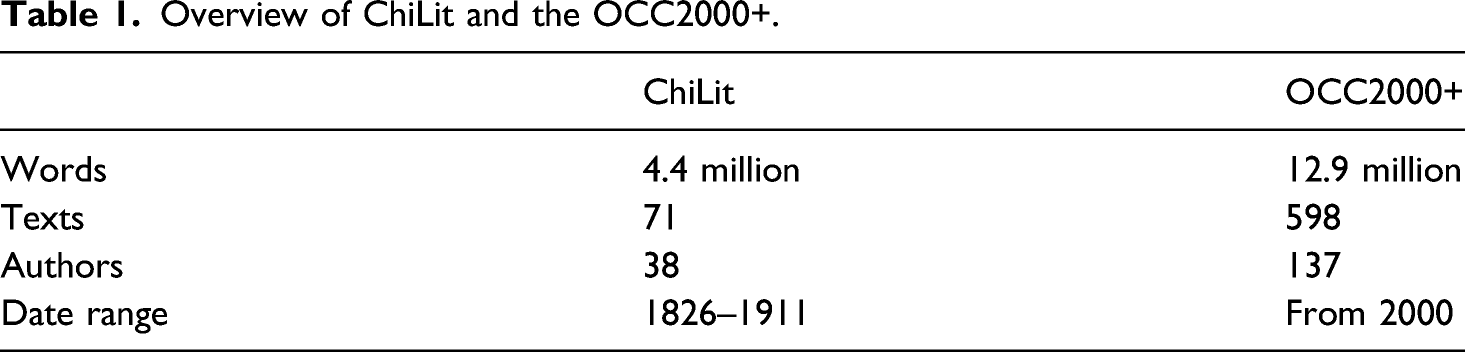
The OCC2000+ contains 12.9 million words. It is a subcorpus of the Oxford Children’s Corpus (OCC) compiled by Oxford University Press (OUP). As a publisher reaching extensive audiences across the UK, OUP has a significant impact on the perceived mainstream norms of children’s literature. The OCC is hosted through SketchEngine but access to the corpus is restricted due to copyright. The OCC2000+ is a sample of the OCC created by selecting only texts published from 2000 onwards. According to the metadata available through SketchEngine, there are 598 titles by 137 authors. There are several book series written by one author, for example, the Witchfinder series by William Hussey. Additionally, there are four author collectives. The authors of the OCC2000+ are mainly British but, unlike ChiLit, not exclusively so. There are, for instance, some translations (e.g. Astrid Lindgren books). The age range of the target audience of the OCC2000+ covers KS1 up to KS3 (i.e. five to 14-year-olds). The OCC primarily serves lexicographic purposes, so there are limitations as to the detail that is available about the exact composition of the corpus, and hence any subcorpus drawn from it. 1 For stylistic analysis, the main limitation of this data source is the lack of access to extended context. Through SketchEngine it is only possible to examine a context of about 180 words around the search word, that is, about 90 words to the left and to the right.
Following Mahlberg (2013), we focus on five-word body part clusters. These are repeated sequences of five words that include at least one body part (BP) noun, as in his
Both CLiC and SketchEngine have n-gram functionalities. We generated a list of five-word clusters with the following thresholds. For ChiLit, clusters will occur at least five times; that is, they have a normalised frequency of at least 1.13 per million words. To match the same normalised frequency in the OCC2000+, a cluster has to occur at least 18 times. With these thresholds, there are 4041 and 1669 clusters in ChiLit and the OCC2000+ respectively. From the initial lists, the GBPCs have been identified manually: there are 112 GBPCs in ChiLit and 94 in the OCC2000+. Our selection does not contain clusters that are specific to one text only. In ChiLit all clusters occur in at least two texts, in the OCC2000+ the clusters are distributed across at least 11 texts.
Overview of clusters in ChiLit and the OCC2000+.
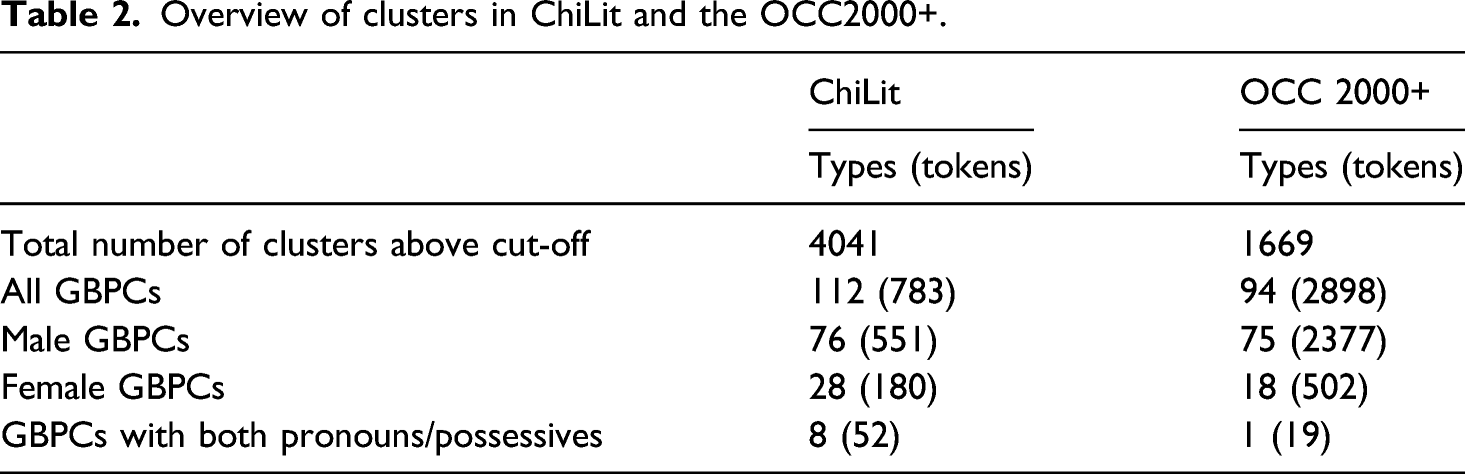
In this study, our aim is to describe the most prominent gender differences in each corpus and to compare these differences across the two corpora. Our focus is on the functions of the clusters in their textual contexts, so our analysis is mainly qualitative. We will point to tendencies based on frequencies, but as a total of 206 GBPCs is not a sound basis for statistical comparisons, these are just that – tendencies. Frequency overviews provide starting points for our analysis that are followed up by looking at clusters in concordances to understand their textual functions in context. 2
4. Gendered body language in 19th-century children’s literature
Top 15 male and female GBPCs in ChiLit.
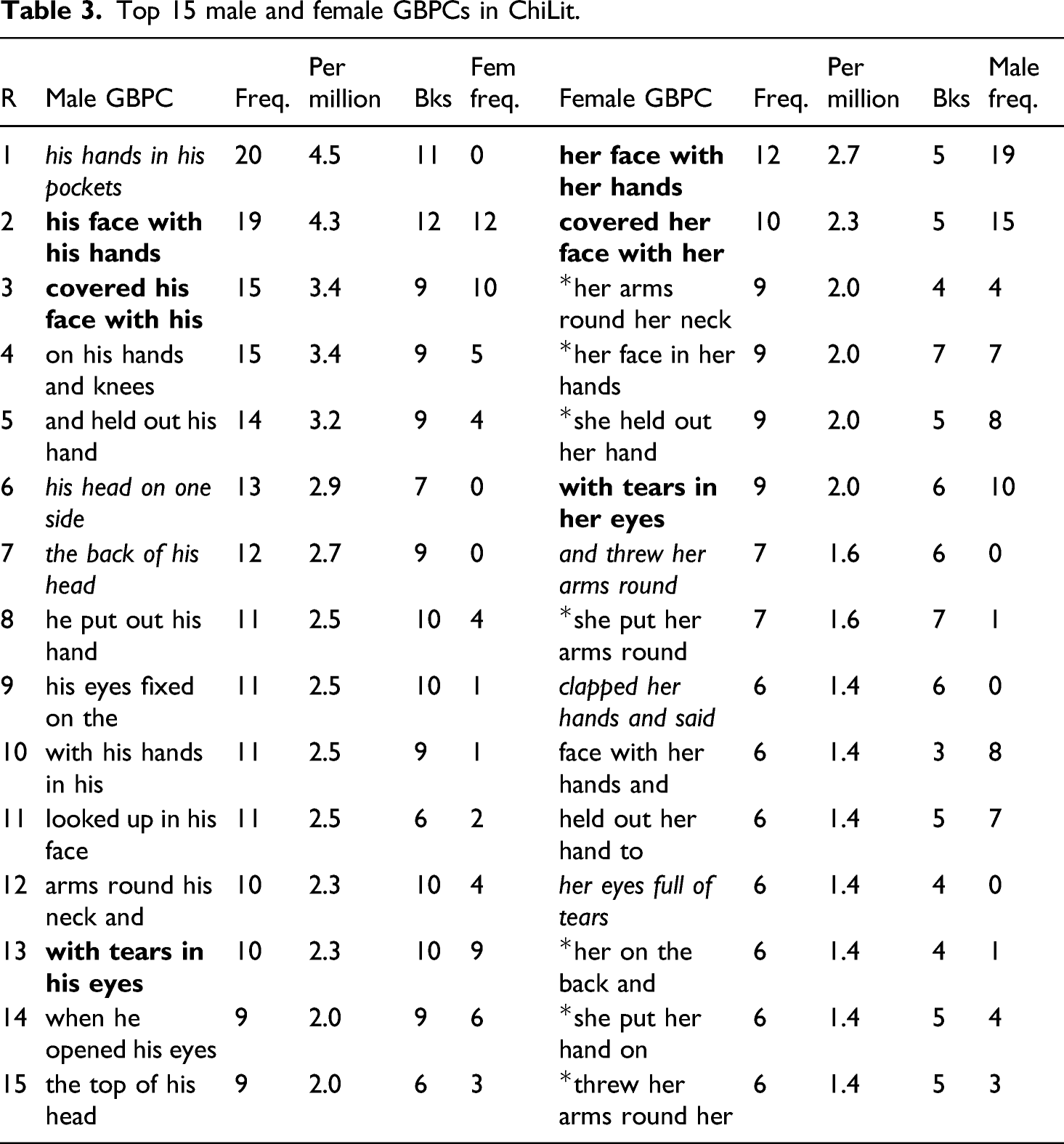
To account for gendered differences, male and female variants of clusters deserve specific attention, that is, clusters that formally only differ in the gender of the pronoun. In Table 3, clusters highlighted in bold have both a male and a female form among the top 15 clusters, such as his/her face with his/her hands (occurring 19 and 12 times respectively). Most clusters have a form for both genders. Out of the 76 male clusters, 14 have no attested female form. For the female clusters, six out of 28 are found with only one gender. It is generally the masculine variant that is more frequent. In Table 3, clusters with an asterisk * are more frequent in the feminine form. Clusters in italics in Table 3 (e.g. his hands in his pockets and and threw her arms round) are examples that only occur with one of the genders.
The most frequent clusters already point to an important difference between male and female clusters. Not only are there fewer female GBPCs overall, there is also a tendency for less variety across the female clusters. In Table 3, there are four female clusters that contain the word arms (ranks 3, 7, 8 and 15). Three of them occur more frequently in the feminine variant and the cluster and threw her arms round is found in the feminine form only. The plural form arms is the most frequently occurring BP in female GBPCs. Out of the 28 female GBPCs, seven contain the word arms. In comparison, of the 76 male GBPCs, there are only five with either arm or arms (him by the arm and, arms round his neck and, he threw his arms round, in his arms and carried, in his arms and kissed). Strikingly, while there is variation even among the five male clusters (by the arm, his arms round, in his arms), all female clusters are similar in that they contain arms and round: her and threw her she put her threw her throwing her and put her her
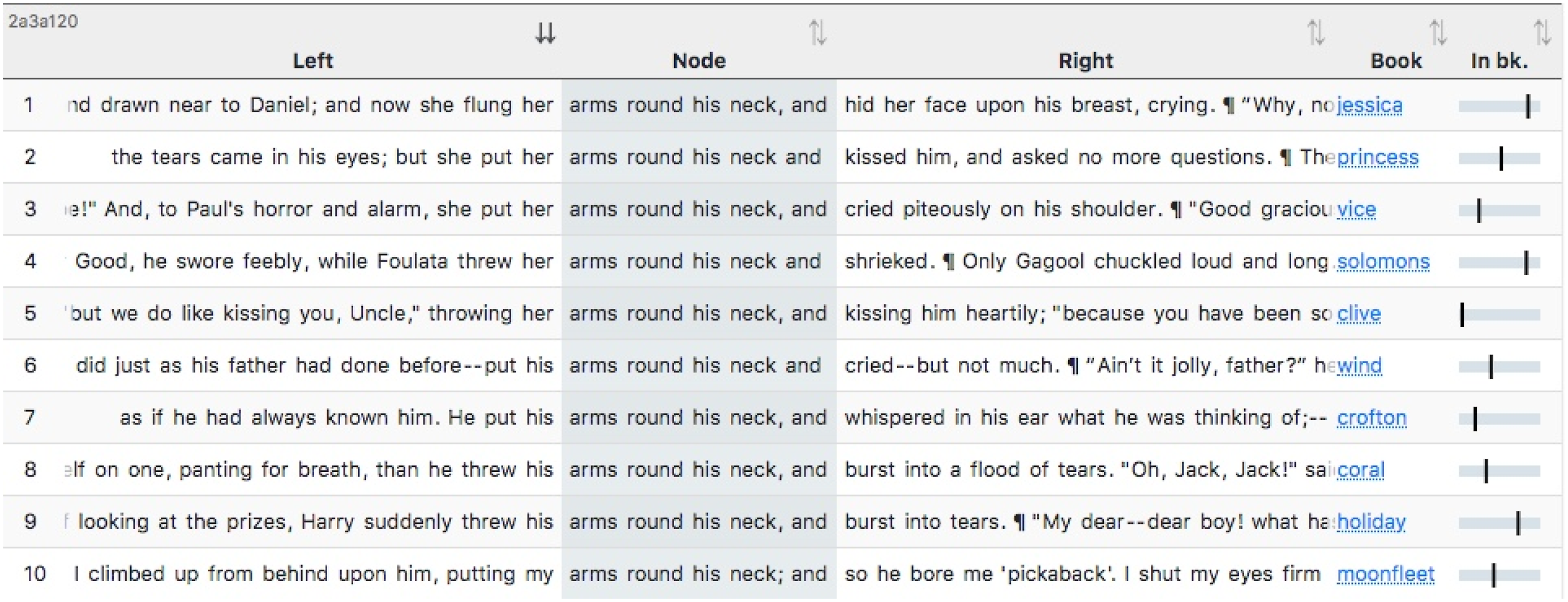
Frequency counts and the identification of formal similarities between clusters make a good starting point for our analysis. To find out how the clusters function in their textual contexts, concordances provide more detailed insights. Figure 1 shows the seven occurrences of the cluster and threw her arms round. This is the cluster that does not have a male variant in ChiLit. Touch is often associated with the expression of emotions. In the cluster itself, the verb threw already indicates the emotional outburst of the character. The meanings that are associated with a cluster, that is, the functions that the cluster can fulfil in fictional texts, are not inherent in the cluster alone, but also depend on the context. In this sense, describing the meaning of clusters is similar to describing meanings of words in the contexts shown in concordances. To account for meanings of body language clusters, Mahlberg (2013) draws on the term ‘local textual functions’, which stresses the need to see the cluster in its local context. The meaning of the cluster is its function in the fictional text, that is, the way in which it contributes to describing and creating a fictional character. In the concordance in Figure 1, other action verbs underline the meaning triggered by threw. There is ran (lines 2 and 6) and sprang (lines 3 and 5), which show the force of the action. There are also references to kissing (lines 4 and 7) indicative of an emotional situation. The concordance in Figure 1 further points to the relatedness of the different arms clusters. It contains three of the six occurrences of the cluster threw her arms round her (lines 1, 2 and 7), and there is also the cluster her arms round his neck (lines 4 and 6). All seven occurrences of and threw her arms round in ChiLit.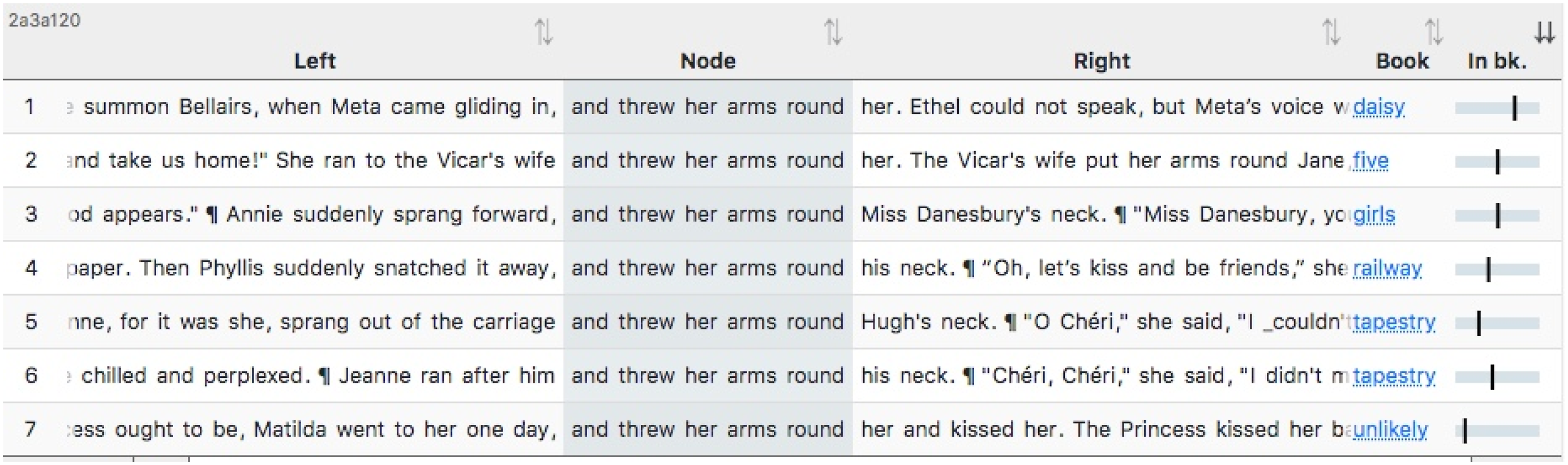
The meanings associated with ‘throwing someone’s arms round someone’ are not exclusive to female characters. The cluster threw her arms round her has a male form, threw his arms round his, shown in Figure 2. Again, the action verb threw is supported by related meanings in the context (burst in lines 1 and 3, and struck in line 2). The female and male clusters are similar in that they function in emotionally-loaded contexts. The important difference is that this type of meaning makes up a larger proportion of the body language descriptions of female characters than that of male characters. These clusters show haptic, or touch, behaviour, indicating the relationship between two characters. The relational meaning of clusters is also relevant for the cluster arms round his neck and. Formally, it is a male GBPC – in the five-word sequences there is only a male possessive. But as Figure 3 shows, half of the ten occurrences are part of the six-word cluster her arms round his neck and. So an important aspect of the body language that is described for female characters is the way in which they reach out to other characters. Female characters tend to be shown in relation to others.
3
All three occurrences of threw his arms round his in ChiLit. All 10 occurrences of arms round his neck and in ChiLit, alphabetically sorted on L1.
4.1. Touch, emotions and the social context
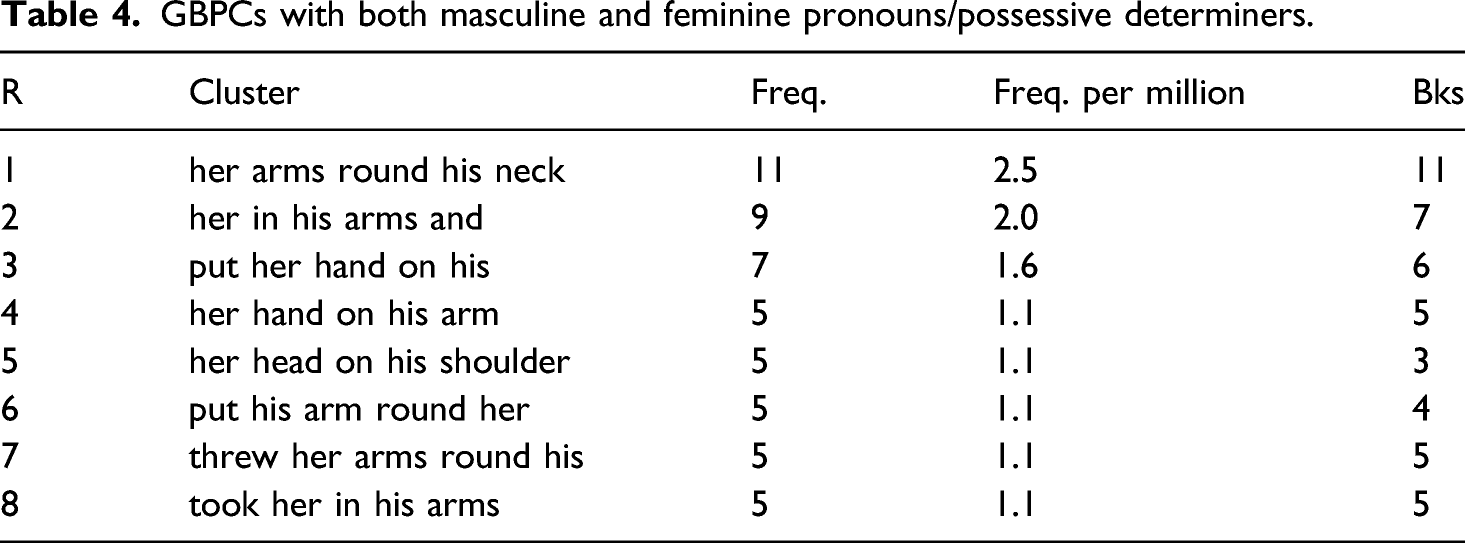
The description of touch behaviour allows to show interpersonal relations between fictional characters as well as emotional responses to other characters and situations. At the same time, touch behaviour is socially regulated. As Korte (1997: 68) points out: ‘every society has rules regarding which areas of the body are allowed to be touched […] and who is allowed to touch them’. GBPCs can provide insights into socially acceptable physical contact. Clusters that contain both a masculine and feminine pronoun are good candidates in this regard. Table 4 lists all of them for ChiLit. The body parts in these clusters are arms, arm, neck, hand, head and shoulder. The clusters tend to describe encounters among siblings, parents and their children, occasionally other family members, or very close friends. Example 1 illustrates a family situation. There are also social roles that affect conventions for acceptable behaviour, as in example 2, where Mr Everard is a close family friend. Example 3 shows how the text can explicitly comment on the appropriateness, or in this case the inappropriate nature, of an encounter. 1. Mr Tufton kissed them both, muttering to himself: “I suppose I ought to kiss them. Girls always expect to be kissed at every opportunity.” “What are you laughing at, grandniece?” “I don’t think girls expect to be kissed, except by people they like,” Kate said; “but we do like kissing you, Uncle,” throwing 2. “Tell me what is wrong, my poor child,” said Mr Everard. He laid 3. And, to Paul’s horror and alarm, she put her GBPCs with both masculine and feminine pronouns/possessive determiners.
For children, there seems to be more variety of physical contact, as in example 4. 4. ‘Oh, it’s not that, Oswald,’ Alice said. ‘Don’t be a pig! I am so miserable. Do be kind to me.’ So Oswald thumped
Touch behaviour provides an opportunity to stress the closeness between characters (see Mahlberg, 2013: 117). It can also reflect social status and asymmetrical relationships of power or responsibility, as shown by the cluster his hand on his shoulder in example 5. 5. “My brave lad!” said master, laying
Touch behaviour is not the only way to make the emotional state of characters visible. Among the most frequent GBPCs in ChiLit (Table 3), there is with tears in his/her eyes. Eye language is generally important in fiction and has been much commented on (cf. Korte, 1997; Mahlberg et al., 2020; Čermáková and Malá, 2021). In ChiLit, the prominence of with tears in his/her eyes is notable, as it is a cluster that occurs in the top of the frequency list for both genders. As we pointed out before, the cluster numbers we are dealing with are relatively low. Still, considering that not for every cluster variants for both genders are attested in ChiLit, with tears in his/her eyes deserves a closer look. The female variant with tears in her eyes is less frequent in absolute terms (nine occurrences vs ten for the male cluster). Due to the ratio of male versus female pronouns and possessives though (cf. Section 3), the cluster is relatively more common for female characters. What is noteworthy is that tears are also seen with men, as in example 6. 6. As it was, he stood before the Assembly an object of universal contempt, - proposing,
Richgels (1994) observes a shift during the 19th century with tears shed by men gradually becoming unacceptable. 19th-century ideas of masculinity increasingly seem to emphasise toughness and self-control. Examples 7 and 8 are both from texts from the latter half of the century (published in 1869 and 1877 respectively). As Stearns (1993: 37) notes, from the 1850s popular advice ‘urged males and females to prepare for distinct gender roles from childhood onward by accepting equally distinct emotional norms’. Boys were to learn to ‘handle emotions in ways useful in the world outside the home, girls to manage emotions in ways useful for maintaining the family’ (Stearns, 1993: 42). 7. […] without a word Tony slipped down upon a heap of paper shavings strewed within, drew his ragged jacket up about his ears, and turned his face away, 8. […] he stood close up to our heads
4.2. An effect of fashion
The most frequent cluster among the male GBPCs is his hands in his pockets. It occurs 20 times in 11 books. Out of the 20 instances, 11 are part of the six-word cluster with his hands in his pockets. This cluster does not have a female variant in our data. As Burman (2002) explains, ‘pockets’ echo wider gender issues. Throughout the long 19th century fashion changed dramatically. So did male and female pockets (for a contemporary view, see Diehm and Thomas, 2018). While male pockets were mostly of the inset type, the prevailing female pocket was the tie pocket.
4
The long, knitted sports cardigans that were fashionable at the turn of the century were amongst the first female fashion items that routinely had side patch pockets (Burman, 2002: 452). That pockets were an item of fashion that underwent change did not escape Charles Dickens either – the master of body language descriptions. In Barnaby Rudge, set at the end of the 18th century, the narrator comments on Dolly who is looking for something in her pockets, stressing ‘there were pockets in those days’, example 9. 9. Dolly nodded and smiled, and feeling in her pockets (there were pockets in those days) with an affectation of not being able to find what she wanted, […] (Dickens, Barnaby Rudge).
Whether body language descriptions that refer to hands in pockets are found with male or female characters will depend to some extent on the fashion of the time. The availability of specific types of clothes will affect women’s opportunities to deport themselves. Additionally, the occurrence of specific clusters might also be affected by the typical meanings that have come to be associated with specific poses, as well as their social desirability. For the ‘hands in pockets’ pose, Burman (2002: 463) notes: The hand in the trouser pocket, though expressive of bodily confidence and presence, was also an ambivalent stance because of its association with poor deportment, lack of restraint and degeneracy. In 1868, an English public school reportedly ruled that its scholars would no longer have ‘side trousers pockets’ because they ‘continually had their hands in these pockets, and thereby contracted a lounging and stooping habit’.
The general frequency of clusters with his hands and pockets, not only in children’s literature but also 19th-century novels more widely, is associated with a range of functions the clusters can fulfil – at least for male characters. These can be described on a cline from providing contextualising information, as in example 10 to highlighting information as in example 11. In example 10, putting his hands his pockets provides detail on the context of speech, together with the description of the character’s gaze direction. In example 11, the cluster is more than contextualising information. It is associated with a particular character, Peter, for whom having his hands in his pockets is characteristic behaviour (for more detail on the functional variety of this cluster, see Mahlberg 2007a; 2007b, 2012, 2013). 10. “Look here, Jane,” said the grown-up Lamb, putting 11. “All the same,” said Peter,
Of particular significance for the comparison of gendered body language is that his hands in his pockets refers to body movements that can be described without reference to other characters. So the most frequent male GBPC is in stark contrast to the most frequent patterns we observed for female characters, which emphasise how female characters are seen in relation to others.
For any analysis of clusters, it is important to keep in mind that clusters, as fixed sequences of words, only provide a selection of the range of meanings they reflect (Mahlberg, 2013). The clusters in our study are a selection of ways in which gendered body language can be shown. As we have illustrated with the concordance examples, the specific textual functions of clusters are created together with other words and phrases in their context. Since the meanings of the clusters are context dependent and shaped by the overall fictional worlds of the texts in which they occur, they can potentially change.
5. Body language in contemporary children’s literature
Top 15 male and female GBPCs in the OCC2000+.
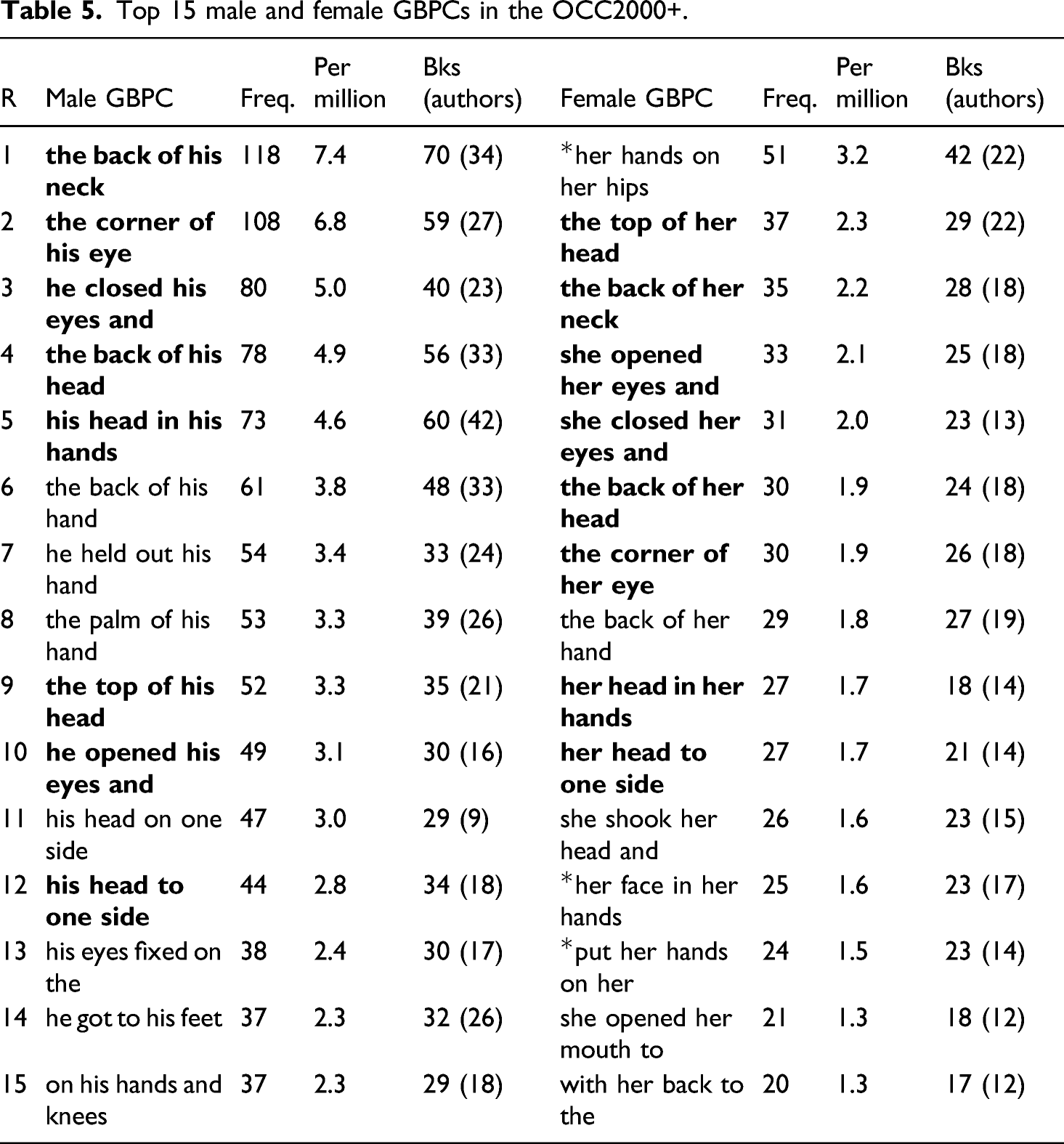
As Table 3, Table 5 shows the top 15 clusters for both male and female GBPCs; for the full list, see Appendix 2. Also as in Table 3, clusters in bold are those for which both feminine and masculine forms already appear among the top 15. Clusters with an asterisk * are more frequent in the feminine form. Although overall male clusters are still more frequent than the female forms, compared to ChiLit, the table shows that there are now more clusters that are common for both genders. Additionally, while in ChiLit the most frequent male GBPC (his hands in his pockets) occurs exclusively in the male form, in the OCC2000+, the most frequent male cluster does have a female form. We will discuss this point in more detail in Section 5.1. At the same time, the variety of frequent female forms presents a different picture in the OCC2000+, which we will look at in Section 5.2. Another development from Table 3 to Table 5 is the appearance of a number of clusters specifying a body part in greater detail (the back of his/her neck, the corner of his/her eye, the top of his/her head) which suggests increased focus on detailed description, but in this article we do not have the space to follow up on this point.
5.1. Towards more equal opportunities
When clusters have both a male and a female form it does not automatically follow that male and female characters are described in exactly the same way. Still, such clusters provide an opportunity for more similarity. The example of the back of his/her neck illustrates this point. It is the most frequent male GBPC and among the most frequent female ones, so it can illustrate a range of local textual functions. One is to contribute to descriptions of a character’s feelings or emotional responses. In these contexts, for both male and female forms, we find the verb 12. The terrified boy 13. …and when John spoke again she 14. Dax 15. Sara 16. The voice screamed higher this time. Tom 17. Sara
In addition to the cluster being used in similar contexts for both genders, it is still used in contexts of more gendered descriptions, too. While there were no examples of male forms together with descriptions of appearances, examples 18 and 19 illustrate such descriptions for female characters. 18. She had grey-brown hair in an untidy bun at 19. All the time, I was wondering what Jennifer would wear and what we’d talk about and I was thinking of her eyes, the way they were like the sun, and the bit of velvet on
The availability of male and female forms of a GBPC opens up more options especially for the description of female characters. This development from ChiLit to the OCC2000+ becomes even clearer when we look at the increased variety among the female clusters, which we discuss in the next section.
5.2. Female assertiveness
For ChiLit, we found that body language involving arms was particularly important for the description of female characters and a way to describe them in relation to others. In the OCC2000+, descriptions of arms appear to be different. To start with, among all clusters, there are only three that contain a reference to arms: a hand on his arm, put an arm round her and put his arm around her (see Appendix 2). For all three, it is the singular form of the noun, arm, that occurs in the clusters. In ChiLit, in contrast, the plural form, arms, is preferred. Additionally, there is the indefinite article instead of a possessive determiner (put
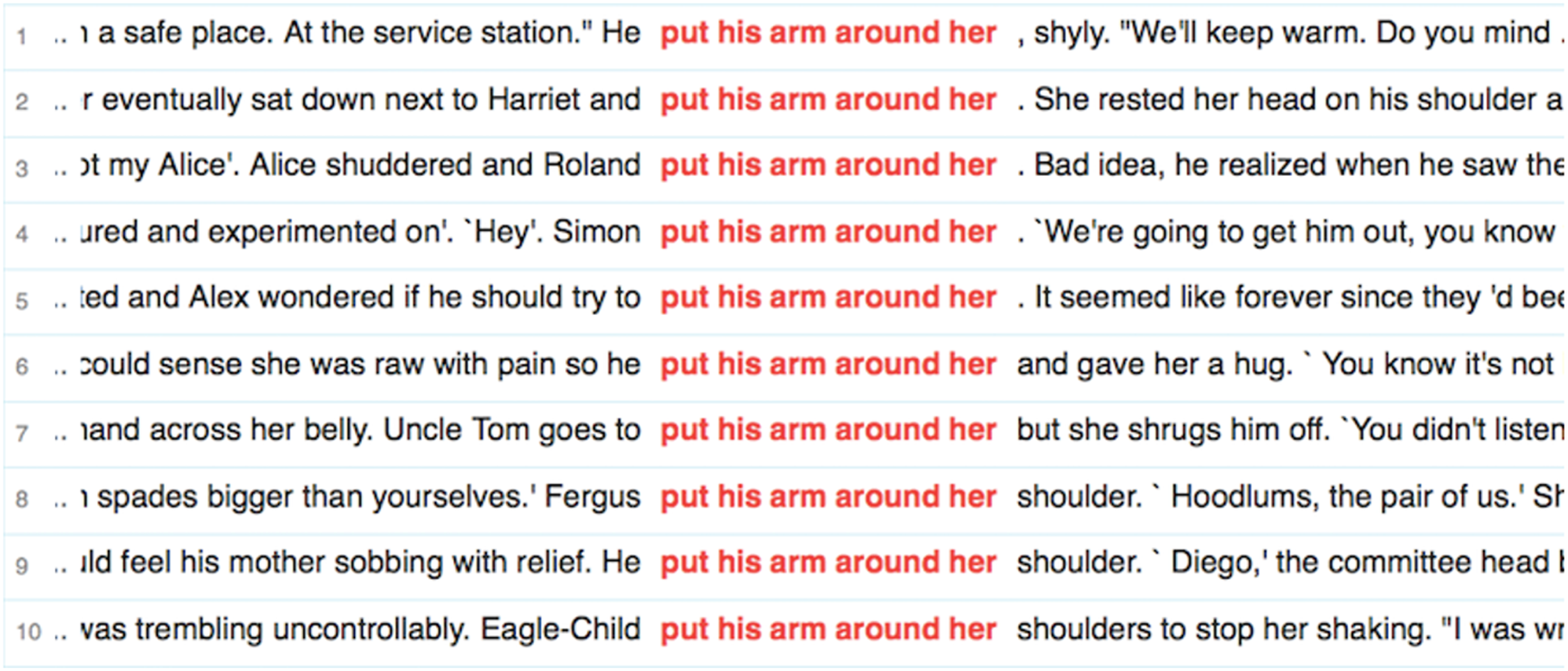
Figure 4 shows all five of the ChiLit examples and Figure 5 a sample of ten out of 19 lines from the OCC2000+. Compared to ChiLit, in the OCC2000+ data, the cluster contains around instead of round.
5
What is noticeable in the contemporary data are examples where male agency is described in a way that gives consideration to how the participants feel in the situation. In Figure 5, in line 1, the male character puts ‘his arm around her, shyly’; in line 3, Roland realises that it was a ‘Bad idea’; in line 5, ‘Alex wondered if he should try to put his arm around her’. We find occurrences where the female character responds negatively (line 3) or actively opposes the approach ‘she shrugs him off’ (line 7). There are also examples where the cluster describes comforting behaviour; see lines 4, 6, 9 and 10. This comforting behaviour shows similarity in function between ChiLit and the OCC2000+. See line 2 in Figure 4, where the arm round the neck allows the female character to rest her head on his shoulder, similar to line 2 in Figure 5, where the character Harriet rest her head on the male character’s shoulder. All five examples of put his arm round her in ChiLit. A sample of ten out of the 19 lines of put his arm around her in the OCC2000+.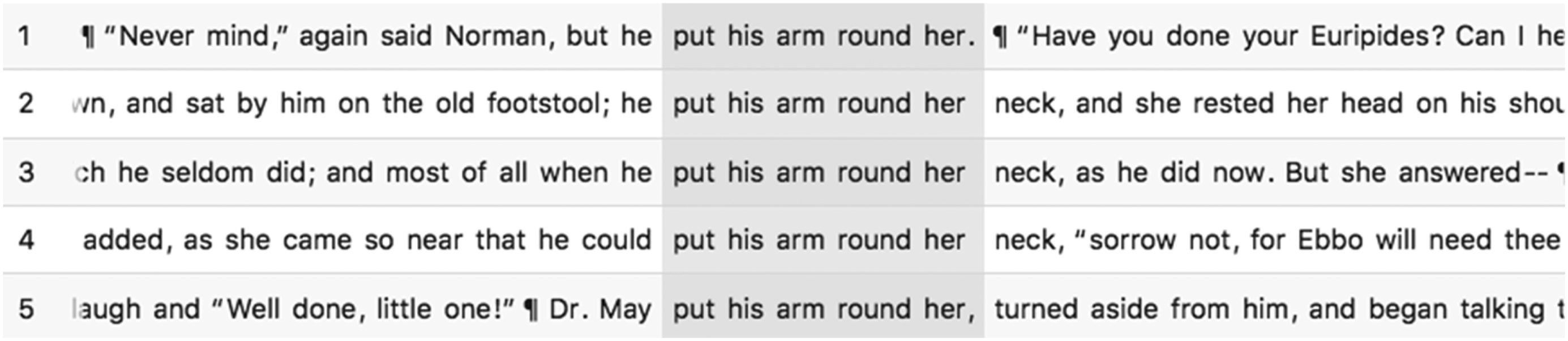
A key difference between ChiLit and the OCC2000+ is the emergence of the cluster her hands on her hips, which is the most frequent female GBPC and one of the few clusters that are more frequent in the female form.
6
To get a better general picture of the time period between the two corpora, Figure 6 shows the Google N-gram Viewer curve for this cluster over a period from 1800 to 2000. Although the N-gram Viewer only provides a very rough picture, we do see a sharp rise from the 1980s. This suggests a link to what has come to be referred to as the ‘Wonder Woman pose’, with the first Wonder Woman comics appearing in the 1940s. This ‘power pose’ is also discussed in terms of public speaking and self-confidence
7
(Cuddy, 2015). In this pose, a woman can claim more space for herself, which Argyle (2010: 97) describes as a signal for dominance.
8
Google N-gram viewer: her hands on her hips, 1800 to 2000 [accessed 2 May 2021].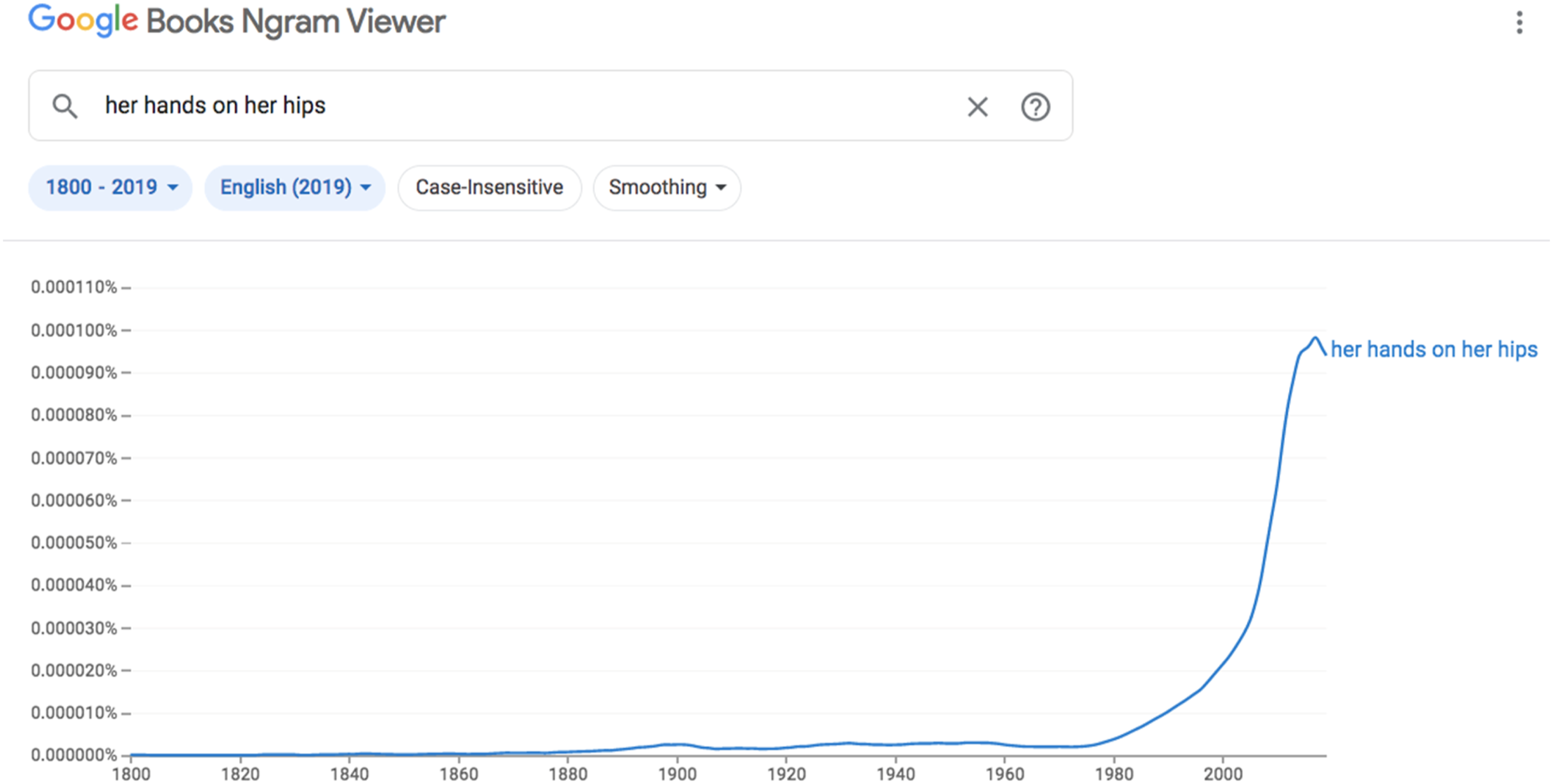
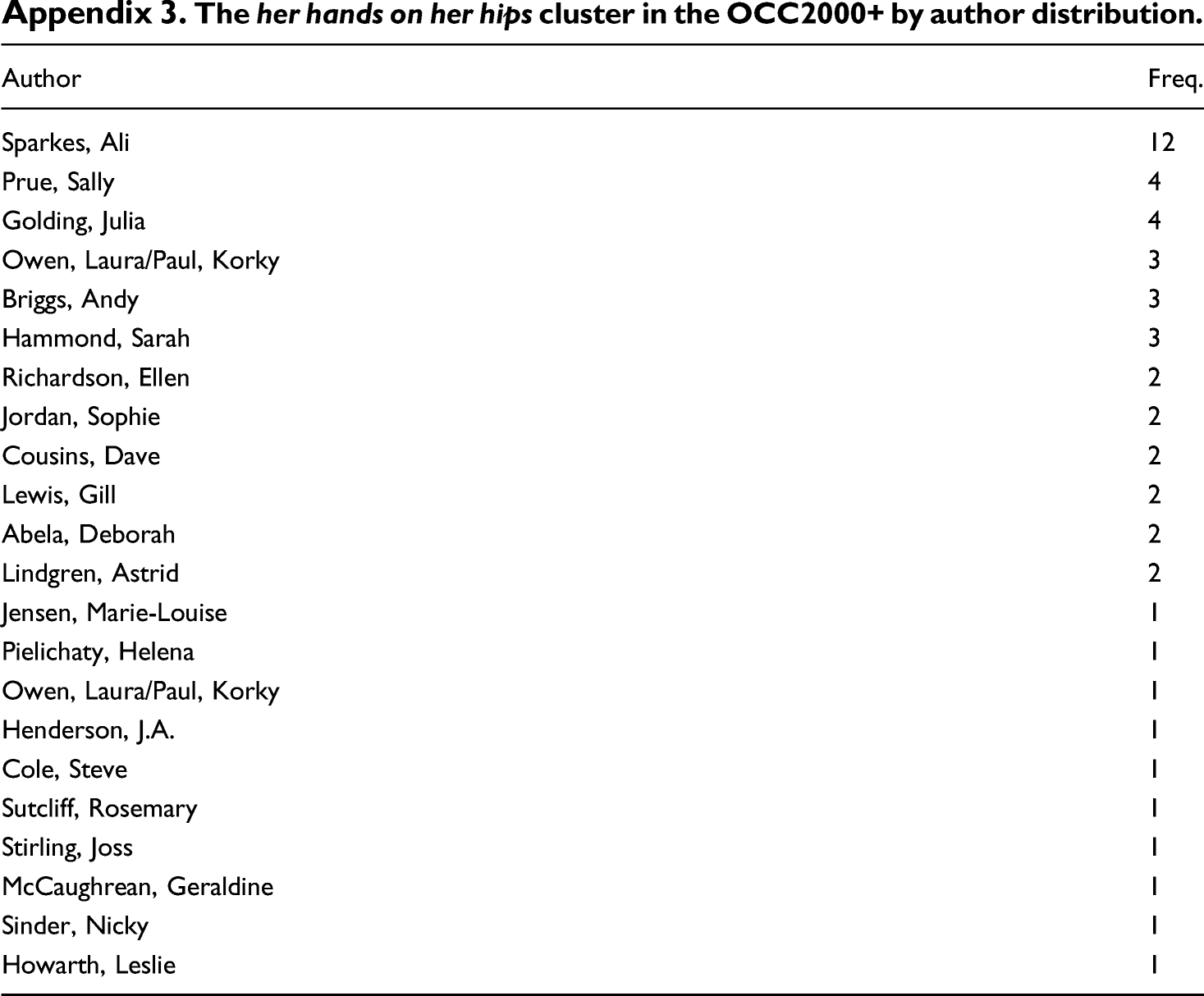
In the OCC2000+, the cluster her hands on her hips occurs 51 times in 42 texts by 22 different authors. The cluster is preferred by female authors who seem to be driving the change. Ali Sparkes in particular contributes to the overall frequency using the cluster 12 times in nine texts. See Appendix 3 for the distribution of the cluster by author. As Figure 7 illustrates, the contexts of this cluster are often confrontational situations in which female characters are shown as being assertive. For example, in line 3 flung expresses the force that complements ‘got ready to let him have it’, in 11 the narrator explicitly points out that Mrs Clamworthy is exasperated, and in line 13 ‘Lorna was furious’ paraphrases ‘She put her hands on her hips’. A sample of 15 of the 51 lines of her hands on her hips in the OCC2000+.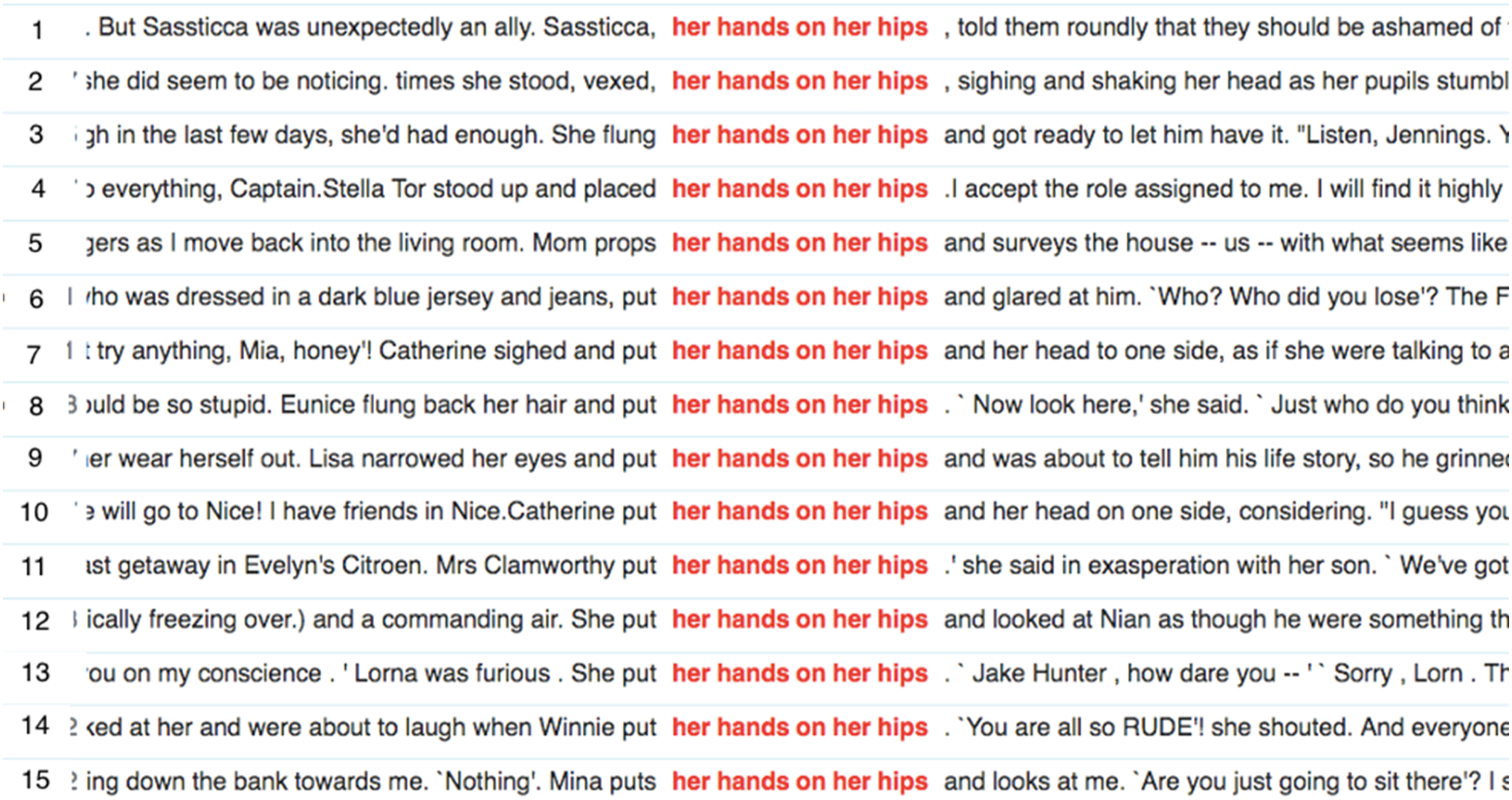
6. Conclusions
Our analysis shows that the description of female characters in children’s literature allows more space and variety in contemporary fiction compared to 19th-century texts. Based on our data, it seems to be still the case that there is overall more room for male characters, but the space in which female characters are operating has started to change. The most striking evidence of this development is the emergence of the cluster her hands on her hips. The picture that the clusters paint for the 19th century emphasises female behaviour in relation to others. Generally, the description of body language is a prime location in the text to depict interpersonal relations between fictional characters, especially when it comes to touch behaviour. What we have seen for the female characters is a limited range of behaviours that are typically described. The fact that the contemporary data contains more clusters that have both a male and a female form shows how the range of clusters formally reflects the increasing options for female behaviour. The changing interactional spaces are also reflected in the way in which clusters, that remain formally the same, function differently in their textual contexts. In the contemporary data, touch behaviour as in one character putting their arm around another, can still be shown as comforting and positive interaction. But we have also seen that there is a tendency towards more reflection on the appropriateness of the behaviour and the response of the person (especially in the case of female characters) who is the beneficiary of the action.
Our comparison further points to the context-dependency of clusters. The functions that clusters fulfil are created in connection with other words and patterns in the text. The context-dependency also extends to the situational context. As we have shown, clusters indicate what is common in the social contexts of the time. This became especially apparent through the link to fashion. At the same time, clusters are culturally dependent. Almost all the texts in our corpora are written by British authors. Body language in general is culturally dependent, so what we have shown in this article does not necessarily hold for other cultural contexts. This will also be relevant to studies that look at translations and cross linguistic comparisons of fictional body language (e.g. Čermáková and Mahlberg, 2018, Čermáková and Malá, 2021).
Clearly, clusters only provide a very specific view on the body language descriptions in the texts. They emphasise those behaviours that are repeatedly described and described in fixed forms. One the one hand, this is a limitation, and studies that investigate more flexible patterns (e.g. Mahlberg et al., 2020) can broaden the view. On the other hand, as we have argued, clusters are a useful starting point and enable comparisons that focus on common patterns. Additionally, the observation of repeatedly occurring patterns is relevant to the role of children’s fiction in child development. As we focus on patterns that occur repeatedly across texts, as opposed to patterns that are specific to individual texts or authors we are dealing with common patterns – patterns that are likely candidates to become part of the literary knowledge of child readers. In this way, they have the potential to contribute relatively subtly to the knowledge that children develop about gendered behaviours. This is no different for children’s literature than for gendered patterns in the language at large. The methods we employed in this paper are not only a means to identify and describe gendered body language, they can also help to raise awareness of the existence of such patterns. In this sense, our methods and approach open up further opportunities for studies that contribute to the big picture of gendered differences in language, literature and culture.
Footnotes
Declaration of conflicting interests
The author(s) declared no potential conflicts of interest with respect to the research, authorship, and/or publication of this article.
Funding
The author(s) disclosed receipt of the following financial support for the research, authorship, and/or publication of this article: This publication is part of a project that received funding from the European Union’s Horizon 2020 research and innovation programme under grant agreement No. 749521.
Notes
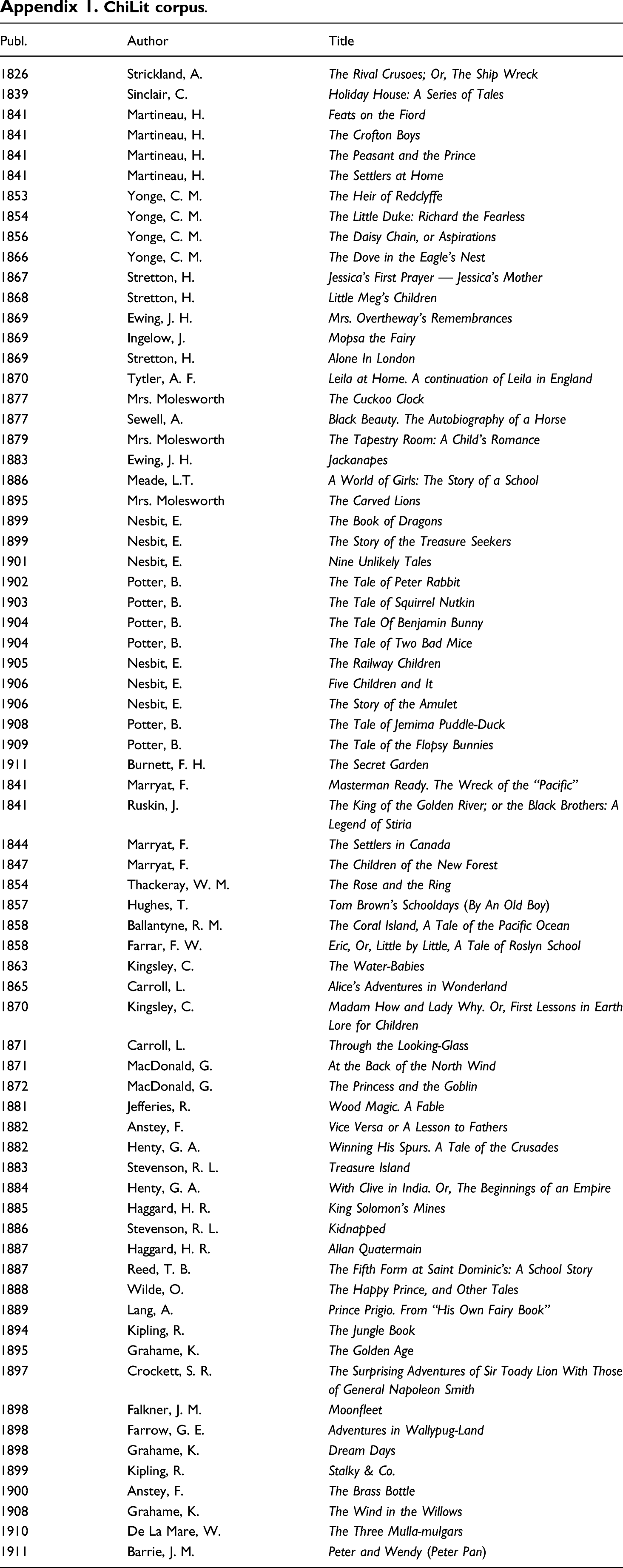
ChiLit corpus.
Publ.
Author
Title
1826
Strickland, A.
The Rival Crusoes; Or, The Ship Wreck
1839
Sinclair, C.
Holiday House: A Series of Tales
1841
Martineau, H.
Feats on the Fiord
1841
Martineau, H.
The Crofton Boys
1841
Martineau, H.
The Peasant and the Prince
1841
Martineau, H.
The Settlers at Home
1853
Yonge, C. M.
The Heir of Redclyffe
1854
Yonge, C. M.
The Little Duke: Richard the Fearless
1856
Yonge, C. M.
The Daisy Chain, or Aspirations
1866
Yonge, C. M.
The Dove in the Eagle’s Nest
1867
Stretton, H.
Jessica’s First Prayer — Jessica’s Mother
1868
Stretton, H.
Little Meg’s Children
1869
Ewing, J. H.
Mrs. Overtheway’s Remembrances
1869
Ingelow, J.
Mopsa the Fairy
1869
Stretton, H.
Alone In London
1870
Tytler, A. F.
Leila at Home. A continuation of Leila in England
1877
Mrs. Molesworth
The Cuckoo Clock
1877
Sewell, A.
Black Beauty. The Autobiography of a Horse
1879
Mrs. Molesworth
The Tapestry Room: A Child’s Romance
1883
Ewing, J. H.
Jackanapes
1886
Meade, L.T.
A World of Girls: The Story of a School
1895
Mrs. Molesworth
The Carved Lions
1899
Nesbit, E.
The Book of Dragons
1899
Nesbit, E.
The Story of the Treasure Seekers
1901
Nesbit, E.
Nine Unlikely Tales
1902
Potter, B.
The Tale of Peter Rabbit
1903
Potter, B.
The Tale of Squirrel Nutkin
1904
Potter, B.
The Tale Of Benjamin Bunny
1904
Potter, B.
The Tale of Two Bad Mice
1905
Nesbit, E.
The Railway Children
1906
Nesbit, E.
Five Children and It
1906
Nesbit, E.
The Story of the Amulet
1908
Potter, B.
The Tale of Jemima Puddle-Duck
1909
Potter, B.
The Tale of the Flopsy Bunnies
1911
Burnett, F. H.
The Secret Garden
1841
Marryat, F.
Masterman Ready. The Wreck of the “Pacific”
1841
Ruskin, J.
The King of the Golden River; or the Black Brothers: A Legend of Stiria
1844
Marryat, F.
The Settlers in Canada
1847
Marryat, F.
The Children of the New Forest
1854
Thackeray, W. M.
The Rose and the Ring
1857
Hughes, T.
Tom Brown’s Schooldays (By An Old Boy)
1858
Ballantyne, R. M.
The Coral Island, A Tale of the Pacific Ocean
1858
Farrar, F. W.
Eric, Or, Little by Little, A Tale of Roslyn School
1863
Kingsley, C.
The Water-Babies
1865
Carroll, L.
Alice’s Adventures in Wonderland
1870
Kingsley, C.
Madam How and Lady Why. Or, First Lessons in Earth Lore for Children
1871
Carroll, L.
Through the Looking-Glass
1871
MacDonald, G.
At the Back of the North Wind
1872
MacDonald, G.
The Princess and the Goblin
1881
Jefferies, R.
Wood Magic. A Fable
1882
Anstey, F.
Vice Versa or A Lesson to Fathers
1882
Henty, G. A.
Winning His Spurs. A Tale of the Crusades
1883
Stevenson, R. L.
Treasure Island
1884
Henty, G. A.
With Clive in India. Or, The Beginnings of an Empire
1885
Haggard, H. R.
King Solomon’s Mines
1886
Stevenson, R. L.
Kidnapped
1887
Haggard, H. R.
Allan Quatermain
1887
Reed, T. B.
The Fifth Form at Saint Dominic’s: A School Story
1888
Wilde, O.
The Happy Prince, and Other Tales
1889
Lang, A.
Prince Prigio. From “His Own Fairy Book”
1894
Kipling, R.
The Jungle Book
1895
Grahame, K.
The Golden Age
1897
Crockett, S. R.
The Surprising Adventures of Sir Toady Lion With Those of General Napoleon Smith
1898
Falkner, J. M.
Moonfleet
1898
Farrow, G. E.
Adventures in Wallypug-Land
1898
Grahame, K.
Dream Days
1899
Kipling, R.
Stalky & Co.
1900
Anstey, F.
The Brass Bottle
1908
Grahame, K.
The Wind in the Willows
1910
De La Mare, W.
The Three Mulla-mulgars
1911
Barrie, J. M.
Peter and Wendy (Peter Pan)
Gendered body part clusters in ChiLit and the OCC2000+.

ChiLit corpus: 5-word GBP clusters
Male clusters
Female clusters
Male/female clusters
Freq.
Bks
Freq.
Bks
Freq.
Bks
his hands in his pockets
20
11
her face with her hands
12
5
her arms round his neck
11
11
his face with his hands
19
12
covered her face with her
10
5
her in his arms and
9
7
covered his face with his
15
9
her face in her hands
9
7
put her hand on his
7
6
on his hands and knees
15
9
with tears in her eyes
9
6
her hand on his arm
5
5
and held out his hand
14
9
she held out her hand
9
5
her head on his shoulder
5
3
his head on one side
13
7
her arms round her neck
9
4
put his arm round her
5
4
the back of his head
12
9
she put her arms round
7
7
threw her arms round his
5
5
he put out his hand
11
10
and threw her arms round
7
6
took her in his arms
5
5
his eyes fixed on the
11
10
clapped her hands and said
6
6
with his hands in his
11
9
held out her hand to
6
5
looked up in his face
11
6
she put her hand on
6
5
arms round his neck and
10
10
threw her arms round her
6
5
with tears in his eyes
10
10
when she opened her eyes
6
5
when he opened his eyes
9
9
her eyes full of tears
6
4
the top of his head
9
6
her on the back and
6
4
face with his hands and
8
8
face with her hands and
6
3
his head out of the
8
8
throwing her arms round her
6
3
with his back to the
8
7
and put her arms round
5
5
he held out his hand
8
6
her arms round her and
5
5
he sprang to his feet
8
6
on her hands and knees
5
5
his hand in his pocket
8
6
put her head out of
5
5
laid his hand on his
8
6
tears came into her eyes
5
5
put his hand in his
8
5
and whispered in her ear
5
4
his face in his hands
7
7
her face hidden in her
5
4
put out his hand to
7
7
her head out of the
5
4
himself on his knees and
7
6
thumped her on the back
5
4
his head on his hand
7
6
she covered her face with
5
2
turned on his heel and
7
6
clapped her hands with delight
4
3
put his hand to his
7
5
looking up in his face
7
4
up in his face and
7
3
held out his hand to
6
6
put his head out of
6
6
he opened his eyes and
6
5
him by the hand and
6
5
his finger in his mouth
6
5
his hands on his knees
6
5
laid his hand on the
6
5
put out his hand and
6
5
the palm of his hand
6
5
threw himself on his knees
6
5
took to his heels and
6
5
he put his hand in
6
4
hands in his pockets and
6
3
he lifted his head and
6
3
his hand on his shoulder
6
3
laying his hand on his
6
3
and he laid his hand
5
5
buried his face in his
5
5
he threw his arms round
5
5
him on the shoulder and
5
5
his elbows on his knees
5
5
in his arms and carried
5
5
in his hand and a
5
5
in his hand as he
5
5
it into his head to
5
5
out his hand to the
5
5
out of his mouth and
5
5
with his face to the
5
5
hand in his pocket and
5
4
he held in his hand
5
4
he laid his hand on
5
4
he put in his hand
5
4
his hand as if to
5
4
his head out of his
5
4
in his arms and kissed
5
4
sprang to his feet and
5
4
the hand and led him
5
4
took him by the hand
5
4
with his eyes on the
5
4
him by the arm and
5
3
him full in the face
5
3
the corners of his mouth
5
3
with his ear to the
5
3
he said between his teeth
5
2
his head upon one side
5
2
OCC2000+ subcorpus: 5-word GBP clusters
Male clusters
Female clusters
Male/female clusters
Freq.
Bks (author)
Freq.
Bks (author)
Freq.
Bks (author)
the back of his neck
118
70 (34)
her hands on her hips
51
42 (22)
put his arm around her
19
13 (9)
the corner of his eye
107
58 (27)
the top of her head
37
29 (22)
he closed his eyes and
80
40 (23)
the back of her neck
35
28 (18)
the back of his head
78
56 (33)
she opened her eyes and
33
25 (18)
his head in his hands
73
60 (42)
she closed her eyes and
31
23 (13)
the back of his hand
61
48 (33)
the corner of her eye
30
26 (18)
he held out his hand
54
33 (24)
the back of her head
30
24 (18)
the palm of his hand
53
39 (26)
the back of her hand
29
27 (19)
the top of his head
52
35 (21)
her head to one side
27
21 (14)
he opened his eyes and
49
30 (16)
her head in her hands
27
18 (14)
his head on one side
47
29 (9)
she shook her head and
26
23 (15)
his head to one side
44
34 (18)
her face in her hands
25
23 (17)
his eyes fixed on the
38
30 (17)
put her hands on her
24
23 (14)
he got to his feet
37
32 (26)
she opened her mouth to
21
18 (12)
on his hands and knees
37
29 (18)
with her back to the
20
17 (12)
he shook his head and
35
32 (24)
got to her feet and
19
16 (9)
got to his feet and
35
32 (20)
put an arm round her
19
14 (7)
opened his mouth to speak
35
30 (19)
her head on one side
18
13 (12)
put a hand on his
35
27 (16)
he opened his mouth to
33
30 (18)
and held out his hand
33
28 (18)
a hand on his shoulder
33
25 (18)
with his back to the
32
31 (22)
his finger to his lips
32
28 (21)
he glanced over his shoulder
30
22 (14)
in front of his face
29
27 (15)
turned on his heel and
29
26 (16)
a hand on his arm
29
23 (17)
the side of his face
28
24 (17)
threw back his head and
28
23 (15)
he dropped to his knees
28
20 (14)
the side of his head
27
22 (18)
and he shook his head
27
21 (15)
held out his hand and
26
21 (14)
in front of his eyes
26
20 (16)
smiled and shook his head
26
20 (11)
a finger to his lips
25
24 (20)
his hands over his ears
25
22 (16)
the look on his face
24
23 (18)
the corner of his mouth
24
23 (18)
over his shoulder at the
24
22 (15)
leapt to his feet and
24
20 (13)
when he opened his eyes
24
19 (13)
the pit of his stomach
24
17 (11)
put his hands over his
23
20 (13)
held out his hand to
23
19 (13)
opened his mouth to say
23
18 (9)
he put his hand on
22
21 (17)
the corners of his mouth
22
21 (14)
looked back over his shoulder
22
19 (12)
rose to his feet and
22
15 (7)
his hands on his knees
21
20 (15)
he jumped to his feet
21
20 (14)
he opened his mouth and
21
20 (13)
over his shoulder and saw
21
14 (11)
his hands through his hair
21
14 (10)
keep an eye on him
20
20 (17)
his face in his hands
20
17 (12)
his hands behind his back
20
16 (15)
dropped to his knees and
20
16 (11)
his hands on his hips
20
13 (11)
put his finger to his
19
18 (13)
then he shook his head
19
18 (13)
take his eyes off the
19
12 (9)
he turned his back on
18
17 (16)
his eyes for a moment
18
16 (15)
his hands in his pockets
18
16 (15)
put his head in his
18
16 (15)
the tips of his fingers
18
16 (13)
head in his hands and
18
16 (13)
the soles of his feet
18
15 (13)
the back of his throat
18
14 (9)
opened his eyes and saw
18
13 (8)
corner of his eye he
18
12 (8)
sat back on his heels
18
11 (6)
The her hands on her hips cluster in the OCC2000+ by author distribution.
Author
Freq.
Sparkes, Ali
12
Prue, Sally
4
Golding, Julia
4
Owen, Laura/Paul, Korky
3
Briggs, Andy
3
Hammond, Sarah
3
Richardson, Ellen
2
Jordan, Sophie
2
Cousins, Dave
2
Lewis, Gill
2
Abela, Deborah
2
Lindgren, Astrid
2
Jensen, Marie-Louise
1
Pielichaty, Helena
1
Owen, Laura/Paul, Korky
1
Henderson, J.A.
1
Cole, Steve
1
Sutcliff, Rosemary
1
Stirling, Joss
1
McCaughrean, Geraldine
1
Sinder, Nicky
1
Howarth, Leslie
1
Author biographies
Anna Čermáková is a Research Associate at the Faculty of Education, University of Cambridge. Before joining the University of Cambridge, she worked together with Michaela Mahlberg on the European Commission funded GLARE project (‘Exploring Gender in Children’s literature from a Cognitive Corpus Stylistic Perspective’) at the University of Birmingham, which explore diachronic change of gender representation in children’s literature. Anna’s main area of expertise is corpus linguistics.
Michaela Mahlberg is Professor of Corpus Linguistics at the University of Birmingham, UK. She is the editor of the International Journal of Corpus Linguistics (John Benjamins) and co-editor of the book series Corpus and Discourse (Bloomsbury). Michaela has been leading the development of the CLiC web application, which was initially funded as part of the CLiC Dickens project (AHRC grant reference AH/P504634/1).