Abstract
Framed by cognitive-poetic and possible worlds theories, this article explores two 21st century novels by the British postmodernist author Ian McEwan. Building upon Ryan’s (1991) seminal conceptualisation of the theory in relation to literature and using the novels as case studies, possible worlds theory is used to explain the unique and destabilising stylistic effects at play in the texts, which result in a ‘duplicitous point of view’ and consequent disorientation for the reader. With reference to the stylistically deviant texts of McEwan, it is argued that revisions to current theoretical frameworks are warranted. Most significantly, the concepts of suppositious text-possible worlds and (total) frame readjustment are introduced. Further to this, neuropsychiatric research is applied to the novels, highlighting the potential for interdisciplinary overlap in the study of narrative focalisation. It is concluded that the duplicity integral to both novels’ themes and texture is effected through artful use of hypothetical focalisation and suppositious text-possible worlds.
Keywords
1. Introduction: Ian McEwan, hypothetical focalisation and suppositious text-possible worlds
The fiction of contemporary, postmodernist British author Ian McEwan (1948– ) abounds in instances of hypothetical focalisation. While focalisation refers to the angle from which a narrative is narrated, hypothetical focalisation focuses specifically upon instances of supposition within a narrative. These are the ‘what if...?’ or ‘if only...’ scenarios so common to both fiction and everyday life. Hypothetical focalisation can occur in two distinct, albeit interrelated, forms. The first involves the narrator, or focalising consciousness, presenting non-pertaining events. These may extend into the past, present, or future domains but, crucially, never transpire: they are imaginings of ‘what might be or have been seen or perceived’ (Herman, 1994: 231) were there a figure able to assume the requisite viewpoint on events. Aligned with this is the second form of hypothetical focalisation, which involves a recounting of text-actual events from a fictionalised perspective. Both forms may be more or less elaborate, ranging in length from paragraphs to pages, as well as more or less explicit. Hypothetical focalisation is constantly appealed to by McEwan’s narrators and characters, as they imagine how events might have panned out, how they themselves might be viewed by others, or how others might view the world. (This fascination extends to the author’s non-fictional work, too; cf. McEwan (2001b), an article contemporaneous with the publication of Atonement.) Meanwhile, it is the second form of hypothetical focalisation, which involves the assumption and often presumption of another character’s perspective to detail narrative events, that is most pertinent to the novels under discussion here. The novels in question are Atonement (McEwan, 2001a) and Sweet Tooth (McEwan, 2012), which will be used as case studies to demonstrate the intrinsic and extrinsic interest of hypothetical focalisation as a stylistic concern.
Following the seminal conceptualisation of Ryan (1991), the digressions formed from hypothetical focalisation result in further possible worlds within the necessarily fictional possible world that is a work of literary fiction. To distinguish between the originally philosophical concept of possible worlds and its incarnation in literature, I refer to the former – the possible worlds of a literary text – as text-possible worlds. They are, after all, only ‘possible’ within the imaginative confines of the novel. The remainder of the text can thus be classified as text-actual. Furthermore, I suggest that several of the possible worlds categories suggested in the literature on possible worlds theory (e.g. Ryan, 1991; Semino, 1997; Semino et al., 1999; Gregoriou, 2009; Bell, 2010; Raghunath, 2017) might profitably be grouped together under the heading of ‘suppositious’ text-possible worlds. The worlds in question comprise the Speculative Extension to the Knowledge World; the Wish World; the Fantasy World; the Prediction World; alongside the Hypothesis World proper. All five world types involve scenarios which are not quite verifiable, which are speculative, which are, crucially, no more than supposition. This collective terminology also mitigates against the confusing overuse of the adjectives ‘hypothetical’ and ‘speculative’, which signify their own specific text-possible worlds. These suppositious text-possible worlds will form the core focus of this essay, contributing as they do to the unique stylistic effects achieved in both of the McEwan novels under discussion.
2. A ‘duplicitous point of view’: Ian McEwan’s Atonement and Sweet Tooth
A distinctive feature of McEwan’s text-possible worlds, one which differentiates them from the prototypical examples given in possible worlds literature (see references above), is that often they are not initially indexed as being possible, or hypothetical. Instead, they are presented as text-actual. Evident across his oeuvre, in children’s and adult’s fiction alike, this phenomenon is particularly salient in two of his more recent adult novels: Atonement (2001a) and Sweet Tooth (2012). In both narratives, the respective final chapter radically alters the discourse architecture that has been presumed over the course of the novel. Ultimately, a character within the narrative is revealed to be responsible for its authorship, introducing what Werth (1999: 24) refers to as a ‘doppelganger effect’ as the roles of author and character are conflated. Not only do these hybrid entities delay in ‘outing’ themselves as authors of the preceding text, they also pretend to unfettered access to and knowledge of other characters’ consciousnesses and detail events at which they were not even present. This level of deceit, devoid of a disclaimer acknowledging hypothetically, is relatively rare in literature. To address the phenomenon in all its complexity, special adaptation to existing theoretical frameworks is warranted. Below, the theories of discourse architecture and contextual frames will be amended to account for the duplicitous novels.
It is of course debatable as to whether rare or marginal cases of the sort under discussion here truly necessitate lasting revisions to standard models. I return to this issue in the conclusion, where I argue in favour of these revisions.
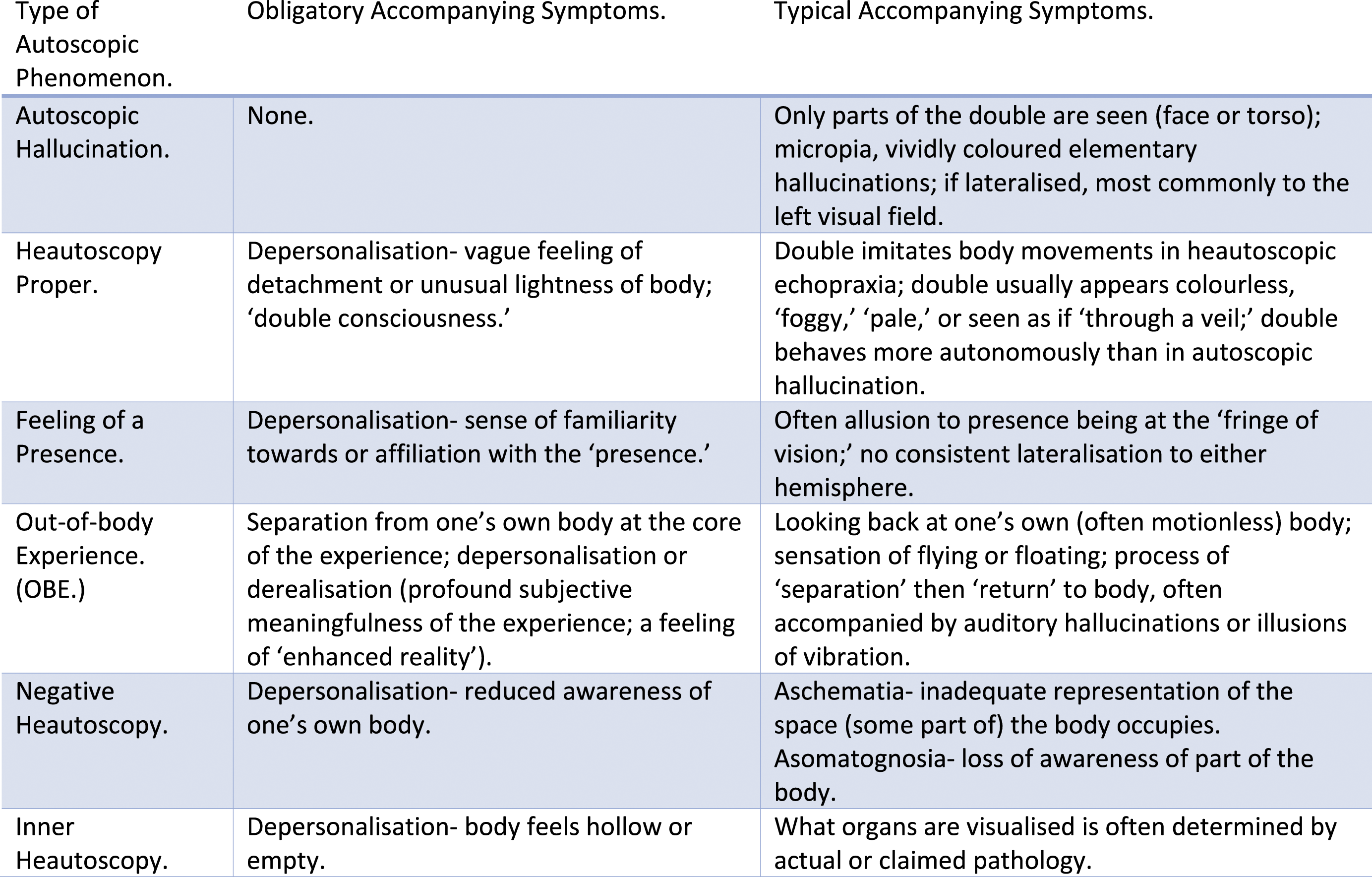
The duplicity immanent to both texts is also linked to a recurrent cognitive phenomenon evidenced throughout: the characters are constantly imagining how they would appear to a third-party, external observer. It occurs in a variety of (interrelated) forms. Some instances are more rudimentary, presenting the innate human tendency to imagine how we might appear to others. These instances of hypothesis often involve invoking Herman’s (1994) ‘hypothetical focaliser’. The others, however, are more unusual: varieties of what is known in neuropsychiatry as autoscopic reduplication. These phenomena, also referred to in the medical literature under the hypernym ‘autoscopy’, ‘involve the illusory reduplication of one’s own body’ (Brugger et al., 1997: 19) and can be further subdivided into six variants (see Figure 1). In Sweet Tooth, we encounter type 4, the ‘out-of-body experience (OBE)’. Despite being a term commonplace in folk circles, it has slightly different signification in the medical literature: it involves the perception that one is looking down at one’s own body, which often remains motionless, from an elevated position. This phenomenon commonly occurs at moments of intense emotion or significance. Meanwhile, in Atonement, alongside an OBE (hereafter OBE), type 2 – heautoscopy proper – is in evidence. Here, the patient believes themselves to have an ethereal bodily double. Crucially, this has wider narratorial and thematic significance – as indeed do all autoscopic occurrences across the two novels. Appeals to a hypothetical focaliser, too, are dramatically ironic: as the delayed revelations make clear, both novels are premised upon the notion of viewing others from a distance, of hypothetically imputing their thoughts, feelings and actions. As Sweet Tooth’s Haley counters, ‘I’ve been obliged to extrapolate or invent’ (2012: 363). Meanwhile, in possible worlds terms, McEwan demonstrates additional complexity by nesting text-possible worlds matryoshka-like within text-possible worlds as in both novels the hypothesising of characters transpires to be hypothesis. Alongside this embedding, we also encounter Werth’s (1999: 353) possible world simultaneity. Overall, then, both novels are clearly preoccupied with the notion of a ‘duplicitous point of view’ (McEwan, 2012: 359).
3. ‘[M]y duplicitous point of view’: The need for theoretical revisions
Atonement can be broadly categorised as historical fiction; Sweet Tooth, on the other hand, is McEwan’s first foray into the spy thriller genre. Yet the two narratives differ with regard to more than genre. It should be noted that the use of hypothetical focalisation and text-possible worlds differs in both form and function across the two novels. This is despite repeated remarks (made by critics, the press and the public alike) that McEwan is copying his own narrative technique, ‘recycling the same metafictional trick’ in the endings of both novels, as Pastoor (2019: 294) would have it. (As an exception to the rule, whilst exploring gender relations in the novel, perceptive journalist Roiphe (2012) notes that Sweet Tooth is written by a male about a male writing as a female, whilst Atonement features a male writing as a female. This has implications for gender presentation in the novels; see below.) This is unjustified, for viewpoint relations – what Short (1996: 256–263) discusses as the ‘discourse architecture’ of a novel – clearly differ across the two works. Atonement is (ostensibly) heterodiegetic, with an ‘omniscient’ narrator presenting events from the view of various reflectors of the fiction: protagonist Briony, yes, but also her sister Cecilia, mother Emily, family friend Robbie, and his mother Grace, among others.
In fact, analysts including Childs (2005), Cormack (2013) and Marcus (2013) have noted the influence of the modernist aesthetic upon McEwan in this novel; in Part One, in particular, the free indirect mode is consistently used to allow privileged access into the minds of an assortment of characters. Part Four, in switching to an autodiegetic narrative, precipitates the realisation that each of these individualised viewpoints, bar those of Briony who narrates the final part, are complete conjecture. She has been present at only some of the events recounted (the dinner party scene (McEwan, 2001a: 126–143), for instance); much of the rest of the novel is based upon her speculation or scholarly research. Part Two, for instance, the account of the British retreat to Dunkirk in 1940, focalised through origo Robbie, is the product of research undertaken by Briony at the Imperial War Museum (353), correspondence with former soldiers like Corporal Nettle, and her imagination. In a subtle, metafictional twist, McEwan also conducted his research at this establishment (Byrnes, 2006). In this section, the free (in)direct realisation of Robbie that ‘No-one would ever know what it was like to be here [fighting in France]’ (227) ironically prefigures the eventual confession that Briony has hypothesised the account, attempted to try to know. Lacking a pronoun to anchor it to either the character Robbie or the narrator Briony, this statement is poised ambiguously between free direct and free indirect thought. Nonetheless, the undeniably free form reflects at least some attempt to allow the character to present his own, unfiltered thoughts – disingenuous when it is considered all is the hypothesis of Briony.
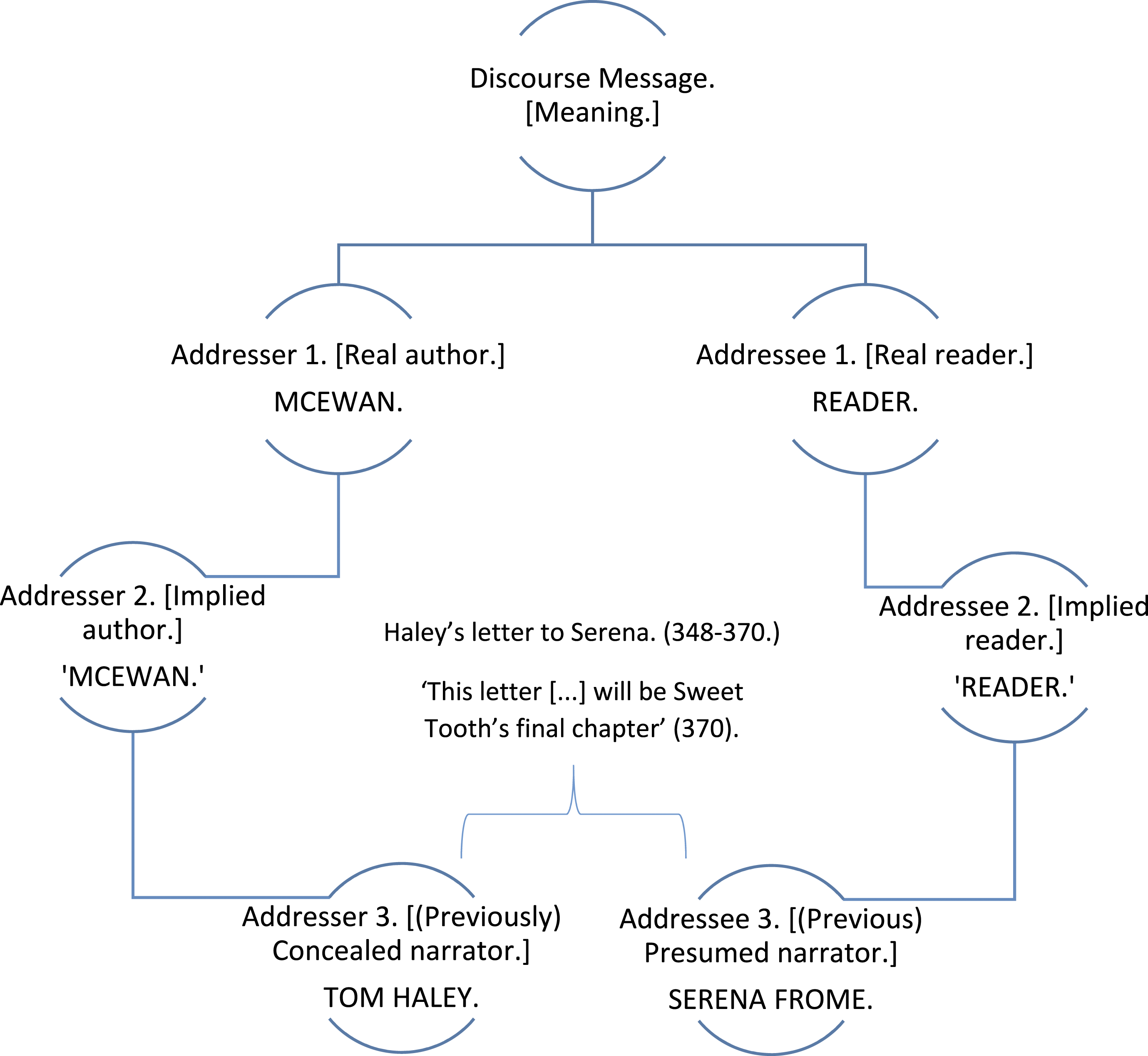
Sweet Tooth, meanwhile, arguably displays more narrative duplicity than Atonement. It is from the first written as though an autodiegetic chronicling of the life of the narrator, one Serena Frome: indeed, ‘My name is Serena Frome’ (McEwan, 2012: 1) is the opening proposition. Yet the parenthetical clause which follows this statement – that, counterintuitively, ‘Frome’ is pronounced to rhyme with ‘plume’ – subtly serves to warn the reader that, in this narrative, all is not as it seems (Childs, 2005: 140). Just like this phonologically deviant surname, the narrative structure is also deviant: by the last, epistolary chapter Tom Haley, previously presented in the third person as a love interest to Serena, is revealed to be the novel’s ‘true’ author (McEwan, 2012: Ch. 22; cf. Figure 3). As the (professional writer) Haley conceptualises it, the preceding narrative is ‘extrapolation’ (364), based on events he has heard recounted second- or even third-hand, as well as those at which he has been present.
It is worth flagging up that the concealed narrators of both novels are professional writers; they have made a living by penning fictional accounts of events. (On the linkages between Atonement’s intradiegetic author, Briony, and its extradiegetic author, McEwan, see further: Phelan, 2005). To foreground this, both novels feature a profusion of ‘tales-within-tales’ (Genette’s (1980) metadiegesis). More recently, Morini (2009: 43) has instead referred to these as ‘sub-fictions’, using a prefix which perhaps better underlines the embedding characteristic of McEwan’s fiction. In summary, then, one text features an intradiegetic narrator posing as an extradiegetic one; the other text has a character within the diegesis narrating intradiegetically from the perspective of a different character.
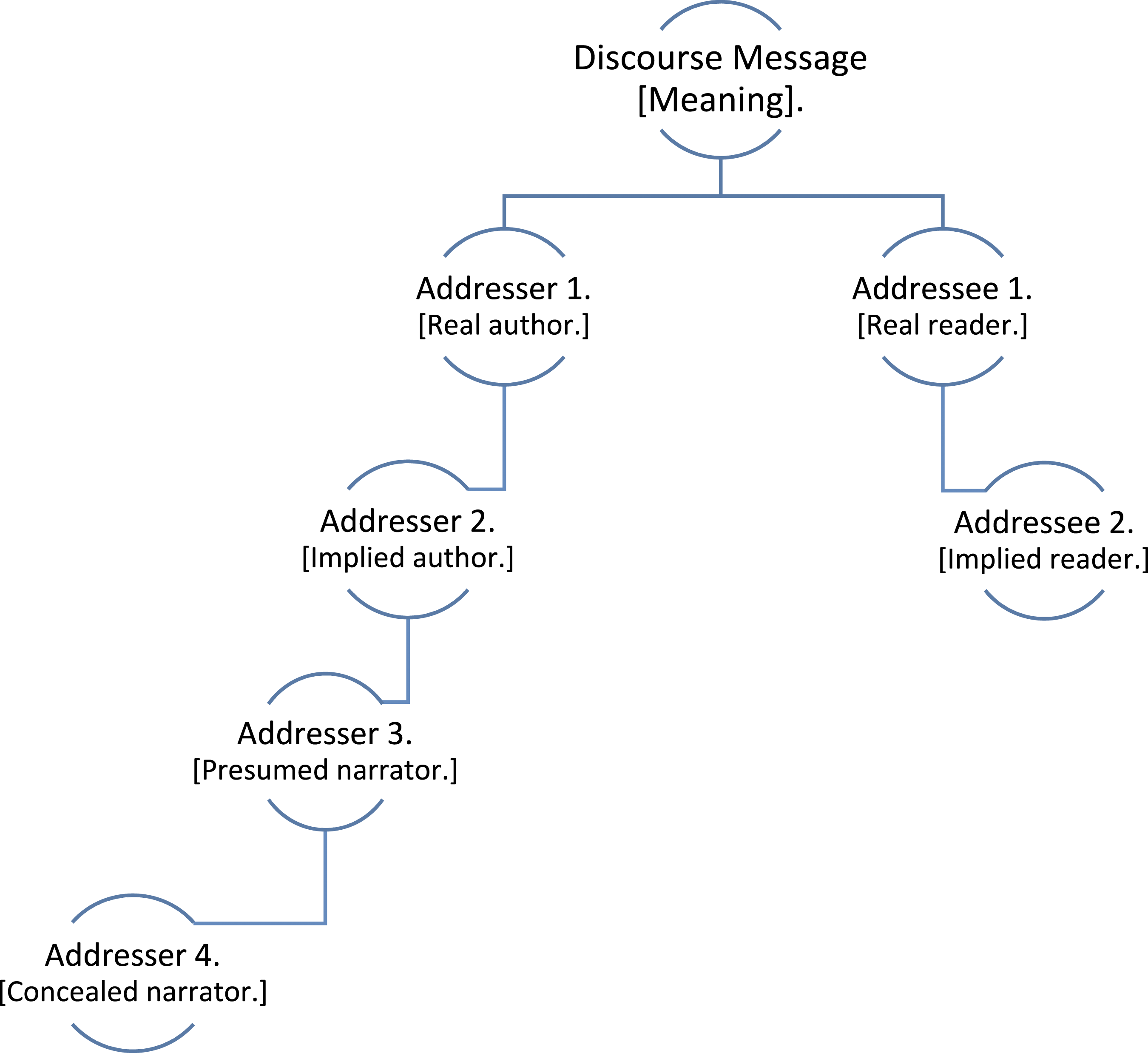
Despite their differences, both novels clearly share a complex discourse architecture. To illustrate this visually, below are produced two discourse architectural diagrams, modelled on those of Short (1996: 257, 261, 282), which pertain, respectively, to Atonement and Sweet Tooth (see Figures 2 and 3). To Short, these diagrams aid our understanding of complex, original and deviant narrative structures: I concur, and all these premodifiers are clearly appropriate to both novels of McEwan. Interestingly, Short (1996: 258) cites Christie’s (1926) The Murder of Roger Ackroyd to be a prototypical instance of a narrative aided by a discourse architectural diagram; this work has also been compared to Sweet Tooth (Cooke: 2012). My discourse architectural diagrams are structured iconically, with the ‘higher-order’ levels of interaction (Gregoriou, 2009: 129) positioned higher up the diagram. (Note: To avoid overcomplication, the lowest, and least relevant to this discussion, discourse levels (i.e. character–character) have been elided.) Meanwhile, the structure of the diagram ‘in series’ helps to highlight the many embedded levels of the novels’ narration.
In fact, four distinct figures are distinguishable on the left-hand side of the discourse architecture diagram. Firstly, there are two traditional entities, as proposed by Booth (1961): the real and implied author, corresponding to the McEwan of the real world, at his laptop composing the novel, and the idealised McEwan constructed by the reader due to the judgements made or the standpoints taken in the novel’s Text-actual world. For example, implied author McEwan condemns the senselessness of war in Part Two. As Head (2007: 156) contends, this stance runs counter to the usual view taken, that of the retreat at Dunkirk as a heroic and patriotic venture. Alongside this, in the works discussed here, we can discern a presumed narrator – the figure believed to be responsible for the narrative within the Text-actual world – and a concealed narrator, the figure actually responsible for the narrative within the Text-actual world. In Atonement, there is really negligible difference between the implied author and the presumed narrator, due to the omniscient variety of heterodiegetic focalisation in use, and the two levels collapse; the concealed narrator, meanwhile, is Briony Tallis. Sweet Tooth features the presumed narrator Serena Frome, and the concealed (albeit eventually revealed in the final chapter) narrator of Haley. In both narratives, the concealed narrators overreach their limited knowledge, and do so using the mechanisms of hypothetical focalisation and text-possible worlds. In Figure 3, I have chosen to illustrate the novel’s twenty-second chapter alone, as opposed to the entire narrative. I believe this illustrates most clearly the disparity between the novels Atonement and Sweet Tooth. For, whilst the final part of Atonement merely elides the ‘Presumed narrator’ level as Briony is revealed as concealed narrator, the last epistolary chapter of Sweet Tooth (Ch. 22) uses second-person direct address to Serena, transferring her from addresser to addressee. Yet in both novels the narrators overreach their limited knowledge, and do so using the mechanisms of hypothetical focalisation and text-possible worlds.
Similarly, both works are innovative enough to merit a revision to contextual frame theory. This framework was established in 1997 by Emmott in Narrative Comprehension: A Discourse Perspective. Within this monograph is a seminal conceptualisation of the ways in which readers cognitively construct and maintain narrative scenarios, peopling them with characters as well as objects. It is these narrative scenarios Emmott refers to as frames. As it is concerned with mental representations created by readers while processing a text, it has a clear affinity with text and possible world theories, a fact many a stylistician (e.g. Stockwell, 2002; Stockwell and Harrison, 2015; Werth himself, 1999) has noted. However, in some areas, its terminology is more fine-grained, and hence more relevant to the discussion of delayed revelations of hypothetical possible worlds here. Take its notion of frame repair: here a reader must replace erroneous information that has accumulated in an existent frame, due to either personal incomprehension, or a purposefully misleading narrative. Adaptations to Emmott’s theory (Stockwell, 2000; 2002) have appended the notion of frame replacement. Gregoriou (2009) applies this insightfully to her analyses, for example, of the realisation that a central character in The Sixth Sense is actually a ghost (96). To be applied when the term ‘frame repair’ seems too reductive, inadequate, it entails the complete overhaul of a frame or series of frames, not merely a slight readjustment. As Stockwell elaborates, it can be triggered by ‘large-scale surprise endings, or twists in the tale’ (2002: 157). In short, it is in the more ‘radical’ instances it is required. When, in Atonement, Briony reveals that Cecilia and Robbie were never reunited (370), that ‘the lovers who shared a bed in Balham’ were ‘a fantasy’ (371), we clearly encounter an example of frame replacement. An entire section of the narrative (329–349) has deliberately misled, is in direct contravention of the Text-actual truth.
However, the delayed revelation of a concealed narrator which ends both books is of a different kind. After all, the admission implicates not just one frame (or even an additional series of ‘linked frames’ as Stockwell (2002: 157) notes as a caveat), but the entirety of the novel, and thus every single frame it contains. It is even larger scale than the already ‘radical’ reconfiguration frame replacement demands. All are tainted by the deceptive discourse architecture; some frames may be text-actually true, but in all the angle of viewing – the focalisation – is false. It is not a replacement of frames that is needed, but a complete conceptual readjustment: (total) frame readjustment. For it is the discourse structure, not an aspect of narrative content, that is revealed as false, and which necessitates readerly reprocessing. Here, the optional premodifier ‘total’ signals that multiple frames are implicated. The bracketing of the premodifier is an attempt to underscore that the number of frames in question depends upon at exactly what point the concealed narrator choose to reveal themselves. It need not be at the end, but in the two novels discussed here it is: in these two instances what is required is frame readjustment applying to the totality of the preceding narrative.
4. ‘[C]oncocted [...] at eye level’: The supposedly text-actual as hypothetical
In the Text-actual World of Sweet Tooth (2012), it is Britain, 1972, and the height of the cultural Cold War. Low-ranking MI5 operative Serena Frome has been tasked with covertly recruiting professor and professional writer Tom Haley, via a front organisation, to a scheme promoting literature as propaganda against the Communist regime. Secretly funded by the security service, with the aim of ‘encourag[ing] the right people’ (108), the sanctioned view is pro-capitalist, anti-Communist and democratic. This is Operation ‘Sweet Tooth’. Spy Serena acts as go-between, provides Haley with a salary and promptly falls in love with him. Moral quandaries ensue for the presumed narrator about the ‘necessary untruths’ (232) she tells to her lover. Yet concealed author Haley has been just as duplicitous, acting as ‘a ventriloquist’ (358), using Serena as the narrative mouthpiece. Nevertheless, throughout he is completely, if disingenuously, grounded in her subjective experience. Consider the following passage, based upon Haley’s ‘research’ (363) involving ‘a stroll’ (361) around the grounds of the cottage in which the scene is set.
Excerpt 1
I remember everything- the scrubbed pine table with dented legs of faded duck-egg blue, the wide faience bowl of slippery ceps, the disc of polenta beaming like a miniature sun from a pale green plate with a cracked glaze, the dusty black bottle of wine, the peppery rugola in a chipped white bowl, and Tony making the dressing in seconds [...] so it seemed. (My mother concocted her dressings at eye level like an industrial chemist.) (McEwan, 2012: 21-2.)
On first reading, this scene belongs to the actual world evoked by the text but is deictically remote (hence the simple past tense), a reminiscence of Serena. Yet following the revelation of the novel’s ending, it transpires the entire scene is supposition. Just like the salad dressings of Serena’s mother, the account has been ‘concocted’ by concealed narrator Haley, presuming the ‘eye level’ view of Serena. It is thus a retrospective Hypothesis World, as Haley fabulates ‘what might have been [...] perceived’ (Herman, 1994: 231) should he have had the requisite viewpoint on events, that is, that of Serena. Given his profession as author, this fictionalisation is unsurprising, a mere extension of his day job. However, it is notably based upon ‘research’ around the cottage setting and later conversations with Serena about the affair. Therefore, it could alternatively be viewed as a retrospective Prediction World due to its grounding in ‘prior contextual knowledge’ and established fact. This is somewhat counterintuitive, given that Prediction Worlds typically refer to future domains. What I intend to capture is the melding of fiction and fact within the scene; it may be invented, but it has at least nominal premise in fact. This is due, at least partially, to the preponderance of description, as opposed to dialogue, within the excerpt. As discussed below, Haley has visited the locations for the fictitious scenes he concocts as part of his writerly research.
Whatever its categorisation, it is remarkably assured and hence misleading from the first. Factual details may be authentic (domestic world-building, or WB, elements, for instance); the narrative stance most certainly is not. Subjective and evaluative, prototypically Category A, positive (Simpson, 1994: 55–56), it is nonetheless complete conjecture. Stylistically, concealed narrator Haley cunningly disguises this throughout. No weak epistemic modality is attached; no woulds frame the scene. Curiously, presumed narrator Serena expresses doubt about her own perceptions in the hedging clause ‘so it seemed’. Haley displays guile here in writing Serena as questioning herself, affecting an attenuated focalisation as does Briony in Excerpt 2. This technique is in fact repeated throughout Sweet Tooth; see Excerpt 5, below. In each instance, it achieves the verisimilitude of an imperfectly remembered past event, reflecting the fallibility of memory. The deceit lies in the fact that this is not Serena’s memory at all. He has been no closer to the cottage than to ‘peer into the garden’ (McEwan, 2012: 361) yet attaches a first-person pronoun and explicit verb of cognition to a recollection of an experience within it. The boldness of this indicative superordinate clause (‘I remember everything’) serves to add a veneer of authenticity to all that succeeds it.
Excerpt 1 is one complex, meandering sentence – actually, as indicated by the ellipsis, here it has been abridged somewhat. Noun phrases throughout are similarly complex, often both pre- and post-modified, with frequent use of subjunctive clauses. Meanwhile, grounding us in the sense memory of presumed narrator Serena, paired adjectives are synaesthetic: ‘dusty black’ evokes the tactile and the visual. The hypothetical focalisation extends beyond the visual: there is hypothetical tactivilisation (Nelles, 1997) here too. Combined with the asyndetic coordination, the effect is at once readerly immersion into the world depicted, and a sense of breathy wistfulness on the part of Serena, the presumed narrator, in recalling the event. The gerunds (for instance, ‘making’, ‘squeezing’ and ‘tipping’) augment this sense of immediacy and vividness. Duplicitously, though, these are neither the thoughts of the presumed narrator nor the true (concealed) narrator of the piece, just as the incident related does not come from his own store of memories. The chronological leap of the final, parenthetical analepsis bolsters the realism of the hypothetical account by evoking the associative workings of Serena’s mind, as well as pretending to intimate familial knowledge. Instead, it is an (albeit brief) instance of a pretended Knowledge World (Ryan, 1991). It is a fleeting reminiscence, in which one state of affairs (‘Tony making the dressing’) triggers another parallel past event. It is pretended by virtue of being ‘inauthentic’ (Ryan, 1991: 118), not an involuntary memory of Serena at all but one crafted by concealed narrator Haley. Following this, nested as with a Russian matryoshka doll set, one must remember Haley himself to have been crafted by the author, McEwan. The discourse architecture diagrams (Figures 2 and 3) attempt to elucidate this recursivity.
Analysis of the aforementioned parenthetical assertion would gain greater nuance from recourse to Turner’s (1996) concepts of mental spaces, specifically his notions of viewpoint and focus spaces. As he explains, these latter two concepts correspond to the innately human ability to ‘mentally focus on this part or that part, and move around, perceiving it from this angle or that’ (118). An astronomer may have a viewpoint space in Greenwich Royal Observatory; the corresponding focus space is potentially thousands of miles away, in outer space. (Or millions of miles, should the focus be another planet as opposed to our moon.) Meanwhile, even accounting for the speed of light, the interstellar object viewed will always be temporally as well as spatially distant. A state-of-the-art telescope enables this feat of interstellar vision. Note, too, that focus spaces may be temporally as well as spatially distant: memories often evidence both types of distancing. In Excerpt 1, Haley has hijacked not only Serena’s viewpoint space but also her focus space (which is directed towards the temporally, not spatially, distant, i.e. a memory). His duplicity is once again highlighted as doubly embedded. In this instance, it is a state-of-the-art imagination which enables this feat of interpersonal vision. Yet one may question just how authentic an evocation of another’s mental spaces this proves.
Extract 1 displays an element of self-conscious posturing as female, an affectation evident both in the linguistic and thematic content. Stylistically, an initial indicator is the extended sentence length noted above. Mills (1995: 53) discusses how the stereotypically ‘feminine sentence [...] is often characterized as the outpouring of the soul, without the mediation of a structure or plan’. Exemplifying this, she offers an extract from Anita Brookner’s (1984) Hotel du Lac. During her analysis of the passage, she cites its ‘grammatical construction [being] very complex and meandering’ (59) as one among a number of reasons for its stereotypical femininity. Not insignificantly, these adjectives echo those used above to characterise McEwan’s passage. Here, Haley is subscribing to inherited assumptions about women’s writing in creating Serena’s narrative voice. Alongside this, colour-related lexis predominates, both the generic (‘green’) and the more pedantic, as with the hyphenated ‘duck-egg blue’ to evoke a more exacting shade. Even the more rudimentary ‘green’ is actually qualified as a ‘pale’ variant. In the literature on women’s language (e.g. Eckert and McConnell-Ginnet, 2013; Frank, 1990; Lakoff, 2004), the ability to make fine distinctions between colours is often cited as a defining and stereotypical characteristic. (Notably, the feature forms Lakoff’s (2004: 43) first area of exploration in the ‘Talking Like A Lady’ section and her first bullet point in summarising ‘women’s language’ [78].) Also implicated as a ‘site for constructing’ femininity (Eckert and McConnell-Ginnet, 2013: 203) are the domains of household furnishings and utensils, both referenced in the extract above. These world-building elements include a ‘table’, two ‘bowls’ and a ‘plate’. The specialised terminology of ‘faience bowl,’ especially, dovetails with their suggestion that women have ‘supposedly more articulated concepts and beliefs’ in this most domestic of domains (Eckert and McConnell-Ginnet, 2013: 203). Note, though, the hedging use of the epistemic adverbial; the authors refer here to stereotype, not actuality.
Unfortunately, the source of this hyperawareness of colour is impossible to prove definitively. Instead of being a manifestation of gender stereotyping on the character level, it may possibly be simply an aspect of McEwan’s poetics. In this regard, though, responses to the novel are both instructive and decisive. As noted above, Roiphe (2012) reads the novel as commentary on the ‘thinness [of the male] fantasy of the female consciousness’, a critique of a culture of stereotyping femininity. Although not mentioned specifically, overlexicalisation of the semantic field of colour is likely related to this. Many reviewers on Amazon make similar protestations. They differ as to who they accuse of gender stereotyping: the real author (McEwan) or the concealed narrator (Haley). Bellicose 50 (2018) notes ‘its apparent belief that you only have to write about clothes to produce a convincing female voice’, but levels this accusation at Haley, not McEwan.
When Haley admits to his deception, he reveals how he mentally projected himself into her body and mind. ‘I had to get out of my skin and into yours [...] carry your white glossy handbag on its shoulder strap’ (358). Preceding pages of his confession have made no mention of colour. The inclusion here, when admitting to mimicking Serena’s viewpoint, is instructive. Recalling his exercise of mimicry, he once again lapses into the language patterns he associates with Serena, however stereotyped they may be. Here, Haley draws upon the aforementioned folk equation of an enhanced sensitivity to colour and the female mind. The language use constitutes a style shift, specifically one of the transformative variety. This linguistic phenomenon encompasses ‘alterations between different styles within a single language’, as Hodson (2014: 171) articulates. She continues: in film and literature, transformative style-shifting is often used to depict a wily and resistant character who is capable of renegotiating the social situation in which they find themselves by projecting a new identity. (Hodson, 2014: 182)
By virtue of his role as concealed narrator, the adjectives ‘wily and resistant’ may fittingly be applied to Haley. Here, the ‘new identity’ he has been ‘projecting’ throughout, that of Serena, again momentarily inflects his discourse. Furthermore, the nominal phrase ‘white glossy handbag’ flaunts English grammatical rules in its placing of an adjective of colour (‘white’) prior to an adjective of quality. By virtue of its deviance, this syntax foregrounds the colour lexeme. The falseness of this projected femininity is impressed upon the reader, paralleling the falseness of the hypothetical focalisation.
Atonement’s Text-actual World is less chronologically straightforward than that of Sweet Tooth. The novel is graphically and temporally divided into four main sections, the second and third of which are partially synchronous. It ranges from a scene in 1935, involving a lethargic summer’s day and night in a grand country house, to the British retreat from Dunkirk in 1940, a hospital ward treating injured servicemen in London, also in 1940, and finally present-day London, in which the grand country house, now a hotel, is revisited. Plotwise, the novel details a deliberately false accusation of rape made by the thirteen-year-old protagonist, Briony Tallis; the repercussions of this falsified testimony are then followed over the succeeding seven decades. In Part Four, it is admitted that Parts One to Three have been composed by seventy-seven-year-old author Briony as an ‘atonement’ for her past actions. The majority of the past 349 pages, as far as presenting the interior states of other characters is concerned, has been as patently false as her initial accusation. Indeed, Briony condemned Robbie with the insistent claim ‘I saw him’ (165, 181); the veracity of perception figures as a major theme in the novel.
The excerpt below constitutes one of these imagined scenarios penned by Briony. Here, her elder sister Cecilia is a restless and discontented origo pondering the view in her eyeline.
Excerpt 2
She lolled against the warm stone, lazily finishing her cigarette and contemplating the scene before her- the foreshortened slab of chlorinated water, the black inner tube of a tractor tyre propped against a deck chair, the two men in cream linen suits of infinitesimally different hues, bluish-grey smoke rising against the bamboo green. [...] she felt it: it had happened a long time ago, and all outcomes, on all scales, from the tiniest to the most colossal- were already in place. Whatever happened in the future, however superficially strange or shocking, would have an unsurprising, familiar quality, inviting her to say, but only to herself, Oh yes, of course. That. I should have known. (McEwan, 2001a: 53.)
Clearly, unlike in Excerpt 1, the concealed narrator here does not claim first-person access to another’s mind. Instead, the account is heterodiegetic, taking Cecilia as focaliser through the sustained use of the free indirect mode. She is the ‘she’: the referent of the passage’s feminine pronouns. Use of the pronominal form instead of the expected establishing proper noun promotes ‘closeness’ between reader and focaliser, as well as deftly illustrating Uspensky’s (1973) phraseological point-of-view plane as crucial. This concept argues for even seemingly minor linguistic markers as subtly able to convey viewpoint: use of a proper noun (i.e. ‘Cecilia’) in this instance would incrementally distance the reader from her internalised perspective. Language selection on the paradigmatic axis is hence recognised as key. Simpson (2004: 80–2) does well to systematically debunk many of Uspensky’s now dated formulations. However, he does not address, nor attempt to rework, that of the phraseological point-of-view plane, a decision one may posit lies in tacit acceptance of its usefulness.
Consequently, it is clearly Cecilia’s cognition (‘contemplating’) and perception (‘felt’) that colours the scene. Actually, this metaphor is apposite: again there is a reliance upon a lexical set of colour. Here, though, it serves to create an almost painterly impression of the scene before Cecilia. Indeed, it is explicitly described as a ‘scene’, whilst the adjective ‘foreshortened’ has undeniable artistic connotations. Strikingly, the focalisation is attenuated, with the swimming pool a ‘foreshortened slab of chlorinated water’. Aside from fixing the narrative’s focalisation firmly ‘at eye level’ of Cecelia, the implicit value judgement here conveys her abject state of mind. The account’s overall impression is one of disaffection and disassociation, as if she herself is not involved in the scene. She notes the figures before her, for example, with neutral, generic reference: ‘two men in cream linen suits’. The intention is presumably to convey Cecilia’s sense of stasis in life, yet this passage also ironically mirrors the narrative of Atonement as a whole. For we have a narrator affecting a detached narrative stance, falsifying neutrality despite being an integral component of the scene. Furthermore, all outcomes are ‘already in place’, for this is Briony’s retrospective account. The interjections and elliptical sentence fragments which end the passage constitute the free direct ruminations of Cecilia and function as hypothesis on two distinct levels. The hypothesising of Cecilia about her response to ‘Whatever happened in the future’ is embedded within the hypothesising of Briony as to what her sister was thinking and feeling in the past.
Overall, in evidence is a Hypothesis World within a Hypothesis World, as narrative duplicity leads to a recursivity of text-possible worlds. Above was noted recursivity at a discourse architectural and hence extradiegetic level; here, the reader encounters recursivity in the intradiegetic relations between text-possible worlds.
5. ‘I fantasised at length of how it might be’: Doubly embedded hypothetical focalisation
The recursivity of hypothesis is not unusual in McEwan’s work as a whole, nor is it unusual in this particular novel. Typifying this is a scene from a later chapter in which Robbie, lovesick and pensive after an encounter with Cecilia, is focaliser.
Excerpt 3
He rolled onto his side, eyes fixed and unseeing, and indulged a cinema fantasy: she pounded against his lapels before yielding with a little sob to the safe enclosure of his arms and letting herself be kissed; she didn’t forgive him, she simply gave up. He watched this several times before he returned to what was real [...] (McEwan, 2001a: 80.)
Here, the colon signals the textual juncture, with the (supposedly) Text-actual segueing into a Fantasy world; indeed, it is explicitly labelled as ‘a cinema fantasy’, in acknowledgement of its melodramatic qualities. Iterative present participle forms (‘yielding’ and ‘letting’) establish the scene as continuously replayed in Robbie’s mind, as would be a film reel. Tallying with the OED definition of fantasy, Robbie is clearly ‘deluding himself with imaginary perceptions’ here (see Oxford English Dictionary (2019), sense 3a). This is due to Robbie viewing it as unattainable Text-actually, believing it to clash with the social hierarchies of the Obligation World. In the context of the stratified interwar society, he is all too aware of himself as a cleaner’s son, Cecilia the daughter of landed gentry. Yet it must be remembered that neither of the worlds of the extract above are Text-actual, despite one being described as ‘real’, as they are instead both Briony’s creation, a hypothetical imagining. In this extract, the link between imagining and seeing is also established, pervasive across the episodes analysed in both novels as an
Interestingly, this scene of doubly embedded hypothetical focalisation directly follows an appeal to a hypothetical focaliser of the sort described by Herman in his 1994 article. ‘A Fauvist dedicated to improbable colour might have imagined a landscape this way’ (McEwan, 2001a: 78) the narrator claims. Of Herman’s four entities tabulated (1994: 244) as able to provide this perspective on a scene, the fictionalised Fauvist is variant 1: a strong, hypothetical focaliser. This type necessitates an explicitly nominated figure to focalise, and an acknowledgement that what is supposedly seen is actually conjecture. These two qualities actually serve to lessen the deceit of this particular proposition, when compared to the narrative as a whole. For one, the auxiliary modal ‘might’ explicitly signals non-factivity. Secondly, as is indicated by the indefinite article, it is not the thoughts of a specific individual which are being presumed, merely a Fauvist everyman, any painter of that school. Few other instances in the duplicitous narrative are quite so open about their hypothetical nature. As a relatively guileless instance of hypothesis, it juxtaposes interestingly with the more obscured, disingenuous foray into Robbie’s thoughts which follows. The reader is misled into believing all hypotheses will be so clearly signalled.
Likewise, instances of doubly embedded hypothetical focalisation are to be found in Sweet Tooth, due to the speculation of the (already hypothetical) presumed narrator Serena Frome. Here Serena, like Robbie, succumbs to pleasant ‘fantasi[es]’, hers about an idyllic existence on the remote island of Kumlinge in the Aland archipelago.
Excerpt 4
I fantasised at length of how it might be, to have enough money and single-mindedness to leave suddenly without explaining myself, go somewhere simple and clean, far from here, like the island of Kumlinge in the Baltic. I saw myself in watery sunlight, divested of all obligations and connections, walking without luggage along a narrow road by a sandy bay, with sea thrift and gorse and a solitary pine, a road that rose to a promontory and a plain white country church in whose tiny cemetery was a fresh stone, and a jam jar of harebells left by the housekeeper. I would sit on the grass on the mound of his grave and think about Tony [...] I could forgive him because everything could be resolved in Kumlinge, where the light and air were pure. (McEwan, 2012: 326.)
Immediately, this world is hypothetical on one level, as a ‘might be’ scenario reminiscent of Herman’s aforementioned dictum that hypothetical focalisation entails ‘what might be or have been seen or perceived’ by a fictionalised observer. Established in direct opposition to the Obligation World-type (cf. ‘divested of all obligations’), this constitutes an example, instead, of a Wish World. This evidently contradicts the lexis used in the passage, namely the matrix verb ‘fantasised’. However, as the situation is unattainable to Serena because of ‘obstacles’ (material, psychological) it is more strictly a Wish than a Fantasy World. On the continuum of Wish Worlds outlined in the introduction, moreover, it typifies a greatly desired variant, exemplified lexically by the profusion of (positive) evaluative terms. These are largely adjectives relating a sense of rustic tranquillity and unadornedness (‘simple and clean’, ‘plain’, ‘fresh’ and ‘pure’), as well as the invocation of ‘sunlight’, metaphorically associated with happiness. As with Robbie’s doubly embedded hypothetical scenario, Serena’s is detailed using verba sentiendi (‘I saw’), harnessing the metaphor of
As the visualisation progresses, it seems to become more concrete not only for the reader but for the narrative voice evoking it. Anaphorically unnecessary clause-initial repetition of the phrase ‘a road’ (zero-anaphora would be more usual as the concept has not yet decayed) reveals the ‘online’ nature of the imagined scene, which is accumulating information. This is reflected in the syntactic structure, which uses multi-clausal compounds.
Cumulatively, this means that by the end of the excerpt, the Wish World status is somewhat in doubt. Aside from concretising her imagined scenario, presumed author Serena has also transferred modality, from ‘would’ (archaically used to denote ‘wish’) to ‘could’, more aligned with an Intention World. This modal change co-occurs with a slippage from predominantly indefinite reference to an increased usage of the definite article the, too. The simple past variant of the copula verb (‘the air and the light were [not are] pure’, my italics) furthers this by affecting knowledge of an island to which she has never been. This mirrors the novel’s Text-actual reality, which has Haley assuming the metaphorical ‘landscape’ of the inside of Serena’s mind, a place to which he has never been.
Following Excerpt 4, on the same sleepless night Serena soon turns to extrapolation about what the future will hold for author Tom, now that he has been outed as financed by the Security Services.
Excerpt 5
T.H. Haley, lackey of the security state, his integrity blown before he’d even got started, and I was the one, no, it was us, Serena Frome and her employers, who brought him down. [...] I could hear the fifth floor saying it-the project will survive. I thought of what Ian Hamilton would say. My feverish insomnia was making my fantasies active on my retina. I saw in the dark a ghostly smile and shrug as he turned away. Well, we’ll have to find someone else. Too bad. The kid was bright. Perhaps I was exaggerating. (McEwan, 2012: 326-7.)
Overall, despite being referred to diegetically as ‘fantasy’, this excerpt is actually an example of a Speculative Extension to a Knowledge World. Having read the current day’s papers (the information in which is assimilated to her Knowledge World), she can feel relatively assured of the exposes which are to succeed them and elaborate upon Haley’s financial misdemeanours. Later, as sections of hypothesised speech are introduced, the Text-possible world switches to a Hypothesis World. This is not, however, jarring, as the ‘not quite verifiable’ worlds referenced in the Introduction (Speculative Extension, Wish, Fantasy, Hypothesis and Prediction) complement each other and mesh well together. Ontologically, they are only distinct in relation to the degree of likelihood of their occurrence.
This passage is of particular interest due to the sheer variety of hypothetical stances Serena adopts. In amongst her own (or Haley hypothesising her own) perspective, we encounter that of the daily press, her employers and her lover’s literary agent. Initially, it is that of the following day’s press (‘Tuesday’s press’ [326]), as indicated by the nomenclature in use. The abbreviated vocative ‘T.H. Haley’, for example, is the author’s professional pen name, how ‘he prefers it in print’ (209), used in journalism (e.g. 317, 318), a formal variant never adopted by Serena, his lover with whom he is on more intimate terms. It is this unusual occurrence, coupled with the derogatory appositional clause ‘lackey of the security state’, which flags up that the viewpoint is no longer that of (presumed narrator) Serena. Instead, it is her presumption of the collective opinion of the unpublished press, hypothetical collective focalisation, and this standpoint colours her narrative. Further indices of this reportage-coloured narrative (Hough, 1970; see also Wales, 2011: 69–70, where it is explicitly linked to ‘journalistic opinion’ [70]) include the use of cliche in phrases like ‘integrity blown’ and ‘brought down’. This likewise explains the otherwise jarring reference to herself in the third person, as ‘Serena Frome and her employers’, double distanced by virtue of the formality of the title. Here, we have her hypothesising about how she and her actions will be viewed in future newsprint.
Following this, Serena conjectures the responses of her superiors at MI5, and Haley’s literary agent, to the newspapers’ revelations. This hypothesis covers a range of senses. Initially vocal (‘I could hear the fifth floor saying it’), the projections later also become visual, and she evokes ‘a ghostly smile and shrug’ before her. Note, here, too, the metonymy inherent in the evocation of ‘the fifth floor saying it’; this attribution of hypothetical speech to a collective is depersonalising, as well as arguably less easy to refute as spurious or unreasonable, not being attached to a single, named individual. Once again, we have hypothetical collective focalisation. Moreover, Oatley (2011) notes the writerly use of metonymy, densely packed with schematic information as it is, to be crucial to the readerly creation of an elaborate and plausible mental model of the narrative scene in question. While Oatley’s discussion (2011: 127–129) pertains solely to the realm of the text-actual, this can indubitably be extended to the text-possible as well.
Like with Robbie in Excerpt 3, the hypothetical scenario is closely linked to a metaphorical ‘seeing’; whilst he ‘watche[s]’ imagined events, Serena ‘saw’ them unfold ‘on her retina’. Meanwhile, these hypothetical responses are marked in italics, to distinguish them from her own narrative viewpoint. Typographically, this achieves a variant form of free direct speech, with the italics acting instead of speech marks to distinguish the relevant sentences as utterances. Taken thus, they are tied to an actual speech event and given a veneer of veracity. Presumed narrator Serena then appropriates the voice of Haley’s publisher Hamilton, impersonating another’s discoursal style with impressive verisimilitude. It displays both the condescending lexis (‘The kid’) and elliptical sentence structure (‘Too bad’) associated with the character in a previous chapter (cf Ch. 19). This adds further veracity, then, to a hypothesised account. Hypothesised, that is, twice over. For it should not be forgotten that this is Haley-as-Serena-as-Hamilton: Haley hypothesising the view of Serena, who is in turn hypothesising the view of Hamilton. This, then, is second-order hypothesis: doubly embedded hypothetical focalisation.
6. ‘[H]er, and another self, no less real’: Variants of autoscopy in Atonement and Sweet Tooth
Fleeting in the above extract, but nonetheless salient, is Serena’s tendency to picture herself from the perspective of others. Below are five more examples of this phenomenon, apparent in the novel from beginning to end.
Excerpt 6.1
How can one understand the inner life of a character, real or fictional, without knowing the state of her finances? Miss Frome, newly installed in diminutive lodgings at number seventy St. Augustine’s Road, London North West One, had less than one thousand a year and a heavy heart. (McEwan, 2012: 49.)
Excerpt 6.2
For it was my best self I wanted, not the girl hunched in the evenings in her junk-shop chair over a cracked-spine paperback, but a fast young woman pulling open the passenger door of a sports car, leaning over to receive her lover’s kiss, speeding towards a rural hideout. (McEwan, 2012: 75-6.)
Excerpt 6.3
That October I was absorbed by the short stories of William Trevor. The constrained lives of his characters made me wonder how my own existence might appear in his hands. The young girl alone in her bedsit, washing her hair in the basin, daydreaming about a man from Brighton who didn’t get in touch [...] (McEwan, 2012: 189.)
Excerpt 6.4
A passing voyeur with a view through the bedroom curtains would have peeped at an unadventurous couple in missionary pose, barely making a sound. (McEwan, 2012: 284.)
Excerpt 6.5
I could see us clearly, as though from a window two flights up, with the view distorted by black-edged raindrops. A couple of Soho drunks about to have a row on the filthy slick pavement. (McEwan, 2012: 303.)
All these instances prefigure the delayed revelation of the novel’s duplicity, with Serena observed, a character in a novel written by Haley. Interpretable as self-conscious ‘nods’ made by either the text’s intradiegetic author (i.e. Haley) or its extradiegetic one (McEwan), they wield the full force of their dramatic irony to the reader upon a second reading. (Indeed, Briony’s name is notably almost an anagram of the word ‘irony’.) Meanwhile, as instances of fiction-within-fiction, they can be categorised in the possible worlds framework as Fantasy Worlds. In these text-possible worlds, she is ‘in two places at once’ (358), as Haley chastises her upon learning of her deception. Notably, though, Serena’s text-possible worlds are flagged as supposition, using italics in the first extract, boulomaic modality in the second and verba sentiendi in the third. As with the Fauvist focaliser above, they foreground their hypotheticality; concealed narrator Haley disguises his hypothetical perspective throughout.
As Excerpts 6.1–6.3 illustrate, they often take the form of metafictional meditations, with Serena imagining herself as a character within a novel, a conceit enabled by her voracious literary appetite. In the first parodic example, she becomes a character in an Austen novel, the tone perfectly pitched as Austenian through the formalised vocative, archaic lexis (‘newly installed in diminutive lodgings’) and monetary preoccupation. It is typical of the ‘orientation’ beginning her novels to have ‘the narrator [...] inform us of the moral qualities and financial situation’ (Morini, 2009: 41) of a central character.
The next extract satirises not a specific author, but the formulaic, escapist ‘Mills & Boon’-type genre. Indeed, the Seventies were a decade of ‘unprecedented expansion and profit’ for the company, who grossly increased their readership (Mills & Boon, 2019). Excerpt 6.2 is interesting in that it actually evokes two enactors of Serena: the staid ‘girl’ reading alone and the adventurous ‘woman’ note the juxtaposition of the generic nouns. This creates what Werth (1999) termed simultaneous sub-worlds. As the text-world theorists Gavins (2007) and Werth (1999) elaborate, even in situations signalled as negative and non-pertaining (‘not the girl’), readers automatically visualise the negated scene. There is, additionally, persuasive psycholinguistic evidence for this phenomenon (see Gibbons and Whiteley, 2018: 236–246). Thus, cued up in this short extract of a Fantasy World is Serena’s Wish World incarnation, alongside a Hypothetical World version of herself, representing how she believes she is perceived by others. Plus, it should not be forgotten that all this is contained within the already Hypothetical World of concealed narrator Haley. Underlining that all has been narrative impersonation on his part, Haley’s explication of ‘the logic of the process’ of ‘becoming’ Serena also leads him to refer to a girl alone in a bedsit, struggling to wash her hair in a tiny sink (368): the same prototypical activities associated with Serena in this extract. Her supposed account of her life ‘in [William Trevor’s] hands’ is ultimately revealed as sham; she has been a character in the hands of Haley instead. Even more deviously, he allows himself to appear in this extract, attempting detached objectivity with indefinite reference: ‘a man from Brighton’. In his confessional letter, Haley states he aimed for his ventriloquised account of Serena to include ‘your understanding, your version, of me’ (McEwan, 2012: 359), as here. It must also be noted that the third excerpt is the only one of the quintet above not to feature a modal verb. It thus projects the greatest sense of certainty (cf. Gregoriou, 2009; Norgaard et al., 2010); this is perhaps appropriate given that it is the passage which most closely reflects text-actual reality. Serena, after all, is a character in contemporary fiction, one penned by Haley, and, at a further remove, McEwan.
Excerpt 6.4 is more straightforwardly an example of Herman’s hypothetical focaliser. However, unlike in Robbie’s extract, it is the weak direct kind: the observer is virtual, but there is relative certainty as to what they are seeing, viz. the modal verb ‘would’. In comparison to the hypothetical Fauvist, then, the view is necessarily more duplicitous due to its increased level of certainty.
Only the final extract functions as true autoscopy. Specifically, it is an OBE. It involves an elevated position (‘two flights up’), heightened emotion (‘a row’) and is undeniably ‘vivid and veridical’ (Zamboni et al., 2005: 3). Just note the ‘black-edged raindrops’ which hypothetically frame the scene. As with the sunlight of the fourth extract, this reference harnesses a weather-based conceptual metaphor, presaging the serious, ‘stormy’ argument to come. Indeed, the passage is not dissimilar to the vividly evoked suppositious text-possible worlds of the rest of the novel: Tony’s cottage of Excerpt 1, for example, or Kumlinge in Excerpt 4. This suggests that the phenomenon, so common in literature (Brugger et al., 1997; Faulks, 2019: 27) is merely a special formation of text-possible world, one with a neuropsychiatric bent (see further McEwan, 1997: esp. Appendix 1). Both are non-pertaining, both are caused by the (delusive) mental states of a novel’s characters and both can be perceived as real despite being fictive.
Atonement, meanwhile, features an OBE alongside an instance of heautoscopy proper: the perception that one has a corporeal double. The result of a hallucination, the resultant world is of the Fantasy variety. Meanwhile, in text-world terms, two ‘enactors’ of Briony exist.
Excerpt 7.1
She left the cafe and as she walked along the Common she felt the distance widen between her and another self, no less real, who was walking back towards the hospital. Perhaps the Briony who was walking in the direction of Balham was the imagined or ghostly persona. (McEwan, 2001a: 289)
The characterisation of this enactor as ‘ghostly’ echoes the symptomatic tendency for the double to ‘appear colourless’ (Brugger et al., 1997: 21), whilst it is again clearly ‘vivid and veridical’, being ‘no less real’ to Briony. It also acts ‘autonomously’, in choosing a different path home. Ironically, however, this second enactor of Briony is the Text-actual one; she later admits ‘my walk across London ended [...] at Clapham Common,’ that she ‘limped back towards the hospital’ (370). This autoscopic phenomenon marks the exact textual juncture that hypothesised reality on the part of Briony (based on her own memories of incidents or the recounts of others of historical incidents) shades into fantasy, with no grounding in historical fact or memory. Her duplicity, the dictionary denotations of which involve ‘the quality of being ‘double’ (OED) involves a literal doubling of self. It is thus not surprising that Briony’s next autoscopic experience also comes when visiting her sister in Balham, as part of the fictionalised scenario. Below, her feelings of trepidation at the reunion with Cecilia and Robbie are expressed.
Excerpt 7.2
Now it was happening at last, and it was as if she wasn’t quite here. She was watching from far away and she was numb. (McEwan, 2001a: 341.)
As is expected of an OBE, she is dissociated both sensorially (‘numb’), and spatially (‘far away’), as in Excerpt 6.5. Likewise Emmott (2008) notes the pervasiveness of the ‘split self’ phenomenon during instances of personal crisis, as evidenced in both fictional and non-fictional literature. Meanwhile, whilst Briony bifurcates her identity, Emmott attests to the possibility of an experiencer of trauma (e.g. a stroke patient) conceptualising up to four distinct enactors of themselves. In the extract above, as in Emmott’s research, this technique functions as something of a coping mechanism; the phenomenon also appears to correlate with the sensation of numbness in Emmott’s (2008: 244–246) findings.
This episode also illustrates the truth in Werth’s (1999) assertion that sub-worlds (here corresponding to text-possible worlds) may be simultaneous. In text-actuality, neither of the enactors of Briony in this scene are real. Whilst one is in a Hypothesis World, the other results from hallucination, a Fantasy World enactor.
The irony of these autoscopic episodes, ‘no less real’ to the experiencing characters of Serena and Briony, is that they are arguably more real. In Sweet Tooth, they pre-empt the realisation that Serena is being observed throughout – by the concealed author, Haley. In Atonement, clustered in the Balham fantasy section, they prefigure Briony’s later confession of having fictionalised the entire scene. Across both novels they also make a metaliterary comment about the nature of fiction itself. As McEwan wryly observed in interview (2014), ‘all novels are spy novels’, demanding that their readers become spies in imputing the motivations of a variety of characters. (Oatley (2011) forwards a similar argument from a cognitive linguistic angle.) While the final chapter ends the reader’s privileged access into the mind of presumed narrator Serena, we may still vicariously read Haley’s confessional letter to her, and so access his cognition instead. Atonement’s ending, meanwhile, gives first-person, unfiltered access into the mind of the aged Briony. Haley and Briony may stop their mental infiltration; the reader of the novel never does. McEwan’s categorisation of literature itself as ‘a higher form of spying... or... erm, maybe a lower form of spying’, is apposite here.
7. Conclusion
‘She just Ian McEwaned you, man’, one character goads another in Nicola Barker’s Clear (2011: 51). Through lexical conversion, the author’s name becomes a byword for double-dealing. Analysing the novels Atonement and Sweet Tooth, it becomes clear this is justified. Both novels display their duplicity on a variety of levels: with their discourse architecture, which as we have seen demands adaptation to existing theoretical frameworks; thematically, as truth and reality are explored as relative concepts; even generically, as the author experiments with the spy novel for the first time in Sweet Tooth. Double-dealing is clearly integral to the spy narrative in particular.
The
As with postmodernist fiction in general, both novels contain devices which destabilise the narrative. Hypothesis and text-possible worlds are recursively nested, there are frequent appeals to metafictionality in the media of both film and fiction, and characters experience themselves as though from odd, disembodied perspectives, making peculiar narratives about themselves within their minds. These phenomena cause us to question the permeability of boundaries, between fiction and reality, between truth and falsity and between narrator and narratee. They also help us to appreciate our own necessarily vicarious position in reading a novel. ‘[A]ll novels are spy novels’, as McEwan (2014) perceptively asserts. Meanwhile, it is through the creative use of the mechanisms of hypothetical focalisation and possible worlds that he is able to affect this narratological spying, allowing privileged access into the thoughts, desires, wishes, hopes, beliefs and dreams of a host of characters.
Meanwhile, it is clear that the duplicity integral to both novels’ themes, and overall texture is effected through an artful use of the mechanisms of hypothetical focalisation and, relatedly, suppositious text-possible worlds. The latter term has been suggested in this essay as a superordinate label to account for a variety of possible world-types premised upon conjecture, essential in creating the ‘duplicitous point of view’ in McEwan’s novels, but also more widely applicable to narrative in general. Indeed, with the very etymology of ‘fiction’ revealing its foundations in imaginary supposition (OED, 2019), it would be both interesting and instructive to apply this newly coined terminology to further literary texts, across a range of genres. Also, proposed as an addition to existing stylistic terminology has been the concept of ‘(total) frame readjustment’, a revision to Emmott’s existing notion (1997) of narrative frames. This accounts for instances in which it is not the content of the narrative scenario which must be cognitively reprocessed by readers, but merely the perspective from which it is narrated. Taken together, both techniques – suppositious text-possible worlds and (total) frame readjustment – result in the reader being thoroughly ‘McEwaned’ as they work their way through Atonement and Sweet Tooth.
I noted above that it may not be universally agreed that rare or marginal phenomena, unable to be corralled into categorisation within existing standard models, necessitate lasting amendments to these models. If these models are otherwise perfectly equipped to aid in the analysis of the majority of cases, should they not be left unmolested, the unusual novels relegated to the dustbin of literary oddities? I would argue against this notion. Theoretically sound frameworks should account for the many, as well as the few. For it is the unusual ‘few’ – McEwan’s works undeniably among them – which help not only to challenge critical orthodoxies but to challenge orthodox thinking in new and exciting ways. As Gavins (2001) notes, it is always the most markedly unusual of texts which work best to test the boundaries of critical frameworks. By adopting this viewpoint, stylistics remains at the vanguard of cognitive and linguistic approaches to literary analysis. Furthermore, it is often true that once-unusual narrative techniques quickly become incorporated into the literary mainstream. The trajectory of free indirect discourse, with its advent in Austen (Oatley, 2011) through to assumption by the modernists and prevalence today, illustrates this perfectly. Meanwhile, there is evidence that techniques like those on display in McEwan’s novels are becoming ever more apparent. Gavins noted this in 2007: ‘[M]any fictional texts, particularly in the twentieth and twenty-first centuries, take advantage of the conceptual structure of narrative [...] author experimentation has increased’ (135–136). Pinborough’s perceptive 2017 article underscores just this trend; its top 10 of unreliable narrators is skewed hugely towards recent works, with only one published prior to 1930. (Tellingly, the vast majority have also been adapted into successful films.) Cumulatively, the above serves to suggest that, while rare enough phenomena in fiction today, techniques like total frame readjustment or the employment of concealed narrators may well become the literary norms of tomorrow.
Footnotes
Declaration of Conflicting Interests
The author(s) declared no potential conflicts of interest with respect to the research, authorship and/or publication of this article.
Funding
The author disclosed receipt of the following financial support for the research, authorship, and/or publication of this article: The author received a funding grant from the AHRC NWCDTP. Funding code: AH/R012792/1.

Note
Author biography
Appendix 1
Autoscopic reduplication. A tabulation of the six major types of autoscopic reduplication and their accompanying symptoms. Adapted from Brugger et al. (1997: 21). A discourse architecture of duplicity. Modelled on the diagrams of Short (1996). The discourse architecture of Chapter 22 of Sweet Tooth.