



Abstract
The article discusses the morality of W. B. Yeats’ sonnet Leda and the Swan in the context of a widening gap between the sexual mores of earlier times and our own, and whether the poem remains a suitable choice for the teaching of stylistics. I begin by examining stylistics treatments of the poem, and its political, social and artistic context, then move on to consider charges of misogyny against the poem for eroticising and failing to condemn the rape it depicts. To assess these charges I examine other literary uses of the Leda myth both before and after Yeats, including earlier poems which romanticise the rape, and later ones which vilify it. I also consider the implications of my discussion for the teaching of other canonical poems on similar themes. The last part of the paper discusses more generally the place of morality in literature and literature teaching, including stylistics: whether teachers and analysts should promote a moral world view and moral behaviour through their choice of texts and comments on them, or whether there are other valid criteria for selecting and describing a text such as Leda and the Swan. To elucidate current views, I draw parallels with the moral didacticism of the highly influential literary critic F. R. Leavis in the mid twentieth century, and ask whether aspects of his patrician view have undergone a surreptitious revival in some contemporary pedagogy and criticism at the beginning of the twenty first.
Keywords
1. Introduction
This article discusses teaching the stylistics of W. B. Yeats’ sonnet Leda and the Swan (henceforth Leda) in the context of a widening gap between the sexual mores of earlier times and our own. Here is the poem:
A sudden blow: the great wings beating still Above the staggering girl, her thighs caressed By the dark webs, her nape caught in his bill, He holds her helpless breast upon his breast. How can those terrified vague fingers push The feathered glory from her loosening thighs? And how can body, laid in that white rush, But feel the strange heart beating where it lies? A shudder in the loins engenders there The broken wall, the burning roof and tower And Agamemnon dead. Being so caught up, So mastered by the brute blood of the air, Did she put on his knowledge with his power Before the indifferent beak could let her drop?
I have both an analytic and a pedagogic focus. The latter stems from a course I teach on literary stylistics to third year undergraduates as part of their BA in Linguistics and English Language. For several years, I have used Leda and analyses of it to introduce the principles of stylistics. Until recently, I thought without reservation, even with self-satisfaction, that it was a good choice for the module’s opening session. Not only is it a dramatic, arresting, vivid and memorable poem, it also neatly illustrates the explanatory power of stylistics to link linguistic detail to possible effects, while simultaneously revealing the necessity of moving beyond that classical stylistics position to incorporate attention to other, extralinguistic dimensions – as I shall explain below. In recent years, however, I have become increasingly hesitant about using it in the opening session, given the sensitivity of its topic and the possible affront it presents to contemporary mores.
Feedback on the module has been positive over several years and no complaints have been voiced about the use of Leda. Two years ago, however, on another module on the same degree, two students formally complained that their ability to complete a lexical semantics test was affected by its inclusion of the word ‘rape’. (The text was about Julian Assange and mentioned his indictment for rape in Sweden.) I was not involved in this incident, but it did start me wondering whether a similar complaint could be made about Leda. I found myself thus faced with a dilemma: whether or not to continue using the poem in my teaching.
To explore this problem, I begin by considering treatments of Leda in stylistics, then, broaden the approach to bring in aspects of myth, art, politics, religion, sexuality, visual representations of the myth and the numerous critiques of the poem from a critical feminist standpoint. I then compare Yeats’ treatment with other poems on the same theme in order better to gauge its attitude to its subject by placing it alongside others, both earlier and later. I also briefly suggest that issues raised by Leda are relevant to the analysis and teaching of other canonical poems on similar themes. In conclusion, I discuss the role of morality in literary analysis and teaching and in stylistics. Although I shall keep an eye on the pedagogic affordances of the argument and how Leda and other similar texts might be taught in the contemporary world, my aim is not to offer practical suggestions for teaching this or any other poem, but rather to scrutinise the moral issues raised by its choice.
2. Leda in stylistics
The poem has been the object of different stylistics approaches: systemic functional linguistics (Halliday, 1966), discourse analysis (Widdowson, 1975), Bakhtinian dialogism (Burke, 2000), cognitive stylistics (Tewksbury, 2009) and text world theory (Gavins, 2007, 2012). The differences, as Gavins astutely observes, reflect the changing face of stylistics over the last half century, and her commentary on the analyses by Halliday, Widdowson and Burke elucidates what those changes have been.
Halliday gives an exhaustive description of the poem’s deixis and other linguistic details but does not link these details to putative effects or meanings. Widdowson, however, arguing that stylistics should mediate between linguistic description and literary critical interpretation, builds upon Halliday’s factual observations of these linguistic details to suggest their possible effects. Thus where Halliday only notes the density of definite articles, modifiers and qualifiers in the poem, Widdowson extends this observation to suggest that the definite articles (
As an instance of the genre for comparison, Widdowson gives the example of Auden’s Musée des Beaux Arts, the second half of which is explicitly about a painting, Bruegel’s Landscape with the Fall of Icarus (Figure 1). Significantly, it too displays a high density of definite articles. They create the impression that the language of the poem is referring to something we can see in front of us. Landscape with the Fall of Icarus, by Pieter Bruegel the Elder.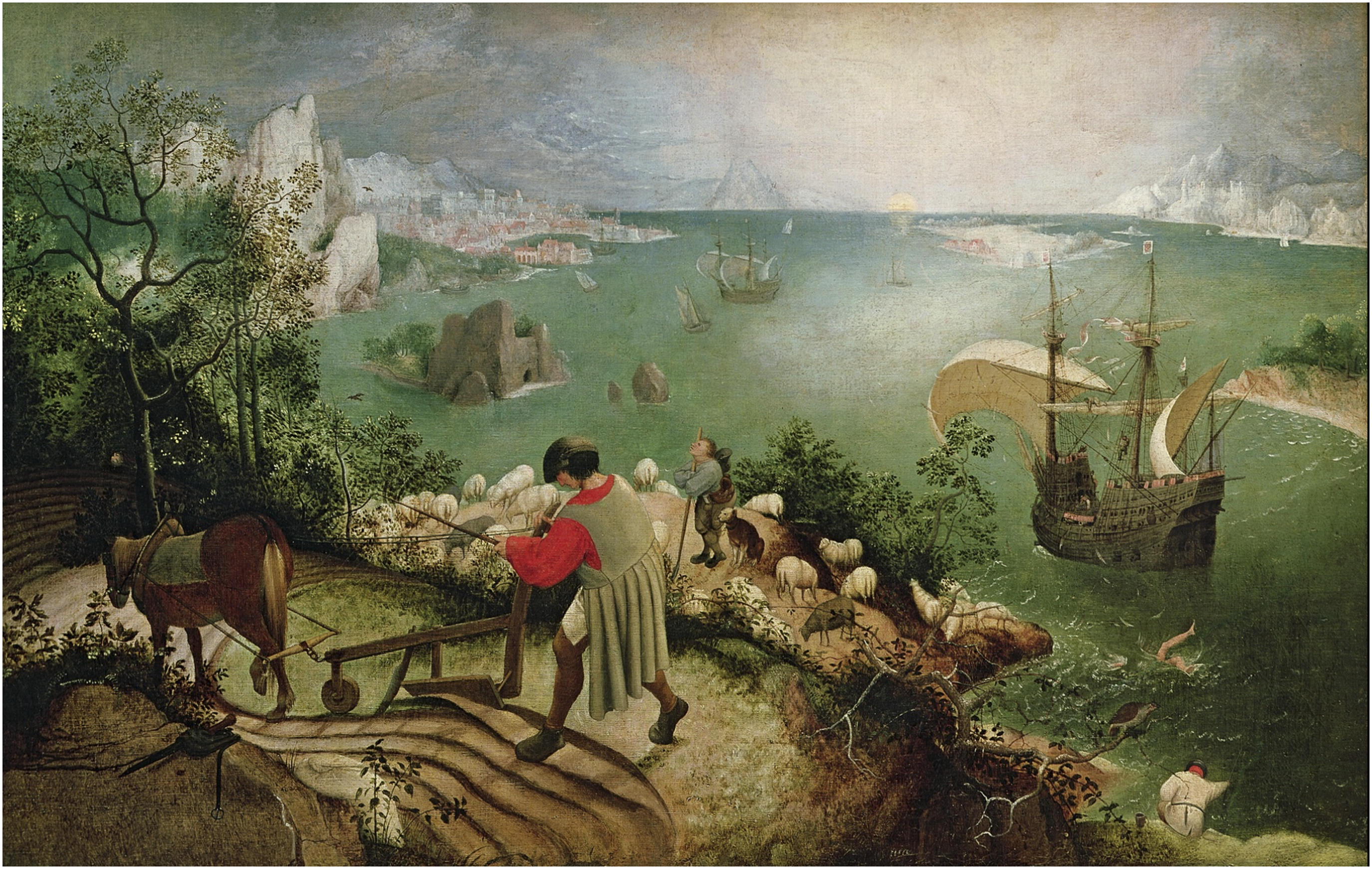
In Breughel’s Icarus, for instance: how everything turns away
Quite leisurely from
Have heard
But for him it was not an important failure; the sun shone
As it had to on
Water, and
Something amazing, a boy falling out of the sky,
Had somewhere to get to and sailed calmly on. (emphasis added)
Widdowson thus illustrates convincingly the power of linguistic analysis in elucidating poetic effect. He neatly demonstrates the basic tenet of literary stylistics – that form creates meanings and effects – while also providing a platform for discussing the limits of such an approach.
Pedagogically, having worked through the Widdowson analysis in detail, together with some pedagogically useful props such as an exercise on the function of definite articles, and discussion of the delightful Bruegel painting described by Auden (Figure 1), I have then sought to elicit from the students the idea that appreciating Leda needs more than attention to its grammar, and that, as with any poem, understanding is deepened by consideration of other non-linguistic aspects of its subject matter and of the context in which it was published. This move is not a criticism of Widdowson’s analysis but an addition to it. Indeed, Widdowson’s discourse analytic approach focuses precisely upon context and how it is created by text. Nevertheless, the poem can be used to illustrate the benefits of additional external contextual information. An understanding of its background and context can enhance and add dimensions to its effect and demonstrates the limitations of a purely intratextual stylistic analysis.
One such layer necessary to understanding Leda – but not available to all or even many of my students – is knowledge of the Ancient Greek myth which provides the poem’s subject matter. (For Yeats, when he first offered Leda for publication in 1923, familiarity with the story would have been even more widespread among his educated Anglophone readership than it was among Halliday’s and Widdowson’s readers in the 1960s/70s.) In the myth – with some variation between versions – Zeus, lusting after the Aetolian princess Leda, transforms himself into a swan and rapes her. Leda conceives and lays two eggs. One of the offspring is Helen, whose abduction caused the Trojan War, and another Clytemnestra who later murdered her husband Agamemnon.
Another piece of relevant background knowledge, also not known to all students, concerns the standing of the poet. Yeats is the epitome of a canonical poet. He is extensively taught, discussed, anthologised and acclaimed, and won the Nobel Prize for Literature in 1923. He is, moreover, like so many canonical poets, dead, white, and male. I use these observations to introduce both the term and the concept of the canon (and its correct spelling) and lay the ground for discussion of its male bias. Most of my students are studying linguistics rather than literature, so the term is a novelty to many.
One later stylistic analysis of Leda which does insist on the incorporation of context in the analysis of this or indeed any poem is by Burke (2000: 93), who explicitly addresses the necessary background knowledge of the myth, observing that ‘unlike the poem’s initial readers, many current-day ones may be excluded from this knowledge’. Linking his study to its own date, he describes his work as not merely textual, but unconditionally and unashamedly contextual, since stylistic approaches to prose and poetry that remain purely text-based may now, at the beginning the twenty-first century, be deemed both anachronistic and infelicitous. (Burke, 2000: 101)
Taking Bakhtinian dialogism as his starting point but rejecting its limitation to prose, he uses the linguistic details of Leda, including the uses of the definite article, but also others such as the shifting tenses of verbs, to argue convincingly ‘for the true polyphonic nature of poetic discourse’ (Burke, 2000: 97).
2.1. Political and historical context
Though written from the standpoint of cognitive stylistics, following Stockwell (2002), Tewksbury’s (2009) analysis of Leda also provides a commentary on the history of the poem and many details about its earlier versions and publication history. This can be used to demonstrate the affordances of such an approach and again can be contrasted with more formal stylistics analyses. Her article also, incidentally, can serve as a model and inspiration to current students as it was written while she was still an undergraduate.
The details she provides can give Leda quite a different slant. Originally commissioned for publication in the Irish Statesman by editor George Russell at the end of the Irish Civil War, it is likely to have been intended 2 and initially perceived as –at least in part – an allegory of the relationship between England (the rapist) and Ireland (the raped). In addition, as suggested by its original title The Annunciation, the poem was a challenge to the Catholic Church, a dominant force in Irish politics. Not only is Leda sexually explicit for its time but also added offence would have been caused by equating the Immaculate Conception with an act so physical and violent. Yeats' own beliefs – an idiosyncratic concoction of paganism, spiritualism and magic – were decidedly at odds with those of the Church (Ellman, 1948; Foster, 1998; Ross, 2020). In addition to all this, there is the feasibility of Freudian sexual interpretations of the phallic swan, the spermatic ‘white rush’ and ‘the broken wall’ 3 .
2.2. Visual depictions
Consideration of visual representations can add yet another dimension to perceptions of the poem, in contrast to those based only on the details of its language. Widdowson’s exposition of Leda as ekphrastic, while based on linguistic detail, has also pointed away from the linguistic details of the poem towards the powerful visual image which it creates. There are an extraordinary number of visual depictions of this rape, including ones by Leonardo, Michelangelo and Rubens, and there has been some discussion, including in the stylistics literature, about which depiction, if any, Yeats has in mind. Burke and Widdowson consider whether it was Michelangelo’s; Gavins discusses this claim extensively but suggests that an older Roman bas-relief is a better candidate (see third image on http://jpellegrino.com/teaching/yeatsimages.html) and argues convincingly, as part of her text world theory analysis, that the relation between poem and mental image is more complex than linking it to a particular painting or sculptor.
Many depictions are erotic and lend themselves to an interpretation of the swan’s neck as phallic – an observation which is relevant to my discussion in the next section. As such, they can cause considerable offence: in 2012, a photo exhibit by Derrick entitled Fool for Love was removed from the Scream Gallery in Mayfair for contravening laws on pornography depicting bestiality 4 . A selection of visual representations from different periods can be found at https://elitklub.blog.hu/2012/07/16/leda_es_a_hattyu. When I first started teaching my module, I used to open this website on the screen in the front of my class as a kind of entertainment and light relief. It is a sign of the times that I no longer do so. It is to the reasons for this reluctance and to the change of atmosphere in recent years that I now turn.
3. Misogyny and pornography
The poem, and analyses of it, can be used to take students on a journey – not all in one session of course – from early stylistics through Bakhtinian dialogism, cognitive stylistics, text world theory, psychoanalytic criticism, literary production, relations between words and pictures and so forth. It can also form an introduction to feminist stylistics. For what has not been mentioned so far, and is more or less ignored in the various stylistics analyses, is the ethics of reaction to a poem which is a depiction of a rape, and whether contemporary teachers and analysts should describe the poem, as Yeats may seem to describe the event, without condemning it. Cullingford (1994) is less sanguine than the stylisticians. ‘Pornography’ may seem an extreme term to apply to ‘Leda and the Swan’, which is protected from such judgements by its canonical status as ‘high’ art. Artistic merit is, of course, one of the grounds on which a work can be defined in law as not pornographic. But as Kappeler argues, ‘What women find objectionable in pornography, they have learnt to accept in products of “high” art and literature’. Stripped of its canonical privilege and examined in terms of its content alone, ‘Leda and the Swan’ certainly qualifies as pornography, which is, according to MacKinnon, ‘the graphic sexually explicit subordination of women through pictures or words that also includes women dehumanised as sexual objects, things or commodities; enjoying pain or humiliation or rape; being tied up, cut up, mutilated, bruised, or physically hurt; in postures of sexual submission or servility or display; reduced to body parts, penetrated by objects or animals, or presented in scenarios of degradation, injury, torture. (Cullingford 1994: 174)
This raises the issue of whether the poem is misogynistic. Many other studies have advanced the view that it is, as the following list, by its quantity, makes clear: Cullingford (1996, 1997), Neigh (2006), Drumond Viana (2010), Pistrang (2013), Nava Sevilla (2014), Neimneh et al. (2017), Nelson (2017) and Oró-Piqueras and Mina-Riera (1995). It is a favoured focus for allegations of sexism and misogyny in the canon.
Although the poem does not explicitly condemn the rape, it can be seen, as it is by Cullingford, to condone and eroticise it. Leda’s graphic physical details – ‘the loosening thighs’, ‘those terrified vague fingers’ and ‘a shudder in the loins’ – amount in this view to complicity. In particular, from a linguistics standpoint, the continuous aspects of the participial adjective loosening and the finite verb engenders seem to place us right in the middle of the event as readers and onlookers, almost as though we could, but do not, intervene. On the other hand, it is hard to pinpoint in the poem any explicit approval of Zeus' action. The adjectives – a grammatical category associated with evaluation – applied to both the victim and her attacker could be seen as more descriptive than judgemental. Leda and parts of her are described as staggering, helpless, terrified, vague and loosening; the swan and parts of him as great, dark, feathered, white, strange, brute and indifferent. If anything, these last two adjectives, brute and indifferent, could be construed as critical of Zeus. Moral judgement, moreover, it could be argued, is not generally attached to mythological events, such as an assault by a god in the form of a bird, in the same way as it is to human actions. In addition, the poem is not itself a rape but a depiction of a rape, and if all literary depictions of crimes were to be treated as though they were the actual crime itself, the casualty list would be extensive.
For Nelson (2017), who like Cullingford also fixes upon Leda as the epitome of misogyny in poetry, any deflection of attention from the poem as the description of a rape is inadmissible. Take, for example, W.B. Yeats’s Leda and the Swan, which figures the ‘helpless breast’, the ‘loosening thighs’ and the ‘white rush’ of – well – this is a poem about rape. Apologists often claim the rape of Leda is a metaphor for the conquest of Ireland, but this is hardly better. To put it academically, the ‘rape trope’ or ‘rape as metaphor’ displaces the actual, violent and traumatic act of rape. In short, there’s something deeply misogynistic in the way female rape victims continue to be cast as collateral damage on the way to something else.
Cullingford’s and Nelson’s arguments would appear to have considerable force, and many contemporary readers, including some current students, take the view that it is indeed reprehensible to describe a rape without simultaneously condemning it. Cullingford seems to imply that Leda should be removed from both the canon and the syllabus; Nelson (2017) however has a different view: I am certainly not advocating that any of these books
5
should not be set on the curriculum. Or even be prefaced with a ‘trigger warning’. Rather, there’s an urgent need for these stories to be read again. Not by interpreting power as ‘passion’ and violence as ‘persuasion’, or glossing over the politics of sexual violence in order to get to the ‘aesthetics’ of a text. These books are important precisely because they are a reflection of the oppressive societies that gave rise to them. And, indeed, function as a reminder that the oppression isn’t over yet.
Whatever conclusion one ultimately reaches about whether Leda should remain on the syllabus, it no longer seems possible, nor would it be right, to teach it, or other works open to similar charges without reference to views of this kind. There are other canonical poems which might be candidates for review in the same light. Keats' Ode on a Grecian Urn, also an ekphrastic poem, describes its object as an ‘unravished bride’ and tells approvingly of ‘struggles to escape’ by ‘maidens loth’ from ‘bold lover[s]’; Shakespeare’s The Rape of Lucrece describes a woman’s rape by her husband’s friend, empathising, at different points in the poem, with both the victim and the perpetrator. More generally there are recurrent themes, such as the attempted persuasion of a virgin to ‘yield’ her honour to a suitor – as in Donne’s The Flea or Marvell’s To His Coy Mistress. The arguments over Leda therefore have a relevance to the issue of what should be analysed, taught and generally esteemed, which extends far beyond this one poem.
I shall shortly return to this issue – whether the poem should be taught – but before I do, it will be useful to contrast Yeats' poetic treatment of the Leda myth with others, both earlier and later than 1923, as a means of assessing the charges of misogyny against the poem, by placing it in a wider literary historical context and a range of attitudes. Whether and to what degree Yeats' Leda is misogynist may appear more clearly in contrast with other treatments.
4. Other literary depictions, earlier and later
There are many other poetic treatments of the same myth. From Ronsard’s 16th century La défloration de Lède onward, it is almost as recurrent a theme in the written as in the visual arts; rightly or wrongly, the story clearly appeals to the creative mind. As with Gavins' suggestion that insight may be gained into stylistics by comparing analyses of the poem over time, so changing attitudes to the myth may be reflected in changing literary treatments of it.
4.1. Yeats’ contemporaries
Several poets contemporaneous with Yeats published poems on the same theme: Rubén Darío in 1892, Rainer Maria Rilke in 1908 (also a sonnet), Hilda Doolittle (pen name H.D.) in 1919, Aldous Huxley in 1920, D.H. Lawrence in 1929 and Robert Graves in 1933. All are called simply Leda. Of those poems predating his own (to be found in the appendix), Yeats very likely knew of Darío’s work 6 ; he was influenced by Rilke, at least later in life (Jeffares, 2001: 288); he was certainly aware of Doolittle’s poems as she was one of a group of young imagist poets taken under his wing (so to speak!) around 1912 (Foster, 1998: 473–474). Rilke approaches the story from Zeus' viewpoint; Darío, Doolittle and Huxley are anything but condemnatory of Zeus, presenting the congress of bird and princess as a rather positive and beautiful event, in which the swan appears as a benign force, with a ‘soft breast’ and a ‘kingly kiss’ (Doolittle) for which Leda feels a ‘strange desire’ and ‘longing’ (Huxley).
4.2. Later treatments
Later women writers, however, alluding to Zeus’ attack on Leda are unequivocally condemnatory. Sylvia Plath’s Three Women (Plath 1968) is a verse play for radio, first performed in 1962, in which the three characters have very different experiences of childbirth. ‘First Voice’ returns with her baby to a traditional home; ‘Second Voice’ miscarries; ‘Third Voice’ gives up her child for adoption. ‘Third voice’ has the following lines: I remember a white, cold wing And the great swan, with its terrible look, Coming at me, like a castle, from the top of the river. There is a snake in swans. He glided by; his eye had a black meaning. I saw the world in it – small, mean and black, Every little word hooked to every little word, and act to act. A hot blue day had budded into something. I wasn’t ready. The white clouds rearing Aside were dragging me in four directions.
Many other women poets have written poems from Leda’s point of view (Neimneh et al., 2017). These include Lucille Clifton’s Leda Trilogy (1993), as well as three poems anthologised in Kossman (2001), Mona Jane Van Duyn’s Leda (1971), Nina Kossman’s Leda (1996) and Barbara Bentley’s Living Next to Leda (1996). Oró-Piqueras and Mina-Riera (2018) analyse two further poems on the Leda theme by Lorna Crozier, ‘Forms of Innocence’ (1985) and ‘The Swan Girl’ (1995).
More recently, the first half of Fiona Benson’s 2019 collection Vertigo and Ghost is a series of poems about Zeus’ theriomorphic assaults on a succession of women. She unremittingly presents Zeus as a coarse abusive vulgar criminal (using upper case letters to suggest his braggadocio) BEST TO DRESS AS A PEACOCK A BULL A STAG A SWAN WHEN YOU WALK AMONG HUMANS ESPECIALLY IF YOU WANT TO GET A GIRL
and those he overpowers as victims, rather than as – à la Darío, Doolittle and Huxley – lucky and grateful recipients of his divine attention: I fletched back and tan and flew against the wind before I reached the stars he as a swan, I was pinned – we made a crater where we fell screaming through the night a bloody prolapse – his shame, not mine.
Male Nigerian poet, performer and playwright, Inua Ellams, has used the Leda myth in his 2019 play The Half-God of Rainfall. In this work, Yoruba and Ancient Greek gods mix together and behave in similarly cruel and arrogant manners. The play’s eponymous boy hero is Demi, the offspring of an assault by Zeus on Modupe, his mother. With her encouragement, Demi aspires to become a basketball star through his semi-divine powers. Although the mixing of cultures and periods creates many humorous elements, Demi’s references to his father’s sexual aggression are stark and unforgiving: He beat mother blue Pinned her down. Then... forced his.... The Òrįsà stood there. Did nothing. Mother couldn’t tell me. How? Could you?
Lastly, in this brief and doubtless incomplete survey, I might also mention the appearance of Yeats’ Leda in Philip Roth’s bildungsroman Portnoy’s Complaint (1969), a story focused – wittily for some, disgustingly for others – on intense male sexual desire. The autodiegetic Portnoy knows Leda by heart and proposes a recital of it to his uneducated girlfriend, a young woman with supermodel looks whom he calls ‘the monkey’, while she is fellating him in his car. To her protestation that ‘I do not understand poems’, he answers: ‘You’ll understand this one. It’s about fucking. A swan fucks a beautiful girl’. She looked up, batting her false eyelashes. ‘Oh goody’. ‘But it’s a serious poem’. ‘Well,’ she said, licking my prick, ‘it’s a serious offense’.
The appearance of the poem in this situation, and in a work by an author so often lambasted for alleged male chauvinism (Bloom, 1996), could be taken as evidence for the poem’s misogynistic nature. It is an apt choice for this character. On the other hand, it seems unfair to criticise either Yeats or his creation for their appearance in a work written 46 years later. Yet for those who see Roth and Portnoy as beyond the sexist pale, it certainly does not help any case for the poem’s defence.
Richard Yates’ (1962) novel Revolutionary Road alludes to the myth in similar context and in a similar mood of male assertiveness. After sex with one of the secretaries in his office, the character Frank Wheeler muses ‘did the swan apologise to Leda? Did an eagle apologise? Did a lion apologise? Hell no!’ As always with the Leda story, however, there is a feminist counterbalance: Angela Carter’s novel The Magic Toyshop (1967), a bildungsroman about a 15-year-old girl’s road to womanhood (Oró-Piqueras and Mina-Riera, 2018), equates the heroine with Leda and the swan with her abusive guardian uncle.
4.3. Summary of other depictions
So as with Gavins’ thesis about changing stylistics analyses reflecting changing premises, poetic depictions of this same story reveal changing attitudes to rape, hierarchy and male power. Some writers invoke a hierarchical patriarchal social order and speak of the rape in a positive, even approving way as though Zeus’ power and standing made his action acceptable. Those writings from a feminist standpoint are condemnatory. For them, Zeus' status does not mitigate the humiliation and violence of the rape in any way. It is not a simple division between writers though. Not all of the former category are men; not all of the latter category are women (exceptions are Hilda Doolittle and Inua Ellams). More significant than gender seems to be period. Poems before Yeats’ are approving, those after him more likely to be condemnatory.
But, where does Yeats stand in this spectrum? On the strength of the text of Leda alone, it is difficult to say. Despite the many critiques of the poem as misogynistic, there is no phrase one can pinpoint as approving or disapproving of Zeus, sympathetic or unsympathetic to Leda. Yeats seems to be midway in attitude as well as time, strangely detached, and thus perhaps a useful gateway into the spectrum of approval and disapproval. Cullingford, Nelson and others certainly infer that Yeats is on the side of male violence, that the very detachment is wrong and thus that any apparent neutrality is unconvincing: as Yeats does not condemn the rape and presents it as a visual spectacle, his treatment is necessarily mired in misogyny and sexism. For them, this is not a poem to teach without simultaneously being morally condemned.
In light of these anxieties about Leda’s misogyny, an easy option would be simply to abandon it and choose a poem with a less disturbing topic, conceding that some literary works which have previously figured prominently in curricula and academic literature, as Leda has in stylistics, are now morally unsuitable. This route however would lose not only the poem itself but also all of the stylistics analyses described above and other suspect poetic depictions of the myth as well, leaving us only with later critical feminist literary portrayals of the mythical rape, such as those by Plath, Crozier, and Benson. Yet all of these later poems gain at least part of their power by departing from earlier representations, and all of these authors are likely to have known and assumed their readers to know the story of Leda in Western art and literature, including its use by Yeats. Neat dissociation of the acceptable from the unacceptable is not then simple. Works of literature exist in and gain power from a changing context – even if stylistics has sometimes treated them as free floating entities. Simply abandoning works of which we disapprove deprives us of interesting explorations of changing literary, cultural and sexual assumptions.
In any case, an argument against censorship of the poem is one with a straw woman! None of the feminist critiques listed earlier make such a proposal and their authors make very good use of Leda to develop their own ideas. Whether morally reprehensible or not, the poem provides a useful locus for feminist arguments. Oró-Piqueras and Mina-Riera (2018) discuss both the myth and the poem to expound ecofeminism, the idea (simply put) that there are parallels between men’s oppression of women and of the natural world; Pistrang (2013) explores how the myth has been used to talk about the sexes and relations between them; Neimneh et al. (2017) discuss the story’s various literary representations; and Nava Sevilla (2014), dealing with the visual arts, treats the theme of female abduction and its manifestations in contemporary art in Israel and Palestine. If the function of a myth is to encapsulate values which can then be accepted or challenged, then for criticism and theory, the poem Leda, as well as representing a myth, has itself achieved a mythical status.
5. Morality in Literature analysis and pedagogy
Leda can be used to lead students from formal text-centred stylistics analysis to a broader view of a poem, one which encompasses aspects of literary history, social context and ideology and the relation of poetry to the visual arts. There is however a complication to this apparent expansion of view – threatening to lead stylistics round in a historical circle and enmesh it in a paradox.
The feminist critiques of Leda are moral judgements. Men are morally wrong to treat women violently and proprietorially, and the poem is morally wrong to represent Zeus' attack the way that it does. This raises the question of the place of morality in stylistics and its teaching. Is it the responsibility of a teacher of stylistics to inculcate moral views into their students, and should literary texts be presented as moral examples, developing commendable beliefs and behaviour? Historically, this has not been the role of stylistics and in none of the stylistics analyses of Leda with which I began is there any moral lesson being taught.
Over the years, stylistics has moved away from descriptive linguistics and closer to literary theory and literary criticism, becoming increasingly concerned with the social, psychological and ideological contexts of literature as well as its formal textual features. Bakhtinian analyses see texts in the context of genres and voices, and cognitive stylistics introduces notions of schematic understanding which inevitably address stereotypes, including those relating to gender. Feminist stylistics (e.g. Mills, 1995; Montoro, 2014) intersecting substantially with feminist literary theory (e.g. Eagleton, 2010; Moi, 2002) must by definition be concerned with the representation of women and gender relations and thus with such issues as whether Leda is reprehensible pornography or a great work of art.
Though apparently progressive and liberating, this move can ironically revive a belief in the prime function of literature and literature teaching as the promotion of a moral world view achieved through the reading and study of improving texts, whose exemplary authors should be models for readers’ and students’ own lives. In the mid-twentieth century, 7 this patrician notion found a particularly powerful voice in the influential work of F. R. Leavis, especially in the Anglo-American critical establishment. For Leavis, whose insular focus was on English literature to the exclusion of everything foreign, the principal concern of literary criticism was evaluation, and the main purpose of its writing and teaching was to ensure that English literature should be an informing spirit in society, shaping contemporary behaviour, morals and sensibility (Bilan, 1979: 61). For all the professed openness, diversity and cosmopolitan tolerance of contemporary literature analysis and pedagogy, these views linger on, perhaps even in stylistics.
Leavis expresses his judgements with an extreme directness: seen as plain speaking by his acolytes, dogmatism by his critics. His orotund didacticism is most evident in The Great Tradition (Leavis, 1948), his major work on the English novel. ‘The great English novelists’, he declares, ‘are Jane Austen, George Eliot, Henry James and Joseph Conrad’. In this very limited canon of only native and naturalised 8 British authors, a main criterion of excellence is that the works should be moral in effect. Of George Eliot, he writes that she does not ‘offer an “aesthetic” value that is separate from moral significance’ and ‘without her intense moral preoccupation she would not have been a great novelist’ (Leavis, 1948:16). In his earlier major work on poetry New Bearings in English Poetry (Leavis, 1932), he adopts a similar line. He is also resolutely opposed to any theory of a poem as a self-contained and self-sufficient aesthetic and formal artefact, isolated – as it is in New Criticism and indeed in early stylistics –from the society, culture and tradition from which it emerged. As Leavis grew older, though literature remained at the centre of his attention, his perspective became increasingly moralistic and nationalist; this was most visible in the content and title of his last major work Nor Shall my Sword (1972).
The untroubled certainty of these views is striking. So too is the lack of attention to a definition of morality, and whether there might not be positions other than his own. Such certainty is common to moralist views of literature, of many different religious, political and philosophical persuasions. Didactic moralists brook no code other than their own. For Leavis, the moral is vaguely assumed to be some English view of modest plain dealing, reliability, and decency, of the kind exemplified by the heroines and heroes of Jane Austen novels. Thus in his morality, there is concern about double dealing and ‘weakness of character’—but there is none about class, colonialism, racism or misogyny.
For Leavis, then morality could be identified with a particular though undefined set of values. Yet, the notion of a moral function for literature and its teaching is independent of specific ideologies. It may be anti-racist, atheist, Catholic, communist, environmentalist, fascist, feminist, pacifist, Maoist, Muslim, Zionist or whatever.... but the concept of texts as vehicles for correct points of view and moral improvement remains. Which texts and which authors can accomplish this improvement will vary of course with the dominant ideology in the society in question, the moral stance of the educational institution, as well as the individual viewpoint of the teacher or the analyst. There is no single morality of all places and times, and literature, spanning the centuries and the continents, presents various moral views. For Milton, the moral world view centres upon Protestant Christianity, for Virginia Woolf on female emancipation, for D.H. Lawrence on the abandonment of bourgeois prudery, for Chinua Achebe on the rebuttal of colonialism, for J.M. Coetzee on animal rights and so forth. Authors have moral views and seek to promulgate them through their works. It does not follow, however, that this promulgation is the totality or even the essence of their worth. Readers see value in authors and works with whose morality they disagree. Gerard Manley Hopkins, for example, is a favourite poet of mine, despite the incompatibility of his Roman Catholicism and my own atheism. This othering ability of literature can be conceived as a very positive aspect of literary experience – also, paradoxically perhaps, a kind of moral force, though in a different sense from those ideologies cited above. It is a morality of ethical heteroglossia rather than monologism.
Explicitly in Leavis and implicitly in some other didactic approaches, the moral and the aesthetic are collapsed. ‘Beauty is truth, truth beauty.’ 9 There is no room for the idea that a work may suggest or even expound views which are felt by the reader to be wrong and yet remain for that reader valuable, worthwhile and beautiful. For me, this is the case with Hopkins. I do not want Jesus to take over ‘innocent mind and Mayday in girl or boy’ (Spring) nor do I believe that the last rites of the Catholic Church are a ‘sweet reprieve and ransom’ for the dying (Felix Randall); on the contrary, I see Catholic theology as generally harmful (both globally and for Hopkins); but I nevertheless find these two poems to be beautiful, insightful and supremely worth reading and teaching. This is highly relevant to the case in hand. For some feminist critics, the worth of a text is completely undermined by any taint of sexism, even if it comes from a time or place where conceptions of gender relations were very different from their own. Steve Clark 10 (1994) for example in his book Sordid Images: The Poetry of Masculine Desire, attacks not only obvious targets—his include Larkin and Rochester—but also others whose offences against a feminist moral code may be less immediately obvious, including Chaucer, Wyatt, Shakespeare, Donne, Milton, Blake, Swift, Coleridge, Keats, Browning, Hardy, Eliot and indeed Yeats. If we bring into account the behaviour of writers as well as the contents of their writing, then the carnage in the canon will be even greater.
There is an argument of this kind to be made for Leda. It can remain a beautiful poem, even for those who see its voyeurism and its lack of overt condemnation as wrong. The economy of expression, the vividness of the scene, the skilful manipulation of the sonnet form, the evocative use of definite articles and demonstratives, can remain independent of its moral force.
There is an important caveat here nevertheless. In Leda, we are not talking about a poem which advocates rape. If we were, the case would be different as it would be if a poem were to advocate any other repugnant crime, lynching for example or genocide. There are thresholds which a reader may not be prepared to cross. This does not seem to me to undermine the general argument that poetic achievements can be separated from moral views. Yet even here, there may be exceptions. In Virgil’s Aeneid for example, the hero Aeneas takes pleasure in killing his disarmed opponents slowly and painfully – that is a very long way from contemporary ideas about the ethical treatment of prisoners of war. Indeed, the further we move from our own time and cultural context, the more likely we are to encounter sentiments unacceptable to contemporary mores.
Leavisite and other moral approaches to literature are thus both specific to a particular code of values and general. Leavis' own overbearing, 11 nationalist, snobbish, parochial certainty, in tune with the English establishment of his time, exerted a stifling effect both on what could be taught and how. Successive approaches to literary analysis and pedagogy, of which stylistics is one, have replaced his stranglehold with more diverse and tolerant perspectives based on principles rather than mere personal preferences. His particular values may have waned, and in many quarters even been replaced with their opposites, yet his overriding idea remains never too far away, that only improving texts should be taught, and others dismissed out of hand.
Divergences of view do not need to be resolved to teach Leda, and it need not be the job of the teacher to judge between them. We do not need to take sides. For a teacher, more is to be achieved by approaching the poem from a number of angles, so that understanding of its cultural position may be deepened, thus furthering understanding of poetry in general and of the relation between topic, viewpoint and language in literary texts. This is not to say that individual teachers and students will not have strong moral views, but only that the struggle to impose them on others is not necessarily the best use of the classroom.
More important become the complexity of the issues and interpretations Leda raises and the insight this provides into different and diverse beliefs. The Leda myth has been represented in many ways, from Doolittle’s sugary passivity and Darío’s patriarchal complacence to Plath’s anguish and Benson’s defiant feminist anger. Each is better understood in contrast with the other. In criticism, it is the same. There are critiques which say nothing about issues of male violence, and are weaker for that, but nevertheless have points to make, and there are also feminist critiques which considerably enrich and enhance understanding of the myth. To take away either side of the debate will weaken and impoverish what can be learned from it.
This range of approaches to the myth itself, and the fact that there is so much to say and argue over, makes study of Yeats' Leda pedagogically fruitful, whatever one’s own moral judgement of it may be. Leda is, as I hope to have demonstrated, an extraordinarily rich starting point for the exploration of a vast range of views and of other works. This is as true for those who think Leda is a wonderful poem as for those who think it is dreadful. In this sense, it has a very literary quality, the power to generate many meanings and different interpretations which can never be resolved. This is – surely – what great literature is about.
For all these reasons, I have decided to continue teaching Leda as an introduction to stylistics.
Footnotes
Acknowledgements
My thanks to Elena Poptsova-Cook, Kieran O'Halloran, and Henry Widdowson for helpful comments and invaluable guidance on earlier drafts, and to Gwyneth Williams, Joyce Redfearn and Malcolm Williams for our illuminating group discussions.
Declaration of conflicting interests
The author(s) declared no potential conflicts of interest with respect to the research, authorship and/or publication of this article.
Funding
The author(s) received no financial support for the research, authorship and/or publication of this article.
