




Abstract
The centenary commemorations of the First World War have prompted renewed debate as to the ways in which it ought to be remembered in future, not least through teaching and through historical fiction. This article discusses two contemporary collections of short stories and a number of novels published between 1991 and 2014. It reads these modern literary accounts of the First World War against current popular perceptions of and commemorative discourses surrounding the war, including the representation of the war in secondary education and the use of literature in the classroom. In doing so, the article draws in part on a research project that investigated the teaching of the First World War and its literature in English secondary schools between February 2013 and August 2014.
Introduction
At a time when the First World War is moving out of living memory, mechanisms other than interaction with eyewitnesses become increasingly important in shaping popular understanding of the war. Similar to the war’s fiftieth and eightieth anniversaries, the 2014–2018 centenaries are marked by a high level of media engagement with the war in Britain and beyond, ranging from programming on radio and television to content in new media: dedicated online portals, tweeting of First World War events as they happened 100 years on, war-themed video games, and a host of other cultural products. 1 While a number of different media contribute to contemporary understanding of the war, however, reading remains central to the formation and development of cultural memory. Despite competition from other media, literary accounts of the First World War continue to matter for the teaching of war in the present and inform teaching of the war in both English and history lessons. The short stories and novels discussed in this article offer an insight into the state of the war’s cultural memory in Britain on the eve of its centenary, and form a complement to research into how the First World War is taught in English schools. Owing to the central role of literature in teaching and the construction of the war’s cultural memory, contemporary fiction about the war can serve to not only confirm existing memory discourses, but to introduce new ideas and interests into existing narratives about the First World War. Contemporary teaching practice and contemporary fiction about the First World War both contribute to a cultural memory that casts the war simultaneously as futile tragedy and meaningful sacrifice. They also both grapple with issues surrounding the accessibility and inclusivity of the war’s cultural memory, and promote an understanding of the war in which a core narrative of suffering is tempered by a desire to make the war’s memory more inclusive.
The proposition that contemporary literary representations both reflect and shape the way in which the First World War is remembered is not a new one. Literature – poetry, drama, novels, memoirs, letters and diaries – is the most long-standing medium in which the First World War has been portrayed. While books about the war were being published consistently from its outbreak and all through the 1920s, the years from roughly 1927 to 1933 witnessed a particular peak. Cyril Falls’ 1930 publication War Books: A Critical Guide offers brief discussions of 715 books about the war (including history, memoirs and fiction, but excluding poetry), of which 198 or 28% were published during the years 1927 to 1930. In the fiction category, a staggering 45% appeared in the three years leading up to 1930. The books published during the so-called war books boom are frequently and problematically perceived as offering a clear shift from positive, patriotic literary representation of the war to a harsher, disillusioned portrayal of the war’s futility and waste. 2 Critics such as Rosa Maria Bracco have noted the fact that by no means all writers fit into this mould, but literary portrayals of the war have certainly shifted and changed over time to reflect changing interpretations of the war and its after-effects. Contemporary writing about the war has to be seen as part of this on-going process of literary re-interpretation. Ever since the 1930s, historians have chastised war literature for its contribution to variously shaping, influencing and distorting the cultural memory of the First World War in Britain. In 1930, historian and writer Douglas Jerrold chastised disillusioned war writers’ perceived obsession with futility in his pamphlet The Lie About the War: A Note on Some Contemporary War Books. Jerrold’s criticism has found echoes in the work of later historians, including Correlli Barnett and Brian Bond’. 3 Gary Sheffield and Dan Todman have likewise scrutinised the impact of literary accounts of the war as narrowing the scope of individual war experience, though both also acknowledge the impact of ‘disillusioned’ narratives in other media, particularly the enduringly popular Blackadder Goes Forth (BBC, 1989). 4 Indeed, Esther MacCallum-Stewart posits that literary writing about the war came to be seen as an alternative to historiography from the influential texts of the late 1920s onwards, resulting in the development of a cultural memory of war based on ‘a series of literary constructions’. 5
MacCallum-Stewart proposes that subsequent non-eyewitness fiction about the war has benefited from the perceived status of war literature as a means of accessing the reality of war, since fiction in general has now come to be ‘an accepted location for war writing, and at the same time it is understood to be presenting the “truth”’. 6 A 2014 Guardian blog post about the future of First World War fiction cited the author Theresa Breslin, who ‘expects that fiction writers will continue to play an important role in keeping the story of the first world war alive’. 7 Breslin emphasised the ‘emotional truth’ of war writing, which in her view remains despite the fact that ‘stories of world war one have changed in the telling and will continue to do so as more information becomes available and different insights are gained’. 8 Breslin’s view is in tune with teachers’ strong commitment to keeping alive the memory of the war, 9 but her observations do raise the question of which ‘story’ should and will be kept alive. Breslin’s phrasing suggests that despite variations and new ‘insights’ the fundamental core of ‘emotional truth’ remains unaltered. While the claim of a central ‘truth’ of war is inherently problematic, scrutiny of contemporary writing about the First World War does reveal so many variations on the same themes of pity, sacrifice, horror and disillusionment that arguably constitute the emotional core of modern cultural memory of the First World War in Britain.
The influence of literary voices owes much to the dissemination of literary accounts of the First World War in compulsory, secondary-level education. The teaching of literary representations of war in the classroom draws on and encourages the reading of contemporary fiction about the war both directly (through studying particular texts in class) and indirectly (by validating literary texts as legitimate sources of information about the war). While it is difficult to ascertain exact numbers of fiction titles published about the First World War each year, a number of high-profile novels have appeared between the war’s eightieth anniversaries and the present. The selection of novels discussed below was published by mainstream presses, written by well-established authors, and attracted particular public attention in the form of literary prizes, nominations for literary prizes and author interviews or reviews in the mainstream media, all of which indicate widespread reception. These novels are read alongside a small selection of short stories published in the first centenary year.
First World War literature and teaching
Teachers, like writers, have more recently been in the spotlight of criticism for the views on the war that they convey to their pupils. This criticism often relates to the teaching of the First World War through its literature. 10 Parallels between literary representations of war and the way the war is taught do not end there. Centennial teachers and writers alike deal with the great- and great-great-grandchildren of the war generation, whose link to the war is becoming ever more tenuous. This is particularly true of young people from migrant backgrounds, whose forebears may have participated in the conflict – if at all – in completely different ways compared to the white British ‘Tommy’ on the Western Front. The emphasis on the shared loss and suffering of the First World War in today’s cultural memory is arguably better suited to fostering a sense of national unity than the celebration of a victory that not everyone will feel equally able to share, as pity and a desire to honour the dead offer an easy emotional point of access regardless of direct personal or family links to the war. As a result of students’ potentially reduced personal connection to the First World War and the variety of channels by which students may have encountered the war outside the classroom, teachers today are faced with particular challenges in teaching about the war. As one teacher observed in a letter to the Observer, in teaching war literature to ‘students of many different abilities and nationalities’ over the course of a thirty-year career, ‘[t]he most compelling texts were invariably those which emphasised the horror and futility of the first world war. The literature of endurance, heroism and despair has captured the imaginations of students from all cultures and ranges of ability’. 11 While many teachers wish to offer nuanced teaching of First World War material that looks beyond horror and suffering, the necessity to engage a broad range of students of differing abilities thus perhaps necessarily informs their choice of texts and topics.
Looking beyond anecdotal evidence, the Arts and Humanities Research Council-funded exploratory project ‘The First World War in the Classroom: Teaching and the Construction of Cultural Memory’ can offer some further insights into links between teaching the war and its literature. It was conducted by Catriona Pennell and Ann-Marie Einhaus between February 2013 and August 2014 and scrutinised links between teaching practice and cultural memory of the First World War. 12 A survey of English and history teachers in English secondary schools undertaken as part of this project investigated, among other questions, the role of literature in shaping cultural memory of the war from within the classroom. The survey, split into two distinct pathways for English and history teachers, was held online between 21 June and 1 December 2013. 13 The online questionnaire was advertised via the Historical Association and the English Association as well as via institutional networks, including the University of London’s Institute of Education. The survey was completed by 98 English Pathway respondents and 353 History Pathway respondents. Many of these were Heads of Department in their school (29.3% in the English Pathway; 52.9% in the History Pathway). Taking into account instances where multiple teachers from the same school responded, the History Pathway represented views from at least 307 schools in 43 counties, with an additional 60 schools in 28 counties covered by the English Pathway. Taken together, respondents to the survey represented around 4.6% of all History departments and 0.9% of all English departments in secondary schools in England. 14 The survey also achieved a representative demographic spread among respondents with respect to age distribution, gender, ethnicity and religion as compared to the Department for Education’s National Statistics on schools. 15 Respondents to the survey were, however, necessarily a self-selecting group, as the sample consisted of teachers with a particular interest in the First World War. The lower number of English Pathway respondents reflects the fact that far from all schools teach First World War writing in English lessons. 16
However, the survey suggests that literary texts about the war hold significance for the learning of history as well as English. Teaching practice is intimately connected with the war’s legacy across a range of media, not least literary texts as either a means of teaching about war, or a backdrop against which one teaches. Given the wealth of fiction about the First World War now available for children and young adults in Britain – including recent publications like former Children’s Laureate Michael Morpurgo’s Listen to the Moon (2015) – the possibility is high that many students will have read at least some fiction about the conflict before encountering it in school. In focus group interviews conducted as part of the project, history teachers reported the problems they face when pupils come into their lessons having already read some First World War literature and developed firm ideas about the war on the basis of this reading.
17
The survey also showed, however, that literary writing about the war was considered valid background reading by teachers in both disciplines. While it may not be surprising that most of the additional reading undertaken by English teachers consisted of fiction, memoirs and poetry, free-text responses from history teachers to the question of helpful further reading also included fiction, some poetry and memoirs or collections of letters.
18
These findings by no means suggest that history teachers rely solely on literary writing, since most texts named were historiographical. However, the presence of literary texts highlights the fact that history teachers do engage with literary accounts, which they also use alongside other source materials in their teaching. Seventy-four per cent of History Pathway respondents to the survey stated that they used war poetry in their teaching, as opposed to 35% of English Pathway respondents.
19
English teachers were more likely than history colleagues to use fiction, including classic war novels (45%), modern novels for adults (41%) and most notably, modern novels for young readers such as Morpurgo’s Private Peaceful (2003) (57%). The three most popular authors selected by English teachers overall were Wilfred Owen, Siegfried Sassoon and Morpurgo (see Figure 1),
20
all three of whom were felt to be best suited to engaging pupils, whatever reservations individual teachers might have about the potentially limited view of the war they provide.
21
For older ages, Barker and Faulks were also among authors likely to be taught. The popularity of modern, retrospective accounts of the First World War alongside stylistically and emotionally accessible poets such as Owen and Sassoon seems indicative of a desire to make the war accessible to students, particularly in younger age groups. Given the use of literary texts about the First World War in both history and English lessons, the secondary-school classroom constitutes an environment where young Britons are likely to be exposed to literary representations of the First World War in a more formalised manner alongside encounters with the war in other media.
Authors that respondents considered themselves likely to teach (in percentages). This was a multiple answer question with a set list of authors and a free-text option to list additional authors.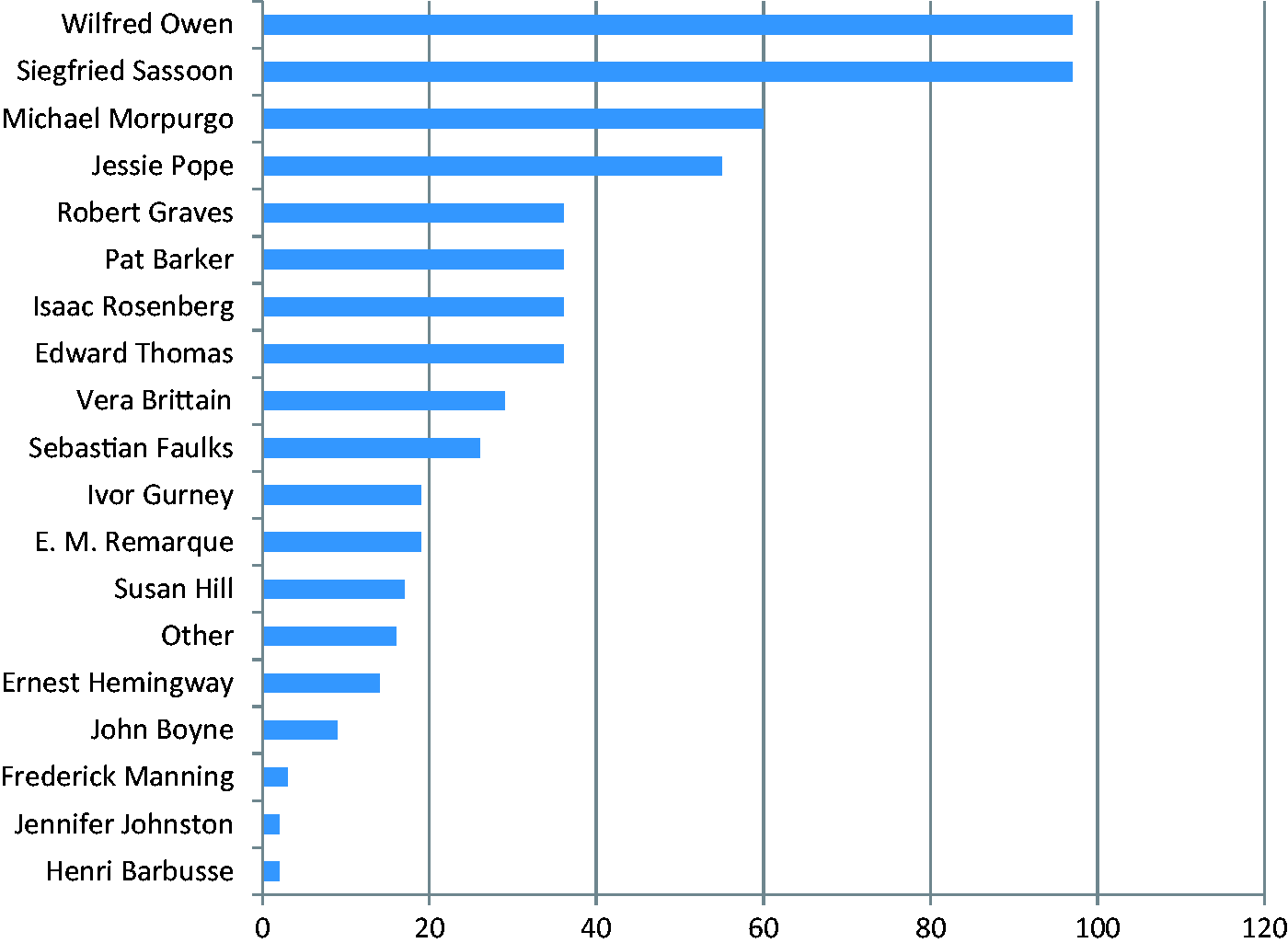
Asked to rate the importance of different goals for their teaching of the First World War, both English and history teachers were keen to build students’ analytical skills and contextual understanding. 22 In addition to these subject-specific goals, however, 84% of history teachers and 98% of English teachers who participated in the survey stated that eliciting a personal response from their students was either important or very important to them. Teachers of both subjects also aimed to widen students’ understanding of the war beyond what is usually covered in the media, 23 and educate students about the impact of war on society as well as literature, including the cost of war in terms of human lives (82% History Pathway, 78% English Pathway) and the war’s futility (70% History Pathway, 86% English Pathway). These particular goals correspond with trends visible in contemporary writing about the First World War. Scrutiny of contemporary teaching practice and contemporary fiction about the First World War alike demonstrates a cultural memory in which futility is working alongside a sense of usefulness in sacrifice, and in which a conservative master narrative of suffering is gradually tempered by a desire to make the war’s memory more inclusive. In both literary and teaching terms, this memory responds to and engages with canonical literary accounts, most notably the war poetry of Wilfred Owen and disillusioned soldier narratives such as All Quiet on the Western Front, which are adapted and re-interpreted in modern narratives. The concerns reflected in contemporary writing and teaching about the First World War can be roughly divided into four broad areas: (i) accessibility and continued relevance, (ii) futility and suffering, (iii) engagement with canonical texts about the First World War and (iv) variety and representativeness.
Accessibility and continued relevance
Although it is difficult to ascertain the exact mechanisms by which fiction impacts upon cultural memory, the best-seller status of certain texts can ensure the wide reach of their specific versions of the war, particularly where they find their way into the classroom. The strength of war writing is the access to the past it offers, which makes it a valuable teaching tool for teachers who need to promote student engagement as well as teach factual knowledge and critical skills. A key challenge for writers of First World War historical fiction is how to re-package the war for evolving audiences, in the same way that teachers have to continually adapt their teaching of the war’s history and literature to new generations of students. The influence of modern writing about the First World War is facilitated by its accessible nature: Rainer Emig has noted the ‘conventional’, non-experimental nature of war fiction published in the 1990s, 24 and his observations hold equally true for twenty-first-century fiction about the First World War. Novels such as John Boyne’s The Absolutist (2011), Louisa Young’s My Dear, I wanted to tell you (2011), Pat Barker’s Toby’s Room (2012), or Helen Dunmore’s The Lie (2014) employ a range of different narrative voices and adopt a variety of structural and narrative techniques, from flashbacks to the insertion of fictional letters, in an attempt to represent the fragmented nature of war experience. Kamila Shamsie’s A God in Every Stone (2015) uses two narrative voices and operates across multiple geographical and temporal settings. However, these novels are nevertheless fundamentally realist and written in language easily accessible to modern readers. Morpurgo’s appeal to young readers, too, is due not least to the fact that he meets his audience on accessible grounds, offering them characters to whom they can relate and scenarios they can understand without in-depth knowledge of early-twentieth-century history. 25 Key to Morpurgo’s appeal is his use of young protagonists and/or narrators: in his 2014 short story ‘Our Jacko’, for instance, he adopts the point of view of a present-day youngster, allowing young readers to follow his narrator on a journey of discovery potentially not dissimilar to their own. 26 In the 1990s, Barker’s Regeneration trilogy relied heavily on dialogue to create a sense of immediacy, while Faulks’s Birdsong is notable for his mediator-figure Elizabeth, who provides a relatable access point to the First World War storyline from the vantage point of the late 1970s. 27 More recent novels frequently opt for a first-person narrator (Boyne), or the use of historical present (Dunmore) to render the war more present to modern readers even as it becomes more distant. This seems to be of particular importance for young readers, as reflected in the claim made in the publishers’ educational resource accompanying Boyne’s First World War children’s novel, Stay Where You Are And Then Leave (2013): ‘The most effective way to ensure that young people remember both the facts and the impact of such an historic event would be facts about the war combined with a fictional interpretation of events’. 28 Contemporary literary accounts like Boyne’s are marketed, then, on the strength of their ability to combine factual information with emotional access to the past.
The desire to keep the First World War relevant and accessible to contemporary audiences also informs two volumes of short fiction about the First World War, both published in 2014: The Great War: Stories Inspired by Objects from the First World War (Walker Books) and The Clock Struck War: An Anthology of Conflict Stories (Mardibooks). Both anthologies serve an explicitly memorialising function and illustrate key features shared between contemporary literature about the First World War and the war’s cultural memory. The 34 stories included in these two anthologies form only a relatively small proportion of new First World War fiction published during and just before the centenary years. However, read alongside the selection of novels discussed here, they constitute a helpful sample of both ‘professional’ material (i.e. fiction written by successful career authors and published for the mainstream commercial market) and ‘amateur’ writing about the First World War (i.e. fiction written by part-time or aspiring authors for a writing competition and published by a small press in electronic format only). They also both consist of entirely contemporary writing, whereas most other war story anthologies published in the last two decades (for instance the 1999 Vintage Book of War Stories, edited by Sebastian Faulks and Jörg Hensgen) re-publish older material. 29
Accessibility and continuing relevance are integral to the concept of The Great War: Stories Inspired by Objects from the First World War, a richly illustrated hardcover anthology of 11 stories by well-known authors, including Morpurgo, Marcus Sedgwick, A. L. Kennedy and Tracy Chevalier. The collection’s publisher, illustrations and mostly young protagonists particularly appeal to young audiences, although they do not preclude adult readers. Contributors were asked to respond to a number of wartime objects ranging from soldiers’ equipment to home-front items in a bid to ‘[bring] home the reality of a war which is fading from living memory; a war many hoped and believed would be a war to end all wars’. 30 This concept adopts an approach that historians, archivists and museum professionals have taken for years; that is, the accessing of a past no longer accessible through eye-witnesses via physical objects. By imaginatively animating a number of objects of the kind that readers are likely to encounter in museum exhibits or online repositories, the collection seeks to bridge a widening gap between the past experience of war and its commemoration and understanding in the present. The second anthology, The Clock Struck War: An Anthology of Conflict Stories, is subtitled as ‘[a] centenary anthology of shorts in memory of the fallen from all battles, public and private and in recognition of the power of the human spirit’. Unlike The Great War, this collection features no well-established authors, but anthologises the 23 winning entries of a short story competition held in 2013 as a collaborative effort between the (now defunct) arts charity IdeasTap and the publishers Mardibooks. 31 The anthology is explicitly designed as ‘a memorial to all those who served in the First World War, and who gave their lives in this and other conflicts’. 32 Like the British Legion’s Poppy Appeal, the brief extended to other conflicts, and a number of contributions deal with the war in Afghanistan and the legacy of the Second World War. The collection’s e-book format makes it particularly affordable and accessible, but the lack of a physical presence and the fact that the authors included are little known also mean that this collection is likely to be even more ephemeral than short story anthologies usually are. This very ephemerality, however, echoes the transitory nature of remembrance and encourages a reading of this anthology as a document of cultural memory in the centenary moment. The fact that The Clock Struck War is authored by non-professional writers makes it a more reliable reflection of genuinely popular understandings of the First World War that are less influenced by experience of market demands, but nevertheless speak to broader cultural expectations of what constitutes a ‘good’ war story.
Futility and suffering
A fundamental aspect of successful war stories, whether amateur or professional, appears to be an element of futility and suffering. The emphasis on suffering and futility that characterises contemporary understandings of the First World War is present in most of the contributions to the two anthologies and in the novels discussed above. The narrators of The Absolutist and The Lie, for instance, both suffer from war trauma compounded by guilt. In The Great War, a number of stories – particularly Morpurgo’s ‘Our Jacko’, Marcus Sedgwick’s ‘Don’t Call It Glory’ and David Almond’s ‘A World That Has No War In It’ – are resolutely pacifist in outlook and highlight loss and suffering as antidotes to war enthusiasm. Sedgwick’s story, which narrates a zeppelin attack from multiple viewpoints (a present-day English boy, the ghost of a German zeppelin crewman, victims of a zeppelin bomb and eyewitnesses enthralled by the raw modernity of the event) concludes with the injunction: ‘Remember it if you will, and if you will, remember it how you want. But don’t call it glory’. 33
While Sedgwick’s story offers multiple possible interpretations of suffering, Fatima Safi’s first-person narrative ‘I Shouldn’t Be Here’ in The Clock Struck War is an example of a particularly conservative version of the First World War futility narrative. Safi’s narrator-protagonist is an underage volunteer who describes the disastrous consequences of his enlistment using language that recalls the idiom of an early-twenty-first rather than an early-twentieth-century teenager (‘I am sixteen. I am a complete idiot. They told me the war would be amazing’). 34 Over the course of a few pages, Safi’s blond and blue-eyed English narrator experiences the full gamut of Western Front experiences enshrined in the popular imagination, from sympathetic musings about the enemy and the death of faithful comrades, to physical obliteration in an enormous explosion. It is noteworthy that Safi was training to be a teacher at the time of writing the story, 35 as its didactic quality reflects a wider trend among English teachers to consider the teaching of First World War writing as a moral as well as a literary lesson. 36 Safi’s story and others in the same volume demonstrate that this lesson may unfortunately be learnt at the cost of nuance or historical accuracy.
Speaking of what constitutes a nation, Ernest Renan famously observed that the strongest bond lies in collective suffering, which ‘impose[s] duties, and require[s] a common effort’. 37 Indeed, Britons tend to remember the grief, loss and suffering of the First World War rather than the moment of victory, coupled with an emphasis on the value of sacrifice and camaraderie. Contemporary fiction and teaching engage with the memory of the war in response to contemporary challenges – particularly the much greater ethnic and linguistic diversity of Britain compared to fifty years ago and the lack of surviving eyewitnesses – by maintaining a core narrative of shared suffering. 38 With few exceptions, contemporary fiction about the First World War is constructed around this core narrative of suffering and futility, even where it is tempered by other concerns.
Engagement with canonical texts
Contemporary fiction built around core ideas of suffering and futility reveals an ingrained reliance on an already established master narrative about the war. Despite some interesting attempts to engage with the war’s memory rather than its actual experience – for instance Julian Barnes’s short story ‘Evermore’ (1995) or Adam Thorpe’s novel Nineeteen Twenty-One (2001) – late-twentieth and early-twenty-first-century fiction about the First World War most often re-writes the now classic narrative of disillusionment. Such literary regenerations are problematic in that they often simply offer second- or third-hand accounts heavily indebted to previous fictional narratives (whether explicitly or implicitly) without reflecting critically on the kind of memory they help perpetuate. Perpetuation of canonical war narratives in the broadest sense affects teaching, literature and memory in equal parts. Catriona Pennell has outlined the cycle of mutual reinforcement that results from teaching primarily those aspects of the First World War that are already well known and particularly well documented or accessible, a practice that strengthens the dominance of those very aspects by impressing their importance on ever new generations of young people. 39 Contemporary writers, too, are faced with this dilemma. In an interview following the publication of The Absolutist, John Boyne emphasised the extensive research he had carried out before writing his own novel, and highlighted the difficulty of avoiding simple repetition, stating ‘when you’re approaching a subject as big as this, that’s been written about so many times, you’ve got to find some fresh way to tell it’. 40 Similarly, Louisa Young noted the at times striking similarities between her own novel, My Dear, I wanted to tell you, and Rebecca West’s The Return of the Soldier (1918), which she described as accidental echoes of the earlier novel: ‘I didn’t do it on purpose – this is what happens, you read, you get influenced’. 41 While these examples of authorial self-reflection are no doubt genuine, it is also worth bearing in mind that there is another, commercial side to finding ‘some fresh way to tell’ the story of the First World War. Ultimately, familiarity sells: a new novel or story about the war ideally offers some variation or novelty, but it must still be recognisable to potential readers as a First World War narrative.
Where Safi’s story appears to draw in an unspecific manner on her reading of ‘the works of Siegfried Sassoon and Wilfred Owen’,
42
two other stories in The Clock Struck War have more clearly definable literary foundations. Alexandar Altman’s ‘Leichenfeld’ (‘Field of Corpses’) constitutes another example of the traditional disillusioned trench narrative: the story’s narrator, a private in the British army who has volunteered straight out of school in a pals’ battalion, relates a tale of endless mud, rats, barbed wire, bloated corpses, jaded old hands and terrified recruits. During an attack, the narrator captures a German soldier and bonds with him over a theological debate, but the German is shot in the end by a sadistic sergeant. The story’s first-person narrative voice and its central experience of a close encounter with the enemy are reminiscent of All Quiet on the Western Front both stylistically and thematically, and the opening paragraphs recall Remarque’s clipped syntax, his present-tense narration, and his portrayal of mindless retaliation: For months now we have fought the Germans over a strip of earth, a hundred yards wide if it was a foot. They attack our trenches. We defend and retaliate by attacking their trenches. Attack follows counterattack; we gain ground, we lose ground, our triumphs measured in inches, our losses in the hundreds of thousands.
43
Like Altman’s story, Andy Robinson’s ‘Kissing the Devil’s Breath’ (also included in The Clock Struck War) appears to be modelled closely on a well-known canonical war text, in this case Wilfred Owen’s ‘Dulce Et Decorum Est’. Robinson’s soldier protagonist embodies the abject soldier as passive victim who has become an ingrained part of the war’s cultural memory. 44 The final paragraph of the story, which details the effect of poison gas, might easily be taken as a prose rendition of Owen’s poem, especially when read alongside one another. Where Owen’s poisoned soldier ‘plunges’ at the poem’s speaker, ‘guttering, choking, drowning’, with ‘white eyes writhing in his face’ and ‘blood […] gargling from the froth-corrupted lungs’, Robinson’s gas victim ‘clutched hopelessly at the chlorine-laden air, frantic to breathe, choking and turning blue’, as he is ‘[d]ischarging mouthfuls of yellow mucus’ while ‘the hawking, rasping cough increased in forcefulness as his lungs heaved against the poison they had already inhaled’. 45 The visceral language of Owen’s poem, captured particularly in the verbs – ‘smothering’, ‘guttering, choking, drowning’, ‘writhing’, ‘gargling’ – is echoed in Robinson’s graphic description, which constitutes a synonymic replacement of Owen’s word choices: ‘cough[ing]’, ‘discharging’, ‘hawking’, ‘rasping’, ‘heav[ing]’, ‘clutch[ing]’, and again ‘choking’. 46 However, unlike Owen’s soldier, Robinson’s gas victim is in fact bludgeoned to death by his comrade in an act of self-defence, augmenting the pity of the poem with an added element of violence and horror. The similarity between both Robinson’s and Altman’s stories and their canonical models extends beyond subject matter to style and word choice. Both Altman and Robinson are, wittingly or unwittingly, caught up in the language and concerns of those writers who have informed their knowledge of events that they have never themselves witnessed.
Variety and representativeness
Despite its prevalent core narrative of futility and suffering and reliance on established narratives, successful First World War historical fiction is frequently also characterised by attempts to shed light on perceived neglected aspects of war within the established framework of the disillusionment narrative. These range from homosexuality and shell-shock (Barker, Boyne, Dunmore), to facial injuries (Barker, Young), and increasingly home front and non-British and/or non-white experiences of war, as in a number of short stories discussed below and in Shamsie’s novel A God in Every Stone, which looks at the Ottoman Empire and Indian soldiers in the First World War. These fictional accounts of war combine a core of what Samuel Hynes has called the war’s ‘collective narrative of significance’ 47 with the introduction of additional concerns that have not perhaps hitherto been part of the war’s cultural memory, but can be accommodated within its basic structure. Within the framework of a narrative of pity, one can trace small, incremental changes to the war’s cultural memory, which are visible in media representations – such as the increased attention now paid to the experience of colonial soldiers, conscientious objectors and frontlines other than the Western Front – but also in teaching and in fiction.
Although she emphasises the cost of war, Tanya Lee Stone’s story ‘A Harlem Hellfighter and His Horn’ (included in The Great War) moves away from a narrow, white, British focus to take into account the war’s effects on race relations in the USA and emphasise the global nature of the First World War. Stone’s story recalls the modernist, spoken word aesthetic of the Harlem Renaissance in its short, pithy paragraphs resembling free verse. Stone’s narrator is a black musician whose service with the 369th ‘Harlem Hellfighters’ in the US army is both terrifying and enabling as he encounters danger alongside an unprecedented experience of racial equality: We were among the first regiments in France, these soldiers had no beef standing side by side with us in the field. No beef at all.
48
Where Stone and Levy revisit the combatant experience of war, Adèle Geras’s ‘Maud’s Story’ and Sheena Wilkinson’s ‘Each Slow Dusk’ scrutinise women’s experiences on the home front. These stories (included in The Great War anthology) work towards documenting other, potentially enabling side-effects of war – such as the opportunity for 12-year-old Maud to learn a skilled trade – alongside the loss and trauma it inflicts. They also point to the fact that the long-term consequences of war could take forms of which modern readers are likely to be unaware: whereas shell-shocked and disabled veterans have come to receive their share of public attention, the detrimental knock-on effect that war-related disability could have on women’s lives continues to be underrated. Wilkinson’s ‘Each Slow Dusk’ contributes to recovering war’s damaging effect on the lives of ordinary women through its protagonist Edith, a Belfast schoolgirl who realises that she has to relinquish her dream of attending university in order to be able to nurse her brother, who has returned from the war permanently disabled. Although Wilkinson does not end the story on an entirely negative note – the comfort of family is clearly seen as a compensation for intellectual ambition – her narrator Edith sees her own sacrifice as on a par with her brother’s: He will get better. He will get better than he is tonight. But he will never be the boy who left here in 1915; and he will never be the person he would have been without the war. And neither will I.
50
Conclusions
In a short story about her own practice of teaching about the First World War through literature, former English teacher Tracey Iceton emphasises the close relationship between the transmission of stories and the transmission of lessons about the past. Her story opens with the idea that ‘[s]tories live and, unlike the people who tell them, they become stronger with age. They touch us. Then they move on. That’s their duty: keep going; keep reaching; keep touching. My duty is passing them on. That’s what I am, a passer-on of stories’. 53 It is the lived experience expressed in literary accounts of the war, so Iceton’s teacher-narrator argues, that makes them indispensable to learning about the past. Einhaus and Pennell’s 2013 survey of English teachers showed that Iceton is not alone in feeling that literary texts continue to be important to teaching about the First World War. The novels and short stories discussed above offer a snapshot of the state of the war’s cultural memory in Britain on the eve of its centenary, and form a useful complement to research into how the First World War is taught in English schools. The compulsion evident in many texts to return to the worst aspects of the First World War can be explained to a great extent by a prevalent sense of moral duty that is also evident in teachers’ motivation to teach about the war. For instance, both the Mardibooks anthology and The Great War set out explicitly to commemorate and honour the war’s victims, whether dead or damaged by war. Published as they were in the war’s first centenary year, their sense of duty comes mixed with anxiety over the war’s passing out of living memory. Any ‘story’ of the war that does not figure suffering and disillusionment would most likely be perceived as in the best case irrelevant to the perceived ‘emotional truth’ of the war (to use Theresa Breslin’s phrase), and in the worst case as disrespectful to the dead and detrimental to the desire to prevent future wars.
The final story in The Clock Struck War draws attention to potential underlying motives for writing about the First World War, while also exposing the fundamental split at the heart of the war’s cultural memory in Britain. A. D. Cooper’s ‘John Keaton’ uses a twist in the tale as a device to bridge the temporal gap between the war and its centenary. At first sight, Cooper’s story seems to describe a question-and-answer session with a First World War veteran. At the end of the story, however, it is revealed that the reader has been witness to a séance, and that the eponymous narrator has related his tale of comradeship and a ghostly rescue in the trenches from beyond the grave. One of the listeners in the story asks of the narrator: ‘“Mr Keaton, there have been thousands of stories told of the Great War and its horrors. What makes yours different?”’ 54 The listener’s challenge can be read as an unwitting rallying cry for contemporary writers and educators engaging with the First World War, whose fundamental problem as well as opportunity is how to reinvent the war through literature in a manner that ensures continued meaningful engagement. The ghostly narrator’s response centres on the importance of friendship, love and solidarity as providing meaning for death and sacrifice, arguing that ‘if you remember, you can save your generation from the same misery as mine’. 55 This sentiment constitutes a somewhat ironic conclusion to the anthology, not least given that this story appears in a collection that includes several stories about the on-going impact of war in Afghanistan in the present. The very split between gratitude for soldiers’ sacrifices and a concomitant sense of futility conveys the troubled and contradictory nature of the war’s cultural memory in Britain in its centenary moment, which casts war as both futile tragedy and meaningful sacrifice. Contemporary literature and contemporary teaching about the First World War alike face the challenge of negotiating between these two interpretations. As teachers endeavour to instil pupils with a sense of the scale of loss and suffering caused by war, they are also frequently at pains to highlight the value of sacrifice. Similarly, within the covers of the same volumes of fiction, tragic and meaningful, patriotic and disillusioned, narrow and broad interpretations may coexist and act to challenge, reflect and re-shape a cultural memory of the First World War that is likely to remain in flux.
Footnotes
Acknowledgements
I would like to express my sincere thanks to my collaborator, Dr Catriona Pennell (University of Exeter), to the three anonymous readers for their insightful comments, and to Dr Christina Spittel (University of NSW at ADFA) for her excellent advice.
Declaration of Conflicting Interests
The author(s) declared no potential conflicts of interest with respect to the research, authorship, and/or publication of this article.
Funding
The author(s) disclosed receipt of the following financial support for the research, authorship and/or publication of this article: The article is based in parts on research funded by the British Arts and Humanities Research Council as part of the project ‘The First World War and the Classroom: Teaching and the Construction of Cultural Memory’, 2013-14.