




Abstract
Conspiracy fantasy or – to use the more common but less accurately descriptive term – ‘conspiracy theory’ is an enduring genre of discourse historically associated with authoritarian political movements. This article presents a literature review of research on conspiracy fantasy as well as two empirical studies of YouTube videos by three leading conspiracy fantasists. Two of these fantasists have been linked to the far right, while one maintains connections to figures on the far right and the far left. The first study employs content analysis of the 10 most popular videos uploaded by each of the three, and the second employs corpus analysis of keywords in comments posted on all videos uploaded by the three fantasists. Jewish-related entities such as Israel, Zionists and the Rothschild family are found to be among the entities most frequently accused of conspiracy in the videos. Conspiracy accusations against other Western nations (especially the United States and the United Kingdom), as well as their leaders and their media, were also common. Jewish-related lexical items such as ‘Zionist’, ‘Zionists’, ‘Rothschild’ and ‘Jews’ are found to be mentioned with disproportionate frequency in user comments. These findings would appear to reflect the conspiracy fantasy genre’s continuing proximity to its roots in the European antisemitic tradition and add weight to existing findings suggesting that the active YouTube audience responds to latently antisemitic content with more explicitly antisemitic comments.
Keywords
1. Introduction
Alongside the ‘blood libel’ – the medieval antisemitic canard that Jews consume the blood of Christian children – conspiracy theory or conspiracy fantasy is argued to be one of the two defining themes of contemporary antisemitism (Hirsh, 2017: 206). It has long been apparent that the YouTube video-sharing platform now plays an important role in disseminating such fantasies (Byford, 2011: 11), and there is evidence that this may be having a discernible political effect: one recent study observed that YouTube users migrate towards overt white supremacist channels via channels that featured conspiracist content (Ribeiro et al., 2018: 1), while another found conspiracy beliefs to be associated with reliance on YouTube for information (Allington et al., 2020; a similar effect was noted for other social media platforms, although it was strongest in the case of YouTube). There is thus a considerable need to study not only the character of YouTube conspiracy fantasy but also its reception – for example in comments left on the videos by members of its active audience.
This study builds on an earlier study which focused on a single YouTube video by leading British conspiracy fantasist David Icke (Allington and Joshi, 2020). While that study established the antisemitic nature of the video in question through qualitative analysis and then used quantitative measures to establish the dominance of antisemitic responses in comments on that video, the current study was designed to generalise beyond those findings through study of a larger number of videos from the YouTube channels of Icke and two of his associates, as well as of the total population of comments across all of their videos.
The remainder of this section first defines the terms of this study before moving to review the existing research on conspiracy fantasies, highlighting the range of social harms with which they have been argued to be associated. While some of those harms have been investigated on a quantitative level, through surveys and experiments, the repeated argument for an association between conspiracy fantasies and antisemitism has for the most part been made on an exclusively qualitative level. This study aims to contribute to knowledge by providing quantitative measures of antisemitism within the conspiracist culture that has grown up on YouTube: the world’s most popular video-sharing site. Section 2 provides a contextual introduction to the YouTube channels from which data were collected, while Section 3 presents an analysis of videos, and Section 4 presents an analysis of user comments. Findings in Sections 3 and 4 are exclusively quantitative, but visualisation and tabular summary of such findings is followed in each case by illustrative examples that may serve to give meaning to the findings by providing fuller explanation of the ways in which conspiracy accusations were made within the videos and of the ways in which particular lexical items were used within the comments. Section 5 concludes the article with a brief discussion of the implications.
1.1. Definitions
The term ‘conspiracy theory’ comes to us from Karl Popper, who referred to the (fallacious) ‘belie[f] that institutions can be understood completely as the result of conscious design’ as ‘the conspiracy theory of society’ (2002 [1967]: 168). Outside of this context, the term can act to obscure the distinction between rational attempts to uncover empirically real, or at least plausible conspiracies, and the type of discourse which is the subject of Richard Hofstadter’s classic essay, ‘The Paranoid Style in American Politics’ (1964). That distinction can be illustrated with two examples from US political history. President Richard Nixon was involved in a conspiracy to commit and then cover up the evidence of a crime. Investigation of that conspiracy involved the formation of theories in the sense of potential explanations of observed events to be supported or refuted by further observations. By contrast, the assassination of President John F. Kennedy by the lone gunman, Lee Harvey Oswald, has generated tremendous volumes of the ‘heated exaggeration, suspiciousness and conspiratorial fantasy’ that Hofstadter (1964: 77) describes. It is that genre of discourse that is usually intended by the term ‘conspiracy theory’, and its proponents are distinguished from genuine investigators in that – to quote a former believer – ‘they postulate unalterable conclusions in search of evidence, instead of following evidence to plausible conclusions’ (Palmer, 2018: n.p.).
To provide a clear distinction between evidence-based investigation of plausibly real conspiracies and our object of study in this essay – which might best be characterised as a sort of pseudohistory or social pseudoscience – we consider it advisable to avoid the term ‘conspiracy theory’ in scholarly discourse. One credible alternative would be ‘conspiracy myth’. But in view both of Hofstadter’s repeated use of the word ‘fantasy’ and of the clearly fantastical and outlandish nature of the ideas promoted by the individuals studied in this article, we prefer the term ‘conspiracy fantasy’.
1.2. Politics of conspiracy fantasy
The original conspiracy fantasy, about the supposed role of the Freemasons, the Illuminati and the Jews in bringing about the French Revolution, was developed and promoted by conservatives who mourned the Ancien Régime (Cohn, 1967: 25–27). Radicals soon developed a rival conspiracy fantasy about the supposed role of the Jesuits in frustrating the Revolution (Cubitt, 1993). And the Republic itself came to use a conspiracy fantasy about Peter the Great in order to justify war with Russia (Groh, 1987). Moreover, it was agents of the Russian Tsar who gave the first of these three fantasies its definitive form in the virulently antisemitic, heavily plagiaristic and spectacularly successful forgery known as The Protocols of the Elders of Zion (Cohn, 1967: 103–107).
Conspiracy fantasy has been important to totalitarian regimes: the ideology of the Austro-German Nazi regime was built around the idea of a Jewish world conspiracy (Cohn, 1967; Herf, 2008 [2006]), and the Soviet Communist regime promoted a near-identical myth, departing from it in that ‘the ethnic category of “the Jew” was replaced with a political one, [the] “Zionist”’ (Byford, 2011: 63). Would-be totalitarians have also employed conspiracy fantasy. The Protocols were distributed both by the British Union of Fascists and by the Britons (Holmes, 1979: 156), with closely derivative fantasies being authored by Webster (1925), who had great intellectual influence on the far right (see Lee, 2005), and by Chesterton (1965), the founder of the National Front (see Hanna, 1974). Today, conspiracy fantasies are near-ubiquitous on the British extreme right (HOPE not hate, 2019b: 12).
Anti-democratic regimes remain heavily associated with belief in conspiracy fantasies. Long before he installed himself as Supreme Leader of Iran, the Ayatollah Khomeini became ‘convinced that the central political theme of contemporary life was an elaborate and highly complex conspiracy by the Jews’ (Taheri, 1986: 159). Since Khomeini’s death, the Tehran regime has disseminated the Protocols at home and abroad (Küntzel, 2012: 247), and the country’s sixth president, Mahmoud Ahmadinejad, was a particularly enthusiastic propagator of such fantasies: [Ahmadinejad] says, ‘Two thousand Zionists want to rule the world’. He says, ‘The Zionists’ have for sixty years now blackmailed ‘all western governments’. ‘The Zionists have imposed themselves on a substantial portion of the banking, financial, cultural and media sectors’. ‘The Zionists’ fabricated the Danish Muhammad cartoons. ‘The Zionists’ are responsible for the destruction of the dome of the Golden Mosque in Iraq. (Küntzel, 2012, p. 249)
The Serbian nationalist movement invoked antisemitic conspiracy fantasies (Byford and Billig, 2001), while the authoritarian military regime in Egypt has used conspiracy fantasies in order ‘to accuse autonomous civil society of serving foreign governments’ agendas’ (Hamzawy, 2018: 494). In the Russian Federation, the collapse of the (heavily conspiracist) Soviet regime has led to further institutionalisation of conspiracy fantasy, although such fantasies tend to be disseminated less by senior politicians than by ‘Kremlin-loyal intellectuals, book publishers and the media’ (Yablokov, 2018: 362). Moreover, the Kremlin regime actively promotes conspiracy fantasy through its international propaganda vehicles, especially RT (formerly, Russia Today) and the Sputnik news agency. Sputnik has been argued to target Anglophone social media users with conspiracist content designed to encourage the emergence of populist, anti-establishment political movements (Watanabe, 2018: 23–24), while RT, demonstrably functioning as ‘an instrument of state defence policy [which is used] to meddle in the politics of other states’ (Elswah and Howard, 2020: 623), has been argued to incorporate conspiracy fantasies in its regular programming as part of an editorial strategy centred around ‘the denial of the very possibility of objective, verifiable truth’ (Richter, 2017: 13, 37, 10). Interviews with current and former RT employees confirm that the promotion of conspiracy fantasies about western media organisations is one of the channel’s three core goals (Elswah and Howard, 2020: 630).
1.3. Psychology of conspiracy fantasy
1.3.1. Correlates of conspiracy belief
Goertzel found that survey respondents who believed in one conspiracy fantasy were likely to believe in others, indicating that such fantasies may form a ‘generalised ideological dimension’ or ‘monological belief system’ associated with feelings of anomie (1994: 735, 740, 736–737). Similarly, generic conspiracist assumptions have been found to predict belief in a wide array of specific conspiracy theories (Brotherton et al., 2013). Among undergraduates, it has been found that specific conspiracy beliefs are associated with anomie, authoritarian inclinations, low self-esteem and feelings of powerlessness, while a general conspiracist outlook is associated with mistrustfulness, hostility and an external locus of control (Abalakina-Paap and Stephan, 1999).
Conspiracist beliefs about the terrorist attacks of 11 September 2001 appear to be associated with political cynicism, political alienation, openness to experience and disagreeableness (Swami et al., 2010: 752), while general conspiracist beliefs share many correlates with paranoia and are associated with multiple psychiatric diagnoses, as well as with poverty, ethnic minority status and lower levels of education (Freeman and Bentall, 2017). Conspiracist beliefs also correlate with Machiavellianism and with willingness to participate in conspiracies, which suggests that they may involve projection (Douglas and Sutton, 2011).
1.3.2. Conspiracy theory and political action
There is evidence that conspiracy beliefs may influence individual action. In one study, viewing the conspiracist movie, JFK was found to be associated with reduced likelihood to vote, to donate money or to volunteer for political activities (Butler et al., 1995). Exposure to anti-vaccine conspiracy literature has been found to reduce intention to vaccinate children, as well as to reduce trust in authorities and increase feelings of powerlessness and disillusionment (Jolley and Douglas, 2014a), while exposure to governmental conspiracy fantasies has been found to reduce intentions to engage in politics, and exposure to climate change conspiracy fantasies has been found to reduce intentions to lessen carbon emissions (Jolley and Douglas, 2014b). Many studies have found an association between conspiracy beliefs and resistance to public health advice (Allington et al., 2020; Dunn et al., 2017; Goertzel, 2010; Grebe and Nattrass, 2011; Thorburn and Bogart, 2005; Zimmerman et al., 2005).
Some scholars have argued that the ‘conspiratorial mindset’ is ‘politically corrosive’, with the potential to cause withdrawal from politics, threats of violence and scapegoating (Muirhead and Rosenblum, 2016: 74). A series of studies found a ‘conspiracy mentality’ to be associated not only with prejudice against groups perceived to powerful but also with a tendency to blame those groups for problems and a willingness to take action against them (Imhoff and Bruder, 2014). Moreover, belief in conspiracy fantasies has been found to predict low-level criminal behaviour, and exposure to conspiracist discourse has been found to increase intentions to commit crime (Jolley et al., 2019).
1.3.3. Conspiracy fantasy as discourse
Conspiracy fantasy exhibits a considerable degree of homogeneity and continuity, which has been explained in terms of the cognitive function of conspiracist assumptions (Grewal, 2016; Van Prooijen and Douglas, 2017). Another explanation lies in conventionality. As Byford emphasises, ‘conspiracy writers tend to interpret the world around them through the work of other conspiracy theorists’, and ‘the main criterion for a successful conspiracy theory is that it is recognised as such by the wider community of conspiracy enthusiasts, who will judge it … according to whether it echoes the motifs and arguments of the conspiracy tradition’ (2011: 102). Perhaps the most notable of the tradition’s continuities has been the central place that it accords Jewry – and especially the famously Jewish Rothschild family. Billig argues that it is conspiracy fantasists’ reliance on the work of earlier generations of conspiracy fantasists that has entrenched what he calls ‘[t]he folklore about Jewish communists and Jewish financiers’ (1978: 340).
2. Context for the data
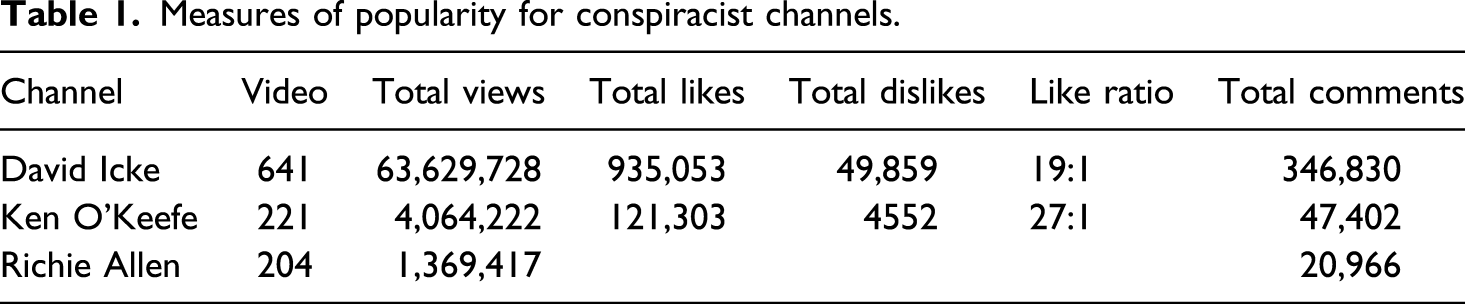
The current study focuses on YouTube channels belonging to David Icke, Richie Allen and Ken O’Keefe. These conspiracy fantasists were chosen because of their prominence and their history of association with one another, with the three arguably constituting a specific ‘movement’ in the production of conspiracist culture, in some ways comparable to a literary movement. All three were involved in The People’s Voice: an online ‘television channel’ devoted to conspiracy fantasies and directed by Icke, with individual shows presented by Allen, O’Keefe and others. Although The People’s Voice was short-lived, it successfully raised £435,248 in donations via the Indiegogo crowdfunding platform (TPV, 2013, 2014a, 2014b).
Measures of popularity for conspiracist channels.
2.1. Three conspiracy fantasists
2.1.1. David Icke
Icke is a former television presenter and political spokesperson. Author Alice Walker has stated that she kept his book And the Truth Shall Set You Free on her nightstand and that ‘[i]n Icke’s books, there is the whole of existence’ (NYT, 2018: BR7); some years earlier, she said that ‘the book she would take with her as a castaway was Icke’s Human Race Get Off Your Knees: The Lion Sleeps No More’ (Independent, 2013: 20). Other high-profile enthusiasts include rock musicians Matt Bellamy (Loundras, 2006) and Mick Fleetwood (BBC, 2018a), as well as comedian Frankie Boyle (Boyle, 2013; Icke, 2016b). But as Barkun writes, Icke has ‘clearly sought to cultivate the extreme right’ (2003: 107) and has repeatedly endorsed the Protocols of the Elders of Zion (Barkun, 2003: 103–104, 146–147). Icke also helped to launch Red Ice – a now-deleted white nationalist YouTube channel – by contributing a series of videos (Prentice, 2018). In 2019, a number of Icke’s videos were deleted for violation of YouTube’s revised hate speech policies (Allington and Joshi, 2020: 38, 40), and in 2020, the UK communications regulator sanctioned the broadcaster ESTV after its London Live channel aired an interview with Icke which it judged to have ‘the potential to cause significant harm to viewers in London during the Coronavirus crisis’ (Ofcom, 2020: 16). The interviewer, YouTube personality Brian Rose, subsequently launched a fundraising drive centred around a live-streamed conversation between himself and Icke; it raised $117,313 in the first 24 hours (CCDH, 2020: 14). After a high-profile campaign by the Centre for Countering Digital Hate, Icke’s YouTube channel was eventually deleted for violation of the platform’s policy on harmful disinformation (BBC, 2020).
Icke’s fantasies characteristically include science-fictional elements, notably the idea that the earth is secretly controlled by shape-shifting reptilian aliens who drink the blood of blonde-haired, blue-eyed children. This is an obvious echo of the blood libel – and Icke often identifies the Rothschild family as reptiles with this gruesome supposed predilection. A further distinguishing feature of Icke’s discourse is its highly sexualised nature, with child rape and abuse a recurring theme. Byford argues that Icke’s repetitive allegations of child abuse and child sacrifice have ‘an ideological link… with the medieval antisemitic demonology in which motifs of ritualistic child abuse were all-pervading’ (2011: 76). The following is a typical example, dealing with two of Icke’s regular targets, the Rothschild family and the British royal family: Anthony Blunt’s reward for services rendered in hiding the Nazi truth about the Windsor-Mountbattens was to be appointed Surveyor of the King’s Pictures when he retired from MI5 after the war – even though he was still a member of the Rothschild spy ring … … The Windsors would have also known that Blunt was a paedophile and … stories have long circulated about his procurement of young boys, mostly from ‘care’ homes, and his paedophile parties. These include how Blunt would murder children through asphyxiation while they were being raped because of the apparent sexual ‘high’ these sickest of people get from this. One rapist would be a masked man said to be a royal or a Rothschild (same thing) who always wore socks even when otherwise naked. He became known as the ‘Soxon Rothschild’. (Icke, 2013, p. n.p.)
In the above, Icke embellishes the baseless but long-standing Elm Guest House conspiracy fantasy, which led to a massive police investigation and to the public vilification of several innocent people (Hermann, 2020). Although Icke’s descriptions of imaginary sex crimes are unusually graphic, essentially similar accusations form a thread within contemporary conspiracist culture. Hofstadter writes as follows: The enemy is … a perfect model of malice, a kind of amoral superman – sinister, ubiquitous, powerful, cruel, sensual, luxury-loving. … [T]he sexual freedom often attributed to the enemy, his lack of moral inhibition, his possession of especially effective techniques for fulfilling his desires, give exponents of the paranoid style an opportunity to project and express unacknowledgeable aspects of their own psychological concerns. (Hofstadter, 1964, p. 85, p. 85)
2.1.2. Richie Allen
Richie Allen is an online radio host based in Greater Manchester. His guests have included the Holocaust denier Nick Kollerstrom and the white nationalist YouTuber, Lana Lokteff, as well as the Holocaust-denying musician, Alison Chabloz (HOPE not hate, 2019a) and a number of less marginal political figures. On the left, these have included former backbench MP George Galloway (Allen, 2017b) and Kerry-Anne Mendoza (Allen, 2017a [2016]), the owner of leading alt-left site The Canary. On the right, former front bench Conservative MP and future Brexit Party MEP Ann Widdecombe has appeared three times, while Brexit Party MEP David Bull has appeared once and Brexit Party parliamentary candidate Stuart Waiton has appeared six times (HOPE not hate, 2019a). The data collected for this study relate to Allen’s second YouTube channel, which was founded in February 2018, just over a week after his original channel was deleted for policy violations.
Allen often treads a fine line, giving his interviewees space in which to make dangerous claims but withholding explicit endorsement. For example HOPE not hate describes his interview with Lokteff as follows: Allen and Lokteff debated the conspiracy theory of ‘white genocide’, the notion that sinister elites are plotting to reduce the white European population. Whilst disagreeing with Lokteff on her views on racial identity and belief in a ‘Jewish conspiracy’, during the course of their discussion, Allen repeatedly praises her for her intelligence, repeatedly states [that] he does not consider her to be racist, and praises her [YouTube show] as ‘very important[’] [as well as saying] [‘]long may it continue[’]. (2019a, p. n.p.)
On other occasions, Allen appears to attempt to lead interviewees to make controversial statements. A good example is provided by Allen’s interview with Michael Shrimpton, which largely focuses on the poisoning of Yulia and Sergei Skripal: an event which Shrimpton blamed on the long-defunct Nazi-era German intelligence service known as the Deutsche Verteidigungs Dienst or DVD. Reports in the legacy media describe Shrimpton as a convicted sex offender who received a custodial sentence for wasting police time with false claims of a ‘DVD’ plot to detonate a stolen nuclear bomb (O’keeffe, 2015; Robertson, 2018). However, Allen makes no mention of this context, instead allowing Shrimpton to pose as an expert on intelligence issues and apparently attempting to steer him towards the canard that the Rothschild family was behind the Russian Revolution: Shrimpton: You’ve got to be careful with the KGB because they were heavily penetrated by the DVD, who set up Russian intelligence after the Bolshevik Revolution, which of course was bankrolled from Germany in order to get Russia out of World War Two, in order to f- World War One rather, in order to free up German troops to launch the spring offensive in 1918 in the west Allen (interrupting): And by the way, I’ll take you to a cricket match, if it’s not this summer, next summer, at Old Trafford, I’ll take you to a cricket match, and you can tell me privately, we’re not talking about the Germans here, we’re talking about the Frankfurt Rothschilds
2.1.3. Ken O’Keefe
A former US Marine, O’Keefe began in environmental activism. However, he has spoken at the Freedompalooza festival (O’Keefe, 2017a), whose organiser was described as ‘an antisemite and [an] anti-government extremist’ by the ADL (2013: n.p.), as well as at the London Forum (SPLC, 2015): an ‘organising hub… for the British far-right’ founded by an ex-soldier (Poulter, 2018: n.p.) who was later jailed for inciting violence against Jews (BBC, 2018b). O’Keefe’s channel was eventually deleted by YouTube, probably as part of the purge of white supremacist content which took place in the summer of 2019 (though see ADL, 2019 on the incomplete nature of this purge; YouTube, 2019).
O’Keefe is a familiar face both on RT (see Section 1.2, above) and on the Iranian English language propaganda channel, PressTV. Although O’Keefe uses branding featuring the phrase ‘Truth Justice Peace’, his address to the London Forum makes clear that he is not a pacifist: Fuck peace in this world. Fuck that shit, I’d rather die. I’d rather kill some of these bastards that are trying to destroy this world and take control of everything. Fuck you. I’d rather die. (O'Keefe quoted in SPLC, 2015, p. n.p.)
O’Keefe achieved mainstream media attention in 2017 after the now-notorious Palestine Live Facebook group was infiltrated by researcher David Collier. O’Keefe was a participant in the Gaza Freedom Flotilla of 2010, along with Free Gaza Movement spokesperson Greta Berlin. Responding to praise of O’Keefe from other members of Palestine Live, Berlin stated that the Israeli commandos who stormed the flotilla had only opened fire after O’Keefe had wrested a weapon from one of them, which meant that he was ‘responsible for some of the deaths on board the Mavi Marmara’ (Berlin quoted in Philpot, 2018: n.p.).
Other conspiracy fantasists have sometimes accused O’Keefe of impropriety in his fundraising activities (e.g. Allen, 2018c; Igan, 2016; Zionist Report, 2019). O’Keefe strongly denies these allegations. For example in a monologue in which he also stated that the United States is ‘totally run by Jewish supremacist Talmudic paedophile satanic bankster cultists’, O’Keefe argued that his accusers cannot know whether or not he has embezzled any money, stating ‘I control the money, so the hundred K that was raised … I know exactly what is left, and these people who are accusing me, they do not know shit’ (O’Keefe, 2017b).
3. Content analysis of videos
Given the repeated scholarly finding that conspiracy fantasies have historically tended to centre around accusations against Jews (see Section 1, above), it was expected that conspiracy accusations against Jewish and Jewish-related entities (individual or collective) would be found to feature prominently in popular videos by the three conspiracy fantasists focused on here (relative to other themes observed in the same videos). The first research question was, therefore, as follows:
Given this study’s focus on antisemitism, the principal interest of these research questions is in the answers with regard to Jewish entities. But in the interest of transparency, findings will be reported for all of the most frequently accused entities.
3.1. Methodology
Content analysis is a research method for identifying recurrent themes in messages of any kind (for an introduction, see Neuendorf, 2017 [2002]). It involves making systematic observations of the presence or absence of particular themes and then treating those observations as data for statistical analysis. It is used here because it enabled YouTube videos to be treated as multimodal texts, with observations being made directly rather than on a transcription.
Conspiracy accusations made in the 30 videos were identified through quantitative content analysis. The initial coding process was carried out between 7 September and 8 October 2018 by one researcher in close consultation with the lead researcher. The top 10 videos by popularity were selected via the YouTube page for each channel, and then streamed via the YouTube website, with notes being taken on each video on a flexible electronic form implemented as an Excel sheet. An initial list of potentially accused conspirators were identified by the two researchers together on the basis of (a) general impressions formed from viewing a range of videos by the three conspiracy fantasists and (b) careful joint viewing of the single most popular video on each channel. The researcher was then able to add further conspirators as and when accusations against them were observed in the remaining videos. The initial form agreed by both researchers contained 26 entities often accused of conspiracy, for example ‘Freemasons’, ‘Israel’, the ‘Deep State’, the ‘mainstream media’ (or MSM), etc. By the end of data collection, there were 34 entities (all of which had been observed in the dataset). Accusations against entities were coded as either present or absent in each video. It would not have been possible to produce a meaningful measure of inter-rater reliability because of (a) the complexity of the coding scheme and (b) the small number of observations (a necessary consequence both of the complexity of the task and of the great length of many of the videos, some of which lasted over an hour). Because there was no use of random sampling, statistical inference is neither necessary nor meaningful. Rather, the findings of this part of the analysis are to be treated as descriptive statistics with regard to the coding of a highly specific population: the 10 most popular videos by each of three specific conspiracy fantasists.
3.2. Findings
3.2.1. Frequency of accusations
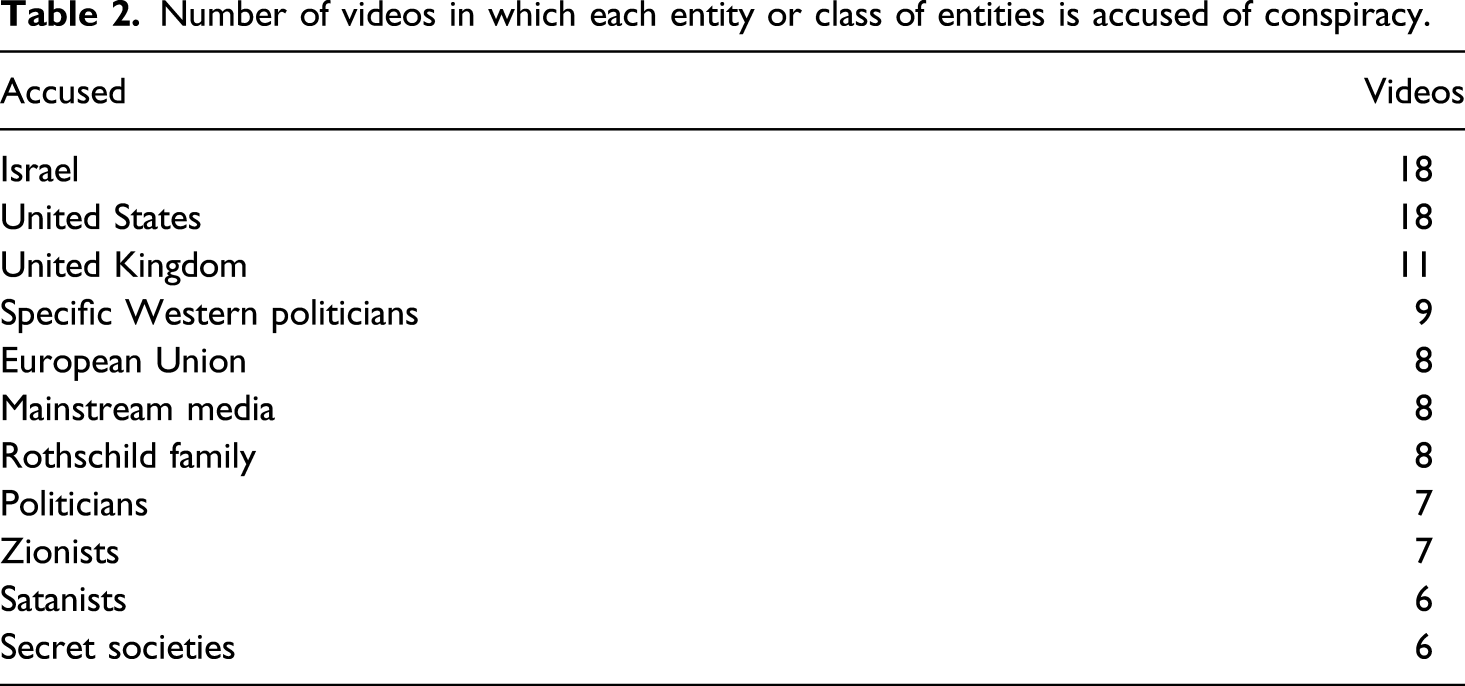
Number of videos in which each entity or class of entities is accused of conspiracy.
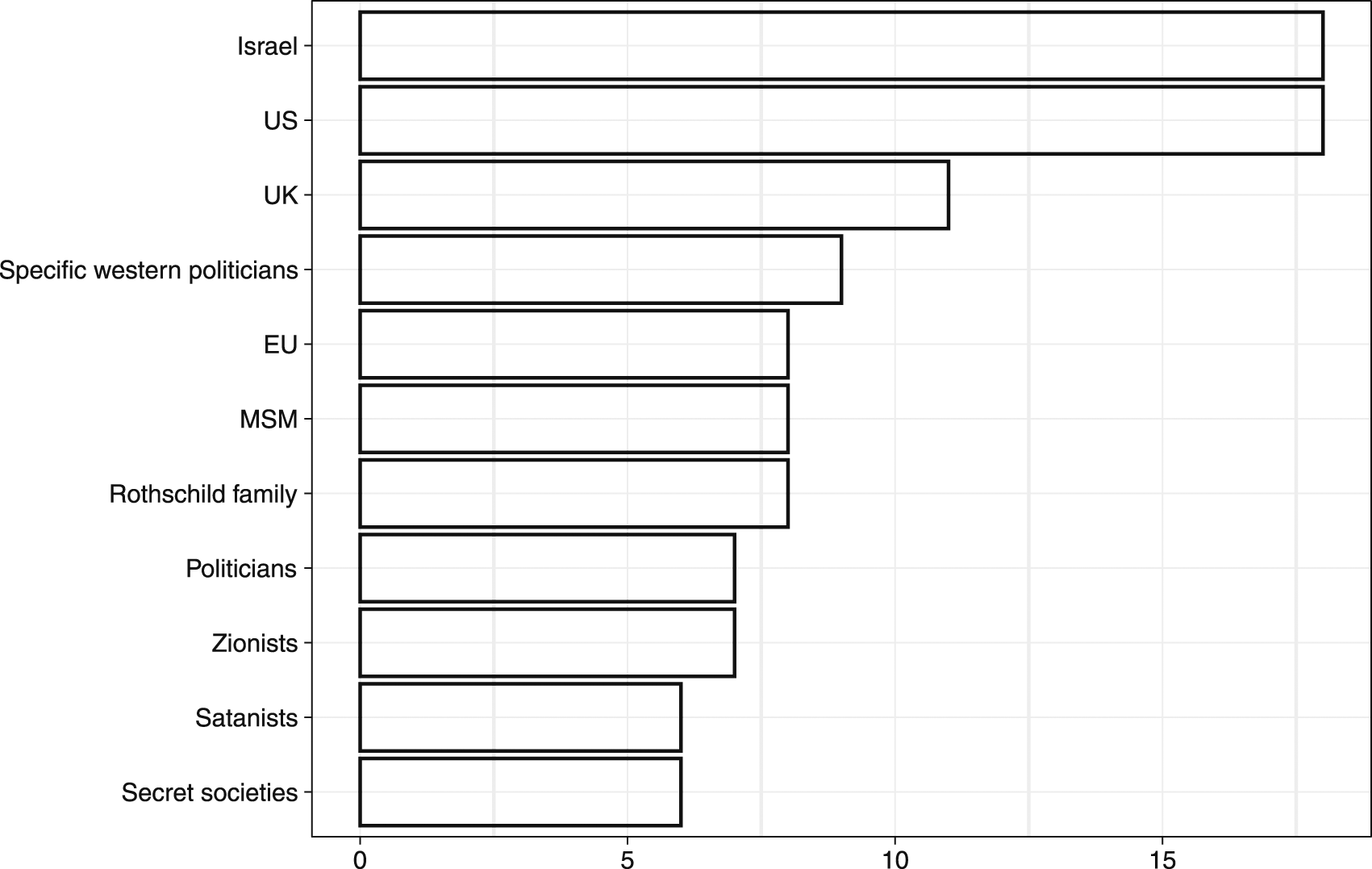
Number of videos in which each entity, class of entities or a member of class of entities is accused of conspiracy (top 10 videos per channel, by popularity).
3.2.2. Illustrative examples
For illustrative purposes, we shall now briefly discuss the top video from each of the three channels. At the time of writing, all three were still available on YouTube.
The most popular video on Icke’s channel was an extract from a public lecture entitled ‘Agenda 21, The Plan To Kill You – David Icke’ (Icke, 2016a). As of the time of data collection, this video had accumulated 2,767,266 views, 29,621 likes and 2050 dislikes. In his lecture, Icke details a multitude of conspiracies relating to concepts such as weather control, genetic modification, vaccines and war and alleges them to have been perpetrated by a bewildering range of entities, including Bill Gates, the World Health Organisation and the Fabian Society. Icke repeatedly presents the United States, the United Kingdom and their allies as a threat both to world peace and to the individual safety of his listeners. By contrast, their strategic adversaries are presented as innocent targets of aggression and propaganda. For example a slide supposedly listing ‘countries attacked by bombing, sabotage or attempted government overthrow since World War II’ features two columns: one labelled ‘USA’ which featured a list of over 50 countries, and one labelled ‘Iran’ which was (absurdly) left completely blank. Towards the end of the video, Icke speaks for over seven minutes about ‘Rothschild Zionism’, which he describes as ‘a secret society created and instigated and controlled by the Rothschilds’, whom he presents as controlling both Israel and the United States, and as conspiring simultaneously to carry out a genocide of Palestinians and to initiate World War III (see Allington and Joshi, 2020 for detailed analysis of Icke’s use of the term ‘Rothschild Zionism’ and of the ways in which his YouTube audience interprets and responds to it; Icke later began using the more obscure but still racially charged term ‘Sabbatean Frankist’ as an alternative, CCDH, 2020: 10).
The most popular video on Allen’s channel was an interview entitled ‘Michael Shrimpton “The Novichok Agent Used On The Skripal’s DID Come From Porton Down Lab!”’ (Allen, 2018a). As of the time of data collection, this video had accumulated 23,461 views (likes and dislikes were disabled). A quotation from the interview has already been presented above (Section 2.2.2). In the video, Allen’s guest makes unsupported assertions to the effect that the chemical weapons attack on Sergei and Yulia Skripal was carried out not by Russian security forces but by the ‘DVD’ using a nerve toxin provided by the UK government’s Defence Science and Technology Laboratory at Porton Down in the south of England. As we have already seen, Allen contributed his own conspiracy accusation against the Rothschild family, implying that it was the real power behind Shrimpton’s imaginary ‘DVD’.
The most popular video on O’Keefe’s channel was entitled ‘Libya & Gaddafi – The Truth you are not supposed to know’ (O’Keefe, 2011). As of the time of data collection, this video had accumulated 370,413 views, 5080 likes and 212 dislikes. It consists of low-quality footage of Col. Muammar Gaddafi touring a city in an open top vehicle, with a series of pro-Gaddafi propaganda claims presented through overlaid text. These include conspiracy fantasy elements, such as the accusation that the rebels who overthrew Gaddafi replaced Libya’s Central Bank with one that was ‘owned by Rothschild, just as ours in the west are’. The video was not unique to O’Keefe’s channel and there is no evidence that he was its creator.
4. Corpus analysis of comments
Corpus analysis is the statistical analysis of text data (for an introduction, see Brezina, 2018). It is used here because it permitted analysis of the whole population of comments on all videos by the three conspiracy theorists, without the need for comments to be individually read and therefore without the need for sampling (YouTube comments take the form of digital text and do not need to be transcribed).
Given the aforementioned qualitative finding that accusations against Jews have been historically central to conspiracist culture (see Section 1, above), it was expected that Jewish-related lexis would be found to feature prominently in comments on videos by the three conspiracy fantasists (relative to both other lexis and to usage in a representative corpus of comparable texts). The second research question was, therefore, as follows:
From the point of view of the current study, the principal interest of this research question is with regard to Jewish-related lexis. However, findings will be reported for all of the most overused lexical items.
4.1. Methodology
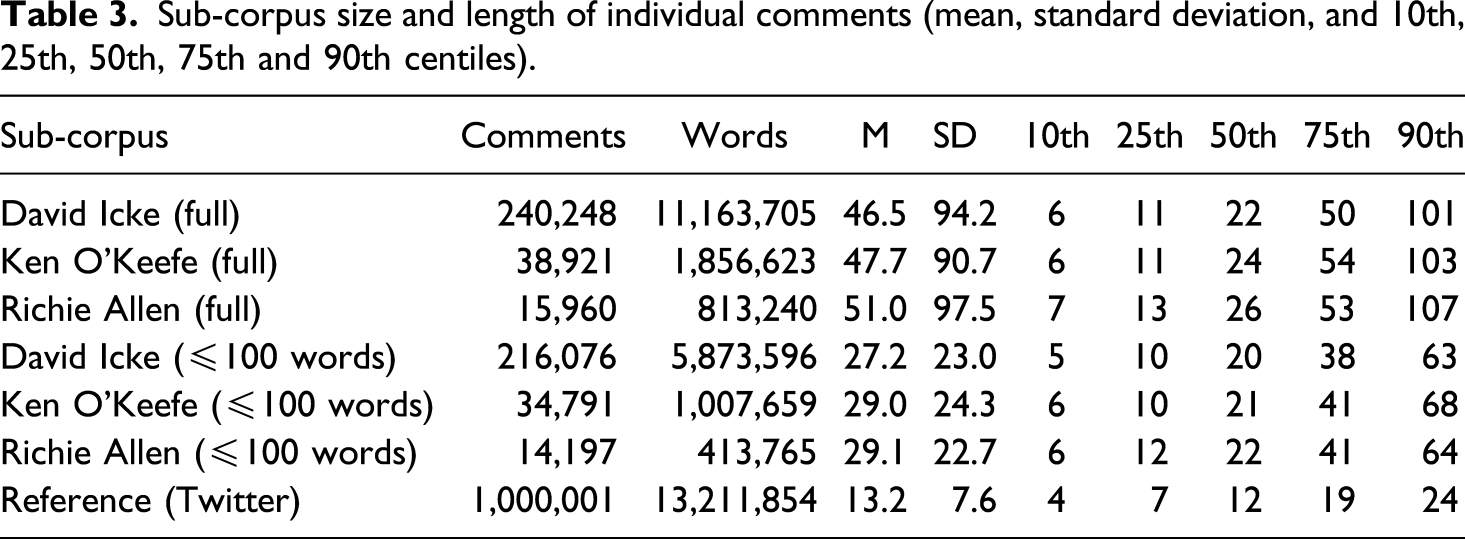
Comments on all videos uploaded to the three YouTube channels were collected on 6 July 2018 via the YouTube API. The number of comments collected by this means was smaller than the total reported number of comments for all videos: an anomaly for which no explanation is available because the API is undocumented (see below). A reference corpus had been collected on 28 April 2017 via the Twitter microblogging platform’s Sample Tweets API, which provides a random sample of tweets (original messages) and retweets (recirculated messages) in real time. Retweets were excluded in order to avoid biasing the sample towards popular tweets, and tweets not recognised by Twitter as being in the English language were also excluded. Altogether, just over one million tweets were collected. The possibility of a reference corpus of YouTube comments was ruled out on the grounds that the API does not facilitate random sampling. Although arising on a platform with different technical affordances and restrictions (Twitter’s hashtags and limit on message length have no YouTube equivalent), the Twitter reference corpus can plausibly be treated as a representative sample of short digital messages in the English language.
Sub-corpus size and length of individual comments (mean, standard deviation, and 10th, 25th, 50th, 75th and 90th centiles).
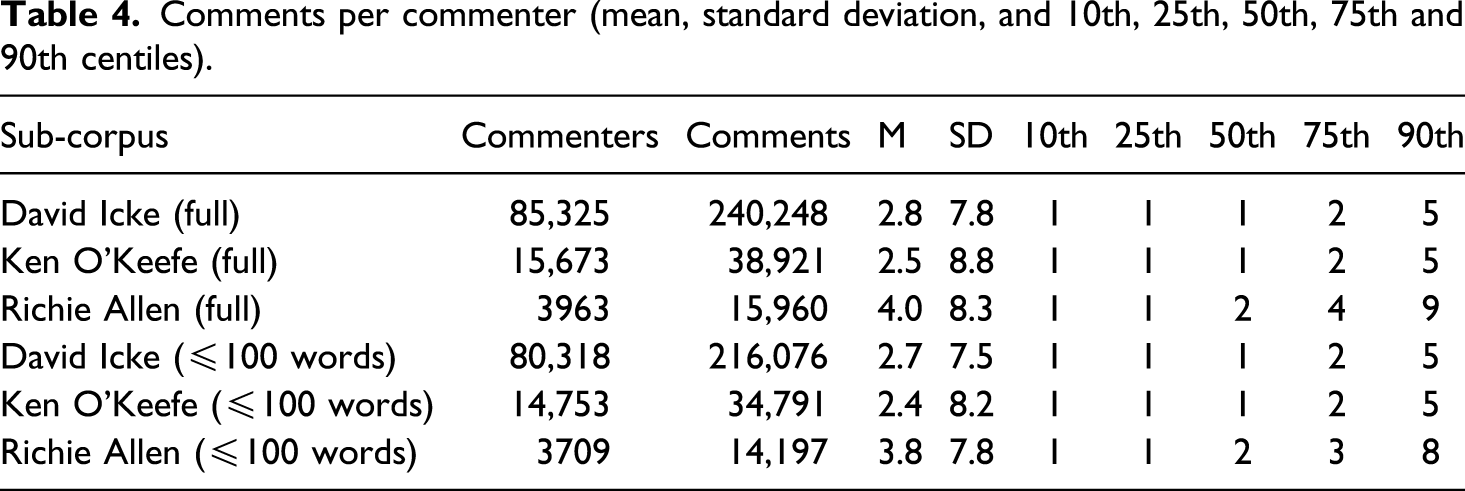
Comments per commenter (mean, standard deviation, and 10th, 25th, 50th, 75th and 90th centiles).
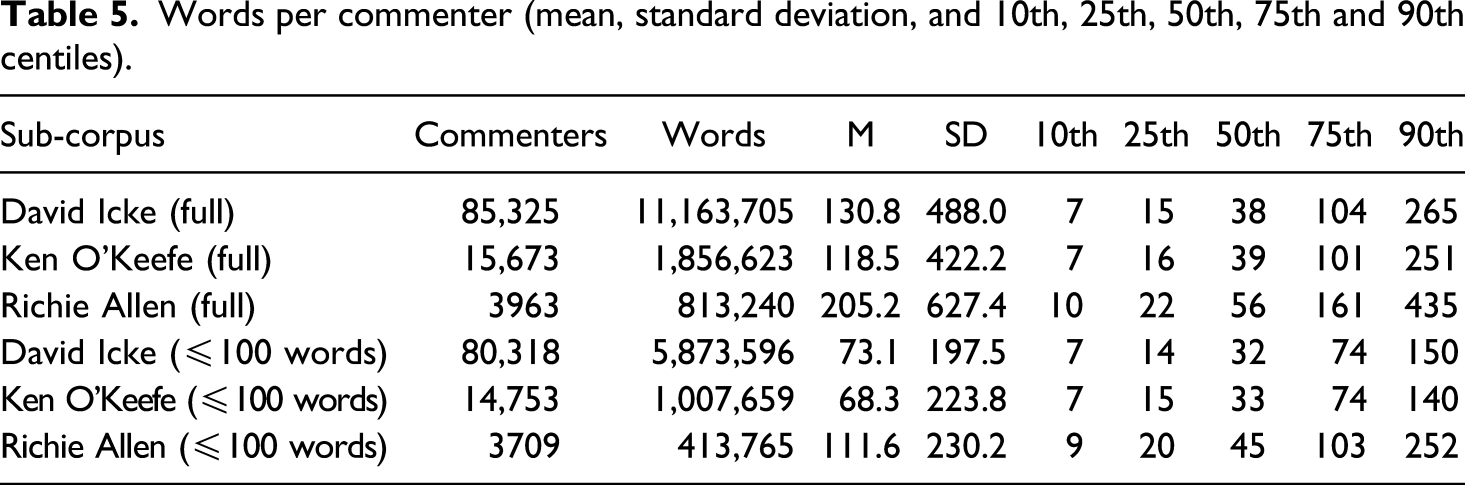
Words per commenter (mean, standard deviation, and 10th, 25th, 50th, 75th and 90th centiles).
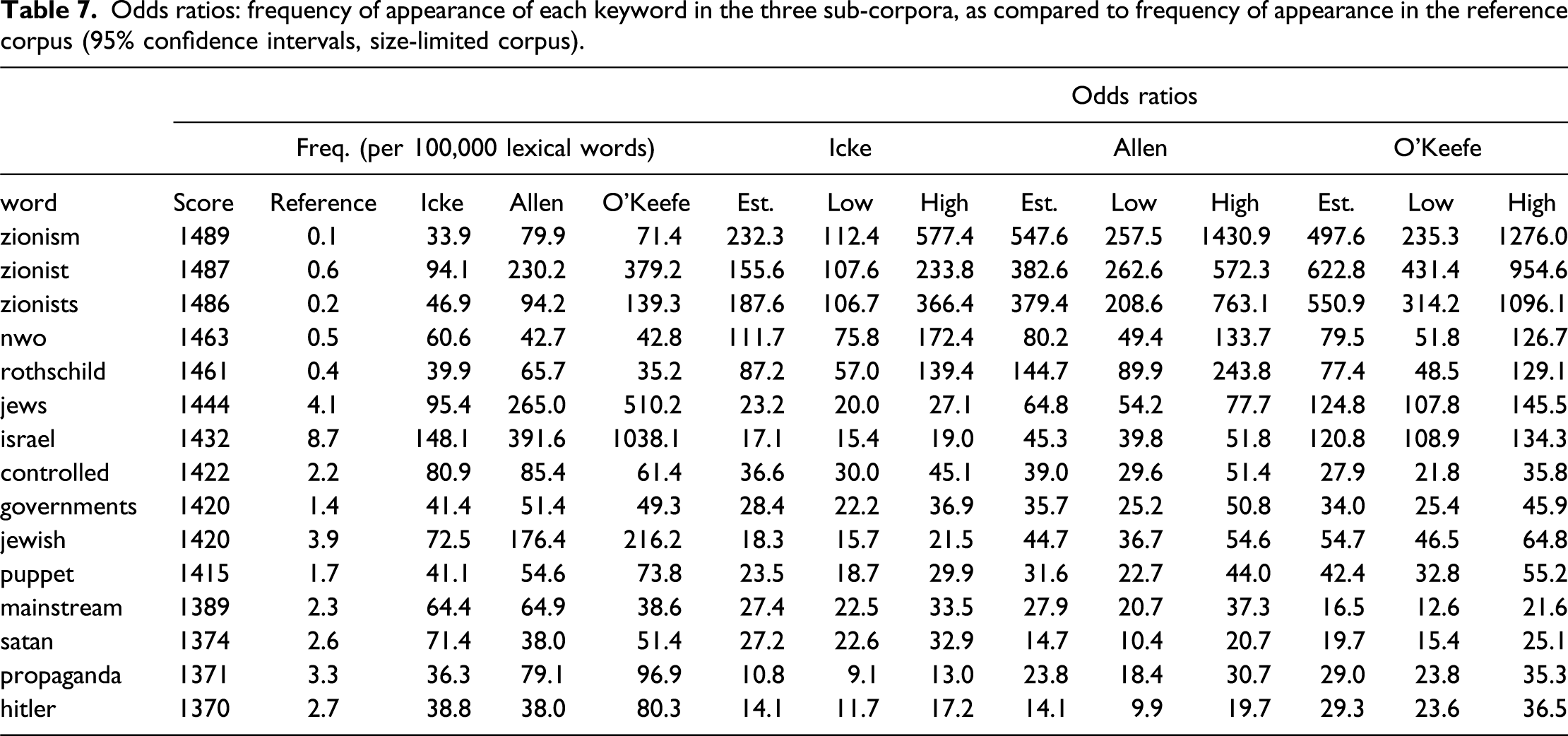
Analysis of comments began with identification of keywords, defined as lexical words that were used more frequently than expected, given their frequencies in the reference corpus (see Dunning, 1993 for an influential articulation of this approach). Stopwords and lexis directly relating to the three conspiracy fantasists and their branding were removed (including misspellings of the fantasists’ names). All digits were removed, except in strings denoting the 2001 terrorist attack on the World Trade Centre, all of which were retained in a single standard form, ‘911’. Lexemes were not lemmatised. For each channel, the 500 most common remaining lexemes were selected. The frequency of each in the corpus of comments associated with a single channel was then compared with its frequency in a million-tweet reference corpus prepared in the same way and expressed as an estimated odds ratio, with a 95% confidence interval for the true odds ratio being calculated using Fisher’s exact test (see Fisher, 1962). The odds ratio is a measure of effect size, unlike the more standard corpus linguistic metric of log-likelihood. Thus, this part of the study follows ‘new statistics’ best practice in reporting confidence intervals and estimated effect sizes, rather than test statistics such as log-likelihood or chi-square, or p-values derived from such test statistics (Cumming, 2014).
In order to protect the analysis from domination by the channel with the most comments, each word was then given a score according to its ranking in each list by odds ratio, with 500 points for the word with the highest rank, 499 for the word with the second-highest and so on. The three lists were then combined, with the 30 highest-scoring words being treated as keywords (only the top 15 are reported below, for reasons of space).
4.2. Findings
4.2.1. Frequency of keywords
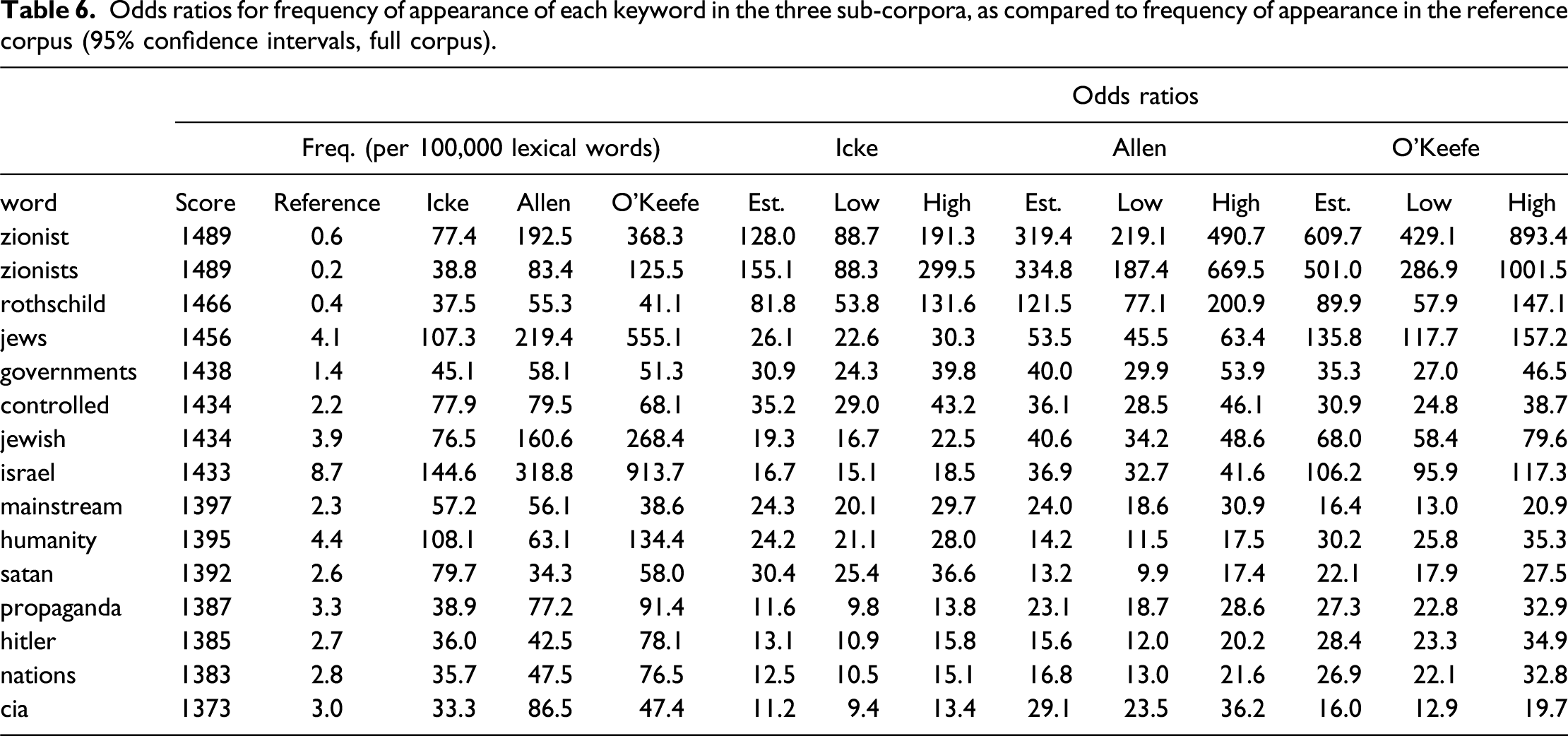
Odds ratios for frequency of appearance of each keyword in the three sub-corpora, as compared to frequency of appearance in the reference corpus (95% confidence intervals, full corpus).
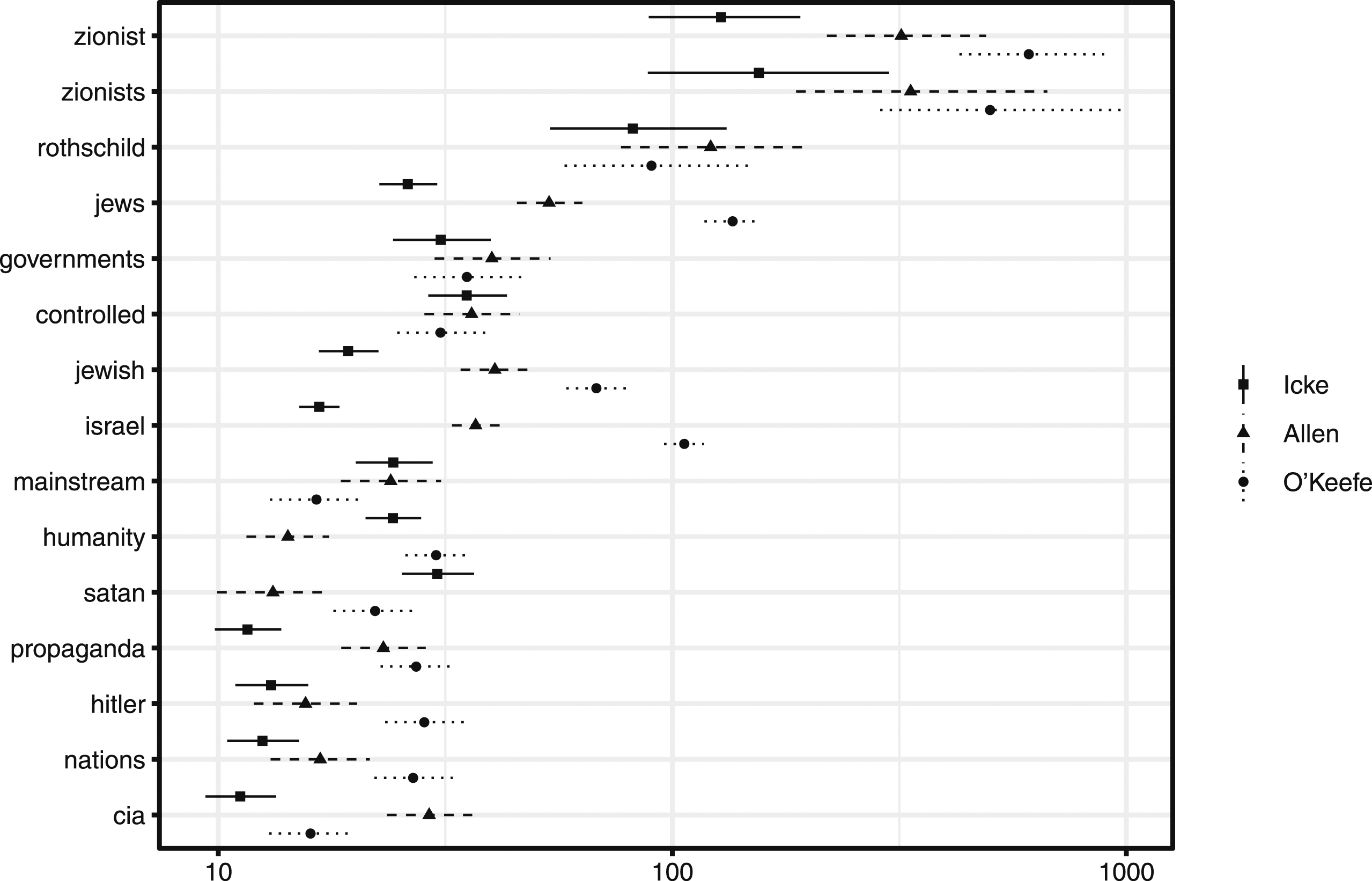
Odds ratios: frequency of appearance of each keyword in the three sub-corpora, as compared to frequency of appearance in the reference corpus (95% confidence intervals, full corpus).
Odds ratios: frequency of appearance of each keyword in the three sub-corpora, as compared to frequency of appearance in the reference corpus (95% confidence intervals, size-limited corpus).
4.2.2. Illustrative examples
It should not be assumed that the words ‘Zionist’ and ‘Zionists’ necessarily refer to a political ideology, while ‘Rothschild’ necessarily refers to a family of real individuals, and ‘Jews’ necessarily refers to a real-world ethno-religious group. Rather, all four function semi-interchangeably to invoke the same fundamental fantasy. Whichever of these words is used by commenters, we find variations on the core idea that the world has been taken over by Zionists, or by Jews, or perhaps by people who are masquerading as Jews, or by a family that is almost universally associated with Jewishness or even – as one commenter put it – by a ‘Khazarian-Ashkenazi-Illuminati-Masonic above 3°-Rothschild-Zionist-Babylonian Talmud following-paedophile-Satan worshipping cabal of fake Jews’. Without carrying out an additional content analysis of comments (as in Allington and Joshi, 2020), there is no feasible way to discuss a sample of comments large enough to be considered representative. However, to mitigate against any temptation to ‘cherry-pick’ evidence, all examples discussed in this section (including the example already quoted in this paragraph) are drawn from a small sample of comments consisting of three randomly selected comments per channel featuring each of the top four keywords (N = 36).
Several of those comments engage in Holocaust denial, or suggest that Jews, Zionists or the Rothschild family either have some responsibility for the Holocaust or have committed crimes worse than the Holocaust. Multiple non-Jewish entities are accused of conspiring with Zionists or Jews to control or destroy the world. One comment accuses the Jesuit order of being ‘Crypto-Jewish’ and of aiming ‘to destroy Europe through revolutions’ (a change from 19th century fantasies of Jews conspiring to cause revolution and Jesuits conspiring to frustrate it; see Section 1.2, above). Multiple political leaders are presented as being under Jewish, Israeli or Rothschild control. Indeed, the implication at times appears to be that the United States and other democratic countries are totally enslaved: one commenter refers to them as ‘[t]he Western Rothschild nations’, for example.
A number of commenters appear to propose extremist solutions to the imaginary Jewish problem. For example one commenter concludes that ‘Zionism is an evil which “must be erased from the page of time” to quote Pressident [sic] Ahmadinejad’, while another argues that ‘we stop the Jews and things will settle down’, and yet another describes ‘Zionist-Globalist, IMF, Trilateral commission, World Bank, Rothschilds, Rockefellers, Warburgs, J.P. Morgan, Goldman Sachs’ as ‘Jews by origin’ who ‘are pure evil’ and ‘should have long time ago to be [sic] removed’. Another suggests that Jews have more than their share of wealth and influence and argues that a proportion of Jews working in ‘high finance and media’ will have to vacate their posts in order to create ‘equal opportunity for every other group’.
Just one comment in the small random sample can be said to be truly critical of conspiracy fantasy and its accompanying racism. The author of that particular comment observes that ‘[t]here is antisemitism in many of the comments on here’ and argues that the reason this goes unnoticed is because hatred of Jews has been normalised. Another commenter questions Icke’s tendency towards ‘think[ing] Israel is horrible’, yet praises him for his ‘wisdom and research’; a third criticises him by stating that United States and Zionist ‘nefariousness’ is eclipsed by the supposed evil of Islam, which he or she asserts to have ‘eradicated love and respect in the people’. Otherwise, there is only support for the three fantasists and for the claims made in their videos.
5. Conclusion
Existing research has already established the centrality of antisemitism to conspiracy fantasy, highlighted the particular role of the YouTube platform in disseminating such fantasy and found suggestions of a pattern by which the active YouTube audience for conspiracy fantasy may respond to latently antisemitic content with explicitly antisemitic comments. The current study adds to this body of knowledge with content analysis of the 10 most popular videos by each of three well-known conspiracy fantasists and with corpus analysis of the total population of comments on all videos by the three.
While the videos analysed here make accusations against a wide variety of entities, it is Israel and the United States that are most frequently accused – and it is Jewish-related lexical items that predominate in user comments. The West as a whole is portrayed as dominated by a ruthless and bloodthirsty elite, whose members are often referred to using racially charged terms such as ‘Zionists’, ‘Rothschilds’, or ‘Rothschild Zionists’. Innovations such as Icke’s ‘reptilians’ or Shrimpton’s ‘DVD’ notwithstanding, it thus appears to be the Holocaust-inspiring antisemitic tradition that continues to dominate the conspiracy fantasy genre – at least as it is expressed by these three particular fantasists, and by the members of the online audience which YouTube has enabled them to reach. Two of the three have faced YouTube’s ultimate sanction since the time of data collection, but only after years of using the platform to broadcast their message of hate. The third remains in place – as do countless others.
Technical note
Data was collected from the YouTube API using R v. 3.4.4 with tuber v. 0.9.7 (Sood, 2018). Quantitative analysis was carried out using R v. 3.6.1, with visualisations created using ggplot2 v. 3.2.1 (see Wickham, 2016). Other notable libraries used include tidytext v. 0.2.2 (Silge and Robinson, 2016) and stopwords v 1.0 (Benoit et al., 2019). All three lists from the latter were used in filtering out non-lexical words.
Footnotes
Acknowledgements
The authors are grateful to Quilliam International for non-financial support.
Declaration of conflicting interests
The authors declared no potential conflicts of interest with respect to the research, authorship and/or publication of this article.
Funding
The authors received no financial support for the research, authorship and/or publication of this article.
